
Showing 70 items matching "medicine for nurses"
-
 St Vincent's Hospital Melbourne Archives
Book, Medicine for Nurses, second edition in 1956, by M.Toohey
... Medicine for Nurses, second edition in 1956, by M.Toohey....Medicine for Nurses...The book is covered in soft green plastic for protection. Medicine for Nurses, second edition in 1956, by M.Toohey. ...One of the reference study books used by Nurse Anne Carolan during her nurse training at St Vincent's Hospital Melbourne in 1957. The book is indexed and includes a list of drugs used at the time. Handwritten in ink and underlined inside the front cover is Anne Carolan's name. medicine for nurses, m.toohey, anne carolan, nurse training, st vincent's hospital melbourne -
 Alfred Hospital Nurses League - Nursing History Collection
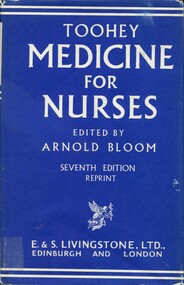
Book - Illustrated textbook, M.(Monty) Toohey 1914-1960 et al, Toohey Medicine for Nurses, 1965
... Toohey Medicine for Nurses...Title rtc on front, back and spine and also a stylized representaion of an angel holding the Rod of Asclepius Toohey Medicine for Nurses Book Illustrated textbook M.(Monty) Toohey 1914-1960 Arnold Bloom Henry Rollin E & S Livingstone Ltd ...Textbook written for both student and graduate nurses to cover the basic physiological and pathological facts which are needed for the understanding of the various diseases and their treatment.Illustrated book with dust jacket. Book is bound with blue cloth, title, edition and publisher's name stamped in silver on spine. Dust jacket has a blue background and white print. Title rtc on front, back and spine and also a stylized representaion of an angel holding the Rod of Asclepiusnon-fictionTextbook written for both student and graduate nurses to cover the basic physiological and pathological facts which are needed for the understanding of the various diseases and their treatment.medicine, nursing, nursing education -
Northern District School of Nursing. Managed by Bendigo Historical Society Inc.
Book - Medical Reference Books
... The Nurses Dictionary of Medical Terms and Nursing Treatment by Honor Morten (21st Edition) Belonged to Nurse Heather Campbell, School 15. 13. Medicine for Nurses by W. Gordon Sears M.D. (Lond.) ...The Nurses Dictionary of Medical Terms and Nursing Treatment by Honor Morten (21st Edition) Belonged to Nurse Heather Campbell, School 15. 13. Medicine for Nurses by W. Gordon Sears M.D. (Lond.) ...1. The Principles and Practice of Surgical Nursing by D.F. Ellison Nash F.R.C.S. Belonged to Nr. M.L. Carr, Northern District School of Nursing 2. Davison's Principles and Practice of Medicine, Edited by John Macleod Belonged to Marion Dunn N.D.S.N., 19-3-75 3. Nursing Care of the Patient by W.B.Smith and Y.L. Lew R.G.N., R.M.N., F.C.N. (NSW) Belonged to Marion Dunn 'Pilot' 4.2.74 4 & 5. Lister House, The Story of the Northern District Scholl of Nursing by Frank Cusack (2copies) One copy belonged to Rosita Jones with signatures of 8 nurses on fly leaf. 6. Medical Nursing by J.E. Whiteside, F.C.N.A. Belonged to Marion Dunn 'Pilot' N.D.S.N. 24.2.'75 7. Lectures for Nurses by G.N. Burbidge S.R.N. Belonged to Swan Hill District Hospital 8. Materia Medica for Nurses by W. Gordon Sears M.D. (Lond.) M.R.C.P. (Lond,) 9. & 10. Aids to Hygiene for Nurses by Edith M. Funnell S.R.N., D.N. (Lond.) Two copies of 4th Edition One copy belonged to Ann Archibald, Bendigo Base Hospital 11. Aids to Gynaecological Nursing, 5th Edition, by Hilda M. Gration and Dorothy L. Holland, both S.R.N., S.C.M., D.N. (London) 12. The Nurses Dictionary of Medical Terms and Nursing Treatment by Honor Morten (21st Edition) Belonged to Nurse Heather Campbell, School 15. 13. Medicine for Nurses by W. Gordon Sears M.D. (Lond.) M.R.C.P. (Lond.) Belonged to D.J. Whitfield, District Hospital Swan Hill 14. Microbiology for Nurses by E. Joan Bocock and Margaret J. Parker Belonged to Marion Dunn, 'Pilot' N.D.S.N. 4.2.74 1. surgical nursing, medicine, physiology, anatomy, lister house, microbiology, nursing care -
 The Beechworth Burke Museum
Audio - Oral History, Jennifer Williams, Mrs Sheila Parkinson, 3 January 2000
... When Sheila first began her nurse training, Mayday Hills suffered from a lack of resources and rudimentary facilities and patients frequently suffered from the cold due to poor heating and inadequate clothing and bedding. However, as the twentieth century progressed, Sheila recalls how conditions and treatments improved as a result of increased government funding of services and advances in psychiatry and pharmaceutical medicine. ...Mrs Sheila Parkinson was born in Wagga in 1916 and came to Beechworth as a young woman around 1938. Sheila trained as a psychiatric nurse at Mayday Hills hospital prior to the second World War. At that time, unmarried women were accommodated and received nursing training on-site. Shiela was obliged to cease professional training and employment when she married in 1941, which disrupted completion of her final nursing examinations. Following post-war changes to the law that allowed married women to work, Sheila returned to Mayday Hills. Sheila's husband, Don, returned to Beechworth after four years abroad as a serviceman in the Australian Air Force. Beechworth's institutions were a major source of local employment throughout the twentieth century. As well as providing limited employment opportunities to young women like Shiela, post-war European migrants from Bonegilla Migrant camp found at Mayday Hills, encouraging European migrant settlement in the district. Mayday Hills was renamed several times since its establishment in 1867. At the peak of operations, it comprised sixty-seven buildings housing over twelve hundred patients patients and five hundred staff. The hospital officially closed in 1998. Today, the decommissioned two-storey Italianate style main building stands on eleven hectares of botanical gardens under National Trust protection. The site remains a popular cultural heritage destination for visitors. This oral history recording was part of a project conducted by Jennifer Williams in the year 2000 to capture the everyday life and struggles in Beechworth during the twentieth century. This project involved recording seventy oral histories on cassette tapes of local Beechworth residents which were then published in a book titled: Listen to what they say: voices of twentieth century Beechworth. The cassette tapes were digitised in July 2021 with funds made available by the Friends of the Burke.Employed as a psychiatric nurse at one of Beechworth's large welfare institutions, Mayday Hills, Mrs Sheila Parkinson recalls the conditions faced by staff and patients at the hospital, which cared for chronically ill people from the Ovens region and patients from the Yarra Bend Asylum, Melbourne, which closed in 1925. When Sheila first began her nurse training, Mayday Hills suffered from a lack of resources and rudimentary facilities and patients frequently suffered from the cold due to poor heating and inadequate clothing and bedding. However, as the twentieth century progressed, Sheila recalls how conditions and treatments improved as a result of increased government funding of services and advances in psychiatry and pharmaceutical medicine. Mrs Sheila Parkinson's oral history recording is historically and socially significant for its witness to life in Beechworth in the pre- and post-WWII period. Sheila's story enriches our understanding of processes of modernisation with regard to psychiatric and welfare services, while the course of Sheila's professional training and employment brings attention to systemic and socio-economic barriers faced by women, as well as the valuable contribution women and migrants make in the delivery of care and ancillary services. This oral history account is socially and historically significant as it is a part of a broader collection of interviews conducted by Jennifer Williams which were published in the book 'Listen to what they say: voices of twentieth-century Beechworth.' While the township of Beechworth is known for its history as a gold rush town, these accounts provide a unique insight into the day-to-day life of the town's residents during the twentieth century, many of which would have been lost if they had not been preserved.This is a digital copy of a recording that was originally captured on a cassette tape. The cassette tape is black with a horizontal white strip and is currently stored in a clear flat plastic rectangular container. It holds up 40 minutes of recordings on each side.Mrs Sheila Parkinson /twentieth century beechworth, mayday hills, psychiatric care, benevolent asylums, nursing, wwii, psychiatric treatment, country women, psychiatric hostpital, beechworth's institutions, local employment, government institutions, listen to what they say, oral history, burke museum, sheila parkinson, beechworth lunatic asylum, beechworth mental hospital, beechworth hospital for the insane, the kerferd clinic, bonegilla migrant camp, working women, white australia policy -
 Federation University Historical Collection
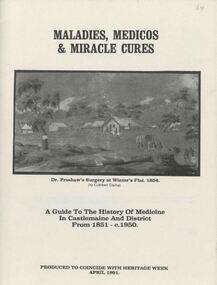
Booklet, Lauretta Zilles, Maladies, Medicos & Miracle Cures: A Guide to the History of Medicine in Castlemaine and District from 1851-c1950, 04/1991
... The book lists information on Castlemaine and district doctors, Castlemaine Hospital, Pharmacists, Herbalists, Dentists, Veterinary Surgeons, Opticians, Nurses, Midwives, Chiropody, Benevolent Asylum, Private Hospitals, Caslemaine Infant Welfare Centre, Homelea Herb Farm Maladies, Medicos & Miracle Cures: A Guide to the History of Medicine in Castlemaine and District from 1851-c1950 Booklet Lauretta Zilles ...This is a catalogue supporting an exhibition held at the Castlemaine Art Gallery and Historical Museum.Grey soft covered booklet printed to accompany am exhibiton held at Castlemaine and Historical Museum during Heritage Week. The book lists information on Castlemaine and district doctors, Castlemaine Hospital, Pharmacists, Herbalists, Dentists, Veterinary Surgeons, Opticians, Nurses, Midwives, Chiropody, Benevolent Asylum, Private Hospitals, Caslemaine Infant Welfare Centre, Homelea Herb Farmdoctors, castlemaine hospital, pharmacists, herbalists, dentists, veterinary surgeons, opticians, nurses, midwives, chiropody, benevolent asylum, private hospitals, homelea herb farm, castlemaine infant welfare centre, richard bunce, william fisher preshaw, john cheyne, henry barraclough, daniel o. preshaw, ching chin, raymond francis duggan, enpo hong, l. goon, shee shok, algernon cyril yandell, augustus courts yandell, myrtle lucinda yandel, daniel cohen, max pincus, s. aaron, mrs foletti, vaughan, mary ann passalaqua, guildford, mary an martinoja, beatrice thurlby, elizabeth spencer, lenna hopkins, rebecca baxter, avonsleigh, ballara, jonathan chapple, alice kenyon, health -
 Lara RSL Sub Branch
Book, Australia in the War of 1939-1945 - MEDICAL Middle East and Far East. Author Allan.S.Walker MD, Ch.M. F.R.A.C.P, First Published 1953
... The complete record of the Medical conditions setting up camp hospitals, medical transport, medical records, tobruk crete general health in the desert surgical conditions in the desert syria nurses tropical medicine malaria medical conditions burma thai railway labour forces prison camps Australian War Memorial Photographs, Maps,Illustrations Australia in the War of 1939-1945 - MEDICAL Middle East and Far East. ...The complete record of the Medical conditions setting up camp hospitals, medical transport, medical records,Photographs, Maps,IllustrationsAustralian War Memorialtobruk, crete, general health in the desert, surgical conditions in the desert, syria, nurses, tropical medicine, malaria, medical conditions, burma thai railway, labour forces, prison camps -
 Flagstaff Hill Maritime Museum and Village
Textile - Surgical Cloth, Green Surgical Cloth
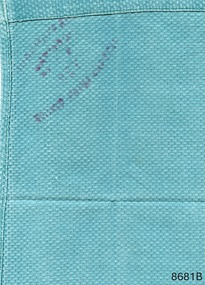
... medicine from late 19th to mid-20th century. Dr Angus assisted Dr Tom Ryan, a pioneer in the use of X-rays and in ocular surgery. flagstaff hill warrnambool shipwrecked coast flagstaff hill maritime museum maritime museum shipwreck coast flagstaff hill maritime village great ocean road surgical cloth Warrnambool & District Hospital Base Hospital Nurses Graduation Warrnambool Dr. ...This surgical cloth is part of the “W.R. Angus Collection” that includes historical medical equipment, surgical instruments and material once belonging to Dr Edward Ryan and Dr Thomas Francis Ryan, (both of Nhill, Victoria) as well as Dr Angus’ own belongings. Dr. Angus throughout his extensive career would have used many of these cloths either in his surgery or other medical institutions; the 1940s saw drapes adopted in medical practice. The use of cloths gave limited assistance to aseptic techniques to reduce the risk of infection; however modern fabrics have superseded the use of cotton. The green colour was an innovation that reduced fatigue from previously used white cloth that promoted glare. ABOUT THE “W.R.ANGUS COLLECTION” Doctor William Roy Angus M.B., B.S., Adel., 1923, F.R.C.S. Edin.,1928 (also known as Dr Roy Angus) was born in Murrumbeena, Victoria in 1901 and lived until 1970. He qualified as a doctor in 1923 at University of Adelaide, was Resident Medical Officer at the Royal Adelaide Hospital in 1924 and for a period was house surgeon to Sir (then Mr.) Henry Simpson Newland. Dr Angus was briefly an Assistant to Dr Riddell of Kapunda, then commenced private practice at Curramulka, Yorke Peninsula, SA, where he was physician, surgeon and chemist. In 1926, he was appointed as new Medical Assistant to Dr Thomas Francis Ryan (T.F. Ryan, or Tom), in Nhill, Victoria, where his experiences included radiology and pharmacy. In 1927 he was Acting House Surgeon in Dr Tom Ryan’s absence. Dr Angus had become engaged to Gladys Forsyth and they decided he would take time to further his studies overseas in the UK in 1927. He studied at London University College Hospital and at Edinburgh Royal Infirmary and in 1928, was awarded FRCS (Fellow from the Royal College of Surgeons), Edinburgh. He worked his passage back to Australia as a Ship’s Surgeon on the on the Australian Commonwealth Line’s T.S.S. Largs Bay. Dr Angus married Gladys in 1929, in Ballarat. (They went on to have one son (Graham 1932, born in SA) and two daughters (Helen (died 12/07/1996) and Berenice (Berry), both born at Mira, Nhill ) Dr Angus was a ‘flying doctor’ for the A.I.M. (Australian Inland Ministry) Aerial Medical Service in 1928 . The organisation began in South Australia through the Presbyterian Church in that year, with its first station being in the remote town of Oodnadatta, where Dr Angus was stationed. He was locum tenens there on North-South Railway at 21 Mile Camp. He took up this ‘flying doctor’ position in response to a call from Dr John Flynn; the organisation was later known as the Flying Doctor Service, then the Royal Flying Doctor Service. A lot of his work during this time involved dental surgery also. Between 1928-1932 he was surgeon at the Curramulka Hospital, Yorke Peninsula, South Australia. In 1933 Dr Angus returned to Nhill where he’d previously worked as Medical Assistant and purchased a share of the Nelson Street practice and Mira hospital from Dr Les Middleton one of the Middleton Brothers, the current owners of what was once Dr Tom Ryan’s practice. Dr L Middleton was House Surgeon to the Nhill Hospital 1926-1933, when he resigned. [Dr Tom Ryan’s practice had originally belonged to his older brother Dr Edward Ryan, who came to Nhill in 1885. Dr Edward saw patients at his rooms, firstly in Victoria Street and in 1886 in Nelson Street, until 1901. The Nelson Street practice also had a 2 bed ward, called Mira Private Hospital ). Dr Edward Ryan was House Surgeon at the Nhill Hospital 1884-1902 . He also had occasions where he successfully performed veterinary surgery for the local farmers too. Dr Tom Ryan then purchased the practice from his brother in 1901. Both Dr Edward and Dr Tom Ryan work as surgeons included eye surgery. Dr Tom Ryan performed many of his operations in the Mira private hospital on his premises. He too was House Surgeon at the Nhill Hospital 1902-1926. Dr Tom Ryan had one of the only two pieces of radiology equipment in Victoria during his practicing years – The Royal Melbourne Hospital had the other one. Over the years Dr Tom Ryan gradually set up what was effectively a training school for country general-practitioner-surgeons. Each patient was carefully examined, including using the X-ray machine, and any surgery was discussed and planned with Dr Ryan’s assistants several days in advance. Dr Angus gained experience in using the X-ray machine there during his time as assistant to Dr Ryan. Dr Tom Ryan moved from Nhill in 1926. He became a Fellow of the Royal Australasian College of Surgeons in 1927, soon after its formation, a rare accolade for a doctor outside any of the major cities. He remained a bachelor and died suddenly on 7th Dec 1955, aged 91, at his home in Ararat. Scholarships and prizes are still awarded to medical students in the honour of Dr T.F. Ryan and his father, Dr Michael Ryan, and brother, John Patrick Ryan. ] When Dr Angus bought into the Nelson Street premises in Nhill he was also appointed as the Nhill Hospital’s Honorary House Surgeon 1933-1938. His practitioner’s plate from his Nhill surgery states “HOURS Daily, except Tuesdays, Fridays and Saturday afternoons, 9-10am, 2-4pm, 7-8pm. Sundays by appointment”. This plate is now mounted on the doorway to the Port Medical Office at Flagstaff Hill Maritime Village, Warrnambool. Dr Edward Ryan and Dr Tom Ryan had an extensive collection of historical medical equipment and materials spanning 1884-1926 and when Dr Angus took up practice in their old premises he obtained this collection, a large part of which is now on display at the Port Medical Office at Flagstaff Hill Maritime Village in Warrnambool. During his time in Nhill Dr Angus was involved in the merging of the Mira Hospital and Nhill Public Hospital into one public hospital and the property titles passed on to Nhill Hospital in 1939. In 1939 Dr Angus and his family moved to Warrnambool where he purchased “Birchwood,” the 1852 home and medical practice of Dr John Hunter Henderson, at 214 Koroit Street. (This property was sold in1965 to the State Government and is now the site of the Warrnambool Police Station. ). The Angus family was able to afford gardeners, cooks and maids; their home was a popular place for visiting dignitaries to stay whilst visiting Warrnambool. Dr Angus had his own silk worm farm at home in a Mulberry tree. His young daughter used his centrifuge for spinning the silk. Dr Angus was appointed on a part-time basis as Port Medical Officer (Health Officer) in Warrnambool and held this position until the 1940’s when the government no longer required the service of a Port Medical Officer in Warrnambool; he was thus Warrnambool’s last serving Port Medical Officer. (The duties of a Port Medical Officer were outlined by the Colonial Secretary on 21st June, 1839 under the terms of the Quarantine Act. Masters of immigrant ships arriving in port reported incidents of diseases, illness and death and the Port Medical Officer made a decision on whether the ship required Quarantine and for how long, in this way preventing contagious illness from spreading from new immigrants to the residents already in the colony.) Dr Angus was a member of the Australian Medical Association, for 35 years and surgeon at the Warrnambool Base Hospital 1939-1942, He served as a Surgeon Captain during WWII 1941-45, in Ballarat, Victoria, and in Bonegilla, N.S.W., completing his service just before the end of the war due to suffering from a heart attack. During his convalescence he carved an intricate and ‘most artistic’ chess set from the material that dentures were made from. He then studied ophthalmology at the Royal Melbourne Eye and Ear Hospital and created cosmetically superior artificial eyes by pioneering using the intrascleral cartilage. Angus received accolades from the Ophthalmological Society of Australasia for this work. He returned to Warrnambool to commence practice as an ophthalmologist, pioneering in artificial eye improvements. He was Honorary Consultant Ophthalmologist to Warrnambool Base Hospital for 31 years. He made monthly visits to Portland as a visiting surgeon, to perform eye surgery. He represented the Victorian South-West subdivision of the Australian Medical Association as its secretary between 1949 and 1956 and as chairman from 1956 to 1958. In 1968 Dr Angus was elected member of Spain’s Barraquer Institute of Barcelona after his research work in Intrasclearal cartilage grafting, becoming one of the few Australian ophthalmologists to receive this honour, and in the following year presented his final paper on Living Intrasclearal Cartilage Implants at the Inaugural Meeting of the Australian College of Ophthalmologists in Melbourne In his personal life Dr Angus was a Presbyterian and treated Sunday as a Sabbath, a day of rest. He would visit 3 or 4 country patients on a Sunday, taking his children along ‘for the ride’ and to visit with him. Sunday evenings he would play the pianola and sing Scottish songs to his family. One of Dr Angus’ patients was Margaret MacKenzie, author of a book on local shipwrecks that she’d seen as an eye witness from the late 1880’s in Peterborough, Victoria. In the early 1950’s Dr Angus, painted a picture of a shipwreck for the cover jacket of Margaret’s book, Shipwrecks and More Shipwrecks. She was blind in later life and her daughter wrote the actual book for her. Dr Angus and his wife Gladys were very involved in Warrnambool’s society with a strong interest in civic affairs. Their interests included organisations such as Red Cross, Rostrum, Warrnambool and District Historical Society (founding members), Wine and Food Society, Steering Committee for Tertiary Education in Warrnambool, Local National Trust, Good Neighbour Council, Housing Commission Advisory Board, United Services Institute, Legion of Ex-Servicemen, Olympic Pool Committee, Food for Britain Organisation, Warrnambool Hospital, Anti-Cancer Council, Boys’ Club, Charitable Council, National Fitness Council and Air Raid Precautions Group. He was also a member of the Steam Preservation Society and derived much pleasure from a steam traction engine on his farm. He had an interest in people and the community He and his wife Gladys were both involved in the creation of Flagstaff Hill, including the layout of the gardens. After his death (28th March 1970) his family requested his practitioner’s plate, medical instruments and some personal belongings be displayed in the Port Medical Office surgery at Flagstaff Hill Maritime Village, and be called the “W. R. Angus Collection”. The W.R. Angus Collection is significant for still being located at the site it is connected with, Doctor Angus being the last Port Medical Officer in Warrnambool. The collection of medical instruments and other equipment is culturally significant, being an historical example of medicine from late 19th to mid-20th century. Dr Angus assisted Dr Tom Ryan, a pioneer in the use of X-rays and in ocular surgery.This is an oblong surgical cloth of woven cotton in the colour green. It shows signs of use due to the faded colour, particular to the hems. The top stitching looks cream and the underneath machine stitching is green. There are two very small rust spots. WARRNAMBOOL/HOSPITAL/? ? ??/Y28/CENTRAL LINEN SERVICEflagstaff hill, warrnambool, shipwrecked coast, flagstaff hill maritime museum, maritime museum, shipwreck coast, flagstaff hill maritime village, great ocean road, surgical cloth, warrnambool & district hospital base hospital, nurses graduation warrnambool, dr. w. r. angus, port medical officer, roy angus, ophthalmology, surgery, aseptic technique, warrnambool hospital linen service -
 Flagstaff Hill Maritime Museum and Village
Work on paper - Photograph with envelope, Dr. W. R. Angus Warrnambool & District Base Hospital, c1951
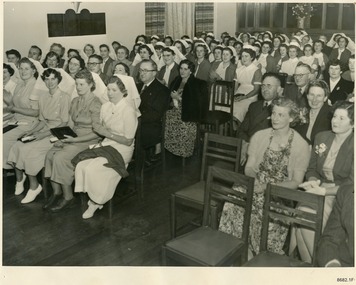
... medicine from late 19th to mid-20th century. Dr Angus assisted Dr Tom Ryan, a pioneer in the use of X-rays and in ocular surgery. Flagstaff Hill Warrnambool Maritime Village Maritime Museum Flagstaff Hill Maritime Museum and Village Shipwreck coast Great Ocean Road Dr. W.R. Angus Dr. Roy Angus Warrnambool & District Base Hospital Nurses ...This photograph is part of the “W.R. Angus Collection” that includes historical medical equipment, surgical instruments and material once belonging to Dr Edward Ryan and Dr Thomas Francis Ryan, (both of Nhill, Victoria) as well as Dr Angus’ own belongings. The Collection’s history spans the medical practices of the two Doctors Ryan, from 1885-1926 plus that of Dr Angus, up until 1969. This sepia photograph is from circa 1950s and came in an envelope with a postage mark commemorating the Australian Jubilee of 1901 and a 2-penny stamp with King George VI. The photo includes Dr. Angus in the second row wearing glasses, his wife Mrs. Angus seated behind in the third row. John Lindsay, Committee Member WDBH, is possibly in the third row on the right. It is probably Sister June H. Stewart, Matron, wearing glasses is seated behind Mrs. Angus. Mr. J. Taylor was Hon. Treasurer. All these names are inscribed on the back of the photograph. The envelope that the photo came is has a note “NURSES GRADUATION WARRNAMBOOL HOSPITAL ?1951/PHOTOGRAPH OF GRADS. The 1951 Report of the Warrnambool and District Base Hospital cites McMillian as a Committee Member, Mr. Taylor as Honorary Treasurer and Dr. Angus was Medical Officer to Diseases of the Eye, Ear, Nose and Throat. It is wondered if this building is the one used by the hospital and removed to 54 Banyan Street, Warrnambool for the use of Legacy? The W.R. Angus Collection is significant for still being located at the site it is connected with, Doctor Angus being the last Port Medical Officer in Warrnambool. The collection of medical instruments and other equipment is culturally significant, being an historical example of medicine from late 19th to mid-20th century. Dr Angus assisted Dr Tom Ryan, a pioneer in the use of X-rays and in ocular surgery.Sepia photograph of nurses and guests seated in rows at an official function. MR McMILLAN/MR J NED TAYLOR/MRS J TAYLOR/ SISTER STEWART/ DR W R ANGUS/MRS ANGUS/Ralph Illidge WARRNAMBOOL on the back of the photograph.flagstaff hill, warrnambool, maritime village, maritime museum, flagstaff hill maritime museum and village, shipwreck coast, great ocean road, dr. w.r. angus, dr. roy angus, warrnambool & district base hospital, nurses graduation, ralph illidge, 1951 warrnambool, jubilee year australia, 1901-1951, ophthalmology -
 City of Moorabbin Historical Society (Operating the Box Cottage Museum)
Certificate - Certificate of General Nursing - Mary Beatrice Josephine Maggs, 1919
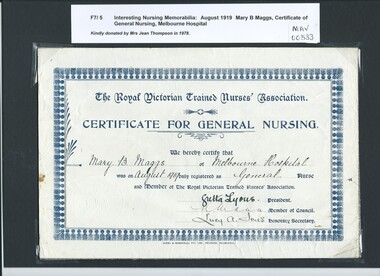
... When she returned to Australia in 1924 she was head nurse at a number of Hospitals, Private Hospital in Loch, Tatura Bush Nursing Home, Mooroopna. maggs mary medicine nursing thompson jean hospitals early settlers pioneers melbourne hospital The Royal Victorian Trained Nurses Association / CERTIFICATE FOR GENERAL NURSING / Signed by President, Member of Council, Secretary Certificate of General Nursing 1919 of Mary B Maggs Certificate Certificate of General Nursing - Mary Beatrice Josephine Maggs Government Printer ...Mary Beatrice Josephine Maggs (1892-1960) came to Australia in 1914 and was a governess for Mr Alfred Rutter Clarke at his mansion "Merriwa" on Orrong Road, Toorak. Mary returned to England in 1919 and furthered her studies in nursing. When she returned to Australia in 1924 she was head nurse at a number of Hospitals, Private Hospital in Loch, Tatura Bush Nursing Home, Mooroopna. Certificate of General Nursing 1919 of Mary B MaggsThe Royal Victorian Trained Nurses Association / CERTIFICATE FOR GENERAL NURSING / Signed by President, Member of Council, Secretarymaggs mary, medicine, nursing, thompson jean, hospitals, early settlers, pioneers, melbourne hospital -
 City of Moorabbin Historical Society (Operating the Box Cottage Museum)
Document, Nurse A Watt , Cheltenham Nursing Home c1900, c1900
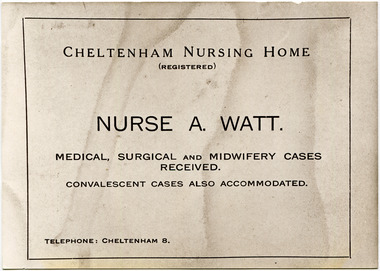
... watts nurse a, joyce dr. a f., cheltenham nursing home c1910, charman road cheltenham, nursing, medicine, midwifery, victoria police force, smith j l; smith mary ann, stanley helen,, horse drawn carts, toll gates brighton, motor cars 1900, steam engines, early settlers, bentleigh, mckinnon, parish of moorabbin, city of moorabbin, county of bourke, moorabbin roads board, shire of moorabbin, henry dendy's special survey 1841, were j.b.; bent thomas, o'shannassy john, king richard, charman stephen, highett william, ormond francis, maynard dennis, market gardeners, vineyards, orchards...She worked with Dr A.Fleming Joyce and Dr Weigall. watts nurse a, joyce dr. a f., cheltenham nursing home c1910, charman road cheltenham, nursing, medicine, midwifery, victoria police force, smith j l; smith mary ann, stanley helen,, horse drawn carts, toll gates brighton, motor cars 1900, steam engines, early settlers, bentleigh, mckinnon, parish of moorabbin, city of moorabbin, county of bourke, moorabbin roads board, shire of moorabbin, henry dendy's special survey 1841, were j.b.; bent thomas, o'shannassy john, king richard, charman stephen, highett william, ormond francis, maynard dennis, market gardeners, vineyards, orchards a) Advertisement / Leaflet for Nurse A.Watt c1900 b) Black & White photograph of the Cheltenham Nursing Home, 200 Charman Road Cheltenham c1900 Document, Nurse A Watt , Cheltenham Nursing Home c1900 ...Nurse A. Watt was a registered Nurse who owned the Cheltenham Nursing Home, located up on the hill, at 200 Charman Road Cheltenham c1900. With Dr. Fleming Joyce, she brought many local identities into the world. Len Allnutt recalls that his brother, Ray, was born there in 1924. Nurse Watt had an excellent reputation for her care and ability in the local area. One recorded event was when in November 1910 Constable Edwards was shot by his son David, at his police house, after an episode of domestic violence involving Constable Edwards long suffering wife - the mother of David. Const. Edwards was first taken to the Police Station, but later taken by Shire ambulance to Nurse Watt's Cheltenham Nursing Home. At 8pm, Edwards was operated on by Dr. Joyce and Dr. Weigall. Despite the surgery, Edwards died the next day of haemorrhage and shock. David was convicted of manslaughter. Dr A Fleming Joyce was the Shire Medical Officer c1914 - 1930. Nurse Watt bequeathed her Estate to the Methodist Church. ( H. Stanley CMHS)c1900 Nurse A Watt had an excellent reputation for her care and ability in the Cheltenham area where Medical, Surgical and Midwifery Cases were received at her Nursing Home in Charman Road. She also accommodated convalescent cases. She worked with Dr A.Fleming Joyce and Dr Weigall.a) Advertisement / Leaflet for Nurse A.Watt c1900 b) Black & White photograph of the Cheltenham Nursing Home, 200 Charman Road Cheltenham c1900watts nurse a, joyce dr. a f., cheltenham nursing home c1910, charman road cheltenham, nursing, medicine, midwifery, victoria police force, smith j l; smith mary ann, stanley helen,, horse drawn carts, toll gates brighton, motor cars 1900, steam engines, early settlers, bentleigh, mckinnon, parish of moorabbin, city of moorabbin, county of bourke, moorabbin roads board, shire of moorabbin, henry dendy's special survey 1841, were j.b.; bent thomas, o'shannassy john, king richard, charman stephen, highett william, ormond francis, maynard dennis, market gardeners, vineyards, orchards -
 City of Moorabbin Historical Society (Operating the Box Cottage Museum)
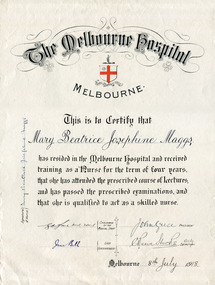
Certificate - The Melbourne Hospital Certificate, Mary Beatrice Josephine Maggs
... When she returned to Australia in 1924 she was head nurse at a number of Hospitals, Private Hospital in Loch, Tatura Bush Nursing Home, Mooroopna. maggs mary medicine nursing thompson jean hospitals early settlers pioneers melbourne hospital The Melbourne Hospital - Melbourne Certificate of Nursing 8 July 1918 Mary Beatrice Josephine Maggs Certificate The Melbourne Hospital Certificate ...Mary Beatrice Josephine Maggs (1892-1960) came to Australia in 1914 and was a governess for Mr Alfred Rutter Clarke at his mansion "Merriwa" on Orrong Road, Toorak. Mary returned to England in 1919 and furthered her studies in nursing. When she returned to Australia in 1924 she was head nurse at a number of Hospitals, Private Hospital in Loch, Tatura Bush Nursing Home, Mooroopna.Certificate of Nursing 8 July 1918The Melbourne Hospital - Melbournemaggs mary, medicine, nursing, thompson jean, hospitals, early settlers, pioneers, melbourne hospital -
 City of Moorabbin Historical Society (Operating the Box Cottage Museum)
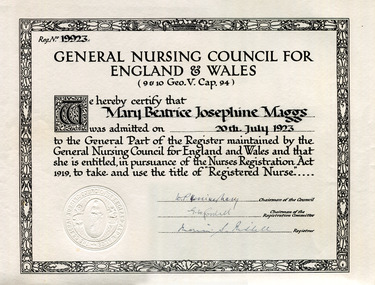
Certificate - General Nursing Council for England and Wales Certificate England, Mary Beatrice Josephine Maggs, 20 July 1923
... When she returned to Australia in 1924 she was head nurse at a number of Hospitals, Private Hospital in Loch, Tatura Bush Nursing Home, Mooroopna. maggs mary medicine nursing thompson jean hospitals early settlers pioneers melbourne hospital General Nursing Council for England and Wales Certificate of General Nursing Mary Beatrice Josephine Maggs Certificate General Nursing Council for England and Wales Certificate England ...Mary Beatrice Josephine Maggs (1892-1960) came to Australia in 1914 and was a governess for Mr Alfred Rutter Clarke at his mansion "Merriwa" on Orrong Road, Toorak. Mary returned to England in 1919 and furthered her studies in nursing. When she returned to Australia in 1924 she was head nurse at a number of Hospitals, Private Hospital in Loch, Tatura Bush Nursing Home, Mooroopna.Certificate of General NursingGeneral Nursing Council for England and Walesmaggs mary, medicine, nursing, thompson jean, hospitals, early settlers, pioneers, melbourne hospital -
 City of Moorabbin Historical Society (Operating the Box Cottage Museum)
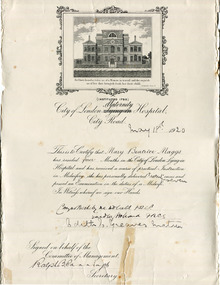
Certificate - City of London Maternity Hospital May 1920, Mary Beatrice Maggs, 18 May 1920
... When she returned to Australia in 1924 she was head nurse at a number of Hospitals, Private Hospital in Loch, Tatura Bush Nursing Home, Mooroopna. maggs mary medicine nursing thompson jean hospitals early settlers pioneers melbourne hospital City of London Maternity Hospital Certificate Mary Beatrice Maggs Certificate City of London Maternity Hospital May 1920 ...Mary Beatrice Josephine Maggs (1892-1960) came to Australia in 1914 and was a governess for Mr Alfred Rutter Clarke at his mansion "Merriwa" on Orrong Road, Toorak. Mary returned to England in 1919 and furthered her studies in nursing. When she returned to Australia in 1924 she was head nurse at a number of Hospitals, Private Hospital in Loch, Tatura Bush Nursing Home, Mooroopna.CertificateCity of London Maternity Hospitalmaggs mary, medicine, nursing, thompson jean, hospitals, early settlers, pioneers, melbourne hospital -
 City of Moorabbin Historical Society (Operating the Box Cottage Museum)
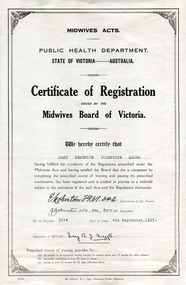
Certificate - Certificate of Registration Midwives Board of Victoria 1925, Mary Beatrice Josephine Maggs, 4 September 1925
... When she returned to Australia in 1924 she was head nurse at a number of Hospitals, Private Hospital in Loch, Tatura Bush Nursing Home, Mooroopna. maggs mary medicine nursing thompson jean hospitals early settlers pioneers melbourne hospital Mary Beatrice Josephine Maggs Certificate Certificate of Registration Midwives Board of Victoria 1925 ...Mary Beatrice Josephine Maggs (1892-1960) came to Australia in 1914 and was a governess for Mr Alfred Rutter Clarke at his mansion "Merriwa" on Orrong Road, Toorak. Mary returned to England in 1919 and furthered her studies in nursing. When she returned to Australia in 1924 she was head nurse at a number of Hospitals, Private Hospital in Loch, Tatura Bush Nursing Home, Mooroopna.maggs mary, medicine, nursing, thompson jean, hospitals, early settlers, pioneers, melbourne hospital -
 City of Moorabbin Historical Society (Operating the Box Cottage Museum)
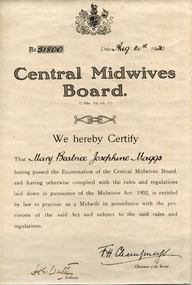
Certificate - Central Midwives Board Certificate England August 1920, Mary Beatrice Josephine Maggs, 14 August 1920
... When she returned to Australia in 1924 she was head nurse at a number of Hospitals, Private Hospital in Loch, Tatura Bush Nursing Home, Mooroopna. maggs mary medicine nursing thompson jean hospitals early settlers pioneers melbourne hospital midwives registration midwives Mary Beatrice Josephine Maggs Certificate Central Midwives Board Certificate England August 1920 ...Mary Beatrice Josephine Maggs (1892-1960) came to Australia in 1914 and was a governess for Mr Alfred Rutter Clarke at his mansion "Merriwa" on Orrong Road, Toorak. Mary returned to England in 1919 and furthered her studies in nursing. When she returned to Australia in 1924 she was head nurse at a number of Hospitals, Private Hospital in Loch, Tatura Bush Nursing Home, Mooroopna.maggs mary, medicine, nursing, thompson jean, hospitals, early settlers, pioneers, melbourne hospital, midwives registration, midwives -
 Bendigo Military Museum
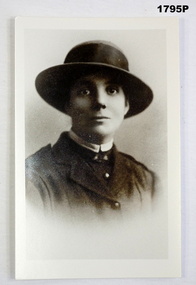
Film - PHOTOGRAPH, 1917
... Nurse A.A.N.S reinforcements AIF age 30 years on 11.7.17. Embarked 31.8.17 and disembarked in Alexandria and served there and in Abassia. She served in the 17th, 31st, 71st General Hospitals and the 14th Aust General hospital. She was discharged from the AIF on 13.6.19. Refer 1797.5,1796.9, 2317.6, 2591. medicine ...Fanny Isabella Nicol from Rochester (born Ballarat, enlisted N/A) Enlisted as a Staff Nurse A.A.N.S reinforcements AIF age 30 years on 11.7.17. Embarked 31.8.17 and disembarked in Alexandria and served there and in Abassia. She served in the 17th, 31st, 71st General Hospitals and the 14th Aust General hospital. She was discharged from the AIF on 13.6.19. Refer 1797.5,1796.9, 2317.6, 2591.B&W copy of a photo re Fanny Isabella Nicol in uniform.on rear of photo is 1/25medicine - nursing, photograph - photography -
 Bendigo Military Museum
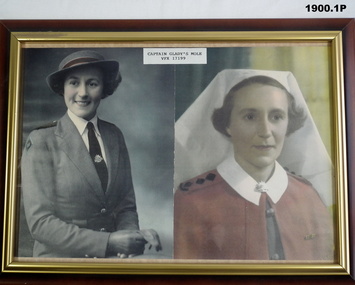
Photograph - PHOTOGRAPHS WW2, 1) 1939-46 .2) 1999
... Refer Cat No’s 1899, 1901.4 medals and service history. photography - photographs, frame accessories medicine nursing military history army .1) " Capt Gladys Mole VFX17199" .2) "Gladys Mole with her wartime uniform prior to going on display." .1) Two photos, colour, side by side in the one frame. On the left is a Nurse ...Gladys Elva Mole VFX17199 Australian Army Nursing Service. Refer Cat No’s 1899, 1901.4 medals and service history. .1) Two photos, colour, side by side in the one frame. On the left is a Nurse in grey uniform with hat & tie. On the right is same Nurse in uniform with red cape. The frame is brown stained wood with gold band. .2) Photo, colour showing Gladys Mole standing beside her uniform that is on a mannequin. The frame is brown stained wood with gold band,.1) " Capt Gladys Mole VFX17199" .2) "Gladys Mole with her wartime uniform prior to going on display."photography - photographs,, frame accessories, medicine, nursing, military history, army -
 Bendigo Military Museum
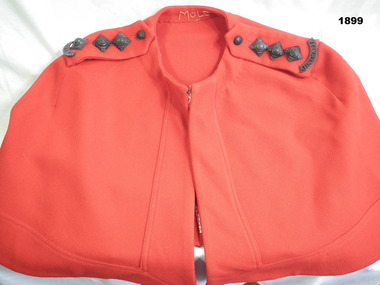
Uniform - NURSES CAPE, 1943
... medicine - nursing...costume female...Cape...nurse...See also Reg No 1497.9 for remainder of uniform. uniforms - military medicine - nursing costume female Cape nurse Embroidered inside back neck edge in orange thread: “MOLE” Label lower back edge: “V231 Made in AUSTRALIA 1943 Size W” Red Nurses Cape worn by Nurses over their uniform. ...CAPT GLADYS ELVA Mole VFX17199, Australian Army Nursing Service. Refer 1900.2 Photos, 1901.4 Medals & Service history. Served Palestine, Tobruk, Colombo, Queensland, Borneo & Singapore. See also Reg No 1497.9 for remainder of uniform.Red Nurses Cape worn by Nurses over their uniform. Cape belonged to CAPT GLADYS ELVA MOLE. Cape fits over shoulders & clips at top front with hook & eye fastener. Complete with Captain's pips on epaulettes with Australia badges & buttons.Embroidered inside back neck edge in orange thread: “MOLE” Label lower back edge: “V231 Made in AUSTRALIA 1943 Size W”uniforms - military, medicine - nursing, costume female, cape, nurse -
 Bendigo Military Museum
Equipment - NURSE'S UNIFORM BAG
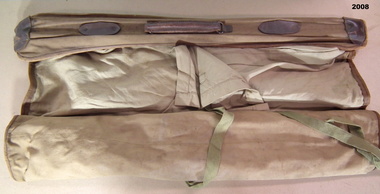
... medicine - nursing Nil Brown canvas roll bag with leather trim. A stitched leather handle is attached to the top with metal clasps. The top of the roll is reinforced with a wooden brace enclosed in a canvas sleeve. Inside is a large pocket with khaki cotton pocket and two open flaps, all secured with cotton straps. Two leather straps used to secure the bag when rolled up are missing. Equipment NURSE'S ...Brown canvas roll bag with leather trim. A stitched leather handle is attached to the top with metal clasps. The top of the roll is reinforced with a wooden brace enclosed in a canvas sleeve. Inside is a large pocket with khaki cotton pocket and two open flaps, all secured with cotton straps. Two leather straps used to secure the bag when rolled up are missing.Nilpersonal effects, travelgoods, trades-leatherworking, medicine - nursing -
Bendigo Historical Society Inc.
Document - Notes of public talk given to Bendigo Historical Society by Jenny Trewartha on 7th March, 2025 relating to NDSN, 7th March, 2025
... nurses in hospitals across the region as the nursing numbers were dwindling. Post World War II was a critical period with soldiers returning with wounds and conditions not seen before and needing special treatment. Medicine...nurses in hospitals across the region as the nursing numbers were dwindling. Post World War II was a critical period with soldiers returning with wounds and conditions not seen before and needing special treatment. Medicine ...Speech given by Jenny Trewartha to the Bendigo Historical Society on 7th March, 2025 at the la Trobe Art Institute, View Street, Bendigo. Jenny was a graduate of the NDSN at the end of 1972. The Northern District School of Nursing opened at Bendigo in 1950 and was the only regional independent School of Nursing of its kind in the southern hemisphere. There was a huge need for trained nurses in hospitals across the region as the nursing numbers were dwindling. Post World War II was a critical period with soldiers returning with wounds and conditions not seen before and needing special treatment. Medicine and medical treatments were entering a new age, and this new age needed nurses with new skills. There was a need to improve the status and prospects for nurses. Improved working and living conditions were needed; adequate remuneration and a career path to attract a better class of trainees, and a uniform training by means of a circular or block system. This was the basis of the establishment of the Northern District School of Nursing which oversaw nurse training in hospitals across the northwest of Victoria, including Bendigo, Castlemaine, Kyneton, Maryborough, Mildura, Ouyen, St Arnaud, Swan Hill, Dunolly, Inglewood and Echuca. The Northern District School of Nursing opened in 1950 and closed its doors in 1989 having overseen the training of more than 3000 nurses who are now scattered across Australia and the world.Ten pages of typed notes pertaining to training as a nurse at the Northern District School of Nursing from 1950 to 1989, and the Northern District School of Nursing Graduates Association. Document discusses different aspects of life as a trainee nurse - including financial, social and where students came from.northern district school of nursing, nursing, student -
 Bendigo Historical Society Inc.
Newspaper - LYDIA CHANCELLOR COLLECTION: HOSPITAL, NURSES BENDIGO
... MEDICINE Nursing hospitals Lydia Chancellor collection medical hospitals hospital nursing Bendigo and Northern District Hospital 'Kurmala ' Bendigo Benevolent Home Bendigo Advertiser, Womens World, The Age, Bendigo Benevolent Home Annual Report. A box containing (1) cuttings about nurses ...A box containing (1) cuttings about nurses and hospitals. Sources include 'Bendigo Advertiser,' 'Women's World' and 'The Age.' (11) A booklet on the opening of 'Kurmala' on June 8th 1935. (111) Bendigo Benevolent Home Annual Report 1962-3.1961-66.Bendigo Advertiser, Womens World, The Age, Bendigo Benevolent Home Annual Report.medicine, nursing, hospitals, lydia chancellor, collection, medical, hospitals, hospital, nursing, bendigo and northern district hospital, 'kurmala, ' bendigo benevolent home -
 Alfred Hospital Nurses League - Nursing History Collection
Newsletter - Nursing Newsletter, Alfred Hospital Nursing Adninistration, The Alfred Group of Hospitals Nursing Division Newsletter, October 1993, October 1993
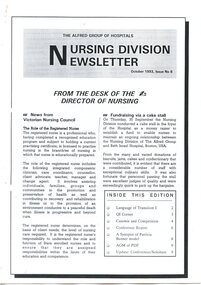
... nurse...Patricia Benner model...hyperbaric medicine...Alfred hospital newsletter featuring nursing related articles, including role of the registered nurse, casemix and competition, hyperbaric conference report. a synopsis of the Patricia Benner Model of how to support the needs of nurses in their first year of registration,quality improvement and upcoming nursing seminars & conferences insight into nursing practice in the 1990's Alfred Hospital Nursing registered nurse Patricia Benner model hyperbaric medicine Holes at upper left wher a staple has been removed Newsletter with pages printed on both sides [black ink on white background]. on the first page In addition to the title [on grey background] there is an index and two articles The Alfred Group of Hospitals Nursing Division Newsletter, October 1993 Newsletter Nursing Newsletter Alfred Hospital Nursing Adninistration ...Alfred hospital newsletter featuring nursing related articles, including role of the registered nurse, casemix and competition, hyperbaric conference report. a synopsis of the Patricia Benner Model of how to support the needs of nurses in their first year of registration,quality improvement and upcoming nursing seminars & conferencesinsight into nursing practice in the 1990'sNewsletter with pages printed on both sides [black ink on white background]. on the first page In addition to the title [on grey background] there is an index and two articlesHoles at upper left wher a staple has been removedalfred hospital, nursing, registered nurse, patricia benner model, hyperbaric medicine -
 Alfred Hospital Nurses League - Nursing History Collection
Book - Illustrated textbook, J H Green, Basic Clinical Physiology, 1969
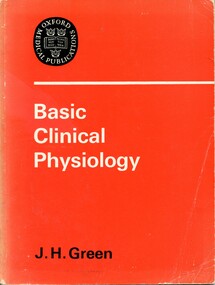
... The author's aim has been to integrate physiology with the day to day practice of medicine in the wards Information available in the late 1960's Nursing-study and teaching human physiology homeostasis A foundational textbook designed for nurses to understand how the human body maintains a consistent iternal environment or homeostasis On the front end page 'E Cameron' is handwritten [blue ink] at top right Illustrated book with red cover. ...A foundational textbook designed for nurses to understand how the human body maintains a consistent iternal environment or homeostasisIllustrated book with red cover. On the front cover at the top is a black oval with white print [logo of Oxford medical publications], underneath is a white stripe, then the title [white print]. At the base is the author [black print]non-fictionA foundational textbook designed for nurses to understand how the human body maintains a consistent iternal environment or homeostasisnursing-study and teaching, human physiology, homeostasis -
![Front view of Mercurochrome bottle [ca.1950's]](/media/collectors/50187a8f023fd7201471f198/items/6a5ecd52406175e53d4449dd/item-media/6a6d892b134352c62cd0d974/item-fit-380x285.jpg?cb=6) Alfred Hospital Nurses League - Nursing History Collection
Alfred Hospital Nurses League - Nursing History CollectionContainer - Glass bottle, Mercurochrome bottle, unknown
... Sometimes known as 'monkey blood because of its distinct colour Mercurochrome was used by nurses for minor wound treatment mercurochrome First aid Wound treatment previous catalogue number handwritten [black ink] underneath base Round vintage medicine bottle (plain glass) with glass stopper, ' Mercurochrome' printed [black ink] within a blue border on a white rectangular label. ...Mercurochrome (merbronim) was discovered in1919, it became a popular topical antiseptic for treatment of minor cuts and scrapes. use is now restricted because of the mercury content. Sometimes known as 'monkey blood because of its distinct colourMercurochrome was used by nurses for minor wound treatmentRound vintage medicine bottle (plain glass) with glass stopper, ' Mercurochrome' printed [black ink] within a blue border on a white rectangular label. Dry mercurochrome at baseprevious catalogue number handwritten [black ink] underneath basemercurochrome, first aid, wound treatment -
 Alfred Hospital Nurses League - Nursing History Collection
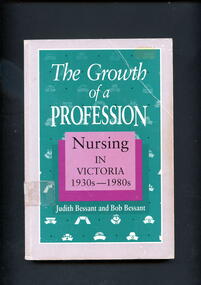
Book - Illustrated book, Judith Bessant et al, The Growth of a Profession: Nursing in Victoria 1930s-1980s, 1991
... nurses and nursing in Victoria from the 1930s until the 1980's. It traces the difficult steps that the nursing profession has made towards forging its identity within medicine, improving wages and conditions and the transferring of nurse education into the tertiary sector. ...This book is about nurses and nursing in Victoria from the 1930s until the 1980's. It traces the difficult steps that the nursing profession has made towards forging its identity within medicine, improving wages and conditions and the transferring of nurse education into the tertiary sector. The book culminates with the nurses' strike of 1986.Illustrated book. Front cover, within a light grey border, has part of title and authors names printed in white on a green background, also on this background are illustrations of nurses' caps in graduating colour shades of green to white. Between the title and authors names is a light pink square offset on a larger dark pink rectangle. On this square the rest of the title is printed in black ink. Abbreviated title, authors and publishers name are printed in black ink on a grey background. On the back cover are printed a synopsis of the book, authors details and publishers name on a grey rectangular background, with a green border.non-fictionThis book is about nurses and nursing in Victoria from the 1930s until the 1980's. It traces the difficult steps that the nursing profession has made towards forging its identity within medicine, improving wages and conditions and the transferring of nurse education into the tertiary sector. The book culminates with the nurses' strike of 1986.nurses - victoria-history, nursing-victoria-history, royal victorian college of nursing, royal australian nursing federation-victorian branch-history -
![Illustrated paperback book with red cover. On the front is a black and white photo of two nurses standing beside a patient in an oxygen tent (Royal Melbourne Hospital [ca.1950s]). The book consists of five parts: the four pillars of critical care, the development of critical nursing and medicine in Australia, critical care nursing-its genesis and evolution, critical care nursing-education and special interest groups.](/media/collectors/50187a8f023fd7201471f198/items/67a17fa8c033d1f73d54129c/item-media/67a6f471d7095b7115015b8f/item-fit-380x285.jpg?cb=6) Alfred Hospital Nurses League - Nursing History Collection
Alfred Hospital Nurses League - Nursing History CollectionBook - Illustrated book, Valda Wiles et al, There's a bird in my hand and a bear by the bed-I must be in ICU: the pivotal years of Australian critical care nursing, 2002
... Intensive Care Nursing Australian college of critical care nurses-history The book consists of five parts: the four pillars of critical care, the development of critical nursing and medicine in Australia, critical care nursing-its genesis and evolution, critical care nursing-education and special interest groups. ...The book consists of five parts: the four pillars of critical care, the development of critical nursing and medicine in Australia, critical care nursing-its genesis and evolution, critical care nursing-education and special interest groups.Illustrated book with red cover. On the front is a black and white photo of two nurses standing beside a patient in an oxygen tent (Royal Melbourne Hospital [ca.1950s]). Title and authors names printed on front cover and spine. Also on front cover is the logo of the Australian College of Critical Care Nurses. On the back cover is information about the authors.non-fictionThe book consists of five parts: the four pillars of critical care, the development of critical nursing and medicine in Australia, critical care nursing-its genesis and evolution, critical care nursing-education and special interest groups.intensive care nursing, australian college of critical care nurses-history -
 Alfred Hospital Nurses League - Nursing History Collection
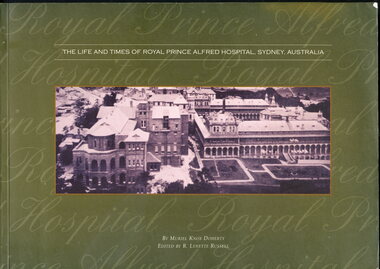
Book - Illustrated book, Muriel Knox Doherty, The life and times of Royal Prince Alfred Hospital, Sydney, Australia, 1996
... Florence Nightingale Royal Prince Alfred Hospital -Sydney-History Nursing-History Women in Medicine Medical Colleges-NSW-History Nurses A history of Royal Prince Alfred Hospital, Sydney. ...A history of Royal Prince Alfred Hospital, Sydney.Illustrated book with olive green cover. Title, author's and editor's names printed in white ink on front and spine. Also on front cover is a black and white photograph of a bird's eye view of Prince Alfred Hospital [ca.1905] taken from St Andrews College (taken for the 23rd annual report of Prince Alfred Hospital for the year ending 1905). On the back cover are black and white photographs of the author and editor, along with information about them printed in white ink.non-fictionA history of Royal Prince Alfred Hospital, Sydney.florence nightingale, royal prince alfred hospital -sydney-history, nursing-history, women in medicine, medical colleges-nsw-history, nurses -
St Vincent's Hospital Melbourne Archives
Document - Reference for Agnes McLean from Dr Alfred Edward Rowden White regarding her qualities as a nurse, 1934
... medicine, University of Melbourne in 1934. Agnes McLean St Vincent's Hospital Melbourne Dr AE Rowden White Typewritten letter. Document Reference for Agnes McLean from Dr Alfred Edward Rowden White regarding her qualities as a nurse ...Dr AE Rowden White writes of his 9 years experience in working with Miss Agnes McLean. He was a Senior Physician at both St Vincent's and the Children's Hospital and on the board of examiners in medicine, University of Melbourne in 1934. agnes mclean, st vincent's hospital melbourne, dr ae rowden white -
 Alfred Hospital Nurses League - Nursing History Collection
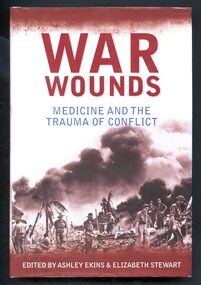
Book - Illustrated book, Elizabeth Stewart 1964- et al, War wounds: medicine and the trauma of conflict, 2011
... Of significance to the AHNL as mention is made of the surgical teams (including nurses) the Alfred sent to Vietnam. War-medical aspects Medicine-military-history-Australia Soldiers-wounds and injuries-treatment-Australia Alfred Nurses War has been an accelerator of the advances in medical treatment and surgery. ...War has been an accelerator of the advances in medical treatment and surgery. As modern weaponry became more destructive, medicine developed techniques and procedures to deal with the volume and nature of battlefield casualties. This book is a collection of chapters by historians, medical practitioners and researchers, former and serving military medical officers, surgeons, nurses and veterans, who explore the impact of war, wounds and trauma through the historical record, reported narratives and personal experiences.Illustrated book with dust jacket. Book has a light brown cover with abbreviated title authors' and publisher's names embossed in silver on the spine. Dust jacket has background of shades of brown, off-white and grey. On the front is a photograph 'Australian infantrymen evacuate a wounded soldier on a stretcher to the beach during the landing at Balikpapan, Borneo, July 1945, along with the title printed in brown and navy, and the authors names printed in white. On the spine, the abbreviated title is printed in brown, authors names in black, and publishers name in white. On the back cover is a photograph of a soldier with arm in a sling (in an advanced dressing station on the Menin Road near Ypres, Belgium, 20 September 1917) Also on the back cover is a quote from Graham Edwards (Vietnam veteran, veteran's advocate and former MP) and a list of other contributors to the book. non-fictionWar has been an accelerator of the advances in medical treatment and surgery. As modern weaponry became more destructive, medicine developed techniques and procedures to deal with the volume and nature of battlefield casualties. This book is a collection of chapters by historians, medical practitioners and researchers, former and serving military medical officers, surgeons, nurses and veterans, who explore the impact of war, wounds and trauma through the historical record, reported narratives and personal experiences.war-medical aspects, medicine-military-history-australia, soldiers-wounds and injuries-treatment-australia, alfred nurses -
 Alfred Hospital Nurses League - Nursing History Collection
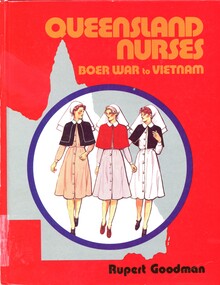
Book - Illustrated book, Rupert Goodwin 1915, Queensland nurses: Boer War to Vietnam, 1985
... Royal Australian Army Nursing Corps-History Military nursing-Queensland-history Nurses-Queensland-history Medicine-military-history-Australia A history of the development and practice of military nursing by Queensland nurses from the Boer War to Vietnam. ...A history of the development and practice of military nursing by Queensland nurses from the Boer War to Vietnam. Includes casualty list and list of decorations awarded to Queensland nurses.Illustrated book with red cover. The front cover has an outline of Queensland on which is printed an illustration of three women in the uniforms of the three military nursing services within a blue circle. Also on the front cover is the title printed in orange and authors name printed in black. Title in orange, author's surname and publishers mark in black are also printed on the spine. On the back cover in black print on a yellow rectangle the AANS pledge of service. Above this is an illustration of the Australian Commonwealth Military Forces badge, and below is the badge of the Royal Australian Army Nursing Corps.non-fictionA history of the development and practice of military nursing by Queensland nurses from the Boer War to Vietnam. Includes casualty list and list of decorations awarded to Queensland nurses.royal australian army nursing corps-history, military nursing-queensland-history, nurses-queensland-history, medicine-military-history-australia
