
Showing 156 items matching "meeting rooms"
-
 Glen Eira Historical Society
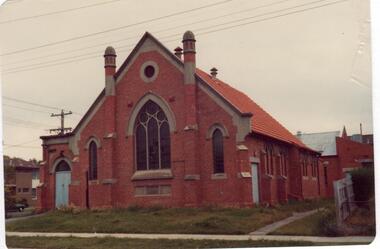
Article - Methodist Church, Grange Road, 183 – 185, Glen Huntly
... ... Meeting Rooms...Presbyterian Church of Eastern Australia Monuments and Memorials Temples Religious Ceremonies Chinese Community Real Estate Agents Commercial Development Residential Development Child Care Glen Huntly Post Office Official Buildings Weatherboard Buildings Clergy Church Residences Meeting Rooms Article Methodist Church, Grange Road, 183 – 185, Glen Huntly ...1/A photocopy of a typed document of notes, source and date unknown, describing a brief history of the former Methodist Church in Grange Road, GlenHuntly. 2/Two colour photographs dated November 1980 of the front and side view of the church, and two undated photographs of the foundation stones, laid 1922 for the church and 1932 for the brick hall. 3/Also a newspaper article by Andrew Molloy dated 25/02/1990 discussing development options for potential buyers, source unknown.glen huntly, smith a. w. f. mr, foundation stones, grange road, molloy andrew, land sales, glen huntly road, methodist church, auctions, wattle ave., uniting church, churches, king f. l mr., presbyterian church of eastern australia, monuments and memorials, temples, religious ceremonies, chinese community, real estate agents, commercial development, residential development, child care, glen huntly post office, official buildings, weatherboard buildings, clergy, church residences, meeting rooms -
 Whitehorse Historical Society Inc.
Pamphlet, Halls and spaces, c1980
... ...meeting rooms...halls meeting rooms Halls and spaces available for hire. ...Halls and spaces available for hire.Halls and spaces available for hire.Halls and spaces available for hire.halls, meeting rooms -
 Whitehorse Historical Society Inc.
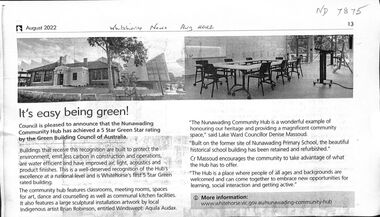
Article - Nunawading Community Hub, Whitehorse News, Aug 2022
... The Nunawading Community Hub has been built on the former site of the Nunawading Primary School and the historical building has been retained and refurbished featuring classrooms, meeting rooms, spaces for art, dance and counselling as well as communal kitchen facilities....The Nunawading Community Hub has achieved a 5 Star Green rating by the Green Building Council of Australia The Nunawading Community Hub has been built on the former site of the Nunawading Primary School and the historical building has been retained and refurbished featuring classrooms, meeting rooms, spaces for art, dance and counselling as well as communal kitchen facilities. ...The Nunawading Community Hub has achieved a 5 Star Green rating by the Green Building Council of AustraliaThe Nunawading Community Hub has been built on the former site of the Nunawading Primary School and the historical building has been retained and refurbished featuring classrooms, meeting rooms, spaces for art, dance and counselling as well as communal kitchen facilities. -
 Greensborough Historical Society
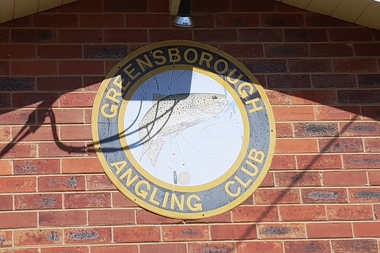
Photograph - Photograph - Digital Image, Marilyn Smith, Greensborough Angling Club 2020, 24/08/2020
... Digital images of the meeting rooms of the Greensborough Angling Club at 161 Para Road Greensborough 23/02/2020. ...Digital images of the meeting rooms of the Greensborough Angling Club at 161 Para Road Greensborough 23/02/2020. ...Digital images of the meeting rooms of the Greensborough Angling Club at 161 Para Road Greensborough 23/02/2020. Part of a collection of miscellaneous historical images with a connection to the local area.Digital colour photographsgreensborough angling club, fishing club, fishing, para road greensborough -
 Ringwood and District Historical Society
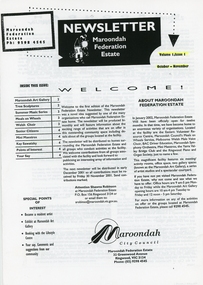
Pamphlet - Newsletter, Maroondah Federation Estate, Maroondah Federation Estate Newsletter Vol 1. Issue 1. 2001, 2001
... Maroondah Federation Estate opened in January 2001 to house some of Maroondah's organisations such as Eastern Volunteers Resource centre, Council's Meals on wheels Service. Consists of meeting rooms, 2 Gallery spaces and office space. ...Maroondah Federation Estate opened in January 2001 to house some of Maroondah's organisations such as Eastern Volunteers Resource centre, Council's Meals on wheels Service. Consists of meeting rooms, 2 Gallery spaces and office space. ...Maroondah Federation Estate opened in January 2001 to house some of Maroondah's organisations such as Eastern Volunteers Resource centre, Council's Meals on wheels Service. Consists of meeting rooms, 2 Gallery spaces and office space. It was originally Ringwood Primary School.4 pages A4 size printed bifold the first newsletter of the Maroondah Federation Estate -
 Ringwood and District Historical Society
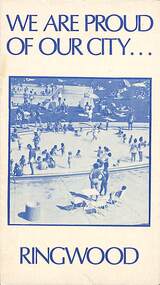
Pamphlet, We Are Proud of Our City - Ringwood (1973), 1973
... Ring 8704311 for guidance on - Town Planning applications, Road and footpath construction, Building matters, Garbage clearance, Connection to sewer by end of 1973, Immunisation times and places, Home help, Rate payments and valuations, Booking of meeting rooms, Clearance of fire hazards, Stray dogs and all nuisance complaints."...Ring 8704311 for guidance on - Town Planning applications, Road and footpath construction, Building matters, Garbage clearance, Connection to sewer by end of 1973, Immunisation times and places, Home help, Rate payments and valuations, Booking of meeting rooms, Clearance of fire hazards, Stray dogs and all nuisance complaints." ...Community information brochure issued in 1973 by Ringwood Council outlining local services, sporting, and cultural facilities. Includes names of Ward Councillors, and two City of Ringwood Free Tipping Vouchers valid until the end of 1974."Frontpiece: A quiet corner of the Fred Dwerryhouse Swimming Centre, Jubilee Park." "The staff at the Civic Centre are at your service. Ring 8704311 for guidance on - Town Planning applications, Road and footpath construction, Building matters, Garbage clearance, Connection to sewer by end of 1973, Immunisation times and places, Home help, Rate payments and valuations, Booking of meeting rooms, Clearance of fire hazards, Stray dogs and all nuisance complaints."rinx -
 Ballarat Heritage Services
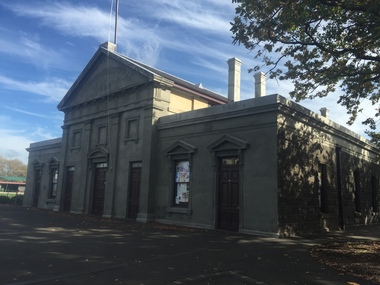
Photograph - Photograph - Colour, Former Kyneton Mechanics' Institute, 2016, 13/05/2016
... It features heritage décor, beautifully restored meeting rooms of various sizes and the main hall which seats approximately 200. ...It features heritage décor, beautifully restored meeting rooms of various sizes and the main hall which seats approximately 200. ...The newly renovated Kyneton Mechanics Institute is located next to the Kyneton Bowling Club. It features heritage décor, beautifully restored meeting rooms of various sizes and the main hall which seats approximately 200. A community space suited to exhibitions, theatre, business and private functions. This venue is managed by the Macedon Ranges Shire Council. (http://www.mrsc.vic.gov.au/Community_Facilities/Find_a_Facility/Kyneton_Mechanics_Institute, accessed 18/10/2016)The former Kyneton Mechanics' Institute. former kyneton mechanics' institute, kyneton, library -
 Bendigo Historical Society Inc.
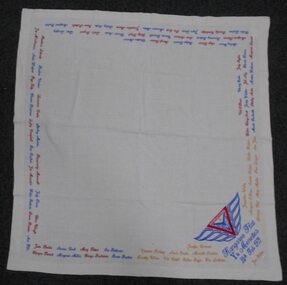
Textile - Kangaroo Flat Y"s Menettes cotton tablecloth, Joyce Lowe, Kangaroo Flat Y's Menettes Tablecloth
... Monthly meetings were held in members' homes and later on in YMCA meeting rooms. The tablecloths were used at the monthly meetings. ...Monthly meetings were held in members' homes and later on in YMCA meeting rooms. The tablecloths were used at the monthly meetings. ...Y's Menettes club was established in Bendigo Kangaroo Flat 24th February 1973. It was one of four Menettes clubs in Bendigo. The other clubs were Bendigo, Lansell and Kangaroo Flat. The Y's Menettes were originally an offshoot of the Y's Men's Clubs. They are linked to the YMCA and aim to promote Christian principles, Youth activities, international good will, community needs, personal development, enjoyment of life and information sharing within the network. Monthly meetings were held in members' homes and later on in YMCA meeting rooms. The tablecloths were used when new members were inducted and their names were added to the cloth. The tablecloths were used at the monthly meetings. They were used at the yearly changeover of office bearers.The Y's Menettes were originally an offshoot of the Y's Men's Clubs. They are linked to the YMCA and aim to promote Christian principles, Youth activities, international good will, community needs, personal development, enjoyment of life and information sharing within the network. Monthly meetings were held in members' homes and later on in YMCA meeting rooms. The tablecloths were used at the monthly meetings. The tablecloths were used when new members were inducted and their names were added to the cloth. they were used at the yearly changeover of office bearers. A cream cotton tablecloth with plain hemming. The embroidery uses the YMCA colours or red, blue and yellow. The tablecloth has a machine decorative hem stitch The YMCA International Men's Club logo is embroidered on the tablecloth. The club's name and Foundation date is beneath the logo. The names of club members embroidered around the sides of the tablecloth.women's service clubs -
 Bacchus Marsh & District Historical Society
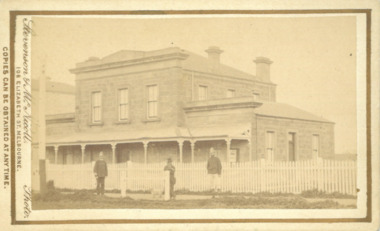
Photograph, Court House Main Street Bacchus Marsh 1883
... Other uses included an office for the Registrar of Births and Deaths, a Dairy Inspectors office from 1863-1865, and as meeting rooms for the Bacchus Marsh Roads Board, a forerunner of the Shire Council. ...Other uses included an office for the Registrar of Births and Deaths, a Dairy Inspectors office from 1863-1865, and as meeting rooms for the Bacchus Marsh Roads Board, a forerunner of the Shire Council. ...The Court House in Main Street Bacchus Marsh was built in 1858 using local sandstone. It opened in 1859. It has been used for jury trials, a Court of Petty Sessions, a County Court and a Crown Land sales office. Other uses included an office for the Registrar of Births and Deaths, a Dairy Inspectors office from 1863-1865, and as meeting rooms for the Bacchus Marsh Roads Board, a forerunner of the Shire Council. It was also used by the Bacchus Marsh Shire Council for its offices until at least 1884. In more recent years it has functioned as a Magistrates Court with weekly court sessions. Small sepia unframed photograph on card with gold border framing photograph. Housed in the album, 'Photographs of Bacchus Marsh and District in 1883 by Stevenson and McNicoll'. The view of the Court House building is seen from the northern side of Main Street looking south or south-east. Three men are standing in the street in front of the building. The men on the left and the right wearing police helmets appear to be police officers. The man in the middle is in civilian clothes and might be an officer or employee of the Court House. He has his dog with him. A white picket fence runs along the front of the building. The front courtyard of the building has been renovated since, but this building still operates as a court house.On the front: Stevenson & McNicoll. Photo. 108 Elizabeth St. Melbourne. COPIES CAN BE OBTAINED AT ANY TIME. On the back: LIGHT & TRUTH inscribed on a banner surmounted by a representation of the rising sun. Copies of this Portrait can be had at any time by sending the Name and Post Office Money Order or Stamps for the amount of order to STEVENSON & McNICOLL LATE BENSON & STEVENSON, Photographers. 108 Elizabeth Street, MELBOURNE. stevenson and mcnicoll 1883 photographs of bacchus marsh and district, courthouses, bacchus marsh court house -
 Bendigo Historical Society Inc.
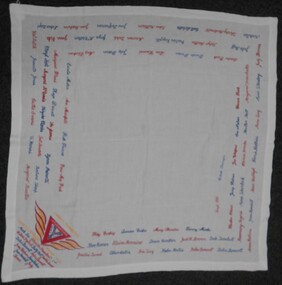
Textile - Lansell Y's Menettes Service club tablecloth, Lansell's Menette's Tablecloth
... Monthly meetings were held in members' homes and later on in YMCA meeting rooms. The tablecloths were used when new members were inducted and their names were added to the cloth. ...Monthly meetings were held in members' homes and later on in YMCA meeting rooms. The tablecloths were used when new members were inducted and their names were added to the cloth. ...The Lansell Y's Menettes club was one of four in Bendigo. The other clubs were Bendigo, Kangaroo Flat and Eaglehawk. The Y's Menettes were originally an offshoot of the Y's Men's Clubs. They are linked to the YMCA and aim to promote Christian principles, Youth activities, international good will, community needs, personal development, enjoyment of life and information sharing within the network. Monthly meetings were held in members' homes and later on in YMCA meeting rooms. The tablecloths were used when new members were inducted and their names were added to the cloth. The tablecloths were used at the monthly meetings. They were used at the yearly changeover of office bearers.white cotton tablecloth with decorativer stitch on the hem. The embroidery uses the YMCA colours or red, blue and yellow. The tablecloth has a machine decorative hem stitch The YMCA International Men's Club logo is embroidered on the tablecloth. The club's name Lansell Y's Menettes is above the logo. The names of charter members in 1960 are below the logos. The names of all club members are embroidered around the sides of the tablecloth.women's service clubs -
 Wodonga & District Historical Society Inc
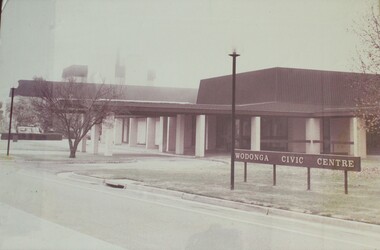
Photograph - Wodonga Civic Centre 1971
... It also included meeting rooms and kitchen facilities. The Civic Centre was officially opened by the Honorable Sir Henry Bolte, K.C.M.P., M.P., Premier of Victoria who was accompanied by the Honorable R. ...It also included meeting rooms and kitchen facilities. The Civic Centre was officially opened by the Honorable Sir Henry Bolte, K.C.M.P., M.P., Premier of Victoria who was accompanied by the Honorable R. ...In the late 1960s the area in Wodonga between Hovell and Havelock Streets was zoned for civic purposes. By 1969 Melbourne architect Bruce Marshall had designed the civic centre which included a library, theatre and senior citizens' rooms. The main hall had a seating capacity of 1,000 people but could be divided by a sliding door. into smaller areas. It also included meeting rooms and kitchen facilities. The Civic Centre was officially opened by the Honorable Sir Henry Bolte, K.C.M.P., M.P., Premier of Victoria who was accompanied by the Honorable R. J. Hamer E.D., Minister for Local Government. The Shire President was Cr. James A. Terrill, J.P.This image records an important stage in the development of local government and civic buildings in Wodonga, Victoria.A black and white image of the Wodonga Civic Centre in a wooden frame.wodonga civic centre, wodonga history, wodonga local government -
 Melbourne Legacy
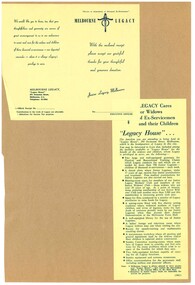
Document, Thank you note to donors and a flyer, 1965
... Free medical examinations are carried out here too. Meeting rooms for Junior Legacy Mothers' Club and Senior Widows Club (those over 50 years of age). ...Free medical examinations are carried out here too. Meeting rooms for Junior Legacy Mothers' Club and Senior Widows Club (those over 50 years of age). ...A copy of note that was given to donors to thank them for their donations it was sent with their receipt. Was part of a folio of proforma stationery from the 1960s. The flyer gives some information about Legacy House. It mentions the facilities available for the benefit of widows and children. Including two large well equipped gymnasia which are attended by more than 700 junior legatees each week. A dental clinic were Junior Legatees under 17 years of age are able to receive free dental examinations and treatment. Free medical examinations are carried out here too. Meeting rooms for Junior Legacy Mothers' Club and Senior Widows Club (those over 50 years of age). When printed the Senior Widows Club numbered more than 5,200. It mentions room for fetes run by a number of auxiliaries to raise funds. Also a sewing room fitted with 5 electric sewing machines to make costumes for the Annual Demonstration. A well equipped library for use of the Junior Legatees. A ladies lounge and television room where widows may rest when visiting the city. Rooms for speech training and mathematics coaching classes. A maintenance workshop where all sporting and general equipment used by widows and children can be repaired and/or constructed. Sundry committee meeting rooms where members of Legacy meet to consider and find solutions for the many problems which arise in respect of the families they care for. Sundry equipment and costume storerooms. Office accommodation for permanent staff including welfare and pension officers. Was compiled in a folio of proforma stationery. A similar set of proformas are at 00338.A record of forms and items used in Legacy's business practices in the 1960s.Yellow brochure thanking donors and a flyer about Legacy pasted on brown paper from a folio of forms and brochures from the 1960s.Pencil mark '1960/1'.proformas, stationery, forms, dureau house -
 Bendigo Historical Society Inc.
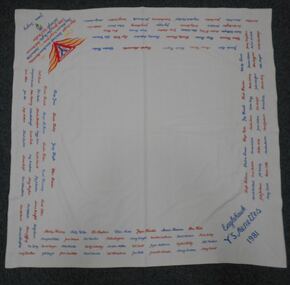
Textile - Eaglehawk Y's Menettes cotton tablecloth, Eaglehawk Y's menettes 1981
... Monthly meetings were held in members' homes and later on in YMCA meeting rooms. The tablecloths were used when new members were inducted and their names were added to the cloth. ...Monthly meetings were held in members' homes and later on in YMCA meeting rooms. The tablecloths were used when new members were inducted and their names were added to the cloth. ...The Eaglehawk Y's Menettes Declaration of Association was made on the 13 of September 1958. This Y's Menettes club was one of four in Bendigo. The other clubs were Bendigo, Lansell and Kangaroo Flat. The Y's Menettes were originally an offshoot of the Y's Men's Clubs. They are linked to the YMCA and aim to promote Christian principles, Youth activities, international good will, community needs, personal development, enjoyment of life and information sharing within the network. Monthly meetings were held in members' homes and later on in YMCA meeting rooms. The tablecloths were used when new members were inducted and their names were added to the cloth. The tablecloths were used at the monthly meetings. They were used at the yearly changeover of office bearers.light brown square tablecloth. The tablecloth has two rows of decorative machine embroidery on the hems. The club's area and the year it was established are embroidered in one corner. The names of all club members are embroidered around the edges of the tablecloth. The logo of the International Y's Menettes is embroidered in one corner along with the date the club was founded. The logo colours are red, yellow and blue. A scot's thistle is embroidered above a member's name.service clubs, women -
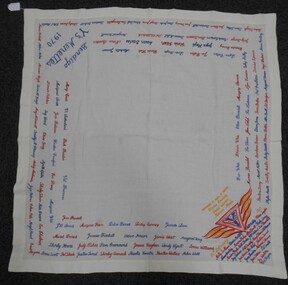 Bendigo Historical Society Inc.
Textile - Bendigo Y's Menettes cotton tablecloth
... Monthly meetings were held in members' homes and later on in YMCA meeting rooms. The tablecloths were used when new members were inducted and their names were added to the cloth. ...Monthly meetings were held in members' homes and later on in YMCA meeting rooms. The tablecloths were used when new members were inducted and their names were added to the cloth. ...The Bendigo Y's Menettes Declaration of Association was made on the 17th of February 1954. This Y's Menettes club was one of four in Bendigo. The other clubs were Eaglehawk, Lansell and Kangaroo Flat. The Y's Menettes were originally an offshoot of the Y's Men's Clubs. They are linked to the YMCA and aim to promote Christian principles, Youth activities, international good will, community needs, personal development, enjoyment of life and information sharing within the network. Monthly meetings were held in members' homes and later on in YMCA meeting rooms. The tablecloths were used when new members were inducted and their names were added to the cloth. The tablecloths were used at the monthly meetings. They were used at the yearly changeover of office bearers.Cream cotton square tablecloth. The tablecloth has one row of decorative machine embroidery on the hems. The club's area and the year it was established are embroidered in one corner. The names of all club members are embroidered around the edges of the tablecloth. The logo of the International Y's Menettes is embroidered in one corner along with the date the club was founded. The logo colours are red, yellow and blue.service clubs, women, ymca, y's menettes -
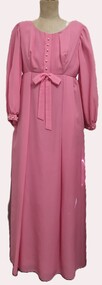 Wodonga & District Historical Society Inc
Clothing - Dress Mrs Yensch
... It also included meeting rooms and kitchen facilities. The Civic Centre was officially opened by the Honorable Sir Henry Bolte, K.C.M.P., M.P., Premier of Victoria who was accompanied by the Honorable R. ...It also included meeting rooms and kitchen facilities. The Civic Centre was officially opened by the Honorable Sir Henry Bolte, K.C.M.P., M.P., Premier of Victoria who was accompanied by the Honorable R. ...This dress was worn by Mrs Beryl Yensch, wife of Councillor Royce Evan Yensch, to the official opening of the Wodonga Civic Centre on 22nd April 1971. Councillor Yensch served as a Councillor representing the Greenhill Riding from 1968 until his resignation in 1974. In 1969 Melbourne architect Bruce Marshall was engaged to design the civic centre which included a library, theatre and senior citizens' rooms. The main hall had a seating capacity of 1,000 people but could be divided by a sliding door. into smaller areas. It also included meeting rooms and kitchen facilities. The Civic Centre was officially opened by the Honorable Sir Henry Bolte, K.C.M.P., M.P., Premier of Victoria who was accompanied by the Honorable R. J. Hamer E.D., Minister for Local Government. The Shire President was Cr. James A. Terrill, J.P. The Civic Centre was demolished in January 2011 to be replaced by the Cube and Hyphen, now the cultural centre of Wodonga. This dress has social significance because it was worn by the wife of a Councillor of the Rural City of Wodonga at the opening of the new Wodonga Civic Centre on 22nd April 1971.A long formai pink dress featuring pintucking and small pearl buttons on the bodice and sleeves worn to the official opening of the Wodonga Civic Centre in 1971. The programme for that event is also included.yensch wodonga, rural city of wodonga, wodonga councillors -
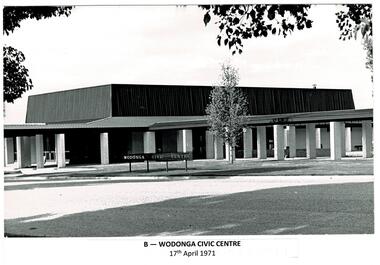 Wodonga & District Historical Society Inc
Photograph - Codling Collection 01 - Wodonga Civic Centre
... It also included meeting rooms and kitchen facilities. The Civic Centre was officially opened by the Honorable Sir Henry Bolte, K.C.M.P., M.P., Premier of Victoria who was accompanied by the Honorable R. ...It also included meeting rooms and kitchen facilities. The Civic Centre was officially opened by the Honorable Sir Henry Bolte, K.C.M.P., M.P., Premier of Victoria who was accompanied by the Honorable R. ...Miss Olive Codling was a Foundation Member and a Life Member of the Wodonga Historical Society. Many of her prize-winning photos are held in the Society Collection. She also held a range of roles and committee positions in a wide range of Wodonga community organisations. These included the Horticultural Society, the Wodonga Arts Council, the Wodonga Camera Club and the Wodonga Lapidary Club. Wodonga Civic Centre - In the late 1960s the area in Wodonga between Hovell and Havelock Streets was zoned for civic purposes. By 1969 Melbourne architect Bruce Marshall had designed the civic centre which included a library, theatre and senior citizens' rooms. The main hall had a seating capacity of 1,000 people but could be divided by a sliding door. into smaller areas. It also included meeting rooms and kitchen facilities. The Civic Centre was officially opened by the Honorable Sir Henry Bolte, K.C.M.P., M.P., Premier of Victoria who was accompanied by the Honorable R. J. Hamer E.D., Minister for Local Government. The Shire President was Cr. James A. Terrill, J.P. This image records an important stage in the development of local government and civic buildings in Wodonga, Victoria.A series of black and white images showing the constriction and opening of the Wodonga Civic centre.wodonga businesses, high st wodonga, melba theatre -
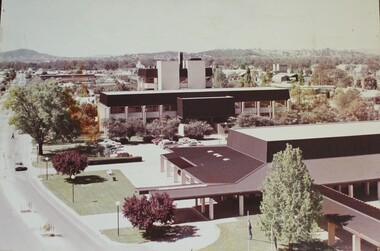 Wodonga & District Historical Society Inc
Photograph - Wodonga Civic Centre 1986
... It also included meeting rooms and kitchen facilities. The Civic Centre was officially opened by the Honorable Sir Henry Bolte, K.C.M.P., M.P., Premier of Victoria who was accompanied by the Honorable R. ...It also included meeting rooms and kitchen facilities. The Civic Centre was officially opened by the Honorable Sir Henry Bolte, K.C.M.P., M.P., Premier of Victoria who was accompanied by the Honorable R. ...In the late 1960s the area in Wodonga between Hovell and Havelock Streets was zoned for civic purposes. By 1969 Melbourne architect Bruce Marshall had designed the civic centre which included a library, theatre and senior citizens' rooms. The main hall had a seating capacity of 1,000 people but could be divided by a sliding door. into smaller areas. It also included meeting rooms and kitchen facilities. The Civic Centre was officially opened by the Honorable Sir Henry Bolte, K.C.M.P., M.P., Premier of Victoria who was accompanied by the Honorable R. J. Hamer E.D., Minister for Local Government. The Shire President was Cr. James A. Terrill, J.P. In 1973, the Council engaged Bruce Marshall to design new offices beside the Civic Centre. Jennings Industries were contracted to complete the offices. The Governor, Sir Henry Winneke, laid the foundation stone of the new offices on 10 March 1976. The Civic Centre was demolished in 2011 to make may for a new $10 million community and entertainment centre which opened in August 2012.This image records an important stage in the development of local government and civic buildings in Wodonga, Victoria.A large framed image of Wodonga Civic Centre after it was upgraded in 1981wodonga history, wodonga civic centre, wodonga civic and government buildings -
 Slovenian Association Melbourne
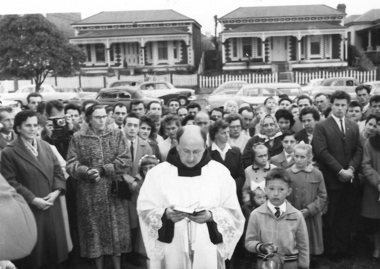
Blessing of Slovenski Dom, Blessing of Slovenian Home in Carlton by Fr Basil in 1960, 1960
... The Dom had comfortable rooms for meetings, drama group practices, welcoming ceremonies, some sporting activities, singing and poetry recitals....The Dom had comfortable rooms for meetings, drama group practices, welcoming ceremonies, some sporting activities, singing and poetry recitals. ...The Slovenian Home in Carlton was purchased partially by donations and personal members loans. The Dom had comfortable rooms for meetings, drama group practices, welcoming ceremonies, some sporting activities, singing and poetry recitals.Being the first Slovenian Home in AustraliaBlack and white photo of the Blessing at the opening of the Slovenian Centre - Slovenski Dom in Carlton by Fr Basil in 1960. Slovenians were very proud to have achieved the goal and purchased a building, the very first Slovenian centre in Australia.Blessing of the Slovenian Domslovenski dom, slovenian centre in carlton, slovenian club melbourne, blessing of the centre -
 Federation University Historical Collection
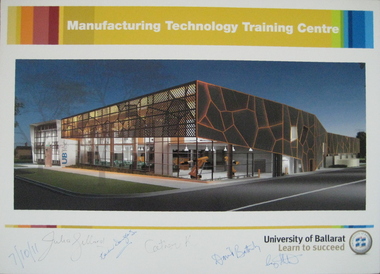
Photograph - Poster, University of Ballarat Manufacturing Technology Training Centre poster signed by Prime Minister Julia Gillard, 07/10/2011 (approx 11.15am)
... UBTec will provide a facility including individual learning spaces, learning studios, administration/office space, circulation, open plan learning space, staff common areas, computer rooms, meeting rooms, staff work areas and kitchen areas as well as car parking and site-wide amenities. ...UBTec will provide a facility including individual learning spaces, learning studios, administration/office space, circulation, open plan learning space, staff common areas, computer rooms, meeting rooms, staff work areas and kitchen areas as well as car parking and site-wide amenities. ...The new Manufacturing Technology Training Centre (MTTC), a part of the proposed Building Construction Training Centre (BCTC), will be a purpose-built, stand-alone, fully fitted-out industry-standard facility. This new space will accommodate current course provision along with specialist training spaces for developing skill requirements in manufacturing technology such as robotics, mechatronics, engineering and industrial automation. Project funding was provided by the Education Investment Fund from the Australian Government Department of Education, Employment and Workplace Relations. The project budget is $18.09m, and the resulting building will have a floor space of 4,755m2. The Manufacturing Technology Training Centre is being built in conjunction with the Technical Education Centre (UBTec). While the buildings will have separate street identities the buildings will be joined with shared amenities areas. UBTec will provide a facility including individual learning spaces, learning studios, administration/office space, circulation, open plan learning space, staff common areas, computer rooms, meeting rooms, staff work areas and kitchen areas as well as car parking and site-wide amenities. While the buildings will have separate street identities the buildings will be joined with shared amenities areas. Funding for the UBTec component of the building is provided by Maintaining the Advantage: Skilled Victorians from the Victorian State Government. A colour poster prepared for the 'turning of the sod' at the site of the proposed University of Ballarat Manufacturing Technology Training Centre (MTTC), Grant Street, Ballarat. The poster was signed on Friday 7 October 2011 at about 11:15 am at the Building Construction Training Centre (BCTC), Grant Street, Ballarat by: Hon. Julia Gillard MP Hon. Catherine King MP (Ballarat ) Prof. David Battersby, Vice Chancellor, University of Ballarat Mayor, Cr Craig Fletcher, Mayor of the City of Ballarat appointed in December 2010 Mrs. Karen Douglas, Chair University of Ballarat Building & Infrastructure Committee The poster is signed by the Prime Minister of Australia, the Hon. Julia Gillard MP; Karen Douglas; the Hon. Catherine King MP (Ballarat ); Prof. David Battersby (Vice Chancellor); Craig Fletcher (Mayor, City of Ballarat)university of ballarat, david battersby, julia gillard, prime minister, catherine king, ubtec, karen douglas, manufacturing technology training centre, grant street, architecural feature -
 City of Greater Bendigo - Civic Collection
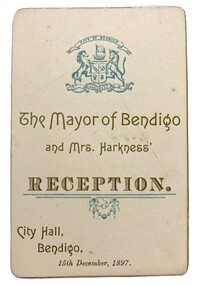
Memorabilia - Invitation and Event Program, City of Bendigo, Reception, 1897
... In the early years it included spaces for Surveyors, Engineers, Town Treasurer, Clerk of Courts, council meeting rooms and a separate office for the Mayor....In the early years it included spaces for Surveyors, Engineers, Town Treasurer, Clerk of Courts, council meeting rooms and a separate office for the Mayor. ...Mayor Harkness is best known for abolishing liquor from the Town Hall and replacing the Mayor's Ball with a Monster Sunday School Picnic for children which took place in Ravenswood in 1883 and was attended by 15,000 people. Abraham Harkness arrived in Victoria in 1857 aged 28. He was initially successful in his search for gold and after a return trip to England in 1862 returned to Bendigo where he opened a general store and then a foundry manufacturing mining machinery. He stood for council from in 1880 and was elected a further eight times over the next twenty years. Cr Harkness served as Mayor in 1882, 1897 and 1898. His son Andrew became Mayor in 1908-09. Abraham Harkness married Jane Elizabeth Noble in Bendigo in1864 and together they had six sons and five daughters. Abraham died in 1912 and Jane in 1927. Town Halls serve many purposes. Symbolically they are an outward expression of a City’s prosperity while practically serving as an administration hub, a place to showcase industry and agriculture, host grand balls and royal visits and administer law and order. The Bendigo Town Hall has proudly served its citizens and played a vital role in nearly every major decision and event that has shaped the City. In the early years it included spaces for Surveyors, Engineers, Town Treasurer, Clerk of Courts, council meeting rooms and a separate office for the Mayor.Blue and gold printed invitation for Christmas Reception held at the City hall, Bendigo on 15th December 1897 by Mayor and Mrs Harkness. Front design features the Bendigo Coat of Arms, inside left message reads 'The Mayor of Bendigo and Mrs. Harkness wish the Citizens the Compliments of the Season - 15th December 1897'. Music program printed on right hand side and bird motif with 'Christmas, 1897 on the back of the invitationcity of bendigo town hall, mayoral reception, mayor harkness, mayoress harkness -
 Wodonga & District Historical Society Inc
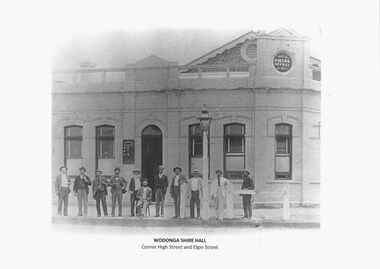
Photograph - Wodonga Civic Buildings Over Time
... The façade featured floor to ceiling windows and several different meeting rooms in addition to the council chamber, which featured an impressive “horse shoe” table. ...The façade featured floor to ceiling windows and several different meeting rooms in addition to the council chamber, which featured an impressive “horse shoe” table. ...Wodonga Shire was created in 1876 when the colonial government agreed to ratepayers' petitions to have their part of the local government district severed from the Yackandandah Shire to form a new municipality. After meeting for 14 years in rented remises, in the Prince of Wales Hall, Wodonga Council built its first Shire Hall on the corner of High and Elgin Streets in 1890. The date on the façade of the building, 1876, represents the date of the formation of the Shire. In 1957 the second Shire Office was built in Woodland Grove by A.B. and M. A. Chick. These offices were considered more than adequate for future needs. The façade featured floor to ceiling windows and several different meeting rooms in addition to the council chamber, which featured an impressive “horse shoe” table. It also included a kitchen equipped with modern fittings and a President’s room. In the late 1960s the area between Hovell and Havelock Streets as far as Jack Hore Place was zoned for civic purposes. In 1969 plans for a civic centre providing a library, theatre and senior citizens’ rooms. It was opened on 22 April 1971. In 1973, the Council engaged Bruce Marshall to design new offices beside the Civic Centre. Jennings Industries were contracted to complete the offices. The Governor, Sir Henry Winneke, laid the foundation stone of the new offices on 10 March 1976. The Civic Centre was demolished in 2011 to make may for a new $10 million community and entertainment centre which opened in August 2012.These photos are significant because they depict the different buildings which have housed the centre of local government in Wodonga since its inception as an independent shire in 1876.A series of photographs depicting the different buildings used to house the Wodonga Council and Civic buildings over time.wodonga civic buildings, wodonga council, shire of wodonga, rural city of wodonga -
 Eltham District Historical Society Inc
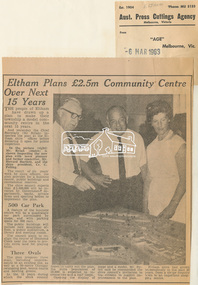
Newspaper Clipping, Eltham Plans £2.5m Community Centre Over Next 15 Years, The Age, 6 March 1963 page 7, 1963
... The public buildings will include new municipal offices, a public auditorium, a library and meeting rooms. The council plans to realign the course of Diamond Creek near the town to provide extra land for playing fields. ...The public buildings will include new municipal offices, a public auditorium, a library and meeting rooms. The council plans to realign the course of Diamond Creek near the town to provide extra land for playing fields. ...Eltham Plans £2.5m Community Centre Over Next 15 Years THE people of Eltham have drawn up a plan to make their township a model community centre in the next 15 years. And yesterday the Chief Secretary (Mr Rylah) inspected the plan at the Eltham shire offices before declaring it open for public inspection In the picture (right) Mr. Rylah (centre) is shown inspecting the new plan with town planner and former councillor, Mr. Howard Bartlett, and the shire president, Cr. C. Pelling. The result of six years' work by shire officers, the plan provides for a business centre, public buildings and recreational reserves. The shire council expects that £2,500,000 will be invested by Government departments, banks, private firms and sporting bodies to implement the plan. 500 Car Park A feature of the business centre will be a quadrangle car park surrounded by shops, and with parking space for 500 cars. The public buildings will include new municipal offices, a public auditorium, a library and meeting rooms. The council plans to realign the course of Diamond Creek near the town to provide extra land for playing fields. Three Ovals The plan proposes three ovals, including improvements to an existing one, as well as a 50-metre Olympic swimming pool, tennis courts and bowling greens. In the 15 years which the shire council hopes to carry out the plan, the shire population of 18,000 is expected to increase two and a half times. Opening the display of maps and a model, Mr. Rylah said he commended the shire council's invitation to the citizens to suggest improvements to the plan. Eltham shire had grown tremendously in the past 20 years, from a sleepy country town to an important shopping centre. Digital file only of copy provided on loanauditorim, bowlong green, charis pelling, eltham community centre, rylah, howard bartlett, car park, library, forward plan -
 Bendigo Historical Society Inc.
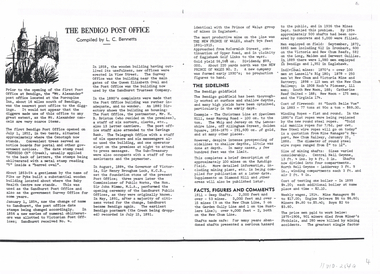
Document - LONG GULLY HISTORY GROUP COLLECTION: THE BENDIGO POST OFFICE
... They were where theatres, concerts and dances were held, and the meeting rooms for clubs and lodges, even church benefits. ...They were where theatres, concerts and dances were held, and the meeting rooms for clubs and lodges, even church benefits. ...Article titled The Bendigo Post Office, compiled by L C Bennetts. Mentioned is the history of the Bendigo Post Office and postmarks, some information on mining, Bendigo foundries, Underground connections of mines, expenses and shaft sinking costs. Also mentioned is Bendigo and Eaglehawk - 60 years ago and the role the pubs played in daily living. They were where theatres, concerts and dances were held, and the meeting rooms for clubs and lodges, even church benefits. Listed is a number of Bendigo hotels. Some even had a few names. Names of the pubs are: The Freemasons, The Courthouse, The Commercial Law Courts, The Hamburg, The European, The Prince Bismark, The Lord Kitchener, The Bendigo, The Rosalind Park, The Showgrounds, Atheneum Club, Olivers, Bridge Hotel, Bourkes, The Globe, The Hibernia, Albert, Albion, Abbotts, Australian, Belvidere, Beehive, British Queen, Black Eagle, British and American, Brian Boru, Bakers Arms, Butchers Arms, Brick Layers Arms, Bull and Mouth, Cresent, Clarence, Back Creek Bridge, Cape Clear, Crooked Billet, Cambridgeshire Arms, Camp, Coach and Horses, Cricketers Arms, Diggers Rest, Ellesmere, Five Lions, Franklyn, Golden Square, Golden Gate, Golden Gully, Golden Age, Golden Vine, Gumtree, Glasgow Reef, Great Britain, Haymarket, Daniel O'Connell, Half Way House, Fleece Inn, Ironbark, Johnsons Reef, Lancashire, Live and Let Live, Manchester Arms, Gold Mines, Metropolitan, Crown, National, New Chum, Honeysuckle Street, Pavilion, Napier Arms, Quartz Miners Arms, Retreat Inn, Rainbow, Rose of Australia, Lake View, Robin Hood, Fountain, Southern Cross, Bath, Berlin, Spring Gully, Star, Sir Charles Hotham, Silvermines, Royal Oak, Suburban, Town Hall, Temperance, Ship Inn, View Point, View Bend, Victoria, Exchange, American, Arcade, Belfast, All Nations, Union, United Kingdom, Union Jack, Westend, Washington, Waterloo, Wellington, Whitehorse, Wheat Sheaf, Yorkshire, Niagra and Noahs Ark.bendigo, history, long gully history group, the long gully history group - the bendigo post office, l c bennetts, mt alexander post office, porcupine inn, cenotaph, pike or pyke, baby health centre, sandhurst post office, government survey office, queen elizabeth oval, sandhurst trustees company, mr h b briston, savings bank, telegraph office, the sub-treasury, sir henry brougham lock kcb, sir john nimmo mla, prince of wales group of mines, the new prince of wales, eaglehawk golf links, new prince of wales no 2, the whip and jersey, mines department, lansell's big 180, new chum and victoria mine and battery, new chum railway, koch's pioneer, south new moon, catherine reef united, new moon, the virginia, south bell vue, central nell gwynne, north nell gwynne, miner's phthisis, hercules engine house, ironbark, new chum syncline, hercules energetic, roberts & sons, harkness & co, horwoods, great southern, ulster, carlisle, lansells big 180, victoria quartz, new st mungo, duchess tribute, south devonshire, hopewell mine, saxby mine, mcnair & co, shamrock, mr king, burke and wills expedition, sandhurst hotel, courthouse, hiberian, the freemasons, the courthouse, the commercial law courts, the hamburg, the european, the prince bismark, the lord kitchener, the bendigo, the rosalind park, the showgrounds, atheneum club, olivers, bridge hotel, bourkes, the globe, the hibernia, albert, albion, abbotts, australian, belvidere, beehive, british queen, black eagle, british and american, brian boru, bakers arms, butchers arms, brick layers arms, bull and mouth, cresent, clarence, back creek bridge, cape clear, crooked billet, cambridgeshire arms, camp, coach and horses, cricketers arms, diggers rest, ellesmere, five lions, franklyn, golden square, golden gate, golden gully, golden age, golden vine, gumtree, glasgow reef, great britain, haymarket, daniel o'connell, half way house, fleece inn, ironbark, johnsons reef, lancashire, live and let live, manchester arms, gold mines, metropolitan, crown, national, new chum, honeysuckle street, pavilion, napier arms, quartz miners arms, retreat inn, rainbow, rose of australia, lake view, robin hood, fountain, southern cross, bath, berlin, spring gully, star, sir charles hotham, silvermines, royal oak, suburban, town hall, temperance, ship inn, view point, view bend, victoria, exchange, american, arcade, belfast, all nations, union, united kingdom, union jack, westend, washington, waterloo, wellington, whitehorse, wheat sheaf, yorkshire, niagra, noahs ark -
 City of Melbourne Libraries
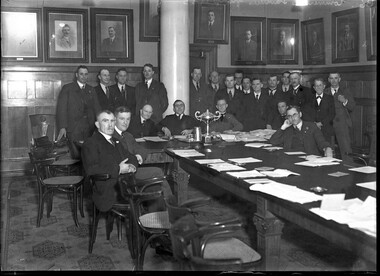
Photograph, Bull, Hugh Jones, 1897-1993, Commercial Travellers' Association, Victoria, Board Room
... The CTA continued to hold meetings in leased rooms in hotels and offices until 1898 when they commissioned purpose-built premises at 190-192 Flinders Street (extant, now the Macstore, next to former Metropolitan Gas Company Buildings). ...The CTA continued to hold meetings in leased rooms in hotels and offices until 1898 when they commissioned purpose-built premises at 190-192 Flinders Street (extant, now the Macstore, next to former Metropolitan Gas Company Buildings). ...Seven seated and fifteen standing men dressed in suits around a long table in a panelled room hung with formal portraits of men. A trophy sits on the long table amongst loose paper sheets. Research by project volunteer, Fiona Collyer: The Commercial Travellers’ Association of Victoria (CTA) was formed at a meeting of 40 commercial travellers held at the Duke of Rothesay Hotel, 24 Elizabeth Street on 1 December 1880. Their charter was to advocate for better working conditions for commercial travelling salesmen, including improved accommodation at discounted rates and travel concession fares. At first by locomotive, horse and buggy, steamers and horseback, later also by motor car and motorcycle, “The Man on the Road” went into the back-blocks of the country to extend the interests of commerce to the stores and households of Australian regional towns and isolated settlements. Affiliated organisations existed in all states and New Zealand and in 1895 they integrated to form the United Commercial Travellers’ Association of Australasia (UCTAA). By the turn of the 20th century, the Victorian branch of the CTA had 421 Association Members and 520 Club members. The CTA continued to hold meetings in leased rooms in hotels and offices until 1898 when they commissioned purpose-built premises at 190-192 Flinders Street (extant, now the Macstore, next to former Metropolitan Gas Company Buildings). Designed by leading architectural firm of brothers H.W. & F.B.Tompkins (Dimmey’s Model Store, Swan Street, London Stores, Herald and Weekly Times, Myer building, Diamond House, Centreway Arcade, Manton’s Store) in the Queen Anne Revival style at the cost of £20,000, the four storey building had a facade of red Northcote bricks and an entrance of Pyrmont stone. It was very modern for the time, featuring elevators, offices, bars, kitchen, dining, card and billiard rooms and 31 bedrooms with shared bathrooms for the footsore travellers. However, despite adding two storeys in 1901, and another storey and a basement in 1905, they soon outgrew their premises, and in 1912 the CTA commissioned a new building at 328 Flinders Street. At this time, buildings in Melbourne were constrained by the city height limit of 132 feet (40 metres)- the maximum height of firefighting ladders. The new CTA building was the tallest building in Melbourne until 1932 when regulations changed allowing the Manchester Unity Building to be built. The new CTA headquarters was the epitome of comfort and luxury with cutting edge facilities to ease the fatigued salesman and prepare him for another stint on the road. General Secretary, James Davies travelled to Britain and America to acquire the very best and latest innovations. After visiting the new premises, Punch magazine 11 June 1914 reported “furnishings, appliances, and labour-saving conveniences which were more than up to date- they were up to-morrow.” The Edwardian Baroque style building was again designed by architects H.W. & F.B. Tompkins at the cost of £100,000 and built by contractors F.E. Shillabeer and Sons (Nicholas Building, Kellow-Falkiner Pty Ltd car showroom). The nine storey plus basement building is of steel frame construction with concrete floors. The ground floor facade is of grey granite and above that it is faced with cream glazed bricks chosen to combat discolouration from the pollution emitted by Flinders Street Station trains across the road. The facade is decorated with mascarons, gum leaf trim and balconies with classical style balustrade. The club was entered through revolving doors into a two storey high, circular, domed lobby with white columns, American oak panelled walls and intricate mosaic flooring. The ceiling is festooned with plaster gum leaf and gum nut detail, a theme that is repeated throughout the building. The basement kitchen had modern, labour saving appliances that would be the envy of any Edwardian housewife, including an electric toaster, a potato peeling machine, heated dumb waiter, dishwashing machine and electric refrigeration and cooking. It serviced the commodious second floor dining room which seated 200 people and the cafe/breakfast room, 80 people. Members were permitted to entertain their lady friends there for afternoon tea between the hours of 3 and 5 pm every day, except Sunday. The members’ facilities included a barbershop, clothes pressing machine, boot cleaning chair, pipe and cigar stall with electric humidor, public telephones, lockers and safe deposit. The building was serviced with five elevators, a built in vacuum cleaning plant, hot water radiators and linen and postal chutes. The first floor was devoted to business and relaxing, containing the Board, Writing, Reading and four Business Rooms. The board room had Queensland maple panelling with huge blackwood tables topped with blue morocco and golden tortoise-shell trim and cane bottomed chairs. Large framed photographs of past presidents since 1884 lined the walls. The Reading Room ran the whole width of the building. Arthur Streeton’s painting “Between the Lights, Princes Bridge 1888” and Frederick McCubbin’s “Looking North from Mount Macedon” were hung there, as well as paintings by renowned Australian artists Hans Heysen, Walter Withers, John Mather, Jan Hendrik Scheltema. The Argus 30 May 1914 quipped “Around the walls hang evidences that the commercial traveller's soul has not been killed in his pursuit of commerce”. The blackwood panelled room was furnished with Queen Anne style tables and chairs and green leather armchairs with inviting rocker foot rests allowing weary travellers to relax after traversing the railways and dusty roads of Victoria while planning their next sales trip. “The Australasia Traveller” Volume 10, Number 2, April 1914 page 35 noted “An attendant will be constantly employed on this floor to take care of the stationary supply, to tidy up newspapers, and generally study the convenience of members.” The third floor was for amusements with billiards, a bar and four rooms for playing cards, dominoes and chess. The huge billiard room had seven Alcock billiard tables including a table in a partitioned match-room for tournaments, exhibitions and matches. The walls were lined with members’ cues and for spectators, comfortable lounges with marble topped tables and electric bell pushes for drinks service. There were 150 bedrooms over five floors, each with their own telephone and wash basin and five suites with a private sitting room attached. There were four bathrooms per bedroom floor and capacious, well-lighted shaving rooms. Top rate club tariff for bed and breakfast - 6 shillings, if called for a country train leaving Melbourne before 8am - 4 shillings, suite and breakfast- 9 shillings, sixpence. “The Australasia Traveller” Volume 10, Number 2, April 1914 page 35 reported “All “early calls” will be made from the Club Office to Bedrooms by means of the Telephone, so that instead of waking everybody else up on the corridor, only the member concerned will know that it is his unpleasant duty to get up.” The new CTA premises was widely regarded as the finest club in the Southern Hemisphere. The CTA also built the adjacent six storey Commerce House with 52 sample rooms for travellers to display their wares with the remainder rented to retail businesses and a post and telegraph office. After the CTA moved into their new, larger premises in 1914, neighbouring department store Ball & Welch expanded into the former CTA. The CTA saw themselves in a nation building role and were an influential lobby group to the Government. They advocated for inter city trunk telephone lines, standard gauge railway lines between NSW and Victoria, improved roads and highways, the Murray River water scheme and maintaining the White Australia Policy. They were very active in fund raising for the war efforts. The CTA offered its members support in other ways with benevolent funds for widows and orphans, mortuary, accident, sickness and an annuities fund for members over 65 years. There were scholarships for members’ children and home purchase scheme to assist with home ownership. A secondary membership scheme provided access to non commercial travellers (men only) to its exclusive club premises. They also organised social events and activities such as billiard tourneys, golf tournaments, dances and an annual “Smoke Social” which was a social event where men gathered for a formal dinner, community singing, lectures, speeches and of course, to smoke! Daylesford born James Davies OBE, (1865-1931) worked at the CTA for 50 years, starting as an office boy and working his way up to General Secretary and editor of the monthly trade journal for UCTAA members, “The Traveller” (1890-1905, later “The Australasian Traveller” 1905-1924 and then “The Australian Traveller” 1925-1976) and the annual colour supplement magazine “Australia To-Day” (1904-1973). “The Australasia Traveller” featured commentary on the issues of the day like wars, tariffs and trade, articles on new products and hotel recommendations and their rates and lots of advertising, especially alcohol, tobacco and accommodation in regional hotels. There were regular columns, each illustrated with a line drawing and these included “Our Immigration Record” a state by state summary of arrivals of “desirable immigrants” to Australia, while bemoaning the declining (white) birth rate. The column followed the arrival of British boys sent to Australia as agricultural apprentices to work on rural properties which were short of labour. Between 1913-1928, 1750 “Barwell Boys”, some as young as 14 years of age arrived in South Australia to work. NSW had a similar program known as the Dreadnaught Boys Scheme where 5595 boys immigrated between 1911-1939. The boys were considered of “good British stock”. There was a “Home Page For The Ladies” showcasing the latest fashions in women’s clothing, millinery and hairstyles and tips and trends in home furnishings.“Children’s Corner for Dear Little Folks” which featured puzzles, jokes and stories and members could send in photographs of their children. “Road Echoes” devoted to “The Man On The Road” and his doings. “Face Massage, Smiling is the Best Face Massage”, the humour page full of jokes and funny stories. “Railway Rumbles” news of innovations, timetables, tickets and grumbles about lavatories, food and drinking water on trains and at railway stations. And in case we forget that members had a home away from their CTA home, gardening tips with “The C.T. as Gardener”column. The annual magazine “Australia To-Day” was a vehicle to promote Australia here and overseas as a modern, prosperous country with abundant opportunities and pleasant climate. It sought to showcase its manufacturing, agriculture and tourism and encourage British immigration to Australia. The magazine featured articles about recently arrived migrants at work, quirky native flora and fauna, beach culture, recreation and the Australian way of life in the settler nation. Many of the articles were written by politicians of the day, including Robert Menzies. The UCTAA commissioned original artwork for the front covers and feature articles of “Australia To-day” from leading Australian artists. These included Norman Lindsay, Frederick McCubbin, Napier Waller, Lionel Lindsay, Hans Heysen, C Dudley Wood, Louis McCubbin, Penleigh Boyd, Louis Buvelot, Christian Waller and Ellis Rowan and her Australian wildflowers. Some of the photographs in “Australia To-Day” were provided by state and federal government departments as well as manufacturers, newspapers and mining companies. Amongst of the credited photographers was Helmut Newton who later earned world acclaim as a fashion photographer and architectural and industrial photographer Wolfgang Sievers (unfortunately their photographs remain in copyright and aren’t available online). Also featured was Richard C. Strangman, a professional photographer from Canberra, William Howieson of Melbourne, who has 22 photographs in the collection of NGV, Tasmanian wilderness photographer Frederick Smithies, Athol Shmith, portrait photographer and educator from Melbourne, Gordon de Lisle, a Melbourne commercial, industrial, aerial and society portrait photographer. (One of Gordon’s assignments was as the stills photographer for the 1959 movie “On The Beach” filmed in Melbourne). Photographs taken by acclaimed Antarctic and official war photographer Captain Frank Hurley OBE for Adelaide’s Centenary were also featured. The Australian Government was keenly aware of the influence and quality of the UCTAA publications. On 1 June 1914 The Age reported that to advertise Australia in Great Britain and elsewhere, the Department of External Affairs purchased 6500 copies of “Australia To-Day” magazine for £515 to distribute free to “places where they are most likely to come under the notice of a desirable class of immigrants.” In 1950, the office of Prime Minister Robert Menzies ordered 2550 copies of that year’s issue of “Australia To-Day” for the Department of Commerce and Information to distribute. The CTA donated their archives to University of Melbourne Archives which includes original artworks and photos used in “Australia To-Day” (Melbourne University has digitised 1114 photos) and sundry items including trophies, ashtrays, commemorative souvenirs, menus, a rare “Safechek” sovereign changer, a bust of James Davies and even a CTA embossed wash bowl and chamber pot. After the death of General Secretary James Davies in 1931, the CTA held the annual “James Davies Memorial Cup” golf tournament at various Melbourne golf courses, the winner receiving a splendid silver cup. “Table Talk” magazine photographs from 29 June 1933 depict the travellers beautifully (and I would say correctly) attired in tweedy plus fours, Fair Isle knitwear, flat caps and of course fringed brogues. I have been unable to ascertain whether the trophy in our photo is for golf or another CTA social activity. The CTA Victoria membership peaked in 1951 with 4,672 Aassociation members and 3,693 Club members. In 1959, Hollywood came to Melbourne when film stars Gregory Peck, Ava Gardner, Anthony Perkins and Fred Astaire descended to film ‘On the Beach,’ directed by Stanley Kramer. The film is based on the bestselling Neville Shute novel about the aftermath of World War Three, a nuclear war that has obliterated most of the Northern Hemisphere. Radioactive dust is heading toward Australia and everyone is preparing for death. Scenes with Anthony Perkins were filmed in the CTA billiards room as the exclusive Pastoral Club. Anthony Perkins’ character, Lieutenant Commander Peter Holmes of RAN tells Gregory Peck’s character, Commander Dwight Lionel, that The Pastoral Club is…”A mahogany and polished brass sort of place-some people claim it was the stuffiest club in the Commonwealth” before assuring him that despite shortages, the club is likely to have some Scotch left. In a scene at the Pastoral Club two, old (probably red faced) codgers discuss the challenge of drinking all of the 400 bottles of Gould Campbell vintage port in the club wine cellar before they succumb to radiation sickness in five months time. The NGV has 12 photographs in their collection of wardrobe stills of Ava Gardner modelling costumes designed by the Fontana Sisters of Rome for “On The Beach”, taken by Italian photographer G.B.Poletto. During the filming, Gregory Peck and his family stayed at “Kurneh” 206 Domain Road, South Yarra, the former home of three times Grand Slam winner Norman Brookes. Through the decades, Australian society was changing and in order to stay relevant, the CTA had to change too. In 1971, two women were elected for club membership, although they were only granted limited access to the club’s facilities and in 1972, women were invited for the first time to participate in the previously men only annual “Smoke Social”. In 1975, dwindling membership forced the closure of The Commercial Travellers’ Association building and in 1977, the building was sold, with the CTA ceasing to operate in 2014. It was the end of the road for the “Knights of the Road”. In 1992, the CTA building at 328 Flinders Street was placed on the Victorian Heritage Register in recognition of its architectural and cultural significance. The building has been meticulously restored with many of the original fittings, decorative plasterwork, mosaic flooring, stained glass windows, columns, chandeliers and the panelling made from Australian timbers retained. After renovations the building became first the Euro Asia Hotel, then the Duxton Hotel and in 2005 The Rendezvous Hotel, Melbourne. In tribute to the history of the building and the film “On The Beach”, the Rendezvous Hotel has the Ms Ava Bar, Perkins room, Mr Tompkins restaurant, Commerce Room and the Davies Room. References: COMMERCIAL TRAVELLERS' ASSOCIATION OF VICTORIA. (1899, May 27). The Australasian (Melbourne, Vic. : 1864 - 1946), p. 25. Retrieved February 21, 2025, from http://nla.gov.au/nla.news-article138615498 COMMERCIAL TRAVELLERS. (1914, May 30). The Argus (Melbourne, Vic. : 1848 - 1957), p. 8. Retrieved February 13, 2025, from http://nla.gov.au/nla.news-article7272511 NEWS OF THE DAY. (1914, June 1). The Age (Melbourne, Vic. : 1854 - 1954), p. 8. Retrieved February 19, 2025, from http://nla.gov.au/nla.news-article189414314 COMMERCIAL TRAVELLERS' "AT HOME." (1914, June 11). Punch (Melbourne, Vic. : 1900 - 1918; 1925), p. 32. Retrieved March 19, 2025, from http://nla.gov.au/nla.news-article129699692 https://archives.library.unimelb.edu.au/nodes/view/69669 https://vhd.heritagecouncil.vic.gov.au/places/757 http://www.pikitiapress.com/blog/2015/1/26/australia-today Commercial Travellers at Yarra Yarra (1933, June 29). Table Talk (Melbourne, Vic. : 1885 - 1939), p. 6. Retrieved February 28, 2025, from http://nla.gov.au/nla.news-article149547845 https://archives.library.unimelb.edu.au/nodes/view/537460 https://viewer.slv.vic.gov.au/?entity=IE7420895&file=FL19171568&mode=browse https://www.history.sa.gov.au/wp-content/uploads/2021/03/Barwell_Boys_Catalogue-compressed-compressed-compressed.pdf Australia Today," 1927 (1926, December 11). Weekly Times (Melbourne, Vic. : 1869 - 1954), p. 15. Retrieved March 17, 2025, from http://nla.gov.au/nla.news-article223844810 https://blogs.unimelb.edu.au/librarycollections/2020/12/19/an-inhabited-space-helmut-newtons-lovers/ https://www.ngv.vic.gov.au/explore/collection/artist/2075/ https://www.ngv.vic.gov.au/?s=Poletto+&type=collection https://rendezvousmelbourne.com.au/digital-history-tour/Photographer notations on slide: "Commercial Travellers Group B6".clubs, department stores, 1930-1939, commerce, manufacturing, federation/edwardian style architecture, railways, tourism, games, agriculture -
 Federation University Historical Collection
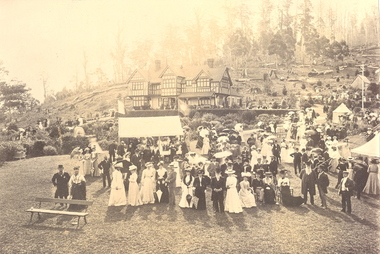
Photograph - Photograph - Black and White, Meeting for the Australian Association for the Advancement of Science, Hobart, 1892, 1892
... meetings in Hobart has been brought to a termination. What he has seen of the Exhibition has impressed him favourably. (Launceston Advertiser, 6 January 1892.) "TASMANIA. AUSTALASIAN ASSOCIATION FOR THE ADVANCEMENT OF SCIENCE. The fourth congress of the Australasian Association for the Advancement of Science was commenced in Hobart at 11. o'olock on Thursday by the general Council assembling at the Royal Society's rooms, at the Museum. ...meetings in Hobart has been brought to a termination. What he has seen of the Exhibition has impressed him favourably. (Launceston Advertiser, 6 January 1892.) "TASMANIA. AUSTALASIAN ASSOCIATION FOR THE ADVANCEMENT OF SCIENCE. The fourth congress of the Australasian Association for the Advancement of Science was commenced in Hobart at 11. o'olock on Thursday by the general Council assembling at the Royal Society's rooms, at the Museum. ...Newspaper reports relating to the Australasian Association for the Advancement of Science, Hobart, 1892. "Australasian Association for the advancement OF SCIENCE. Several members of the Australasian Association for the Advancement of Science arrived in the city yesterday by the inter colonial steamers, some of whom went direct to Hobart, while others remained in the city, but leave for the capital this afternoon. Amongst those who arrived were Baron Von Mueller, the dis tinguished scientist, who has taken some interest in this colony's re sources, Professor W. Baldwin Spencer, M.A., professor of biology at the Melbourne University, who was general secretary at the Melbourne meeting; the Rev. Lorimer Fison, an able worker in the South Sea mission fields; Dr. Robert Giffen, L.L.D., C.ll.; Captain Pascoe, R.N.; Mr Napier Bell, C.E.; Professors Hutton, Nerich, Smith, and Morris, and Mr Richard Teece, F.T.A., the well-known actuary of the A.M.P. Society. A large number of other distinguished members also arrived. Judge Dorkerwho also arrived, was con ducted over the Exhibition in the after noon, and expressed pleasure with what he saw. His Honor leaves by express train to-day for Hobart. The hon. Dr. Campbell was met by Mr Arthur Day, the official agent for Great Britain to the Exhibition, an old friend, who conducted him over the Exhibition. The doctor confined his attention principally to the dry ore concentrator, in which he takes a great interest. He will, however, visit the Exhibition again after the meetings in Hobart has been brought to a termination. What he has seen of the Exhibition has impressed him favourably. (Launceston Advertiser, 6 January 1892.) "TASMANIA. AUSTALASIAN ASSOCIATION FOR THE ADVANCEMENT OF SCIENCE. The fourth congress of the Australasian Association for the Advancement of Science was commenced in Hobart at 11. o'olock on Thursday by the general Council assembling at the Royal Society's rooms, at the Museum. There was a good attendance, including the Governor, Sir B. G. Hamilton. In the absence of the president, Sir James Hector, the chair was occupied by Baron Von Muellor. In the afternoon Lady Hamilton gave a garden party at Government House to 600 guests, including the members of the association, the Judges, the members of the Ministry, and leading citizens." (Newcastle Morning Herald & Miners' Advocate, 9 January 1892.)Two sepia photographs mounted onto charcoal mount. A group of men in hats and coats, and women in hats and long dresses assemble in front of a double story building, thought to be Henry Dobson's of Ferntree near Hobart. In the background stumps of large trees are evident. The event was a garden party held in for members of the Australasian Association for the Advancement of Science who met in Hobart in 1892. .1 F.J. Martell of the Ballarat School of Mines is seated between two women in the right hand foreground. James Oddie, with white beard and top hat, is standing in the centre foreground between two women. .2) James Oddie is standing with cane in hand on the right of the bench in the foreground of the photo. australasian association for the advancement of science, hobart, oddie, james oddie, martell, von mueller, baldwin spencer, lorimer fison, robert giffen, napier bell, arthur day, dobson, henry dobson -
 The Beechworth Burke Museum
Audio - Oral History, Jennifer Williams, Mrs May Sewell, 23rd November 2000
... meeting friends at the pictures, attending girl guides, picking wildflowers around the gorge, participating keenly in the Church of England choir and dances, and the big Easter festivals. May worked various jobs before getting married. After leaving school at fifteen, May learnt dressmaking with Lal Anderson (and was delighted with her wage of two and six pence a week) and then went on to learn tailoring with Mr Charles. May then worked in the dining rooms...meeting friends at the pictures, attending girl guides, picking wildflowers around the gorge, participating keenly in the Church of England choir and dances, and the big Easter festivals. May worked various jobs before getting married. After leaving school at fifteen, May learnt dressmaking with Lal Anderson (and was delighted with her wage of two and six pence a week) and then went on to learn tailoring with Mr Charles. May then worked in the dining rooms ...May Sewell was born in Beechworth in 1917, her paternal grandparents had come to Beechworth from Ireland and her maternal grandparents from Scotland. She was the youngest of five siblings and the only one to be born in a hospital rather than at home. May loved growing up and living in Beechworth, and fondly recalls knowing all her neighbours, meeting friends at the pictures, attending girl guides, picking wildflowers around the gorge, participating keenly in the Church of England choir and dances, and the big Easter festivals. May worked various jobs before getting married. After leaving school at fifteen, May learnt dressmaking with Lal Anderson (and was delighted with her wage of two and six pence a week) and then went on to learn tailoring with Mr Charles. May then worked in the dining rooms at the Commercial Hotel and Hotel Nicholas. May was at the Hotel Nicholas for seven years but stopped when she got married as female employees were not asked to stay once they were married. May married her husband in 1944 and had known him since school. They went on to have six children, sadly three did not live past infancy. Her first children were twin girls who died six hours after birth. May briefly discusses the difficulty in grieving her twin daughters, the lack of available support, and the expectancy to carry on. Her next child, a son named Ian James, died when he was only ten months old from a tumour. May described Ian James as a lovely boy. May had multiple connections to the Zwar Brothers' Beechworth Tannery. Her father and then her three brothers worked there, and also her husband for a short period of time. The tannery was a major employer in Beechworth, and May having multiple family members employed by the tannery underlines the significant role of the tannery in Beechworth. May described her husband as very hardworking, he worked as a cleaner overnight at the Ovens and Murray Hospital for the Aged while during the day tended his cattle and sheep farm. This oral history recording was part of a project conducted by Jennifer Williams in the year 2000 to capture the everyday life and struggles in Beechworth during the twentieth century. This project involved recording seventy oral histories on cassette tapes of local Beechworth residents which were then published in a book titled: Listen to what they say: voices of twentieth century Beechworth. These cassette tapes were digitised in July 2021 with funds made available by the Friends of the Burke. Miss May Sewell’s account of her life in Beechworth is historically and socially significant to the cultural heritage of the region. May in reflecting on her experiences of leisure opportunities, town festivals, work available for women, leaving the workforce once married, the tannery, post-natal care, grief and child mortality provide essential historic, economic, social, and healthcare insights. May’s oral history recording is part of a larger collection of oral histories recorded by Jennifer Williams in 2000, collectively they provide invaluable insights into Beechworth during the 20th century, much of the information in these oral histories would be lost if not documented and missed in the interpretation of tangible objects. This is a digital copy of a recording that was originally captured on a cassette tape. The cassette tape is black with a horizontal white strip and is currently stored in a clear flat plastic rectangular container. It holds up 40 minutes of recordings on each side.Mrs May Sewellmay sewell, oral history, jennifer williams, listen to what they say: voices of twentieth century beechworth, beechworth church of england, easter festival, beechworth girl guides, hospital birth 1917, lal anderson, tailor beechworth, commercial hotel, hotel nicholas, zwar brother's beechworth tannery, ovens and murray hospital for the aged, dressmaking beechworth, beechworth cinemas, paul voglis -
 The Beechworth Burke Museum
Photograph - Two Photographs, Saunders, 1864-1972
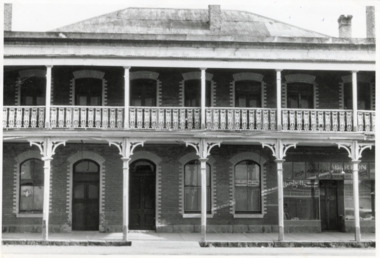
... As such a central hub, the ‘Star Assembly Rooms’ were used as a meeting place for debates, discussions, festivities, and problem solving among the various working sects of the area. ...As such a central hub, the ‘Star Assembly Rooms’ were used as a meeting place for debates, discussions, festivities, and problem solving among the various working sects of the area. ...Taken some time after 1864, these photographs depict the Star Hotel both directly (8674.1) and from the Hotel north west down Ford Street (8674.2). The images depict the building with its modern exterior, having settled for this brick form after several other building designs. The Star Hotel was the first hotel opened in Beechworth, and would go through a series of dramatic changes under its first three owners. The original timber structure was built by W.H. Neuber, though at the time it was only known as ‘The Beechworth Hotel’. The site was later purchased in 1855 by mining entrepreneur, and prolific business owner, John Alston “Six Stars” Wallace. He would go on to extend the established hotel, rebuilding much of it with weatherboard and a shingled roof, adding a two storey structure with a verandah and a theatre capable of supporting 400-500 people, which was often used for international performances. Renamed as the Star Hotel, it was the second in a chain franchise, eventually leading to the “Six Stars” moniker Wallace went by, with hotels at Rutherglen, Chiltern, Yackandandah, Bright, Snake Valley, and of course, Beechworth. Under his ownership, it developed into a popular location for merchants, wayfarers, and locals alike, with the help of his brother Peter as manager. Situated on a road once synonymous with Melbourne to Sydney roadtrips, and the allure of the gold mines, the popularity of the Star drew all manner of clientele from across the country. As such a central hub, the ‘Star Assembly Rooms’ were used as a meeting place for debates, discussions, festivities, and problem solving among the various working sects of the area. These meetings included shareholder discussions for prospecting companies, railway planning, council meetings, and discussions surrounding the interactions between European and Chinese miners, both good and bad. By late 1856, John had the Beechworth at auction through J.H. Grey & Co. It was most likely due to the high profile murder of the manager, Robert Murdoch, during an altercation in relation to a dine and dash event by a Swedish miner, Charles Jansen, who had been ‘excited by drink’ on November 17th. He had refused to pay for his meal and waiter James Mitchell failed to persuade him otherwise. Mitchell, or possibly Murdoch himself, forced him out as tempers and threats escalated. As the photos tell, there are a number of doors which may be entered through, and Jansen used an alternate entrance to access the building. Murdoch was investigating the noise when he encountered the furious man. He was subsequently stabbed with no warning by a small clasp knife, as he tried to stop the intrusion. His exclamations, "I’m stabbed, I’m stabbed!” alerting other occupants, and Jansen was restrained and arrested. Murdoch died the next day from his injuries, with the inquest carried out on the theatre stage. Some 3000 members of the town attended the funeral, and the Star hung black cloth in memory of Robert and his death. Afterwards, an auction caw the property pass to Messrs Robertson and Quirk, though would return shortly thereafter to Six Stars’ portfolio. Six Stars would later sell off his properties from 1862, with the Beechworth Star purchased by 1864 by John Sitch Clark. This allowed Clark to redevelop a significant portion of the Hotel, stripping a central section and constructing the brick structure that survives today, reopening the Star in July that year. It was after this time that our photographs were taken. Clark would later sell the property to Frank Mitchell, shortly before his own death. The next owner, Frederick Allen, lived on the property before the deed was sold to him in the 1880s. He would later sell the property to William Carroll in 1890, with proprietorship eventually moving to Mr. W.H. Porter, and transferring to a Mr. Marendaz by 1913 and Mr. Holly in 1915. Licensing disputes would arise 1917 between Margaret Carroll and a Mrs. McDonald, before it became delicenced some years prior to 1935. It was around this year that the property was bought by Mr. W.J. Pemberton at the meagre price of £500, down from the £13,000 Six Stars originally auctioned it for. It served as a Youth Hostel for a period of time around 1972, and currently the building serves as a private accommodation on the second floor, with shops taking up the ground floor level.These photographs of the Beechworth Star Hotel as they depict a form of Beechworth's first hotel, and also the site of a high profile murder. Two black and white rectangular photographs printed on matte photographic paper.8674.1 (reverse) Beechworth/ 734/ Tanswell’s Hotel [crossed out]/? Old Star/ Hotel,/[small pencil scratching]/ Saunders/ BMM 8674.1 8674.2 (reverse) Beechworth/ 60%[circled]/ Old Star Hotel/Building etc.,/ 12 ½ cm/ 3"[circled, arrows extending horizontally to edges]/[arrows extending top to bottom mid-right of reverse]/ Saunders/ 734[circled]/ BMM 867.2,/ [thin scribbled bordering around top, right, and bottom edges]star hotel, beechworth hotel, john alston wallace, ja wallace, john sitch clark, frederick allen, robert murdoch, meeting place, tragedy, theatre, mining town -
Federation University Historical Collection
Document - SMB Documents E.J. Barker, Various School of Mines Ballarat Papers collected by E.J. Barker
... Rooms...Dr Ron Wild...School of mines and industries Ballarat...Institute Profile...Location Map...University of Ballarat...Campus Plan...Great Hall/Arts Complex...Notes...1970-72 Building Program...Operations and Decisions...Report to Council...Visit by Principal...Priorities...Electrical Engineering...Mt Helen...Minutes of Special Council Meeting...School of Mines is a predecessor of Federation University Planning Requirements Individual Rooms Dr Ron Wild School of mines and industries Ballarat Institute Profile Location Map University of Ballarat Campus Plan Great Hall/Arts Complex Notes 1970-72 Building Program Operations and Decisions Report to Council Visit by Principal Priorities Electrical Engineering Mt Helen Minutes of Special Council Meeting University of Melbourne Engineering Mt Helen Development Report Administration Building Technical Art School Former Ballarat Gaol The Court House SMB Community Centre Trust News Articles Discovery Day K.J. ...E.J. Barker is a past principal of the School of Mines Ballarat and the Library at the Mt Helen Campus is named after him. School of Mines is a predecessor of Federation UniversityLetters, Reports Plans, Ephemera and Clipboard associated with E.J. Barker and the School of Mines Ballaratplanning requirements, individual rooms, dr ron wild, school of mines and industries ballarat, institute profile, location map, university of ballarat, campus plan, great hall/arts complex, notes, 1970-72 building program, operations and decisions, report to council, visit by principal, priorities, electrical engineering, mt helen, minutes of special council meeting, university of melbourne, engineering, mt helen development report, administration building, technical art school, former ballarat gaol, the court house, smb community centre, trust news, articles, discovery day, k.j. flecknoe, retirement, membership of sub committee, n.a crouch, e.j. barker, k.l. cross, w.j. gribble, l.f.j. hillman, r.c lovett, d. nicholson, g. robertson, p.r. shiells, b. tanner, r. feary, i. harris, b.c. mclennan, m. stevens, t.a. wiseman, d.r. bolster, p.h. dixon, r. dunlop, r. furness, e.j. lumsdon, a. mccaffrey, p.r. davies, d. farnsworth, j. harrison, k. mcfarlane, j. mills, s.a. mendelson, i. robinson, d.j. fraser, j. van dreven, k. alsop, b. bridges, m. palmer, r. sutton, l. snibson, h. van hammond, t. runnalls, p. sculley, g. shearer, t. slater, michael ronaldson, robert lovett, edward john barker, e.j. barker building, council membership, clipboard, n.g curry, state college of victoria, articles of association, memorandum, australian conference of principles of colleges of advanced education, commonwealth ministerial working party, victorian post secondary education commission, australian institute of physics symposium, royal australian institute of public administration, premier of victoria, r.j. hamer, m.b. john, new south wales institute of technology, phone messages, peter o'loughlin, annual report, signing of agreement, position description, certificates, fifth form -
Marysville & District Historical Society
THE TRIANGLE NEWS-VOL 36 NO 21-JUNE 12 2009
... rooms at taggerty store...marysville central weekly update...james fraga...cumberland site...ann & simon cuzens...what's on when...marysville cricket club...free advice in marysville...taggerty progress group meeting...marysville victoria australia surviving koalas released at taggerty community counselling rooms at taggerty store marysville central weekly update james fraga cumberland site ann & simon cuzens what's on when marysville cricket club free advice in marysville taggerty progress group meeting consumer affairs victoria visiting marysville alexandra visitor information centre marysville & triangle development group (matdg) moving on get involved rebuilding marysville urban planning marysville lions club new birth maxx garnet advertisements marysville art show councillor comment mobile library positions vacant tourism recovery funding lions triangle tool library church notices triangle arts group buxton primary school house signs ready for pick up marysville medical clinic THE TRIANGLE NEWS-VOL 36 NO 21-JUNE 12 2009 ...marysville, victoria, australia, surviving koalas released at taggerty, community counselling rooms at taggerty store, marysville central weekly update, james fraga, cumberland site, ann & simon cuzens, what's on when, marysville cricket club, free advice in marysville, taggerty progress group meeting, consumer affairs victoria visiting marysville, alexandra visitor information centre, marysville & triangle development group (matdg), moving on, get involved, rebuilding, marysville urban planning, marysville lions club, new birth maxx garnet, advertisements, marysville art show, councillor comment, mobile library, positions vacant, tourism recovery funding, lions triangle tool library, church notices, triangle arts group, buxton primary school, house signs ready for pick up, marysville medical clinic -
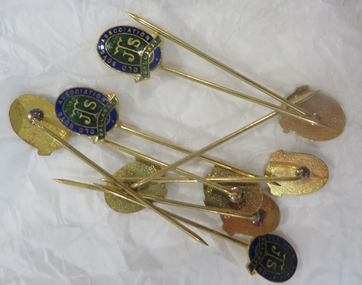 Federation University Historical Collection
Object, Stokes & Sons Pty Ltd, Ballarat Junior Technical School Old Boys Association Lapel Pin, mid 1900s
... The major event held each year was the Annual Meeting held in July usually at the Wattle Tea Rooms where up to 100 past students would meet....The major event held each year was the Annual Meeting held in July usually at the Wattle Tea Rooms where up to 100 past students would meet. ballarat junior technical school ballarat junior technical school old boys association stokes and sons lapel pins On the front face - Ballarat J T S, Old Boys Association. ...Formed in 1921, A.W Steane was the first president of the Ballarat Junior Technical School Ex-Students' Association which later became the Old Boys Association. The association conducted regular social evenings at the school in order to keep past students in touch with one another and to provide amenities for the school. Fund raising dances, smoke nights, film nights and visits to local industries were held. The Old Boys Association presented the Honour Blazer to the best all-round student at Speech Night until 1941 when a wallet bearing an O.A.B. badge was given as the prize. Then in the 1950s a two-year scholarship was instituted to attend the senior school. Donations were also given to purchase library books and sporting equipment. The major event held each year was the Annual Meeting held in July usually at the Wattle Tea Rooms where up to 100 past students would meet.Multiple gold coloured metal lapel pins with enameled face. 'Ballarat J T S' is set in green enamel, and the Old Boys Association is set in blue. The face is oval shaped with a banner across the bottom. These pins are carried in a cardboard box bearing the label of Stokes & Sons.On the front face - Ballarat J T S, Old Boys Association. Impressed into the back face - Stokesballarat junior technical school, ballarat junior technical school old boys association, stokes and sons, lapel pins
