
Showing 174 items matching "melbourne 1837"
-
 St Kilda Historical Society
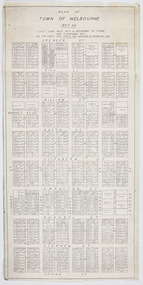
Plan - Melbourne, Plan of Town of Melbourne 1837 A.D, 1837 (original)
... Plan of Town of Melbourne 1837 A.D.......Town of Melbourne- 1837...Shows the outcome of the first land sales held in Melbourne, on 1 June and 1 November 1837. All the names and prices for each lot are displayed....Photocopy of "Plan of Town of Melbourne 1837 A.D." showing first land sales....Photocopy of "Plan of Town of Melbourne 1837 A.D." showing first land sales. Plan of Town of Melbourne 1837 A.D. ...Shows the outcome of the first land sales held in Melbourne, on 1 June and 1 November 1837. All the names and prices for each lot are displayed.Photocopy of "Plan of Town of Melbourne 1837 A.D." showing first land sales.All lots printed with name of buyer and price paid.melbourne - history, town of melbourne- 1837 -
 Port Melbourne Historical & Preservation Society
Document, "Plan of Town of Melbourne 1837 A.D.", 1937
... "Plan of Town of Melbourne 1837 A.D."...Photocopy of "Plan of Town of Melbourne 1837 A.D." Also showing first land sales, historical memoranda, and an alphabetical list of purchases...."Plan of Town of Melbourne 1837 A.D." Document H E Badman Sands and McDougall Pty Ltd ...Photocopy of "Plan of Town of Melbourne 1837 A.D." Also showing first land sales, historical memoranda, and an alphabetical list of purchases.town planning, town of melbourne -
 Bendigo Historical Society Inc.
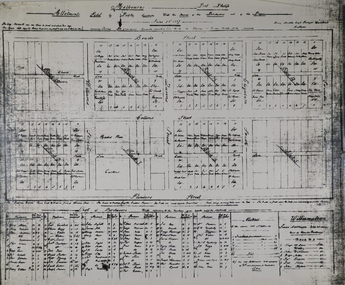
Document - ALLOTMENTS SOLD BY PUBLIC AUCTION 1ST JUNE 1837 MELBOURNE
... ALLOTMENTS SOLD BY PUBLIC AUCTION 1ST JUNE 1837 MELBOURNE......Melbourne 1837...Large copy of the first land auction in Melbourne on June the first 1837. Melbourne - Port Phillip, allotments sold by public auction with the name of the purchasers and of the prices. ...VICTORIA Melbourne 1837 Land Sales Large copy of the first land auction in Melbourne on June the first 1837. ...Large copy of the first land auction in Melbourne on June the first 1837. Melbourne - Port Phillip, allotments sold by public auction with the name of the purchasers and of the prices. June 1st 1837.victoria, melbourne 1837, land sales -
 Ballarat Heritage Services
Image, Melbourne in 1837, 1934
... Melbourne in 1837...A drawing of Melbourne in 1837. ...melbourne ship boat settlement A drawing of Melbourne in 1837. Melbourne in 1837 Image ...A drawing of Melbourne in 1837. melbourne, ship, boat, settlement -
 Greensborough Historical Society
Document - Plan, Surveyor's Street Plan of Melbourne 1837 [copy], 1837_
... Surveyor's Street Plan of Melbourne 1837 [copy]...Copy of Surveyor's Street Plan of Melbourne 1837. Donated by Patsy Coverdale and accompanied by brief details of her family connection to the map. ...Surveyor's Street Plan of Melbourne 1837 [copy] Document Plan ...Copy of Surveyor's Street Plan of Melbourne 1837. Donated by Patsy Coverdale and accompanied by brief details of her family connection to the map. Copies of plan available for sale from Greensborough Historical Society.Map of early Melbourne with connections to a current resident.Copy of plan, mounted on timber and framed.melbourne street plan, umpleby, patsy coverdale -
 Greensborough Historical Society
Book, Craftsmen Press, East Melbourne: 1837-1977: people, places, problems, 1977
... East Melbourne: 1837-1977: people, places, problems...East Melbourne town planning melbourne A history of early development and more recent redevelopment in East Melbourne, from a town planning perspective. 177 p., illus., maps. East Melbourne: 1837-1977: people, places, problems Book Book Craftsmen Press Winston Burchett ...A history of early development and more recent redevelopment in East Melbourne, from a town planning perspective.177 p., illus., maps.non-fictionA history of early development and more recent redevelopment in East Melbourne, from a town planning perspective.east melbourne, town planning, melbourne -
Koorie Heritage Trust
Book, Burchett, Winston H. (Winston Harold), East Melbourne 1837 - 1977 : people, places, problems, 1978
... East Melbourne 1837 - 1977 : people, places, problems..... ; tables; 23 x 29cm. East Melbourne 1837 - 1977 : people, places, problems. ...xiii, 177p. : ill. ; tables; 23 x 29cm. lcsh: 1. city planning -- victoria -- east melbourne. 2. east melbourne (vic.) -- history. 3. east melbourne (vic.) -- buildings, structures, etc. -
Box Hill Historical Society
Book, Marjorie Morgan, The old Melbourne Cemetery 1837 - 1922, 1982
... The old Melbourne Cemetery 1837 - 1922...It includes a copy of inscriptions on tombstones in the Old Melbourne Cemetery, some photos, plan of cemetery, grave numbers, denomination and some birth dates and details of those buried. 319p The old Melbourne Cemetery 1837 - 1922 Book Marjorie Morgan Australian Institute of Genealogical Studies ...An alphabetical burial register of those who were buried in the old Melbourne Cemetery located where the Queen Victoria Market now stands. It includes a copy of inscriptions on tombstones in the Old Melbourne Cemetery, some photos, plan of cemetery, grave numbers, denomination and some birth dates and details of those buried.319pAn alphabetical burial register of those who were buried in the old Melbourne Cemetery located where the Queen Victoria Market now stands. It includes a copy of inscriptions on tombstones in the Old Melbourne Cemetery, some photos, plan of cemetery, grave numbers, denomination and some birth dates and details of those buried.cemeteries, old melbourne cemetery, graves -
 Ballarat Heritage Services
Image, Melbourne in 1866, 1934
... A drawing of Melbourne in 1837. ...melbourne ship boat settlement A drawing of Melbourne in 1837. Melbourne in 1866 Image ...A drawing of Melbourne in 1837. melbourne, ship, boat, settlement -
 Kew Historical Society Inc
Photograph - Photograph [copy], John Hodgson, 1845-1852
... Born Studley England 1799. Arrived Melbourne 1837...Born Studley England 1799. Arrived Melbourne 1837 A print of John Hodgson, early Melbourne settler and prominent figure in the early history of Kew. ...This work forms part of the collection assembled by the historian Dorothy Rogers, that was donated to the Kew Historical Society by her son John Rogers in 2015. The manuscripts, photographs, maps, and documents were sourced by her from both family and local collections or produced as references for her print publications. Many were directly used by Rogers in writing ‘Lovely Old Homes of Kew’ (1961) and 'A History of Kew' (1973), or the numerous articles on local history that she produced for suburban newspapers. Most of the photographs in the collection include detailed annotations in her hand. The Rogers Collection provides a comprehensive insight into the working habits of a historian in the 1960s and 1970s. Together it forms the largest privately-donated collection within the archives of the Kew Historical Society.A print of John Hodgson, early Melbourne settler and prominent figure in the early history of Kew. [Copy 1]John Hodgson. Born Studley England 1799. Arrived Melbourne 1837john hodgson, kew, dorothy rogers -
 City of Greater Geelong
Etching, Geelong & Melbourne (1855) Railway Terminus 1837
... Geelong & Melbourne (1855) Railway Terminus 1837...Geelong & Melbourne (1855) Railway Terminus 1837 Etching ... -
 Ringwood and District Historical Society
Card - Invitation, Ringwood Historical Research Group AGM Invitation card 1967, 26-Jul-67
... McComb on "Development of Region East from Melbourne 1837-1860 According to Government Surveys"....McComb on "Development of Region East from Melbourne 1837-1860 According to Government Surveys". ...Invitation from President of RHRG, E.V. Pullin & secretary B.M. Jamieson to Mr. K. Ward, Chamber of Commerce, to be present at the 1967 AGM. Speaker was Mr. H.S. McComb on "Development of Region East from Melbourne 1837-1860 According to Government Surveys".Buff coloured card marked Ringwood Historical Research Group inviting person to annual meeting on Wed 26-Jul-1967 in Lower Town Hall, Ringwood, at 8pm +Additional Keywords: Pullin, E.V. / Jamieson, B.M. / Ward, K. / McComb, H.S. -
 Kew Historical Society Inc
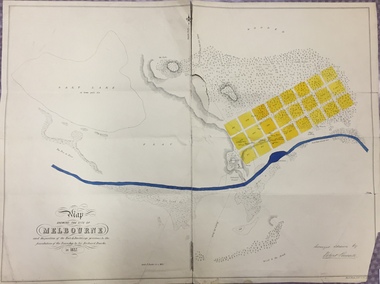
Map, Robert Russell, Map Shewing the Site of Melbourne and the Position of the Huts & Buildings Previous to the Foundation of the Township by Sir Richard Bourke in 1837
... Map Shewing the Site of Melbourne and the Position of the Huts & Buildings Previous to the Foundation of the Township by Sir Richard Bourke in 1837 ...Map shows the first layout of Melbourne by Government surveyor Robert Russell, who accompanied Governor Richard Bourke in 1837. ...Black and white lithographed map hand-coloured in blue and yellow gouache of the town of Melbourne in 1837. In contrast to the original lithograph, the river and the township blocks are coloured blue and yellow. ...It is a nationally significant artefact. maps - melbourne - 1830s governor sir richard bourke robert russell - surveyor cartography Black and white lithographed map hand-coloured in blue and yellow gouache of the town of Melbourne in 1837. In contrast to the original lithograph, the river and the township blocks are coloured blue and yellow. ...Map shows the first layout of Melbourne by Government surveyor Robert Russell, who accompanied Governor Richard Bourke in 1837. The surveyed blocks extend from present-day Flinders Street to Lonsdale Street, and Spring Street to Spencer Street, with extensive vacant land west to a salt lake (afterwards Batman's Swamp, later drained), north beyond Flagstaff Hill and south towards South Melbourne. Vegetation coverage is indicated, and tracks and existing buildings and cultivated land are shown.Printed map was created by Day & Haghe, Lithographers to the Queen, sometime after 1838, when the company received its Royal appointment. Copies of the 1837 map exist in several major map collections in Australia; most are uncoloured. This particular map is the earliest in the Kew Historical Society's map collection. It is a nationally significant artefact. Black and white lithographed map hand-coloured in blue and yellow gouache of the town of Melbourne in 1837. In contrast to the original lithograph, the river and the township blocks are coloured blue and yellow. A similar, partly coloured copy is in the collection of the University of Melbourne.maps - melbourne - 1830s, governor sir richard bourke, robert russell - surveyor, cartography -
Surrey Hills Historical Society Collection
Work on paper - Vertical file, Bell family
... Photocopied excerpts from ‘Printers of the Streets and Lanes of Melbourne (1837-1975)’ by Don Hauser, 4 pages relating to the Bell family. ...Photocopied excerpts from ‘Printers of the Streets and Lanes of Melbourne (1837-1975)’ by Don Hauser, 4 pages relating to the Bell family. ...1. Photocopied excerpts from ‘A kettle, a skillet and a warming pan’ by Margot Titcher & Walter Savage, 1964, 5 pages (p83-88) which relate to Lucy Russell Powell and the Bell family members. (Source: Judy Cameron, nee Bell) 2. Photocopied memoir re Savige family at Narracan – 9 double-pages. Poor copy ; some text is missing at the edges. (Source: Judy Cameron, nee Bell) 3. Inventory of Bell family photos provided for copying by Judy Cameron, nee Bell 4. Notes re the family of Harcourt Bell & Lucy Russell Bell, nee Powell 5. AIF project listing for Harry Norman Bell 6. AIF project listing for William Russell Bell 7. Photocopied excerpts from ‘Printers of the Streets and Lanes of Melbourne (1837-1975)’ by Don Hauser, 4 pages relating to the Bell family. margot titcher, walter savage, bell, savige, powell, don hauser -
 Sunshine and District Historical Society Incorporated
Journal - Victorian Historical Journal Volume 47 Number 4 November 1976, Royal Historical Society of Victoria et al, November 1976
... Geoffery Searle) The journal Article Page 284: Where John Batman built in Melbourne in 1837. A short History of the site by Barbara J. ...Geoffery Searle) The journal Article Page 284: Where John Batman built in Melbourne in 1837. A short History of the site by Barbara J. ...The Victorian Historical Journal, first published as the Victorian Historical Magazine in 1911, is the official journal of record and scholarly publication of the Royal Historical Society of Victoria. It is the second oldest history journal in Australia. It has become a vast collaborative history of Victoria with hundreds of individual contributors and topics and has itself become a primary source for researchers The journal features research articles, historical studies and book reviews.Paperback book. Includes a list of upcoming speakers at the RHSV for 1977.non-fictionThe Victorian Historical Journal, first published as the Victorian Historical Magazine in 1911, is the official journal of record and scholarly publication of the Royal Historical Society of Victoria. It is the second oldest history journal in Australia. It has become a vast collaborative history of Victoria with hundreds of individual contributors and topics and has itself become a primary source for researchers The journal features research articles, historical studies and book reviews. john batman, charles j latrobe, charlotte pellett, thomas bolton -
 Chelsea & District Historical Society Inc
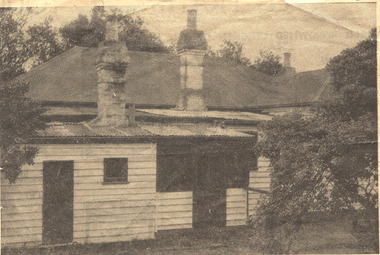
Photograph - Captain Lonsdale's Cottage, At Carrum
... The cottage was built by the Royal Engineers in Sydney and flat packed to Melbourne in 1837, erected at Jolimont. In 1891 the cottage had to be removed to make way for the Jolimont Railway. ...The cottage was built by the Royal Engineers in Sydney and flat packed to Melbourne in 1837, erected at Jolimont. In 1891 the cottage had to be removed to make way for the Jolimont Railway. ...The cottage was built for Captain William Lonsdale (1799-1864), the first Police Magistrate of Melbourne. The cottage was built by the Royal Engineers in Sydney and flat packed to Melbourne in 1837, erected at Jolimont. In 1891 the cottage had to be removed to make way for the Jolimont Railway. It was bought by A. M. Alexander and put up as a beach house in Point Nepean Road (Nepean Highway). In 1959, the cottage was removed from Carrum and was recovered by the National Trust.Newspaper cutting, picture of Captain Lonsdale's Cottage, when it was situated in Point Nepean Road, Carrumcottage, beach house, nepean highway, point nepean road, captain lonsdale, carrum -
 City of Melbourne Libraries
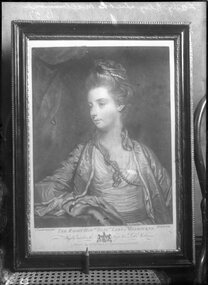
Photograph, Bull, Hugh Jones, 1897-1993, Photo of portrait of Lady Elizabeth Melbourne, 1934
... Research by project volunteer, Fiona Collyer: In 1934, Mr Roger Dolbey of London donated to the City of Melbourne a mezzotint engraving of Lady Melbourne, mother of the British Prime Minister after whom the Victorian capital city of Melbourne was named in 1837. The engraving was created in 1771 by John Finlayson after Sir Joshua Reynolds. ...Research by project volunteer, Fiona Collyer: In 1934, Mr Roger Dolbey of London donated to the City of Melbourne a mezzotint engraving of Lady Melbourne, mother of the British Prime Minister after whom the Victorian capital city of Melbourne was named in 1837. The engraving was created in 1771 by John Finlayson after Sir Joshua Reynolds. ...Published: The Age, 3 October 1934 Published title: CENTENARY GIFT PORTRAIT. Published caption: A reproduction of the attractive portrait of Lady Melbourne, the mother of Lord Melbourne, which has been presented to the City of Melbourne, and will hang in the Lady Mayoress’s room at the Town Hall. Trove article identifier: https://trove.nla.gov.au/newspaper/article/205879945 Description: A framed mezzotint portrait of a young woman gazing towards her right, with her right arm resting on a table. She is wearing an 18th century style dress and jacket trimmed with ermine tails. A string of pearls is entwined in her upswept hair and through a long lock of hair falling over her shoulder then draping across her bodice. The portrait rests on a cane bottomed chair and a pencil holds it in place. Research by project volunteer, Fiona Collyer: In 1934, Mr Roger Dolbey of London donated to the City of Melbourne a mezzotint engraving of Lady Melbourne, mother of the British Prime Minister after whom the Victorian capital city of Melbourne was named in 1837. The engraving was created in 1771 by John Finlayson after Sir Joshua Reynolds. The gift commemorates the centenary of Melbourne. Elizabeth Milbank, Viscountess Melbourne, 1751-1818 was the wife of wealthy Whig politician, Peniston Lamb, 1st Viscount Melbourne. Lady Melbourne was an ambitious political hostess of the Regency period who cultivated beneficial relationships for her husband’s career. She was beautiful and vibrant and men found her easy going, good humoured company. She had many lovers and it is believed that of her nine children, (three of which did not survive childhood) only her first born, Peniston was fathered by her husband. One of her lovers was George, Prince of Wales, later George IV, believed to be the father of her fourth son George and who was his godfather. Lady Melbourne’s second son William Lamb, 2nd Viscount Melbourne, 1779-1848, was British Prime Minister and a close political confidant and father figure to the young Queen Victoria in the early years of her reign. In 1812, his wife Lady Caroline Lamb, 1785-1828, had a torrid and very public affair with poet Lord Bryon who she described as “Mad, bad and dangerous to know”. As a child, Caroline considered being able to wash a dog as one of her most satisfying accomplishments! The portrait hung in the Lady Mayoress’s room at Melbourne Town Hall. References: CENTENARY GIFT PORTRAIT. (1934, October 3). The Age (Melbourne, Vic. : 1854 - 1954), p. 11. Retrieved June 14, 2024, from http://nla.gov.au/nla.news-article205879945 Presentation of Mezzotint of Lady Melbourne (1934, October 2). The Argus (Melbourne, Vic. : 1848 - 1957), p. 10. Retrieved June 14, 2024, from http://nla.gov.au/nla.news-article10961120 NEWS OF THE DAY. (1934, October 2). The Age (Melbourne, Vic. : 1854 - 1954), p. 8. Retrieved June 14, 2024, from http://nla.gov.au/nla.news-article205883518 https://en.wikipedia.org/wiki/Lady_Caroline_LambPhotographer notations on slide: "Lady Elizabeth Melbourne B57".city of melbourne, melbourne town hall, 1930-1939, portraits -
 City of Melbourne Libraries
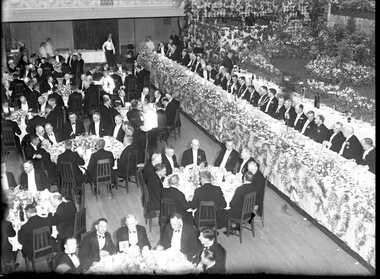
Photograph, Bull, Hugh Jones, 1897-1993, Lord Mayor's Dinner, Melbourne Town Hall
... Hoddle arrived in Australia from the UK in 1823 and went on to carry out surveys in NSW and Queensland before arriving in Melbourne in 1837. He designed layouts for both Melbourne and Williamstown, and later Geelong and other Victorian country areas. ...Hoddle arrived in Australia from the UK in 1823 and went on to carry out surveys in NSW and Queensland before arriving in Melbourne in 1837. He designed layouts for both Melbourne and Williamstown, and later Geelong and other Victorian country areas. ...Photographer notations on slide: "General View Of Lord Mayor's Dinner At Town Hall Nov 1936 B112" Published: The Age, Tuesday 10 November 1936, page 13 Published title: LORD MAYOR'S BANQUET Published caption: The brilliant scene inside the Melbourne Town Hall last night during the Lord Mayor’s banquet. Trove article identifier: http://nla.gov.au/nla.news-article205939431 Description: 700 guests (all men) are seated around numerous tables in the Melbourne Town Hall for the Lord Mayor's dinner in November 1936. Before the stage is a top table of 35 men, all dressed smartly in black dinner suits, with either a black or white bow tie. Many are wearing their medals. The Lord Mayor has on his Mayoral chains, and to his right is the Governor of Victoria, Lord Huntingfield. The stage is heavily decorated with fresh flowers. Research by project volunteer, Louise McKenzie: This image takes up one quarter of the photographic space on page 13 of The Age on 10 November 1936, reflecting the importance of the event and also the sheer dramatics of the image: 700 guests (all men), a top table of 35, and all dressed smartly in black dinner suits, with either a black or white bow tie. Many are wearing their medals. The Lord Mayor has on his Mayoral chains, and to his right is the Governor of Victoria, Lord Huntingfield. Further to his right is a man with an impressive sash across his chest. It is a very animated, and rather informal, moment. Banks of fresh flowers smother the stage, which is decorated in the manner of a terrace at an English stately home. Tables are laden with food, drink and decorations, and the wait staff (men and women) are also formally dressed, in the manner of Downton Abbey. It is spectacular, dramatic, and luxurious, and perpetuates the proud descriptor of “Marvellous Melbourne” as conferred by London Journalist George Augustus Sala when he visited the city in 1885. During its 1880s boom, Melbourne was the second-largest city in the British Empire, after London, and reputedly the richest city in the world. At times the expression was used with some irony, but "...in Victoria’s centenary year, 1934, with the city mired in another depression, a publisher bravely entitled a book of souvenir photographs Marvellous Melbourne, claiming that the subject ‘still finds apt expression in the happy one-time sobriquet’.” This photo seems to reflect an ongoing pride in Melbourne and a desire for it to live up to its descriptor and celebrate its post-centenary era in style. So it is no surprise to find that on page 11 of The Age on the same day, a second photo is to be found – a cropped view of one table – along with a very detailed description of the night, its purpose, and a surprise announcement. But, who was the Lord Mayor in whose honour the dinner was held? In 1934, the Lord Mayor of Melbourne was Cr. Alexander George Wales, (born Richmond, 11 October 1885, died Elsterwick, 31 May 1962). His father was a contractor and quarry-owner, but was blinded in an industrial accident in 1899. Consequently Alexander, then aged 14, left Brunswick State School to become a railway labourer working at a quarry, and in 1903 joined the Commonwealth public service as a clerk and began studying at night school, determined to improve himself. In 1907 he was appointed secretary of the Albion Quarrying Co. (in which the family had an interest), then its managing director and chairman. As the Australian Dictionary of Biography notes, he was instrumental in expanding the company’s interests, "...becoming director of the Hardware Co. of Australia Pty Ltd, the Twentieth Century Building and Investment Society, the Albion Sand Co. and the Geelong Brick Co.”. His public career began in 1914 when he was elected to the Brunswick council. He was mayor 1917-18, and in 1925 progressed to the Melbourne City Council where he remained for 29 years, being a member of most council committees. He served three successive terms as lord mayor (1934-37), was Chairman of the council’s decorations committee for Melbourne’s centenary, president of the Metropolitan Fire Brigades Board (1936), and Chairman of the Public Works Committee (1937-39). In 1936 he was elected to the Legislative Council with United Australia Party support, but later resigned over possible State government contract tender irregularities. Wales received "the customary reward” of a knighthood and was invested at Buckingham Palace by King George VI whose coronation he attended in 1937. He was an early director of what is now Ampol, and helped the development of the petroleum industry in Australia after visiting the USA in 1943 and 1946. He was impressed by that country’s wartime shipbuilding efforts and supported closer ties with the USA. “While president (1947-48) of the Melbourne Chamber of Commerce, Wales was a vocal critic of the Federal Labor Government, ...a staunch anti-socialist ... and a focus for conservative opposition to the Curtin and Chifley governments...” He is described as “a natural leader in business and civic politics,... a powerful force in the Melbourne City Council... opposing democratic reforms such as the creation of a Greater Melbourne Council and the abolition of plural voting, but advocat[ing] the redevelopment of city-owned property like the Eastern and Western markets...” So, this Lord Mayor’s dinner marks the third successive term in office for Governor Cr. A G Wales. The room is filled with powerful and influential men, and provided a platform for the Premier of Victoria, Albert Dunstan (1882-1950, United Country party) to announce that if the City Council would bear half the cost the State Government would build a bridge at Punt Road “at once”. He announced that the Government proposed to have the bridge built by the Country Roads Board, and allow the City Council to pay its share on convenient terms, and further, it would investigate the shared provision of more Yarra bridges. The proposal for the Punt Road Bridge was met with applause as the Yarra River constituted a serious traffic barrier. On 12 November 1936, two days after the Lord Mayor’s dinner, The Age published an article, “Building without a Plan”. It questions the appropriateness of the next Yarra bridge being the one at Punt Road, and encourages a “proper procedure” to look at the provision of additional Yarra bridges as a whole. But in fact this topic had been canvassed back in August when Melbourne City Council’s public works committee had recommended the replacement of the footbridge at Punt Road with a bridge, and if the Country Roads Board would declare this portion of Punt Road, including the river crossing, a State Highway, this could give the Board authority to construct the bridge and allocate the cost. Hence the reference at the dinner to a shared expense. Still an integral part of traffic management today, the Hoddle Bridge carries Punt Road over the Yarra River between Richmond and South Yarra in Melbourne. It is a five-lane road bridge with narrow footpaths on either side. It is of continuous reinforced concrete T-beam construction with five segmental arched spans, supported on transverse piers, and linked by concrete cross-beams. “The piers terminate in a series of tapered concrete pillars with Art Deco-styled steamlined decoration. Each pillar supports a Victorian-style lamp. The infill railings are geometric-patterned painted metal. Construction began in late 1937, and it was opened by Premier Albert Dunstan on 22 December 1938. It replaced an earlier footbridge, which in turn had replaced a punt service. The bridge (originally referred to as Punt Road Bridge) was named after Robert Hoddle, who planned central Melbourne’s Hoddle Grid, the grid of streets which form Melbourne’s central business district. Hoddle arrived in Australia from the UK in 1823 and went on to carry out surveys in NSW and Queensland before arriving in Melbourne in 1837. He designed layouts for both Melbourne and Williamstown, and later Geelong and other Victorian country areas. He was keen that major streets be at least 30 metres wide. ”With remarkable foresight he provided for wide boulevards from the city to the suburbs, but the subdivisions of early speculators in inner suburbs created the bottle-necks of today. After the separation of the colony in 1851, he became Victoria’s first surveyor-general... and advocated the provision of three-chain (60 m) roads and the widening of all existing main roads from one (20 m) to three chains." However, he was met with constant opposition and in 1853, was eased out of office. As a small and interesting aside: Hoddle was appointed auctioneer for the first sale of crown land in Melbourne on 1 June 1837. His commission was 57 pounds 12s 7d. and he bought two allotments for himself at a cost of 54 pounds. After he died his second wife married Richard Buckhurst Buxton, a member of the family which in 1860s Melbourne established the Australian property dynasty of Buxton Real Estate, Becton, MAB Corporation etc. Returning to the dinner and The Age article of 10 November 1836: Another topic of the after-dinner speeches was a reference to the upcoming Armistice Day. “The Minister of Customs (Mr White) said the proximity of Armistice day reminded us that eighteen years ago we had high hopes of prolonged peace.” The term “Armistice Day” was coined after WWI: “At 11 am on 11 November 1918, the guns on the Western Front fell silent after more than four years of continuous warfare. The Germans called for an armistice (suspension of fighting) in order to secure a peace settlement. They accepted the allied terms on unconditional surrender. Therefore on the 11th hour of the 11th day of the 11th month, a minute’s silence is observed and dedicated to those soldiers who died fighting to protect the nation. Originally known as Armistice Day, it was renamed Remembrance Day after World War Two to commemorate those who were killed in both World Wars. Today it refers to the loss of Australian lives from all wars and conflicts, accompanied by the words, "We will remember them, Lest we forget"." There was comment at the dinner about the need to remain firm in supporting the “democratic government in the British Empire to avoid a “plunge into savagery”. There was a grave responsibility on the British people to keep democracy alive, and that could not be done without adequate defence forces... Many weak governments in non-British countries had been swept aside by strong-fisted dictators, who now were the real threat to peace”. With the benefit of hindsight these were very pertinent comments and tragically prophetic. The Melbourne Shrine of Remembrance had only been dedicated two years earlier, at a ceremony attended by the Duke of Gloucester, son of King George V. Over 300,000 citizens attended: one third of the population of Melbourne. It became the location for the Anzac Day Dawn Service. Originally the march travelled from the Shrine into the city, however, in 1936, this was reversed, and the Shrine became the termination point for Anzac Day Marches. Also significant in 1936, was the installation of a statue in the west forecourt of the Shrine: “The Man with the Donkey” (aka 'Private John Simpson and his Little Donkey'). The work is said to represent the “valour and compassion of the Australian soldier”. Its full citation, according to the City of Melbourne City Collection is: West Side of Base: "The / Man with his Donkey / Gallipoli, April 25 to May 19 / in Commemoration / of the valour and compassion / of the Australian Soldier" AFTER LANDING AT GALLIPOLI, SIMPSON, WITH HIS LITTLE DONKEY, WORKED ALONE, DAY AND NIGHT TAKING WATER TO THE FRONT LINE AND CARRYING THE WOUNDED BACK TO THE DRESSING STATIONS. HE AND HIS DONKEY WERE KILLED BY A SHRAPNEL SHELL ON THE 19TH MAY, 1915. SIMPSON WAS MENTIONED IN DISPATCHES BY SIR IAN HAMILTON, COMMANDER-IN-CHIEF OF THE MEDITERRANEAN EXPEDITIONARY FORCE. / Erected by Public Subscription under auspices of the / Red Cross Society. East Side of Base: Private John Simpson." Their summary in background states: "A bronze figure of Simpson and his donkey with a wounded man on the donkey's back on a granite pedestal. Private John Simpson Kirkpatrick’s intrepid and short-lived exploits during the Gallipoli campaign have made him a popular figure of World War One. He has been mythologised to represent the lauded values of the digger, and he symbolises all those who went into battle unarmed. Born in England in 1892, he came to Australia in 1910. He enlisted to make his way back to England, but as a member of the 3rd Field Ambulance AIA was sent to Gallipoli. After just three weeks of bearing wounded soldiers across Shrapnel Gully on the back of his donkey, Simpson was killed by shrapnel fire. Simpson’s story became a powerful propaganda tool for enlistment in Australia, but following the war he was quickly forgotten. With the Shrine of Remembrance nearing completion in 1933, the memory of Simpson was rekindled to commemorate all who gave their lives to help others during the war. One plaque reads: ‘The / Man with his donkey / Gallipoli … / In commemoration / of the valour and compassion / of the Australian soldier’. In 1935, Wallace Anderson’s design for the memorial was selected though a competition organised by the Australian Red Cross. Anderson had served during the war and worked at the Australian War Memorial after his return. His Man with the Donkey was cast in Italy, and after some debate was sited near the shrine. Unveiled 20th June, 1936." The sculptor, Victorian-born William Wallace Anderson (1888-1975), served in France during WWI and afterwards produced a number of bronze war memorials and memorial portraits, predominantly in Victoria. “His most famous work is that of Simpson and his Donkey (1935), which he completed after winning a competition conducted by the Victorian Division of the Australian Red Cross. Anderson’s fee was 350 pounds; the cast, made by the Chiurazzi Foundry, Naples, Italy, cost 40 pounds. The work... has become well known as a symbol of the Anzac tradition.” A debate as to the siting of the statue arose from a strong view expressed by General Sir John Monash that no representation of individual members of the Australian Defence Force be located on the Shrine itself. Hence its location off to the northwest of the forecourt, in a garden of rosemary. And finally we return to the photo of the grand Lord Mayor’s dinner! An article in The Argus of 4 November 1936 refers to “Brilliant Scene at Lord Mayor’s Ball – Hall Becomes a Garden”. So now it becomes clear why the Town Hall, location of the Lord Mayor’s Dinner on 10 November 1934, only 6 days later, is so lavishly decorated. The floral decorations from the Ball are still in place - an early example of “recycling”, which is gratifying to note at a time of Depression. The reporter has captured the scene with enthusiasm: “Hundreds of tiny rose lights, hidden among pink roses, transformed the Melbourne Town Hall into a magical garden last night, when the Lord Mayor and Lady Mayoress (Councillor A. C. Wales, M.L.C., and Mrs. Wales) entertained about 3,500 guests at a ball. His Excellency the Governor (Lord Huntingfield) and Lady Huntingfield were present, while Rear-Admiral and Mrs. Lane Poole and officers from the visiting squadron were among the special guests. The balconies all round the hall were hidden by a white trellis, covered with pink blossoms and greenery. Rosy flowers were issued up every pillar, and great golden lamps, hanging from the door, were seated in greenery and trails of sweet peas. The organ gallery was converted into a terrace garden with stone steps leading to banks of pink azaleas, pink pelargoniums, masses of calceolarias, and the lovely deep mauve and blue of cinerarias. Slender Japanese maples and poplar trees grew from the higher slopes amid thickets of hostas, while a fascinating illusion was created by the lofty conservatory windows, which formed the background, and which were tinted cerulean blue to simulate the sky seen through glass. Large fern baskets hung from the conservatory roof, and the whole scene was enclosed in trellises of blossom. In the entrance palm green shrubs stood like sentinels round the passed floor, and flowers bloomed in misty golds. The long corridor upstairs leading to the council chamber was lined with an avenue of poplar trees in tubs. In the Lower Town Hall great banks of calceolarias and azaleas decked the upper dais, and each supper table was adorned with a different coloured flower with sprays of roses and Japanese maple laid on the snowy cloths. The adjoining supper-rooms were fragrant with the scent of huge bowls of stock in mauve, purple, and pink, while the white walls were covered with palm leaves and flowers. The roof garden below the clock tower was enclosed as a buffet with rose wreathed walls, and flowers were arranged attractively in the Lady Mayoress's rooms." References: LORD MAYOR'S BANQUET. CENTURY MAKERS AT THE M.C.G. BEFORE THE CHANGE. (1936, November 10). The Age (Melbourne, Vic. : 1854 - 1954), p. 13. Retrieved September 4, 2024, from http://nla.gov.au/nla.news-article205939431 'Portrait of Sir George Wales (Lord Mayor 1934-1937)', City Collection, City of Melbourne, https://citycollection.melbourne.vic.gov.au/portrait-of-sir-george-wales-lord-mayor-1934-37/ Graeme Davison, 'Marvellous Melbourne', eMelbourne, https://www.emelbourne.net.au/biogs/EM00906b.htm THE LORD MAYOR'S BANQUET. (1936, November 10). The Age (Melbourne, Vic. : 1854 - 1954), p. 11. Retrieved September 26, 2024, from http://nla.gov.au/nla.news-article205939643 BRILLIANT SCENE AT LORD MAYOR'S BALL Hall Becomes a Garden (1936, November 4). The Argus (Melbourne, Vic. : 1848 - 1957), p. 14. Retrieved September 26, 2024, from http://nla.gov.au/nla.news-article11932746 'Hoddle Bridge', Wikipedia, https://en.wikipedia.org/wiki/Hoddle_Bridge 'Hoddle Bridge', Victorian Heritage Database Report, Victorian Heritage Council, https://vhd.heritagecouncil.vic.gov.au/places/195689/download-report David Dunstan, 'Wales, Sir Alexander George (1885–1962)', Australian Dictionary of Biography, National Centre of Biography, Australian National University, https://adb.anu.edu.au/biography/wales-sir-alexander-george-8951/text15737, published first in hardcopy 1990, accessed online 26 September 2024. Marjorie J. Tipping, 'Hoddle, Robert (1794–1881)', Australian Dictionary of Biography, National Centre of Biography, Australian National University, https://adb.anu.edu.au/biography/hoddle-robert-2190/text2823, published first in hardcopy 1966, accessed online 26 September 2024. BUILDING WITHOUT A PLAN. (1936, November 12). The Age (Melbourne, Vic. : 1854 - 1954), p. 8. Retrieved September 26, 2024, from http://nla.gov.au/nla.news-article205949762 NEW BRIDGE AT PUNT ROAD (1936, August 12). The Argus (Melbourne, Vic. : 1848 - 1957), p. 10. Retrieved September 26, 2024, from http://nla.gov.au/nla.news-article11902131 'The Shrine of Remembrance', Beaconsfield’s Soldiers: https://beaconsfield.org.au/digitalmemorial/shrine-introduction/ 'Shrine of Remembrance', Wikipedia, https://en.wikipedia.org/wiki/Shrine_of_Remembrance Ken Scarlett, 'Anderson, William Wallace (1888–1975)', Australian Dictionary of Biography, National Centre of Biography, Australian National University, https://adb.anu.edu.au/biography/anderson-william-wallace-9362/text16441, published first in hardcopy 1993, accessed online 26 September 2024. 'Man with the Donkey', City Collection, City of Melbourne, https://citycollection.melbourne.vic.gov.au/man-with-the-donkey-aka-private-john-simpson-and-his-little-donkey/ 'Remembrance Day', Australian Army, https://www.army.gov.au/about-us/history-and-research/traditions/remembrance-day Photographer notations on slide: "General View Of Lord Mayor's Dinner At Town Hall Nov 1936 B112".melbourne town hall, mayors, lord mayors, centenaries, bridges, dinners, clothing and dress, festive decorations, dances and balls, eating and drinking, shrine of remembrance, governors, monuments and memorials, 1930-1939, plants -
 Flagstaff Hill Maritime Museum and Village
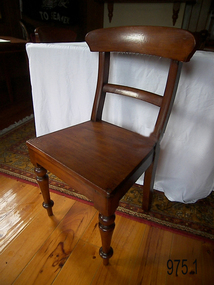
Furniture - Chair, ca. 1944
... Melbourne Board of Management of Missions to Seamen Victoria gave its permission on 21st May 1979 for the entire furnishings of the Williamstown chapel to be transferred to Flagstaff Hill. The St Nicholas Seamen’s Church was officially opened on October 11, 1981, and closely resembles the Williamstown chapel. This chair is historically significant for its origin in the St Nicholas Mission to Seamen's Church in Williamstown, established in 1857 to cater for the physical, social, and spiritual needs of seafarers. The organisation originated in Bristol, England, when a Seamen's Mission was formed in 1837 ...This chair, one of a set of three, was part of the original furnishings of the St Nicholas' Mission to Seamen's Church at 139 Nelson Place, Williamstown, Victoria. The Church was operated by the Mission to Seamen organisation. THE MISSIONS TO SEAMEN (Brief History: for more, see our Reg. No. 611, Set of Pews) The Missions to Seamen was an Anglican charity that served seafarers of the world since 1856 in Great Britain. It symbol is a Flying Angel, inspired by a Bible verse. Today there are centres in over 200 ports worldwide where seamen of all backgrounds are offered a warm welcome and provided with a wide range of facilities. In Victoria, the organisation began in Williamstown in 1857 as a Sailors’ Church, also known as ‘Bethel’ or the ‘Floating Church’ in an old hulk floating in Hobson’s Bay, Port of Melbourne. It soon became part of the Missions to Seamen, Victoria. In the year 2000 the organisation, now named Mission to Seafarers, still operated locally in Melbourne, Portland, Geelong and Hastings. The Ladies’ Harbour Lights Guild was formed in 1906 to support the Missions to Seamen in Melbourne and other centres such as Williamstown. Two of the most significant ladies of the Guild were founder Ethel Augusta Godfrey and foundation member Alice Sibthorpe Tracy (who established a branch of the Guild in Warrnambool in 1920). The Guild continued its work until the 1960s. In 1943 a former Williamstown bank was purchased for the Missions to Seaman Club. The chapel was named St Nicholas’ Seamen’s Church and was supported by the Ladies’ Harbour Lights Guild, the Williamstown Lightkeepers’ Auxiliary and the League of Soldiers’ and Sailors’ Friends. It ceased operation in 1966. A Missions to Seamen Chapel and Recreation Room was a significant feature of ports during the late 1800s and into the 1900s. It seemed appropriate for Flagstaff Hill to include such a representation within the new Maritime Village, so the Melbourne Board of Management of Missions to Seamen Victoria gave its permission on 21st May 1979 for the entire furnishings of the Williamstown chapel to be transferred to Flagstaff Hill. The St Nicholas Seamen’s Church was officially opened on October 11, 1981, and closely resembles the Williamstown chapel. This chair is historically significant for its origin in the St Nicholas Mission to Seamen's Church in Williamstown, established in 1857 to cater for the physical, social, and spiritual needs of seafarers. The organisation originated in Bristol, England, when a Seamen's Mission was formed in 1837. Chair, dark brown wood, curved backrest. One of a set of three. The two front legs are decoratively shaped (turned), while the back legs are plain and flat-sided. It has an almost square flat seat. This chair is part of the St Nicholas Seamen's Church Collection. flagstaff hill maritime museum and village, flagstaff hill, warrnambool, maritime museum, maritime village, shipwreck coast, great ocean road, religion, religious service, st nicholas seamen’s church, williamstown, missions to seamen victoria, chair, religious furniture, dining chair, church furniture, religious worship, anglican church, worship service, mission to seafarers, st nicholas missions to seamen’s church williamstown, missions to seamen, st nicholas missions to seamen’s church flagstaff hill, 139 nelson place williamstown -
 Flagstaff Hill Maritime Museum and Village
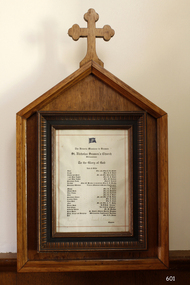
Document - Commemorative, The Victorian Missions to Seamen, St Nicholas Seamen's Church Williamstown, circa 1944
... Melbourne, established in 1857. The document is socially significant as it connects the community of Williamstown with the St Nicholas' Missions to Seamen and represents the importance of the church to the community. The items in our collection from the Missions to Seamen in Williamstown, Victoria, have historical and social significance. They show that people of the 1800s and 1900s cared about the seafarers’ religious, moral, and social welfare, no matter what the religion, social status or nationality. It had its origins in Bristol, England when a Seamen's Mission was formed in 1837 ...This framed document titled "The Victorian Missions to Seamen, St Nicholas Seamen's Church Williamstown" shows a list of donors of significant items to the St Nicholas Missions to Seamen's Church in Williamstown when the new building opened in 1944. The organisation ceased in 1966, and the furnishings were later donated to Flagstaff Hill Maritime Village in Warrnambool by the Missions to Seamen Victoria. The transcription of the document is as follows: The Victoria Missions to Seamen, St Nicholas Seamen's Church, Williamstown To the Glory of God List of Gifts Altar - Mrs. and Miss J.R. Schutt Cross - Mrs. R.J. Ewart Chalice and Paten - Mr. and Mrs. Percy Taylor 1 Pair Altar Lights - Mrs. R.J. Ewart 1 Pair Altar Lights - Mrs. M. Jackson Sanctuary Lamp - Miss C. Roberts Rerebos - Miss. M. Breaks, in memoriam Miss. L.A. Breaks Sanctuary Window - Victoria Missions to Seamen Lightkeepers' Auxiliary Missal - Mrs. R.J. Ewart Missal Desk - Mrs. R. Hodgkiss Altar Vases - Mrs. R. Kaybould Bible - Mrs. R.J. Ewart Sanctuary Chairs - Mr. and Mrs. F.H. Twist Credence Table - Mrs. F. Clark Altar Dish – Mrs L. Clark Font - Mr. and Mrs. C.V. Dyble Prayer Desk - H.M.H.S. "Centaur" Reed Organ - "Joy Club for Fighters" Collection Plates - Mr. D. MacKae Hymn Board - St. David's Musical Society, Brighton Pews, Carpet and Hangings - Williamstown Lightkeepers' Auxiliary Bell - Mrs. A.L. Feenes THE MISSIONS TO SEAMEN (Brief History: for more, see our Reg. No. 611, Set of Pews) The Missions to Seamen, an Anglican charity, has served seafarers of the world since 1856 in Great Britain. It symbol is a Flying Angel, inspired by a Bible verse. Today there are centr4es in over 200 ports world-wide where seamen of all backgrounds are offered a warm welcome and provided with a wide range of facilities. In Victoria the orgainsation began in Williamstown in 1857. It was as a Sailors’ Church, also known as ‘Bethel’ or the ‘Floating Church’. Its location was an old hulk floating in Hobson’s Bay, Port of Melbourne. It soon became part of the Missions to Seamen, Victoria. In the year 2000 the organisation, now named Mission to Seafarers, still operated locally in Melbourne, Portland, Geelong and Hastings. The Ladies’ Harbour Lights Guild was formed in 1906 to support the Missions to Seamen in Melbourne and other centres such as Williamstown. Two of the most significant ladies of the Guild were founder Ethel Augusta Godfrey and foundation member Alice Sibthorpe Tracy (who established a branch of the Guild in Warrnambool in 1920). The Guild continued its work until the 1960s. In 1943 a former Williamstown bank was purchased for the Missions to Seaman Club. The chapel was named St Nicholas’ Seamen’s Church and was supported by the Ladies’ Harbour Lights Guild, the Williamstown Lightkeepers’ Auxiliary and the League of Soldiers’ and Sailors’ Friends. It ceased operation in 1966. A Missions to Seamen Chapel and Recreation Room was a significant feature of ports during the late 1800s and into the 1900s. It seemed appropriate for Flagstaff Hill to include such a representation within the new Maritime Village, so the Melbourne Board of Management of Missions to Seamen Victoria gave its permission on 21st May 1979 for the entire furnishings of the Williamstown chapel to be transferred to Flagstaff Hill. The St Nicholas Seamen’s Church was officially opened on October 11, 1981 and closely resembles the Williamstown chapel. This document is significant through its association with the St Nicholas' Mission to Seamen Church in Williamstown, Melbourne, established in 1857. The document is socially significant as it connects the community of Williamstown with the St Nicholas' Missions to Seamen and represents the importance of the church to the community. The items in our collection from the Missions to Seamen in Williamstown, Victoria, have historical and social significance. They show that people of the 1800s and 1900s cared about the seafarers’ religious, moral, and social welfare, no matter what the religion, social status or nationality. It had its origins in Bristol, England when a Seamen's Mission was formed in 1837. The first Australian branch was started in 1856 by the Rev. Kerr Johnston, a Church of England clergyman, and operated from a hulk moored in Hobson's Bay; later the Mission occupied buildings in Williamstown and Port Melbourne. Document titled "The Victorian Missions to Seamen, St Nicholas Seamen's Church Williamstown". The document is a list of gifts originally given to the St Nicholas Seaman's Church in Williamstown, Victoria. The document is mounted in a decorative wooden frame with glass cover. This is one of the original items in our ‘St Nicholas Seamen's Church Williamstown Collection’.flagstaff hill, warrnambool, shipwrecked-coast, flagstaff-hill, flagstaff-hill-maritime-museum, maritime-museum, shipwreck-coast, flagstaff-hill-maritime-village, framed document, donations to st nicholas seamen's church williamstown, 139 nelson place williamstown, religion, religious service, sailors rest, bethel sailors’ church, bethel floating church, ladies harbour light guild, mission to seafarers, st nicholas seaman’s church williamstown, mission to seamen williamstown, st nicholas seamen’s church flagstaff hill, flying angel club, mrs. and miss j.r. schutt, mrs. r.j. ewart, mr. and mrs. percy taylor, mrs. m. jackson, miss c. roberts, miss. l.a. breaks, miss. m. breaks, victoria missions to seamen lightkeepers' auxiliary, mrs. r. hodgkiss, mrs. r. kaybould, mr. and mrs. f.h. twist, mrs. f. clark, mrs l. clark, mr. and mrs. c.v. dyble, h.m.h.s. "centaur", "joy club for fighters", mr. d. mackae, williamstown lightkeepers' auxiliary, mrs. a.l. feenes, st. david's musical society brighton -
 Flagstaff Hill Maritime Museum and Village
Book - Religious Book, The Book of Common Prayer, 20th century
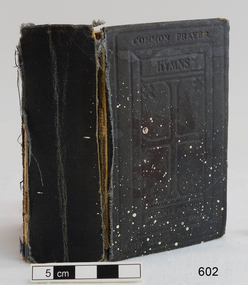
... Melbourne, established in 1857. The items in our collection from the Missions to Seamen in Williamstown, Victoria, have historical and social significance. They show that people of the 1800s and 1900s cared about the seafarers’ religious, moral, and social welfare, no matter what the religion, social status or nationality. It had its origins in Bristol, England when a Seamen's Mission was formed in 1837 ...The Book of Common Prayer is the foundational liturgical text of the Church of England and the broader Anglican Communion. The subject book as a standard 730-page UK edition often printed in the late 19th or early 20th century by major privilege presses like Cambridge University Press, Oxford University Press, or William Clowes & Sons contains the complete 1662 standard text. The volume is structured into distinct sections designed for daily worship, sacramental rites, and personal devotion. There is introductory matter within the text that includes the original prefaces regarding the service of the Church and how the Psalter and Holy Scriptures are ordered to be read. Lectionary and calendar tables are also included as well as lessons for daily Bible readings, rules for determining the date of Easter, and the calendar of Holy Days and saints' days.The Book of Common Prayer. Small book, dark fabric hardcovers, both embossed design on cover incorporating a cross. Owner's name written in black ink inside the cover, also four brown stamps of a cross inside cover. Titled "The Book of Common Prayer and Administration of the Sacraments and other Rules and Ceremonies of the CHURCH according to the use of The Church of England". Printed in Great Britain. Book has 730 numbered pages. Inscribed with a signature inside the front cover as well as brown stamps of images of a cross.. This is one of the original items in our St Nicholas Seamen's Church Williamstown Collection.non-fictionThe Book of Common Prayer is the foundational liturgical text of the Church of England and the broader Anglican Communion. The subject book as a standard 730-page UK edition often printed in the late 19th or early 20th century by major privilege presses like Cambridge University Press, Oxford University Press, or William Clowes & Sons contains the complete 1662 standard text. The volume is structured into distinct sections designed for daily worship, sacramental rites, and personal devotion. There is introductory matter within the text that includes the original prefaces regarding the service of the Church and how the Psalter and Holy Scriptures are ordered to be read. Lectionary and calendar tables are also included as well as lessons for daily Bible readings, rules for determining the date of Easter, and the calendar of Holy Days and saints' days.flagstaff hill, warrnambool, shipwrecked-coast, flagstaff-hill, flagstaff-hill-maritime-museum, maritime-museum, shipwreck-coast, flagstaff-hill-maritime-village, book, prayer book, the book of common prayer, church of england prayer book, anne ambrose, religion, religious service, sailors rest, bethel sailors’ church, bethel floating church, ladies harbour light guild, missions to seamen victoria, mission to seafarers, st nicholas seaman’s church williamstown, st nicholas mission to seamen church williamstown, mission to seamen williamstown, st nicholas seamen’s church flagstaff hill, 139 nelson place williamstown, flying angel club -
 Flagstaff Hill Maritime Museum and Village
Ceremonial object - Font, 1940s
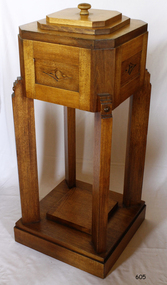
... Melbourne, established in 1857. The collection of items from the Missions to Seamen in Williamstown, Victoria, has historical and social significance. They show that people of the 1800s and 1900s cared about the seafarers’ religious, moral, and social welfare, no matter what their religion, social status or nationality. It had its origins in Bristol, England, when a Seamen's Mission was formed in 1837 ...This font is a piece of church furniture used in a baptism or christening service. It was originally installed in the St Nicholas Seamen's Church at 139 Nelson Place, Williamstown, Victoria. The church was a branch of the Victoria Missions to Seamen. THE MISSIONS TO SEAMEN (Brief History): - The Missions to Seamen was an Anglican charity that has served seafarers of the world since 1856 in Great Britain. Its symbol is a Flying Angel, inspired by a Bible verse. Today, there are centres in over 200 ports worldwide where seamen of all backgrounds are offered a warm welcome and provided with a wide range of facilities. In Victoria, the organisation began in Williamstown in 1857 as a Sailors’ Church, also known as ‘Bethel’ or the ‘Floating Church’ in an old hulk floating in Hobson’s Bay, Port of Melbourne. It soon became part of the Missions to Seamen, Victoria. In the year 2000, the organisation, now named Mission to Seafarers, still operated locally in Melbourne, Portland, Geelong and Hastings. The Ladies’ Harbour Lights Guild was formed in 1906 to support the Missions to Seamen in Melbourne and other centres, such as Williamstown. Two of the most significant ladies of the Guild were founder Ethel Augusta Godfrey and foundation member Alice Sibthorpe Tracy (who established a branch of the Guild in Warrnambool in 1920). The Guild continued its work until the 1960s. In 1943, a former Williamstown bank was purchased for the Missions to Seaman Club. The chapel was named St Nicholas’ Seamen’s Church and was supported by the Ladies’ Harbour Lights Guild, the Williamstown Lightkeepers’ Auxiliary and the League of Soldiers’ and Sailors’ Friends. It ceased operation in 1966. A Missions to Seamen Chapel and Recreation Room was a significant feature of ports during the late 1800s and into the 1900s. It seemed appropriate for Flagstaff Hill to include such a representation within the new Maritime Village, so the Melbourne Board of Management of Missions to Seamen Victoria gave its permission on 21st May 1979 for the entire furnishings of the Williamstown chapel to be transferred to Flagstaff Hill. The St Nicholas Seamen’s Church was officially opened on October 11, 1981, and closely resembles the Williamstown chapel. This font is significant through its association with the St Nicholas' Mission to Seamen Church in Williamstown, Melbourne, established in 1857. The collection of items from the Missions to Seamen in Williamstown, Victoria, has historical and social significance. They show that people of the 1800s and 1900s cared about the seafarers’ religious, moral, and social welfare, no matter what their religion, social status or nationality. It had its origins in Bristol, England, when a Seamen's Mission was formed in 1837. The first Australian branch was started in 1856 by the Rev. Kerr Johnston, a Church of England clergyman, and operated from a hulk moored in Hobson’s Bay; later, the Mission occupied buildings in Williamstown and Port Melbourne. Baptismal font: four-legged, varnished oak wood pedestal supporting a wooden box with a hand-beaten, rolled edge, copper ewer, bowl or basin insert. The box has a removable cover that has a round wooden knob. The sides of the box section have a decorative, diamond-shaped motif. The box and lid are octagonal, with four short sides and four long sides. The tops of the legs have an ornamental design. This is one of the original items in our St Nicholas Seamen's Church Williamstown Collection.flagstaff hill, warrnambool, shipwrecked-coast, flagstaff-hill, flagstaff-hill-maritime-museum, maritime-museum, shipwreck-coast, flagstaff-hill-maritime-village, font, baptisimal font, church furniture, religious ceremony, copper ewet, religious furniture, christening font, religion, religious service, sailors rest, bethel sailors’ church, bethel floating church, ladies harbour light guild, missions to seamen victoria, mission to seafarers, st nicholas seaman’s church williamstown, st nicholas mission to seamen church williamstown, mission to seamen williamstown, st nicholas seamen’s church flagstaff hill, 139 nelson place williamstown, anglican church, flying angel club, copper ewer, copper bowl, flagstaff hill maritime museum and village, maritime museum, maritime village, shipwreck coast, great ocean road, religious worship, worship service, st nicholas seamen’s church, williamstown, st nicholas missions to seamen’s church williamstown, missions to seamen, st nicholas missions to seamen’s church flagstaff hill, baptism, christening, ceremony, tradition, hand-beaten copper ewer -
 Flagstaff Hill Maritime Museum and Village
Furniture - Hymn Board, 1944-1966
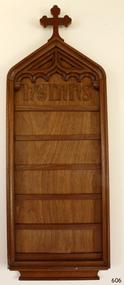
... Melbourne, established in 1857. The items in our collection from the Missions to Seamen in Williamstown, Victoria, have historical and social significance. They show that people of the 1800s and 1900s cared about the seafarers’ religious, moral, and social welfare, no matter what the religion, social status or nationality. It had its origins in Bristol, England when a Seamen's Mission was formed in 1837 ...This hymn board is attached to the wall. Numbers referring to the hymn or hymns for the current religious service would have been placed onto the rails and would be visible to the congregation. It is used for showing the hymn number or numbers that will be sung during the service. This hymn board was part of the original furnishings of the St Nicholas' Mission to Seamen's Church at 139 Nelson Place, Williamstown, Victoria. THE MISSIONS TO SEAMEN (Brief History: for more, see our Reg. No. 611, Set of Pews) The Missions to Seamen, an Anglican charity, has served seafarers of the world since 1856 in Great Britain. It symbol is a Flying Angel, inspired by a Bible verse. Today there are centr4es in over 200 ports world-wide where seamen of all backgrounds are offered a warm welcome and provided with a wide range of facilities. In Victoria the orgainsation began in Williamstown in 1857. It was as a Sailors’ Church, also known as ‘Bethel’ or the ‘Floating Church’. Its location was an old hulk floating in Hobson’s Bay, Port of Melbourne. It soon became part of the Missions to Seamen, Victoria. In the year 2000 the organisation, now named Mission to Seafarers, still operated locally in Melbourne, Portland, Geelong and Hastings. The Ladies’ Harbour Lights Guild was formed in 1906 to support the Missions to Seamen in Melbourne and other centres such as Williamstown. Two of the most significant ladies of the Guild were founder Ethel Augusta Godfrey and foundation member Alice Sibthorpe Tracy (who established a branch of the Guild in Warrnambool in 1920). The Guild continued its work until the 1960s. In 1943 a former Williamstown bank was purchased for the Missions to Seaman Club. The chapel was named St Nicholas’ Seamen’s Church and was supported by the Ladies’ Harbour Lights Guild, the Williamstown Lightkeepers’ Auxiliary and the League of Soldiers’ and Sailors’ Friends. It ceased operation in 1966. A Missions to Seamen Chapel and Recreation Room was a significant feature of ports during the late 1800s and into the 1900s. It seemed appropriate for Flagstaff Hill to include such a representation within the new Maritime Village, so the Melbourne Board of Management of Missions to Seamen Victoria gave its permission on 21st May 1979 for the entire furnishings of the Williamstown chapel to be transferred to Flagstaff Hill. The St Nicholas Seamen’s Church was officially opened on October 11, 1981 and closely resembles the Williamstown chapel. This hymn board is significant through its association with the St Nicholas' Mission to Seamen Church in Williamstown, Melbourne, established in 1857. The items in our collection from the Missions to Seamen in Williamstown, Victoria, have historical and social significance. They show that people of the 1800s and 1900s cared about the seafarers’ religious, moral, and social welfare, no matter what the religion, social status or nationality. It had its origins in Bristol, England when a Seamen's Mission was formed in 1837. The first Australian branch was started in 1856 by the Rev. Kerr Johnston, a Church of England clergyman, and operated from a hulk moored in Hobson’s Bay; later the Mission occupied buildings in Williamstown and Port Melbourne. Hymn board; arch-shaped wooden board with relief decorative wood and decorative cross on top of the peak. The word 'hymns' is raised in decorative wood on the top. The board has six rails. This is one of the original items in our ‘St Nicholas Seamen's Church Williamstown Collection’.Carved into the wood "hymns"flagstaff hill, warrnambool, shipwrecked-coast, flagstaff-hill, flagstaff-hill-maritime-museum, maritime-museum, shipwreck-coast, flagstaff-hill-maritime-village, religion, religious service, sailors rest, bethel sailors’ church, bethel floating church, ladies harbour light guild, missions to seamen victoria, mission to seafarers, st nicholas seaman’s church williamstown, st nicholas mission to seamen church williamstown, mission to seamen williamstown, st nicholas seamen’s church flagstaff hill, 139 nelson place williamstown, church furniture, religious furniture, anglican church, flying angel club, hymn board, song board, religious worship, worship service, worship music -
 Flagstaff Hill Maritime Museum and Village
Artwork, other - Window, Brooks, Robinson & Co, Christ Showing the Helmsman the Way, circa August 1947
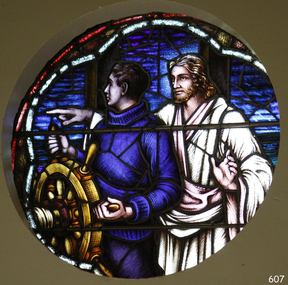
... 1837. The first Australian branch was started in 1856 by the Rev. Kerr Johnston, a Church of England clergyman, and operated from a hulk moored in Hobson’s Bay. Later, the Mission occupied buildings in Williamstown and Port Melbourne ...This round, stained glass window, titled "Christ Showing the Helmsman the Way", was also referred to as the Sanctuary Window or Memorial window. It was installed in the St Nicholas Seamen's Church at 139 Nelson Place, Williamstown, Victoria, inside the chapel above the altar. This memorial window has significance as a part of Victoria's War Heritage and is listed on the Victorian Heritage Database. The window and subsequent plaque were donated to St Nicholas Seamen’s Church as a memorial to the members of the Merchant Navy whose lives were lost in the Second World War, 1939-1945. The donor was the Williamstown Lightkeepers Auxiliary, an independent ladies' association working with the Williamstown Missions to Seamen (the Missions to Seamen organisation was re-named the Mission to Seafarers in the year 2000). The window was officially dedicated on December 14, 1947, by Geelong's Anglican Bishop, Rt. Rev. J.D. McKie. In the early months of 1948, a bronze plaque was also placed in the chapel above the altar. It recognises the lost souls of the Merchant Navy during World War 2, as well as the donor of the window, the Williamstown Lightkeepers Auxiliary. The inscription impressed on the rectangular bronze plaque, 20.4 x 10.2cm, is as follows: “IN MEMORY OF THE MEMBERS OF THE MERCHANT NAVY WHO WERE LOST IN THE SECOND WORLD WAR 1939-1945 FAITHFUL UNTO DEATH. THE WINDOW ABOVE THE ALTAR WAS ERECTED BY THE WILLIAMSTOWN LIGHTKEEPERS AUXILIARY 1947.” The Williamstown St Nicholas Seamen’s Church ceased operation in 1966. In 1979, the Victoria Missions to Seamen donated this round, stained glass window and the memorial plaque to Flagstaff Hill Maritime Village, along with many other items and furnishings. These items have been used to simulate the Williamstown Mission and Chapel as much as possible. The round space that formerly displayed the window can still be seen at the back of the old St Nicholas Seamen’s Church, previously the ES&A bank, in Williamstown. THE MISSIONS TO SEAMEN (Brief History): - The Missions to Seamen was an Anglican charity in Great Britain that has served the world's seafarers since 1856. Its symbol is a Flying Angel, inspired by a Bible verse. Today, there are centres in over 200 ports worldwide where seamen of all backgrounds are offered a warm welcome and provided with a wide range of facilities. In Victoria, the organisation began in Williamstown in 1857 as a Sailors’ Church, also known as ‘Bethel’ or the ‘Floating Church’ in an old hulk floating in Hobson’s Bay, Port of Melbourne. It soon became part of the Missions to Seamen, Victoria. In 2000, the organisation, now named Mission to Seafarers, still operated locally in Melbourne, Portland, Geelong and Hastings. The Ladies’ Harbour Lights Guild was formed in 1906 to support the Missions to Seamen in Melbourne and other centres, such as Williamstown. Two of the most significant ladies of the Guild were founder Ethel Augusta Godfrey and foundation member Alice Sibthorpe Tracy (who established a branch of the Guild in Warrnambool in 1920). The Guild continued its work until the 1960s. In 1943, a former Williamstown bank was purchased for the Missions to Seamen Club. The chapel was named St Nicholas’ Seamen’s Church and was supported by the Ladies’ Harbour Lights Guild, the Williamstown Lightkeepers’ Auxiliary and the League of Soldiers’ and Sailors’ Friends. It ceased operation in 1966. A Missions to Seamen Chapel and Recreation Room was a significant feature of ports during the late 1800s and 1900s. It seemed appropriate for Flagstaff Hill to include such a representation within the new Maritime Village, and the Melbourne Board of Management of Missions to Seamen Victoria gave its permission on 21st May 1979 for the entire furnishings of the Williamstown chapel to be transferred to Flagstaff Hill. The St Nicholas Seamen’s Church was officially opened on October 11, 1981, and resembles the Williamstown chapel. This stained glass window is historically significant for its connection to the St Nicholas Mission to Seamen's Church in Williamstown, established in 1857 to cater for the physical, social, and spiritual needs of seafarers. It was donated to the Mission by the Lightkeepers Auxiliary (Ladies Harbour Lights Guild, which was formed in 1905). The Missions to Seamen organisation had its origins in Bristol, England, when a Seamen's Mission was formed in 1837. The first Australian branch was started in 1856 by the Rev. Kerr Johnston, a Church of England clergyman, and operated from a hulk moored in Hobson’s Bay. Later, the Mission occupied buildings in Williamstown and Port Melbourne. The connection of this window, the Mission to Seamen and the Ladies Harbour Lights Guild highlights the strong community awareness of the life of people at sea, their dangers and hardships, and their need for physical, financial, spiritual and moral support. This memorial window is significant as a part of Victoria's War Heritage and is listed on the Victorian Heritage Database, Heritage Number 196973.Window, stained glass, circular, with reinforcing bars. The window represents Christ showing the helmsman the way. It shows a man in blue knitted jumper holding onto a ship's wheel, looking over his right shoulder. Behind him stands a man in a white robe, pointing to his right and looking to his left, his left hand gesturing to pause. The background has various shapes and patterns of blue glass, bordered by two arcs; the outer one is white, the inner one is red. This beautiful window is in our St Nicholas Seamen's Church Collection and was brought to Warrnambool from the original St Nicholas Seamen’s Church in Williamstown. flagstaff hill, warrnambool, shipwrecked coast, flagstaff hill maritime museum, maritime museum, shipwreck coast, flagstaff hill maritime village, great ocean road, mission to seamen williamstown, st nicholas seaman’s church williamstown, missions to seamen victoria, mission to seafarers, lightkeepers auxiliary, ladies harbour light guild, 139 nelson place williamstown, religion, religious service, sailors rest, bethel sailors’ church, bethel floating church, e. s. & a. bank williamstown, christ directing a sailor, christ showing the helmsman the way, quartermaster’s hand on the wheel, stained glass window, church window, religious window, sanctuary window, memorial window, war memorial window, victorian war heritage inventory, victorian heritage database, merchant navy ww2, 1939-1945, anglican church, bishop mckie, mrs musther, brooks robinson & co, flying angel club, williamstown lightkeepers' auxiliary, ladies' harbour lights guild, commemorative window -
 Flagstaff Hill Maritime Museum and Village
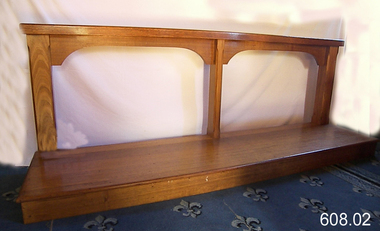
Furniture - Rail and Base, circa 1944
... Melbourne, established in 1857. The items in our collection from the Missions to Seamen in Williamstown, Victoria, have historical and social significance. They show that people of the 1800s and 1900s cared about the seafarers’ religious, moral, and social welfare, no matter what the religion, social status or nationality. It had its origins in Bristol, England when a Seamen's Mission was formed in 1837 ...This is one of a pair of kneeling rails that were part of the original furnishings of the St Nicholas Mission to Seamen's Church at 139 Nelson Place, Williamstown, Victoria. A kneeling rail is a part of the church's furniture and is used during religious prayer to assist the person in assuming the kneeling position. A padded kneeling mat or cushion would also be provided for comfort. THE MISSIONS TO SEAMEN (Brief History): - The Missions to Seamen was an Anglican charity in Great Britain that has served the world's seafarers since 1856. Its symbol is a Flying Angel, inspired by a Bible verse. Today, there are centres in over 200 ports worldwide where seamen of all backgrounds are offered a warm welcome and provided with a wide range of facilities. In Victoria, the organisation began in Williamstown in 1857 as a Sailors’ Church, also known as ‘Bethel’ or the ‘Floating Church’ in an old hulk floating in Hobson’s Bay, Port of Melbourne. It soon became part of the Missions to Seamen, Victoria. In 2000, the organisation, now named Mission to Seafarers, still operated locally in Melbourne, Portland, Geelong and Hastings. The Ladies’ Harbour Lights Guild was formed in 1906 to support the Missions to Seamen in Melbourne and other centres, such as Williamstown. Two of the most significant ladies of the Guild were founder Ethel Augusta Godfrey and foundation member Alice Sibthorpe Tracy (who established a branch of the Guild in Warrnambool in 1920). The Guild continued its work until the 1960s. In 1943, a former Williamstown bank was purchased for the Missions to Seamen Club. The chapel was named St Nicholas’ Seamen’s Church and was supported by the Ladies’ Harbour Lights Guild, the Williamstown Lightkeepers’ Auxiliary and the League of Soldiers’ and Sailors’ Friends. It ceased operation in 1966. A Missions to Seamen Chapel and Recreation Room was a significant feature of ports during the late 1800s and 1900s. It seemed appropriate for Flagstaff Hill to include such a representation within the new Maritime Village, and the Melbourne Board of Management of Missions to Seamen Victoria gave its permission on 21st May 1979 for the entire furnishings of the Williamstown chapel to be transferred to Flagstaff Hill. The St Nicholas Seamen’s Church was officially opened on October 11, 1981, and resembles the Williamstown chapel. This pair of kneeling rails is significant through its association with the St Nicholas' Mission to Seamen Church in Williamstown, Melbourne, established in 1857. The items in our collection from the Missions to Seamen in Williamstown, Victoria, have historical and social significance. They show that people of the 1800s and 1900s cared about the seafarers’ religious, moral, and social welfare, no matter what the religion, social status or nationality. It had its origins in Bristol, England when a Seamen's Mission was formed in 1837. The first Australian branch was started in 1856 by the Rev. Kerr Johnston, a Church of England clergyman, and operated from a hulk moored in Hobson’s Bay; later the Mission occupied buildings in Williamstown and Port Melbourne. Rail and base, one of a pair of two kneeling rails. Three varnished wood pillars and cap rail, mounted on a rectangular box-shaped base: a kneeling rail is used in religious worship. These kneeling rails are part of the St Nicholas Seamen's Church Williamstown Collection.flagstaff hill, warrnambool, shipwrecked-coast, flagstaff-hill, flagstaff-hill-maritime-museum, maritime-museum, shipwreck-coast, flagstaff-hill-maritime-village, rail for kneeling, rail, kneeling rail, religion, religious service, sailors rest, bethel sailors’ church, bethel floating church, ladies harbour light guild, missions to seamen victoria, mission to seafarers, st nicholas seaman’s church williamstown, st nicholas mission to seamen church williamstown, mission to seamen williamstown, st nicholas seamen’s church flagstaff hill, 139 nelson place williamstown, church furniture, religious furniture, religious worship, flying angel club, altar rail, kneeler, prayer, ceremonial furniture -
 Flagstaff Hill Maritime Museum and Village
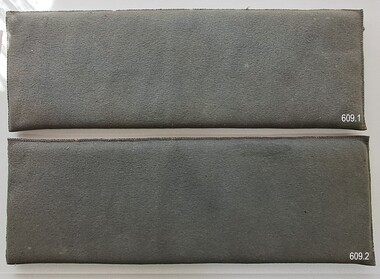
Ceremonial object - Kneeling Mat, ca. 1944
... Melbourne Board of Management of Missions to Seamen Victoria gave its permission on 21st May 1979 for the entire furnishings of the Williamstown chapel to be transferred to Flagstaff Hill. The St Nicholas Seamen’s Church was officially opened on October 11, 1981, and closely resembles the Williamstown chapel. This pair of kneeling mats is historically significant for its origin in the St Nicholas Mission to Seamen's Church in Williamstown, established in 1857 to cater for seafarers’ physical, social, and spiritual needs. The organisation originated in Bristol, England, when a Seamen's Mission was formed in 1837 ...This pair of comfortable kneeling mats is from the original furnishings of St Nicholas Seamen's Church, Williamstown, operated by the Williamstown Missions to Seamen organisation. THE MISSIONS TO SEAMEN (Brief History): - The Missions to Seamen was an Anglican charity that has served seafarers of the world since 1856 in Great Britain. Its symbol is a Flying Angel, inspired by a Bible verse. Today, there are centres in over 200 ports worldwide where seamen of all backgrounds are offered a warm welcome and provided with a wide range of facilities. In Victoria, the organisation began in Williamstown in 1857 as a Sailors’ Church, also known as ‘Bethel’ or the ‘Floating Church’ in an old hulk floating in Hobson’s Bay, Port of Melbourne. It soon became part of the Missions to Seamen, Victoria. In the year 2000, the organisation, now named Mission to Seafarers, still operated locally in Melbourne, Portland, Geelong and Hastings. The Ladies’ Harbour Lights Guild was formed in 1906 to support the Missions to Seamen in Melbourne and other centres, such as Williamstown. Two of the most significant ladies of the Guild were founder Ethel Augusta Godfrey and foundation member Alice Sibthorpe Tracy (who established a branch of the Guild in Warrnambool in 1920). The Guild continued its work until the 1960s. In 1943, a former Williamstown bank was purchased for the Missions to Seaman Club. The chapel was named St Nicholas’ Seamen’s Church and was supported by the Ladies’ Harbour Lights Guild, the Williamstown Lightkeepers’ Auxiliary and the League of Soldiers’ and Sailors’ Friends. It ceased operation in 1966. A Missions to Seamen Chapel and Recreation Room was a significant feature of ports during the late 1800s and into the 1900s. It seemed appropriate for Flagstaff Hill to include such a representation within the new Maritime Village, so the Melbourne Board of Management of Missions to Seamen Victoria gave its permission on 21st May 1979 for the entire furnishings of the Williamstown chapel to be transferred to Flagstaff Hill. The St Nicholas Seamen’s Church was officially opened on October 11, 1981, and closely resembles the Williamstown chapel. This pair of kneeling mats is historically significant for its origin in the St Nicholas Mission to Seamen's Church in Williamstown, established in 1857 to cater for seafarers’ physical, social, and spiritual needs. The organisation originated in Bristol, England, when a Seamen's Mission was formed in 1837. Mat, quantity of two. Kneeling mats used during prayer. Mats are rectangular and made of blue cloth with sewn edges and padding inside. The mats are part of the St. Nicholas Seamen's Church Williamstown Collection.flagstaff hill, warrnambool, shipwrecked coast, flagstaff hill maritime museum, maritime museum, shipwreck coast, flagstaff hill maritime village, great ocean road, religion, religious service, sailors rest, bethel sailors’ church, bethel floating church, ladies harbour light guild, lightkeepers’ auxiliary, missions to seamen victoria, mission to seafarers, flying angel’s club, st nicholas seaman’s church williamstown, st nicholas mission to seamen church williamstown, mission to seamen williamstown, st nicholas seamen’s church flagstaff hill, 139 nelson place williamstown, religious worship, anglican church, prayer accessory, kneeling mat, prayer mat, religious custom, religious tradition -
 Flagstaff Hill Maritime Museum and Village
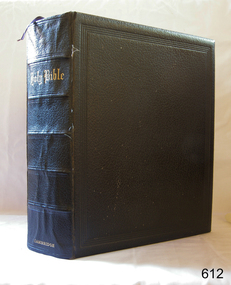
Book - Religious Book, Cambridge University Press, The Holy Bible containing the Old and New Testaments, circa 1942
... Melbourne Board of Management of Missions to Seamen Victoria gave its permission on 21st May 1979 for the entire furnishings of the Williamstown chapel to be transferred to Flagstaff Hill. The St Nicholas Seamen’s Church was officially opened on October 11, 1981, and resembles the Williamstown chapel. This Bible is significant historically for its origin in the St Nicholas Mission to Seamen's Church in Williamstown, established in 1857 to cater for the physical, social, and spiritual needs of seafarers. It originated in Bristol, England when a Seamen's Mission was formed in 1837 ...Book with black textured leather cover, ribbed spine, gold embossed letters, and logo on spine. Titled The Holy Bible containing the Old and New Testaments. The inside section has a list of signatures (after page 872). An inscription is written inside the front opening and three pages of inscriptions within the pages. The book was presented by R.J. Ewart in 1942. The book now forms part of the St. Nicholas Seamen's Church Collection. flagstaff hill, warrnambool, shipwrecked-coast, flagstaff-hill, flagstaff-hill-maritime-museum, maritime-museum, shipwreck-coast, flagstaff-hill-maritime-village, the holy bible containing the old and new testaments, book, bible, the bible, r j ewart, cambridge bible, holy bible, st nicholas seamen’s church williamstown, centaur, pembena, jolten, kooringa, niriana, hobart -
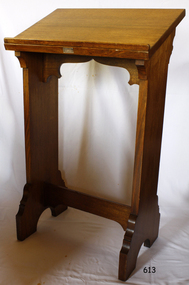 Flagstaff Hill Maritime Museum and Village
Furniture - Missal Lectern
... Melbourne Board of Management of Missions to Seamen Victoria gave its permission on 21st May 1979 for the entire furnishings of the Williamstown chapel to be transferred to Flagstaff Hill. The St Nicholas Seamen’s Church was officially opened on October 11, 1981, and closely resembles the Williamstown chapel. This Missal lectern is historically significant for its origin in the St Nicholas Mission to Seamen's Church in Williamstown, established in 1857 to cater for seafarers' physical, social, and spiritual needs. It originated in Bristol, England, when a Seamen's Mission was formed in 1837 ...The Missal lectern was part of the original furnishings of St Nicholas Seamen's Church, Williamstown, Victoria, and was donated by Mrs R J Eward for use in the religious services there. The church was operated by the Williamstown Missions to Seamen organisation. THE MISSIONS TO SEAMEN (Brief History): - The Missions to Seamen was an Anglican charity in Great Britain that has served the world's seafarers since 1856. Its symbol is a Flying Angel, inspired by a Bible verse. Today, there are centres in over 200 ports worldwide where seamen of all backgrounds are offered a warm welcome and provided with a wide range of facilities. In Victoria, the organisation began in Williamstown in 1857 as a Sailors’ Church, also known as ‘Bethel’ or the ‘Floating Church’ in an old hulk floating in Hobson’s Bay, Port of Melbourne. It soon became part of the Missions to Seamen, Victoria. In the year 2000, the organisation, now named Mission to Seafarers, still operated locally in Melbourne, Portland, Geelong and Hastings. The Ladies’ Harbour Lights Guild was formed in 1906 to support the Missions to Seamen in Melbourne and other centres, such as Williamstown. Two of the most significant ladies of the Guild were founder Ethel Augusta Godfrey and foundation member Alice Sibthorpe Tracy (who established a branch of the Guild in Warrnambool in 1920). The Guild continued its work until the 1960s. In 1943, a former Williamstown bank was purchased for the Missions to Seaman Club. The chapel was named St Nicholas’ Seamen’s Church and was supported by the Ladies’ Harbour Lights Guild, the Williamstown Lightkeepers’ Auxiliary and the League of Soldiers’ and Sailors’ Friends. It ceased operation in 1966. A Missions to Seamen Chapel and Recreation Room was a significant feature of ports during the late 1800s and into the 1900s. It seemed appropriate for Flagstaff Hill to include such a representation within the new Maritime Village, so the Melbourne Board of Management of Missions to Seamen Victoria gave its permission on 21st May 1979 for the entire furnishings of the Williamstown chapel to be transferred to Flagstaff Hill. The St Nicholas Seamen’s Church was officially opened on October 11, 1981, and closely resembles the Williamstown chapel. This Missal lectern is historically significant for its origin in the St Nicholas Mission to Seamen's Church in Williamstown, established in 1857 to cater for seafarers' physical, social, and spiritual needs. It originated in Bristol, England, when a Seamen's Mission was formed in 1837. It is also an example of a community-supported local charity organisation.Solid wooden Missal Lectern on two supporting legs. The top section has an angled back and a small shelf at the front, designed to support a bible. The two legs, with decorative feet, are supported by the decorative wooden bar. There appears to be a rectangular label in the centre front of the small shelf. This lectern is part of the St. Nicholas Seamen's Church Collection. flagstaff hill, warrnambool, shipwrecked coast, flagstaff hill maritime museum, maritime museum, shipwreck coast, flagstaff hill maritime village, great ocean road, religion, religious service, church furniture, religious furniture, lectern, preaching equipment, missal lectern, bible support, music stand -
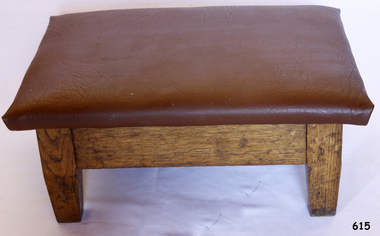 Flagstaff Hill Maritime Museum and Village
Furniture - Stool, ca. 1944
... Melbourne Board of Management of Missions to Seamen Victoria gave its permission on 21st May 1979 for the entire furnishings of the Williamstown chapel to be transferred to Flagstaff Hill. The St Nicholas Seamen’s Church was officially opened on October 11, 1981, and resembles the Williamstown chapel. This kneeling stool is significant historically for its origin in the St Nicholas Mission to Seamen's Church in Williamstown, established in 1857 to cater for the physical, social, and spiritual needs of seafarers. The Church originated in Bristol, England when a Seamen's Mission was formed in 1837 ...This low kneeling stool was used for prayer and was part of the original furnishings of the St Nicholas' Mission to Seamen's Church at 139 Nelson Place, Williamstown, Victoria. The Church was operated by the Mission to Seamen organisation. THE MISSIONS TO SEAMEN (Brief History): - The Missions to Seamen was an Anglican charity in Great Britain that has served the world's seafarers since 1856. Its symbol is a Flying Angel, inspired by a Bible verse. Today, there are centres in over 200 ports worldwide where seamen of all backgrounds are offered a warm welcome and provided with a wide range of facilities. In Victoria, the organisation began in Williamstown in 1857 as a Sailors’ Church, also known as ‘Bethel’ or the ‘Floating Church’ in an old hulk floating in Hobson’s Bay, Port of Melbourne. It soon became part of the Missions to Seamen, Victoria. In 2000, the organisation, now named Mission to Seafarers, still operated locally in Melbourne, Portland, Geelong and Hastings. The Ladies’ Harbour Lights Guild was formed in 1906 to support the Missions to Seamen in Melbourne and other centres, such as Williamstown. Two of the most significant ladies of the Guild were founder Ethel Augusta Godfrey and foundation member Alice Sibthorpe Tracy (who established a branch of the Guild in Warrnambool in 1920). The Guild continued its work until the 1960s. In 1943, a former Williamstown bank was purchased for the Missions to Seamen Club. The chapel was named St Nicholas’ Seamen’s Church and was supported by the Ladies’ Harbour Lights Guild, the Williamstown Lightkeepers’ Auxiliary and the League of Soldiers’ and Sailors’ Friends. It ceased operation in 1966. A Missions to Seamen Chapel and Recreation Room was a significant feature of ports during the late 1800s and 1900s. It seemed appropriate for Flagstaff Hill to include such a representation within the new Maritime Village, and the Melbourne Board of Management of Missions to Seamen Victoria gave its permission on 21st May 1979 for the entire furnishings of the Williamstown chapel to be transferred to Flagstaff Hill. The St Nicholas Seamen’s Church was officially opened on October 11, 1981, and resembles the Williamstown chapel. This kneeling stool is significant historically for its origin in the St Nicholas Mission to Seamen's Church in Williamstown, established in 1857 to cater for the physical, social, and spiritual needs of seafarers. The Church originated in Bristol, England when a Seamen's Mission was formed in 1837. The stool is historically significant for its connection to the Ladies Lightkeepers’ Auxiliary, an organisation of women, formed to support seafarers. The connection of this stool to the Mission to Seamen and to the Ladies Lightkeepers’ Auxiliary highlights the strong community awareness of the life of people at sea, their dangers and hardships, and their need for physical, financial, spiritual and moral support. Stool; kneeling stool with textured vinyl cover and wooden base, with 4 wooden legs. The stool is part of the St Nicholas Mission to Seamen's Collection.flagstaff hill maritime museum and village, flagstaff hill, warrnambool, maritime museum, maritime village, shipwreck coast, great ocean road, religion, religious service, prayer, church furniture, prayer stool, worship -
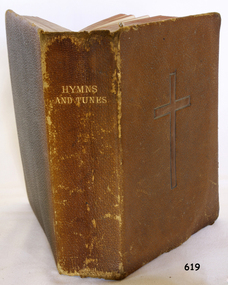 Flagstaff Hill Maritime Museum and Village
Book - Religious Book, William Clowes & Sons, Limited, Hymns Ancient and Modern, bef. Sept 8th 1884
... Melbourne Board of Management of Missions to Seamen Victoria gave its permission on 21st May 1979 for the entire furnishings of the Williamstown chapel to be transferred to Flagstaff Hill. The St Nicholas Seamen’s Church was officially opened on October 11, 1981, and closely resembles the Williamstown chapel. This hymn book is significant historically for its origin in the St Nicholas Mission to Seamen's Church in Williamstown, established in 1857 to cater for the physical, social, and spiritual needs of seafarers. It originated in Bristol, England when a Seamen's Mission was formed in 1837 ...The brown leather-covered bound book has an embossed inscription on the spine and an impressed cross symbol on the front cover. It has red leaf pages (681 pages). The music and words were compiled and arranged by editor William Henry Monk, and published in London. This Revised and Enlarged edition was printed in London by William Clowes & Sons Ltd. The book's title is "Hymns Ancient and Modern". The inscription shows it was given as a gift in 1884. It has since been added to our St Nicholas Seamen's Church Collection. flagstaff hill maritime museum and village, flagstaff hill, warrnambool, maritime museum, maritime village, shipwreck coast, great ocean road, religion, religious service, st nicholas seamen’s church, williamstown, missions to seamen victoria, worship service, worship music, hymn book, music book, william clowes and sons, st nicholas seamen's church, london, hymns ancient and modern, revised and enlarged edition, 1884
