
Showing 230 items matching "melbourne australia badge"
-
 Charlton Golden Grains Museum Inc
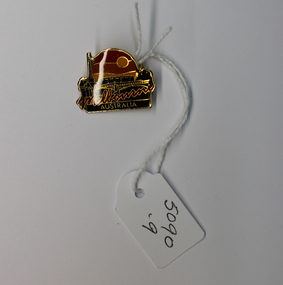
Badge - Melbourne Australia Badge
... Melbourne Australia Badge......Melbourne Australia badge...Gold pin clasp at back with safety catch. Badge Melbourne Australia Badge ...Josephine Ryan (a Charlton resident) was a Lions Youth Exchange Student to New York State in 1989.Gold toned metal souvenir lapel pin featuring a red and sunset skyline above the word "Melbourne" in red script and "AUSTRALIA" in gold letters. Gold pin clasp at back with safety catch.On back : COPYRIGHTjosephine ryan, lions youth exchange, charlton lions exchange 1989, noreen ryan, melbourne australia badge -
 Mission to Seafarers Victoria
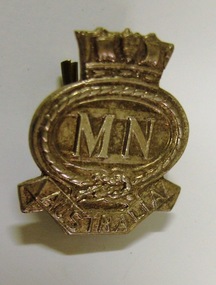
Badge, Wallace Bishop, MN Australia, circa 1940
... WW2 Merchant Navy Australia, issued by the Commonwealth Government 1940 MN War Service officially-numbered silver lapel badge. A company called Bishop also manufactured badges in Melbourne ....WW2 Merchant Navy Australia, issued by the Commonwealth Government 1940 MN War Service officially-numbered silver lapel badge. A company called Bishop also manufactured badges in Melbourne . ...WW2 Merchant Navy Australia, issued by the Commonwealth Government 1940 MN War Service officially-numbered silver lapel badge. A company called Bishop also manufactured badges in Melbourne .Intended as a form of service badge for Australian Merchant Seafarers especially those perhaps serving on the newly armed civilian craft. The term Merchant Navy was coined by King George V in 1919, as recognition of the sacrifice made by merchant seafarers during the First World War.WW2 Merchant Navy war service solid (silver) badge. Initials ‘MN’ enclosed by oval rope motif with crown above. The word ‘Australia’ (UC) displayed beneath. Retains original two-loop lapel fixtures. Officially-numbered 10910 on the back. Inscribed "issued by the Commonwealth Government 1940". "Wallace-Bishop Brisbane".ww2, merchant navy, commonwealth government 1940, badge, war service, australia, mn -
 Frankston RSL Sub Branch
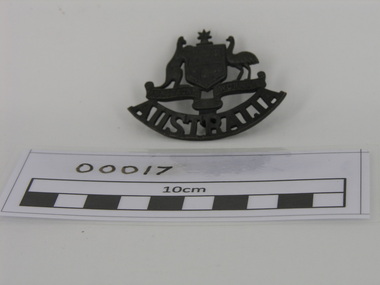
Badge, Sokes and Sons
... munitions worker badge metal Australian coat of arms, munitions worker, Australia, issued by Department of Defence (reverse),Stokes and Sons Melbourne (reverse), 357 badge Badge Sokes and Sons ...badgeAustralian coat of arms, munitions worker, Australia, issued by Department of Defence (reverse),Stokes and Sons Melbourne (reverse), 357munitions worker badge, metal -
 Frankston RSL Sub Branch
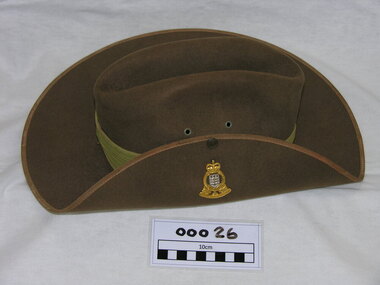
Hat, Felt, United Felt Hats Pty Ltd, 1953 (exact)
... "FAYREFIELD" made by United Felt Hats Pty Ltd Melbourne, 7 1/4, 1953 on inside hat band; Honi Soit Qui Mal Y Pense, Royal Australian Ordinance Corps on badge...slouch hat binding edge broken chin strap 7 fold puggaree royal australian ordinance corps badge "FAYREFIELD" made by United Felt Hats Pty Ltd Melbourne, 7 1/4, 1953 on inside hat band; Honi Soit Qui Mal Y Pense, Royal Australian Ordinance Corps on badge A 1953 felt fur slouch hat, binding edge, press stud, 7 fold puggaree, Royal Australian Ordinance Corps badge Hat, Felt United Felt Hats Pty Ltd ...A 1953 felt fur slouch hat, binding edge, press stud, 7 fold puggaree, Royal Australian Ordinance Corps badge"FAYREFIELD" made by United Felt Hats Pty Ltd Melbourne, 7 1/4, 1953 on inside hat band; Honi Soit Qui Mal Y Pense, Royal Australian Ordinance Corps on badgeslouch hat, binding edge, broken chin strap, 7 fold puggaree, royal australian ordinance corps badge -
 Ballarat and Queen's Anglican Grammar School
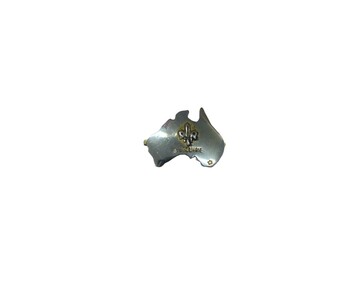
Badge, Scouts metal badge
... scouts metal badge in the shape of Australia with trefoil in centre with MELBOURNE underneath, possibly silver and gold plated...melbourne badge scouts trefoil MELBOURNE scouts metal badge in the shape of Australia with trefoil in centre with MELBOURNE underneath, possibly silver and gold plated Scouts metal badge Badge Badge ...scouts metal badge in the shape of Australia with trefoil in centre with MELBOURNE underneath, possibly silver and gold platedMELBOURNEmelbourne, badge, scouts, trefoil -
 Lara RSL Sub Branch
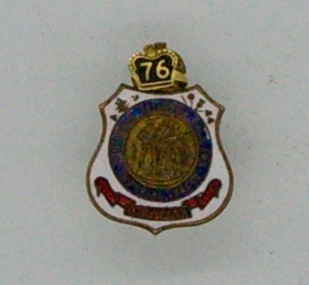
Returned Sailor's & Soldier's Imperial League (RSSILA) membership badge
... badge is a red enamelled scroll with 'AUSTRALIA' written in gilt lettering. On the reverse of the badge are soldered two brass lugs with a split pin attached for securing the badge to clothing. Stamped at the top of the badge is 'COPYRIGHT' and at the bottom of the badge is impressed V40289 and the maker's details 'STOKES & SONS MELBOURNE'....Australia (RSL) was formed in June 1916. Badges, World War One Lapel Badge,Lara R.S.L.Returned Sailor's & Soldier's Imperial League (RSSILA) membership badge Returned Sailors and Soldiers Imperial League Australia.Stamped on the reverse of the badge is 'COPYRIGHT' and at the bottom of the badge is impressedV40289and the maker's details 'STOKES & SONS MELBOURNE'. ...The League evolved out of concern for the welfare of returned servicemen from the First World War. In 1916, a conference recommended the formation of The Returned Sailors and Soldiers Imperial League of Australia, which included representation from Queensland, South Australia, Tasmania and Victoria. New South Wales was admitted to the League the following year, Western Australia in 1918. In 1927, the Australian Capital Territory formed a branch and was admitted. The Returned Sailors’ and Soldiers’ Imperial League of Australia (RSSILA) the forerunner of today’s Returned and Services League of Australia (RSL) was formed in June 1916.Returned Sailors and Soldiers Imperial League of Australia Badge. The centre of the badge shows a sailor and a soldier in raised detail. A blue enamel circle surrounds the central detail and has 'RETURNED SAILORS & SOLDIERS / IMPERIAL LEAGUE' in gilt lettering. The outer edges of the badge are white enamel with a floral spray to the top left and right of the blue circle. At the bottom of the badge is a red enamelled scroll with 'AUSTRALIA' written in gilt lettering. On the reverse of the badge are soldered two brass lugs with a split pin attached for securing the badge to clothing. Stamped at the top of the badge is 'COPYRIGHT' and at the bottom of the badge is impressed V40289 and the maker's details 'STOKES & SONS MELBOURNE'.Returned Sailors and Soldiers Imperial League Australia.Stamped on the reverse of the badge is 'COPYRIGHT' and at the bottom of the badge is impressedV40289and the maker's details 'STOKES & SONS MELBOURNE'.badges, world war one lapel badge,lara r.s.l.returned sailor's & soldier's imperial league (rssila) membership badge -
 Lara RSL Sub Branch
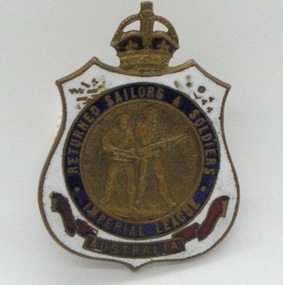
Metal Badge, RSSI.A. Lapel badge. 1918
... Australia 1918.(front) 53212 & Stokes and sons Melbourne (reverse) coated metal with painted surface RSSI.A. Lapel badge ...coated metal with painted surfaceReturned Sailors & (reverse) Soldiers Imperial League Australia 1918.(front) 53212 & Stokes and sons Melbourne (reverse) -
 Lara RSL Sub Branch
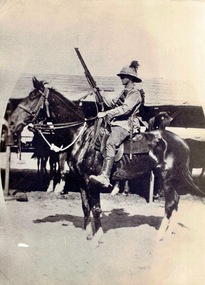
Service Gear, Trooper Patrick Nolan, Picture on his horse "Jack Ordeal" with his googles, stirrups, Registration of membership to R. S..S. I. L .A. dated 6/2/1917, badge "Rising Sun"
... badge "Raising Sun, Registration of membership to R. S..S. I. L .A. dated 6/2/1917. Patrick Nolan Joined as a labourer aged 21 on 5/8/1915. Attached to Reinforcements, the 8th Australian Light Horse. Also known as Maygar's Boys. Suffering shell shock and deafness at Bir El Abd, Sinai, 8/9/1916. Discharged in Melbourne...badge "Raising Sun, Registration of membership to R. S..S. I. L .A. dated 6/2/1917. Patrick Nolan Joined as a labourer aged 21 on 5/8/1915. Attached to Reinforcements, the 8th Australian Light Horse. Also known as Maygar's Boys. Suffering shell shock and deafness at Bir El Abd, Sinai, 8/9/1916. Discharged in Melbourne ...Details relating to Trooper Patrick NolanWW1 8th Light HorsePhotograph of Trooper Patrick Nolan on his horse "Jack Ordeal" taken at Port Said. Accompanied by items: stirrups, badge "Raising Sun, Registration of membership to R. S..S. I. L .A. dated 6/2/1917. Patrick Nolan Joined as a labourer aged 21 on 5/8/1915. Attached to Reinforcements, the 8th Australian Light Horse. Also known as Maygar's Boys. Suffering shell shock and deafness at Bir El Abd, Sinai, 8/9/1916. Discharged in Melbourne, 8/12/1916, rejoined Home Service 6/2/1917. Discharged at own request 21/6/1917. Rejoined 26/7/1917. Discharged 5/5/1918Dust/sand goggles, leather with brown lens for desert warfare. Lens 4.5 cm round, Badge "Rising Sun" Australian Military ArmedForces L 6.00 cm H. 4.5 cm. 1904 blackened copper. Left and Right strips. Markings stamped inside C. Greatnfk & Son Ld, solid nickel. The righthand strip has a broken foot strap mounting. Paper receipt for membership to Returned Sailors & Soldiers Imperial League dated 6/2/1917. Number 965. Group Photo * light bHorse Inscription on Back - mBack Row @nd from Left Patrick Nolan Dad 8th Light Horse Egypt 1st World War 1914/1918 nolan patrick 8th light horse world war one trooper stirrups goggles rising sun -
 Shepparton RSL Sub Branch
Uniform, Hat, Emerco
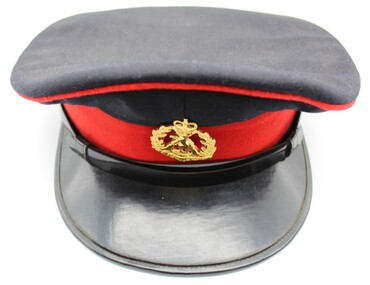
... Sticker reads “6 7/8”, and manufacturer’s label reads “MELBOURNE 36 1218/EMERCO/REG TRADE MARK/THIS IS YOUR GUARANTEE FOR QUALITY/MADE IN AUSTRALIA”. Badge...royal australian regiment rar army uniform Sticker reads “6 7/8”, and manufacturer’s label reads “MELBOURNE 36 1218/EMERCO/REG TRADE MARK/THIS IS YOUR GUARANTEE FOR QUALITY/MADE IN AUSTRALIA”. Badge ...Navy-black coloured peaked cap with red piping trim along peak. Red felt band encircles the band. Black patent leather chin strap is held in place with two gold buttons on either side, each depicting a crown above the map of Australia. Gold badge in centre depicts kangaroo in front of crossed rifles underneath a crown with oak leaves forming an arch eitehr side. Interior brim is green with black patent leather trim; brown leather sweatband with holes for air cirulation, tied at back with cream silk bow. Top of hat is covered with plastic layer, underneath which is the manufacturer’s label and a sticker for size.Sticker reads “6 7/8”, and manufacturer’s label reads “MELBOURNE 36 1218/EMERCO/REG TRADE MARK/THIS IS YOUR GUARANTEE FOR QUALITY/MADE IN AUSTRALIA”. Badge reads “DUTY FIRST/ROYAL AUSTRALIAN REGIMENT”.royal australian regiment, rar, army, uniform -
 Shepparton RSL Sub Branch
Uniform, Hat, 1989
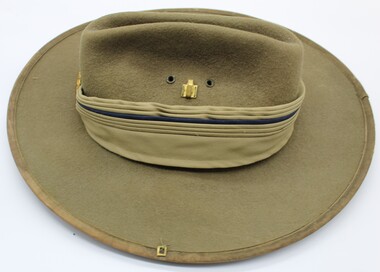
... australian air force raaf r.a.a.f. slouch hat 1980s Label on interior of cotton band reads “A.G.C.F./VIC 1989 [broad arrow]/SIZE. 58/8405-66.[crossed out 109-5392]033-5309”. Handwritten on interior brim “FORSYTH”. Size labels read “58” and “58 7 1/8”. Sticker reads “COMMANDO/WOOL SLOUCH HAT/MELBOURNE” Khaki-coloured slouch hat with folded cotton band with blue strip around brim; gold coloured badge ...This slouch hat belonged to Royal Australian Air Force serviceman/woman Forsyth. Khaki-coloured slouch hat with folded cotton band with blue strip around brim; gold coloured badge depicting a wreath with crown atop and ornamental letters “RAAF”. Four plastic eyelets at crow of hat and signature fold on crown. Wide brim edged with brown coloured binding. A hook on the left crown and left brim attach together to lift one side of the hat. On interior, brown leather chinstrap with metal adjustable buckle ad black leather sweatband stitched in with zig-zag black stitching and secured by khaki silk bow at back. Bow attaches a card reading “58” in a circle. Sticker on interior centre in brown and metallic gold. Size sticker hidden underneath sweatband reads “58 7 1/8”Label on interior of cotton band reads “A.G.C.F./VIC 1989 [broad arrow]/SIZE. 58/8405-66.[crossed out 109-5392]033-5309”. Handwritten on interior brim “FORSYTH”. Size labels read “58” and “58 7 1/8”. Sticker reads “COMMANDO/WOOL SLOUCH HAT/MELBOURNE”uniform, royal australian air force, raaf, r.a.a.f., slouch hat, 1980s -
 Shepparton RSL Sub Branch
Slouch Hat, 1972
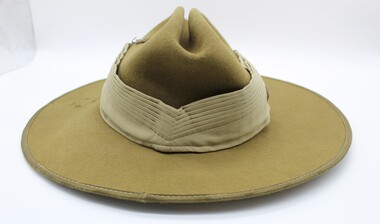
... Melbourne. Circa. 970s Kharki Slouch hat, no rising sun cap badge or hook to brim, 7 fold Pungaree with 2x small Australia buttons on right hand side, chin strap missing and replaced with leather bootlace, several names written on inside One of the names is Sgt J. ...Possible used by Cadets because of the several names inside the hatPossible use by CadetsKharki Slouch hat, no rising sun cap badge or hook to brim, 7 fold Pungaree with 2x small Australia buttons on right hand side, chin strap missing and replaced with leather bootlace, several names written on inside One of the names is Sgt J. Kelly. 351414Size 6 3/4. Made by Fayrefield. Melbourne. Circa. 970s -
 Flagstaff Hill Maritime Museum and Village
Uniform - Tunic, 1899-1903
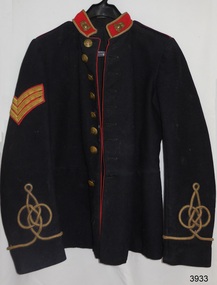
... MELBOURNE ." Collar badges: Artillery emblem (field cannon facing right | stars | exploding grenade | "AUSTRALIA")...australian artillery raa field gun sergeant W. Moncton garrison dress uniform tunic scarlet collar red collar scarlet piping red piping gold bullion artillery emblem light horse artillery mounted troops Victorian Garrison Artillery Corps Button front: Artillery emblem on front (field cannon facing left, in front of a muzzle-loading ram rod). Button back: engraved "W. MONCTON . MELBOURNE ." Collar badges ...This original tunic or jacket is part of the full dress uniform of the pre-Federation Victorian Permanent Artillery regiment. Its owner had the rank of Sergeant, as indicated by the three inverted chevrons. The Artillery design of the badges and buttons indicate the date of the tunic to be from 1893 to 1903. However the maker of the tunic, W. Moncton, began manufacture in Melbourne in 1899, so this the tunic can be dated between 1899 and 1903. The donor's grandfather was given this tunic but not the name of the original owner. It has since been suggested to the family that the tunic was worn by a local Western District Light Horse member. This could very well have been the case because mounted troops were officially referred to as the Light Horse in the late 19th to early 20th century. Several local men were involved in the Light Horse during the First World War. The donor's grandfather wore this tunic in the local district when riding a penny farthing bicycle. The donor's father also wore the tunic when dressed as a 'Captain' hosting a local disco dance. BRIEF MILITARY HISTORY- The Crimean War began In 1854 and many people in colonial Australia were afraid of a Russian attack. Volunteer forces were established to strengthen the British Imperial troops posted here. A battery of artillery was raised in Victoria as well as in other Australian states. In 1870 Australia became responsible for its own naval and military defence. The Volunteer Corps and Victorian Navy shared the responsibility of defending the existing forts, assisted by volunteer coastal and mobile field batteries. The Permanent Victorian Artillery force was established. It was disbanded in 1880 then re-formed in 1882 as the Victorian Garrison Artillery Corps. In 1895 the Geelong, Warrnambool, Port Fairy and Portland Batteries became part of the Western District Garrison Artillery. Many of the volunteers who served in the Artillery were from rural areas. They belonged to rifle clubs and were experience horsemen as well. Australia's defence at this time relied on these mounted troops, or Light Horse men. In 1899 the Victorian Garrison Artillery Corps amalgamated with the New South Wales and Queensland Permanent Artillery to become the Victorian Regiment of the Royal Australian Artillery (RAA). Then prior to Federation, the RAA and the Permanent Artillery of South Australia, Western Australia and Tasmania all combined, becoming the Royal Australian Artillery Regiment with two Batteries of Field Artillery; Battery A from Sydney and Battery B from Melbourne.This original uniform tunic of the pre-Federation Victorian Permanent Artillery is significant for its association with Australia's military defence and the fortifications of our district, state and country. The tunic is also significant, representing part of the history and evolution of uniforms in the Australian military forces. The tunic is also significant in its representation of Australia's independence in forming its own defences. The tunic has local significance in its connection with local social events.Tunic or jacket, part of the full dress uniform of the pre-Federation Victorian Permanent Artillery operating from 1893 to 1903. Original, single-breasted tunic of dark blue wool, red piping trim, black cotton lining in body. Sleeves lined with blue striped, white cotton. Front closure has eight brass buttons. Red band-style collar with hook-and-eye closure has gold bullion braid trim and a brass badge pinned each side at the front. Upper right sleeve has three inverted chevrons on red fabric with gold bullion braid trim (rank of Sergeant). Both sleeves have gold bullion braid 'Austrian knot' emblems stitched onto lower arm, with ends finishing on the inner sleeve. Shoulder epaulettes have red piping and smaller brass buttons. Closed back vent has vertical scalloped design with six brass buttons, in two columns of three, and red piping trim. Brass belt hook is attached to the left back waist, close to the seam (right side has a mark indicating a previous similar clip). Inside left breast is a concealed pocket. Tunic has both machine and hand stitching. All brass shank-style buttons have matching Artillery emblems with inscriptions on the back. The two brass collar badges have additional artillery emblems of exploding grenade and star as well as an inscription. Buttons were made for W. Moncton, of Melbourne and marked with his name. He traded from 1899, dating the tunic to between 1899 and 1903.Button front: Artillery emblem on front (field cannon facing left, in front of a muzzle-loading ram rod). Button back: engraved "W. MONCTON . MELBOURNE ." Collar badges: Artillery emblem (field cannon facing right | stars | exploding grenade | "AUSTRALIA")flagstaff hill, warrnambool, shipwrecked coast, flagstaff hill maritime museum, maritime museum, shipwreck coast, flagstaff hill maritime village, great ocean road, uniform jacket, uniform tunic, garrison volunteer uniform, fortifications in victoria, victorian permanent artillery, pre-federation military uniform, sergeant's uniform, jacket, militia, victoria, victorian volunteer forces, victorian regiment, royal australian artillery, raa, field gun, sergeant, w. moncton, garrison, dress uniform, tunic, scarlet collar, red collar, scarlet piping, red piping, gold bullion, artillery emblem, light horse, artillery, mounted troops, victorian garrison artillery corps -
 Flagstaff Hill Maritime Museum and Village
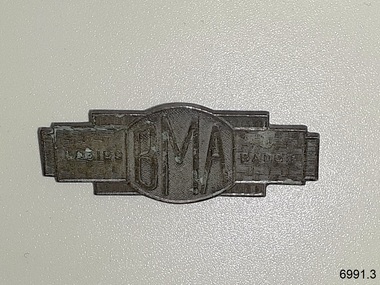
Badge - BMA Ladies Badge, Stokes, 1935
... Australia. The badge was specifically for a female relative of the person who did service, showing compassion for women. The W.R. Angus Collection is significant for still being located at the site it is connected with, Doctor Angus being the last Port Medical Officer in Warrnambool. The Collection includes historical medical objects that date back to the late 1800's. Flagstaff Hill Warrnambool Maritime Museum Maritime Village Great Ocean Road Shipwreck Coast W.R. Angus badge BMA British Medical Association Ladies’ Badge Female relative's badge military service Stokes Melbourne ...The badge was issued by the British Medical Association 'BMA'. It is known as the Female Relative's Bade or Ladies' Badge. It was manufactured in Melbourne in 1935 by Stokes of Melbourne. The BMA badge is one of a set of badges collected by Dr W R Angus from the organisations in which he was involved. They are now part of Flagstaff Hill’s comprehensive W.R. Angus Collection, donated by the family of Dr W R Angus, surgeon and oculist. The W.R. Angus Collection: - The W.R. Angus Collection includes historical medical equipment, surgical instruments and material once belonging to Dr Edward Ryan and Dr Thomas Francis Ryan, (both of Nhill, Victoria) as well as Dr Angus’ own belongings. The Collection’s history spans the medical practices of the two Doctors Ryan, from 1885-1926 plus that of Dr Angus, up until 1969. It includes historical medical and surgical equipment and instruments from the doctors Edward and Thomas Ryan of Nhill, Victoria. Dr Angus married Gladys in 1927 at Ballarat, the nearest big city to Nhill where he began as a Medical Assistant. He was also Acting House surgeon at the Nhill hospital where their two daughters were born. During World War II He served as a Military Doctor in the Australian Defence Forces. Dr Angus and his family moved to Warrnambool in 1939, where Dr Angus operated his own medical practice. He later added the responsibility of part-time Port Medical Officer and was the last person appointed to that position. Both Dr Angus and his wife were very involved in the local community, including the planning stages of the new Flagstaff Hill and the layout of the gardens there. Dr Angus passed away in March 1970.This badge is significant for connecting Doctor Angus with organisations that support men and women who performed military service for Australia. The badge was specifically for a female relative of the person who did service, showing compassion for women. The W.R. Angus Collection is significant for still being located at the site it is connected with, Doctor Angus being the last Port Medical Officer in Warrnambool. The Collection includes historical medical objects that date back to the late 1800's.This BMA badge is an overall rectangular shape made in a silver metal. It has a raised oval section in the centre. The badge has embossed text and a basket weave background pattern within the metal. It is a Ladies Badge, made for the women connected to members of the British Medical Association. It was made in Melbourne in 1935. This badge is part of a set of badges collected by Dr W R Angus. the set represents organisations that he was involved in, and is part of the W.R. Angus Collection.Front embossed; “BMA” “LADIES” “BADGE. Back embossed; “MELBOURNE / 1935 “ “STOKES MELB”flagstaff hill, warrnambool, maritime museum, maritime village, great ocean road, shipwreck coast, w.r. angus, badge, bma, british medical association, ladies’ badge, female relative's badge, military service, stokes, melbourne, w.r. angus collection -
 Flagstaff Hill Maritime Museum and Village
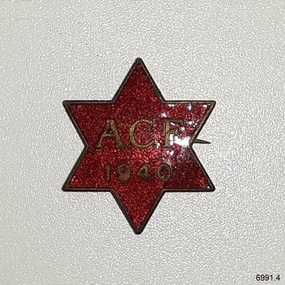
Badge - ACF Australian Comforts Fund badge, P J King Pty Ltd, 1940
... Melbourne in 1893 in partnership with Charles Walder Bridgland, continuing on his own from 1899. Percy and his son John Howard King set up a new business P J King Pty Ltd in 1928 making uniform buttons. In the late 1980s, it merged with two other companies that then became J J Cash, now known as Cash's Australia. The set of badges...Melbourne in 1893 in partnership with Charles Walder Bridgland, continuing on his own from 1899. Percy and his son John Howard King set up a new business P J King Pty Ltd in 1928 making uniform buttons. In the late 1980s, it merged with two other companies that then became J J Cash, now known as Cash's Australia. The set of badges ...This Australian Comforts Fund badge is part of a set of eleven badges collected from the 1920s to the 1940s by Dr W. R. Angus. The badge was sold by the ACF in 1940 to raise funds for gifts to send to the Australian troops serving overseas. The badge is one of a set of badges that represents various organisations that he had interests in. The Australian Comforts Fund was a mostly female, volunteer-run organisation officially recognised by the Government. It began in 1916 as an amalgamation of groups of people who wanted to support the Australian troops abroad with Items of comfort to supplement the essential items provided by the Australian Military Forces. The ACF raised funds to purchase goods, pack them and send them overseas. One of their fund-raising activities was 'button days' where buttons such as this one were given to those who gave donations. The ACF closed down after World War I but was re-formed at the start of World War II. Items that the ACF sent to the troops included personal toiletry items such as toothbrushes and toothpaste, magazines, pyjamas, singlets and socks. They also provided sporting equipment, recreational music, writing materials and postcards. Special hampers were sent to the troops at Christmas time. The maker, P J King, (Percy John King), originally established his engraving and ie casting business in Russell Street, Melbourne in 1893 in partnership with Charles Walder Bridgland, continuing on his own from 1899. Percy and his son John Howard King set up a new business P J King Pty Ltd in 1928 making uniform buttons. In the late 1980s, it merged with two other companies that then became J J Cash, now known as Cash's Australia. The set of badges was donated to Flagstaff Hill Maritime Village by the family of Doctor Angus, Surgeon and Oculist. It is part of the “W.R. Angus Collection” which includes historical medical equipment, surgical instruments and material belonging to Dr Edward Ryan and Dr Thomas Francis Ryan, (both of Nhill, Victoria) and Dr Angus’ own belongings. The Collection’s history spans the medical practices of the two Doctors Ryan, from 1885-1926 plus that of Dr Angus, up until 1969. The W.R. Angus Collection: - The W.R. Angus Collection includes historical medical equipment, surgical instruments and material belonging to Dr Edward Ryan and Dr Thomas Francis Ryan, (both of Nhill, Victoria) and Dr Angus’ own belongings. The Collection’s history spans the medical practices of the two Doctors Ryan, from 1885-1926 plus that of Dr Angus, up until 1969. It includes historical medical and surgical equipment and instruments from the doctors Edward and Thomas Ryan of Nhill, Victoria. Dr Angus married Gladys in 1927 at Ballarat, the nearest big city to Nhill where he began as a Medical Assistant. He was also Acting House surgeon at the Nhill hospital where their two daughters were born. During World War II He served as a Military Doctor in the Australian Defence Force. Dr Angus and his family moved to Warrnambool in 1939, where Dr Angus operated his own medical practice. He later added the part-time Port Medical Officer responsibility and was the last person appointed to that position. Dr Angus and his wife were very involved in the local community, including the planning stages of the new Flagstaff Hill and the layout of the gardens there. Dr Angus passed away in March 1970.This badge represents the efforts of the women volunteers in Australia to support the Australian troops overseas in WWI and WWII. This badge is one of a set of significant badges that connects Doctor Angus with Australian organisations of the early-to-mid 20th century, including those relating to military service support. The W.R. Angus Collection is significant for still being located at the site it is connected with, Doctor Angus being the last Port Medical Officer in Warrnambool. The Collection includes historical medical objects that date back to the late 1800s.The ACF Badge is a star-shaped, gold, glittered red enamel and metal badge. The star has six points. The enamel surface is textured. The border and front inscription of the badge is gold. It is the badge of the Australian Comfort Fund, made by P.J. King and dated 1940. This badge is part of a set of badges collected by Dr W R Angus. the set represents organisations that he was involved in, and is part of the W.R. Angus Collection.Front: “ACF / 1940” Reverse embossed “P.J. KING”flagstaff hill, warrnambool, maritime museum, maritime village, great ocean road, shipwreck coast, metal badges, enamel badges, organisation badges, acf, presbyterian brotherhood, oikumene, w.r. angus, flagstaff hill maritime museum and village, australian comforts fund, button day, volunteer, australian military forces, christmas hamper, 1940 acf badge, fund-raising, p j king pty ltd, percy john king, donor's badge, world war ii, 1939-1945, australians at war, voluntary work, volunteers, home front, w.r. angus collection -
 Flagstaff Hill Maritime Museum and Village
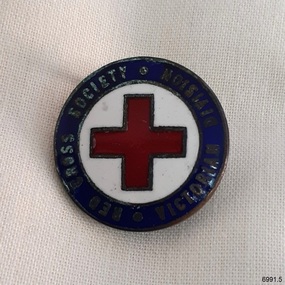
badge - Red Cross Society badge, Australian Red Cross Society, Victorian Division, 1914-1940s
... The badge represents the Victoria Division of the Australian Red Cross Society, which was formed on 21st August 1914 at the outbreak of the First World War. Stokes & Sons of Melbourne...The badge represents the Victoria Division of the Australian Red Cross Society, which was formed on 21st August 1914 at the outbreak of the First World War. Stokes & Sons of Melbourne ...The badge represents the Victoria Division of the Australian Red Cross Society, which was formed on 21st August 1914 at the outbreak of the First World War. Stokes & Sons of Melbourne made the button. It was made by Stokes & Sons Pty. Ltd. in Melbourne. The maker, Thomas Stokes, migrated to Melbourne from Birmingham in 1854 and set up business in Mincer Lane as a die-sinker, producing medals, tokens, buttons and silverware, and offered an engraving service. He moved to Flinders Lane in 1856. After a time, in 1894, the business became Stokes & Sons Pty. Ltd, electroplates and badge makers at Post Office Place in Melbourne. The maker's mark 'Stokes & Sons' continued to be made on badges up until 1962. This badge is one of a set of badges collected by Dr W R Angus from the organisations in which he was involved. The set of badges is now part of Flagstaff Hill’s comprehensive W.R. Angus Collection, donated by the family of Dr W R Angus, surgeon and oculist. The W.R. Angus Collection: - The W.R. Angus Collection includes historical medical equipment, surgical instruments and material belonging to Dr Edward Ryan and Dr Thomas Francis Ryan, (both of Nhill, Victoria) and Dr Angus’ own belongings. The Collection’s history spans the medical practices of the two Doctors Ryan, from 1885-1926 plus that of Dr Angus, up until 1969. It includes historical medical and surgical equipment and instruments from the doctors Edward and Thomas Ryan of Nhill, Victoria. Dr Angus married Gladys in 1927 at Ballarat, the nearest big city to Nhill where he began as a Medical Assistant. He was also Acting House surgeon at the Nhill hospital where their two daughters were born. During World War II He served as a Military Doctor in the Australian Defence Forces. Dr Angus and his family moved to Warrnambool in 1939, where Dr Angus operated his own medical practice. He later added the part-time Port Medical Officer responsibility and was the last person appointed to that position. Both Dr Angus and his wife were very involved in the local community, including the planning stages of the new Flagstaff Hill and the layout of the gardens there. Dr Angus passed away in March 1970.This badge is significant for connecting Doctor Angus with organisations that he supported. The W.R. Angus Collection is significant for still being located at the site it is connected with, Doctor Angus being the last Port Medical Officer in Warrnambool. The Collection includes historical medical objects that date back to the late 1800s.Badge; a round metal and enamel badge with a blue band around the perimeter and a silver-edged red cross on a white background in the centre. The badge has a vertical pin on the back. It is the badge of the Victorian Division of the Red Cross Society. the maker was Stokes & Sons of Melbourne. This badge is part of a set of badges collected by Dr W R Angus. the set represents organisations that he was involved in, and is part of the W.R. Angus Collection.Printed within the blue band; “RED CROSS SOCIETY” “VICTORIAN DIVISION” Embossed on the reverse; “STOKES & SONS / MELB” flagstaff hill, warrnambool, maritime village, maritime museum, shipwreck coast, great ocean road, w.r. angus, badge, organisation badge, flagstaff hill maritime museum and village, australian red cross, victorian division, charity, volunteer organisation, w.r. angus collection -
 Flagstaff Hill Maritime Museum and Village
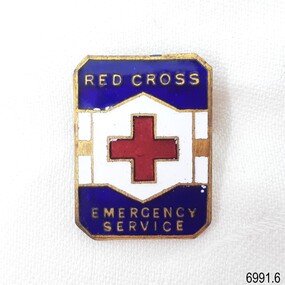
badge - Red Cross Society badge, K.G. Luke Pty. Ltd, Emergency Service, 1935-1945
... badge represents the Emergency Services section of the Red Cross Society. The Australian Red Cross was formed on 21st August 1914 at the outbreak of the First World War. The badge was made by K.G. Luke Pty. Ltd. in Melbourne...badge represents the Emergency Services section of the Red Cross Society. The Australian Red Cross was formed on 21st August 1914 at the outbreak of the First World War. The badge was made by K.G. Luke Pty. Ltd. in Melbourne ...The badge represents the Emergency Services section of the Red Cross Society. The Australian Red Cross was formed on 21st August 1914 at the outbreak of the First World War. The badge was made by K.G. Luke Pty. Ltd. in Melbourne. Kenneth George Luke, began work as an apprentice in 1910 at Stokes & Sons Pty. Ltd. in Melbourne and stayed with the company for eleven years. He then became a partner in a metalworking business, wholly owning this successful Carlton business in 1925. From 1935-1945 his products included silverware and supplies for military needs. The firm was K.G. Luke Pty. Ltd. by 1936, making buttons, badges, brooches, and heated food trolleys at his office and factory in North Fitzroy, and selling from his showroom in Elizabeth Street Melbourne. His customers included the Australian Red Cross, Victoria Police, TAA Airline, and the military forces of Australia and the United States. Seventeen years later the company was K.G. Luke (A/Asia) Ltd, then twenty-three years on it was Luke Ltd. until in 1983 it was taken over by National Consolidated Ltd. Sir Kenneth George Luke was also a V.F.L. football administrator. This badge is one of a set of badges collected by Dr W R Angus from the organisations in which he was involved. The set of badges is now part of Flagstaff Hill’s comprehensive W.R. Angus Collection, donated by the family of Dr W R Angus, surgeon and oculist. The W.R. Angus Collection: - The W.R. Angus Collection includes historical medical equipment, surgical instruments and material belonging to Dr Edward Ryan and Dr Thomas Francis Ryan, (both of Nhill, Victoria) and Dr Angus’ own belongings. The Collection’s history spans the medical practices of the two Doctors Ryan, from 1885-1926 plus that of Dr Angus, up until 1969. It includes historical medical and surgical equipment and instruments from the doctors Edward and Thomas Ryan of Nhill, Victoria. Dr Angus married Gladys in 1927 at Ballarat, the nearest big city to Nhill where he began as a Medical Assistant. He was also Acting House surgeon at the Nhill hospital where their two daughters were born. During World War II He served as a Military Doctor in the Australian Defence Forces. Dr Angus and his family moved to Warrnambool in 1939, where Dr Angus operated his own medical practice. He later added the part-time Port Medical Officer responsibility and was the last person appointed to that position. Both Dr Angus and his wife were very involved in the local community, including the planning stages of the new Flagstaff Hill and the layout of the gardens there. Dr Angus passed away in March 1970.This badge is significant for connecting Doctor Angus with organisations that he supported. The W.R. Angus Collection is significant for still being located at the site it is connected with, Doctor Angus being the last Port Medical Officer in Warrnambool. The Collection includes historical medical objects that date back to the late 1800s.Badge, rectangular metal and enamel badge, with a blue band across the top and bottom, and a white and gold band in the middle similar to a belt with the buckle of a red cross. The badge has a horizontal pin on the back. Inscriptions on top and bottom bands and on the reverse. It is the badge of the Red Cross Emergency Service, made by K.G. Luke of Melbourne.This badge is part of a set of badges collected by Dr W R Angus. the set represents organisations that he was involved in, and is part of the W.R. Angus Collection.Printed on front; “RED CROSS” above “EMERGENCY / SERVICE”. Embossed on back “8029” “K.G. LUKE / MELB” flagstaff hill, warrnambool, maritime village, maritime museum, shipwreck coast, great ocean road, w.r. angus, badge, organisation badge, flagstaff hill maritime museum and village, australian red cross, charity, volunteer organisation, red cross, k.g. luke pty. ltd., kenneth george luke, north fitzroy, stokes & sons, w.r. angus collection -
 Flagstaff Hill Maritime Museum and Village
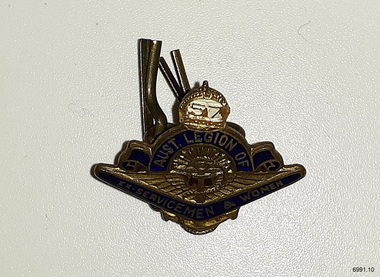
Badge - Australian Legion of Ex-Servicemen and Women, Stokes, Membership badge, 1957
... The badge was issued by the Victorian branch (indicated by the 'V' on the reverse) of the Australian Legion of Ex-Servicemen and Women and is referred to as The Badge of Unity or Tri-Services badge, uniting the armed services of Australia; the Army (rising sun), the Navy (anchor) and the Air Force (pair of wings). The number '57' on the crown represents the year of paid membership; 1957. The badge belonged to Dr W R Angus, who served in the Australian Army as a military doctor during WWII. It was made in Melbourne...The badge was issued by the Victorian branch (indicated by the 'V' on the reverse) of the Australian Legion of Ex-Servicemen and Women and is referred to as The Badge of Unity or Tri-Services badge, uniting the armed services of Australia; the Army (rising sun), the Navy (anchor) and the Air Force (pair of wings). The number '57' on the crown represents the year of paid membership; 1957. The badge belonged to Dr W R Angus, who served in the Australian Army as a military doctor during WWII. It was made in Melbourne ...The badge was issued by the Victorian branch (indicated by the 'V' on the reverse) of the Australian Legion of Ex-Servicemen and Women and is referred to as The Badge of Unity or Tri-Services badge, uniting the armed services of Australia; the Army (rising sun), the Navy (anchor) and the Air Force (pair of wings). The number '57' on the crown represents the year of paid membership; 1957. The badge belonged to Dr W R Angus, who served in the Australian Army as a military doctor during WWII. It was made in Melbourne by Stokes in 1957, around 100 years after the firm was established by Thomas Stokes in Mincing Lane, Melbourne. The firm was operating from Caledonian Lane/Post Office Place in the 1950s. The badge is one of a set of badges collected by Dr W R Angus from the organisations in which he was involved. They are now part of Flagstaff Hill’s comprehensive W.R. Angus Collection, donated by the family of Dr W R Angus, surgeon and oculist. Australian Legion of Ex-Servicemen and Women was formed in 1944 to "entourage fellowship and assist those who have served". The organisation is open to members from Australia, British Commonwealth and Allied ex-service personnel. The W.R. Angus Collection: - The W.R. Angus Collection includes historical medical equipment, surgical instruments and material once belonging to Dr Edward Ryan and Dr Thomas Francis Ryan, (both of Nhill, Victoria) as well as Dr Angus’ own belongings. The Collection’s history spans the medical practices of the two Doctors Ryan, from 1885-1926 plus that of Dr Angus, up until 1969. It includes historical medical and surgical equipment and instruments from the doctors Edward and Thomas Ryan of Nhill, Victoria. Dr Angus married Gladys in 1927 at Ballarat, the nearest big city to Nhill where he began as a Medical Assistant. He was also Acting House surgeon at the Nhill hospital where their two daughters were born. During World War II He served as a Military Doctor in the Australian Defence Force. Dr Angus and his family moved to Warrnambool in 1939, where Dr Angus operated his own medical practice. He later added the responsibility of part-time Port Medical Officer and was the last person appointed to that position. Both Dr Angus and his wife were very involved in the local community, including the planning stages of the new Flagstaff Hill and the layout of the gardens there. Dr Angus passed away in March 1970.This Badge of Unity, or Tri-Service badge, is significant for connecting Doctor Angus with organisations that support men and women who performed military service for Australia. The badge was for membership with the organisation, which supports ex-servicemen and women of the three military forces; Army, Navy and Air Force. The W.R. Angus Collection is significant for still being located at the site it is connected with, Doctor Angus being the last Port Medical Officer in Warrnambool. The Collection includes historical medical objects that date back to the late 1800s.Badge; a gold-coloured metal and enamel badge. The blue boomerang-shaped band is below an arch of blue, below a crown with a number and coloured red, white and blue. There are symbols in the centre; a rising sun, above a pair of wings, with an anchor in the centre of both. There is red and blue scrollwork behind the symbols. Inscriptions are on the front and back of the badge. There are two loops and pins on the back of the badge. It is a membership badge of the Victorian branch of the Australian Legion of Ex-Servicemen and Women and was made by Stokes in 1957. The badge has a Serial Number. This badge is part of a set of badges collected by Dr Angus and is part of the W.R. Angus Collection.FRONT; “AUST. LEGION OF / EX-SERVICEMEN & WOMEN” On crown “57” REVERSE; “V” “13156" "STOKES” flagstaff hill, warrnambool, maritime museum, maritime village, great ocean road, shipwreck coast, w.r. angus, badge, ladies’ badge, military service, stokes, melbourne, australian legion of ex-servicemen and women, membership badge, 1957 membership badge, ex=service personnel, heraldry, world war ii, second world war, tri-services symbol, badge of unity, rising sun, anchor, pair of wings -
 Flagstaff Hill Maritime Museum and Village
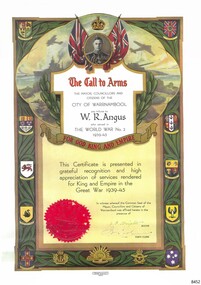
Certificate - Call to Arms, Osboldstone & Co. Pty. Ltd, W.R. Angus, ca. 1945
... Australia and Tasmania. The bottom has the badges of the Royal Australian Navy, the Australian Commonwealth Military Forces and the Royal Australian Air Force. The Certificate was printed by Osboldstone & Co. of Melbourne...Melbourne" and "55319" Call to Arms; certificate of service awarded as a tribute to W. R. Angus by the Mayor, Councillors and Citizens of the City of Warrnambool and sealed with Common Seal and the signatures of the Mayor and the Town Clerk. The top of the certificate has a portrait of King George VI below a crown emblem. The border has logos for countries of the British Commonwealth - Canada, South Africa, Inda and New Zealand - and the Australian States of Queensland, South Australia, Victoria, West Australia and Tasmania. The bottom has the badges ...This copy of the Certificate of Call to Arms was presented to Dr William Roy Angus at the completion of World War II by the May, Councillors and Citizens of Warrnambool in appreciation for his service. It is now part of Flagstaff Hill’s comprehensive W.R. Angus Collection, donated by the family of Dr W R Angus, 1901-1970, surgeon and oculist. During World War II between 1942-45, Dr Angus served with the Australian Department of Defence as a Surgeon Captain in Ballarat, Victoria, and in Bonegilla, N.S.W., completing his service just before the end of the war due to suffering from a heart attack. The Certificate is headed by a crown above the portrait of King George VI, the reigning British monarch at the time of WWII and afterwards. King George was King of the United Kingdom and the Dominions of the British Commonwealth, which is illustrated by the emblems of the Commonwealth countries and of the states of Australia. It also has symbols for the three Australian Military Forces; Navy, Army and Air Vorce. The Certificate also carries the Common Seal of the Mayor, Councillors and Citizens of the City of Warrnambool, and the signatures of the Mayor and Town Clerk. The W.R. Angus Collection: - The W.R. Angus Collection includes historical medical equipment, surgical instruments and material belonging to Dr Edward Ryan and Dr Thomas Francis Ryan, (both of Nhill, Victoria) and Dr Angus’ own belongings. The Collection’s history spans the medical practices of the two Doctors Ryan, from 1885-1926 plus that of Dr Angus, up until 1969. It includes historical medical and surgical equipment and instruments from the doctors Edward and Thomas Ryan of Nhill, Victoria. Dr Angus married Gladys in 1927 at Ballarat, the nearest big city to Nhill where he began as a Medical Assistant. He was also Acting House surgeon at the Nhill hospital where their two daughters were born. During World War II He served as a Military Doctor in the Australian Defence Force. Dr Angus and his family moved to Warrnambool in 1939, where Dr Angus operated his own medical practice. He later added the part-time Port Medical Officer responsibility and was the last person appointed to that position. Both Dr Angus and his wife were very involved in the local community, including the planning stages of the new Flagstaff Hill and the layout of the gardens there. Dr Angus passed away in March 1970.This is an example of objects used by or issued to Doctor Angus during and after his military service as Surgeon Captain in Australia during World War II. The W.R. Angus Collection is significant for still being located at the site it is connected with, Doctor Angus being the last Port Medical Officer in Warrnambool. The Collection includes historical medical objects that date back to the late 1800s.Call to Arms; certificate of service awarded as a tribute to W. R. Angus by the Mayor, Councillors and Citizens of the City of Warrnambool and sealed with Common Seal and the signatures of the Mayor and the Town Clerk. The top of the certificate has a portrait of King George VI below a crown emblem. The border has logos for countries of the British Commonwealth - Canada, South Africa, Inda and New Zealand - and the Australian States of Queensland, South Australia, Victoria, West Australia and Tasmania. The bottom has the badges of the Royal Australian Navy, the Australian Commonwealth Military Forces and the Royal Australian Air Force. The Certificate was printed by Osboldstone & Co. of Melbourne, with the registered serial number 55319. This copy of the original certificate is part of the W. R. Angus Collection.Printed; "The Mayor, Councillors and citizens of the City of Warrnambool pay tribute to W.R. Angus who served in The World War No. 2 1939-45, for God, King and Empire" "This Certificate is presented in grateful recognition and high appreciation of services rendered for King and Empire in the Great War 1939-45." "In witness whereof, the Common Seal of the Mayor, Councillors and Citizens of Warrnambool was affixed hereto in the presence of " (Signatures of "J.F. Knights" [Mayor] "H.J. Worland" [Town Clerk]) Printed under the certificate: "Osboldstone & Co. Pty. Ltd. Printers, Melbourne" and "55319"flagstaff hill, warrnambool, maritime village, maritime museum, shipwreck coast, great ocean road, flagstaff hill maritime museum and village, dr w r angus, dr ryan, warrnambool base hospital, nhill base hospital, mira hospital, flying doctor, w.r. angus collection, australian department of defence, australian army, world war ii, wwii, surgeon captain, ballarat, bonegilla, certificate, call to arms, warrnambool mayor, j.f. knights, warrnambool town clerk, h.j. worland", city of warrnambool, world war no. 2', 1939-45, great war 1939-45, common seal of city of warrnambool, osboldstone & co. pty ltd., 55319, king george vi, british commonwealth, canada, south aftrica, india, new zealand, australian commonwealth military forces -
 City of Moorabbin Historical Society (Operating the Box Cottage Museum)
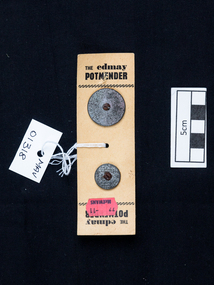
Kitchen Equipment, 'the edmay' Pot mender, c1930
... The McEwans name finally left the Australian retail scene with little fanfare when the last store was re-badged Bunnings in 1993 Early settlers were frugal and self sufficient so they repaired their kitchen equipment when possible . McEwans Pty Ltd. was an established hardware company in Melbourne ...Early settlers in Moorabbin Shire used large cast iron pots, pans and kettles, that were suspended over the open fire in the kitchen, for cooking meals. They had to be frugal and self-sufficient and so repaired the equipment to prolong its useful lifetime. Blacksmiths also made and repaired household equipment. James McEwan & Co 1852 - 1993 once dominated the the hardware retailing scene in Victoria. Established in 1852 to service the booming gold rush in Victoria the company went on to become one of the longest established retailers in Australia. Over it’s 140 year history the company went through many booms and busts. The McEwans name finally left the Australian retail scene with little fanfare when the last store was re-badged Bunnings in 1993Early settlers were frugal and self sufficient so they repaired their kitchen equipment when possible . McEwans Pty Ltd. was an established hardware company in Melbourne 1852-1993. Bunnings Pty Ltd is currently a successful hardware retailer for trade and public customers.Two metal discs with screw and nut for mending holes in cast iron pots, pans and kettles c1930 packing strip; THE edmay POTMENDER / Price tag ; McEWANS 77 - 11early settlers, market gardeners, cooking utensils, kitchenware, castiron cooking pots, blacksmiths, slow cooking, moorabbin shire, bentleigh, mckinnon, highett, cheltenham,mcewan james pty ltd, melbourne, bunnings pty ltd, -
 Geelong RSL Sub Branch
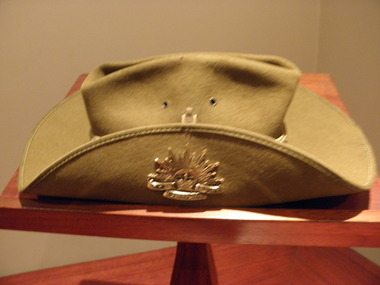
Hat, Slouch, Mid 20th Century
... Australian Army issue slouch hat issued to all members of the Australian Army owned by a person by the name of Phipps. australian army slouch rising sun phipps fayrefield Hand written on leather band inside the hat: PHIPPS Embossed into leather band: MADE BY/"FAYREFIELD"/MELBOURNE/6 5/8/19[indecipherable] Post World War 2 Australian Army Hat pinned into the slouch position. The pinned brim has a Rising Sun Badge ...Australian Army issue slouch hat issued to all members of the Australian Army owned by a person by the name of Phipps.Post World War 2 Australian Army Hat pinned into the slouch position. The pinned brim has a Rising Sun Badge attached by two metal pins. Hat Band is cotton and rouched. It also has a leather chin strap. Hand written on leather band inside the hat: PHIPPS Embossed into leather band: MADE BY/"FAYREFIELD"/MELBOURNE/6 5/8/19[indecipherable]australian army slouch rising sun phipps fayrefield -
 City of Moorabbin Historical Society (Operating the Box Cottage Museum)
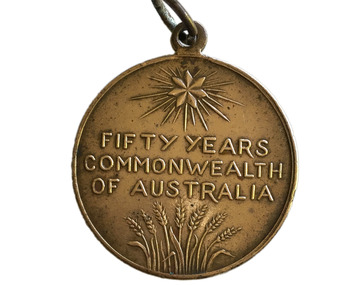
Badge - Fifty Years Commonwealth of Australia, c. 1951
... Australia. The competition in 1950, with the valuable cash prize of two hundred guineas, for the design the medallion was won by John Elischer, a Melbourne sculptor. The medallion bears an image of a man hand sowing wheat with the dates 1901-1951 on one side. The reverse has wheat growing to represent the seven states of Australia and the words ‘Fifty years Commonwealth of Australia’. commonwealth of australia 50 years medal Fifty Years Commonwealth of Australia 1901 - 1957 Metal Medal Badge Fifty Years Commonwealth of Australia ...The medal was awarded to the school children of Australia in 1951 to mark the fiftieth anniversary of the Federation of Australia. The competition in 1950, with the valuable cash prize of two hundred guineas, for the design the medallion was won by John Elischer, a Melbourne sculptor. The medallion bears an image of a man hand sowing wheat with the dates 1901-1951 on one side. The reverse has wheat growing to represent the seven states of Australia and the words ‘Fifty years Commonwealth of Australia’.Metal MedalFifty Years Commonwealth of Australia 1901 - 1957commonwealth of australia, 50 years, medal -
 City of Moorabbin Historical Society (Operating the Box Cottage Museum)
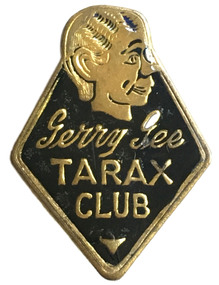
Badge - Gerry Gee Tarax Club Badge, 1959-69
... Australian children’s TV program on GTV-9 in Melbourne running from 1957 to 1969. A favourite character of the show was the mischievous doll Gerry Gee and the Melbourne ventriloquist Ron Blaskett. television children gtv 9 melbourne gerry gee ron blaskett pupett Gerry Gee Tarax Club Gold and black diamond shaped pin with a picture of Gerry Gee, a puppet. Badge ...The Tarax Show was an early Australian children’s TV program on GTV-9 in Melbourne running from 1957 to 1969. A favourite character of the show was the mischievous doll Gerry Gee and the Melbourne ventriloquist Ron Blaskett.Gold and black diamond shaped pin with a picture of Gerry Gee, a puppet.Gerry Gee Tarax Clubtelevision, children, gtv 9, melbourne, gerry gee, ron blaskett, pupett -
 Glenelg Shire Council Cultural Collection
Medal - Medallion - Australia's Commonwealth 1899, Stokes, Melbourne, 1899
... Australia's Commonwealth/1899 Back: Presented to E.N.T. Henry by mrs. W. Hanlon, August, 1899 (around edge) Stokes/15C (embossed, lower centre) Gold and white enamel. Star-shaped badge with outline of Australia in centre, and gold text on white background encircling inner edge. Copper link for chain on top. "Australia's Commonwealth 1899, Presented to E.N.T. Henry by Mrs. W. Hanlon, August 1899" Medal Medallion - Australia's Commonwealth 1899 Stokes, Melbourne ...Gold and white enamel. Star-shaped badge with outline of Australia in centre, and gold text on white background encircling inner edge. Copper link for chain on top. "Australia's Commonwealth 1899, Presented to E.N.T. Henry by Mrs. W. Hanlon, August 1899"Front: Australia's Commonwealth/1899 Back: Presented to E.N.T. Henry by mrs. W. Hanlon, August, 1899 (around edge) Stokes/15C (embossed, lower centre)commonwealth, 1899, medallion -
 The Beechworth Burke Museum
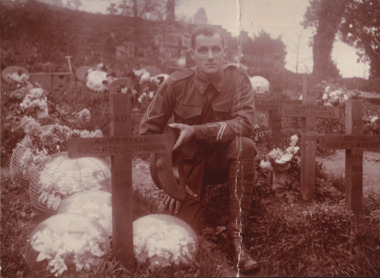
Photograph
... badge on his coat. Australia, unlike most other Commonwealth countries, did not adopt metal regimental badges during the First World War. All units were issued with the Australian Army General Service Badge, better known as the 'Rising Sun’ badge. This insignia is almost always identified with the Australian Imperial Force. Furthermore, the grave that this unidentified soldier is kneeling next to is the resting place of Private John James (J. J.) Simpson. He was born in Stanley, Victoria in 1883. He enlisted in the Australian Imperial Force in Melbourne...badge on his coat. Australia, unlike most other Commonwealth countries, did not adopt metal regimental badges during the First World War. All units were issued with the Australian Army General Service Badge, better known as the 'Rising Sun’ badge. This insignia is almost always identified with the Australian Imperial Force. Furthermore, the grave that this unidentified soldier is kneeling next to is the resting place of Private John James (J. J.) Simpson. He was born in Stanley, Victoria in 1883. He enlisted in the Australian Imperial Force in Melbourne ...Taken on an unknown date, depicted is a portrait of a young, unidentified male soldier kneeling beside a grave in a cemetery. He is dressed in an Australian military uniform. The cemetery pictured is the Arnos Vale Cemetery in Bristol, United Kingdom. There are multiple crosses marking graves in this photograph, all marked in memory of different soldiers who fought with the Australian Imperial Force (AIF) during World War I. It is believed that the soldier who is kneeling was also part of the Australian Imperial Force. This can be inferred by the chevron rank insignia visible on the uniform. The placement of this insignia on the sleeve of the right arm suggests that this soldier was either a Warrant Officer or a Non-Commissioned Officer (NCO). Another signifier of the Australian Imperial Force uniform are the three inverted chevron stripes positioned on the lower part of the left sleeve, near the wrist. These are called Good Conduct Stripes and were worn by Warrant Officers and NCOs. This patch consisted of a single chevron stripe for each year of military service meeting certain requirements of good conduct. Additionally, the man in this photograph is also wearing a 'Rising Sun' collar badge on his coat. Australia, unlike most other Commonwealth countries, did not adopt metal regimental badges during the First World War. All units were issued with the Australian Army General Service Badge, better known as the 'Rising Sun’ badge. This insignia is almost always identified with the Australian Imperial Force. Furthermore, the grave that this unidentified soldier is kneeling next to is the resting place of Private John James (J. J.) Simpson. He was born in Stanley, Victoria in 1883. He enlisted in the Australian Imperial Force in Melbourne, Victoria on 12 July, 1915, with the service number 4909. John James Simpson was then posted to the 60th Company Depot at Seymour for military recruit training. John James Simpson was reported wounded in action in France on 19 July, 1916. He was admitted to 13th General Hospital, France with gunshot wounds to his legs. From Boulogne, France, he traveled to the United Kingdom aboard the Hospital Ship 'St. Denis' for medical care. Upon arrival, he was admitted to 2nd Southern General Hospital, Bristol, England on 27 July, 1916. John James Simpson passed away from his wounds on 1 August, 1916. He was 33 years old.The record is historically significant due to its connection to World War I. This conflict is integral to Australian culture as it was the single greatest loss of life and the greatest repatriation of casualties in the country's history. Australia’s involvement in the First World War began when the Australian government established the Australian Imperial Force (AIF) in August 1914. Immediately, men were recruited to serve the British Empire in the Middle East and on the Western Front. The first significant Australian action of the war was the Australian Naval and Military Expeditionary Force’s (ANMEF) landing on Rabaul on 11 September 1914. The ANMEF took possession of German New Guinea at Toma on 17 September 1914 and of the neighbouring islands of the Bismarck Archipelago in October 1914. On 25 April 1915, members of the AIF landed on Gallipoli in Turkey with troops from New Zealand, Britain, and France. This specific event holds very strong significance within Australian history. The record has strong research potential. This is due to the ongoing public and scholarly interest in war, history, and especially the ANZAC legend, which is commemorated annually on 25 April, known as ANZAC Day.Sepia rectangular photograph printed on matte photographic paper mounted on card.Obverse: A.I.F. / AUSTRALIA / 441, PTE.T. / T (?) / 26B (?) / 6.1.17 / (?) / LANGTON RD. / ST. ANNES PK. / BRISTOL / A.I.F. / AUSTRALIA. / 708, GNR B.L.CRAWFORD. / FR / 5 D.A.C. / 13.2.17 / A.I.F. / AUSTRALIA. / 4481, P (?) D.MORRIS. / (?) / 31.12.(?) / A.I.F. / AUSTRALIA. / 4909, PTE J.J.SIMPSON. / 608(?) / 1.8.16 / Winchester / LANGTON RD. / ST. ANNES PK / BRISTOL / Reverse: 2641 /military album, military, war, world war i, wwi, australian imperial force, aif, j. j. simpson, uniform, cemetery -
 Mission to Seafarers Victoria
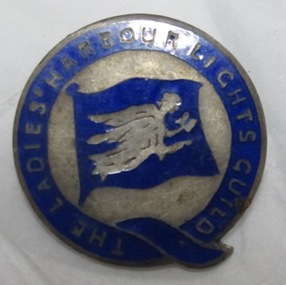
Badge, The Ladies' Harbour Lights Guild, 1917-1930
... Melbourne in 1906. The first secretary Miss Ethel Godfrey is known to have addressed and helped establish LHLG groups in Brisbane and Sydney circa 1918 to 1920 (see clipping MTS scrapbook 1906-1935). This badge therefore represents a link with LHLG groups elsewhere in Australia ...The Ladies' Harbour Lights Guild originally inspired by the Central Mission in England was established in Melbourne in 1906. The first secretary Miss Ethel Godfrey is known to have addressed and helped establish LHLG groups in Brisbane and Sydney circa 1918 to 1920 (see clipping MTS scrapbook 1906-1935). This badge therefore represents a link with LHLG groups elsewhere in Australia. The LHLG groups were vital in raising funds and maintaining facilities around Australia for seafarers. This badge is an early Queensland variation on the usual circular badge of the LHLG.Enamel badge with back fastening: The Ladies' Flying Angel Guild in the form of a blue enamel "Q" with the flying angel flag (see also notes on reverse).At the front: The Ladies' Harbour Lights Guild. On reverse stamped in upper case the word "SILVER" and initials "W.B." (possibly W.Blake?)badge, lhlg hostesses, ladies' harbour lights guild, queensland, brisbane, mission to seafarers, seafarers -
 Montmorency–Eltham RSL Sub Branch
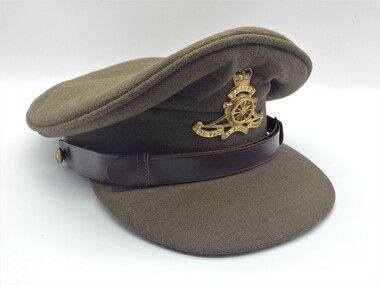
Cap, Peaked, Royal Australian Artillery, 1969
... Melbourne" red printing on white label. Overstamped "S56 6 7/8" in black ink Manufacturer's and Inspection stamp inside sweatband, partly indecipherable. No personal I.D. Khaki cloth peaked cap with Royal Regiment of Australian Artillery gilt cap badge ...Standard RAA cap for 1950 / 1960 periodKhaki cloth peaked cap with Royal Regiment of Australian Artillery gilt cap badge (Queen's crown) with brown leather chin strap and gilt AMF 12mm diameter buttons. Brown leather sweat band and clear plastic liner. Manufacturer's label. Manufacturer's and Inspectors stamp inside sweat band. Manufacturer's Label "Commonwealth Government Clothing Factories, Melbourne" red printing on white label. Overstamped "S56 6 7/8" in black ink Manufacturer's and Inspection stamp inside sweatband, partly indecipherable. No personal I.D.headgear, cap -
 Montmorency–Eltham RSL Sub Branch
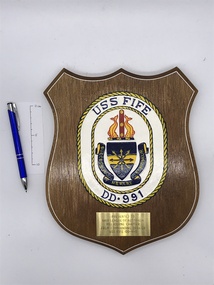
Plaque - USS Fife
... On Shield: USS FIFE DD-991 SUCCESSUM MERERE CONEMUR On Presentation Plate: PRESENTED TO NAVY LEAGUE OF AUSTRALIA MELBOURNE CHAPTER FROM COMMANDING OFFICER USS FIFE (DD–991) Wooden shield with plaque painted onto haut relief carved badge Plaque USS Fife ...Wooden shield with plaque painted onto haut relief carved badgeOn Shield: USS FIFE DD-991 SUCCESSUM MERERE CONEMUR On Presentation Plate: PRESENTED TO NAVY LEAGUE OF AUSTRALIA MELBOURNE CHAPTER FROM COMMANDING OFFICER USS FIFE (DD–991) -
 Mission to Seafarers Victoria
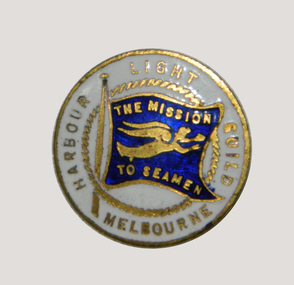
Badge, Mission to Seamen: Harbour Light Guild Melbourne, circa 1950-1960
... badge manufacturers. Variations also indicated during some eras if the wearer was a full member, worker or honorary. The Harbour Lights Guild was instrumental in securing funds to construct the current building at 717 Flinders Street, and in particular the Memorial chapel and Gymnasium. They were also dedicated volunteers who organised many social functions and events to offer visiting seafarers an opportunity to relax, have fun and socialise away from the ship. The organisation operated from 1906 to the early 1960s in Melbourne and developed an organisational model that was adopted by many branches across Australia ...The lapel badge was worn to signify membership of the Harbour Lights Guild. Variations of this badge were made for different State Guilds by different jewellers or badge manufacturers. Variations also indicated during some eras if the wearer was a full member, worker or honorary.The Harbour Lights Guild was instrumental in securing funds to construct the current building at 717 Flinders Street, and in particular the Memorial chapel and Gymnasium. They were also dedicated volunteers who organised many social functions and events to offer visiting seafarers an opportunity to relax, have fun and socialise away from the ship. The organisation operated from 1906 to the early 1960s in Melbourne and developed an organisational model that was adopted by many branches across Australia and for other global missions.Small round white enamel and gilt lapel badge denoting the Harbour Lights Guild and its association with Mission to Seamen (Mission to Seafarers). The badge incorporates the logo flag of Mission to Seamen.Gold lettering around the edge of the badge: "HARBOUR LIGHT GUILD MELBOURNE" Gold lettering inside central Mission flag: "THE MISSION/TO SEAMEN" Maker's mark on reverse: "K.G. Luke/Melb"volunteers, social, harbour-lights-guild, mission-to-seafarers, membership-tokens, functions, visits, badge, hlg -
 Heidelberg Repatriation Hospital
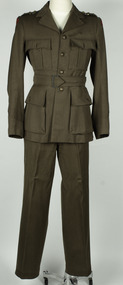
Uniform - Vietnam War Uniform, Circa 1960
... Australian Government. uniform army vietnam Label reads: Buckleys & Nunn Ptd Ltd / Melbourne. Handwritten: Chappell Uniform comprises Jacket (.1) Pants (.2) and Tie (.3) . Khaki wool. Button up trousers. Jacket has Royal Australian Engineers badge ...Army Uniform from the Vietnam War era.Representative of the era. Massed produced by the Australian Government.Uniform comprises Jacket (.1) Pants (.2) and Tie (.3) . Khaki wool. Button up trousers. Jacket has Royal Australian Engineers badge on shoulder, gold buttons on epaulettes.Label reads: Buckleys & Nunn Ptd Ltd / Melbourne. Handwritten: Chappelluniform, army, vietnam -
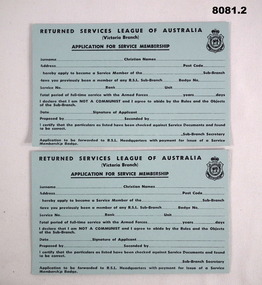 Bendigo Military Museum
Card - MEMBERSHIP RSL VIC, HQ RSL Melbourne, pre 1990
... Australia. These were filled in by a prospective new member and forwarded to RSL HQ in Melbourne for approval. brsl smirsl membership "Returned Services League of Australia - (Victorian Branch) - Application for Service Membership" Membership cards, blue with black text double sided, front has spaces for the person to fill in details re name address, and financial to service number, rank, unit, time in service. The rear has space for approval, badge ...These membership cards were used pre 1990, from then on the League became known as The Returned & Service's League of Australia. These were filled in by a prospective new member and forwarded to RSL HQ in Melbourne for approval.Membership cards, blue with black text double sided, front has spaces for the person to fill in details re name address, and financial to service number, rank, unit, time in service. The rear has space for approval, badge number and financial to."Returned Services League of Australia - (Victorian Branch) - Application for Service Membership"brsl, smirsl, membership
