
Showing 4 items matching "melbourne biscuit maker"
-
 Flagstaff Hill Maritime Museum and Village
Container - Biscuit Tin, Swallow and Ariell Pty Ltd, Mid-19th to mid-20th century
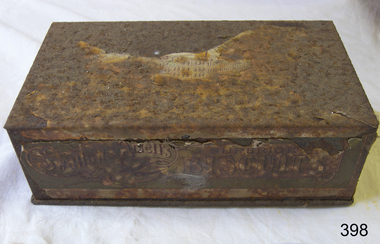
... ...melbourne biscuit maker...biscuit tin is representative of local Melbourne and Victorian produce. The label was in four languages, perhaps for export or for local immigrants. The firm Swallow and Ariells Pty Ltd was a very early manufacture and was in business for over 100 years. Flagstaff Hill Warrnambool Shipwrecked-coast Flagstaff-Hill Flagstaff-Hill-Maritime-Museum Maritime-Museum Shipwreck-coast Flagstaff-Hill-Maritime-Village metal craft tin ware biscuit box biscuit tin food container melbourne biscuit maker swallow thomas swallow thomas ariell Ariell 'Swallow and Ariells Superior Melbourne Biscuits' Trademark: image [swallow] Rectangular tin container with attached lid. ...This tin was made in Melbourne and contained Swallows and Ariells biscuits. The label was written in four languages. The biscuits may have been made for export or perhaps for immigrants now living in Australia. Australia's first biscuit company was founded in 1854 by Thomas Swallow. Within five years he had taken in a partner, T.H. Ariell. After Ariell died in 1875, F.T. Derham was appointed partner and managing director in 1877, a position held by several generations of his descendants. By the early 1880s the Port Melbourne factory extended to 3 acres (1.2 ha), and the company owned flourmills and sugar plantations in the Goulburn Valley and Northern Queensland. With no equal outside Great Britain, Swallow & Ariell was the fifth largest biscuit company in the world, manufacturing over 100 varieties, including the common ship biscuit (an original product) and meat biscuits (apparently taken by Burke and Wills on their ill-fated expedition). The company also boasted popular sideline products, including cakes, plum puddings, ice-cream and dried fruit. Renowned for its patriotic fundraising campaigns during both world wars, it diverted most of its biscuits and plum puddings to the Australian and US services in World War II. Company employees were filmed leaving work in 1905 in the Salvation Army film unit's first sponsored industrial documentary film. The surviving opening sequences are held by ScreenSound Australia. The company was delisted on 5 August 1964 following acquisition of more than 95% of its capital by the Australian Biscuit Co. The factory was later registered by the National Trust and converted into units. https://www.emelbourne.net.au/biogs/EM01456b.htmThis biscuit tin is representative of local Melbourne and Victorian produce. The label was in four languages, perhaps for export or for local immigrants. The firm Swallow and Ariells Pty Ltd was a very early manufacture and was in business for over 100 years.Rectangular tin container with attached lid. Label advertises Swallow and Ariells biscuits. Made in Melbourne. The label is written in four languages. The trademark, a swallow, is on the tin. The tin is very badly corroded.'Swallow and Ariells Superior Melbourne Biscuits' Trademark: image [swallow]flagstaff hill, warrnambool, shipwrecked-coast, flagstaff-hill, flagstaff-hill-maritime-museum, maritime-museum, shipwreck-coast, flagstaff-hill-maritime-village, metal craft, tin ware, biscuit box, biscuit tin, food container, melbourne biscuit maker, swallow, thomas swallow, thomas ariell, ariell -
 Orbost & District Historical Society
tin, Swallow & Ariell, circa 1915
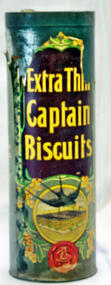
... biscuit makers were competing to develop original and novel tins to sell their products. They soon became a collectable item. The first biscuits to be made by Arnott’s were called ‘Thin Captains’ which were the biscuit maker’s version of the sea biscuit. This tin is typical of food tins bought not only for the contents but as a decorative reusable container in the home. tin biscuits swallow-ariell container Factory Port Melbourne Vic Aust Swallow & Ariells Tall cylindrical tin. ...Printed and branded tins were one of the first marketing forms of advertising. After Huntley & Palmer introduced these tins in 1860, all biscuit makers were competing to develop original and novel tins to sell their products. They soon became a collectable item. The first biscuits to be made by Arnott’s were called ‘Thin Captains’ which were the biscuit maker’s version of the sea biscuit. This tin is typical of food tins bought not only for the contents but as a decorative reusable container in the home.Tall cylindrical tin. Extra Thin Captain Bisuits on paper label. Lid is push in type.Factory Port Melbourne Vic Aust Swallow & Ariellstin biscuits swallow-ariell container -
 Mont De Lancey
Decorative object - Hampden Buggy Model, Chas W. Davis, Unknown
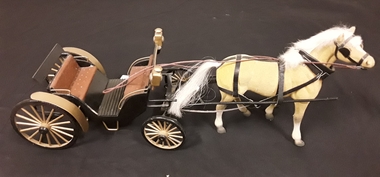
... There are two long shafts on each side to surround the biscuit coloured horsel with a white tail and mane, which has the necessary horse tack for carriage use to help the driver communicate with the horse. The original Hampden buggy was the inspiration of K.Booth, an American coach maker. It was designed for the ladies to show off their finery. Keep Bros. and Wood of Melbourne...There are two long shafts on each side to surround the biscuit coloured horsel with a white tail and mane, which has the necessary horse tack for carriage use to help the driver communicate with the horse. The original Hampden buggy was the inspiration of K.Booth, an American coach maker. It was designed for the ladies to show off their finery. Keep Bros. and Wood of Melbourne ...The collection of thirteen horse drawn vehicles were carefully handmade by Mr Chas W Davis 1925 - 2002. He was a talented artist and saw doctor. This model of a horse drawn Hampden Buggy replicates the vehicle that enjoyed respect from the public from c.1800's. It came in various types.A model of a Hampden buggy, c1900. The body is low to the ground, making it easy for passengers to board and disembark as well as allowing for speed and is lightweight for one horse to pull, making the journey cheaper than using four horses. It has four spoked wheels, two large and two small which have gold painted mudguards. It has brown padded seating, gold painted armrests and two coach lamps. There are two long shafts on each side to surround the biscuit coloured horsel with a white tail and mane, which has the necessary horse tack for carriage use to help the driver communicate with the horse. The original Hampden buggy was the inspiration of K.Booth, an American coach maker. It was designed for the ladies to show off their finery. Keep Bros. and Wood of Melbourne built many variations of buggies for wet or dry conditions.replicas, models, scale models, vehicles, carriages, horse drawn vehicles, toy horses -
 Port Melbourne Historical & Preservation Society
Photograph - William and Harry CANN, c 1915-19
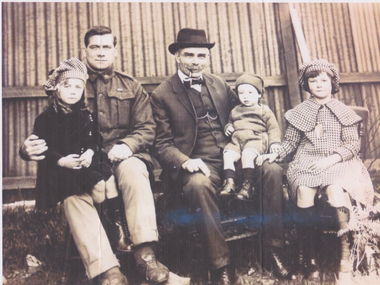
... Melbourne. In the 1930s, at the height of the Depression, William set up a kitchen in the corner of his upholstery workshop to feed hungry children from Nott Street School free of charge. After a few years the Council shut it down due to hygiene concerns. William set up another kitchen with a hired cook and continued to feed the children. William's son, Henry, aka Harry, was born in Croydon, England. He was 21 years old working as a biscuit maker...Melbourne. In the 1930s, at the height of the Depression, William set up a kitchen in the corner of his upholstery workshop to feed hungry children from Nott Street School free of charge. After a few years the Council shut it down due to hygiene concerns. William set up another kitchen with a hired cook and continued to feed the children. William's son, Henry, aka Harry, was born in Croydon, England. He was 21 years old working as a biscuit maker ...William CANN (centre) with his son, Harry, in military uniform, and three unidentified children. British-born William CANN arrived in Melbourne in 1907 and set up a pram building business, London Prams, in Lalor Street, Port Melbourne. In the 1930s, at the height of the Depression, William set up a kitchen in the corner of his upholstery workshop to feed hungry children from Nott Street School free of charge. After a few years the Council shut it down due to hygiene concerns. William set up another kitchen with a hired cook and continued to feed the children. William's son, Henry, aka Harry, was born in Croydon, England. He was 21 years old working as a biscuit maker when he enlisted in the AIF on 13 July 1915. He suffered a bomb wound to his ear while serving in France in July 1916. He returned to Australia on 22 July 1919 and was formally discharged two months later as medically unfit due to deafness.Digital copy of a B&W photograph.william cann, henry (harry) cann
