
Showing 3 items matching "melbourne police presence"
-
 University of Melbourne, Burnley Campus Archives
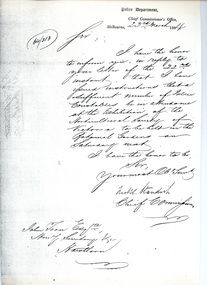
Letter, Police Department et al, Letter from the Police Department to Mr John Toon Honorary Secretary Horticultural Society Hawthorn, 1864
... ...melbourne police presence...It is addressed to John Toon, Honorary Secretary Hawthorn. horticultural society exhibition police nicholas standish melbourne police presence john toon Photocopy of letter from Police Department to Mr John Toon, Honorary Secretary, Horticultural Society, Hawthorn, dated 23.03.1864 Letter from the Police Department to Mr John Toon Honorary Secretary Horticultural Society Hawthorn Letter Police Department Nicholas Standish ...Letter from Police Department re police attendance at Horticultural Society's exhibition. This is a photocopy of the letter from the Police Department informing the recipient that a sufficient amount of Police Constables would be in attendance at the Exhibition of the Horticultural Society of Victoria to be held the following Saturday. It is signed by Nicholas Standish, Chief Commissioner. It is addressed to John Toon, Honorary Secretary Hawthorn.Photocopy of letter from Police Department to Mr John Toon, Honorary Secretary, Horticultural Society, Hawthorn, dated 23.03.1864horticultural society, exhibition, police, nicholas standish, melbourne police presence, john toon -
 Victoria Police Museum
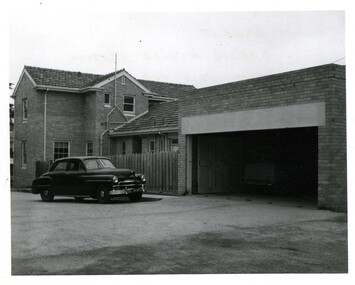
Police Stations (Ararat)
... Ararat is a city in south-west Victoria, Australia, about 198 kilometres west of Melbourne, on the Western Highway on the eastern slopes of the Ararat Hills and Cemetery Creek valley between Victoria's Western District and the Wimmera. It is named after Mount Ararat 10 kilometres south-west of the town. A police station opened in Ararat in 1859, though there was a police presence...Ararat is a city in south-west Victoria, Australia, about 198 kilometres west of Melbourne, on the Western Highway on the eastern slopes of the Ararat Hills and Cemetery Creek valley between Victoria's Western District and the Wimmera. It is named after Mount Ararat 10 kilometres south-west of the town. A police station opened in Ararat in 1859, though there was a police presence ...Ararat is a city in south-west Victoria, Australia, about 198 kilometres west of Melbourne, on the Western Highway on the eastern slopes of the Ararat Hills and Cemetery Creek valley between Victoria's Western District and the Wimmera. It is named after Mount Ararat 10 kilometres south-west of the town. A police station opened in Ararat in 1859, though there was a police presence in the area formerly known as Cathcart, Canton Lead and later Mount Ararat. In 1861 staff consisted of 1 Superintendent, 2 Mounted Constables, 1 Sergeant 2nd class, 1 Senior Constable, 8 Constables. The police reserve was on land bounded by Ligar Street, Barkley Street, Ingor Street and High Street. In 1930 the police station was described as a six-room brick dwelling with a slate roof, situated on one quarter acre of land. There was also a bathroom, wash-house, pantry, office, muster room and quarters for a single constable, stables with three stalls, and a lock-up consisting of two six-person cells. Later residences were located at 3 Ligar Street (brick veneer with a tile roof); 32A High Street (brick veneer with tile roof); and 3 Tobin Street (wood with an iron roof). A new, purpose built police station was opened in October 2010 at 77 Barkly Street. The Ararat Police District was reformed into the Wimmera Police District in 1870. Ararat Police Station became part of "R" (Glenelg) District in January 1948 and "M" (Highlands/Wimmera) District from March 1990. A list of police stationed at Ararat from 1903 - 1930 is available from the Victoria Police Museum8 photos comprising: 7 black & white photos 1 colour photopolice stations; ararat police station -
 Sunshine and District Historical Society Incorporated
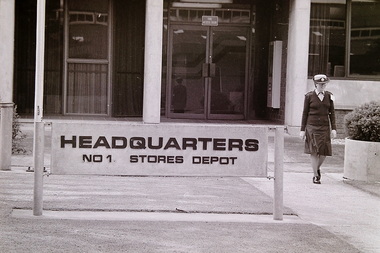
Photograph - RAAF No 1 Stores Depot South Road Braybrook Site Tour 1990 Photograph, C. McGee, 17th June 1991
... It was also a major employer in Melbourne’s western suburbs, shaping the social and economic life of Braybrook, Sunshine, and Tottenham for nearly five decades. The presence of the RAAF Police ...No. 1 RAAF Stores Depot in Braybrook (often called the Tottenham RAAF Stores Depot) was one of the most important defence facilities in Melbourne’s west, a massive wartime logistics base built in 1944–45 and operated until 1993. The site expanded significantly after WWII, adding: RAAF Police Dog Training Centre (established 1962), supply‑officer training facilities, accommodation blocks, mess halls, chapels, gyms and sports grounds which transformed the depot into a self‑contained military community. It shaped Braybrook’s industrial landscape, employed hundreds of locals, and played a central role in Australia’s WWII and post‑war supply chain. These photographs capture only a small part of the No. 1 RAAF Stores Depot that one of Australia’s major wartime and post‑war defence logistics centres, representing the scale, organisation, and industrial capability required to support the Royal Australian Air Force from 1945 to 1993. Established during the critical final years of the Second World War, the depot consolidated dozens of scattered storage sites into a single purpose‑built facility, demonstrating the Commonwealth’s shift toward modern, centralised military supply systems. Its extensive warehouses, rail sidings, and specialised training areas illustrate mid‑20th‑century defence planning and the functional architectural style of the Department of Works. The depot played a vital role in national logistics, handling equipment, clothing, barracks stores, demobilisation materials, and returned overseas supplies. It was also a major employer in Melbourne’s western suburbs, shaping the social and economic life of Braybrook, Sunshine, and Tottenham for nearly five decades. The presence of the RAAF Police Dog Training Centre further highlights the site’s operational diversity and long‑term importance to defence readiness. Although most of the depot has been demolished, the surviving guard house and office block on Ashley Street remain as rare physical evidence of a once‑vast military complex. The depot’s legacy endures in the urban form of Braybrook and in the community memory of the thousands who worked there. Its significance lies in its contribution to Australia’s defence history, its impact on the development of Melbourne’s west, and its representation of large‑scale wartime infrastructure.R.A.A.F. Base Tour 285.1raaf no 1 store, south road, braybrook
