
Showing 38 items matching "melbourne stairs"
-
 Port Melbourne Historical & Preservation Society
Plan - Detail of Grille and Stairs, Port Melbourne Town Hall, Port Melbourne City Council, 1916
... Detail of Grille and Stairs, Port Melbourne Town Hall...Port Melbourne Town Hall Built Environment - Civic Plan - Details of grille to entrance and over main stair, details of main stairs. (1915 Town Hall) Plan Detail of Grille and Stairs, Port Melbourne Town Hall Port Melbourne City Council ...Plan - Details of grille to entrance and over main stair, details of main stairs. (1915 Town Hall)port melbourne town hall, built environment - civic -
 Eltham District Historical Society Inc
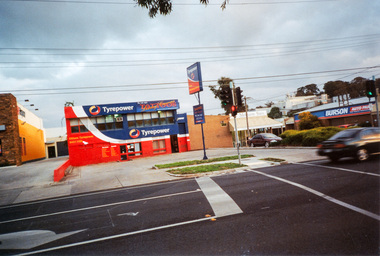
Photograph, 24 Bridge Street, Eltham, 16 May 2010, 16/05/2010
... ...Melbourne Stairs...industries bridge street Burson Auto Parts Melbourne Stairs Repco Tyrepower Colour photograph 24 Bridge Street, Eltham, 16 May 2010 Photograph ...Colour photographindustries, bridge street, burson auto parts, melbourne stairs, repco, tyrepower -
 Eltham District Historical Society Inc
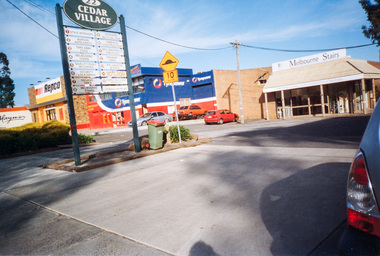
Photograph, 22-24 Bridge Street, Eltham, 16 May 2010, 16/05/2010
... ...Melbourne Stairs...industries bridge street repco tyrepower Cedar Village Haymes Paint Right Melbourne Stairs Colour photograph 22-24 Bridge Street, Eltham, 16 May 2010 Photograph ...Colour photographindustries, bridge street, repco, tyrepower, cedar village, haymes paint right, melbourne stairs -
 Melbourne Tram Museum
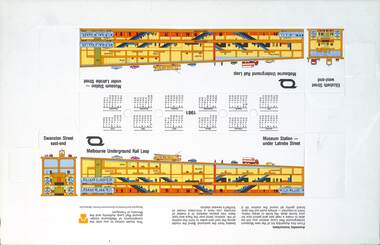
Ephemera - Fold up calendar - MURLA, Melbourne Underground Rail Loop Authority (MURLA), late 1981
... Shows a cross section through the Museum Station under La Trobe St (later Melbourne Central), showing trams, stairs, trains of the then new underground station. ...Shows a cross section through the Museum Station under La Trobe St (later Melbourne Central), showing trams, stairs, trains of the then new underground station. ...Shows a cross section through the Museum Station under La Trobe St (later Melbourne Central), showing trams, stairs, trains of the then new underground station. Published by the Melbourne Underground Rail Loop Authority and Ministry of Transport, late 1980. The station was opened in Jan. 1981 see reference. Note the Z class trams with incorrect doors given the trolley pole and silver or Hitachi trains.Demonstrates a calendar produced by MURLA to show the Museum Station in cross section.Printed card with punched out folds and 1981 calendar. Two copies held.murla, museum station, diagrams -
 Flagstaff Hill Maritime Museum and Village
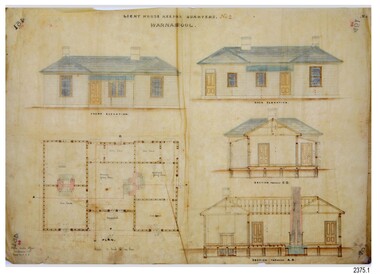
Document - Plans, Lighthouse Keeper's Quarters Warrnambool, 1858-1909
... Melbourne. This plan shows a round tower, including the stairs, windows on the tower and the weather vane on the top...Melbourne. This plan shows a round tower, including the stairs, windows on the tower and the weather vane on the top ...The set of seven 1858 plans shows proposed plans for the original Lighthouse Complex that was built on Middle Island in 1858-1859. The whole complex was then transferred to Flagstaff Hill in 1871. The plan, dated 1909, is for proposed additions and repairs to the Quarters at Flagstaff Hill. The plan 'Alterations and Additions' shows alternate plans for changes to the quarters at the Flagstaff Hill location. This plan has no date. The Complex comprised the Lighthouse, the Lighthouse Keepers’ Quarters, the Store (now called the Chart Room) and a Privy, which was not included in these plans. The Keeper’s bluestone Quarters was a cottage divided into two compartments, one for each keeper and his family. The bluestone Store was divided into three; a store, a workshop an oil store (or office). The Privy comprised of a small building also divided into two separate, back-to-back toilets, one for each Keeper and his family. The Flagstaff Hill Keeper's Quarters have had extensions and additions at various times, and these have also been removed at various other times. THE PLANS - *Dec. 1858 (12/58) ‘Lighthouse Keepers Quarters No.2 Warrnambool’ (2375.01)* Public Works Office Melbourne – Front and Back elevations, sections, and floor plan. The drawing shows timber walls. [The floor plan is the closest plan to the current building, however, the walls are timber in this plan.] *Nov. 1858 – No.3 ‘Lighthouse Keepers Quarters Warrnambool’ (2375.02)* Office of Public Works, Melbourne – Back and End elevations and section through. The drawing shows stone walls. One side; Senior Keeper’s bedroom, living room and kitchen with storeroom. Another side; is the Assistant’s bedroom, living room and storeroom. *Nov. 1858 - No.4 ‘Lighthouse Stores Warrnambool’ (2375.03)* Office of Public Works – Front, Side and end elevations, centre section. The drawing shows stone walls. *Nov. 1858 – No.4, ‘Lighthouse Stores No. 2 Warrnambool’ (2375.04)* Office of Public Works – Front, side and end elevations, centre section. The drawing shows timber walls. *Nov. 1858 – ‘Details Lighthouse Keepers Quarters No. 2 Warrnambool’ (2375.05)* Public Works Office Melbourne. The plan shows the foundations, joists and eaves. The drawing shows timber walls. (Nov. 1858 – ‘No.4 ‘Lighthouse No. 2 – Warrnambool’ (2375.06)* Public Works Melbourne (Part of the paper is missing). This plan shows an octagonal tower, internal stairs, a balcony landing, and a weather vane on top. *November 1858 – No. 1, ‘Lighthouse – Warrnambool’ (2375.07)* Office of Public Works Melbourne. This plan shows a round tower, including the stairs, windows on the tower and the weather vane on the top. *4/3/9 [1909] – ‘Additions and Repairs, Lighthouse Quarters, Warrnambool, General Plan’ (2375.8)* Department of Public Works Melbourne’s official stamp is signed by Croft. It shows the floor plans of the Store, Upper Lighthouse and the Quarters. The Store building has three sections; a Store, Work-Shop and Office, with an internal wall between them and separate entries. The Quarters are divided into two dwellings. The Senior Keeper’s side on the left has fireplaces in two of the three bedrooms and there is a pantry and wash house. The Assistant’s side has no fireplaces in the bedrooms and there’s no pantry or washhouse. These plans include proposed changes to the buildings. The Senior Keeper’s Quarters would have a partition on bedroom 2, a bath with plumbing and drainage, a wall moved and a built-in side porch. The Store would also have a built-in porch. The undated plan 'Additions and Alterations' (2375.9) shows alternative arrangements for water tanks, plumbing and such. WARRNAMBOOL'S LADY BAY LIGHTHOUSES- In the 1800s ships sailing from England to Australia began to use Bass Strait as a faster route to Melbourne. Small navigation errors led to many tragic shipwrecks. From 1848 lighthouses were operating along Victoria’s southern coast as a guide for sailors. Coastal towns such as Warrnambool grew and the exchange of trade and passengers were of great benefit. However, the uncertain weather changes, relatively shallow waters and treacherous, hidden rocky reefs were not suitable for a Harbour and in the 1840s and 1850s there were many shipwrecks in the area, with some even stranded in its Lady Bay harbour. A jetty was built in 1850 and a flagstaff to guide seafarers was placed up high on what became known now as Flagstaff Hill. In November 1857 the Victorian Government recommended that Warrnambool Harbour had beacons and two lighthouses to guide vessels into and out of the Harbour safely. The white light of the Middle Island lighthouse was to be used for the first time on September 1, 1859. The red light of the Beach Lighthouse, a wooden obelisk structure, was first operated on March 25, 1860, but in 1868 this light was ‘discontinued’ due to it being too low. Melbourne’s Department of Public Works decided to relocate the Middle Island Lighthouse Complex - Lighthouse, Keeper’s Quarters, Privy, Store Room and even water tanks - to Flagstaff Hill. The lower obelisk was shortened, and a protruding gallery, railing, and external ladder were added, as well as the light from the Beach Lighthouse. A green guiding light was erected on the end of the jetty. The transfer of the Complex began in March 1871. Each shaped stone of the lighthouse was carefully numbered, removed then reassembled on Flagstaff Hill. In 1872 the well was sunk behind the Lighthouse Keeper’s Cottage. The Keepers and families had left Middle Island in April and moved to Flagstaff Hill in October 1871. Vessels entering Lady Bay align the Upper and Lower Lighthouse towers during the day and the lights at night. The Upper Lighthouse is a round tower, the Lower Light is square. The Lighthouses were categorised as harbour lights rather than coastal lights, so they remain under the control of the Victorian Government’s Ports and Harbours section. The lights were originally powered by oil, then acetylene gas, later by electricity, and then converted to solar power in 1988. In 1993 the solar panel was replaced by a battery charger. A decision was made in 1936 to replace the lighthouses’ lights with unattended lights that no longer required Keepers and Assistants. At least 29 Keepers had attended to the lighthouse from its opening in 1859 to when the last official Lightkeepers left In April 1916. The Warrnambool Harbour Board rented out the Quarters from 1916 to 1936. The Board closed down but the rentals continued with other unknown landlords. In the 1970s the Flagstaff Hill Planning Board was set up under the chairmanship of John Lindsay. The Board was to make recommendations to the Warrnambool City Council regarding the use of the buildings and the rest of the Crown Land on the site. The Flagstaff Hill Maritime Village opened in 1975 and began renovating the Cottage in stages, during which time evidence of a 1920s fire was found in the eastern section of the cottage. Additions of a porch on the west and a washroom on the east were made in the 1980s. The western part of the building is now a Shipwreck Museum and the east has returned to a late 19th-century Lighthouse Keeper’s cottage and includes the screen made by Assistant Lighthouse Keeper Thomas Hope during one of his two periods of service there. THE LIGHTHOUSE KEEPERS Lighthouse Keepers were responsible for keeping their Lighthouse’s lights shining at night. They kept a lookout for passing vessels and changes in weather. They were expected to clean, polish and maintain the equipment and buildings. They kept regular and detailed records of who was on watch, and the time the light was lit, trimmed and extinguished. They kept a journal about other events that occurred. They keep regular, accurate Meteorological Logs. It was expected that they were competent in Morse code signalling. They would be called to help in times of disasters and shipwrecks, and to give official statements about these events. Many Lighthouse Keepers also volunteered as members of the lifeboat crew. The Lady Bay lighthouses were officially classified as small, so the Keepers had the official titles of Senior Assistant Lighthouse Keeper and Assistant Lighthouse Keeper. They were employed by the Public Service and paid rent to live in the Lighthouse Quarters. They were compulsorily retired at the age of 60, with most receiving a superannuation payment. Despite their time-consuming duties, there was time to follow hobbies and crafts such as growing vegetables, playing musical instruments, making models of buildings including lighthouses, and crafting furniture pieces. An example of a keeper’s skills is the carved fire screen made by /assistant Keeper Thomas Hope in the early 20th century and displayed in the Lighthouse Keeper’s cottage at Flagstaff Hill. The last occupants of the Middle Island Complex were Senior Keeper Robert Deverell, his Assistant Keeper, Andrew Farncombe, and their families. They all became the first occupants at the Lady Bay Lighthouse Keepers’ Quarters on Merri Street. The Warrnambool Lighthouse Complex plans are the origin of what is now the Lady Bay Lighthouse Complex. They are a record of the people, process and departments involved in bringing the complex into fruition. The plans are significant to the Complex, which is now listed on the Victorian Heritage Register, H1520, for being of historical, scientific (technological) and architectural significance to the State of Victoria. The Complex is significant as an example of early colonial development. The plan are significant for their connection with the important navigational function of the Lighthouses, a function still being performed to this day. The plans are also significant as an example of a product from the Public Works Department in Victoria in the mid-to-late 19th century. The structures built to these plans still stand strong. Plans for the Lighthouse Complex in Warrnambool, including Lighthouses, Keeper's Quarters and Stores. Seven of the plans are on thin fragile paper, one is on thicker, stronger paper. The drawings have been made in pens coloured red and black. They originate from Public Works in Melbourne. Seven were drawn in 1858, one in 1904, the other is not dated.Dec. 1858 - Lighthouse Keepers Quarters No.2 Warrnambool. Public Works Office Melbourne. Nov. 1858 - No.3 ‘Lighthouse Keepers Quarters Warrnambool. Public Works Office Melbourne. Nov. 1858 - No.4 ‘Lighthouse Stores Warrnambool. Office of Public Works. Nov. 1858 - No.4, ‘Lighthouse Stores No. 2 Warrnambool. Office of Public Works. Nov. 1858 - Details Lighthouse Keepers Quarters No. 2 Warrnambool. Public Works Office Melbourne. Nov. 1858 - No.4 ‘Lighthouse No. 2 – Warrnambool. Public Works Melbourne. Nov. 1858 - No. 1, Lighthouse - Warrnambool. Office of Public Works Melbourne. 4/3/9 [1909] - Additions and Repairs, Lighthouse Quarters, Warrnambool, General Plan. Department of Public Works Melbourne. SIGNED "Croft" "15A" on reverse [no date] - Lighthouse Quarters Warrnambool, Additions and Alterations. "9A" on reverseflagstaff hill, warrnambool, lighthouse keeper's cottage, lighthouse residence, lighthouse, plans, public works, melbourne, flagstaff hill maritime museum, maritime museum, shipwreck coast, flagstaff hill maritime village, chart room, quarters, privy, middle island, beach lighthouse, obelisk, lighthouse keeper, assistant keeper, lighthouse complex, lady bay, lady bay complex, keepers, upper lighthouse, lower lighthouse, ports and harbours, cottage, harbour board, flagstaff hill planning board, meteorological record, robert deverell, andrew farncombe, warrnambool port, warrnambool harbour, residence, alterations, repairs, department of works, light keeper -
 Federation University Historical Collection
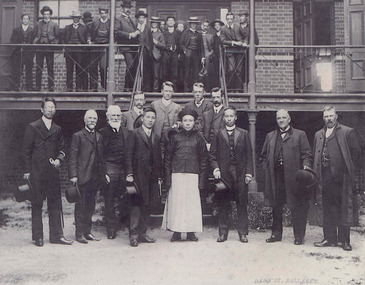
Photograph, Visit of the Chinese Commissioner to the Ballarat School of Mines, 13 November 1906, 23/11/1906 (exact)
... stairs of a building at the Ballarat School of Mines. Back row left to right: A.D. Gilchrist (Prof. of Engineering), B. Whittington (Mathematics, Physics), Thomas S. Hart (Prof. of Geology and Mining), J.M. Sutherland (Electrical Engineering) Front row left to right: Dr Wong Chock Son (Ballarat), Fred. J. Martell, Alfred Mica Smith, Ah Ket esq (Melbourne...stairs of a building at the Ballarat School of Mines. Back row left to right: A.D. Gilchrist (Prof. of Engineering), B. Whittington (Mathematics, Physics), Thomas S. Hart (Prof. of Geology and Mining), J.M. Sutherland (Electrical Engineering) Front row left to right: Dr Wong Chock Son (Ballarat), Fred. J. Martell, Alfred Mica Smith, Ah Ket esq (Melbourne ...The Chinese Imperial Commissioner, Hwang How Cheng, visited Australia at the request of the Chinese Emperor for the purpose of establishing Chinese consulates in the Commonwealth. He visited Ballarat at the request of Ballarat’s Chinese community. The newspaper reported that it was hoped the Commissioner would visit the Ballarat School of Mines “where the knowledge he would get would probably be of the utmost usefulness in the development of the great resources of China.” The Commissioner was accompanied by interpreter Ah Ket (Melbourne barrister and solicitor), and met by members of Ballarat’s Chinese community, including Dr Wong Chock Son. Apparently the Chinese Commissioner wanted to visit SMB because of its international fame relating to education in mining. From the SMB Letter book (Cat. No. 436) comes the following which suggests the Commissioner was based in Adelaide) '17th November 1906 His Excellency, Hwang How Cheng Chinese Commission Adelaide May it please your Excellency By this post I have the pleasure in forwarding for your Excellency's kind acceptance (and one for Mr. When) copies of the photograph taken of your recent visit to the School of Mines. I trust they will serve a pleasing memento of what, I hope, was a pleasant visit to our Golden City. Yours Faithfully Fredk Martell Director' The visit was reported in the Ballarat Star in 14 November 1906:- The Chinese Imperial Commissioner, Hwang Hon Cheng, who recently arrived in Victoria on behalf of the Chinese Government, paid a visit to Ballarat last evening, and was entertained by his fellow countrymen at a dinner at the Bow Leong rooms, Main street. The commissioner, who came up by the express, was accompanied by his secretary and Mr Ah Ket, the well-known Chinese barrister, of Melbourne; but some disappointment was expressed by the fact that he did not wear his official robes, being attired in the more sombre European dress. Mr W. D. M’Kee presided at the dinner, on the invitation of the Bow Leong Society, and in addition to representative Chinese residents, three were also present the mayor of the city (Cr. J. J. Brokenshire), Crs. R. Pearse, G. Crocker (City), J. R. Elsworth, A. Mackenzie, J. A. M’Neil, A. Levy, G. Bunting, F. Penhalluriack (Town), Col. Williams, Mr. J. Gent, Messrs. F. J. Martell (director of the School of Mines), A. W. Hager (president of the Orphan Asylum), A. Kenny (superintendent), R. G. Fitzgerald (clerk of courts at Ballarat East), J. Trethowan, A. A. Buley, Serg Dalton, and others. Apologies were received from the mayor of the town Revs. J. West Lau, Dr Cairns, Hon. J. Y. M’Donald, L. Lederman, C. C. Shoppee and others. The gathering was a very cordial one, and the hospitality of the Chinese was greatly appreciated. After the loyal toasts, “The King” and “The Emperor of China,” had been honoured, the chairman extended a hearty welcome on behalf of the society and others to the commissioner. Mr M’Kee said he was privileged to speak in behalf of the Chinese. There was a warm feeling of friendship between them and himself, and his services were always at their command. If he were in China he would desire that a similar compliment would be extended to him. They were all pleased the Emperor of China had sent the commissioner to establish consulates in Australia with a view of the empire understanding the feelings of Australasia better than they did at present. He hoped the commissioner would have opportunity of visiting some of their industries, as they desired him to gain all the scientific and practical knowledge of those industries that he could. The toast of “The Commissioner” was proposed by Col. Williams who expressed pleasure at the visit of a gentleman of education and attainments to look into the condition of the scions of China in Australia. He hoped the commissioner would carry away a correct impression. In Australia they had nothing to conceal; they hoped to be understood. (Applause.) No intelligent man had the temerity to condescend to patronise China, one of the richest countries in the world, with a civilisation dating back thousands of years. In the matter of population alone it was equal to one-third of the world. They heard a lot about the “awakening of China.” They hoped it would be humane, just, and considerate if it had power. He hoped the commissioner would be satisfied with what he saw. The law of filial relation to the children was strictly observed in China, and he did not know whether it would not be a good thing if they had a little more of that religion here. It would be a fair thing to tell the commissioner that while he might inquire into the labour laws, the basis of these laws was not a desire to oppress but to enable every man to obtain the same conditions they expected from their own people. If he gained that impression he felt they would be fairly treated. (Applause.) Mayor Brokenshire supported the toast. They had, he said, in the Chinese a most law-abiding people. Their behaviour was an example to the British citizens. They were quiet, inoffensive men, and they toiled hard, even on Sundays. (Laughter.) Mr Ah Ket; That is what the government does with the railway employees. (Laughter.) The Commissioner replied through Mr Ah Ket, who in a graceful speech acknowledged the toast. The commissioner had, he said been delighted with what he had seen of the country – he believed it to be one of the finest in the world – and he greatly appreciated the hospitality extended to him. (Applause.) The Chairman proposed the toast of “The health of Mr Ah Ket,” and paid a tribute to his ability. It was satisfactory to see that he had risen to such a position, and it might be that in the future he would be asked to occupy a position on the bench. (Applause.) Mr Ah Ket, in response, said he had not come prepared to make a speech. He had come to Ballarat to have a quiet evening with his friends, and as soon as he arrived he had been whirled away in a motor car to a place where he found an aggregation of East and West. He was pleased to see them commingled at the festive board. That suggested the idea that East and West could meet together without friction. Misunderstandings arose only because men were superficial. If they threw off outer garments they would know each other better. He looked forward to the time when nations would understand each other. It was by an interchange of visits that such things could be accomplished, and nations would then live at peace with each other. (Applause.) Other toasts were also honored. Twelve men pose for a photograph on the stairs of a building at the Ballarat School of Mines. Back row left to right: A.D. Gilchrist (Prof. of Engineering), B. Whittington (Mathematics, Physics), Thomas S. Hart (Prof. of Geology and Mining), J.M. Sutherland (Electrical Engineering) Front row left to right: Dr Wong Chock Son (Ballarat), Fred. J. Martell, Alfred Mica Smith, Ah Ket esq (Melbourne Barrister), His Excellency Hwang How Cheng (Chinese Commissioner), Wen Esq (Secretary), Alderman Grase (mayor of Brisbane), Grase Esq (Ballarat).ballarat school of mines, alfred mica smith, fred martell, j m sutherland, a d gilchrist, b whittington, thomas hart, wong chock son, ah ket, hwang how cheng, chinese, chinese commissioner, international, new classrooms, administration building, a building -
 Flagstaff Hill Maritime Museum and Village
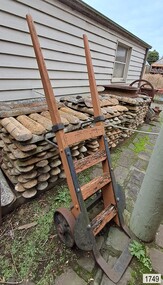
Functional object - Hand Trolley, Melbourne Steamship Company (MSS Co), Late 19th to mid-20th century
... More recently, as well as the continued use of this simple style of trolley, the design has been improved to include specialised trolleys that fold, climb stairs, move pianos and even easily turn corners on their spinning, pivoting wheels. warrnambool flagstaff-hill flagstaff-hill-maritime-museum maritime-museum shipwreck-coast flagstaff-hill-maritime-village Hand Trolley Sack Truck Trolley Luggage Trolley hand truck trundler sack barrow bag barrow leverage marine technology cargo handling docks wharft shipping trade vintage antique hand card rolling cart station trolley dolly stack truck box cart two-wheeler material handling equipment shipping trade MSS Co MSSC Melbourne Steamship Company interstate shipping Hugh R. ...This hand trolley was originally marked M.S.S. Co., and likely to have once belonged to the Melbourne Steamship Company, often referred to by those initials. Flagstaff Hill’s collection has several other objects connected to the M.S.S. Co. The firm was established in 1873 under the name Hugh R. Reid and Company, renamed Melbourne Steamship Company Ltd in 1895, and became Melbourne’s foremost interstate shipping line. Warrnambool was one of the ports of call at least between 1922 and 1956; for example, on September 27 1934, the ship Coolana left Warrnambool on its way to Stanley, Burnie and Devonport, then on to Sydney and Newcastle, while other of its vessels were visiting Fremantle, Port Lincoln, Whyalla, Adelaide, and Melbourne. The firm remained in business until around 1960. A hand trolley can be loaded with heavy and bulky objects such as luggage, and stacks of boxes such as produce, cargo and equipment. It uses the principles of wheels and leverage, like a wheelbarrow, and can easily be wheeled from one place to another. Hand trolleys are still used by farmers, railway workers, shipping companies, porters, airports, hospitals, warehouses, logistical firms, furniture removalists, factory labourers and even in private homes when heavy loads need to be moved. Hand trolleys were first used in the 18th century in industries where children were used to move heavy loads. By using a hand trolley, the young labourers could move the piles of objects with the same efficiency as the adult workers. This hand trolley is significant for its likely connection to the Melbourne Steamship Company, or MSSCo, Melbourne’s foremost shipping line for interstate trade in the late nineteenth and early-to- mid twentieth century, representing many aspects of early trade within maritime Australia; Warrnambool was one of the ports visited by the company’s ships. The design of the hand trolley is an example of equipment used since the 18th century to move heavy loads at docks and shipyards. It is associated with the maritime industries of shipping, transportation, travel, and trade, as well as the colonial primary production sectors of farming, markets, and produce. The design represents an early step in the evolution of the simple hand trolley. More recently, as well as the continued use of this simple style of trolley, the design has been improved to include specialised trolleys that fold, climb stairs, move pianos and even easily turn corners on their spinning, pivoting wheels. Hand trolley: an L-shaped handcart with handles and supporting legs at one end, wheels at the other, and a ledge or platform to hold the load. This hand trolley has orange wooden slats and handles, two metal wheels, and a black metal frame with semi-circular side flanges. An inscription is stamped on one side.Stamped: "M.S.S.CO."warrnambool, flagstaff-hill, flagstaff-hill-maritime-museum, maritime-museum, shipwreck-coast, flagstaff-hill-maritime-village, hand trolley, sack truck, trolley, luggage trolley, hand truck, trundler, sack barrow, bag barrow, leverage, marine technology, cargo handling, docks, wharft, shipping, trade, vintage, antique, hand card, rolling cart, station trolley, dolly, stack truck, box cart, two-wheeler, material handling equipment, shipping trade, mss co, mssc, melbourne steamship company, interstate shipping, hugh r. reid and company -
 Mission to Seafarers Victoria
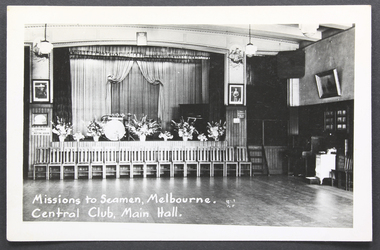
Postcard - Postcard, Black and white, KODAK, The Mission to Seamen, Melbourne - Central Hall, Main Hall, c. 1950
... melbourne...mission to seamen...wood floor...writing room...heater...stairs...Visual record of the club area in the 1950s (before Queen Elizabeth's coronation) ready for the dances. stage curtains mission to seafarers seamen's mission main hall dancing events concerts band flowers drums piano paintings royal portraits flinders street melbourne mission to seamen wood floor writing room heater stairs chairs king george vi Queen mother Printed on back: 'POST CARD/CORRESPONDENCE ADDRESS ONLY/' . ...One of a series of Mission to Seamen postcards produced in the immediate post-war and post WW2 period. Visual record of the club area in the 1950s (before Queen Elizabeth's coronation) ready for the dances.Black and white gloss postcard depicts the central club space facing stage with flowers on stage, a drum kit and a piano. Curtained backdrop with sixteen chairs in front of the proscenium. Shows dance floorboards. Note: Possible heater at far right of picture frame.Printed on back: 'POST CARD/CORRESPONDENCE ADDRESS ONLY/' . Stamp location is top right is indicated by the word 'KODAK' on four sides.stage, curtains, mission to seafarers, seamen's mission, main hall, dancing, events, concerts, band, flowers, drums, piano, paintings, royal portraits, flinders street, melbourne, mission to seamen, wood floor, writing room, heater, stairs, chairs, king george vi, queen mother -
 Federation University Historical Collection
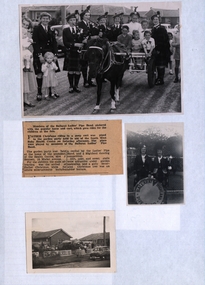
Photograph - Photograph - Black and White, Ballarat Ladies Highland Pipe Band Photographs and Newspaper Article
... Melbourne C3 - Mr & Mrs Zilles, Margaret and John Bennett, Joan Bolden (Parker) A1 - Black and white photograph of band members with children in horse and cart. A2 - Newspaper article relating to the above mentioned photograph. A3 - Black and White photograph of Drum major and member of band. A4 - Black and White photograph of Ballarat Ladies Highland Pipe Band Bazaar B1 - Black and White photograph of piper in uniform B2 - Black and White photograph of Drum Major in uniform B3 - Black and White photograph of Drum Major in uniform on stairs B4 - List of Members. ..."After the war Pipe-Major Duncan McLennan, moved to Ballarat and took up a position as cadet instructor and leader of the Ballarat Highland Pipe Band and the Ballarat Ladies Pipe Band. " (Victorian Historical Journal Vol. 85, No. 1, June 2014)A1 - Black and white photograph of band members with children in horse and cart. A2 - Newspaper article relating to the above mentioned photograph. A3 - Black and White photograph of Drum major and member of band. A4 - Black and White photograph of Ballarat Ladies Highland Pipe Band Bazaar B1 - Black and White photograph of piper in uniform B2 - Black and White photograph of Drum Major in uniform B3 - Black and White photograph of Drum Major in uniform on stairs B4 - List of Members. C1 - Black and White photograph of pipe band marching. C2 - Black and white photograph of Ladies Drum Major with Lew Zilles and Mrs Zilles C3 - Black and white photograph of Mr & Mrs Zilles, Mr and Mrs Bennett and Joan Bolden Gift of Margaret Bennett, 2019A1 - Outside 19 Waller Avenue where the ladies pipe band held a fair to raise money for new drums. The horse and cart was hired to give children rides around the "island". Trevor in the cart - striped shirt. M. Bennett. Ballarat Courier Press Photograph. A3 - Ballarat - Margaret Smith - Base drummer and Margaret Bennett - Drum Major, outside I & R Morley Doveton Street. A4 - Ballarat Ladies Highland Pipe Band Bazaar 1959. 19 Waller Ave, Ballarat B1 - 183 B2 - Margaret Bennett the Drum Major of Ballarat Ladies Pipe Band. Taken on front porch of 19 Waller Avenue B3 - Ballarat City Oval. Drum Major Margaret Bennett nee Reynolds. C1 - Copyright The Ballarat Courier Proprietary Limited C2 - Mrs Zilles, Lew Zilles, and Margaret Bennett. Progress Photos, Midway Arcade, 256 Collins St, Melbourne C3 - Mr & Mrs Zilles, Margaret and John Bennett, Joan Bolden (Parker) ladies pipe band, members, members list, ladies highland pipe band, photograph, black and white photograph -
 Flagstaff Hill Maritime Museum and Village
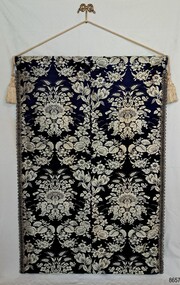
Textile - Wall Hanging, curtain, 1854-1855
... Melbourne. A reporter explored the Schomberg before its journey; the following detailed description is an excerpt of his article published in a newspaper after the disastrous voyage was announced. “ … descending by a flight of stairs...Melbourne. A reporter explored the Schomberg before its journey; the following detailed description is an excerpt of his article published in a newspaper after the disastrous voyage was announced. “ … descending by a flight of stairs ...The striking fabric of this wall hanging was recovered from the sinking Schomberg. It was originally one of the many curtains adorning the captain’s cabin and ladies’ saloons that attracted first-class passengers to this luxury vessel, built for comfort and speed. The clipper ship was on its maiden voyage, full of passengers emigrating to Australia in 1855. Its commander was Captain James Nicol Forbes, who had been selected by James Baine & Co for his navigation skills, experience, and reputation for breaking sailing records. However, on December 26th, 1855, the vessel became stranded and sank west of Cape Otway, not quite reaching its destination of Melbourne. A reporter explored the Schomberg before its journey; the following detailed description is an excerpt of his article published in a newspaper after the disastrous voyage was announced. “ … descending by a flight of stairs, covered with carpet of a very rich pattern, we came to the saloon passengers’ cabin. This is a noble place, and all that refined taste would suggest has been done to make each berth a miniature palace. The bedding is of the very best material, and the fittings are replete with every convenience. The carpets are of various coloured velvet pile, and the curtains are of satin damask, lined with white satin … The fronts of the berths are highly decorated, and festoons of flowers are painted on the panels … No two berths are furnished with the same-coloured material … the visitor is, therefore, much pleased with the variety which he has to inspect….” (Trove: Shipping Gazette and Sydney General Trade, 31 Dec 1955, p. 283) The curtain material, ‘folded into a single piece and parcelled for protection’, has been passed down through generations of Captain Forbes’ relatives, starting with his half-sister Isabella Jeffrey Nicol. The curtain has remained with the family, although some transition details are incomplete. About a century later, Isabella and Blakiston Robinson’s great-grandson and his wife had the fabric professionally mounted as a wall hanging to showcase the beauty of the woven brocade. Eventually, the custodianship of the curtain was transferred to the donor, who is also a great-grandson of Isabella and Blakiston. He and his wife hung the curtain on the wall of a high-ceilinged room in their home, away from direct light, making it visible for all to appreciate its beauty and significance. In 2024, they donated the curtain for inclusion among the collection of artefacts that help tell the story of the Schomberg and those who sailed on its first and last voyage. The donor’s aunt was highly involved in the family’s history. She had collected and recorded information that dates back to pre-1341. A footnote included in a handwritten letter dated April 20, 1959, from the late Arthur William Rudd, OBE, MA, LLB, husband of another of the donor’s aunts, states, “The curtains you mentioned came from the Schomberg. AWR.” CAPTAIN JAMES NICOL FORBES (1821-1874) and the donor’s family: - Captain Forbes was born in Aberdeen. In his late teens, he moved to Liverpool, a hub for international trade and an emigration port. By the age of 25, he was master of the Prince of Waterloo and later, the Wakefield. He then commanded the Cleopatra for the James Baines Co., which, two years later, transferred him to command the Maria, providing fast and lucrative passage to the gold fields in Ballarat, Australia. James Baines Co. and shipbuilder Thomas Mackay formed the Black Ball Line of clipper ships in 1852. Forbes was appointed master of the largest ship in the fleet, the marvellous Marco Polo. He broke the record time for the passage to Australia, taking only 68 days at sea, and the return journey in only 76 days, a total of 5 months and 21 days. On his second voyage to Melbourne in the Marco Polo the following year, he took 75 days, and 95 days on the return trip. His accomplishment made him famous. James Baines reported that the Marco Polo was the only ship, sail or steam, to do the round trip within 6 months, and it had done it twice. Captain Forbes then took command of the American-built clipper Lightning, one of four built for the Black Ball line. His 19-year-old half-sister, Isabella Jaffray Nicol, was also onboard when he sailed for Melbourne in 1854. During the 77-day voyage, Isabella met Blakiston Robinson, and not long after the ship arrived in Melbourne on July 31, the couple married, with James Nicol Forbes as a witness, on August 16. When Forbes returned to Liverpool, he took a record-breaking 63 days, which has never been bettered. James Baines Co. ordered a new luxury emigrant ship from Alexander Hall of Aberdeen; the Schomberg was the largest sailing ship ever built in Britain. On October 6, 1855, the vessel departed Liverpool commanded by Captain Forbes, with 430 passengers on board, 54 of whom were First Class. It had almost completed its voyage to Melbourne when, on the night of December 26, it ran aground west of Cape Otway. Captain Doran, master of the steamer Queen, responded to the distress signal while on its way to Portland and, with the agreement of his passengers, rescued as many as possible from the Schomberg and returned to Melbourne with them. Captain Helpman, master of the steamer Champion, rescued most of the remaining Schomberg passengers on December 27. On Friday, 28th, Captain James Lawrence was on his way to Adelaide in the steamer Burra Burra, and called past the Schomberg. He reported that the remaining crew were all doing their duties, but the Schomberg was deteriorating on a sand spit and had about 16 feet of water in its hold. That same day, the schooner Jane Elizabeth collected 220 packages of passengers’ luggage to deliver to Melbourne on the 29th. Two steamers also arrived on the 29th with 20 men to collect passengers’ luggage and valuable ship’s cargo items. They were accompanied by water police, customs agents, company representatives and a Lloyds agent. The decision was made to abandon ship on the 30th due to rough and unsafe conditions. The officials and Captain Forbes voyaged to Melbourne, while the seamen remained behind awaiting rescue. Evacuation by sea became too risky, so on January 2, 1856, while the first Mate and Steward remained at the wreck site, the rest of the crew began the 70-mile march to Warrnambool, led by the band. They arrived on January 5th and left for Melbourne on the steamer Champion on January 10th. Parts of the Schomberg wreck ended up in New Zealand. The curtain is important for its connection to the Schomberg, which was unique for being designed and built in Aberdeen, and commanded by an Aberdonian who was the most celebrated clipper captain of the age. The ship was the largest sailing ship ever built in Britain, and reported as the largest vessel that sailed to Australia. The curtain is an example of the rich decorative furnishings available in 1855. The preservation and respect the donor and his family have shown towards the curtain over many decades reflect its important role in telling the family’s history; the journey, the romantic attachment, the family connection to the sea, and travel in gold rush times. The curtain is significant for its connection to James Nocol Forbes, a famous sailing ship commander who broke several sailing records, one of which has never been bettered. This wall hanging, also known as the Schomberg Curtain, was created from a curtain recovered from the stranded luxury ship Schomberg in December 1855. The woven satin damask fabric in blue and cream has been meticulously joined to blend the intricate pattern. The reverse features a soft cream lining. The hems at the top and bottom of the fabric hold wooden rods. The side edges feature decorative braid that has been hand-stitched in place. On the reverse, the bottom hem includes the same braid, which remains unseen from the front, and the centre of the top hem has a hand-worked, unused buttonhole. Each of the hems varies in depth. The curtain was tastefully mounted later to highlight the beauty of the original saloon curtain. A decorative twisted cord of cream silk threads, accented with gold highlights and decorative tassels, was coiled and attached to the ends of the top rod. The elegant display was completed with an ornate gold hook, chosen to complement the wall hanging.flagstaff hill maritime museum and village, great ocean road, shipwreck coast, shipwreck artefact, memorabilia, curtain, saloon curtain, schomberg, wall hanging, decorative object, domestic item, warrnambool, flagstaff hill, maritime museum, maritime village, maritime history, shipwreck, stranding, schomberg curtain, schomberg wall hanging, luxury ship, 1855, damask, silk damask, blue and cream, captain’s cabin, ladies’ saloon, clipper ship, migrant, emigrant, liverpool to australia, captain james nicol forbes, james forbes, captain forbes, bully forbes, james baines & co, james baines, cape otway, aberdeen, prince of waterloo, wakefield, cleopatra, maria, thomas mackay, black ball line, marco polo, sailing record, lightning, isabella jaffray nocol, blakiston robinson, alexander hall, steamer queen, captain helpman, james lawrence, steamer burra burra, steamer jane elizabeth, water police, customs agents, lloyds agent, ship’s band, walk to warrnambool, march to warrnambool, steamer champion, agnes nicol robinson, arthur william rudd obe ma llb -
 Greensborough Historical Society
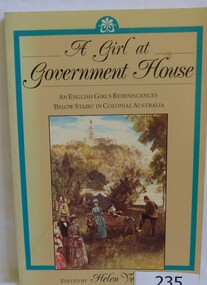
Book, A girl at Government house: an English girl’s reminiscences, ed. By Helen Vellacott, 1932_
... An English girl's reminiscences: 'below stairs' in Colonial Australia. Set in Sydney and Melbourne....An English girl's reminiscences: 'below stairs' in Colonial Australia. Set in Sydney and Melbourne. helen vellacott melbourne Signed by author. 145 p., illus. ...An English girl's reminiscences: 'below stairs' in Colonial Australia. Set in Sydney and Melbourne.145 p., illus. (some col.).Signed by author.helen vellacott, melbourne -
 Eltham District Historical Society Inc
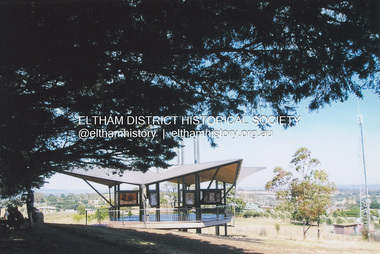
Photograph, Fay Bridge, Moor-rul Viewing Platform, Garden Hill, Kangaroo Ground, n.d
... Melbourne, the You Yangs, Mount Macedon, the Kinglake Ranges and the Mt Baw-Baw Ranges where the Yarra River starts. This landscape covers all the ancestral lands of the Wurundjeri and some of the wider Kulin nation land. The platform has been given the name Moor-rut, a name which described the fertile soils of the Kangaroo Ground area in contrast to the poorer (Silurian) country of its surrounds, which the Wurundjeri knew as 'Nillumbik' or less rich country. The full 360 degree view can be seen from the adjacent Tower of Remembrance which has 53 stairs...Melbourne, the You Yangs, Mount Macedon, the Kinglake Ranges and the Mt Baw-Baw Ranges where the Yarra River starts. This landscape covers all the ancestral lands of the Wurundjeri and some of the wider Kulin nation land. The platform has been given the name Moor-rut, a name which described the fertile soils of the Kangaroo Ground area in contrast to the poorer (Silurian) country of its surrounds, which the Wurundjeri knew as 'Nillumbik' or less rich country. The full 360 degree view can be seen from the adjacent Tower of Remembrance which has 53 stairs ...OPENING OF THE VIEWING PLATFORM AT KANGAROO GROUND Nillumbik Council has advised that the viewing platform at Kangaroo Ground 27km NE of Melbourne is to be opened to the public on Wednesday, March 26th 2008 (Melway 271 , G10). The function of the platform is to provide shelter adjacent to the War Memorial Tower whilst allowing all people to enjoy the stunning panoramic views. From the platform you. can see the Dandenongs, the city of Melbourne, the You Yangs, Mount Macedon, the Kinglake Ranges and the Mt Baw-Baw Ranges where the Yarra River starts. This landscape covers all the ancestral lands of the Wurundjeri and some of the wider Kulin nation land. The platform has been given the name Moor-rut, a name which described the fertile soils of the Kangaroo Ground area in contrast to the poorer (Silurian) country of its surrounds, which the Wurundjeri knew as 'Nillumbik' or less rich country. The full 360 degree view can be seen from the adjacent Tower of Remembrance which has 53 stairs. The viewing platform however can be accessed by wheelchair. Inside the viewing platform there are eight double sided interpretive panels giving the history and information regarding this special area. The viewing platform's interpretive panels set out the Aboriginal and European history of the area and also the geology and the local flora and fauna, so that the casual visitor comes away understanding more about this significant part of Victoria. The concept of the viewing platform is part of the refurbishment project for the Kangaroo Ground War Memorial Park which has taken place since 1997 with the active approval and financial assistance of the Nillumbik Shire Council. This project has been guided by an Advisory Committee with volunteer community representatives from the local Historical Societies, the Country Fire Authority, the Returned Services League and the Wurundjeri people. Other allied groups such as the Nillumbik Reconciliation Group have been called upon for their expertise. The initial idea for the viewing platform came from Dean Stewart when he was the caretaker while living at the park. He discussed this idea with local author Mick Woiwod and Harry Gilham of Eltham District Historical Society when they were planning the refurbishment of the War Memorial Park in 1996. When the committee was formalised by the Nillumbik Council in 1997, Nicholas Pelling, representing the CFA and RSL, joined the group. Dennis Ward, local architect, then volunteered to develop the concept plan for the refurbishment of the park and later drew up the plans for the viewing platform. The Kangaroo Ground War Memorial Park and its Tower of Remembrance is located on one of the highest locations in the Yarra Valley. The Tower of Remembrance is a unique war memorial constructed from local stone standing 14 metres high. It was built in the style of a Scottish watchtower reflecting the strong Scottish influence of the first European settlers of the district from the 1840s onward. The park was opened in 1921 and the Tower of Remembrance was dedicated in 1926 recognising the local people who served in the First World War. Those who served in the Second World War were recognised by plaques dedicated in 1951 and more recently those who served in Korea, Borneo, Malaya and Vietnam by plaques unveiled in 2001. Harry Gilham, Advisory Committee Convenor - Eltham District Historical Society Newsletter N0 179 March 2008fay bridge collection, garden hill, kangaroo ground, memorial park, moor-rul viewing platform -
 Eltham District Historical Society Inc
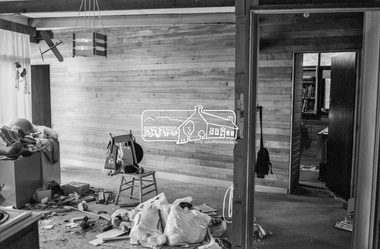
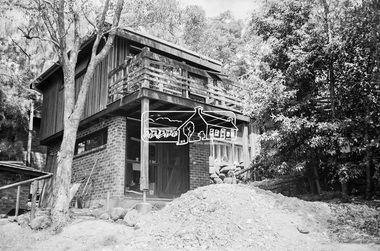
Photograph, 68 Mount Pleasant Road, Eltham, c.1983, 1983
... stairs and general interior timber cabinet work. Bedroom wardrobe doors came from scrapped Victorian Railways country coaches. Most of the timbers used in the extension were re-purposed from the Templestowe Cool Store and the Port Melbourne wool, hide & skin store....stairs and general interior timber cabinet work. Bedroom wardrobe doors came from scrapped Victorian Railways country coaches. Most of the timbers used in the extension were re-purposed from the Templestowe Cool Store and the Port Melbourne wool, hide & skin store. alistair knox design, eltham, graham rose, houses, mount pleasant road Digital TIFF file Scan of 35mm Ilford XP1 black and white transparency 68 Mount Pleasant Road, Eltham, c.1983 Photograph George Coop George Coop ...An early Alistair Knox design and build, this home was purchased by George Coop in 1968. Eltham builder, Graham Rose, extended the original Alistair Knox structure over the foundation excavation dug by George. Graham organised the brick walls where required, raised all frame work and laid the steel tray roof. George did all external/internal wall cladding, made all opening windows, sliding and swinging doors, stairs and general interior timber cabinet work. Bedroom wardrobe doors came from scrapped Victorian Railways country coaches. Most of the timbers used in the extension were re-purposed from the Templestowe Cool Store and the Port Melbourne wool, hide & skin store.Digital TIFF file Scan of 35mm Ilford XP1 black and white transparencyalistair knox design, eltham, graham rose, houses, mount pleasant road -
 Eltham District Historical Society Inc
Photograph, 68 Mount Pleasant Road, Eltham, c.1983, 1983
... stairs and general interior timber cabinet work. Bedroom wardrobe doors came from scrapped Victorian Railways country coaches. Most of the timbers used in the extension were re-purposed from the Templestowe Cool Store and the Port Melbourne wool, hide & skin store....stairs and general interior timber cabinet work. Bedroom wardrobe doors came from scrapped Victorian Railways country coaches. Most of the timbers used in the extension were re-purposed from the Templestowe Cool Store and the Port Melbourne wool, hide & skin store. alistair knox design, eltham, graham rose, houses, mount pleasant road Digital TIFF file Scan of 35mm Ilford XP1 black and white transparency 68 Mount Pleasant Road, Eltham, c.1983 Photograph George Coop George Coop ...An early Alistair Knox design and build, this home was purchased by George Coop in 1968. Eltham builder, Graham Rose, extended the original Alistair Knox structure over the foundation excavation dug by George. Graham organised the brick walls where required, raised all frame work and laid the steel tray roof. George did all external/internal wall cladding, made all opening windows, sliding and swinging doors, stairs and general interior timber cabinet work. Bedroom wardrobe doors came from scrapped Victorian Railways country coaches. Most of the timbers used in the extension were re-purposed from the Templestowe Cool Store and the Port Melbourne wool, hide & skin store.Digital TIFF file Scan of 35mm Ilford XP1 black and white transparencyalistair knox design, eltham, graham rose, houses, mount pleasant road -
 Eltham District Historical Society Inc
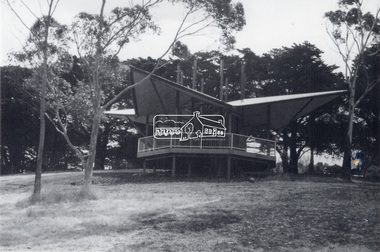
Photograph - Black and White Print, Moor-rul Viewing Platform, March 2007
... Melbourne, the You Yangs, Mount Macedon, the Kinglake Ranges and the Mt Baw-Baw Ranges where the Yarra River starts. This landscape covers all the ancestral lands of the Wurundjeri and some of the wider Kulin nation land. The platform has been given the name Moor-rut, a name which described the fertile soils of the Kangaroo Ground area in contrast to the poorer (Silurian) country of its surrounds, which the Wurundjeri knew as 'Nillumbik' or less rich country. The full 360 degree view can be seen from the adjacent Tower of Remembrance which has 53 stairs...Melbourne, the You Yangs, Mount Macedon, the Kinglake Ranges and the Mt Baw-Baw Ranges where the Yarra River starts. This landscape covers all the ancestral lands of the Wurundjeri and some of the wider Kulin nation land. The platform has been given the name Moor-rut, a name which described the fertile soils of the Kangaroo Ground area in contrast to the poorer (Silurian) country of its surrounds, which the Wurundjeri knew as 'Nillumbik' or less rich country. The full 360 degree view can be seen from the adjacent Tower of Remembrance which has 53 stairs ...Early stages - no display panels installed. OPENING OF THE VIEWING PLATFORM AT KANGAROO GROUND Nillumbik Council has advised that the viewing platform at Kangaroo Ground 27km NE of Melbourne is to be opened to the public on Wednesday, March 26th 2008 (Melway 271 , G10). The function of the platform is to provide shelter adjacent to the War Memorial Tower whilst allowing all people to enjoy the stunning panoramic views. From the platform you. can see the Dandenongs, the city of Melbourne, the You Yangs, Mount Macedon, the Kinglake Ranges and the Mt Baw-Baw Ranges where the Yarra River starts. This landscape covers all the ancestral lands of the Wurundjeri and some of the wider Kulin nation land. The platform has been given the name Moor-rut, a name which described the fertile soils of the Kangaroo Ground area in contrast to the poorer (Silurian) country of its surrounds, which the Wurundjeri knew as 'Nillumbik' or less rich country. The full 360 degree view can be seen from the adjacent Tower of Remembrance which has 53 stairs. The viewing platform however can be accessed by wheelchair. Inside the viewing platform there are eight double sided interpretive panels giving the history and information regarding this special area. The viewing platform's interpretive panels set out the Aboriginal and European history of the area and also the geology and the local flora and fauna, so that the casual visitor comes away understanding more about this significant part of Victoria. The concept of the viewing platform is part of the refurbishment project for the Kangaroo Ground War Memorial Park which has taken place since 1997 with the active approval and financial assistance of the Nillumbik Shire Council. This project has been guided by an Advisory Committee with volunteer community representatives from the local Historical Societies, the Country Fire Authority, the Returned Services League and the Wurundjeri people. Other allied groups such as the Nillumbik Reconciliation Group have been called upon for their expertise. The initial idea for the viewing platform came from Dean Stewart when he was the caretaker while living at the park. He discussed this idea with local author Mick Woiwod and Harry Gilham of Eltham District Historical Society when they were planning the refurbishment of the War Memorial Park in 1996. When the committee was formalised by the Nillumbik Council in 1997, Nicholas Pelling, representing the CFA and RSL, joined the group. Dennis Ward, local architect, then volunteered to develop the concept plan for the refurbishment of the park and later drew up the plans for the viewing platform. The Kangaroo Ground War Memorial Park and its Tower of Remembrance is located on one of the highest locations in the Yarra Valley. The Tower of Remembrance is a unique war memorial constructed from local stone standing 14 metres high. It was built in the style of a Scottish watchtower reflecting the strong Scottish influence of the first European settlers of the district from the 1840s onward. The park was opened in 1921 and the Tower of Remembrance was dedicated in 1926 recognising the local people who served in the First World War. Those who served in the Second World War were recognised by plaques dedicated in 1951 and more recently those who served in Korea, Borneo, Malaya and Vietnam by plaques unveiled in 2001. Harry Gilham, Advisory Committee Convenor - Eltham District Historical Society Newsletter N0 179 March 2008 Black and white inkjet print on paper 14 x 21 cmmoor-rul viewing platform, garden hill, kangaroo ground, memorial park -
Glen Eira Historical Society
Book - Robertson, Alexander William
... Stairs... Stained Glass... Settlements... Graziers... Verandas... Cast Iron Work... Marble... Balconies... Bell Towers... Towers... Bay Windows... Panoramic Views... Bedrooms... Servants Quarters... Billiards Rooms... Rooms... Fireplaces... Sculpture... Servants... Marvellous Melbourne...Billing Mary Billing Williamina Billing Richard Junior Watson Flora Kate Robertson Eva Robertson Nina Robertson Emily Robertson John Australian-German Association Bicentennial Gift to the Nation Ferguson and Urie Crouch and Wilson Tangent Design Midas Printing (Asia) Limited (Ltd) Flats Architectural Features Architectural Styles Auctions Land Sales Land Subdivision Architects Lawyers Judges Coaches and Carriages Businesspeople German Community Victorian Style Grants Voluntary Workers Property Development Construction (events and activities) Gold Mining Theatrical Productions Stairs Stained Glass Settlements Graziers Verandas Cast Iron Work Marble Balconies Bell Towers Towers Bay Windows Panoramic Views Bedrooms Servants Quarters Billiards Rooms Rooms Fireplaces Sculpture Servants Marvellous Melbourne Land Use Depression 1890s Photography Photographers Entrance Hall Domestic Life Cultural Events and Activities Book Robertson, Alexander William ...Contains one item about 'Labassa', called 'Ontario' when owned by Alexander William Robertson: 1/One copy of a thirty-two page colour book, published by the Friends of Labassa and The National Trust in 2004. The book details the history of Labassa (and its owners) as a place for social gatherings and entertaining of Melbourne society of the late nineteenth century, and its letter use as flats and a boarding house. Extensively illustrated with colour photographs, architectural sketches and plans, the book LABASSA: A GRAND VICTORIAN MANSION details Labassa’s architectural significance Please refer to file 1113Y for the other copy of this book. For further information about Labrassa please refer to file 1113.labassa, ontario, sylliott hill, caulfield north, friends of labassa, manor grove, national trust of australia (victoria), balaclava road, orrong road, caulfield, mansions, cobb and co., amatil ltd. (limited), alcoa of australia ltd. (limited), lyall william, mickle john, billing richard annesley judge, robertson alexander william, watson john boyd ii, koch john augustus bernard, hammond victoria, palmer lee, davis kingsley, groenhout chris, worrall bronwyn, balderstone sue, biarujia ian, cassidy darien, davidson rodney ao obe, forge warwick, lewis miles dr., sagazio celestina dr., billing mary, billing williamina, billing richard junior, watson flora kate, robertson eva, robertson nina, robertson emily, robertson john, australian-german association, bicentennial gift to the nation, ferguson and urie, crouch and wilson, tangent design, midas printing (asia) limited (ltd), flats, architectural features, architectural styles, auctions, land sales, land subdivision, architects, lawyers, judges, coaches and carriages, businesspeople, german community, victorian style, grants, voluntary workers, property development, construction (events and activities), gold mining, theatrical productions, stairs, stained glass, settlements, graziers, verandas, cast iron work, marble, balconies, bell towers, towers, bay windows, panoramic views, bedrooms, servants quarters, billiards rooms, rooms, fireplaces, sculpture, servants, marvellous melbourne, land use, depression 1890s, photography, photographers, entrance hall, domestic life, cultural events and activities -
 Eltham District Historical Society Inc
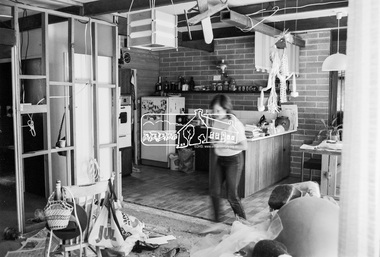
Photograph, 68 Mount Pleasant Road, Eltham, c.1983, 1983
... stairs and general interior timber cabinet work. Bedroom wardrobe doors came from scrapped Victorian Railways country coaches. Most of the timbers used in the extension were re-purposed from the Templestowe Cool Store and the Port Melbourne wool, hide & skin store....stairs and general interior timber cabinet work. Bedroom wardrobe doors came from scrapped Victorian Railways country coaches. Most of the timbers used in the extension were re-purposed from the Templestowe Cool Store and the Port Melbourne wool, hide & skin store. alistair knox design, eltham, graham rose, houses, mount pleasant road Digital TIFF file Scan of 35mm Ilford XP1 black and white transparency 68 Mount Pleasant Road, Eltham, c.1983 Photograph George Coop George Coop ...An early Alistair Knox design and build, this home was purchased by George Coop in 1968. Eltham builder, Graham Rose, extended the original Alistair Knox structure over the foundation excavation dug by George. Graham organised the brick walls where required, raised all frame work and laid the steel tray roof. George did all external/internal wall cladding, made all opening windows, sliding and swinging doors, stairs and general interior timber cabinet work. Bedroom wardrobe doors came from scrapped Victorian Railways country coaches. Most of the timbers used in the extension were re-purposed from the Templestowe Cool Store and the Port Melbourne wool, hide & skin store.Digital TIFF file Scan of 35mm Ilford XP1 black and white transparencyalistair knox design, eltham, graham rose, houses, mount pleasant road -
 Port Melbourne Historical & Preservation Society
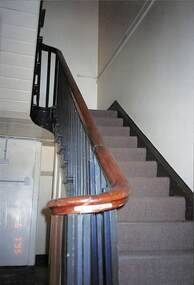
Photograph - Port Melbourne Police Station and lock-up, Jim Hillis, 1996
... Photo of station stairs One of a set of photographs of Port Melbourne police station and lock up taken by Jim HILLIS in 1996 when PMH&PS representatives were given a tour after station was vacated by police:...Taken by Jim HILLIS as a record of the buildings Built Environment - Civic Police Law Police Station Photo of station stairs One of a set of photographs of Port Melbourne police station and lock up taken by Jim HILLIS in 1996 when PMH&PS representatives were given a tour after station was vacated by police: Photograph Port Melbourne Police Station and lock-up Jim Hillis ...Taken by Jim HILLIS as a record of the buildingsPhoto of station stairs One of a set of photographs of Port Melbourne police station and lock up taken by Jim HILLIS in 1996 when PMH&PS representatives were given a tour after station was vacated by police:built environment - civic, police, law, police station -
Port Melbourne Historical & Preservation Society
Photograph - Port Melbourne Police Station and lock-up, Jim Hillis, 1996
... Photo of stairs from above. One of a set of photographs of Port Melbourne police station and lock up taken by Jim HILLIS in 1996 when PMH&PS representatives were given a tour after station was vacated by police:...Taken by Jim HILLIS as a record of the buildings Built Environment - Civic Police Law Police Station Photo of stairs from above. One of a set of photographs of Port Melbourne police station and lock up taken by Jim HILLIS in 1996 when PMH&PS representatives were given a tour after station was vacated by police: Photograph Port Melbourne Police Station and lock-up Jim Hillis ...Taken by Jim HILLIS as a record of the buildingsPhoto of stairs from above. One of a set of photographs of Port Melbourne police station and lock up taken by Jim HILLIS in 1996 when PMH&PS representatives were given a tour after station was vacated by police:built environment - civic, police, law, police station -
Port Melbourne Historical & Preservation Society
Photograph - Port Melbourne Police Station and lock-up, Jim Hillis, 1996
... Photo of front door from stairs One of a set of photographs of Port Melbourne police station and lock up taken by Jim HILLIS in 1996 when PMH&PS representatives were given a tour after station was vacated by police:...Taken by Jim HILLIS as a record of the buildings Built Environment - Civic Police Law Police Station Photo of front door from stairs One of a set of photographs of Port Melbourne police station and lock up taken by Jim HILLIS in 1996 when PMH&PS representatives were given a tour after station was vacated by police: Photograph Port Melbourne Police Station and lock-up Jim Hillis ...Taken by Jim HILLIS as a record of the buildingsPhoto of front door from stairs One of a set of photographs of Port Melbourne police station and lock up taken by Jim HILLIS in 1996 when PMH&PS representatives were given a tour after station was vacated by police:built environment - civic, police, law, police station -
 Bendigo Historical Society Inc.
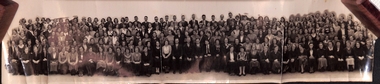
Costume - Skidmore Collection: Aust. Knitting Mills Pty. Ltd. Bendigo - B&W photograph of factory and office staff, 9th May 1934, 1934
... Melbourne. Skidmore Collection: Aust. Knitting Mills Pty. Ltd. Bendigo - B&W photograph of the full complement of Hanro factory and office staff, taken 9th May 1934. Photo shows six rows of staff, front row seated, the balance shown standing on steps/stairs. ...Social history of knitting mills in Bendigo Skidmore Collection: Aust. Knitting Mills Pty. Ltd. Bendigo - B&W photograph of the full complement of Hanro factory and office staff, taken 9th May 1934. Photo shows six rows of staff, front row seated, the balance shown standing on steps/stairs. The photo has been compiled from several (possibly six) photographs. A section of the RHS of the compiled photo is missing, though all staff are shown on the photo.Photographer Irine McCartney, South Yarra, Melbourne.factory & office staff, hano staff complement 1934 -
 Victoria Police Museum
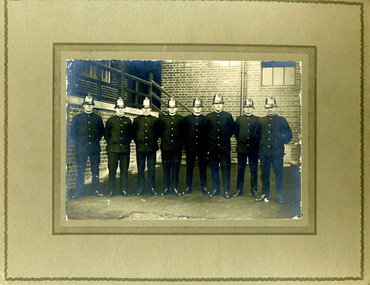
Photograph (Victoria Police Group Photo), Police Officers group in depot, 1920s
... Melbourne - 43 PTS // 21.8.26 Stamp: PHOTOGRAPH TAKEN // AT YOUR OWN HOME // P. J. DWYER // Onr. Harding & Salisbury Sts. // COBURG // PHOTOGRAPHS COPIED // AND ENLARGED Black and white photograph mounted on light brown frame. 8 Police Officers in 1920s uniform pose in uniforms with helmets. Standfing in a terrace with an open brick building with windows and a set of stairs ...Black and white photograph mounted on light brown frame. 8 Police Officers in 1920s uniform pose in uniforms with helmets. Standfing in a terrace with an open brick building with windows and a set of stairs on the background. Amongst them is William Arthur Poulter.Handwritten: BILL POULTER // 3RD FROM RIGHT Handwritten: The M.C.G. Gang // Collingwood - 93 PTS V Melbourne - 43 PTS // 21.8.26 Stamp: PHOTOGRAPH TAKEN // AT YOUR OWN HOME // P. J. DWYER // Onr. Harding & Salisbury Sts. // COBURG // PHOTOGRAPHS COPIED // AND ENLARGEDpoulter, william, william arthur poulter, victoria police museum, dwyer, p. j., police officers -
 Port Melbourne Historical & Preservation Society
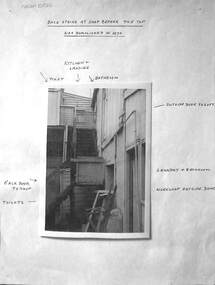
Photograph - Back stairs before demolition, Faram Bros, Bay Street, Port Melbourne, 1970
... Back stairs before demolition, Faram Bros, Bay Street, Port Melbourne...The prints have been marked with dates. .10 - Back stairs before 1970 demolition (annotated) Photograph Back stairs before demolition, Faram Bros, Bay Street, Port Melbourne ...Series of A4 copy photos given to the collection by Judy Faram, Illustrating the evolution of the 1856 building (see also #1516, 1522). The prints have been marked with dates. .10 - Back stairs before 1970 demolition (annotated)In ink, various information dates etc on surface of prints.business and traders - hardware, built environment - commercial, faram brothers hardware -
 Port Melbourne Historical & Preservation Society
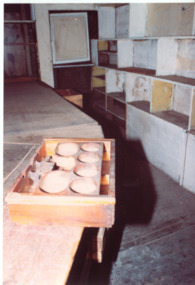
Photograph - Interior, former grocery shop, 175 Stokes Street, Port Melbourne, Russell Polson, 1991
... (.01) cash drawer. (.02) windows. (.03) stables (.04) backyard (.05) back house (.06) bathroom (.07) fireplace (.08) bedroom (.09) stairs (.10) cupboard (.11) shelves (.12) drawers (.13) bench (.14) bench 2 (.15) under windows (.16) bench and door (.17) under stairs (.18) windows 2 (.19) door (.20) stables and yard (.21) backwindow (.22) sideway (.23) kitchen (.24) upstairs Photograph Interior, former grocery shop, 175 Stokes Street, Port Melbourne Russell Polson ...Shop due for demolition was purchased by artist Helen ..... and restored keeping most of it intact. These pictures were taken at the time of sale by Russell POLSON, a descendant of the Bellions. They were brought in for copying in 1991 by the Bellion's granddaughter, Margaret BRIDE.24 photos taken by Russell POLSON in 1991 of Benjamin Henry BELLION (original builder) and Elzabeth Sarah WALKER's shop and shipping business at 175 Stokes Street.. 1870 to 1959. (.01) cash drawer. (.02) windows. (.03) stables (.04) backyard (.05) back house (.06) bathroom (.07) fireplace (.08) bedroom (.09) stairs (.10) cupboard (.11) shelves (.12) drawers (.13) bench (.14) bench 2 (.15) under windows (.16) bench and door (.17) under stairs (.18) windows 2 (.19) door (.20) stables and yard (.21) backwindow (.22) sideway (.23) kitchen (.24) upstairsbusiness and traders - grocers and supermarkets, built environment - commercial, benjamin bellion, william j bellion, helen leitch, a peterson -
 Port Melbourne Historical & Preservation Society
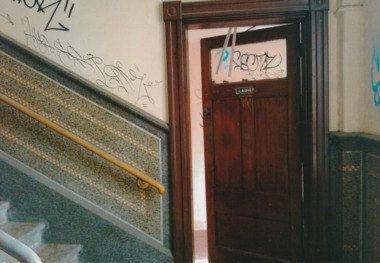
Photograph - Back staircase, Administration Building, J Kitchen & Sons, Port Melbourne, Lionel Layfield, 2014 - 2015
... Stairs and toilets series of colour photographs taken inside and from the J Kitchen & Sons Administration Building, Ingles St, Port Melbourne. ...See also cat nos 3846, 3847 and 3848 Industry - Manufacturing Built Environment - Industrial Built Environment - Commercial J Kitchen & Sons Pty Ltd Lionel LAYFIELD Demolitions Stairs and toilets series of colour photographs taken inside and from the J Kitchen & Sons Administration Building, Ingles St, Port Melbourne. ...Photographs taken by ex-employee of Kitchen's, Lionel LAYFIELD (refer catalogue numbers 3411 and 3412) just before the building sold to "The Block" - a Channel 9 TV program. See also cat nos 3846, 3847 and 3848Stairs and toilets series of colour photographs taken inside and from the J Kitchen & Sons Administration Building, Ingles St, Port Melbourne. Details where possible are on the back of the photographs. ..01-.04 ; back staircaseindustry - manufacturing, built environment - industrial, built environment - commercial, j kitchen & sons pty ltd, lionel layfield, demolitions -
 Port Melbourne Historical & Preservation Society
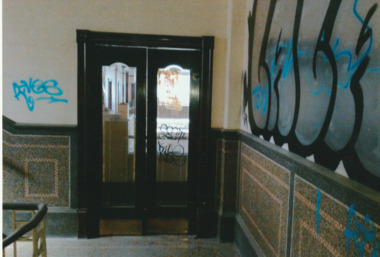
Photograph - Front staircase, Administration Building, J Kitchen & Sons, Port Melbourne, Lionel Layfield, 2014 - 2015
... Stairs and toilets series of colour photographs taken inside and from the J Kitchen & Sons Administration Building, Ingles St, Port Melbourne. ...See also cat nos 3846, 3847 and 3848 Industry - Manufacturing Built Environment - Industrial Built Environment - Commercial J Kitchen & Sons Pty Ltd Lionel LAYFIELD Demolitions Stairs and toilets series of colour photographs taken inside and from the J Kitchen & Sons Administration Building, Ingles St, Port Melbourne. ...Photographs taken by ex-employee of Kitchen's, Lionel LAYFIELD (refer catalogue numbers 3411 and 3412) just before the building sold to "The Block" - a Channel 9 TV program. See also cat nos 3846, 3847 and 3848Stairs and toilets series of colour photographs taken inside and from the J Kitchen & Sons Administration Building, Ingles St, Port Melbourne. Details where possible are on the back of the photographs. .05-.06 ; front staircaseindustry - manufacturing, built environment - industrial, built environment - commercial, j kitchen & sons pty ltd, lionel layfield, demolitions -
 Port Melbourne Historical & Preservation Society
Photograph - Toilets, Administration Building, J Kitchen & Sons, Port Melbourne, Lionel Layfield, 2014 - 2015
... Stairs and toilets series of colour photographs taken inside and from the J Kitchen & Sons Administration Building, Ingles St, Port Melbourne. ...See also cat nos 3846, 3847 and 3848 Industry - Manufacturing Built Environment - Industrial Built Environment - Commercial J Kitchen & Sons Pty Ltd Lionel LAYFIELD Demolitions Stairs and toilets series of colour photographs taken inside and from the J Kitchen & Sons Administration Building, Ingles St, Port Melbourne. ...Photographs taken by ex-employee of Kitchen's, Lionel LAYFIELD (refer catalogue numbers 3411 and 3412) just before the building sold to "The Block" - a Channel 9 TV program. See also cat nos 3846, 3847 and 3848Stairs and toilets series of colour photographs taken inside and from the J Kitchen & Sons Administration Building, Ingles St, Port Melbourne. Details where possible are on the back of the photographs. .13 -.18 ;toiletsindustry - manufacturing, built environment - industrial, built environment - commercial, j kitchen & sons pty ltd, lionel layfield, demolitions -
 Port Melbourne Historical & Preservation Society
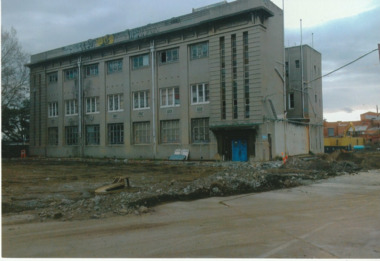
Photograph - Outside Staircase Administration Building, J Kitchen & Sons, Port Melbourne, Lionel Layfield, 2014 - 2015
... Back Stairs series of colour photographs taken outside the J Kitchen & Sons Administration Building, Ingles St, Port Melbourne. ...See also cat nos 3846, 3847 and 3848 Industry - Manufacturing Built Environment - Industrial Built Environment - Commercial J Kitchen & Sons Pty Ltd Lionel LAYFIELD Demolitions Back Stairs series of colour photographs taken outside the J Kitchen & Sons Administration Building, Ingles St, Port Melbourne. ...Photographs taken by ex-employee of Kitchen's, Lionel LAYFIELD (refer catalogue numbers 3411 and 3412) just before the building sold to "The Block" - a Channel 9 TV program. See also cat nos 3846, 3847 and 3848Back Stairs series of colour photographs taken outside the J Kitchen & Sons Administration Building, Ingles St, Port Melbourne. Details where possible are on the back of the photographs. industry - manufacturing, built environment - industrial, built environment - commercial, j kitchen & sons pty ltd, lionel layfield, demolitions -
 Churchill Island Heritage Precinct
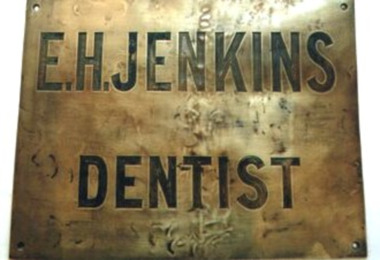
Functional object - Name Plate, c. 1930s, 1940s
... The name plate was used by Harry Jenkins for his dentist practice, Collins St, Melbourne. harry jenkins churchill island dentistry collins st Front: "E.H. JENKINS / DENTIST" Reverse: "SRIATS PU" (UP STAIRS backwards) Rectangular brass name plate, one recessed screw hole per corner. ...The Churchill Island collection includes objects from the late 1800s to 1900s. The collection is presented in sets and series, of which this name plate represents the Jenkins era.Dr Harry Jenkins owned Churchill Island from 1936-1963 and served as dentist with the AEF and British forces in England and France 1917-1919, recorded in the history of the Royal Australian Army Dental Corps. The name plate was used by Harry Jenkins for his dentist practice, Collins St, Melbourne. Rectangular brass name plate, one recessed screw hole per corner.Front: "E.H. JENKINS / DENTIST" Reverse: "SRIATS PU" (UP STAIRS backwards)harry jenkins, churchill island, dentistry, collins st -
 Williamstown Historical Society Inc
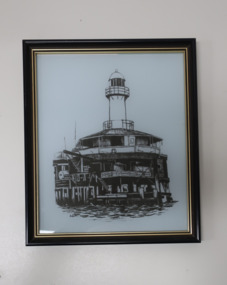
Drawing - Gellibrand Pile Light
... In June 1976 the "Melbourne Trader" collided with the pile light and due to the hazardous situation that developed a decision was made to set fire to the light on 23 June. Appears to be: "O.S.M". (at bottom left of drawing) A black and white detailed pencil drawing of the Gellibrand Pile Light showing the front with the access stairs. ...The Gellibrand Pile Light commenced operation on 1 August 1908 and replaced a circular iron vessel with a red light atop. The new structure with 33 piles was built in the water; the light was then placed on top of the piles. In June 1976 the "Melbourne Trader" collided with the pile light and due to the hazardous situation that developed a decision was made to set fire to the light on 23 June. A black and white detailed pencil drawing of the Gellibrand Pile Light showing the front with the access stairs. The drawing is in a black wooden frame, behind glass.Appears to be: "O.S.M". (at bottom left of drawing)
