
Showing 19 items matching "melbourne transport unit"
-
 Bendigo Military Museum
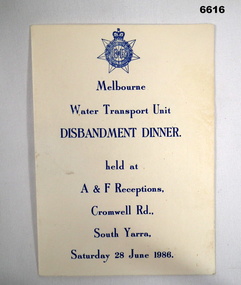
Programme - MENU, WATER TRANSPORT UNIT, DISBANDMENT DINNER, Melbourne Water Transport Unit, 1981
... Melbourne Water Transport Unit carried supplies by land and sea....Front cover, RAACT badge, titled "Melbourne Water Transport Unit, Disbandment Dinner" plus "Held at A & F Receptions, Cromwell Rd, South Yarra - Saturday 28 June 1986". ...Melbourne Water Transport Unit...Melbourne Water Transport Unit carried supplies by land and sea. ...Melbourne Water Transport Unit carried supplies by land and sea.Single sheet of cardboard, off white, folded once. Printing is in blue ink. Front cover, RAACT badge, titled "Melbourne Water Transport Unit, Disbandment Dinner" plus "Held at A & F Receptions, Cromwell Rd, South Yarra - Saturday 28 June 1986". Inside are faint pictures of L.A.R.C.S. Printing of toasts, guests and menu is in red ink. Includes after dinner mints! Dining President WO2 R. Brown CSM.water transport, larcs, passchendaele barracks trust -
 Bendigo Military Museum
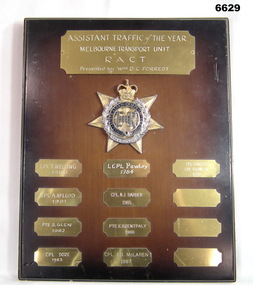
Plaque - R.A.C.T PLAQUE
... ...Melbourne Transport Unit...PLAQUE WAS AWARDED EACH YEAR FOR THE CATEGORY OF "ASSISTANT TRAFFIC OF THE YEAR" MELBOURNE TRANSPORT UNIT FROM 1980 TO 1988....Headed "Assistant Traffic of The Year" then "Melbourne Transport Unit" then "RACT" then "Presented by WO2 D. ...PLAQUE WAS AWARDED EACH YEAR FOR THE CATEGORY OF "ASSISTANT TRAFFIC OF THE YEAR" MELBOURNE TRANSPORT UNIT FROM 1980 TO 1988. Wooden Plaque Melbourne Transport Unit Passchendaele Barracks Trust Headed "Assistant Traffic of The Year" then "Melbourne Transport Unit" then "RACT" then "Presented by WO2 D. ...PLAQUE WAS AWARDED EACH YEAR FOR THE CATEGORY OF "ASSISTANT TRAFFIC OF THE YEAR" MELBOURNE TRANSPORT UNIT FROM 1980 TO 1988.Brown wooden plaque with gold metal heading and individual metal name labels. Also in-between badge emblem of Royal Australian Corps of Transport.Headed "Assistant Traffic of The Year" then "Melbourne Transport Unit" then "RACT" then "Presented by WO2 D. C. Forrest" then 12 metal labels, 9 with names of recipients from 1980 to 1988. 1980 - CPL T. WELLING. 1981 - CPL A. McLEOD. 1982 - PTE S. GLEN. 1983 - CPL DORE. 1984 - LCPL PAWLEY. 1985 - CPL A. J. BARBER. 1986 - PTE E. SZENTPALY. 1987 - CPL I.D. McLAREN. 1988 - CPL CARTER & CPL FRAWLEY.wooden plaque, melbourne transport unit, passchendaele barracks trust -
 Montmorency–Eltham RSL Sub Branch
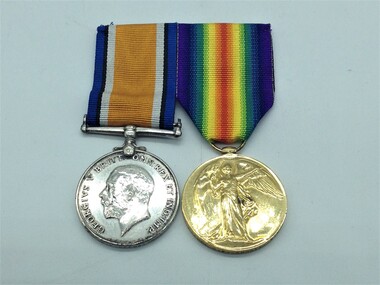
Medal - Medal Group, WW1, 2166 Lieutenant Reginald Frank Barratt
... Embarkation details - Unit embarked from Melbourne, Victoria on board Transport A2 Geelong on 19th September 1914. ...Embarkation details - Unit embarked from Melbourne, Victoria on board Transport A2 Geelong on 19th September 1914. ...Information from "The AIF Project" Lieutenant Reginald Frank Barratt was born in 1879 in Withington, Manchester, Lancashire, England. Regimental number 2166. 3rd Field Artillery Brigade, Military District 3 and Military District 6. Arrived in Australia in 1903 aged 24. Address was Mount Street, Heidelberg, Victoria. Occupation - Farmer. Enlistment date was 17th August 1914. Served with the 68 Battery Royal Field Artillery during the South African War. Rank on enlistment was Sergeant. Embarkation details - Unit embarked from Melbourne, Victoria on board Transport A2 Geelong on 19th September 1914. Rank Lieutenant - Unit 1st Divisional Ammunition Column. Information from the Roll of Honour - Awarded Royal Human Society Medal for saving three lives from drowning in Orange River during South African War. Wounded at Zillebeke, near Ypres, Belgium. Died of wounds 22nd August 1917 at the age of 38. Buried at Bedford House Cemetery, Enclosure No 2, (Plot 1, R0w F, Grave 23), Zillebeke, Belgium. Panel number , Roll of Honour Australian War Memorial British War Medal - The medal was struck by the Royal Mint, is a silver disc 36mm in diameter with a straight clasp suspended without swivel. The obverse shows Sir Bertram Mackennal's bare headed effigy of King George V facing left with the legend 'GEORGIVS V BRITT:OMN:REX ET IND:IMD - "George V, King of all the British Isles & Emperor of India". The reverse, designed by William McMillan, shows St George, naked on horseback and armed with a short sword, an allegory of the physical & mental strength which achieved victory of Prussianism. The horse tramples on the Prussian eagle shield and the emblems of death, a skull and cross bones. In the background are ocean waves and just off centre near the right upper time is the risen sun of victory. The years 1914-1918 appear on the perimeter in the left and right fields respectively. The watered silk ribbon is 32mm wide with 3mm wide royal blue band, 2mm wide black band, 3mm wide white band repeated in reverse order and separated by 16mm wide orange band. Victory Medal - The medal is bronze disc 36mm in diameter with a winged figure of Victory on the obverse. The reverse has the words 'THE GREAT WAR FOR CIVILIZATION 1914-1918', all surrounded by a laurel leaf. The watered silk ribbon is 32mm wided has two rainbow design with the violet from each rainbow on the outside edges, moving through to a central red stripe where both rainbows meet.The recipients name, rank and unit are impressed on the bottom edge of the medals - Lieut F Barratt AIF -
 Bendigo Military Museum
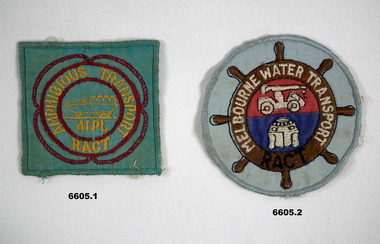
Badge - UNIT BADGES, RACT
... units within the RACT (Royal Australian Corp of Transport). RACT Cloth Badges Passchendaele Barracks Trust 1. Embroidered "Amphibious Transport RACT"and "41 PL". 2. Embroidered "Melbourne ...Badges used to identify units within the RACT (Royal Australian Corp of Transport).1. Square material blue patch with red round borders and yellow writing and picture of a vehicle. Other side, white felt. 2. Round light blue patch with brown spoked boat wheel. White writing and inside wheel picture of white crane vehicle on red background and white machine on blue background.1. Embroidered "Amphibious Transport RACT"and "41 PL". 2. Embroidered "Melbourne Water Transport RACT".ract, cloth badges, passchendaele barracks trust -
 Eltham District Historical Society Inc
Photograph, Peter Pidgeon, Grave of Sarah Jane Procter, Eltham Cemetery, Victoria, 5 April 2021
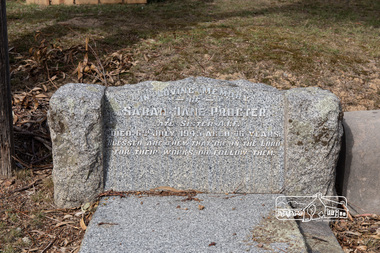
... She embarked from Melbourne on board RMS Morea on 24 August, 1915 and like many the served in Egypt in 1915, her record is a little hazy, but it appears at in January, 1916 after serving with No. 2 AGH, she was promoted to Nursing Sister and returned on HMAT Ulysses transporting wounded back to Australia. Nurse Procter embarked again on 4 April, 1916 to re-join her unit...She embarked from Melbourne on board RMS Morea on 24 August, 1915 and like many the served in Egypt in 1915, her record is a little hazy, but it appears at in January, 1916 after serving with No. 2 AGH, she was promoted to Nursing Sister and returned on HMAT Ulysses transporting wounded back to Australia. Nurse Procter embarked again on 4 April, 1916 to re-join her unit ...Nurse Sarah Procter stretched the limits by enlisted on 12 August, 1915 at 45 years of age, the maximum acceptable age. A sister, Mrs J H Treloar (Amelia) in Hamilton was given as next of kin. Her Attestation shows she had 13 years nursing experience, having earned her Certificate at Stawell Hospital, served for one year with the Women's Hospital with the balance with private amenities. The Embarkation Roll lists her residential address simply as Brunswick - there is no Attestation or other material surviving to suggest a more specific address. She embarked from Melbourne on board RMS Morea on 24 August, 1915 and like many the served in Egypt in 1915, her record is a little hazy, but it appears at in January, 1916 after serving with No. 2 AGH, she was promoted to Nursing Sister and returned on HMAT Ulysses transporting wounded back to Australia. Nurse Procter embarked again on 4 April, 1916 to re-join her unit. She arrived in England 30 December after further service at Alexandria and was initially assigned to No. 2 A.A.H, then at Southall, She was transferred just a few weeks later to No. 1 AAH at Barefield where she remained until February, 1918. She proceeded to join No.5 AGH at Rouen, France in May, 1918; she returned to England on 23 November, 1918 after spending a month off duty with general debility and on return was admitted to South Kensington hospital with rheumatism. She was released around a fortnight later and at the same time promoted to the rank of Sister. Perhaps because of her age, she embarked for Australia soon afterwards and was assigned to No. 11 AGH at Caulfield from 9 February, 1919 until her appointment was terminated on 3 May. Born Stawell, Protestant, Sarah Jane Procter died at 75 years of age in a private hospital in St. Kilda, on 6 July, 1945 as the result of an accident and was interred in Eltham Cemetery. Her National Archives are held as Procter, AWM files as Proctor, the former is correct. (Brian Membery for Wikinorthia) Sarah Jane Procter never married and served in WW1. She enlisted at 45, but said she was only 40 on the enlistment papers. Sarah is buried in CE Monumental Section Grave 182. She was born in Stawell in 1869 and died accidentally in Heidelberg 1945. She lays next to an older brother, George Charles Alfred Procter, born 1865. died 1935 in grave CE 181. In Loving Memory of Sarah Jane Proctor Late Sister A.I.F. Died 6th July 1945 aged 76 years Blessed are they that die in the Lord For their works do follow them.Born Digitaleltham cemetery, gravestones, proctor, george charles alfred procter, sarah jane procter -
 Eltham District Historical Society Inc
Photograph - Digital Photograph, Marguerite Marshall, Former home of Professor William MacMahon Ball, York Street, Eltham, 24 May 2007
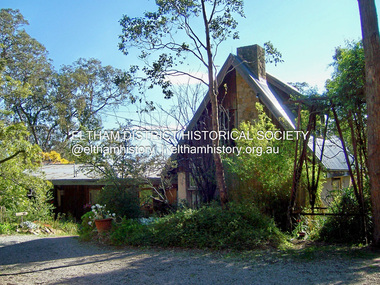
... Unit during World War Two, which later became Radio Australia. From 1923 he taught at The University of Melbourne, then became foundation Professor of Political Science in 1949 and was Chair until his retirement in 1968.6 In 1942, as the government expected a Japanese invasion, Mac’s wife Katrine and their only child Jenny, moved from Kew to Eltham as temporary evacuees. However Mac and Katrine lived in Eltham for almost the rest of their lives. After staying with friends, they rented a house in Reynolds Road, where, as it was wartime, they needed to keep horses for transport...Unit during World War Two, which later became Radio Australia. From 1923 he taught at The University of Melbourne, then became foundation Professor of Political Science in 1949 and was Chair until his retirement in 1968.6 In 1942, as the government expected a Japanese invasion, Mac’s wife Katrine and their only child Jenny, moved from Kew to Eltham as temporary evacuees. However Mac and Katrine lived in Eltham for almost the rest of their lives. After staying with friends, they rented a house in Reynolds Road, where, as it was wartime, they needed to keep horses for transport ...Situated at the eastern end of York Street, Eltham, 'Shinrone', the former home of Professor William (Mac) MacMahon Ball was one of the first in the Shire of Eltham to incorporate mud-brick. Professor MacMahon Ball, a political scientist, writer, broadcaster and diplomat and family moved to York Street, Eltham in 1945 into a timber cottage built around the 1890s and in poor repair. Mac asked Alistair Knox to renovate the home and he expanded the living area and added verandahs. In 1948 Montsalvat artist and sculptor Sonia Skipper supervised the building of most of the mud-brick studio. Neighbour Gordon Ford made the mud-bricks. Mac also asked John Harcourt, who had worked with him as a journalist in shortwave broadcasting, to build a pise (rammed earth) and stone addition to the largely timber house. Harcourt built two bedrooms - including an attic bedroom - a balcony with a shower and toilet, a nd a fireplace and chimney of local stone. Published: Nillumbik Now and Then / Marguerite Marshall 2008; photographs Alan King with Marguerite Marshall.; p141 At the eastern tip of York Street, Eltham, stands Shinrone, the former home of one of Australia’s intellectual leaders. Professor William Macmahon Ball, was one of the first to bring Asia as a foreign policy issue to the Australian public.1 He was a political scientist, writer, broadcaster and diplomat. The house was one of the first in Eltham Shire to incorporate mud-brick,2 because of the acute shortage of building materials after World War Two. Its novice builders later become leaders in Eltham’s built and garden design. Mac (as he was usually called), who was the son of a Church of England minister, was born in Casterton, Victoria in 1901 and died in 1986. In 1945 he helped establish the United Nations, as political consultant to the Australian Delegation at the San Francisco Conference.3 Then in 1946 Mac was appointed British Commonwealth Representative on the Allied Council for Japan, which is recorded in detail in his diary.4 In 1948 Mac led an Australian Government Goodwill Mission to South East Asia. However, Mac was perhaps most successful as an academic and public speaker.5 He was a commentator on the Australian Broadcasting Commission, from the early 1930s to the early 1960s. He was also Controller of the Short-Wave Broadcasting Unit during World War Two, which later became Radio Australia. From 1923 he taught at The University of Melbourne, then became foundation Professor of Political Science in 1949 and was Chair until his retirement in 1968.6 In 1942, as the government expected a Japanese invasion, Mac’s wife Katrine and their only child Jenny, moved from Kew to Eltham as temporary evacuees. However Mac and Katrine lived in Eltham for almost the rest of their lives. After staying with friends, they rented a house in Reynolds Road, where, as it was wartime, they needed to keep horses for transport and a cow and poultry for milk and eggs. In 1945 the family moved to the house at York Street, which was then a timber cottage, built around the 1890s and in poor repair. The underground well, cellar and part of the garden are all that remain of what stood on the original 18 acre (7.3ha) allotment. Thanks largely to Katrine’s hard work, the house was gradually renovated and extended. The long rambling house was partially built by several young neighbours, who were inspired by the cheap mud-brick and stone building style of Montsalvat, the Eltham artists’ colony. Mac asked Alistair Knox to renovate Shinrone, named after an Irish village near Katrine’s family home. Knox later popularised the mud-brick style of house construction, for which Eltham became known. He expanded the living area and added verandas. In 1948 Montsalvat artist and sculptor Sonia Skipper supervised the building of most of the mud-brick studio. Another neighbour, Gordon Ford, who was to have a major influence on the Australian garden style, made the mud-bricks. Mac also asked John Harcourt, who had worked with him as a journalist in short-wave broadcasting, to build a pisé (rammed earth) and stone addition to the largely timber house. Harcourt built two bedrooms – including an attic bedroom – a balcony with a shower and toilet, and a fireplace and chimney of local sandstone. With pioneering work naturally came mistakes, including one particularly dramatic incident when Harcourt was building walls with unsupported sections. Jenny Ellis, Mac’s daughter, remembers being awakened from sleep by a thundering shudder. The wall of her room had fallen down – fortunately away from her! In 1950 artist Peter Glass – another neighbour and later landscape designer – built Katrine a mud-brick pottery. As a result, the house features at one end Harcourt’s characteristic steep gable roof, while at the other the flatter construction characteristic of Knox. Mac referred to the home as the Eltham ‘experimental building site’.7 Surprisingly, the combination works, perhaps partly because it has the warm inviting feel of timber, mud-brick and stone.This collection of almost 130 photos about places and people within the Shire of Nillumbik, an urban and rural municipality in Melbourne's north, contributes to an understanding of the history of the Shire. Published in 2008 immediately prior to the Black Saturday bushfires of February 7, 2009, it documents sites that were impacted, and in some cases destroyed by the fires. It includes photographs taken especially for the publication, creating a unique time capsule representing the Shire in the early 21st century. It remains the most recent comprehenesive publication devoted to the Shire's history connecting local residents to the past. nillumbik now and then (marshall-king) collection, eltham, alistair knox, gordon ford, john harcourt, mudbrick construction, pise construction, professor macmahon ball, shinrone, sonia skipper, york street -
 Waverley RSL Sub Branch
Photographic Print, W. H. Houghton 929 57Batallion
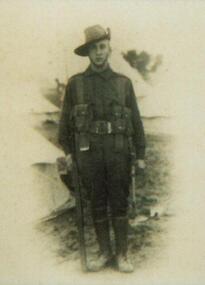
... William (Bill) Houghton 929 enlisted 24 August 1914 and was taken on strength in the 57th Battalion Unit embarked from Melbourne, Victoria, on board Transport A3 Orvieto on 21 October 1914 and was sent to the Gallipoli Peninsular He later fought in France with the 5th Battalion H company. ...William (Bill) Houghton 929 enlisted 24 August 1914 and was taken on strength in the 57th Battalion Unit embarked from Melbourne, Victoria, on board Transport A3 Orvieto on 21 October 1914 and was sent to the Gallipoli Peninsular He later fought in France with the 5th Battalion H company. ...William (Bill) Houghton 929 enlisted 24 August 1914 and was taken on strength in the 57th Battalion Unit embarked from Melbourne, Victoria, on board Transport A3 Orvieto on 21 October 1914 and was sent to the Gallipoli Peninsular He later fought in France with the 5th Battalion H company. Was promoted to Lance Corporal and returned to Australia 12 March 1918Black and white printhoughton, william houghton, bill houghton, 57th battalion, gallipoli, a.n.z.a.c, a.i.f., anzac, w. houghton, w houghton -
 Bendigo Military Museum
Uniform - MESS DRESS, RACT, 1) and .2) DAVID KLEIN PTY LTD, 1) and .2) 1966
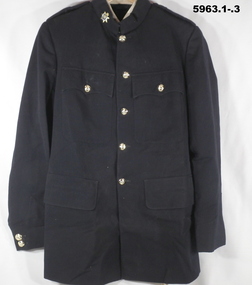
... Transport Kevin John Herdman .1) On manufacture's label: 'DAVID KLEIN PTY LTD, PTY LTD, VICTORIA, 1966, (upwards arrow)'. On false collar: 'C.G.C.F., SIZE 15'. .2) On manufacturer's label: 'DAVID KLEIN PTY LTD, PTY LTD, VICTORIA, 1966, (upwards arrow)'. .3) Stamped on leather joiner: 'P-F, 10 73, (upwards arrow), 44'. .4) Inside cap: 'COMMONWEALTH GOVERNMENT CLOTHING FACTORIES, MELBOURNE,6 3/4'. .1) Black jacket with two button-down breast pockets and two side pockets with flaps. Jacket buttons at the neck and down the front. Unit ...Royal Australian Corps of Transport mess dress belonging to Kevin John Herdman. Part of the Kevin John Herdman No. 397661 Collection, See Catalogue No. 5942P for details of his service record..1) Black jacket with two button-down breast pockets and two side pockets with flaps. Jacket buttons at the neck and down the front. Unit insignia on right collar. White starched false collar attached with studs. All buttons bear a unit insignia and are gold coloured. Major's rank insignia on each epaulette. Manufacturer's label on inside left. .2) Pair of black trousers with two white stripes down the outside of each leg. Buttons on waist band for attaching braces. .3) White elastic adjustable braces. .4) Black peaked cap with red band. Gold coloured braiding on peak. Brown coloured sweat band and clear plastic lining..1) On manufacture's label: 'DAVID KLEIN PTY LTD, PTY LTD, VICTORIA, 1966, (upwards arrow)'. On false collar: 'C.G.C.F., SIZE 15'. .2) On manufacturer's label: 'DAVID KLEIN PTY LTD, PTY LTD, VICTORIA, 1966, (upwards arrow)'. .3) Stamped on leather joiner: 'P-F, 10 73, (upwards arrow), 44'. .4) Inside cap: 'COMMONWEALTH GOVERNMENT CLOTHING FACTORIES, MELBOURNE,6 3/4'.uniform, mess dress, royal australian corps of transport, kevin john herdman -
 Bendigo Historical Society Inc.
Ephemera - V/Line Bendigo workshops 'Open Day' leaflet
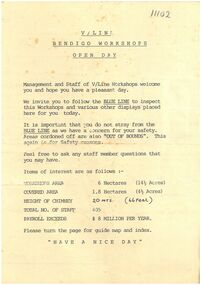
... Melbourne suburban electric multiple units. The 1980s were also a time of restructuring, and on the breakup of the Victorian Railways the workshops passed to the State Transport Authority and then the Public Transport Corporation. ...Melbourne suburban electric multiple units. The 1980s were also a time of restructuring, and on the breakup of the Victorian Railways the workshops passed to the State Transport Authority and then the Public Transport Corporation. ...The workshops were opened in November 1917 by the Victorian Railways. It opened in response to political pressures from provincial groups for decentralisation, with the Victorian Railways preferring the cheaper option of expanding the existing Newport Workshops in suburban Melbourne. Furthermore, unemployment had risen in both Bendigo and Ballarat due to a decline in mining operations. The main work carried out was repairs and maintenance of existing wagons and locomotives, however during 1919-22 thirteen new steam locomotives were also built - eight DD class (1033 - 1037, 1047 - 1049) and five A2 class (1078 - 1082). From the 1950s onwards, numerous steam locomotives were scrapped at the workshops. During the years immediately following nominal dieselisation in 1968, they were, at times, cutting up locomotives at the rate of one every two to three weeks. The workshops were also the site of the first VR brass foundry, which was transferred to Newport by the 1960s. Also, throughout 1965, VLX louvred vans were constructed at the workshops, at a rate of one a week. Other tasks included spring manufacture, construction of stainless steel footwarmers, and assembly of pantographs for electric trains, with a staff of 720 employed during 1966. By the 1980s, refurbishment work was also being carried out on Melbourne suburban electric multiple units. The 1980s were also a time of restructuring, and on the breakup of the Victorian Railways the workshops passed to the State Transport Authority and then the Public Transport Corporation. With privatisation the workshops were closed, with the loss of 262 jobs. In February 1996, the workshops were taken over by A Goninan & Co. In October 1999 the workshops were purchased by Great Northern Rail Services, with A Goninan & Co remaining as a tenant. In February 2001 A Goninan & Co vacated the site. The workshops were redeveloped in 2002 at a cost of $6.5 million - $4 million from VicTrack, $2 million from the State Government Regional Infrastructure Development Fund and $500,000 by the City of Greater Bendigo. The Bendigo Rail Workshops at North Bendigo are currently used by Southern Shorthaul Railroad to maintain broad gauge rolling stock for Pacific National, V/Line, Metro Trains Melbourne and CFCLA.Typed document. A4 page folded in half. On tan paper. Document pertaining to Bendigo V/Line workshops open day. Map on inside of folded page. Undated document.train, v/line, workshops, open day -
 Bendigo Historical Society Inc.
Document - BILL ASHMAN COLLECTION: CORRESPONDENCE
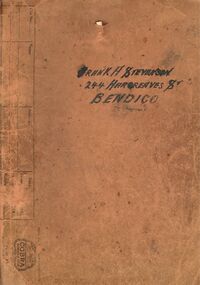
... Melbourne... J L Osborne... N Clarkson... Sister Mary Gonzaga... St Joseph's Hospital... Mater Misericordiae Hospital... Mr Herzog... Sister m Monica?... Vacuum Oil... J Johns... H J Grigg... W A Walsh... Market Square... Crown Hotel... G E Cole... Transport & Engineering in Australia 16/12/1937... Mr Menderson... Mr Ross... Sanitary Age 8/2/1935... Northern Kiwanis Clubs... Harry A Baxter... W H Cunningham & Hill Ltd... Link-Belt Co Ltd... Sir William Crooks... Royal Zoological Society... Ginna Works Germany... Close Brothers... W H Taylor... Geo Taylor Hardware Co Ltd... Details of Hydraulic Spinner Unit...Melbourne J L Osborne N Clarkson Sister Mary Gonzaga St Joseph's Hospital Mater Misericordiae Hospital Mr Herzog Sister m Monica? Vacuum Oil J Johns H J Grigg W A Walsh Market Square Crown Hotel G E Cole Transport & Engineering in Australia 16/12/1937 Mr Menderson Mr Ross Sanitary Age 8/2/1935 Northern Kiwanis Clubs Harry A Baxter W H Cunningham & Hill Ltd Link-Belt Co Ltd Sir William Crooks Royal Zoological Society Ginna Works Germany Close Brothers W H Taylor Geo Taylor Hardware Co Ltd Details of Hydraulic Spinner Unit (Scalebuoy) A Davidson John G Kelly Inc Hannon Myers Wishart Kennedy Mr Critten Pennsylvania Rubber Coy Paul A Douden & Co W E Humphrey Kansas City Public Service Co Smith Tangney Hotels Wahkonsa Hotel Muscatine Hotel Arlington Hotel Burke Hotel Helen Tangney-Springer F W Woolworth Co W W Edan YMCA N F Alcock B J Ingram Scalebuoys Bendigo Electronic Company of Australia Proprietary Limited A S Bloomfield Harry Ponsonby Mackenzie Arthur Robinson & Co The Commercial Banking Company of Sydney Ltd A T Madden Victorian Railways E C Eyers City of Bendigo Frank H Day Lane's Motors Pty Ltd H C Holland Union Oil Soap & Candle Co Ltd Knox Home N A Duthie W H McCorkindale Maungatapere Co-Op Dairy Co Ltd The Whangarei Co-Op Dairy Co Ltd W H Millingford Kettering Cartons Limited J G Arlidge W E Humphrey Kansas City Public Service Company H W Smith Prospectus of Scale Buoy Distributors Limited Edwin Gripper Banks Richard Hartley Smith Abbott Frank Shaw Fitchett Hayden Smith & Fitchett The Commercial Bank of Australia Limited William John Stanley Horsfall Frank Cooper Scott's Hotel A J Phillips Stringer & Phillips Proprietary Ltd E G Banks Edwin Gripper Banks Reginald William Stringer Frank Cooper Claude Gordon Robinson S Reid Dull orange folder containing copies of letters, brochures, information sheets and some newspaper cuttings. ...Dull orange folder containing copies of letters, brochures, information sheets and some newspaper cuttings. Name on the front is Frank A. Stevenson 244 Hargreaves St Bendigo. Letters date from 1937 to 1942. Newspaper titles include: Prevention of Rust- Principle of the Scalebuoy, Scalebuoys in Cars, Tragic Death of Captain Hartley Abbott and the Obituary of Captain R.H.S.Abbott.sciences, instruments - general, scalebuoy, bill ashman collection - correspondence, frank a stevenson, mr bacon, amalgamated freezing co bendigo, g whalley, gunbower co-operative butter factory & trading coy ltd, mr wallace, j charlesworth, d v evershed, bendigo electronic co, walshes crown hotel, hunter bros, wybgones unit, 180 gold mining co, o'hallorans cyanide unit, crystal ice works, stevenson unit, bendigo council, central nell gwynne, nth deborugh g m co, deborugh g m c, deborugh consolidated, cohuna butter factory, geo ross, victorian producers' co-operative coy ltd, h abbott, ernest f o liddell, rothacker bros, motor spares ltd, leggo's buildings, t j jorgensen, mr robinson, stevenson bros, r h s abbott, d c house, the electrical factor in metabolism, w n abbott, the great boulder proprietary gold mines ltd, w o galletly, mr stronell, newport workshops, victorian railways, mr brownbill, mr james, the university of melbourne, j l osborne, n clarkson, sister mary gonzaga, st joseph's hospital, mater misericordiae hospital, mr herzog, sister m monica?, vacuum oil, j johns, h j grigg, w a walsh, market square, crown hotel, g e cole, transport & engineering in australia 16/12/1937, mr menderson, mr ross, sanitary age 8/2/1935, northern kiwanis clubs, harry a baxter, w h cunningham & hill ltd, link-belt co ltd, sir william crooks, royal zoological society, ginna works germany, close brothers, w h taylor, geo taylor hardware co ltd, details of hydraulic spinner unit (scalebuoy), a davidson, john g kelly inc, hannon, myers wishart, kennedy, mr critten, pennsylvania rubber coy, paul a douden & co, w e humphrey, kansas city public service co, smith, tangney hotels, wahkonsa hotel, muscatine hotel, arlington hotel, burke hotel, helen tangney-springer, f w woolworth co, w w edan, ymca, n f alcock, b j ingram, scalebuoys, bendigo electronic company of australia proprietary limited, a s bloomfield, harry ponsonby mackenzie, arthur robinson & co, the commercial banking company of sydney ltd, a t madden, victorian railways, e c eyers, city of bendigo, frank h day, lane's motors pty ltd, h c holland, union oil soap & candle co ltd, knox home, n a duthie, w h mccorkindale, maungatapere co-op dairy co ltd, the whangarei co-op dairy co ltd, w h millingford, kettering cartons limited, j g arlidge, w e humphrey, kansas city public service company, h w smith, prospectus of scale buoy distributors limited, edwin gripper banks, richard hartley smith abbott, frank shaw fitchett, hayden smith & fitchett, the commercial bank of australia limited, william john stanley horsfall, frank cooper, scott's hotel, a j phillips, stringer & phillips proprietary ltd, e g banks, edwin gripper banks, reginald william stringer, frank cooper, claude gordon robinson, s reid -
 Port Melbourne Historical & Preservation Society
Photograph - Panorama Beach Street, Port Melbourne, Swift, William, Jul 1925
... Three original photographs by William Swift were digitally combined to create this panorama as a fund raiser for the Port Melbourne Historical and Preservation Society - an initiative of member Jim Hillis transport - shipping piers and wharves - station pier piers and wharves - princes pier william swift beach street sinclair parade ps weeroona Framed panorama of Beach Street, Port Melbourne 1925: view of Station and Princes Piers from Swallow and Ariell gingerbread bakery. At Princes Pier are Pennsylvania, Nevada, Oklahoma and Seattle, visiting units ...Three original photographs by William Swift were digitally combined to create this panorama as a fund raiser for the Port Melbourne Historical and Preservation Society - an initiative of member Jim HillisFramed panorama of Beach Street, Port Melbourne 1925: view of Station and Princes Piers from Swallow and Ariell gingerbread bakery. At Princes Pier are Pennsylvania, Nevada, Oklahoma and Seattle, visiting units of the American Pacific Fleet July/August 1925transport - shipping, piers and wharves - station pier, piers and wharves - princes pier, william swift, beach street, sinclair parade, ps weeroona -
 Sunshine and District Historical Society Incorporated
Album - A.D.I. Stores And Transport WWII, 1939-45
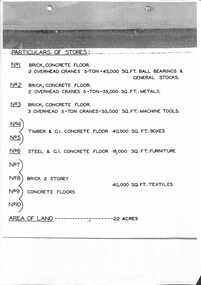
... Stores & Transport WW2 - Hire Stores Sites Olympic Park Chemical Drums & Victoria Street Melbourne Radio & Signal Store. 617.058 - A.D.I. Stores & Transport WW2 - Hire Stores Sites Victoria Street Melbourne Unit Piling & Electrical Equipment. 617.059 - A.D.I. ...Stores & Transport WW2 - Hire Stores Sites Olympic Park Chemical Drums & Victoria Street Melbourne Radio & Signal Store. 617.058 - A.D.I. Stores & Transport WW2 - Hire Stores Sites Victoria Street Melbourne Unit Piling & Electrical Equipment. 617.059 - A.D.I. ...617.001 - A.D.I. Stores & Transport WW2 - Maribyrnong Particular Of Stores. 617.002 - A.D.I. Stores & Transport WW2 - Maribyrnong Main Entrance & Administrative Offices. 617.003 - A.D.I. Stores & Transport WW2 - Maribyrnong No 1 Store & No 2 Store. 617.004 - A.D.I. Stores & Transport WW2 - Maribyrnong No 3 Store & Textiles Stores No 7, 8, 9 & 10. 617.005 - A.D.I. Stores & Transport WW2 - Maribyrnong Furniture Store & No 3 Store. 617.006 - A.D.I. Stores & Transport WW2 - Maribyrnong 25 Pdr Shell Steel Bar Plates & Ball Bearings. 617.007 - A.D.I. Stores & Transport WW2 - Maribyrnong Electric Cable & Tin Plate & Terne Plate. 617.008 - A.D.I. Stores & Transport WW2 - Maribyrnong Treating Tin Plate Stock & Brass Rod. 617.009 - A.D.I. Stores & Transport WW2 - Maribyrnong Non-Ferrous Rod & Coper Tubing. 617.010 - A.D.I. Stores & Transport WW2 - Maribyrnong No 2 Store Tool Steel Section. 617.011 - A.D.I. Stores & Transport WW2 - Maribyrnong No 2 Store Tool Steel Section. 617.012 - A.D.I. Stores & Transport WW2 - Maribyrnong No 2 Store Steel Section & No 3 Store Machine Tool Section. 617.013 - A.D.I. Stores & Transport WW2 - Maribyrnong No 3 Store Machine Tool Section. 617.014 - A.D.I. Stores & Transport WW2 - Maribyrnong No 3 Store Machine Tool Section. 617.015 - A.D.I. Stores & Transport WW2 - Maribyrnong Box Stores. 617.016 - A.D.I. Stores & Transport WW2 - Maribyrnong Box Stores. 617.017 - A.D.I. Stores & Transport WW2 - Maribyrnong Box Stores. 617.018 - A.D.I. Stores & Transport WW2 - Maribyrnong Domestic Maintenace Store. 617.019 - A.D.I. Stores & Transport WW2 - Maribyrnong Domestic Maintenence Store. 617.020 - A.D.I. Stores & Transport WW2 - Maribyrnong Textile Store. 617.021 - A.D.I. Stores & Transport WW2 - Maribyrnong Textile Store & Protective Clothing. 617.022 - A.D.I. Stores & Transport WW2 - Maribyrnong Cream Serge Cartridge Bags For Naval Guns. 617.023 - A.D.I. Stores & Transport WW2 - Tottenham Particular Of Stores. 617.024 - A.D.I. Stores & Transport WW2 - Tottenham Stores. 617.025 - A.D.I. Stores & Transport WW2 - Tottenham Entrance & Guard Room At Gate. 617.026 - A.D.I. Stores & Transport WW2 - Tottenham Rail Siding With Crane & Weightbridge Near Entrance. 617.027 - A.D.I. Stores & Transport WW2 - Tottenham Brass Cartridge Storage Area & Smoke Floats. 617.028 - A.D.I. Stores & Transport WW2 - Tottenham Ammunition Boxes & Shell Storage Area. 617.029 - A.D.I. Stores & Transport WW2 - Tottenham Aircraft Bomb Parachutes & Small Arms Ammunition. 617.030 - A.D.I. Stores & Transport WW2 - Tottenham Stoarge Area & Boxes. 617.031 - A.D.I. Stores & Transport WW2 - Tottenham Storage Unit Piling. 617.032 - A.D.I. Stores & Transport WW2 - Tottenham Paper Stores & Stores For Empty Storage Boxes. 617.033 - A.D.I. Stores & Transport WW2 - Tottenham Paper Stores & Stores For Empty Storage Boxes & Copper Stacking Compound. 617.034 - A.D.I. Stores & Transport WW2 - Tottenham Railway Siding & Railway Platform. 617.035 - A.D.I. Stores & Transport WW2 - Tottenham Store. 617.036 - A.D.I. Stores & Transport WW2 - Derrimut Particulars Of Buildings. 617.037 - A.D.I. Stores & Transport WW2 - Derrimut Main Entrance & Guard House & Aerial View Of Magazines. 617.038 - A.D.I. Stores & Transport WW2 - Derrimut Loading Shed & Battery Train. 617.039 - A.D.I. Stores & Transport WW2 - Derrimut Magazine Loading & Train Returning From Distant Magazines. 617.040 - A.D.I. Stores & Transport WW2 - Derrimut Electric Locomotive Battery Charging Plant. 617.041 - A.D.I. Stores & Transport WW2 - Ravenhall Explosive Siding. 617.042 - A.D.I. Stores & Transport WW2 - Ravenhall Entrance & Explosive Rail Siding & Mess Hutt. 617.043 - A.D.I. Stores & Transport WW2 - Ravenhall Railway Siding At Deer Park. 617.044 - A.D.I. Stores & Transport WW2 - Longlea Explosive Area. 617.045 - A.D.I. Stores & Transport WW2 - Longlea Main Office & Foreman's Cottage. 617.046 - A.D.I. Stores & Transport WW2 - Longlea Peace Officer's Quarters & Explosive Area Loading Shed. 617.047 - A.D.I. Stores & Transport WW2 - Longlea Repacking House & 50 Ton Magazine. 617.048 - A.D.I. Stores & Transport WW2 - Longlea Main Storage & Fire Fighting Static Pool. 617.049 - A.D.I. Stores & Transport WW2 - Longlea Fire Pump Trailer. 617.050 - A.D.I. Stores & Transport WW2 - Longlea Fire Spotting Tower. 617.051 - A.D.I. Stores & Transport WW2 - Longlea Fire Breaks & Explosive Area Fire Fighting Equipment. 617.052 - A.D.I. Stores & Transport WW2 - Footscray Magazines. 617.053 - A.D.I. Stores & Transport WW2 - Footscray Explosive Magazines & Ammunition Factory Entrance (Jacks Magazine). 617.054 - A.D.I. Stores & Transport WW2 - Footscray Explosive Store & Magazine Access Tunnels Through Mound. 617.055 - A.D.I. Stores & Transport WW2 - Footscray Mounded Magazine. 617.056 - A.D.I. Stores & Transport WW2 - Hire Stores Sites. 617.057 - A.D.I. Stores & Transport WW2 - Hire Stores Sites Olympic Park Chemical Drums & Victoria Street Melbourne Radio & Signal Store. 617.058 - A.D.I. Stores & Transport WW2 - Hire Stores Sites Victoria Street Melbourne Unit Piling & Electrical Equipment. 617.059 - A.D.I. Stores & Transport WW2 - Hire Stores Sites Victoria Street Melbourne Radio & Signals Packing & Testing. 617.060 - A.D.I. Stores & Transport WW2 - Hire Stores Sites Victoria Street Melbourne Dispatched Section & Radio & Union Street North Melbourne Signal Store. 617.061 - A.D.I. Stores & Transport WW2 - Hire Stores Sites Errol Street North Melbourne Unit Piling & Electrical Equipment. 617.062 - A.D.I. Stores & Transport WW2 - Hire Stores Sites Errol Street North Melbourne Checking & Packing Store. 617.063 - A.D.I. Stores & Transport WW2 - Hire Stores Sites Casino Dance Hall Brunswick Valves Storage Store. 617.064 - A.D.I. Stores & Transport WW2 - Hire Stores Sites Casino Dance Hall Brunswick Valves Storage Store & Haymarket Parkville Copper Storage. 617.065 - A.D.I. Stores & Transport WW2 - Hire Stores Sites Deer Park Toluol Tanks & Acetone Tanks. 617.066 - A.D.I. Stores & Transport WW2 - Hire Stores Sites Deer Park Acetone Drum Stock Shelters & Albion Drum Stocks. 617.067 - A.D.I. Stores & Transport WW2 - Hire Stores Sites Lonsdale Street Melbourne Food Service Store & Repairing Frigidaire. 617.068 - A.D.I. Stores & Transport WW2 - Hire Stores Sites Lonsdale Street Melbourne Unit Pile & Stocks For Food Service Store. 617.069 - A.D.I. Stores & Transport WW2 - Hire Stores Sites Lonsdale Street Melbourne Food Service Store. 617.070 - A.D.I. Stores & Transport WW2 - Hire Stores Sites Albion Barblock Wire Coils & Crockery. 617.071 - A.D.I. Stores & Transport WW2 - Hire Stores Sites Bendigo & Ballarat Chemical Stock Stores. 617.072 - A.D.I. Stores & Transport WW2 - Hire Stores Sites Ballarat Skating Link Kexachlorethane Storage & Ballarat Motor Garage Di-Nitro-Toluol Storage. 617.073 - A.D.I. Stores & Transport WW2 - Hire Stores Sites Rae Hill School Bendigo Amorphous Phosphorus Storage & Williamstown Racecourse Grandstand. 617.074 - A.D.I. Stores & Transport WW2 - Hire Stores Sites Williamstown Racecourse Rear Of Grandstand Chemical Stocks & Racecourse Stables Chemcial Storage. 617.075 - A.D.I. Stores & Transport WW2 - Hire Stores Sites Williamstown Racecourse Tote Chemical Storage & White Phosphorus Storage Area. 617.076 - A.D.I. Stores & Transport WW2 - Hire Stores Sites Williamstown Racecourse Scratching Board Chemical Stoage Area. 617.077 - A.D.I. Stores & Transport WW2 - Braybrook Transport Depot. 617.078 - A.D.I. Stores & Transport WW2 - Braybrook Transport Depot Entrance, Guard Room & Control Room & Petrol & Oil Filling Station. 617.079 - A.D.I. Stores & Transport WW2 - Braybrook Transport Depot Offices & Repair Shops & Light Vehicle Repair Shop. 617.080 - A.D.I. Stores & Transport WW2 - Braybrook Transport Depot Semi-Trailers Loaded For Shipment & Semi-Trailers Loaded With Tallow. 617.081 - A.D.I. Stores & Transport WW2 - Braybrook Transport Depot Parking Area & Stick-Up Area For Load Vehicles. 617.082 - A.D.I. Stores & Transport WW2 - Braybrook Transport Depot Section Of Fleet & Special Explosive Trucks. 617.083 - A.D.I. Stores & Transport WW2 - Braybrook Transport Depot Section Of Fleet & Buses. 617.084 - A.D.I. Stores & Transport WW2 - Melbourne Western Market Transport Section & Maribyrnong Passenger Car Pool. 617.085 - A.D.I. Stores & Transport WW2 - Melbourne Western Market City Parcel Delivery Service & Horse Vehicles. 617.086 - A.D.I. Stores & Transport WW2 - Horse Vehicles & Maribyrnong Horse Vehicles Leaving Stables. 617.087 - A.D.I. Stores & Transport WW2 - Maribyrnong Horse Off To Work & Types Of Horses. 617.088 - A.D.I. Stores & Transport WW2 - Maribyrnong Foal & Off To Grass For Weekend. 617.089 - A.D.I. Stores & Transport WW2 - Maribyrnong Blacksmith & Horseshoeing. 617.090 - A.D.I. Stores & Transport WW2 - Maribyrnong Shrinking Tyre & Carpenter's Work Shop. 617.091 - A.D.I. Stores & Transport WW2 - Material Handing. 617.092 - A.D.I. Stores & Transport WW2 - Material Handing Iton Stillage, Iton Elevating Truck & Hand Truck & Gravity Rollers. 617.093 - A.D.I. Stores & Transport WW2 - Material Handing Fordson Tractor & Lister Tow Motor & Trailers. 617.094 - A.D.I. Stores & Transport WW2 - Material Handing Mechical Drum Loader. 617.095 - A.D.I. Stores & Transport WW2 - Material Handing Electric Stacker. 617.096 - A.D.I. Stores & Transport WW2 - Material Handing Tottenham 5 Ton Mobile Crane. 617.097 - A.D.I. Stores & Transport WW2 - Material Handing 3 Ton Crane. 617.098 - A.D.I. Stores & Transport WW2 - Material Handing Fowler Iton Tractor Crane & 2 Ton Gibson Battle Crane. 617.099 - A.D.I. Stores & Transport WW2 - Material Handing 3 Ton Ransome Rapier Crane. 617.100 - A.D.I. Stores & Transport WW2 - Material Handing Coles 3 Ton Mobile Crane. 617.101 - A.D.I. Stores & Transport WW2 - Material Handing Fowler Iton Crane & 2 Ton Gibson Batle Crane. 617.102 - A.D.I. Stores & Transport WW2 - Material Handing Material Handing Coles 3 Ton Mobile Crane. 617.103 - A.D.I. Stores & Transport WW2 - Material Handing Lawton 3000 Lbs Hydraulic Fork Truck. 617.104 - A.D.I. Stores & Transport WW2 - Material Handing Special Explosive Truck. 617.105 - A.D.I. Stores & Transport WW2 - Material Handing Road Transport Of Explosive. 617.106 - A.D.I. Stores & Transport WW2 - Material Handing 80 Ton Transport Bogie. 617.107 - A.D.I. Stores & Transport WW2 - Material Handing Special Explosive Truck. 617.108 - A.D.I. Stores & Transport WW2 - Horse Vehicles & Maribyrnong Horse Vehicles Leaving Stables. 617.109 - A.D.I. Stores & Transport WW2 - Horse Vehicles. 617.110 - A.D.I. Stores & Transport WW2 - Semi-Trailers Loaded With Tallow For Shipment. 617.111 - A.D.I. Stores & Transport WW2 - Williamstown Racecourse White Phosphorus Storage Area. 617.112 - A.D.I. Stores & Transport WW2 - Albion Barblock Wire Coils. 617.113 - A.D.I. Stores & Transport WW2 - Rae Hill School Bendigo Amorphous Phosphorus Storage. 617.114 - A.D.I. Stores & Transport WW2 - Albion Drum Stocks. 617.115 - A.D.I. Stores & Transport WW2 - Deer Park Acetone Tanks. 617.116 - A.D.I. Stores & Transport WW2 - Footscray Explosive Store (Jacks Magazine). 617.117 - A.D.I. Stores & Transport WW2 - Derrimut Aerial View Of Magazines. 617.118 - A.D.I. Stores & Transport WW2 - Tottenham Railway Siding. 617.119 - A.D.I. Stores & Transport WW2 - Tottenham Weightbridge Near Entrance. 617.120 - A.D.I. Stores & Transport WW2 - Tottenham Rail Siding With Crane. 617.121 - A.D.I. Stores & Transport WW2 - Tottenham Entrance. 617.122 - A.D.I. Stores & Transport WW2 - Maribyrnong No 2 Store Steel Section. 617.123 - A.D.I. Stores & Transport WW2 - Maribyrnong Treating Tin Plate Stock. 617.124 - A.D.I. Stores & Transport WW2 - Maribyrnong Treating Tin Plate Stock.world war 1939 - 1945 -
 Wodonga & District Historical Society Inc
Photograph - Sunicrust Bakery Wodonga, 1970s - 1990s
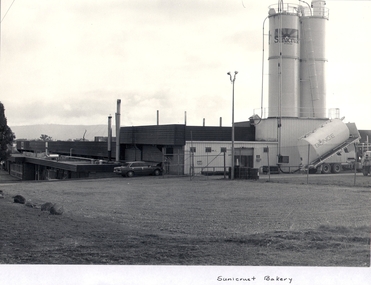
... transported to Albury in semi-trailer loads of 10,000 units. It was unloaded and placed in the shed. A docket was written out and the bread was reloaded and was free to be sent back over the border and sent to Melbourne if need be. ...transported to Albury in semi-trailer loads of 10,000 units. It was unloaded and placed in the shed. A docket was written out and the bread was reloaded and was free to be sent back over the border and sent to Melbourne if need be. ...Hall's Bakery was established in Wodonga in 1930. In 1960, Bob Hall and Albury bakers Wynne and Thiel joined Bunge's Albury Flour Mills in forming a new company, Southern Border Bakeries. The three bakeries continued to operate separately, but in 1972 Southern Border built the Sunicrust Bakery in Kendall St. A strange anomaly in interstate trade regulations in the 1970s required some innovative thinking. In Victoria, it was illegal to transport bread over 75km, so to get around this, Sunicrust rented a shed in South Albury known as Southern Border Bakeries. Bread from Wodonga was transported to Albury in semi-trailer loads of 10,000 units. It was unloaded and placed in the shed. A docket was written out and the bread was reloaded and was free to be sent back over the border and sent to Melbourne if need be. This manoeuvre complied with Section 92 of the Australian Constitution allowing free trade between States. By 1997, the Sunicrust bakery employed 100 people and produced 200,000 units a week. Goodman Fielder acquired the Sunicrust brand when they purchased Bunge Australia's baking and milling assets in late 1998. Gradually employment fell and Goodman Fielder decided that Wodonga was a small plant and it was no longer economically viable to keep it going. Baking ceased in 2007 with the loss of 44 jobs. Goodman Fielder retained a distribution depot on site.These photos are significant because they document an important manufacturing industry based in Wodonga from the 1970s to 2007,Two photographs of the Sunicrust Bakery in Wodonga. In the coloured photo it has been renamed as Goodman Fielder.wodonga industries, 1970s wodonga, manufacturing industries wodonga -
 Surrey Hills Historical Society Collection
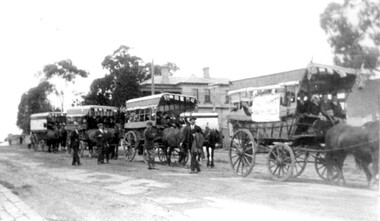
Photograph, Preparing to leave for the St George's Church of England Sunday School picnic, Mont Albert Road, 1922, 1922
... units. Its current address is 19 St Georges Avenue, Mont Albert. The annual Sunday School picnic was held at Hampton and drags were the usual mode of transport. 'Lugano' was built in 1893 for William Wilson, a prominent stonemason and importer of marble fireplaces. In 1903 it became the home of William Holmes who was Chief Electrical Engineer for the Victorian Railways. He designed the electrification of the Melbourne...units. Its current address is 19 St Georges Avenue, Mont Albert. The annual Sunday School picnic was held at Hampton and drags were the usual mode of transport. 'Lugano' was built in 1893 for William Wilson, a prominent stonemason and importer of marble fireplaces. In 1903 it became the home of William Holmes who was Chief Electrical Engineer for the Victorian Railways. He designed the electrification of the Melbourne ...The drags would have been leaving St George's Church of England in Mont Albert Road. The foundation stone for St George's Church of England, Mont Albert was laid in 1886 on land donated by Edward Dyer and the first service was preached in January 1887. From 1904 until 1907 it was known as Holy Trinity, Surrey Hills. The original church was weatherboard and replaced by a brick one in the Gothic Revival style which was designed by local architect George J V Blackburne, who also designed the Wesleyan School at Surrey Hills. The building was partly funded by donations, profits from a bazaar and concert, and other people donated furnishings. The church had boundaries along Mont Albert Road and St Georges Road. In 1998 the Church was sold and converted into a complex of units. Its current address is 19 St Georges Avenue, Mont Albert. The annual Sunday School picnic was held at Hampton and drags were the usual mode of transport. 'Lugano' was built in 1893 for William Wilson, a prominent stonemason and importer of marble fireplaces. In 1903 it became the home of William Holmes who was Chief Electrical Engineer for the Victorian Railways. He designed the electrification of the Melbourne suburban network. 'Lugano' stayed in the Holmes family until the 1930s. The annual Sunday School picnic was held at at a variety of locations and drags were the usual mode of transport. Donor information is that this was taken as the congregation prepared to depart for at Hampton on the picnic held on 25/2/1922. There are 2 copies: the original donated print and an enlargement. The original was mounted on card with photo mounts along with 506, 871, 872, and 873. It measures 13 cm x 9 cm.Black and white photo of 4 'drags' (horse-drawn hooded carriages) lined up in Mont Albert Road near the corner of St George's Avenue, in readiness for departure for the Sunday School picnic. The carriages are loaded with people and decorated with flags. The front carriage has a material sign attached to the side; the top line of writing is not decipherable, but the bottom one reads "SURREY HILLS". Four men stand in the road, which has bluestone curb and channelling. In the background is 'Lugano'.On rear in ink: "S.S. picnic to Hampton / 25th. Feb. 1922" and in a different hand in biro: "At Mont Albert. St George's Church"churches, holy trinity church, anglican church, sunday schools, picnics, lugano, horse-drawn vehicles, william wilson, willaim holmes, st george's church of england, mont albert, mont albert road -
 City of Kingston
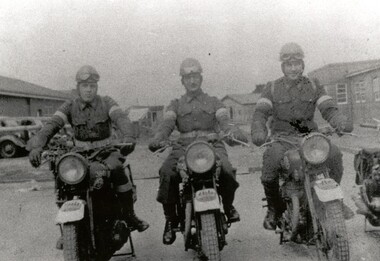
Photograph - Black and white, c.1942
... This image shows motorbike despatch riders who were tasked with transporting intercepted Japanese communications from the wartime wireless receiving station established in Chesterville Road, Moorabbin to Queens Road, St Kilda where the Directorate of Naval Communications and the code-breaking unit called FRUMEL (Fleet Radio Unit - Melbourne) were housed. ...This image shows motorbike despatch riders who were tasked with transporting intercepted Japanese communications from the wartime wireless receiving station established in Chesterville Road, Moorabbin to Queens Road, St Kilda where the Directorate of Naval Communications and the code-breaking unit called FRUMEL (Fleet Radio Unit - Melbourne) were housed. ...This image shows motorbike despatch riders who were tasked with transporting intercepted Japanese communications from the wartime wireless receiving station established in Chesterville Road, Moorabbin to Queens Road, St Kilda where the Directorate of Naval Communications and the code-breaking unit called FRUMEL (Fleet Radio Unit - Melbourne) were housed. The despatch riders would travel every two hours, all day and night. The wireless receiving station was established in Moorabbin because it was considered an area free of significant electrical interference and was not too far afield from the Melbourne headquarters in Queens Road. Moorabbin was originally established as a rural market gardening community.A secret wartime wireless receiving station was established in March 1942 in Chesterville Road, Moorabbin. The station was established on requisitioned market garden properties, and soon housed WRAN (Women's Royal Australian Navy) personnel and up to 35 US Navy servicemen. The Navy personnel intercepted Japanese coded communications and then despatched these by motorbike riders to Queens Road, St Kilda where the Directorate of Naval Communications and the code-breaking unit called FRUMEL (Fleet Radio Unit - Melbourne) were housed. The information intercepted by the wireless receiving station helped shape the Allied response to Japan's advances in the Pacific. Declassified defence records show that this unprepossessing station handled some of World War II's most sensitive secrets, and the despatch riders were a familiar sight in the Moorabbin area, though few were aware of their purpose. Black and white image of three men in uniform sitting astride three motorcycles in front of cars and buildings. The rider on the right is Jack Barker a local resident. Handwritten in red ink: A 602 / 90% Handwritten in blue ink: SW / 950301111 Handwritten in grey pencil: A 34 CHAP 6 / Spy basemoorabbin, despatch riders, wireless receiving station, world war ii, frumel (fleet radio unit - melbourne) -
 Melbourne Tram Museum
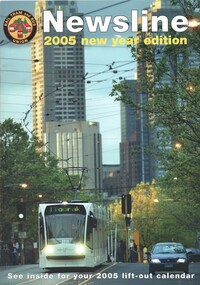
Magazine, Rail Tram & Bus Union (RTBU), "Newsline - 2005 New Year Edition", 2004
... Has adverts for Safeworking Solutions, Winchcombe financial advisors, Slater & Gordon, STA Investments, Members Equity bank, Connex, John Holland, Metlink, RTBU Holiday units, Transport Health Fund, Retired Railway Employees Association of Vic and Retired Tramway Employees Association of Vic. Contains an folded A3 calendar, full colour for 2005 featuring Southern Cross Station, contact details, Pay Days and Public Holidays, with adverts for Melbourne Credit Union and the RTBU Visa card....Has adverts for Safeworking Solutions, Winchcombe financial advisors, Slater & Gordon, STA Investments, Members Equity bank, Connex, John Holland, Metlink, RTBU Holiday units, Transport Health Fund, Retired Railway Employees Association of Vic and Retired Tramway Employees Association of Vic. Contains an folded A3 calendar, full colour for 2005 featuring Southern Cross Station, contact details, Pay Days and Public Holidays, with adverts for Melbourne Credit Union and the RTBU Visa card. ...Magazine - A4 - 20 pages including light card covers, full colour, centre stapled titled "Newsline - 2005 New Year Edition", published by the RTBU - Rail Tram and Bus Union Christmas 2004. Contains reports from Union officials including Trevor Dobbyn Secretary, Marc Marotta Branch President, Phil Altieri, Lou DiGregorio - Secretary and Doug Brady, President of the Tram and Bus division. Gives contact details. Photos supplied by Yarra Trams, Connex and Metlink. Has adverts for Safeworking Solutions, Winchcombe financial advisors, Slater & Gordon, STA Investments, Members Equity bank, Connex, John Holland, Metlink, RTBU Holiday units, Transport Health Fund, Retired Railway Employees Association of Vic and Retired Tramway Employees Association of Vic. Contains an folded A3 calendar, full colour for 2005 featuring Southern Cross Station, contact details, Pay Days and Public Holidays, with adverts for Melbourne Credit Union and the RTBU Visa card.trams, tramways, yarra trams, rtbu, unions, metlink -
 Melbourne Tram Museum
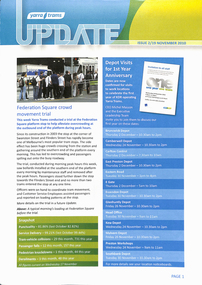
Magazine, Yarra Trams, "Update", 2010
... 1 - Magazine - four pages - issue 2 of 19/11/2010 - Federation Square (Swanston St) crowd control, performance, depot visits by the CEO, Port Melbourne, Safety, Docklands works, Movember, Special events, new uniforms, the retirement of Des Davies, celebrating 125 years of Melbourne trams. 2 - four pages - issue 3 of 6/12/2019 - message from CEO, trackwork at Harbour Esplanade, Thierry Guinard, the Technology tram (measuring infrastructure), Janine Young Public Transport Ombudsman and Transport Advisory Group. 3 - six pages, one sheet, issue 4 of 21/12/2010 - performance, response units, fleet operations, Oprah Winfrey tram, Carlton Control, Preston Workshops, appeals, safety, a Golding cartoon of a tram on a curve, Keolis, telco agreement with VicTrack....1 - Magazine - four pages - issue 2 of 19/11/2010 - Federation Square (Swanston St) crowd control, performance, depot visits by the CEO, Port Melbourne, Safety, Docklands works, Movember, Special events, new uniforms, the retirement of Des Davies, celebrating 125 years of Melbourne trams. 2 - four pages - issue 3 of 6/12/2019 - message from CEO, trackwork at Harbour Esplanade, Thierry Guinard, the Technology tram (measuring infrastructure), Janine Young Public Transport Ombudsman and Transport Advisory Group. 3 - six pages, one sheet, issue 4 of 21/12/2010 - performance, response units, fleet operations, Oprah Winfrey tram, Carlton Control, Preston Workshops, appeals, safety, a Golding cartoon of a tram on a curve, Keolis, telco agreement with VicTrack. ...1 - Magazine - four pages - issue 2 of 19/11/2010 - Federation Square (Swanston St) crowd control, performance, depot visits by the CEO, Port Melbourne, Safety, Docklands works, Movember, Special events, new uniforms, the retirement of Des Davies, celebrating 125 years of Melbourne trams. 2 - four pages - issue 3 of 6/12/2019 - message from CEO, trackwork at Harbour Esplanade, Thierry Guinard, the Technology tram (measuring infrastructure), Janine Young Public Transport Ombudsman and Transport Advisory Group. 3 - six pages, one sheet, issue 4 of 21/12/2010 - performance, response units, fleet operations, Oprah Winfrey tram, Carlton Control, Preston Workshops, appeals, safety, a Golding cartoon of a tram on a curve, Keolis, telco agreement with VicTrack.Yields infomation about Yarra Trams in 2010Three copies of Yarra Trams internal newsletter "Update", All A4, printed in full colour.trams, tramways, yarra trams, traffic control, trackwork, spencer st, fund raising, carlton control, victrack, fleet operations, preston workshops, cartoons -
 Sunshine and District Historical Society Incorporated
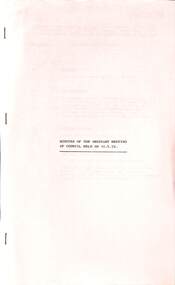
Administrative record - City of Sunshine - Commissioner Mr Alexander Alex George Gillon Collection 1976 - 1982 - Minutes of the ordinary meeting of council held on 10th April 1979, City of Sunshine, 10th April 1979
... Unit Lot 9 Mernda Street Sunshine West Home Occupations 3 Phase Power Connection 237A Main Road West St. Albans Plan of Subdivision Entally Drive Albanvale Plan of Consolidation Lots 327 & 328 Aycliffe Drive Deer Park Transport Regulation Board Survey Bus Shelter Facilities Greater Melbourne Area Results Council Depot Working Conditions and Improvements Wright Street Bridge by Country Road Board Footpath (New) Corner Hampshire Road and Ballarat Road Gary & Warren Smith (Sunshine) Pty Ltd Muncipal Sunshine Tip Asbestos Dumping James Hardie & Co Pty Ltd Half Cost Fencing 22 Kynoch Street Deer Park backing onto Sassella Park Sunshine Indoor Pool Security Lighting Report of Building Surveyor Building Over Easement 5 Banksia Street St. ...Unit Lot 9 Mernda Street Sunshine West Home Occupations 3 Phase Power Connection 237A Main Road West St. Albans Plan of Subdivision Entally Drive Albanvale Plan of Consolidation Lots 327 & 328 Aycliffe Drive Deer Park Transport Regulation Board Survey Bus Shelter Facilities Greater Melbourne Area Results Council Depot Working Conditions and Improvements Wright Street Bridge by Country Road Board Footpath (New) Corner Hampshire Road and Ballarat Road Gary & Warren Smith (Sunshine) Pty Ltd Muncipal Sunshine Tip Asbestos Dumping James Hardie & Co Pty Ltd Half Cost Fencing 22 Kynoch Street Deer Park backing onto Sassella Park Sunshine Indoor Pool Security Lighting Report of Building Surveyor Building Over Easement 5 Banksia Street St. ...Minutes of the Ordinary Meeting of Council held on 10th April 1979 Report of the Town Clerk's Department Report of the Town Clerk Purchase of Victorian Manufactured Goods Land Transfer Discontinued Street Arvona Avenue Sunshine North Report of the Co-Ordinator of Welfare Services Western Region Child Care & Family Services Committee Community Directory Youth Work Development Programme Report of the Chief Health Surveyor Application for Transfer of Proprietorship of Premises under the Health act Health Act Registrations Prosecution Proceedings Sunshine Magistrates Court Use of Infant Welfare Centre Roberts Crescent Sunshine West by Air Force Wives Group Report of the Chief By-Laws Officer Australian Posters Seat Agreement (Supply & Placement of Seats within the City of Sunshine at no cost to Council). Court Proceedings Parking Infringements Report of the City Librarian Special Projects Grant 1977/78 Report of the Municipal Recreation Officer Allocation of Reserves Schools Winter Season Report of the City Engineer & Planner Regional Shopping Centres Government Review Planning Permit Application Amusement Machines 8 King Street Braybrook Planning Permit Application Warehouse Lots 37 & 38 Balfour Avenue Sunshine North Planning Permit Application Motor Workshop McIntyre Road South East Corner of Whitehill Avenue Sunshine North Planning Permit Application Factory Lots 52 & 53 Judge Street Sunshine Planning Permit Application Factory or Workshop Extension 19 Evans Street Braybrook Planning Permit Application Brick Veneer Residence Lot 18 Robinsons Road Deer Park Planning Permit Application Fitness Centre Hook Street and Vule Street St. Albans Planning Permit Application Additional Villa Unit Lot 9 Mernda Street Sunshine West Home Occupations 3 Phase Power Connection 237A Main Road West St. Albans Plan of Subdivision Entally Drive Albanvale Plan of Consolidation Lots 327 & 328 Aycliffe Drive Deer Park Transport Regulation Board Survey Bus Shelter Facilities Greater Melbourne Area Results Council Depot Working Conditions and Improvements Wright Street Bridge by Country Road Board Footpath (New) Corner Hampshire Road and Ballarat Road Gary & Warren Smith (Sunshine) Pty Ltd Muncipal Sunshine Tip Asbestos Dumping James Hardie & Co Pty Ltd Half Cost Fencing 22 Kynoch Street Deer Park backing onto Sassella Park Sunshine Indoor Pool Security Lighting Report of Building Surveyor Building Over Easement 5 Banksia Street St. Albans Building Over Easement 58 Whitesides Avenue Sunshine West Verandah over Street Corner Hampshire Road and Derby Road Sunshine Siting of Building 22 Cleveland Street St. Albans Fence 14 Belvedere Close Maribyrnong Building on Flood Prone Land Lot 6 Scenic Place Maribyrnong Orders of the Day Accounts for Payment as at 31st March 1979 Extraordinary Business Report of the Town Clerk Development of Dempster Park Report of the City Engineer & Planner Planning Permit Application Canteen Dempster Park Phoenix Street Sunshine North Planning Permit Application Take Away Food & Restaurant McDonalds Ballarat Road Report of the Building Surveyor Lot 6 Scenic Place Maribyrnong Report of the Director of Parks & Recreation Crossroads Football Club Provision of Flood Lights at Dempster Parkarvona avenue, sunshine north, roberts crescent, sunshine west, air force wives group, king street, braybrook, balfour avenue, mcintyre road, whitehill avenue, judge street, sunshine, evans street, robinsons road, deer park, hook street, vule street, st. albans, mernda street, main road west, entally drive, albanvale, aycliffe drive, wright street bridge, wright street, hampshire road, ballarat road, gary & warren smith, sunshine tip, kynoch street, sassella park, station road, sunshine indoor pool, banksia street, whitesides avenue, derby road, cleveland street, belvedere close, scenic place, maribyrnong, james hardie & co, dempster park, phoenix street, crossroads football club, mcdonalds -
 Sunshine and District Historical Society Incorporated
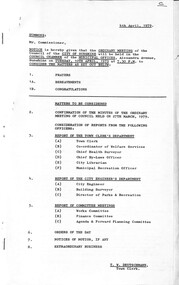
Administrative record - City of Sunshine - Commissioner Mr Alexander Alex George Gillon Collection 1976 - 1982 - Notice of ordinary meeting of the council 10th April 1979, City of Sunshine, 4th April 1979
... Unit Lot 9 Mernda Street Sunshine West Home Occupations 3 Phase Power Connection 237A Main Road West St. Albans Plan of Subdivision Entally Drive Albanvale Plan of Consolidation Lots 327 & 328 Aycliffe Drive Deer Park Transport Regulation Board Survey Bus Shelter Facilities Greater Melbourne Area Results Council Depot Working Conditions and Improvements Wright Street Bridge by Country Road Board Footpath (New) Corner Hampshire Road and Ballarat Road Gary & Warren Smith (Sunshine) Pty Ltd Muncipal Sunshine Tip Asbestos Dumping James Hardie & Co Pty Ltd Half Cost Fencing 22 Kynoch Street Deer Park backing onto Sassella Park Sunshine Indoor Pool Security Lighting Report of Building Surveyor Building Over Easement 5 Banksia Street St. ...Unit Lot 9 Mernda Street Sunshine West Home Occupations 3 Phase Power Connection 237A Main Road West St. Albans Plan of Subdivision Entally Drive Albanvale Plan of Consolidation Lots 327 & 328 Aycliffe Drive Deer Park Transport Regulation Board Survey Bus Shelter Facilities Greater Melbourne Area Results Council Depot Working Conditions and Improvements Wright Street Bridge by Country Road Board Footpath (New) Corner Hampshire Road and Ballarat Road Gary & Warren Smith (Sunshine) Pty Ltd Muncipal Sunshine Tip Asbestos Dumping James Hardie & Co Pty Ltd Half Cost Fencing 22 Kynoch Street Deer Park backing onto Sassella Park Sunshine Indoor Pool Security Lighting Report of Building Surveyor Building Over Easement 5 Banksia Street St. ...Notice of Ordinary Meeting of the Council 10th April 1979 Report of the Town Clerk's Department Report of the Town Clerk Purchase of Victorian Manufactured Goods Land Transfer Discontinued Street Arvona Avenue Sunshine North Report of the Co-Ordinator of Welfare Services Western Region Child Care & Family Services Committee Community Directory Youth Work Development Programme Report of the Chief Health Surveyor Application for Transfer of Proprietorship of Premises under the Health act Health Act Registrations Prosecution Proceedings Sunshine Magistrates Court Use of Infant Welfare Centre Roberts Crescent Sunshine West by Air Force Wives Group Report of the Chief By-Laws Officer Australian Posters Seat Agreement (Supply & Placement of Seats within the City of Sunshine at no cost to Council). Court Proceedings Parking Infringements Report of the City Librarian Special Projects Grant 1977/78 Report of the Municipal Recreation Officer Allocation of Reserves Schools Winter Season Report of the City Engineer & Planner Regional Shopping Centres Government Review Planning Permit Application Amusement Machines 8 King Street Braybrook Planning Permit Application Warehouse Lots 37 & 38 Balfour Avenue Sunshine North Planning Permit Application Motor Workshop McIntyre Road South East Corner of Whitehill Avenue Sunshine North Planning Permit Application Factory Lots 52 & 53 Judge Street Sunshine Planning Permit Application Factory or Workshop Extension 19 Evans Street Braybrook Planning Permit Application Brick Veneer Residence Lot 18 Robinsons Road Deer Park Planning Permit Application Fitness Centre Hook Street and Vule Street St. Albans Planning Permit Application Additional Villa Unit Lot 9 Mernda Street Sunshine West Home Occupations 3 Phase Power Connection 237A Main Road West St. Albans Plan of Subdivision Entally Drive Albanvale Plan of Consolidation Lots 327 & 328 Aycliffe Drive Deer Park Transport Regulation Board Survey Bus Shelter Facilities Greater Melbourne Area Results Council Depot Working Conditions and Improvements Wright Street Bridge by Country Road Board Footpath (New) Corner Hampshire Road and Ballarat Road Gary & Warren Smith (Sunshine) Pty Ltd Muncipal Sunshine Tip Asbestos Dumping James Hardie & Co Pty Ltd Half Cost Fencing 22 Kynoch Street Deer Park backing onto Sassella Park Sunshine Indoor Pool Security Lighting Report of Building Surveyor Building Over Easement 5 Banksia Street St. Albans Building Over Easement 58 Whitesides Avenue Sunshine West Verandah over Street Corner Hampshire Road and Derby Road Sunshine Siting of Building 22 Cleveland Street St. Albans Fence 14 Belvedere Close Maribyrnong Building on Flood Prone Land Lot 6 Scenic Place Maribyrnongarvona avenue, sunshine north, roberts crescent, sunshine west, air force wives group, king street, braybrook, balfour avenue, mcintyre road, whitehill avenue, judge street, sunshine, evans street, robinsons road, deer park, hook street, vule street, st. albans, mernda street, main road west, entally drive, albanvale, aycliffe drive, wright street bridge, wright street, hampshire road, ballarat road, gary & warren smith, sunshine tip, kynoch street, sassella park, station road, sunshine indoor pool, banksia street, whitesides avenue, derby road, cleveland street, belvedere close, scenic place, maribyrnong, james hardie & co
