
Showing 8 items matching "mercury box"
-
 Bendigo Historical Society Inc.
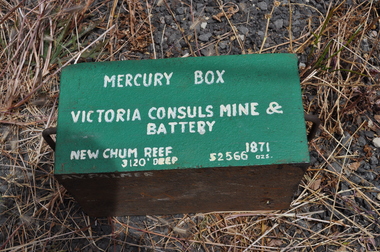
Container - MERCURY BOX: A.V. PALMER. VICTORIA CONSULS MINE AND BATTERY, NEW CHUM REEF
... MERCURY BOX: A.V. PALMER. VICTORIA CONSULS MINE AND BATTERY, NEW CHUM REEF......Mercury Box...Very heavy Green Metal Box with two steel handles with the following label. Mercury Box - Victoria Consuls Mine and Battery, New Chum Reef. 3120' deep, 1871, 52566 oz. ...Mercury Box - Victoria Consuls Mine and Battery, New Chum Reef. 3120' deep, 1871, 52566 oz. ...Very heavy Green Metal Box with two steel handles with the following label. Mercury Box - Victoria Consuls Mine and Battery, New Chum Reef. 3120' deep, 1871, 52566 oz. On the side of the box is painted. A.V. Palmer. A.V.Palmera.v. palmer, mercury box, victoria consul mine, new chum reef -
 Federation University Historical Collection
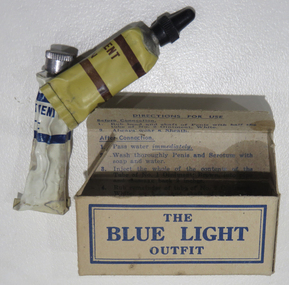
Object, Blue Light Outfit, c1914
... A cardboard box with two tubes of ointment - an anti-Venereal Disease outfit supplied to Australian Armed Services Tube number one is filled with brown contents known as 'No. 1 ointment BROWN' and has a long, tapered opening, with black pastic lid. Tube number two is filled with a thick white ointment 'No. 2 ointment WHITE', with a normal opening and metal lid. The tubes contained 3 percent Argyrol Jelly for gonorrhea and 33% Calomel Ointment (Mercury...A cardboard box with two tubes of ointment - an anti-Venereal Disease outfit supplied to Australian Armed Services Tube number one is filled with brown contents known as 'No. 1 ointment BROWN' and has a long, tapered opening, with black pastic lid. Tube number two is filled with a thick white ointment 'No. 2 ointment WHITE', with a normal opening and metal lid. The tubes contained 3 percent Argyrol Jelly for gonorrhea and 33% Calomel Ointment (Mercury ...The bluelight outfit was offered to members of the armed services in an attempt to prevent venereal disease. Around 60,000 Australian soldiers had contracted venereal disease by the end of the First World War. (http://www.canberratimes.com.au/act-news/secret-wwi-history-of-australian-soldiers-with-venereal-disease-20141022-119wan.html, accessed 21 August 2017) Australia colloquial language defines a Blue Light clinic as a venereal disease clinic.A cardboard box with two tubes of ointment - an anti-Venereal Disease outfit supplied to Australian Armed Services Tube number one is filled with brown contents known as 'No. 1 ointment BROWN' and has a long, tapered opening, with black pastic lid. Tube number two is filled with a thick white ointment 'No. 2 ointment WHITE', with a normal opening and metal lid. The tubes contained 3 percent Argyrol Jelly for gonorrhea and 33% Calomel Ointment (Mercury-Chloride) for syphilis prophylaxis.Inside box: Directions for Use Before Connection 1. Rub head and shaft of Penis with half the tube of No. 2 Ointment, White. 2. Always wear a sheath After Connection 1. Pass water IMMEDIATELY 2. Wash thoroughly Penis and Scrotum with soap and water. 3. Inject the whole of the contents of the Tube of No. 1. Oitnment, Brown, into pipe and massage back 2 inches. 4. Rub remainder of tube No. 2 Ointment, White, on head and shaft of Penis and Scrotum 5. Hold urine some hours after treatment 6. Report at V.D. Prevention Depot (Blue Light Depot) as soon as possible. 7. Having read directions and understood them, destroy by tearing up or by burning.blue light outfit, veneral disease, vd, armed services, gonorrhea, syphilis, disease, medical -
 Geoffrey Kaye Museum of Anaesthetic History
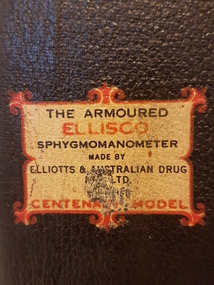
Tool - Manometer, Mercury, Elliotts & Australian Drug Pty. Ltd
... mercury sphygmomanometer. American neurosurgeon, Harvey Cushing, was an early adopter, and advocate for monitoring patients during surgery and anaesthesia. Blood pressure monitoring is still an essential component of evaluating a patient’s condition. Harvey Cushing Blood pressure Measurement Anaesthetics John Marum Sphygmomanometer Elliotts & Australian Drug Pty Ltd Centenary Model Cuff Bellows ELLISCO Armoured Blue sticker affixed inside the kit: JOHN MARUM Ornate manufacturer's label: THE ARMOURED / ELLISCO / SPHYGMOMANOMETER / MADE BY / ELLIOTTS & AUSTRALIA DRUG / [indecipherable] LTD / CENTEN[indecipherable] MODEL This blood pressure kit is housed in a rectangular, vinyl covered box with metal handle and press-stud lid release mechanism. ...In the 1600s, William Harvey realised a finite amount of blood circulates in one direction through the body. Jean Léonard Marie Poiseuille introduced the mercury hydrodynometer in the early 1800s for measuring blood pressure. Karl von-Vierordt created the sphygmograph in 1855 and, in 1881, Samuel von Basch created the sphygmomanometer, distinct improvements on the hydrodynometer. In 1896, Scipione Riva-Rocci developed the mercury sphygmomanometer. American neurosurgeon, Harvey Cushing, was an early adopter, and advocate for monitoring patients during surgery and anaesthesia. Blood pressure monitoring is still an essential component of evaluating a patient’s condition.This blood pressure kit is housed in a rectangular, vinyl covered box with metal handle and press-stud lid release mechanism. The lid opens upwards and the glass blood pressure valve and plastic scale is attached to the underside of the lid. The measurements are written in black and go up in increments of ten, from 0 to 300. The glass valve has unidentified increments labelled in red, which is housed within a metal cylinder. The bellows is attached to the measuring valve via a dark green pressure cuff and rubber hose.Blue sticker affixed inside the kit: JOHN MARUM Ornate manufacturer's label: THE ARMOURED / ELLISCO / SPHYGMOMANOMETER / MADE BY / ELLIOTTS & AUSTRALIA DRUG / [indecipherable] LTD / CENTEN[indecipherable] MODELharvey cushing, blood pressure, measurement, anaesthetics, john marum, sphygmomanometer, elliotts & australian drug pty ltd, centenary model, cuff, bellows, ellisco, armoured -
 Bendigo Historical Society Inc.
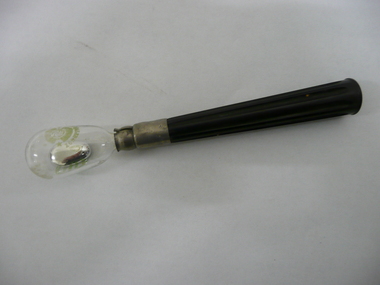
Tool - BILL ASHMAN COLLECTION: SMALL SCALEBUOY
... Small hand held Scalebuoy in original box, screw on handle of black bakelite attached to a glass bulb containing liquid mercury...SCIENCES Instruments - general scalebuoy Tested and Guaranteed boston USA Pnt Applied For The Scalebuoy Small hand held Scalebuoy in original box, screw on handle of black bakelite attached to a glass bulb containing liquid mercury Tool BILL ASHMAN COLLECTION: SMALL SCALEBUOY ...Small hand held Scalebuoy in original box, screw on handle of black bakelite attached to a glass bulb containing liquid mercuryTested and Guaranteed boston USA Pnt Applied For The Scalebuoysciences, instruments - general, scalebuoy -
 Bendigo Historical Society Inc.
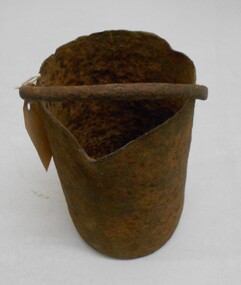
Tool - MERCURY BUCKET
... The violent agitation of the mercury in the mortar box...The violent agitation of the mercury in the mortar box however could cause the mercury to break into myriad tiny globules that were carried away by the water with the tailings thus losing a certain amount of gold in the process (Thompson 1867; Ritchie & hooker 1997). ...Cast iron mercury bucket, used to hold mercury, potentially in the process of recovering minute pieces of gold mixed in soil and sediments. See research page for description of one process of using mercury to extract gold.gold mines, mining equipment, mercury bucket, miners used mercury in a number of ways to amalgamate gold, with each mill or battery operator having their preferred method depending on the nature of the ore. by the late 1850s the most common way of crushing goldbearing quartz ores or consolidated alluvial cements was in a stamp battery. the battery featured heavy iron stamp heads held in a frame, with each head often weighing up to 500 pounds (226 kg) or more (see msv 1880, page 45) (birrell 2005). stamp heads were lifted and dropped by a rotating overhead cam shaft driven by a steam engine or water wheel. ore was fed into a large cast-iron battery box, mixed with a steady stream of water, and pulverised by the stamp heads. in some batteries, mercury was placed in the base of the boxes to amalgamate with freed gold. the violent agitation of the mercury in the mortar box, however, could cause the mercury to break into myriad tiny globules that were carried away by the water with the tailings, thus losing a certain amount of gold in the process (thompson 1867; ritchie & hooker 1997). the water and sand slurry was splashed by the falling stamps from the box through fine mesh screens and onto inclined wooden tables below the mortar box (figure 2). the tables were covered with copper sheets or plates coated with mercury, which caught and amalgamated with a portion of the gold. the grey putty-like amalgam was periodically scraped off the sheets and retorted in a furnace to collect the gold and recover the mercury for reuse. mercury was inevitably lost from the plates, while poor maintenance resulted in further losses of gold and mercury in the tailings. mercury use and loss from gold mining in 19th century victoria. peter davies1, susan lawrence, and jodi turnbull, department of archaeology and history, la trobe university. -
![Instrument - sphygmomanometer, similar items found dated to [ca.1920's]](/media/collectors/50187a8f023fd7201471f198/items/67a400e37f6a71232efcda38/item-media/67a4193e7f6a71232e003811/item-fit-380x285.jpg?cb=6) Alfred Hospital Nurses League - Nursing History Collection
Alfred Hospital Nurses League - Nursing History CollectionInstrument - sphygmomanometer, similar items found dated to [ca.1920's]
... box and contents -The sphygmomanometer is enclosed in the beige metal container. There is a click opening button on the exterior inferior end. The lid lifts via an internal hinge on the superior end to reveal a glass cartridge tube calibrated to 300 millimetres of mercury. ...mercury and later aneroid sphygmomanometers provided the accuracy and portability required for clinical use. In common daily use by nurses for clinical assessment of patients' blood pressure. sphygmomanometer medical instrument blood pressure Alfred Hospital Nurses League student nurse training Alfred Hospital superior lid - silver metal plaque in centre, engraved P.T.S., right corner of lid - white sticky label - black ink 176-01, manufacturers stamp inside lid - SPHYGMOMANOMETER/Mercurius/MINIATUR MODELL/Made in Germany, serial number 342308, on base of box, white paint - 176-01 metallic box and contents -The sphygmomanometer is enclosed in the beige metal container. ...The sphygmomanometer is an early diagnostic instrument used to measure blood pressure. Since the discovery of blood circulation in 1628, the search for accurate, convenient, simple, and non-invasive tools has led to evolving measuring devices and cuffs. Until the twentieth century, few doctors tolerated the inconvenience of blood pressure measurers and relegated the exiting tools to laboratory research. The mercury and later aneroid sphygmomanometers provided the accuracy and portability required for clinical use.The sphygmomanometer is an early diagnostic instrument used to measure blood pressure. Since the discovery of blood circulation in 1628, the search for accurate, convenient, simple, and non-invasive tools has led to evolving measuring devices and cuffs. Until the twentieth century, few doctors tolerated the inconvenience of blood pressure measurers and relegated the exiting tools to laboratory research. The mercury and later aneroid sphygmomanometers provided the accuracy and portability required for clinical use. In common daily use by nurses for clinical assessment of patients' blood pressure.metallic box and contents -The sphygmomanometer is enclosed in the beige metal container. There is a click opening button on the exterior inferior end. The lid lifts via an internal hinge on the superior end to reveal a glass cartridge tube calibrated to 300 millimetres of mercury. The case and meter were manufactured in Germany (according to original museum catalogue worksheet) and identified as the “Mercurius Miniatur Modell.” The dark green rubber bulb and of tubing are in good condition. The black cotton fabric cuff shows signs of wear and is frayed at the bladder insertion opening. According to the company insignia on the bladder, it was manufactured by ACCOSON in England. superior lid - silver metal plaque in centre, engraved P.T.S., right corner of lid - white sticky label - black ink 176-01, manufacturers stamp inside lid - SPHYGMOMANOMETER/Mercurius/MINIATUR MODELL/Made in Germany, serial number 342308, on base of box, white paint - 176-01sphygmomanometer, medical instrument, blood pressure, alfred hospital nurses league, student nurse training alfred hospital -
 Kew Historical Society Inc
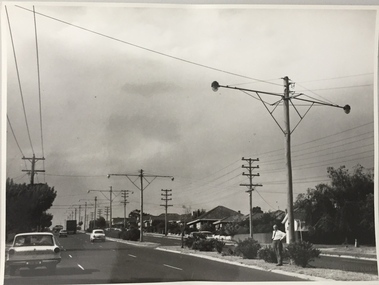
Photograph, Stuart Tompkins Studio, Electricity Supply Poles, Warrigal Road, Holmesglen, 1965
... mercury lamps proposed. Wooden pole 3' up 11 3/4" dia." Studio stamp: "Stuart Tompkins Studio. 547 Station Street, Box Hill. ...mercury lamps proposed. Wooden pole 3' up 11 3/4" dia." Studio stamp: "Stuart Tompkins Studio. 547 Station Street, Box Hill. ...Research provided by Stuart Tompkins Studio, Box Hill, into alternatives for median strip street lighting to be used in Burke Road, Kew. The photographers identified variants in different suburbs appropriate to Kew's needs. The series from which the photograph is drawn provides a snapshot by a commercial photographic studio of each named vicinity in 1965 as well as providing examples of public works infrastructure being commissioned by local government in the 1960s. The photos originally formed part of the Engineering Department's files in the City of Kew before being donated to the kew Historical Society.Electricity Supply Poles, Warrigal Road, Holmesglen, 1965. Stuart Tompkins Studio provided this photograph for the Kew City Council. The photograph of Warrigal Road, north of Holmesglen looking north depicts wooden poles with bracket light fittings. These were the same as those proposed for Kew, except the lights and fittings were not to be 350 watt. Mercury lamps were preferred. [There are three copies of this photograph in the Collection.] Typed inscription on reverse: "Electricity Supply Poles. Photographed for Kew City Council 8/2/65. No.3 Warrigal Road - North of Holmesglen looking north. Wooden poles with bracket fittings same as those proposed for Kew except lights and fittings are not for 250 watt c. c. mercury lamps proposed. Wooden pole 3' up 11 3/4" dia." Studio stamp: "Stuart Tompkins Studio. 547 Station Street, Box Hill. WX1439."stuart tompkins studio, warrigal road (holmesglen) 1965, street lighting -
 Kew Historical Society Inc
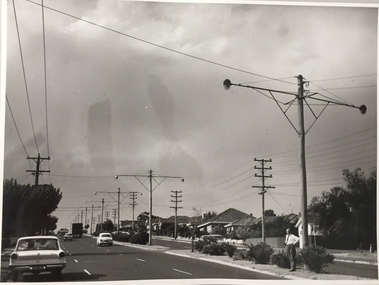
Photograph, Stuart Tompkins Studio, Electricity Supply Poles, Warrigal Road, Holmesglen, 1965
... mercury lamps proposed. Wooden pole 3' up 11 3/4" dia." Studio stamp: "Stuart Tompkins Studio. 547 Station Street, Box Hill. ...mercury lamps proposed. Wooden pole 3' up 11 3/4" dia." Studio stamp: "Stuart Tompkins Studio. 547 Station Street, Box Hill. ...Research provided by Stuart Tompkins Studio, Box Hill, into alternatives for median strip street lighting to be used in Burke Road, Kew. The photographers identified variants in different suburbs appropriate to Kew's needs. The series from which the photograph is drawn provides a snapshot by a commercial photographic studio of each named vicinity in 1965 as well as providing examples of public works infrastructure being commissioned by local government in the 1960s. The photos originally formed part of the Engineering Department's files in the City of Kew before being donated to the kew Historical Society.Electricity Supply Poles, Warrigal Road, Holmesglen, 1965. Stuart Tompkins Studio provided this photograph for the Kew City Council. The photograph of Warrigal Road, north of Holmesglen looking north depicts wooden poles with bracket light fittings. These were the same as those proposed for Kew, except the lights and fittings were not to be 350 watt. Mercury lamps were preferred. [There are three copies of this photograph in the Collection.] Typed inscription on reverse: "Electricity Supply Poles. Photographed for Kew City Council 8/2/65. No.3 Warrigal Road - North of Holmesglen looking north. Wooden poles with bracket fittings same as those proposed for Kew except lights and fittings are not for 250 watt c. c. mercury lamps proposed. Wooden pole 3' up 11 3/4" dia." Studio stamp: "Stuart Tompkins Studio. 547 Station Street, Box Hill. WX1439."stuart tompkins studio, warrigal road (holmesglen) 1965, street lighting
