
Showing 4263 items matching "metalcraft-steel"
-
 Mont De Lancey
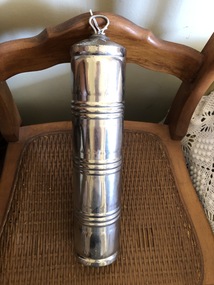
Domestic object - Bed Warmer, Sunrise Stainless Steel Co, 1930's - 1950's
... 1930's to 1950's Sunrise Stainless Steel Co. Melbourne Pat Appn 6368/42 1.2 litre stainless steel bed warmer, foot warmer, thermos bottle. ...A stainless steel, cylindrical bed warmer, with a removable screw stopper which has a looped handle on top. ...'Sunrise Stainless Steel Co Pat App 6368/42' Patent marks around the stopper....Sunrise Stainless Steel Co...Sunrise Stainless Steel Co...1930's to 1950's Sunrise Stainless Steel Co. Melbourne Pat Appn 6368/42 1.2 litre stainless steel bed warmer, foot warmer, thermos bottle. ...1930's to 1950's Sunrise Stainless Steel Co. Melbourne Pat Appn 6368/42 1.2 litre stainless steel bed warmer, foot warmer, thermos bottle. Bed warmer with very small opening, but the bottle works effectively on the principle of a thermos bottle. Holds water without leaking. Russell SebireA stainless steel, cylindrical bed warmer, with a removable screw stopper which has a looped handle on top. It has a pattern of three bands of three lines around it. It would be filled with hot water, sealed with the stopper and wrapped in a towel or cloth to stop it burning your feet.'Sunrise Stainless Steel Co Pat App 6368/42' Patent marks around the stopper.bed warmers, hot water bottles -
 Puffing Billy Railway
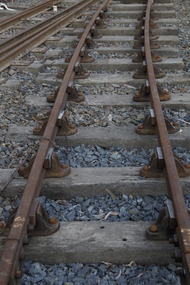
Double Headed Rail, circa 1872 - 1883
... Double Headed Rail from Ravenswood Station Siding which was dismantled circa 1987 the two rails were stored for a time at Maldon before being donated to Puffing Billy Museum Bearing makers marks of Wilson & Cammell - Dronfield- Steel works Wilson & Cammell made Steel rails at their Dronfield Steel Works, in Dronfield, North East Derbyshire, England from 1872 - 1883 Double-headed rail In late 1830s Britain, railway lines had a vast range of different patterns. ...2 rail lengths of Double Headed Rail made of Iron makers marks : Wilson & Cammell - Dronfield - Steel and 20 joint chairs with metal rail pins ...Makers mark Wilson & Cammell - Dronfield - Steel (possible date 187? very hard to read ) ...Wilson & Cammell - Dronfield - Steel Works ...Double Headed Rail from Ravenswood Station Siding which was dismantled circa 1987 the two rails were stored for a time at Maldon before being donated to Puffing Billy Museum Bearing makers marks of Wilson & Cammell - Dronfield- Steel works Wilson & Cammell made Steel rails at their Dronfield Steel Works, in Dronfield, North East Derbyshire, England from 1872 - 1883 Double-headed rail In late 1830s Britain, railway lines had a vast range of different patterns. ...Double Headed Rail from Ravenswood Station Siding which was dismantled circa 1987 the two rails were stored for a time at Maldon before being donated to Puffing Billy Museum Bearing makers marks of Wilson & Cammell - Dronfield- Steel works Wilson & Cammell made Steel rails at their Dronfield Steel Works, in Dronfield, North East Derbyshire, England from 1872 - 1883 Double-headed rail In late 1830s Britain, railway lines had a vast range of different patterns. One of the earliest lines to use double-headed rail was the London and Birmingham Railway, which had offered a prize for the best design. This rail was supported by chairs and the head and foot of the rail had the same profile. The supposed advantage was that, when the head became worn, the rail could be turned over and re-used. In practice, this form of recycling was not very successful as the chair caused dents in the lower surface, and double-headed rail evolved into bullhead rail in which the head was more substantial than the foot. Info from Wikipedia - Rail Profile https://en.wikipedia.org/wiki/Rail_profile The first records of double headed rail being used In Victoria by Victorian Railways was in 1859, the rails, chairs, oak and trenails were imported from UK. After the 1870’s the Victorian Railways went over to using flat bottom rails, but they still needed replacement double headed rail for lines already laid and this continued up to at least 1883 Wilson & Cammell - Dronfield- Steel works Wilson & Cammell made Steel rails at their Dronfield Steel Works, in Dronfield England from 1872 - 1883 Mount Alexander & Murray River Railway The Melbourne, Mount Alexander & Murray River Railway Company received parliamentary assent in February 1853 to build Victoria's first inland railway from Melbourne to Williamstown, and Melbourne to Bendigo and Echuca. Construction commenced in January 1854 with work on a pier at Williamstown but lack of funds slowed progress, eventually prompting the company to sell out to the government. The 100-mile (162 km) section to Bendigo opened in October 1862. Its cost of £35,000 per mile made it the most expensive railway ever built in Australia. In 1864, the line was extended to Echuca, tapping into the booming Murray-Darling paddlesteamer trade. info from Museums Victoria - Victorian Railways https://museumsvictoria.com.au/railways/theme.aspx?lvl=3&IRN=450&gall=456 1863 Ravenswood Station open on the 1st Feb 1863 Victorian Railways - purchased and imported the Rail and Chairs from Raleigh, Dalgleish, White and Co. London Importation of railway plant : abstract of a return to an order of the Legislative Assembly dated 27th June 1860 for - Copies of the advertisements calling for tenders, the names of the tenderers and the accounts and correspondence with Mr Brunel relating thereto GP V 1859/60 no. C 15 http://www.parliament.vic.gov.au/papers/govpub/VPARL1859-60NoC15.pdf Report from the Select Committee upon the Importation of Railway Plant : together with proceedings of the Committee, minutes of evidence and appendix GP V 1859/60 no. D 38 (2.9 MB) http://www.parliament.vic.gov.au/papers/govpub/VPARL1859-60NoD38.pdf Ravenswood Siding When the Victorian Railways were established in 1856 they adopted one of the popular British permanent way standards - heavy 80lb (36.3kg) double-headed rail held up right in cast iron chairs attached to transverse timber sleepers by wooden pegs called trenails. The Ravenswood Railway siding was constructed in 1862 with 12 feet wrought iron double-head rail held in cast iron chairs with Ransom and May patent compressed keys. Trenails held the chairs to the sleepers and the joints were secured in joint chairs. Joints were subsequently joined using fish plates. It formed part of the Melbourne to Echuca rail line, initially known as the Melbourne, Mt Alexander and Murray River Railway. George Christian Derbyshire, the first Engineer-in-Chair of the Victorian Railways was responsible for the design and construction of the works. No new lines were built in Victoria using double-headed rail after 1870. The siding was disconnected from the main line in 1988. The Ravenswood Railway Siding demonstrates the original 1856 philosophy of the Victorian Railways to adopt British permanent way technology. The siding demonstrates significant aspects in the development of permanent way technology in England and Victoria over the period from the 1830's to the 1880's. The chairs in the Ravenswood siding are physical evidence of early railway technology rendered obsolete 120 years ago, namely joint chairs at rail joints and trenails to secure the chairs to the sleepers. The double-headed rail demonstrates an important stage in the evolution of British rail technology in the 1830s. The old fish plates, square headed bolts and square nuts demonstrate the success of fishing the rail joins. The Ravenswood siding demonstrates the earliest form of rail joint technology developed in England, and existing in Australia, the joint chair. In part of the siding the sequence of joint and intermediate chairs is consistent with the 1856 specifications, that sequence is rare with the joints secured in joint chairs. The survival of chairs in this sequence is rare and almost certainly demonstrates that they remained in continuous use at the same location from 1862 to 1988. This remnant of the Ravenswood siding has survived 126 years. The siding has proved to be the most significant of extant remnant double-headed sidings in Victoria, containing a rare combination of early permanent way technologies. Construction dates 1862, Info from Ravenswood Railway Siding Victorian Heritage Database Report http://vhd.heritagecouncil.vic.gov.au/places/4693/download-report The remaining section of this siding is significant at the State and National levels in that it demonstrates the use of chaired rail by the Victorian Railways Department for the Trunk Lines and, more particularly, the following stages in the evolution of this long obsolete method of permanent way construction: a) The use of joint chairs and intermediate chairs at regular intervals inferring that the original wrought iron rail lengths were 12 feet, as is known through documentary sources to have been the case. The survival of chairs in this sequence is unique and almost certainly demonstrates that they have remained in continuous use at the same location and in the same sequence from 1862 to 1988 . b) The use of joint chairs and intermediate chairs designed for use with trenails. c) The use of later intermediate chairs designed for use with steel pins and the use of fished joints with steel double head chaired rail, representing a second method of constructing the permanent way using chaired rail technology. info from Ravenswood Siding - Melbourne/Echuca Railway Line - Victorian Heritage Database Report http://vhd.heritagecouncil.vic.gov.au/places/70103/download-report Addition to Citation for Melbourne to EchucaRailway Line 1/10/1990 Double Head Rail The surviving lengths of double head rail with chairs on this railway compare with one surviving similar remnant on the Geelong to Ballarat railway and are representative of permanent way construction techniques applied exclusively to the two trunk railways of the 1860's. In this respect they are rare survivors and may be unique at the national level and of technical importance at the international level to the extent that they enhance contemporary understanding of early railway building technology. Surviving lengths of chaired double head rail survive at Kyneton, Ravenswood and Bendigo on this railway and include a number of different types of cast iron intermediate and joint chairs with hardwood keys and metal pins. The Ravenswood siding is of special significance for the diversity of chair types and for the sequence of chairs recalling rail lengths known to be associated with construction of the line in 1862. Construction of the Railway Tenders closed on 24 March 1858 with no less than 133 tenders being received. A contract was let to Cornish and Bruce for £3,356,937 to commence work on 1 June 1858 and complete the line by 31 July 1861. Cornish and Bruce made quick early progress with the Melbourne to Sunbury section being officially opened on 13 January 1859. The line was officially opened to Bendigo (Sandhurst) on 20 October 1862 by the Governor of Victoria, Sir Henry Barkly. A great banquet was held for 800 guests and this was followed by a grand ball. The extension of the line to Echuca was a relatively simple matter as that part of the line was across plain country without any significant engineering challenges. Tenders were called for the work in 1863 and the work was completed in 1864 by contractors Collier and Barry Apart from the line contractors, other firms directly involved were J Shire law and Co (sleepers), R Fulton, Langlands Brothers and Co, William Crossley (water supply), B Moreland, Langlands Brothers and Co (platelayers lorries), E Chambers (iron pins, traversers), Miller and McQuinstan (luggage vans and steam engines) and various contractors for building works. Info from Engineers Australia Engineering Heritage Victoria Nomination for Recognition under the Engineering Heritage Australia Heritage Recognition Program for the Goldfields Railways - Melbourne , Bendigo & Echuca Railway Page 25 - .2.9.2 Statement from National Trust of Australia (Victoria) Listing number B5323 for Mt Alexander/Murray Valley Rail Line: Page 69 - Theme 3 https://www.engineersaustralia.org.au/portal/system/files/engineering-heritage-australia/nomination-title/Melbourne_%20Bendigo_Echuca%20Railway%20Nomination.pdf The Melbourne, Mount Alexander and Murray River Railway Company was a railway company in Victoria, Australia. It was established on 8 February 1853 to build a railway from Melbourne to Echuca on the Victorian-NSW border and a branch railway to Williamstown. The company struggled to make any progress and on 23 May 1856, the colonial Government took over the Company and it became part of the newly established Department of Railways, part of the Board of Land and Works. The Department of Railways became Victorian Railways in 1859. Construction of the Bendigo line commenced in 1858, but this private consortium also met with financial difficulties when it was unable to raise sufficient funds, and was bought out by the Victorian colonial government. The design work was then taken over by Captain Andrew Clarke, R. E., Surveyor-General of Victoria, with bridge designs completed by Bryson and O'Hara The contract for the first stage of the line from Footscray to Sandhurst (now Bendigo), was let to Cornish and Bruce for £3,356,937.2s.2d ($6.714 million) with work commencing on 1 June 1858. Completion of the permanent way was to be by 31 July 1861 https://en.wikipedia.org/wiki/Melbourne,_Mount_Alexander_and_Murray_River_Railway_Company Victorian Railways - purchased and imported the Rail and Chairs from Raleigh, Dalgleish, White and Co. London Importation of railway plant : abstract of a return to an order of the Legislative Assembly dated 27th June 1860 for - Copies of the advertisements calling for tenders, the names of the tenderers and the accounts and correspondence with Mr Brunel relating thereto GP V 1859/60 no. C 15 http://www.parliament.vic.gov.au/papers/govpub/VPARL1859-60NoC15.pdf Report from the Select Committee upon the Importation of Railway Plant : together with proceedings of the Committee, minutes of evidence and appendix GP V 1859/60 no. D 38 (2.9 MB) http://www.parliament.vic.gov.au/papers/govpub/VPARL1859-60NoD38.pdf Victorian Railways : report of the Board of Land and Works November 1862 GP V 1862/63 no. 21 (2.8 MB) https://www.parliament.vic.gov.au/papers/govpub/VPARL1862-63No21.pdfHistoric - Victorian Railways - Double Headed rail Ravenswood Railway Station and Siding Victorian Heritage Database Reports Victorian Heritage Register VHR H1100 Victorian Heritage Register VHR H1786 National Trust VHR H1100 Mount Alexander and Murray River Rail way Line National Trust2 rail lengths of Double Headed Rail made of Iron makers marks : Wilson & Cammell - Dronfield - Steel and 20 joint chairs with metal rail pins Makers mark Wilson & Cammell - Dronfield - Steel (possible date 187? very hard to read ) puffing billy, double headed rail, wilson & cammell - dronfield - steel works, ravenswood station siding, melbourne to echuca rail line, initially known as the melbourne, mt alexander and murray river railway. -
 Mont De Lancey
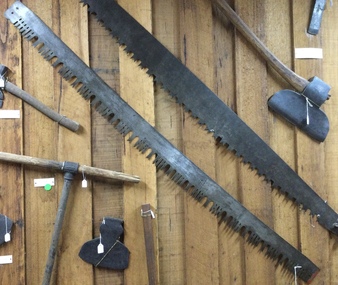
Tool - Saw, Simond Steel and saw Co, Crosscut Saw, Unknown
... ...Steel...A forged steel narrow bladed double Peg and Rake toothed crosscut saw with no handles. ...Stamped on the saw: made of Simond Steel, Trade mark Reg. Warranted The Simond Saw Est 1832, Simond Steel & Saw co USA. ...Simond Steel and saw Co...Hand tools Woodworking tools Carpentry tools Steel Hand saws Saws Cutting tools Crosscut saws Stamped on the saw: made of Simond Steel, Trade mark Reg. ...Used in the 19th century.A forged steel narrow bladed double Peg and Rake toothed crosscut saw with no handles. It was used to saw rough wood or cross cut wood against the grain in the late 19th Century.Stamped on the saw: made of Simond Steel, Trade mark Reg. Warranted The Simond Saw Est 1832, Simond Steel & Saw co USA. Crescent Ground Steel Mill, Lockport New York. Factories Fitchburg Mass, Montreal Quebec No 325hand tools, woodworking tools, carpentry tools, steel, hand saws, saws, cutting tools, crosscut saws -
 Clunes Museum
Book, JOHN PERCY, Percy's Metallurgy - Iron & Steel, 1894
... Percy's Metallurgy - Iron & Steel...Dowlais is a former Iron/steel making and coal mining town in Wales, United Kingdom...Percy on Iron and Steel" published in The Times Tuesday, May 17, 1864 .3 Plan for Dowlais New Mills ...Gold Lettering on spine: "Percy's Metallurgy Iron & Steel London John Murray Faded Maroon stamp page 2 - Clunes School of Mines No. 24 16 Jun 93...Percy on Iron and Steel" published in The Times Tuesday, May 17, 1864 .3 Plan for Dowlais New Mills Percy's Metallurgy - Iron & Steel Book BOOK JOHN PERCY JOHN MURRAY Edmonds & Remnants J. ...The art of extracting metals from their ores and adapting them to various purposes of manufacture.1 Hardcover book light brown embossed cover, gold lettering on spine, 1864, subject matter, the art of extracting metals from their ores and adapting them to various purposes of manufacture. With illustrations, chiefly from original drawings, carefully laid down to scale. .2 Newspaper Article "Dr. Percy on Iron and Steel" published in The Times Tuesday, May 17, 1864 .3 Plan for Dowlais New Mills non-fictionThe art of extracting metals from their ores and adapting them to various purposes of manufacturemetallurgy, mining -
 Mont De Lancey
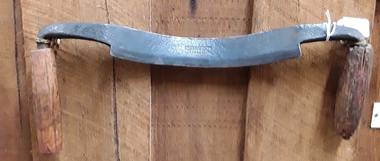
Tool - Draw Knife, ROBT SORBY AUS STEEL, Unknown
... ...Steel...A steel curved bladed woodworking tool with two wooden handles used to remove thin slices and big chunks of wood from timber. ...ROBT SORBY AUS STEEL...ROBT SORBY AUS STEEL...Woodcarving Tools Drawing knives Shaves Handtools Steel Wood Woodworking tools ROBT SORBY AUS STEEL A steel curved bladed woodworking tool with two wooden handles used to remove thin slices and big chunks of wood from timber. ...A steel curved bladed woodworking tool with two wooden handles used to remove thin slices and big chunks of wood from timber. It can be used to fashion wooden sculptures, debarking trees and trimming beams. The final finishing on such work was done by a Spoke Shave tool which we also have in our collection.ROBT SORBY AUS STEELwoodcarving tools, drawing knives, shaves, handtools, steel, wood, woodworking tools -
 Wodonga & District Historical Society Inc
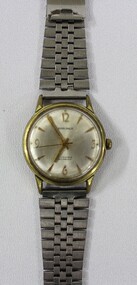
Functional object - Haeusler Collection Men's 'Baronex' Stainless Steel Wrist Watch, Mid-century
... Haeusler Collection Men's 'Baronex' Stainless Steel Wrist Watch, Mid-century...Men's 'Baronex' analogue, stainless steel wrist watch, c. mid-century. ...On back of watch face "STAINLESS STEEL BACK/WATER RESISTANT/ANTIMAGNETIC SHOCKPROOF/DUST PROOF". ...On watch band near clasp "100% /STAINLESS STEEL/HONG KONG". On watch face "BARONEX/JEWELS INCABLOC" Men's 'Baronex' analogue, stainless steel wrist watch, c. mid-century. ...The Wodonga Historical Society Haeusler Collection provides invaluable insight into life in late nineteenth and early twentieth century north east Victoria. The collection comprises manuscripts, personal artefacts used by the Haeusler family on their farm in Wodonga, and a set of glass negatives which offer a unique visual snapshot of the domestic and social lives of the Haeusler family and local Wodonga community. The Haeusler family migrated from Prussia (Germany) to South Australia in the 1840s and 1850s, before purchasing 100 acres of Crown Land made available under the Victorian Lands Act 1862 (also known as ‘Duffy’s Land Act’) in 1866 in what is now Wodonga West. The Haeusler family were one of several German families to migrate from South Australia to Wodonga in the 1860s.This item has well documented provenance and a known owner. It forms part of a significant and representative historical collection which reflects the local history of Wodonga. It contributes to our understanding of domestic and family life in early twentieth century Wodonga, as well as providing interpretative capacity for themes including local history, social history, and women’s history. Men's 'Baronex' analogue, stainless steel wrist watch, c. mid-century. On back of watch face "STAINLESS STEEL BACK/WATER RESISTANT/ANTIMAGNETIC SHOCKPROOF/DUST PROOF". On watch band near clasp "100% /STAINLESS STEEL/HONG KONG". On watch face "BARONEX/JEWELS INCABLOC"watch, clock, time, timepiece, haeusler collection, wodonga, social history -
 Ballarat Tramway Museum
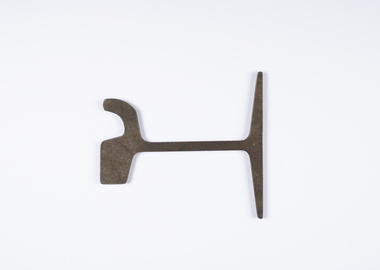
Functional Object - Rail Section, Lorain Steel, 9mm Sawn Cut Rail, 1930's?
... On the other side of the rail, "81LBS PERYD", stamped onto the head of the rail. and "LORAIN STEEL CO LORAIN" stamped into the web.... FRONT - 8116/yd Morain Steel Co. Lorain BACK - Bendigo ...Lorain Steel...Yields information about some of the rail used in Bendigo and demonstrates the type of rail used in tramways and made by the Lorain Steel Co. France. Trams tramways Rail Bendigo Rail Section FRONT - 8116/yd Morain Steel Co. ...Yields information about some of the rail used in Bendigo and demonstrates the type of rail used in tramways and made by the Lorain Steel Co. France.Section of flanged tramway rail - saw cut from rail, smooth finished - Stamped "BENDIGO" stamped into the foot of the rail. On the other side of the rail, "81LBS PERYD", stamped onto the head of the rail. and "LORAIN STEEL CO LORAIN" stamped into the web. FRONT - 8116/yd Morain Steel Co. Lorain BACK - Bendigo trams, tramways, rail, bendigo, rail section -
 City of Melbourne Libraries
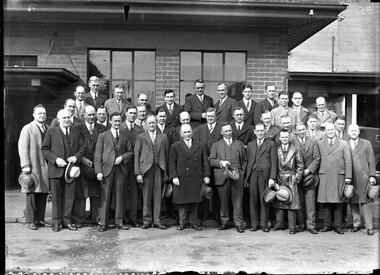
Photograph, Bull, Hugh Jones, 1897-1993, Steel manufacturers, McPherson's Ltd, Melbourne
... Steel manufacturers, McPherson's Ltd, Melbourne...Photographer notations on slide: Steel Manuf’rs at McPherson’s Ltd 1933 Published: The Age, 30 August 1933 BUREAU OF STEEL MANUFACTURERS OF AUSTRALIA. (1933, August 30). ...Photographer notations on slide: "Steel manuf'rs at McPherson's Ltd 1933 B5"....Photographer notations on slide: Steel Manuf’rs at McPherson’s Ltd 1933 Published: The Age, 30 August 1933 BUREAU OF STEEL MANUFACTURERS OF AUSTRALIA. (1933, August 30). ...Photographer notations on slide: Steel Manuf’rs at McPherson’s Ltd 1933 Published: The Age, 30 August 1933 BUREAU OF STEEL MANUFACTURERS OF AUSTRALIA. (1933, August 30). The Age (Melbourne, Vic. : 1854 - 1954), p. 11. Retrieved January 25, 2026, from http://nla.gov.au/nla.news-article204372874 Published title: Bureau of Steel Manufacturers of Australia Published caption: A group of Inter-State Visitors, from the Bureau of Steel Manufacturers of Australia, on a tour of inspection at the Bolt Works of McPhersons Pty. Ltd., Burnley-Richmond, yesterday. Research by Project Volunteer, Louise McKenzie: The photo shows a line up of 36 men, in three rows, in front of a building. They are mostly dressed in dark 3-piece suits, or camel coats. But one gentleman stands out in his full length leather coat! Striped ties are popular, and they are all holding hats. One man, at the rear towards the right, looks a bit younger with his thick, black, brylcreamed hair.. These interstate gentlemen are described in the newspaper caption as representatives of the Bureau of Steel Manufacturers "...on a tour of inspection at the Bolt Works of McPhersons Pty Ltd, Burnley, Richmond." Interestingly, the Bureau of Steel Manufacturers of Australia (BOSMA) still exists, and is the industry body for major Australian steel producers like BlueScope, Liberty, and InfraBuild, representing their interests, engaging with government, and participating in standards setting for the domestic steel market, with a history dating back to 1923. While BOSMA focuses on primary manufacturing, the Australian Steel Institute (ASI) serves as the broader peak body for the entire steel supply chain, from mills to end-users, promoting and supporting the industry. But at the time of this photo, the Australian steel industry was just starting to make headway. As the AST website explains, "Steelmaking in Australia began just a decade prior to the start of the 1851 Gold Rush whilst Australia was still divided into colonies. Iron ore deposits were discovered in 1840 at Iron Knob, South Australia but a lack of equipment meant that the process of producing steel was impossible. Even attempts at smelting the iron ore in a blast furnace to create pig iron were unsuccessful due to the poor quality of iron ore and coke available to the budding industry. In the other colonies at the time, such as Victoria, Tasmania, and New South Wales, there were minor discoveries of iron ore but poor technical expertise and limited quantity meant that the quality of steel was poor. Compared to the far superior steel being imported from Britain at the time, the steel manufacturing industry simply couldn’t compete and was unviable. By the 1870s, almost all steel production in Australia had been abandoned. The situation began to change at the turn of the century. Rapid growth sparked higher demand for industrial machinery made from steel and infrastructure such as rail. It became apparent that there was a need for locally manufactured steel and soon there would be an answer. In 1901, the year Australia united into a federation, the nation’s first blast furnace went into production at Eskbank near Lithgow in New South Wales. The development was spearheaded by William Stafford and his son Esk, and Stafford is known as the father of Australian steel production. In 1915, production expanded with another steel mill in Newcastle that was opened by BHP. It sourced coke from local mines and iron ore from South Australia, creating a domestic loop for steel manufacturing. In the following years, more steelworks opened in Whyalla, South Australia and Port Kembla in NSW. Steel manufacturing in Australia was now underway." The company mentioned in the photo’s notation and in the newspaper caption, was McPhersons, "...an Australian hardware firm, for many years a leading merchant of woodworking and metal-working machinery... [and founded by] Thomas McPherson (c.1823–1888) who had a home "Dudley House" at 142 Dudley Street, West Melbourne. [The] ironmongery business [was located] in 1860 at 149 Spencer Street, Melbourne. Merchandise carried included bells, lathes, horseshoes and steam engines." (Wikipedia - McPherson's Pty Ltd) Anyone who has read Robyn Annear’s excellent award-winning 2014 book Bearbrass – the name for early Melbourne - will remember only too well her description of West Melbourne, from where the city of Melbourne as we know it, emerged. Her book resurrects the village that was early Melbourne – from the arrival of white settlers in 1835 until the first gold rushes shook the town – and brings it to life in vivid colour. The McPherson family, whose arrival in Bearbrass coincides with this period (Thomas arrived in 1852), became intimately involved in the growth and development of Melbourne. Thomas was Mayor of Melbourne (1870-1871); his eldest son Hunter became a successful Sydney businessman; second son Edward and third son William inherited the company, and ran it together until 1896 when Edward killed himself. William had a notable career in politics as treasurer of Victoria 1917-1923, in which year he was knighted. 1928-1929 he was Premier of Victoria, and a noted philanthropist. The family were significant property owners in the city of Melbourne: 149 Spencer Street, 582-588 Collins Street, 554-566 Collins Street, together with a property on Jeffcott Street, West Melbourne, and factories in Sunshine, Tottenham, Kensington and Richmond – all by the mid 1940s. By that time they also had controlling interests in several Australasian industries, including Ajax Bolt and Rivet Pty Ltd of NZ, F W Hercus Manufacturing Co Ltd, manufacturers in South Australia of lathes, guillotines and other heavy machinery, also of Patience and Nicholson (P & N), manufacturers in Maryborough, Victoria, of twist drills and thread-forming tools; also Wiltshire Files on Sunshine Road, Tottenham, manufacturing files and rasps. The Acme Machine Tool Company became a branch of McPhersons, and the company claimed to have supplied, from their own manufacture, all five million rivets (some 3,600 tonnes) used in the building of the Sydney Harbour Bridge – described as a steel through arch bridge, which opened in 1932; the tallest of its kind in the world (Wikipedia – Sydney Harbour Bridge) McPherson’s was also innovative in other ways. It published a comprehensive catalogue, extensively detailed with prices, available free of charge to farmers and other businesses. In 1908 it had 148 pages. By 1937 it had grown to 372 pages. The University of Melbourne’s Archives entry on McPherson’s Limited notes: "After the outbreak of the Second World War, McPherson’s factories worked at full capacity and were crucial to Australia’s war efforts. On 5 December 1944 McPherson's converted to a public company named McPherson's Ltd, with William Edward as Chairman of Directors. By the start of the 1950s the company had a very different Board of Directors; in 1947 the Managing Director Oliver Addison died, and his replacement Marshall Eady died only six months later. Both had been Directors since McPherson’s became a proprietary company in 1913. Another Director, Philip Bevan, died in 1948 and this was followed by the death of William Edward in 1950. S.B Holder, F.G. Thorpe, H.L. Hastie, F. Grassick and D.G. Syme all joined the Board before 1950. The company continued to prosper for many years after the death of William Edward. His son, William David, was invited to join the McPherson’s Ltd Board in 1951. He married Angela Cumming in 1955 and soon after was sent to Brisbane as Director in Charge to oversee the building of a new warehouse. The opening of this warehouse in Queensland meant that the company now had major outlets in five states. As time went on, manufacturing in Australia began to decline and imports of everyday tools began arriving from Asia. These tools were being produced with much lower labour costs and could be sold at cheaper prices. William David retired in 1984 and eventually parts of the company were divested, such as the Richmond Bolt Works which closed in the early 1990s. Since the 1980s, McPherson's has diversified into housewares, printing, and health and beauty care products." This article also contains photos, one of which is a photograph of 'Bolt works picnic' 1920, showing workers in their shirt sleeves participating in a tug of war in a rural "picnic" setting. McPherson’s premises at 554-566 Collins Street more than lasted the test of time and is listed as historically significant. The magnificent art deco building from the 1930s in the heart of Melbourne was first commissioned in 1934 and completed in 1937. It is an imposing building fronting almost a quarter of the city block between Spencer Street and King Street, and was designed to be a warehouse, office and showroom for the hardware empire. International architects Stuart P Calder, and Reid and Pearson designed the four-storey building with a basement level and a stair tower at the centre that provides access to what was a tennis court on the roof. It is considered an example of the streamlined modern style in Melbourne and shows how the McPherson company, protected from taxes after World War I, was able to manufacture goods without being affected by the competition. The building has survived, and its current iteration is as the home to il Mercato Centrale – an Italian style artisan market concept. The University of Melbourne Archives hold a particularly good image of the building from its heyday, complete with Collins Street lamps on the pavement outside the store. And to return to our image, sited at "Bolt Works of McPhersons". Today this segment of McPhersons is still very well known - Ajax. A good summary of the company’s history, and the development of the name and business, can be found on the Mine Suppliers Online website: "AJAX Fasteners can trace its heritage back to 1900, when the Acme Bolt Company was established in West Melbourne, Victoria. In 1909, William McPherson used the company as the basis for establishing McPherson’s Bolt Works – adopting the brand ‘Ajax’ – and moved it to Richmond. Over the years, the company changed many times in response to industry needs to ensure that it remained the premier manufacturer of high quality fasteners in Australia. Many other names in the industry, such as Firth Cleveland, Spurway Cooke and Nettlefolds were merged or acquired into the company. McPhersons ended their 80-year ownership of Ajax in the early 90s when they sold their shares to National Consolidated, which was also a major shareholder at the time. In 1997, Ajax Fasteners moved to new purpose-built premises in Braeside, Victoria. Soon after, National Consolidated was taken over by the diversified manufacturer Austrim. The group soon acquired the iconic Nylex, and adopted the name Nylex Corporation. In January 2007, ACME Operations Pty Ltd acquired Ajax Fasteners and continues to operate the business today from the Braeside plant. The name ACME provides a nostalgic return by the new owners to the company’s heritage, when the Acme Bolt Company was founded in July 1900." REFERENCES: BUREAU OF STEEL MANUFACTURERS OF AUSTRALIA. (1933, August 30). The Age (Melbourne, Vic. : 1854 - 1954), p. 11. Retrieved January 25, 2026, from http://nla.gov.au/nla.news-article204372874 Wikipedia, McPherson’s Pty Ltd, https://en.wikipedia.org/wiki/McPherson%27s_Pty_Ltd Wikipedia, Richmond, Victoria, https://en.wikipedia.org/wiki/Richmond,_Victoria Industry: From the mid-19th century, Richmond was a centre of manufacturing industry, including many large complexes such as the Bryant & May match factory, Jaques Limited engineering works, the Wertheim Piano factory and Pelaco. Wikipedia, Sydney Harbour Bridge, https://en.wikipedia.org/wiki/Sydney_Harbour_Bridge eMelbourne, Manufacturing, https://www.emelbourne.net.au/biogs/EM00896b.htm 'New life for Melbourne's McPherson Building', The Urban Developer, https://www.theurbandeveloper.com/articles/mcphersons-building-melbourne-il-mercato-centrale-food-retail-destination Bureau Of Steel Manufacturers Of Australia Limited, http://www.bosma.org.au/ 'A Brief History of Steel Manufacturing in Australia', AST, https://astraders.com.au/a-brief-history-of-steel-manufacturing-in-australia/ 'Steel manufacturing in Australia: a brief history', Hard Bakka Steel Fabrication, https://www.hardbakka.com.au/component/virtuemart/steel-manufacturing-in-australia-a-brief-history?Itemid=494 McPherson's Limited, University of Melbourne Archives, https://archives.library.unimelb.edu.au/nodes/view/58364 Source of Description: 'Nuts and Bolts: A story of a family and a firm', Barbara Hamer (2006), McPherson’s Printing Group 'Photograph of 'Bolt works picnic' 1920', University of Melbourne Archives, https://archives.library.unimelb.edu.au/assets/display/1287217-max?u=dea2e4d2fd07ac822e624f1e7d39adb3 'Photograph of the exterior of the McPhersons Department store at 546 Collins Street, Melbourne.', University of Melbourne Archives, https://archives.library.unimelb.edu.au/assets/display/1287215-max?u=12430d30453a77059b7d10d49006a521 Robyn Annear, Bearbrass: imagining early Melbourne, Black Inc., 2014 (originally published 1995 by Mandarin) 'Company details', Ajax Fasteners, http://www.minesuppliersonline.com.au/australia/braeside/hardware/ajax-fasteners 'Former McPherson's Building', Victorian Heritage Database, https://vhd.heritagecouncil.vic.gov.au/places/741Photographer notations on slide: "Steel manuf'rs at McPherson's Ltd 1933 B5".1930-1939, industrial workers, clothing and dress, 1930, iron and steel industry, businesses, bridges, industry, melbourne, gold rush, moderne style architecture -
 Ballarat Tramway Museum
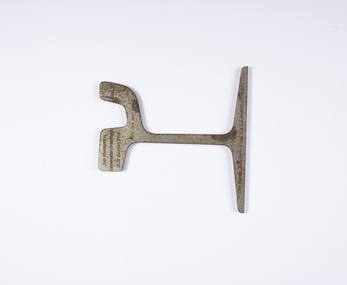
Functional Object - Rail Section, The North Eastern Steel Co. Ltd. Middlesborough, Rail Section 9616 Manufacturers Sample, 1903?
... Section of flanged tramway rail - saw cut from rail, polished and then nickel plated silver finished and stamped in italics - "Northampton Corporation Tramways B.S.Section No. 1C" in the head of the rail, "96lbs per yard" stamped in the base of the flange and along the foot of the rail "The North Eastern Steel Co. Ltd Middlesborough" and in the flangeway "1903"....Northampton Corporation Tramways B.S Section No. 15 1993 The North Western Steel Co. Ld. Middlesbrough...The North Eastern Steel Co. Ltd. Middlesborough...Rail Section 9616 Manufacturers Sample Functional Object Rail Section The North Eastern Steel Co. Ltd. Middlesborough ...Yields information about some of the rail used in Northampton UK and demonstrates the type of rail used in tramways.Section of flanged tramway rail - saw cut from rail, polished and then nickel plated silver finished and stamped in italics - "Northampton Corporation Tramways B.S.Section No. 1C" in the head of the rail, "96lbs per yard" stamped in the base of the flange and along the foot of the rail "The North Eastern Steel Co. Ltd Middlesborough" and in the flangeway "1903".Northampton Corporation Tramways B.S Section No. 15 1993 The North Western Steel Co. Ld. Middlesbroughtrams, tramways, rail, uk, rail section -
 Bendigo Military Museum
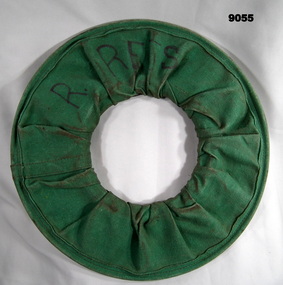
Equipment - Surveying Tape 100m Steel, Circa 1960s
... Surveying Tape 100m Steel...These steel Surveying measuring tapes were used by members of the Royal Australian Survey Corps (surveyors and chainmen) for simple short length measurements between points.....1 A 100m steel Surveying measuring tape rolled in a green canvass cover. ...The first 3m replaces a broken section with yellow and red tape. .2 Green Canvas cover to hold the rolled-up steel tape. Surveying Tape 100m Steel Equipment Surveying Tape 100m Steel ...These steel Surveying measuring tapes were used by members of the Royal Australian Survey Corps (surveyors and chainmen) for simple short length measurements between points..1 A 100m steel Surveying measuring tape rolled in a green canvass cover. The tape is 3mm in width. The first 3m replaces a broken section with yellow and red tape. .2 Green Canvas cover to hold the rolled-up steel tape.Labelled "R.REES"royal australian survey corps, rasvy, fortuna, army survey regiment, army svy regt -
 Anglesea and District Historical Society
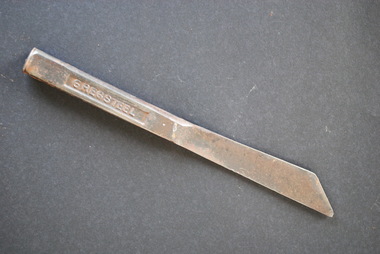
Plugging Cold Chisel, Gregory Steel Products Pty Ltd, Estimated 1960's
... GREGSTEEL - on handle ALLOY STEEL - on other side of handle...Gregory Steel Products Pty Ltd...knife alloy steel plugging cold chisel gregsteel GREGSTEEL - on handle ALLOY STEEL - on other side of handle A Gregsteel Plugging cold chisel which is sought after due to excellent edge-holding properties. ...A Gregsteel Plugging cold chisel which is sought after due to excellent edge-holding properties. Used by bricklayers (Gregsteel 279) to remove mortar from between bricks to allow for a timber plug to be inserted to allow skirtings and architraves to be fixed to it. This object may have been used as a timber paling knife.GREGSTEEL - on handle ALLOY STEEL - on other side of handleknife, alloy steel, plugging cold chisel, gregsteel -
Federation University Historical Collection
Correspondence, Correspondence from The Steel Company of Australia to Victorian Institute of Colleges, The Steel Company
... Correspondence from The Steel Company of Australia to Victorian Institute of Colleges...Arblaster (former Principal of the Ballarat School of Mines) .2 - Photocopied paper - Heat sensitive coy of a letter from Harry Arblaster of th Steel Company of Australia to R. Parry, Registrar of the Victoria Institute of Colleges, 18 March 1971. .3 - Photocopied paper .4 - Photocopied paper .5 - Photocopied paper .6 - Photocopied paper .7 - Photocopied paper .8 - Typed carbon letter to Harold Arblaster concerning the proposed degree in Metallurgy....The Steel Company...Correspondence from The Steel Company of Australia to Victorian Institute of Colleges Correspondence ...Mr. H. E. Arblaster comments on the Ballarat School of Mines submission for Bachelor of Applied Science in Metallurgy in a letter to Victorian Institute of Colleges (Copy) Mr. H. E. Arblaster comments on the Ballarat School of Mines submission for Bachelor of Applied Science in Metallurgy in a letter to Mr F Morgan, Mason & Cox P/L (Copy) Letter acknowledging the Arblaster copies, from Ballarat School of Mines .1 - Business Card of Harold E. Arblaster (former Principal of the Ballarat School of Mines) .2 - Photocopied paper - Heat sensitive coy of a letter from Harry Arblaster of th Steel Company of Australia to R. Parry, Registrar of the Victoria Institute of Colleges, 18 March 1971. .3 - Photocopied paper .4 - Photocopied paper .5 - Photocopied paper .6 - Photocopied paper .7 - Photocopied paper .8 - Typed carbon letter to Harold Arblaster concerning the proposed degree in Metallurgy.victoria institute of colleges, h.e. arblaster, arlaster, ballarat school of mines, metallurgy, f. morgan, morgan, mason and cox, r. parry, harold arblaster, frank morgan -
City of Moorabbin Historical Society (Operating the Box Cottage Museum)
Education kit - Wood shaft writing pens and nibs, Steel Nib Manufacturer, mid 20thC
... 3 wood shaft writing dip pens with steel nibs ...Steel Nib Manufacturer...Dip pens emerged in the early 19th century, when they replaced quill pens and were generally used before the development of fountain pens in the later 19th century The pioneer settlers in the Moorabbin Shire area valued education and established schools for their children in Cheltenham and East Brighton c1860's These wood shaft pens and steel nibs are typical of the type used up to the mid 20th Century in school classes. schools education writing equipment victoria melbourne market gardeners pioneer settlers cheltenham state school no. 84. bentleigh east state school no. 2083 st stephens c of e school tucker road east brighton pen steel nibs 3 wood shaft writing dip pens with steel nibs Education kit Wood shaft writing pens and nibs Steel Nib Manufacturer ...A dip pen usually consists of a metal nib with capillary channels like those of fountain pen nibs, mounted in a handle or holder, often made of wood. Dip pens have no ink reservoir, so the user must recharge the ink from an ink bowl or bottle to continue drawing or writing. Dip pens emerged in the early 19th century, when they replaced quill pens and were generally used before the development of fountain pens in the later 19th centuryThe pioneer settlers in the Moorabbin Shire area valued education and established schools for their children in Cheltenham and East Brighton c1860's These wood shaft pens and steel nibs are typical of the type used up to the mid 20th Century in school classes.3 wood shaft writing dip pens with steel nibs schools, education, writing equipment, victoria melbourne, market gardeners, pioneer, settlers, cheltenham state school no. 84., bentleigh east state school no. 2083, st stephens c of e school tucker road east brighton, pen steel nibs -
 Puffing Billy Railway
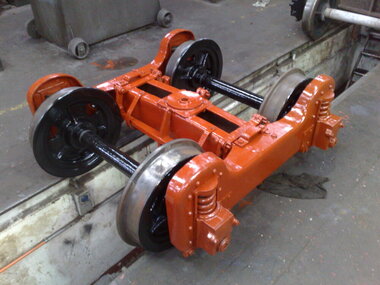
2'6" gauge Fox Freight Bogie, 1890s
... Pressed Steel Frame Bogie made of iron and Wrought iron ...Fox Solid Pressed Steel Company...Historic - Narrow Gauge Railway - Fox freight Bogie imported and used by the Victorian Railways fox bogie puffing billy victorian railways Pressed Steel Frame Bogie made of iron and Wrought iron 2'6" gauge Fox Freight Bogie Fox Solid Pressed Steel Company ...'FOX" Built Fox freight Bogie imported by the Victorian Railways First patented by Englishman Samson Fox in 1893, the Fox style bogie carried virtually all the rolling stock on the Victorian Railways 4 narrow gauge lines from construction to demolition.Historic - Narrow Gauge Railway - Fox freight Bogie imported and used by the Victorian RailwaysPressed Steel Frame Bogie made of iron and Wrought iron fox, bogie, puffing billy, victorian railways -
Stawell Historical Society Inc
Realia, Set of six stainless steel Standard Jugs
... Set of six stainless steel Standard Jugs...Stainless Steel with handles...Used for measurement or testing Scales Wimmera Weights & Measures Union Stawell Shire Stainless Steel with handles Set of six stainless steel Standard Jugs Realia ...Used for measurement or testing Scales Wimmera Weights & Measures Union Stawell ShireStainless Steel with handles -
Charlton RSL Sub Branch
Weapon - Bullet clips, Steel clips each for holding 4 bullets
... Steel clips each for holding 4 bullets...Steel clips for bullets...Steel clips for bullets Steel clips each for holding 4 bullets Weapon Bullet clips ...Steel clips for bullets -
 Kew Historical Society Inc
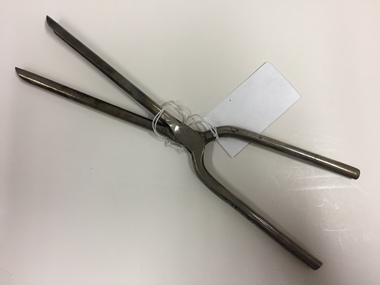
Domestic object - Hair Care Equipment, Steel Curling Irons
... Steel Curling Irons...Pair of steel curling irons ...curling tongs hair care equipment curling irons Pair of steel curling irons Steel Curling Irons Domestic object Hair Care Equipment ...Pair of steel curling irons curling tongs, hair care equipment, curling irons -
 Ringwood RSL Sub-Branch
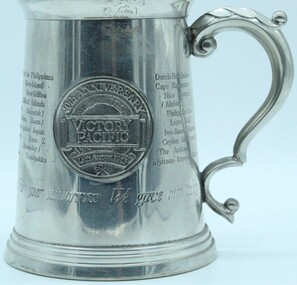
Souvenir - 40th Anniversary victory pacific, Pewter products, Melbourne, Australia, Stainless steel tankard
... Stainless steel tankard...Stainless steel drinking tankard ...40th anniversary of the Victory in the pacific and battle locations inscribed Stainless steel drinking tankard Stainless steel tankard Souvenir 40th Anniversary victory pacific. ...Stainless steel drinking tankard 40th anniversary of the Victory in the pacific and battle locations inscribed -
Federation University Historical Collection
Object, University of Ballarat Boxed Stainless Steel Picture Frame, c2015
... University of Ballarat Boxed Stainless Steel Picture Frame...A boxed stainless steel picture frame. ...university of ballarat merchandise picture frame A boxed stainless steel picture frame. University of Ballarat Boxed Stainless Steel Picture Frame Object ...A boxed stainless steel picture frame. university of ballarat, merchandise, picture frame -
 Stawell Historical Society Inc
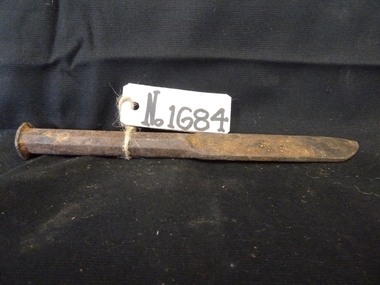
Equipment - Tool, Steel Builders Plugging Chisel used by a Bricklayer
... Steel Builders Plugging Chisel used by a Bricklayer...Steel Builders Plugging Chisel used by a Bricklayer...Stawell Steel Builders Plugging Chisel used by a Bricklayer Steel Builders Plugging Chisel used by a Bricklayer Equipment Tool ...Steel Builders Plugging Chisel used by a Bricklayerstawell -
 Ballarat Heritage Services
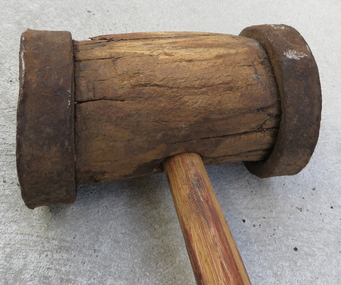
Photograph - Photograph - Colour, Clare Gervasoni, Steel rimmed wooden mallet, 2017
... Steel rimmed wooden mallet...Colour photographs of a steel rimmed wooden mallet....mallet tools Steel rimmed wooden mallet Colour photographs of a steel rimmed wooden mallet. ...Colour photographs of a steel rimmed wooden mallet.mallet, tools, steel rimmed wooden mallet -
 Ringwood RSL Sub-Branch
Memorabilia - Knife attached to steel shrapnel piece
... Knife attached to steel shrapnel piece...Knife blade attached to steel shrapnel piece...Knife blade attached to steel shrapnel piece Knife attached to steel shrapnel piece Memorabilia Knife attached to steel shrapnel piece ...Knife blade attached to steel shrapnel piece -
 Alfred Hospital Nurses League - Nursing History Collection
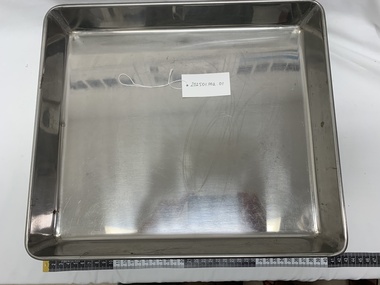
Functional object - instrument tray, SILVERGLO STAINLESS STEEL PTY LTD
... 479-01 blue texta on base, 479-01 black ink on white sticker to outside edge, engraving SILVERGLO/.../STAINLESS STEEL/PTY.LTD/MELBOURNE/55...SILVERGLO STAINLESS STEEL PTY LTD...Functional object instrument tray SILVERGLO STAINLESS STEEL PTY LTD ...TRAY USED FOR HOLDING INSTRUMENTS USED FOR CARE OF PATIENTSUSED BY NURSES IN PROVIDING CAREshallow rectangular silver coloured metal instrument tray, rolled metal edge.479-01 blue texta on base, 479-01 black ink on white sticker to outside edge, engraving SILVERGLO/.../STAINLESS STEEL/PTY.LTD/MELBOURNE/55instrument tray, stainless steel, silverglo stainless steel pty ltd, alfred hospital off campus juvenille psychiatric unit, alfred hospital nurses league -
 Federation University Historical Collection
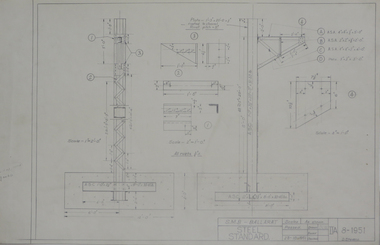
Drawing - Student's Technical Drawing, Technical drawing - Steel standard, 1951
... Technical drawing - Steel standard...Pencil on paper student's technical drawing of a steel standard...technical drawing diaphgram valve donald stevens steel standard School of Mining Ballarat Pencil on paper student's technical drawing of a steel standard Technical drawing - Steel standard Drawing Student's Technical Drawing ...Pencil on paper student's technical drawing of a steel standardtechnical drawing, diaphgram valve, donald stevens, steel standard, school of mining ballarat -
 Wodonga & District Historical Society Inc
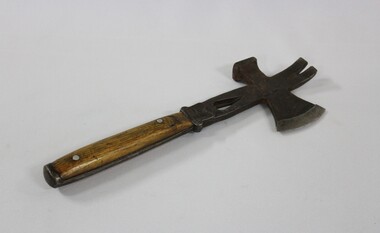
Functional object - Haeusler Collection Steel Axe early 1900s
... Haeusler Collection Steel Axe early 1900s...Steel axe with wooden handle from the Haeusler Collection...It contributes to our understanding of domestic and family life in early twentieth century Wodonga, as well as providing interpretative capacity for themes including local history, agricultural history and social history. axe farm wood wood chopping haeusler haeusler collection wodonga Steel axe with wooden handle from the Haeusler Collection Haeusler Collection Steel Axe early 1900s Functional object Haeusler Collection Steel Axe early 1900s ...The Wodonga Historical Society Haeusler Collection provides invaluable insight into life in late nineteenth and early twentieth century north east Victoria. The collection comprises manuscripts, personal artefacts used by the Haeusler family on their farm in Wodonga, and a set of glass negatives which offer a unique visual snapshot of the domestic and social lives of the Haeusler family and local Wodonga community. The Haeusler family migrated from Prussia (Germany) to South Australia in the 1840s and 1850s, before purchasing 100 acres of Crown Land made available under the Victorian Lands Act 1862 (also known as ‘Duffy’s Land Act’) in 1866 in what is now Wodonga West. The Haeusler family were one of several German families to migrate from South Australia to Wodonga in the 1860s."" This axe belonged to Louis Haeusler (b.1878) and is one of the many objects in the Haeusler Collection that represent home and farm life in early twentieth century Wodonga.This item has well documented provenance and a known owner. It forms part of a significant and representative historical collection which reflects the local history of Wodonga. It contributes to our understanding of domestic and family life in early twentieth century Wodonga, as well as providing interpretative capacity for themes including local history, agricultural history and social history.Steel axe with wooden handle from the Haeusler Collectionaxe, farm, wood, wood chopping, haeusler, haeusler collection, wodonga -
Canterbury History Group
Letter - Mrs Yvonne Steel, Steel, Yvonne, 3/03/1988
... Letter from Yvonne Steel to Mrs Doery of the Canterbury History Group sharing some of her memories of Canterbury...Steel, Yvonne...Letter from Yvonne Steel to Mrs Doery of the Canterbury History Group sharing some of her memories of Canterbury Canterbury Prospect Hill Road Coghill and Sons Bracher> Ken Camberwell High School Carnell Family Presbyterian Babies Home Canterbury Road Letter Mrs Yvonne Steel Steel, Yvonne ...Letter from Yvonne Steel to Mrs Doery of the Canterbury History Group sharing some of her memories of Canterburycanterbury, prospect hill road, coghill and sons, bracher> ken, camberwell high school, carnell family, presbyterian babies home, canterbury road -
Stawell Historical Society Inc
Realia, Three Stainless Steel Measuring Jugs with Adjustable Scale and Handle
... Three Stainless Steel Measuring Jugs with Adjustable Scale and Handle...Large Stainless Steel container with handle scale and Glass tube. ...Stamped with Crown & 76 Three Stainless Steel Measuring Jugs with Adjustable Scale and Handle Realia ...Used for measuring volumes. Wimmera Weights & Measures Union Stawell ShireLarge Stainless Steel container with handle scale and Glass tube. Stamped with Crown & 7615 Litre, 10 Litre, 5 Litre. -
 Kew Historical Society Inc
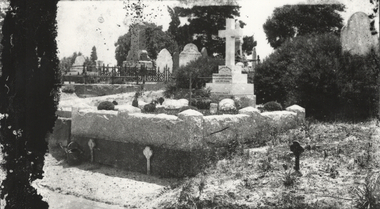
Photograph, Grave, Violet Laura Steel, c.1925
... Grave, Violet Laura Steel...The grave of Violet Laura Steel (1892-1914), after 1914. Violet Laura Steel, was the daughter of Charles Joseph Steel and Julia Harrington. ...Violet Laura Steel, was the daughter of Charles Joseph Steel and Julia Harrington. ...This photograph was printed from a glass negative held in the Society's picture collection. The original glass negative is part of a set donated to the Society by Ian McKenzie, a professional photographer in Kew. The grave of Violet Laura Steel (1892-1914), after 1914. Violet Laura Steel, was the daughter of Charles Joseph Steel and Julia Harrington. She was born 31 October 1892 in the Police camp in Echuca, and died, aged 21, on 22 May 1914 at her father’s home ‘Maescourt’ in Gladstone Parade, Elsternwick. The photograph of her grave in the Brighton Cemetery is on the top half of a glass negative.st kilda cemetery, violet laura steel (1892-1914) -
Moorabbin Air Museum
Book - Aircraft manufacture, steel construction, The Steel Construction of Aeroplanes
... The Steel Construction of Aeroplanes...Aircraft Manufacture, Steel Construction...Aircraft Manufacture, Steel Construction Oveview of hte use of steel in aircraft construction, circa World War 1 The Steel Construction of Aeroplanes Book Aircraft manufacture, steel construction ...Oveview of hte use of steel in aircraft construction, circa World War 1Oveview of hte use of steel in aircraft construction, circa World War 1 -
Stawell Historical Society Inc
Memorabilia - Realia, Stainless Steel Imperial Yard Measure. Shire of Stawell Weights & Measures
... Stainless Steel Imperial Yard Measure. Shire of Stawell Weights & Measures ...12 inch rule. Stainless Steel Imperial yard Measure stored in a grey Wood Box....Stainless Steel Imperial Yard Measure. Shire of Stawell Weights & Measures Memorabilia Realia ...12 inch rule. Stainless Steel Imperial yard Measure stored in a grey Wood Box.Rustless / Chesterman Sheffieldstawell, standards
