
Showing 31 items matching "methodist babies' home"
-
 Uniting Church Archives - Synod of Victoria
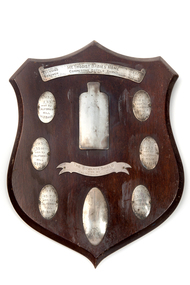
Shield, Methodist Babies' Home Competitive Bottle Shield
... Methodist Babies' Home Competitive Bottle Shield...Methodist Babies' Home Bendigo Branch..."BENDIGO BRANCH METHODIST BABIES HOME COMPETITIVE BOTTLE SHIELD 1937-1942" "THE 'EDWARDS' SHIELD WON BY CALIFORNIA HILL"...Methodist Babies' Home Bendigo Branch "BENDIGO BRANCH METHODIST BABIES HOME COMPETITIVE BOTTLE SHIELD 1937-1942" "THE 'EDWARDS' SHIELD WON BY CALIFORNIA HILL" Varnished dark brown wooden shield with engraved silver plaques attached. ...Varnished dark brown wooden shield with engraved silver plaques attached. Winners: California Hill Amount of money raised given together with the number of 'bags'."BENDIGO BRANCH METHODIST BABIES HOME COMPETITIVE BOTTLE SHIELD 1937-1942" "THE 'EDWARDS' SHIELD WON BY CALIFORNIA HILL"methodist babies' home bendigo branch -
 Uniting Church Archives - Synod of Victoria
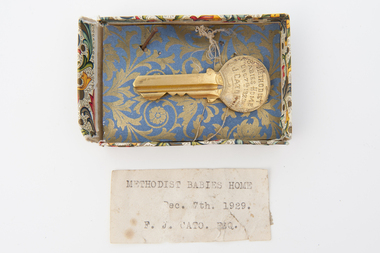
Key
... Methodist Babies Home..."METHODIST BABIES HOME DEC 7TH 1929 F. J. CATO ESQ"...Methodist Babies Home "METHODIST BABIES HOME DEC 7TH 1929 F. ...Gilt door key in a small cardboard box. There is a slip of paper inside the box with typed words that are engraved on the key."METHODIST BABIES HOME DEC 7TH 1929 F. J. CATO ESQ"methodist babies home -
 Uniting Church Archives - Synod of Victoria
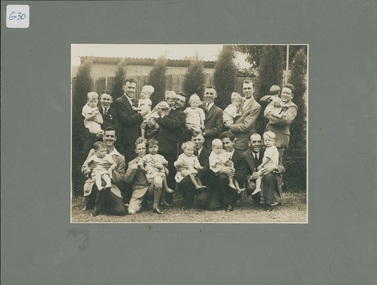
Photograph, c.1930
... Methodist Babies' Home...Group of 11 young men photographed holding babies from the Methodist Babies' Home. The photograph was probably taken to mark the first birthday of the Babies' Home in 1930. ...Group of 11 young men photographed holding babies from the Methodist Babies' Home. The photograph was probably taken to mark the first birthday of the Babies' Home in 1930. ...Group of 11 young men photographed holding babies from the Methodist Babies' Home. The photograph was probably taken to mark the first birthday of the Babies' Home in 1930. The money for the property at 12 Copelen Street, South Yarra, was largely raised by the Young Men's section of the Methodist Church's Laymen's Missionary Movement. The donor's husband is one of the young men in the photgraph.B & W photograph mounted on cardmethodist babies' home, laymen's missionary movement, copelen street -
 Uniting Church Archives - Synod of Victoria
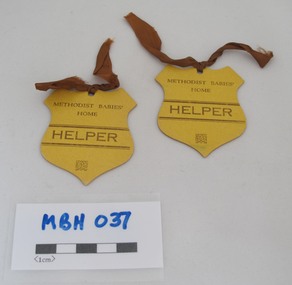
Badge
... "Methodist Babies' Home HELPER"..."Methodist Babies' Home HELPER" 2 yellow shield shaped card badges with tan satin ribbon. ...2 yellow shield shaped card badges with tan satin ribbon."Methodist Babies' Home HELPER" -
 Glen Eira Historical Society
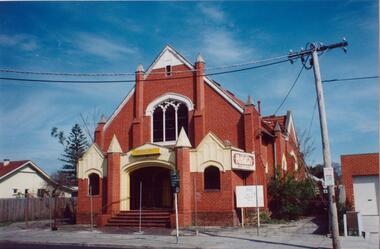
Document - Methodist Church, Murrumbeena Road, Murrumbeena
... ... Methodist Babies Home...Rev Young men’s club Methodist Babies Home Assisted migrant scheme Harris L.B. ...Five items about this church. 1.Detailed inscription of foundation stone. 2.Photograph, date unknown. 3.Pamphlet of Inaugural Service Diamond Jubilee Celebration 1912 to 1972. 4.Information on the window installed by Mrs Agnes M Beck. 5.A photocopy of a typed document titled ‘The Methodist Heritage of the Murrumbeena Uniting Church’.daws c.k. rev, cain j.h. rev, johns w. rev, blakemore john rev, foundationstones, white h.g builder, murrumbeena, methodist church, st giles presbyterian, festivals and celebrations, architect browning and bladen, delascombe rohan sir, murrumbeena road, delacombe lady, fox mrs, fox emc mhr, scanlon a mr mla, arden f.a. mrs, moran mrs, moran b mr, moyors, councillors, town clerks, beck agnes m mrs, windows, monuments and memorials, doble allan, brown bob rev, presbyterian church, inglis robert mr, mcdonald hall, parish magazine ‘encounter’, reid jack, arden f.a, kindergartens, religious groups, fusion, demmler pty ltd, mcdonald hall, pollock lex. rev, plaques, bruce mrs, monkhouse mrs, holbern mrs, ladies league, sunderland h. rev, armstrong w.j., secomb w.e. rev, dandenong road, belgrave road, harwood c., tally ho auxiliary, women’s auxiliary, murrumbeena men’s methodist movement, methodist men’s society, hartley f. rev, manzoney w.s. rev, sholton h.t rev, eldridge l.b rev, wilcock s.c rev, bye r. rev, slattery k. rev, archbold b. rev, sunderland h. rev, blanksby a. rev, mcdonald n. rev, porrih d. rev, lukies j. rev, reid g. rev, orton a. rev, young men’s club, methodist babies home, assisted migrant scheme, harris l.b., reid pris, reid will, davey eric, field jack, st giles centenary, encounter no.2. 1990, encounter no.3. 1991, mcdonald edua, don anne -
 Uniting Church Archives - Synod of Victoria
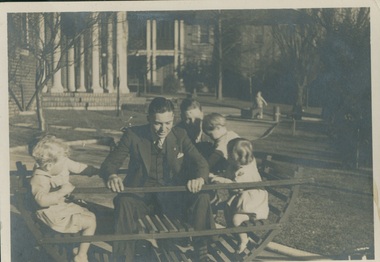
Photograph, c.1930
... Methodist Babies' Home...Home's first birthday. The money for the property at 12 Copelen Street, South Yarra, was largely raised by the Young Men's section of the Methodist Church's Laymen's Missionary Movement. Methodist Babies ...The photograph was probably taken c. 1930, around the time of the Home's first birthday. The money for the property at 12 Copelen Street, South Yarra, was largely raised by the Young Men's section of the Methodist Church's Laymen's Missionary Movement. B & W photograph methodist babies' home, laymen's missionary movement, copelen street -
 Uniting Church Archives - Synod of Victoria
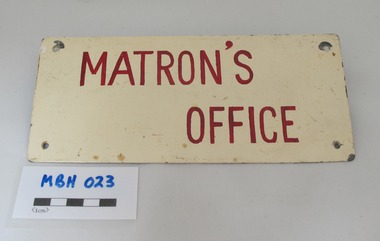
Door Sign, Matron's Office
... methodist babies' home...methodist babies' home Matron's Office Rectangular metal door sign painted cream with red text. ...Rectangular metal door sign painted cream with red text. Holes in each corner for screws.Matron's Officemethodist babies' home -
 Uniting Church Archives - Synod of Victoria
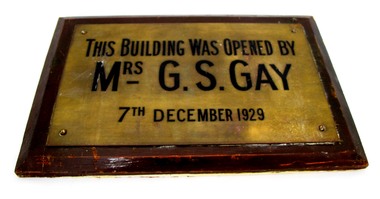
Plaque
... Methodist Babies' Home...Methodist Babies' Home "This Building Was Opened By Mrs G.S.Gay 7th December 1929" Brass wall plaque mounted on varnished wood. ...Brass wall plaque mounted on varnished wood."This Building Was Opened By Mrs G.S.Gay 7th December 1929"methodist babies' home -
 Uniting Church Archives - Synod of Victoria
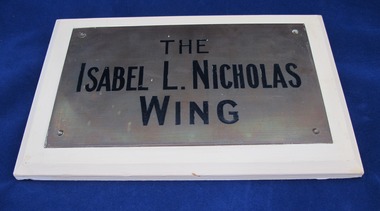
Plaque
... methodist babies' home...methodist babies' home "The Isabel L.Nicolas Wing" Brass plaque mounted on cream painted wood. ...Brass plaque mounted on cream painted wood."The Isabel L.Nicolas Wing"methodist babies' home -
 Uniting Church Archives - Synod of Victoria
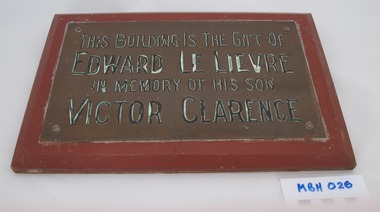
Plaque
... methodist babies' home...methodist babies' home "This Building Is The Gift Of Edward Le Lievre in memeory of his son Victor Clarence" Brass wall plaque mounted on varnished wood. ...Brass wall plaque mounted on varnished wood."This Building Is The Gift Of Edward Le Lievre in memeory of his son Victor Clarence"methodist babies' home -
 Uniting Church Archives - Synod of Victoria
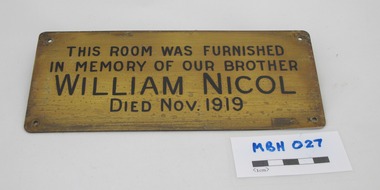
Plaque
... methodist babies' home...methodist babies' home "This room was furnished in memory of our brother William Nicol Died Nov 1919" Brass plaque Plaque ...Brass plaque"This room was furnished in memory of our brother William Nicol Died Nov 1919"methodist babies' home -
 Uniting Church Archives - Synod of Victoria
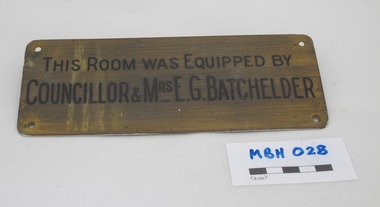
Plaque
... methodist babies' home...methodist babies' home "The Room Was Equipped by Councillor & Mrs E.G.Batchelder" Brass plaque Plaque ...Brass plaque"The Room Was Equipped by Councillor & Mrs E.G.Batchelder"methodist babies' home -
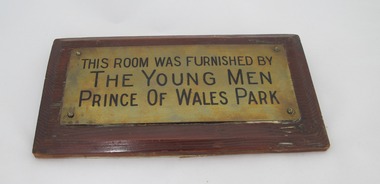 Uniting Church Archives - Synod of Victoria
Plaque
... methodist babies' home...methodist babies' home "This room was furnished by The Young Men Prince Of Wales Park" Brass plaque on varnished wood mount. ...Brass plaque on varnished wood mount."This room was furnished by The Young Men Prince Of Wales Park"methodist babies' home -
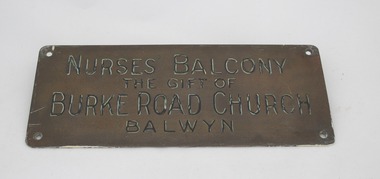 Uniting Church Archives - Synod of Victoria
Plaque
... methodist babies' home...methodist babies' home "Nurses Balcony the gift of Burke Road Church Balwyn" Brass plaque on varnished wood mount. ...Brass plaque on varnished wood mount."Nurses Balcony the gift of Burke Road Church Balwyn"methodist babies' home -
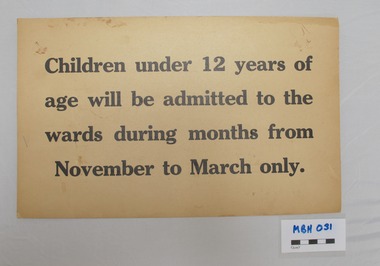 Uniting Church Archives - Synod of Victoria
Sign
... methodist babies' home...methodist babies' home "Children under 12 years of age will be admitted to the wads during months from November to March only" Card sign. ...Card sign."Children under 12 years of age will be admitted to the wads during months from November to March only"methodist babies' home -
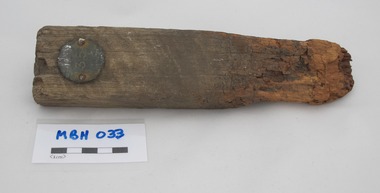 Uniting Church Archives - Synod of Victoria
Marker Peg, 35
... methodist babies' home...methodist babies' home "35" Wood marker peg with round metal number. 35 Marker Peg ...Wood marker peg with round metal number."35"methodist babies' home -
 Uniting Church Archives - Synod of Victoria
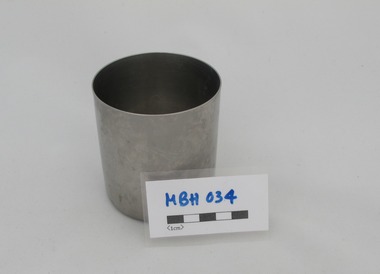
Beaker
... Methodist Babies Home...Methodist Babies Home Stainless steel beaker Beaker ...Stainless steel beakermethodist babies home -
 Uniting Church Archives - Synod of Victoria
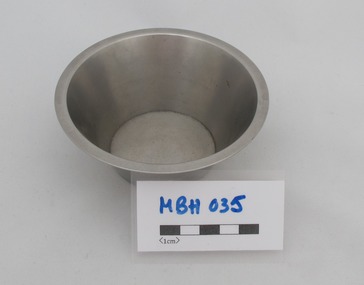
Bowl, 2003
... Methodist Babies Home...Methodist Babies Home Small stainless steel bowl Bowl ...Small stainless steel bowlmethodist babies home -
 Bendigo Historical Society Inc.
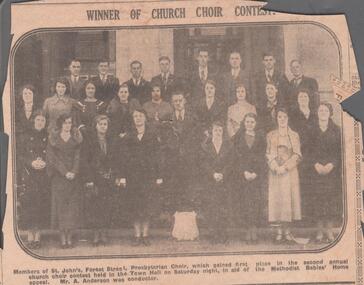
Newspaper - KEN HESSE COLLECTION: ST. JOHN'S CHURCH CHOIR
... A photo of members of St.John's, Forest Street, Presbyterian Choir which gained first place in a contest raising money for the Methodist Babies' Home Appeal. Mr. A. Anderson was the conductor. ...A photo of members of St.John's, Forest Street, Presbyterian Choir which gained first place in a contest raising money for the Methodist Babies' Home Appeal. Mr. A. Anderson was the conductor. ...A newspaper article titled 'Winner of Church Choir Contest.' A photo of members of St.John's, Forest Street, Presbyterian Choir which gained first place in a contest raising money for the Methodist Babies' Home Appeal. Mr. A. Anderson was the conductor. Item part of Mr. Ken Hesse Collection donated by Mr. James Lerk.church, celebration, presbyterian church forest st bendigo, ken hesse collection, collection, newspaper, choir, singing, music, contest, competition -
 Flagstaff Hill Maritime Museum and Village
Textile - Overskirt, circa 1910
... During W.W.2, a local Warrnambool couple (Meryl and Tony Everard) boarded with them – Tony was in the airforce training paratroopers to jump into (and survive) enemy territory and his wife Meryl worked in the Methodist baby Home. The Everards developed a close friendship with the Stephensons and were responsible for clearing out the house (and finding this clothing collection) after Lila died in 1977. ...During W.W.2, a local Warrnambool couple (Meryl and Tony Everard) boarded with them – Tony was in the airforce training paratroopers to jump into (and survive) enemy territory and his wife Meryl worked in the Methodist baby Home. The Everards developed a close friendship with the Stephensons and were responsible for clearing out the house (and finding this clothing collection) after Lila died in 1977. ...This item is one of a collection of clothing items that belonged to the Stephenson family who lived at 22 McCracken Street, Kensington, Melbourne. Matthew Stephenson (1861 – 1943) who had grown up on the Bendigo goldfields and shifted to Melbourne in the early 1900’s was a train driver and later, a fireman with the railways. His wife Elizabeth Jane (Betsy) Wigley (1865 – 1953) also grew up on the goldfields around Majorca and Bendigo. They married in 1885 in Bendigo. They had two daughters – Ethel Evelyn Stephenson (1886 – 1956) and Lillian or Lila (1891 – 1977) who were milliners and dressmakers and who continued to live in the family home after the death of their parents. The family are recorded as living at 22 McCracken Street, Kensington, as early as 1914. It is not known who made or owned the clothing that makes up this collection but as it appears to be from the late Victorian and early Edwardian era, the different pieces were probably made and worn by any of the three ladies of the house – Betsy, Ethel and/or Lila. During W.W.2, a local Warrnambool couple (Meryl and Tony Everard) boarded with them – Tony was in the airforce training paratroopers to jump into (and survive) enemy territory and his wife Meryl worked in the Methodist baby Home. The Everards developed a close friendship with the Stephensons and were responsible for clearing out the house (and finding this clothing collection) after Lila died in 1977. This overskirt is an outer protective garment made of durable cotton and was probably worn over a lady's skirt or dress to protect it whilst they were working. The pockets are large enough for the wearer to keep small items in and there is a loop at the back that would allow the wearer to hang it on a hook, when she finished her work. This item is an example of clothing worn by working women in the late 19th and early 20th centuryA heavy cotton ankle length overskirt made with two wide gored sections containing inset pockets joined to a middle T shaped front band. It has a waistband of grosgrain ribbon and a side opening with 3 pairs of metal snaps (one pair is missing) and a hook and eye at the top. The waistband also has a taped loop (for hanging) and an unusual double fabric overlay with unattached curved ends.flagstaff hill maritime museum and village, great ocean road, shipwreck coast, warrnambool, overskirt, needlework, sewing, protective garment, stephenson family -
 Flagstaff Hill Maritime Museum and Village
Textile - Waistcoat, circa 1910
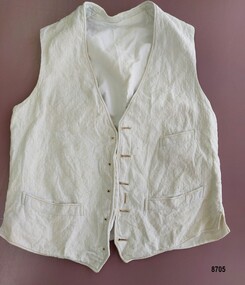
... During W.W.2, a local Warrnambool couple (Meryl and Tony Everard) boarded with them – Tony was in the airforce training paratroopers to jump into (and survive) enemy territory and his wife Meryl worked in the Methodist baby Home. The Everards developed a close friendship with the Stephensons and were responsible for clearing out the house (and finding this clothing collection) after Lila died in 1977. ...During W.W.2, a local Warrnambool couple (Meryl and Tony Everard) boarded with them – Tony was in the airforce training paratroopers to jump into (and survive) enemy territory and his wife Meryl worked in the Methodist baby Home. The Everards developed a close friendship with the Stephensons and were responsible for clearing out the house (and finding this clothing collection) after Lila died in 1977. ...This item is one of a collection of clothing items that belonged to the Stephenson family who lived at 22 McCracken Street, Kensington, Melbourne. Matthew Stephenson (1861 – 1943) who had grown up on the Bendigo goldfields and shifted to Melbourne in the early 1900’s was a train driver and later, a fireman with the railways. His wife Elizabeth Jane (Betsy) Wigley (1865 – 1953) also grew up on the goldfields around Majorca and Bendigo. They married in 1885 in Bendigo. They had two daughters – Ethel Evelyn Stephenson (1886 – 1956) and Lillian or Lila (1891 – 1977) who were milliners and dressmakers and who continued to live in the family home after the death of their parents. The family are recorded as living at 22 McCracken Street, Kensington, as early as 1914. It is not known who made or owned the clothing that makes up this collection but as it appears to be from the late Victorian and early Edwardian era however the vest was probably made by one of the three ladies of the house, for their husband and father, Matthew Stephenson. During W.W.2, a local Warrnambool couple (Meryl and Tony Everard) boarded with them – Tony was in the airforce training paratroopers to jump into (and survive) enemy territory and his wife Meryl worked in the Methodist baby Home. The Everards developed a close friendship with the Stephensons and were responsible for clearing out the house (and finding this clothing collection) after Lila died in 1977. Although by 1916, men's "ready to wear" clothing were widely available, this waistcoat was handmade (possibly by Matthew's wife or daughters). Men's suits in the early part of the twentieth century were predominantly three piece, consisting of a jacket, vest (or waistcoat) and trousers made from matching fabrics. Some men liked to wear a watch attached to their waistcoat with a fob chain. This item is an example of clothing worn by men on special occasions, in the late 19th and early 20th century.A man's waistcoat with cream cotton weave front pieces and cream cotton lining and back. The left front features five machine worked horizontal buttonholes and one vertical buttonhole (for a fob watch) and two inset pockets. The right hand side has five corresponding stud holes and one inset pocket. The studs or buttons are missing. The lining and back of the waistcoat are made from a plain cream cotton fabric. The back also features a cotton strap with a two pronged metal buckle.flagstaff hill maritime museum and village, great ocean road, shipwreck coast, warrnambool, vest, waistcoat, needlework, sewing, stephenson family, man's waistcoat -
 Flagstaff Hill Maritime Museum and Village
Textile - Nightgown, Circa 1900
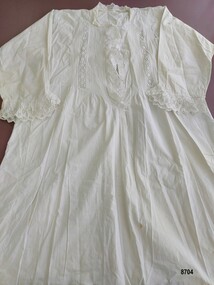
... During W.W.2, a local Warrnambool couple (Meryl and Tony Everard) boarded with them – Tony was in the airforce training paratroopers to jump into (and survive) enemy territory and his wife Meryl worked in the Methodist baby Home. The Everards developed a close friendship with the Stephensons and were responsible for clearing out the house (and finding this clothing collection) after Lila died in 1977. ...During W.W.2, a local Warrnambool couple (Meryl and Tony Everard) boarded with them – Tony was in the airforce training paratroopers to jump into (and survive) enemy territory and his wife Meryl worked in the Methodist baby Home. The Everards developed a close friendship with the Stephensons and were responsible for clearing out the house (and finding this clothing collection) after Lila died in 1977. ...This item is one of a collection of clothing items that belonged to the Stephenson family who lived at 22 McCracken Street, Kensington, Melbourne. Matthew Stephenson (1861 – 1943) who had grown up on the Bendigo goldfields and shifted to Melbourne in the early 1900’s was a train driver and later, a fireman with the railways. His wife Elizabeth Jane (Betsy) Wigley (1865 – 1953) also grew up on the goldfields around Majorca and Bendigo. They married in 1885 in Bendigo. They had two daughters – Ethel Evelyn Stephenson (1886 – 1956) and Lillian or Lila (1891 – 1977) who were milliners and dressmakers and who continued to live in the family home after the death of their parents. The family are recorded as living at 22 McCracken Street, Kensington, as early as 1914. It is not known who made or owned the clothing that makes up this collection but as it appears to be from the late Victorian and early Edwardian era, the different pieces were probably made and worn by any of the three ladies of the house – Betsy, Ethel and/or Lila. During W.W.2, a local Warrnambool couple (Meryl and Tony Everard) boarded with them – Tony was in the airforce training paratroopers to jump into (and survive) enemy territory and his wife Meryl worked in the Methodist baby Home. The Everards developed a close friendship with the Stephensons and were responsible for clearing out the house (and finding this clothing collection) after Lila died in 1977. This nightgown is machine sewn and has an added detailed design of pintucks and broderie anglaise lace to the front yoke and cuffs as a decorative element. The 1800's bought a shift in attitude towards modesty as the Victorian era progressed and by the mid to late 1800's it had become more acceptable ladies to wear simple, modest nightgowns. They tended to have a very loose fit and were usually made of linen, cotton or flannel, which had the advantage of providing warmth and also being easy to wash - a necessity for a garment worn next to the skin. Although the basic design of the nightgown was fairly simple, the wearer was free to add various types of trim e.g. lace, crochet, pintucks, embroidery etc.This item is an example of the needlework skills of women in the late 19th and early 20th century - combining machine stitching with hand embroidery to personalise and embellish a practical item of clothing. A full length lady's cotton nightgown with long sleeves finished with a diagonal pointed cuff of broderie anglaise. The bodice features a front opening placket with 3 buttons and buttonholes and a broderie anglaise cover. On either side of the placket, the bodice has been decorated with rows of vertical pintucks and a broderie anglaise panel insert. There is also a frill of broderie anglaise lace around the neck. The back of the nightgown is gathered onto a yoke.flagstaff hill maritime museum and village, great ocean road, shipwreck coast, warrnambool, nightgown, lady's nightgown, needlework, sewing, broderie anglaise, pintucks, stephenson family -
 Flagstaff Hill Maritime Museum and Village
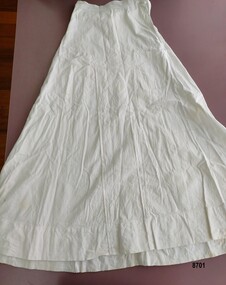
Textile - Skirt, circa 1910
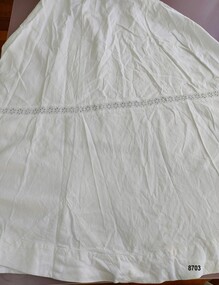
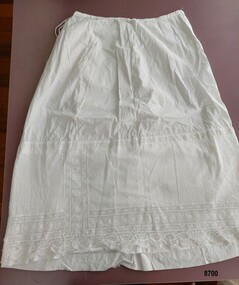
... During W.W.2, a local Warrnambool couple (Meryl and Tony Everard) boarded with them – Tony was in the airforce training paratroopers to jump into (and survive) enemy territory and his wife Meryl worked in the Methodist baby Home. The Everards developed a close friendship with the Stephensons and were responsible for clearing out the house (and finding this clothing collection) after Lila died in 1977. ...During W.W.2, a local Warrnambool couple (Meryl and Tony Everard) boarded with them – Tony was in the airforce training paratroopers to jump into (and survive) enemy territory and his wife Meryl worked in the Methodist baby Home. The Everards developed a close friendship with the Stephensons and were responsible for clearing out the house (and finding this clothing collection) after Lila died in 1977. ...This item is one of a collection of clothing items that belonged to the Stephenson family who lived at 22 McCracken Street, Kensington, Melbourne. Matthew Stephenson (1861 – 1943) who had grown up on the Bendigo goldfields and shifted to Melbourne in the early 1900’s was a train driver and later, a fireman with the railways. His wife Elizabeth Jane (Betsy) Wigley (1865 – 1953) also grew up on the goldfields around Majorca and Bendigo. They married in 1885 in Bendigo. They had two daughters – Ethel Evelyn Stephenson (1886 – 1956) and Lillian or Lila (1891 – 1977) who were milliners and dressmakers and who continued to live in the family home after the death of their parents. The family are recorded as living at 22 McCracken Street, Kensington, as early as 1914. It is not known who made or owned the clothing that makes up this collection but as it appears to be from the late Victorian and early Edwardian era, the different pieces were probably made and worn by any of the three ladies of the house – Betsy, Ethel and/or Lila. During W.W.2, a local Warrnambool couple (Meryl and Tony Everard) boarded with them – Tony was in the airforce training paratroopers to jump into (and survive) enemy territory and his wife Meryl worked in the Methodist baby Home. The Everards developed a close friendship with the Stephensons and were responsible for clearing out the house (and finding this clothing collection) after Lila died in 1977. This skirt features broderie anglaise trim. Although broderie anglaise was a lace that could be made by hand, it was very time consuming to make. St Gallen was a city in Switzerland that had become known for producing quality textiles. At the beginning of the 19th century, the first embroidery machines were developed in St Gallen. Factories used embroidery machines but people also had them in their homes. They were able to produce broderie anglaise for export. By the early 20th century, machine made lace, fabric, ribbons etc. were being sold in drapers shops all over England and Wales to women who were making clothes and furnishings for their families. It is highly likely that the lady who made this skirt brought the lengths of broderie anglaise already made to embellish and personalise her skirt.This item is an example of the needlework skills of women in the late 19th century - creating pintucks and adding lace to personalise and embellish a practical item of clothing. A full length lady's skirt of heavy textured ribbed twill cotton. The top of the skirt is made from five pieces of fabric, sewn together and inserted into a simple waistband. It has an opening with room for 6 hook and eyes (but only the middle three remain). The top section of the skirt is separated from the bottom section by a strip of eyelet embroidery that has been inserted in a horizontal line at the back but becomes slightly diagonal at the front causing the two ends to cross in a decorative X fashion. The bottom of the skirt is the same heavy cotton as the top and one seam features a V shaped insert or patch.flagstaff hill maritime museum and village, great ocean road, shipwreck coast, warrnambool, broderie anglaise, needlework, sewing, stephenson family, skirt, lady's skirt -
 Flagstaff Hill Maritime Museum and Village
Footwear - Leather boots, Adler Boots and Shoes, circa 1920
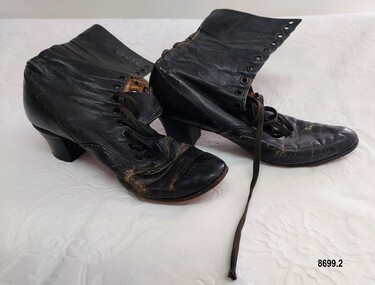
... During W.W.2, a local Warrnambool couple (Meryl and Tony Everard) boarded with them – Tony was in the airforce training paratroopers to jump into (and survive) enemy territory and his wife Meryl worked in the Methodist baby Home. The Everards developed a close friendship with the Stephensons and were responsible for clearing out the house (and finding this clothing collection) after Lila died in 1977. ...During W.W.2, a local Warrnambool couple (Meryl and Tony Everard) boarded with them – Tony was in the airforce training paratroopers to jump into (and survive) enemy territory and his wife Meryl worked in the Methodist baby Home. The Everards developed a close friendship with the Stephensons and were responsible for clearing out the house (and finding this clothing collection) after Lila died in 1977. ...This item is one of a collection of clothing items that belonged to the Stephenson family who lived at 22 McCracken Street, Kensington, Melbourne. Matthew Stephenson (1861 – 1943) who had grown up on the Bendigo goldfields and shifted to Melbourne in the early 1900’s was a train driver and later, a fireman with the railways. His wife Elizabeth Jane (Betsy) Wigley (1865 – 1953) also grew up on the goldfields around Majorca and Bendigo. They married in 1885 in Bendigo. They had two daughters – Ethel Evelyn Stephenson (1886 – 1956) and Lillian or Lila (1891 – 1977) who were milliners and dressmakers and who continued to live in the family home after the death of their parents. The family are recorded as living at 22 McCracken Street, Kensington, as early as 1914. It is not known who made or owned the clothing that makes up this collection but as it appears to be from the late Victorian and early Edwardian era, the different pieces were probably made and worn by any of the three ladies of the house – Betsy, Ethel and/or Lila. During W.W.2, a local Warrnambool couple (Meryl and Tony Everard) boarded with them – Tony was in the airforce training paratroopers to jump into (and survive) enemy territory and his wife Meryl worked in the Methodist baby Home. The Everards developed a close friendship with the Stephensons and were responsible for clearing out the house (and finding this clothing collection) after Lila died in 1977. Starting in around 1850, women began wearing boots that resembled the ones already worn by men in high society. Victorian women's boots were slightly more feminine in nature, however, than those worn by their male counterparts. The boots first worn by women extended to the middle of the calf so that her ankle would stay properly covered underneath her many skirts. These boots often featured laces or a row of buttons to keep them secure to the foot and ankle. Although usually made from durable materials like rubber and leather, boots that were worn purely for fashion were sometimes made of more elegant materials like patent leather or dyed suede. Edwardian boots were lace up or button up. The most remarkable thing about women's shoes in the 1920's was that they were visible! This led to an increase in demand for new styles every season which made ordering custom fit shoes a thing of the past. New shoes were made in standard sizes, ready to buy from local clothing stores or mail order catalogues. Working women, however, tended to wear sensible, lace up shoes and boots. These boots appear to be of a practical nature, designed for comfort, warmth, and proof against the rain and mud, rather than high fashion. They feature the brand name "adler" printed on the inner sole and have stamped letters and numbers suggesting ready-made sizes.This pair of boots are a significant example of a working woman's footwear dating around the early 20th century.Pair of lady's black leather, lace up boots featuring 3.75 cm heels, 14 pairs of lacing eyelets, a black leather tongue and black shoelaces. The leather soles have tacks on the heels and near the instep. The boots have a black leather inner sole and the inner shaft and upper part of the boots are lined with a durable cotton type fabric. Both boots have ink markings (handwritten and stamped) at the top of the shaft lining and the inner sole of the left hand boot is labelled "adler".Both boots - "0/128 /X" (handwritten) and "6MC200" (stamped). Left boot inner sole - "adler" left boot upper shaft lining - "X/8FH?" (handwritten)flagstaff hill maritime museum and village, great ocean road, shipwreck coast, warrnambool, boots, lady's boots, footwear, leather boots, lace up boots, adler, stephenson family -
 Flagstaff Hill Maritime Museum and Village
Textile - Petticoat, circa 1900
... During W.W.2, a local Warrnambool couple (Meryl and Tony Everard) boarded with them – Tony was in the airforce training paratroopers to jump into (and survive) enemy territory and his wife Meryl worked in the Methodist baby Home. The Everards developed a close friendship with the Stephensons and were responsible for clearing out the house (and finding this clothing collection) after Lila died in 1977. ...During W.W.2, a local Warrnambool couple (Meryl and Tony Everard) boarded with them – Tony was in the airforce training paratroopers to jump into (and survive) enemy territory and his wife Meryl worked in the Methodist baby Home. The Everards developed a close friendship with the Stephensons and were responsible for clearing out the house (and finding this clothing collection) after Lila died in 1977. ...This item is one of a collection of clothing items that belonged to the Stephenson family who lived at 22 McCracken Street, Kensington, Melbourne. Matthew Stephenson (1861 – 1943) who had grown up on the Bendigo goldfields and shifted to Melbourne in the early 1900’s was a train driver and later, a fireman with the railways. His wife Elizabeth Jane (Betsy) Wigley (1865 – 1953) also grew up on the goldfields around Majorca and Bendigo. They married in 1885 in Bendigo. They had two daughters – Ethel Evelyn Stephenson (1886 – 1956) and Lillian or Lila (1891 – 1977) who were milliners and dressmakers and who continued to live in the family home after the death of their parents. The family are recorded as living at 22 McCracken Street, Kensington, as early as 1914. It is not known who made or owned the clothing that makes up this collection but as it appears to be from the late Victorian and early Edwardian era, the different pieces were probably made and worn by any of the three ladies of the house – Betsy, Ethel and/or Lila. During W.W.2, a local Warrnambool couple (Meryl and Tony Everard) boarded with them – Tony was in the airforce training paratroopers to jump into (and survive) enemy territory and his wife Meryl worked in the Methodist baby Home. The Everards developed a close friendship with the Stephensons and were responsible for clearing out the house (and finding this clothing collection) after Lila died in 1977. A petticoat is a lady's undergarment - worn under a skirt or dress. They provided warmth, modesty and shape to the dress. In the middle of the 19th century, petticoats were worn over hoops, bustles or in layers. Petticoats varied according to the style of the outside skirt or dress. Plain petticoats tended to be worn with everyday wear whilst better dresses (party dresses or silk gowns) were worn with petticoats that often had more trim and embellishments. Edwardian petticoats had less volume than Victorian era petticoats and they had a "dust ruffle" or lining under a lace flounce. The "dust ruffle" protected the lace flounce and gave the petticoat more flare at the bottom, greater freedom when walking as well as saving the flounce (which was often made of finer material) from everyday wear and tear. Tucks are another feature of Edwardian petticoats - when the lace at the bottom became worn, it could be cut off and the tucks released. This extended the life of the petticoat. This petticoat features an intricate trim of broderie anglaise. Although broderie anglaise was a lace that could be made by hand, it was very time consuming to make. St Gallen was a city in Switzerland that had become known for producing quality textiles. At the beginning of the 19th century, the first embroidery machines were developed in St Gallen. Factories used embroidery machines but people also had them in their homes. They were able to produce broderie anglaise for export. By the early 20th century, machine made lace, fabric, ribbons etc. were being sold in drapers shops all over England and Wales to women who were making clothes and furnishings for their families. It is highly likely that the lady who made this petticoat brought the lengths of broderie anglaise already made to embellish and personalise her petticoat.This item is an example of the needlework skills of women in the late 19th century - creating pintucks and adding lace to personalise and embellish a practical item of clothing. A lady's fine cotton and lace ankle length petticoat featuring a deep decorative hem made from sheer pinspot fabric and bands of eyelet lace. The top section of the petticoat is made from five sections of fine cotton sewn together with french seams and gathered with pleats and darts into the waistband. The waistband opening has two button holes and one button (the top button is missing) and a front section with a drawstring. The lace hem is lined with the same fine cotton as the top of the petticoat. There are three different lace bands - a narrow one featuring small flowers, a similar wider band with larger flowers and it is finished at the bottom with a broad band of lace with an intricate leaf design.flagstaff hill maritime museum and village, great ocean road, warrnambool, shipwreck coast, petticoat, lady's petticoat, broderie anglaise, decorative petticoat, draw string waist, machine sewn, dressmaker, stephenson family, pintucks, needlework -
 Flagstaff Hill Maritime Museum and Village
Textile - Petticoat, circa 1910
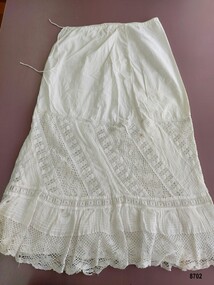
... During W.W.2, a local Warrnambool couple (Meryl and Tony Everard) boarded with them – Tony was in the airforce training paratroopers to jump into (and survive) enemy territory and his wife Meryl worked in the Methodist baby Home. The Everards developed a close friendship with the Stephensons and were responsible for clearing out the house (and finding this clothing collection) after Lila died in 1977. ...During W.W.2, a local Warrnambool couple (Meryl and Tony Everard) boarded with them – Tony was in the airforce training paratroopers to jump into (and survive) enemy territory and his wife Meryl worked in the Methodist baby Home. The Everards developed a close friendship with the Stephensons and were responsible for clearing out the house (and finding this clothing collection) after Lila died in 1977. ...This item is one of a collection of clothing items that belonged to the Stephenson family who lived at 22 McCracken Street, Kensington, Melbourne. Matthew Stephenson (1861 – 1943) who had grown up on the Bendigo goldfields and shifted to Melbourne in the early 1900’s was a train driver and later, a fireman with the railways. His wife Elizabeth Jane (Betsy) Wigley (1865 – 1953) also grew up on the goldfields around Majorca and Bendigo. They married in 1885 in Bendigo. They had two daughters – Ethel Evelyn Stephenson (1886 – 1956) and Lillian or Lila (1891 – 1977) who were milliners and dressmakers and who continued to live in the family home after the death of their parents. The family are recorded as living at 22 McCracken Street, Kensington, as early as 1914. It is not known who made or owned the clothing that makes up this collection but as it appears to be from the late Victorian and early Edwardian era, the different pieces were probably made and worn by any of the three ladies of the house – Betsy, Ethel and/or Lila. During W.W.2, a local Warrnambool couple (Meryl and Tony Everard) boarded with them – Tony was in the airforce training paratroopers to jump into (and survive) enemy territory and his wife Meryl worked in the Methodist baby Home. The Everards developed a close friendship with the Stephensons and were responsible for clearing out the house (and finding this clothing collection) after Lila died in 1977. A petticoat is a lady's undergarment - worn under a skirt or dress. They provided warmth, modesty and shape to the dress. In the middle of the 19th century, petticoats were worn over hoops, bustles or in layers. Petticoats varied according to the style of the outside skirt or dress. Plain petticoats tended to be worn with everyday wear whilst better dresses (party dresses or silk gowns) were worn with petticoats that often had more trim and embellishments. Edwardian petticoats had less volume than Victorian era petticoats and they had a "dust ruffle" or lining under a lace flounce. The "dust ruffle" protected the lace flounce and gave the petticoat more flare at the bottom, greater freedom when walking as well as saving the flounce (which was often made of finer material) from everyday wear and tear. Tucks are another feature of Edwardian petticoats - when the lace at the bottom became worn, it could be cut off and the tucks released. This extended the life of the petticoat. This petticoat features an intricate trim of broderie anglaise. Although broderie anglaise was a lace that could be made by hand, it was very time consuming to make. St Gallen was a city in Switzerland that had become known for producing quality textiles. At the beginning of the 19th century, the first embroidery machines were developed in St Gallen. Factories used embroidery machines but people also had them in their homes. They were able to produce broderie anglaise for export. By the early 20th century, machine made lace, fabric, ribbons etc. were being sold in drapers shops all over England and Wales to women who were making clothes and furnishings for their families. It is highly likely that the lady who made this petticoat brought the lengths of broderie anglaise already made to embellish and personalise her petticoat.This item is an example of the needlework skills of women in the late 19th century - creating pintucks and adding lace to personalise and embellish a practical item of clothing.A lady's ankle length petticoat made in three sections. The top section is made from three rectangles of fine cotton (batiste) joined into a round with narrow french seams and inserted into a simple drawstring waistband with a small opening. The second section is made with rows of alternating strips of fine pin tucked lawn, white cotton cut work embroidery and a wider cotton lace design all joined in a diagonal pattern and lined with fine lawn. The bottom section of the petticoat has a horizontal strip of eyelet lace followed by a wider strip of fine pin tucked lawn and is finished with a deep hem of white cotton crocheted lace fabric and has the same lawn lining as the section above.flagstaff hill maritime museum and village, great ocean road, shipwreck coast, warrnambool, petticoat, lady's petticoat, needlework, sewing, broderie anglaise, stephenson family, drawstring waistband -
 Uniting Church Archives - Synod of Victoria
Offering envelope, Methodist Home Missions
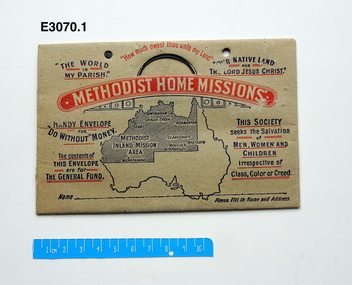
... The Methodist Home Missions was the department running the work of smaller churches and charitable institutions such as babies' homes, the Epworth Hospital, chaplaincies to hospitals and prisons, aged care homes, alcohol rehabilitation, local missions to depressed areas and the like. ...The Methodist Home Missions was the department running the work of smaller churches and charitable institutions such as babies' homes, the Epworth Hospital, chaplaincies to hospitals and prisons, aged care homes, alcohol rehabilitation, local missions to depressed areas and the like. ...The Methodist Home Missions was the department running the work of smaller churches and charitable institutions such as babies' homes, the Epworth Hospital, chaplaincies to hospitals and prisons, aged care homes, alcohol rehabilitation, local missions to depressed areas and the like. A minister was appointed each year by Conference, on deputation, to travel around Victoria to explain and encourage local congregations to support the work of the missions.Methodist Home Missions cardboard envelope with a blue map of Australia and blue and red text. The is a curved slot at the top of the envelope for inserting coins and squares on the back to mark off weekly giving. methodist home missions, methodist inland mission -
 Uniting Church Archives - Synod of Victoria
Pamphlet, Methodist Home Missions
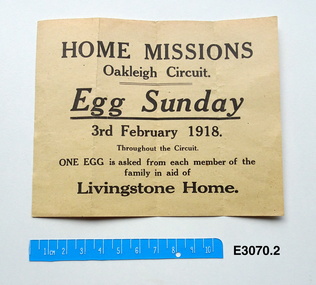
... The Methodist Home Missions was the department running the work of smaller churches and charitable institutions such as babies' homes, the Epworth Hospital, chaplaincies to hospitals and prisons, aged care homes, alcohol rehabilitation, local missions to depressed areas and the like. ...The Methodist Home Missions was the department running the work of smaller churches and charitable institutions such as babies' homes, the Epworth Hospital, chaplaincies to hospitals and prisons, aged care homes, alcohol rehabilitation, local missions to depressed areas and the like. ...The Methodist Home Missions was the department running the work of smaller churches and charitable institutions such as babies' homes, the Epworth Hospital, chaplaincies to hospitals and prisons, aged care homes, alcohol rehabilitation, local missions to depressed areas and the like. A minister was appointed each year by Conference, on deputation, to travel around Victoria to explain and encourage local congregations to support the work of the missions. Livingstone House was established in Carlton in 1888, and was first known as the Temporary Home for Destitute Children. It was run by the Central Dorcas Society, and led by its Senior Biblewoman, Mrs Varcoe. Many children in Livingstone were placed in foster care. In 1891, it relocated to a new property in Cheltenham and later became the Methodist Homes for Children. [https://www.findandconnect.gov.au/guide/vic/E000067]Methodist Home Missions Oakleigh Circuit Egg Sunday promotional pamphlet, 3rd February 1918. methodist home missions, livingstone home -
 Uniting Church Archives - Synod of Victoria
Brochure, Northcote Methodist Circuit
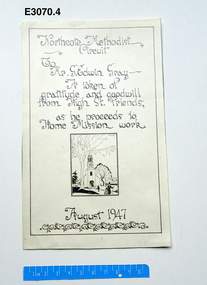
... The Methodist Home Missions was the department running the work of smaller churches and charitable institutions such as babies' homes, the Epworth Hospital, chaplaincies to hospitals and prisons, aged care homes, alcohol rehabilitation, local missions to depressed areas and the like. ...The Methodist Home Missions was the department running the work of smaller churches and charitable institutions such as babies' homes, the Epworth Hospital, chaplaincies to hospitals and prisons, aged care homes, alcohol rehabilitation, local missions to depressed areas and the like. ...The Methodist Home Missions was the department running the work of smaller churches and charitable institutions such as babies' homes, the Epworth Hospital, chaplaincies to hospitals and prisons, aged care homes, alcohol rehabilitation, local missions to depressed areas and the like. A minister was appointed each year by Conference, on deputation, to travel around Victoria to explain and encourage local congregations to support the work of the missions.Northcote Methodist Circuit: To Mr G Edwin Gray - A token of gratitude and goodwill from High St friends as he proceeds to Home Mission Work. August 1947. The paper has a small drawing of a church embedded in the hand written text.northcote methodist circuit, g edwin gray, methodist home mission -
 Uniting Church Archives - Synod of Victoria
Pamphlet - The Bulletin, Fraser & Morphet Pty Ltd
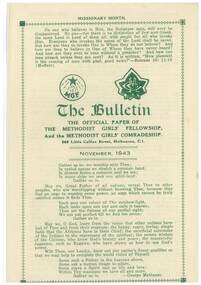
... Methodist Girls' Comradeship for November 1943 which was missionary month. It contains a missionary quiz and the "working for God's Kingdom": Christian Social Order Committee, Overseas Committee, City Missions, Inland, Cheltenham Homes, Babies' Homes, National Fitness and Easter Camps. ...Methodist Girls' Comradeship for November 1943 which was missionary month. It contains a missionary quiz and the "working for God's Kingdom": Christian Social Order Committee, Overseas Committee, City Missions, Inland, Cheltenham Homes, Babies' Homes, National Fitness and Easter Camps. ...This pamphlet is the official paper of the Methodist Girls' Fellowship and the Methodist Girls' Comradeship for November 1943 which was missionary month. It contains a missionary quiz and the "working for God's Kingdom": Christian Social Order Committee, Overseas Committee, City Missions, Inland, Cheltenham Homes, Babies' Homes, National Fitness and Easter Camps. The back contains "Doings - Near and Far". Amounts raised or donated are handwritten in the margin. Cream bi-fold paper with green text and images of the Methodist Girls' Fellowship and the Methodist Girls' Comradeship on the front. methodist girls' comardeship, methdodist girls' fellowship, missionary month
