
Showing 38 items matching "methodist churches -- melbourne -- victoria"
-
 Kew Historical Society Inc
Archive (series) - Subject File, Methodist Church
... methodist churches -- melbourne -- victoria...Typically files will contain primary and secondary sources. churches -- kew (vic.) methodist churches -- melbourne -- victoria highbury grove Methodist Church Archive Subject File ...Kew Historical SocietySince its foundation in 1958, members of the Kew Historical Society have been compiling and storing information about subjects relating to the history of Kew and its environs, of which this file is an example.Arranged by Secondary Values (value of records to users)The former Kew Methodist Church is located in Highbury Grove, Kew. This subject file was created by researchers of the Kew Historical Society. It contains primary and secondary sources relevant to the former Methodist Church (now Uniting Church). The file includes original booklets produced by the Church celebrating its history and a hymn sheet used during the Church's jubilee. There are also sundry newspaper cuttings. churches -- kew (vic.), methodist churches -- melbourne -- victoria, highbury grovechurches -- kew (vic.), methodist churches -- melbourne -- victoria, highbury grove -
 Mission to Seafarers Victoria
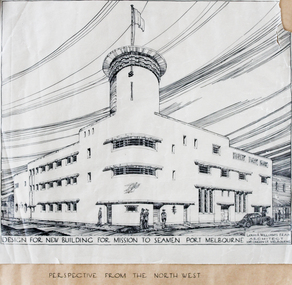
Plan - Architectural Plan, Louis Reginald Williams, Plans for the Port Melbourne Mission to Seamen by Louis R.Williams of F.R.A.I.A Architect, c. 1936
... Melbourne building dating from 1888 was too small and not longer suitable for the purpose of the mission. So architects were asked to design a new building. Harry Morris 's project was chosen. Louis Reginald Williams (1890–1980) was s sought after ecclesiastical architect in Australia. He designed churches throughout the country, particularly in Victoria. The Anglican Church was his major client but he also Methodists ...In 1936, the old Port Melbourne building dating from 1888 was too small and not longer suitable for the purpose of the mission. So architects were asked to design a new building. Harry Morris 's project was chosen.Louis Reginald Williams (1890–1980) was s sought after ecclesiastical architect in Australia. He designed churches throughout the country, particularly in Victoria. The Anglican Church was his major client but he also Methodists, Presbyterians, Lutherans and Christian Scientists churches. Williams was probably the major church architect in Australia in the Arts and Crafts tradition from the 1920s to the 1970s.Plans port melbourne, louis reginald williams, louis reginald williams (1890–1980), arts and crafts, art deco, harry norris -
City of Moorabbin Historical Society (Operating the Box Cottage Museum)
Newsletter - City of Moorabbin Historical Society Jun 2011, June 2011
... melbourne...moorabbin...brighton...cheltenham...ormond...bentleigh...mckinnon...market gardeners...pioneers...early settlers...moorabbin shire...box cottage museum...city of moorabbin...box william...glen eira city council...museums australia victoria...knott peta...church of christ cheltenham...baptist church...presbyterian church. salvation army...jasper road...point nepean road...brewer’s road...redmore rev. james...methodist...Church of Christ.. The Blackman family were early settlers in Moorabbin Shire. city of moorabbin historical society stanley helen melbourne moorabbin brighton cheltenham ormond bentleigh mckinnon market gardeners pioneers early settlers moorabbin shire box cottage museum city of moorabbin box william glen eira city council museums australia victoria knott peta church of christ cheltenham baptist church presbyterian church. salvation army jasper road point nepean road brewer’s road redmore rev. james methodist mission to chinese market gardeners blackman nance lydia street bentleigh CITY of MOORABBIN HISTORICAL SOCIETY / JUNE 2011 NEWSLETTER 5 x A4 paper printed on 1 side Issue 22 of the bi-monthly, City of Moorabbin Historical Society Newsletter produced by Society member and Secretary, Mrs Helen Stanley in June 2011. ...The City of Moorabbin Historical Society was formed c 1960 by a group of Moorabbin residents who were concerned that the history of the area should be preserved. A good response to a call for items related to the historical area of Moorabbin Shire brought donations of a wide variety of artefacts which are now preserved by the current members of CMHS at Box Cottage Museum . Helen Stanley, Secretary of CMHS, began producing a Newsletter for members in April 2007 to provide current information and well researched items of historical interestHelen Stanley has produced a bi-monthly Newsletter, 2007 - 2013, for the members of the City of Moorabbin Historical Society that contains well researched interesting historical items, notification of upcoming events, current advice from Royal Australian Historical Society , Museums Australia Victoria and activities of Local Historical Societies. The Newsletter is an important record of the activities of the CMHS. Mrs Nance Blackman’s notes in 1978 for the Centenary of The Cheltenham Church of Christ.. The Blackman family were early settlers in Moorabbin Shire. 5 x A4 paper printed on 1 side Issue 22 of the bi-monthly, City of Moorabbin Historical Society Newsletter produced by Society member and Secretary, Mrs Helen Stanley in June 2011. Notice of meeting June 26th and CMHS members exhibited some artefacts at the ‘Fun4over50’s’ event at Kingston (Moorabbin ) Town Hall June 5th. Glen Eira City Council Building Dept. Officers inspected erosion along the North side of the Barn floor, members have planted seedlings in the garden and Helen and Joan are entering data about our ‘Collection’ onto the MAV website while Jim Dale has photographed some of the farm machinery. Small paragraphs about early local Religious groups – Salvation Army, Methodist and Presbyterian Ministries – with 2 photocopied photographs. Helen also provides the notes penned by Mrs Nance Blackman in 1978 for the Centenary of The Cheltenham Church of Christ. CITY of MOORABBIN HISTORICAL SOCIETY / JUNE 2011 NEWSLETTER city of moorabbin historical society, stanley helen, melbourne, moorabbin, brighton, cheltenham, ormond, bentleigh, mckinnon, market gardeners, pioneers, early settlers, moorabbin shire, box cottage museum, city of moorabbin, box william, glen eira city council, museums australia victoria, knott peta, church of christ cheltenham, baptist church, presbyterian church. salvation army, jasper road, point nepean road, brewer’s road, redmore rev. james, methodist mission to chinese market gardeners, blackman nance, lydia street bentleigh -
 Eltham District Historical Society Inc
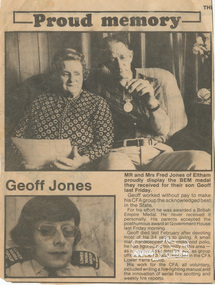
Document - Folder, Jones, 1979
... Victoria, Chief Accountants Department, Head Office, Elizabeth Street, Melbourne. On October 20, 1937 after ten years of service, Gwenda submitted her letter of resignation effective November 26th as she was to be married in the near future to Fred Jones. Frederick Geoffrey Jones, born 7 January 1911, third son of Mr. and Mrs. W. Jones of Napoleon Street, Eltham, married Gwenda at the Eltham Methodist Church...Victoria, Chief Accountants Department, Head Office, Elizabeth Street, Melbourne. On October 20, 1937 after ten years of service, Gwenda submitted her letter of resignation effective November 26th as she was to be married in the near future to Fred Jones. Frederick Geoffrey Jones, born 7 January 1911, third son of Mr. and Mrs. W. Jones of Napoleon Street, Eltham, married Gwenda at the Eltham Methodist Church ...Fred, Gwenda and Geoff Jones Contents 1. Proud memory; Geoff Jones, Diamond Valley News, 21 Nov 1979 2. Sudden death of 'much loved man', Diamond Valley News, 13 Feb 1979 3. Honor for a community friend, Diamond Valley News, 8 March 1995 (On reverse, 'Diverse program to entice riders' about St Andrews Saddle Club and fgeatures a photo of Debbie Jones) Gwendoline (Gwenda) Grace Watson Davies, only daughter of Mr. William Watson Davies and Mrs. Grace Davies (nee Hayes) of Arthur Street, Eltham was born in Newport, 18 February 1908. Gwenda grew up in Arthur Street and when she left school she was employed as an officer at the State Bank of Victoria, Chief Accountants Department, Head Office, Elizabeth Street, Melbourne. On October 20, 1937 after ten years of service, Gwenda submitted her letter of resignation effective November 26th as she was to be married in the near future to Fred Jones. Frederick Geoffrey Jones, born 7 January 1911, third son of Mr. and Mrs. W. Jones of Napoleon Street, Eltham, married Gwenda at the Eltham Methodist Church on 27 November 1937. They made their home at ‘Llangollen’, Arthur Street, Eltham, a new house Fred had constructed earlier that year opposite the Shire Offices. Their residence was recorded in the Electoral Rolls from 1963-1980 as 6 Arthur Street, Eltham which was situated on the corner of Arthur Street and present-day Commercial Place. In the 1970s their home was sold and demolished to make way for the new shops. They built a new home at the top of the hill in Bible Street. In the Electoral Rolls for 1943-1980, Frederick’s occupation was recorded as a Plumber’s Assistant. Fred was also a long-standing member of the Eltham Cemetery Trust. He was first appointed 26 April 1944 and resigned 17 July 1957 to be appointed to the Warringal and Eltham Joint Trust where he served till February 1980. He then re-joined the Eltham Cemetery Trust and served a further 14 years till his resignation on 24 August 1994. In total, Fred represented the interests of Eltham Cemetery for 50 years (1944-1994). Gwenda and Fred were blessed with a son, Frederick William Jones in March 1942. Sadly, Frederick only lived two days and was buried at Eltham Cemetery on March 11. It is not known whether his grave is marked. A second son, Geoffrey Morris Jones arrived 25 November 1944 but he sadly contracted polio as a child. A fall down the front steps of Fred and Gwenda’s new home in Bible Street culminated in Geoff’s death from a heart attack whilst in transit to the Austin Hospital on February 6, 1979, at age 34. He was also interred in the Eltham Cemetery. Geoff was posthumously awarded the British Empire Medal for his services to fire safety at the CFA. A small man, handicapped from his childhood polio, he had figured prominently in the area as an active Apex member and as group officer for the 13 local brigades in the CFA Lower Yarra Group. His work for the CFA, all voluntary, included writing a fire-fighting manual and the innovation of aerial fire spotting and weekly fire reports. Gwendoline and Fred were presented with Geoff’s B.EM. award at Government House. Four years later on the anniversary of Geoff’s death, Gwenda could not sleep and collapsed in the hallway at home from a heart attack, 6 February 1983 at age 74. She was interred with her son Geoff, at Eltham Cemetery on February 9th. Fred died 31 July 1997 at age 86 and was also interred at Eltham Cemetery. A memorial plaque to Gwenda, Fred and Geoff lies within the lawn cemetery at Eltham Cemetery.Newsprint clippingscfa, eltham cemetery, eltham cemetery trust, frederick geoffrey jones, geoffrey morris jones b.e.m., gwendoline grace watson jones (nee davies), lower yarra group, debbie jones, st andrews saddle club -
 Eltham District Historical Society Inc
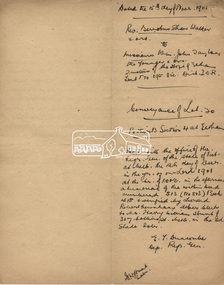
Document, Certificate of Consent of Sale of Lot 20 Henry Street, Eltham to Hope of Eltham Tent No. 195 Victoria District Independent Order of Rechabites, 28 Nov 1901
... Alexander Robert Edgar, President of the Victoria and Tasmania Conference of the Wesleyan Methodist Church by Certificate of Consent of Sale dated 28 November 1901, declared that the Conference of the Church held in Melbourne, 27 February 1894, agreed to the sale by the Trustees of Lot 20 Henry Street. ...Alexander Robert Edgar, President of the Victoria and Tasmania Conference of the Wesleyan Methodist Church by Certificate of Consent of Sale dated 28 November 1901, declared that the Conference of the Church held in Melbourne, 27 February 1894, agreed to the sale by the Trustees of Lot 20 Henry Street. ...Alexander Robert Edgar, President of the Victoria and Tasmania Conference of the Wesleyan Methodist Church by Certificate of Consent of Sale dated 28 November 1901, declared that the Conference of the Church held in Melbourne, 27 February 1894, agreed to the sale by the Trustees of Lot 20 Henry Street. Indenture dated 15 November 1901 between Revd. Barnabas Shaw Walker, Minister of the Pentridge Circuit, Joseph Cooper, Gardener of Keelbundora, Samuel Jeffrey, Farmer of Jika Jika, John Brown, State School Teacher, Robert David Taylor, Gardener and Isaac Hill, Dealer, all of Eltham, the Trustees conveyed the land to William John Taylor the Younger, Gardener, George Knapman, Blacksmith and Isaac Hill junior, Carrier, all of Eltham and Trustees at the time for a Friendly Society known as the Hope of Eltham Tent No. 195 Victoria District Independent Order of Rechabites for the sum of £40. The conveyance was received into the Office of the Registrar General, State of Victoria, 12 December 1901. Originally purchased in 1856 from Thomas Roberts, Yeoman of Little Eltham, for £10 for use by the Wesleyan Chapel, represented by indentured Trustees, Rev. Barnabas Shaw Walker, Minister of the Pentridge Circuit, Francis Thomas, Farmer of Keelbundora, William Harriman, Blacksmith of Nillumbik, Nicholas Rodda, Farmer of Nillumbik, Aaron Grimshaw, Farmer of Greensborough, Joseph Cooper, Gardener of Keelbundora, Peter Dredge, Scholmaster of Jika Jika and Samuel Jeffrey, Farmer of Jika Jika. Lot 20 of Subdivision of Portion 13, Section 4 of the Parish of Nillumbik in the County of Evelyn was located on the southern side of Henry street in Little Eltham North, where the current Our Lady Help of Christians Catholic Church is situated. It became the location of the Eltham Rechabite Hall. In 1893 a new hall was built and further enlarged in 1919. At the commencement of 1922, the property was purchased from the Independent Order of Rechabites with publicly subscribed funds and a new hall built at a cost of £750 and improved road access constructed to reduce the grade, running from Dudley Street to Henry Street. This hall was eventually replaced with the new Shire Offices and Hall built on the corner of Arthur Street and Main Road, which was opened in 1941. Traces the earliest history of the Eltham Public Hall in Henry Street and the various names, occupations and abodes of the Trustees associated with the propertyaaron grimshaw, blacksmith, edmond perry, eltham public hall, eltham rechabite hall, eltham wesleyan chapel, francis thomas, george knapman, george smith, henry street, hope of eltham tent no. 195, i.w. lucas, isaac hill, james blanch, james chapman, james william brown, john brown, john jenkins peacock, john jones, john neale, john van mangerhoussen weiss, joseph cooper, joseph morris holloway, josiah atwool, keelbundora, lancelot iredale, little eltham, little eltham north, lizar elliott, mark blanchard, methodist church, nicholas rodda, p. mather, peter dredge, rev barnabas shaw walker, robert david taylor, samuel jeffrey, samuel moor munce, thomas roberts, thomas wheaten bowden, trustee, victoria district independent order of rechabites, wesleyan methodist church, william harriman, william hebblewhite, william john munce, william john taylor, william matthews, william rose -
 Warrnambool and District Historical Society Inc.
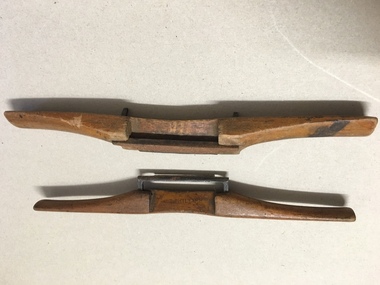
Tools, Spoke Shavers x 2, Late 19th century/early 20th century
... Victoria outside Melbourne and sold his products all over Australia. He and his family lived at ‘Heatherlie’ in Koroit Street and after his death this Phillips house was acquired by the Methodist Church and the Heatherlie Homes for retired people were built on this site....Victoria outside Melbourne and sold his products all over Australia. He and his family lived at ‘Heatherlie’ in Koroit Street and after his death this Phillips house was acquired by the Methodist Church and the Heatherlie Homes for retired people were built on this site. ...Spoke shaves were used by woodmakers to shape curved surfaces (originally wheel spokes). These two spoke shaves belonged to Ernest Phillips of Warrnambool who would have used them to shape the surfaces of chair and table legs etc. Ernest Brighton Phillips (1875-1924) was the son of Henry Phillips (a hay and corn dealer in Warrnambool) and his wife, Emma. He learned cabinet making at the Box Works in Warrnambool and in the late 19th century established a furniture-making and selling business at the corner of Liebig and Koroit Streets. By the early 20th century he had the largest furniture warehouse and factory in Victoria outside Melbourne and sold his products all over Australia. He and his family lived at ‘Heatherlie’ in Koroit Street and after his death this Phillips house was acquired by the Methodist Church and the Heatherlie Homes for retired people were built on this site.These tools are of considerable significance as they were used by Ernest Phillips, a prominent businessman in Warrnambool during the late 19th and early 20th centuries. These are two spoke shaves - small planes, slightly curved, with wooden handles and a metal blade in the middle. The blade is attached to the handles via metal ends which go through holes in the wood. The blade area is strengthened with metal plates attached by metal screws. The metal parts are well-rusted and the handles are somewhat worn. ‘E. Phillips’ etched into wood on each spoke shave.ernest phillips, history of warrnambool -
 Eltham District Historical Society Inc
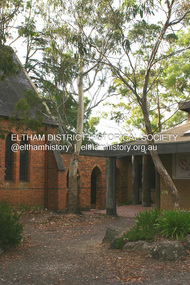
Photograph - Digital Photograph, Alan King, St Margaret's Anglican Church, Pitt Street, Eltham, 30 January 2008
... church. Usually in Victoria a vicar was appointed to a parish and then a permanent church was constructed. But then, the nearest church was at Heidelberg, which was a tedious and time-consuming journey. St Margaret’s builder was a local, George Stebbing, who also constructed the former Methodist, later Uniting, Church at John Street and the Shillinglaw Cottage near Eltham’s Central Park. It is believed the first Anglican Bishop of Melbourne...church. Usually in Victoria a vicar was appointed to a parish and then a permanent church was constructed. But then, the nearest church was at Heidelberg, which was a tedious and time-consuming journey. St Margaret’s builder was a local, George Stebbing, who also constructed the former Methodist, later Uniting, Church at John Street and the Shillinglaw Cottage near Eltham’s Central Park. It is believed the first Anglican Bishop of Melbourne ...St Margaret’s Church of England was officially opened on December 12, 1861. It is the oldest intact church building in Eltham. At the time it was known as Christ Church until its consecration in 1871, when it was completely free of debt (£1,700 for the church and parsonage) despite the district’s poverty. This was largely due to the free labour and materials, including locally made bricks donated by local artisans and others. The church is historically significant because it is the oldest church in the former Shire of Eltham and has associations with the philanthropist and founder of Brighton, Henry Dendy (who donated the land on which the church is built), the architect Nathaniel Billing and the prominent local builder, George Stebbing. The church is architecturally and aesthetically significant because it is constructed in the Gothic Revival style with several stained-glass windows of various dates and is also a very early use of polychromatic brickwork in Victoria. Billing was one of the first Melbourne architects to employ polychromatic brickwork and an important early architect. The rear wall was intended to be temporary. A major feature of the design is the large buttresses with long, steeply graded upper faces. The overall design is well proportioned with the surface brick patterns relieving an otherwise austere design. The church is spiritually and socially significant because it has been an important place of worship for the people of Eltham for almost 150 years. The land on which the buildings stand was donated by Henry Dendy. Dendy arrived in Melbourne in 1841 after purchasing in England eight square miles at Brighton under the system of "special surveys". After this land passed out of his hands, Dendy moved about Victoria, visited England, then returned to settle in Eltham where he purchased a flour mill. Dendy chaired the meeting held in 1860 “for the purpose of devising such means as may be expedient for the establishment of a Church of England in the township of Eltham”. He became chairman and treasurer of the church committee. Unlike the establishment of many early churches in Victoria where a vicar was appointed to a parish and later a permanent church was constructed, the population at Eltham initiated action to build a church. The nearest church at that time was at Heidelberg and the Eltham settlement was part of the parish of St Johns Heidelberg. Isolation and the tedious, time consuming journey between Heidelberg and Eltham resulted in the Eltham community taking its own action. The original vicarage (Dendy House) at the rear of the church is also an important part of the cultural significance of this place because it is connected to the church and the development of the Eltham area. Together, the church and the vicarage are aesthetically significant because they form a significant streetscape feature. The mud-brick community hall designed by Robert Marshall was added in 1978. In 2014 the original temporary rear wall was removed as part of a modern extension designed by Architects Atelier Wagner and constructed by Conrad Construction and Management. Covered under Heritage Overlay, Nillumbik Planning Scheme. National Trust of Australia (Victoria) State significance Victorian Heritage Published: Nillumbik Now and Then / Marguerite Marshall 2008; photographs Alan King with Marguerite Marshall.; p67 St Margaret’s Anglican Church in Pitt Street, Eltham, which officially opened on December 12, 1861, is the oldest intact church building in Eltham.1 With the nearby courthouse and police station, it was one of the first permanent community buildings in the district. The church and vicarage are on the Register of the Heritage Council of Victoria and the National Trust of Australia – Victoria. The church is important as an early example of polychrome brickwork by the notable architect Nathaniel Billings. It is also notable for its historic associations with the early settlement of the Shire of Eltham and its connection with Henry Dendy, Brighton’s founder.2 Henry Dendy, who lived in Eltham much longer than at Brighton, chaired the original meeting which planned the church, and he donated the half-acre (0.2ha) site. Dendy had arrived in Melbourne in 1841 after buying eight square miles (20.7sq km) at Brighton while in England. After this land passed out of his hands, he eventually settled in Eltham where he bought a flour mill, west from the corner of Main Road and Pitt Street (then called Brewery Lane). The vicarage was named Dendy House after him. The Eltham settlers were unusual in initiating the establishment of a church. Usually in Victoria a vicar was appointed to a parish and then a permanent church was constructed. But then, the nearest church was at Heidelberg, which was a tedious and time-consuming journey. St Margaret’s builder was a local, George Stebbing, who also constructed the former Methodist, later Uniting, Church at John Street and the Shillinglaw Cottage near Eltham’s Central Park. It is believed the first Anglican Bishop of Melbourne, Bishop Perry, dedicated the church. After the ceremony he joined in the festivities at the nearby pub and a bill was sent to the parish for teas taken there by the bishop with other participants. The first vicar was the Reverend Robert Mackie from 1864 to1866. St Margaret’s Church was originally called Christ Church until its consecration in 1871, when it was completely free of debt (£1700 pounds for the church and parsonage) despite the district’s poverty. This was largely due to the free labour and materials, including local bricks, donated by local artisans and others. St Margaret’s Church is in the Gothic Revival tradition with a buttressed nave, paired lancet windows, porch and bell-cote. It was the first polychromatic brick church in Australia, using softly contrasting coloured brickwork.3 Billing was one of the first architects to introduce polychrome brickwork into Melbourne. His original drawings for St Margaret’s survive in a folio of his architectural work. However the church’s brickwork is more subdued than in his drawings. About half the windows – those in clear glass with gold borders – are original. The stained glass windows were made much later, but the one behind the altar is thought to be the oldest in the Diamond Valley. It was to be temporary until the congregation could afford to extend the church. In the early 1960s the original cedar pews were replaced by blonde timber pews and the originals were sold to restaurants and to private individuals. Eminent local sculptor Matcham Skipper created a crucifix for the church. A major addition was made in 1978, when the weatherboard hall was replaced by a mud-brick hall. Made of local material, it was designed by local architect and a former shire president Robert Marshall. The mud-brick hall reflects the style of building in Eltham of the late 1970s and for which Eltham is well-known. Perhaps because its earthy tones blend with the surrounding environment, the hall sits well with the church building. St Margaret’s membership has included economist and ABC chairman, Richard Downing; political commentator, diplomat and academic, William Macmahon Ball; Eltham civic leader, Charles Wingrove; artist, Peter Glass; and Eltham’s first postmaster, Frederick Falkiner.This collection of almost 130 photos about places and people within the Shire of Nillumbik, an urban and rural municipality in Melbourne's north, contributes to an understanding of the history of the Shire. Published in 2008 immediately prior to the Black Saturday bushfires of February 7, 2009, it documents sites that were impacted, and in some cases destroyed by the fires. It includes photographs taken especially for the publication, creating a unique time capsule representing the Shire in the early 21st century. It remains the most recent comprehenesive publication devoted to the Shire's history connecting local residents to the past. nillumbik now and then (marshall-king) collection, eltham, st margaret's anglican church, st margaret's church, st margarets church hall, christ church -
 Uniting Church Archives - Synod of Victoria
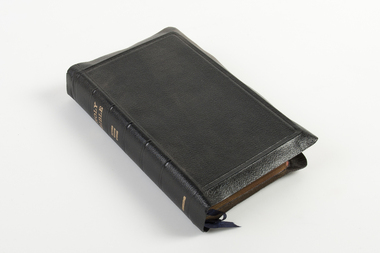
Book - Bible, Cambridge, Holy Bible Revised Version in Verses
... Methodist Church of Australia Victoria and Tasmania Conference. Presented to Stella Marion Opie on the occasion of dedication as Deaconess of the Methodist Church at Wesley Church Melbourne 27th February 1951"...Methodist Church of Australia Victoria and Tasmania Conference. Presented to Stella Marion Opie on the occasion of dedication as Deaconess of the Methodist Church at Wesley Church Melbourne 27th February 1951" Black embossed leather bible with soft protective edges and gilt text on the spine. ...Black embossed leather bible with soft protective edges and gilt text on the spine. Coloured maps and gilt edges. Handwriting inside the front cover."Methodist Church of Australia Victoria and Tasmania Conference. Presented to Stella Marion Opie on the occasion of dedication as Deaconess of the Methodist Church at Wesley Church Melbourne 27th February 1951"methodist deaconess stella marion opie -
 Uniting Church Archives - Synod of Victoria
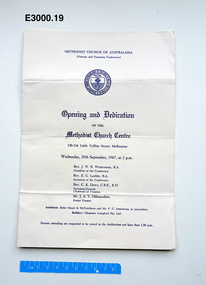
Programme - Opening and dedication, Methodist Church Centre opening and dedication program, 1967
... Methodist Church Centre, whose Architects were Bates Smart & McCutheon and F. C. Armstrong, was opened and dedicated on Wednesday 20 September 1967. The Methodist Church Centre Melbourne Folded order of service with dark blue text for the opening and dedication of the Methodist Church Centre 130-134 Little Collins Street, Melbourne. Methodist Church Centre opening and dedication program Programme Opening and dedication Australia Victoria ...The Methodist Church Centre, whose Architects were Bates Smart & McCutheon and F. C. Armstrong, was opened and dedicated on Wednesday 20 September 1967.Folded order of service with dark blue text for the opening and dedication of the Methodist Church Centre 130-134 Little Collins Street, Melbourne.the methodist church centre melbourne -
 Uniting Church Archives - Synod of Victoria
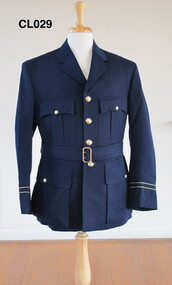
Uniform - Jacket, RAAF Chaplain, c1942
... Rev Quick served in seven Methodist Circuits in Victoria, one in Tasmania, one City Mission (North Melbourne) and also an appointment with the Methodist Inland Mission in Central Australia. He was one of the first ministers to be appointed to the new John Flynn Memorial Church in Alice Springs. ...Rev Quick served in seven Methodist Circuits in Victoria, one in Tasmania, one City Mission (North Melbourne) and also an appointment with the Methodist Inland Mission in Central Australia. He was one of the first ministers to be appointed to the new John Flynn Memorial Church in Alice Springs. ...The jacket belonged to RAAF Chaplain Aubrey Alfred Quick. Rev Quick served in seven Methodist Circuits in Victoria, one in Tasmania, one City Mission (North Melbourne) and also an appointment with the Methodist Inland Mission in Central Australia. He was one of the first ministers to be appointed to the new John Flynn Memorial Church in Alice Springs. Aubrey Quick was a part-time Chaplain in the Royal Australian Airforce and received an Order of Australia for his pastoral care of the apprentices the RAAF. He served on the University of Melbourne Queens College Council for 23 years. Navy blue wool belted jacket with four brass buttons and a brass buckle. The jacket has four pleated pockets, each with a brass button, one small ticket pocket on the RHS and two pale blue grosgrain ribbons at the cuffs. It is lined with black cotton and the sleeves with cream striped lining. The right pocket contains two metal Chaplain's RAAF metal hat badges and two colour bars.rev aubrey quick, raaf chaplain, methodist circuit, australian inland mission -
 Uniting Church Archives - Synod of Victoria
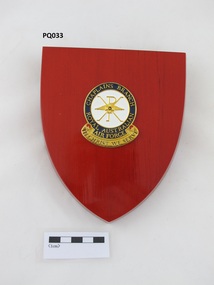
Plaque - Small plaque, Lega Pty Ltd, n.d
... Rev Quick served in seven Methodist Circuits in Victoria, one in Tasmania, one City Mission (North Melbourne) and also an appointment with the Methodist Inland Mission in Central Australia. He was one of the first ministers to be appointed to the new John Flynn Memorial Church in Alice Springs. ...Rev Quick served in seven Methodist Circuits in Victoria, one in Tasmania, one City Mission (North Melbourne) and also an appointment with the Methodist Inland Mission in Central Australia. He was one of the first ministers to be appointed to the new John Flynn Memorial Church in Alice Springs. ...Rev Quick served in seven Methodist Circuits in Victoria, one in Tasmania, one City Mission (North Melbourne) and also an appointment with the Methodist Inland Mission in Central Australia. He was one of the first ministers to be appointed to the new John Flynn Memorial Church in Alice Springs. Aubrey Quick was a part-time Chaplain in the Royal Australian Airforce and received an Order of Australia for his pastoral care of the apprentices the RAAF. He served on the University of Melbourne Queens College Council for 23 years.Small shield shaped wooden plaque with Chaplain's Branch Royal Australian Air Force insignia in gold, navy and white metal. The plaque has a hole for hanging on the back together with the manufacturer's label."CHAPLAINS BRANCH ROYAL AUSTRALIAN AIR FORCE IN CHRIST WE SERVE"rev aubrey quick, chaplains branch royal australian air force -
 Uniting Church Archives - Synod of Victoria
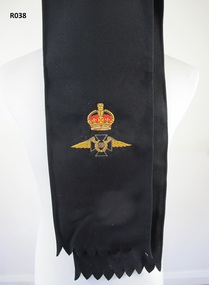
Uniform - Regalia - Stole, n.d
... Rev Quick served in seven Methodist Circuits in Victoria, one in Tasmania, one City Mission (North Melbourne) and also an appointment with the Methodist Inland Mission in Central Australia. He was one of the first ministers to be appointed to the new John Flynn Memorial Church in Alice Springs. ...Rev Quick served in seven Methodist Circuits in Victoria, one in Tasmania, one City Mission (North Melbourne) and also an appointment with the Methodist Inland Mission in Central Australia. He was one of the first ministers to be appointed to the new John Flynn Memorial Church in Alice Springs. ...Rev Quick served in seven Methodist Circuits in Victoria, one in Tasmania, one City Mission (North Melbourne) and also an appointment with the Methodist Inland Mission in Central Australia. He was one of the first ministers to be appointed to the new John Flynn Memorial Church in Alice Springs. Aubrey Quick was a part-time Chaplain in the Royal Australian Airforce and received an Order of Australia for his pastoral care of the apprentices the RAAF. He served on the University of Melbourne Queens College Council for 23 years.Black RAAF Chaplain's stole with yellow, red, green and gold embroidered stitching of embroidery and gold thread at each end. The stole has three pleats around the neck."RAAF"rev aubrey quick, chaplains branch royal australian air force -
 Uniting Church Archives - Synod of Victoria
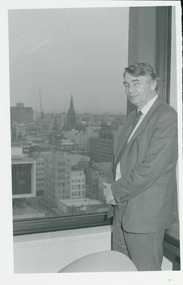
Photograph, Rev. Brian Howe MP, 1986
... Melbourne. He later studied theology in Chicago (1967–69) and then returned to Australia. He served as a minister with the Methodist Church and the Uniting Church in various parts of Victoria – Morwell, Eltham and Fitzroy. ...Melbourne. He later studied theology in Chicago (1967–69) and then returned to Australia. He served as a minister with the Methodist Church and the Uniting Church in various parts of Victoria – Morwell, Eltham and Fitzroy. ...Brian Leslie Howe, AO (born 23 January 1936), is an Australian former politician who served as the Deputy Prime Minister of Australia in the Labor government under prime ministers Bob Hawke and Paul Keating from 1991 to 1995. Howe was born in Melbourne. He spent his early childhood in the suburb of Malvern and was educated at Melbourne High School and the University of Melbourne. He later studied theology in Chicago (1967–69) and then returned to Australia. He served as a minister with the Methodist Church and the Uniting Church in various parts of Victoria – Morwell, Eltham and Fitzroy. Howe was elected to the House of Representatives in 1977 representing the northern Melbourne metropolitan electoral Division of Batman. He defeated the incumbent Horrie Garrick for Labor preselection in a hard-fought contest.[1] A member of the Socialist Left faction of the Labor Party, he was Minister for Defence Support in the government of Bob Hawke from 1983. In 1984 he became Minister for Social Security and carried out various radical reforms to Australia's welfare system.[2] Howe appeared to face significant opposition within his electorate in 1988, when up to 60 members of the Greek Westgarth branch of the ALP defected to join the Australian Democrats. One of the defectors, tram-conductor George Gogas, contested Batman as a Democrat candidate in 1990, but polled only 12.9 per cent of the vote.[3] After the 1990 election Howe was appointed to the post of Minister for Community Services and Health. When Paul Keating resigned from Cabinet in 1991, Howe succeeded him as Deputy Prime Minister. He became Minister for Health, Housing and Community Services in the Keating government in December 1991, dropping the health part of the portfolio in 1993. In June 1995 he resigned as Deputy Prime Minister and was succeeded by Kim Beazley. He did not stand for re-election at the 1996 election. Following his parliamentary career, Howe has been appointed as an Associate Professor for Melbourne University and continues to work with social policy and related fields. He is a member of the Church of All Nations in Carlton, and active in the Uniting Church. A full biography in his own words can be found in the Proceedings of the Uniting Church Historical Society, Synod of Victoria and Tasmania, Vol. 21, No. 1 for June 2014.Howe standing by a window in his office 1986.Identification of Howe. -
 Uniting Church Archives - Synod of Victoria
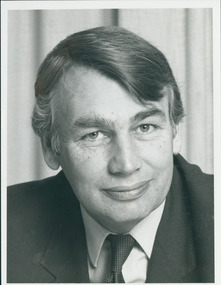
Photograph, Rev. Brian Howe MP, 1984
... Melbourne. He later studied theology in Chicago (1967–69) and then returned to Australia. He served as a minister with the Methodist Church and the Uniting Church in various parts of Victoria – Morwell, Eltham and Fitzroy. ...Melbourne. He later studied theology in Chicago (1967–69) and then returned to Australia. He served as a minister with the Methodist Church and the Uniting Church in various parts of Victoria – Morwell, Eltham and Fitzroy. ...Brian Leslie Howe, AO (born 23 January 1936), is an Australian former politician who served as the Deputy Prime Minister of Australia in the Labor government under prime ministers Bob Hawke and Paul Keating from 1991 to 1995. Howe was born in Melbourne. He spent his early childhood in the suburb of Malvern and was educated at Melbourne High School and the University of Melbourne. He later studied theology in Chicago (1967–69) and then returned to Australia. He served as a minister with the Methodist Church and the Uniting Church in various parts of Victoria – Morwell, Eltham and Fitzroy. Howe was elected to the House of Representatives in 1977 representing the northern Melbourne metropolitan electoral Division of Batman. He defeated the incumbent Horrie Garrick for Labor preselection in a hard-fought contest.[1] A member of the Socialist Left faction of the Labor Party, he was Minister for Defence Support in the government of Bob Hawke from 1983. In 1984 he became Minister for Social Security and carried out various radical reforms to Australia's welfare system.[2] Howe appeared to face significant opposition within his electorate in 1988, when up to 60 members of the Greek Westgarth branch of the ALP defected to join the Australian Democrats. One of the defectors, tram-conductor George Gogas, contested Batman as a Democrat candidate in 1990, but polled only 12.9 per cent of the vote.[3] After the 1990 election Howe was appointed to the post of Minister for Community Services and Health. When Paul Keating resigned from Cabinet in 1991, Howe succeeded him as Deputy Prime Minister. He became Minister for Health, Housing and Community Services in the Keating government in December 1991, dropping the health part of the portfolio in 1993. In June 1995 he resigned as Deputy Prime Minister and was succeeded by Kim Beazley. He did not stand for re-election at the 1996 election. Following his parliamentary career, Howe has been appointed as an Associate Professor for Melbourne University and continues to work with social policy and related fields. He is a member of the Church of All Nations in Carlton, and active in the Uniting Church. A full biography in his own words can be found in the Proceedings of the Uniting Church Historical Society, Synod of Victoria and Tasmania, Vol. 21, No. 1 for June 2014.Full-face, looking into the camera 1984 - part of an advertisement for Wesley Church's 126th anniversary 9/9/1984.Identification of Howe -
 Uniting Church Archives - Synod of Victoria
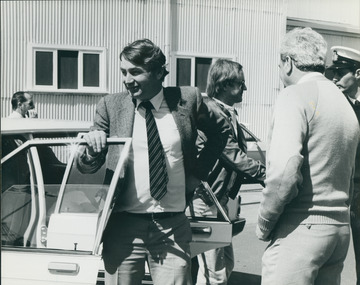
Photograph, Rev. Brian Howe MP, 1985
... Melbourne. He later studied theology in Chicago (1967–69) and then returned to Australia. He served as a minister with the Methodist Church and the Uniting Church in various parts of Victoria – Morwell, Eltham and Fitzroy. ...Melbourne. He later studied theology in Chicago (1967–69) and then returned to Australia. He served as a minister with the Methodist Church and the Uniting Church in various parts of Victoria – Morwell, Eltham and Fitzroy. ...Brian Leslie Howe, AO (born 23 January 1936), is an Australian former politician who served as the Deputy Prime Minister of Australia in the Labor government under prime ministers Bob Hawke and Paul Keating from 1991 to 1995. Howe was born in Melbourne. He spent his early childhood in the suburb of Malvern and was educated at Melbourne High School and the University of Melbourne. He later studied theology in Chicago (1967–69) and then returned to Australia. He served as a minister with the Methodist Church and the Uniting Church in various parts of Victoria – Morwell, Eltham and Fitzroy. Howe was elected to the House of Representatives in 1977 representing the northern Melbourne metropolitan electoral Division of Batman. He defeated the incumbent Horrie Garrick for Labor preselection in a hard-fought contest.[1] A member of the Socialist Left faction of the Labor Party, he was Minister for Defence Support in the government of Bob Hawke from 1983. In 1984 he became Minister for Social Security and carried out various radical reforms to Australia's welfare system.[2] Howe appeared to face significant opposition within his electorate in 1988, when up to 60 members of the Greek Westgarth branch of the ALP defected to join the Australian Democrats. One of the defectors, tram-conductor George Gogas, contested Batman as a Democrat candidate in 1990, but polled only 12.9 per cent of the vote.[3] After the 1990 election Howe was appointed to the post of Minister for Community Services and Health. When Paul Keating resigned from Cabinet in 1991, Howe succeeded him as Deputy Prime Minister. He became Minister for Health, Housing and Community Services in the Keating government in December 1991, dropping the health part of the portfolio in 1993. In June 1995 he resigned as Deputy Prime Minister and was succeeded by Kim Beazley. He did not stand for re-election at the 1996 election. Following his parliamentary career, Howe has been appointed as an Associate Professor for Melbourne University and continues to work with social policy and related fields. He is a member of the Church of All Nations in Carlton, and active in the Uniting Church. A full biography in his own words can be found in the Proceedings of the Uniting Church Historical Society, Synod of Victoria and Tasmania, Vol. 21, No. 1 for June 2014.Howe alighting from a car at Williamstown dockyards March 1985.Identification of Howe. -
 Uniting Church Archives - Synod of Victoria
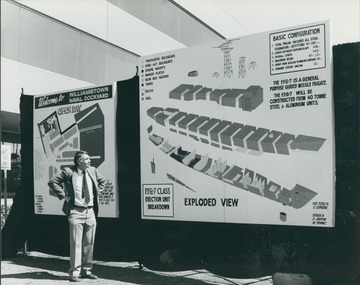
Photograph, Rev. Brian Howe MP, 1984
... Melbourne. He later studied theology in Chicago (1967–69) and then returned to Australia. He served as a minister with the Methodist Church and the Uniting Church in various parts of Victoria – Morwell, Eltham and Fitzroy. ...Melbourne. He later studied theology in Chicago (1967–69) and then returned to Australia. He served as a minister with the Methodist Church and the Uniting Church in various parts of Victoria – Morwell, Eltham and Fitzroy. ...Brian Leslie Howe, AO (born 23 January 1936), is an Australian former politician who served as the Deputy Prime Minister of Australia in the Labor government under prime ministers Bob Hawke and Paul Keating from 1991 to 1995. Howe was born in Melbourne. He spent his early childhood in the suburb of Malvern and was educated at Melbourne High School and the University of Melbourne. He later studied theology in Chicago (1967–69) and then returned to Australia. He served as a minister with the Methodist Church and the Uniting Church in various parts of Victoria – Morwell, Eltham and Fitzroy. Howe was elected to the House of Representatives in 1977 representing the northern Melbourne metropolitan electoral Division of Batman. He defeated the incumbent Horrie Garrick for Labor preselection in a hard-fought contest.[1] A member of the Socialist Left faction of the Labor Party, he was Minister for Defence Support in the government of Bob Hawke from 1983. In 1984 he became Minister for Social Security and carried out various radical reforms to Australia's welfare system.[2] Howe appeared to face significant opposition within his electorate in 1988, when up to 60 members of the Greek Westgarth branch of the ALP defected to join the Australian Democrats. One of the defectors, tram-conductor George Gogas, contested Batman as a Democrat candidate in 1990, but polled only 12.9 per cent of the vote.[3] After the 1990 election Howe was appointed to the post of Minister for Community Services and Health. When Paul Keating resigned from Cabinet in 1991, Howe succeeded him as Deputy Prime Minister. He became Minister for Health, Housing and Community Services in the Keating government in December 1991, dropping the health part of the portfolio in 1993. In June 1995 he resigned as Deputy Prime Minister and was succeeded by Kim Beazley. He did not stand for re-election at the 1996 election. Following his parliamentary career, Howe has been appointed as an Associate Professor for Melbourne University and continues to work with social policy and related fields. He is a member of the Church of All Nations in Carlton, and active in the Uniting Church. A full biography in his own words can be found in the Proceedings of the Uniting Church Historical Society, Synod of Victoria and Tasmania, Vol. 21, No. 1 for June 2014.Howe at Williamstown dockyard with an exploded view of a frigate September 1984.Identification of Howe.rev brian leslie howe, deputy prime minister of australia -
 Uniting Church Archives - Synod of Victoria
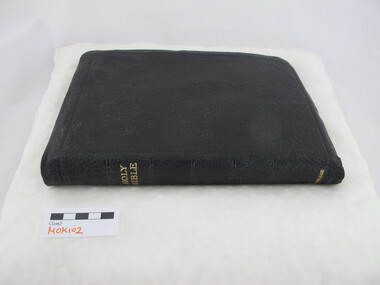
Bible, The Holy Bible containing the Old and New Testaments: appointed to be read in churches
... METHODIST ORDER OF KNIGHTS. Presented to the Provincial High Court of Victoria and Tasmania as an Expression of Esteem and Appreciation of the many courtesies shown during the Inter-Provincial Rally held in Melbourne December 1950 - January 51 for the South-Australian Delegation" " ? Beasley Knight Grand Commander" Brown leather covered bible with 1505 gilt edged pages and 6 colour maps at the back. The spine has gilt embossed text. There is a dedication stuck inside the front of the bible. The Holy Bible containing the Old and New Testaments: appointed to be read in churches ...Brown leather covered bible with 1505 gilt edged pages and 6 colour maps at the back. The spine has gilt embossed text. There is a dedication stuck inside the front of the bible."METHODIST ORDER OF KNIGHTS. Presented to the Provincial High Court of Victoria and Tasmania as an Expression of Esteem and Appreciation of the many courtesies shown during the Inter-Provincial Rally held in Melbourne December 1950 - January 51 for the South-Australian Delegation" " ? Beasley Knight Grand Commander"methodist order of knights -
 Uniting Church Archives - Synod of Victoria
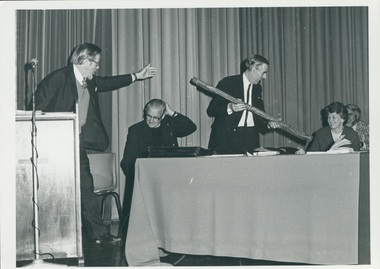
BW photo, May 1975
... Methodist minister 1933. 1974 Sup. Hawthorn. 1975 Sup. Box Hill. Other placements were Foster, Belgrave, Diamond Creek, Pyramid Hill, Wycheproof, Military chaplain, North Melbourne Mission, Moonee Ponds, Managing Secretary of the Methodist Church in Victoria, Chaplain-General AMF, Treasurer various Methodist funds; Dept Stewardship Promotion. ...Methodist minister 1933. 1974 Sup. Hawthorn. 1975 Sup. Box Hill. Other placements were Foster, Belgrave, Diamond Creek, Pyramid Hill, Wycheproof, Military chaplain, North Melbourne Mission, Moonee Ponds, Managing Secretary of the Methodist Church in Victoria, Chaplain-General AMF, Treasurer various Methodist funds; Dept Stewardship Promotion. ...Charles Kingston Daws (1903–1980) Ordained Methodist minister 1933. 1974 Sup. Hawthorn. 1975 Sup. Box Hill. Other placements were Foster, Belgrave, Diamond Creek, Pyramid Hill, Wycheproof, Military chaplain, North Melbourne Mission, Moonee Ponds, Managing Secretary of the Methodist Church in Victoria, Chaplain-General AMF, Treasurer various Methodist funds; Dept Stewardship Promotion. Dr Greet was the Cato Lecturer for 1975. Speaker, the Cato lecturer Dr Kenneth Greet, entertained and stimulated those present with his personal story of one man's journey as a Methodist preacher. Next week Dr Greet will deliver the lecture for which he is primarily in Australia, during the final General Conference before union. Titled 'When the Spirit Moves' the lecture will speak to the question, 'has the Christian any clue to the future and can he look to it with hope?' Dr Greet will answer yes to that. 'The answer lies in the doctrine of the Holy Spirit, the guide of God's people and the interpreter of events,' he will say."Rev. Dr K. Greet and Rev. C.K. Daws are on a stage; Greet is holding a didgeridoo and Daws is seated to his right. "Greet and C.K. Daws(seated)"c.k. daws; dr kenneth greet; cato lecture -
 Uniting Church Archives - Synod of Victoria
BW photo, Undated, but post-1977
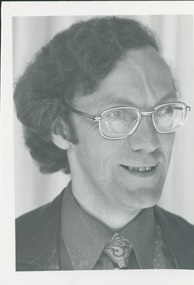
... He has been involved with, lectured in, studied at, worked for, chaired committees or directed at one or more times — La Trobe University, Christian Television Association, Australian Consultation on Liturgy, UCA Assembly committees, Lincoln College, England, Brugge Catholic Faculty, Oxford Institute for Methodist Theological Studies, Graduate School in Ecumenism at Bosse, the English Language Liturgical Consultation, World Methodist Council, World Council of Churches, Christian Unity Working Group, the Victorian Casino and Gambling Authority, Centre for Ecumenical Studies, Cambridge Society of Australia, Fellow of the School of Historical Studies Melbourne University, Queen’s College Council, Fellow of Queen’s College, Editor of the Australian Journal of Liturgy, Professorial Fellow of Charles Sturt University, President of the Cornish Association of Victoria, and member of the Council of the Genealogical Society of Victoria. ...He has been involved with, lectured in, studied at, worked for, chaired committees or directed at one or more times — La Trobe University, Christian Television Association, Australian Consultation on Liturgy, UCA Assembly committees, Lincoln College, England, Brugge Catholic Faculty, Oxford Institute for Methodist Theological Studies, Graduate School in Ecumenism at Bosse, the English Language Liturgical Consultation, World Methodist Council, World Council of Churches, Christian Unity Working Group, the Victorian Casino and Gambling Authority, Centre for Ecumenical Studies, Cambridge Society of Australia, Fellow of the School of Historical Studies Melbourne University, Queen’s College Council, Fellow of Queen’s College, Editor of the Australian Journal of Liturgy, Professorial Fellow of Charles Sturt University, President of the Cornish Association of Victoria, and member of the Council of the Genealogical Society of Victoria. ...The Rev. Dr Robert Gribben was born in 1943 in country Victoria where he was educated through primary and secondary state schools. He entered Queen’s College in 1961 in order to study degrees in law and arts, but after two years discontinued his legal studies and completed his Bachelor of Arts whilst beginning his candidature for the Methodist ministry. In 1965 he and his wife Susan became engaged, but before he could begin his theological studies he was offered the opportunity to undertake his theological studies in Cambridge University in Wesley House. After Susan completed her law degree with honours at Melbourne University, she followed Robert to England in June 1967, and they were married in June 1968 as Robert was completing his Cambridge B.A. He’d received notice that his first Methodist ministry appointment was to be in “Portland No. 2”, but as they had six months before he was to take that up, they moved to India where Robert worked for the Student Christian Movement and Susan for the Church of South India sorting out their legal records. Robert’s placements that followed in the Methodist Church were Portland and Heywood and Highbury Grove Kew, and in the Uniting Church as chaplain of Ormond College, Trinity Church North Balwyn, General Secretary of the Victorian Council of Churches, Wesley Church Melbourne, and Professor of Worship and Mission at the UCA Theological Hall and UFT. He formally retired in 2008. He has been involved with, lectured in, studied at, worked for, chaired committees or directed at one or more times — La Trobe University, Christian Television Association, Australian Consultation on Liturgy, UCA Assembly committees, Lincoln College, England, Brugge Catholic Faculty, Oxford Institute for Methodist Theological Studies, Graduate School in Ecumenism at Bosse, the English Language Liturgical Consultation, World Methodist Council, World Council of Churches, Christian Unity Working Group, the Victorian Casino and Gambling Authority, Centre for Ecumenical Studies, Cambridge Society of Australia, Fellow of the School of Historical Studies Melbourne University, Queen’s College Council, Fellow of Queen’s College, Editor of the Australian Journal of Liturgy, Professorial Fellow of Charles Sturt University, President of the Cornish Association of Victoria, and member of the Council of the Genealogical Society of Victoria. He has written some seven books and edited both editions of Uniting in Worship. On top of all that he has visited, worked in, or represented one body or another in — Colombo, Cairo, Rome, Geneva, Parish, the UK, Bangalore, Mysore, Madras, Kottoyam, Agra, Jaipur, Sri Lanka, Malaysia, Philippines, Japan, Hong Kong, the USA, Canada, Vienna, Israel, Netherlands, Poland, Bangkok, Singapore, Romania, Bucharest, Bulgaria, Greece, Syria, Lebanon, Cyprus, Turkey, Zimbabwe, Ethiopia, Jordan, Italy, Tonga, Finland, Germany, Norway, Denmark, Samoa, South Africa, Spain, Sicily, Chile, Indonesia, New Zealand, Ghana, Nigeria, Russia, Antigua and Jamaica. And on top of all that, he’s had two audiences with the Pope! Susan and Robert have two children and three grandchildren. Head and shoulders portrait of Rev. Dr Robert Gribben."Rev. Dr Robert Gribben", "Church & Nation"rev. dr robert gribben; liturgy; theological hall melbourne -
 Uniting Church Archives - Synod of Victoria
Photograph, C. 1870s
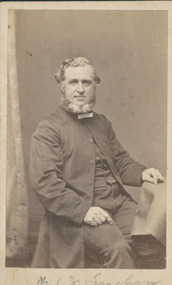
... Methodist home he attended the Paterson Street Sunday school and was 'converted' under the ministry of Rev. William Butters. In 1847 the family moved to Victoria where Langham joined the Fitzroy Church. After two years training as a teacher in Britain he returned to Melbourne...Methodist home he attended the Paterson Street Sunday school and was 'converted' under the ministry of Rev. William Butters. In 1847 the family moved to Victoria where Langham joined the Fitzroy Church. After two years training as a teacher in Britain he returned to Melbourne ...ADB entry: http://adb.anu.edu.au/biography/langham-frederick-3987 Frederick Langham (1833-1903), Wesleyan missionary, was born on 24 April 1833 at Launceston, Van Diemen's Land, son of Samuel Langham, builder, and his wife Eliza, née Robinson. Nurtured in a Methodist home he attended the Paterson Street Sunday school and was 'converted' under the ministry of Rev. William Butters. In 1847 the family moved to Victoria where Langham joined the Fitzroy Church. After two years training as a teacher in Britain he returned to Melbourne and on 16 November 1854 at Richmond married Ann Elizabeth Knight. In January 1855 Langham became headmaster of the Wesleyan Denominational School at Barker Street, Castlemaine, where he was a contemporary of Shirley Baker at the other Wesleyan school. Influenced by Rev. Thomas Raston to consider missionary work, Langham was prepared for the ministry by Rev. John Harcourt and in 1858 was received into the Victorian Conference. He was appointed to Fiji where he arrived in June. Langham served at Lakemba in 1858-63, Bau in 1864-66 and Viwa in 1868-70. As one of the assertive 'colonial young men', he was resented at first by Rev. James Calvert and his colleagues, but Langham soon dominated the mission and was chairman of the Fiji district in 1869-94. From 1871 he lived at Bau where he won repute among Methodists as King Cakobau's adviser. Although his policies did not please all the missionaries, they accepted him as their spokesman. Believing himself the champion of the Fijians he encouraged annexation by Britain, but often nettled the colonial administrators by his paternalism and lack of imagination. To his colleagues he was 'Father' Langham and Sir Arthur Gordon referred to him as 'The Cardinal'. In 1874-75 and 1890 Langham and his wife visited Melbourne mainly for their health. They finally left Fiji in April 1895 and lived in Sydney where Langham worked on the revision of the Fijian Bible. Though always reluctant in Australia to travel on deputationary work, he identified himself with the Orange cause and was easily persuaded to give anti-Catholic missionary lectures, which involved him in public controversy with Cardinal Patrick Moran. In 1898 Langham went to England to see his New Testament through the press. The subsequent burning of some testaments at the Roman Catholic mission at Namosi received much publicity in Australia. Langham's wife had helped his revision and was author of many Fijian hymns. Their adopted (European) daughter Annie Langham Lindsay died on 21 December 1901, just before the revised Old Testament was completed. His wife did not recover from this shock and died on 5 January 1902. Langham became a supernumerary in 1901 and travelled on deputationary work in Britain, mainly for the British and Foreign Bible Society, of which he was a life governor. He also shared in the 'simultaneous mission' of the Evangelical churches. In addition to the Fijian Bible he had published other works in Fijian, some in conjunction with other authors. Recommended by Sir William MacGregor, Langham was awarded a doctorate of divinity by the University of Glasgow. He died at Wilton Villa, Albion Grove, Hackney, on 21 June 1903 and was buried in Abney Park cemetery. Although he bequeathed a 'cannibal fork with human bone attached' to a sister in Melbourne, the rest of his Fijian collection was sold. He instructed his trustees to destroy his journals and correspondence but many of his original letters are in other collections. Physically impressive with leonine hair and beard, Langham cut his missionary role in the cloth of the schoolmaster. As a disciplinarian his punishments were severe but tempered with justice; he once insisted on being caned by a wrongfully punished boy. His relentless energy and simple piety won him renown as a great missionary by his denomination and those of the religious public familiar with the romanticized version of his career. Sepia toned carte de visite studio portrait of the Rev. Frederick Langham"Langham c.1873-77"rev frederick langam, wesleyan methodist missionary, minister, fiji -
 Uniting Church Archives - Synod of Victoria
Photograph, Before 1919
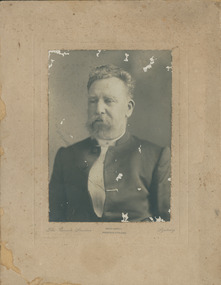
... Victoria he arrived in Adelaide in 1867 to take charge of the Pirie-street Church. He received three ap-pointments as pastor at Pirie-street, two at Kent Town, and two at North Ade-laide (Archer-street), and he was also at Burra, Gawler, and Moonta. He was president of the Wesleyan Methodist Con-ference in 1877. In 1889 he returned to Victoria, and among the circuits of which he had charge at different times were Brunswick-st (Melbourne...Victoria he arrived in Adelaide in 1867 to take charge of the Pirie-street Church. He received three ap-pointments as pastor at Pirie-street, two at Kent Town, and two at North Ade-laide (Archer-street), and he was also at Burra, Gawler, and Moonta. He was president of the Wesleyan Methodist Con-ference in 1877. In 1889 he returned to Victoria, and among the circuits of which he had charge at different times were Brunswick-st (Melbourne ...B. 1835 England, D. 1919 Christchurch NZ. Methodist minister. Chronicle 17 May 1919, p.43: Deep regret will be felt in South Aus-tralia at the passing away of the Rev. Samuel Knight, one of the best-known and most loved of the earlier ministers of the Wesleyan Methodist Church in Australia. The announcement of the death of Mr. Knight, who was in his 85th year, was received by cable on May 11 from Christ-church, New Zealand, where he had re-sided during the last few years with his only son, the Rev. Percy N. Knight, B.A. The veteran preacher spent over twenty years of his busy and useful life in this State. His last visit to Adelaide was in July, 1915, and it was through his agency and influence that £1,150 was raised for the reduction of the debt on the Archer-street Methodist Church. At that time, except for his head being crowned with snow-white hair, there was little in Mr. Knight's appearance to indicate his great age. He was obviously perfectly happy, and was still the tender shepherd who was so well beloved by his flock when he labored in South Australia. The older members of the Methodist Church remember well the splendid work he did more than half a century ago. He won similarly widespread respect in Vic-toria when he was transferred to the Con-ference there. He had charge of the prin-cipal circuits in both States, and he was equally successful as an eloquent preacher, a sympathetic and an assiduous pastor, and a wise and prudent administrator. His presence in the pulpit was always greeted by a large congregation, and the earnest-ness and spiritually of his discourses never failed to impress them. He was imbued with the true spirit of Methodism, and he had a firm and confident belief in the doctrines which he inculcated with such emotional fervor. Mr. Knight was a broad-minded, genial man with a keen sense of humor, and he shone on the platform. A true Christian, he was also a man of the world, and he could, when appealed to, give valuable counsel. He was a friend to be trusted, and he was ever ready to help those in need of his practical sympathy or his well-considered advice. He lived in an era of great Australian Methodists, and he was one of the greatest among them. Mr. Knight was an indefatigable worker, and under his control all the institutions of the circuits in which he worked nourished abundantly. He was a guide, philosopher, and friend to the younger ministers and exercised a great influence for good in Conference. Mr. Knight was born in Liverpool in 1834 and came to Australia in 1854. After spending several years in Victoria he arrived in Adelaide in 1867 to take charge of the Pirie-street Church. He received three ap-pointments as pastor at Pirie-street, two at Kent Town, and two at North Ade-laide (Archer-street), and he was also at Burra, Gawler, and Moonta. He was president of the Wesleyan Methodist Con-ference in 1877. In 1889 he returned to Victoria, and among the circuits of which he had charge at different times were Brunswick-st (Melbourne), St. Kilda, Ballarat, and Geelong. His activities by no means ceased after he went on the supernumerary list. For some years he was connected with Queen's College (Uni-versity of Melbourne), for which he col-lected a large sum for the liquidation of certain liabilities. The Samuel Knight scholarship was founded last year at Queen's College in his honor. Mr. Knight had taken up in recent years the work of establishing ministers in new circuits and of helping struggling churches. He undertook an energetic campaign of attack upon the debts on various churches that, recognising what his personality could do for them, had appealed to him for assistance, and achieved remarkable success in placing the finances on a sounder footing. A considerable portion of his own income in recent years was devoted to the assistance of young ministers, and to aug-menting the stipends that could be offered by newly established circuits in various parts of Victoria. Mr. Knight had been a widower for many years. His only daughter, Dr. Adela Knight, who appeared to have a brilliant career before her in medicine, died in Vienna about 25 years ago. The Rev. Samuel Knight was for many years a close personal friend of the late Sir Samuel Way, with whom he always stayed when visiting Adelaide. His death was a subject of reference at a number of Methodist churches in and around Ade-laide.B & W head & shoulders studio portrait of Rev. Samuel Knight, mounted on buff card.Rev. S. Knightknight, samuel, rev. -
 Uniting Church Archives - Synod of Victoria
Printed image, Rev. Oswald W S McCall
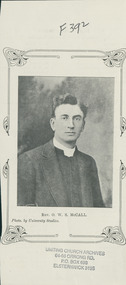
... Victoria in 1885. Minister of the Methodist Church of Australia 1912 - 1921. Married Florence May Jones in 1914. Egypt, England, France with the AIF 1918-1919 (YMCA). D.D. 1924. Lecturer on international, public and literary topics. Moved to the United States in 1921, and was appointed pastor of the First Congregational Church in Berkeley California. Visited his brother W.V. McCall, Clerk of Melbourne...Victoria in 1885. Minister of the Methodist Church of Australia 1912 - 1921. Married Florence May Jones in 1914. Egypt, England, France with the AIF 1918-1919 (YMCA). D.D. 1924. Lecturer on international, public and literary topics. Moved to the United States in 1921, and was appointed pastor of the First Congregational Church in Berkeley California. Visited his brother W.V. McCall, Clerk of Melbourne ...Born in Flemington Victoria in 1885. Minister of the Methodist Church of Australia 1912 - 1921. Married Florence May Jones in 1914. Egypt, England, France with the AIF 1918-1919 (YMCA). D.D. 1924. Lecturer on international, public and literary topics. Moved to the United States in 1921, and was appointed pastor of the First Congregational Church in Berkeley California. Visited his brother W.V. McCall, Clerk of Melbourne in 1925. Died in Connecticut in 1959.Head and shoulder printed image of the Rev. Oswald Walter Samuel McCall."Rev O.W.S. McCall" Image has been cut out of a publication with listings of churches and ministers on the reversemccall, ows, rev., first congregational church, berkley california -
 Uniting Church Archives - Synod of Victoria
Photograph, Undated c.1960
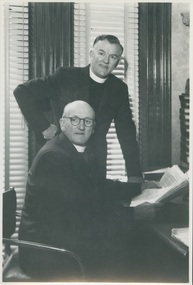
... Victoria in 1950 and was appointed by the Methodist Church as a Home Missionary at Lancefield. Accepted as a candidate for the ministry in 1952 and appointed Probationary Minister to Colac (Elliminyt). Ordained in 1958 and served 7 years as Secretary of the Home Missions Department (1957 - 1864), 6 years as Chaplain of the Royal Melbourne and Royal Children's Hospitals (1964 - 1970) and 7 years in the Footscray Yarraville Circuit (1970 - 1977. ...Victoria in 1950 and was appointed by the Methodist Church as a Home Missionary at Lancefield. Accepted as a candidate for the ministry in 1952 and appointed Probationary Minister to Colac (Elliminyt). Ordained in 1958 and served 7 years as Secretary of the Home Missions Department (1957 - 1864), 6 years as Chaplain of the Royal Melbourne and Royal Children's Hospitals (1964 - 1970) and 7 years in the Footscray Yarraville Circuit (1970 - 1977. ...Rev Alec Pederick (1902 - 1972). Trained at Queen's College. Commenced his ministry at Zeehan, Tasmania in 1927. In 1929 he went to Rabaul P.N.G. and to Piniqidu in 1931. Returning to Australia in 1933 was appointed to Beaufort Circuit and then to the Methodist Home Missions Department. Served as a Chaplain in the A.I.F 1942 - 1944. After discharge from the army Rev. Pederick resumed working with Home Missions, becoming General Superintendent and residing at “Otira”, the Home Mission Training College in Kew, at which he was also principal. President of Conference in 1955. Died 19 August 1972. Rev Andrew J. Pearce (1912 - 1986) Entered the Salvation Army Training College in 1934. Joined the United Aborigines Mission and served 2 years in Oolea and 10 years in Finnis Spring. Returned to Victoria in 1950 and was appointed by the Methodist Church as a Home Missionary at Lancefield. Accepted as a candidate for the ministry in 1952 and appointed Probationary Minister to Colac (Elliminyt). Ordained in 1958 and served 7 years as Secretary of the Home Missions Department (1957 - 1864), 6 years as Chaplain of the Royal Melbourne and Royal Children's Hospitals (1964 - 1970) and 7 years in the Footscray Yarraville Circuit (1970 - 1977. Retired in 1977. B & W photograph of the Revs. Alec W. Pederick (seated) and Andrew J. Pearce (standing) in the office of Otira Home Missionary Training College.alec pederick, methodist, minister, home missions, overseas missions, chaplain a.i.f., otira, president of conference, andrew pearce, salvation army, united aborigines mission, methodist, minister, home missionary, secretary home missions department, chaplain royal melbourne hospital, royal children's hospital -
 Uniting Church Archives - Synod of Victoria
Photograph, Undated c.1960
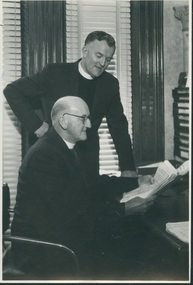
... Victoria in 1950 and was appointed by the Methodist Church as a Home Missionary at Lancefield. Accepted as a candidate for the ministry in 1952 and appointed Probationary Minister to Colac (Elliminyt). Ordained in 1958 and served 7 years as Secretary of the Home Missions Department (1957 - 1864), 6 years as Chaplain of the Royal Melbourne and Royal Children's Hospitals (1964 - 1970) and 7 years in the Footscray Yarraville Circuit (1970 - 1977. ...Victoria in 1950 and was appointed by the Methodist Church as a Home Missionary at Lancefield. Accepted as a candidate for the ministry in 1952 and appointed Probationary Minister to Colac (Elliminyt). Ordained in 1958 and served 7 years as Secretary of the Home Missions Department (1957 - 1864), 6 years as Chaplain of the Royal Melbourne and Royal Children's Hospitals (1964 - 1970) and 7 years in the Footscray Yarraville Circuit (1970 - 1977. ...Rev Alec Pederick (1902 - 1972). Trained at Queen's College. Commenced his ministry at Zeehan, Tasmania in 1927. In 1929 he went to Rabaul P.N.G. and to Piniqidu in 1931. Returning to Australia in 1933 was appointed to Beaufort Circuit and then to the Methodist Home Missions Department. Served as a Chaplain in the A.I.F 1942 - 1944. After discharge from the army Rev. Pederick resumed working with Home Missions, becoming General Superintendent and residing at “Otira”, the Home Mission Training College in Kew, at which he was also principal. President of Conference in 1955. Died 19 August 1972. Rev Andrew J. Pearce (1912 - 1986) Entered the Salvation Army Training College in 1934. Joined the United Aborigines Mission and served 2 years in Oolea and 10 years in Finnis Spring. Returned to Victoria in 1950 and was appointed by the Methodist Church as a Home Missionary at Lancefield. Accepted as a candidate for the ministry in 1952 and appointed Probationary Minister to Colac (Elliminyt). Ordained in 1958 and served 7 years as Secretary of the Home Missions Department (1957 - 1864), 6 years as Chaplain of the Royal Melbourne and Royal Children's Hospitals (1964 - 1970) and 7 years in the Footscray Yarraville Circuit (1970 - 1977. Retired in 1977. B & W photograph of the Revs. Alec W. Pederick (seated) and Andrew J. Pearce (standing) in the office of Otira Home Missionary Training College.alec pederick, methodist, minister, home missions, overseas missions, chaplain a.i.f., otira, president of conference, andrew pearce, salvation army, united aborigines mission, methodist, minister, home missionary, secretary home missions department, chaplain royal melbourne hospital, royal children's hospital -
 Uniting Church Archives - Synod of Victoria
Photograph, 1981
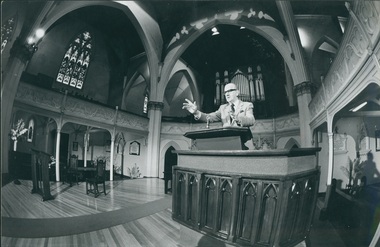
... Victoria. From 1968 until his retirement at the end of 1981, Arthur Preston was the Superintendent of what is now Wesley Central Parish Mission (Central Methodist Mission prior to Church Union in 1977. In 1982 he was awarded the Order of Australia. Arthur Preston died on 19 March 1985. Arthur Preston, Methodist, minister, Wesley Church, Life Line B & W gloss fish eye photograph of the Rev Arthur Preston preaching from the pulpit in Wesley Church, Lonsdale St. Melbourne ...Arthur William Preston was born in 1912. Following his ordination into the Methodist Church he was stationed in Mareeba and Townsville in North Queensland. From 1944 to 1948 he was Field Secretary for the Queensland Methodist Centenary Celebrations, conducting evangelistic missions throughout Queensland and assisting in raising the sum of 100,000 pounds for development work within the Queensland Methodist Church. From 1948 to 1963 he was superintendent of the West End Methodist Mission in Brisbane. In 1963 he was awarded the O.B.E. From 1963 - 1966 he was Associated Minister at the Adelaide Central Mission. During his ministry in Adelaide he established and directed the Life Line Telephone Counselling Service. During 1966 and 1968 he was Associate Minister in the Glen Iris Circuit, Victoria. From 1968 until his retirement at the end of 1981, Arthur Preston was the Superintendent of what is now Wesley Central Parish Mission (Central Methodist Mission prior to Church Union in 1977. In 1982 he was awarded the Order of Australia. Arthur Preston died on 19 March 1985.B & W gloss fish eye photograph of the Rev Arthur Preston preaching from the pulpit in Wesley Church, Lonsdale St. Melbourne. arthur preston, methodist, minister, wesley church, life line -
 Uniting Church Archives - Synod of Victoria
Photograph, 1982
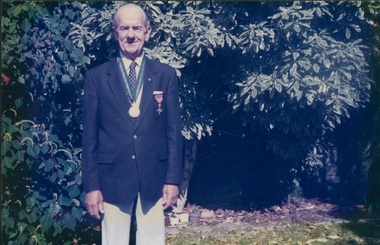
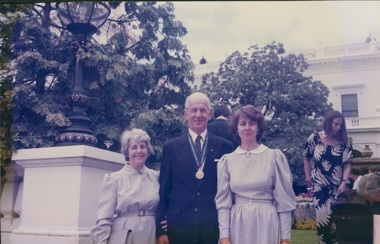
... Victoria. From 1968 until his retirement at the end of 1981, Arthur Preston was the Superintendent of what is now Wesley Central Parish Mission (Central Methodist Mission prior to Church Union in 1977. In 1982 he was awarded the Order of Australia. Arthur Preston died on 19 March 1985. arthur preston, methodist, minister, wesley church, life line order of australia Informal gloss coloured photograph of the Rev Arthur Preston standing in the grounds of Government House, Melbourne. ...Arthur William Preston was born in 1912. Following his ordination into the Methodist Church he was stationed in Mareeba and Townsville in North Queensland. From 1944 to 1948 he was Field Secretary for the Queensland Methodist Centenary Celebrations, conducting evangelistic missions throughout Queensland and assisting in raising the sum of 100,000 pounds for development work within the Queensland Methodist Church. From 1948 to 1963 he was superintendent of the West End Methodist Mission in Brisbane. In 1963 he was awarded the O.B.E. From 1963 - 1966 he was Associated Minister at the Adelaide Central Mission. During his ministry in Adelaide he established and directed the Life Line Telephone Counselling Service. During 1966 and 1968 he was Associate Minister in the Glen Iris Circuit, Victoria. From 1968 until his retirement at the end of 1981, Arthur Preston was the Superintendent of what is now Wesley Central Parish Mission (Central Methodist Mission prior to Church Union in 1977. In 1982 he was awarded the Order of Australia. Arthur Preston died on 19 March 1985.Informal gloss coloured photograph of the Rev Arthur Preston standing in the grounds of Government House, Melbourne. He is wearing his Order of Australia Award medallionarthur preston, methodist, minister, wesley church, life line, order of australia -
 Uniting Church Archives - Synod of Victoria
Photograph, 1982
... Victoria. From 1968 until his retirement at the end of 1981, Arthur Preston was the Superintendent of what is now Wesley Central Parish Mission (Central Methodist Mission prior to Church Union in 1977. In 1982 he was awarded the Order of Australia. Arthur Preston died on 19 March 1985. arthur preston, methodist, minister, wesley church, life line order of australia claire preston, adele preston Informal gloss coloured photograph of the Rev Arthur Preston standing in the grounds of Government House, Melbourne with his wife Mrs Claire Preston and his daughter Miss Adel Preston. ...Arthur William Preston was born in 1912. Following his ordination into the Methodist Church he was stationed in Mareeba and Townsville in North Queensland. From 1944 to 1948 he was Field Secretary for the Queensland Methodist Centenary Celebrations, conducting evangelistic missions throughout Queensland and assisting in raising the sum of 100,000 pounds for development work within the Queensland Methodist Church. From 1948 to 1963 he was superintendent of the West End Methodist Mission in Brisbane. In 1963 he was awarded the O.B.E. From 1963 - 1966 he was Associated Minister at the Adelaide Central Mission. During his ministry in Adelaide he established and directed the Life Line Telephone Counselling Service. During 1966 and 1968 he was Associate Minister in the Glen Iris Circuit, Victoria. From 1968 until his retirement at the end of 1981, Arthur Preston was the Superintendent of what is now Wesley Central Parish Mission (Central Methodist Mission prior to Church Union in 1977. In 1982 he was awarded the Order of Australia. Arthur Preston died on 19 March 1985.Informal gloss coloured photograph of the Rev Arthur Preston standing in the grounds of Government House, Melbourne with his wife Mrs Claire Preston and his daughter Miss Adel Preston. He is wearing his Order of Australia Award medallion.arthur preston, methodist, minister, wesley church, life line, order of australia, claire preston, adele preston -
 Uniting Church Archives - Synod of Victoria
photograph, Undated c.1890s
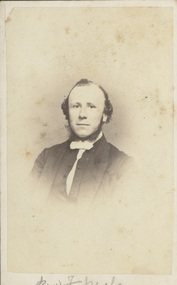
... Methodist minister. Born 1840 England, ministry in Victoria commenced 1862, died 1906 Melbourne. Minister of Paterson Street Methodist Church, Launceston, from 1889 to 1892. ...Methodist minister. Born 1840 England, ministry in Victoria commenced 1862, died 1906 Melbourne. Minister of Paterson Street Methodist Church, Launceston, from 1889 to 1892. ...Methodist minister. Born 1840 England, ministry in Victoria commenced 1862, died 1906 Melbourne. Minister of Paterson Street Methodist Church, Launceston, from 1889 to 1892. Chairman of Wesleyan Methodist District Synod (Victoria) in 1894.Sepia toned carte de visite. Head and shoulders studio portrait of the Rev. Francis NealeRev F. Nealerev francis neale, methodist, minister, launceston, wesleyan, paterson street methodist church -
 Uniting Church Archives - Synod of Victoria
Photograph, Undated c.1915 - 1918
... church in many circuits in Tasmania and Victoria. Before the war he was superintendent of the Methodist Mission at Collingwood,and after his return from overseas he occupied important positions, including those of superintendent minister in the Brunswick, Port Melbourne, and Yarra street, Geelong, circuits. ...church in many circuits in Tasmania and Victoria. Before the war he was superintendent of the Methodist Mission at Collingwood,and after his return from overseas he occupied important positions, including those of superintendent minister in the Brunswick, Port Melbourne, and Yarra street, Geelong, circuits. ...Born 26 June 1865 at Manchester, England Husband of Mrs. Edith Ann Maria GAULT Of 'The Inglenook', Sea Parade, Cheltenham, Vic. Aged 50 years Enlisted 01 July 1915 for Continuous Service Embarked 16 July 1915 per 'HMAT Demosthenes' from Melbourne, Vic Pay rate of 19s 0d after embarkation Embarked 29 March 1916 per 'RMS Orontes' from Melbourne, Vic. Served in Egypt and on the Western Front Returned to Australia 01 November 1919 Awarded OBE Death of Rev. J. A. Gault The Rev. J. A. Gault, a Methodist minister, who was widely known to Australian soldiers as Padre Gault, died yesterday after a long illness. One of the best-loved padres in the AIF, Mr. Gault served for four years with the Australians, at first in Egypt and later in France and England. After the war, he continued to show great interest in returned soldiers and work in training camps. When he retired in February, 1934, Mr. Gault had been in the ministry for 40 years. Bom at Manchester. England on June 10, 1865 he came to Australia when aged three years in the sailing-ship Antiope. He was educated at Gold street State school and later at Wesley College. After his appointment as a minister, he served the church in many circuits in Tasmania and Victoria. Before the war he was superintendent of the Methodist Mission at Collingwood,and after his return from overseas he occupied important positions, including those of superintendent minister in the Brunswick, Port Melbourne, and Yarra street, Geelong, circuits. His last charge was at Camberwell. After ill-health caused him to retire, he lived at Mentone. He has left a widow, a son, and two daughters. Dr. Edward Gault. of Collins street, is a brother, and there are two sisters in New Zealand. The funeral will leave Mr. Gault's home In Sea parade, Mentone, tomorrow, at 2p.m., for the Methodist Church, Mentone. It will then proceed to the Springvale Crematorium. W. D. Rose and Son. Cheltenham, are making the arrangemnts. R.S.L. Tribute "Returned soldiers will learn of the death of Padre Gault with deep regret," said the president of the Returned Soldiers' League (Mr. G. W. Holland) lastnight. "He was revered by the AIF. for his unfailing sympathy, understanding, and comradeship." - from the Melbourne Argus 02 Feb 1938 "REV. J. A. GAULT. BELOVED A.I.F."PADRE." Death After A Long Illness. After a long Illness, the death occurred at his home at Mentone yesterday afternoon, of Rev. James Archibald ("Padre") Gault, one of the best known and beloved Methodist chaplains to the A.I.F. at Galllpoli and in France. Sorrow at the "padre's" demise, at the age of 72 years, will be shared not only by the thousands to whom he rendered, both spiritual and temporal comfort during the war, but, also by a host of friends won during a long and. fruitful, ministry at many centres in the State, and as chaplain at military camps after the war. He retired from the ministry three years ago, and had suffered Ill-health from that time. Deceased entered the Methodist ministry in 1894, and was ordained four years later. After a successful year as conference evangelist. he was stationed at Mansfield, then at Richmond. Following a ministry at Richmond he was transferred to Tasmania, where for twelve years he exercised his ministry at Mt Lyell Launceston, Penguin and Hobart. Returning to Victoria, Mr. Gault was stationed at St. Kilda, and when the war broke out he was associated with the Colllngwood Mission. He left on active service as a chaplain with the first troops, and was ' present ' throughout the Galllpoli campaign. Later he was with the forces In France, and remained on active service until the last of the troops were demobilised to 1920. He was affectionately known as "padre"after the war to the thousands of soldiers who had learned to regard him as guide, philosopher and friend In the trenches. He was noted always for the good cheer he invariably brought to the troops, and his famous "stunts" among the men were subsequently recorded by him in his publication, "The Stunt Book." For services rendered he was made a member of the Order of the British Empire. On his return to Australia In 1920 he was stationed at Brunswick for three years, and then followed ministries at Port Melbourne, Spring-road, Malvern and finally at Camberwell. A deeply spiritual man, he brought a rare devotion to his ministry, and was beloved by his congregations and ministerial brethren alike. He shunned the limelight, and was one of the most retiring men in conference affairs. The deceased is survived by a widow, two daughters and, one, son. Dr. Edward L. Gaul is a brother." - from the Melbourne Age 02 Feb 1938 B & W waist length studio portrait of the Rev. James Archibald Gault dressed in uniform as Chaplain to the A.I.F. Mounted on grey card.Padre J.A. Gault OBE -
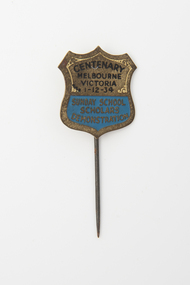 Uniting Church Archives - Synod of Victoria
Badge, 1934
... The Methodist Church Sunday School Anniversary Celebration held at Pinnaroo, South Australia in April 1934. "CENTENARY MELBOURNE VICTORIA 1-12-34" "SUNDAY SCHOOL SCHOLARS DEMONSTRATION" Shield shaped blue and gold enamel lapel badge on a pin. ...The Methodist Church Sunday School Anniversary Celebration held at Pinnaroo, South Australia in April 1934.Shield shaped blue and gold enamel lapel badge on a pin."CENTENARY MELBOURNE VICTORIA 1-12-34" "SUNDAY SCHOOL SCHOLARS DEMONSTRATION"
