
Showing 206 items matching "middlesex"
-
 Wangaratta RSL Sub Branch
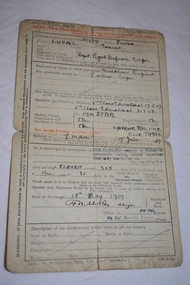
Certificate - Discharge Certificate, Private Ernest LUCAS 88379 Middlesex Regt
... Private Ernest LUCAS 88379 Middlesex Regt....Discharge certificate dated 18.5.1919 belonging to Private Ernest LUCAS 88399 Royal Defence Corps Middlesex Regiment who enlisted in London on 7.6.1907...88379 Private Ernest LUCAS Dept Royal Defence Corps - Middlesex Regiment. Enlisted London on 17th of June 1907 and discharged on 18th of May 1919....Discharge certificate dated 18.5.1919 belonging to Private Ernest LUCAS 88399 Royal Defence Corps Middlesex Regiment who enlisted in London on 7.6.1907 ernest lucas 6th battalion middlesex regiment 88379 Private Ernest LUCAS Dept Royal Defence Corps - Middlesex Regiment. ...Discharge certificate dated 18.5.1919 belonging to Private Ernest LUCAS 88399 Royal Defence Corps Middlesex Regiment who enlisted in London on 7.6.1907Off white coloured cardboard document with black and red printing88379 Private Ernest LUCAS Dept Royal Defence Corps - Middlesex Regiment. Enlisted London on 17th of June 1907 and discharged on 18th of May 1919.ernest lucas, 6th battalion middlesex regiment -
 Warrnambool RSL Sub Branch
Uniform - Shoulder Badge, Middlesex Regiment
... Middlesex Regiment...'MIDDLESEX' on curve...'MIDDLESEX' on curve metal Middlesex Regiment Uniform Shoulder Badge ...metal'MIDDLESEX' on curve -
 Flagstaff Hill Maritime Museum and Village
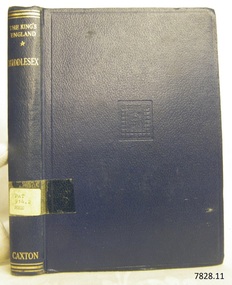
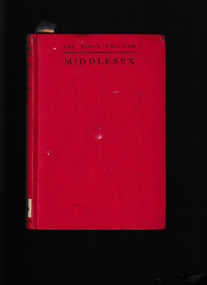
Book, The King's England - Middlesex
... The King's England - Middlesex...The King's England - Middlesex Little Home County Edited by Arthur Mee Publisher: The Caxton Publishing Co ...The Warrnambool Mechanics' Institute’s publication collection is of both local and state significance. warrnambool shipwrecked-coast flagstaff-hill flagstaff-hill-maritime-museum maritime-museum shipwreck-coast flagstaff-hill-maritime-village shipwrecked-artefact book pattison collection warrnambool library warrnambool mechanics’ institute ralph eric pattison corangamite regional library service warrnambool city librarian mechanics’ institute library victorian library board warrnambool books and records warrnambool children’s library great ocean road The King's England Arthur Mee The King's England - Middlesex Label on spine cover with typed text PAT 914.2 MEE Pastedown front endpaper has sticker from Warrnambool Public Library covered by a sticker from Corangamite Regional Library Service Front loose endpaper has a stamp from Corangamite Regional Library Service The King's England - Middlesex Little Home County Edited by Arthur Mee Publisher: The Caxton Publishing Co The King's England - Middlesex Book ...This item is from the ‘Pattison Collection’, a collection of books and records that was originally owned by the Warrnambool Mechanics’ Institute, which was founded in Warrnambool in 1853. By 1886 the Warrnambool Mechanics’ Institute (WMI) had grown to have a Library, Museum and Fine Arts Gallery, with a collection of “… choice productions of art, and valuable specimens in almost every branch and many wonderful national curiosities are now to be seen there, including historic relics of the town and district.” It later included a School of Design. Although it was very well patronised, the lack of financial support led the WMI in 1911 to ask the City Council to take it over. In 1935 Ralph Pattison was appointed as City Librarian to establish and organise the Warrnambool Library as it was then called. When the WMI building was pulled down in 1963 a new civic building was erected on the site and the new Warrnambool Library, on behalf of the City Council, took over all the holdings of the WMI. At this time some of the items were separated and identified as the ‘Pattison Collection’, named after Ralph Pattison. Eventually the components of the WMI were distributed from the Warrnambool Library to various places, including the Art Gallery, Historical Society and Flagstaff Hill. Later some were even distributed to other regional branches of Corangamite Regional Library and passed to and fro. It is difficult now to trace just where all of the items have ended up. The books at Flagstaff Hill Maritime Village generally display stamps and markings from Pattison as well as a variety of other institutions including the Mechanics’ Institute itself. RALPH ERIC PATTISON Ralph Eric Pattison was born in Rockhampton, Queensland, in 1891. He married Maude Swan from Warrnambool in 1920 and they set up home in Warrnambool. In 1935 Pattison accepted a position as City Librarian for the Warrnambool City Council. His huge challenge was to make a functional library within two rooms of the Mechanics’ Institute. He tirelessly cleaned, cleared and sorted a disarrayed collection of old books, jars of preserved specimens and other items reserved for exhibition in the city’s museum. He developed and updated the library with a wide variety of books for all tastes, including reference books for students; a difficult task to fulfil during the years following the Depression. He converted all of the lower area of the building into a library, reference room and reading room for members and the public. The books were sorted and stored using a cataloguing and card index system that he had developed himself. He also prepared the upper floor of the building and established the Art Gallery and later the Museum, a place to exhibit the many old relics that had been stored for years for this purpose. One of the treasures he found was a beautiful ancient clock, which he repaired, restored and enjoyed using in his office during the years of his service there. Ralph Pattison was described as “a meticulous gentleman whose punctuality, floorless courtesy and distinctive neat dress were hallmarks of his character, and ‘his’ clock controlled his daily routine, and his opening and closing of the library’s large heavy doors to the minute.” Pattison took leave during 1942 to 1945 to serve in the Royal Australian Navy, Volunteer Reserve as Lieutenant. A few years later he converted one of the Museum’s rooms into a Children’s Library, stocking it with suitable books for the younger generation. This was an instant success. In the 1950’s he had the honour of being appointed to the Victorian Library Board and received more inspiration from the monthly conferences in Melbourne. He was sadly retired in 1959 after over 23 years of service, due to the fact that he had gone over the working age of council officers. However he continued to take a very keen interest in the continual development of the Library until his death in 1969. The Pattison Collection, along with other items at Flagstaff Hill Maritime Village, was originally part of the Warrnambool Mechanics' Institute’s collection. The Warrnambool Mechanics’ Institute Collection is primarily significant in its totality, rather than for the individual objects it contains. Its contents are highly representative of the development of Mechanics' Institute libraries across Australia, particularly Victoria. A diversity of publications and themes has been amassed, and these provide clues to our understanding of the nature of and changes in the reading habits of Victorians from the 1850s to the middle of the 20th century. The collection also highlights the Warrnambool community’s commitment to the Mechanics’ Institute, reading, literacy and learning in the regions, and proves that access to knowledge was not impeded by distance. These items help to provide a more complete picture of our community’s ideals and aspirations. The Warrnambool Mechanics Institute book collection has historical and social significance for its strong association with the Mechanics Institute movement and the important role it played in the intellectual, cultural and social development of people throughout the latter part of the nineteenth century and the early twentieth century. The collection of books is a rare example of an early lending library and its significance is enhanced by the survival of an original collection of many volumes. The Warrnambool Mechanics' Institute’s publication collection is of both local and state significance. The King's England - Middlesex Little Home County Edited by Arthur Mee Publisher: The Caxton Publishing Co Label on spine cover with typed text PAT 914.2 MEE Pastedown front endpaper has sticker from Warrnambool Public Library covered by a sticker from Corangamite Regional Library Service Front loose endpaper has a stamp from Corangamite Regional Library Service warrnambool, shipwrecked-coast, flagstaff-hill, flagstaff-hill-maritime-museum, maritime-museum, shipwreck-coast, flagstaff-hill-maritime-village, shipwrecked-artefact, book, pattison collection, warrnambool library, warrnambool mechanics’ institute, ralph eric pattison, corangamite regional library service, warrnambool city librarian, mechanics’ institute library, victorian library board, warrnambool books and records, warrnambool children’s library, great ocean road, the king's england, arthur mee, the king's england - middlesex -
 Learmonth and District Historical Society Inc.
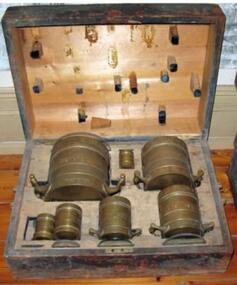
Weights & Measures, Circa 19th Century
... J.D.Potter,Poultry, London,Middlesex, U.K....London, Middlesex, United Kingdom...Weights & Measures J.D.Potter,Poultry, London,Middlesex, U.K. ...These measures were used for establishing standards and testing of Imperial Liquids and were used in the 19th & 20th centuriesused by commerce and retailing to establish standards.Set of seven standard imperial liquid measures,made of brass,in a wooden box, comprising 1/2 Gill, 1/2 Gallon, 1 Gill,1/2 Pint, 1 Pint & 1 Gill.Each piece stamped with measures. weights and measures, potter j d london united kingdom -
 Learmonth and District Historical Society Inc.
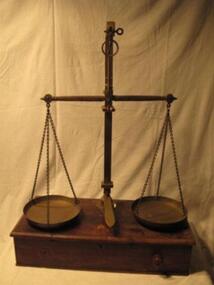
Scales, "Circa 1863"
... This set of scales would have been used to check the acuracy of Weights and Measures.Where it was used is unknown, but it may have always been part of the Shire.The maker was J.D.Potter,Poultry,London Middlesex,U.K. ...J.D.Potter,Poultry, London,Middlesex, U.K....Scales J.D.Potter,Poultry, London,Middlesex, U.K. ...This set of scales would have been used to check the acuracy of Weights and Measures.Where it was used is unknown, but it may have always been part of the Shire.The maker was J.D.Potter,Poultry,London Middlesex,U.K. One of several sets of scales of various sizes in collection of Learmonth And District Historical Society Inc.To measure precise weights,the instruments used were a set of precise balanced scales. Set on a wooden box,( which would have contained the weights).It is made of brass and has a brass beam balance,steel pointer with index and twin pans. Date 25/1/1865.Various hallmarks similar to "jewellers".tools, and, scales, weights, measures, potter london, measuring devices -
 Ballarat Tramway Museum
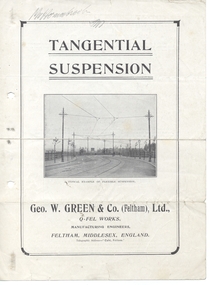
Pamphlet, Geo W Green & Co. (Feltham) and Ltd. and Q- Fell Works and Feltham and Middlesex England, "Tangential Suspension", c1915
... (Feltham), Ltd., Q- Fell Works, Feltham, Middlesex England. Has four photos of tangential trolley construction. ...(Feltham) and Ltd. and Q- Fell Works and Feltham and Middlesex England....(Feltham) and Ltd. and Q- Fell Works and Feltham and Middlesex England. ...Folded printed pamphlet titled "Tangential Suspension" contained within Reg Item 4909, published by Geo W Green & Co. (Feltham), Ltd., Q- Fell Works, Feltham, Middlesex England. Has four photos of tangential trolley construction. Gives the background to this type of construction Reprinted from "The Electric Railway & Tramway Journal, Nov. 6th, 1914". Note has a reference to Mr. P. J. Pringle, late of the Burton-on-Trent Corporation - who was to become the ESCo Manager in Ballarat.On front cover in pencil, "Mr Hornabrook" with initials and the words "Mr. P.J. Pringle" on page 3, underline in red pen.trams, tramways, overhead, trolley wire, poles -
 Bendigo Military Museum
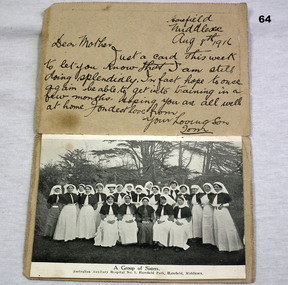
Card - PHOTO LETTER CARD, 08.08.1916
... Contains commercial photos of the Australian Auxilliary Hospital No.1 Harefield, Middlesex, England. ...Stamped: Australian Auxillary Hospital, Harefield, Middlesex...Contains commercial photos of the Australian Auxilliary Hospital No.1 Harefield, Middlesex, England. Card PHOTO LETTER CARD ...Contains pictures of nursing staff and patients at No 1 Australian Auxilliary Hospital 1914 - 1919. Tom will be Charles Thomas Chapman No 325, enlisted in E Coy 5th Batt AIF on 17.8.1914. Embarked for Egypt 21.10.1914 then for Gallipoli 5.4.1915. WIA 16.5.1915 GSW to upper extremities and hernia. Hospitalised England No 1 Aust Aux Hospital. Finally back to France 28.6.1917. Hospitalised 16.11.1917 with Tachy Cardia and then Laryngitis. Promoted Cpl 18.8.1918. Embarked for Aust 14.9.1918 transport duty (1914 men). Discharged 23.3.1919. Collection re Mrs May Burns.Letter card to Mrs C. CHAPMAN, Kyneton Road Heathcote, from her son Tom. Contains commercial photos of the Australian Auxilliary Hospital No.1 Harefield, Middlesex, England. Stamped: Australian Auxillary Hospital, Harefield, Middlesexdocuments, letters, cards, military history, hospitals -
 Federation University Historical Collection
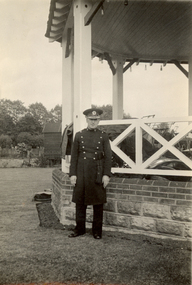
Photograph - Photograph - Black and White, Frank Wright standing in front of a bandstand at Staines, Middlesex, 22/5/1934
... Frank Wright standing in front of a bandstand at Staines, Middlesex...Frank Wright standing in front of a bandstand at Staines, Middlesex Photograph Photograph - Black and White ...Frank Wright was a renown resident of Smeaton, where he was born on 2 August 1901. He lived at Laura Villa, and attended Smeaton State School. His father William was a gold miner and his mother's name was Sarah. Their family won many singing and instrumental awards. Frank was tutored by Percy Code and was awarded a gold medal for the highest marks in the ALCM examinations in the British Colonies at the age of seventeen years. He became the Australian Open Cornet Champion by the age of eighteen. A year later, Frank conducted the City of Ballarat Band, and later the Ballarat Soldiers’ Memorial Band. He formed the Frank Wright Frisco Band and Frank Wright and his Coliseum Orchestra. These bands won many South Street awards, and Frank as conductor won many awards in the Australian Band Championship contest. In 1933 Frank Wright sailed to England to conduct the famous St Hilda’s Band and was later appointed Musical Director of the London County Council, where he organized many amazing concerts in parks, in and around the London district. He was made Professor of Brass and Military Band Scoring and conducted at the Guildhall of Music and Drama. Frank was often invited to adjudicate Brass Band Championships around Europe, in Australia, including South Street and in New Zealand. The Frank Wright Medal at the Royal South Street competition is awarded to an individual recognized as making an outstanding contribution to brass music in Australia.Black and white photograph of a man dressed in a band uniform standing on the grass in front of a raised bandstand. The bandstand has a stone and brick base, a white railed balustrade, white timber support columns and a roof. In the back ground is a garden, timber building and trees. The man is Frank Wright and he is dressed is the St. Hilda's band uniform.Written in pencil on the back - Frank Wright 32, Conductor St Hilda's, Staines, 22/5/34frank wright, brass band, conductor, bandstand, staines -
 Mrs Aeneas Gunn Memorial Library
Book, Hodder & Stoughton, Middlesex, little home county, 1940
... Middlesex, little home county...Middlesex - Description Middlesex - Travel A description of the county of Middlesex Index, ill, map, p.232. ...A description of the county of MiddlesexIndex, ill, map, p.232.A description of the county of Middlesexmiddlesex - description, middlesex - travel -
 Robin Boyd Foundation
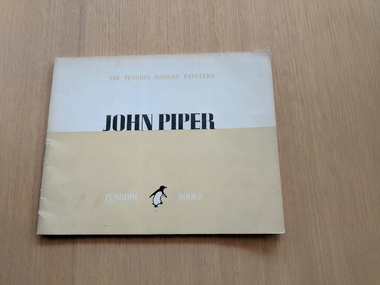
Book, John Betjeman, John Piper, The Penguin Modern Painters, 1944
... Penguin Books Limited, Harmondsworth, Middlesex, England...british painting british art british artists Walsh St library Letters R.P.B top right on first page Softcover John Piper, The Penguin Modern Painters Book John Betjeman Penguin Books Limited, Harmondsworth, Middlesex, England ...SoftcoverLetters R.P.B top right on first pagebritish painting, british art, british artists, walsh st library -
 Wangaratta RSL Sub Branch
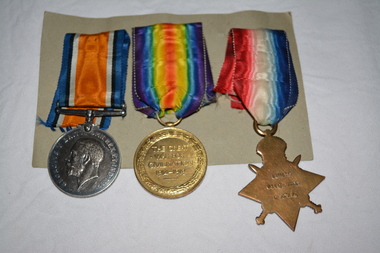
Medal - WW1 Medals, Private Ernest LUCAS
... Three WW1 medals including 1914 Star awarded to Private Ernest LUCAS Royal Defence Corps who was first assigned to the Middlesex Regiment. LUCAS was discharged on 18/5/1919 having served 11 years and 305 days....PTE E LUCAS- Middlesex Regt....The 6th Battalion Middlesex Regiment can trace its history back to 7 August 1760 as part of the Middlesex Militia. ...Three WW1 medals including 1914 Star awarded to Private Ernest LUCAS Royal Defence Corps who was first assigned to the Middlesex Regiment. LUCAS was discharged on 18/5/1919 having served 11 years and 305 days.The 6th Battalion Middlesex Regiment can trace its history back to 7 August 1760 as part of the Middlesex Militia. In 1778 it was titled the 1st East Middlesex Militia. By royal order the regiment was later designated the Royal East Middlesex Militia on 24 April 1804. By 1855 it was using the formal title of "1st or Royal East Middlesex Regiment of Militia". In 1900 the number of regular Middlesex Regiment battalions was doubled with the formation of a new the 3rd and 4th battalions; and the two militia battalions were renumbered as 5th and 6th battalions of the regiment. The unit's standing orders of 1863 record the regimental insignia as being somewhat unusual, in that it did not include standard royal crown, but featured a five-pointed Saxon Crown atop a shield with the arms of the East Saxon Kingdom i.e. three stylised Seaxes hilted and pommeledThree original WW1 medals with ribbons - round silver coloured metal medal with grey black white and orange striped ribbon - round gold coloured metal medal with purple blue green yellow and orange striped ribbon and bronze coloured star shaped metal medal with blue white and red striped ribbonPTE E LUCAS- Middlesex Regt.ernest lucas, middlesex regiment -
 Sunbury Family History and Heritage Society Inc.
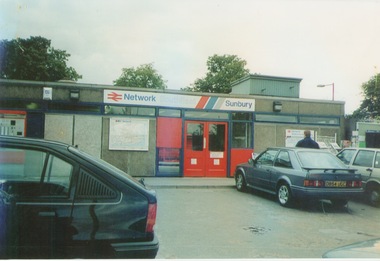
Photograph, September 1996
... The town of Sunbury in Victoria was named after the English township of Sunbury-on-Thames in Middlesex by the Jackson Brothers who took up land in Sunbury, Victoria. ...Sunbury, Middlesex., United Kingdom...The town of Sunbury in Victoria was named after the English township of Sunbury-on-Thames in Middlesex by the Jackson Brothers who took up land in Sunbury, Victoria. ...The photograph shows the railway station at Sunbury in Surrey in the United Kingdom. The town of Sunbury in Victoria was named after the English township of Sunbury-on-Thames in Middlesex by the Jackson Brothers who took up land in Sunbury, Victoria. The area was originally known as Koora Kooracup by the Wurundjeri people.Sunbury in Victoria like many other settlements in Australia were given names of towns in the United KingdomA non-digital coloured photograph of a railway station with three cars parked outside the building, which has grey walls and scarlet and blue trims. There are framed maps and notices on the exterior walls.sunbury-in surrey, england -
 Running Rabbits Military Museum operated by the Upwey Belgrave RSL Sub Branch
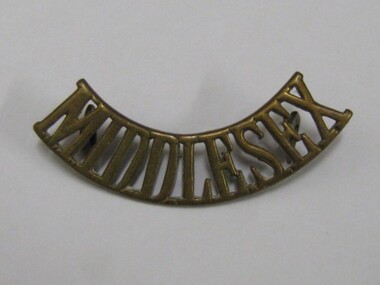
Shoulder Title
... Middlesex regiment...Badge/Buttons WW2 Army Middlesex regiment Shoulder Title ...Middlesex regimentbadge/buttons, ww2, army -
Whitehorse Historical Society Inc.
Document, Doctor Stanley Cochrane
... AIF Service records 1918; Correspondence with Australian War Memorial; 1881 census Middlesex, Eng.; Vic. Death Index records Cochrane Family; a brief biography Kindergarten Web page....Stanley Cochrane: Research notes by Yvonne Fitzmaurice;AIF Service records 1918; Correspondence with Australian War Memorial; 1881 census Middlesex, Eng.; Vic. Death Index records Cochrane Family; a brief biography Kindergarten Web page....AIF Service records 1918; Correspondence with Australian War Memorial; 1881 census Middlesex, Eng.; Vic. Death Index records Cochrane Family; a brief biography Kindergarten Web page. ...Documents relating to Dr. Stanley Cochrane: Research notes by Yvonne Fitzmaurice.Documents relating to Dr. Stanley Cochrane: Research notes by Yvonne Fitzmaurice;AIF Service records 1918; Correspondence with Australian War Memorial; 1881 census Middlesex, Eng.; Vic. Death Index records Cochrane Family; a brief biography Kindergarten Web page.Documents relating to Dr. Stanley Cochrane: Research notes by Yvonne Fitzmaurice.cochrane, stanley dr., doctor stanley cochrane memorial kindergarten -
 Wangaratta RSL Sub Branch
Equipment - Swagger Stick, c1863
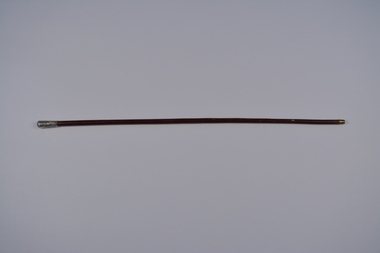
... This swagger stick belonged to Private Ernest LUCAS who served with the Royal Defence Corps between 17/6/1907 and 18/5/1919 including the 6th Battalion Middlesex Regiment In the British Army before World War I, swagger sticks were carried by all other ranks when off duty as part of their walking out uniform. ...Silver metal top embossed with a crown above a shield inscribed 6th Battalion Middlesex Regt...The 6th Battalion Middlesex Regiment can trace its history back to 7 August 1760 as part of the Middlesex Militia. ...This swagger stick belonged to Private Ernest LUCAS who served with the Royal Defence Corps between 17/6/1907 and 18/5/1919 including the 6th Battalion Middlesex Regiment In the British Army before World War I, swagger sticks were carried by all other ranks when off duty as part of their walking out uniform. The stick took the form of a short cane of polished wood, with an ornamented metal head of regimental pattern. The usual custom was for the private soldier or NCO to carry the stick tucked under his arm. Until 1939 swagger sticks were still carried by peacetime regular soldiers when "walking out" of barracks but the practice ceased with the outbreak of World War II. The 6th Battalion Middlesex Regiment can trace its history back to 7 August 1760 as part of the Middlesex Militia. In 1778 it was titled the 1st East Middlesex Militia. By royal order the regiment was later designated the Royal East Middlesex Militia on 24 April 1804. By 1855 it was using the formal title of "1st or Royal East Middlesex Regiment of Militia". In 1900 the number of regular Middlesex Regiment battalions was doubled with the formation of a new the 3rd and 4th battalions; and the two militia battalions were renumbered as 5th and 6th battalions of the regiment. The unit's standing orders of 1863 record the regimental insignia as being somewhat unusual, in that it did not include standard royal crown, but featured a five-pointed Saxon Crown atop a shield with the arms of the East Saxon Kingdom i.e. three stylised Seaxes hilt and pommel.Long narrow round cane made from polished reddish/brown wood with brass metal tip and embossed silver topSilver metal top embossed with a crown above a shield inscribed 6th Battalion Middlesex Regtswagger stick, 6th battalion middlesex regiment, private ernest lucas -
 Running Rabbits Military Museum operated by the Upwey Belgrave RSL Sub Branch
ID Card
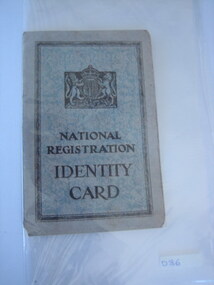
... Abraham Van Lier Alien Register, middlesex england...Abraham Van Lier Alien Register, middlesex england ID Card ...National Identity Card. Abraham Van Lier Alien Register, middlesex englanddocuments, general -
 Tramways/East Melbourne RSL Sub Branch - RSL Victoria Listing id: 27511
Certificate - Printed certificate, La Ville De Dunkerque, 20/06/2019
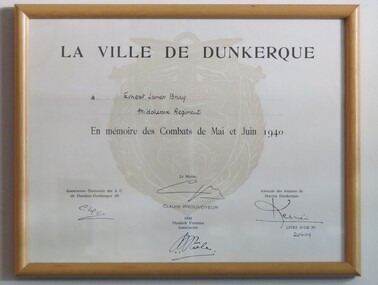
... Ernest James Bray - Middlesex Regiment....dunkirk wwii world war two second world war france ernest james bray Ernest James Bray - Middlesex Regiment. Printed copy of a certificate of commemoration of the evacuation of Dunkirk La Ville De Dunkerque Certificate Printed certificate ...Printed copy of a certificate of commemoration of the evacuation of DunkirkErnest James Bray - Middlesex Regiment.dunkirk, wwii, world war two, second world war, france, ernest james bray -
 Tramways/East Melbourne RSL Sub Branch - RSL Victoria Listing id: 27511
Certificate, La Ville De Dunkerque
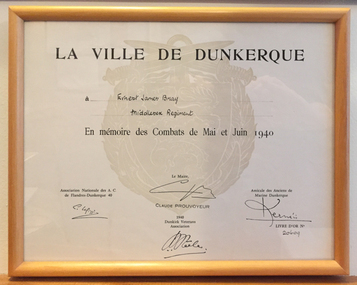
... Framed certificate awarded to Ernest James Bray of the Middlesex Regiment, in memory of combat in June 1940. ...Dunkerque Dunkirk Ernest James Bray Middlesex Regiment WW2 combat certificate Framed certificate awarded to Ernest James Bray of the Middlesex Regiment, in memory of combat in June 1940. ...Framed certificate awarded to Ernest James Bray of the Middlesex Regiment, in memory of combat in June 1940. dunkerque, dunkirk, ernest james bray, middlesex regiment, ww2, combat certificate -
 Ringwood RSL Sub-Branch
Badge - Badges
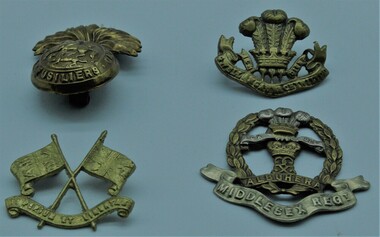
... 00513.1 Royal Northumberland Fusiliers 00513.2 The Welsh Regt 00513.3The Middlesex Regt 00513.4 Royal Standards...00513.1 Royal Northumberland Fusiliers 00513.2 The Welsh Regt 00513.3The Middlesex Regt 00513.4 Royal Standards Badge Badges ...00513.1 Royal Northumberland Fusiliers 00513.2 The Welsh Regt 00513.3The Middlesex Regt 00513.4 Royal Standards -
 Flagstaff Hill Maritime Museum and Village
Functional object - Date Stamp, Mid 20th century
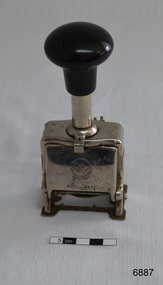
... Enfield, Middlesex, UK ...This hand held, mechanical date stamp, made in mid-20th century by English Numbering Machines Ltd (ENM) in Enfield, England and is part of the stationary items once used by Dr. W.R. Angus in his medical service. ENM was a well know manufacturer of mechanical counters and hand numbering machines, both printing and non-printing, for the stationery industry, offices, sales control and the legal profession. The company was amongst the exhibitors at the Birmingham section of the British Industries Fair, (stand number D 539). This Fair operated annually from the 1920 – 1960 and was attended by royalty and dignitaries as well as the general public. At its peak there were over 1000 exhibitors. This date stamp was donated to Flagstaff Hill Maritime Village by the family of Doctor William Roy Angus, Surgeon and Oculist. It is part of the “W.R. Angus Collection” includes historical medical equipment, surgical instruments and material once belonging to Dr Edward Ryan and Dr Thomas Francis Ryan, (both of Nhill, Victoria) as well as Dr Angus’ own belongings. The Collection’s history spans the medical practices of the two Doctors Ryan, from 1885-1926 plus that of Dr Angus, up until 1969. ABOUT THE “W.R.ANGUS COLLECTION” Doctor William Roy Angus M.B., B.S., Adel., 1923, F.R.C.S. Edin.,1928 (also known as Dr Roy Angus) was born in Murrumbeena, Victoria in 1901 and lived until 1970. He qualified as a doctor in 1923 at University of Adelaide, was Resident Medical Officer at the Royal Adelaide Hospital in 1924 and for a period was house surgeon to Sir (then Mr.) Henry Simpson Newland. Dr Angus was briefly an Assistant to Dr Riddell of Kapunda, then commenced private practice at Curramulka, Yorke Peninsula, SA, where he was physician, surgeon and chemist. In 1926, he was appointed as new Medical Assistant to Dr Thomas Francis Ryan (T.F. Ryan, or Tom), in Nhill, Victoria, where his experiences included radiology and pharmacy. In 1927 he was Acting House Surgeon in Dr Tom Ryan’s absence. Dr Angus had become engaged to Gladys Forsyth and they decided he further his studies overseas in the UK in 1927. He studied at London University College Hospital and at Edinburgh Royal Infirmary and in 1928, was awarded FRCS (Fellow from the Royal College of Surgeons), Edinburgh. He worked his passage back to Australia as a Ship’s Surgeon on the on the Australian Commonwealth Line’s T.S.S. Largs Bay. Dr Angus married Gladys in 1929, in Ballarat. (They went on to have one son (Graham 1932, born in SA) and two daughters (Helen (died 12/07/1996) and Berenice (Berry), both born at Mira, Nhill ) According to Berry, her mother Gladys made a lot of their clothes. She was very talented and did some lovely embroidery including lingerie for her trousseau and beautifully handmade baby clothes. Dr Angus was a ‘flying doctor’ for the A.I.M. (Australian Inland Ministry) Aerial Medical Service in 1928 . Its first station was in the remote town of Oodnadatta, where Dr Angus was stationed. He was locum tenens there on North-South Railway at 21 Mile Camp. He took up this ‘flying doctor’ position in response to a call from Dr John Flynn; the organisation was later known as the Flying Doctor Service, then the Royal Flying Doctor Service. A lot of his work during this time involved dental surgery also. Between 1928-1932 he was surgeon at the Curramulka Hospital, Yorke Peninsula, South Australia. In 1933 Dr Angus returned to Nhill and purchased a share of the Nelson Street practice and Mira hospital (a 2 bed ward at the Nelson Street Practice) from Dr Les Middleton one of the Middleton Brothers, the current owners of what previously once Dr Tom Ryan’s practice. Dr Tom and his brother had worked as surgeons included eye surgery. Dr Tom Ryan performed many of his operations in the Mira private hospital on his premises. He had been House Surgeon at the Nhill Hospital 1902-1926. Dr Tom Ryan had one of the only two pieces of radiology equipment in Victoria during his practicing years – The Royal Melbourne Hospital had the other one. Over the years Dr Tom Ryan had gradually set up what was effectively a training school for country general-practitioner-surgeons. Each patient was carefully examined, including using the X-ray machine, and any surgery was discussed and planned with Dr Ryan’s assistants several days in advance. Dr Angus gained experience in using the X-ray machine there during his time as assistant to Dr Ryan. When Dr Angus bought into the Nelson Street premises in Nhill he was also appointed as the Nhill Hospital’s Honorary House Surgeon 1933-1938. His practitioner’s plate from his Nhill surgery is now mounted on the doorway to the Port Medical Office at Flagstaff Hill Maritime Village, Warrnambool. When Dr Angus took up practice in the Dr Edward and Dr Tom Ryan’s old premises he obtained their extensive collection of historical medical equipment and materials spanning 1884-1926. A large part of this collection is now on display at the Port Medical Office at Flagstaff Hill Maritime Village in Warrnambool. In 1939 Dr Angus and his family moved to Warrnambool where he purchased “Birchwood,” the 1852 home and medical practice of Dr John Hunter Henderson, at 214 Koroit Street. (This property was sold in1965 to the State Government and is now the site of the Warrnambool Police Station. and an ALDI sore is on the land that was once their tennis court). The Angus family was able to afford gardeners, cooks and maids; their home was a popular place for visiting dignitaries to stay whilst visiting Warrnambool. Dr Angus had his own silk worm farm at home in a Mulberry tree. His young daughter used his centrifuge for spinning the silk. Dr Angus was appointed on a part-time basis as Port Medical Officer (Health Officer) in Warrnambool and held this position until the 1940’s when the government no longer required the service of a Port Medical Officer in Warrnambool; he was thus Warrnambool’s last serving Port Medical Officer. (Masters of immigrant ships arriving in port reported incidents of diseases, illness and death and the Port Medical Officer made a decision on whether the ship required Quarantine and for how long, in this way preventing contagious illness from spreading from new immigrants to the residents already in the colony.) Dr Angus was a member of the Australian Medical Association, for 35 years and surgeon at the Warrnambool Base Hospital 1939-1942, He served with the Australian Department of Defence as a Surgeon Captain during WWII 1942-45, in Ballarat, Victoria, and in Bonegilla, N.S.W., completing his service just before the end of the war due to suffering from a heart attack. During his convalescence he carved an intricate and ‘most artistic’ chess set from the material that dentures were made from. He then studied ophthalmology at the Royal Melbourne Eye and Ear Hospital and created cosmetically superior artificial eyes by pioneering using the intrascleral cartilage. Angus received accolades from the Ophthalmological Society of Australasia for this work. He returned to Warrnambool to commence practice as an ophthalmologist, pioneering in artificial eye improvements. He was Honorary Consultant Ophthalmologist to Warrnambool Base Hospital for 31 years. He made monthly visits to Portland as a visiting surgeon, to perform eye surgery. He represented the Victorian South-West subdivision of the Australian Medical Association as its secretary between 1949 and 1956 and as chairman from 1956 to 1958. In 1968 Dr Angus was elected member of Spain’s Barraquer Institute of Barcelona after his research work in Intrasclearal cartilage grafting, becoming one of the few Australian ophthalmologists to receive this honour, and in the following year presented his final paper on Living Intrasclearal Cartilage Implants at the Inaugural Meeting of the Australian College of Ophthalmologists in Melbourne In his personal life Dr Angus was a Presbyterian and treated Sunday as a Sabbath, a day of rest. He would visit 3 or 4 country patients on a Sunday, taking his children along ‘for the ride’ and to visit with him. Sunday evenings he would play the pianola and sing Scottish songs to his family. One of Dr Angus’ patients was Margaret MacKenzie, author of a book on local shipwrecks that she’d seen as an eye witness from the late 1880’s in Peterborough, Victoria. In the early 1950’s Dr Angus, painted a picture of a shipwreck for the cover jacket of Margaret’s book, Shipwrecks and More Shipwrecks. She was blind in later life and her daughter wrote the actual book for her. Dr Angus and his wife Gladys were very involved in Warrnambool’s society with a strong interest in civic affairs. He had an interest in people and the community They were both involved in the creation of Flagstaff Hill, including the layout of the gardens. After his death (28th March 1970) his family requested his practitioner’s plate, medical instruments and some personal belongings be displayed in the Port Medical Office surgery at Flagstaff Hill Maritime Village, and be called the “W. R. Angus Collection”. The W.R. Angus Collection is significant for still being located at the site it is connected with, Doctor Angus being the last Port Medical Officer in Warrnambool. The collection of medical instruments and other equipment is culturally significant, being an historical example of medicine from late 19th to mid-20th century. Dr Angus assisted Dr Tom Ryan, a pioneer in the use of X-rays and in ocular surgery. Metal date stamp with Bakelite handle, made in Britain by English Numbering Machines. Model No. 4531; part of the W.R. Angus Collection. Stamped on metal: “ENM / British made / Model 4531” flagstaff hill, warrnambool, shipwrecked coast, flagstaff hill maritime museum, maritime museum, shipwreck coast, flagstaff hill maritime village, great ocean road, dr w r angus, dr ryan, surgical instrument, t.s.s. largs bay, warrnambool base hospital, nhill base hospital, mira hospital, flying doctor, date stamp, office stationery, mechanical date stamp, enm date stamp, english numbering machines, enm model 4531 -
 Greensborough Historical Society
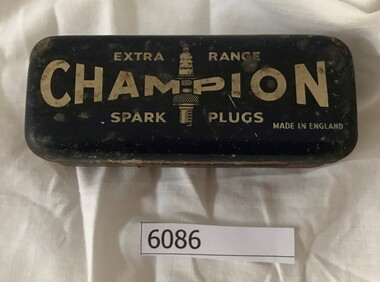
Container, Champion Sparking Plug Co. Ltd, Champion Spark Plugs, 1950s
... Feltham, Middlesex, England ...This containerswould have contained Spark plugs for internal combustion enginesHinged metal container, lid printed in blue and white"Extra range Champion Spark plugs Made in England"container, spark plugs -
Phillip Island and District Historical Society Inc.
Book, FORSTER, E.M, Passage to India, 1936
... Harmondsworth, Middlesex ... -
 Flagstaff Hill Maritime Museum and Village
Instrument - Fob watch, 1882
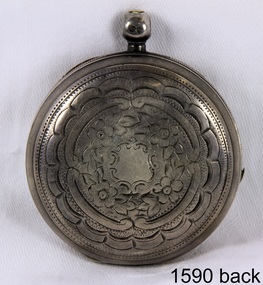
... London, Middlesex, Great Britain ...The watch was given to William James Robe by the captain of the barque Fiji as a token for helping to save his life and that of the crew on September 6th 1891 when the steel barque Fiji had foundered off “wreck beach" near Moonlight Head Warrnambool during a voyage from Hamburg to Melbourne. William or Bill as he was called was the one who had hauled out the last man, the captain, after he had become tangled in the kelp. William along with many other onlookers on the beach at the time had taken it in turns to go into the surf and drag half-drowned seamen to safety. These rescuers along with William James Robe, included Edwin Vinge, Hugh Cameron, Fenelon Mott, Arthur Wilkinson and Peter Carmody. Years later Bill passed the watch on to his brother-in-law Gilbert Hulands as payment of a debt. The grandson of Gilbert Hulands, John Hulands, has donated this watch to Flagstaff Hill Maritime Museum. The Fiji Wreck: The three-masted iron barque Fiji had been built in Belfast, Ireland, in 1875 by Harland and Wolfe for a Liverpool based shipping company. The ship departed Hamburg on 22nd May 1891 bound for Melbourne, under the command of Captain William Vickers with a crew of 25. On September 5th, one hundred days out from Hamburg in squally and boisterous south-west winds the Cape Otway light was sighted on a bearing differing from Captain Vickers' calculation of his position. At about 2:30 am, Sunday 6th September 1891 land was reported 4-5 miles off the port bow. The captain tried to put the ship on the other tack, but she would not respond. He then tried to turn her the other way but just as the manoeuvre was being completed Fiji struck rock only 274 metres from shore. The place is known as Wreck Bay, Moonlight Head. Blue lights were burned and rockets fired whilst an effort was made to lower boats but all capsized or swamped and smashed to pieces. Two of the younger crewmen volunteered to swim for the shore, taking a line. One, a Russian named Daniel Carkland, drowned after he was swept away when the line broke. The other, 17-year-old able seaman Julius Gebauhr, a German, reached shore safely on his second attempt but without the line, which he had cut loose with his sheath-knife when it becomes tangled in kelp. He rested on the beach a while then climbed the cliffs in search of help. At about 10 am on Sunday a party of land selectors - including F. J. Stanmore, Leslie Dickson (or Dixon) and Mott - found Gebauhr. They were near Ryans Den, on their travels on horseback from Princetown towards Moonlight Head, and about 5km from the wreck. They found Gebauhr lying in scrub and a poor state, bleeding and scantly dressed and with a sheath-knife. At first, they were concerned about his appearance and gibberish speech, taking him to be an escaped lunatic. They were reassured after Gebauhr threw his knife away realising he was speaking half-English, half-German. They gave him food and brandy and some clothing and were then able to gain information about the wreck. Some of the men took him to Rivernook, a nearby guest house owned by John Evans, where he was cared for. Stansmore and Dickson rode off to try and summon help. Others went down to the site of the wreck. Messages for rescuing the rest of the crew were sent both to Port Campbell for the rocket rescue crew and to Warrnambool for the lifeboat. The S.S. Casino sailed from Portland towards the scene. After travelling the 25 miles to the scene, half of the Port Campbell rocket crew and equipment arrived and set up the rocket tripod on the beach below the cliffs. By this time the crew of Fiji had been clinging to the jib-boom for almost 15 hours, calling frantically for help. Mr Tregear from the Rocket Crew fired the line. The light line broke and the rocket was carried away. A second line was successfully fired across the ship and made fast. The anxious sailors then attempted to come ashore along the line but, with as many as five at a time, the line sagged considerably and some were washed off. Others, nearly exhausted, had to then make their way through masses of seaweed and were often smothered by waves. Only 14 of the 24 who had remained on the ship made it to shore. Many onlookers on the beach took it in turns to go into the surf and drag half-drowned seamen to safety. One of the rescuers Arthur Wilkinson, a 29-year-old land selector, swam out to the aid of one of the ship's crewmen, a carpenter named John Plunken who was attempting to swim to shore. Two or three times both men almost reached the shore but were washed back to the wreck, a line was thrown to them. It was thought that Wilkinson had struck his head on the anchor during the rescue and had remained unconscious, the carpenter survived this ordeal but Wilkinson died and his body was washed up the next day. The wreck of Fiji smashed apart within 20 minutes of the captain being brought ashore, and it finally settling in 6m of water. Of the 26 men on Fiji, 11 in total lost their lives. The remains of 7 bodies were washed onto the beach. They were buried on the clifftop above the wreck. Captain Vickers was severely reprimanded for his mishandling of the ship and his is Masters Certificate was suspended for 12 months. At the time there was also a great deal of public criticism at the slow and disorganised rescue attempt to save those on board. The important canvas ‘breech buoy’ or ‘bucket chair’ and the heavy line from the Rocket Rescue was in the half of the rocket outfit that didn’t make it in time for the rescue: they had been delayed at the Gellibrand River ferry. Communications to Warrnambool were down so the call for help didn’t get through on time and the two or three boats that had been notified of the wreck failed to reach it in time. Much looting occurred of the cargo that washed up on the shore, with nearly every visitor leaving the beach with bulky pockets. One looter was caught with a small load of red and white rubber balls, which were duly confiscated and he was 'detained' for 14 days. The essence of peppermint mysteriously turned up in many settlers homes. Sailcloth was salvaged and used for horse rugs and tent flies. Soon after the wreck "Fiji tobacco" was being advertised around Victoria. A Customs officer, trying to prevent some of the looting, was assaulted by looters and thrown over a cliff. He managed to cling to a bush lower down until rescued. Seaman Julius Gebauhr later gave his knife, in its hand crafted leather sheath, to F. J. Stansmore for caring for him when he came ashore. Flagstaff Hill’s Fiji collection is of historical significance at a State level because of its association with the wreck Fiji, which is on the Victorian Heritage Register (S 259). The collection also represents key aspects of Victoria’s shipping history and its items offer the potential to interpret maritime historical events and social history of the time. Along with the potential to yield information that will contribute to an understanding of Victoria’s cultural history.Sterling silver fob watch Fusee movement face has a white background with black Roman numerals on it. The minute hand is gold coloured with a leaf shape. Seconds dial is inset at position 6, with Arabic numerals around it. Watch has machine engraving flower pattern front and back. The spherical winder has a number and a symbol on the upper face and a hole through the centre, the ring for the chain is missing. Back of a the watch opens to reveal a concave cover with a winding hole, which has a border of overlapping crescent-shapes. Inside cover a diamond with initials “JR”(John Rotherham) inside, a date letter “G” (1882) with a Lion Passant (Sterling Silver) also 3 numbers “8 1 9“embossed beside each other. The clock face has “Rotherhams / London” printed on it. The winder is also marked with a maker and sterling silver mark. “Y” and numbers “688” “3 CI A” “3309” “819” “555 A” and other numbers including a set engraved around the edge possibly jewelers marks who did repairs or maintenance on the item over the years.1891, shipwrecked coast, flagstaff hill, flagstaff hill maritime museum, maritime museum, shipwrecked artefact, flagstaff hill maritime village, shipwreck coast, warrnambool, fiji, pocket watch, william vickers, william robe, bill robe, fiji watch -
 Coal Creek Community Park & Museum
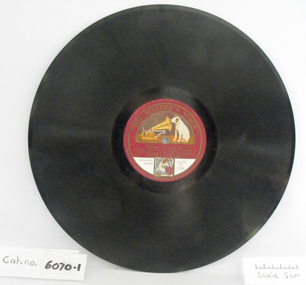
Phonograph Record, Primrose Selection
... Middlesex, England ...Phonograph record, black shellac with red "His Master's Voice" label. A&B sides: Primrose Selection Part 1 & Part 2. Artist: Mayfair Orchestra.Cat. No. C 1180 -
 Coal Creek Community Park & Museum
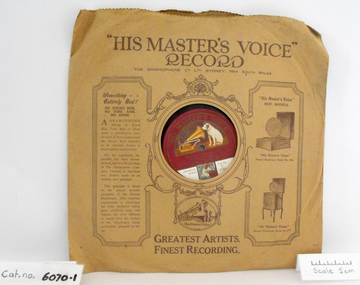
Phonograph Record Sleeve, "Something Entirely New!"
... Middlesex, England ...Phonograph record cover, beige with promotion for His Master's Voice new model gramophones printed on both sides. -
 Yarrawonga and Mulwala Pioneer Museum
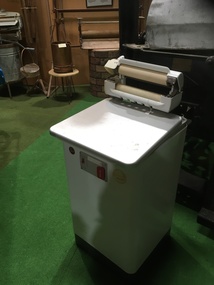
Washing machine, Hoover Limited, Hoover Electrical Washing Machine, est 1950's
... Middlesex, England ...metal square tub with wringer. Instruction sheet enclosedHoover mode lApp marking N/27 type 0343 .240 volts 3.8 amps 50 HZ AC only motor 350 watts serial No 0343 107 10499hoover, washing machine, electric, washing, clothes -
Tatura Irrigation & Wartime Camps Museum
Book, Arte Primitiva, 1964
... Harmondsworth, Middlesex, England ...Dr. Leonhard Adam studied both Anthropology and jurisdiction as a young manPale grey hard cover with black and green printing on front and spine of book. 40 pages of reproductions. Written in Germanarteprimitiva, adam l, adam murvitz mc, camp 2, tatura, books, history, local -
 The Celtic Club
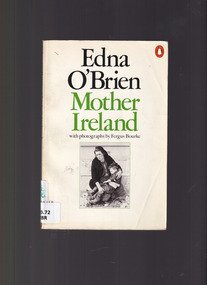
Book, Edna O'Brien, Mother Ireland, 1978
... Harmondsworth, Middlesex, England ...An autobiographical tapestry, recollections of an Irish childhood linked to an account of a journey there today, interwoven with fragments of Irish mythology, history and hearsay.Ill, p.89.non-fictionAn autobiographical tapestry, recollections of an Irish childhood linked to an account of a journey there today, interwoven with fragments of Irish mythology, history and hearsay.ireland - authors - biography, ireland - description and travel -
 Ringwood RSL Sub-Branch
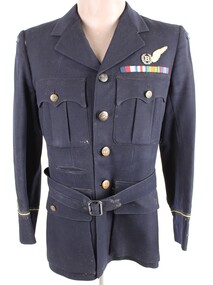
Uniform - Royal Air Force WW2, Carr & Son & Moor, Circa 1940
... Saville Row, London, Middlesex, England ...00020.1 Navy Blue Jacket with Australia cloth titles and B bomb aimer half wing. Medal ribbons 1939 - 45 Star, France Germany Star,Defence Medal and War Medal. With waste belt. 00020.2 Navy Blue RAF Trousers 00020.3 RAF Forage Cap with metal badge 00020.4 RAF issue money belt. -
 Ringwood RSL Sub-Branch
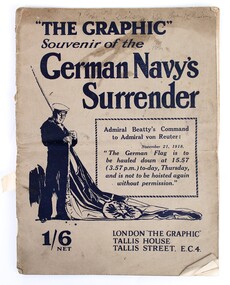
Book - Document, WW1 Magazine, Graphic Publications, The German Navy Surrenders, 1918
... Tallis, London, EC4, Middlesex, England ...The Graphic Souvenir of the German Navy Surrender November 1918.
