
Showing 307 items matching "military areas"
-
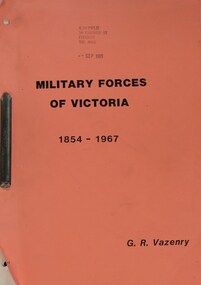 4th/19th Prince of Wales's Light Horse Regiment Unit History Room
Booklet, G R Vezenry: Military Forces of Victoria 1854-1967, 1969 (estimated)
... ...military areas...military forces victoria 1854 1967 g r vazenry military history army units drill halls military camps military areas southern command rifle clubs cadets militia citizen military forces military forces victoria 1854 1967 g r vazenry military history army units drill halls military camps military areas southern command rifle clubs cadets militia citizen military forces 1 inscribed: 4/19 PWLH 16 GEORGE ST FITZROY VIC 3065 SEP 1985 Book, A4, 24 Chapters, type print, loose leaf, side bound, Privately Published. 2 Copies G R Vezenry: Military Forces of Victoria 1854-1967, Booklet Booklet G R Vazenry ...Book, A4, 24 Chapters, type print, loose leaf, side bound, Privately Published. 2 Copies1 inscribed: 4/19 PWLH 16 GEORGE ST FITZROY VIC 3065 SEP 1985military forces victoria, 1854 1967, g r vazenry, military history, army units, drill halls, military camps, military areas, southern command, rifle clubs, cadets, militia, citizen military forces, military forces victoria, 1854 1967, g r vazenry, military history, army units, drill halls, military camps, military areas, southern command, rifle clubs, cadets, militia, citizen military forces -
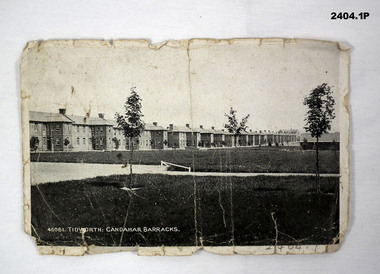 Bendigo Military Museum
Postcard - POSTCARDS, MILITARY, c.1917
... Rectangular, thin paper post cards, black & white photographs re Tidworth Military area barracks, each photo has over print description....Refer Cat No 2380 for details re Frank Barnes service. documents - photographs military history photography Rectangular, thin paper post cards, black & white photographs re Tidworth Military area barracks, each photo has over print description. ...Sent from FRANK BARNES (AIF 4156) to UNA FRANKLING of Harcourt. Photographs on both sides. Possibly remnants of a larger group of post cards. Dated 28.7.17. Small amount of handwriting. Refer Cat No 2380 for details re Frank Barnes service.Rectangular, thin paper post cards, black & white photographs re Tidworth Military area barracks, each photo has over print description.documents - photographs, military history, photography -
 Bendigo Historical Society Inc.
Map - EPPALOCK : COUNTY OF BENDIGO, 1982
... Eppalock, County of Bendigo, Axedale, Knowsley, Heathcote, Tooborac, Kyneton, Lancefield, Pyalong, Seymour, Graytown, Toolleen, Colbinabbin, Costerfield, Redesdale, Mia Mia, Nagambie, Department of Interior, Puckapunyal Military Area, Various connecting roads. Shire of McIvor. ...Eppalock, County of Bendigo, Axedale, Knowsley, Heathcote, Tooborac, Kyneton, Lancefield, Pyalong, Seymour, Graytown, Toolleen, Colbinabbin, Costerfield, Redesdale, Mia Mia, Nagambie, Department of Interior, Puckapunyal Military Area, Various connecting roads. Shire of McIvor. ...Map. Eppalock, County of Bendigo, Axedale, Knowsley, Heathcote, Tooborac, Kyneton, Lancefield, Pyalong, Seymour, Graytown, Toolleen, Colbinabbin, Costerfield, Redesdale, Mia Mia, Nagambie, Department of Interior, Puckapunyal Military Area, Various connecting roads. Shire of McIvor. Updated Dec.1982. (number 40 in map cupboard 1)map, bendigo, eppalock -
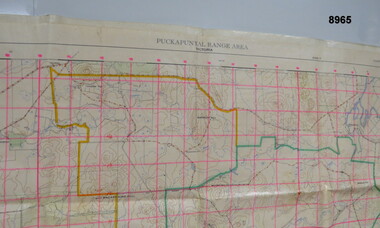 Bendigo Military Museum
Map - MAP - PUCKAPUNYAL RANGE AREA, Royal Australian Survey Corps, Bendigo, 1958
... ”Puckapunyal Range Area Military Survey Australia 1.25,000. First Edition”...Passchendaele Barracks Trust PBT? Military Map ”Puckapunyal Range Area Military Survey Australia 1.25,000. ...Military Survey, First Edition 1958.Large waterproof map of Puckapunyal Range area compiled by the Royal Australian Survey Corps in 1958 detailing Reference locations in and around Puckapunyal area.”Puckapunyal Range Area Military Survey Australia 1.25,000. First Edition”passchendaele barracks trust, pbt?, military map -
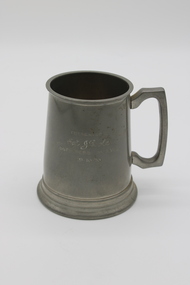 National Vietnam Veterans Museum (NVVM)
Memorabilia - Tankard, Huntly Melbourne, C1970
... The Moorebank Military Area in NSW housed the School of Military Engineering. ...The Moorebank Military Area in NSW housed the School of Military Engineering. ...The Moorebank Military Area in NSW housed the School of Military Engineering. During the war in Vietnam it was expanded to cater for the increased number of soldiers being allocated to the Royal Australian Engineers. A mock Vietnamese village was built to familiarise troops with guerilla warfare tactics and military raids, and a nuclear, biological and chemical warfare wing was constructed.Tankard, small, made of pewter with a glass bottom and personal engraving.Presented to / Sgt. J Poole/ by Sgts mess MAW / 19.10.70. (MAW = Moorebank Area Workshop).poole cpl s. j., tankard, 1970, vietnam -
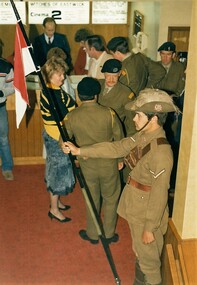 8th/13th Victorian Mounted Rifles Regimental Collection
Photograph
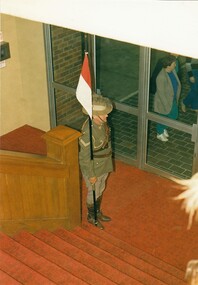
... The official party included the Area Commander Albury-Wodonga Military Area, Honorary Colonel 8/13 VMR and Officer Commanding ‘a’ Squadron 8/13 VMR. ...The official party included the Area Commander Albury-Wodonga Military Area, Honorary Colonel 8/13 VMR and Officer Commanding ‘a’ Squadron 8/13 VMR. ...‘A’ Squadron 8/13 Victorian mounted Rifles hosted a special screening of the movie “The Lighthorsemen” at the Regent Theatre Albury on 11 September 1987. The official party included the Area Commander Albury-Wodonga Military Area, Honorary Colonel 8/13 VMR and Officer Commanding ‘a’ Squadron 8/13 VMR. The VMR Heritage Troop mounted a Lance-Guard in the theatre foyer and the Albury City Band played prior to the screening. Proceeds from the function were donated to Legacy.Colour photograph of Corporal Shane Walch, a member of the 8/13 Victorian Mounted Rifles Heritage Toop which mounted a Lance - Guard at the film screening at Albury 11 September 1987. -
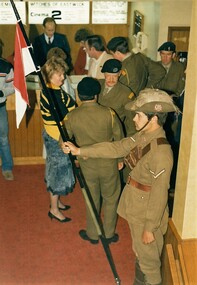 8th/13th Victorian Mounted Rifles Regimental Collection
Photograph
... The official party included the Area Commander Albury-Wodonga Military Area, Honorary Colonel 8/13 VMR and Officer Commanding ‘a’ Squadron 8/13 VMR. ...The official party included the Area Commander Albury-Wodonga Military Area, Honorary Colonel 8/13 VMR and Officer Commanding ‘a’ Squadron 8/13 VMR. ...A’ Squadron 8/13 Victorian mounted Rifles hosted a special screening of the movie “The Lighthorsemen” at the Regent Theatre Albury on 11 September 1987. The official party included the Area Commander Albury-Wodonga Military Area, Honorary Colonel 8/13 VMR and Officer Commanding ‘a’ Squadron 8/13 VMR. The VMR Heritage Troop mounted a Lance-Guard in the theatre foyer and the Albury City Band played prior to the screening. Proceeds from the function were donated to Legacy.Colour photograph of group in foyer prior to screening of film. Member of 8/13 Victorian Mounted Rifles Heritage Troop Lance Guard in foreground. -
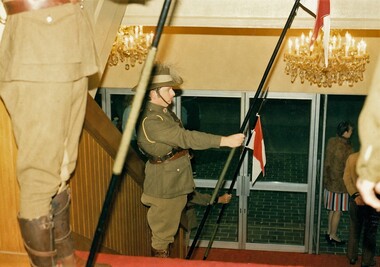 8th/13th Victorian Mounted Rifles Regimental Collection
Photograph
... The official party included the Area Commander Albury-Wodonga Military Area, Honorary Colonel 8/13 VMR and Officer Commanding ‘a’ Squadron 8/13 VMR. ...The official party included the Area Commander Albury-Wodonga Military Area, Honorary Colonel 8/13 VMR and Officer Commanding ‘a’ Squadron 8/13 VMR. ...A’ Squadron 8/13 Victorian mounted Rifles hosted a special screening of the movie “The Lighthorsemen” at the Regent Theatre Albury on 11 September 1987. The official party included the Area Commander Albury-Wodonga Military Area, Honorary Colonel 8/13 VMR and Officer Commanding ‘a’ Squadron 8/13 VMR. The VMR Heritage Troop mounted a Lance-Guard in the theatre foyer and the Albury City Band played prior to the screening. Proceeds from the function were donated to Legacy.Two colour photographs of Trooper R.J. Walsh a member of 8/13 Victorian Mounted Rifles Heritage Troop mounting the Lance - Guard at special screening of film 11 September 1987. -
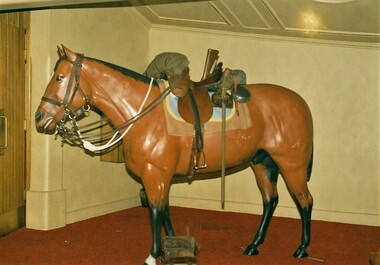 8th/13th Victorian Mounted Rifles Regimental Collection
Photograph
... The official party included the Area Commander Albury-Wodonga Military Area, Honorary Colonel 8/13 VMR and Officer Commanding ‘a’ Squadron 8/13 VMR. ...The official party included the Area Commander Albury-Wodonga Military Area, Honorary Colonel 8/13 VMR and Officer Commanding ‘a’ Squadron 8/13 VMR. ...‘A’ Squadron 8/13 Victorian mounted Rifles hosted a special screening of the movie “The Lighthorsemen” at the Regent Theatre Albury on 11 September 1987. The official party included the Area Commander Albury-Wodonga Military Area, Honorary Colonel 8/13 VMR and Officer Commanding ‘a’ Squadron 8/13 VMR. The VMR Heritage Troop mounted a Lance-Guard in the theatre foyer and the Albury City Band played prior to the screening. Proceeds from the function were donated to Legacy.Colour photograph of a horse with Light Horse saddlry and equipment. It was part of a static display at special screening of film " The Lighthorsemen " at Albury 11 September 1987. -
 8th/13th Victorian Mounted Rifles Regimental Collection
Photograph
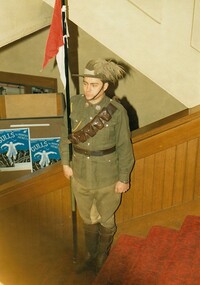
... The official party included the Area Commander Albury-Wodonga Military Area, Honorary Colonel 8/13 VMR and Officer Commanding ‘a’ Squadron 8/13 VMR. ...The official party included the Area Commander Albury-Wodonga Military Area, Honorary Colonel 8/13 VMR and Officer Commanding ‘a’ Squadron 8/13 VMR. ...‘A’ Squadron 8/13 Victorian mounted Rifles hosted a special screening of the movie “The Lighthorsemen” at the Regent Theatre Albury on 11 September 1987. The official party included the Area Commander Albury-Wodonga Military Area, Honorary Colonel 8/13 VMR and Officer Commanding ‘a’ Squadron 8/13 VMR. The VMR Heritage Troop mounted a Lance-Guard in the theatre foyer and the Albury City Band played prior to the screening. Proceeds from the function were donated to Legacy.Colour photograph of Corporal Nigel Morris, a member of 8/13 Victorian Mounted Rifles Heritage Troop which mounted a Lance - Guard at the film screening at Albury 11 September 1987 -
 8th/13th Victorian Mounted Rifles Regimental Collection
Photograph
... The official party included the Area Commander Albury-Wodonga Military Area, Honorary Colonel 8/13 VMR and Officer Commanding ‘a’ Squadron 8/13 VMR. ...The official party included the Area Commander Albury-Wodonga Military Area, Honorary Colonel 8/13 VMR and Officer Commanding ‘a’ Squadron 8/13 VMR. ...A’ Squadron 8/13 Victorian mounted Rifles hosted a special screening of the movie “The Lighthorsemen” at the Regent Theatre Albury on 11 September 1987. The official party included the Area Commander Albury-Wodonga Military Area, Honorary Colonel 8/13 VMR and Officer Commanding ‘a’ Squadron 8/13 VMR. The VMR Heritage Troop mounted a Lance-Guard in the theatre foyer and the Albury City Band played prior to the screening. Proceeds from the function were donated to Legacy.Colour photograph of Trooper Chris Ellison, a member of the 8/13 Victorian Mounted Rifles Heritage Troop which mounted a Lance - Guard at the film screening at Albury 11 September 1987. -
 8th/13th Victorian Mounted Rifles Regimental Collection
Photograph
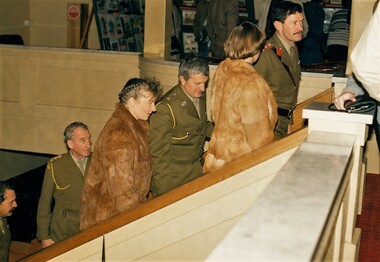
... The official party included the Area Commander Albury-Wodonga Military Area, Honorary Colonel 8/13 VMR and Officer Commanding ‘a’ Squadron 8/13 VMR. ...The official party included the Area Commander Albury-Wodonga Military Area, Honorary Colonel 8/13 VMR and Officer Commanding ‘a’ Squadron 8/13 VMR. ...‘A’ Squadron 8/13 Victorian mounted Rifles hosted a special screening of the movie “The Lighthorsemen” at the Regent Theatre Albury on 11 September 1987. The official party included the Area Commander Albury-Wodonga Military Area, Honorary Colonel 8/13 VMR and Officer Commanding ‘a’ Squadron 8/13 VMR. The VMR Heritage Troop mounted a Lance-Guard in the theatre foyer and the Albury City Band played prior to the screening. Proceeds from the function were donated to Legacy.Colour photograph of a group ascending stairs at Regent Theatre Albury. From left: Capt R. Morrison, Colonel J. Neale, Mrs. D. Morrison, major J. Gay, Mrs. C. brewer, Colonel C. Brewer. -
 8th/13th Victorian Mounted Rifles Regimental Collection
Artwork, other - Display board
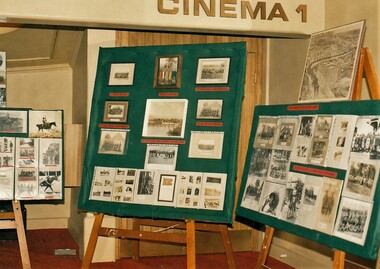
... The official party included the Area Commander Albury-Wodonga Military Area, Honorary Colonel 8/13 VMR and Officer Commanding ‘a’ Squadron 8/13 VMR. ...The official party included the Area Commander Albury-Wodonga Military Area, Honorary Colonel 8/13 VMR and Officer Commanding ‘a’ Squadron 8/13 VMR. ...A’ Squadron 8/13 Victorian mounted Rifles hosted a special screening of the movie “The Lighthorsemen” at the Regent Theatre Albury on 11 September 1987. The official party included the Area Commander Albury-Wodonga Military Area, Honorary Colonel 8/13 VMR and Officer Commanding ‘a’ Squadron 8/13 VMR. The VMR Heritage Troop mounted a Lance-Guard in the theatre foyer and the Albury City Band played prior to the screening. Proceeds from the function were donated to Legacy.Colour photograph of display in foyer of Theatre at special screening of " The Lighthorsemen " 11 September 1987.military, cinema, light horse, film, legacy -
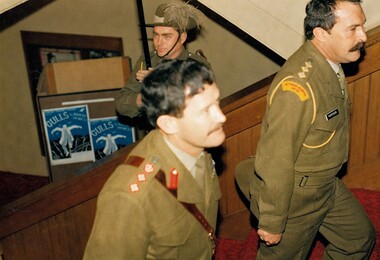 8th/13th Victorian Mounted Rifles Regimental Collection
Photograph - Two officers a movie theatre
... The official party included the Area Commander Albury-Wodonga Military Area, Honorary Colonel 8/13 VMR and Officer Commanding ‘a’ Squadron 8/13 VMR. ...The official party included the Area Commander Albury-Wodonga Military Area, Honorary Colonel 8/13 VMR and Officer Commanding ‘a’ Squadron 8/13 VMR. ...‘A’ Squadron 8/13 Victorian mounted Rifles hosted a special screening of the movie “The Lighthorsemen” at the Regent Theatre Albury on 11 September 1987. The official party included the Area Commander Albury-Wodonga Military Area, Honorary Colonel 8/13 VMR and Officer Commanding ‘a’ Squadron 8/13 VMR. The VMR Heritage Troop mounted a Lance-Guard in the theatre foyer and the Albury City Band played prior to the screening. Proceeds from the function were donated to Legacy.Colour photograph of CDolonel C. Brewer, Commander AWMA with Captain Robert Morrison arriving at the special screening of the " Lighthorsemen " at Albury. Lance - Guard Trooper Chris Ellison in backgroundmilitary, vmr, movie, lighthorsemen, theatre -
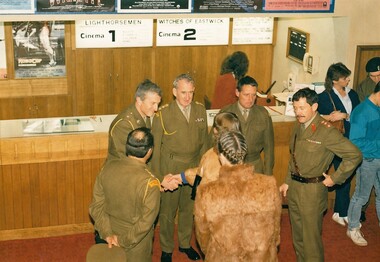 8th/13th Victorian Mounted Rifles Regimental Collection
Photograph
... The official party included the Area Commander Albury-Wodonga Military Area, Honorary Colonel 8/13 VMR and Officer Commanding ‘a’ Squadron 8/13 VMR. ...The official party included the Area Commander Albury-Wodonga Military Area, Honorary Colonel 8/13 VMR and Officer Commanding ‘a’ Squadron 8/13 VMR. ...‘A’ Squadron 8/13 Victorian mounted Rifles hosted a special screening of the movie “The Lighthorsemen” at the Regent Theatre Albury on 11 September 1987. The official party included the Area Commander Albury-Wodonga Military Area, Honorary Colonel 8/13 VMR and Officer Commanding ‘a’ Squadron 8/13 VMR. The VMR Heritage Troop mounted a Lance-Guard in the theatre foyer and the Albury City Band played prior to the screening. Proceeds from the function were donated to Legacy.Colour photograph of gathering in theatre foyer prior tto screening of " The Lighthorsemen ". Facing camera from left: Major J. Gay, Colonel J.A. Neale, Squadron Sergeant Major Clarke and Colonel C. Brewer. -
8th/13th Victorian Mounted Rifles Regimental Collection
Document
... The official party included the Area Commander Albury-Wodonga Military Area, Honorary Colonel 8/13 VMR and Officer Commanding ‘a’ Squadron 8/13 VMR. ...The official party included the Area Commander Albury-Wodonga Military Area, Honorary Colonel 8/13 VMR and Officer Commanding ‘a’ Squadron 8/13 VMR. ...‘A’ Squadron 8/13 Victorian mounted Rifles hosted a special screening of the movie “The Lighthorsemen” at the Regent Theatre Albury on 11 September 1987. The official party included the Area Commander Albury-Wodonga Military Area, Honorary Colonel 8/13 VMR and Officer Commanding ‘a’ Squadron 8/13 VMR. The VMR Heritage Troop mounted a Lance-Guard in the theatre foyer and the Albury City Band played prior to the screening. Proceeds from the function were donated to Legacy.Typed letter on Legacy Club Albury letterhead advising members of the special screening of the " Lighthorsemen in partnership with 8/13 Victorian Mounted Rifles . 11 September 1987. -
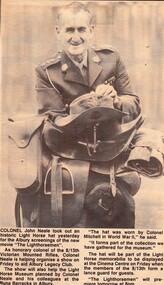 8th/13th Victorian Mounted Rifles Regimental Collection
Document
... The official party included the Area Commander Albury-Wodonga Military Area, Honorary Colonel 8/13 VMR and Officer Commanding ‘a’ Squadron 8/13 VMR. ...The official party included the Area Commander Albury-Wodonga Military Area, Honorary Colonel 8/13 VMR and Officer Commanding ‘a’ Squadron 8/13 VMR. ...‘A’ Squadron 8/13 Victorian mounted Rifles hosted a special screening of the movie “The Lighthorsemen” at the Regent Theatre Albury on 11 September 1987. The official party included the Area Commander Albury-Wodonga Military Area, Honorary Colonel 8/13 VMR and Officer Commanding ‘a’ Squadron 8/13 VMR. The VMR Heritage Troop mounted a Lance-Guard in the theatre foyer and the Albury City Band played prior to the screening. Proceeds from the function were donated to Legacy.Newspaper clipping from Border Mail of Wednesday 9 September 1987 regarding special screening of film " the lighthorsemen " hosted by 8/13 Victorian Mounted Rifles. -
8th/13th Victorian Mounted Rifles Regimental Collection
Document
... The official party included the Area Commander Albury-Wodonga Military Area, Honorary Colonel 8/13 VMR and Officer Commanding ‘a’ Squadron 8/13 VMR. ...The official party included the Area Commander Albury-Wodonga Military Area, Honorary Colonel 8/13 VMR and Officer Commanding ‘a’ Squadron 8/13 VMR. ...‘A’ Squadron 8/13 Victorian mounted Rifles hosted a special screening of the movie “The Lighthorsemen” at the Regent Theatre Albury on 11 September 1987. The official party included the Area Commander Albury-Wodonga Military Area, Honorary Colonel 8/13 VMR and Officer Commanding ‘a’ Squadron 8/13 VMR. The VMR Heritage Troop mounted a Lance-Guard in the theatre foyer and the Albury City Band played prior to the screening. Proceeds from the function were donated to Legacy.Three page typed document detailing administrative arrangements for the special screening of film " The Lighthorsemen " at Albury 11 September 1987. -
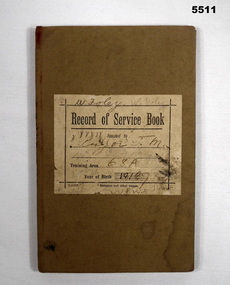 Bendigo Military Museum
Administrative record - RECORD OF SERVICE BOOK, CADETS
... Issued 1/1/1911 as a Military Cadet, training area 68A. Joined Citizen Forces in Mar 1915 and Cadet from 1911....Issued 1/1/1911 as a Military Cadet, training area 68A. Joined Citizen Forces in Mar 1915 and Cadet from 1911. ...Record of Service for J.M. Pryor. Issued 1/1/1911 as a Military Cadet, training area 68A. Joined Citizen Forces in Mar 1915 and Cadet from 1911.Hard covered Service book with 32 pages (1-64) on yellow paper and cover brown. Watermarks on cover and discolourisation on inside pages.On cover, Signature, Training Area "68A" & year of birth "1916". Inside of cover, various miscellaneous notes.record of service, citizen forces, ww1 -
 National Vietnam Veterans Museum (NVVM)
Photograph, Gibbons, Denis, Document Inspection
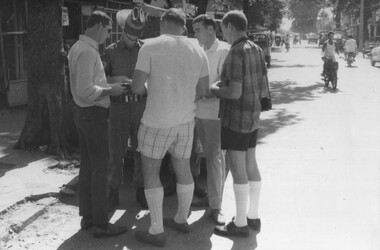
... A black and white photograph of Diggers on R & C leave in Vung Tau have their leave passes and other military documents inspected by Australian and New Zealand Military Police. this area was a popular area in Vung Tau knows as the "street of bars" with a row of bars each side of the street....Photograph Military Police Street Of Bars Vung Tau Diggers R & C Leave Street Bars Denis Gibbons A black and white photograph of Diggers on R & C leave in Vung Tau have their leave passes and other military documents inspected by Australian and New Zealand Military Police. this area was a popular area in Vung Tau knows as the "street of bars" with a row of bars each side of the street. ...Denis Gibbons (1937 – 2011) Trained with the Australian Army, before travelling to Vietnam in January 1966, Denis stayed with the 1st Australian Task Force in Nui Dat working as a photographer. For almost five years Gibbons toured with nine Australian infantry battalions, posting compelling war images from within many combat zones before being flown out in late November 1970 after sustaining injuries. The images held within the National Vietnam Veterans Museum make up the Gibbons Collection.A black and white photograph of Diggers on R & C leave in Vung Tau have their leave passes and other military documents inspected by Australian and New Zealand Military Police. this area was a popular area in Vung Tau knows as the "street of bars" with a row of bars each side of the street.photograph, military police, street of bars, vung tau, diggers, r & c leave, street bars, denis gibbons -
 Bendigo Military Museum
Book - BOOK, Military History of Seymour and Puckapunyal Districts, "Military History of Seymour and Puckapunyal 1903 - 1969"
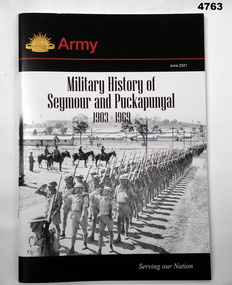
... Seymour and Puckapunyal areas Military history. "Spans well over 130 years from the Colonial days, the post Federation era, the First and Second World Wars, the Korean War and 1st National Service scheme to the Vietnam War and the 2nd National Service scheme"....Seymour and Puckapunyal areas Military history. "Spans well over 130 years from the Colonial days, the post Federation era, the First and Second World Wars, the Korean War and 1st National Service scheme to the Vietnam War and the 2nd National Service scheme". ...Seymour and Puckapunyal areas Military history. "Spans well over 130 years from the Colonial days, the post Federation era, the First and Second World Wars, the Korean War and 1st National Service scheme to the Vietnam War and the 2nd National Service scheme".Soft cover book. Soft cover - heavy gauge paper, black, red and white print on front and back. Front illustrated black and white photograph soldiers on parade with background of buildings. Bacl - illustrated lightly coloured map. 65 pages - cut, plain, sewn, gloss white. Illustrated black and white, sepia and colour photographs and maps.book, military history, seymour and puckapunyal -
 Bendigo Military Museum
Administrative record - Army Survey Regiment - Operation Rapid Track 1987 Operation Report, Army Survey Regiment, Bendigo, 27 May 1987
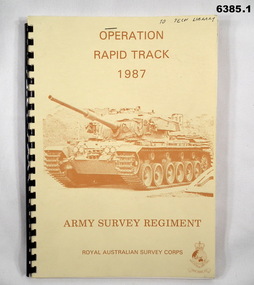
... The Survey Operation Report deals with the cartographic completion of four 1:50,000 topographical line maps and one Special 1:50,000 map covering the Puckapunyal Military Training Area. The report covers in detail the digital stereo plotting, field completion (checking) and the cartographic completion including printing. ...The Survey Operation Report deals with the cartographic completion of four 1:50,000 topographical line maps and one Special 1:50,000 map covering the Puckapunyal Military Training Area. The report covers in detail the digital stereo plotting, field completion (checking) and the cartographic completion including printing. ...The Survey Operation Report deals with the cartographic completion of four 1:50,000 topographical line maps and one Special 1:50,000 map covering the Puckapunyal Military Training Area. The report covers in detail the digital stereo plotting, field completion (checking) and the cartographic completion including printing. The four 1:50.000 maps are 7823-1 PYALONG, 7824-2 COSTERFIELD, 7923-4 TALLAROOK and 7924-3 NAGAMBIE. Annex A lists personnel and dates involved and is attached as 6385.2. Annex B lists the members of the field completion parties.A4 sized buff coloured light cardboard covered report, plastic spiral binding. Front cover includes text, Survey Corps badge and light brown image of a Centurian tank. "To Tech Library", Page 2 has two small handwritten notes indicating that Phase 2 was the Field Completion Phaseroyal australian survey corps, rasvy, fortuna, army survey regiment, army svy regt, asr -
 National Vietnam Veterans Museum (NVVM)
Manual, Vazenry, G.R, Military Forces of Victoria, 1854-1967
... A cream coloured cardboard cover with a black area on the front. In this area reads Military Forces of Victoria, 1865-1967 with the name G.R. ...In this area reads Military Forces of Victoria, 1865-1967 with the name G.R. ...A cream coloured cardboard cover with a black area on the front. In this area reads Military Forces of Victoria, 1865-1967 with the name G.R. Vazenry further down the cover. There are four punch holes down the left hand side and a metal slide is in the two middle holes which holds the manual together.australia - armed forces - service manuals, military forces of victoria -
 Bendigo Military Museum
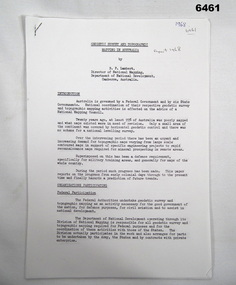
Administrative record - Geodetic Survey and Topographical Mapping in Australia - Report by BP Lambert 1968, 1968
... areas. Superimposed on this has been a defence requirement, specifically for military training areas, and generally for maps of the whole country. ...areas. Superimposed on this has been a defence requirement, specifically for military training areas, and generally for maps of the whole country. ...Australia is governed by a Federal Government and by six State Governments. National coordination of their respective geodetic survey and topographic mapping activities is effected on the advice of a National Mapping Council. Twenty years ago, at least 95% of Australia was poorly mapped and what maps existed were in need of revision. only a small area of the continent was covered by horizontal geodetic control and there was no scheme for a national levelling survey. Over the intervening period there has been an urgent and increasing demand for topographic maps varying from large scale contoured maps in support of specific engineering projects to rapid reconnaissance maps required for mineral prospecting in remote areas. Superimposed on this has been a defence requirement, specifically for military training areas, and generally for maps of the whole country. During the period much progress has been made. This paper reports on the progress from early colonial days through to the present time and finally hazards a prediction of future trends.Photocopy of 18-page typed report including diagrams, stapled top left-hand corner. Geodetic Survey and Topographic Mapping a Report by BP Lambert Director of National Mapping, Department of National Development, Canberra, Australia, 1968.royal australian survey corps, rasvy, fortuna, army survey regiment, army svy regt, asr, national mapping -
 Flagstaff Hill Maritime Museum and Village
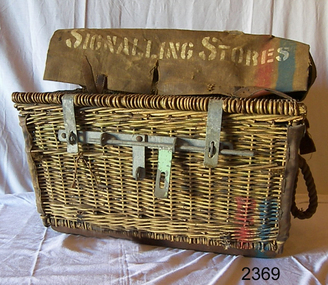
Equipment - Wicker Basket
... military applications. Flares may be ground pyrotechnics, projectile pyrotechnics, or parachute-suspended to provide maximum illumination time over a large area. ...military applications. Flares may be ground pyrotechnics, projectile pyrotechnics, or parachute-suspended to provide maximum illumination time over a large area. ...A flare, also sometimes called a fusee, is a type of pyrotechnic that produces a bright light or intense heat without an explosion. Flares are used for distress signalling, illumination, communication or defensive countermeasures in civilian and military applications. Flares may be ground pyrotechnics, projectile pyrotechnics, or parachute-suspended to provide maximum illumination time over a large area. Projectile pyrotechnics may be dropped from aircraft, fired from rocket or artillery, or deployed by flare guns or hand held percussive tubes. Signalling flares have been in use by all branches of the military services since the 1920s also by the maritime services to signal other ships or for distress purposes. The earliest recorded use of gunpowder for signalling purposes was the 'signal bomb' used by the Chinese Song Dynasty as the Mongol-led Yuan Dynasty besieged Yangzhou in 1276. These soft-shelled bombs, timed to explode in mid-air, were used to send messages to a detachment of troops far in the distance. Another mention of the signal bomb appears in a text dating from 1293 requesting their collection from those still stored in Zhejiang. A signal gun appears in Korea by 1600. The (Wu I Thu Phu Thung Chih or Illustrated Military Encyclopedia) written in 1791 depicts a signal gun in an illustration. The item was used to carry and store flares for signalling use as the inscription on the canvas cover suggests. Given the method of storing flares is in a wicker basket that is non conducting of an electrical charge that may accidentally set of explosive materials. The writer assumes the basket was used from the early 20th century and most likely by maritime or military services to store it's flares.Basket cane square with metal locks & rope handles each end. Canvas reinforced on vertical sides with a canvas cover on top. Canvas cover has leather straps. Stencilled on canvas in white paint "SIGNALLING STORES" flagstaff hill, warrnambool, shipwrecked-coast, flagstaff-hill, flagstaff-hill-maritime-museum, maritime-museum, shipwreck-coast, flagstaff-hill-maritime-village, basket, cane basket, signalling stores -
 Flagstaff Hill Maritime Museum and Village
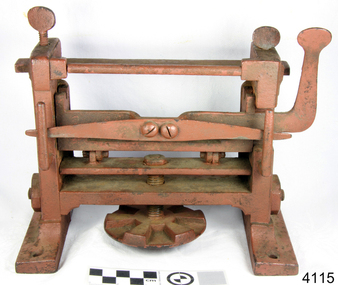
Lap Skiver, J Dixon, 1900s
... The Walsall area emerged as a major supplier of military saddlery and harnesses, with one company supplying an astonishing 100,000 saddles for the British army in the First World War. ...The Walsall area emerged as a major supplier of military saddlery and harnesses, with one company supplying an astonishing 100,000 saddles for the British army in the First World War. ...Walsall in England was regarded as the world`s greatest centre of the saddlery trade. The town's craftsmen began to specialise in making bits, stirrups and spurs in the Middle Ages, developing into fully-fledged makers of saddlery and harness, by the end of the nineteenth century. As a result, over a hundred firms were exporting their products throughout the British Empire and beyond. The Walsall firms flourished as horses were so vital to everyday life in Victorian Britain and the colonies. The Walsall area emerged as a major supplier of military saddlery and harnesses, with one company supplying an astonishing 100,000 saddles for the British army in the First World War. The twentieth century saw the rise of light leather goods, such as handbags, cases and gloves. With the coming of the motor car, these products became the mainstay of the Walsall leather industry. Many companies supplied this trade and Dixon tools was one, as a commercial and industrial equipment supplier to the trade. The company started in 1843 and has continued to produce tools for the leather industries up and till August 2017 when the company was dissolved.A vintage item used in the leather working industries see additional notes at end of document for clarity on how the item was used and it's importance in making leather goods.Lap Skiver has a roller missing. Painted reddish brown J Dixonflagstaff hill, warrnambool, shipwrecked-coast, flagstaff-hill, flagstaff-hill-maritime-museum, maritime-museum, shipwreck-coast, flagstaff-hill-maritime-village, lap skiver, leather industries, leather making tools, tools, j dixon -
 Flagstaff Hill Maritime Museum and Village
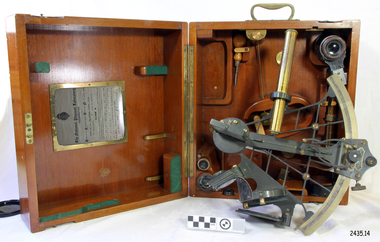
Instrument - Navigational Sextant, 1882-1890
... It also demonstrates the skill and workmanship of the early instrument makers that operated scientific instrument businesses from London and other areas of England to provide most of the navigational instrumentation used by commercial and military navies of the time. flagstaff hill warrnambool shipwrecked-coast flagstaff-hill flagstaff-hill-maritime-museum maritime-museum shipwreck-coast flagstaff-hill-maritime-village sextant box sextant hezzanith heath & co navigational instrument george wilson heath astronomical instrument instrument manufacturers scientific instrument navigation celestial navigation octant quadrant lunar navigation On certificate "Heath & Co, London. ...A sextant is an astronomical instrument used to determine latitude and longitude at sea by measuring angular distances, especially the altitudes of the sun, moon, and stars. It is a doubly reflecting navigation instrument and used mainly by sailors to measure the angular distance between two visible objects. The name comes from the Latin sextans, or “sixth part of a unit,” because the sextant’s arc can be 60° or 120° of a circle depending on the model used. The primary use was to measure the angle between an astronomical object and the horizon for the purposes of celestial navigation. The estimation of this angle is known as sighting or shooting the object, or taking a sight. This angle and the time when it was measured is used in order to determine Greenwich Mean Time and hence longitude. Sighting the height of a landmark on land can also give a measure of distance from that object. History: The development of the sextant was as an improvement over the octant, an instrument designed to measure one's latitude. The octant was first implemented around 1731-present but can only measure angles up to 45°. As larger angles were needed to allow the measurement of lunar objects - moon, stars and the sun - at higher angles, the octant was superseded by the sextant. The sextant is a similar instrument but better made and allows larger angles from 60° to 120°. This improvement allows distances to be accurately calculated thereby giving longitude when used with a chronometer. The sextant was derived from the octant in 1757, eventually making all previous instruments used for navigational positioning obsolete. The sextant had been attributed to by John Hadley (1682–1744) and Thomas Godfrey (1704–1749), but reference to the sextant was also found later in the unpublished writings of Isaac Newton (1643–1727). Earlier links can be found to Bartholomew Gosnold (1571–1607) indicating that the use of a sextant for nautical navigation predates Hadley's implementation. In 1922, the sextant was modified for aeronautical navigation by Portuguese navigator and naval officer Gago Coutinho. It should be noted that the octant and quadrant are in the same family as they were, and all are, regarded as sextants. The sextant is representative of it's type and although not fully complete it demonstrates how 18th,19th and 20th century mariners determined their latitude and longitudinal to determine their position on a chart, allowing them to navigate there way across the world's oceans. It also demonstrates the skill and workmanship of the early instrument makers that operated scientific instrument businesses from London and other areas of England to provide most of the navigational instrumentation used by commercial and military navies of the time.Sextant with square, fitted box of polished wood, "Hezzanith" brand. Box contains many parts for the sextants use. On certificate "Heath & Co, London. Sextant Number Y 822". Catch on lid "DEFIANT LEVER" and "PATENT NUMBER 187.10". Maker's certificate is attached to the inside of the box.flagstaff hill, warrnambool, shipwrecked-coast, flagstaff-hill, flagstaff-hill-maritime-museum, maritime-museum, shipwreck-coast, flagstaff-hill-maritime-village, sextant box, sextant, hezzanith, heath & co, navigational instrument, george wilson heath, astronomical instrument, instrument manufacturers, scientific instrument, navigation, celestial navigation, octant, quadrant, lunar navigation -
 Federation University Historical Collection
Medal - Numismatics, 'Dead Man's Penny' for Edwin Joseph 'Ted' Cannon, c1919
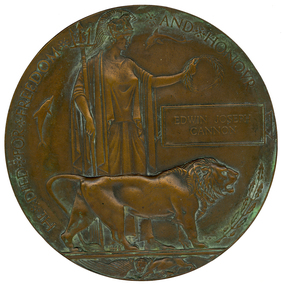
... area from Hill 60 to The Bluff. It was a hazardous task and Ted was warned to be careful. Tragically he was sniped by an enemy machine-gunner and sustained severe abdominal wounds. Stretcher-bearers rushed him to the 17th Casualty Clearing Station where he was operated on by the doctors at 8.30 that night. With little chance of success, but ever resilient, Ted remained conscious almost to the end. He died early in the morning of the 14 September 1916. His body was buried in the large Military...area from Hill 60 to The Bluff. It was a hazardous task and Ted was warned to be careful. Tragically he was sniped by an enemy machine-gunner and sustained severe abdominal wounds. Stretcher-bearers rushed him to the 17th Casualty Clearing Station where he was operated on by the doctors at 8.30 that night. With little chance of success, but ever resilient, Ted remained conscious almost to the end. He died early in the morning of the 14 September 1916. His body was buried in the large Military ...The Dead Man’s Penny is a commemorative medallion which was presented to the next-of-kin of the men and women from England and the Empire who died during World War One. The Dead Man’s Penny was accompanied by a letter from King George V, stating ‘I join with my grateful people in sending you this memorial of a brave life given for others in the Great War’.[http://nma.gov.au/blogs/education/2010/11/14/dead-mans-penny/] Popularly known as the "Dead Man’s Penny", because of the similarity in appearance to the somewhat smaller penny coin. 1,355,000 plaques were issued, which used a total of 450 tonnes of bronze, and continued to be issued into the 1930s to commemorate people who died as a consequence of the war. [http://en.wikipedia.org/wiki/Memorial_Plaque_(medallion)] It was decided that the design of the plaque was to be picked from submissions made in a public competition. Over 800 designs were submitted and the competition was won by the sculptor and medallist Edward Carter Preston with his design called Pyramus, receiving a first place prize of £250.[http://en.wikipedia.org/wiki/Memorial_Plaque_(medallion)] They were initially made at the Memorial Plaque Factory, 54/56 Church Road, Acton, W3, London from 1919. Early plaques did not have a number stamped on them but later ones have a number stamped behind the lion's back leg. [http://en.wikipedia.org/wiki/Memorial_Plaque_(medallion)] Ted Cannon's plaquette does not have a stamped number. Ted Cannon was a gifted artist and cartoonist who studied at the Ballarat School of Mines Technical Art School. During the Battle of Pozieres on the Western Front Ted Cannon worked with the Scout Platoon sketching the enemy's gun emplacements. Ted proved invaluable to the Brigade and brought he came under the attention of the Australian High Command. On 13 September 1916 Ted was given a special assignment for General C.B.B. White. Ted was sent out forward of the Old Mill at Verbrandenmolen (in the Ypres Salient) to draw a panorama of the German lines in the area from Hill 60 to The Bluff. It was a hazardous task and Ted was warned to be careful. Tragically he was sniped by an enemy machine-gunner and sustained severe abdominal wounds. Stretcher-bearers rushed him to the 17th Casualty Clearing Station where he was operated on by the doctors at 8.30 that night. With little chance of success, but ever resilient, Ted remained conscious almost to the end. He died early in the morning of the 14 September 1916. His body was buried in the large Military Cemetery at Lijssenthoek. The effects of the late Ted Cannon were returned to his parents. These were an autograph book, three brushes, prayer book, housewife, whistle, book, hymn book, curios. Another listing gives his effects as "identity disc, letters, photos, wallet, 2 books, Mexican Dollar, 1 cent (Ceylon), 3 German Straps, Fountain Pen, Cigarette-holder, Franc Note, 50 centimes Note, devotional book, mirror, rosary, scapula, metal ring, two combs, book of views, nail clippers, badges, tie clip, Egyptian stamp.[http://recordsearch.naa.gov.au/scripts/Imagine.asp?B=3202589] Ted Cannon was an only child. It is not known how the 'Dead Man's Penny' came into the ownership of the donor, but it is thought that it may have been left in a house owned by the donor's mother. Further information on Ted Cannon can be found at http://bih.ballarat.edu.au/index.php/Edwin_J._Cannon and http://www.ballarat.edu.au/about-ub/history/art-and-historical-collection/ub-honour-roll/c/edwin-joseph-ted-cannon-1895-1916Large bronze medallion or plaquette featuring an image of Lady Britannia surrounded by two dolphins (representing Britain’s sea power) and a lion (representing Britain) standing over a defeated eagle (symbolising Germany). Around the outer edge of the medallion are the words ‘He died for freedom and honour’. Next to Lady Britannia is the deceased solider’s name, with no rank provided to show equality in their sacrifice. (http://nma.gov.au/blogs/education/2010/11/14/dead-mans-penny) The plaque was distributed throughout the British Empire, and the first plaques were distributed in Australia in 1922 "Returned home" by W. & O. Mayne, 2013. ted cannon, edwin joseph cannon, cannon, world war 1, world war -
 Federation University Historical Collection
Book, Final recommendations Ballarat Study Area Land Conservation Council, Victoria, 1982, 1982
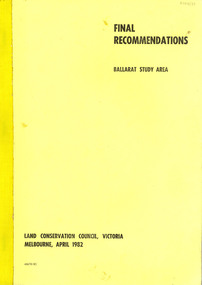
... The contents of the report include: Parks, reference areas, wildlife reserves, water production, hardwood production, softwood production, flora Reserves and Flora and Fauna reserves, bushland reserves, historic area and reserves, rivers and streams, Roadside conservation and Highway parks, Education areas and School Plantations, Lake Reserves, geological reserves, recreation, scenic reserves, agriculture, mineral and stone production, utilities and survey, township land, Uncommitted Land, military training, other reserves and public land. ...The contents of the report include: Parks, reference areas, wildlife reserves, water production, hardwood production, softwood production, flora Reserves and Flora and Fauna reserves, bushland reserves, historic area and reserves, rivers and streams, Roadside conservation and Highway parks, Education areas and School Plantations, Lake Reserves, geological reserves, recreation, scenic reserves, agriculture, mineral and stone production, utilities and survey, township land, Uncommitted Land, military training, other reserves and public land. ...Yellow soft covered report of 95 pages . The contents of the report include: Parks, reference areas, wildlife reserves, water production, hardwood production, softwood production, flora Reserves and Flora and Fauna reserves, bushland reserves, historic area and reserves, rivers and streams, Roadside conservation and Highway parks, Education areas and School Plantations, Lake Reserves, geological reserves, recreation, scenic reserves, agriculture, mineral and stone production, utilities and survey, township land, Uncommitted Land, military training, other reserves and public land. Maps include: The Study area 1: 250 000 Supplementary Mapsland conservation authority, ballarat, endowment plantations, pine plantations, langi ghiran state park, mount buangor state park, enfield state park, ballarat-creswick regional park, rossbridge, black lake, flax mill swamp, dereel lagoon, lake bolac, lake wongan, langi ghiran reservoir, gong gong reservoir, pincotts reservoir, beales reservoir, wilsons reservoir, moorabool reservoir, korweinguboora, korweinguborra reservoir, learmonth bores, sago hill, illabarook reservoir, ballarat water commission, dunneworthy, mount cole, mont lonarch, ben major, waterloo, trawalla, linton, ross creek, canadian, shepherds flat, lal lal, mount doran, raglan, chute, carngham, buninyong, watsons hill, enfield, cape clear, illabrook, rokewood junction, mount warrenheip, nerrina, jubilee, golden stream, australasian deep lead mine, happy valley school, piggoreet, berringa, bulldog, ballarat common, wildlife, water, timber, flora, rivers, geology, agriculture, warrenheip, biodiversity -
 Federation University Historical Collection
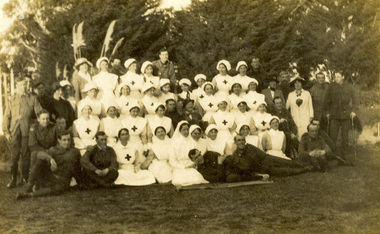
Photograph, VADs, a Nurse, and Soldiers at Highton, c1917
... The primary role of a Voluntary Aid Detachment (VAD) member was that of nursing orderly in hospitals, carrying out menial but essential tasks - scrubbing floors, sweeping, dusting and cleaning bathrooms and other areas, dealing with bedpans, and washing patients. They were not employed in military hospitals, except as ward and pantry maids; rather, they worked in Red Cross convalescent and rest homes, canteens, and on troop trains. ...The primary role of a Voluntary Aid Detachment (VAD) member was that of nursing orderly in hospitals, carrying out menial but essential tasks - scrubbing floors, sweeping, dusting and cleaning bathrooms and other areas, dealing with bedpans, and washing patients. They were not employed in military hospitals, except as ward and pantry maids; rather, they worked in Red Cross convalescent and rest homes, canteens, and on troop trains. ...The primary role of a Voluntary Aid Detachment (VAD) member was that of nursing orderly in hospitals, carrying out menial but essential tasks - scrubbing floors, sweeping, dusting and cleaning bathrooms and other areas, dealing with bedpans, and washing patients. They were not employed in military hospitals, except as ward and pantry maids; rather, they worked in Red Cross convalescent and rest homes, canteens, and on troop trains. At the start of the First World War, Australian VADs were restricted from travelling overseas by the Defence Council. As a result, many chose to travel on their own initiative and join British detachments, often in Australian Hospitals. It is reported that the 1st Australian Auxiliary Hospital included in their nursing staff some 120 VADs, chiefly Australians in the British service, employed through the Australian Red Cross Society. This policy was changed in 1916 after a request from Great Britain, and the first detachment of thirty official Australian VADs to serve overseas left Australia in September 1916.(http://www.awm.gov.au/encyclopedia/vad/, accessed 13 August 2014)A group of VADs, a nurse, and some men from the Australian Imperial Forces. Verso: 'group of nurses and some of the men at Highton - taken at an afternoon we had. Can you find me [Harold Holmes] it is not very clear. The 2nd in uniform from the right hand side.chatham family archive, chatham, holmes, world war, world war 1, world war i, world war one, highton, red cross, vad, voluntary aid detachment, nurse, nursing
