
Showing 92 items matching "military ball"
-
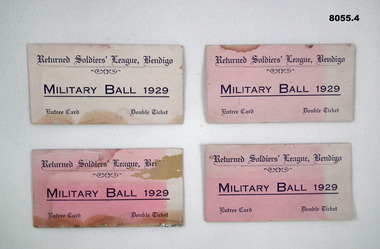 Bendigo Military Museum
Card - MILITARY BALL 1929, C. 1929
... MILITARY BALL 1929......military ball...Card, one sided double entree ticket to a "Military Ball 1929". At the top "Returned Soldiers League Bendigo"...The first mention of a Ball held by the Sub Branch is in 1926, these events were fund raisers. brsl smirsl military ball Card, one sided double entree ticket to a "Military Ball 1929". ...The first mention of a Ball held by the Sub Branch is in 1926, these events were fund raisers.Card, one sided double entree ticket to a "Military Ball 1929". At the top "Returned Soldiers League Bendigo"brsl, smirsl, military ball -
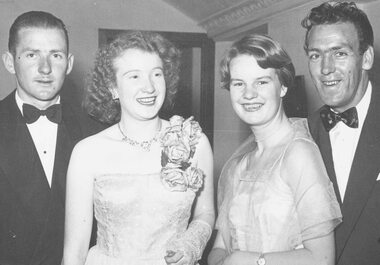 Ringwood and District Historical Society
Photograph, Military Ball, Ringwood 1952
... Military Ball, Ringwood 1952...Written on back of photograph: "Mail 11/12/52. Military Ball. Left to right A. McCann, Shirley Matthews, Jennifer Allsop, Max Haig."...Black and white photograph Military Ball, Ringwood 1952 Photograph ...Black and white photographWritten on back of photograph: "Mail 11/12/52. Military Ball. Left to right A. McCann, Shirley Matthews, Jennifer Allsop, Max Haig." -
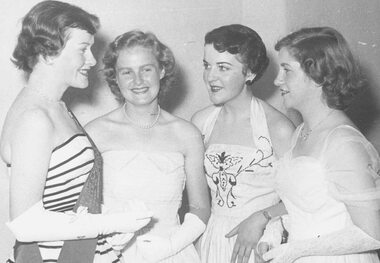 Ringwood and District Historical Society
Photograph, Military Ball, Ringwood 1952
... Military Ball, Ringwood 1952....Written on back of photograph: "Mail 11/12/52. Military Ball. 4 finalists, Left - Valerie Stevens, Norma Hortle, Jennifer White, Jill McLean."...Black and white photograph Military Ball, Ringwood 1952. Photograph ...Black and white photographWritten on back of photograph: "Mail 11/12/52. Military Ball. 4 finalists, Left - Valerie Stevens, Norma Hortle, Jennifer White, Jill McLean." -
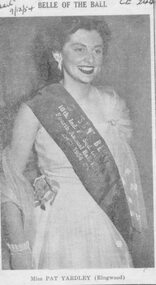 Ringwood and District Historical Society
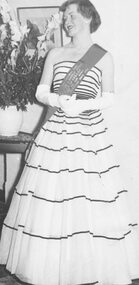
Photograph, Belle of the Ball, Miss Pat Yardley, 4th Military Ball, Ringwood. 1954
... Belle of the Ball, Miss Pat Yardley, 4th Military Ball, Ringwood. 1954....Belle of the Ball, Miss Pat Yardley (Ringwood). 4th Military Ball, 10th Sqd. Ringwood."...Belle of the Ball, Miss Pat Yardley (Ringwood). 4th Military Ball, 10th Sqd. Ringwood." Newspaper cutting Belle of the Ball, Miss Pat Yardley, 4th Military Ball, Ringwood. 1954. ...Newspaper cuttingWritten and printed around newspaper photograph: "Mail 9/12/54. Belle of the Ball, Miss Pat Yardley (Ringwood). 4th Military Ball, 10th Sqd. Ringwood." -
 Ringwood and District Historical Society
Photograph, Ringwood Military Ball, 1952
... Ringwood Military Ball, 1952...Written on back of photograph: "2nd Annual Military Ball, Town Hall, Ringwood, 1952. For Ringwood troop 10th Independent Field Squadron. ...Black and white photograph Ringwood Military Ball, 1952 Photograph ...Black and white photographWritten on back of photograph: "2nd Annual Military Ball, Town Hall, Ringwood, 1952. For Ringwood troop 10th Independent Field Squadron. Belle of the Ball, Valerie Stevens." -
 Bendigo Historical Society Inc.
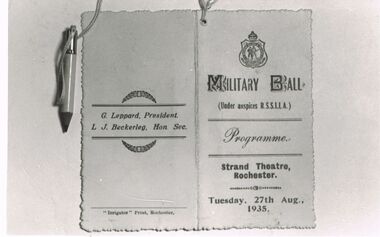
Photograph - PETER ELLIS COLLECTION: MILITARY BALL, Tuesday 27th August, 1935
... PETER ELLIS COLLECTION: MILITARY BALL...Black and white photograph white edges. Military Ball (Under auspices R.S.S.I.I.A) Programme. ...Photograph PETER ELLIS COLLECTION: MILITARY BALL ...Black and white photograph white edges. Military Ball (Under auspices R.S.S.I.I.A) Programme. Strand Theatre, Rochester. Tuesday, 27th Aug., 1935. G. Leppard, President. LJ. Beckerleg, Hon. Sec. ''Irrigator'' Print, Rochester.ephemera, mementoes, dance programme -
 Ringwood and District Historical Society
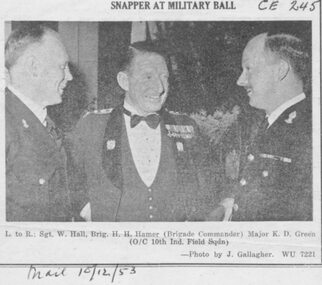
Photograph, Ringwood Military Ball, 1953
... Ringwood Military Ball, 1953...Typed around photograph: "Snapper at Military Ball. L. to R.: Sgt. W. Hall, Brig. H. ...Typed around photograph: "Snapper at Military Ball. L. to R.: Sgt. W. Hall, Brig. H. ...Newspaper cuttingTyped around photograph: "Snapper at Military Ball. L. to R.: Sgt. W. Hall, Brig. H. H. Hamer (Brigade Commander) Major K. D. Green (O/C 10th Ind. Field Sqdn) - Photo by J. Gallagher." Mail 10/12/53. Ball was held at the Box Hill Town Hall. -
 Ringwood and District Historical Society
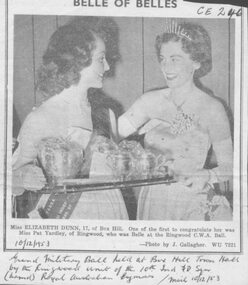
Photograph, Ringwood Military Ball, 1953
... Ringwood Military Ball, 1953...Written below- Grand Military Ball held at Box Hill Town Hall by the Ringwood Unit of the 10th Ind. ...Newspaper cutting Ringwood Military Ball, 1953 Photograph ...Newspaper cuttingTyped above and below photograph: "Belle of Belles. Miss Elizabeth Dunn, 17, of Box Hill. One of the first to congratulate her was Miss Pat Yardley, of Ringwood, who was Belle at the Ringwood C.W.A. Ball. - Photo by J. Gallagher. 10/12/1953. Written below- Grand Military Ball held at Box Hill Town Hall by the Ringwood Unit of the 10th Ind. F.D. Sqn. (armed) Royal Australian Engineers." -
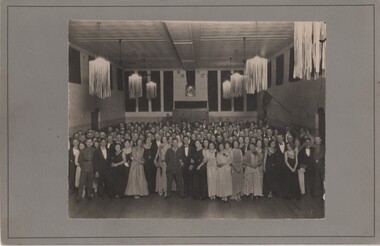 Rutherglen Historical Society
Image, c1940
... military ball...Written on back of mount: "Rutherglen Military Ball" ...military ball balls dances Written on back of mount: "Rutherglen Military Ball" Black and white photograph, mounted on grey cardboard, of a large group of people at a ball. ...Black and white photograph, mounted on grey cardboard, of a large group of people at a ball.Written on back of mount: "Rutherglen Military Ball" military ball, balls, dances -
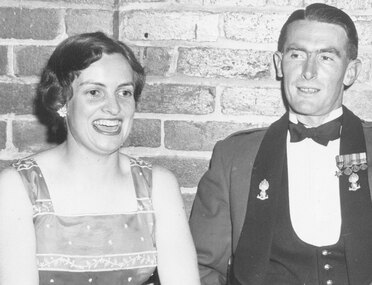 Ringwood and District Historical Society
Photograph, Ringwood Military Ball, 1957
... Ringwood Military Ball, 1957, ...Black and white photograph Ringwood Military Ball, 1957, Photograph ...Black and white photographWritten on back of photograph: "Mail 12/12/1957. Army Ball, Dr. Joan Bradley (Balwyn) and Major Robertson (Hawthorn), O.C. 10th Field Squadron." -
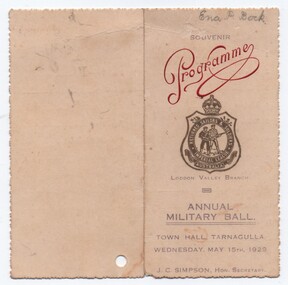 Tarnagulla History Archive
Dance Card and Programme, Annual Military Ball, Tarnagulla, 1929
... Dance Card and Programme, Annual Military Ball, Tarnagulla, 1929...Dance Card and Programme, Annual Military Ball, Tarnagulla, 1929 ... -
 Tatura Irrigation & Wartime Camps Museum
Booklet, Debutantes, 1938
... ...Military ball...List of names of debutantes presented to Miss Pearl Maskell, Military ball 4 July 1938....List of names of debutantes presented to Miss Pearl Maskell, Military ball 4 July 1938. debutants Military ball Miss Pearl Maskell 1838 debutant ball Pale blue cover, black lettering, wood threaded at spine. ...List of names of debutantes presented to Miss Pearl Maskell, Military ball 4 July 1938.Pale blue cover, black lettering, wood threaded at spine.debutants, military ball, miss pearl maskell, 1838 debutant ball -
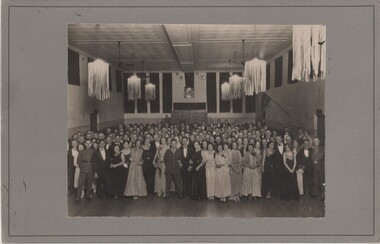 Rutherglen Historical Society
Image, Vine's Studio, 1932-1933
... Black and white photograph, mounted on cardboard, of people in evening dress, believed to be at Military Ball...Gibbs, 1932 or 33" Black and white photograph, mounted on cardboard, of people in evening dress, believed to be at Military Ball Image Vine's Studio ...Black and white photograph, mounted on cardboard, of people in evening dress, believed to be at Military BallOn back of photo: "J. Gibbs, 1932 or 33"evening dress, ball, dance -
 8th/13th Victorian Mounted Rifles Regimental Collection
Photograph - Squadron Ball 89
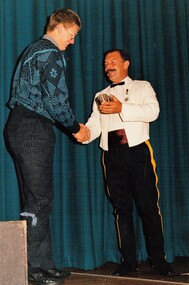
... military...Ball...In 1977 8/13 VMR Regiment was reduced to an independent squadron A Squadron 8th/13th Victorian Mounted Rifles and in 1991 was linked with 4th/19th Prince of Wales’s Light Horse forming the VMR Squadron of that regiment. military Ball VMR Wangaratta Colour photograph of Major Robert Morrison, Officer Commanding ' A ' Squadron 8/13 Victorian Mounted Rifles presenting a trophy tankard to Trooper Fraser of Wangaratta at the Squadron Ball, 7 October 1989. ...The 8th/13th Victorian Mounted Rifles was raised as a regiment of the Royal Australian Armoured Corps on 1 May 1948 with Headquarters in Melbourne and squadrons in Sale, Benalla/Wangaratta and Albury. In 1955 Regimental Headquarters moved to Wangaratta and a second squadron was located at Albury. The Sale squadron transferred to 4th/19th Prince of Wales’s Light Horse. In 1977 8/13 VMR Regiment was reduced to an independent squadron A Squadron 8th/13th Victorian Mounted Rifles and in 1991 was linked with 4th/19th Prince of Wales’s Light Horse forming the VMR Squadron of that regiment.Colour photograph of Major Robert Morrison, Officer Commanding ' A ' Squadron 8/13 Victorian Mounted Rifles presenting a trophy tankard to Trooper Fraser of Wangaratta at the Squadron Ball, 7 October 1989.military, ball, vmr, wangaratta -
 Orbost & District Historical Society
invitation, 1939
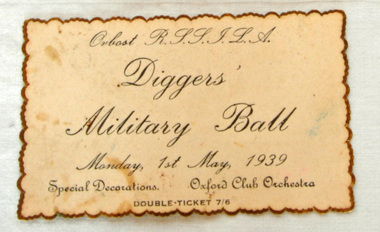
... A rectangular card invitation to the Diggers' Military Ball, Monday 1st May 1939. Print is in black. ...A rectangular card invitation to the Diggers' Military Ball, Monday 1st May 1939. Print is in black. ...The Returned Sailors and soldiers Imperial League of Australia was formed in 1916. Annual RSSAILA Balls (originally known as the Diggers Balls) were held to raise funds for those who returned fromconflicts especially those who were not eligible for war pensions.Socially , the ‘Diggers’ Annual Ball’ accomplished a great deal in bringing Returned Servicemen together. At this time, these functions were organised by self-appointed committees and proceeds were distributed among special causes – mainly to the RSSAILA members who were experiencing hardship.A rectangular card invitation to the Diggers' Military Ball, Monday 1st May 1939. Print is in black. The card is edged in gold. It is a Double Ticket - 7/6 RSSILAmilitary-balls r.s.s.i.l.a. -
 8th/13th Victorian Mounted Rifles Regimental Collection
Photograph - 8/13 VMR group
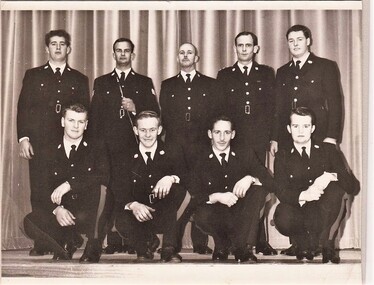
... Military...Blues...Ball...Photograph of soldiers of 8/13 VMR in formal dress at a Ball. Military Blues Ball VMR " Back L to R :- Sgt. ...Photograph of soldiers of 8/13 VMR in formal dress at a Ball.Black and white photograph of nine men in dress uniform with 8/13 VMR collar badges participating in a community event at Wangaratta in September 1965." Back L to R :- Sgt. Andrews, RSM Harrower, Capt. McInerney,Selwood. Front Trooper Wadley, Reid, O' Loughlin, McDermot. "military, blues, ball, vmr -
 Bendigo Historical Society Inc.
Functional object - CANNON BALL
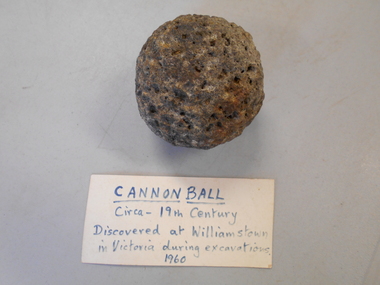
... MILITARY...Army...Cannon ball...MILITARY Army Cannon ball Cannon ball, surface very pitted. ...Cannon ball, surface very pitted. Information with cannon ball states:' Circa 19th Century, discovered at Williamstown in Victoria during excavations 1960'military, army, cannon ball -
Tatura Irrigation & Wartime Camps Museum
Postcards and Cards, 1909 to approximately to 1920
... Dance Programmes - Some with pencils attached| l. Tatura Military Ball - July 21 ?| 2. Rushworth Military Ball - June 20, 1913| 3. ...Dance Programmes - Some with pencils attached| l. Tatura Military Ball - July 21 ?| 2. Rushworth Military Ball - June 20, 1913| 3. ...Personal Stationery belonging to Kitty (CE) Crawford, Mother of John Lawry. Dance Programmes|Person stationary belonging to Kitty (CE Crawford) mother of John Lawry.|GROUP l. Dance Programmes - Some with pencils attached| l. Tatura Military Ball - July 21 ?| 2. Rushworth Military Ball - June 20, 1913| 3. Tatura Military Ball - July 17, 1913| 4. Murchison 3rd Squadron Annual Ball - August 11, 1909| 5. Tatura Golf Club Annual Ball - 1914|GROUP 2 - Perfume Cards| 1. Divinia (1913 Calendar on back) 6 cards| 2. Eau de Cologne Francaise (1 card)| 3. Rose de L'Empire (2 cards)| 4. Californian Poppy (1 card)| 5. Muguet (2 cards)| 6. Lierre Fleuri (1910 Calendar on back) (1 card)| 7. Floramye (1 card)| 8. Phul-Nana (1 card)|GROUP 3 - Bible Texts - Memory Verses| 4 cards with texts and colourful pictures. - Isaiah 12:2,| Psalms 51.15, Isaiah 26:4, 2 Timothy 2:3|GROUP 4 - Greeting Cards to Miss Kitty Crawford (mainly birthday)| 18 postcard size cards, most have letters included.|GROUP 5 - Greeting cards with no writing (unused)| 15 cards, same vintage as others (2 have writing but not to K Crawford)|GROUP 6 - Miscellaneous - including| Nestle's "Wonders of the World" - 32 cards| Cigarette Card - Wills (1 card)| Butterflies - Allens Irish moss Gum Jubes (1 card)| Victorian Footballers (J Bissett), Hoadley's Violet Nut Bars (1 card)| Ships of the World (Empress of Britain) (1 card)| No Category (3 cards)|GROUP 7 - Puzzle|Ribbons on a lggage tag|Perfume Cards|Bible Texts|Greeting Cards to Miss Kitty Crawford - Mainly birthday|Greeting Cards - unused|Miscellaneous|Puzzle|Tatura|1938 Military Ball Debs|Pearl Maskell|Myrtle Dick|Pauline Brady|Mabel Wilson|Margaret Hastie|Jean McIntyre|Madge Wells|Beth Bitcon|Mollie Arnold|Melvie Nicholson|Kitty Crawford|May Crawford|Christmas Card - To Miss Katie Crawford from J Powell|New Year Card -To M Hall From S Boyer|Crawford Centenary 1871-1971 Invitation - WoodlandsBlack plastic archive boxVariousdances and birthdays, documents, cards, postcards -
 Bendigo Historical Society Inc.
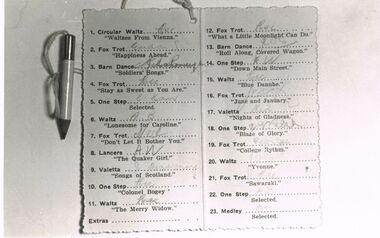
Photograph - PETER ELLIS COLLECTION: DANCE CARD
... Programme. Rochester Military Ball. Scalloped edges. String. Pencil. 1. ...Programme. Rochester Military Ball. Scalloped edges. String. Pencil. 1. ...Black and white photograph. Dance card. Programme. Rochester Military Ball. Scalloped edges. String. Pencil. 1. Circular Waltz 'waltes from Vienna' 2. Fox trot 'Happiness ahead' 3 Barn Dance 'Soldiers'songs'. 5. one step Selected. 6. Waltz. 'Lonesome for Caroline.' 7. Fox trot 'Don't let it bother you'. 8. Lancers 'The Quaker girl'. 9. Valetta 'Songs of Scotland'. 10. One Step 'Colonel Bogey'. 11. Waltz. 'The merry widow'. Extras. 12. Fox trot 'What a little Moonlight can do'. 13. Barn Dance 'Roll Along Covered Wagon'. 14. One step 'Down Main Street'. 15. Waltz 'Blue Danube'. 16. Fox Trot 'June and January'. 17. Valetta 'Nights og Gladness'. 18. One Step 'Blaze of Glory'. 19. Fox Trot 'College Rhythm'. 20. Waltz 'Yvonne'. 21. Fox Trot 'Sawaraki'. 22. One Step Selected. 23. Medley Selected. Back of photo reads: ELLIS.C (3)ephemera, mementoes, dance programme -
 Flagstaff Hill Maritime Museum and Village
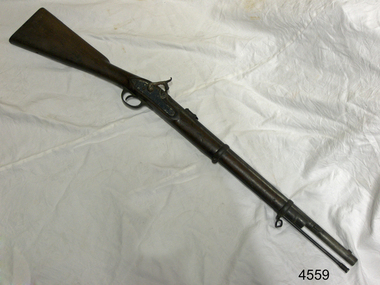
Weapon - Gun, ISAAC HOLLIS & SONS, Mid 19th Century
... Military gun...Pattern 1861...muzzle-loading...muzzle-loading musket...cap and ball...Flagstaff Hill Maritime Museum Maritime Village Warrnambool Great Ocean Road Shipwreck Coast Firearm gun percussion carbine .577 cal Colonial Tasmanian Issue Artillery Carbine Military gun Pattern 1861 muzzle-loading muzzle-loading musket cap and ball musket wood stock 1861 percussion breech-loading guns Richard and William Hillis Herbert & Co. ...The Hollis Brothers were first recorded as operating from 11 Weaman Row in 1840, although evidence suggests that the business may have commenced prior to this date. Over time, the firm evolved and became known as Isaac Hollis & Sons, with claims of its establishment dating back to 1814. This earlier date is supported by records of Richard and William Hollis trading in Bath Street, Birmingham, between 1814 and 1818, which raises the possibility that Isaac and Frederick Hollis were their descendants. The principal brothers involved in the business were Isaac Hollis, born in 1815, and Frederick Hollis, whose birth date remains unknown. Frederick’s life was cut short when he died on 20 December 1839. According to the 1841 census, Isaac Hollis resided in Weaman Row and was listed as a 25-year-old gun and pistol maker. He was married to Emma, who was born in 1821, and together they had two children: Isaac, born in 1837, and Henry, born in 1839. Following Frederick’s death, Isaac continued to operate under the name Hollis Brothers until 1845, after which he renamed the business Hollis Brothers & Co. This entity remained active up to 1848. In 1844, Isaac Hollis entered a brief partnership with William Tranter at 10 & 11 Weaman Row, likely to fulfil a specific contract or to supply particular parts. This partnership continued until 1849. In 1848, Isaac Hollis formed a partnership with Isaac Brentnall Sheath, establishing the firm of Hollis & Sheath and expanding their operations into 10 Weaman Row. The partnership saw Hollis & Sheath become licensed manufacturers of percussion breech-loading guns, positioning the company as a notable presence in the industry. In 1861, Sheath left the partnership and emigrated to New Zealand, where he conducted several enterprises and was elected as a provincial councillor. He died in Christchurch on 19th May 1897. Following the departure of Isaac Sheath in 1861, the business underwent a name change to Isaac Hollis & Sons. By approximately 1870, Isaac Hollis and Henry Hollis had assumed responsibility for the daily management of the firm, with Isaac overseeing the overall management and marketing of the company's products, while Henry managed the manufacturing processes. During this period, the company became known for producing large volumes of affordable trade guns and sporting guns, catering to customers in South Africa and the British colonies. In 1870, Isaac Hollis & Sons opened a retail location at 44a Cannon Street in London, subsequently relocating to 83 Cheapside in 1871. Isaac Hollis Jnr passed away in October 1875 in Birmingham at the age of 37, having never married. In 1876/1877, Henry Hollis registered a limited liability company under the name Isaac Hollis & Sons Ltd. However, by 1879, trading resumed under the name Isaac Hollis & Sons, and the London shop moved to 6 Great Winchester Street. From 1932 to 1933, the business operated in London as Hollis, Bentley & Playfair. The final closure of Hollis, Bentley & Playfair occurred in Birmingham in 1953. This firearm serves as an exemplary representation of the type of weapon distributed to the colony’s military forces in 1861. It was specifically manufactured by Isaac Hollis & Sons, a prominent gunmaker of the period, to meet the requirements of military use. Distribution was facilitated through Hebbert & Sons, an established military supplier based in London. Before it arrived in Tasmania, Australia, around 1861, the firearm was likely issued from the Hythe Armoury, which functioned as a British military training facility. Probably, the gun was originally allocated to British troops or police before being transferred for use in the colony. Gun: Percussion Carbine, .577 Cal. Colonial Tasmanian issue Artillery carbine, Pattern 1861. Muzzle-loading "Cap and Ball" musket. Wood stock and ramrod. Inscriptions are on the stock and breech. Gun was made for Herbert & Co., London, by Isaac Hollis & Sons, Birmingham.Stamped on stock "SOLD 95", " ISAAC HOLLIS & SONS" "GUN & PISTOL MANUFACTURES" "BIRMINGHAM" "J ASTON ARMOURER HYTHE" "MANUFACTURED EXPRESSLY FOR HEBBERT & CO LONDON". Stamped on breech "25", and "25C ---05"flagstaff hill, maritime museum, maritime village, warrnambool, great ocean road, shipwreck coast, firearm, gun, percussion, carbine, .577 cal, colonial tasmanian issue, artillery carbine, military gun, pattern 1861, muzzle-loading, muzzle-loading musket, cap and ball, musket, wood stock, 1861, percussion breech-loading guns, richard and william hillis, herbert & co., herbert & co. london, hollis & sons, isaac hollis & sons, isaac hillis & sons ltd., hollis bentley & playfair., isaac hollis, frederick hollis, isaac brentnall sheath, isaac sheath, william tranter, gun manufacturer, pistol manufacturer, gun and pistol maker, birmingham, j aston armourer, hythe, hythe armoury, military supplies -
 Federation University Historical Collection
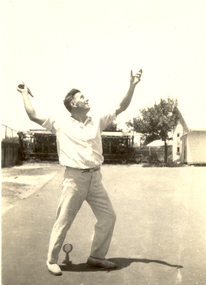
Photograph - black and white, Frank Wright Playing Tennis, 10/1928
... Military Band Scoring and conducted at the Guildhall of Music and Drama. Frank was often invited to adjudicate Brass Band Championships around Europe, in Australia, including South Street and in New Zealand. The Frank Wright Medal at the Royal South Street competition is awarded to an individual recognized as making an outstanding contribution to brass music in Australia. frank wright conductor tennis tennis racquet 1). Black and white photograph of a man dressed in light coloured trousers and a white short sleeve shirt, serving a tennis ball ...Frank Wright was a renown resident of Smeaton, where he was born. He lived at Laura Villa, and attended Smeaton State School. His father William was a gold miner and his mother's name was Sarah. Their family won many singing and instrumental awards. Frank was tutored by Percy Code and was awarded a gold medal for the highest marks in the ALCM examinations in the British Colonies at the age of seventeen years. He became the Australian Open Cornet Champion by the age of eighteen. A year later, Frank conducted the City of Ballarat Band, and later the Ballarat Soldiers’ Memorial Band. He formed the Frank Wright Frisco Band and Frank Wright and his Coliseum Orchestra. These bands won many South Street awards, and Frank as conductor won many awards in the Australian Band Championship contest. In 1933 Frank Wright sailed to England to conduct the famous St Hilda’s Band and was later appointed Musical Director of the London County Council, where he organized many amazing concerts in parks, in and around the London district. He was made Professor of Brass and Military Band Scoring and conducted at the Guildhall of Music and Drama. Frank was often invited to adjudicate Brass Band Championships around Europe, in Australia, including South Street and in New Zealand. The Frank Wright Medal at the Royal South Street competition is awarded to an individual recognized as making an outstanding contribution to brass music in Australia.1). Black and white photograph of a man dressed in light coloured trousers and a white short sleeve shirt, serving a tennis ball. Situated on a tennis court with buildings in the background. The man is Frank Wright. 2). Black and white photograph of a young man dressed in tennis whites and a jacket, holding a tennis racquet and leaning against the net on a tennis court. In the background is a hedge topped timber fence with the roof of a house behind. The man is perhaps Frank Wright or a friend.frank wright, conductor, tennis, tennis racquet -
 Flagstaff Hill Maritime Museum and Village
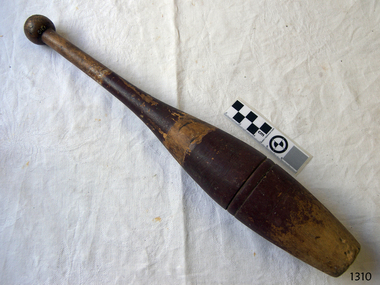
Equipment - Juggling Club, late 19th to early 20th century
... ball, ribbon and clubs. The clubs come in a variety of weights and heights and have been used from the mid-1800s until around the 1930s in schools and military institutions. ...ball, ribbon and clubs. The clubs come in a variety of weights and heights and have been used from the mid-1800s until around the 1930s in schools and military institutions. ...This wooden juggling club or exercise club may also be referred to as a juggling pin. It is very similar in shape to a bowling pin or an Indian club. It dates approximately to the early 20th century. It may have been used as one of a pair for gymnastics or exercise, or part of a larger set used by a juggler for entertainment in a circus or carnival. At some time it may have been used with a ball or disc as part of a Skittles or bowling game set. The historical collection of Federation University Australia, Victoria, includes a very similar but slightly shorter club, labelled ‘timber skittle”, as can be seen in their photograph. Another example of very similar-shaped, same-sized clubs can be seen in the collection of Nobelius Heritage Park and Emerald Museum, Emerald, Victoria. JUGGLING Jugglers entertain audiences with their tricks and routines at events such as circuses, amusement parks, parties, shows on television or theatre, schools and parties. Juggles also compete at International Championships to obtain world records, performing as individuals or in groups or teams. Contemporary champion juggler David Cain performs a Juggling History Show that both entertains and educates his audience. His routines date from the early 1600s to the 20th century. He uses a wide variety of equipment in his acts including juggling clubs. EXERCISE Exercise clubs or Indian clubs were used in 19th century Victorian times as part of exercise or strengthening programs when they were swung in certain patterns and movements. Even in the early 20th century workplace a few minutes of Indian club swinging was common practice for the relief of tension. A video clip of an American school room in 1904 shows a group of boys and girls skilfully wielding clubs in an exercise sequence (see ‘Links” section). The 1904 and 1932 Olympic Games had an event called Club Swinging. Rhythmic gymnastics was added to the Olympic Program at the L.A. Games in 1984 where competitors use apparatus such as rope, hoop, ball, ribbon and clubs. The clubs come in a variety of weights and heights and have been used from the mid-1800s until around the 1930s in schools and military institutions. They are decorated in a variety of patterns and colours and some have feature lines or scored rings on them. This juggling club is significant for its association with education, entertainment and sport in the late 19th and early 20th century.Wooden juggling club (or pin, skittle or Indian club). Vintage, bottle-shaped club with a flat, slightly concave, base. Its turned, solid timber body tapers out from the base then in again to a very narrow handle with a round knob joined onto the top. Two concentric feature lines are scored into the wider part of club. It was possibly used in exercise, gymnastics or as a skittle. Sections of the club have two brown painted stripes; paint on the lower strip has been worn off at the base . There are remnants of white paint in two areas, possibly the remains of a maker’s name or decoration. There also appears to be an inscription stamped into the wooden handle but this is illegible. Late 19th to early 20th century.Remnants of what appears to be stamped lettering and painted labelling.flagstaff hill, warrnambool, shipwrecked coast, flagstaff hill maritime museum, maritime museum, shipwreck coast, flagstaff hill maritime village, great ocean road, wooden skittle, entertainment, bowling skittle, wooden juggling pin, wooden juggling club, wooden exercise club, indian club, exercise club, club swinging, rhythmic gymnastics, sport equipment, juggling equipment, wooden club -
 Flagstaff Hill Maritime Museum and Village
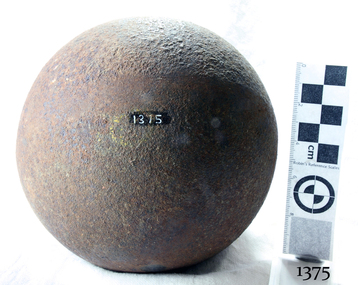
Weapon - Cannon Ball, Victorian era
... ball...ammunition...cannon...fortifications...Military...Flagstaff Hill Flagstaff Hill Maritime Museum and Village Warrnambool Maritime Museum Maritime Village Great Ocean Road Shipwreck Coast cannon ball ammunition cannon fortifications Military Equipment firearm Originally marked "16" Cannon ball, iron, painted black. ...A cannon ball, made of iron, is used as ammunition for a cannon and fired at a target.Cannons with cannon balls as ammunition were installed at Warrnambool for protection from possible invasion in the mid-to-late 19th century and early 20th century.Cannon ball, iron, painted black. Originally marked "16"flagstaff hill, flagstaff hill maritime museum and village, warrnambool, maritime museum, maritime village, great ocean road, shipwreck coast, cannon ball, ammunition, cannon, fortifications, military equipment, firearm -
 Federation University Historical Collection
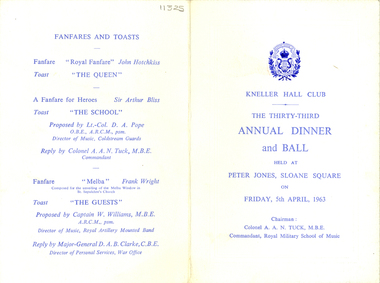
Document - Menu, Kneller Hall Club Annual Dinner, 1965, 1963
... On the front cover is the coat of arms of the Royal Military School of Music. It is to celebrate the thirty-third annual dinner and ball of the Kneller Hall Club. ...On the front cover is the coat of arms of the Royal Military School of Music. It is to celebrate the thirty-third annual dinner and ball of the Kneller Hall Club. ...Frank Wright was a renown resident of Smeaton, where he was born. He lived at Laura Villa, and attended Smeaton State School. His father William was a gold miner and his mother's name was Sarah. Their family won many singing and instrumental awards. Frank was tutored by Percy Code and was awarded a gold medal for the highest marks in the ALCM examinations in the British Colonies at the age of seventeen years. He became the Australian Open Cornet Champion by the age of eighteen. A year later, Frank conducted the City of Ballarat Band, and later the Ballarat Soldiers’ Memorial Band. He formed the Frank Wright Frisco Band and Frank Wright and his Coliseum Orchestra. These bands won many South Street awards, and Frank as conductor won many awards in the Australian Band Championship contest. In 1933 Frank Wright sailed to England to conduct the famous St Hilda’s Band and was appointed in 1934 as the Musical Director of the London County Council (the GLC or Greater London Council), where he organized many amazing concerts in most of the 150 parks, in and around the London district. He was also responsible for some of London’s major concerts at Kenwood, the Crystal Palace and Holland Park. He was made Professor of Brass and Military Band Scoring and Conducting and was a Fellow of the Guildhall School of Music and Drama. Frank was often invited to adjudicate Brass Band Championships around Europe, in Australia, including South Street and in New Zealand. Frank was awarded an M.B.E. in 1967. The Frank Wright Medal at the Royal South Street competition is awarded to an individual recognized as making an outstanding contribution to brass music in Australia.This cream card with blue print folded in half, is both a menu and a programme of music. On the front cover is the coat of arms of the Royal Military School of Music. It is to celebrate the thirty-third annual dinner and ball of the Kneller Hall Club. On the back cover one of the fanfares is "Melba" by Frank Wright.Only printed informationroyal military school of music, frank wright, fanfare melba, kneller hall club -
 Flagstaff Hill Maritime Museum and Village
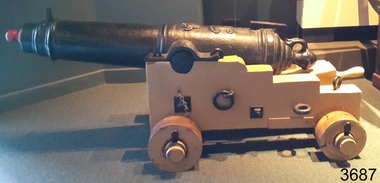
Weapon - Carronade, 1840
... ball. This nineteenth century artillery piece is a rare and representative item of artillery of this era, used predominately on ships, both military and merchant. ...The carronade was designed as a short-range naval weapon with a low muzzle velocity for merchant ships, but it also found a niche role on warships. It was produced by the Carron Iron Works and was at first sold as a complete system with the gun, mounting, and shot altogether. Carronades initially became popular on British merchant ships during the American Revolutionary War. A lightweight gun that needed only a small gun crew and was devastating at short range was well suited to defending merchant ships against French and American privateers. The invention of the cannon is variously attributed to Lieutenant General Robert Melville in 1759, or to Charles Gascoigne, manager of the Carron Company from 1769 to 1779. In its early years, the weapon was sometimes called a "mellvinade" or a "gasconade". The carronade can be seen as the culmination of a development of naval guns reducing the barrel length and thereby the gunpowder charge. The Carron Company was already selling a "new light-constructed" gun, two-thirds of the weight of the standard naval gun and charged with one-sixth of the weight of the ball in powder before it introduced the carronade, which further halved the gunpowder charge. The theory of its design was to use less powder and had other advantages that were advertised in the company's sales pamphlet of the time, state. The smaller gunpowder charge reduced the barrel heating in action, also reduced the recoil. The mounting, attached to the side of the ship on a pivot, took the recoil on a slider, without altering the alignment of the gun. The pamphlet advocated the use of woollen cartridges, which eliminated the need for wadding and worming, although they were more expensive. Carronades also simplified gunnery for comparatively untrained merchant seamen in both aiming and reloading that was part of the rationale for adopting the gun. Other advantages promoted by the company were. The replacement of trunnions by a bolt underneath, to connect the gun to the mounting, reduced the width of the carriage that enhanced the wide angle of fire. A merchant ship would almost always be running away from an enemy, so a wide-angle of fire was much more important than on a warship. A carronade weighed a quarter as much as a standard cannon and used a quarter to a third of the gunpowder charge. This reduced charge allowed Carronades to have a shorter length and much lighter weight than long guns. Increasing the size of the bore and ball reduces the required length of the barrel. The force acting on the ball is proportional to the square of the diameter, while the mass of the ball rises by the cube, so acceleration is slower; thus, the barrel can be shorter and therefore lighter. Long guns were also much heavier than Carronades because they were over-specified to be capable of being double-shotted, (to load cannons with twice the shot, for increased damage at the expense of range), whereas it was dangerous to do this in a carronade. A ship could carry more carronades, or carronades of a larger calibre, than long guns, and carronades could be mounted on the upper decks, where heavy long guns could cause the ship to be top-heavy and unstable. Carronades also required a smaller gun crew, which was very important for merchant ships, and they were faster to reload. The small bore carronade and carriage is part of a collection of nineteenth Century Flagstaff Hill Guns and Cannon, which is classified as being of significance and was made a few years after the beginning of Queen Victoria's reign in 1837 and fires a 6 lb pound cannon ball. This nineteenth century artillery piece is a rare and representative item of artillery of this era, used predominately on ships, both military and merchant. The artillery piece, individually and as part of the collection, is highly significant for its historical, scientific and aesthetic reasons at the state, national and world level. This carronade represents the methods of artillery technology, its advancement and its modifications to suit dangerous situations that sailors encountered from attacks from free booters (pirates, living from plunder) or others at the time. Carronade firing a 6 lb cast iron ball, with a smooth bore barrel 6.5 cm in dia the item is mounted on stepped wooden carriage with wooden wheels. Cannon barrel can have its elevation adjusted via a wooden wedge. Gun carriage has loops for locating and holding in position to a deck by ropes. Carriage is a replica made 1982Cast into the barrel is the royal emblem of Queen Victoria (VR "Victoria Regina") indicating the carronade was cast during Queen Victoria's reign / 1840 & 4-2-0 denoting the weight of the barrel. Right hand trunnion has a serial number “8708”. Also on top of the barrel is the British "Board of Ordinance" identifying mark a broad arrow indicating the carronade was in military use. flagstaff hill, warrnambool, shipwrecked coast, flagstaff hill maritime museum, maritime museum, shipwreck coast, flagstaff hill maritime village, great ocean road, colonial defences, victoria’s coastal defences, warrnambool fortification, warrnambool garrison battery, warrnambool volunteer corps, ordinance, armaments, garrison gun, smooth bore cannon, carronade, black powder, 12 pounder, 1840, artillery, lieutenant general robert melville, charles gascoigne, carron company, mellvinade, gasconade -
 Flagstaff Hill Maritime Museum and Village
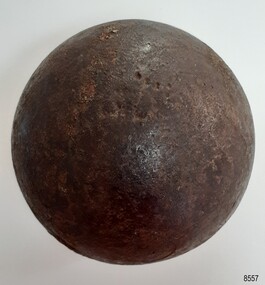
Weapon - Cannon Ball, Victorian era
... ball...ammunition...cannon...fortifications...Military...Flagstaff Hill Flagstaff Hill Maritime Museum and Village Warrnambool Maritime Museum Maritime Village Great Ocean Road Shipwreck Coast cannon ball ammunition cannon fortifications Military Equipment firearm weapon two-piece mould seam line four-pounder 4-pounder field gun field ammunition gun carriage cast cannon ball Remnants of an indecipherable stamp and / or red text. ...This small cannon ball was found by the donor around 1975 to 1977 when he was digging a trench to install underground cables at the Warrnambool Surfside Caravan Park' Its location is just below both Cannon Hill and the 19th century Fortifications at Flagstaff Hill Maritime Museum and Village. The ball is made of iron. Cannon balls were used as ammunition for a cannon gun and fired at a target. This cannon ball is only 8 cm round, or 4.15 inches, and is likely to have been called a 4-pounder (4-pdr). The ball was made from molten iron was poured into the small opening of a two-piece mould. The seam between the moulds sometimes left a raised ring mark on the ball, as can be seen on this ball. The ridge would have been filed to make the join smooth, sometimes leaving a slightly flat area. Six 4-powder cannons were recovered from Endeavour Reef, Queensland, in 1969. They were from Captain Cook's HMS Endeavour, thrown overboard when the ship struck a reef there in 1770. They are likely to have been mounted on deck cannon carriages on the ship. Similar 4-pounder cannons were mounted on gun carriages and used as field guns. Cannons with cannon balls as ammunition were installed at Warrnambool for protection from possible invasion in the mid-to-late 19th century and early 20th century.Cannon ball, iron, black with a pitted shiny surface. It has three flat areas and evidence of a seam around the circumference. There are remnants of a possible inscription stamped into the iron. The cannon ball is a four-pounder ball. Imperial weight is 71 oz (201.3 gms or 4.44 pounds).Remnants of an indecipherable stamp and / or red text.flagstaff hill, flagstaff hill maritime museum and village, warrnambool, maritime museum, maritime village, great ocean road, shipwreck coast, cannon ball, ammunition, cannon, fortifications, military equipment, firearm, weapon, two-piece mould, seam line, four-pounder, 4-pounder, field gun, field ammunition, gun carriage, cast cannon ball -
 Flagstaff Hill Maritime Museum and Village
Weapon - Cannon Ball, Late 18th to 19th centuries
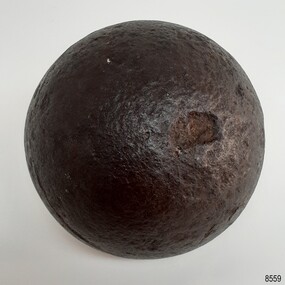
... ball...shot...24-pounder...24 pdr...deck cannon...ship cannon...military...Flagstaff Hill Maritime Museum and Village Warrnambool Great Ocean Road Shipwreck Coast artillery ammunition cannon ball shot 24-pounder 24 pdr deck cannon ship cannon military cannon gun iron ball moulded ball naval gun deck gun navy Carronade war maritime weapon cast iron mould Cannon ball; a heavy black iron ball with a casting seam around its circumference. ...This cannon ball could have been made as ammunition to be shot from a 24-pounder gun, perhaps a deck cannon or Carronade on a sailing ship. It is similar to those used by both British and French navies from the late 18th and 19th centuries. The iron cannon ball shows the casting mark around its circumference made by the mould during the casting process. The cannon ball is an example of ammunition used during naval conflicts in the late 18th and 19th centuries. It was made for cannon or Carronade similar to those in the collection of cannon at Flagstaff Hill Maritime Museum.Cannon ball; a heavy black iron ball with a casting seam around its circumference. The surface is shiny with many pits and has slight corrosion. There are several chips including one large deep chip and a small, crescent shaped chip. The cannon ball’s size is similar to a cast iron 24-pounder shot.flagstaff hill maritime museum and village, warrnambool, great ocean road, shipwreck coast, artillery, ammunition, cannon ball, shot, 24-pounder, 24 pdr, deck cannon, ship cannon, military, cannon, gun, iron ball, moulded ball, naval gun, deck gun, navy, carronade, war, maritime weapon, cast iron, mould -
 City of Moorabbin Historical Society (Operating the Box Cottage Museum)
Barbers' Equipment, hair clippers 'BURMAN", c1950
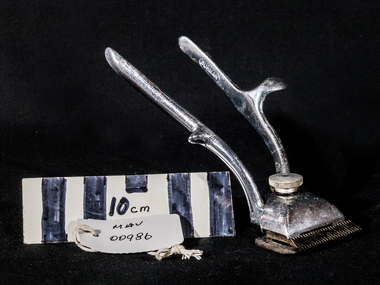
... military and in prisons. Burman & Sons Ltd, of Ryland Road, Birmingham, West Midlands, manufactured Burman-Douglas steering gear. Their recirculating worm and ball...military and in prisons. Burman & Sons Ltd, of Ryland Road, Birmingham, West Midlands, manufactured Burman-Douglas steering gear. Their recirculating worm and ball ...Hair clippers are specialized implements used to cut human head hair. They work on the same principle as scissors, but are distinct from scissors and razors. :Hair clippers comprise a pair of sharpened comb-like blades in close contact one above the other which slide sideways relative to each other, a mechanism which may be manual or electrical to make the blades oscillate from side to side, and a handle. The clipper is moved so that hair is positioned between the teeth of the comb, and cut with a scissor action when one blade slides sideways relative to the other. Friction between the blades needs to be as low as possible, which is attained by choice of material and finish, and frequent lubrication. Hair clippers are operated by a pair of handles that are alternately squeezed together and released. Barbers used them to cut hair close and fast. The hair was picked up in locks and the head was rapidly depilated. Mid 20thC such haircuts became popular among boys, and young men in the military and in prisons. Burman & Sons Ltd, of Ryland Road, Birmingham, West Midlands, manufactured Burman-Douglas steering gear. Their recirculating worm and ball design of steering gear was fitted to pre-war vehicles such as the Ford Eight and the Ford Prefect, the Bedford CA, plus heavy trucks and off-road vehicles - both pre and post-war. In its day, Burman-Douglas steering-gear was regarded as.... a "quality" feature of a car chassis specification, but the worm and ball design was eventually surpassed by the cheaper rack and pinion design that dominates today. The company also manufactured motorcycle gearboxes, horse clippers and barbers’ clippers. 1871 Company founded. 1897 Private company. 1930s Gearbox for Ariel Square-four motorcycle. (Exhibit at Birmingham Thinktank museum) 1933 Burman and Sons Limited, manufacturers of horse and barbers' clippers, sheep shearers, motor cycle gear boxes and steering gears, Ryland road, Edgebaston 1953 S. F. Burman, M.B.E., Managing Director, Burman and Sons, Ltd 1955 Acquired by Vono Industrial Products. 1961 Manufacturers of motor and motorcycle accessories. 1,500 employees. 1968 Supplied rack and pinion steering units to Ford 1978 Adwest Group acquired Burman and Sons, the steering gear part of Duport. 1986 Major reduction in staffing at Burman due to fall in demand for its products and delivery problems. A set of hand held barbers’ hair clippers with an adjustable screw, from Burman and Sons Ltd of Birmingham, England. Chrome plated, in good condition, c1950. On left arm ; BURMAN On right arm ; MADE IN ENGLANDbarbers, hairdressing, hair clippers, grooming, horse clippers, cars, motor cycles, gear boxes, rack and pinion , worm and ball, steering gears, steel manufacture, birmingham england, burman and sons ltd, moorabbin, bentleigh, ormond, cheltenham, market gardeners, -
 Geelong RSL Sub Branch
Pith Helmet
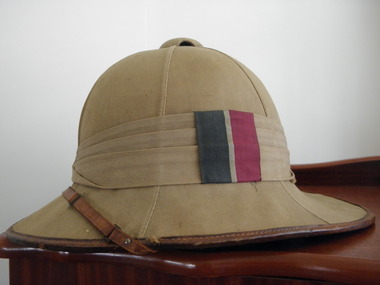
... military uniform from 1840 up until the the mid 20th century. Khaki pith helmet field use dress uniform headware Handwritten inside the helmet is the name of Sgt. Canr A.E. Pith Helmet is khaki colour with khaki puggaree, the puggaree has three folds and sewn on the left hand side of the puggaree is a blue white red colour patch. There is a leather band around the brim of the helmet and across the front visor there is a leather chin strap with metal adjustment buckles there is a ball ...The earliest appearance of these helmets went back as far as 1840 for use in the field and then worn with dress uniform only in the 20th century. The helmet was part of military uniform from 1840 up until the the mid 20th century.Pith Helmet is khaki colour with khaki puggaree, the puggaree has three folds and sewn on the left hand side of the puggaree is a blue white red colour patch. There is a leather band around the brim of the helmet and across the front visor there is a leather chin strap with metal adjustment buckles there is a ball shaped finial in the top of the hat.Handwritten inside the helmet is the name of Sgt. Canr A.E.khaki pith helmet field use dress uniform headware -
 Eltham District Historical Society Inc
Photograph, Doug Orford, 1914-1918 Roll of Honour Board, Eltham State School No. 209, c.2000
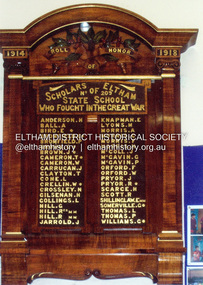
... Ball, A. Bird, E. * Bromfield, C. * Bromfield, P. Brown, G. * Brown, J. * Cameron, T. * Cameron, W. Carrucan, J. Clayton, T. Cone, L. Crellin, W. * Crossley, N. Gilsenan, H. Gollings, L. Hill, G. Hill, Reg MM Hill, R. MM Jarrold, J. Knapman, E. Lyons, M. Morris, A. Morris, C. Morris, F. Morris, H. McColl, J. McGavin, G. McGavin, P. Orford, F. Orford, W. Pryor, J. Pryor, R. * Scarce, H. Scott, R. Shillinglaw, E. MM Somerville, G. * Thomas, L. Thomas, P. Williams, G. * * - Paid the ultimate sacrifice for their country MM - Awarded the Military...Ball, A. Bird, E. * Bromfield, C. * Bromfield, P. Brown, G. * Brown, J. * Cameron, T. * Cameron, W. Carrucan, J. Clayton, T. Cone, L. Crellin, W. * Crossley, N. Gilsenan, H. Gollings, L. Hill, G. Hill, Reg MM Hill, R. MM Jarrold, J. Knapman, E. Lyons, M. Morris, A. Morris, C. Morris, F. Morris, H. McColl, J. McGavin, G. McGavin, P. Orford, F. Orford, W. Pryor, J. Pryor, R. * Scarce, H. Scott, R. Shillinglaw, E. MM Somerville, G. * Thomas, L. Thomas, P. Williams, G. * * - Paid the ultimate sacrifice for their country MM - Awarded the Military ...1914-1918 Roll of Honour board located at Eltham Primary School Scholars of Eltham No. 209 State School Who Fought In The Great War Anderson, H. Ball, A. Bird, E. * Bromfield, C. * Bromfield, P. Brown, G. * Brown, J. * Cameron, T. * Cameron, W. Carrucan, J. Clayton, T. Cone, L. Crellin, W. * Crossley, N. Gilsenan, H. Gollings, L. Hill, G. Hill, Reg MM Hill, R. MM Jarrold, J. Knapman, E. Lyons, M. Morris, A. Morris, C. Morris, F. Morris, H. McColl, J. McGavin, G. McGavin, P. Orford, F. Orford, W. Pryor, J. Pryor, R. * Scarce, H. Scott, R. Shillinglaw, E. MM Somerville, G. * Thomas, L. Thomas, P. Williams, G. * * - Paid the ultimate sacrifice for their country MM - Awarded the Military Medal1918, a. ball, a. morris, aif, c. bromfield, c. morris, e. bird, e. knapman, e. shillinglaw mm, eltham state school no. 209, f. morris, f. orford, first world war, g. brown, g. hill, g. mcgavin, g. somerville, g. williams, great war, h. anderson, h. gilsenan, h. morris, h. scarce, honour board, honour roll, j. brown, j. carrucan, j. jarrold, j. mccoll, j. pryor, l. cone, l. gollings, l. thomas, m. lyons, n. crossley, p. bromfield, p. mcgavin, p. thomas, r. hill mm, r. pryor, r. scott, reg hill mm, roll of honour, t. cameron, t. clayton, w. cameron, w. crellin, w. orford, ww1, eltham primary school
