
Showing 733 items matching "military equipment"
-
 Moorabbin Air Museum
Document (Item) - CAC Report on Government and Service Departments involved in the Purchase of Military Equipment, Government and Service Departments involved in the Purchase of Military Equipment
... CAC Report on Government and Service Departments involved in the Purchase of Military Equipment...Government and Service Departments involved in the Purchase of Military Equipment...Light blue soft-cover booklet bound with plastic ring binder Government and Service Departments involved in the Purchase of Military Equipment Document CAC Report on Government and Service Departments involved in the Purchase of Military Equipment ... -
National Vietnam Veterans Museum (NVVM)
Audio - Audio, CD, SVN: 1st Field Squadron RAE: mines room and others
... Military equipment...Photos of military equipment...Military equipment Photos of military equipment SVN: 1st Field Squadron RAE: mines room and others Audio Audio, CD ...Photos of military equipmentmilitary equipment -
 Monbulk RSL Sub Branch
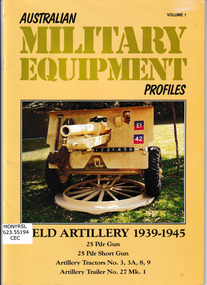
Book, Michael K Cecil, Australian Military Equipment Profiles: Field Artillery 1939-1945. 25 Pdr Gun, 25 Pdr Short Gun, Artillery Tractors No.3, 3A, 8,9, Artillery Trailer No. 27 Mk.1, 1992
... Australian Military Equipment Profiles: Field Artillery 1939-1945. 25 Pdr Gun, 25 Pdr Short Gun, Artillery Tractors No.3, 3A, 8,9, Artillery Trailer No. 27 Mk.1...Military weapons - Australia Weapons - Australia Illustrative and textual description of Australian field artillery 1939-1945 Ill, p.40 Australian Military Equipment Profiles: Field Artillery 1939-1945. 25 Pdr Gun, 25 Pdr Short Gun, Artillery Tractors No.3, 3A, 8,9, Artillery Trailer No. 27 Mk.1 Book Michael K Cecil Michael K Cecil ...Illustrative and textual description of Australian field artillery 1939-1945Ill, p.40non-fictionIllustrative and textual description of Australian field artillery 1939-1945military weapons - australia, weapons - australia -
 Monbulk RSL Sub Branch
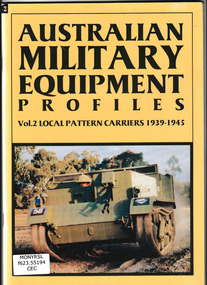
Book, Michael K Cecil, Australian Military Equipment Profiles: Local pattern carriers 1939-1945, 1992
... Australian Military Equipment Profiles: Local pattern carriers 1939-1945...Military weapons - Australia Machine gun carriers - Australia Illustrative and textual description of Australian local pattern carriers 1939-1945 Ill, p.48 Australian Military Equipment Profiles: Local pattern carriers 1939-1945 Book Michael K Cecil Michael K Cecil ...Illustrative and textual description of Australian local pattern carriers 1939-1945Ill, p.48non-fictionIllustrative and textual description of Australian local pattern carriers 1939-1945military weapons - australia, machine gun carriers - australia -
 Monbulk RSL Sub Branch
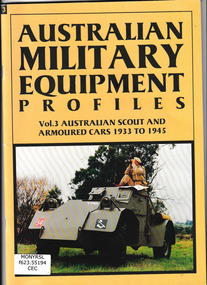
Book, Michael K Cecil, Australian Military Equipment Profiles: Australian scout and armoured cars 1933-1945, 1993
... Australian Military Equipment Profiles: Australian scout and armoured cars 1933-1945...Military weapons - Australia Scout and armoured cars - Australia Illustrative and textual description of Australian scout and armoured cars 1933-1945 Ill, p.52 Australian Military Equipment Profiles: Australian scout and armoured cars 1933-1945 Book Michael K Cecil Michael K Cecil ...Illustrative and textual description of Australian scout and armoured cars 1933-1945Ill, p.52non-fictionIllustrative and textual description of Australian scout and armoured cars 1933-1945military weapons - australia, scout and armoured cars - australia -
 Monbulk RSL Sub Branch
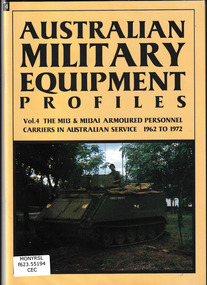
Book, Michael K Cecil, Australian Military Equipment Profiles: The M113 and M113 A1 armoured personnel carriers in Australian service 1962-1972, 1994
... Australian Military Equipment Profiles: The M113 and M113 A1 armoured personnel carriers in Australian service 1962-1972...Australian Military Equipment Profiles: The M113 and M113 A1 armoured personnel carriers in Australian service 1962-1972 Book Michael K Cecil Michael K Cecil ...Illustrative and textual description of Australian M113 and M113 A1 armoured personnel carriers in Australian service 1962-1972Ill, p.56.non-fictionIllustrative and textual description of Australian M113 and M113 A1 armoured personnel carriers in Australian service 1962-1972military weapons - australia, armoured personnel carriers - australia -
 National Vietnam Veterans Museum (NVVM)
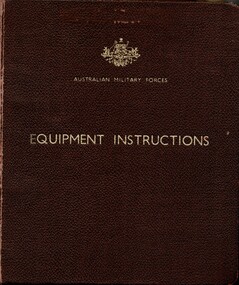
Manual, Australian Army, Australian Military Forces: Equipment Instructions, 1964
... Australian Military Forces: Equipment Instructions...Equipment Instructions...Australian Military...The manual is held together by a metal slide Australian Military Forces: Equipment Instructions Manual Australian Army ...A heavy duty burgandy cardboard cover with gold print on the front. Under they Australian Military Forces insignia are the details of the manual. The manual is held together by a metal slideaustralia - armed forces - service manuals, manual, equipment instructions, australian military forces -
 Bendigo Military Museum
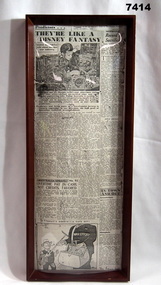
Newspaper - NEWSPAPER CUTTING, FRAMED, Melbourne Herald, c1942
... ...Military Equipment...Relates to an ANTI AIRCRAFT PREDICTOR - VICKERS NO.1 MK111 - piece of Military equipment on display in the museum. Refer Cat No. 4591....Relates to an ANTI AIRCRAFT PREDICTOR - VICKERS NO.1 MK111 - piece of Military equipment on display in the museum. Refer Cat No. 4591. ...Relates to an ANTI AIRCRAFT PREDICTOR - VICKERS NO.1 MK111 - piece of Military equipment on display in the museum. Refer Cat No. 4591.Newspaper extract - facsimile copy on paper, black print on off white paper. Illustrated with photograph. Small typewritten label on paper attached to top of facsimile with metal staples. Frame - timber with mid brown stain, heavy plastic front and cardboard backing with paper tape. - handwritten information on cardboard.Top of facsimile - typewritten label - black ink. "Believed to be an extract from a "Melbourne Herald" early December 1942". On cardboard - handwritten - black ink "NEWSPAPER ARTICLE/ Newspaper article and photograph explaining how the PREDICTOR on/display in the main hall operated./ See Catalogue No: 4591"framed accessories, newspaper, military equipment, anti-aircraft, predictor -
 Trafalgar Holden Museum
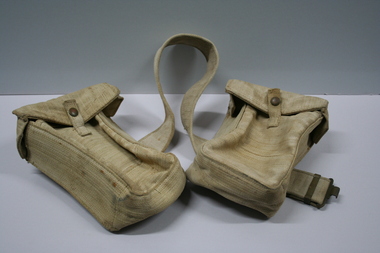
Functional object - Webbing belt, 1940
... Military...Equipment...Military canvas equipment used to carry small items and ammunition during WW2...Military canvas equipment used to carry small items and ammunition during WW2 Military equipment made by GMH Military Equipment GMH 1943 D -D Inside lid of each bag Canvas webbing belt with brass buckles and clips, with two canvas bags also attached by brass clip and bucklke. ...Military canvas equipment used to carry small items and ammunition during WW2Military equipment made by GMHCanvas webbing belt with brass buckles and clips, with two canvas bags also attached by brass clip and bucklke.GMH 1943 D -D Inside lid of each bagmilitary, equipment -
 National Vietnam Veterans Museum (NVVM)
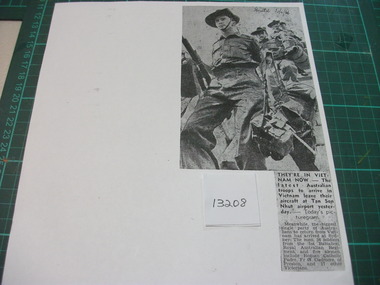
Article, Article, Clipping - Herald 30/4/66
... Picture of Soldiers with full military equipment disembarking their aircraft to start their Tour in Vietnam from the Herald dated 30th April 1966....Picture of Soldiers with full military equipment disembarking their aircraft to start their Tour in Vietnam from the Herald dated 30th April 1966. ...Copied Newspaper cutting. Picture of Soldiers with full military equipment disembarking their aircraft to start their Tour in Vietnam from the Herald dated 30th April 1966.nerwspaper, australian soldiers, tour of vietnam -
 National Vietnam Veterans Museum (NVVM)
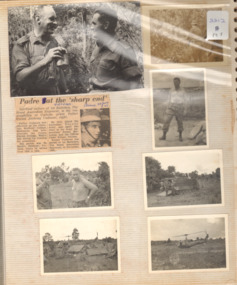
Memorabilia - Photographs and a newspaper clipping from Gerald Anthony Cudmore
... A newspaper clipping with the headline Padre at the 'sharp end' together with seven black and white photographs of soldiers and military equipment (see media for more information). ...Chaplains Padre Chaplain Royal Australian Army Chaplains Department 37979 Australian Army Force 1 RAR Holsworthy Headquarters Australian Army Force Vietnam A newspaper clipping with the headline Padre at the 'sharp end' together with seven black and white photographs of soldiers and military equipment (see media for more information). ...This item is part of a collection donated by Gerald Anthony Cudmore was a Padre who served as a Chaplain in the Royal Australian Army Chaplains Department at Headquarters, Australian Army Force Vietnam from May 1965 to April 1966. He was a Catholic priest from Melbourne who was asked to come into the Army reserve before being posted to 1 RAR at Holsworthy.A newspaper clipping with the headline Padre at the 'sharp end' together with seven black and white photographs of soldiers and military equipment (see media for more information). This is page eight of Personal Collections 5.chaplains, padre, chaplain, royal australian army chaplains department, 37979, australian army force, 1 rar, holsworthy, headquarters, australian army force vietnam -
 Bendigo Military Museum
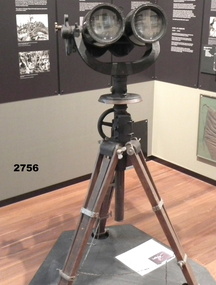
Equipment - JAPANESE ARTILLERY BINOCULARS
... Military equipment...During World War 2, they were used by a Japanese Army artillery unit. Military equipment Military history Herbert Trangmar Allan Japanese Army Binoculars On the silver manufacturer's plate: Details in Japanese writing. ...These binoculars were originally held in the Headquarters of the Pacific Islands Regiment in New Guinea. In February 1946, Colonel H. T. Allan OBE, MC, ED was presented with the binoculars to bring home as a souvenir. Refer Cat No 2755.4 for his extensive career and awards. During World War 2, they were used by a Japanese Army artillery unit.A tall and heavy set of binoculars comprising the binoculars set and a tripod base with wooden legs. The binoculars are attached to the tripod via a circular metal base plate with a small levelling bubble on the surface. The base plate is marked in degrees from zero to 360. Between each lens tube is an aiming device. The top of the tripod has a winding mechanism for raising and lowering the height of the binoculars. On the right hand side of the binoculars is a marked gauge which allows them to be tilted at different angles of elevation. Each of the eyepieces is able to be adjusted to fit the user's face. A silver metal manufacturer's plate is attached to the top of the binoculars.On the silver manufacturer's plate: Details in Japanese writing.military equipment, military history, herbert trangmar allan, japanese army, binoculars -
 Bendigo Military Museum
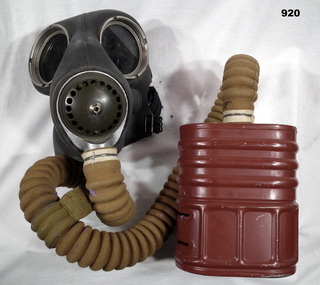
Equipment - GAS MASK
... military-equipment...military-equipment military history protective gear Gas Gas mask which includes face covering with two eye pieces, metal casing and flexible hose connecting the two Equipment GAS MASK ...Gas mask which includes face covering with two eye pieces, metal casing and flexible hose connecting the twomilitary-equipment, military history, protective gear, gas -
 National Vietnam Veterans Museum (NVVM)
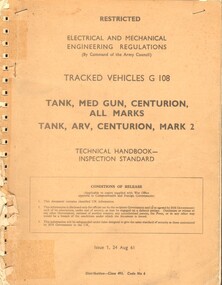
Booklet, Australian Army, Australian Army: Electrical and Mechanical Engineering Regulations: Tracked Vehicles G 108: Tank, Med Gun, Centurion, All Marks, Tank, ARV, Centurion, Mark 2
... Military equipment...Technical Instructions for Centurion Mark 2 Tanks Military equipment Military - Centurion Tank Technical Booklet - inspection standard Australian Army: Electrical and Mechanical Engineering Regulations: Tracked Vehicles G 108: Tank, Med Gun, Centurion, All Marks, Tank, ARV, Centurion, Mark 2 Booklet Booklet Australian Army ...Technical Instructions for Centurion Mark 2 TanksTechnical Booklet - inspection standardmilitary equipment, military - centurion tank -
 Flagstaff Hill Maritime Museum and Village
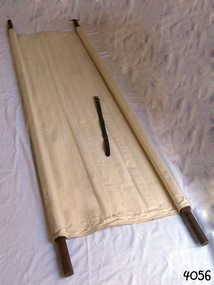
Equipment - Field Stretcher, Australian Defence Force, 1939-1942
... ...military equipment...Flagstaff Hill Flagstaff Hill Maritime Museum and Village Warrnambool Maritime Museum Maritime Village Great Ocean Road Shipwreck Coast stretcher field stretcher First Aid military equipment medical equipment emergency equipment Dr W R Angus canvas stretcher patient transport World War II WW2 Australian Department of Defence Military Doctor medic military stretcher field gear Army stretcher litter ADF folding stretcher W.R. ...This field stretcher was the property of Dr. William Roy Angus. It was donated to Flagstaff Hill Maritime Village by the family of Doctor William Roy Angus, Surgeon and Oculist. It is part of the “W.R. Angus Collection” that includes historical medical equipment, surgical instruments, and material once belonging to Dr Edward Ryan and Dr Thomas Francis Ryan (both of Nhill, Victoria), as well as Dr Angus’ belongings. The Collection’s history spans the medical practices of the two Doctors Ryan, from 1885-1926, plus that of Dr Angus, up until 1969. W R Angus served with the Australian Department of Defence as a Surgeon Captain during World War II from 1942 to 1945, in Ballarat, Victoria, and Bonegilla, N.S.W., completing his service just before the end of the war due to suffering from a heart attack. During his convalescence, he carved an intricate and ‘most artistic’ chess set from the material used for making dentures.The stretcher is an example of portable medical and emergency equipment used by the military and emergency services in the 19th and early 20th centuries. It is significant for its connection to Dr W R Abgus, who practised medicine in the community, the Australian Army and the Flying Doctor service from the 1920s to 1960s. He was also Warrnambool's last Port Medical Officer.Medical Field Stretcher: cream coloured canvas with wooden poles through side hems and a leather strap with buckle to keep parts together when folded or rolled up. This stretcher is part of the W.R. Angus Collection.flagstaff hill, flagstaff hill maritime museum and village, warrnambool, maritime museum, maritime village, great ocean road, shipwreck coast, stretcher, field stretcher, first aid, military equipment, medical equipment, emergency equipment, dr w r angus, canvas stretcher, patient transport, world war ii, ww2, australian department of defence, military doctor, medic, military stretcher, field gear, army stretcher, litter, adf, folding stretcher, w.r. angus -
 Flagstaff Hill Maritime Museum and Village
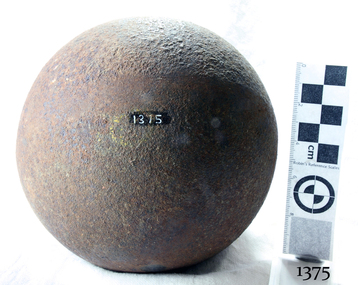
Weapon - Cannon Ball, Victorian era
... ...Military Equipment...Flagstaff Hill Flagstaff Hill Maritime Museum and Village Warrnambool Maritime Museum Maritime Village Great Ocean Road Shipwreck Coast cannon ball ammunition cannon fortifications Military Equipment firearm Originally marked "16" Cannon ball, iron, painted black. ...A cannon ball, made of iron, is used as ammunition for a cannon and fired at a target.Cannons with cannon balls as ammunition were installed at Warrnambool for protection from possible invasion in the mid-to-late 19th century and early 20th century.Cannon ball, iron, painted black. Originally marked "16"flagstaff hill, flagstaff hill maritime museum and village, warrnambool, maritime museum, maritime village, great ocean road, shipwreck coast, cannon ball, ammunition, cannon, fortifications, military equipment, firearm -
 Nhill Aviation Heritage Centre
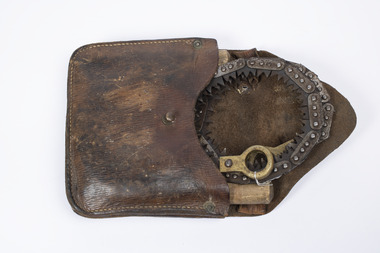
Tool - Military Folding Saw, 1939
... military equipment...military equipment saw folding saw SE Norris, 1939 Chain link saw with eyelet ends, also two wooden handles complete with leather carry pouch Tool Military Folding Saw ...Chain link saw with eyelet ends, also two wooden handles complete with leather carry pouchSE Norris, 1939military equipment, saw, folding saw -
 Flagstaff Hill Maritime Museum and Village
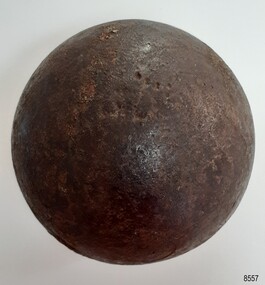
Weapon - Cannon Ball, Victorian era
... ...Military Equipment...Flagstaff Hill Flagstaff Hill Maritime Museum and Village Warrnambool Maritime Museum Maritime Village Great Ocean Road Shipwreck Coast cannon ball ammunition cannon fortifications Military Equipment firearm weapon two-piece mould seam line four-pounder 4-pounder field gun field ammunition gun carriage cast cannon ball Remnants of an indecipherable stamp and / or red text. ...This small cannon ball was found by the donor around 1975 to 1977 when he was digging a trench to install underground cables at the Warrnambool Surfside Caravan Park' Its location is just below both Cannon Hill and the 19th century Fortifications at Flagstaff Hill Maritime Museum and Village. The ball is made of iron. Cannon balls were used as ammunition for a cannon gun and fired at a target. This cannon ball is only 8 cm round, or 4.15 inches, and is likely to have been called a 4-pounder (4-pdr). The ball was made from molten iron was poured into the small opening of a two-piece mould. The seam between the moulds sometimes left a raised ring mark on the ball, as can be seen on this ball. The ridge would have been filed to make the join smooth, sometimes leaving a slightly flat area. Six 4-powder cannons were recovered from Endeavour Reef, Queensland, in 1969. They were from Captain Cook's HMS Endeavour, thrown overboard when the ship struck a reef there in 1770. They are likely to have been mounted on deck cannon carriages on the ship. Similar 4-pounder cannons were mounted on gun carriages and used as field guns. Cannons with cannon balls as ammunition were installed at Warrnambool for protection from possible invasion in the mid-to-late 19th century and early 20th century.Cannon ball, iron, black with a pitted shiny surface. It has three flat areas and evidence of a seam around the circumference. There are remnants of a possible inscription stamped into the iron. The cannon ball is a four-pounder ball. Imperial weight is 71 oz (201.3 gms or 4.44 pounds).Remnants of an indecipherable stamp and / or red text.flagstaff hill, flagstaff hill maritime museum and village, warrnambool, maritime museum, maritime village, great ocean road, shipwreck coast, cannon ball, ammunition, cannon, fortifications, military equipment, firearm, weapon, two-piece mould, seam line, four-pounder, 4-pounder, field gun, field ammunition, gun carriage, cast cannon ball -
 Flagstaff Hill Maritime Museum and Village
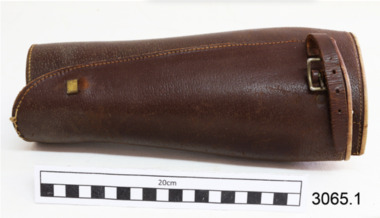
Clothing - Leather Leggings, 1899 to 1920
... ...Military Equipment...It was a time when many young men gave their lives during the South African and First World Wars in the defence of the then British Empire as part of the Imperial Forces that were gathered from many British-controlled Colonial countries. flagstaff hill warrnambool flagstaff hill maritime museum shipwreck coast flagstaff hill maritime village great ocean road leggings leather leggings protective leggings protective clothing Australian Mounted Light Horse Units Military Equipment None A pair of two Leather Leggings used by Mounted Australian soldiers during the first world war. ...The subject leather leggings are associated with mounted troops known as the Australian Light Horse that served in the South African War from 1899 to 1902. After the war, Britain wanted to use fewer mounted troops and restructured its force around a style of combat that needed more infantry. But the defence of Australia still relied upon mounted military units as these were more mobile than infantry and could travel faster over long distances. Light Horse brigades in the Australian Imperial Force (AIF) mostly contained recruits who served in the Light Horse regiments of the Citizen Forces. Many young men from rural areas of Australia volunteered for the Light Horse regiments. They had to pass a riding test to join, this test was easier for men from the bush because horses were still the main method of transport on farms and in country towns. The army did not officially accept First Australians into the AIF until May 1917 when enlistment standards were relaxed to include 'half-castes' with a parent of European origin. Indigenous soldiers served as valuable members of the Light Horse and many possessed excellent horse handling skills and specialist tracking knowledge.The subject items are part of the uniform for the Light Horse Units that served in the Australian army from 1899 until 1918. These leggings were worn by soldiers on horseback and are significant as they represent a noteworthy time in Australia's early military history. It was a time when many young men gave their lives during the South African and First World Wars in the defence of the then British Empire as part of the Imperial Forces that were gathered from many British-controlled Colonial countries.A pair of two Leather Leggings used by Mounted Australian soldiers during the first world war. The leggings are dark tan in colour with stitching to attach buckles and fastener straps. The strap buckles are made of brass and the leather legging straps are of same leather as leggings. Noneflagstaff hill, warrnambool, flagstaff hill maritime museum, shipwreck coast, flagstaff hill maritime village, great ocean road, leggings, leather leggings, protective leggings, protective clothing, australian mounted light horse units, military equipment -
 Flagstaff Hill Maritime Museum and Village
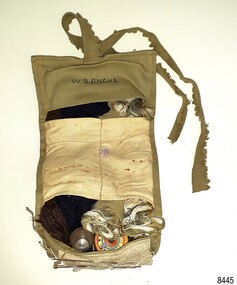
Equipment - Sewing Kit, 1939-1945
... ...Military Equipment...equipment and instruments from the doctors Edward and Thomas Ryan of Nhill, Victoria. Dr Angus married Gladys in 1927 at Ballarat, the nearest big city to Nhill where he began as a Medical Assistant. He was also Acting House surgeon at the Nhill hospital where their two daughters were born. During World War II He served as a Military...Angus Collection Australian Army Surgeon Captain Ballarat Bonegilla World War 2 Second World War Australian Defence Forces Army Medical Corps Australian Army Medical Corp (Militia) WW 2 ww II AAMC sewing kit sewing roll housewife clothing repairs Military Equipment Army issue "W.R. ANGUS" Australian Army sewing kit, WWII era. ...This sewing kit was issued to W.R. Angus during his Military Service in WWII. It is sometimes referred to as a soldier's ‘housewife’ and includes items necessary for mending and adjusting a soldier’s clothing and other fabric items. Earlier Army issue sewing kits were made of leather but were subject to deterioration due to holding moisture if they became wet. The sewing kit is now part of Flagstaff Hill’s comprehensive W.R. Angus Collection, donated by the family of Dr W R Angus (1901-1970), surgeon and oculist. Dr W R Angus was a Surgeon Captain for the Australian Defence Forces, Army Medical Corps, stationed in Ballarat, Victoria, and in Bonegilla, N.S.W. He completed his service just before the end of the war due to suffering from a heart attack. The W.R. Angus Collection: - The W.R. Angus Collection includes historical medical equipment, surgical instruments and material belonging to Dr Edward Ryan and Dr Thomas Francis Ryan, (both of Nhill, Victoria) and Dr Angus’ own belongings. The Collection’s history spans the medical practices of the two Doctors Ryan, from 1885-1926 plus that of Dr Angus, up until 1969. It includes historical medical and surgical equipment and instruments from the doctors Edward and Thomas Ryan of Nhill, Victoria. Dr Angus married Gladys in 1927 at Ballarat, the nearest big city to Nhill where he began as a Medical Assistant. He was also Acting House surgeon at the Nhill hospital where their two daughters were born. During World War II He served as a Military Doctor in the Australian Defence Forces. Dr Angus and his family moved to Warrnambool in 1939, where Dr Angus operated his own medical practice. He later added the part-time Port Medical Officer responsibility and was the last person appointed to that position. Both Dr Angus and his wife were very involved in the local community, including the planning stages of the new Flagstaff Hill and the layout of the gardens there. Dr Angus passed away in March 1970.This item is significant in Australia's War History and its connection with local history. It aids in understanding life in the military and the changes to normal life. Dr W R Angus (1901-1970), surgeon and oculist, collected a range of military objects including those he personally used during his time as Surgeon Captain in the Australian Defence Forces in World War II. The W.R. Angus Collection is significant for still being located at the site it is connected with, Doctor Angus being the last Port Medical Officer in Warrnambool. The Collection includes historical medical objects that date back to the late 1800s.Australian Army sewing kit, WWII era. A rectangular khaki cotton fabric pouch with pockets containing sewing needles, threads of various colours, a thimble and a reel of cotton. The pouch rolls up and is secured with its own ties. It has a handwritten inscription. The cloth patches belonged to Dr W R Angus and are now part of the W. R. Angus Collection."W.R. ANGUS"flagstaff hill, warrnambool, maritime village, maritime museum, shipwreck coast, great ocean road, flagstaff hill maritime museum and village, dr w r angus, w.r. angus collection, australian army, surgeon captain, ballarat, bonegilla, world war 2, second world war, australian defence forces, army medical corps, australian army medical corp (militia), ww 2, ww ii, aamc, sewing kit, sewing roll, housewife, clothing repairs, military equipment, army issue -
 Flagstaff Hill Maritime Museum and Village
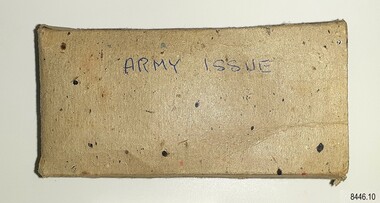
Equipment - Personal Care kit, 1939-1945
... ...Military Equipment...This Personal Care kit was issued by the Australian Army to those in military service during WWII, including Dr.W.R. Angus. The kit was part of a soldier's equipment to guard against possible sexually transmitted infections. ...Angus Collection Australian Army World War 2 Second World War Australian Defence Forces WW 2 ww II Military Equipment Army issue personal care personal hygene prevention of STD prevention of STI prevention of VD On the large box, handwritten “ARMY ISSUE” On waxed paper wrapper; “CHECKER NEW LATEX PROPHYLACTIC” On the small box “THE BLUE LIGHT OUTFIT” “DIRECTIONS INSIDE” Australian Army personal care kit, WWII era. ...This Personal Care kit was issued by the Australian Army to those in military service during WWII, including Dr.W.R. Angus. The kit was part of a soldier's equipment to guard against possible sexually transmitted infections. It is now part of Flagstaff Hill’s comprehensive W.R. Angus Collection, donated by the family of Dr W R Angus (1901-1970), surgeon and oculist. Dr W R Angus was a Surgeon Captain for the Australian Defence Forces, Army Medical Corps, stationed in Ballarat, Victoria, and in Bonegilla, N.S.W. He completed his service just before the end of the war due to suffering from a heart attack. The W.R. Angus Collection: - The W.R. Angus Collection includes historical medical equipment, surgical instruments and material belonging to Dr Edward Ryan and Dr Thomas Francis Ryan, (both of Nhill, Victoria) and Dr Angus’ own belongings. The Collection’s history spans the medical practices of the two Doctors Ryan, from 1885-1926 plus that of Dr Angus, up until 1969. It includes historical medical and surgical equipment and instruments from the doctors Edward and Thomas Ryan of Nhill, Victoria. Dr Angus married Gladys in 1927 at Ballarat, the nearest big city to Nhill where he began as a Medical Assistant. He was also Acting House surgeon at the Nhill hospital where their two daughters were born. During World War II He served as a Military Doctor in the Australian Defence Forces. Dr Angus and his family moved to Warrnambool in 1939, where Dr Angus operated his own medical practice. He later added the part-time Port Medical Officer responsibility and was the last person appointed to that position. Both Dr Angus and his wife were very involved in the local community, including the planning stages of the new Flagstaff Hill and the layout of the gardens there. Dr Angus passed away in March 1970.This item is significant in Australia's Military History. It aids in understanding life in the military and the changes to normal life and morality. Dr W R Angus (1901-1970), surgeon and oculist, collected a range of military objects including those he personally used during his time as Surgeon Captain in the Australian Defence Forces in World War II. The W.R. Angus Collection is significant for still being located at the site it is connected with, Doctor Angus being the last Port Medical Officer in Warrnambool. The Collection includes historical medical objects that date back to the late 1800s.Australian Army personal care kit, WWII era. A rectangular brown box containing a small blue cardboard box with a leaflet and two small tubes of ointment inside it, four square waxed paper prophylactic packets and a brown cardboard cylinder with enclosed ends containing a waxy substance. The overall box has a handwritten inscription. The kit belonged to Dr W R Angus and are now part of the W. R. Angus Collection.On the large box, handwritten “ARMY ISSUE” On waxed paper wrapper; “CHECKER NEW LATEX PROPHYLACTIC” On the small box “THE BLUE LIGHT OUTFIT” “DIRECTIONS INSIDE” flagstaff hill, warrnambool, maritime village, maritime museum, shipwreck coast, great ocean road, flagstaff hill maritime museum and village, dr w r angus, w.r. angus collection, australian army, world war 2, second world war, australian defence forces, ww 2, ww ii, military equipment, army issue, personal care, personal hygene, prevention of std, prevention of sti, prevention of vd -
 Greensborough Historical Society
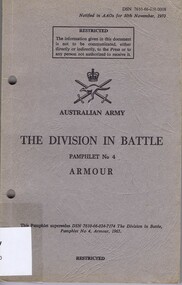
Book - Pamphlet, The Division in battle; pamphlet No 4: Armour, 1965
... ...military equipment...Military Manual. world war i military manuals armour military equipment Restricted. Contains classified Australian information. ...Australian Army. Royal Australian Armoured Corps. Military Manual.In 4 parts, pages not numbered, Illus.Restricted. Contains classified Australian information.world war i, military manuals, armour, military equipment -
 Flagstaff Hill Maritime Museum and Village
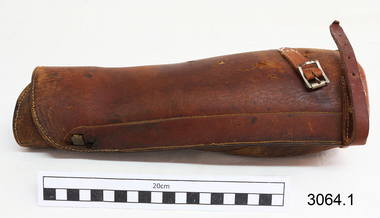
Clothing - Leather Leggings, 1899 to 1918
... ...Military Equipment...It was a time when many young men gave their lives during the South African and First World Wars in the defence of the then British Empire as part of the Imperial Forces that were gathered from many British-controlled Colonial countries. flagstaff hill warrnambool flagstaff hill maritime museum shipwreck coast flagstaff hill maritime village great ocean road leggings leather leggings protective leggings protective clothing Australian Mounted Light Horse Units Military Equipment None A pair of two Leather Leggings used by Mounted Australian soldiers during the first world war. ...The subject leather leggings are associated with mounted troops known as the Australian Light Horse that served in the South African War from 1899 to 1902. After the war, Britain wanted to use fewer mounted troops and restructured its force around a style of combat that needed more infantry. But the defence of Australia still relied upon mounted military units as these were more mobile than infantry and could travel faster over long distances. Light Horse brigades in the Australian Imperial Force (AIF) mostly contained recruits who served in the Light Horse regiments of the Citizen Forces. Many young men from rural areas of Australia volunteered for the Light Horse regiments. They had to pass a riding test to join, this test was easier for men from the bush because horses were still the main method of transport on farms and in country towns. The army did not officially accept First Australians into the AIF until May 1917 when enlistment standards were relaxed to include 'half-castes' with a parent of European origin. Indigenous soldiers served as valuable members of the Light Horse and many possessed excellent horse handling skills and specialist tracking knowledge.The subject items are part of the uniform for the Light Horse Units that served in the Australian army from 1899 until 1918. These leggings were worn by soldiers on horseback and are significant as they represent a noteworthy time in Australia's early military history. It was a time when many young men gave their lives during the South African and First World Wars in the defence of the then British Empire as part of the Imperial Forces that were gathered from many British-controlled Colonial countries.A pair of two Leather Leggings used by Mounted Australian soldiers during the first world war. The leggings are dark tan in colour with stitching to attach buckles and fastener straps. The strap buckles are made of brass and the leather legging straps are of same leather as leggings. Noneflagstaff hill, warrnambool, flagstaff hill maritime museum, shipwreck coast, flagstaff hill maritime village, great ocean road, leggings, leather leggings, protective leggings, protective clothing, australian mounted light horse units, military equipment -
 Bendigo Military Museum
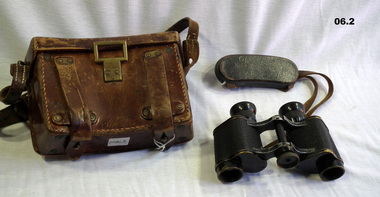
Accessory - BINOCULARS & CASE, c.1917
... military equipment...Refer Cat No 09.2. military equipment personal effects german forces Handwritten in black letters on front of case: F WIGMORE, 6th AUS MGC On binoculars: D F 03.6 Fuch U F Emil Busch, A G Ruthenow, "2 MGK 5R 124.8, "Serial No. 105069 Handwritten on lens cover: Captured from Hindenberg Line East of Bullecourt 30/5/17 .1) Steel Binoculars with metal / leather lens cap. ...Captured from Hindenberg Line east of Bullecourt 3?.5.1917, Second battle of Bullecourt, by Frederick WIGMORE No 1273 6th Australian Machine Gun Company. He (born Essendon, enlisted Bendigo) in the 23rd Batt AIF on 11.1.1915. Embarked for Eygpt on 4.5.1915 then to Gallipoli late August 1915. Disembarked from Gallipoli 10.1.1916. Transferred to 6th M G Coy 1.3.1916. Embarked for France 24.3.1916. Awarded Military Medal at Moquet Farm 25.8.1916. Promoted Cpl 11.6.1917. Promoted Sgt 19.12.1917. WIA 29.8.1918, GSW severe to forearm. Discharged from the AIF 21.4.1919. Refer Cat No 09.2..1) Steel Binoculars with metal / leather lens cap. Engraved details of German owner. .2) Leather Binoculars case with neck strap, brass studs & buckles. Machine sewn & felt lined. Handwritten in black letters on front of case: F WIGMORE, 6th AUS MGC On binoculars: D F 03.6 Fuch U F Emil Busch, A G Ruthenow, "2 MGK 5R 124.8, "Serial No. 105069 Handwritten on lens cover: Captured from Hindenberg Line East of Bullecourt 30/5/17military equipment, personal effects, german forces -
 Bendigo Military Museum
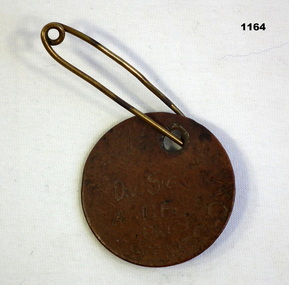
Accessory - IDENTITY DISC, C.1915
... military equipment - identity...Part of the William (Bill) Thomason collection, refer Cat No 4136P for more items. military equipment - identity Identity Jones Marked “2672 Sgt A C Jones 5. ...Archibald Clarkson Jones enlisted on the 17.7 1915 aged 20 years. He embarked as No 2672, 6th Reinforcements 23rd Battalian AIF on 27.10.1915. He was atached to various Signal units at Battalian and Divisional level. He was discharged from the AIF on 29.7.1919. Refer Cat no 1040 medals. Part of the William (Bill) Thomason collection, refer Cat No 4136P for more items.Identity Disc, fibre, round with brass clip.Marked “2672 Sgt A C Jones 5. Div Sig Co AIF Presbyterian “military equipment - identity, identity, jones -
 Bendigo Military Museum
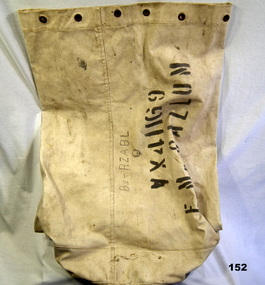
Equipment - KIT BAG WW2, 1939
... ...military equipment...Discharged from the 2nd AIF on 12.9.1945. containers military equipment In handwritten lettering - "B2 - RZABL- Q" Stencilled - "VX41169 E. ...Item issued to Eric MacCALLUM No VX41169, (born Scotland, enlisted Caulfield) on 26.6.40, 2/32nd Batt 9th Div AIF, age 31 years 9 months, promoted Cpl 6.8.1940, embarked 15.9.1940 for the Middle East, hospital 25.11.1940 with Haemorhoids, rejoinn unit 17.12.1940, attends Mortar and Grenade schools, hospital 16.8.1941 with PUO, taken POW 17.2.1942 at El Alamein. He served in the Seige of Tobruk, Middle East Campaigns. As a POW it appears he was interred from 1942/43 in Italy then 1943/45 in XV111Austria. He describes his conditions in the camps as fair and that he worked on road works. This is a brief description as to his treatment in his records. Embarked from England 4.7.1945 and disembarked in Sydney on 8.8.1945. Discharged from the 2nd AIF on 12.9.1945.Canvas Kit bag with stenciled name and details on side and base.In handwritten lettering - "B2 - RZABL- Q" Stencilled - "VX41169 E. MacCallum"containers, military equipment -
 Bendigo Military Museum
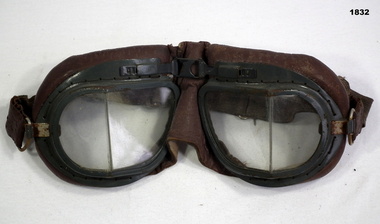
Equipment - FLYING GOGGLES, Possible WW1 onwards
... ...military equipment...uniforms raaf military equipment metalcraft Flying goggles WW2, Grey metal frame on leather lining. ...Flying goggles WW2, Grey metal frame on leather lining. Elastic strap with metal clips attached.uniforms raaf, military equipment, metalcraft -
 Warrnambool and District Historical Society Inc.
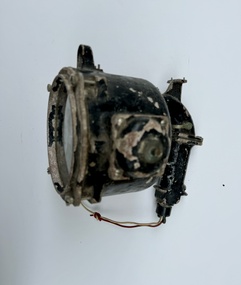
Functional object - Signalling Lamp, c. 1940
... World War Two military equipment...Signalling lamp World War Two military equipment This is a cylindrical metal lamp with a clear glass front attached to the lantern by metal screws. ...This hand-held signalling lamp could have had a number of uses. It could have been used by groups such as the Boy Scouts or most likely was used by local air raid wardens and other military personnel in World War Two. Its large face and the reflecting mechanism would have made it useful over a long distance.This lamp is of historical interest and is retained for display and research purposes.This is a cylindrical metal lamp with a clear glass front attached to the lantern by metal screws. The lantern has been painted black. There is an electric bulb behind the glass and a reflector disc behind the bulb. A handle, attached to the metal body, has two strands of electrical wiring at its end. The handle includes a finger clip, which, when pressed, produces a signal inside the glass area.signalling lamp, world war two military equipment -
 Bendigo Military Museum
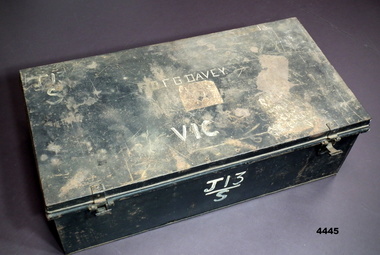
Equipment - TRUNK PERSONAL RAAF WW2, 1944
... ...military equipment...Refer Cat No 3536P f.g. davey personal equipment military equipment On lid: 'J13/S, F.G. Davey, VIC, R/124, RAAF Central Repository, West Melbourne, Vic'. ...Metal trunk issued to F.G. Davey for his personal effects which were shipped home to Australia after WW2.Part of the Frederick Gardner Davey DFC collection. Refer Cat No 3536PRectangular metal hinged trunk painted black. A hinged metal handle in on each end and at the back. Each handle is secured with metal rivets. The lid is secured closed with two 'Closebind' catches A brass locking mechanism is located on the front of the body and is accessed through a keyhole. The interior is painted grey with a brown leather seal around the edges of the lid. Various markings in white paint appear on the lid, each end, the back and the front. Paper stickers are glued onto the lid, back and right hand end. Inside the lid is a manufacturers plaque and year of manufacture printed in black.On lid: 'J13/S, F.G. Davey, VIC, R/124, RAAF Central Repository, West Melbourne, Vic'. On front: 'J13/S'. On Left hand end: 'J13?S 90 VIC, P410533, Davey F.G.'. On right hand end: 'J13/S, Vic' plus paper labels 'Geelong' and 'Mr F.G. Davey, Bendigo'. On back: 'J13/S' and paper label 'Not wanted on voyage'. Inside lid; ' 1944'.f.g. davey, personal equipment, military equipment -
 Bendigo Military Museum
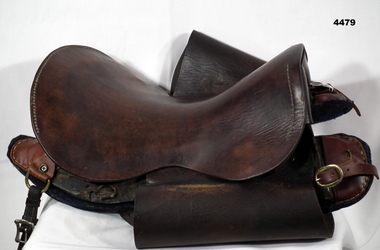
Equipment - SADDLE, 1916
... Military equipment...Military steel arch brown leather saddle. Tree is made of wood with thick blue felt pads and leather attachments. Neither is original. Various brass rings located on the saddle for attaching sundry equipment. ...The saddles were designed to have interchangeable parts, making them easy to repair. Military equipment Saddle Horse equipment Transport Stamped on the front of the seat: '1916, 13'. ...British military saddle as used in WW1. The saddles were designed to have interchangeable parts, making them easy to repair.Military steel arch brown leather saddle. Tree is made of wood with thick blue felt pads and leather attachments. Neither is original. Various brass rings located on the saddle for attaching sundry equipment. Brown leather strap with silver coloured metal buckle attached to the rear right hand side of the tree. No stirrups, stirrup leathers or girth attached. The leather seat covers the frame of the saddle between the front and rear arches and is connected to them by khaki webbing and leather laces. Leather sweat flaps on each side. Leather straps and brass buckles on the front of each pad.Stamped on the front of the seat: '1916, 13'. Stamped on each sweat flap: '1916, 13'.military equipment, saddle, horse equipment, transport
