
Showing 17 items matching "military hygiene"
-
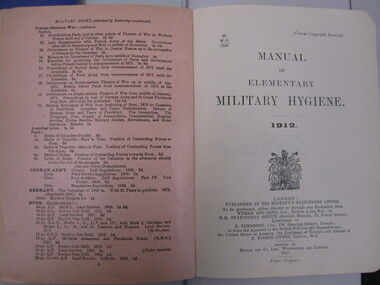 4th/19th Prince of Wales's Light Horse Regiment Unit History Room
Book, Mackie & Co Ltd, Manual of Elementary Military Hygiene 1912, 22 Aug 1912
... Manual of Elementary Military Hygiene 1912...Military Hygiene...Military Hygiene Safety in health WO 1680 Major McAuley Mailer Hard covered book of 97 pages Manual of Elementary Military Hygiene 1912 Book Book Mackie & Co Ltd His Majesty's Stationery Office ...Hard covered book of 97 pagesWO 1680 Major McAuley Mailermilitary hygiene, safety in health -
 National Vietnam Veterans Museum (NVVM)
Book, British Army, British Army: Manual of Military Hygiene 1921, 1921
... British Army: Manual of Military Hygiene 1921......Military Hygiene...British Army Manual Military Hygiene A greyish coloured cardboard book with black information on it. ...A greyish coloured cardboard book with black information on it. Near the top left hand side reads 24 Gen. No. 6529. There is an insignie near the centre of the cover, There is a brown binding down the spine of the book. The book is covered in a plastic coverbritish army, manual, military hygiene -
 Greensborough Historical Society
Book, Notes on Military Sanitation, 1906_
... ...military hygiene...Military Manual. Military Hygiene and Sanitation. ...Military Manual. Military Hygiene and Sanitation. Notes from a 5 part course for military personnel and St John's Ambulance Brigade volunteers. st johns ambulane brigade military manuals military hygiene sanitation Notes on Military Sanitation by Lt-Col H P G Elkington. ...Military Manual. Military Hygiene and Sanitation. Notes from a 5 part course for military personnel and St John's Ambulance Brigade volunteers.104 p., illus. Soft cover.Notes on Military Sanitation by Lt-Col H P G Elkington. St John's Ambulance Association.st johns ambulane brigade, military manuals, military hygiene, sanitation -
 Greensborough Historical Society
Book - Training Manual, Royal Army Medical Corps Training 1911, 1911_
... ...military hygiene...Military Manual royal army military manuals military hygiene sanitation Contains owner's personal notes at end of text. 452p., hard cover, illus (some col.). ...Royal Army. Medical. Military Manual452p., hard cover, illus (some col.).Contains owner's personal notes at end of text. royal army, military manuals, military hygiene, sanitation -
 Bendigo Military Museum
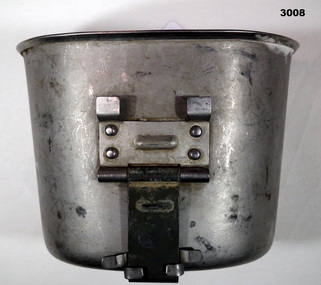
Equipment - MUG, 1969
... military...cooking/personal hygiene...Item issued to Peter Ball 3796117, refer Cat No 4704 military cooking/personal hygiene STOKES MELB 8465-50-242-7843 1969 [up arrow] Written: Peter BALL Stainless steel, kidney shaped mug with fold out handle. ...The mug used for washing, shaving, cooking, making a brew. Refer Reg No's 3006 & 3007. Item issued to Peter Ball 3796117, refer Cat No 4704Stainless steel, kidney shaped mug with fold out handle.STOKES MELB 8465-50-242-7843 1969 [up arrow] Written: Peter BALLmilitary, cooking/personal hygiene -
 Flagstaff Hill Maritime Museum and Village
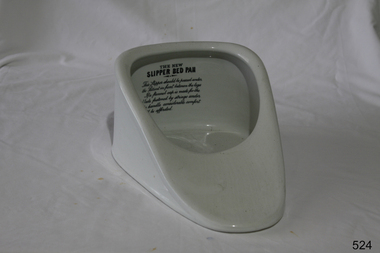
Equipment - Bed Pan
... military and civilian hospitals, including the addition of bedpans in order to reduce infection exposure from urine or faeces. https://www.wikiwand.com/en/Bedpan The use of bedpans is significant, as it allows a patient who cannot move much, to remain in bed and perform toilet functions. Flagstaff Hill Warrnambool Shipwrecked-coast Flagstaff-Hill Flagstaff-Hill-Maritime-Museum Maritime-Museum Shipwreck-coast Flagstaff-Hill-Maritime-Village Nursing Bedpans Hygiene ...The Bedpan Toilet device is a special tool designed for people who are unable to get out of bed to use the bathroom. It helps them go to the toilet comfortably and conveniently without having to leave their bed. The device is placed under the person's bottom, and it has a container that collects urine or stool. It is easy to clean and can be emptied into a toilet or sink. The Bedpan Toilet device allows individuals who are confined to bed due to illness or injury to maintain their dignity and independence by providing them with a practical solution for using the bathroom while staying in bed. The word bedpan was first seen in the literature of John Higgins in 1572, and one of the oldest known bedpans is on display in the Science Museum of London. It is a green, glazed earthenware bedpan that has been dated to the 16th or 17th century. At that time, bedpans were made from materials including pewter, brass, pottery, glass, and porcelain. Bedpans were not a commonplace item in hospitals until the late 1800s. Florence Nightingale, who worked as a nurse in the United Kingdom from the mid to late 1800s, recorded death rates and causes for soldiers in military hospitals during the Crimean War and then correlated them to corresponding sanitisation procedures. As a result, Nightingale proposed several methods to improve the sanitary conditions in both military and civilian hospitals, including the addition of bedpans in order to reduce infection exposure from urine or faeces. https://www.wikiwand.com/en/Bedpan The use of bedpans is significant, as it allows a patient who cannot move much, to remain in bed and perform toilet functions.Bed pan ceramic white glaze with handle. Labelled "The New Slipper Bed Pan". Has specific instructions for use under the maker's label.‘THE NEW SLIPPER BED PAN. This slipper should be passed under the patient in front between the legs. If a flannel cap is made for the blade fastened by strings under the handle considerable comfort will be afforded.’ flagstaff hill, warrnambool, shipwrecked-coast, flagstaff-hill, flagstaff-hill-maritime-museum, maritime-museum, shipwreck-coast, flagstaff-hill-maritime-village, nursing, bedpans, hygiene -
 Geelong RSL Sub Branch
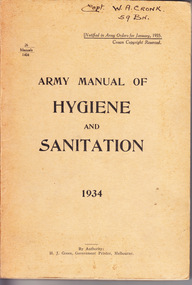
Book, Army Manual of Hygiene and Sanitation 1934, Early 20th Century
... Book relating to Hygiene and Sanitation in the Military Forces used by W.A. Cronk....Book relating to Hygiene and Sanitation in the Military Forces used by W.A. Cronk. ...Book relating to Hygiene and Sanitation in the Military Forces used by W.A. Cronk.Book belonging to W.A. Cronk 59 Bn.Oblong book buff colour cardboard cover.On the front cover in pen Capt W.A. Cronk 59 Bn. On the spine in in H&S 1934. Inside on the first page in ink W.A. Cronk Capt 59 Bn. manual hygiene sanitation army -
 Bendigo Military Museum
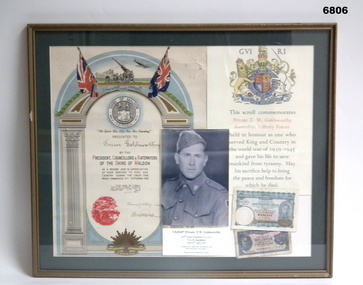
Memorabilia - MEMORIAL SCROLL, SHIRE OF MALDON, PHOTO, FRAMED, Unknown
... Military Forces. There is a B & W portrait of VX35497 Pte T.W. Goldsworthy, 2/5 Hygiene section. ...Military Forces. There is a B & W portrait of VX35497 Pte T.W. Goldsworthy, 2/5 Hygiene section. ..."VX35497 Pte T.W. GOLDSWORTHY" was a POW at Sandakan and died there on 20 April 1945. This is a framed display. The edge is of dull gold colour. Inside the frame there is an approx 27mm wide border - green colour. The objects in the frame are:- A certificate from the Shire of Maldon for the service and sacrifice of "Trevor Goldsworthy". There is the King's memorial scroll for the death of "Pte T. W. Goldsworthy" Aust. Military Forces. There is a B & W portrait of VX35497 Pte T.W. Goldsworthy, 2/5 Hygiene section. He is in uniform. There is two paper notes from Malaya. 25 cents printed 1 Sep 1940, 10 cents printed 15 Aug 1940.The Maroon Certificate is signed by “Thomas J Ottrey, President, and Edward A Rewell, Secretary” It is dated “15 June 1946”sandakan death march, pow, ww2, pte t.w. goldsworthy -
 Alfred Hospital Nurses League - Nursing History Collection
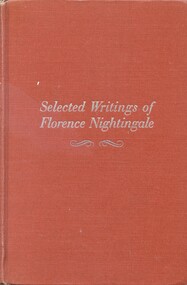
Book, Florence Nightingale 1820-1910, Selected writings of Florence Nightingale, 1954
... Of significance to the AHNL because of the importance of Florence Nightingale to the nursing profession Florence Nightingale Nurses-History Nursing-history A compilation of Florence Nightingale's essays and writings: Subsidiary notes as to the introduction of female nursing into military hospitals (1858), Notes on nursing: what it is and what it is not (1859), Notes on different systems of nursing; from notes on hospitals (a pamphlet 1863), Suggestions on a system of nursing for hospitals in India (1865), Suggestions on the subject of providing, training and organizing nurses for the sick poor in workhouse infirmaries (1867) On trained nurses for the sick poor (a pamphlet, 1876), Nurses, training of , and nursing the sick (1882), Sick-nursing and health-nursing (1893), Health teaching in towns and villages, rural hygiene (1894). ...A compilation of Florence Nightingale's essays and writings: Subsidiary notes as to the introduction of female nursing into military hospitals (1858), Notes on nursing: what it is and what it is not (1859), Notes on different systems of nursing; from notes on hospitals (a pamphlet 1863), Suggestions on a system of nursing for hospitals in India (1865), Suggestions on the subject of providing, training and organizing nurses for the sick poor in workhouse infirmaries (1867) On trained nurses for the sick poor (a pamphlet, 1876), Nurses, training of , and nursing the sick (1882), Sick-nursing and health-nursing (1893), Health teaching in towns and villages, rural hygiene (1894).Book with brown cover, title embossed in silver on front. Title, editor's surname and publisher's name embossed in silver on the spine.non-fictionA compilation of Florence Nightingale's essays and writings: Subsidiary notes as to the introduction of female nursing into military hospitals (1858), Notes on nursing: what it is and what it is not (1859), Notes on different systems of nursing; from notes on hospitals (a pamphlet 1863), Suggestions on a system of nursing for hospitals in India (1865), Suggestions on the subject of providing, training and organizing nurses for the sick poor in workhouse infirmaries (1867) On trained nurses for the sick poor (a pamphlet, 1876), Nurses, training of , and nursing the sick (1882), Sick-nursing and health-nursing (1893), Health teaching in towns and villages, rural hygiene (1894).florence nightingale, nurses-history, nursing-history -
 Emerald Museum & Nobelius Heritage Park
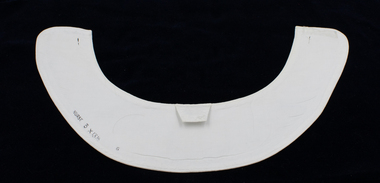
Uniform - Nurse Collar, 1900s
... Ethel May Ogilvy (nee Stoddart) became a Red Cross Nurse during World War I after completing a course in Nursing and Hygiene conducted by the St John Ambulance Association in November 1914. The Red Cross was ostensibly non-military in line with its principles of neutrality and independence. ...Ethel May Ogilvy (nee Stoddart) became a Red Cross Nurse during World War I after completing a course in Nursing and Hygiene conducted by the St John Ambulance Association in November 1914. The Red Cross was ostensibly non-military in line with its principles of neutrality and independence. ...Nurse collars were detachable to allow for quick laundering. Ethel May Ogilvy (nee Stoddart) became a Red Cross Nurse during World War I after completing a course in Nursing and Hygiene conducted by the St John Ambulance Association in November 1914. The Red Cross was ostensibly non-military in line with its principles of neutrality and independence. While a group of 20 nurses were sent to Europe by the NSW Division of the Red Cross, most Red Cross nurses, like Ethel, contributed to the war effort at home. They filled a need created by the exit of a large number of Australian nurses to the front and by the influx of seriously injured personnel who were brought back home. In 1919, Ethel Stoddart married Arthur James Ogilvy, a veteran of the Boer War and World War I. The couple moved to Emerald in 1936 where they lived the remainder of their lives. These collars are part of a complete World War I Red Cross nurse uniform held by the Museum which was worn by a young woman who later moved to Emerald. The uniform is emblematic of the variety of ways in which women contributed to the war effort.Two almost identical white starched collars. Each collar has a buttonhole at each end which might have enabled the collar to be fastened at the front with cufflink-like buttons.On back of collar 1/2: 'NURSE 3 x 13 1/2 G' On back of collar 2/2: 'NURSE 8432 /13 1/2 P' - also '?Stoddart' very faint.red cross, world war 1, nurse uniform -
 Emerald Museum & Nobelius Heritage Park
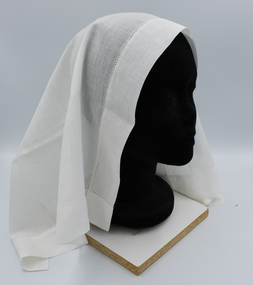
Uniform - Nurse Veil, 1900s
... Ethel May Ogilvy (nee Stoddart) became a Red Cross Nurse during World War I after completing a course in Nursing and Hygiene conducted by the St John Ambulance Association in November 1914. The Red Cross was ostensibly non-military in line with its principles of neutrality and independence. ...Ethel May Ogilvy (nee Stoddart) became a Red Cross Nurse during World War I after completing a course in Nursing and Hygiene conducted by the St John Ambulance Association in November 1914. The Red Cross was ostensibly non-military in line with its principles of neutrality and independence. ...Veils were worn to cover a nurse's hair and were usually square in shape. Ethel May Ogilvy (nee Stoddart) became a Red Cross Nurse during World War I after completing a course in Nursing and Hygiene conducted by the St John Ambulance Association in November 1914. The Red Cross was ostensibly non-military in line with its principles of neutrality and independence. While a group of 20 nurses were sent to Europe by the NSW Division of the Red Cross, most Red Cross nurses, like Ethel, contributed to the war effort at home. They filled a need created by the exit of a large number of Australian nurses to the front and by the influx of seriously injured personnel who were brought back home. In 1919, Ethel Stoddart married Arthur James Ogilvy, a veteran of the Boer War and World War I. The couple moved to Emerald in 1936 where they lived the remainder of their lives. This veil is part of a complete World War I Red Cross nurse uniform held by the Museum which was worn by a young woman who later moved to Emerald. The uniform is emblematic of the variety of ways in which women contributed to the war effort.One piece of square white lawn material used as a nurse veil.red cross, world war 1, nurse uniform -
 Emerald Museum & Nobelius Heritage Park
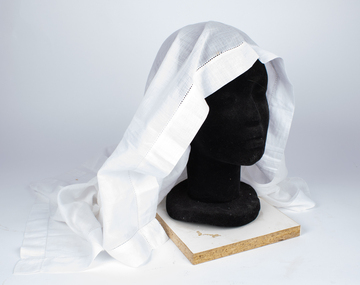
Uniform - Nurse Veil, 1900s
... Ethel May Ogilvy (nee Stoddart) became a Red Cross Nurse during World War I after completing a course in Nursing and Hygiene conducted by the St John Ambulance Association in November 1914. The Red Cross was ostensibly non-military in line with its principles of neutrality and independence. ...Ethel May Ogilvy (nee Stoddart) became a Red Cross Nurse during World War I after completing a course in Nursing and Hygiene conducted by the St John Ambulance Association in November 1914. The Red Cross was ostensibly non-military in line with its principles of neutrality and independence. ...Veils were worn to cover a nurse's hair and were usually square in shape. Ethel May Ogilvy (nee Stoddart) became a Red Cross Nurse during World War I after completing a course in Nursing and Hygiene conducted by the St John Ambulance Association in November 1914. The Red Cross was ostensibly non-military in line with its principles of neutrality and independence. While a group of 20 nurses were sent to Europe by the NSW Division of the Red Cross, most Red Cross nurses, like Ethel, contributed to the war effort at home. They filled a need created by the exit of a large number of Australian nurses to the front and by the influx of seriously injured personnel who were brought back home. In 1919, Ethel Stoddart married Arthur James Ogilvy, a veteran of the Boer War and World War I. The couple moved to Emerald in 1936 where they lived the remainder of their lives. This veil is part of a complete World War I Red Cross nurse uniform held by the Museum which was worn by a young woman who later moved to Emerald. The uniform is emblematic of the variety of ways in which women contributed to the war effort.One piece of square white lawn material used as a nurse veil.red cross, world war 1, nurse uniform -
 Port Melbourne Historical & Preservation Society
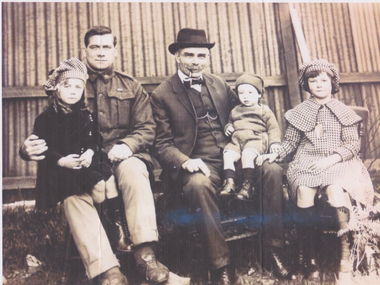
Photograph - William and Harry CANN, c 1915-19
... military uniform, and three unidentified children. British-born William CANN arrived in Melbourne in 1907 and set up a pram building business, London Prams, in Lalor Street, Port Melbourne. In the 1930s, at the height of the Depression, William set up a kitchen in the corner of his upholstery workshop to feed hungry children from Nott Street School free of charge. After a few years the Council shut it down due to hygiene...military uniform, and three unidentified children. British-born William CANN arrived in Melbourne in 1907 and set up a pram building business, London Prams, in Lalor Street, Port Melbourne. In the 1930s, at the height of the Depression, William set up a kitchen in the corner of his upholstery workshop to feed hungry children from Nott Street School free of charge. After a few years the Council shut it down due to hygiene ...William CANN (centre) with his son, Harry, in military uniform, and three unidentified children. British-born William CANN arrived in Melbourne in 1907 and set up a pram building business, London Prams, in Lalor Street, Port Melbourne. In the 1930s, at the height of the Depression, William set up a kitchen in the corner of his upholstery workshop to feed hungry children from Nott Street School free of charge. After a few years the Council shut it down due to hygiene concerns. William set up another kitchen with a hired cook and continued to feed the children. William's son, Henry, aka Harry, was born in Croydon, England. He was 21 years old working as a biscuit maker when he enlisted in the AIF on 13 July 1915. He suffered a bomb wound to his ear while serving in France in July 1916. He returned to Australia on 22 July 1919 and was formally discharged two months later as medically unfit due to deafness.Digital copy of a B&W photograph.william cann, henry (harry) cann -
 Emerald Museum & Nobelius Heritage Park
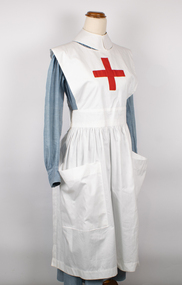
Uniform - Nurse Apron, 1900s
... Ethel May Ogilvy (nee Stoddart) became a Red Cross Nurse during World War I after completing a course in Nursing and Hygiene conducted by the St John Ambulance Association in November 1914. The Red Cross was ostensibly non-military in line with its principles of neutrality and independence. ...Ethel May Ogilvy (nee Stoddart) became a Red Cross Nurse during World War I after completing a course in Nursing and Hygiene conducted by the St John Ambulance Association in November 1914. The Red Cross was ostensibly non-military in line with its principles of neutrality and independence. ...Ethel May Ogilvy (nee Stoddart) became a Red Cross Nurse during World War I after completing a course in Nursing and Hygiene conducted by the St John Ambulance Association in November 1914. The Red Cross was ostensibly non-military in line with its principles of neutrality and independence. While a group of 20 nurses were sent to Europe by the NSW Division of the Red Cross, most Red Cross nurses, like Ethel, contributed to the war effort at home. They filled a need created by the exit of a large number of Australian nurses to the front and by the influx of seriously injured personnel who were brought back home. In 1919, Ethel Stoddart married Arthur James Ogilvy, a veteran of the Boer War and World War I. The couple moved to Emerald in 1936 where they lived the remainder of their lives. This apron is part of a complete World War I Red Cross nurse uniform held by the Museum which was worn by a young woman who later moved to Emerald. The uniform is emblematic of the variety of ways in which women contributed to the war effort.White cotton apron consisting of a gathered skirt with two capacious pockets and a bib and waistband with a Red Cross symbol stitched in the centre of the bib. Two straps - each with one buttonhole - extend from the bib to be buttoned into the waistband at the back. The apron waistband has two buttons on one side and one button and one buttonhole on the other side. Separately there are two long narrow cotton strips which may have been suitable for bandages. red cross, world war 1, nurse uniform -
 Emerald Museum & Nobelius Heritage Park
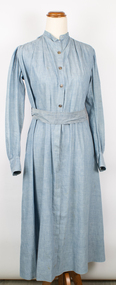
Uniform - Nurse Dress, 1900s
... Ethel May Ogilvy (nee Stoddart) became a Red Cross Nurse during World War I after completing a course in Nursing and Hygiene conducted by the St John Ambulance Association in November 1914. The Red Cross was ostensibly non-military in line with its principles of neutrality and independence. ...Ethel May Ogilvy (nee Stoddart) became a Red Cross Nurse during World War I after completing a course in Nursing and Hygiene conducted by the St John Ambulance Association in November 1914. The Red Cross was ostensibly non-military in line with its principles of neutrality and independence. ...Ethel May Ogilvy (nee Stoddart) became a Red Cross Nurse during World War I after completing a course in Nursing and Hygiene conducted by the St John Ambulance Association in November 1914. The Red Cross was ostensibly non-military in line with its principles of neutrality and independence. While a group of 20 nurses were sent to Europe by the NSW Division of the Red Cross, most Red Cross nurses, like Ethel, contributed to the war effort at home. They filled a need created by the exit of a large number of Australian nurses to the front and by the influx of seriously injured personnel who were brought back home. In 1919, Ethel Stoddart married Arthur James Ogilvy, a veteran of the Boer War and World War I. The couple moved to Emerald in 1936 where they lived the remainder of their lives. This dress is part of a complete World War I Red Cross nurse uniform held by the Museum which was worn by a young woman who later moved to Emerald. The uniform is emblematic of the variety of ways in which women contributed to the war effort.Long blue cotton dress with long sleeves - at the end of each sleeve are two mother of pearl buttons and buttonholes. The dress has four mother of pearl buttons and buttonholes down the front and two buttonholes at the neck. There are three loops at the waist at the back for a belt to be threaded through. Separate long narrow sash-like belt of the same material. (The belt may have originally had a buckle.)red cross, world war 1, nurse uniform -
 Emerald Museum & Nobelius Heritage Park
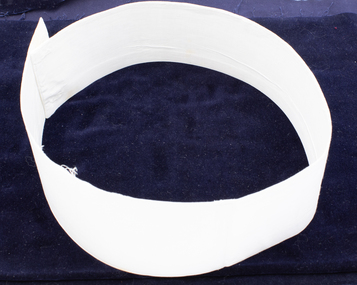
Uniform - Nurse Belts, 1900s
... Ethel May Ogilvy (nee Stoddart) became a Red Cross Nurse during World War I after completing a course in Nursing and Hygiene conducted by the St John Ambulance Association in November 1914. The Red Cross was ostensibly non-military in line with its principles of neutrality and independence. ...Ethel May Ogilvy (nee Stoddart) became a Red Cross Nurse during World War I after completing a course in Nursing and Hygiene conducted by the St John Ambulance Association in November 1914. The Red Cross was ostensibly non-military in line with its principles of neutrality and independence. ...Belts on nurse uniforms were made to be detachable for ease of laundering. Ethel May Ogilvy (nee Stoddart) became a Red Cross Nurse during World War I after completing a course in Nursing and Hygiene conducted by the St John Ambulance Association in November 1914. The Red Cross was ostensibly non-military in line with its principles of neutrality and independence. While a group of 20 nurses were sent to Europe by the NSW Division of the Red Cross, most Red Cross nurses, like Ethel, contributed to the war effort at home. They filled a need created by the exit of a large number of Australian nurses to the front and by the influx of seriously injured personnel who were brought back home. In 1919, Ethel Stoddart married Arthur James Ogilvy, a veteran of the Boer War and World War I. The couple moved to Emerald in 1936 where they lived the remainder of their lives. These belts are part of a complete World War I Red Cross nurse uniform held by the Museum which was worn by a young woman who later moved to Emerald. The uniform is emblematic of the variety of ways in which women contributed to the war effort.Three pairs of white starched belts for a nurse uniform. One belt (1/3) has a long narrow rectangular shape with two buttonholes at each end. The other belt (2/3) has a triangular shape at one end with two press studs (rings) at this end. There may have been two posts at the other end at one time. The third (3/3) has three buttonholes at each end.At one end of belt 1/3 hand printed: 'E. M. Stoddart' At one end of belt 3/3 hand-written: 'Stoddart' and underneath printed '?8412'red cross, world war 1, nurse uniform -
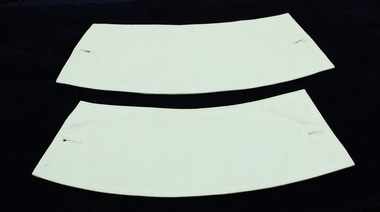 Emerald Museum & Nobelius Heritage Park
Uniform - Nurse Cuffs, 1900s
... Ethel May Ogilvy (nee Stoddart) became a Red Cross Nurse during World War I after completing a course in Nursing and Hygiene conducted by the St John Ambulance Association in November 1914. The Red Cross was ostensibly non-military in line with its principles of neutrality and independence. ...Ethel May Ogilvy (nee Stoddart) became a Red Cross Nurse during World War I after completing a course in Nursing and Hygiene conducted by the St John Ambulance Association in November 1914. The Red Cross was ostensibly non-military in line with its principles of neutrality and independence. ...Cuffs on nurse uniforms were made to be detachable for ease of laundering. Ethel May Ogilvy (nee Stoddart) became a Red Cross Nurse during World War I after completing a course in Nursing and Hygiene conducted by the St John Ambulance Association in November 1914. The Red Cross was ostensibly non-military in line with its principles of neutrality and independence. While a group of 20 nurses were sent to Europe by the NSW Division of the Red Cross, most Red Cross nurses, like Ethel, contributed to the war effort at home. They filled a need created by the exit of a large number of Australian nurses to the front and by the influx of seriously injured personnel who were brought back home. In 1919, Ethel Stoddart married Arthur James Ogilvy, a veteran of the Boer War and World War I. The couple moved to Emerald in 1936 where they lived the remainder of their lives. These cuffs are part of a complete World War I Red Cross nurse uniform held by the Museum which was worn by a young woman who later moved to Emerald. The uniform is emblematic of the variety of ways in which women contributed to the war effort.Two pairs of white starched cuffs for a nurse uniform. Each cuff has a buttonhole at each end which would enable the cuff to be joined by cufflink-like buttons.On each cuff, printed: 'NURSE 8 G' On each cuff handwritten: 'Stoddart'red cross, world war 1, nurse uniform
