
Showing 73 items matching "mine tailings"
-
 Stawell Historical Society Inc
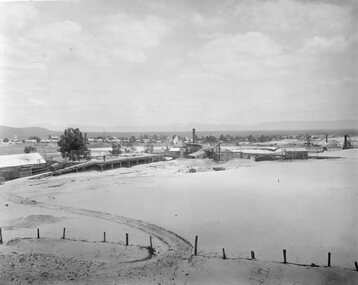
Photograph, Magdala cum Moonlight Mine with tailings dam & the Grampians in the background. c1900's
... Magdala cum Moonlight Mine with tailings dam & the Grampians in the background. c1900's...The fire station is on the left in the far distance. with the W S Heal & Sons Coachbuilders Corner of Lazelle and Byrne Street business Magdala cum Moonlight Mine with tailings dam & the Grampians in the background. c1900's Photograph ...Magdala cum Moonlight Mine. Wide view of mine with Grampians Mountains in background.Mine with snow. The Cyanide plant was constructed in Sept 1900 and became the largest in Victoria. Just in front of the large tree a ramp can be seen and a horse and dray going up the ramp. Just below and to the left of the tree the cyanide vats can be seen. On the right is the poppet head of the Magdala and Oriental and North Cross Mine. The fire station is on the left in the far distance. with the W S Heal & Sons Coachbuilders Corner of Lazelle and Byrne Street businessMagdala Cum Moonlight Mine. Herbert's Studio. Stawellstawell gold mining -
 Bendigo Historical Society Inc.
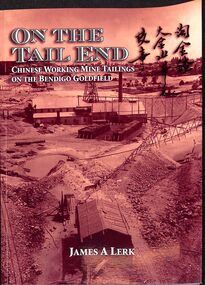
Book - "On the Tail End", 2017
... ...Mine Tailings...The long sluicing boxes and blankets laid out in lines over the tailings became a familiar feature in the city landscape. It was an essential element of the operations of the mines. ...Concerns Chinese working mine tailings on the Bendigo Goldfield. Published in Australia by JA & ERS Lerk in 2017. ...Mining Chinese Mine Tailings Gold "On the tail end" written by James A. ...A large ethnic group in the Bendigo area was the Chinese, numbering 400-500 in 1868. There were several large Chinese villages in the Bendigo district of which one was located in Long Gully, near the junction with Sparrowhawk Gully. It was Sir John Quick, former resident of Ironbark, who introduced the first bill into Parliament in 1888 for the disenfranchisement of Chinese holding a Miner’s Right. Chinese miners worked the tailing heaps and discarded ore bodies. It was only the Chinese contractors, who worked the tailings of the quartz reefs. The work of stacking tailing dumps associated with major mine sites was a particular feature of the Bendigo field. The tailings had to be stacked for placement as they washed out of the batteries. It was undertaken exclusively by groups of Chinese workers, who paid the mining companies to stack the tailings with the hope of finding traces of gold. The long sluicing boxes and blankets laid out in lines over the tailings became a familiar feature in the city landscape. It was an essential element of the operations of the mines. The tailings were progressively planted with spiny rushes, pampas grass and peppercorn trees."On the tail end" written by James A. Lerk. Concerns Chinese working mine tailings on the Bendigo Goldfield. Published in Australia by JA & ERS Lerk in 2017. Soft cover. Cover is sepia in tone on the front and back. Title in white with red Chinese figures beside English text. Back cover has inset image of 'Register of Purchases' listing details of individuals. Book includes both color and black and white images. 78 pp. ISBN 9780646978598. Contains index. mining, chinese, mine tailings, gold -
 Bendigo Historical Society Inc.
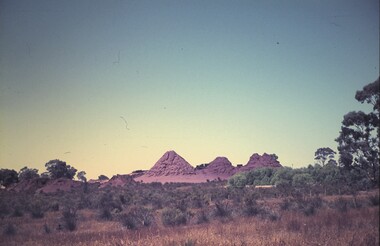
Slide - BENDIGO & EASTER FAIR, 1966
... Pyrites, mine tailings....SLIDE Bendigo mining Pyrites, mine tailings. Slide BENDIGO & EASTER FAIR ...Pyrites, mine tailings.slide, bendigo, mining -
 Bendigo Historical Society Inc.
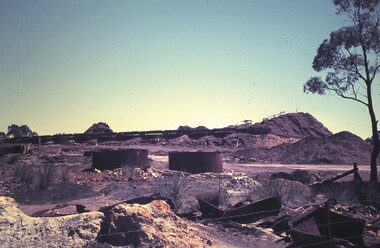
Slide - BENDIGO & EASTER FAIR, 1966
... Pyrites, mine tailings....SLIDE Bendigo mining Pyrites, mine tailings. Slide BENDIGO & EASTER FAIR ...Pyrites, mine tailings.slide, bendigo, mining -
 Bendigo Historical Society Inc.
Document - The Faces of China - Bendigo, Eaglehawk, Mines and Missionaries
... Seo Young of Eaglehawk was a wealthy mine tailings manager believed to be the only known Chinese to have occupied a position of authority over both Caucasians and Chinese workers....Seo Young of Eaglehawk was a wealthy mine tailings manager believed to be the only known Chinese to have occupied a position of authority over both Caucasians and Chinese workers. ...George Young arrived in Australia in 1856-7 and settled in Eaglehawk where he was the mining manger in a firm that extracted gold from tailings using cyanide. In 1917 it was recalled by the Eaglehawk manager of the Commercial Bank of Australia that he employed about 70 men in his firm. In 1884 he successfully applied through Sergent John Gleeson for Victorian naturalisation. His application was processed along with five others. According to an article in the Australasian he was 'highly respected' in Eaglehawk for his 'uprightness and integrity'. The Bendigo Advertiser described him as being 'held in high esteem' and being 'a kind and benevolent man'. He made donations to the Bendigo Benevolent Asylum and Hospital on a number of occasions and was involved in organising the Chinese performance in the Bendigo Easter Fair in 1879. In June 1900, after his elder brother's death in 1899, George Young returned to China at his father's request to manage the family property. His Chinese-born wife and six Australian-born children accompanied him. Prior to his departure a portrait of the Young family was published in the Australasian and given to prominent citizens of Eaglehawk. A banquet was also given by the citizens of Eaglehawk to see the family off and George Young was presented with an illuminated address.The Faces of China - Bendigo, a presentation author unknown, photo copy of Seo (George) Young and his family with two paragraphs description of Chinese mines and missionaries on the gold fields. Seo Young of Eaglehawk was a wealthy mine tailings manager believed to be the only known Chinese to have occupied a position of authority over both Caucasians and Chinese workers.Handwritten on the rear is "found in "Chinese Footsteps" Historical sites of Bendigo.history, bendigo, eaglehawk, chinese, chinese mine managers, chinese missionaries -
 Bendigo Historical Society Inc.
Document - NEW CHUM & VICTORIA LINES OF REEF - NOTES ON THE VICTORIA REEF GOLD MINES COY
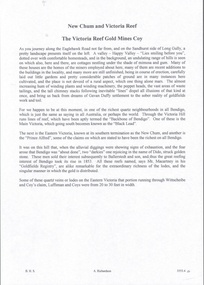
... Handwritten notes describing the journey along Eaglehawk Road from the houses, poppet heads and mine tailings, etc. When the alluvial diggings were showing signs of exhaustion, and the fear arose that Bendigo was 'about done', two 'darkies' One named Dido, struck golden stone. ...DOCUMENT Gold New Chum & Victoria Lines of Reef Notes on the Victoria Reef Gold Mines Coy Gavan Duffy Victoria Hill Black Lead Prince Alfred Ballerstadt & Son Goldfields Registry Mr Macartney Wittscheibe Luffsman Handwritten notes describing the journey along Eaglehawk Road from the houses, poppet heads and mine tailings, etc. When the alluvial diggings were showing signs of exhaustion, and the fear arose that Bendigo was 'about done', two 'darkies' One named Dido, struck golden stone. ...Handwritten notes describing the journey along Eaglehawk Road from the houses, poppet heads and mine tailings, etc. When the alluvial diggings were showing signs of exhaustion, and the fear arose that Bendigo was 'about done', two 'darkies' One named Dido, struck golden stone. They sold out to Ballerstedt and Son, and thus gold mining was revived. These areas were remarkable for the extraordinary richness of the lodes, and the singular manner in which the gold is distributed.document, gold, new chum & victoria lines of reef, notes on the victoria reef gold mines coy, gavan duffy, victoria hill, black lead, prince alfred, ballerstadt & son, goldfields registry, mr macartney, wittscheibe, luffsman -
 Bendigo Historical Society Inc.
Document - MCCOLL, RANKIN AND STANISTREET COLLECTION: PHOTOGRAPHS - MONUMENT HILL MINE, c1950's
... Photographs: Folder contains photos - see attached Monument Hill Mine. Earthmoving sandy tailings heap 1950's....Monument Hill Gold Mine Bendigo gold mining sand tailings MCCOLL RANKIN & STANISTREET Photographs: Folder contains photos - see attached Monument Hill Mine. ...Photographs: Folder contains photos - see attached Monument Hill Mine. Earthmoving sandy tailings heap 1950's.MCCOLL RANKIN & STANISTREETmonument hill gold mine, bendigo, gold mining, sand tailings -
 Bendigo Historical Society Inc.
Slide - DIGGERS & MINING: BENDIGO, c1850s
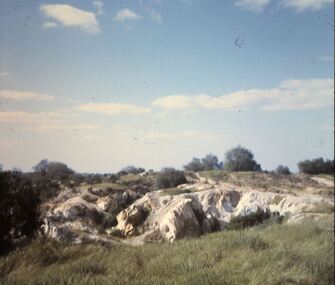
... Diggers & Mining: Bendigo. Tailings from mine. Markings: 16 DEC76M10. Used as a teaching aid....EDUCATION Tertiary bendigo Kodachrome Diggers & Mining: Bendigo. Tailings from mine. Markings: 16 DEC76M10. Used as a teaching aid. ...Diggers & Mining: Bendigo. Tailings from mine. Markings: 16 DEC76M10. Used as a teaching aid.Kodachromeeducation, tertiary, bendigo -
 Bendigo Historical Society Inc.
Newspaper - Kangaroo Flat Gold Mine Collection: Bendigo Mining, 1995, 1999
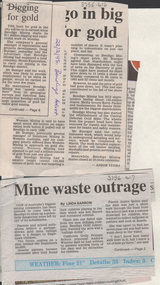
... Bendigo Gold Associates have been ordered to 'come back' and 'clean up a potentially dangerous mess' at a gold mine tailings dam in Eaglehawk. ...Bendigo Gold Associates have been ordered to 'come back' and 'clean up a potentially dangerous mess' at a gold mine tailings dam in Eaglehawk. Newspaper Kangaroo Flat Gold Mine Collection: Bendigo Mining ...Two newspaper clippings: a. 'Digging for Gold' Bendigo Advertiser, 22nd. February, 1995. Article describes $11 million 'digging and exploration work' being undertaken by Bendigo Mining at Kangaroo Flat, Eaglehawk and other areas of Bendigo. Mr. Doug Buerger stated that his company had 'set a conservative target' to discover up to 100,000 ounces of gold. b. 'Mine Waste Outrage' Bendigo Advertiser, 25th November, 1999. Bendigo Gold Associates have been ordered to 'come back' and 'clean up a potentially dangerous mess' at a gold mine tailings dam in Eaglehawk. bendigo, gold mining, eaglehawk, bendigo gold associates, tailings dam, doug buerger, bendigo mining, exploration -
 Ballarat Heritage Services
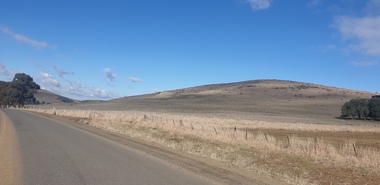
Photograph - Colour Photograph, Clare Gervasoni, Mount Greenock, 2025, 28/06/2025
... The lava flow and the scoria cone overlie the Greenock lead (a buried valley with auriferous gravels). A line of mine tailing and abandoned mining relics associated with the former Union Mine occur on the margins of the lava flow. ...The lava flow and the scoria cone overlie the Greenock lead (a buried valley with auriferous gravels). A line of mine tailing and abandoned mining relics associated with the former Union Mine occur on the margins of the lava flow. ...Mt Greenock is an extinct volcano with lava flows associated with a deep lead. It is a tall scoria cone with a broad shallow crater open to the northwest. In the crater are blocks and bombs of scoriaceous basalt. Long lava flows extend both north and south from the cone. It is considered a significant geological site, and part of the Major Mitchell Trail, with a 1936 ‘Centenary of Major Mitchell ‘monument on the summit. The flow to the north has been eroded by McCallum Creek which is a lateral stream. On the eastern base of the cone, the stream valley exposes a lava flow and underlying sedimentary rocks. The lava flow and the scoria cone overlie the Greenock lead (a buried valley with auriferous gravels). A line of mine tailing and abandoned mining relics associated with the former Union Mine occur on the margins of the lava flow. Mount Greenock is a 120 hectare ‘Geological Reserve’, is one of the few large scoria cones on public land and contains abundant outcrop and morphological evidence of its volcanic origin. Colour Photographs of Mt Greenock, near Talbot, Victoria. The photographs were taken in winter not long after the first post drought rains. Mt Greenock was climbed by Major Thomas Mitchell on 26 September 1936, and he gave it the current name. At that time the mount was part of Alexander McCallum's Dunach Forest Pastoral Run.mt greenock, mount greenock, mining, mullock heap, mt greenock geological reserve, union mine, volcanic grasslands, dunach -
 Ballarat Heritage Services
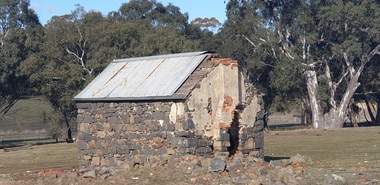
Photograph - Colour Photograph, Clare Gervasoni, Built Remains near Mount Greenock, 2025, 28/06/2025
... The lava flow and the scoria cone overlie the Greenock lead (a buried valley with auriferous gravels). A line of mine tailing and abandoned mining relics associated with the former Union Mine occur on the margins of the lava flow. ...The lava flow and the scoria cone overlie the Greenock lead (a buried valley with auriferous gravels). A line of mine tailing and abandoned mining relics associated with the former Union Mine occur on the margins of the lava flow. ...Mt Greenock is an extinct volcano with lava flows associated with a deep lead. It is a tall scoria cone with a broad shallow crater open to the northwest. In the crater are blocks and bombs of scoriaceous basalt. Long lava flows extend both north and south from the cone. It is considered a significant geological site, and part of the Major Mitchell Trail, with a 1936 ‘Centenary of Major Mitchell ‘monument on the summit. The flow to the north has been eroded by McCallum Creek which is a lateral stream. On the eastern base of the cone, the stream valley exposes a lava flow and underlying sedimentary rocks. The lava flow and the scoria cone overlie the Greenock lead (a buried valley with auriferous gravels). A line of mine tailing and abandoned mining relics associated with the former Union Mine occur on the margins of the lava flow. Mount Greenock is a 120 hectare ‘Geological Reserve’, is one of the few large scoria cones on public land and contains abundant outcrop and morphological evidence of its volcanic origin. Colour Photographs of bluestone and brick buildings at Mt Greenock, near Talbot, Victoria. The photographs were taken in winter not long after the first post drought rains. mt greenock, mount greenock, mining, mullock heap, mt greenock geological reserve, union mine, volcanic grasslands, dunach -
 Bendigo Historical Society Inc.
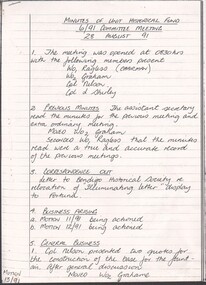
Document - Minutes of Army Survey Regiment Unit Historical Fund, Fortuna Villa
... The 1875 crushing works are attached directly to the mansion, and the mine's tailings and settling ponds (turned into ornamental lakes) represent a direct link between George Lansell's wealth and its source. ...The 1875 crushing works are attached directly to the mansion, and the mine's tailings and settling ponds (turned into ornamental lakes) represent a direct link between George Lansell's wealth and its source. ...Fortuna Villa was initially commenced as a modest single storey home in 1861 next to the 180 Mine by Theodore Ballerstedt, who sold the mine and house to George Lansell in 1869. Lansell already owned the adjacent Fortuna Mine, and through deeper mining techniques greatly expanded the mine's operation, his personal wealth, and the house and grounds. Lansell was soon known as the 'Quartz King', Australia's first gold mining millionaire and credited as the driving force behind much of Bendigo's prosperity. He continuously added to and expanded the villa, decorating it extravagantly with the finest of artworks and materials, into a sprawling mansion with extensive landscaped grounds, to create a house and grounds of a size and grandeur with few rivals in Australia. After his death in 1907, his second wife Edith carried on with improvements, creating a house and grounds developed over 50 years. The attached mine also contributes to its significance, being one of the richest mines in Bendigo, and at one stage probably the deepest gold mine in the world at 3176 feet. The 1875 crushing works are attached directly to the mansion, and the mine's tailings and settling ponds (turned into ornamental lakes) represent a direct link between George Lansell's wealth and its source. Fortuna was compulsorily acquired by the Commonwealth in 1942 as the Cartographic Headquarters of the Australian Survey Corps during World War II, and many ancillary structures were added while preserving the main house and ornamental grounds. Victorian Heritage Database Report https://vhd.heritagecouncil.vic.gov.au/places/68334/download-reportMinutes of Army Survey Regiment Unit Historical Fund, Fortuna Villa (28 Aug 1991 - 25 Nov 1992) 28 August 1991 - cost of construction of base of the fountain, and letter to Bendigo Art Gallery to follow-up loan of the "Venus" statue for display in the RM's office and resurfacing of marble baths in the CO and adjutant's offices. Single undated page from Unit Historical Fund Committee in 1991. 11 Nov 1992 - discussion of Christmas tours and a plaque for hallway. 25 Nov 1992 - lights for the Company's office, and a discussion of five tasks for next year. Lansell's Fortuna flyer for tour.fortuna villa, minutes -
 Bendigo Historical Society Inc.
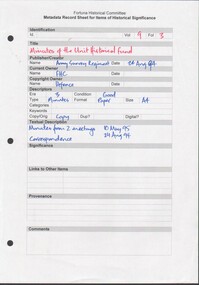
Administrative record - Minute records Army Survey Regiment Fortuna Historical Society
... The 1875 crushing works are attached directly to the mansion, and the mine's tailings and settling ponds (turned into ornamental lakes) represent a direct link between George Lansell's wealth and its source. ...The 1875 crushing works are attached directly to the mansion, and the mine's tailings and settling ponds (turned into ornamental lakes) represent a direct link between George Lansell's wealth and its source. ...Fortuna Villa was initially commenced as a modest single storey home in 1861 next to the 180 Mine by Theodore Ballerstedt, who sold the mine and house to George Lansell in 1869. Lansell already owned the adjacent Fortuna Mine, and through deeper mining techniques greatly expanded the mine's operation, his personal wealth, and the house and grounds. Lansell was soon known as the 'Quartz King', Australia's first gold mining millionaire and credited as the driving force behind much of Bendigo's prosperity. He continuously added to and expanded the villa, decorating it extravagantly with the finest of artworks and materials, into a sprawling mansion with extensive landscaped grounds, to create a house and grounds of a size and grandeur with few rivals in Australia. After his death in 1907, his second wife Edith carried on with improvements, creating a house and grounds developed over 50 years. The attached mine also contributes to its significance, being one of the richest mines in Bendigo, and at one stage probably the deepest gold mine in the world at 3176 feet. The 1875 crushing works are attached directly to the mansion, and the mine's tailings and settling ponds (turned into ornamental lakes) represent a direct link between George Lansell's wealth and its source. Fortuna was compulsorily acquired by the Commonwealth in 1942 as the Cartographic Headquarters of the Australian Survey Corps during World War II, and many ancillary structures were added while preserving the main house and ornamental grounds. Victorian Heritage Database Report https://vhd.heritagecouncil.vic.gov.au/places/68334/download-reportMinutes of the Fortuna Historical Committee held 24 August 1994 (hand written minutes over four sheets, referenced Vol 9 Fol 3) including four pages of stakeholder feedback tabled at the meetingfortuna, historical unit -
 Bendigo Historical Society Inc.
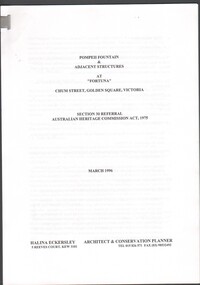
Document - Pompeii Fountain & Adjacent Structures at "Fortuna"
... The 1875 crushing works are attached directly to the mansion, and the mine's tailings and settling ponds (turned into ornamental lakes) represent a direct link between George Lansell's wealth and its source. ...The 1875 crushing works are attached directly to the mansion, and the mine's tailings and settling ponds (turned into ornamental lakes) represent a direct link between George Lansell's wealth and its source. ...Fortuna Villa was initially commenced as a modest single storey home in 1861 next to the 180 Mine by Theodore Ballerstedt, who sold the mine and house to George Lansell in 1869. Lansell already owned the adjacent Fortuna Mine, and through deeper mining techniques greatly expanded the mine's operation, his personal wealth, and the house and grounds. Lansell was soon known as the 'Quartz King', Australia's first gold mining millionaire and credited as the driving force behind much of Bendigo's prosperity. He continuously added to and expanded the villa, decorating it extravagantly with the finest of artworks and materials, into a sprawling mansion with extensive landscaped grounds, to create a house and grounds of a size and grandeur with few rivals in Australia. After his death in 1907, his second wife Edith carried on with improvements, creating a house and grounds developed over 50 years. The attached mine also contributes to its significance, being one of the richest mines in Bendigo, and at one stage probably the deepest gold mine in the world at 3176 feet. The 1875 crushing works are attached directly to the mansion, and the mine's tailings and settling ponds (turned into ornamental lakes) represent a direct link between George Lansell's wealth and its source. Fortuna was compulsorily acquired by the Commonwealth in 1942 as the Cartographic Headquarters of the Australian Survey Corps during World War II, and many ancillary structures were added while preserving the main house and ornamental grounds. Victorian Heritage Database Report https://vhd.heritagecouncil.vic.gov.au/places/68334/download-reportConservation report for the Pompeii Fountain & Adjacent Structures at "Fortuna" Chum Street, Golden Square, Victoria. Prepared for Fortuna Historical Committee. March 1996.Halina Eckersley, Architect & Conservation Planner, Kewpompeii fountain, greenhouse, fortuna lake, gardens -
 Bendigo Historical Society Inc.
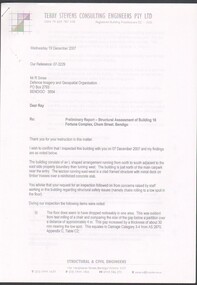
Document - Preliminary report of Structural assessment Fortuna
... The 1875 crushing works are attached directly to the mansion, and the mine's tailings and settling ponds (turned into ornamental lakes) represent a direct link between George Lansell's wealth and its source. ...The 1875 crushing works are attached directly to the mansion, and the mine's tailings and settling ponds (turned into ornamental lakes) represent a direct link between George Lansell's wealth and its source. ...Fortuna Villa was initially commenced as a modest single storey home in 1861 next to the 180 Mine by Theodore Ballerstedt, who sold the mine and house to George Lansell in 1869. Lansell already owned the adjacent Fortuna Mine, and through deeper mining techniques greatly expanded the mine's operation, his personal wealth, and the house and grounds. Lansell was soon known as the 'Quartz King', Australia's first gold mining millionaire and credited as the driving force behind much of Bendigo's prosperity. He continuously added to and expanded the villa, decorating it extravagantly with the finest of artworks and materials, into a sprawling mansion with extensive landscaped grounds, to create a house and grounds of a size and grandeur with few rivals in Australia. After his death in 1907, his second wife Edith carried on with improvements, creating a house and grounds developed over 50 years. The attached mine also contributes to its significance, being one of the richest mines in Bendigo, and at one stage probably the deepest gold mine in the world at 3176 feet. The 1875 crushing works are attached directly to the mansion, and the mine's tailings and settling ponds (turned into ornamental lakes) represent a direct link between George Lansell's wealth and its source. Fortuna was compulsorily acquired by the Commonwealth in 1942 as the Cartographic Headquarters of the Australian Survey Corps during World War II, and many ancillary structures were added while preserving the main house and ornamental grounds. Victorian Heritage Database Report https://vhd.heritagecouncil.vic.gov.au/places/68334/download-reportPreliminary report of Structural assessment of Building 16 Fortuna Complex, Chum Street, Bendigo. Four page preliminary report finding the building is structurally safe as at Wed 19 December 2007 with three recommendations. Prepared for DIGO by Structural Engineers - Terry Stevens Consulting Engineers Pty Ltd.fortuna, structural assessment -
 Bendigo Historical Society Inc.
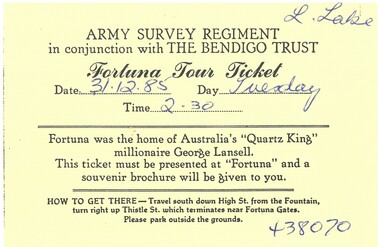
Ephemera - Tour Ticket
... The 1875 crushing works are attached directly to the mansion, and the mine's tailings and settling ponds (turned into ornamental lakes) represent a direct link between George Lansell's wealth and its source. ...The 1875 crushing works are attached directly to the mansion, and the mine's tailings and settling ponds (turned into ornamental lakes) represent a direct link between George Lansell's wealth and its source. ...Fortuna Villa was initially commenced as a modest single storey home in 1861 next to the 180 Mine by Theodore Ballerstedt, who sold the mine and house to George Lansell in 1869. Lansell already owned the adjacent Fortuna Mine, and through deeper mining techniques greatly expanded the mine's operation, his personal wealth, and the house and grounds. Lansell was soon known as the 'Quartz King', Australia's first gold mining millionaire and credited as the driving force behind much of Bendigo's prosperity. He continuously added to and expanded the villa, decorating it extravagantly with the finest of artworks and materials, into a sprawling mansion with extensive landscaped grounds, to create a house and grounds of a size and grandeur with few rivals in Australia. After his death in 1907, his second wife Edith carried on with improvements, creating a house and grounds developed over 50 years. The attached mine also contributes to its significance, being one of the richest mines in Bendigo, and at one stage probably the deepest gold mine in the world at 3176 feet. The 1875 crushing works are attached directly to the mansion, and the mine's tailings and settling ponds (turned into ornamental lakes) represent a direct link between George Lansell's wealth and its source. Fortuna was compulsorily acquired by the Commonwealth in 1942 as the Cartographic Headquarters of the Australian Survey Corps during World War II, and many ancillary structures were added while preserving the main house and ornamental grounds. Victorian Heritage Database Report https://vhd.heritagecouncil.vic.gov.au/places/68334/download-reportTicket for Fortuna Villa Tour conducted by the Army Survey Regiment and the National Trust. 31/12/1985. Black printing on yellow card.fortuna villa, tour -
 Bendigo Historical Society Inc.
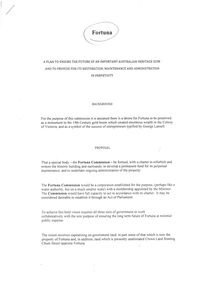
Document - Preservation proposal
... The 1875 crushing works are attached directly to the mansion, and the mine's tailings and settling ponds (turned into ornamental lakes) represent a direct link between George Lansell's wealth and its source. ...The 1875 crushing works are attached directly to the mansion, and the mine's tailings and settling ponds (turned into ornamental lakes) represent a direct link between George Lansell's wealth and its source. ...Fortuna Villa was initially commenced as a modest single storey home in 1861 next to the 180 Mine by Theodore Ballerstedt, who sold the mine and house to George Lansell in 1869. Lansell already owned the adjacent Fortuna Mine, and through deeper mining techniques greatly expanded the mine's operation, his personal wealth, and the house and grounds. Lansell was soon known as the 'Quartz King', Australia's first gold mining millionaire and credited as the driving force behind much of Bendigo's prosperity. He continuously added to and expanded the villa, decorating it extravagantly with the finest of artworks and materials, into a sprawling mansion with extensive landscaped grounds, to create a house and grounds of a size and grandeur with few rivals in Australia. After his death in 1907, his second wife Edith carried on with improvements, creating a house and grounds developed over 50 years. The attached mine also contributes to its significance, being one of the richest mines in Bendigo, and at one stage probably the deepest gold mine in the world at 3176 feet. The 1875 crushing works are attached directly to the mansion, and the mine's tailings and settling ponds (turned into ornamental lakes) represent a direct link between George Lansell's wealth and its source. Fortuna was compulsorily acquired by the Commonwealth in 1942 as the Cartographic Headquarters of the Australian Survey Corps during World War II, and many ancillary structures were added while preserving the main house and ornamental grounds. Victorian Heritage Database Report https://vhd.heritagecouncil.vic.gov.au/places/68334/download-reportProposal for the formation of a Fortuna Commission to ensure the preservation of Fortuna Villa. Written by Daryl McClure. May 2012fortuna villa, preservation, daryl mcclure -
 Bendigo Historical Society Inc.
Document - FOSTERVILLE GOLD MINE COLLECTION: FOSTERVILLE GOLD PROJECT UPGRADE EXECUTIVE SUMMARUY
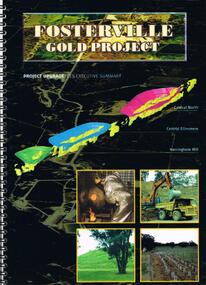
... Contents include: open pits, heap leaching, waste dumps, estimated project life, changes from previously approved project, estimated project life, main project components, expanded open pits and underground mines, processing sulphide ore, tailings storages, waste rock dumps. ...Contents include: open pits, heap leaching, waste dumps, estimated project life, changes from previously approved project, estimated project life, main project components, expanded open pits and underground mines, processing sulphide ore, tailings storages, waste rock dumps. ...Black cover book, wire binding, 13 pages of text and maps. On front: Fosterville Gold Project' Map of ore body on cover - Central North, Central Ellesmere, Harringtons Hill. Contents include: open pits, heap leaching, waste dumps, estimated project life, changes from previously approved project, estimated project life, main project components, expanded open pits and underground mines, processing sulphide ore, tailings storages, waste rock dumps. Principles of rehabilitation, site preparation, rehabilitation activities during operation and decommissioning activities. Environmental issues, and summary of proposed new operating conditions.bendigo, mining, fosterville gold mine -
 Federation University Historical Collection
Book, Mine Haulage
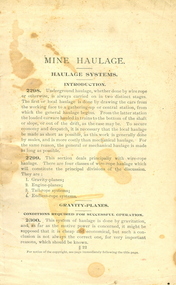
... Probably used at the Ballarat School of Mines for the Mine Driving Certificate mining ballarat school of mines haulage gravity planes engine planes tail-rope system knock-off links Printed book (missing cover) on Mine Haulage and Haulage Systems Mine Haulage Book ...Probably used at the Ballarat School of Mines for the Mine Driving CertificatePrinted book (missing cover) on Mine Haulage and Haulage Systemsmining, ballarat school of mines, haulage, gravity planes, engine planes, tail-rope system, knock-off links -
 Federation University Historical Collection
Tool, Handshears
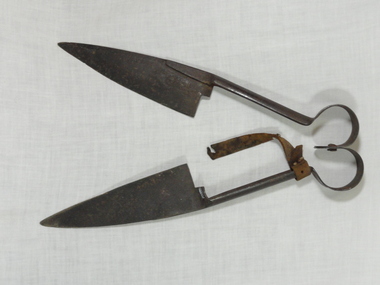
... tail. In the early 1930s the Ballarat School of Mines introduced a wide-ranging Wool Classing Course as jobs were in extremely short supply during the Great Depression. ...tail. In the early 1930s the Ballarat School of Mines introduced a wide-ranging Wool Classing Course as jobs were in extremely short supply during the Great Depression. ballarat school of mines shearing woolclassing sheep Metal handshears used for shearing sheep. ...Hand shears needed to be very sharp and often had a leather strap or ‘driver’ which passed over the hand. Others had sheepskin bound around the grip. Blades had to be regularly sharpened on a grinding stone. Most hand shears were made in Sheffield, England, with various models produced offering wide or narrow blades, sharp or rounded points, and various grips and bows. The technique of Australian hand shearing gradually developed from the 1830s using the old English method of cutting the flank with hand shears in a series of circular cuts from the sheep’s neck to the tail. In the early 1930s the Ballarat School of Mines introduced a wide-ranging Wool Classing Course as jobs were in extremely short supply during the Great Depression. Metal handshears used for shearing sheep.ballarat school of mines, shearing, woolclassing, sheep -
 Federation University Historical Collection
Book, Winding Engines and Winding Appliances, 1912, 1912
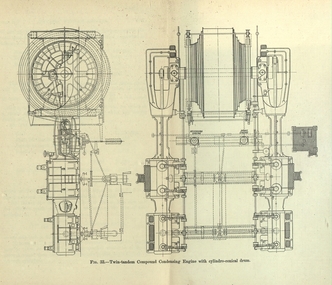
... George McCulloch was an inspector of machinery for the Western Australia Department of Mines. mining winding engines steam engines safety devices winding ropes cages safety cages Brown hard covered book of 452 pages including illustrations and index. Contents include Design; Tail ...George McCulloch was an inspector of machinery for the Western Australia Department of Mines. Brown hard covered book of 452 pages including illustrations and index. Contents include Design; Tail ropes; Winding from Great Depths; Colliery Winding; Electric Winding; Steam engine details, Drims; brakes; Clutches; Safety Devices; Winding ropes; Cages; Skips; Cage Safety Gear, Safety Cages; Cage Guides; Head gearsmining, winding, engines, steam engines, safety devices, winding ropes, cages, safety cages -
 Federation University Historical Collection
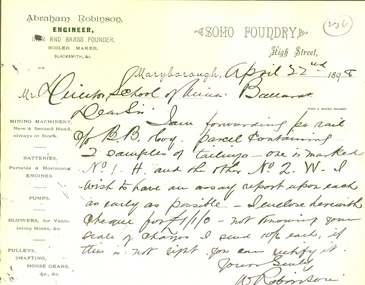
Correspondence, W. Robinson, Correspondence on Soho Foundry Letterhead, 1898, 22/04/1898
... Mines. The letter is on letterhead which includes details for Abraham Robinson, Engineer, iron and brass founder, boiler maker, blacksmith, etc. The correspondence related to two samples of tailings...Mines. The letter is on letterhead which includes details for Abraham Robinson, Engineer, iron and brass founder, boiler maker, blacksmith, etc. The correspondence related to two samples of tailings ...Correspondence from W. Robinson of Soho Foundry Maryborough to the Director of the Ballarat School of Mines. The letter is on letterhead which includes details for Abraham Robinson, Engineer, iron and brass founder, boiler maker, blacksmith, etc. The correspondence related to two samples of tailings for assay.soho foundry maryborough, abraham robinson, w. robinson, assay, ballarat school of mines, engineer, brass founder, iron founder, boiler maker, blacksmith -
 Federation University Historical Collection
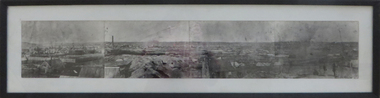
Photograph - Photograph - Black and White, Ballarat, c1858, c1858
... The waterloo mines was one of the first deep shafts and was sunk at the foot of the Dana Street hill. Its tailings are seen in the second photo from left. ...The waterloo mines was one of the first deep shafts and was sunk at the foot of the Dana Street hill. Its tailings are seen in the second photo from left. ...Four photographs framed together to produce a panorama. The four photographs were taken from the slope of the Ballarat School of Mines where the Wesley Church now stands. When joined they gave a panoramic view of one of the world’s richest alluvial goldfields. The town you see had over 50,000 people. Bridge Street on the left is well established. The crude pans and cradles of the early “diggers’ were already giving way to steam power and the deep shafts of the “miners”. Money and machinery were needed to get to the deeper leads, and the smoke stacks of the great company mines can be seen across the photo. The waterloo mines was one of the first deep shafts and was sunk at the foot of the Dana Street hill. Its tailings are seen in the second photo from left. ballarat, ballarat gas works, mount warrenheip, shingle roof, mullock heap, mining -
 The Beechworth Burke Museum
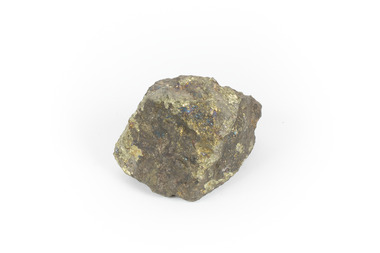
Geological specimen - Chalcopyrite
... The environmental impacts from this complex of mines are extensive, with waste tailings and heavy metal contamination flowing directly into the King and Queen River catchments. ...The environmental impacts from this complex of mines are extensive, with waste tailings and heavy metal contamination flowing directly into the King and Queen River catchments. ...This specimen originated from Mount Lyell on the west coast of Tasmania, where a large group of open cut and underground copper-silver-gold mines began operating in 1883. Between 1893-1994, the Mt Lyell Mining and Railway Company were responsible for operations. The Mt Lyell copper-gold mines produce some excellent crystallised specimens of chalcopyrite and other minerals. The deposits are generally considered to be of Cambrian volcanic origin, but there are indications of Devonian granitic influence on the ores, plus local remobilisation during Devonian deformation. Over 120 million tonnes of ore was produced from several workings, including the main Prince Lyell mine and the North Lyell mine, which was also of great importance. The Mount Lyell mines have a long history of human and environmental disasters, including the 1912 North Lyell fire that killed 42 miners, and two separate incidents in 2013 in which three people lost their lives. The environmental impacts from this complex of mines are extensive, with waste tailings and heavy metal contamination flowing directly into the King and Queen River catchments. In 1954, the eminent Australian historian, Geoffrey Blainey, published 'The Peaks of Lyell' which delves into the history of the 1912 North Mount Lyell Disaster.Chalcopyrite does not contain the most copper in its structure relative to other minerals, but it is the most important copper ore since it can be found in many localities and occurs in a variety of ore types. The brassy-yellow colours in Chalcopyrite mean it is often confused with pyrites and gold, leading to use of the term, "fool's gold." Chalcopyrite has been the primary ore of copper since smelting began five thousand years ago. This specimen is part of a larger collection of geological and mineral specimens collected from around Australia (and some parts of the world) and donated to the Burke Museum between 1868-1880. A large percentage of these specimens were collected in Victoria as part of the Geological Survey of Victoria that begun in 1852 (in response to the Gold Rush) to study and map the geology of Victoria. Collecting geological specimens was an important part of mapping and understanding the scientific makeup of the earth. Many of these specimens were sent to research and collecting organisations across Australia, including the Burke Museum, to educate and encourage further study.This hand sized solid mineral specimen has shades of brass-yellow with spots of iridescent green-black tarnish. Chalcopyrite is a copper iron sulphide mineral and a major ore of copper common in sulphide veins and disseminated in igneous rocks. Chalcopyrite has a hardness of 3.5-4 on the Mohs Scale. It is a member of the tetragonal crystal system and has metallic lustre and opaque transparency.burke museum, beechworth, indigo shire, beechworth museum, geology, geological specimen, chalcopyrite, copper pyrites, copper mining, tasmanian geology, mount lyell, mount lyell mines, fools gold, mohs scale, crystals, minerals, historical geological collection, victorian geological survey, a.r.c selwyn, gold rush, van diemans land -
 Marysville & District Historical Society
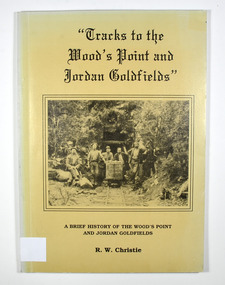
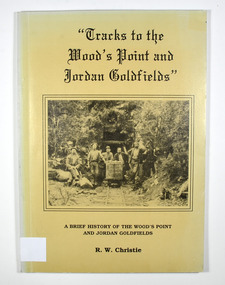
Book, Tracks to the Wood's Point and Jordan Goldfields-A brief history of the Wood's Point and Jordan Goldfields
... Front cover has a black and white photograph of miners standing and sitting around a mine cart that is sitting on railway tracks at the entrance to a mine.Back cover has a cartoon drawing of a pack horse that has fallen down a cliff with his rider trying to pull him back up by his tail. ...Front cover has a black and white photograph of miners standing and sitting around a mine cart that is sitting on railway tracks at the entrance to a mine.Back cover has a cartoon drawing of a pack horse that has fallen down a cliff with his rider trying to pull him back up by his tail. ...A history of the Wood's Point and Jordan gold fieldsPaperback. Beige cover. Front cover has a black and white photograph of miners standing and sitting around a mine cart that is sitting on railway tracks at the entrance to a mine.Back cover has a cartoon drawing of a pack horse that has fallen down a cliff with his rider trying to pull him back up by his tail. Inside the cover is a drawn map entitled 'Map of the Mining District round Wood's point'.Stamp of the Marysville & District Historical Society Inc / P.O. Box 22 / Marysville 3779 gold, gold field, gold mining, gold town, wood's point, jordan goldfields, victoria, australia, history, r w christie -
 Marysville & District Historical Society
Book, Tracks to the Wood's Point and Jordan Goldfields-A brief history of the Wood's Point and Jordan Goldfields
... Front cover has a black and white photograph of miners standing and sitting around a mine cart that is sitting on railway tracks at the entrance to a mine.Back cover has a cartoon drawing of a pack horse that has fallen down a cliff with his rider trying to pull him back up by his tail. ...Front cover has a black and white photograph of miners standing and sitting around a mine cart that is sitting on railway tracks at the entrance to a mine.Back cover has a cartoon drawing of a pack horse that has fallen down a cliff with his rider trying to pull him back up by his tail. ...A history of the Wood's Point and Jordan gold fieldsPaperback. Beige cover. Front cover has a black and white photograph of miners standing and sitting around a mine cart that is sitting on railway tracks at the entrance to a mine.Back cover has a cartoon drawing of a pack horse that has fallen down a cliff with his rider trying to pull him back up by his tail. Inside the cover is a drawn map entitled 'Map of the Mining District round Wood's point'.Stamp of Marysville & District / Historical Society Inc / P.O. Box 22 / Marysville 3779 gold, gold field, gold mining, gold town, wood's point, jordan goldfields, victoria, australia, history, r w christie -
 Federation University Historical Collection
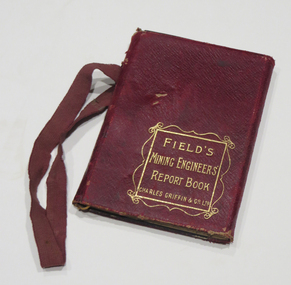
Booklet, Edwin R. Field, Mining engineers' report book and directors' and shareholders' guide to the mining reports, 1909, 1909
... engineer laws concentrates and tailings courts of mines assays foundries tailings edwin r. field mining Small maroon leather covered book of 57 pages. ...Small maroon leather covered book of 57 pages. engineer, laws, concentrates and tailings, courts of mines, assays, foundries, tailings, edwin r. field, mining -
Federation University Historical Collection
Postcard, Post Card to Ballarat School of Mines from J.E. Burke
... Ballarat School of Mines is a predecessor of Federation University Ballarat School of Mines J.E. Burke Battery Tailings Assay Postage stamps Handwritten not on postcard Post Card to Ballarat School of Mines from J.E. ...Ballarat School of Mines is a predecessor of Federation UniversityHandwritten not on postcard Postage stamps ballarat school of mines, j.e. burke, battery tailings, assay -
 Federation University Historical Collection
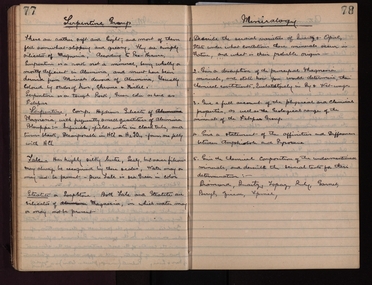
Book - Diary, John Kennedy, John Kennedy's Ballarat School of Mines Lecture Notes, 1889
... John Kennedy Australasian Institute of Mining Engineers AUSIMM American Institute of Mining Metallurgical Engineers Ballarat School of Mines lecture notes lecture notebook Antinomy brick clay carbon coal copper chemistry clay chrome electricity fire clay gas gold gold bullion glass gold test for iron metallurgy light lead metallurgy mica mineralogy pyrites sulphur in pyrites sugar slags wolfram preparation of pure gold scorification gold bullion assay petrography melting poinys of bodies metric system geology mount morgan, queensland rock salt assay of tailings classification of rocks muffle furnace ballarat school of mines wind furnace Assay of antinomy recovery of silver from solutionsheat pyrometer spectroscope organic acids metallurgy of iron assat of copper cornstock lode nevada mount morgan queensland scarification elmwood metallurgy of lead specific gravity copper assay seperation of gold from other metals test for gold wet assay mercury Inside front cover 'John Kennedy Nena Wharf Hobart Tasmania.' ...John Kennedy was born on 04 April 1862, the son of ship carpenter Robert Kennedy and his wife Florinda (Aitken), and the brother of Malcolm and Colin Kennedy. In 1860 the family migrated to Melbourne where Kennedy senior set up as a shipwright. In 1879 Malcolm and John, who trained as a naval architect, joined their father as Robert Kennedy & Sons, shipbuilders and shipsmiths. On 27 December 1883 at North Melbourne, Malcolm married Ann White with Presbyterian forms. Next year Robert Kennedy & Sons removed to Hobart where with John W. Syme and W. J. Duffy, partners until 1889, they took over the Derwent Ironworks & Engineering Co., a foundry formerly owned by the (Alexander) Clark family. The Kennedys also acquired the patent slipyard, formerly Ross's, at Battery Point. After the shipbuilding industry in Hobart began to flag John also turned to mining: he attended the Ballarat School of Mines, and reopened the Hobart smelters which had been an adjunct of the Derwent Ironworks in the 1870s. He made several voyages overseas on smelting business and as mining promoter, and was a member of the London Stock Exchange. In 1913-14 he was manager of Tongkah Compound (1910); Robert Kennedy & Sons was reputed to have contributed to the success of the Hobart-run Tongkah Harbour, Thailand, tin mines by developing a suitable dredge. The brothers also held shares in the Irrawaddy Burma Co. John was a member of the Australasian Institute of Mining Engineers and from 1932 an honorary life member of the American Institute of Mining & Metallurgical Engineers. John died in Hobart on 10 January 1937. (Ann G. Smith, 'Kennedy, John (1862–1937)', Australian Dictionary of Biography, National Centre of Biography, Australian National University, http://adb.anu.edu.au/biography/kennedy-john-7092/text11963, published first in hardcopy 1983, accessed online 24 April 2020.) A book covered in black leather with 'John Kennedy' embossed on the front in gold. The book contains notes from the time he studies at the Ballarat School of Mines. The beginning of the book has an alphabetical section where John Kennedy has created an index.Inside front cover 'John Kennedy Nena Wharf Hobart Tasmania.' john kennedy, australasian institute of mining engineers, ausimm, american institute of mining metallurgical engineers, ballarat school of mines, lecture notes, lecture notebook, antinomy, brick clay, carbon, coal, copper, chemistry, clay, chrome, electricity, fire clay, gas, gold, gold bullion, glass, gold test for, iron metallurgy, light, lead, metallurgy, mica, mineralogy, pyrites, sulphur in pyrites, sugar, slags, wolfram, preparation of pure gold, scorification, gold bullion assay, petrography, melting poinys of bodies, metric system, geology, mount morgan, queensland, rock salt, assay of tailings, classification of rocks, muffle furnace, ballarat school of mines wind furnace, assay of antinomy, recovery of silver from solutionsheat pyrometer, spectroscope, organic acids, metallurgy of iron, assat of copper, cornstock lode nevada, mount morgan queensland, scarification, elmwood, metallurgy of lead, specific gravity, copper assay, seperation of gold from other metals, test for gold, wet assay, mercury -
Ringwood and District Historical Society
Administrative record - Mining Reports, Government Printer, Melbourne, Colony of Victoria quarterly and annual mining reports - 1860s 1870s & 1880s, 1865 - 1883
... mines in Victoria with depth of the deepest shafts, levels, cross-cuts, etc. - Estimated yield of gold and quantity of gold exported during the quarter - Gold received and issued from the Royal Mint during the quarter - Summary of yield of gold from quartz, tailings, etc., crushed during the quarter - Summary of yield of gold from washdirt and cement washed and crushed during quarter - Number and distribution of miners on the goldfields of the colony. 2. 1879-82 Hard bound volume - Chief Inspector of Mines Reports to the Honorable Minister of Mines, Victoria. ...mines in Victoria with depth of the deepest shafts, levels, cross-cuts, etc. - Estimated yield of gold and quantity of gold exported during the quarter - Gold received and issued from the Royal Mint during the quarter - Summary of yield of gold from quartz, tailings, etc., crushed during the quarter - Summary of yield of gold from washdirt and cement washed and crushed during quarter - Number and distribution of miners on the goldfields of the colony. 2. 1879-82 Hard bound volume - Chief Inspector of Mines Reports to the Honorable Minister of Mines, Victoria. ...Colony of Victoria mining reports show any Ringwood mine references under Castlemaine District, St. Andrews Subdivision. Noteworthy for Ringwood: - Death of Pierce Boardman, mining manager at New Ringwood Mining Co., accidentally killed when he lost his footing and fell to a depth of 40 feet on 1st January 1879. - William White injured in truck accident at New Ringwood Antimony Tribute Company, 31st March 1882.Boxed collection of soft and hard bound reports including: 1. Quarterly Colony of Victoria reports of the Mining Surveyors & Registrars, Victoria, 1865-1881 - Summary of gold mining statistics for the quarter - Tables showing the yield of gold from certain parcels of quartz raised during the quarter in some of the deepest mines in Victoria with depth of the deepest shafts, levels, cross-cuts, etc. - Estimated yield of gold and quantity of gold exported during the quarter - Gold received and issued from the Royal Mint during the quarter - Summary of yield of gold from quartz, tailings, etc., crushed during the quarter - Summary of yield of gold from washdirt and cement washed and crushed during quarter - Number and distribution of miners on the goldfields of the colony. 2. 1879-82 Hard bound volume - Chief Inspector of Mines Reports to the Honorable Minister of Mines, Victoria. (Includes fatal and non-fatal accident reports, mining operations, and employment statistcs.) Noteworthy for Ringwood: - Death of Pierce Boardman, mining manager at New Ringwood Mining Co., accidentally killed when he lost his footing and fell to a depth of 40 feet on 1st January 1879. - William White injured in truck accident at New Ringwood Antimony Tribute Company, 31st March 1882. 3. Mineral Statistics for Victoria - annual reports for years 1867, 1871, 1874, 1876, 1877, 1878, & 1879. 4. Handwritten study notes.antimony, boardman, william white
