

Historical information
A large ethnic group in the Bendigo area was the Chinese, numbering 400-500 in 1868. There were several large Chinese villages in the Bendigo district of which one was located in Long Gully, near the junction with Sparrowhawk Gully. It was Sir John Quick, former resident of Ironbark, who introduced the first bill into Parliament in 1888 for the disenfranchisement of Chinese holding a Miner’s Right. Chinese miners worked the tailing heaps and discarded ore bodies. It was only the Chinese contractors, who worked the tailings of the quartz reefs. The work of stacking tailing dumps associated with major mine sites was a particular feature of the Bendigo field. The tailings had to be stacked for placement as they washed out of the batteries. It was undertaken exclusively by groups of Chinese workers, who paid the mining companies to stack the tailings with the hope of finding traces of gold. The long sluicing boxes and blankets laid out in lines over the tailings became a familiar feature in the city landscape. It was an essential element of the operations of the mines. The tailings were progressively planted with spiny rushes, pampas grass and peppercorn trees.
Physical description
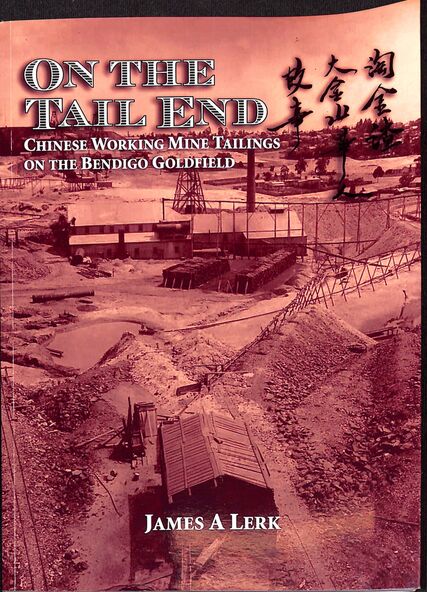
"On the tail end" written by James A. Lerk. Concerns Chinese working mine tailings on the Bendigo Goldfield. Published in Australia by JA & ERS Lerk in 2017. Soft cover. Cover is sepia in tone on the front and back. Title in white with red Chinese figures beside English text. Back cover has inset image of 'Register of Purchases' listing details of individuals. Book includes both color and black and white images. 78 pp. ISBN 9780646978598. Contains index.
