
Showing 32 items matching "mining album"
-
 The Beechworth Burke Museum
Postcard, George Symons, c.1990
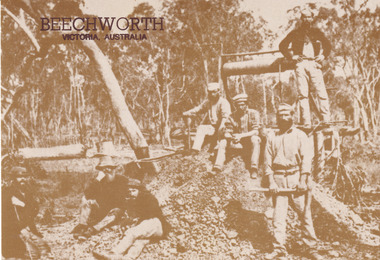
... mining album...In addition, since this image is a postcard reproduction of an early Australian image which may date to approximately 1990 it can impart knowledge as to the interests of people during this time period when there may have been an increase into Australian history. mining album gold mine beechworth burke museum mine shaft postcard australian yesteryear cards george symons the minehead gold fields alluvial gold early australia c.1872 1872 gold diggers north east victoria Obverse: BEECHWORTH / Victoria, Australia / Reverse: GM 2 3275 / CORRESPONDENCE / AUSTRALIAN / YESTERYEAR / CARDS / ADDRESS / Published by George Symons (057) 65 3240 / THE MINEHEAD C. 1872 / The easily gleaned gold of the early fields did / not last very long. ...The photograph printed on this postcard comes from the collection of the Mitchell Library in Sydney. It is sepia in tone and depicts seven men standing and sitting around a mine shaft in the Beechworth region. The photograph has been dated to approximately 1872. This period in history post-dates the Victorian gold rushes which occurred 1852-1853 in Ballarat, Bendigo and Beechworth. During this period, in the 1870s, the surface alluvial gold had been discovered and removed from location. Therefore, in order to reach the deeper and less accessible alluvial gold, diggers began to dig shafts into the earth. These shafts sunk below the ground level by 20 to 30 feet and required timber structures around the entrance and winches to bring the paydirt to the top. The top of this wooden structure is visible behind the man standing in the upper right of the image. This type of mining was highly dangerous as mines often caved in which injured the minors and often resulted in death. Thus, following this period, in the early 1900s, miners opted instead for hydrolic slucing which cut away the earth without the devastating consequences of a mine cave in. This particular group of miners appear to have been unable to afford a horse (then worth around 50 pounds) which were generally used at mines like this to help pull buckets attached to ropes up and down the mine. Instead, this group brought the buckets up and down by windlass. The windlass was a wooden structure mounted over the mining shaft and fitted with a hand-cranked winch which enabled the bucket attached to the rope to be brought up and down.Gold was first discovered in Beechworth in Spring and Reid's Creek in the summer of 1852-1853. At its popularity, this region had approximately 8000 people on the gold fields searching for gold on the banks of these creeks. These periods did not require the use of heavy machinery or the digging of deep mining shafts like the one depicted in this image. Therefore, this image has important connotations for the technologies associated with mining during the approximated 1870s when gold was harder to access. This is a later period in gold history which does not fit into the "gold rush" period. Instead, it occurred after the surface gold had disappeared and therefore, is essential for researchers who are investigating the mining techniques and structures used to reach the alluvial gold which was located deeper under ground in the 1870s. This period predates the use of big heavy machinery used to mine in the 1900s which include dredges. Images such as this one can also impart essential information as to the wardrobe and fashion of men during this period. It also imparts knowledge about the landscape of Beechworth which is useful for people researching the environment and impact of gold mining in the north-east region of Victoria. In addition, since this image is a postcard reproduction of an early Australian image which may date to approximately 1990 it can impart knowledge as to the interests of people during this time period when there may have been an increase into Australian history.A sepia tone facsimile of an early Australian photograph (circa 1872) printed as a postcard.Obverse: BEECHWORTH / Victoria, Australia / Reverse: GM 2 3275 / CORRESPONDENCE / AUSTRALIAN / YESTERYEAR / CARDS / ADDRESS / Published by George Symons (057) 65 3240 / THE MINEHEAD C. 1872 / The easily gleaned gold of the early fields did / not last very long. In order to reach less / accessible alluvial gold diggers began sinking shafts as much as twenty to thirty feet down / and the mines required timbering and winches / to bring the paydirt to the top. / This syndicate has been unable to afford the / luxury of a horse (about 50 pounds) and so everything / must go up and down by windlass and rawhide / bucket. / Photo: Mitchell Library, Sydney / A sepia tone facsimile of / an early Australian photographmining album, gold mine, beechworth, burke museum, mine shaft, postcard, australian yesteryear cards, george symons, the minehead, gold fields, alluvial gold, early australia, c.1872, 1872, gold diggers, north east victoria -
 City of Ballarat Libraries
Photograph, Band & Albion Consols Gold Mining Co
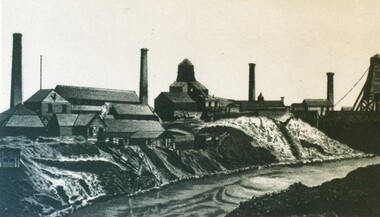
... Mining...Ballarat...premier album...This sketch appears in the Premier Album of Ballarat Views Band & Albion Consols Mining Co. Commerical Mining Ballarat premier album of ballarat views Band & Albion Consols Gold Mining Co. ...This sketch appears in the Premier Album of Ballarat Views band & albion consols mining co., commerical, mining, ballarat, premier album of ballarat views -
 Federation University Historical Collection
Book - Photo album, Photographs of New Zealand Scenery, 1886, 1886 (exact)
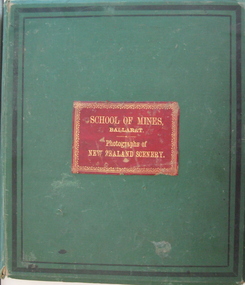
... Walter Burton was born in 1836, and died in 1889. pink terrace white terrace new zealand sumner burton bros rotokakahi wairoa rotomahana crater tikitapu bush wanganui bridge maori canoe volcano mount tarawara james oddie ballarat school of mines museum eruption waterfall bridge sulphur pool crater mt tarawera tikitapu lake rananga house wairoa waikato maori church wairoa ganaru taherepokiore golden bay paterson dowling st dunedin rocky hill harison's cove milford sound tall ship hydraulic mining hale's arm james oddie (donor) george hook stephen carey Lake Rotomahana Each photo has a caption. Large green album ...Before Mt Tarawera erupted, the Pink and White Terraces at Lake Rotomahana in New Zealand’s North Island, were considered one of the wonders of the world. Tourists came to soak in the thermal hot pools and view the marble-like terraces. Due to a volcanic eruption of Mt Tarawera On June 10 1886, between 108-120 people were killed and several settlements were destroyed. It also destroyed the world-famous Pink and White Terraces. The terraces became a crater over 100 metres deep. Within 15 years it filled with water, forming a much larger new Lake Rotomahana. The chain of craters at Waimangu became the site of many new geothermal features, including Waimangu Geyser, the largest in the world, and New Zealand’s largest hot spring, Frying Pan Lake. The Burton brothers (photographers), Alfred Burton was born in 1834 in Leicester and died in 1914 in Dunedin. His brother Walter Burton was born in 1836 and died in 1880. Many of the Burton Brothers' works and original equipment were collected by Dunedin photographer and historian Hardwicke Knight, and are now housed in the Museum of New Zealand Te Papa Tongarewa in Wellington. This album was donated to the Ballarat School of Mines Museum by James Oddie in 1887. (See Cat. No. 458, No. 1720) Alfred Burton was born in 1834 at Leicester and died at Dunedun, New Zealand, in 1914. Walter Burton was born in 1836, and died in 1889. Large green album containing numerous B/W original photographs of New Zealand, especially volcanos. - Includes Pink and White Terraces (no longer in existance). Photos were taken before and after volcanic eruption. A recent inclusion is article on the terraces by Federation University's George Hook and Stephen Carey.Each photo has a caption.pink terrace, white terrace, new zealand, sumner, burton bros, rotokakahi wairoa, rotomahana crater, tikitapu bush, wanganui bridge, maori, canoe, volcano, mount tarawara, james oddie, ballarat school of mines museum, eruption, waterfall, bridge, sulphur pool, crater, mt tarawera, tikitapu lake, rananga house, wairoa, waikato, maori church wairoa, ganaru, taherepokiore, golden bay, paterson, dowling st dunedin, rocky hill, harison's cove, milford sound, tall ship, hydraulic mining, hale's arm, james oddie (donor), george hook, stephen carey, lake rotomahana -
 St Arnaud and District Historical Society
Book. Track of the Years, Track Of The Years. The Story of St.Arnaud.By Yvonne S Palmer
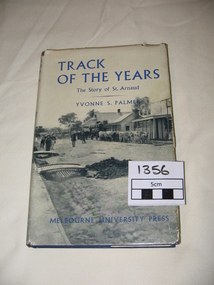
... albums, are now placed permanently on record in this fascinating narrative. Contents: The New Bendigo Goldrush, Pastoral Settlement, The Aborigines of the Eastern Wimmera, A Permanent Goldrush, The Township Surveyed, Councils at Work 1861- 1870, Local Government in the District. 1861-1870. Sons of the Antipodes, Diggers in Townsmen, Daughters and Wives, Companies and Miners, Mining...albums, are now placed permanently on record in this fascinating narrative. Contents: The New Bendigo Goldrush, Pastoral Settlement, The Aborigines of the Eastern Wimmera, A Permanent Goldrush, The Township Surveyed, Councils at Work 1861- 1870, Local Government in the District. 1861-1870. Sons of the Antipodes, Diggers in Townsmen, Daughters and Wives, Companies and Miners, Mining ...TRACK OF THE YEARS. The Story of St.Arnaud by Yvonne S Palmer had aroused local interest when this book was presented in 1955.The fortunes of this prosperous community, whose origins go back to the excitement of of the New Bendigo gold-rush, gleaned from an unusual wealth of reminiscences,diaries, letters, newspapers and photograph albums, are now placed permanently on record in this fascinating narrative. Contents: The New Bendigo Goldrush, Pastoral Settlement, The Aborigines of the Eastern Wimmera, A Permanent Goldrush, The Township Surveyed, Councils at Work 1861- 1870, Local Government in the District. 1861-1870. Sons of the Antipodes, Diggers in Townsmen, Daughters and Wives, Companies and Miners, Mining Settlements, Increasing Needs, Not by Bread Alone, The beginning of Farming, The Changing Countryside, A New St.Arnaud has Come, Deep Sinking and Dividends, Fewer farmers- Larger farms, Pride but not Complacency.Track of The Years by Yvonne S. Palmer. The Story of St.Arnaud. Hardcover book, blue cover with black and white photograph on the dustcover.Includes photographs and maps.308 pages, 1st Edition.1st Edition Published by Melbourne University Press in 1955. 308 pages. -
 Marysville & District Historical Society
Postcard (item) - Black and white postcard, Rose Stereograph Company, The Track to Cora Lynn Falls, Marysville, Vic, 1913-1967
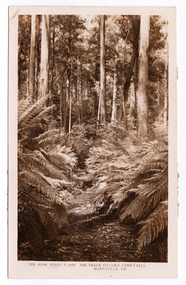
... Cambarville was impacted by the 2009 Black Saturday bushfires and any remaining structures were destroyed. marysville victoria photograph cora lynn falls waterfalls p. 4958 rose series postcard rose stereograph company souvenir cambarville marysville-wood's point road eucalyptus regnans cumberland memorial scenic reserve mining big culvert yarra track a cameron fj barton 1939 bushfires 2009 black saturday bushfires timber mills THE ROSE SERIES P. 4958/ COPYRIGHT/ THE TRACK TO CORA LYNN FALLS, MARYSVILLE, VIC. The reverse of postcard is illegible as it is covered by paper residue from when postcard was removed from an album. ...A postcard in a series produced by the Rose Stereograph Company in Victoria, Australia as a souvenir of Marysville.A black and white photograph of the track leading through the forest to the Cora Lynn Falls which is in the Cumberland Valley in Victoria. These falls are located on the Marysville-Wood's Point Road. Cambarville is notable for its giant mountain ash (Eucalyptus regnans) trees within the Cumberland Memorial Scenic Reserve, and relics from former sawmills and gold mining. The Big Culvert is located nearby on the Marysville-Woods Point Road, which was historically part of the Yarra Track. Cambarville was established as a timber mill town in the 1940s. Timber mill owners A Cameron and FJ Barton named Cambarville. They established the mill to salvage timber from trees destroyed in the 1939 bushfires. Cambarville was impacted by the 2009 Black Saturday bushfires and any remaining structures were destroyed. THE ROSE SERIES P. 4958/ COPYRIGHT/ THE TRACK TO CORA LYNN FALLS, MARYSVILLE, VIC. The reverse of postcard is illegible as it is covered by paper residue from when postcard was removed from an album. marysville, victoria, photograph, cora lynn falls, waterfalls, p. 4958, rose series postcard, rose stereograph company, souvenir, cambarville, marysville-wood's point road, eucalyptus regnans, cumberland memorial scenic reserve, mining, big culvert, yarra track, a cameron, fj barton, 1939 bushfires, 2009 black saturday bushfires, timber mills -
 Federation University Historical Collection
Photograph Album, Ballarat College of Advanced Education Faculty of Science Photo Album, c1987
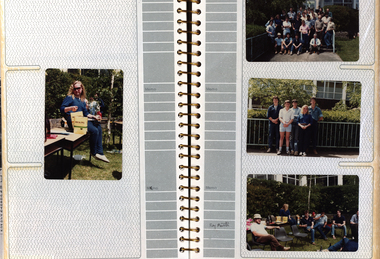
... ballarat college of advanced education t-shirt bbq ray martin brian sunter laboratory mineral industry laboratory mount helen bill vermeend frank hurley jim thyer barry shearer lyn robert frank martin colin kline alan ballard roger johnson david james ian mckee robert pyke bushnell judy dixon dennis else john murray peter dahlhaus kim dowling richard macewan aziz albazazz susanne hynes stafford mcknight bob smith paul bennett athol shelton peter richards geoff brooks computers snow snowman bruce cameron iron monarch mining lal lal iron mine ginny goff ausimm scholarship diane haddon david martin glenn kreelman sunter's, clarendon anne beggs sunter foundry stawell brian sunter's farewell jack harvey microscope metallurgy Maroon photograph album with photographs thought to be Ballarat College of Advanced Education Science students and staff. ...Maroon photograph album with photographs thought to be Ballarat College of Advanced Education Science students and staff. Includes a photograph of the Lal Lal Ironworks kiln in the early 1970s.ballarat college of advanced education t-shirt, bbq, ray martin, brian sunter, laboratory, mineral industry laboratory, mount helen, bill vermeend, frank hurley, jim thyer, barry shearer, lyn robert, frank martin, colin kline, alan ballard, roger johnson, david james, ian mckee, robert pyke, bushnell, judy dixon, dennis else, john murray, peter dahlhaus, kim dowling, richard macewan, aziz albazazz, susanne hynes, stafford mcknight, bob smith, paul bennett, athol shelton, peter richards, geoff brooks, computers, snow, snowman, bruce cameron, iron monarch, mining, lal lal iron mine, ginny goff, ausimm scholarship, diane haddon, david martin, glenn kreelman, sunter's, clarendon, anne beggs sunter, foundry, stawell, brian sunter's farewell, jack harvey, microscope, metallurgy -
 The Beechworth Burke Museum
Photograph, c. 1880
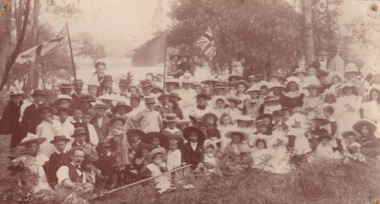
... mining purposes from the Hurdle Swamp, and to additionally serve as Beechworth's main water supply. It was named after George Briscoe Kerferd, a Beechworth businessman and councillor, who later became the tenth Premier of Victoria. entertainment album picnic lake kerferd beechworth burke museum kerferd Sepia rectangular photograph printed on matte photographic paper mounted on board Photograph Photograph ...Taken in the 1880s, depicted is a large group of children and adults dressed in formal clothing picnicking upon the bank of Lake Kerferd. The five members of the group are holding union jack flags that have been hoisted upon portable flag poles. The group is seated by the lakeside in a grassed area beneath eucalyptus trees.This image was taken in the 1880s at Lake Kerferd. Lake Kerferd was created in 1862 to retain water for gold mining purposes from the Hurdle Swamp, and to additionally serve as Beechworth's main water supply. It was named after George Briscoe Kerferd, a Beechworth businessman and councillor, who later became the tenth Premier of Victoria.Sepia rectangular photograph printed on matte photographic paper mounted on boardentertainment album, picnic, lake kerferd, beechworth, burke museum, kerferd -
 Bendigo Historical Society Inc.
Photograph - National Trust Collection: "Album of Sandhurst Views" sketches of Bendigo buildings forming a leporello (folding book), 09/06/2025
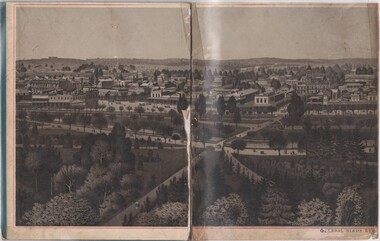
... Mining Exchange & Sandhurst Hospital 3084.101F Two sketches - Sandhurst Post office and Telegraph Offices, & Town Hall 3084.101G Four sketches - The Fernery in the City Reserve, The City Family Hotel, The New Chum Line of Reef, & Pioneer Battery at Long Gully. Also includes a newspaper cutting showing the redevelopment of the ANZ Bank site (Williamson Street & Pall Mall) which incorporates the wrought iron balustrade from the prior building on the site 3084.101H Messrs Schutze , Steffens & Company, 272 Little Collins Street Melbourne (the company produced the "Album of Sandhurst Views" book)...Mining Exchange & Sandhurst Hospital 3084.101F Two sketches - Sandhurst Post office and Telegraph Offices, & Town Hall 3084.101G Four sketches - The Fernery in the City Reserve, The City Family Hotel, The New Chum Line of Reef, & Pioneer Battery at Long Gully. Also includes a newspaper cutting showing the redevelopment of the ANZ Bank site (Williamson Street & Pall Mall) which incorporates the wrought iron balustrade from the prior building on the site 3084.101H Messrs Schutze , Steffens & Company, 272 Little Collins Street Melbourne (the company produced the "Album of Sandhurst Views" book) Photograph National Trust Collection: "Album of Sandhurst Views" sketches of Bendigo buildings forming a leporello (folding book) ...historic buildingNational Trust Collection: 12 pages with 24 sketches of buildings in Sandhurst (Bendigo), circa 1888. The book has been dismantled and the pages mounted on paper. The book was produced by Schutze, Steffens and Company, 272 Little Collins Street, Melbourne (refer 3084.101H). The book contains B&W high quality sketches of Sandhurst / Bendigo. 3084.101A & 3084.101B Cover of the book has been affixed to the paper no longer accessible. The two sketches, along with the two sketches on 3084.101B, provide a "general bird's eye view" of the development of Bendigo around 1888 across Rosiland Park 3084.101C Seven sketches - Sandhurst Savings Bank, Wesleyan Church, Congregational Church, S. Paul's Church, All Saints Church, Roman Catholic Bishop's Palace, & Roman Catholic St. Killian's Church 3084.101D Four sketches - Sandhurst Mechanic's Institute and School of Mines, Masonic Hall, Sandhurst Benevolent Asylum & Sandhurst State Scholl (Camp Hill PS) 3084.101E Three sketches - Alexandra Fountain and Pall Mall from Charing Cross, The Mining Exchange & Sandhurst Hospital 3084.101F Two sketches - Sandhurst Post office and Telegraph Offices, & Town Hall 3084.101G Four sketches - The Fernery in the City Reserve, The City Family Hotel, The New Chum Line of Reef, & Pioneer Battery at Long Gully. Also includes a newspaper cutting showing the redevelopment of the ANZ Bank site (Williamson Street & Pall Mall) which incorporates the wrought iron balustrade from the prior building on the site 3084.101H Messrs Schutze , Steffens & Company, 272 Little Collins Street Melbourne (the company produced the "Album of Sandhurst Views" book)views of significant buildings in sandhurst / bendigo circa 1888 -
 Bendigo Historical Society Inc.
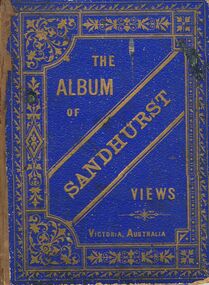
Book - MERLE HALL COLLECTION: THE ALBUM OF SANDHURST VIEWS
... in ''photographic'' detail of well-known Sandhurst Views - Town Hall, Mechanics Institute, Masonic Hall, Bendigo Hospital, Bendigo Benevolent Asylum, Post and Telegraph Offices, Mining Exchange, View from Post Office Tower looking East, View from Post Office Tower looking West, Central State School, Alexandra Fountain, Upper Lake, Rosalind Park, Fernery Rosalind Park, St Pauls Church, Bishop's Palace, General View - New Chum Line, Koch's ''Pioneer'' Crushing Works, Quartz Crushing batteries, Town Hall - Eaglehawk, Railway Station. Appended with two pages summarizing Sandhurst history; current councillors and officers, brief review of five places - Bendigo Hospital, Benevolent Asylum, Mechanics Institute and Free Library, School of Mines and Industries, Masonic Hall. Date is given as ''The present (1888) occupants are ....'' Book MERLE HALL COLLECTION: THE ALBUM ...A bound book of 16 drawings B&W (lithographs?) in ''photographic'' detail of well-known Sandhurst Views - Town Hall, Mechanics Institute, Masonic Hall, Bendigo Hospital, Bendigo Benevolent Asylum, Post and Telegraph Offices, Mining Exchange, View from Post Office Tower looking East, View from Post Office Tower looking West, Central State School, Alexandra Fountain, Upper Lake, Rosalind Park, Fernery Rosalind Park, St Pauls Church, Bishop's Palace, General View - New Chum Line, Koch's ''Pioneer'' Crushing Works, Quartz Crushing batteries, Town Hall - Eaglehawk, Railway Station. Appended with two pages summarizing Sandhurst history; current councillors and officers, brief review of five places - Bendigo Hospital, Benevolent Asylum, Mechanics Institute and Free Library, School of Mines and Industries, Masonic Hall. Date is given as ''The present (1888) occupants are ....''sandhurst, photographs, merle hall collection -
 Bendigo Historical Society Inc.
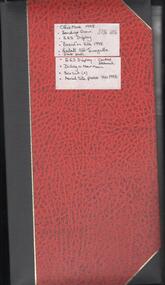
Photograph - Kangaroo Flat Gold Mine Collection: photo album 1998
... Display, 'Board' on site 1998, Residents visit Tarnagulla, shaft shots, E.E.S Display Central Deborah, Drilling at New Moon, Box Cut (2), Aerial site photos Nov. 1998' Album includes mine personnel photos of Doug Berger, Geoff McDermott, John Cahill, Colin Burns, Ken Belfrage, Dean Turnbull, Courtney Chamberlain, 'The Boys' - Frank, Woody, Pratty and Jason, and Jason Bourke. Mining...Kangaroo Flat Gold Mine Bendigo Mining NL New Bendigo Gold Project goldmining personnel Doug Buerger Colin Burns Tarnagulla New Moon displays box cut Unity Mining aerial photos Photo album, red cover with black binding. ...Photo album, red cover with black binding. Seventy colour photos, some with annotations. Label on front of album: 'Office Move 1998. Bendigo Show, E.E.S. Display, 'Board' on site 1998, Residents visit Tarnagulla, shaft shots, E.E.S Display Central Deborah, Drilling at New Moon, Box Cut (2), Aerial site photos Nov. 1998' Album includes mine personnel photos of Doug Berger, Geoff McDermott, John Cahill, Colin Burns, Ken Belfrage, Dean Turnbull, Courtney Chamberlain, 'The Boys' - Frank, Woody, Pratty and Jason, and Jason Bourke. Mining photos include: Carshalton site 24.7.98, drilling at New Moon and portal reef mining Tarnagulla 1998.kangaroo flat gold mine, bendigo mining nl, new bendigo gold project, goldmining, personnel, doug buerger, colin burns, tarnagulla, new moon, displays, box cut, unity mining, aerial photos -
 Bendigo Historical Society Inc.
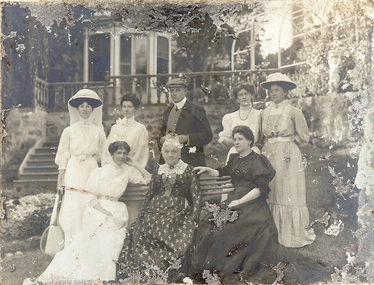
Album - FORTUNA COLLECTION: ALBUM - PHOTOGRAPHS OF FORTUNA, BENDIGO
... album...George Lansell...Gold mining...PLACE Fortuna photo album George Lansell Gold mining Ballerstedt Victoria Hill Historic building Album, covered in blue fabric. ...Fortuna Villa George Lansell purchased Ballerstadt's claim on Victoria Hill for £30,000. The purchase included a two-story villa. Lansell extended the building in the following years with the last major additions in 1904 - 1905. Architects included Vahland and Getzschmann, W.C. Vahland and William Beebe. Contractors include J.K. McLean and W.H.Johns.Album, covered in blue fabric. Printed in gold lettering on front 'Photographs of 'Fortuna' Bendigo". Album contains 48 black and white photos of George Lansell's home, Fortuna, taken in late 1800s, ranging from photos of the interior of the house, the garden and the lake.place, fortuna, photo album, george lansell, gold mining, ballerstedt, victoria hill, historic building -
 Bendigo Historical Society Inc.
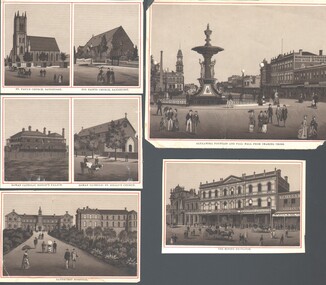
Photograph - WES HARRY COLLECTION: SANDHURST VIEWS, 1888
... Album of Sandhurst Views' 1888. (a) St. Paul's Church, Sandhurst, All saints Church, Sandhurst, (b) Roman Catholic Bishop's Palace, Roman Catholic St. Kilian's Church, (c) The Mining...Mining Exchange Bishops Palace St. Kilian's Church St. Paul's All Saints A collection of artists drawings cut from 'Album of Sandhurst Views' 1888. ...A collection of artists drawings cut from 'Album of Sandhurst Views' 1888. (a) St. Paul's Church, Sandhurst, All saints Church, Sandhurst, (b) Roman Catholic Bishop's Palace, Roman Catholic St. Kilian's Church, (c) The Mining Exchange, (d) Sandhurst Hospital, (e) Alexandra Fountain and Pall Mall from Charing Cross.buildings, vaious, alexandra fountain, charing cross, pall mall, hospital, mining exchange, bishops palace, st. kilian's church, st. paul's, all saints -
 Stawell Historical Society Inc
Photograph, Pioneer Walk -- 3 Photos
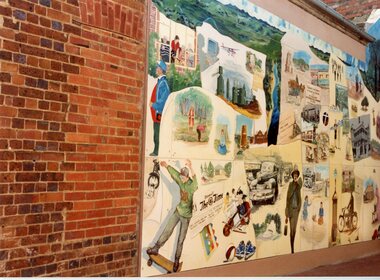
... mining in Stawell. stawell 151 Stawell History Mural, eft panel. Nov. 1992 151 Stawell Mural in Pioneer Walk Nov/92 151.1 Stawell Mural, center section Big Hill view. Nov.1992 Three colour photos of collages decorating a walkway. The scenes are of people, building and landscapes. Copies also found in Album ...Three colour photos of Pioneer Walk located between Main & Church Streets Stawell, photos taken in November 1992. One photo is of Big Hill and the other two of people and scenes and mining in Stawell.Three colour photos of collages decorating a walkway. The scenes are of people, building and landscapes. Copies also found in Album 4, p.49-50.151 Stawell History Mural, eft panel. Nov. 1992 151 Stawell Mural in Pioneer Walk Nov/92 151.1 Stawell Mural, center section Big Hill view. Nov.1992stawell -
 Tatura Irrigation & Wartime Camps Museum
Album - small photo album
... The artist of the sketches Hans - Wolter von Gruenewaldt - ex South African Mining Engineer served in the North Africa campaign. This album also includes photos of visitors to the Tatura Museum, Memorial service German War Cemetery 1992 and visitors to Camps 1, 2, 4 and 13 Photos include Murchison R.S.L clubhouse,which was Murchison P.O.W Camp,13 Recreation Hall, Colonel Walter Tinsley D.S.O who was appointed Commandant camp 13 1946, Folk Dancers from Hungary,Scotland, Yugoslavia, Russia, Spain, Holland, German waitress, African Mother and Child,, Asia, Australian swagman, Australian A.W.A.S, British Army W.O, British Naval Officer. ...The artist of the sketches Hans - Wolter von Gruenewaldt - ex South African Mining Engineer served in the North Africa campaign. This album also includes photos of visitors to the Tatura Museum, Memorial service German War Cemetery 1992 and visitors to Camps 1, 2, 4 and 13 Photos include Murchison R.S.L clubhouse,which was Murchison P.O.W Camp,13 Recreation Hall, Colonel Walter Tinsley D.S.O who was appointed Commandant camp 13 1946, Folk Dancers from Hungary,Scotland, Yugoslavia, Russia, Spain, Holland, German waitress, African Mother and Child,, Asia, Australian swagman, Australian A.W.A.S, British Army W.O, British Naval Officer. ...The artist of the sketches Hans - Wolter von Gruenewaldt - ex South African Mining Engineer served in the North Africa campaign. This album also includes photos of visitors to the Tatura Museum, Memorial service German War Cemetery 1992 and visitors to Camps 1, 2, 4 and 13 Photos include Murchison R.S.L clubhouse,which was Murchison P.O.W Camp,13 Recreation Hall, Colonel Walter Tinsley D.S.O who was appointed Commandant camp 13 1946, Folk Dancers from Hungary,Scotland, Yugoslavia, Russia, Spain, Holland, German waitress, African Mother and Child,, Asia, Australian swagman, Australian A.W.A.S, British Army W.O, British Naval Officer. Visitors to Memorial service German War Cemetery 1992 Photos show a collection of the art work painted on walls of Camp 13 Recreation hall Small, green coloured photo albumHans-Wolter von Gruenewaldt, German P.O.W. painted these scenes and figures as murals on the walls of the camp 13 Recreation Hall. The hall was transferred to Murchison after WW2 and was purchased by the Murchison R.S.L. as its headquarters in 1955. These paintings can now be seen at the David Jones Nursing Home in Murchison.murchison pow recreation hall, german war cemetery -
Tatura Irrigation & Wartime Camps Museum
Photographs, 2001
... Mining engineer) painted these scenes and figures as murals on the walls of the Camp 13 Recreational hall. After WW2 the hall was purchased by the Murchison R.S.L as its headquarters in 1955. These paintings can now be seen at the David Jones Nursing Home in Murchison. Small photo album ...Hans - Wolter von Gruenewaldt, German P.O.W (Ex South African - Mining engineer) painted these scenes and figures as murals on the walls of the Camp 13 Recreational hall. After WW2 the hall was purchased by the Murchison R.S.L as its headquarters in 1955. These paintings can now be seen at the David Jones Nursing Home in Murchison.Small photo album, with a collection of painted scenes and figures as murals on the walls of camp 13 Recreational hall. The album also includes photos of visitors to the Internment camps, Japanese Chan, Oki and Takamura families at the Tatura Historical Society, and visitors to the German War Cemetery during 1992/93. -
 Rutherglen Historical Society
Image, 1931
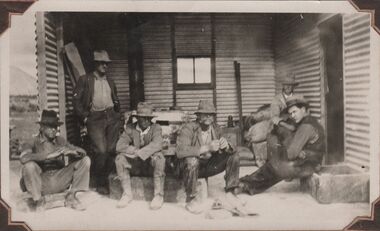
... Photographs showing the works at the Great Southern Mine, cyanide plant, which was an important part of the process of separating gold from the ore. great southern gold mining gold processing cyanide plant Written on album page between photos: "Great Southern Mine Cyanide Plant 1931" One of 4 small black and white photographs, mounted on a single album page. ...Photographs showing the works at the Great Southern Mine, cyanide plant, which was an important part of the process of separating gold from the ore.One of 4 small black and white photographs, mounted on a single album page. This one shows six men, taking a break from their work in a corrugated iron shed. Written on album page between photos: "Great Southern Mine Cyanide Plant 1931"great southern, gold mining, gold processing, cyanide plant -
 Rutherglen Historical Society
Image, 1931
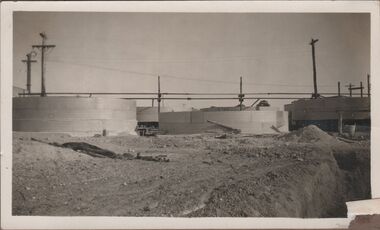
... Photographs showing the works of the Great Southern Mine, cyanide plant, which was an important part of the process of separating gold from the ore. great southern gold mining gold processing cyanide plant Written on album page between photos: "Great Southern Mine Cyanide Plant 1931" One of 4 small black and white photographs, mounted on a single album page. ...Photographs showing the works of the Great Southern Mine, cyanide plant, which was an important part of the process of separating gold from the ore.One of 4 small black and white photographs, mounted on a single album page. This one shows several large corrugated tanks.Written on album page between photos: "Great Southern Mine Cyanide Plant 1931"great southern, gold mining, gold processing, cyanide plant -
 Rutherglen Historical Society
Image, 1931
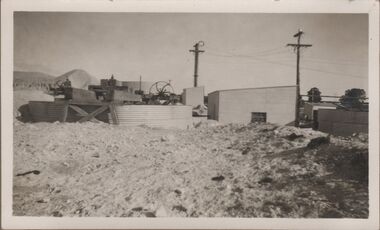
... Photographs showing the works at the Great Southern Mine, cyanide plant, which was an important part of the process of separating gold from the ore. great southern gold mining gold processing cyanide plant Written on album page between photos: "Great Southern Mine Cyanide Plant 1931" One of 4 small black and white photographs, mounted on a single album page. ...Photographs showing the works at the Great Southern Mine, cyanide plant, which was an important part of the process of separating gold from the ore.One of 4 small black and white photographs, mounted on a single album page. This one shows buildings, tanks and equipment of the plant.Written on album page between photos: "Great Southern Mine Cyanide Plant 1931"great southern, gold mining, gold processing, cyanide plant -
 Rutherglen Historical Society
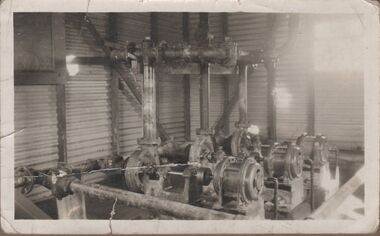
Image, 1931
... Photographs showing the works at the Great Southern Mine, cyanide plant, which was an important part of the process of separating gold from the ore. great southern gold mining gold processing cyanide plant Written on album page between photos: "Great Southern Mine Cyanide Plant 1931" One of 4 small black and white photographs, mounted on a single album page. ...Photographs showing the works at the Great Southern Mine, cyanide plant, which was an important part of the process of separating gold from the ore.One of 4 small black and white photographs, mounted on a single album page. This one shows three pumps in a corrugated iron building.Written on album page between photos: "Great Southern Mine Cyanide Plant 1931"great southern, gold mining, gold processing, cyanide plant -
 Rutherglen Historical Society
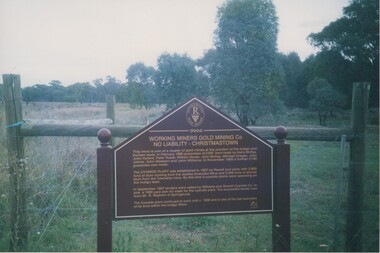
Image, 2004
... storyboards working miners gold mining co gold mining cyanide plant Colour photograph of a story board marking former site of a gold processing cyanide plant at Christmastown. Photo is mounted on an album ...Colour photograph of a story board marking former site of a gold processing cyanide plant at Christmastown. Photo is mounted on an album page.storyboards, working miners gold mining co, gold mining, cyanide plant -
 Rutherglen Historical Society
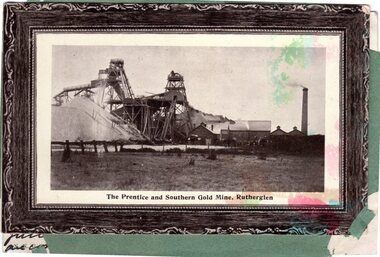
Image, 1920s to 1930s
... Colour image is of a painting identified as The Angelus by Jean-Francois Millet. prentice and southern gold mine angelus gold mining millet painting At bottom of black and white photograph: "The Prentice and Southern Gold Mine, Rutherglen" Two postcards pasted onto either side of a piece of green cardboard, probably cut from an album. ...Black and white photograph is of the Prentice and Southern Mine. Colour image is of a painting identified as The Angelus by Jean-Francois Millet.Two postcards pasted onto either side of a piece of green cardboard, probably cut from an album. One photo is a black and white photograph. One is a colour reproduction of a painting.At bottom of black and white photograph: "The Prentice and Southern Gold Mine, Rutherglen"prentice and southern gold mine, angelus, gold mining, millet, painting -
 Old Colonists' Association of Ballarat Inc.
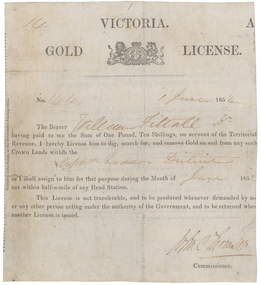
Document - Gold License, Gold License Issued to William Fittall in the Upper Loddon District, 1851, 10/1851
... album of photographic images of early Ballarat. Recognising their significance the Council of the Old Colonists’ Association had them removed and restored. The originals are now framed and on display in the Old Colonists’ Hall. william fittall upper loddon mining old colonists' association fittall eureka 14 Victoria Gold License No 144 1 June 1852 The Bearer William Fittall Jr having paid to me the sum of One Pound, Ten Shillings, on account of the territorial revenue, I hereby License him to dig, search for, and removed Gold on and from any such Crown lands within the Upper Loddon District as I shall assign to him for that purpose during the Month of June 1852 not within half-a-mile of any Head Station. ...This miner's right is a copy from an original held by the Old Colonists' Association of Ballarat. The original was glued onto a page in a large album of photographic images of early Ballarat. Recognising their significance the Council of the Old Colonists’ Association had them removed and restored. The originals are now framed and on display in the Old Colonists’ Hall.Digital image of an original gold license made out to William Fittall Junior.14 Victoria Gold License No 144 1 June 1852 The Bearer William Fittall Jr having paid to me the sum of One Pound, Ten Shillings, on account of the territorial revenue, I hereby License him to dig, search for, and removed Gold on and from any such Crown lands within the Upper Loddon District as I shall assign to him for that purpose during the Month of June 1852 not within half-a-mile of any Head Station. This License is not transferrable, and to be produce whenever demanded by me or any other person acting under the authority of the government, and to be returned when another License is issued. [Undecipherable signature] Commissionerwilliam fittall, upper loddon, mining, old colonists' association, fittall, eureka -
 Old Colonists' Association of Ballarat Inc.
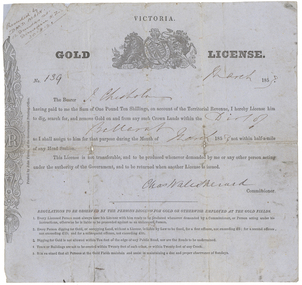
Document - Gold License, Gold License issued to John Chisholm
... album of photographic images of early Ballarat. Recognising their significance the Council of the Old Colonists’ Association of Ballarat Inc. had them removed and restored. The originals are now framed and on display in the Old Colonists’ Hall. chisholm sherard charles sherard john chisholm mining main d.m.d. main Ballarat Victoria Gold License No. 139 March 1853 The Bearer J. ...This miner's right was glued onto a page in a large album of photographic images of early Ballarat. Recognising their significance the Council of the Old Colonists’ Association of Ballarat Inc. had them removed and restored. The originals are now framed and on display in the Old Colonists’ Hall.Victorian Gold License made out to John Chisholm.Ballarat Victoria Gold License No. 139 March 1853 The Bearer J. Chisholm having paid to me the Sum of One Pound Ten Shillings, on account of the territorial revenue, I hereby License him to dig, search for, and remove Gold on and from any such Crown lands within the Dist of Ballarat as I shall assign to him for that purpose during the month of march 1853 not within half-a-mile of any Head Station, This License is not transferable, and to be produced whenever demanded by me or any other person acting under the authority of the Government, and to be returned when another License is issued. Chas Wale Sherard Commissioner. Regulations to be observed by the persons digging for Gold or otherwise employed at the Gold fields. 1. Every licensed person must always have his License with him ready to be produced whenever demanded by a Commissioner, or Person acting under instructions, otherwise he is liable to be proceeded against as an unlicensed person. 2. Every person digging to Gold, or occupying Land, without a License is liable by law to be fined, for a first offence, not exceeding five pounds; for a second offence not exceeding 15 pounds; and for subsequent offence, not exceeding 30 pounds. 3. Digging for Gold is not allowed within ten feet of the edge of any Public Road, nor are the roads to be undermined. 4. Tents or Buildings are not to be erected within twenty feet of each other, or within 20 feet of any Creek 5. It is enjoined that all persons on the Gold Fields maintain a due and proper observance of Sundays. Handwritten in top left corner 'Presented by D.M.D. Main. 12 Dundas St. Dunedin N.Z. 30.8.21chisholm, sherard, charles sherard, john chisholm, mining, main, d.m.d. main -
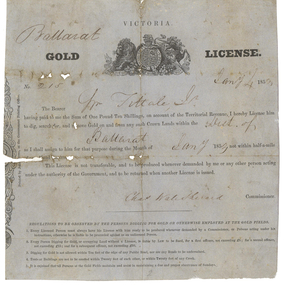 Old Colonists' Association of Ballarat Inc.
Document - Gold License, William Fittall, 04/01/1853
... album of photographic images of early Ballarat. Recognising their significance the Council of the Old Colonists’ Association of Ballarat Inc had them removed and restored. The originals are now framed and on display in the Old Colonists’ Hall. gold license william fittall junior sherard charles sherard charles wale sherard mining fittall eureka Gold License made out to William Fittall Junior. ...This miner's right was glued onto a page in a large album of photographic images of early Ballarat. Recognising their significance the Council of the Old Colonists’ Association of Ballarat Inc had them removed and restored. The originals are now framed and on display in the Old Colonists’ Hall.Gold License made out to William Fittall Junior.gold license, william fittall junior, sherard, charles sherard, charles wale sherard, mining, fittall, eureka -
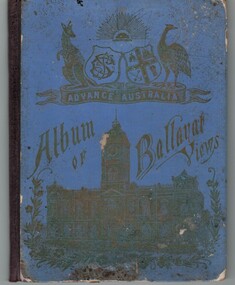 Unions Ballarat
Advance Australia Album of Ballarat Views, circa 1891
... Ballarat buildings Photographs Pictorial history BTLC ballarat regional trades and labour council Ballarat Trades Hall Post Office, Ballarat City Hall, Ballarat East Ballarat Hospital Ballarat Benovolent Asylum Ballarat State School Mining Exchange, Ballarat Wesleyan Church, Ballarat Presbyterian Church, Ballarat Roman Catholic Church, Ballarat Congregational Church, Ballarat New Anglican Cathedral, Ballarat Moorabool Falls Botanical Gardens, Ballarat Architecture, Ballarat Front cover: title. [12] folded leaves of plates; all illustrations (Leporello folding panorama); 14 cm. Front cover: gold gilt on blue background with brown cloth spine; images of kangaroo and emu with shields and rising sun; image of Ballarat Town Hall. Inscribed: "A souvenir of Ballarat to dear Mother, Helen and George September 1891" Advance Australia Album ...Small panoramic picture book with early views of Ballarat. Part of a series including Sydney, Launceston, Lorne and Melbourne views.Significant to the history of Ballarat - particularly streetscapes and architecture.[12] folded leaves of plates; all illustrations (Leporello folding panorama); 14 cm. Front cover: gold gilt on blue background with brown cloth spine; images of kangaroo and emu with shields and rising sun; image of Ballarat Town Hall. Inscribed: "A souvenir of Ballarat to dear Mother, Helen and George September 1891" Front cover: title. ballarat buildings, photographs, pictorial history, btlc, ballarat regional trades and labour council, ballarat trades hall, post office, ballarat, city hall, ballarat east, ballarat hospital, ballarat benovolent asylum, ballarat state school, mining exchange, ballarat, wesleyan church, ballarat, presbyterian church, ballarat, roman catholic church, ballarat, congregational church, ballarat, new anglican cathedral, ballarat, moorabool falls, botanical gardens, ballarat, architecture, ballarat -
 Tarnagulla History Archive
An album of 41 photographs by WMC personnel of Poverty Reef mining, 1980s-1990s
... An album of 41 photographs by WMC personnel of Poverty Reef mining, 1980s-1990s....An album of 41 photographs by WMC personnel of Poverty Reef mining, 1980s-1990s. ... -
 Linton and District Historical Society Inc
Photograph, Mr and Mrs Wearne and family
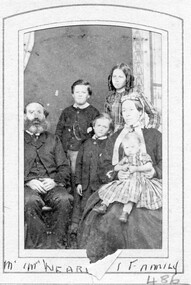
... mining interests. He married Ann McGie in 1865, after his first wife Selina Harris (married 1858) died in 1860. John and Ann Wearne had ten children, all born at Linton. Photograph is part of S E Surman collection (album...mining interests. He married Ann McGie in 1865, after his first wife Selina Harris (married 1858) died in 1860. John and Ann Wearne had ten children, all born at Linton. Photograph is part of S E Surman collection (album ...John Wearne migrated to Victoria from Cornwall in 1853. He was living in the Lintons/Smythesdale district by 1858, where he had mining interests. He married Ann McGie in 1865, after his first wife Selina Harris (married 1858) died in 1860. John and Ann Wearne had ten children, all born at Linton. Photograph is part of S E Surman collection (album) page 10 top right.Sepia photograph of a bearded gentleman wearing suit, seated with hands together on lap, two children standing behind, one child standing between he and a woman wearing long sleeved long outfit and hat, seated holding a young child wearing dress and shoes on her lap."Mr and Mrs Wearne and family". wearne family, surman collection, john wearne, ann wearne nee mcgie -
 Rutherglen Historical Society
Photograph - Image, 1914 (Exact)
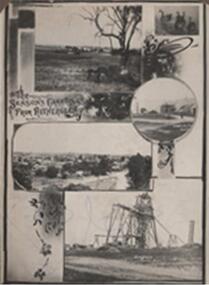
... mt ophir garibaldi mine great southern winemaking mining gold mining mount ophir "The Season's Greetings From Rutherglen" Black & white photograph, unframed but pasted to cardboard album page. ...Black & white photograph, unframed but pasted to cardboard album page. A greetings postcard showing small scenes of the township, Mt Ophir vineyards, Garabaldi Mine, Swans and Great Southern Mine"The Season's Greetings From Rutherglen"mt ophir, garibaldi mine, great southern, winemaking, mining, gold mining, mount ophir -
 City of Greater Bendigo - Civic Collection
Album - Photograph, George Lansell, Photographs of FORTUNA Bendigo, c. 1890's
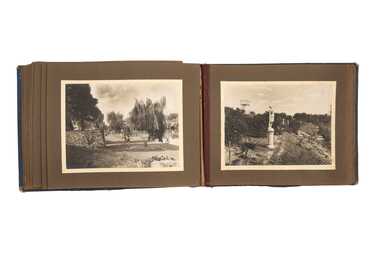
... Historically ‘Fortuna’ is significant for the record it provides from 1855 to 1871 of Christopher and Theodore Ballerstedt, Australia’s first mining magnates and from 1871 to 1935 of the Lansell family, George Lansell (The Quartz King) being one of Australia’s most successful and adventurous nineteenth century gold mine owners and speculators. The photo album...Historically ‘Fortuna’ is significant for the record it provides from 1855 to 1871 of Christopher and Theodore Ballerstedt, Australia’s first mining magnates and from 1871 to 1935 of the Lansell family, George Lansell (The Quartz King) being one of Australia’s most successful and adventurous nineteenth century gold mine owners and speculators. The photo album ...Fortuna Villa is associated with the 180 Mine on the New Chum Reef. Historically ‘Fortuna’ is significant for the record it provides from 1855 to 1871 of Christopher and Theodore Ballerstedt, Australia’s first mining magnates and from 1871 to 1935 of the Lansell family, George Lansell (The Quartz King) being one of Australia’s most successful and adventurous nineteenth century gold mine owners and speculators. The photo album depict the ornamental lake, garden, Roman bath and Pompeii fountain, all features of the house. Bound blue cloth family photo album. Nineteen brown card 'pages' each with photograph adhered to both sides. Total of thirty eight black and white photographs depicting interior and exterior of Fortuna as well as the Lansell family, friends and pets. Photographs attributed to W. Ninnis. Photographs of FORTUNA Bendigofortuna villa, w. ninnis, george lansell, edith lansell -
 The Beechworth Burke Museum
Photograph, Unknown
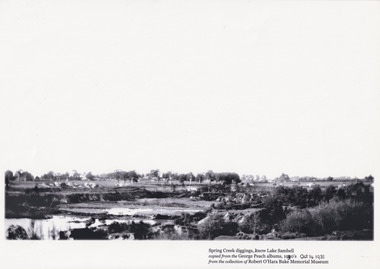
... The photograph is significant as it contributes to knowledge about how Beechworth reinvented itself after the Gold rush period, and more broadly how country towns repurpose and redevelop infrastructure and facilities to meet the present needs of their population Lake Sambell Beechworth Rocky Mountain Mining Co LH Sambell Obverse: Spring Creek diggings, (k)now Lake Sambell / Copied from the George Peach Albums, 19(2)30’s Oct 14 1931 / From the collection of Robert O’Hara Burke Memorial Museum / Black and white rectangular photograph printed on matte photographic paper Photograph Photograph ...The photograph shows Lake Sambell under construction. The present day park and reserve occupies the site of the former Rocky Mountain Mining Company, an open-cut sluice mine that began operations in the mid-Nineteenth Century and operated until the early 1900s, through the peak of Victoria’s Gold Rush. It was converted into a park and leisure area in the 1920s. Lake Sambell was formally opened to the public on Friday 5th October 1928 and was opened by the Victorian Government’s Minister of Lands, Mr Bailey, as part of initiatives to boost the economies and development of country towns. The lake was named after Mr L.H. Sambell, a shire engineer and secretary of the Forward Beechworth Committee who was involved in promoting the transformation of the mining site and promoting plantation forestry and tourism as alternative industries. £300 to begin the process was provided by Mr J. McConvill, a former resident of Beechworth, who is remembered in a street name adjacent to the lake. An article in the Ovens and Murray Advertiser on Saturday, 5th May, 1917, gives some insight into issues in the Rocky Mountain Mining Company’s final years. The writer details the 1917 annual meeting of the Rocky Mountain Mining Company, stating that locals present appeared ‘well pleased this important local industry is in such a prosperous condition and that future prospects are so encouraging’. The author describes plans to give workers a bonus as evidence of profit-sharing that would ‘bridge the gulf between capital and labour’. The article concludes, however, with the statement that ‘there is a little arithmetical puzzle in the report in connection with the dredging operations I have been unable to solve.'The photograph is significant as it contributes to knowledge about how Beechworth reinvented itself after the Gold rush period, and more broadly how country towns repurpose and redevelop infrastructure and facilities to meet the present needs of their populationBlack and white rectangular photograph printed on matte photographic paperObverse: Spring Creek diggings, (k)now Lake Sambell / Copied from the George Peach Albums, 19(2)30’s Oct 14 1931 / From the collection of Robert O’Hara Burke Memorial Museum /lake sambell, beechworth, rocky mountain mining co, lh sambell
