
Showing 19 items matching "mining revival"
-
 Bendigo Historical Society Inc.
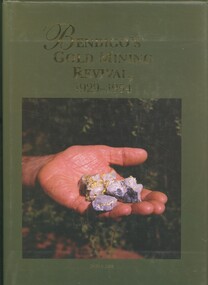
Book - BENDIGO'S GOLD MINING REVIVAL, 1929 - 1954, 1997
... BENDIGO'S GOLD MINING REVIVAL, 1929 - 1954...Book - Bendigo's Gold Mining Revival, 1929 - 1954....Lerk Book - Bendigo's Gold Mining Revival, 1929 - 1954. Book BENDIGO'S GOLD MINING REVIVAL, 1929 - 1954 ...Book - Bendigo's Gold Mining Revival, 1929 - 1954.James A. Lerkbendigo, mining, early history. -
 Bendigo Historical Society Inc.
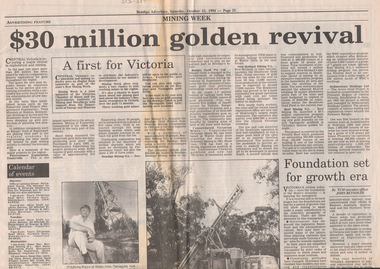
Newspaper - Kangaroo Flat Gold Mine Collection: Central Victoria Gold Revival
... ...mining revival...Smaller articles on page discuss the 'major revival in exploration and mining' in Central Victoria. Mining and exploration companies mentioned in the main article: Perseverance Exploration Fosterville, Bendigo Mining N.L., Ranger Gold Pty Ltd, Consolidated Victoria Mines, New Holland Mining NL, Reef Mining NL and Sedimentary Holdings Ltd. ...Fosterville Gold Mine Mining Week mining revival Bendigo Mining N.L. Ranger Gold Pty Ltd Consolidated Victoria Mines New Holland Mining NL Reef Mining NL and Sedimentary Holdings Ltd. ...One page article, 'Bendigo Advertiser, October 15th., 1994, titled '$30 million golden revival'. Smaller articles on page discuss the 'major revival in exploration and mining' in Central Victoria. Mining and exploration companies mentioned in the main article: Perseverance Exploration Fosterville, Bendigo Mining N.L., Ranger Gold Pty Ltd, Consolidated Victoria Mines, New Holland Mining NL, Reef Mining NL and Sedimentary Holdings Ltd. Mining Week is celebrated at this time by 'giving residents a rare chance to visit working mines in the region.' Black and white photos on the page show: 1. Dick Sandner sitting in front of the head frame of the Prince of Wales Mine at Tarnagulla. 2. A gold pour at Perseverance Fosterville Gold Mine, man dressed in heat proof suit 3. A drill rig with two men alongside rig gold mining, bendigo, perserverance exploration pty ltd., fosterville gold mine, mining week, mining revival, bendigo mining n.l., ranger gold pty ltd, consolidated victoria mines, new holland mining nl, reef mining nl and sedimentary holdings ltd., dick sandner -
 Bendigo Historical Society Inc.
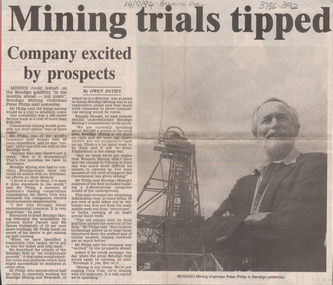
Newspaper - Kangaroo Flat Gold Mine Collection: Bendigo Mining
... ...mining revival...Gold mining Bendigo 1994 Peter Phillips Bendigo Mining Kerry Packer Sir James Goldsmith mining revival 'Bendigo Advertiser' article, 14th. ...'Bendigo Advertiser' article, 14th. September, 1994, titled 'Mining trials tipped'. Peter Phillips, Bendigo Mining chairman, states that mining 'could restart on the Bendigo goldfield in the months ahead - not years'. Mr. Phillips was recruited to head Bendigo Mining following the acquisition by tycoons Kerry Packer and Sir James Goldsmith of 10 per cent share holdings'.gold mining, bendigo, 1994, peter phillips, bendigo mining, kerry packer, sir james goldsmith, mining revival -
 Bendigo Historical Society Inc.
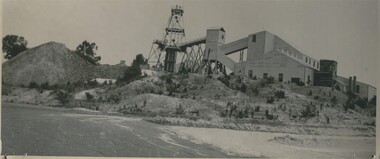
Photograph - CENTRAL NELL GWYNNE MINE
... This was one of three gold mines marked for assistance to commence the mining revival. This steel poppet head previously stood over the Lightning Hill Mine and firstly over the Virginia Mine. ...This was one of three gold mines marked for assistance to commence the mining revival. This steel poppet head previously stood over the Lightning Hill Mine and firstly over the Virginia Mine. ...Black and white photograph of Central Nell Gwynne Mine on boundary of Ironbark. This was one of three gold mines marked for assistance to commence the mining revival. This steel poppet head previously stood over the Lightning Hill Mine and firstly over the Virginia Mine. Bendigonians can access the site from Coath Street. Inscriptions: On back - 'MNG 53', 'Nell Gwynne' in lead pencil, 'Central Nell Gwynne' in black ink', 'Royal Historical society of Victoria, Bendigo Branch' circular blue stamp. History of object: previous Acc. No. MNG 53central nell gwynne gold mine, gold mining -
 Bendigo Historical Society Inc.
Plan - North Deborah Mine, 28.4.40 and 10.2.42
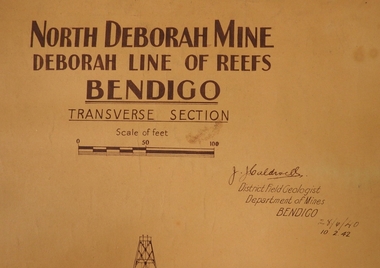
... :The company occupying this site was the leading gold producer of the Deborah line of reef during the 1930's mining revival period. The site is reserved for mining, contains the only brick mine chimney still standing. ...:The company occupying this site was the leading gold producer of the Deborah line of reef during the 1930's mining revival period. The site is reserved for mining, contains the only brick mine chimney still standing. ...North Deborah Gold Mine was located near Eve Street and Breen Street, Golden Square. :The company occupying this site was the leading gold producer of the Deborah line of reef during the 1930's mining revival period. The site is reserved for mining, contains the only brick mine chimney still standing. It is readily accessible, is visible from the Deborah site, Chum Hill and various other places around central Bendigo, and has views both to Chum Hill and the Deborah site.Light tan heavy paper plan. Written on top in bold black text: ' North Deborah Mine, Deborah Line of Reef, Bendigo, Transverse Section' Signed by J.J. Caldwell. Printed under name: 'District Field Geologist, Department of Mines, Bendigo' 28.4.40 and 10.2.42, printed under title. Plan shows poppet head, shaft and levels. Plan forms part of the Margaret Roberts Collection.gold mining, gold, bendigo, north deborah gold mine, eve street, breen street, golden square, transverse section -
 Bendigo Historical Society Inc.
Photograph - MINERS AT WORK: BENDIGO
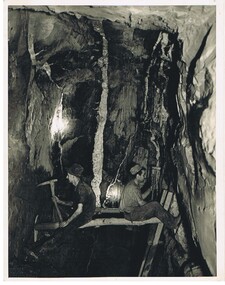
... On back in black pen ' miners shaping shaft prior to ' boxing in' with red gum slabs - note white quartz reef on wall face ' On small paper inclusion ' Miners placing staging for stoping on spurs' Mining Revival C 1930's.. James Lerk 26 Nov. 1999 - not as described in ink on rear '...On back in black pen ' miners shaping shaft prior to ' boxing in' with red gum slabs - note white quartz reef on wall face ' On small paper inclusion ' Miners placing staging for stoping on spurs' Mining Revival C 1930's.. James Lerk 26 Nov. 1999 - not as described in ink on rear ' Photograph MINERS AT WORK: BENDIGO ...black and white photograph of two workmen seated on bush timber fitted between vertical rock faces. The ladder is probably from the level immediately below. The lamps are ' Bendigo bucket carbide lamps ' Some advisers consider consider that this photograph is posed as workers are not safely placed. In grey lead ' miners at work ' down below' in Bendigo ' a signature ' J.J. Stanistreet ' a caption ' Hercules Mine ' ? On back in black pen ' miners shaping shaft prior to ' boxing in' with red gum slabs - note white quartz reef on wall face ' On small paper inclusion ' Miners placing staging for stoping on spurs' Mining Revival C 1930's.. James Lerk 26 Nov. 1999 - not as described in ink on rear 'person, group, mining -
 Bendigo Historical Society Inc.
Newspaper - NEWSPAPER COLLECTION: BENDIGO ADVERTISER VARIOUS ARTICLES
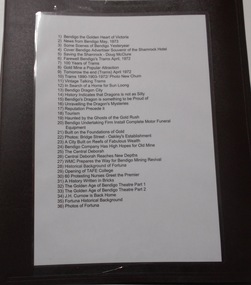
... 1) Bendigo the Golden Heart of Victoria 2) News from Bendigo May, 1973 3) Some Scenes of Bendigo Yesteryear 4) Cover Bendigo Advertiser Souvenir of the Shamrock Hotel 5) Saving the Shamrock - Doug McClure 6) Farewell Bendigo's Trams April, 1972 7) 100 Years of Trams 8) Gold Mine a Popular Attraction 9) Tomorrow the end (Trams) April 1972 10) Trams 1890-1903-1972/ Photo New Chum 11) Vintage Talking Trams 12) In Search of a Home for Sun Loong 13) Bendigo Dragon City 14) History Indicates that Dragons is not as Silly 15) Bendigo's Dragon is Something to be Proud of 16) Unravelling the Dragon's Mysteries 17) Reputation Precede it 18) Tourism 19) Haunted by the Ghosts of the Gold Rush 20) Bendigo Undertaking Firm Installs Complete Motor Funeral Equipment 21) Built on the Foundations of Gold 22) Photos: Bridge Street - Oakley's Establishment 23) A City Built on reefs of Fabulous Wealth 24) Bendigo Company Has High Hopes for Old Mine 25) The Central Deborah 26) Central Deborah Reaches New Depths 27) WMC Prepares the Way for Bendigo Mining Revival 28) Historical Background of Fortuna 29) Opening of TAFE College 30) 60 Protesting Nurses Greet the Premier 31) A History Written in Bricks 32) The Golden Age of Bendigo Theatre Part 1 33) The Golden Age of Bendigo Theatre Part 2 34) J.H. ...Bendigo goldfields tourism history 1) Bendigo the Golden Heart of Victoria 2) News from Bendigo May, 1973 3) Some Scenes of Bendigo Yesteryear 4) Cover Bendigo Advertiser Souvenir of the Shamrock Hotel 5) Saving the Shamrock - Doug McClure 6) Farewell Bendigo's Trams April, 1972 7) 100 Years of Trams 8) Gold Mine a Popular Attraction 9) Tomorrow the end (Trams) April 1972 10) Trams 1890-1903-1972/ Photo New Chum 11) Vintage Talking Trams 12) In Search of a Home for Sun Loong 13) Bendigo Dragon City 14) History Indicates that Dragons is not as Silly 15) Bendigo's Dragon is Something to be Proud of 16) Unravelling the Dragon's Mysteries 17) Reputation Precede it 18) Tourism 19) Haunted by the Ghosts of the Gold Rush 20) Bendigo Undertaking Firm Installs Complete Motor Funeral Equipment 21) Built on the Foundations of Gold 22) Photos: Bridge Street - Oakley's Establishment 23) A City Built on reefs of Fabulous Wealth 24) Bendigo Company Has High Hopes for Old Mine 25) The Central Deborah 26) Central Deborah Reaches New Depths 27) WMC Prepares the Way for Bendigo Mining Revival 28) Historical Background of Fortuna 29) Opening of TAFE College 30) 60 Protesting Nurses Greet the Premier 31) A History Written in Bricks 32) The Golden Age of Bendigo Theatre Part 1 33) The Golden Age of Bendigo Theatre Part 2 34) J.H. ...1) Bendigo the Golden Heart of Victoria 2) News from Bendigo May, 1973 3) Some Scenes of Bendigo Yesteryear 4) Cover Bendigo Advertiser Souvenir of the Shamrock Hotel 5) Saving the Shamrock - Doug McClure 6) Farewell Bendigo's Trams April, 1972 7) 100 Years of Trams 8) Gold Mine a Popular Attraction 9) Tomorrow the end (Trams) April 1972 10) Trams 1890-1903-1972/ Photo New Chum 11) Vintage Talking Trams 12) In Search of a Home for Sun Loong 13) Bendigo Dragon City 14) History Indicates that Dragons is not as Silly 15) Bendigo's Dragon is Something to be Proud of 16) Unravelling the Dragon's Mysteries 17) Reputation Precede it 18) Tourism 19) Haunted by the Ghosts of the Gold Rush 20) Bendigo Undertaking Firm Installs Complete Motor Funeral Equipment 21) Built on the Foundations of Gold 22) Photos: Bridge Street - Oakley's Establishment 23) A City Built on reefs of Fabulous Wealth 24) Bendigo Company Has High Hopes for Old Mine 25) The Central Deborah 26) Central Deborah Reaches New Depths 27) WMC Prepares the Way for Bendigo Mining Revival 28) Historical Background of Fortuna 29) Opening of TAFE College 30) 60 Protesting Nurses Greet the Premier 31) A History Written in Bricks 32) The Golden Age of Bendigo Theatre Part 1 33) The Golden Age of Bendigo Theatre Part 2 34) J.H. Curnow is Back Home 35) Fortuna Historical Background 36) Photos of Fortuna. Folder 110 now in Box 417. AV 03/11/2022bendigo, goldfields, tourism, history -
 Bendigo Military Museum
photograph - Fortuna - 1st Year of Army Occupation in Bendigo, 1942
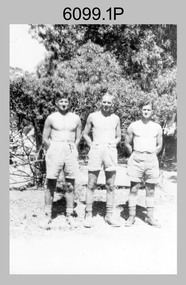
... The Central Nell Gwynne was the premier mine of Bendigo's 1930s mining revival and is of high historical value, due to the extensive and relatively intact features which remain at the site. ...The Central Nell Gwynne was the premier mine of Bendigo's 1930s mining revival and is of high historical value, due to the extensive and relatively intact features which remain at the site. ...This is a set of 17 photographs taken during the first year of Army occupation at Fortuna, Bendigo in 1942. The photos provide an insight into the preparatory work performed on the Fortuna Villa and surrounding buildings, by the Working Party 5th Army Troop and Ordnance Training Depot, before its occupation by personnel from LHQ Cartographic Company, Royal Australian Survey Corps. The annotation on the back of Photos .9P and .10P is misspelt. The correct spelling is ‘Nell Gwynne’. The poppet head of the Central Nell Gwynne mine is still an iconic landmark in Bendigo, lying just down the road from the poppet head lookout at Victoria Hill. The Central Nell Gwynne was the premier mine of Bendigo's 1930s mining revival and is of high historical value, due to the extensive and relatively intact features which remain at the site. The annotation on the back of Photo .17P is incorrect. The location of HQ 5th Army Troop was ‘Reynard St, Coburg.’ By late 1941 as Japan extended its control throughout Indo-China, resolving the accommodation problem of AHQ Cartographic Company located in Melbourne became more urgent. The steady Japanese advance made the bombing of Melbourne no longer a remote possibility, and in accordance with a general policy of dispersion, the Deputy Chief of the General Staff, Major General Sidney Rowell instructed Major William Sarll, in the interests of security of plant and to provide against possible damage of air attack, to investigate suitable safer inland accommodation for AHQ Cartographic Company. Major Sarll inspected many properties before finding one that would meet the requirements of the Cartographic Company. In late 1941, he came to inspect Fortuna, a rambling old mansion with about fifteen acres of ground in central Bendigo. Initially there was no intention to occupy the site beyond the end of the war, although Major Sarll's report to the Director of Survey noted many advantages in moving the Company to Bendigo. Major General Rowell quickly approved the selection of Fortuna before other authorities, which were investigating the evacuation of school children, could get in ahead of the Cartographic Company. On 23 March 1942, the Commonwealth of Australia, under the provisions of the National Security Act of 1939, took possession of the house, the old battery buildings and the fifteen acres of grounds. Under Warrant Officer J. Trist’s direction, over fifty Parks and Works tradesmen completed building works necessary to accommodate the Survey Corps’ military, map making and printing requirements. The building program was still under way when the first officer, Lieutenant Ralph Westgarth, arrived in May 1942 with the advance party which received and positioned all equipment as it came up from Melbourne in semi-trailers. Once the equipment was installed the rest of the Cartographic Company completed its shift to Bendigo by 11th June 1942. The first year of the Survey Corps’ occupation of Fortuna is covered in more detail with additional historic photographs, in pages 17-22 of Valerie Lovejoy’s book 'Mapmakers of Fortuna – A history of the Army Survey Regiment’ ISBN: 0-646-42120-4.This is a set of 17 photographs taken during the first year of Army Occupation at Fortuna, Bendigo in 1942. The black and white photographs were printed on photographic paper and are part of the Army Survey Regiment’s Collection. The photographs were scanned at 300 dpi. .1) - Photo, black & white, 1942. Bendigo Parks and Works tradesmen at Fortuna. L to R: Cliff Day, Ernie Arnold, Norm? .2) - Photo, black & white, 1942. “Don” - possibly SGT Don Sutcliffe. Fortuna, Bendigo. .3) - Photo, black & white, 1942. Parks and Works tradesmen in garden at Fortuna, Bendigo. L to R: Fred & Ernie. .4) - Photo, black & white, 1942. Benny Jack Williams at Fortuna, Bendigo. Accommodation tents were erected above the lake, which later became the parade ground. .5) - Photo, black & white, 1942. Working dress - Giggle suits. Parks and Works tradesmen at Fortuna, Bendigo. L to R: Cliff and Harry on big roof. .6) - Photo, black & white, 1942. Parks and Works tradesmen at Fortuna, Bendigo. Ted on big roof. .7) - Photo, black & white, 1942. Gold crusher battery just behind Fortuna. .8) - Photo, black & white, 1942. Scene of Bendigo from Fortuna. .9) - Photo, black & white, 1942. Nell Gwynne Mine from mullock heap at Victoria Hill near Fortuna, Bendigo. .10) - Photo, black & white, 1942. Nell Gwynne Mine and crusher near Fortuna, Bendigo. .11) - Photo, black & white, 1942. Sluicing for gold at Eaglehawk. .12) - Photo, black & white, 1942. Fortuna, Bendigo taken from the far side of tennis courts. .13) - Photo, black & white, 1942. Fortuna, Bendigo & its reflection from across the lake. .14) - Photo, black & white, 1942. Fortuna, Bendigo from the fishpond. .15) - Photo, black & white, 1942. Fortuna, Bendigo. .16) - Photo, black & white, 1942. First Fortuna Football Team at unknown location. L to R: 5th Bob Wright, 11th SGT Don Sutcliffe. .17) - Photo, black & white, 1942. Working Party from 5th Army Troop and Ordnance Training Depot at Fortuna, Bendigo.Some personnel are identified. Annotated with date within photos. .1) – Annotated on back ‘Cliff, Ernie, Norm, Dec ‘42. Cliff Day - dairy farmer, plasterers’ labourer. Ernie Arnold – hard plasterer. Norm? - QM Store for tools etc. QM Store was the Stables.’ .2) - Annotated on back ‘Don. Fortuna 1942’ .3) - Annotated on back ‘Fred & Ernie. Dec 1942. Carpenters. Note the state of the gardens.’ .4) - Annotated on back ‘Benny Jack Williams Fortuna Bendigo. Tents were erected where present day parade ground is above the lake.’ .5) - Annotated on back ‘Working dress - Giggle suits. June 42. Cliff and Harry on big roof. This photo was taken as the ventilating ridge was being installed on the building housing the printing machines. The machines were installed later by civilian labour when building was complete.’ .6) - Annotated on back ‘Ted on big roof Fortuna Bendigo.’ .7) - Annotated on back ‘Gold crusher battery – Bendigo for slay heap – 1942. 12 stamp battery. Just behind Fortuna. Was working at night when the “Army” came to Bendigo. Later removed to “Coolgardie - WA. Present site of Southern Cross TV.’ .8) - Annotated on back ‘Scene of Bendigo from Fortuna. June 1942.’ .9) - Annotated on back ‘Nell Gwyne Mine from mullock heap (Victoria Hill) Sept 1942.’ .10) - Annotated on back ‘Nell Gwyne Mine and crusher September 1942.’ .11) - Annotated on back ‘Sluicing for gold at Eaglehawk. August 1942.’ .12) - Annotated on back ‘Fortuna Bendigo 1942. Taken from far side of tennis courts.’ .13) - Annotated on back ‘ “Fortuna” across the lake & reflection.’ .14) - Annotated on back ‘Fortuna from fishpond June 1942.’ .15) - Annotated on back ‘Fortuna Dec 1942.’ .16) - Annotated on front ‘X’ x2. Annotated on back First Fortuna Football Team 1942‘Bob Wright’, ‘SGT Don Sutcliffe’. .17) - Annotated ‘Working Party at Fortuna before one of the drafts’, Working Party 5th Army Troop and Ordnance Training Depot Showgrounds, now the Sportsground Bendigo’, ‘HQ of 5th Army Troop was Reynards Rd, Coburg.’royal australian survey corps, rasvy, army survey regiment, army svy regt, fortuna, asr -
 Federation University Historical Collection
Photograph - Black and White, Former Ballarat Library, c1960
... mining boardroom was initially used. Land for additional building to house a Museum and Art Gallery sought and agreement reached in 1882-3. Compensation paid to owners and library granted the land. Plans for a new library building with tower and lantern roof abandoned due to lack of funds. It wasn't until 1895 that a solution to funding was found and the library was able to begin constructing the complex of buildings on the Free Library Reserve. A number of changes have occurred since 1910s - the Classical Revival...mining boardroom was initially used. Land for additional building to house a Museum and Art Gallery sought and agreement reached in 1882-3. Compensation paid to owners and library granted the land. Plans for a new library building with tower and lantern roof abandoned due to lack of funds. It wasn't until 1895 that a solution to funding was found and the library was able to begin constructing the complex of buildings on the Free Library Reserve. A number of changes have occurred since 1910s - the Classical Revival ...First known development on this site was the establishment of the Government Camp from the early 1850s. It was established to accommodate officials, troopers and police who were needed to administer the goldfields. Some permanent buildings were constructed. Lack of materials and bad weather prolonged the building of more permanent buildings and most men were still living in tents. Area was known as Camp Reserve. In 1864 a subdivision map shows the reserve be used for Public Buildings. Library applied for land on corner of Sturt and Camp Streets in 1878. 1880s plans show section of the reserve be used for a Free Library and Reading Room. Lease was granted and the old mining boardroom was initially used. Land for additional building to house a Museum and Art Gallery sought and agreement reached in 1882-3. Compensation paid to owners and library granted the land. Plans for a new library building with tower and lantern roof abandoned due to lack of funds. It wasn't until 1895 that a solution to funding was found and the library was able to begin constructing the complex of buildings on the Free Library Reserve. A number of changes have occurred since 1910s - the Classical Revival facade replaced with an angled facade in a stripped Classical style with Art Deco features and high parapet. Building is now part of Federation UniversityPhotograph of former library. Shows a two-storey rendered brick building in a Classical style. Some Art Deco features. Central pair of double windows with single window either side. High parapet above.government camp, goldfields, camp reserve, free library, reading room, sturt street, camp street, museum, art gallery, troopers, police, barracks, camp street -
 Eltham District Historical Society Inc
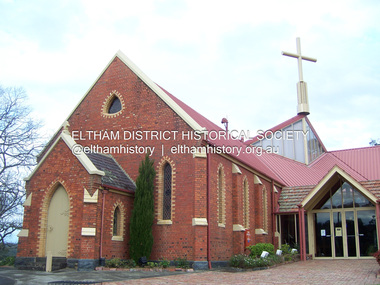
Photograph - Digital Photograph, Marguerite Marshall, St John's Anglican Church, Diamond Creek, 7 September 2008
... Revival style with the traditional rectangular plan of a central nave and sanctuary at the end. It is typical of small churches built in Victoria at that time, with polychromatic hand-made bricks, a porch, diagonal buttresses and a slate roof.3 The church was officially opened by Lord Bishop Perry on November 1, 1870. But during the next 40 years, due to the varying fortunes of gold mining...Revival style with the traditional rectangular plan of a central nave and sanctuary at the end. It is typical of small churches built in Victoria at that time, with polychromatic hand-made bricks, a porch, diagonal buttresses and a slate roof.3 The church was officially opened by Lord Bishop Perry on November 1, 1870. But during the next 40 years, due to the varying fortunes of gold mining ...The building was designed by Charles Maplestone of Heidelberg, son-in-law to Anthony Beale of St Helena. Maplestone was a prominent architect who came out to Australia with his family in 1852. The foundation stone was laid by Mrs Isabella Maplestone on 11th November 1867. The bricklayers for the church were George Stebbing, H Limmer, H Spicer and a Mr Timm while Thomas Day was the stonemason. Another three years were to pass before sufficient money could be raised for its completion. It was opened by Bishop Perry on 1st November, 1870. The church bell which hung under a tree for 50 years until it was incorporated in the parish hall was brought out from England and presented by Charles Orme. In 1916, the estate of George Martin Pizzey left sufficient money to build the red brick hall, which still stands today (2023) though in January 1969 the hall and bell tower were badly damaged by bushfire. Coincidentally the former home of benefactor, George Pizzey was destroyed in the same fire. Of particular significance are the interior and exterior of the church, the Sunday school and hall with emphasis on pre-World War I fabric (excluding the 1990s additions) and the three coloured glass windows currently suspended in the 1990s entry foyer. In 2011 further alterations were made to the front of the Church. The church is historically significant because it was the oldest public building in the former Diamond Valley Shire, is amongst the oldest buildings in the Shire of Nillumbik and is associated with the early settlement of the Diamond Creek district. The church is historically, socially and spiritually significant because it has been a place of worship for over 150 years and continues to be, an important meeting place in the Shire. The church is aesthetically significant for the three stained glass windows executed by the noted stained glass manufacturers, Ferguson & Urie, as well as the supporting coloured glass windows in the church. The Sunday school & parish hall is architecturally significant because the hall is a well executed and preserved example of the work of noted church architects, North & Williams. It is historically significant because it is connected with local parishioner and Melbourne industrialist, George Pizzey, who bequeathed funds for its construction. Covered under Heritage Overlay, Nillumbik Planning Scheme. National Estate Ntionl Trust of Australia (Victoria) Local significance Published: Nillumbik Now and Then / Marguerite Marshall 2008; photographs Alan King with Marguerite Marshall.; p85 St John’s Anglican Church stands like a beacon on the hill on Main Street, Diamond Creek. Today the church has a large congregation, but its early years were marked by a small congregation struggling to find enough money to survive. It was gold in Diamond Creek that resulted in the building of this National Trust registered property.1 This church is far removed from William Wilson’s humble barn (later the Bowling Green) where the first Anglican church services were conducted – probably the first in the district.2 In the mid 19th century services were infrequent as the Rev Francis Hales, travelling on horseback, also conducted services elsewhere, including at Heidelberg, Coburg, Kinglake, Arthurs Creek, St Andrews and Kangaroo Ground. In 1860 Diamond Creek came under the jurisdiction of the Eltham Parish. Until the mid 1860s the Diamond Creek settlement included only about 20 families who were struggling farmers. But this changed when gold was found in 1862. Then the township grew to 200 families, including miners, civil administration workers and shopkeepers. The resulting growth of Church of England adherents prompted them to petition the Government in 1866 for land to build a church. The area chosen, on which the original building still stands, was at the centre of the proposed township. Today church leaders believe that this conspicuous location is one of the reasons for its exceptional growth. Prominent architect Charles Maplestone designed the building as he did the Presbyterian Church at Kangaroo Ground. St John’s, which is still intact, was built in the Gothic Revival style with the traditional rectangular plan of a central nave and sanctuary at the end. It is typical of small churches built in Victoria at that time, with polychromatic hand-made bricks, a porch, diagonal buttresses and a slate roof.3 The church was officially opened by Lord Bishop Perry on November 1, 1870. But during the next 40 years, due to the varying fortunes of gold mining, the church struggled to remain viable. In 1909 it separated from the Eltham Parish to form a parish with Greensborough. Life became more difficult with the privations of World War One. Then disaster struck in 1915 when fire destroyed the Diamond Creek Gold Mine, wiping out the major livelihood of most parishioners. However the church’s morale was lifted in 1916, when it received a bequest to build the red brick hall, from late parishioner and prominent leather manufacturer, George Pizzey. As prosperity grew, in 1924 the congregation separated from Greensborough, but they rejoined in the 1930s Depression. In the 1950s the wider population soared, impacting on St John’s, and it became a separate parish, becoming responsible for six churches at St Andrews, Hazel Glen, Hurstbridge, St Helena and Yarrambat. As parishioner numbers outgrew the building, extensions were added in 1989 and then in 1993, blending in well with the original building. Church members have made a huge contribution to the local community. John Ryan was a Heidelberg Shire Councillor for 25 years from 1931, Mayor in 1939 and headed several local sporting and other organisations. His son Jock became a clergyman and a local historian heading the Nillumbik Historical Society. Another parishioner, Dr Ted Cordner, came to Diamond Creek in 1920. One of his sons Donald, who was a local doctor, won the Brownlow Medal, was President of the Melbourne Cricket Club and President of the Melbourne Grammar School Council. Roy ‘Monty’ Vale was a state Liberal MP and was related to May Vale, a member of the Heidelberg School of Artists.4 In the early 21st century St John’s Anglican Church is one of the fastest growing congregations in Melbourne. References: St Johns Anglican Church complex, Sunday School and Parish Hall 61 Main Street DIAMOND CREEK, NILLUMBIK SHIRE. (2023, June 7). Retrieved from https://vhd.heritagecouncil.vic.gov.au/places/64023 Diamond Creek, VIC. – St John’s Anglican (2023, June 7). Retrieved from https://www.churchhistories.net.au/church-catalog/diamond-creek-vic-st-johns-anglican This collection of almost 130 photos about places and people within the Shire of Nillumbik, an urban and rural municipality in Melbourne's north, contributes to an understanding of the history of the Shire. Published in 2008 immediately prior to the Black Saturday bushfires of February 7, 2009, it documents sites that were impacted, and in some cases destroyed by the fires. It includes photographs taken especially for the publication, creating a unique time capsule representing the Shire in the early 21st century. It remains the most recent comprehenesive publication devoted to the Shire's history connecting local residents to the past. nillumbik now and then (marshall-king) collection, st john's anglican church, diamond creek -
 Bendigo Historical Society Inc.
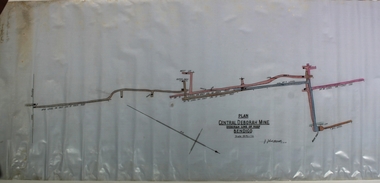
Plan - Central Deborah Gold Mine, J.J. Caldwell, 1945
... It was listed on the Victorian Heritage Register on 18 November 1999.[1] The mine was opened in 1939 by the Central Deborah Gold Mining Company during a 1930s revival of the gold industry, extending an existing 108 ft shaft from many years earlier with new machinery. ...It was listed on the Victorian Heritage Register on 18 November 1999.[1] The mine was opened in 1939 by the Central Deborah Gold Mining Company during a 1930s revival of the gold industry, extending an existing 108 ft shaft from many years earlier with new machinery. ...The Central Deborah Gold Mine is situated at 76 Violet Street, Bendigo. The mine operated from 1939 through to 1954 and extracted 929 kg of gold. The Central Deborah Gold Mine is a non-active gold mine and tourist attraction in Bendigo, Australia. It was listed on the Victorian Heritage Register on 18 November 1999.[1] The mine was opened in 1939 by the Central Deborah Gold Mining Company during a 1930s revival of the gold industry, extending an existing 108 ft shaft from many years earlier with new machinery. It was one of the last mines to open on the Bendigo goldfields and one of the few to stay open during World War II. It was expanded during 1945–46, with extensions and new machinery. It reached its maximum depth (now recorded as 412m) during the 1940s. It closed in November 1954, having produced 29,865 ounces of gold in its lifetime; the closure of the North Deborah Mine two weeks later marked the last mine in Bendigo to close Central Deborah Gold Mine is now a tourist destination, operated by Bendigo Heritage Attractions: https://www.central-deborah.com/about-us/central-deborah-gold-mine-s-history Blue waxed paper, features on plan drawn in pale pink and blue, title written in black text on centre bottom: 'Plan, Central Deborah Mine, Deborah Line of Reef, Bendigo, Scale 30 ft = 1 in.' Signature of J.J. Caldross, 13.10.45, written below name of mine. Handwritten on outside of plan in black pen: 'Mines Department, Cent. Deborah, Transverse section, Plan of levels' Plan notation shows No. 8 level on east leg of inner reef, level of east leg on outer reef, outer back, west leg, main shaft, numbers 5, 6, 7 and 10 levels. Mine map is part of the Margaret Roberts Collection. gold mining, gold, margaret roberts collection, central deborah gold mine, violet street, tourist attraction, bendigo -
 Bendigo Historical Society Inc.
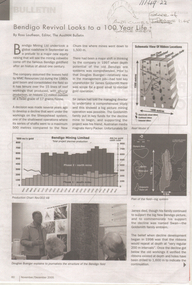
Document - Kangaroo Flat Gold Mine Collection: Bendigo Revival, Ross Louthean, Editor, AusIMM Bulletin, November/December 2005
... Title of document: ' Bendigo Revival Looks to a 100 Year Life' by Ross Louthean, Editor, AusIMM Bulletin. Article discusses the content presented in a 'global roadshow' held by Bendigo Mining. ...Bendigo mining gold Douglas Buerger Kerry Packer Sir James Goldsmith Two page photocopied article with handwritten note affixed to front. Title of document: ' Bendigo Revival ...Bendigo Mining 1993 to present In the 1980s Bendigo Mining listed on the ASX with ownership of leases along the Deborah line of reef. In 1993, the Company consolidated ownership of the entire Goldfield when it purchased WMC’s interests. A detailed account of the recent history of Bendigo Mining is outlined in the Company History. Bendigo Mining NL website: https://www.bmnl.com.au/goldfield-history/ Doug Buerger was the Managing Director of Bendigo Mining NL, recently appointed at the time of this article. Sir James Goldsmith was a key shareholder in the mine. Kerry Packer was a supporter of the proposal. Two page photocopied article with handwritten note affixed to front. Title of document: ' Bendigo Revival Looks to a 100 Year Life' by Ross Louthean, Editor, AusIMM Bulletin. Article discusses the content presented in a 'global roadshow' held by Bendigo Mining. Note on front dated 11.3.07 from R.H. Roberts and addressed to Ralph (Birrell), signed by 'Ray'. bendigo mining n.l., bendigo, mining, gold, douglas buerger, kerry packer, sir james goldsmith -
 Bendigo Historical Society Inc.
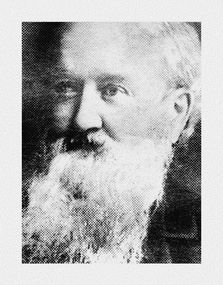
Newspaper - Fortuna Article - "Quartz King's uneasy reign", Nov 02 1997
... mining. His fortunes changed in the early 1860s after successful investments in the Advance and Cinderella mines, laying the foundation for his wealth. He acquired the property Fortuna in 1871. He Married Bedelia Javis, an Irish immigrant, in 1872; she died eight years later at age 38. Despite being the area's most successful mine owner, Lansell faced hostility from miners and left for Britain in 1880 after a threatening incident. He returned to Bendigo after a petition from thousands of residents, contributing significantly to the city's revival...mining. His fortunes changed in the early 1860s after successful investments in the Advance and Cinderella mines, laying the foundation for his wealth. He acquired the property Fortuna in 1871. He Married Bedelia Javis, an Irish immigrant, in 1872; she died eight years later at age 38. Despite being the area's most successful mine owner, Lansell faced hostility from miners and left for Britain in 1880 after a threatening incident. He returned to Bendigo after a petition from thousands of residents, contributing significantly to the city's revival ...George Lansell was born in Kent, England, on August 24, 1823. Inspired by his brother Wootton's reports of opportunities, George and his brother William arrived in Port Adelaide in 1853 and moved to Bendigo to seek fortune in gold mining. Lansell initially lost all his savings twice investing in gold mining. His fortunes changed in the early 1860s after successful investments in the Advance and Cinderella mines, laying the foundation for his wealth. He acquired the property Fortuna in 1871. He Married Bedelia Javis, an Irish immigrant, in 1872; she died eight years later at age 38. Despite being the area's most successful mine owner, Lansell faced hostility from miners and left for Britain in 1880 after a threatening incident. He returned to Bendigo after a petition from thousands of residents, contributing significantly to the city's revival. He donated much of his fortune to charities, public buildings, and monuments, including the Rosalind Park Cascades. He died on March 20, 1906, at age 82. His death marked the end of Bendigo's golden era; the goldfields' output declined sharply within a decade.Fortuna Restoration Article - "Quartz King's uneasy reign" - The Herald Sun Sunday Nov 02 1997- Author Adrian Tame This item contains the following: 11217.8a Black and White Photo of George Lansell 11217.8b Part of page 15 - Quartz King's uneasy reignnon-fictionbendigo, fortuna, stan budds, george lansell -
 Bendigo Historical Society Inc.
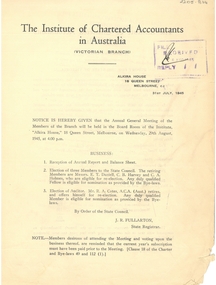
Book - MCCOLL, RANKIN AND STANISTREET COLLECTION: INSTITUTE OF CHARTERED ACCOUNTS AGM NOTICE
... Mining mccoll rankin & stanistreet a. Institute of Chartered Accountants in Australia, Victorian Branch, 31st July, 1945, notice of annual general meeting on 29th. August, 1945. J.R. Fullarton, State Registrar. b. enclosed within notice of AGM, notice re revival ...a. Institute of Chartered Accountants in Australia, Victorian Branch, 31st July, 1945, notice of annual general meeting on 29th. August, 1945. J.R. Fullarton, State Registrar. b. enclosed within notice of AGM, notice re revival of the activities of the Australian Chartered Accountant's Research Society and a profile on Brigadier E. Gorman..business, mining, mccoll rankin & stanistreet -
 Stawell Historical Society Inc
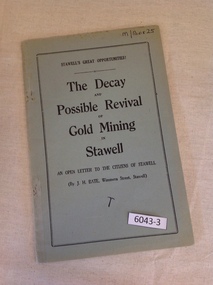
Book, J.H. Bate, The Decay and Possible Revival of Gold Mining in Stawell - Previously Cat No 3643-3, 1939
... The Decay and Possible Revival of Gold Mining in Stawell - Previously Cat No 3643-3...Stawell's Great Opportunities The Decay and Possible Revival of Gold Mining in Stawell An Open Letter to the Citizens of Stawell (By J.H. ...Nine Letters about re-opening mining operations in Stawell that were published in the Stawell Time News from 26 April 1939 to 28 June 1939 stawell mining Stawell's Great Opportunities The Decay and Possible Revival of Gold Mining in Stawell An Open Letter to the Citizens of Stawell (By J.H. ...Nine Letters about re-opening mining operations in Stawell that were published in the Stawell Time News from 26 April 1939 to 28 June 1939 Green Light Card Cover with Black border and Black Print.Stawell's Great Opportunities The Decay and Possible Revival of Gold Mining in Stawell An Open Letter to the Citizens of Stawell (By J.H. Bate. Wimmera Street. Stawell) [Picture of a Miner's Pick]stawell mining -
 Stawell Historical Society Inc
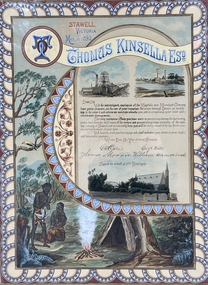
Photograph, Photo of illuminated Address given to Mr Thomas Kinsella March 1890
... The very persistent efforts you have made in prospecting during the last twenty years have been the chief cause of the revival and present prosperous condition of the mining industry of Stawell, and we sincerely hope you will be richly rewarded by the future successful development of your mine. ...The very persistent efforts you have made in prospecting during the last twenty years have been the chief cause of the revival and present prosperous condition of the mining industry of Stawell, and we sincerely hope you will be richly rewarded by the future successful development of your mine. ...Stawell Victoria March 1890 Thomas Kinsella Dear Sir, We the undersigned employees of the Magdala-cum Moonlight company have great pleasure on the eve of your departure for a tour through Europe in testifying to the respect and esteem we entertain towards you in recognition of your kind and considerate management. The very persistent efforts you have made in prospecting during the last twenty years have been the chief cause of the revival and present prosperous condition of the mining industry of Stawell, and we sincerely hope you will be richly rewarded by the future successful development of your mine. We heartily wish you Bon Voyage and shall welcome your return to your highly honorable position. We are, Dearly Sir, your obedient servants, G.W. Ware, George Wild, Thomas Morris, William Hammond Signed on behalf of one hundred employees. Stawell, Victoria 1890. Colour photo of item at the Kinsella's farm "Magdala" Lubeck July 2025 Large Illuminated address in Walnut and glass frameStawell Victoria March 1890 mining, magdala -
 Mont De Lancey
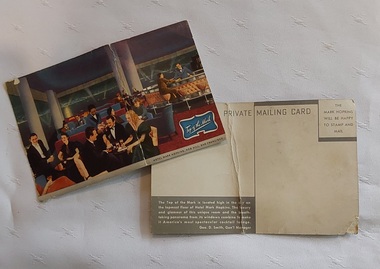
Postcard - Postcards, Hotel Mark Hopkins, early 1900's
... Revival-style architecture and historical features, such as the "Top of the Mark" lounge. One of San Francisco’s "Big Four," Mark Hopkins was among those who founded what became the great Southern Pacific Railroad. In 1925, mining...Revival-style architecture and historical features, such as the "Top of the Mark" lounge. One of San Francisco’s "Big Four," Mark Hopkins was among those who founded what became the great Southern Pacific Railroad. In 1925, mining ...The history of the InterContinental Mark Hopkins San Francisco is rooted in the Gilded Age mansion built by railroad tycoon Mark Hopkins on Nob Hill, which burned down after the 1906 earthquake. The current hotel was constructed in its place and opened in 1926, retaining the opulent spirit of its predecessor through its Renaissance Revival-style architecture and historical features, such as the "Top of the Mark" lounge. One of San Francisco’s "Big Four," Mark Hopkins was among those who founded what became the great Southern Pacific Railroad. In 1925, mining engineer and hotel investor George D. Smith bought the land where the Hopkins estate was built with the desire to build a luxury hotel. San Franciscans declared the new “Mark Hopkins Hotel” to be, "architecturally perfect, flawless in its erection, comprehensive in its accommodations, strikingly representative of the best there is in modern hostelry." The Mark Hopkins Hotel quickly became an immediate part of San Francisco’s rich and colorful history. This famous hotel is still in existence today.Two identical coloured vintage postcards from the Top of the Mark bar at Hotel Mark Hopkins in San Francisco in the early 1900's. Guests are illustrated seated in their fine clothes enjoying drinks together. The curved bar is in the background. The whole scene overlooks the Bay of San Francisco at night through the large glass windows. On the back of the cards is room for writing a message and address, postage information and facts from the General manager.'Top of the Mark' is printed on the front of the cards at the bottom right, as well as Hotel Mark Hopkins, Nob Hill, San Fransisco' 'Private Mailing Card' 'The Mark Hopkins will be happy to stamp and mail' Plus general information about the hotel from the General Manager.postcards, photographic postcards, postal stationery -
 Bendigo Historical Society Inc.
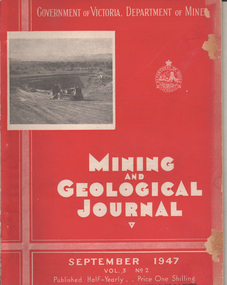
Book - Kairn Collection: Mining & Geological Journal, Department of Mines, Victoria, September 1947
... mining. The journal also included advertisements and references to business interests. An article in the journal notes that: 'On the Bendigo goldfield, in the first term of 1947, six mines 'have suspended operations, leaving twelve at present in operation. Of these only three mines are in regular production....expectations of a revival...mining. The journal also included advertisements and references to business interests. An article in the journal notes that: 'On the Bendigo goldfield, in the first term of 1947, six mines 'have suspended operations, leaving twelve at present in operation. Of these only three mines are in regular production....expectations of a revival ...The Mining & Geological Journal was published by the Department of Mines, Victoria twice a year, during the period 1937 to 1972. It was an official publication of the Victorian Government, Department of Mines, devoted to issues and events surrounding mining and metallurgical engineering in Victoria along with education, research and innovations in mining. The journal also included advertisements and references to business interests. An article in the journal notes that: 'On the Bendigo goldfield, in the first term of 1947, six mines 'have suspended operations, leaving twelve at present in operation. Of these only three mines are in regular production....expectations of a revival following the lifting of restrictions on the sale of shares have not yet been realised' (N. Bolitho, Inspector, Bendigo District, page 35.) Red and white cover, fifty-one pages. On front cover: ' Mining and Geological Journal' September 1947, Government of Victoria, Department of Mines, Vol 3, No. 2, published half yearly, price one shilling. Black and white photo of mine pit on cover, top left. Articles relative to Bendigo goldfield: mine reports Central Nell Gwynne, Bendigo, Deborah Extended, Bendigo, South Virginia Bendigo and notes from the mining districts. geology, mining, gold mining, bendigo, department of mines, central nell gwynne, deborah extended, south virginia bendigo, n. bolitho, gold dumps pty ltd., costerfield, tait's, sedgewick, great eastern mine sedgewick, north deborah -
 The Beechworth Burke Museum
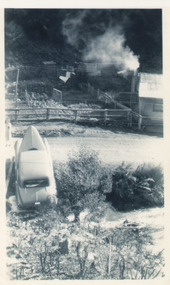
Photograph, Unknown
... mining designed to increase ore production volume. This original, undated photograph of the A1 Mine appears to depict an area or phase of disuse or abandonment. The aged and humble appearance of the cottage suggests association with the historical A1 Mine Settlement, therefore the image may have been taken prior to the 1950s-1970s revival period in which the A1 mine is known to have produced high gold yields. ...The A1 Gold Mine is located north of Woods Point, near Jamieson, in the Upper Goulburn region of Victoria. Gold was discovered at the A1 site in 1861 and mining operations began in 1864. The A1 Mine Settlement refers to a small township known variously as Castle Reef, Castle Point, and Raspberry Creek, which developed in the 1860s around mining industry centred on a crushing machine that worked the three gold reefs in the area. Historically, the name "A1"referred to the high quality of gold found in the quartz reefs at depths of at least two thousand feet. Along with the Morning Star mine at Woods Point, the A1 gold mine produced almost sixty percent of Victoria's gold output in the 1950s to 1970s and continued operating until 1992 when it went into administration. Operations at the site were revived in 2016 and the A1 Mine is now considered one of Victoria's premier gold mines. The A1 mine is part of the extensive and prospective Lachlan Fold Belt, a north-west trending belt of tightly folded Early Devonian sedimentary rocks extending from New South Wales to Victoria. Mineralisation is hosted within or immediately adjacent to diorite dykes. Contemporary development of the 'Queens Lode' at the A1 mine signals a move from high-grade, narrow vein airleg mining into larger scale, mechanical mining designed to increase ore production volume. This original, undated photograph of the A1 Mine appears to depict an area or phase of disuse or abandonment. The aged and humble appearance of the cottage suggests association with the historical A1 Mine Settlement, therefore the image may have been taken prior to the 1950s-1970s revival period in which the A1 mine is known to have produced high gold yields. The photograph contributes to our understanding of the A1 Gold Mine's impact on the landscape and the social, environmental impacts of mining on communities and may be compared with others in the Burke Museum's extensive collection of mining photographs to deepen our understanding of mining in the Jamieson area.Black and white rectangular photograph printed on photographic paperReverse: 5577 / A1 Mine / Near Jamieson / Vic. /burke museum, beechworth museum, beechworth, gold fields, gold rush, victorian gold rush, mining tunnels, gold ming history, colonial australia, australian gold rushes, mining technology, beechworth historic district, indigo gold trail, indigo shire, upper goulburn shire, jamieson, woods point-walhalla goldfield, a1 gold mine, victorian high country, modern mining methods, orogenic gold province, gold mineralisation, devonian, dykes
