
Showing 35 items matching "misty"
-
 National Vietnam Veterans Museum (NVVM)
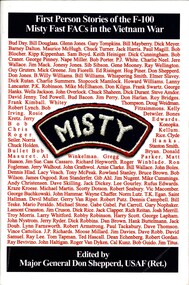
Book, Shepperd, Don Major General, USAF (Ret.), Misty: First Person Stories of the F-100 Misty Fast FACs in the Vietnam War
... Misty: First Person Stories of the F-100 Misty Fast FACs in the Vietnam War......Misty...Over 3.4 million personnel served in Southeast Asia. Misty: First Person Stories of the F-100 Misty Fast FACs in the Vietnam War Book Shepperd, Don Major General, USAF (Ret.) ...The Vietnam War years are officially classified as the period between 5 August 1964 and 7 May 1975. During that time over nine million Americans were on active duty. Over 3.4 million personnel served in Southeast Asia.The Vietnam War years are officially classified as the period between 5 August 1964 and 7 May 1975. During that time over nine million Americans were on active duty. Over 3.4 million personnel served in Southeast Asia.vietam, misty, american servicement -
 South Gippsland Shire Council
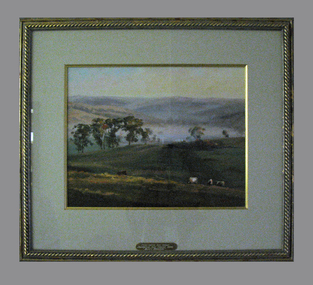
Painting, Oil, Misty Morning, 1992
... Misty Morning...Framed oil painting titled: "Misty Morning" painted by Mardie O'Bryan. Set in cream card window mount with brass plaque affixed to lower edge. ...Gold decorative wood frame. Misty Morning Painting, Oil ...Framed oil painting titled: "Misty Morning" painted by Mardie O'Bryan. Set in cream card window mount with brass plaque affixed to lower edge. Gold decorative wood frame. -
 Kew Historical Society Inc
Newspaper - Newspaper photograph, The Age, Modern Melbourne #72. Play misty for me: Kew Junction, 2013, 2013
... Modern Melbourne #72. Play misty for me: Kew Junction, 2013...Modern Melbourne #72. Play misty for me: Kew Junction looks spookily like a city in America's Deep South on a foggy Winter morning / Photo: Eddie Jim. ...Modern Melbourne #72. Play misty for me: Kew Junction looks spookily like a city in America's Deep South on a foggy Winter morning / Photo: Eddie Jim. ...Modern Melbourne #72. Play misty for me: Kew Junction looks spookily like a city in America's Deep South on a foggy Winter morning / Photo: Eddie Jim. Published in The Age, August 25, 2013, page 16. In copyright until 2088. Not to be copied or published without permission.kew junction, newspaper photos -- kew (vic.) -
Lakes Entrance Historical Society
Book, Kleinitz, Misty, The Nungurner Hall, 2003
... Kleinitz, Misty...Community facilities Schools Research, interpretation and management recommendations for the Nungurner Hall, Nungurner, East Gippsland, Victoria, by Forestec student The Nungurner Hall Book Kleinitz, Misty ...Research, interpretation and management recommendations for the Nungurner Hall, Nungurner, East Gippsland, Victoria, by Forestec studentcommunity facilities, schools -
 Marysville & District Historical Society
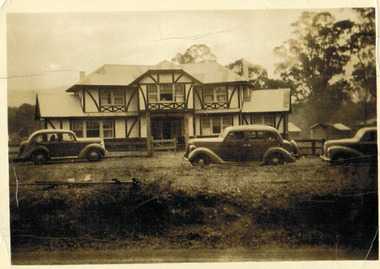
Photograph (Item) - Black and white photograph, Unknown
... A digital copy of a black and white photograph of Misty Hills Guest House in Narbethong in Victoria....A digital copy of a black and white photograph of Misty Hills Guest House in Narbethong in Victoria....A digital copy of a black and white photograph of Misty Hills Guest House in Narbethong in Victoria. ...A digital copy of a black and white photograph of Misty Hills Guest House in Narbethong in Victoria.A digital copy of a black and white photograph of Misty Hills Guest House in Narbethong in Victoria. After being known as Misty Hills Guest House it became Tudor Lodge Cafe then Tudor Lodge Roadhouse. The building was destroyed in the 2009 Black Saturday bushfires. The building was subsequently rebuilt albeit as a smaller building and was known as Wombat Cottage. That business was then sold and the property is now known as Oaktree Guest House.narbethong, victoria, misty hills guest house, photograph, tudor lodge cafe, tudor lodge roadhouse, wombat cottage, oaktree guest house, 2009 black saturday bushfires -
 Marysville & District Historical Society
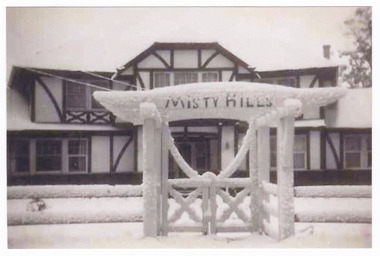
Photograph (Item) - Black and white photograph, Unknown
... A black and white photograph of Misty Hills Guest House in Narbethong in Victoria. ...A copy of a black and white photograph of Misty Hills Guest House in Narbethong in Victoria....A black and white photograph of Misty Hills Guest House in Narbethong in Victoria. ...A black and white photograph of Misty Hills Guest House in Narbethong in Victoria. After being known as Misty Hills Guest House it became Tudor Lodge Cafe then Tudor Lodge Roadhouse. The building was destroyed in the 2009 Black Saturday bushfires. The building was subsequently rebuilt albeit as a smaller building and was known as Wombat Cottage. That business was then sold and the property is now known as Oaktree Guest House.A black and white photograph of Misty Hills Guest House in Narbethong in Victoria.narbethong, victoria, misty hills guest house, photograph, tudor lodge cafe, tudor lodge roadhouse, wombat cottage, oaktree guest house, 2009 black saturday bushfires -
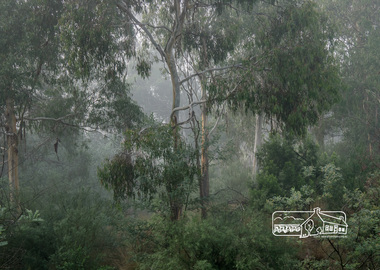 Eltham District Historical Society Inc
Photograph, Fred Mitchell, Misty morning on the Diamond Creek Trail, 19 June 2013, 19/06/2013
... Misty morning on the Diamond Creek Trail, 19 June 2013...fred mitchell collection 2013 diamond creek trail Digital copy of colour photograph Misty morning on the Diamond Creek Trail, 19 June 2013 Photograph Fred Mitchell ...Digital copy of colour photographfred mitchell collection, 2013, diamond creek trail -
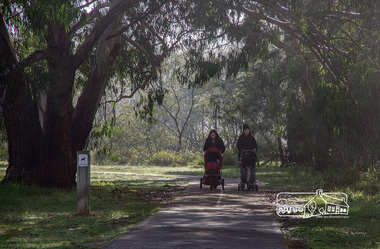 Eltham District Historical Society Inc
Photograph, Fred Mitchell, Misty morning on the Diamond Creek Trail, 19 June 2013, 19/06/2013
... Misty morning on the Diamond Creek Trail, 19 June 2013...fred mitchell collection 2013 diamond creek trail Digital copy of colour photograph Misty morning on the Diamond Creek Trail, 19 June 2013 Photograph Fred Mitchell ...Digital copy of colour photographfred mitchell collection, 2013, diamond creek trail -
National Vietnam Veterans Museum (NVVM)
Book, Bury Us Upside Down: the Misty Pilots and the Secret Battle for the Ho Chi Minh Trail, 2006
... Bury Us Upside Down: the Misty Pilots and the Secret Battle for the Ho Chi Minh Trail....Vietnamese conflict 1961-1975 - Aerial operations - American Ho Chi Minh Trail Aerial observation (Military Science) Bury Us Upside Down: the Misty Pilots and the Secret Battle for the Ho Chi Minh Trail. ...vietnamese conflict, 1961-1975 - aerial operations - american, ho chi minh trail, aerial observation (military science) -
Thompson's Foundry Band Inc. (Castlemaine)
Sheet Music, Misty
... Misty...Misty Sheet Music ... -
Thompson's Foundry Band Inc. (Castlemaine)
Sheet Music, Misty Islands
... Misty Islands...Misty Islands Sheet Music ... -
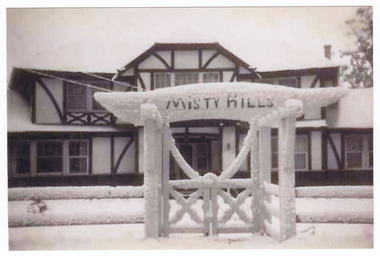 Marysville & District Historical Society
Photograph (Item) - Black and white photograph, Unknown
... A digital copy of a black and white photograph of Misty Hills Guest House in Narbethong in Victoria....A digital copy of a black and white photograph of Misty Hills Guest House in Narbethong in Victoria. ...A digital copy of a black and white photograph of Misty Hills Guest House in Narbethong in Victoria. ...A digital copy of a black and white photograph of Misty Hills Guest House in Narbethong in Victoria.A digital copy of a black and white photograph of Misty Hills Guest House in Narbethong in Victoria. After being known as Misty Hills Guest House it became Tudor Lodge Cafe then Tudor Lodge Roadhouse. The building was destroyed in the 2009 Black Saturday bushfires. The building was subsequently rebuilt albeit as a smaller building and was known as Wombat Cottage. That business was then sold and the property is now known as Oaktree Guest House.narbethong, victoria, misty hills guest house, photograph, tudor lodge cafe, tudor lodge roadhouse, wombat cottage, oaktree guest house, 2009 black saturday bushfires -
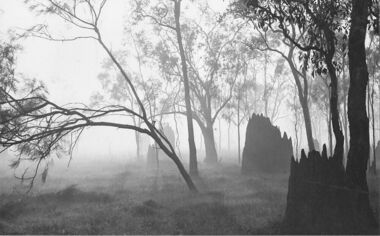 Montsalvat
Photograph, These were my Tribesmen
... Black and white photograph of a misty landscape with trees. ...Black and white photograph of a misty landscape with trees. These were my Tribesmen Photograph Matcham Skipper ...Black and white photograph of a misty landscape with trees. Inscribed on reverse in pencil 'These were my Tribesmen'. Inscribed on Matt front 35 circled and 5/5. matcham skipper, photograph, landscape -
 Surrey Hills Historical Society Collection
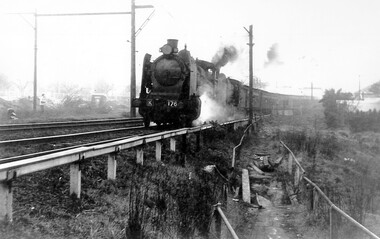
Photograph, Loco K176 at Surrey Hills on a vintage tour train to Healesville, 1 October 1966, 1 October 1966
... Although the photo was taken on a misty day, houses in Windsor Crescent can just be seen in the background. ...One person is looking on from the left hand side of the photo. It's a misty day but houses in Windsor Crescent and the pedestrian overpass at Surrey Hills railway station can be seen....Although the photo was taken on a misty day, houses in Windsor Crescent can just be seen in the background. ...We have an original B&W copy donated by Ian Barkla and a larger one copied by Ken Hall. The Barkla original has a sticker with his reference details on the back. The photo records a Vintage Train tour to Healesville on 1 October 1966. The Lilydale to Healesville line opened on 1 March 1889. The last steam train on the line ran in 1957 and the last passenger service was in 1980. The line reopened as a tourist railway in 2010. Although the photo was taken on a misty day, houses in Windsor Crescent can just be seen in the background. It is possibly Lorne Parade in the background with preparatory works for the 3rd rail line underway.A black and white photocopy of a steam train. One person is looking on from the left hand side of the photo. It's a misty day but houses in Windsor Crescent and the pedestrian overpass at Surrey Hills railway station can be seen.surrey hills railway station, windsor cresent, 1966, railfan tour, steam trains, vintage tour train -
 Benalla Art Gallery
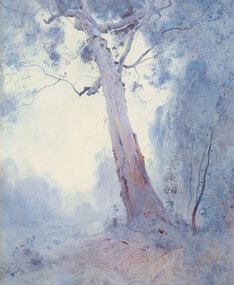
Watercolour, Penleigh BOYD, Edge of the forest, 1919
... Misty forest landscape with large gum tree. ...Interwar Watercolour Tree Landscape Recto: Signed "Penleigh Boyd" in brown watercolour in l.r.c of composition; Not dated; Not titled Misty forest landscape with large gum tree. ...Born: Westbury, Wiltshire, England 1890; Arrived: Melbourne, Victoria, Australia 1893; Died: Warragul, Victoria, Australia 1923InterwarGift of Wooleen Pty Ltd.,1980Misty forest landscape with large gum tree. Limed timber frame.Recto: Signed "Penleigh Boyd" in brown watercolour in l.r.c of composition; Not dated; Not titledwatercolour, tree, landscape -
 Mission to Seafarers Victoria
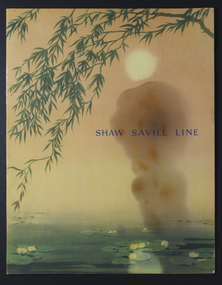
Souvenir - Menu, Shaw Savill Line, Shaw Savill Line SS Athenic, Maiden Voyage, 30/8/1947
... The cover features an imaginary asian design featuring water lilies , willow leaves and a misty sun, colours are gold green pink....The cover features an imaginary asian design featuring water lilies , willow leaves and a misty sun, colours are gold green pink. Shaw Savill Line SS Athenic, Maiden Voyage Souvenir Menu Shaw Savill Line ...This menu appears to have been produced for the 1947 Maiden Voyage of the S.S. Athenic travelling between London and New Zealand via Curacao and Panama. This was possibly the first voyage on this vessel early in his career for engineer G. W. Duncan and therefore a souvenir. The commander of the vessel was D. Aitchinson. Also of interest given that the UK was still very much governed by post WW2 rationing, is the range of food available for the farewell dinner listed.Mariner Duncan had a particular regard for the Mission to Seafarers. This plate for display on a commissioned new table at the MTSV chapel acknowledges his bequest and the material donated. Collectively the G W Duncan material includes: photographs, professional data memorabilia and written and commercially printed resources. The memorabilia relates to his career at sea and in particular the role of an engineer, including a handwritten manual of notes and references relating to the mechanical and engineering aspects and areas of responsibility for maintenance. Single fold card menu cover with typed paper menu listing adhered to inside cover. The cover features an imaginary asian design featuring water lilies , willow leaves and a misty sun, colours are gold green pink.see images 1 and 2 attachedmenu, ss athenic, shaw savill line, george winfield duncan (1922-2017), sailors, seafarers, passenger ships, ship engineer -
 Marysville & District Historical Society
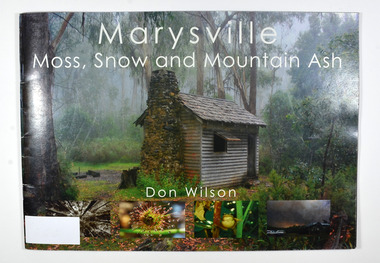
Book, Marysville-Moss, Snow and Mountain Ash, Unknown
... Front cover has a main photograph of Keppel's Hut on a misty day in the rainforest. There are also four small photographs along the lower edge of the front cover. ...Front cover has a main photograph of Keppel's Hut on a misty day in the rainforest. There are also four small photographs along the lower edge of the front cover. ...A pictorial book of the flora, fauna and waterfalls in the Marysville district affected by the 2009 Black Saturday bushfirePaperback. Front cover has a main photograph of Keppel's Hut on a misty day in the rainforest. There are also four small photographs along the lower edge of the front cover. They are of a Mountain Ash canopy, a Drosera Peltata, a Brown Tree Frog and a view of the smoke plume on Black Saturday.marysville, victoria, australia, landmarks, flora, fauna, waterfalls, black saturday, bushfire, nature -
 Marysville & District Historical Society
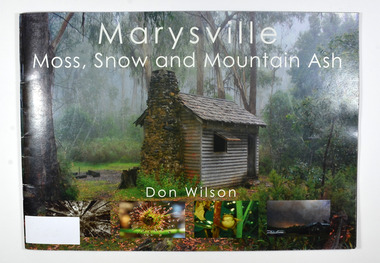
Book, Marysville-Moss, Snow and Mountain Ash
... Front cover has a main photograph of Keppel's Hut on a misty day in the rainforest. There are also four small photographs along the lower edge of the front cover. ...Front cover has a main photograph of Keppel's Hut on a misty day in the rainforest. There are also four small photographs along the lower edge of the front cover. ...A pictorial book of the flora, fauna and waterfalls in the Marysville district affected by the 2009 Black Saturday bushfirePaperback. Front cover has a main photograph of Keppel's Hut on a misty day in the rainforest. There are also four small photographs along the lower edge of the front cover. They are of a Mountain Ash canopy, a Drosera Peltata, a Brown Tree Frog and a view of the smoke plume on Black Saturday.marysville, victoria, australia, landmarks, flora, fauna, waterfalls, black saturday, bushfire, nature -
 Marysville & District Historical Society
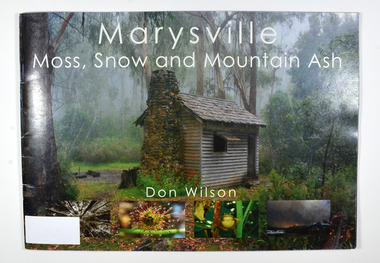
Book, Marysville-Moss, Snow and Mountain Ash
... Front cover has a main photograph of Keppel's Hut on a misty day in the rainforest. There are also four small photographs along the lower edge of the front cover. ...Front cover has a main photograph of Keppel's Hut on a misty day in the rainforest. There are also four small photographs along the lower edge of the front cover. ...A pictorial book of the flora, fauna and waterfalls in the Marysville district affected by the 2009 Black Saturday bushfirePaperback. Front cover has a main photograph of Keppel's Hut on a misty day in the rainforest. There are also four small photographs along the lower edge of the front cover. They are of a Mountain Ash canopy, a Drosera Peltata, a Brown Tree Frog and a view of the smoke plume on Black Saturday.marysville, victoria, australia, landmarks, flora, fauna, waterfalls, black saturday, bushfire, nature -
 Southern Sherbrooke Historical Society Inc.
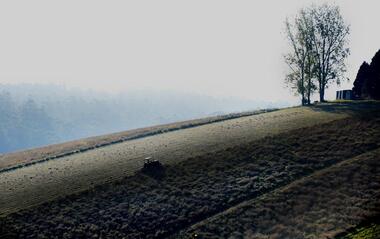
Photograph - Photo, Cotswold Valley
... There are trees and tanks on the right side, and many trees in the misty background. Sourced from Facebook, 2019. ...There are trees and tanks on the right side, and many trees in the misty background. Sourced from Facebook, 2019. ...Colour photograph of a farm in the Cotswold Valley, Menzies Creek, possibly Bob Endersby's land. Photo shows a field in morning mist. A tractor is ploughing the fields. There are trees and tanks on the right side, and many trees in the misty background. Sourced from Facebook, 2019. Photographer unknown. -
 Marysville & District Historical Society
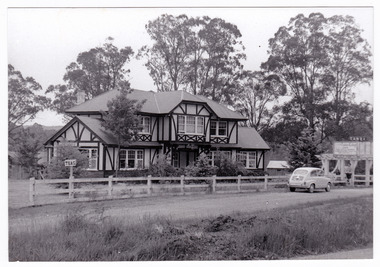
Photograph (Item) - Black and white photograph, Unknown
... After being known as Misty Hills Guest House it became Tudor Lodge Cafe then Tudor Lodge Roadhouse. ...After being known as Misty Hills Guest House it became Tudor Lodge Cafe then Tudor Lodge Roadhouse. ...A black and white photograph of Tudor Lodge Cafe in Narbethong in Victoria. After being known as Misty Hills Guest House it became Tudor Lodge Cafe then Tudor Lodge Roadhouse. The building was destroyed in the 2009 Black Saturday bushfires. The building was subsequently rebuilt albeit as a smaller building and was known as Wombat Cottage. That business was then sold and the property is now known as Oaktree Guest House.A black and white photograph of Tudor Lodge Cafe in Narbethong in Victoria. narbethong, victoria, tudor lodge cafe, misty hills guest house, tudor lodge roadhouse, oaktree guest house, photograph, accommodation, wombat cottage, 2009 black saturday bushfires -
 Marysville & District Historical Society
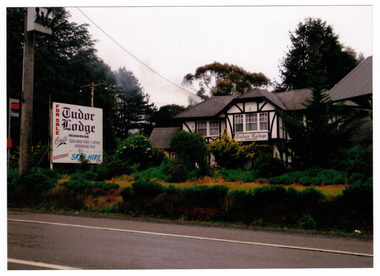
Photograph (item) - Colour photograph, Unknown
... After being known as Misty Hills Guest House it became Tudor Lodge Cafe then Tudor Lodge Roadhouse. ...After being known as Misty Hills Guest House it became Tudor Lodge Cafe then Tudor Lodge Roadhouse. ...A colour photograph of Tudor Lodge Roadhouse in Narbethong in Victoria. After being known as Misty Hills Guest House it became Tudor Lodge Cafe then Tudor Lodge Roadhouse. The building was destroyed in the 2009 Black Saturday bushfires. The building was subsequently rebuilt albeit as a smaller building and was known as Wombat Cottage. That business was then sold and the property is now known as Oaktree Guest House.A colour photograph of Tudor Lodge Roadhouse in Narbethong in Victoria.narbethong, victoria, tudor lodge roadhouse, photograph, accommodation, 2009 black saturday bushfires, oaktree guest house, misty hills guest house, tudor lodge cafe, wombat cottage -
 Marysville & District Historical Society
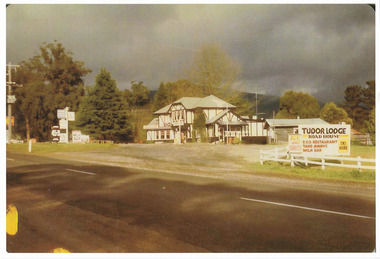
Photograph (item) - Colour photograph, Unknown
... After being known as Misty Hills Guest House it became Tudor Lodge Cafe then Tudor Lodge Roadhouse. ...After being known as Misty Hills Guest House it became Tudor Lodge Cafe then Tudor Lodge Roadhouse. ...A colour photograph of Tudor Lodge Roadhouse in Narbethong in Victoria. After being known as Misty Hills Guest House it became Tudor Lodge Cafe then Tudor Lodge Roadhouse. The building was destroyed in the 2009 Black Saturday bushfires. The building was subsequently rebuilt albeit as a smaller building and was known as Wombat Cottage. That business was then sold and the property is now known as Oaktree Guest House.A colour photograph of Tudor Lodge Roadhouse in Narbethong in Victoria.narbethong, victoria, tudor lodge roadhouse, tudor house cafe, misty hills guest house, 2009 black saturday bushfires, oaktree guest house, accommodation, photograph, wombat cottage -
 Marysville & District Historical Society
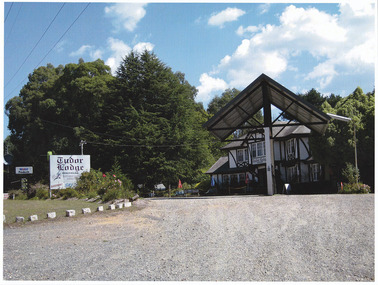
Photograph (item) - Colour photograph, Unknown
... After being known as Misty Hills Guest House it became Tudor Lodge Cafe then Tudor Lodge Roadhouse. ...After being known as Misty Hills Guest House it became Tudor Lodge Cafe then Tudor Lodge Roadhouse. ...A colour photograph of Tudor Lodge Roadhouse in Narbethong in Victoria. After being known as Misty Hills Guest House it became Tudor Lodge Cafe then Tudor Lodge Roadhouse. The building was destroyed in the 2009 Black Saturday bushfires. The building was subsequently rebuilt albeit as a smaller building and was known as Wombat Cottage. That business was then sold and the property is now known as Oaktree Guest House.A colour photograph of Tudor Lodge Roadhouse in Narbethong in Victoria.narbethong, victoria, tudor lodge roadhouse, tudor house cafe, misty hills guest house, 2009 black saturday bushfires, oaktree guest house, accommodation, photograph, wombat cottage -
 Nillumbik Shire Council
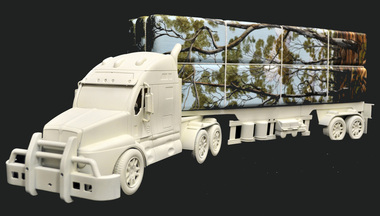
Sculpture, Ghost, 2012
... His direct experience of nature, as both pioneer settler and painter, resulted in a new approach using a subtle palette of olive greens, ochres, misty greys and intense blues, and layered glazes of mauve, grey and gold, to portray Australian light and atmosphere. ...His direct experience of nature, as both pioneer settler and painter, resulted in a new approach using a subtle palette of olive greens, ochres, misty greys and intense blues, and layered glazes of mauve, grey and gold, to portray Australian light and atmosphere. ...The (logging) truck carries a representation of John Glover’s painted landscapes, which Cox has painted on a solid block of wood. John Glover is one of Australia’s most celebrated colonial landscape painters. Born in England, he was a highly successful water-colourist and painter of landscapes in the tradition of French artist Claude Lorrain. Arriving in Australia in 1831, Glover adapted his picturesque style and luminous technique to his new surrounds, creating naturalistic and atmospheric paintings of Australian nature, settler life, and Aboriginal culture. Working out of doors, Glover developed an understanding of the unfamiliar Australian landscape, especially the twisting forms of native eucalyptus trees. His direct experience of nature, as both pioneer settler and painter, resulted in a new approach using a subtle palette of olive greens, ochres, misty greys and intense blues, and layered glazes of mauve, grey and gold, to portray Australian light and atmosphere. Dale Cox continues the ongoing preoccupation and tradition of landscape painting in the Nillumbik area and our impact on the environment in a contemporary way. The truck creates a playful nexus between painting (representational landscape) and sculpture, purposely bluring boundaries across these traditionally distinct disciplines. ‘Ghost’ seeks to convey the idea that when we remove something significant from a location, like the landscape itself, the remaining ‘place’ changes to become a new ‘place’. This may seem self-evident until we think more deeply about location and landscape. The white truck is a ghost, an ethereal, transient being that spirits away an entire place, forever removed from itself, and forever changed. Logging wild trees can never be like harvesting a ‘crop’. Logging removes a landscape, and changes a place forever. The ‘packaging’ of this painted landscape highlights the anomaly between commodity and our environment. Dale Cox was a local artist and this work was highly commended at the 2012 Nillumbik Prize. White plastic toy (logging) truck with a landscape painting on a wooden block. The landscape painting is reminiscent of paintings by colonial artist John Glover. N/Alandscape, truck, sculpture, environment, john glover, colonial, painting, ghost, nillumbik prize -
 Marysville & District Historical Society
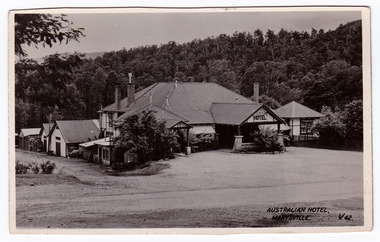
Postcard (item) - Black and white postcard, The Valentine Publishing Co. Pty. Ltd, AUSTRALIAN HOTEL, MARYSVILLE, 1923-1963
... Just now it's trying to fine up but we've/ managed to get out inspite of the rain as often it's only/ very fine misty rain. Wednes. we went to Maroondah/ Dam + Healesville + when we go on to Town where/ we'll stay with Maisie + Clem, we are going Acheron Way/ via Warburton. ...Just now it's trying to fine up but we've/ managed to get out inspite of the rain as often it's only/ very fine misty rain. Wednes. we went to Maroondah/ Dam + Healesville + when we go on to Town where/ we'll stay with Maisie + Clem, we are going Acheron Way/ via Warburton. ...A black and white postcard of the Australian Hotel in Marysville that was produced by The Valentine Publishing Co. Pty. Ltd. as a souvenir of Marysville. The hotel was originally built and opened by the Keppel Family in 1865. The Keppel's Australian Hotel was the first hotel to be opened in Marysville. The Keppel Family were among Marysville's earliest pioneering families. A black and white postcard of the Australian Hotel in Marysville that was produced by The Valentine Publishing Co. Pty. Ltd.V. 42. VALENTINE'S A GENUINE PHOTOGRAPH 1952 SEPT/ Friday 10.30 AM Dear Mum, Dad + Arthur,/ Yesterday brought a letter from you _ Pappa/ I ???? also a ???? ???. Today we should get/ the photos of Jim Gordans, the photographer. Last night/ Don + Kath rang. They were also to give you a ring./ I told them to tell you how beautiful it was snowing/ on Tues. - quite heavy in the town here, but it melted/ on arriving the ground but a couple of miles up the/ hill it was 6 - 8" deep so picturesque among the/ ferns. The best I've ever seen specially while it was/ falling. Just now it's trying to fine up but we've/ managed to get out inspite of the rain as often it's only/ very fine misty rain. Wednes. we went to Maroondah/ Dam + Healesville + when we go on to Town where/ we'll stay with Maisie + Clem, we are going Acheron Way/ via Warburton. While in Town we are aiming to see/ Tommy ???? Show on Seagulls Over Sorrento. On returning/ we'll come round via Daylesford, Bendigo etc, we book/ out of here on Wednes. morn. Just now there are only/ about 8 of us but it certainlymarysville, victoria, australia, keppel hotel, keppel's australian hotel, australian hotel, keppel family, maurice john keppel, accommodation, the valentine publishing co. pty. ltd., postcard, souvenir -
University of Melbourne, Burnley Campus Archives
Album - Black and white and sepia prints, Gardens Other Than Burnley, 1890-1920
... Probably-fenced originally-fences coming down 1890's on. (11) Statue at crossroad. (12) The Vase Fountain. (13) Tree trunks. (14) Tree trunks. (15) Probably, tree trunks. (16) Winding path. (17) Probably, misty winter scene. (18) Probably, summer. (19) Probably, this is the sort of garden seat used. (20) Avenue of trees, information about exposure on reverse. (21) 2 copies. ...Probably-fenced originally-fences coming down 1890's on. (11) Statue at crossroad. (12) The Vase Fountain. (13) Tree trunks. (14) Tree trunks. (15) Probably, tree trunks. (16) Winding path. (17) Probably, misty winter scene. (18) Probably, summer. (19) Probably, this is the sort of garden seat used. (20) Avenue of trees, information about exposure on reverse. (21) 2 copies. ...Identification and information on reverse of some photographs given by Georgina Whitehead (Tel-9572 1225) who visited the Archives on 26 September, 1995 when she was writing a book on the various gardens owned and run by the Melbourne City Council-'Civilizing the city: a history of Melbourne's public gardens,' State Library of Victoria, Melbourne 1997.34 bkack and white and sepia photographs. Possibly used for Magic Lantern slides. Fitzroy Gardens: (1) Possibly, towards St Patrick's Cathedral. (2, 3) Path through avenue of trees. (4) Winter. Heavily pruned Elms. (5) Looking towards Clarendon St-eastwards. (6) Probably, lawn. (7) 2 copies, possibly Kiosk. (8) 1920's or earlier. Man sitting on bench. (9) Path through avenue of trees. (10) 2 copies. Probably-fenced originally-fences coming down 1890's on. (11) Statue at crossroad. (12) The Vase Fountain. (13) Tree trunks. (14) Tree trunks. (15) Probably, tree trunks. (16) Winding path. (17) Probably, misty winter scene. (18) Probably, summer. (19) Probably, this is the sort of garden seat used. (20) Avenue of trees, information about exposure on reverse. (21) 2 copies. Probably. Treasury Gardens: (22) Japanese Garden. (23)Japanese Garden. This area around the Lake done by Guilfoyle c.1901-1902. This photograph about this period. (24) Gardener at lake edge. Snowdon Gardens: (25) View towards city. Unidentified: (26) ?Botanic fern Gully/ Fitzroy Fern Gully. (27) Lake view. (28) Narrow path through long grass and trees. (29) Trees in winter. (30, 30a) Tree ferns. (31,32) Cordylines. (33) People on lawn. (34) Winter view of path through elms. These photographs have been scanned but have not been uploaded.georgina whitehead, fitzroy gardens, trees, elms, the vase fountain, trunks, treasury gardens, japanese garden, guilfoyle, snowdon gardens, fern gully, lake view, parks -
 City of Melbourne Libraries
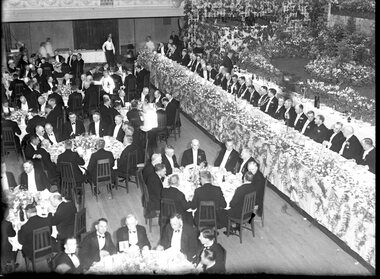
Photograph, Bull, Hugh Jones, 1897-1993, Lord Mayor's Dinner, Melbourne Town Hall
... In the entrance palm green shrubs stood like sentinels round the passed floor, and flowers bloomed in misty golds. The long corridor upstairs leading to the council chamber was lined with an avenue of poplar trees in tubs. ...In the entrance palm green shrubs stood like sentinels round the passed floor, and flowers bloomed in misty golds. The long corridor upstairs leading to the council chamber was lined with an avenue of poplar trees in tubs. ...Photographer notations on slide: "General View Of Lord Mayor's Dinner At Town Hall Nov 1936 B112" Published: The Age, Tuesday 10 November 1936, page 13 Published title: LORD MAYOR'S BANQUET Published caption: The brilliant scene inside the Melbourne Town Hall last night during the Lord Mayor’s banquet. Trove article identifier: http://nla.gov.au/nla.news-article205939431 Description: 700 guests (all men) are seated around numerous tables in the Melbourne Town Hall for the Lord Mayor's dinner in November 1936. Before the stage is a top table of 35 men, all dressed smartly in black dinner suits, with either a black or white bow tie. Many are wearing their medals. The Lord Mayor has on his Mayoral chains, and to his right is the Governor of Victoria, Lord Huntingfield. The stage is heavily decorated with fresh flowers. Research by project volunteer, Louise McKenzie: This image takes up one quarter of the photographic space on page 13 of The Age on 10 November 1936, reflecting the importance of the event and also the sheer dramatics of the image: 700 guests (all men), a top table of 35, and all dressed smartly in black dinner suits, with either a black or white bow tie. Many are wearing their medals. The Lord Mayor has on his Mayoral chains, and to his right is the Governor of Victoria, Lord Huntingfield. Further to his right is a man with an impressive sash across his chest. It is a very animated, and rather informal, moment. Banks of fresh flowers smother the stage, which is decorated in the manner of a terrace at an English stately home. Tables are laden with food, drink and decorations, and the wait staff (men and women) are also formally dressed, in the manner of Downton Abbey. It is spectacular, dramatic, and luxurious, and perpetuates the proud descriptor of “Marvellous Melbourne” as conferred by London Journalist George Augustus Sala when he visited the city in 1885. During its 1880s boom, Melbourne was the second-largest city in the British Empire, after London, and reputedly the richest city in the world. At times the expression was used with some irony, but "...in Victoria’s centenary year, 1934, with the city mired in another depression, a publisher bravely entitled a book of souvenir photographs Marvellous Melbourne, claiming that the subject ‘still finds apt expression in the happy one-time sobriquet’.” This photo seems to reflect an ongoing pride in Melbourne and a desire for it to live up to its descriptor and celebrate its post-centenary era in style. So it is no surprise to find that on page 11 of The Age on the same day, a second photo is to be found – a cropped view of one table – along with a very detailed description of the night, its purpose, and a surprise announcement. But, who was the Lord Mayor in whose honour the dinner was held? In 1934, the Lord Mayor of Melbourne was Cr. Alexander George Wales, (born Richmond, 11 October 1885, died Elsterwick, 31 May 1962). His father was a contractor and quarry-owner, but was blinded in an industrial accident in 1899. Consequently Alexander, then aged 14, left Brunswick State School to become a railway labourer working at a quarry, and in 1903 joined the Commonwealth public service as a clerk and began studying at night school, determined to improve himself. In 1907 he was appointed secretary of the Albion Quarrying Co. (in which the family had an interest), then its managing director and chairman. As the Australian Dictionary of Biography notes, he was instrumental in expanding the company’s interests, "...becoming director of the Hardware Co. of Australia Pty Ltd, the Twentieth Century Building and Investment Society, the Albion Sand Co. and the Geelong Brick Co.”. His public career began in 1914 when he was elected to the Brunswick council. He was mayor 1917-18, and in 1925 progressed to the Melbourne City Council where he remained for 29 years, being a member of most council committees. He served three successive terms as lord mayor (1934-37), was Chairman of the council’s decorations committee for Melbourne’s centenary, president of the Metropolitan Fire Brigades Board (1936), and Chairman of the Public Works Committee (1937-39). In 1936 he was elected to the Legislative Council with United Australia Party support, but later resigned over possible State government contract tender irregularities. Wales received "the customary reward” of a knighthood and was invested at Buckingham Palace by King George VI whose coronation he attended in 1937. He was an early director of what is now Ampol, and helped the development of the petroleum industry in Australia after visiting the USA in 1943 and 1946. He was impressed by that country’s wartime shipbuilding efforts and supported closer ties with the USA. “While president (1947-48) of the Melbourne Chamber of Commerce, Wales was a vocal critic of the Federal Labor Government, ...a staunch anti-socialist ... and a focus for conservative opposition to the Curtin and Chifley governments...” He is described as “a natural leader in business and civic politics,... a powerful force in the Melbourne City Council... opposing democratic reforms such as the creation of a Greater Melbourne Council and the abolition of plural voting, but advocat[ing] the redevelopment of city-owned property like the Eastern and Western markets...” So, this Lord Mayor’s dinner marks the third successive term in office for Governor Cr. A G Wales. The room is filled with powerful and influential men, and provided a platform for the Premier of Victoria, Albert Dunstan (1882-1950, United Country party) to announce that if the City Council would bear half the cost the State Government would build a bridge at Punt Road “at once”. He announced that the Government proposed to have the bridge built by the Country Roads Board, and allow the City Council to pay its share on convenient terms, and further, it would investigate the shared provision of more Yarra bridges. The proposal for the Punt Road Bridge was met with applause as the Yarra River constituted a serious traffic barrier. On 12 November 1936, two days after the Lord Mayor’s dinner, The Age published an article, “Building without a Plan”. It questions the appropriateness of the next Yarra bridge being the one at Punt Road, and encourages a “proper procedure” to look at the provision of additional Yarra bridges as a whole. But in fact this topic had been canvassed back in August when Melbourne City Council’s public works committee had recommended the replacement of the footbridge at Punt Road with a bridge, and if the Country Roads Board would declare this portion of Punt Road, including the river crossing, a State Highway, this could give the Board authority to construct the bridge and allocate the cost. Hence the reference at the dinner to a shared expense. Still an integral part of traffic management today, the Hoddle Bridge carries Punt Road over the Yarra River between Richmond and South Yarra in Melbourne. It is a five-lane road bridge with narrow footpaths on either side. It is of continuous reinforced concrete T-beam construction with five segmental arched spans, supported on transverse piers, and linked by concrete cross-beams. “The piers terminate in a series of tapered concrete pillars with Art Deco-styled steamlined decoration. Each pillar supports a Victorian-style lamp. The infill railings are geometric-patterned painted metal. Construction began in late 1937, and it was opened by Premier Albert Dunstan on 22 December 1938. It replaced an earlier footbridge, which in turn had replaced a punt service. The bridge (originally referred to as Punt Road Bridge) was named after Robert Hoddle, who planned central Melbourne’s Hoddle Grid, the grid of streets which form Melbourne’s central business district. Hoddle arrived in Australia from the UK in 1823 and went on to carry out surveys in NSW and Queensland before arriving in Melbourne in 1837. He designed layouts for both Melbourne and Williamstown, and later Geelong and other Victorian country areas. He was keen that major streets be at least 30 metres wide. ”With remarkable foresight he provided for wide boulevards from the city to the suburbs, but the subdivisions of early speculators in inner suburbs created the bottle-necks of today. After the separation of the colony in 1851, he became Victoria’s first surveyor-general... and advocated the provision of three-chain (60 m) roads and the widening of all existing main roads from one (20 m) to three chains." However, he was met with constant opposition and in 1853, was eased out of office. As a small and interesting aside: Hoddle was appointed auctioneer for the first sale of crown land in Melbourne on 1 June 1837. His commission was 57 pounds 12s 7d. and he bought two allotments for himself at a cost of 54 pounds. After he died his second wife married Richard Buckhurst Buxton, a member of the family which in 1860s Melbourne established the Australian property dynasty of Buxton Real Estate, Becton, MAB Corporation etc. Returning to the dinner and The Age article of 10 November 1836: Another topic of the after-dinner speeches was a reference to the upcoming Armistice Day. “The Minister of Customs (Mr White) said the proximity of Armistice day reminded us that eighteen years ago we had high hopes of prolonged peace.” The term “Armistice Day” was coined after WWI: “At 11 am on 11 November 1918, the guns on the Western Front fell silent after more than four years of continuous warfare. The Germans called for an armistice (suspension of fighting) in order to secure a peace settlement. They accepted the allied terms on unconditional surrender. Therefore on the 11th hour of the 11th day of the 11th month, a minute’s silence is observed and dedicated to those soldiers who died fighting to protect the nation. Originally known as Armistice Day, it was renamed Remembrance Day after World War Two to commemorate those who were killed in both World Wars. Today it refers to the loss of Australian lives from all wars and conflicts, accompanied by the words, "We will remember them, Lest we forget"." There was comment at the dinner about the need to remain firm in supporting the “democratic government in the British Empire to avoid a “plunge into savagery”. There was a grave responsibility on the British people to keep democracy alive, and that could not be done without adequate defence forces... Many weak governments in non-British countries had been swept aside by strong-fisted dictators, who now were the real threat to peace”. With the benefit of hindsight these were very pertinent comments and tragically prophetic. The Melbourne Shrine of Remembrance had only been dedicated two years earlier, at a ceremony attended by the Duke of Gloucester, son of King George V. Over 300,000 citizens attended: one third of the population of Melbourne. It became the location for the Anzac Day Dawn Service. Originally the march travelled from the Shrine into the city, however, in 1936, this was reversed, and the Shrine became the termination point for Anzac Day Marches. Also significant in 1936, was the installation of a statue in the west forecourt of the Shrine: “The Man with the Donkey” (aka 'Private John Simpson and his Little Donkey'). The work is said to represent the “valour and compassion of the Australian soldier”. Its full citation, according to the City of Melbourne City Collection is: West Side of Base: "The / Man with his Donkey / Gallipoli, April 25 to May 19 / in Commemoration / of the valour and compassion / of the Australian Soldier" AFTER LANDING AT GALLIPOLI, SIMPSON, WITH HIS LITTLE DONKEY, WORKED ALONE, DAY AND NIGHT TAKING WATER TO THE FRONT LINE AND CARRYING THE WOUNDED BACK TO THE DRESSING STATIONS. HE AND HIS DONKEY WERE KILLED BY A SHRAPNEL SHELL ON THE 19TH MAY, 1915. SIMPSON WAS MENTIONED IN DISPATCHES BY SIR IAN HAMILTON, COMMANDER-IN-CHIEF OF THE MEDITERRANEAN EXPEDITIONARY FORCE. / Erected by Public Subscription under auspices of the / Red Cross Society. East Side of Base: Private John Simpson." Their summary in background states: "A bronze figure of Simpson and his donkey with a wounded man on the donkey's back on a granite pedestal. Private John Simpson Kirkpatrick’s intrepid and short-lived exploits during the Gallipoli campaign have made him a popular figure of World War One. He has been mythologised to represent the lauded values of the digger, and he symbolises all those who went into battle unarmed. Born in England in 1892, he came to Australia in 1910. He enlisted to make his way back to England, but as a member of the 3rd Field Ambulance AIA was sent to Gallipoli. After just three weeks of bearing wounded soldiers across Shrapnel Gully on the back of his donkey, Simpson was killed by shrapnel fire. Simpson’s story became a powerful propaganda tool for enlistment in Australia, but following the war he was quickly forgotten. With the Shrine of Remembrance nearing completion in 1933, the memory of Simpson was rekindled to commemorate all who gave their lives to help others during the war. One plaque reads: ‘The / Man with his donkey / Gallipoli … / In commemoration / of the valour and compassion / of the Australian soldier’. In 1935, Wallace Anderson’s design for the memorial was selected though a competition organised by the Australian Red Cross. Anderson had served during the war and worked at the Australian War Memorial after his return. His Man with the Donkey was cast in Italy, and after some debate was sited near the shrine. Unveiled 20th June, 1936." The sculptor, Victorian-born William Wallace Anderson (1888-1975), served in France during WWI and afterwards produced a number of bronze war memorials and memorial portraits, predominantly in Victoria. “His most famous work is that of Simpson and his Donkey (1935), which he completed after winning a competition conducted by the Victorian Division of the Australian Red Cross. Anderson’s fee was 350 pounds; the cast, made by the Chiurazzi Foundry, Naples, Italy, cost 40 pounds. The work... has become well known as a symbol of the Anzac tradition.” A debate as to the siting of the statue arose from a strong view expressed by General Sir John Monash that no representation of individual members of the Australian Defence Force be located on the Shrine itself. Hence its location off to the northwest of the forecourt, in a garden of rosemary. And finally we return to the photo of the grand Lord Mayor’s dinner! An article in The Argus of 4 November 1936 refers to “Brilliant Scene at Lord Mayor’s Ball – Hall Becomes a Garden”. So now it becomes clear why the Town Hall, location of the Lord Mayor’s Dinner on 10 November 1934, only 6 days later, is so lavishly decorated. The floral decorations from the Ball are still in place - an early example of “recycling”, which is gratifying to note at a time of Depression. The reporter has captured the scene with enthusiasm: “Hundreds of tiny rose lights, hidden among pink roses, transformed the Melbourne Town Hall into a magical garden last night, when the Lord Mayor and Lady Mayoress (Councillor A. C. Wales, M.L.C., and Mrs. Wales) entertained about 3,500 guests at a ball. His Excellency the Governor (Lord Huntingfield) and Lady Huntingfield were present, while Rear-Admiral and Mrs. Lane Poole and officers from the visiting squadron were among the special guests. The balconies all round the hall were hidden by a white trellis, covered with pink blossoms and greenery. Rosy flowers were issued up every pillar, and great golden lamps, hanging from the door, were seated in greenery and trails of sweet peas. The organ gallery was converted into a terrace garden with stone steps leading to banks of pink azaleas, pink pelargoniums, masses of calceolarias, and the lovely deep mauve and blue of cinerarias. Slender Japanese maples and poplar trees grew from the higher slopes amid thickets of hostas, while a fascinating illusion was created by the lofty conservatory windows, which formed the background, and which were tinted cerulean blue to simulate the sky seen through glass. Large fern baskets hung from the conservatory roof, and the whole scene was enclosed in trellises of blossom. In the entrance palm green shrubs stood like sentinels round the passed floor, and flowers bloomed in misty golds. The long corridor upstairs leading to the council chamber was lined with an avenue of poplar trees in tubs. In the Lower Town Hall great banks of calceolarias and azaleas decked the upper dais, and each supper table was adorned with a different coloured flower with sprays of roses and Japanese maple laid on the snowy cloths. The adjoining supper-rooms were fragrant with the scent of huge bowls of stock in mauve, purple, and pink, while the white walls were covered with palm leaves and flowers. The roof garden below the clock tower was enclosed as a buffet with rose wreathed walls, and flowers were arranged attractively in the Lady Mayoress's rooms." References: LORD MAYOR'S BANQUET. CENTURY MAKERS AT THE M.C.G. BEFORE THE CHANGE. (1936, November 10). The Age (Melbourne, Vic. : 1854 - 1954), p. 13. Retrieved September 4, 2024, from http://nla.gov.au/nla.news-article205939431 'Portrait of Sir George Wales (Lord Mayor 1934-1937)', City Collection, City of Melbourne, https://citycollection.melbourne.vic.gov.au/portrait-of-sir-george-wales-lord-mayor-1934-37/ Graeme Davison, 'Marvellous Melbourne', eMelbourne, https://www.emelbourne.net.au/biogs/EM00906b.htm THE LORD MAYOR'S BANQUET. (1936, November 10). The Age (Melbourne, Vic. : 1854 - 1954), p. 11. Retrieved September 26, 2024, from http://nla.gov.au/nla.news-article205939643 BRILLIANT SCENE AT LORD MAYOR'S BALL Hall Becomes a Garden (1936, November 4). The Argus (Melbourne, Vic. : 1848 - 1957), p. 14. Retrieved September 26, 2024, from http://nla.gov.au/nla.news-article11932746 'Hoddle Bridge', Wikipedia, https://en.wikipedia.org/wiki/Hoddle_Bridge 'Hoddle Bridge', Victorian Heritage Database Report, Victorian Heritage Council, https://vhd.heritagecouncil.vic.gov.au/places/195689/download-report David Dunstan, 'Wales, Sir Alexander George (1885–1962)', Australian Dictionary of Biography, National Centre of Biography, Australian National University, https://adb.anu.edu.au/biography/wales-sir-alexander-george-8951/text15737, published first in hardcopy 1990, accessed online 26 September 2024. Marjorie J. Tipping, 'Hoddle, Robert (1794–1881)', Australian Dictionary of Biography, National Centre of Biography, Australian National University, https://adb.anu.edu.au/biography/hoddle-robert-2190/text2823, published first in hardcopy 1966, accessed online 26 September 2024. BUILDING WITHOUT A PLAN. (1936, November 12). The Age (Melbourne, Vic. : 1854 - 1954), p. 8. Retrieved September 26, 2024, from http://nla.gov.au/nla.news-article205949762 NEW BRIDGE AT PUNT ROAD (1936, August 12). The Argus (Melbourne, Vic. : 1848 - 1957), p. 10. Retrieved September 26, 2024, from http://nla.gov.au/nla.news-article11902131 'The Shrine of Remembrance', Beaconsfield’s Soldiers: https://beaconsfield.org.au/digitalmemorial/shrine-introduction/ 'Shrine of Remembrance', Wikipedia, https://en.wikipedia.org/wiki/Shrine_of_Remembrance Ken Scarlett, 'Anderson, William Wallace (1888–1975)', Australian Dictionary of Biography, National Centre of Biography, Australian National University, https://adb.anu.edu.au/biography/anderson-william-wallace-9362/text16441, published first in hardcopy 1993, accessed online 26 September 2024. 'Man with the Donkey', City Collection, City of Melbourne, https://citycollection.melbourne.vic.gov.au/man-with-the-donkey-aka-private-john-simpson-and-his-little-donkey/ 'Remembrance Day', Australian Army, https://www.army.gov.au/about-us/history-and-research/traditions/remembrance-day Photographer notations on slide: "General View Of Lord Mayor's Dinner At Town Hall Nov 1936 B112".melbourne town hall, mayors, lord mayors, centenaries, bridges, dinners, clothing and dress, festive decorations, dances and balls, eating and drinking, shrine of remembrance, governors, monuments and memorials, 1930-1939, plants -
 Flagstaff Hill Maritime Museum and Village
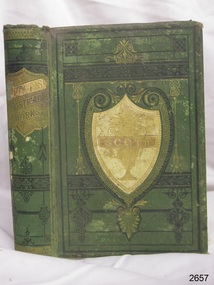
Book - Book of Poetry, Gall & Inglis, The Poetical Works of Sir Walter Scott, 1874-1880
... This helped cement the romantic, misty image of Scotland in the public imagination. ...Sir Walter Scott was the literary rock star of the 19th century, and the Edinburgh-based firm Gall & Inglis played a massive role in making his work accessible to the Victorian masses.The Poetical Works of Sir Walter Scott Author: Sir Walter Scott Publisher: Gall & Inglis fictionSir Walter Scott was the literary rock star of the 19th century, and the Edinburgh-based firm Gall & Inglis played a massive role in making his work accessible to the Victorian masses.warrnambool, shipwrecked-coast, flagstaff-hill, flagstaff-hill-maritime-museum, maritime-museum, shipwreck-coast, flagstaff-hill-maritime-village, book, the poetical works of sir walter scott, sir walter scott, poetry -
 Marysville & District Historical Society
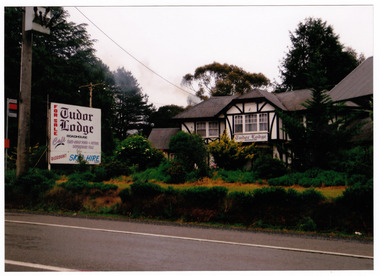
Photograph (item) - Colour photograph, Unknown
... After being known as Misty Hills Guest House it became Tudor Lodge Cafe then Tudor Lodge Roadhouse. ...A digital copy of a colour photograph of Tudor Lodge Roadhouse in Narbethong in Victoria.A digital copy of a colour photograph of Tudor Lodge Roadhouse in Narbethong in Victoria. After being known as Misty Hills Guest House it became Tudor Lodge Cafe then Tudor Lodge Roadhouse. The building was destroyed in the 2009 Black Saturday bushfires. The building was subsequently rebuilt albeit as a smaller building and was known as Wombat Cottage. That business was then sold and the property is now known as Oaktree Guest House.narbethong, victoria, tudor lodge roadhouse, photograph, accommodation, 2009 black saturday bushfires, oaktree guest house, misty hills guest house, tudor lodge cafe, wombat cottage
