
Showing 11 items matching "mobility aid"
-
 Bendigo Military Museum
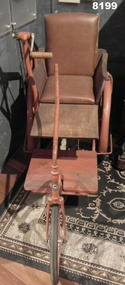
Accessory - WHEEL CHAIR MOBILITY AID, Webster Brothers, C.Post WW1
... WHEEL CHAIR MOBILITY AID...mobility...aid...This mobility aid was housed under the old stage area of the Soldiers Memorial Institute building in Pall Mall Bendigo. ...Three wheeled Mobility Aid. Front wheel is 41cm dia pneumatic, 32mm wide, rear wheel 68cm dia, width 52mm wide. ...This mobility aid was housed under the old stage area of the Soldiers Memorial Institute building in Pall Mall Bendigo. ...This mobility aid was housed under the old stage area of the Soldiers Memorial Institute building in Pall Mall Bendigo. When the renovations to the building began in late 2016 the Aid was removed and restored by the Bendigo District RSL Men in Sheds program and is now on display in the same building now called Bendigo Military Museum. The Soldiers Memorial was the HQ of the Bendigo RSL Sub Branch. It is not known the origin of the Aid but it was most likely used by disabled Bendigo RSL members post WW1.Three wheeled Mobility Aid. Front wheel is 41cm dia pneumatic, 32mm wide, rear wheel 68cm dia, width 52mm wide. The right wheel axle has a sprocket & chain assembly, the left is free wheeling, both have mud guards. Frame is tubular steel painted reddish colour, the seat and back rest are brown leather, seat sides are timber, there are two timber platforms in front, the top one is adjustable the bottom one is fixed. The chair is steered via a long metal handle fixed to the wheel frame. The right hand side has the sprocket and chain assembly and motion is controlled by turning the handle in a circular motion, only one speed.on the front wheel stem is a transfer. “Webster Brothers Cycle Manufacturers Mitchell Street Bendigo”mobility, aid, wheel chair, brsl, smirsl -
 Musculoskeletal Health Australia (now held by the Glen Eira Historical Society)
Photograph - Solo photo, 1999
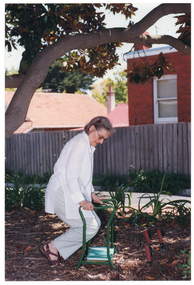
... In this photo, Glenda demonstrates how to use a 'garden kneeler' mobility aid to assist her in getting down to or up from a kneeling position....COL photo of a woman, from an upright position, pushing her arms down onto the armrests of a garden kneeler mobility aid. Her knees are bent at a 90 degree angle. ...In this photo, Glenda demonstrates how to use a 'garden kneeler' mobility aid to assist her in getting down to or up from a kneeling position. arthritis foundation of victoria afv arthritic aids mobility aids gardening aids gardening tools garden kneeler living with arthritis pain management arthritis update 1999 [On a yellow sticky note, in blue ink] Glenda Shalman Gardening COL photo of a woman, from an upright position, pushing her arms down onto the armrests of a garden kneeler mobility aid. ...In 1999, a series of photos were taken of Arthritis Victoria member, Glenda Shalman, demonstrating arthritis-friendly gardening tools and aids, and how to use them. Some of these photos were used to accompany an article in the Arthritis Foundation of Victoria's quarterly magazine, Arthritis Update. In this photo, Glenda demonstrates how to use a 'garden kneeler' mobility aid to assist her in getting down to or up from a kneeling position.COL photo of a woman, from an upright position, pushing her arms down onto the armrests of a garden kneeler mobility aid. Her knees are bent at a 90 degree angle. She is either lowering herself down to a kneeling position or getting back up from a kneeling to a standing position.[On a yellow sticky note, in blue ink] Glenda Shalman Gardeningarthritis foundation of victoria, afv, arthritic aids, mobility aids, gardening aids, gardening tools, garden kneeler, living with arthritis, pain management, arthritis update, 1999 -
 Musculoskeletal Health Australia (now held by the Glen Eira Historical Society)
Photograph - Solo photo, 1999
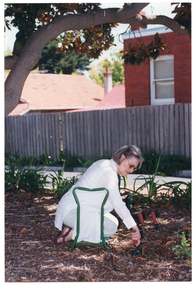
... In this photo, a woman demonstrates how to sit back on her calves and feet while kneeling on a 'garden kneeler' mobility aid. From this position, she leans forward to dig a small garden fork or trowel into the ground with one hand....COL photo of a woman sitting back on her calves and feet while kneeling on a 'garden kneeler' mobility aid. She is holding a small garden fork or trowel in one hand, which she has dug into the ground. ...In this photo, a woman demonstrates how to sit back on her calves and feet while kneeling on a 'garden kneeler' mobility aid. From this position, she leans forward to dig a small garden fork or trowel into the ground with one hand. arthritis foundation of victoria afv arthritic aids mobility aids gardening aids gardening tools garden kneeler living with arthritis pain management arthritis update 1999 [On a yellow sticky note, in blue ink] Glenda Shalman Gardening COL photo of a woman sitting back on her calves and feet while kneeling on a 'garden kneeler' mobility aid. ...In 1999, a series of photos were taken of Arthritis Victoria member, Glenda Shalman, demonstrating arthritis-friendly gardening tools and aids, and how to use them. Some of these photos were used to accompany an article in the Arthritis Foundation of Victoria's quarterly magazine, Arthritis Update. In this photo, a woman demonstrates how to sit back on her calves and feet while kneeling on a 'garden kneeler' mobility aid. From this position, she leans forward to dig a small garden fork or trowel into the ground with one hand.COL photo of a woman sitting back on her calves and feet while kneeling on a 'garden kneeler' mobility aid. She is holding a small garden fork or trowel in one hand, which she has dug into the ground. There are two other garden forks or trowels pushed into the ground in front of her. She is positioned beneath a large tree. In the background, some houses are visible from behind a wooden fence.[On a yellow sticky note, in blue ink] Glenda Shalman Gardeningarthritis foundation of victoria, afv, arthritic aids, mobility aids, gardening aids, gardening tools, garden kneeler, living with arthritis, pain management, arthritis update, 1999 -
 Flagstaff Hill Maritime Museum and Village
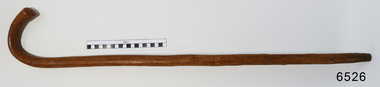
Accessory - Walking Stick, William Dale, early 1900's
... ...mobility aid...The handmade walking stick was made from local resources. flagstaff hill warrnaflagstaff hill warrnambool shipwrecked coast flagstaff hill maritime museum maritime museum shipwreck coast flagstaff hill maritime village great ocean road chamberlain dale lees stone betty stone warrnambool pioneers mbool shipwrecked-coast flagstaff-hill flagstaff-hill-maritime-museum maritime-museum shipwreck-coast flagstaff-hill-maritime-village dale bluestone quarries william dale walking aid walking stick mobility aid Walking Stick, polished wood with grain and knots showing. ...In the words of the Donor, Betty Stone, "This walking stick was made by William Dale from wood obtained from his property Bluestone Quarries situated at Wangoom, Warrnambool. William Dale, the son of William Booth and Hannah (nee Broadbent) Dale was born on 8 July 1828 in Saddleworth, Yorkshire, England. He emigrated to Australia in 1852 and seven years later purchased twenty acres of land in the shire of Wangoom, Warrnambool where he operated a quarry known as The Dale Bluestone Quarries. According to family legend, when William and his wife Elizabeth (nee Chamberlain) first moved into their bluestone cottage on the property, it was surrounded by dense bush that abounded with wildlife. William Dale used this walking stick in his later years. Although physically bent after years of toil, his grandchildren remembered him wheeling his barrow and walking with his stick around the quarries when aged well over eighty years. William Dale died at his residence on 14 December 1913 aged 85 years." (Note: For additional information please refer to Betty Stone’s book “Pioneers and Places - A History of three Warrnambool Pioneering Families” ie. Chamberlain, Dale and Lees Families) This item is associated with the families of Chamberlain, Dale and Lees. These families are listed in the "Pioneers' Register" for Warrnambool Township and Shire, 1835-1900, published by A.I.G.S. Warrnambool Branch. The handmade walking stick was made from local resources.Walking Stick, polished wood with grain and knots showing. Brass tip, 'J' shaped handle. Made by William Dale in the early 1900's of wood from his property, "Dale Bluestone Quarries", Wangoom, Warrnambool. From the 'Chamberlain Dale and Lees Collection'.flagstaff hill, warrnaflagstaff hill, warrnambool, shipwrecked coast, flagstaff hill maritime museum, maritime museum, shipwreck coast, flagstaff hill maritime village, great ocean road, chamberlain, dale, lees, stone, betty stone, warrnambool pioneers, mbool, shipwrecked-coast, flagstaff-hill, flagstaff-hill-maritime-museum, maritime-museum, shipwreck-coast, flagstaff-hill-maritime-village, dale bluestone quarries, william dale, walking aid, walking stick, mobility aid -
 Clunes Museum
Functional object - WALKING STICK
... ...MOBILITY AID...WALKING AID MOBILITY AID BAMBOO WITH WOVEN LEATHER AT TOP OF SHAFT AND WOVEN LEATHER KNOB Functional object WALKING STICK ...BAMBOO WITH WOVEN LEATHER AT TOP OF SHAFT AND WOVEN LEATHER KNOBwalking aid, mobility aid -
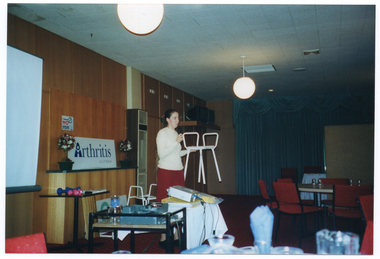 Musculoskeletal Health Australia (now held by the Glen Eira Historical Society)
Photograph - Solo photo, Circa 1990s
... COL photo of a woman holding up a shower stool mobility aid. Behind her is a toilet chair mobility aid. ...Various mobility aids are available for attendees to look at as she explains their function and how to use them safely. arthritis foundation of victoria afv rheumatism and arthritis association of victoria raav arthritic aids mobility aids shower chair toilet seat riser gym weights safety living with arthritis pain management 1990s COL photo of a woman holding up a shower stool mobility aid. Behind her is a toilet chair mobility aid. ...Since its inception, the Arthritis Foundation of Victoria (AFV), formerly the Rheumatism and Arthritis Association of Victoria (RAAV), has sought to inform and educate its members in all manner of things related to their condition. In this photo, a woman is conducting a presentation on mobility aids. Various mobility aids are available for attendees to look at as she explains their function and how to use them safely.COL photo of a woman holding up a shower stool mobility aid. Behind her is a toilet chair mobility aid. Beside her is a table and a slide projecter. Behind her is another table with some gym hand weights, a large Arthritis Victoria sign, and a projector screen on the wall. Tables and chairs are visible in the room, which is a large hall.arthritis foundation of victoria, afv, rheumatism and arthritis association of victoria, raav, arthritic aids, mobility aids, shower chair, toilet seat riser, gym weights, safety, living with arthritis, pain management, 1990s -
 Flagstaff Hill Maritime Museum and Village
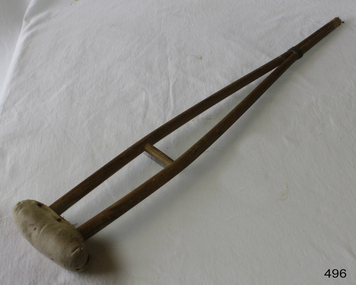
Equipment - Crutch
... By helping to bear their body weight, crutches aid mobility in people with either short-term injuries to life-long disabilities. ...By helping to bear their body weight, crutches aid mobility in people with either short-term injuries to life-long disabilities. ...“Alas for Tiny Tim, he bore a little crutch, and had his limbs supported by an iron frame!” A Christmas Carol has long proved one of Dickens’ most popular works. Debate still continues over what disease afflicted poor Tiny Tim, but I find it interesting to think about the crutch he used. As a child, crutches were almost a hallmark of the adventurous, from falling out of trees to the consequence of a luxurious skiing accident. Broadly speaking, a crutch is a medical device which helps a person walk from one spot to another. By helping to bear their body weight, crutches aid mobility in people with either short-term injuries to life-long disabilities. The first evidence of their use dates back to the time of the Pharaohs, clearly visible in a carving dating to nearly 3000 BCE. The earliest crutches were essentially a T-shaped design, which slowly morphed into the more popular V-shape in use today. They were made form a piece of hardwood cut to length, and split near the top to create this V-shape. A wooden underarm piece could then be attached for both underarm and handle use. Although uncomfortable as they lacked cushioning, they proved effective. Today, crutches are essentially of two basic designs. Canadian, Lofstrand or forearm crutches are the more popular design used outside of America. They have cuffs which give forearm support, along with grips which allow the user to either hold or rest their hands. These act together to help support the patient’s weight. These type of crutches tend to offer the best alternative for long-term use, and for people with impaired upper body strength. Perhaps for these reasons, underarm or axillary crutches are more commonly used in the States. These consist of a pad designed to rest below the armpit and against the rib cage, along with a hand support parallel to this. The body’s weight is taken by the hands, not the armpit; if used incorrectly, a condition known as crutch paralysis, or crutch palsy can arise from pressure on nerves in the armpit, or axilla. In 1917 Emile Schlick patented the first commercially-produced crutch, catering to the need of wounded returning WWI soldiers. Later, the first customisable crutches – they had a height-adjustable frame – were designed by A.R. Lofstrand, Jr. Crutch mills soon became common through out New England, some of which remain in production today, using production methods dating back to the Civil War. Plus, both types of crutches offer an alternative use: they are ideal for poking people to gain attention. And so back to Tiny Tim. In the 1860s, William Treloar, future Lord Mayor of London, became inspired to help crippled children after attending a public reading of A Christmas Carol. He established the Lord Mayor Treloar Cripple’s Hospital and College, in Alton, where pioneering orthopaedic treatments were used to help children deformed by tuberculosis and other diseases. The hospital closed in 1994. https://bonesurgeon.com.au/crutches-history/ This child's crutch was donated to Flagstaff Hill Maritime Village by the family of Doctor William Roy Angus, Surgeon and Oculist. It is part of the “W.R. Angus Collection” includes historical medical equipment, surgical instruments and material once belonging to Dr Edward Ryan and Dr Thomas Francis Ryan, (both of Nhill, Victoria) as well as Dr Angus’ own belongings. The Collection’s history spans the medical practices of the two Doctors Ryan, from 1885-1926 plus that of Dr Angus, up until 1969. ABOUT THE “W.R.ANGUS COLLECTION” Doctor William Roy Angus M.B., B.S., Adel., 1923, F.R.C.S. Edin.,1928 (also known as Dr Roy Angus) was born in Murrumbeena, Victoria in 1901 and lived until 1970. He qualified as a doctor in 1923 at University of Adelaide, was Resident Medical Officer at the Royal Adelaide Hospital in 1924 and for a period was house surgeon to Sir (then Mr.) Henry Simpson Newland. Dr Angus was briefly an Assistant to Dr Riddell of Kapunda, then commenced private practice at Curramulka, Yorke Peninsula, SA, where he was physician, surgeon and chemist. In 1926, he was appointed as new Medical Assistant to Dr Thomas Francis Ryan (T.F. Ryan, or Tom), in Nhill, Victoria, where his experiences included radiology and pharmacy. In 1927 he was Acting House Surgeon in Dr Tom Ryan’s absence. Dr Angus had become engaged to Gladys Forsyth and they decided he further his studies overseas in the UK in 1927. He studied at London University College Hospital and at Edinburgh Royal Infirmary and in 1928, was awarded FRCS (Fellow from the Royal College of Surgeons), Edinburgh. He worked his passage back to Australia as a Ship’s Surgeon on the on the Australian Commonwealth Line’s T.S.S. Largs Bay. Dr Angus married Gladys in 1929, in Ballarat. (They went on to have one son (Graham 1932, born in SA) and two daughters (Helen (died 12/07/1996) and Berenice (Berry), both born at Mira, Nhill ) According to Berry, her mother Gladys made a lot of their clothes. She was very talented and did some lovely embroidery including lingerie for her trousseau and beautifully handmade baby clothes. Dr Angus was a ‘flying doctor’ for the A.I.M. (Australian Inland Ministry) Aerial Medical Service in 1928 . Its first station was in the remote town of Oodnadatta, where Dr Angus was stationed. He was locum tenens there on North-South Railway at 21 Mile Camp. He took up this ‘flying doctor’ position in response to a call from Dr John Flynn; the organisation was later known as the Flying Doctor Service, then the Royal Flying Doctor Service. A lot of his work during this time involved dental surgery also. Between 1928-1932 he was surgeon at the Curramulka Hospital, Yorke Peninsula, South Australia. In 1933 Dr Angus returned to Nhill and purchased a share of the Nelson Street practice and Mira hospital (a 2 bed ward at the Nelson Street Practice) from Dr Les Middleton one of the Middleton Brothers, the current owners of what previously once Dr Tom Ryan’s practice. Dr Tom and his brother had worked as surgeons included eye surgery. Dr Tom Ryan performed many of his operations in the Mira private hospital on his premises. He had been House Surgeon at the Nhill Hospital 1902-1926. Dr Tom Ryan had one of the only two pieces of radiology equipment in Victoria during his practicing years – The Royal Melbourne Hospital had the other one. Over the years Dr Tom Ryan had gradually set up what was effectively a training school for country general-practitioner-surgeons. Each patient was carefully examined, including using the X-ray machine, and any surgery was discussed and planned with Dr Ryan’s assistants several days in advance. Dr Angus gained experience in using the X-ray machine there during his time as assistant to Dr Ryan. When Dr Angus bought into the Nelson Street premises in Nhill he was also appointed as the Nhill Hospital’s Honorary House Surgeon 1933-1938. His practitioner’s plate from his Nhill surgery is now mounted on the doorway to the Port Medical Office at Flagstaff Hill Maritime Village, Warrnambool. When Dr Angus took up practice in the Dr Edward and Dr Tom Ryan’s old premises he obtained their extensive collection of historical medical equipment and materials spanning 1884-1926. A large part of this collection is now on display at the Port Medical Office at Flagstaff Hill Maritime Village in Warrnambool. In 1939 Dr Angus and his family moved to Warrnambool where he purchased “Birchwood,” the 1852 home and medical practice of Dr John Hunter Henderson, at 214 Koroit Street. (This property was sold in1965 to the State Government and is now the site of the Warrnambool Police Station. and an ALDI sore is on the land that was once their tennis court). The Angus family was able to afford gardeners, cooks and maids; their home was a popular place for visiting dignitaries to stay whilst visiting Warrnambool. Dr Angus had his own silk worm farm at home in a Mulberry tree. His young daughter used his centrifuge for spinning the silk. Dr Angus was appointed on a part-time basis as Port Medical Officer (Health Officer) in Warrnambool and held this position until the 1940’s when the government no longer required the service of a Port Medical Officer in Warrnambool; he was thus Warrnambool’s last serving Port Medical Officer. (Masters of immigrant ships arriving in port reported incidents of diseases, illness and death and the Port Medical Officer made a decision on whether the ship required Quarantine and for how long, in this way preventing contagious illness from spreading from new immigrants to the residents already in the colony.) Dr Angus was a member of the Australian Medical Association, for 35 years and surgeon at the Warrnambool Base Hospital 1939-1942, He served with the Australian Department of Defence as a Surgeon Captain during WWII 1942-45, in Ballarat, Victoria, and in Bonegilla, N.S.W., completing his service just before the end of the war due to suffering from a heart attack. During his convalescence he carved an intricate and ‘most artistic’ chess set from the material that dentures were made from. He then studied ophthalmology at the Royal Melbourne Eye and Ear Hospital and created cosmetically superior artificial eyes by pioneering using the intrascleral cartilage. Angus received accolades from the Ophthalmological Society of Australasia for this work. He returned to Warrnambool to commence practice as an ophthalmologist, pioneering in artificial eye improvements. He was Honorary Consultant Ophthalmologist to Warrnambool Base Hospital for 31 years. He made monthly visits to Portland as a visiting surgeon, to perform eye surgery. He represented the Victorian South-West subdivision of the Australian Medical Association as its secretary between 1949 and 1956 and as chairman from 1956 to 1958. In 1968 Dr Angus was elected member of Spain’s Barraquer Institute of Barcelona after his research work in Intrasclearal cartilage grafting, becoming one of the few Australian ophthalmologists to receive this honour, and in the following year presented his final paper on Living Intrasclearal Cartilage Implants at the Inaugural Meeting of the Australian College of Ophthalmologists in Melbourne In his personal life Dr Angus was a Presbyterian and treated Sunday as a Sabbath, a day of rest. He would visit 3 or 4 country patients on a Sunday, taking his children along ‘for the ride’ and to visit with him. Sunday evenings he would play the pianola and sing Scottish songs to his family. One of Dr Angus’ patients was Margaret MacKenzie, author of a book on local shipwrecks that she’d seen as an eye witness from the late 1880’s in Peterborough, Victoria. In the early 1950’s Dr Angus, painted a picture of a shipwreck for the cover jacket of Margaret’s book, Shipwrecks and More Shipwrecks. She was blind in later life and her daughter wrote the actual book for her. Dr Angus and his wife Gladys were very involved in Warrnambool’s society with a strong interest in civic affairs. He had an interest in people and the community They were both involved in the creation of Flagstaff Hill, including the layout of the gardens. After his death (28th March 1970) his family requested his practitioner’s plate, medical instruments and some personal belongings be displayed in the Port Medical Office surgery at Flagstaff Hill Maritime Village, and be called the “W. R. Angus Collection”.The W.R. Angus Collection is significant for still being located at the site it is connected with, Doctor Angus being the last Port Medical Officer in Warrnambool. The collection of medical instruments and other equipment is culturally significant, being an historical example of medicine from late 19th to mid-20th century. Dr Angus assisted Dr Tom Ryan, a pioneer in the use of X-rays and in ocular surgery.A crutch only suitable for a small child with padded armpit rest. Constructed with wooden joints. Padding nailed on.None.flagstaff hill, warrnambool, shipwrecked-coast, flagstaff-hill, flagstaff-hill-maritime-museum, maritime-museum, shipwreck-coast, flagstaff-hill-maritime-village, crutches, fractures, children's medical support -
 Vision Australia
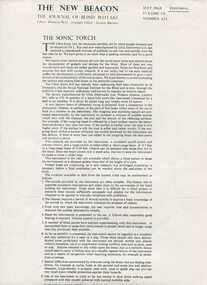
Document - Text, The Sonic Torch, 1968
... Aid produced by Ultra Electronics. Collected by C.H. Nipper during his writing of 'The Past and the Present 1866-1971' (a history of the RVIB). Royal Victorian Institute for the Blind Orientation and mobility 1 photocopied page from magazine The Sonic Torch Document Text ...Copy of review in the The New Beacon: the journal of blind welfare magazine (May 1968, Vol LH, no. 613) on the Ultra Sonic Aid produced by Ultra Electronics. Collected by C.H. Nipper during his writing of 'The Past and the Present 1866-1971' (a history of the RVIB). 1 photocopied page from magazineroyal victorian institute for the blind, orientation and mobility -
 Vision Australia
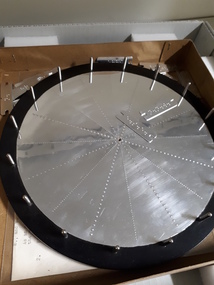
Equipment - Object, Instructional compass with plates
... aid for learning the points of the compass. A circular aluminium plate mounted on a wooden base and embossed with 16 raised lines radiating from the center. 16 small plates each brailled with a different compass direction are provided. The set is accompanied by an instruction sheet. Assistive devices Orientation and mobility ...An aid for learning the points of the compass. A circular aluminium plate mounted on a wooden base and embossed with 16 raised lines radiating from the center. 16 small plates each brailled with a different compass direction are provided. The set is accompanied by an instruction sheet. 1 silver aluminium plate on a larger black wooden circle with 16 metal spikes around edge housed in a cardboard box and 16 rectangular aluminum plates.assistive devices, orientation and mobility -
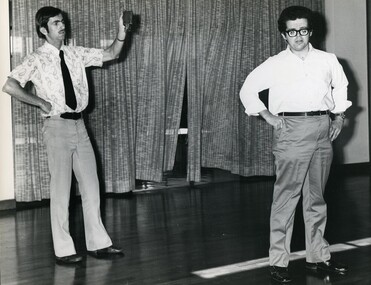 Vision Australia
Photograph - Image, Mitchell Street Theater rehearsal
... aid who appears to be talking to the man behind him. This image was possibly taken from a play performed by staff in the 1970s. Royal Blind Society of NSW Mitchell Street Theatre A106E5 Mobility - current B/W photograph of two man performing a sketch Mitchell Street Theater rehearsal Photograph Image ...Two men stand on a stage, one holding a key wallet out in front of him, and the other with a pair of comic glasses and a hearing aid who appears to be talking to the man behind him. This image was possibly taken from a play performed by staff in the 1970s.B/W photograph of two man performing a sketchA106E5 Mobility - currentroyal blind society of nsw, mitchell street theatre -
Musculoskeletal Health Australia (now held by the Glen Eira Historical Society)
Photograph - Objects, 1981-1982
... mobility or arthritic aids are arranged on a board. Each item is numbered, from 1 to 9. This photo appears on page 5 of the Vol 24, March 1982 issue of RAAV's News Review. It accompanies an article titled, "COULD ONE OF THESE HELP YOU?". The article begins with the paragraph, "The publication of this photo in the Herald brought so many enquiries to the Resource Centre we de-cided to reprint it in News Review, together with a brief description of each aid." ...mobility or arthritic aids are arranged on a board. Each item is numbered, from 1 to 9. This photo appears on page 5 of the Vol 24, March 1982 issue of RAAV's News Review. It accompanies an article titled, "COULD ONE OF THESE HELP YOU?". The article begins with the paragraph, "The publication of this photo in the Herald brought so many enquiries to the Resource Centre we de-cided to reprint it in News Review, together with a brief description of each aid." ...A range of mobility or arthritic aids are arranged on a board. Each item is numbered, from 1 to 9. This photo appears on page 5 of the Vol 24, March 1982 issue of RAAV's News Review. It accompanies an article titled, "COULD ONE OF THESE HELP YOU?". The article begins with the paragraph, "The publication of this photo in the Herald brought so many enquiries to the Resource Centre we de-cided to reprint it in News Review, together with a brief description of each aid." The photo is captioned: Photo courtesy of the "Herald" .B&W photo of various arthritic and/or mobility aids arranged on a board. Each item has been numbered, from 1 to 9.rheumatism and arthritis association of victoria, raav, arthritic aids, kitchen utensils, kitchen aids, kitchen gadgets, mobility aids, display, expo, pain management, news review, 1981, 1982
