
Showing 179 items matching "model maker"
-
 Flagstaff Hill Maritime Museum and Village
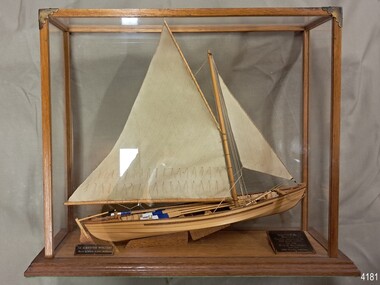
Craft - Ship Model, Whaleboat, Wally St John (ship model maker), New Bedford, 1988
... Wally St John (ship model maker)...New Bedford Craft Ship Model, Whaleboat Wally St John (ship model maker) Warrnambool City Council (WCC) ...The whaleboat model was built for the 1988 Warrnambool Wunta Festival by Wally St John, of Melbourne. Its name comes from the port of New Bedford in Massachusetts, America. Coastal whaling in the area began in the 17th Century, and by the mid-18th century, it was performed on a large scale. The town is renowned for the author, Herman Melville, who sailed out on the whaler "Acushnet" in 1841. When he returned, he published his book about the great white whale "Moby Dick". The Wunta Festival began in 1985. In 1988, it was sponsored by the Warrnambool City Council and Mr. Alan Lane, a Warrnambool businessman who served on the Council for 18 years. The festival is held on the first weekend in February and involves the whole community. One of the activities is the Whaleboat Race. International whaleboat racing began in 1805 with a race between America and Britain. The City of Warrnambool Rowing Club started the whaleboat race in 1986 as part of the Wunta festival, and a Whaleboat Club was soon formed. The race is held on the Hopkins River. The ship model of the whaleboat, New Bedford, is significant because it represents vessels used in the early industry of whaling in southwest Victoria. It is also representative of the centuries-old craft of ship model making. It is important for its connection to the Wunta Festival, a Warrnambool community event. It is connected to Mr. Alan L Lane, whose estate generously funded the Alan Lane Foundation for the continuous support and funding of local community events and activities. Ship model of a whaleboat. The boat has two fabric sails, a tiller, and four wooden oars with blue and white sections painted on the blades. The model is mounted on a wooden stand inside a glass case with a wooden frame. Two gold embossed black plaques are on the base of the case, on the front. The plaques have decorative borders and inscriptions. The model of the New Bedford Whaleboat, built by Wally St John, Melbourne, was made for the 1988 WUNTA Festival in Warrnambool. Left plaque: "THE NEW BEDFORD WHALEBOAT / Built by Wally St John Melbourne" Right plaque: "]Logo of a Triangle with "WUNTA festival" "Proudly sponsored by Mr. ALAN LANE for the City of Warrnambool and 1988 Wunta Festival"flagstaff hill, flagstaff hill maritime museum and village, warrnambool, maritime museum, maritime village, great ocean road, shipwreck coast, whaleboat, ship model, vessel, 1988, wunta, wunta festival, wally st john, melbourne, new bedford, massachusetts, america, coastal whaling, herman melville, acushnet, alan lane, alan lane foundation, councillor, whaleboat race, warrnambool rowing club, hopkins river -
 Flagstaff Hill Maritime Museum and Village
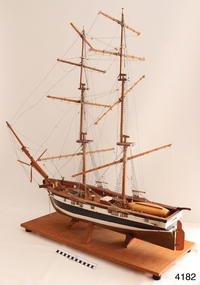
Craft - Ship Model, Mr Edward Howard Grainger (ship model maker), Skylark, circa 1980s
... Mr Edward Howard Grainger (ship model maker)...Skylark Craft Ship Model Mr Edward Howard Grainger (ship model maker) ...This handmade ship model was built and donated by mr E H Grainger in the late 20th century. The warship represents the British Sloop, Seagull Class, HMS Skylark 1806-1812. The brig-rigged, two-masted HMS Skylark was built at William Rowes' Yard on the River Tyne for the Royal Navy of the United Kingdom in 1806. The ship was armed with 14 British 24-pound Carronades and 2 British 6-pounders. It could carry a crew of 95. This model is an example of the craft of ship model making, which has been a popular hobby for hundreds of years. Our collection has many ship models, some of which were built by professional model makers, others by naval enthusiasts. The model is also an example of British warships that predate the colonisation of Australia.Ship model, Skylark. 2-masted sailing ship, hull painted, with a white strip on white. Separate wooden lifeboat. "Skylark" on each side of the bow and across the stern. The rudder pivots. Mounted on a timber stand. Model built by Mr E.H. Grainger."SKYLARK" on both sides of the bow. "SKYLARK HULL" across bowflagstaff hill, flagstaff hill maritime museum and village, warrnambool, maritime museum, maritime village, great ocean road, shipwreck coast, ship model, skylark, two-masted ship, sailing ship, hobby, war ship, hms skylark, british sloop, british brig, carronade, brig of war, 1806 -
 Moorabbin Air Museum
Document (series) - Correspondence re model making between Dr Michael Gibson and Peter Cooke Model Maker
... Correspondence re model making between Dr Michael Gibson and Peter Cooke Model Maker...Document Correspondence re model making between Dr Michael Gibson and Peter Cooke Model Maker ... -
 Williamstown Historical Society Inc
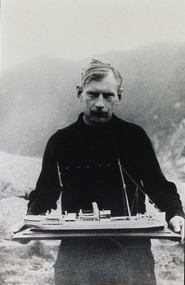
Photograph - Model ship "Lady Loch" with maker
... Model ship "Lady Loch" with maker...Model maker...The maker of the "Lady Loch" model, holding his model. He was reputed to be a Polish crewman on the ship. ...By 1908 it was being used as a Commonealth lighthouse tender. Model maker Model ship Lady Loch The maker of the "Lady Loch" model, holding his model. ...SS Lady Loch was built in Melbourne, in Footscray, by Anderson Campbell. The ship was named after Lady Elizabeth Loch, wife of Sir Henry Loch, Governor of Victoria from 1884 -1889. It was originally used by the Victorian Ports and Harbours Branch for coastal and bay work. By 1908 it was being used as a Commonealth lighthouse tender. The maker of the "Lady Loch" model, holding his model. He was reputed to be a Polish crewman on the ship. He is dressed in a dark jumper, with a view of waves and a rugged coastline in the background. model maker, model ship, lady loch -
 Flagstaff Hill Maritime Museum and Village
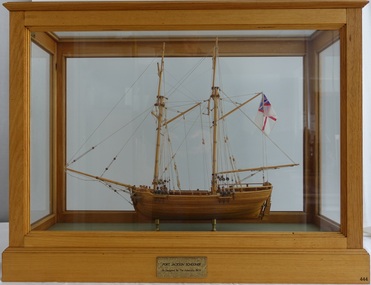
Craft - Ship Model, Port Jackson Schooner
... ...model maker bill leonard...The colonial Port Jackson schooner is considered significant to Australian history, and represented on the 1994 twenty dollar banknote and its new version being rolled out in October 2019. flagstaff hill warrnambool shipwrecked-coast flagstaff-hill flagstaff-hill-maritime-museum maritime-museum shipwreck-coast flagstaff-hill-maritime-village ship model port jackson schooner sailing ship limited edition model model maker bill leonard david mcgregor design maritime trade maritime vessel colonial port jackson schooner pacific island trade in early 1800s sydney cove governor arthur phillip governor philip gidley king a schooner for port jackson national maritime museum greenwich australian $20 banknote Engraved on metal plaque "PORT JACKSON SCHOONER / As Designed By The Admiralty. 1803" Ship model of a colonial Port Jackson Schooner. ...This ship model is of a Colonial Port Jackson schooner, originally designed by the British Admiralty in 1803 as a response to the request of New South Wales' Governor Arthur Phillip. The drafts for the original plans are in Greenwich, UK, in the National Maritime Museum. The model is a Ledition edition, number 2 of 5, modelled by Bill Leonard. The model is rigged and decked in the manner of David McGregor. The flag on model of Port Jackson schooner is that of the British White Ensign which was used as the flag design of the Royal Australian Navy from 1911 - 1967. In 1785 the First Fleet arrived in the new British colony of Port Jackson (now Sydney Harbour) in New South Wales and Arthur Phillip was appointed as the first Governor. The following year Governor Phillip asked the English Royal Navy to provide drafts and materials for two ships for use in the Port Jackson colony for exploring and surveying rivers. The vessels needed a shallow draught and to be made from local cedar timber. He asked for the frames of the schooners to be provided along with shipwrights to assemble them. Many years later, in 1803, Governor Phillip’s request was fulfilled but he had already resigned from his post. The drafts titled ‘Schooner for Port Jackson’ were despatched by the Royal Navy from England to Australia. The original draft is still in the National Maritime Museum in Greenwich, UK. Meanwhile, the NSW Government had already built various other ships before 1803. In 1797 His Majesty’s Dockyard was opened at Port Jackson for building larger vessels. The Royal Navy’s 1803 design of a ‘Schooner for Port Jackson’ has been recognised on the obverse of Australia’s twenty dollar banknote since 1994. A sketch of the schooner is beside the portrait of Mrs Mary Reibey, who arrived as a convict and rose to become a respected and successful owner of a cargo shipping business. Her fleet included the Mercury, a schooner similar to the 1803 design for the Port Jackson schooner. Although the 1803 plans for a ‘Schooner for Port Jackson’ are commonly believed to be used for the first ship built in Australia, no records have been found of any ships being built according to these plans. However, it can be claimed that the plans were the ‘first Royal Navy plans made for a ship for use at Port Jackson, and to be built at Port Jackson, in Australia’. William (Bill) Leonard passed away on March 1st 1995.This ship model is significant for its representation of an early Australian colonial schooner. The 1803 Royal Navy’s plans for the colonial ‘Schooner for Port Jackson, were for the first ship specifically designed by the Royal Navy to be built and used in Port Jackson, for use in exploration and surveying of Australian ports and rivers. The plans are associated with Australia’s colonial settlement in the late 1700s. This ship model is significant for its association with the emblems of Australia’s history on the twenty dollar banknote. The colonial Port Jackson schooner is considered significant to Australian history, and represented on the 1994 twenty dollar banknote and its new version being rolled out in October 2019.Ship model of a colonial Port Jackson Schooner. Two-masted sailing ship displaying the flag named The British White Ensign. Mode of light coloured stained timberl is mounted on brass legs inside a glass case with timber frame and base. Metal engraved plaque states that the model is as designed by The Admiralty in 1803. Model is a number 2 of 5 in a limited edition, made by Bill Leonard.Engraved on metal plaque "PORT JACKSON SCHOONER / As Designed By The Admiralty. 1803"flagstaff hill, warrnambool, shipwrecked-coast, flagstaff-hill, flagstaff-hill-maritime-museum, maritime-museum, shipwreck-coast, flagstaff-hill-maritime-village, ship model port jackson schooner, sailing ship, limited edition model, model maker bill leonard, david mcgregor design, maritime trade, maritime vessel, colonial port jackson schooner, pacific island trade in early 1800s, sydney cove, governor arthur phillip, governor philip gidley king, a schooner for port jackson, national maritime museum greenwich, australian $20 banknote -
 Flagstaff Hill Maritime Museum and Village
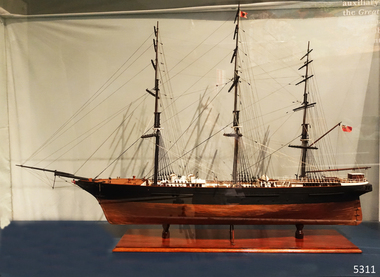
Craft - Ship Model, S.S. Schomberg, 1988
... ...ship model maker...The collection as a whole is historically significant for representing aspects of Victoria's maritime history and its potential to interpret social and historical themes from society at the time of the wreck. flagstaff hill warrnambool shipwrecked-coast flagstaff-hill flagstaff-hill-maritime-museum maritime-museum shipwreck-coast flagstaff-hill-maritime-village ship model schomberg ship model 1855 david lumsden ship model maker clipper ship black ball line 1855 shipwreck aberdeen clipper ship captain forbes peterborough shipwreck ss queen None Wooden model of the clipper ship SS Schomberg. ...This model of the clipper ship SS Schomberg was researched and constructed to a scale of 1:64 by David Lumsden in 1988. When the Schomberg was launched in 1855, she was considered the "Noblest” ship that ever floated on the water. Schomberg's owners, the Black Ball Line had commissioned the ship for their fleet of passenger liners. She was built by Alexander Hall of Aberdeen for £43,103 and constructed with 3 skins. One planked fore and aft and two diagonally planked, fastened together with screw-threaded trunnels (wooden rails). Her First Class accommodation was simply luxurious with velvet pile carpets, large mirrors, rosewood, birds-eye maple and mahogany timbers throughout, soft furnishings of satin damask, and oak-lined library with a piano. Overall she had accommodation for 1000 passengers. At the launch, the Schomberg's 34-year-old master, Captain 'Bully' Forbes, had promised to reach Melbourne in sixty days stating, "with or without the help of God." Captain James Nicol Forbes was born in Aberdeen in 1821 and rose to fame with his record-breaking voyages on the famous Black Ball Line ships; Marco Polo and Lightning. In 1852 in the Marco Polo, he made the record passage from London to Melbourne in 68 days. Unfortunately, there were 53 deaths on the voyage, but the great news was off the record passage by Captain Forbes. In 1854 he took the clipper “Lighting” to Melbourne in 76 days and back in 63 days, this record was never beaten by a sailing ship. He often drove his crew and ship to breaking point to beat his previous records. He cared little for the comfort of the passengers. On this, the Schomberg's maiden voyage, he was determined to break existing records. Schomberg departed Liverpool on her maiden voyage on 6th October 1855 flying a sign that read "Sixty Days to Melbourne". She departed with 430 passengers and 3000 tons cargo including iron rails and equipment intended to build the Melbourne to Geelong Railway and a bridge over the Yarra from Melbourne to Hawthorn. She also carried a cow for fresh milk, pens for fowls and pigs, 90,000 gallons of water for washing and drinking. She also carried 17,000 letters and 31,800 newspapers. The ship and cargo were insured for $300,000 a fortune for the time. The winds were poor as she sailed across the equator, slowing Schomberg's journey considerably. The land was first sighted on Christmas Day, at Cape Bridgewater near Portland, Captain Forbes followed the coastline towards Melbourne. Forbes was said to be playing cards when called by the third mate Henry Keen, who reported land about 3 miles off. Due in large part to the captain's regarding a card game as more important than his ship, it eventually ran aground on a sand spit near Curdie's Inlet (about 56 km west of Cape Otway) on 26th December 1855, 78 days after leaving Liverpool. The sand spit and the currents were not marked on Forbes's map. Overnight, the crew launched a lifeboat to find a safe place to land the ship’s passengers. The scouting party returned to Schomberg and advised Forbes that it was best to wait until morning because the rough seas could easily overturn the small lifeboats. The ship’s Chief Officer spotted the SS Queen at dawn and signaled the steamer. The master of the Queen approached the stranded vessel and all of Schomberg’s passengers and crew disembarked safely. The Black Ball Line's Melbourne agent sent a steamer to retrieve the passengers' baggage from the Schomberg. Other steamers helped unload her cargo until the weather changed and prevented the salvage teams from accessing the ship. Later one plunderer found a case of Wellington boots, but alas, all were for the left foot. Local merchants Manifold & Bostock bought the wreck and cargo but did not attempt to salvage the cargo still on board the ship. They eventually sold it on to a Melbourne businessman and two seafarers. In 1864 after two of the men drowned when they tried to reach Schomberg, salvage efforts were abandoned. In 1870, nearly 15 years after the wreck parts of the Schomberg had washed ashore on the south island of New Zealand. The wreck now lies in almost 9 metres of water and although the woodwork is mostly disintegrated the shape of the ship can still be determined due to the remaining railway irons, girders and the ship’s frame. A variety of goods and materials can be seen scattered about nearby. There have been many other artefacts salvaged from the wreck include ship fittings and equipment, personal effects, a lithograph, tickets and photographs from the Schomberg. This item was retrieved from the shipwreck site during early salvage efforts on the vessel. And was donated to the Flagstaff Hill collection of Schomberg shipwreck artefacts.This artifact is particularly significant in that along with other items salvaged from the wreck have helped in part to having legislation changed to protect shipwrecks, with far tighter controls being employed to oversee the salvaging of wreck sites. This item forms part of the Schomberg collection at Flagstaff Hill maritime museum. The collection as a whole is of historical and archaeological significance at a State level. Flagstaff Hill’s collection of artefacts from the Schomberg is also significant for its association with the Victorian Heritage Registered Schomberg shipwreck (VHR S 612). The collection is of additional significance because of the relationship between the objects salvaged, as together they help us to interpret the story of the Schomberg. The collection as a whole is historically significant for representing aspects of Victoria's maritime history and its potential to interpret social and historical themes from society at the time of the wreck.Wooden model of the clipper ship SS Schomberg. The three masts are rigged with lines but have no sails. The model is mounted on pedestals on a timber board, exhibited in a glass case. The scale of this model is 1:64.Noneflagstaff hill, warrnambool, shipwrecked-coast, flagstaff-hill, flagstaff-hill-maritime-museum, maritime-museum, shipwreck-coast, flagstaff-hill-maritime-village, ship model, schomberg ship model, 1855, david lumsden, ship model maker, clipper ship, black ball line, 1855 shipwreck, aberdeen clipper ship, captain forbes, peterborough shipwreck, ss queen -
 Federation University Historical Collection
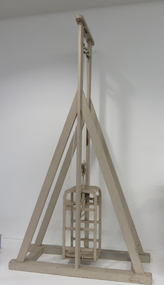
Unknown - Object, Allan Mine Cage Safety Brake, c1873, c1873
... model...machine maker...maker of Creswick Rd, Ballarat. He said his cage featured a ‘dissolving’ fulcrum. Others called it an eccentric (off centre) system. Note the pair of clutch levers designed to grab the side guides if tension ceases in the suspending rope from the poppet head pulley. Also, the hinged ‘lids’; designed to protect miners trapped in a braked cage from falling rope, and to enable rescue of the miners. This model...The model is significant to Ballarat's mining history. safety cage mine cage safety brake robert allan model safety cage model machine maker millwright mining gold mining tools equipment Victorian Board of Inquiry Model of a mine safety cafe. ...A mining safety cage was used in a mine lift. It was fitted with mechanisms to prevent the cage from dropping if the lifting rope broke. In the 1870s in Victoria, deaths and injuries from falling cages in vertical shafts of gold mines were a major problem. The inventor of this safety cage was Robert Allan, a machinery maker of Creswick Rd, Ballarat. He said his cage featured a ‘dissolving’ fulcrum. Others called it an eccentric (off centre) system. Note the pair of clutch levers designed to grab the side guides if tension ceases in the suspending rope from the poppet head pulley. Also, the hinged ‘lids’; designed to protect miners trapped in a braked cage from falling rope, and to enable rescue of the miners. This model was presented to The Ballarat School of Mines Council in November 1876. This model was shown at the Smeaton Show in November 1874, Ballarat School of Mines Museum from 1876, and examined by the 1879 Victorian Board of Inquiry (Pg 15 of FedUni Catalogue 3437) From the Argus of 13 November 1874: At Smeaton Show, Robert Allan of Ballarat won 1st prize for a Model of a Mining Cage, a Butter working machine, a Cheese press and a Curd Mill. By 1878 an Allan Safety-Cage was in operation in the Number 6 shaft of the Band and Albion Consols mine in Ballarat. This cage was judged the best inspected by the Victorian Board of Inquiry by 1879, p. 39.Mining was a big industry in Ballarat in the late 1800s and a lot of deaths were recorded because of mining accidents, the development of the mining safety cage brake limited the deaths and injuries from falling cages in vertical shafts. The model also has links to the Ballarat School of Mines, being presented to the council in 1876. Ballarat School of Mines is the oldest Technical School in Australia and is a predecessor of Federation University. The model is significant to Ballarat's mining history.Model of a mine safety cafe. A grey painted wooden frame with metal model of cage and safety brake system. When tension ceases in rope a pair of crutch levers grab strongly onto the wooden guide strips which run down the sides of a vertical shaft. This safety cage was discussed in "Safety Mining Cages. Report of the Board of Enquiry on Safety Cages 1878-9; together with proceedings of the Board and Appendices".safety cage, mine cage safety brake, robert allan, model, safety cage model, machine maker, millwright, mining, gold mining, tools, equipment, victorian board of inquiry -
 Robin Boyd Foundation
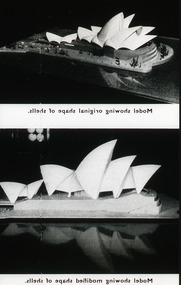
Slide, Robin Boyd
... Sydney Opera House Model (specific model and model maker TBC). (Architects: Jorn Utzon and Arup.)...Sydney Opera House Model (specific model and model maker TBC). (Architects: Jorn Utzon and Arup.) ...Colour slide in a mount. Sydney Opera House Model (specific model and model maker TBC). (Architects: Jorn Utzon and Arup.)Made in Australia / Encircled 48 (Handwritten)slide, robin boyd -
 Flagstaff Hill Maritime Museum and Village
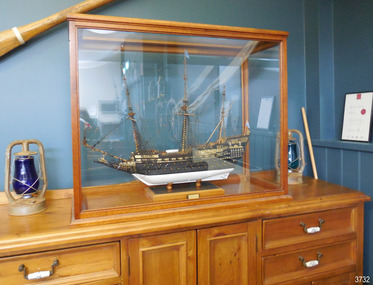
Craft - Ship Model, Sovereign of the Seas, Made between 1930-1955
... Jim Williams, the model’s maker - Jim (James Bernard) Williams was born in 1888 at The Forth in Scotland. ...Many of the tools used were made by the model maker, Jim Williams. An inscribed plaque is within the case. ...Jim Williams, the model’s maker - Jim (James Bernard) Williams was born in 1888 at The Forth in Scotland. ...This meticulously hand crafted ship model is one of the most intricate and challenging projects for a ship modeller to create. Jim Williams took up the challenge, choosing to make all of the components by hand, following a plan of the ship rather than purchasing a pre-made kit. He even made his own tools specifically for working with this model. The “Sovereign of the Seas” 1637-1697 - The magnificent ship “Sovereign of the Seas” was ordered by Charles I of England, who desired a giant Great Ship to be built. It was built by Peter Pett under the guidance of his father Phineas, the King's master shipwright, and launched with 102-guns at Woolwich Dockyard on 13th October 1637, as the Navy’s second three-decker first-rate ship. It was the most extravagantly decorated warship in the Royal Navy, bought with the help of a special 'Ship Money' tax imposed by the King. Soon afterwards the ship was remodelled and cut down to a safer and faster ship. Over the ship’s lifetime it was renamed “Commonwealth”, then in 1650 it became simply “Sovereign” then again after a rebuild in 1660 it was named “Royal Sovereign”. By 1642 the ship’s armament had been reduced to 90 guns. In 1651 Sovereign was made more manoeuvrable by reducing the upper works. It served throughout the wars of the Commonwealth and became the flagship of General Robert Blake. It was involved in all of the great English naval conflicts fought against the United Provinces and France and was referred to as 'The Golden Devil' by the Dutch. By 1660 the armament was changed attain to 100 guns. After the English Restoration, it was rebuilt as a first-rate ship of the line, with flatter gun decks and 100 guns, and most of the carvings were removed. During the First Anglo-Dutch War, in a secret session on 21 October 1652, the States-General of the Netherlands announced reward money for the crews of fire ships that succeeded in destroying enemy vessels; the Sovereign was singled out with an extra prize of 3000 guilders to sink or ruin it. Although repeatedly occupied by the Dutch, the Sovereign was retaken every time by the British and remained in service for nearly sixty years as the best ship in the English fleet. The Sovereign was in regular service during the three Anglo-Dutch Wars, surviving the Raid on the Medway in 1667. After a second rebuild in 1685 the Sovereign was relaunched as a first-rate ship of 100 guns, before taking part in the outset of the War of the Grand Alliance against Louis XIV of France, venturing into the Irish Sea, and later participating in the Battle of Beachy Head in 1690 and the Battle of La Hougue. At this time she was more than fifty years old. It was the first ship in history to fly ‘royals’ above the topgallant sails and a top gallant sail on the jigger-mast. The Sovereign eventually became leaky and defective with age and was laid up at Chatham when, on 27th January 1697, the famous ship caught fire, burning to the waterline. Jim Williams, the model’s maker - Jim (James Bernard) Williams was born in 1888 at The Forth in Scotland. He lived in Tasmania for some time and enlisted to fight in France in WW1. After the war he moved to Warrnambool, Victoria, where he worked at the Cramond & Dickson clothing store until the Great Depression in the 1930’s. He was later employed at Fletcher Jones Menswear, where he worked for 27 years until just before his death in 1959. Jim was a passionate ship model builder. He worked on his model ships between 1930 and 1955, including The Endeavour and The Sovereign of the Seas, which was one of the most intricate historic ship models to build. He had a table set up in a bay window and worked on them on and off using a jeweller's eye glass on the finer pieces. Jim’s long-time employer, Fletcher Jones, knew of Jim’s hobby and skill as a ship model builder and requested Jim to describe the model, Sovereign of the Seas, with the view of putting it on display. When the model was finished there was a full article and photo in The Standard newspaper. Jim described his work on the ship mode “Sovereign of the Seas” in correspondence to his then employer, Fletcher Jones. The document gives us an insight into his skill, patience, and regard for replicating the details of the original ship. Some of the details are: "In making the model the time taken to make certain items might be of interest. For instance "The Great Lantern" on the stern, four weeks, a similar time for the figurehead of St George & the Dragon. "The lower shrouds three to each side about six weeks & the rigging as whole several months. There are nearly 300 blocks and pulleys ranging from nearly 1 / 16 inch in diameter. Dead eyes were bored with 3 to 5 holes. To do this needles of different sizes, set in handles & ground to wedge ends were used. Glass cut and ground to shape were used windows. All gun-port covers (74) hinged. "All guns and anchors made of wood. Nothing for the model was purchased ready-made; everything hand made." Jim’s family donated the ship model along with many associated tools, accessories and papers. The model represents the Sovereign of the Seas. The Royal Navy ship of the line launched in 1637 has a significant British maritime heritage. These days the Sovereign of the Seas still remains one of the most intricate historic ship models to build, representing to the model enthusiast a true challenge to the art of model shipbuilding. The model of Sovereign of the Seas in Flagstaff Hill's collection is an exemplary example of a ship model built and hand crafted from a plan with the making of every item on the model, not a model kit with prefabricated parts. It was made by a local Warrnambool man Jim Williams as a leisure activity in the mid 20th century. The hobby and craft of ship model making has resulted in visual representations of the changes in maritime technology and advances in world-wide navigation. Ship model of HMS Sovereign of the Seas, a 17th century British warship. The handmade model is in wooden framed, airtight glass case. All components were hand crafted. Many of the tools used were made by the model maker, Jim Williams. An inscribed plaque is within the case. Inscribed on plaque "SOVEREIGN OF THE SEAS / 102 GUNS - 1634"flagstaff hill, warrnambool, shipwrecked coast, flagstaff hill maritime museum, maritime museum, shipwreck coast, flagstaff hill maritime village, great ocean road, model ship, vessel sovereign of the seas, jim williams, james bernard williams, the forth tasmania, freda williams, heather williams, phyllis bowditch, fletcher jones staff 1936, 17th century sailing ship, cramond and dickson, sovereign of the seas, royal sovereign, sovereign, charles 1, ship model -
Glenelg Shire Council Cultural Collection
Plan - Plan - S.S Admella Model Plans, SS 'Admella', n.d
... Plan used by 'Float-a-boat' model makers for the construction of the Admella model acquired by Grant District council....Plan used by 'Float-a-boat' model makers for the construction of the Admella model acquired by Grant District council. ...Photocopy of model plan for lines and general arrangement of SS 'Admella'. scale 1:48. Photocopy paper is parchment style. Plan used by 'Float-a-boat' model makers for the construction of the Admella model acquired by Grant District council. -
 Orbost & District Historical Society
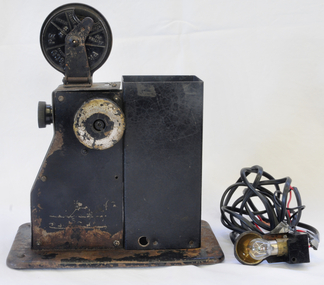
projector, 1920's
... Similar to Pathescope model. No maker's name. An early home projector....Similar to Pathescope model. No maker's name. An early home projector. projector ...About 5000 of these projectors were produced. They were the first type of home projector and were very popular. Ref. Nick Richardson ACMI.A 9.5mm movie projector. Similar to Pathescope model. No maker's name. An early home projector.None on projector. Large spool - pathescope. Small spool - BABY FILM, MADE IN FRANCE, BRIT. PATS.film projector movie-projector -
Port Melbourne Historical & Preservation Society
Photograph - E J Tobin sign, former engineering works, 49 Nott Street, Port Melbourne, Pat Grainger, 1998
... Ted Tobin was an engineer, inventor, model maker who lived in Heath Street and maintained a workshop at 49 Nott Street. ...Ted Tobin was an engineer, inventor, model maker who lived in Heath Street and maintained a workshop at 49 Nott Street. ...Ted Tobin was an engineer, inventor, model maker who lived in Heath Street and maintained a workshop at 49 Nott Street. His creations were displayed at the Library from time to time.Colour, panoramic photograph of the old E.J. Tobin sign on the roller door of his former engineering works at 49 Nott Street (Ted Tobin passed away c1994 but the sign is still visible in 2002)built environment - commercial, e j (ted) tobin -
 Bendigo Military Museum
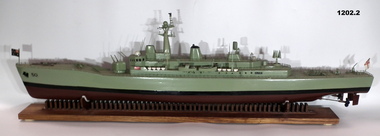
Craft - MODEL & BASE, HMAS SWAN
... Was a River Class Destroyer. Model maker worked in British Dockyards during WW2 and emigrated to Australia in 1955. ...Was a River Class Destroyer. Model maker worked in British Dockyards during WW2 and emigrated to Australia in 1955. ...Model of HMAS Swan built by Shipwright Charles Axiak. Original ship construction in Melbourne and entered service 1970. Was a River Class Destroyer. Model maker worked in British Dockyards during WW2 and emigrated to Australia in 1955. He worked in Williamstown dockyards involved with construction of the Swan,1. Model of River Class Destroyer. green in colour from water line. Black line and brown at bottom. Small Australian flag at front and naval flag at back. 2. Wooden stand, tailor made to hold the model of the 'Swan'. Brown in colour with long flat board and separate pieces of wood embedded in the base to make the cradle. High points of cradle covered by some white felt to protect boat. Bottom of stand has felt studs."50" painted at front of boat.ships model, hmas swan -
 Warrnambool and District Historical Society Inc.
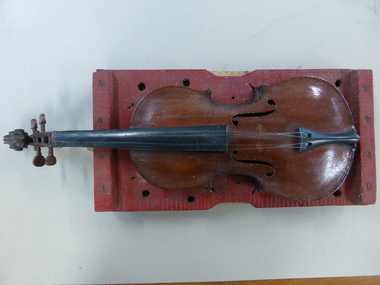
Instrument - Musical Instrument, Violin and stand, Early 20th Century
... This violin was made by Mr Edward Richter who lived in Warrnambool for 78 of his 85 years. he was born 10/03/1853 and was an expert model maker making models of ships. The Warrnambool Museum in 1937 held a model of the Cutty Sark which he had made from timber from the wreck of the Enterprise which was wrecked on Warrnambool beach. ...This violin was made by Mr Edward Richter who lived in Warrnambool for 78 of his 85 years. he was born 10/03/1853 and was an expert model maker making models of ships. The Warrnambool Museum in 1937 held a model of the Cutty Sark which he had made from timber from the wreck of the Enterprise which was wrecked on Warrnambool beach. ...This violin was made by Mr Edward Richter who lived in Warrnambool for 78 of his 85 years. he was born 10/03/1853 and was an expert model maker making models of ships. The Warrnambool Museum in 1937 held a model of the Cutty Sark which he had made from timber from the wreck of the Enterprise which was wrecked on Warrnambool beach. Violins were another of of his hobbies.This violin has a connection to Warrnambool through the maker who was a long time resident of the town. It belongs to an era when many people were interested in and turned their hand to making objects such as this.The body of the violin is stained brown in colour with black neck and bridge. The four strings are nylon. The pegs and scroll are timber of a finer grain than the front and back.The tailpiece and end button are black material. The bridge is missing. The stand is rectangular with violin shape cutout, painted in red with a ply backing. Small leather strap on one end. Six large and two small drilled holes around front section.Richter written in large letters on back of standwarrnambool, edward richter, handmade violin, richter warrnambool -
 Flagstaff Hill Maritime Museum and Village
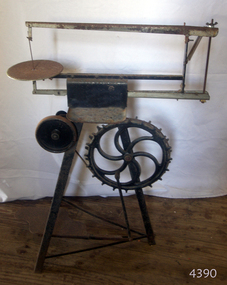
Tool - Treadle Scroll Saw, Hobbies Ltd, Manufactured by Hobbies in England from 1928- 1965
... Since 1895, Hobbies Ltd have been supplying model makers and enthusiasts throughout the world with a wide range of quality model kits, accessories, tools, components and handbooks. ...Since 1895, Hobbies Ltd have been supplying model makers and enthusiasts throughout the world with a wide range of quality model kits, accessories, tools, components and handbooks. ...Since 1895, Hobbies Ltd have been supplying model makers and enthusiasts throughout the world with a wide range of quality model kits, accessories, tools, components and handbooks. The Hobbies Company began life in Dereham, Norfolk in 1881 with a London Office opened later (1922) at 65 New Oxford Street, WC1. In 1895 Hobbies began supplying model makers with their products and in 1897 were incorporated into a Public company. In 1922 at a British Industries Fair the company had a stand advertising their products as "The All-British Firm with a World reputation". Fretwork Outfits. Fretwork Machines. Carpentry Outfits. Strip work Outfits. Also manufactures of Fretwork Tools and Benches, Wood, Circular Saws, Lathes, Picture Framing Outfits, Tools, etc. In 1947 the company had expanded and was still making tools and materials for the amateur craftsman in wood. They had acquired a reputation as manufacturers of quality Fretwork Outfits, Tools, Treadle Machines, Model Maker's Tool Kits. The company also publishers of ‘Hobbies Weekly magazine’ and also sold plans for fretwork, model making and wooden toys. In 1961 they were still manufacturers and retailers of craft tools and materials, timber merchants, light engineers and Government contractors with around 500 employees. A vintage tool made for hobbyists and distributed throughout the world by a British company that is still in existence today. The item is significant as it catalogues the manufactures history at a specific time in the company's development.Foot operated treadle Fret saw called "GEM" subject item is a short saw , the stand in the background is the base for a Delta Q3 model scroll saw. Gem inscription cast into the cast iron frameworkflagstaff hill, warrnambool, flagstaff hill maritime museum, maritime museum, shipwreck coast, flagstaff hill maritime village, great ocean road, saw, treadle saw, fret saw, pedal saw, the gem, tool, hobbies ltd, treadle, foot operated -
 Tennis Australia
Racquet, Circa 1987
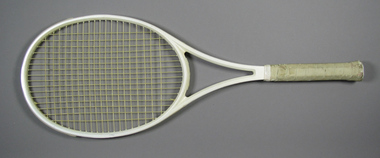
... A white protoype racquet with red plastic elements; composite matierals; no model or maker markings. Materials: Metal, Plastic, Adhesive tape, Plastic, Nylon...Tennis A white protoype racquet with red plastic elements; composite matierals; no model or maker markings. Materials: Metal, Plastic, Adhesive tape, Plastic, Nylon Racquet ...A white protoype racquet with red plastic elements; composite matierals; no model or maker markings. Materials: Metal, Plastic, Adhesive tape, Plastic, Nylontennis -
 Tennis Australia
Racquet, Circa 1985
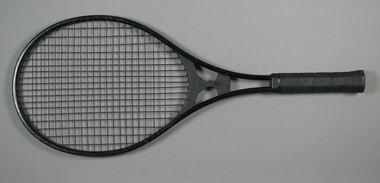
... A black protoype racquet; composite matierals; no model or maker markings. Handle wrapped in black leather. ...Tennis A black protoype racquet; composite matierals; no model or maker markings. Handle wrapped in black leather. ...A black protoype racquet; composite matierals; no model or maker markings. Handle wrapped in black leather. Materials: Metal, Plastic, Adhesive tape, Leathertennis -
Tatura Irrigation & Wartime Camps Museum
Painting, Paintings from inside Camps by Guidolaldi, 1940-1945
... Guidobaldi was a model maker and after the war made models for Film and TV Productions in England. ...Guidobaldi was a model maker and after the war made models for Film and TV Productions in England. ...Images forwarded by email by the son of Guidobaldi. Thirteen images of artwork performed by Guidobaldi while in Loveday and later in Camp 1 Tatura. Guidobaldi was a model maker and after the war made models for Film and TV Productions in England. Images were sent to Museum via email and show the reverse sides of the paintings, which were drawn on the sides of cardboard containers.camp 1, loveday camp -
 Clunes Museum
Photograph
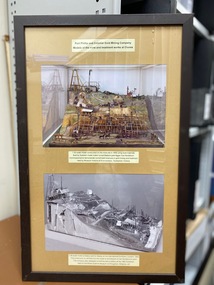
... The 1:32 scale model was built by Swedish model maker Carl Nordstrom and is now part of the Museums Victoria collection (currently not on display). ...The 1:32 scale model was built by Swedish model maker Carl Nordstrom and is now part of the Museums Victoria collection (currently not on display). ...The 1:32 scale model was built by Swedish model maker Carl Nordstrom and is now part of the Museums Victoria collection (currently not on display). The 1:48 scale model was built for display at the International Exhibition in London in 1862. It is now part of the British Science Museum, Wroughton, Wiltshire, United Kingdom. These models were part of a commission by Nordstrom who depicted a series of different gold mining extraction methods in Victoria from 1856 to 1859.Two photographs 1 x colour and 1 x Black and white in a dark wooden frame Showing models of Port Phillip Mine, Clunes, Victoria, Australia. Models are 1:32 scale constructed in 1858 using local materials and 1:48 build for possible display at the International Exhibition London 1862scale model, nordstrom -
 Tennis Australia
Racquet, Circa 1987
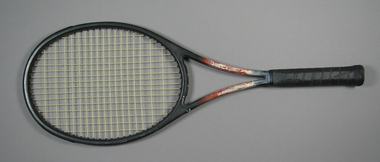
... A painted tennis racquet; composite materials; no visible model or maker markings. Marked post-maufacture with silver ink on butt: 'HB'. ...Tennis A painted tennis racquet; composite materials; no visible model or maker markings. Marked post-maufacture with silver ink on butt: 'HB'. ...A painted tennis racquet; composite materials; no visible model or maker markings. Marked post-maufacture with silver ink on butt: 'HB'. Materials: Metal composite, Plastic, Adhesive tape, Nylon, Painttennis -
 Tennis Australia
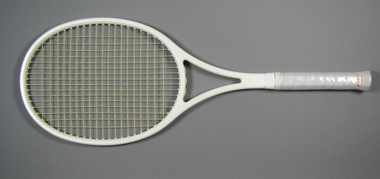
Racquet, Circa 1990
... A white protoype racquet; composite matierals; no model or maker markings. Plastic wrap on handle and adhesive label atating: '3609/30-6' Materials: Metal, Plastic, Adhesive tape, Plastic, Adhesive label...Tennis A white protoype racquet; composite matierals; no model or maker markings. Plastic wrap on handle and adhesive label atating: '3609/30-6' Materials: Metal, Plastic, Adhesive tape, Plastic, Adhesive label Racquet ...A white protoype racquet; composite matierals; no model or maker markings. Plastic wrap on handle and adhesive label atating: '3609/30-6' Materials: Metal, Plastic, Adhesive tape, Plastic, Adhesive labeltennis -
 Surrey Hills Historical Society Collection
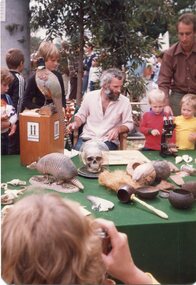
Photograph, Rudi Mineur at Surrey Hills Day, 1981, 1981
... With a keen interest in natural science, he is also a talented watercolourist and model-maker. His work included model-making for the Melbourne Museum and creating special effects for films including 'Mad Max'. ...With a keen interest in natural science, he is also a talented watercolourist and model-maker. His work included model-making for the Melbourne Museum and creating special effects for films including 'Mad Max'. ...Rudi Mineur was born in Holland and grew up in Tasmania. He came to live in Surrey Hills with his wife Betsie and their 3 sons in 1974. Rudi worked as a taxidermist. With a keen interest in natural science, he is also a talented watercolourist and model-maker. His work included model-making for the Melbourne Museum and creating special effects for films including 'Mad Max'. He is also renowned for his sculpting of netsuke. He illustrated the book 'Growing up in the Goldrush' by Michael Dugan (pubd. 1989), who also lived locally. A colour photo in portrait format taken on Surrey Hills Day. He has greying hair and beard and seated behind a table on which are an assortment of stuffed animals / birds, shells, bones and a microscope.Nilrudi mineur, taxidermy, artist, netsuke, surrey hills day -
 Tennis Australia
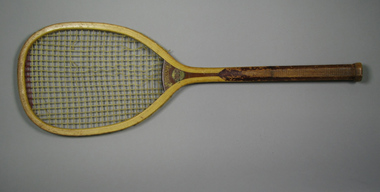
Racquet, Circa 1898
... A Peck & Snyder 'The Beckman' tennis racquet, with solid convex throat, cross-hatched handle, and, a wooden butt cap. Decals of model and maker feature across throat on obverse. ...Tennis A Peck & Snyder 'The Beckman' tennis racquet, with solid convex throat, cross-hatched handle, and, a wooden butt cap. Decals of model and maker feature across throat on obverse. ...A Peck & Snyder 'The Beckman' tennis racquet, with solid convex throat, cross-hatched handle, and, a wooden butt cap. Decals of model and maker feature across throat on obverse. Materials: Wood, Lacquer, Glue, Metal, Ink, Guttennis -
 Tennis Australia
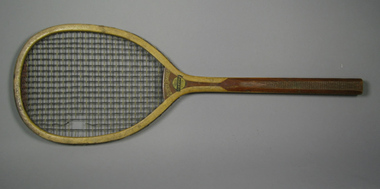
Racquet, Circa 1898
... A Peck & Snyder Staten Island tennis racquet, with solid convex throat, cross-hatched handle, and originally, a wooden butt cap. Decals of model and maker feature across throat on obverse. ...Tennis A Peck & Snyder Staten Island tennis racquet, with solid convex throat, cross-hatched handle, and originally, a wooden butt cap. Decals of model and maker feature across throat on obverse. ...A Peck & Snyder Staten Island tennis racquet, with solid convex throat, cross-hatched handle, and originally, a wooden butt cap. Decals of model and maker feature across throat on obverse. Materials: Wood, Lacquer, Glue, Metal, Ink, Guttennis -
 Tennis Australia
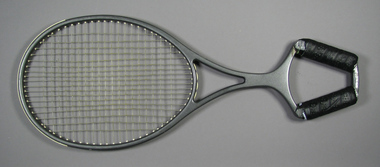
Racquet, Circa 1983
... A double-handled grey composite metal tennis racquet. No model or maker markings. Dymo sticker between handles states: PATENT 4861030. non-original grip tape on handles. ...Tennis A double-handled grey composite metal tennis racquet. No model or maker markings. Dymo sticker between handles states: PATENT 4861030. non-original grip tape on handles. ...A double-handled grey composite metal tennis racquet. No model or maker markings. Dymo sticker between handles states: PATENT 4861030. non-original grip tape on handles. Materials: Metal composite, Plastic, Adhesive tape, Nylon, Adhesive labeltennis -
 Tennis Australia
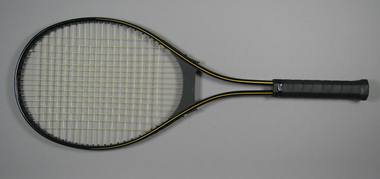
Racquet, Circa 1982
... A black composite metal tennis racquet. No maker or model markings. Materials: Metal composite, Plastic, Leather, Adhesive tape...Tennis A black composite metal tennis racquet. No maker or model markings. Materials: Metal composite, Plastic, Leather, Adhesive tape Racquet ...A black composite metal tennis racquet. No maker or model markings. Materials: Metal composite, Plastic, Leather, Adhesive tapetennis -
 Tennis Australia
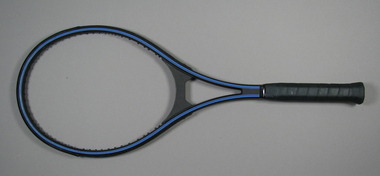
Racquet, Circa 1982
... A blue & black composite tennis racquet. No net; no maker or model markings. Materials: Metal composite, Plastic, Leather, Adhesive tape...Tennis A blue & black composite tennis racquet. No net; no maker or model markings. Materials: Metal composite, Plastic, Leather, Adhesive tape Racquet ...A blue & black composite tennis racquet. No net; no maker or model markings. Materials: Metal composite, Plastic, Leather, Adhesive tapetennis -
 Phillip Island and District Historical Society Inc.
Photograph Album, Kodak, Phillip Island Cemetery, c 1990
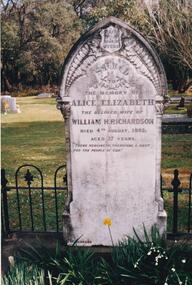
... Alice's father Fredrick was a Model Maker employed at the Melbourne Museum. ...Alice's father Fredrick was a Model Maker employed at the Melbourne Museum. ...The Album was compiled by Nancy McHaffie late 1990's, with the assistance of Edith Jeffery's, with her book "Garden of Memories" and extensive knowledge of Phillip Island. The Cemetery lies back from the road and is surrounded by Manna Gums, rare Peppermint Gums, Blackwoods and other native trees. In all 25 acres of land were set aside as Crown Land in the land settlement of 1868. There are 6.2 acres of wetlands near the cemetery entrance.466-25: William and Alice Richardson: Alice Barnard married William Richardson at Hawthorn, April 1887. Alice's father Fredrick was a Model Maker employed at the Melbourne Museum. Alice died in childbirth having her third child, Joseph in 1892. Baby Joseph died in April 1893, eight months later at Rhyll. 466-26: The Forrest Family: The Forrest family were amongst our early settlers. The Forrest Caves are named after them. Matthew Forrest arrived by dray from Tarradale on 9th November 1869. He died in 1916 at the age of 75. His Grandson, Peter Forrest Sr. has recorded that Matthew was the first to plant Marum Grass on the Island to prevent erosion.phillip island cemetery, nancy mchaffie, edith jeffery -
 Flagstaff Hill Maritime Museum and Village
Document - Ship Model Plans, Webb Warships Pty Ltd, Loch Ard Clipper Ship, 1874; Model Construction Plan Set, 1978
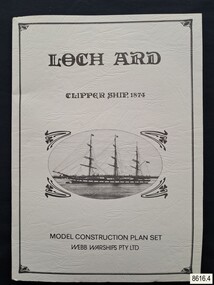
... “The details were based on all available information which resulted in considerable historical research…and received favourable comment from model makers because of their attention to detail…In excess of 650 sets of plans were sold before entries closed…Many plans were probably purchased by collectors and interested persons for historical reference. ...“The details were based on all available information which resulted in considerable historical research…and received favourable comment from model makers because of their attention to detail…In excess of 650 sets of plans were sold before entries closed…Many plans were probably purchased by collectors and interested persons for historical reference. ...The plans are presented in a keepsake folder. They show marks of sections copied and assembled together. Overall, the plans are similar to those drawn by Mr P Webb to the order of the Loch Ard Shipwreck Centenary through Mr P Williams, the organizer of the Centenary competition. “The details were based on all available information which resulted in considerable historical research…and received favourable comment from model makers because of their attention to detail…In excess of 650 sets of plans were sold before entries closed…Many plans were probably purchased by collectors and interested persons for historical reference. An illustrated historical story sheet…was prepared and enclosed with the plans…” (‘Loch Ard Shipwreck Centenary 1878-1978 Report’, November 1978). An example of the attention to historical detail on the plans is the inclusion of the following useful information about the original vessel … Tonnage….1,693 G.R.T., 1,624 N.R.T. Dimensions, Builders….Charles Connell & Co., Ltd., Scotstoun, 1873. Owners….General Shipping Co., Glasgow, (Aitken Lilburn & Co., Ltd.), and the ship’s fate. The plans, in conjunction with the scale Ship Model of the LOCH ARD also on display, are of interpretive significance to Flagstaff Hill Maritime Village. The plans provide historical and technological context to artefacts from the shipwreck, increasing understanding and appreciation of those objects. Flagstaff Hill’s collection of artefacts from LOCH ARD is significant for being one of the largest collections of artefacts from this shipwreck in Victoria. It is significant for its association with the shipwreck, which is on the Victorian Heritage Register (VHR S417). The collection is significant because of the relationship between the objects, as together they have a high potential to interpret the story of the LOCH ARD. The LOCH ARD collection is archaeologically significant as the remains of a large international passenger and cargo ship. The LOCH ARD collection is historically significant for representing aspects of Victoria’s shipping history and its potential to interpret sub-theme 1.5 of Victoria’s Framework of Historical Themes (living with natural processes). The collection is also historically significant for its association with the LOCH ARD, which was one of the worst and best known shipwrecks in Victoria’s history.Model ship plans for building the LOCH ARD. The three sets of plans are presented in a textured cream card folder with the supplier’s details and an oval cameo drawing of the LOCH ARD. The plans are detailed and drawn to scale. They and printed on good quality paper with details, scale and legends. Sheet 1: Sails and Rigging Sheet 2: Lines, Decks and Details Sheet 3: Masts and Spars Details include deck fittings, the wheel, lights and the shipping company’s house flag. The ship model plans are copyrighted in 1977 and 1978 to Webb Warships Pty Ltd. The folder has details of four locations; Australia, USA, UK and New Zealand. Sheet has a handwritten inscription.On Folder: "LOCH ARD CLIPPER SHIP, 1874, MODEL CONSTRUCTION PLAN SET, WEBB WARRIORS PTY LTD." "CONTENTS COPYRIGHT (C) 1978, WEBB WARSHIPS PTY LTD" "WEBB WARSHIPS PTY LTD, PO BOX 50, WILLIAMSTOWN, VICTORIA 3016, AUSTRALIA" Handwritten inscription on sheet 3: "834" "THE FLOATING DRYDOCK, PO BOX 16066, PHILADELPHIA, PENNA. 14114, USA" "SAMBROOK MARINE (PLANS), 84 BROAD ST. TEDDINGTON, MIDDLESEX, UK" "BYMODELS, PO BOX 3037, FORBURY, DUNEDIN, NEW ZEALAND" flagstaff hill, warrnambool, shipwrecked coast, flagstaff hill maritime museum, maritime museum, shipwreck coast, flagstaff hill maritime village, great ocean road, loch line, loch ard, captain gibbs, eva carmichael, tom pearce, glenample station, mutton bird island, loch ard gorge, ship model plans, loch ard model plans, sailing ship, loch ard centenary, webb warriors pty ltd, 1977, 1978, centenary competition -
 Tennis Australia
Racquet, Circa 1975
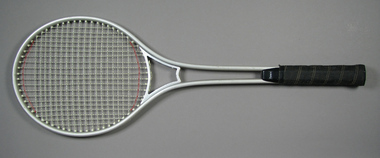
... Tenex labels on black plastic shaft casing and labels on sides of shaft with model and maker names. Handle wrapped with tan leather grip tape. ...Tenex labels on black plastic shaft casing and labels on sides of shaft with model and maker names. Handle wrapped with tan leather grip tape. ...A Tenex 'Pro 700' metal tennis racquet with double shaft and metal bridge; round head with net made of nylon and red stringing. Tenex labels on black plastic shaft casing and labels on sides of shaft with model and maker names. Handle wrapped with tan leather grip tape. Plastic butt cap with adhesive label featuring graphic of net & ball and 'T' logo. Materials: Metal, Nylon, Adhesive tape, Leather, Plastic, Stringtennis
