
Showing 157 items matching "monash house"
-
 Federation University Historical Collection
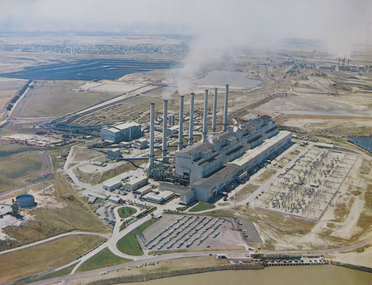
Book, State Electricity Commission, Serving Victoria. 50 Years of Service. State Electricity Commission of Victoria, 1969
... ...monash house...state electricity commission of victoria anniversary monash house w.h. connolly alexander fitzgerald t.p. scott b.j. callinan yallourn hazelwood power station morwell power station briquettes morwell briquette works water power hydro-electric supply rocky valley reservoir electricity network transmission statins yallourn "w" power station eildon reservoir A blue, soft, illustrated covered book. ...A blue, soft, illustrated covered book.state electricity commission of victoria, anniversary, monash house, w.h. connolly, alexander fitzgerald, t.p. scott, b.j. callinan, yallourn, hazelwood power station, morwell power station, briquettes, morwell briquette works, water power, hydro-electric supply, rocky valley reservoir, electricity network, transmission statins, yallourn "w" power station, eildon reservoir -
 Maccabi Victoria
1937-1938
... Welcome ball to Maccabeans, 1937-38, Monash House. Photo taken in front of ZELTNER HALL. ...Maccabi Senior Carnival 12 Judean League of Victoria Welcome ball to Maccabeans, 1937-38, Monash House. Photo taken in front of ZELTNER HALL. ...Welcome ball to Maccabeans, 1937-38, Monash House. Photo taken in front of ZELTNER HALL. Photo includes all participants at Carnival 250-300 people. Photo has been reprodcuedmaccabi senior carnival 12, judean league of victoria -
Maccabi Victoria
Document, 1974
... The invitation was from the AJAX Judaean League & the front of the invitation was the photo of the Welcome Ball from the 1937-1938 Senior Carnival held at Monash House in Melbourne. The invitation was addressed to Rose Rubenstein, 6 Mitchell Rd. ...The invitation was from the AJAX Judaean League & the front of the invitation was the photo of the Welcome Ball from the 1937-1938 Senior Carnival held at Monash House in Melbourne. The invitation was addressed to Rose Rubenstein, 6 Mitchell Rd. ...invitation to Maccabi Victoria's 50thCard invitation to the 50th Anniversary Ball held Sunday 13th October 1974 at Chaucers, Canterbury Rd., Canterbury. The invitation was from the AJAX Judaean League & the front of the invitation was the photo of the Welcome Ball from the 1937-1938 Senior Carnival held at Monash House in Melbourne. The invitation was addressed to Rose Rubenstein, 6 Mitchell Rd. Caulfield.gala or award function, judean league of victoria -
 Maccabi Victoria
Book, 1920-1937
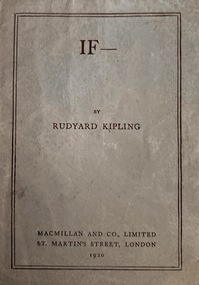
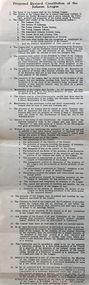
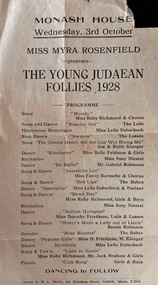
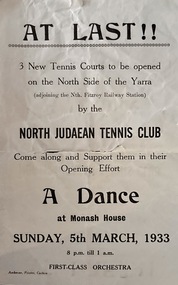
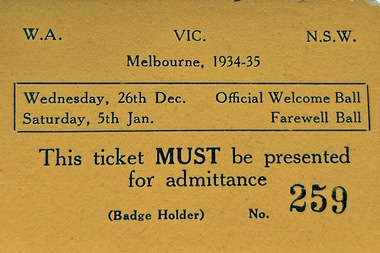
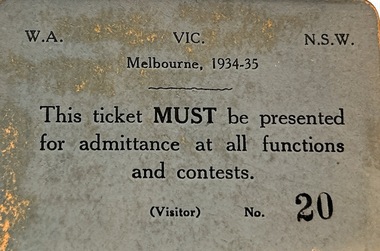
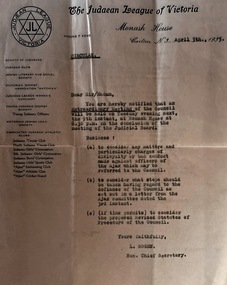
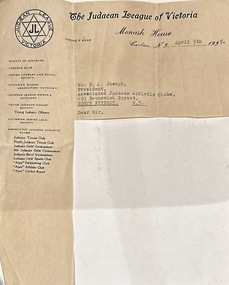
... Held Wednesday 3rd October 1928 at Monash House. Myra Rosenfield presents………… 02: 1920 publication "if" by Rudyard Kipling 03: Invitation to "A Dance" at Monash House to celebrate the opening of 3 new tennis courts by the North Judean Tennis Club (NJTC) 04: 1934-35 9th Senior Carnival (Melb. 25/12-5/1) AJAX Invitation to participate in all functions & competitions throughout Carnival (25 x 18cm) 05&06: 1934-35 Tickets to Welcome Ball & Farewell Ball No.259 (yellow) and all functions & contests No.20 - Mr. ...Held Wednesday 3rd October 1928 at Monash House. Myra Rosenfield presents………… 02: 1920 publication "if" by Rudyard Kipling 03: Invitation to "A Dance" at Monash House to celebrate the opening of 3 new tennis courts by the North Judean Tennis Club (NJTC) 04: 1934-35 9th Senior Carnival (Melb. 25/12-5/1) AJAX Invitation to participate in all functions & competitions throughout Carnival (25 x 18cm) 05&06: 1934-35 Tickets to Welcome Ball & Farewell Ball No.259 (yellow) and all functions & contests No.20 - Mr. ...Melbourne 25/12 1934-5/1/1935, also Welcome Ball at same Carnival, 10th Carnival Sydney, JLV meetings and Social events****IMPORTANT HISTORY various items of memorabilia 01:1928 programme "The Young Judean Follies 1928", included dance, song, recitations. Held Wednesday 3rd October 1928 at Monash House. Myra Rosenfield presents………… 02: 1920 publication "if" by Rudyard Kipling 03: Invitation to "A Dance" at Monash House to celebrate the opening of 3 new tennis courts by the North Judean Tennis Club (NJTC) 04: 1934-35 9th Senior Carnival (Melb. 25/12-5/1) AJAX Invitation to participate in all functions & competitions throughout Carnival (25 x 18cm) 05&06: 1934-35 Tickets to Welcome Ball & Farewell Ball No.259 (yellow) and all functions & contests No.20 - Mr. Joe Abadee (blue) 07: 5 April 1935 Letter from L. Rosen inviting to extraordinary meeting of Judean League of Victoria (JLV) - letterhead shows organisations under JLV: Society of Judeans, Judean Club, Jewsih Literary & Social Society, Victorian Zionist Association "Hatchiah", Judean League Women's Auxiliary, Young Judean Zionist Society, Victorian Jewish Loan Society, Associated Judean Athletics Clubs - Tennis, Gymnasium, Sports, Swimming, Athletic, Cricket 08: 26/12/1935-4/1/1936 Certificate awarded to E.A.Joseph, Cricket at 10th Carnival in Sydney 09: 18 May 1937 - Judean Repertory Club, Invitation to 3 One-Act Plays at Monash House, Souvenir Programme w list of actors 10: Proposed revised Constitution of the Judean League of Victoria.maccabi senior carnival 9, maccabi senior carnival 10, cricket - senior, judean league of victoria -
 Maccabi Victoria
Book, 1920-1937
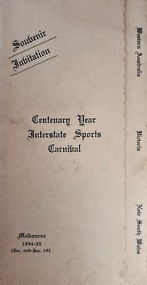
... Held Wednesday 3rd October 1928 at Monash House. Myra Rosenfield presents………… 02: 1920 publication "if" by Rudyard Kipling 03: Invitation to "A Dance" at Monash House to celebrate the opening of 3 new tennis courts by the North Judean Tennis Club (NJTC) 04: 1934-35 9th Senior Carnival (Melb. 25/12-5/1) AJAX Invitation to participate in all functions & competitions throughout Carnival (25 x 18cm) 05&06: 1934-35 Tickets to Welcome Ball & Farewell Ball No.259 (yellow) and all functions & contests No.20 - Mr. ...Held Wednesday 3rd October 1928 at Monash House. Myra Rosenfield presents………… 02: 1920 publication "if" by Rudyard Kipling 03: Invitation to "A Dance" at Monash House to celebrate the opening of 3 new tennis courts by the North Judean Tennis Club (NJTC) 04: 1934-35 9th Senior Carnival (Melb. 25/12-5/1) AJAX Invitation to participate in all functions & competitions throughout Carnival (25 x 18cm) 05&06: 1934-35 Tickets to Welcome Ball & Farewell Ball No.259 (yellow) and all functions & contests No.20 - Mr. ...Melbourne 25/12 1934-5/1/1935, also Welcome Ball at same Carnival, 10th Carnival Sydney, JLV meetings and Social events****IMPORTANT HISTORY various items of memorabilia 01:1928 programme "The Young Judean Follies 1928", included dance, song, recitations. Held Wednesday 3rd October 1928 at Monash House. Myra Rosenfield presents………… 02: 1920 publication "if" by Rudyard Kipling 03: Invitation to "A Dance" at Monash House to celebrate the opening of 3 new tennis courts by the North Judean Tennis Club (NJTC) 04: 1934-35 9th Senior Carnival (Melb. 25/12-5/1) AJAX Invitation to participate in all functions & competitions throughout Carnival (25 x 18cm) 05&06: 1934-35 Tickets to Welcome Ball & Farewell Ball No.259 (yellow) and all functions & contests No.20 - Mr. Joe Abadee (blue) 07: 5 April 1935 Letter from L. Rosen inviting to extraordinary meeting of Judean League of Victoria (JLV) - letterhead shows organisations under JLV: Society of Judeans, Judean Club, Jewsih Literary & Social Society, Victorian Zionist Association "Hatchiah", Judean League Women's Auxiliary, Young Judean Zionist Society, Victorian Jewish Loan Society, Associated Judean Athletics Clubs - Tennis, Gymnasium, Sports, Swimming, Athletic, Cricket 08: 26/12/1935-4/1/1936 Certificate awarded to E.A.Joseph, Cricket at 10th Carnival in Sydney 09: 18 May 1937 - Judean Repertory Club, Invitation to 3 One-Act Plays at Monash House, Souvenir Programme w list of actors 10: Proposed revised Constitution of the Judean League of Victoria.maccabi senior carnival 9, maccabi senior carnival 10, cricket - senior, judean league of victoria -
 Maccabi Victoria
Book, 1920-1937
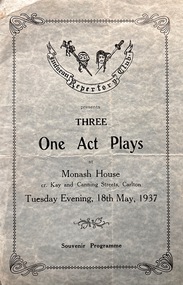
... Held Wednesday 3rd October 1928 at Monash House. Myra Rosenfield presents………… 02: 1920 publication "if" by Rudyard Kipling 03: Invitation to "A Dance" at Monash House to celebrate the opening of 3 new tennis courts by the North Judean Tennis Club (NJTC) 04: 1934-35 9th Senior Carnival (Melb. 25/12-5/1) AJAX Invitation to participate in all functions & competitions throughout Carnival (25 x 18cm) 05&06: 1934-35 Tickets to Welcome Ball & Farewell Ball No.259 (yellow) and all functions & contests No.20 - Mr. ...Held Wednesday 3rd October 1928 at Monash House. Myra Rosenfield presents………… 02: 1920 publication "if" by Rudyard Kipling 03: Invitation to "A Dance" at Monash House to celebrate the opening of 3 new tennis courts by the North Judean Tennis Club (NJTC) 04: 1934-35 9th Senior Carnival (Melb. 25/12-5/1) AJAX Invitation to participate in all functions & competitions throughout Carnival (25 x 18cm) 05&06: 1934-35 Tickets to Welcome Ball & Farewell Ball No.259 (yellow) and all functions & contests No.20 - Mr. ...Melbourne 25/12 1934-5/1/1935, also Welcome Ball at same Carnival, 10th Carnival Sydney, JLV meetings and Social events****IMPORTANT HISTORY various items of memorabilia 01:1928 programme "The Young Judean Follies 1928", included dance, song, recitations. Held Wednesday 3rd October 1928 at Monash House. Myra Rosenfield presents………… 02: 1920 publication "if" by Rudyard Kipling 03: Invitation to "A Dance" at Monash House to celebrate the opening of 3 new tennis courts by the North Judean Tennis Club (NJTC) 04: 1934-35 9th Senior Carnival (Melb. 25/12-5/1) AJAX Invitation to participate in all functions & competitions throughout Carnival (25 x 18cm) 05&06: 1934-35 Tickets to Welcome Ball & Farewell Ball No.259 (yellow) and all functions & contests No.20 - Mr. Joe Abadee (blue) 07: 5 April 1935 Letter from L. Rosen inviting to extraordinary meeting of Judean League of Victoria (JLV) - letterhead shows organisations under JLV: Society of Judeans, Judean Club, Jewsih Literary & Social Society, Victorian Zionist Association "Hatchiah", Judean League Women's Auxiliary, Young Judean Zionist Society, Victorian Jewish Loan Society, Associated Judean Athletics Clubs - Tennis, Gymnasium, Sports, Swimming, Athletic, Cricket 08: 26/12/1935-4/1/1936 Certificate awarded to E.A.Joseph, Cricket at 10th Carnival in Sydney 09: 18 May 1937 - Judean Repertory Club, Invitation to 3 One-Act Plays at Monash House, Souvenir Programme w list of actors 10: Proposed revised Constitution of the Judean League of Victoria.maccabi senior carnival 9, maccabi senior carnival 10, cricket - senior, judean league of victoria -
 Maccabi Victoria
Document, 1920-1937
... Held Wednesday 3rd October 1928 at Monash House. Myra Rosenfield presents………… 02: 1920 publication "if" by Rudyard Kipling 03: Invitation to "A Dance" at Monash House to celebrate the opening of 3 new tennis courts by the North Judean Tennis Club (NJTC) 04: 1934-35 9th Senior Carnival (Melb. 25/12-5/1) AJAX Invitation to participate in all functions & competitions throughout Carnival (25 x 18cm) 05&06: 1934-35 Tickets to Welcome Ball & Farewell Ball No.259 (yellow) and all functions & contests No.20 - Mr. ...Held Wednesday 3rd October 1928 at Monash House. Myra Rosenfield presents………… 02: 1920 publication "if" by Rudyard Kipling 03: Invitation to "A Dance" at Monash House to celebrate the opening of 3 new tennis courts by the North Judean Tennis Club (NJTC) 04: 1934-35 9th Senior Carnival (Melb. 25/12-5/1) AJAX Invitation to participate in all functions & competitions throughout Carnival (25 x 18cm) 05&06: 1934-35 Tickets to Welcome Ball & Farewell Ball No.259 (yellow) and all functions & contests No.20 - Mr. ...Melbourne 25/12 1934-5/1/1935, also Welcome Ball at same Carnival, 10th Carnival Sydney, JLV meetings and Social events****IMPORTANT HISTORY various items of memorabilia 01:1928 programme "The Young Judean Follies 1928", included dance, song, recitations. Held Wednesday 3rd October 1928 at Monash House. Myra Rosenfield presents………… 02: 1920 publication "if" by Rudyard Kipling 03: Invitation to "A Dance" at Monash House to celebrate the opening of 3 new tennis courts by the North Judean Tennis Club (NJTC) 04: 1934-35 9th Senior Carnival (Melb. 25/12-5/1) AJAX Invitation to participate in all functions & competitions throughout Carnival (25 x 18cm) 05&06: 1934-35 Tickets to Welcome Ball & Farewell Ball No.259 (yellow) and all functions & contests No.20 - Mr. Joe Abadee (blue) 07: 5 April 1935 Letter from L. Rosen inviting to extraordinary meeting of Judean League of Victoria (JLV) - letterhead shows organisations under JLV: Society of Judeans, Judean Club, Jewsih Literary & Social Society, Victorian Zionist Association "Hatchiah", Judean League Women's Auxiliary, Young Judean Zionist Society, Victorian Jewish Loan Society, Associated Judean Athletics Clubs - Tennis, Gymnasium, Sports, Swimming, Athletic, Cricket 08: 26/12/1935-4/1/1936 Certificate awarded to E.A.Joseph, Cricket at 10th Carnival in Sydney 09: 18 May 1937 - Judean Repertory Club, Invitation to 3 One-Act Plays at Monash House, Souvenir Programme w list of actors 10: Proposed revised Constitution of the Judean League of Victoria.maccabi senior carnival 9, maccabi senior carnival 10, cricket - senior, judean league of victoria -
 Maccabi Victoria
Document, 1920-1937
... Held Wednesday 3rd October 1928 at Monash House. Myra Rosenfield presents………… 02: 1920 publication "if" by Rudyard Kipling 03: Invitation to "A Dance" at Monash House to celebrate the opening of 3 new tennis courts by the North Judean Tennis Club (NJTC) 04: 1934-35 9th Senior Carnival (Melb. 25/12-5/1) AJAX Invitation to participate in all functions & competitions throughout Carnival (25 x 18cm) 05&06: 1934-35 Tickets to Welcome Ball & Farewell Ball No.259 (yellow) and all functions & contests No.20 - Mr. ...Held Wednesday 3rd October 1928 at Monash House. Myra Rosenfield presents………… 02: 1920 publication "if" by Rudyard Kipling 03: Invitation to "A Dance" at Monash House to celebrate the opening of 3 new tennis courts by the North Judean Tennis Club (NJTC) 04: 1934-35 9th Senior Carnival (Melb. 25/12-5/1) AJAX Invitation to participate in all functions & competitions throughout Carnival (25 x 18cm) 05&06: 1934-35 Tickets to Welcome Ball & Farewell Ball No.259 (yellow) and all functions & contests No.20 - Mr. ...Melbourne 25/12 1934-5/1/1935, also Welcome Ball at same Carnival, 10th Carnival Sydney, JLV meetings and Social events****IMPORTANT HISTORY various items of memorabilia 01:1928 programme "The Young Judean Follies 1928", included dance, song, recitations. Held Wednesday 3rd October 1928 at Monash House. Myra Rosenfield presents………… 02: 1920 publication "if" by Rudyard Kipling 03: Invitation to "A Dance" at Monash House to celebrate the opening of 3 new tennis courts by the North Judean Tennis Club (NJTC) 04: 1934-35 9th Senior Carnival (Melb. 25/12-5/1) AJAX Invitation to participate in all functions & competitions throughout Carnival (25 x 18cm) 05&06: 1934-35 Tickets to Welcome Ball & Farewell Ball No.259 (yellow) and all functions & contests No.20 - Mr. Joe Abadee (blue) 07: 5 April 1935 Letter from L. Rosen inviting to extraordinary meeting of Judean League of Victoria (JLV) - letterhead shows organisations under JLV: Society of Judeans, Judean Club, Jewsih Literary & Social Society, Victorian Zionist Association "Hatchiah", Judean League Women's Auxiliary, Young Judean Zionist Society, Victorian Jewish Loan Society, Associated Judean Athletics Clubs - Tennis, Gymnasium, Sports, Swimming, Athletic, Cricket 08: 26/12/1935-4/1/1936 Certificate awarded to E.A.Joseph, Cricket at 10th Carnival in Sydney 09: 18 May 1937 - Judean Repertory Club, Invitation to 3 One-Act Plays at Monash House, Souvenir Programme w list of actors 10: Proposed revised Constitution of the Judean League of Victoria.maccabi senior carnival 9, maccabi senior carnival 10, cricket - senior, judean league of victoria -
 Maccabi Victoria
Document, 1920-1937
... Held Wednesday 3rd October 1928 at Monash House. Myra Rosenfield presents………… 02: 1920 publication "if" by Rudyard Kipling 03: Invitation to "A Dance" at Monash House to celebrate the opening of 3 new tennis courts by the North Judean Tennis Club (NJTC) 04: 1934-35 9th Senior Carnival (Melb. 25/12-5/1) AJAX Invitation to participate in all functions & competitions throughout Carnival (25 x 18cm) 05&06: 1934-35 Tickets to Welcome Ball & Farewell Ball No.259 (yellow) and all functions & contests No.20 - Mr. ...Held Wednesday 3rd October 1928 at Monash House. Myra Rosenfield presents………… 02: 1920 publication "if" by Rudyard Kipling 03: Invitation to "A Dance" at Monash House to celebrate the opening of 3 new tennis courts by the North Judean Tennis Club (NJTC) 04: 1934-35 9th Senior Carnival (Melb. 25/12-5/1) AJAX Invitation to participate in all functions & competitions throughout Carnival (25 x 18cm) 05&06: 1934-35 Tickets to Welcome Ball & Farewell Ball No.259 (yellow) and all functions & contests No.20 - Mr. ...Melbourne 25/12 1934-5/1/1935, also Welcome Ball at same Carnival, 10th Carnival Sydney, JLV meetings and Social events****IMPORTANT HISTORY various items of memorabilia 01:1928 programme "The Young Judean Follies 1928", included dance, song, recitations. Held Wednesday 3rd October 1928 at Monash House. Myra Rosenfield presents………… 02: 1920 publication "if" by Rudyard Kipling 03: Invitation to "A Dance" at Monash House to celebrate the opening of 3 new tennis courts by the North Judean Tennis Club (NJTC) 04: 1934-35 9th Senior Carnival (Melb. 25/12-5/1) AJAX Invitation to participate in all functions & competitions throughout Carnival (25 x 18cm) 05&06: 1934-35 Tickets to Welcome Ball & Farewell Ball No.259 (yellow) and all functions & contests No.20 - Mr. Joe Abadee (blue) 07: 5 April 1935 Letter from L. Rosen inviting to extraordinary meeting of Judean League of Victoria (JLV) - letterhead shows organisations under JLV: Society of Judeans, Judean Club, Jewsih Literary & Social Society, Victorian Zionist Association "Hatchiah", Judean League Women's Auxiliary, Young Judean Zionist Society, Victorian Jewish Loan Society, Associated Judean Athletics Clubs - Tennis, Gymnasium, Sports, Swimming, Athletic, Cricket 08: 26/12/1935-4/1/1936 Certificate awarded to E.A.Joseph, Cricket at 10th Carnival in Sydney 09: 18 May 1937 - Judean Repertory Club, Invitation to 3 One-Act Plays at Monash House, Souvenir Programme w list of actors 10: Proposed revised Constitution of the Judean League of Victoria.maccabi senior carnival 9, maccabi senior carnival 10, cricket - senior, judean league of victoria -
 Maccabi Victoria
Document, 1920-1937
... Held Wednesday 3rd October 1928 at Monash House. Myra Rosenfield presents………… 02: 1920 publication "if" by Rudyard Kipling 03: Invitation to "A Dance" at Monash House to celebrate the opening of 3 new tennis courts by the North Judean Tennis Club (NJTC) 04: 1934-35 9th Senior Carnival (Melb. 25/12-5/1) AJAX Invitation to participate in all functions & competitions throughout Carnival (25 x 18cm) 05&06: 1934-35 Tickets to Welcome Ball & Farewell Ball No.259 (yellow) and all functions & contests No.20 - Mr. ...Held Wednesday 3rd October 1928 at Monash House. Myra Rosenfield presents………… 02: 1920 publication "if" by Rudyard Kipling 03: Invitation to "A Dance" at Monash House to celebrate the opening of 3 new tennis courts by the North Judean Tennis Club (NJTC) 04: 1934-35 9th Senior Carnival (Melb. 25/12-5/1) AJAX Invitation to participate in all functions & competitions throughout Carnival (25 x 18cm) 05&06: 1934-35 Tickets to Welcome Ball & Farewell Ball No.259 (yellow) and all functions & contests No.20 - Mr. ...Melbourne 25/12 1934-5/1/1935, also Welcome Ball at same Carnival, 10th Carnival Sydney, JLV meetings and Social events****IMPORTANT HISTORY various items of memorabilia 01:1928 programme "The Young Judean Follies 1928", included dance, song, recitations. Held Wednesday 3rd October 1928 at Monash House. Myra Rosenfield presents………… 02: 1920 publication "if" by Rudyard Kipling 03: Invitation to "A Dance" at Monash House to celebrate the opening of 3 new tennis courts by the North Judean Tennis Club (NJTC) 04: 1934-35 9th Senior Carnival (Melb. 25/12-5/1) AJAX Invitation to participate in all functions & competitions throughout Carnival (25 x 18cm) 05&06: 1934-35 Tickets to Welcome Ball & Farewell Ball No.259 (yellow) and all functions & contests No.20 - Mr. Joe Abadee (blue) 07: 5 April 1935 Letter from L. Rosen inviting to extraordinary meeting of Judean League of Victoria (JLV) - letterhead shows organisations under JLV: Society of Judeans, Judean Club, Jewsih Literary & Social Society, Victorian Zionist Association "Hatchiah", Judean League Women's Auxiliary, Young Judean Zionist Society, Victorian Jewish Loan Society, Associated Judean Athletics Clubs - Tennis, Gymnasium, Sports, Swimming, Athletic, Cricket 08: 26/12/1935-4/1/1936 Certificate awarded to E.A.Joseph, Cricket at 10th Carnival in Sydney 09: 18 May 1937 - Judean Repertory Club, Invitation to 3 One-Act Plays at Monash House, Souvenir Programme w list of actors 10: Proposed revised Constitution of the Judean League of Victoria.maccabi senior carnival 9, maccabi senior carnival 10, cricket - senior, judean league of victoria -
 Maccabi Victoria
Document, 1920-1937
... Held Wednesday 3rd October 1928 at Monash House. Myra Rosenfield presents………… 02: 1920 publication "if" by Rudyard Kipling 03: Invitation to "A Dance" at Monash House to celebrate the opening of 3 new tennis courts by the North Judean Tennis Club (NJTC) 04: 1934-35 9th Senior Carnival (Melb. 25/12-5/1) AJAX Invitation to participate in all functions & competitions throughout Carnival (25 x 18cm) 05&06: 1934-35 Tickets to Welcome Ball & Farewell Ball No.259 (yellow) and all functions & contests No.20 - Mr. ...Held Wednesday 3rd October 1928 at Monash House. Myra Rosenfield presents………… 02: 1920 publication "if" by Rudyard Kipling 03: Invitation to "A Dance" at Monash House to celebrate the opening of 3 new tennis courts by the North Judean Tennis Club (NJTC) 04: 1934-35 9th Senior Carnival (Melb. 25/12-5/1) AJAX Invitation to participate in all functions & competitions throughout Carnival (25 x 18cm) 05&06: 1934-35 Tickets to Welcome Ball & Farewell Ball No.259 (yellow) and all functions & contests No.20 - Mr. ...Melbourne 25/12 1934-5/1/1935, also Welcome Ball at same Carnival, 10th Carnival Sydney, JLV meetings and Social events****IMPORTANT HISTORY various items of memorabilia 01:1928 programme "The Young Judean Follies 1928", included dance, song, recitations. Held Wednesday 3rd October 1928 at Monash House. Myra Rosenfield presents………… 02: 1920 publication "if" by Rudyard Kipling 03: Invitation to "A Dance" at Monash House to celebrate the opening of 3 new tennis courts by the North Judean Tennis Club (NJTC) 04: 1934-35 9th Senior Carnival (Melb. 25/12-5/1) AJAX Invitation to participate in all functions & competitions throughout Carnival (25 x 18cm) 05&06: 1934-35 Tickets to Welcome Ball & Farewell Ball No.259 (yellow) and all functions & contests No.20 - Mr. Joe Abadee (blue) 07: 5 April 1935 Letter from L. Rosen inviting to extraordinary meeting of Judean League of Victoria (JLV) - letterhead shows organisations under JLV: Society of Judeans, Judean Club, Jewsih Literary & Social Society, Victorian Zionist Association "Hatchiah", Judean League Women's Auxiliary, Young Judean Zionist Society, Victorian Jewish Loan Society, Associated Judean Athletics Clubs - Tennis, Gymnasium, Sports, Swimming, Athletic, Cricket 08: 26/12/1935-4/1/1936 Certificate awarded to E.A.Joseph, Cricket at 10th Carnival in Sydney 09: 18 May 1937 - Judean Repertory Club, Invitation to 3 One-Act Plays at Monash House, Souvenir Programme w list of actors 10: Proposed revised Constitution of the Judean League of Victoria.maccabi senior carnival 9, maccabi senior carnival 10, cricket - senior, judean league of victoria -
 Maccabi Victoria
Document, 1920-1937
... Held Wednesday 3rd October 1928 at Monash House. Myra Rosenfield presents………… 02: 1920 publication "if" by Rudyard Kipling 03: Invitation to "A Dance" at Monash House to celebrate the opening of 3 new tennis courts by the North Judean Tennis Club (NJTC) 04: 1934-35 9th Senior Carnival (Melb. 25/12-5/1) AJAX Invitation to participate in all functions & competitions throughout Carnival (25 x 18cm) 05&06: 1934-35 Tickets to Welcome Ball & Farewell Ball No.259 (yellow) and all functions & contests No.20 - Mr. ...Held Wednesday 3rd October 1928 at Monash House. Myra Rosenfield presents………… 02: 1920 publication "if" by Rudyard Kipling 03: Invitation to "A Dance" at Monash House to celebrate the opening of 3 new tennis courts by the North Judean Tennis Club (NJTC) 04: 1934-35 9th Senior Carnival (Melb. 25/12-5/1) AJAX Invitation to participate in all functions & competitions throughout Carnival (25 x 18cm) 05&06: 1934-35 Tickets to Welcome Ball & Farewell Ball No.259 (yellow) and all functions & contests No.20 - Mr. ...Melbourne 25/12 1934-5/1/1935, also Welcome Ball at same Carnival, 10th Carnival Sydney, JLV meetings and Social events****IMPORTANT HISTORY various items of memorabilia 01:1928 programme "The Young Judean Follies 1928", included dance, song, recitations. Held Wednesday 3rd October 1928 at Monash House. Myra Rosenfield presents………… 02: 1920 publication "if" by Rudyard Kipling 03: Invitation to "A Dance" at Monash House to celebrate the opening of 3 new tennis courts by the North Judean Tennis Club (NJTC) 04: 1934-35 9th Senior Carnival (Melb. 25/12-5/1) AJAX Invitation to participate in all functions & competitions throughout Carnival (25 x 18cm) 05&06: 1934-35 Tickets to Welcome Ball & Farewell Ball No.259 (yellow) and all functions & contests No.20 - Mr. Joe Abadee (blue) 07: 5 April 1935 Letter from L. Rosen inviting to extraordinary meeting of Judean League of Victoria (JLV) - letterhead shows organisations under JLV: Society of Judeans, Judean Club, Jewsih Literary & Social Society, Victorian Zionist Association "Hatchiah", Judean League Women's Auxiliary, Young Judean Zionist Society, Victorian Jewish Loan Society, Associated Judean Athletics Clubs - Tennis, Gymnasium, Sports, Swimming, Athletic, Cricket 08: 26/12/1935-4/1/1936 Certificate awarded to E.A.Joseph, Cricket at 10th Carnival in Sydney 09: 18 May 1937 - Judean Repertory Club, Invitation to 3 One-Act Plays at Monash House, Souvenir Programme w list of actors 10: Proposed revised Constitution of the Judean League of Victoria.maccabi senior carnival 9, maccabi senior carnival 10, cricket - senior, judean league of victoria -
 Maccabi Victoria
Document, 1920-1937
... Held Wednesday 3rd October 1928 at Monash House. Myra Rosenfield presents………… 02: 1920 publication "if" by Rudyard Kipling 03: Invitation to "A Dance" at Monash House to celebrate the opening of 3 new tennis courts by the North Judean Tennis Club (NJTC) 04: 1934-35 9th Senior Carnival (Melb. 25/12-5/1) AJAX Invitation to participate in all functions & competitions throughout Carnival (25 x 18cm) 05&06: 1934-35 Tickets to Welcome Ball & Farewell Ball No.259 (yellow) and all functions & contests No.20 - Mr. ...Held Wednesday 3rd October 1928 at Monash House. Myra Rosenfield presents………… 02: 1920 publication "if" by Rudyard Kipling 03: Invitation to "A Dance" at Monash House to celebrate the opening of 3 new tennis courts by the North Judean Tennis Club (NJTC) 04: 1934-35 9th Senior Carnival (Melb. 25/12-5/1) AJAX Invitation to participate in all functions & competitions throughout Carnival (25 x 18cm) 05&06: 1934-35 Tickets to Welcome Ball & Farewell Ball No.259 (yellow) and all functions & contests No.20 - Mr. ...Melbourne 25/12 1934-5/1/1935, also Welcome Ball at same Carnival, 10th Carnival Sydney, JLV meetings and Social events****IMPORTANT HISTORY various items of memorabilia 01:1928 programme "The Young Judean Follies 1928", included dance, song, recitations. Held Wednesday 3rd October 1928 at Monash House. Myra Rosenfield presents………… 02: 1920 publication "if" by Rudyard Kipling 03: Invitation to "A Dance" at Monash House to celebrate the opening of 3 new tennis courts by the North Judean Tennis Club (NJTC) 04: 1934-35 9th Senior Carnival (Melb. 25/12-5/1) AJAX Invitation to participate in all functions & competitions throughout Carnival (25 x 18cm) 05&06: 1934-35 Tickets to Welcome Ball & Farewell Ball No.259 (yellow) and all functions & contests No.20 - Mr. Joe Abadee (blue) 07: 5 April 1935 Letter from L. Rosen inviting to extraordinary meeting of Judean League of Victoria (JLV) - letterhead shows organisations under JLV: Society of Judeans, Judean Club, Jewsih Literary & Social Society, Victorian Zionist Association "Hatchiah", Judean League Women's Auxiliary, Young Judean Zionist Society, Victorian Jewish Loan Society, Associated Judean Athletics Clubs - Tennis, Gymnasium, Sports, Swimming, Athletic, Cricket 08: 26/12/1935-4/1/1936 Certificate awarded to E.A.Joseph, Cricket at 10th Carnival in Sydney 09: 18 May 1937 - Judean Repertory Club, Invitation to 3 One-Act Plays at Monash House, Souvenir Programme w list of actors 10: Proposed revised Constitution of the Judean League of Victoria.maccabi senior carnival 9, maccabi senior carnival 10, cricket - senior, judean league of victoria -
![Book, J.F. Turner, "Timetable and Duty Schedule compilation [Road Passenger Transport], 1946](/media/collectors/510b3f7f023fd725b4cd5226/items/6493f269441d47e609791900/item-media/64940105441d47e609793fb2/item-fit-380x285.jpg?cb=6) Ballarat Tramway Museum
Ballarat Tramway MuseumBook, J.F. Turner, "Timetable and Duty Schedule compilation [Road Passenger Transport], 1946
... Feb. 1963" / D.T. Supt. / Monash House 1963" and top left hand corner of first page "L.J. ...Feb. 1963" / D.T. Supt. / Monash House 1963" and top left hand corner of first page "L.J. ...Hardcover book - titled "Timetable and Duty Schedule compilation [Road Passenger Transport]", written by J.F. Turner outline the underlying principles involved in the preparation of the Timetables and compilation of Duty Schedules necessary for the operation of Road (Bus) Passenger Transport Services. Has Title page, foreword, Preface, table of Contents, text covering timetables, duty schedules, the duty rota and schedule economics, index and inset facing page 46, tipped in and printed on art paper, a timetable chart in colour identifying scheduled times to intermediate points. Cover blue Rexene colour board with red block lettering on the front cover and spine full bound, sewn with end papers. J.F. Turner, Lecturer at the City of London College and the North Western Polytechnic (London). Published by Sir Isaac Pitman and Sons, London, 1946. On inside front cover "L.J. Denmead / Superintendent Tramways, S.E.C. Ballarat Nov. 1951" / "A.D. T. Supt. Flinders St. Feb. 1963" / D.T. Supt. / Monash House 1963" and top left hand corner of first page "L.J. Denmead M.M.T.B. 1947" and "p29" reference in ink. page 29 has an "X" in top left hand corner.trams, tramways, timetables, schedules, rosters, buses -
 Maccabi Victoria
Document, 1919-1955
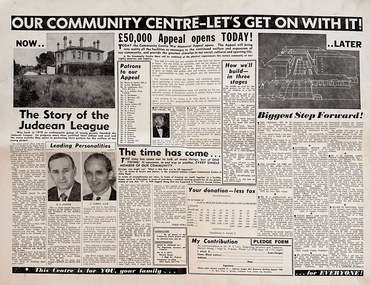
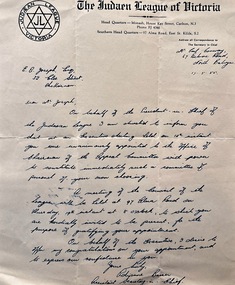
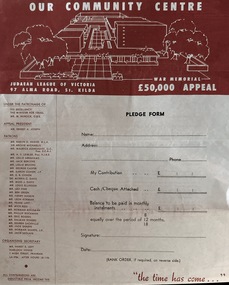
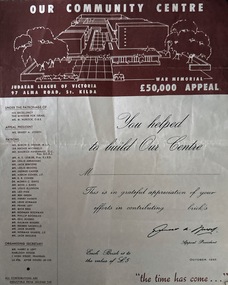
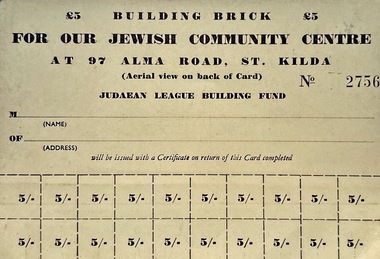
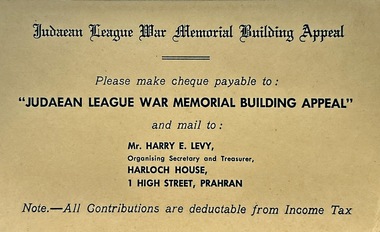
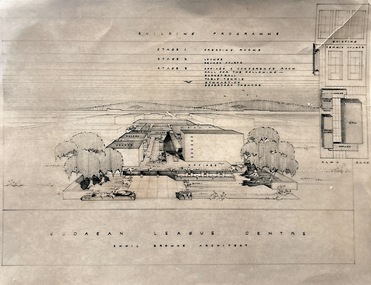
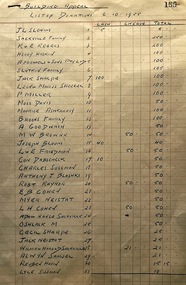
... Letterhead JLV (Judean League of Victoria) Headquarters Monash House, Kay st. Carlton &Southern Headquarters 97 Alma rd, East St. ...Letterhead JLV (Judean League of Victoria) Headquarters Monash House, Kay st. Carlton &Southern Headquarters 97 Alma rd, East St. ...Related to fundraising for 97 Alma Road - earliest letterhead dated 1919. Letterhead includes a list of patrons. The letters and floorplan are in an envelope marked Ernie Joseph & Harry Levy. 01: Letter dated 17.5.1955 to Ernie Joseph from Adrianne Besser re appointing EJ to Chairman of Appeal Committee & inviting him to meeting. Letterhead JLV (Judean League of Victoria) Headquarters Monash House, Kay st. Carlton &Southern Headquarters 97 Alma rd, East St. Kilda. 02/03: "Our Community Centre" - pledge form & receipt for contributing bricks fundraising at &5/brick (pound) Oct.1955 04: card no. 2756 with tear-off 5/- (shilling) (14 x 9.5cm) 05: Judean League War Memorial Building Appeal card (13.5 x 8cm) 06: Building 97 Alma rd. plan (30 x 23.5cm) 07: "&50,000 appeal opens" newsletter & history of Judean League (56.5 x 43cm). 1919 - Judean League founded by a few people including Myer Zeltner. By 1926, 20 people bought Fernshaw House & renamed it Myer House. Alma rd. was bought in 1930. 08: Ledger pp.135-141. Building Appeal List of Donations to 6.10.1955 from &5-1000 (pounds)judean league of victoria -
 Maccabi Victoria
Document, 1919-1955
... Letterhead JLV (Judean League of Victoria) Headquarters Monash House, Kay st. Carlton &Southern Headquarters 97 Alma rd, East St. ...Letterhead JLV (Judean League of Victoria) Headquarters Monash House, Kay st. Carlton &Southern Headquarters 97 Alma rd, East St. ...Related to fundraising for 97 Alma Road - earliest letterhead dated 1919. Letterhead includes a list of patrons. The letters and floorplan are in an envelope marked Ernie Joseph & Harry Levy. 01: Letter dated 17.5.1955 to Ernie Joseph from Adrianne Besser re appointing EJ to Chairman of Appeal Committee & inviting him to meeting. Letterhead JLV (Judean League of Victoria) Headquarters Monash House, Kay st. Carlton &Southern Headquarters 97 Alma rd, East St. Kilda. 02/03: "Our Community Centre" - pledge form & receipt for contributing bricks fundraising at &5/brick (pound) Oct.1955 04: card no. 2756 with tear-off 5/- (shilling) (14 x 9.5cm) 05: Judean League War Memorial Building Appeal card (13.5 x 8cm) 06: Building 97 Alma rd. plan (30 x 23.5cm) 07: "&50,000 appeal opens" newsletter & history of Judean League (56.5 x 43cm). 1919 - Judean League founded by a few people including Myer Zeltner. By 1926, 20 people bought Fernshaw House & renamed it Myer House. Alma rd. was bought in 1930. 08: Ledger pp.135-141. Building Appeal List of Donations to 6.10.1955 from &5-1000 (pounds)judean league of victoria -
 Maccabi Victoria
Document, 1919-1955
... Letterhead JLV (Judean League of Victoria) Headquarters Monash House, Kay st. Carlton &Southern Headquarters 97 Alma rd, East St. ...Letterhead JLV (Judean League of Victoria) Headquarters Monash House, Kay st. Carlton &Southern Headquarters 97 Alma rd, East St. ...Related to fundraising for 97 Alma Road - earliest letterhead dated 1919. Letterhead includes a list of patrons. The letters and floorplan are in an envelope marked Ernie Joseph & Harry Levy. 01: Letter dated 17.5.1955 to Ernie Joseph from Adrianne Besser re appointing EJ to Chairman of Appeal Committee & inviting him to meeting. Letterhead JLV (Judean League of Victoria) Headquarters Monash House, Kay st. Carlton &Southern Headquarters 97 Alma rd, East St. Kilda. 02/03: "Our Community Centre" - pledge form & receipt for contributing bricks fundraising at &5/brick (pound) Oct.1955 04: card no. 2756 with tear-off 5/- (shilling) (14 x 9.5cm) 05: Judean League War Memorial Building Appeal card (13.5 x 8cm) 06: Building 97 Alma rd. plan (30 x 23.5cm) 07: "&50,000 appeal opens" newsletter & history of Judean League (56.5 x 43cm). 1919 - Judean League founded by a few people including Myer Zeltner. By 1926, 20 people bought Fernshaw House & renamed it Myer House. Alma rd. was bought in 1930. 08: Ledger pp.135-141. Building Appeal List of Donations to 6.10.1955 from &5-1000 (pounds)judean league of victoria -
 Maccabi Victoria
Document, 1919-1955
... Letterhead JLV (Judean League of Victoria) Headquarters Monash House, Kay st. Carlton &Southern Headquarters 97 Alma rd, East St. ...Letterhead JLV (Judean League of Victoria) Headquarters Monash House, Kay st. Carlton &Southern Headquarters 97 Alma rd, East St. ...Related to fundraising for 97 Alma Road - earliest letterhead dated 1919. Letterhead includes a list of patrons. The letters and floorplan are in an envelope marked Ernie Joseph & Harry Levy. 01: Letter dated 17.5.1955 to Ernie Joseph from Adrianne Besser re appointing EJ to Chairman of Appeal Committee & inviting him to meeting. Letterhead JLV (Judean League of Victoria) Headquarters Monash House, Kay st. Carlton &Southern Headquarters 97 Alma rd, East St. Kilda. 02/03: "Our Community Centre" - pledge form & receipt for contributing bricks fundraising at &5/brick (pound) Oct.1955 04: card no. 2756 with tear-off 5/- (shilling) (14 x 9.5cm) 05: Judean League War Memorial Building Appeal card (13.5 x 8cm) 06: Building 97 Alma rd. plan (30 x 23.5cm) 07: "&50,000 appeal opens" newsletter & history of Judean League (56.5 x 43cm). 1919 - Judean League founded by a few people including Myer Zeltner. By 1926, 20 people bought Fernshaw House & renamed it Myer House. Alma rd. was bought in 1930. 08: Ledger pp.135-141. Building Appeal List of Donations to 6.10.1955 from &5-1000 (pounds)judean league of victoria -
 Maccabi Victoria
Document, 1919-1955
... Letterhead JLV (Judean League of Victoria) Headquarters Monash House, Kay st. Carlton &Southern Headquarters 97 Alma rd, East St. ...Letterhead JLV (Judean League of Victoria) Headquarters Monash House, Kay st. Carlton &Southern Headquarters 97 Alma rd, East St. ...Related to fundraising for 97 Alma Road - earliest letterhead dated 1919. Letterhead includes a list of patrons. The letters and floorplan are in an envelope marked Ernie Joseph & Harry Levy. 01: Letter dated 17.5.1955 to Ernie Joseph from Adrianne Besser re appointing EJ to Chairman of Appeal Committee & inviting him to meeting. Letterhead JLV (Judean League of Victoria) Headquarters Monash House, Kay st. Carlton &Southern Headquarters 97 Alma rd, East St. Kilda. 02/03: "Our Community Centre" - pledge form & receipt for contributing bricks fundraising at &5/brick (pound) Oct.1955 04: card no. 2756 with tear-off 5/- (shilling) (14 x 9.5cm) 05: Judean League War Memorial Building Appeal card (13.5 x 8cm) 06: Building 97 Alma rd. plan (30 x 23.5cm) 07: "&50,000 appeal opens" newsletter & history of Judean League (56.5 x 43cm). 1919 - Judean League founded by a few people including Myer Zeltner. By 1926, 20 people bought Fernshaw House & renamed it Myer House. Alma rd. was bought in 1930. 08: Ledger pp.135-141. Building Appeal List of Donations to 6.10.1955 from &5-1000 (pounds)judean league of victoria -
 Maccabi Victoria
Document, 1919-1955
... Letterhead JLV (Judean League of Victoria) Headquarters Monash House, Kay st. Carlton &Southern Headquarters 97 Alma rd, East St. ...Letterhead JLV (Judean League of Victoria) Headquarters Monash House, Kay st. Carlton &Southern Headquarters 97 Alma rd, East St. ...Related to fundraising for 97 Alma Road - earliest letterhead dated 1919. Letterhead includes a list of patrons. The letters and floorplan are in an envelope marked Ernie Joseph & Harry Levy. 01: Letter dated 17.5.1955 to Ernie Joseph from Adrianne Besser re appointing EJ to Chairman of Appeal Committee & inviting him to meeting. Letterhead JLV (Judean League of Victoria) Headquarters Monash House, Kay st. Carlton &Southern Headquarters 97 Alma rd, East St. Kilda. 02/03: "Our Community Centre" - pledge form & receipt for contributing bricks fundraising at &5/brick (pound) Oct.1955 04: card no. 2756 with tear-off 5/- (shilling) (14 x 9.5cm) 05: Judean League War Memorial Building Appeal card (13.5 x 8cm) 06: Building 97 Alma rd. plan (30 x 23.5cm) 07: "&50,000 appeal opens" newsletter & history of Judean League (56.5 x 43cm). 1919 - Judean League founded by a few people including Myer Zeltner. By 1926, 20 people bought Fernshaw House & renamed it Myer House. Alma rd. was bought in 1930. 08: Ledger pp.135-141. Building Appeal List of Donations to 6.10.1955 from &5-1000 (pounds)judean league of victoria -
 Maccabi Victoria
Document, 1919-1955
... Letterhead JLV (Judean League of Victoria) Headquarters Monash House, Kay st. Carlton &Southern Headquarters 97 Alma rd, East St. ...Letterhead JLV (Judean League of Victoria) Headquarters Monash House, Kay st. Carlton &Southern Headquarters 97 Alma rd, East St. ...Related to fundraising for 97 Alma Road - earliest letterhead dated 1919. Letterhead includes a list of patrons. The letters and floorplan are in an envelope marked Ernie Joseph & Harry Levy. 01: Letter dated 17.5.1955 to Ernie Joseph from Adrianne Besser re appointing EJ to Chairman of Appeal Committee & inviting him to meeting. Letterhead JLV (Judean League of Victoria) Headquarters Monash House, Kay st. Carlton &Southern Headquarters 97 Alma rd, East St. Kilda. 02/03: "Our Community Centre" - pledge form & receipt for contributing bricks fundraising at &5/brick (pound) Oct.1955 04: card no. 2756 with tear-off 5/- (shilling) (14 x 9.5cm) 05: Judean League War Memorial Building Appeal card (13.5 x 8cm) 06: Building 97 Alma rd. plan (30 x 23.5cm) 07: "&50,000 appeal opens" newsletter & history of Judean League (56.5 x 43cm). 1919 - Judean League founded by a few people including Myer Zeltner. By 1926, 20 people bought Fernshaw House & renamed it Myer House. Alma rd. was bought in 1930. 08: Ledger pp.135-141. Building Appeal List of Donations to 6.10.1955 from &5-1000 (pounds)judean league of victoria -
 Maccabi Victoria
Document, 1919-1955
... Letterhead JLV (Judean League of Victoria) Headquarters Monash House, Kay st. Carlton &Southern Headquarters 97 Alma rd, East St. ...Letterhead JLV (Judean League of Victoria) Headquarters Monash House, Kay st. Carlton &Southern Headquarters 97 Alma rd, East St. ...Related to fundraising for 97 Alma Road - earliest letterhead dated 1919. Letterhead includes a list of patrons. The letters and floorplan are in an envelope marked Ernie Joseph & Harry Levy. 01: Letter dated 17.5.1955 to Ernie Joseph from Adrianne Besser re appointing EJ to Chairman of Appeal Committee & inviting him to meeting. Letterhead JLV (Judean League of Victoria) Headquarters Monash House, Kay st. Carlton &Southern Headquarters 97 Alma rd, East St. Kilda. 02/03: "Our Community Centre" - pledge form & receipt for contributing bricks fundraising at &5/brick (pound) Oct.1955 04: card no. 2756 with tear-off 5/- (shilling) (14 x 9.5cm) 05: Judean League War Memorial Building Appeal card (13.5 x 8cm) 06: Building 97 Alma rd. plan (30 x 23.5cm) 07: "&50,000 appeal opens" newsletter & history of Judean League (56.5 x 43cm). 1919 - Judean League founded by a few people including Myer Zeltner. By 1926, 20 people bought Fernshaw House & renamed it Myer House. Alma rd. was bought in 1930. 08: Ledger pp.135-141. Building Appeal List of Donations to 6.10.1955 from &5-1000 (pounds)judean league of victoria -
 Federation University Historical Collection
Booklet, Churchill & District Community Association, Churchill's 40th Anniversary, 2005
... monash university...hazelwood...yallourn...eel hole...eel hole school...cigar...hare's house...With campuses from Horsham in the west of the state, to Churchill in the east, the name Federation University Australia was chosen to convey the scope and capacity of an expanded regional university with a federated network of campuses contributing to a new and different Australian university. churchill monash university hazelwood yallourn eel hole eel hole school cigar hare's house binishell gippsland gippsland campus gippsland campus collection Green and brown soft covered book of 16 pages. ...Green and brown soft covered book of 16 pages.non-fictionchurchill, monash university, hazelwood, yallourn, eel hole, eel hole school, cigar, hare's house, binishell, gippsland, gippsland campus, gippsland campus collection -
 Federation University Historical Collection
Book, Jennifer O'Donnell, Caragulac, 2021
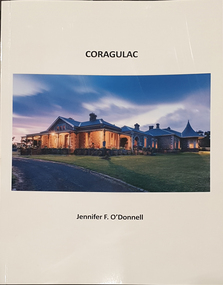
... house...cororooke...andrew spence chirnside...william prenzel...polo...colac caledonian society...colac mounted cadets...thomas baker...leonard samuel ralton...len talton...matthews family...monash...Contents include the Gulidjan, Robertson family, Cargulac house, Cororooke, Andrew Spence Chirnside, William Prenzel, polo, Colac Caledonian Society, Colac Mounted Cadets, Thomas Baker, Leonard Samuel Ralton, Len Talton, Matthews family, Monash Cottage, Disappearing lakes....gulidjan robertson family cargulac house cororooke andrew spence chirnside william prenzel polo colac caledonian society colac mounted cadets thomas baker leonard samuel ralton len talton matthews family monash cottage disappearing lakes. tuff quarries red rock hugh murray murdering gully massacre william robertson margaret robertson william buckley the hill estate colac estate colac polo club guyon purchas caragulac land sale garry gibson sharyn gibson Soft covered book with a photographuc image of the building known as Caragulac on the cover. ...Soft covered book with a photographuc image of the building known as Caragulac on the cover. Contents include the Gulidjan, Robertson family, Cargulac house, Cororooke, Andrew Spence Chirnside, William Prenzel, polo, Colac Caledonian Society, Colac Mounted Cadets, Thomas Baker, Leonard Samuel Ralton, Len Talton, Matthews family, Monash Cottage, Disappearing lakes.gulidjan, robertson family, cargulac house, cororooke, andrew spence chirnside, william prenzel, polo, colac caledonian society, colac mounted cadets, thomas baker, leonard samuel ralton, len talton, matthews family, monash cottage, disappearing lakes., tuff quarries, red rock, hugh murray, murdering gully massacre, william robertson, margaret robertson, william buckley, the hill estate, colac estate, colac polo club, guyon purchas, caragulac land sale, garry gibson, sharyn gibson -
City of Moorabbin Historical Society (Operating the Box Cottage Museum)
Newsletter - CMHS Moorabbin Mirror Vol 3 August 2015, Moorabbin Mirror Vol 3 August 2015, August 2015
... Monash. Members are informed of the Heritage Display at Stanley's Menswear, Bentleigh East, in conjunction with Glen Eira HS, Market Garden Display at Bendigo Bank Ormond and the Sandbelt Milestones at Brighton Cemetery, Godfrey Street Community House, St Peter's Church & School, the ongoing Gallipoli Centenary and Moorabbin Saints AFL team at Linton Street. ...Monash. Members are informed of the Heritage Display at Stanley's Menswear, Bentleigh East, in conjunction with Glen Eira HS, Market Garden Display at Bendigo Bank Ormond and the Sandbelt Milestones at Brighton Cemetery, Godfrey Street Community House, St Peter's Church & School, the ongoing Gallipoli Centenary and Moorabbin Saints AFL team at Linton Street. ...This is Vol. 3 of the Moorabbin Mirror produced by CMHS members Fran & Holger Bader , Valma Sharp August 2015 The Moorabbin Mirror reflects the history and heritage of the former City of Moorabbin — derived from Mooroobin, ‘a resting place’ in the Bunurrung spoken language. In 1994, the City of Moorabbin was integrated into the Cities of Bayside, Glen Eira, Kingston and Monash. Members are informed of the Heritage Display at Stanley's Menswear, Bentleigh East, in conjunction with Glen Eira HS, Market Garden Display at Bendigo Bank Ormond and the Sandbelt Milestones at Brighton Cemetery, Godfrey Street Community House, St Peter's Church & School, the ongoing Gallipoli Centenary and Moorabbin Saints AFL team at Linton Street. Dates for Committee Meeting, General Meeting and the upcoming AGM in October. Photos from The Booklet and Leaflet Launch on May 13th, a request for information about the Womens’ Farm Mordialloc c 1916 , advertisements for the Bayside Arts & Cultural Exhibition featuring Tommy Bent and the RHSV Exhibition re MacPherson Robertson featuring the bust made by August Reitman at Box Cottage . Open Days are listed with an invitation for new members showing the benefits and duties of CMHS membership. CMHS thanks The Office of the Hon. Andrew Robb AO MP Minister for Trade & Investment, Federal Member for Goldstein, who photocopied this newsletter under community printing entitlements. This is Vol. 3 of the Moorabbin Mirror, Newsletter of CMHS August 2015 A4 x 3 paper folded to A5 x 6pp with colour photographs. Moorabbin / Mirror / August 2015 Issue 3 moorabbin mirror, bader fran, bader holger, sharp valma, bent tommy, mordialloc womens farm c1916, gallipoli landings 1915, robertson macpherson, reitman august, godrfrey street community hhouse bentleigh, st peter's church bentleigh east, brighton cemetery, bendigo bank ormond, stanley's menwear bentleigh, glen eira historical society, launch of box cottage museum publications 2015, glen eira city council,east -
 City of Moorabbin Historical Society (Operating the Box Cottage Museum)
Newsletter - City of Moorabbin Historical Society, Newsletter No 1 August 1961, 1961
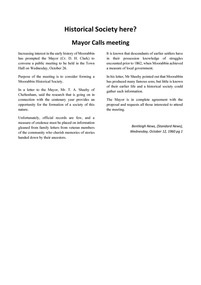
... The Aims of the CMHS are ‘to record the history of the City, and register something of the Australian Atmosphere, which the necessary speed-up in post-world-war two (WW11) immigration has caused to be lost; to produce a magazine at regular intervals, featuring the work of pioneers and the changing Australian scene; to work constantly with a long range view towards building a hall where records and exhibits can be housed’ The Original Newsletters reflect the history and heritage of the former City of Moorabbin — derived from Mooroobin, ‘a resting place’ in the Bunurrung spoken language. In 1994, the City of Moorabbin was integrated into the Cities of Bayside, Glen Eira, Kingston and Monash. ...The Aims of the CMHS are ‘to record the history of the City, and register something of the Australian Atmosphere, which the necessary speed-up in post-world-war two (WW11) immigration has caused to be lost; to produce a magazine at regular intervals, featuring the work of pioneers and the changing Australian scene; to work constantly with a long range view towards building a hall where records and exhibits can be housed’ The Original Newsletters reflect the history and heritage of the former City of Moorabbin — derived from Mooroobin, ‘a resting place’ in the Bunurrung spoken language. In 1994, the City of Moorabbin was integrated into the Cities of Bayside, Glen Eira, Kingston and Monash. ...This is No.1 the first Newsletter produced by CMHS members in August 1961. Topics : October 1960 Mayor Cr. D.H. Clark called a meeting in the Moorabbin Town Hall to form the City of Moorabbin Historical Society. Local residents attended including descendants of early settler families - Coates, LePage, Shipston - and a Committee was elected. Mr T.A.Sheehy, President, Mr R.Colbourne, Secretary, Mrs F.Wright, Treasurer set the Annual Membership Fee at 5/- ( shillings), arranged the next meetings at the Moorabbin Town Hall and began to compile a Newsletter to tell the ' story of Moorabbin'. The Cheltenham & District Society Co-operative Limited (est.1896) sponsored this 1st CMHS Newsletter published August 1961. The Aims of the CMHS are ‘to record the history of the City, and register something of the Australian Atmosphere, which the necessary speed-up in post-world-war two (WW11) immigration has caused to be lost; to produce a magazine at regular intervals, featuring the work of pioneers and the changing Australian scene; to work constantly with a long range view towards building a hall where records and exhibits can be housed’ The Original Newsletters reflect the history and heritage of the former City of Moorabbin — derived from Mooroobin, ‘a resting place’ in the Bunurrung spoken language. In 1994, the City of Moorabbin was integrated into the Cities of Bayside, Glen Eira, Kingston and Monash. This is the 1st Newsletter of CMHS in August 1961 CMHS obtained a Kingston City Council Community Grant 2016 for the digitization and preservation of these Original CMHS Newsletters commenced in 1961 Foolscap paper printed on 1 side.CITY OF MOORABBIN HISTORICAL / SOCIETY / NEWSLETTER No 1 / AUGUST 1961moorabbin, cheltenham, bentleigh, newsletters,, sheehy thomas, coates l.r, shipston h, lepage e.a, lepage f.w., blackburn nance, clark d.h., wright f, moorabbin city council, cheltenham and district society co-operative limited, moorabbin town hall, early settlers, market gardeners, pioneers, dendy henry, brighton, box william, bent thomas -
City of Moorabbin Historical Society (Operating the Box Cottage Museum)
Newsletter - CMHS Moorabbin Mirror Vol 7 August 2016, Moorabbin Mirror Vol 7 August 2016, August 2016
... Monash. In this Issue This is Vol. 7 of the Moorabbin Mirror, Newsletter of CMHS August 2016 moorabbin, bentleigh, cheltenham, open house melbourne 2016, wattle trees, robb andrew hon. mhr., goldstein vida, mckinnon kindergarten, kingston historical societies network, southern metro historical societies network, moorabbin aviation museum, Moorabbin / Mirror / August 2016 Vol 7 A4 x 3 paper folded to A5 x 6pp with colour photographs. ...This is Vol. 7 of the Moorabbin Mirror produced by CMHS members Fran & Holger Bader , Valma Sharp in August 2016 The Moorabbin Mirror reflects the history and heritage of the former City of Moorabbin — derived from Mooroobin, ‘a resting place’ in the Bunurrung spoken language. In 1994, the City of Moorabbin was integrated into the Cities of Bayside, Glen Eira, Kingston and Monash. In this Issue This is Vol. 7 of the Moorabbin Mirror, Newsletter of CMHS August 2016A4 x 3 paper folded to A5 x 6pp with colour photographs. Moorabbin / Mirror / August 2016 Vol 7moorabbin, bentleigh, cheltenham, open house melbourne 2016, wattle trees, robb andrew hon. mhr., goldstein vida, mckinnon kindergarten, kingston historical societies network, southern metro historical societies network, moorabbin aviation museum, -
 City of Moorabbin Historical Society (Operating the Box Cottage Museum)
Newsletter - City of Moorabbin Historical Society No. 1 Vol 2 April 1962, City of Moorabbin Historical Society Newsletter No 1 Vol 2 April 1962, 1962
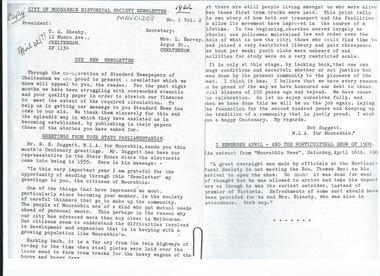
... This is Newsletter No.1 Vol 2 produced by CMHS members April 1962 The Aims of the CMHS are ‘to record the history of the City, and register something of the Australian Atmosphere, which the necessary speed-up in post-world-war two (WW11) immigration has caused to be lost; to produce a magazine at regular intervals, featuring the work of pioneers and the changing Australian scene; to work constantly with a long range view towards building a hall where records and exhibits can be housed’ The Original Newsletters reflect the history and heritage of the former City of Moorabbin — derived from Mooroobin, ‘a resting place’ in the Bunurrung spoken language. In 1994, the City of Moorabbin was integrated into the Cities of Bayside, Glen Eira, Kingston and Monash. ...This is Newsletter No.1 Vol 2 produced by CMHS members April 1962 The Aims of the CMHS are ‘to record the history of the City, and register something of the Australian Atmosphere, which the necessary speed-up in post-world-war two (WW11) immigration has caused to be lost; to produce a magazine at regular intervals, featuring the work of pioneers and the changing Australian scene; to work constantly with a long range view towards building a hall where records and exhibits can be housed’ The Original Newsletters reflect the history and heritage of the former City of Moorabbin — derived from Mooroobin, ‘a resting place’ in the Bunurrung spoken language. In 1994, the City of Moorabbin was integrated into the Cities of Bayside, Glen Eira, Kingston and Monash. ...This is Newsletter No.1 Vol 2 produced by CMHS members April 1962 The Aims of the CMHS are ‘to record the history of the City, and register something of the Australian Atmosphere, which the necessary speed-up in post-world-war two (WW11) immigration has caused to be lost; to produce a magazine at regular intervals, featuring the work of pioneers and the changing Australian scene; to work constantly with a long range view towards building a hall where records and exhibits can be housed’ The Original Newsletters reflect the history and heritage of the former City of Moorabbin — derived from Mooroobin, ‘a resting place’ in the Bunurrung spoken language. In 1994, the City of Moorabbin was integrated into the Cities of Bayside, Glen Eira, Kingston and Monash. This Issue - Mr R.H.Suggett MLA Letter; Horticultural Show 1904; Harry Hawker; Dr Fleming Joyce; Henry Dendy; John King. This is CMHS Newsletter No 1 Vol. 2 of il 1962 4 x pages Paper L 21.5cm x W 17cm CITY OF MOORABBIN HISTORICAL SOCIETY NEWSLETTER / No.1 Vol. 2 / President T.A.Sheehy ..... Secretary Mrs L Harvey / OUR NEW NEWSLETTER -
City of Moorabbin Historical Society (Operating the Box Cottage Museum)
Newsletter - City of Moorabbin Historical Society, Newsletter No. 2 September 1961, September 1961
... This is Newsletter No 2 produced by CMHS members in September 1961 The Aims of the CMHS are ‘to record the history of the City, and register something of the Australian Atmosphere, which the necessary speed-up in post-world-war two (WW11) immigration has caused to be lost; to produce a magazine at regular intervals, featuring the work of pioneers and the changing Australian scene; to work constantly with a long range view towards building a hall where records and exhibits can be housed’ The Original Newsletters reflect the history and heritage of the former City of Moorabbin — derived from Mooroobin, ‘a resting place’ in the Bunurrung spoken language. In 1994, the City of Moorabbin was integrated into the Cities of Bayside, Glen Eira, Kingston and Monash. ...This is Newsletter No 2 produced by CMHS members in September 1961 The Aims of the CMHS are ‘to record the history of the City, and register something of the Australian Atmosphere, which the necessary speed-up in post-world-war two (WW11) immigration has caused to be lost; to produce a magazine at regular intervals, featuring the work of pioneers and the changing Australian scene; to work constantly with a long range view towards building a hall where records and exhibits can be housed’ The Original Newsletters reflect the history and heritage of the former City of Moorabbin — derived from Mooroobin, ‘a resting place’ in the Bunurrung spoken language. In 1994, the City of Moorabbin was integrated into the Cities of Bayside, Glen Eira, Kingston and Monash. ...This is Newsletter No 2 produced by CMHS members in September 1961 The Aims of the CMHS are ‘to record the history of the City, and register something of the Australian Atmosphere, which the necessary speed-up in post-world-war two (WW11) immigration has caused to be lost; to produce a magazine at regular intervals, featuring the work of pioneers and the changing Australian scene; to work constantly with a long range view towards building a hall where records and exhibits can be housed’ The Original Newsletters reflect the history and heritage of the former City of Moorabbin — derived from Mooroobin, ‘a resting place’ in the Bunurrung spoken language. In 1994, the City of Moorabbin was integrated into the Cities of Bayside, Glen Eira, Kingston and Monash. This is No 2 of the Newsletter of CMHS Setember 1961 CMHS obtained a Kingston City Council Community Grant 2016 for the digitalization and preservation of these Original CMHS Newsletters commenced in 1961 2 pages of Foolscap paper printed on 1 side.CITY OF MOORABBIN HISTORICAL / SOCIETY / NEWSLETTER No 2 / SEPTEMBER 1961 -
City of Moorabbin Historical Society (Operating the Box Cottage Museum)
Newsletter - City of Moorabbin Historical Society Newsletter No 3 August 1961, 1961
... This is No 3 of the Newsletter produced by CMHS President in October 1961 The Aims of the CMHS are ‘to record the history of the City, and register something of the Australian Atmosphere, which the necessary speed-up in post-world-war two (WW11) immigration has caused to be lost; to produce a magazine at regular intervals, featuring the work of pioneers and the changing Australian scene; to work constantly with a long range view towards building a hall where records and exhibits can be housed’ The Original Newsletters reflect the history and heritage of the former City of Moorabbin — derived from Mooroobin, ‘a resting place’ in the Bunurrung spoken language. In 1994, the City of Moorabbin was integrated into the Cities of Bayside, Glen Eira, Kingston and Monash. ...This is No 3 of the Newsletter produced by CMHS President in October 1961 The Aims of the CMHS are ‘to record the history of the City, and register something of the Australian Atmosphere, which the necessary speed-up in post-world-war two (WW11) immigration has caused to be lost; to produce a magazine at regular intervals, featuring the work of pioneers and the changing Australian scene; to work constantly with a long range view towards building a hall where records and exhibits can be housed’ The Original Newsletters reflect the history and heritage of the former City of Moorabbin — derived from Mooroobin, ‘a resting place’ in the Bunurrung spoken language. In 1994, the City of Moorabbin was integrated into the Cities of Bayside, Glen Eira, Kingston and Monash. ...This is No 3 of the Newsletter produced by CMHS President in October 1961 The Aims of the CMHS are ‘to record the history of the City, and register something of the Australian Atmosphere, which the necessary speed-up in post-world-war two (WW11) immigration has caused to be lost; to produce a magazine at regular intervals, featuring the work of pioneers and the changing Australian scene; to work constantly with a long range view towards building a hall where records and exhibits can be housed’ The Original Newsletters reflect the history and heritage of the former City of Moorabbin — derived from Mooroobin, ‘a resting place’ in the Bunurrung spoken language. In 1994, the City of Moorabbin was integrated into the Cities of Bayside, Glen Eira, Kingston and Monash. This is Vol. 3 of the Newsletter of CMHS October 1961 CMHS obtained a Kingston City Council Community Grant 2016 for the digitalization and preservation of these Original CMHS Newsletters commenced in 1961 2 x pages Foolscap paper printed on 1 side.CITY OF MOORABBIN HISTORICAL / SOCIETY / NEWSLETTER No 3 / October 1961 / ( affiliated with the Royal Historical Society of Victoria).moorabbin
