
Showing 49 items matching "montana"
-
 Camberwell Historical Society
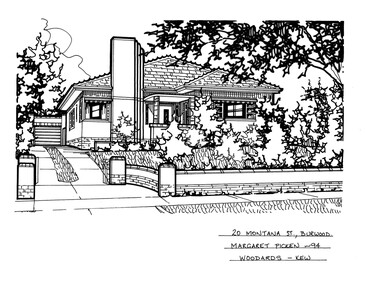
Drawing (series) - Architectural drawing, 20 Montana Street, Burwood, 2002
... 20 Montana Street, Burwood...Pen and ink architectural drawing on drafting film of 20 Montana Street, Burwood by Margaret Picken...20 MONTANA ST., BURWOOD / MARGARET PICKEN - 94 / WOODARDS - KEW...The fact that each drawing is dated with the year it was created also proves a valuable record for house historians - since that date a number of the depicted properties have either been altered or demolished. artist architectural drawings margaret picken camberwell houses 20 MONTANA ST., BURWOOD / MARGARET PICKEN - 94 / WOODARDS - KEW Pen and ink architectural drawing on drafting film of 20 Montana Street, Burwood by Margaret Picken 20 Montana Street, Burwood Drawing Architectural drawing ...artist, architectural drawings, margaret picken, camberwell, housesartist, architectural drawings, margaret picken, camberwell, houses -
 Camberwell Historical Society
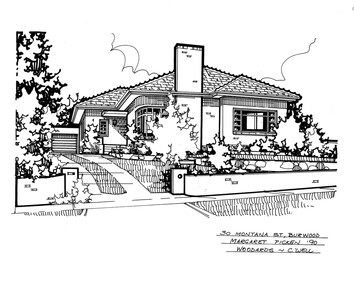
Drawing (series) - Architectural drawing, 30 Montana Street, Burwood, 2002
... 30 Montana Street, Burwood...Pen and ink architectural drawing on drafting film of 30 Montana Street, Burwood by Margaret Picken...30 MONTANA ST., BURWOOD / MARGARET PICKEN '90 / WOODARDS - C'WELL...The fact that each drawing is dated with the year it was created also proves a valuable record for house historians - since that date a number of the depicted properties have either been altered or demolished. artist architectural drawings margaret picken camberwell houses 30 MONTANA ST., BURWOOD / MARGARET PICKEN '90 / WOODARDS - C'WELL Pen and ink architectural drawing on drafting film of 30 Montana Street, Burwood by Margaret Picken 30 Montana Street, Burwood Drawing Architectural drawing ...artist, architectural drawings, margaret picken, camberwell, housesartist, architectural drawings, margaret picken, camberwell, houses -
 Camberwell Historical Society
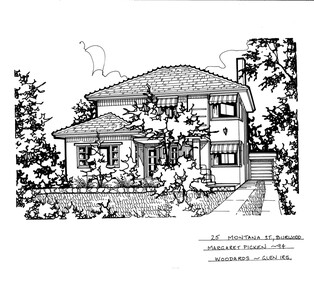
Drawing (series) - Architectural drawing, 25 Montana Street, Burwood, 2002
... 25 Montana Street, Burwood...Pen and ink architectural drawing on drafting film of 25 Montana Street, Burwood by Margaret Picken...25 MONTANA ST., BURWOOD / MARGARET PICKEN - 94 / WOODARDS - GLEN IRIS...The fact that each drawing is dated with the year it was created also proves a valuable record for house historians - since that date a number of the depicted properties have either been altered or demolished. artist architectural drawings margaret picken camberwell houses 25 MONTANA ST., BURWOOD / MARGARET PICKEN - 94 / WOODARDS - GLEN IRIS Pen and ink architectural drawing on drafting film of 25 Montana Street, Burwood by Margaret Picken 25 Montana Street, Burwood Drawing Architectural drawing ...artist, architectural drawings, margaret picken, camberwell, housesartist, architectural drawings, margaret picken, camberwell, houses -
 Camberwell Historical Society
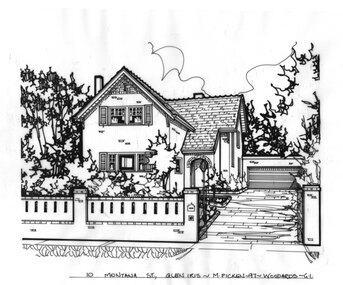
Drawing (series) - Architectural drawing, 10 Montana Street, Glen Iris, 1997
... 10 Montana Street, Glen Iris...Pen and ink architectural drawing on drafting film of 10 Montana Street, Glen Iris by Margaret Picken...10 MONTANA ST., GLEN IRIS - M. PICKEN -97 - WOODARDS - G.I....Pen and ink architectural drawing on drafting film of 10 Montana Street, Glen Iris by Margaret Picken 10 Montana Street, Glen Iris Drawing Architectural drawing ...artist, architectural drawings, margaret picken, camberwell, housesartist, architectural drawings, margaret picken, camberwell, houses -
 Camberwell Historical Society
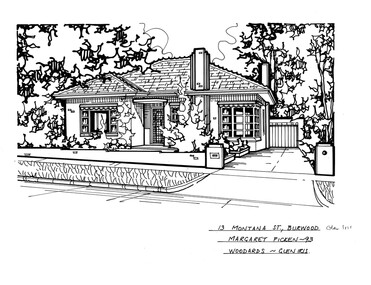
Drawing (series) - Architectural drawing, 13 Montana Street, Burwood, 1993
... 13 Montana Street, Burwood...Pen and ink architectural drawing on drafting film of 13 Montana Street, Burwood by Margaret Picken...13 MONTANA ST., BURWOOD GLEN IRIS / MARGARET PICKEN - 93 / WOODARDS - GLEN IRIS...The fact that each drawing is dated with the year it was created also proves a valuable record for house historians - since that date a number of the depicted properties have either been altered or demolished. artist architectural drawings margaret picken camberwell houses 13 MONTANA ST., BURWOOD GLEN IRIS / MARGARET PICKEN - 93 / WOODARDS - GLEN IRIS Pen and ink architectural drawing on drafting film of 13 Montana Street, Burwood by Margaret Picken 13 Montana Street, Burwood Drawing Architectural drawing ...artist, architectural drawings, margaret picken, camberwell, housesartist, architectural drawings, margaret picken, camberwell, houses -
 Whitehorse Historical Society Inc.
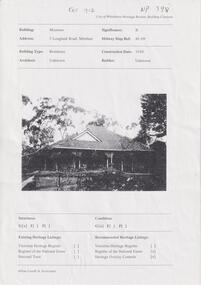
Document, 5 Longland Road, Mitcham
... ...Montana...The site of Montana comprised Lot 26 of the Heatherdale Estate, part of Crown Allotment 130, which was subdivided in 1906. ...3 page photocopy of MONTANA, 5 Longland Road, Mitcham...The site of Montana comprised Lot 26 of the Heatherdale Estate, part of Crown Allotment 130, which was subdivided in 1906. ...Montana is of historical and aesthetic significance3 page photocopy of MONTANA, 5 Longland Road, Mitchamnon-fictionMontana is of historical and aesthetic significancepurches frederick, montana, longland road mitcham no 5 -
 Whitehorse Historical Society Inc.
Document, Archaeology Assessment, 1/11/2002 12:00:00 AM
... ...Montana... The Burwood Uniting Church, Burwood East; The Wattles, Vermont South; Strathdon Homestead; Montana, Mitcham. Prepared by Biosis Research Pty. ...City of Whitehorse archaeology assessment citing 4 properties identified: The Burwood Uniting Church, Burwood East; The Wattles, Vermont South; Strathdon Homestead; Montana, Mitcham. Prepared by Biosis Research Pty. ...The Burwood Uniting Church, Burwood East; The Wattles, Vermont South; Strathdon Homestead; Montana, Mitcham. Prepared by Biosis Research Pty. ...City of Whitehorse archaeology assessment citing 4 properties identified.City of Whitehorse archaeology assessment citing 4 properties identified: The Burwood Uniting Church, Burwood East; The Wattles, Vermont South; Strathdon Homestead; Montana, Mitcham. Prepared by Biosis Research Pty. LtdCity of Whitehorse archaeology assessment citing 4 properties identified. city of whitehorse, uniting church, burwood east, wattles, vermont south, strathdon homestead, montana, mitcham -
 Beechworth Honey Archive
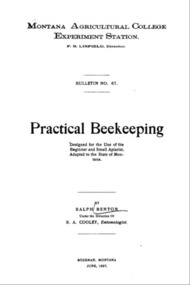
Publication, e-book, Practical beekeeping (Benton, R.), Bozeman, 1907, 1907
... Bozeman, Montana Agricultural College, Experiment Station ... -
 Federation University Art Collection
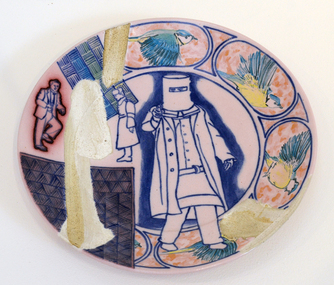
Ceramic, Ned Kelly by Vernon Patrick, c1990
... Professor Vernon PATRICK (1943- ) Born Havre, Montana, United States of America A lecturer at the Montana State University, Vernon Patrick was a visiting artist to the Gippsland Centre for Art and Design (GCAD)....Professor Vernon PATRICK (1943- ) Born Havre, Montana, United States of America A lecturer at the Montana State University, Vernon Patrick was a visiting artist to the Gippsland Centre for Art and Design (GCAD). vernon patrick jan feder memorial ceramics collection ceramics gippsland campus churchill A stoneware platter with decoration featuring Ned Kelly in armour. ...Professor Vernon PATRICK (1943- ) Born Havre, Montana, United States of America A lecturer at the Montana State University, Vernon Patrick was a visiting artist to the Gippsland Centre for Art and Design (GCAD).A stoneware platter with decoration featuring Ned Kelly in armour. vernon patrick, jan feder memorial ceramics collection, ceramics, gippsland campus, churchill -
 Federation University Art Collection
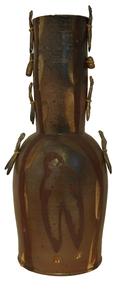
Ceramic, 'Man and Woman' by Professor Patrick Vernon, c1990
... Professor Vernon PATRICK (1943- )
Born Havre, Montana, United States of America
A lecturer at the Montana State University, Vernon Patrick was a visiting artist to the Gippsland Centre for Art and Design (GCAD)....Professor Vernon PATRICK (1943- )
Born Havre, Montana, United States of America
A lecturer at the Montana State University, Vernon Patrick was a visiting artist to the Gippsland Centre for Art and Design (GCAD). jan feder memorial collection vernon patrick ceramics gippsland campus artwork artist jan feder memorial ceramics collection patrick vernon Woodfired stoneware vase form. ...Professor Vernon PATRICK (1943- ) Born Havre, Montana, United States of America A lecturer at the Montana State University, Vernon Patrick was a visiting artist to the Gippsland Centre for Art and Design (GCAD).Woodfired stoneware vase form. jan feder memorial collection, vernon patrick, ceramics, gippsland campus, artwork, artist, jan feder memorial ceramics collection, patrick vernon -
 Federation University Art Collection
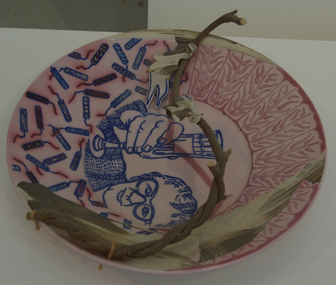
Ceramic, Vernon Patrick, Stoneware Platter with Stick by Vernon Patrick, c1990
... Professor Vernon PATRICK (1943- )
Born Havre, Montana, United States of America
A lecturer at the Montana State University, Vernon Patrick was a visiting artist to the Gippsland Centre for Art and Design (GCAD). ...Professor Vernon PATRICK (1943- )
Born Havre, Montana, United States of America
A lecturer at the Montana State University, Vernon Patrick was a visiting artist to the Gippsland Centre for Art and Design (GCAD). ...Professor Vernon PATRICK (1943- ) Born Havre, Montana, United States of America A lecturer at the Montana State University, Vernon Patrick was a visiting artist to the Gippsland Centre for Art and Design (GCAD). Contextual or historic informationPlatter with glaze design and stickvernon patrick, ceramics, gippsland campus, churchill, jan feder memorial ceramics collection -
 Federation University Art Collection
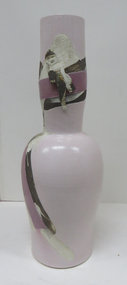
Ceramic, 'Girl with Dalmation' by Vernon Patrick, c1990
... Professor Vernon Cecil PATRICK (18 November 1943- ) Born Haure , Montana, USA Professor Vernon Patrick was a visiting artist to the Gippsland Campus. ...Professor Vernon Cecil PATRICK (18 November 1943- ) Born Haure , Montana, USA Professor Vernon Patrick was a visiting artist to the Gippsland Campus. ...Professor Vernon Cecil PATRICK (18 November 1943- ) Born Haure , Montana, USA Professor Vernon Patrick was a visiting artist to the Gippsland Campus. In 2018 he was listed as an Emeritus Professor of the California State University.Stoneware vase featuring a girl and dalmation.vernon patrick, gippsland campus, churchill, jan feder memorial ceramics collection, stoneware -
 Flagstaff Hill Maritime Museum and Village
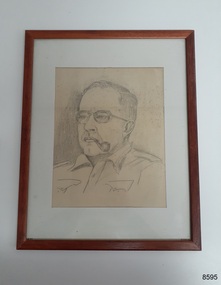
Drawing - Portrait, Dr William Roy Angus, c. 1960s
... Done by Cpt William Baxerd 520 Daka Street Butte Montana USA ? a Dr a Royal Melb Hospital.' ...Done by Cpt William Baxerd 520 Daka Street Butte Montana USA ? a Dr a Royal Melb Hospital.' ...This drawing of Dr.William Roy Angus, Surgeon and Oculist, was donated to Flagstaff Hill Maritime Village by his daughter, Bernice McDade. It is part of the “W.R. Angus Collection” that includes historical medical equipment, surgical instruments and material once belonging to Dr Edward Ryan and Dr Thomas Francis Ryan, (both of Nhill, Victoria) as well as Dr Angus’ own belongings. The Collection’s history spans the medical practices of the two Doctors Ryan, from 1885-1926 plus that of Dr Angus, up until 1969. ABOUT THE “W.R.ANGUS COLLECTION” Doctor William Roy Angus M.B., B.S., Adel., 1923, F.R.C.S. Edin.,1928 (also known as Dr Roy Angus) was born in Murrumbeena, Victoria in 1901 and lived until 1970. He qualified as a doctor in 1923 at University of Adelaide, was Resident Medical Officer at the Royal Adelaide Hospital in 1924 and for a period was house surgeon to Sir (then Mr.) Henry Simpson Newland. Dr Angus was briefly an Assistant to Dr Riddell of Kapunda, then commenced private practice at Curramulka, Yorke Peninsula, SA, where he was physician, surgeon and chemist. In 1926, he was appointed as new Medical Assistant to Dr Thomas Francis Ryan (T.F. Ryan, or Tom), in Nhill, Victoria, where his experiences included radiology and pharmacy. In 1927 he was Acting House Surgeon in Dr Tom Ryan’s absence. Dr Angus had become engaged to Gladys Forsyth and they decided he would take time to further his studies overseas in the UK in 1927. He studied at London University College Hospital and at Edinburgh Royal Infirmary and in 1928, was awarded FRCS (Fellow from the Royal College of Surgeons), Edinburgh. He worked his passage back to Australia as a Ship’s Surgeon on the on the Australian Commonwealth Line’s T.S.S. Largs Bay. Dr Angus married Gladys in 1929, in Ballarat. (They went on to have one son (Graham 1932, born in SA) and two daughters (Helen (died 12/07/1996) and Berenice (Berry), both born at Mira, Nhill ) Dr Angus was a ‘flying doctor’ for the A.I.M. (Australian Inland Ministry) Aerial Medical Service in 1928 . The organisation began in South Australia through the Presbyterian Church in that year, with its first station being in the remote town of Oodnadatta, where Dr Angus was stationed. He was locum tenens there on North-South Railway at 21 Mile Camp. He took up this ‘flying doctor’ position in response to a call from Dr John Flynn; the organisation was later known as the Flying Doctor Service, then the Royal Flying Doctor Service. A lot of his work during this time involved dental surgery also. Between 1928-1932 he was surgeon at the Curramulka Hospital, Yorke Peninsula, South Australia. In 1933 Dr Angus returned to Nhill where he’d previously worked as Medical Assistant and purchased a share of the Nelson Street practice and Mira hospital from Dr Les Middleton one of the Middleton Brothers, the current owners of what was once Dr Tom Ryan’s practice. Dr L Middleton was House Surgeon to the Nhill Hospital 1926-1933, when he resigned. [Dr Tom Ryan’s practice had originally belonged to his older brother Dr Edward Ryan, who came to Nhill in 1885. Dr Edward saw patients at his rooms, firstly in Victoria Street and in 1886 in Nelson Street, until 1901. The Nelson Street practice also had a 2 bed ward, called Mira Private Hospital ). Dr Edward Ryan was House Surgeon at the Nhill Hospital 1884-1902 . He also had occasions where he successfully performed veterinary surgery for the local farmers too. Dr Tom Ryan then purchased the practice from his brother in 1901. Both Dr Edward and Dr Tom Ryan work as surgeons included eye surgery. Dr Tom Ryan performed many of his operations in the Mira private hospital on his premises. He too was House Surgeon at the Nhill Hospital 1902-1926. Dr Tom Ryan had one of the only two pieces of radiology equipment in Victoria during his practicing years – The Royal Melbourne Hospital had the other one. Over the years Dr Tom Ryan gradually set up what was effectively a training school for country general-practitioner-surgeons. Each patient was carefully examined, including using the X-ray machine, and any surgery was discussed and planned with Dr Ryan’s assistants several days in advance. Dr Angus gained experience in using the X-ray machine there during his time as assistant to Dr Ryan. Dr Tom Ryan moved from Nhill in 1926. He became a Fellow of the Royal Australasian College of Surgeons in 1927, soon after its formation, a rare accolade for a doctor outside any of the major cities. He remained a bachelor and died suddenly on 7th Dec 1955, aged 91, at his home in Ararat. Scholarships and prizes are still awarded to medical students in the honour of Dr T.F. Ryan and his father, Dr Michael Ryan, and brother, John Patrick Ryan. ] When Dr Angus bought into the Nelson Street premises in Nhill he was also appointed as the Nhill Hospital’s Honorary House Surgeon 1933-1938. His practitioner’s plate from his Nhill surgery states “HOURS Daily, except Tuesdays, Fridays and Saturday afternoons, 9-10am, 2-4pm, 7-8pm. Sundays by appointment”. This plate is now mounted on the doorway to the Port Medical Office at Flagstaff Hill Maritime Village, Warrnambool. Dr Edward Ryan and Dr Tom Ryan had an extensive collection of historical medical equipment and materials spanning 1884-1926 and when Dr Angus took up practice in their old premises he obtained this collection, a large part of which is now on display at the Port Medical Office at Flagstaff Hill Maritime Village in Warrnambool. During his time in Nhill Dr Angus was involved in the merging of the Mira Hospital and Nhill Public Hospital into one public hospital and the property titles passed on to Nhill Hospital in 1939. In 1939 Dr Angus and his family moved to Warrnambool where he purchased “Birchwood,” the 1852 home and medical practice of Dr John Hunter Henderson, at 214 Koroit Street. (This property was sold in1965 to the State Government and is now the site of the Warrnambool Police Station. ). The Angus family was able to afford gardeners, cooks and maids; their home was a popular place for visiting dignitaries to stay whilst visiting Warrnambool. Dr Angus had his own silk worm farm at home in a Mulberry tree. His young daughter used his centrifuge for spinning the silk. Dr Angus was appointed on a part-time basis as Port Medical Officer (Health Officer) in Warrnambool and held this position until the 1940’s when the government no longer required the service of a Port Medical Officer in Warrnambool; he was thus Warrnambool’s last serving Port Medical Officer. (The duties of a Port Medical Officer were outlined by the Colonial Secretary on 21st June, 1839 under the terms of the Quarantine Act. Masters of immigrant ships arriving in port reported incidents of diseases, illness and death and the Port Medical Officer made a decision on whether the ship required Quarantine and for how long, in this way preventing contagious illness from spreading from new immigrants to the residents already in the colony.) Dr Angus was a member of the Australian Medical Association, for 35 years and surgeon at the Warrnambool Base Hospital 1939-1942, He served as a Surgeon Captain during WWII1942-45, in Ballarat, Victoria, and in Bonegilla, N.S.W., completing his service just before the end of the war due to suffering from a heart attack. During his convalescence he carved an intricate and ‘most artistic’ chess set from the material that dentures were made from. He then studied ophthalmology at the Royal Melbourne Eye and Ear Hospital and created cosmetically superior artificial eyes by pioneering using the intrascleral cartilage. Angus received accolades from the Ophthalmological Society of Australasia for this work. He returned to Warrnambool to commence practice as an ophthalmologist, pioneering in artificial eye improvements. He was Honorary Consultant Ophthalmologist to Warrnambool Base Hospital for 31 years. He made monthly visits to Portland as a visiting surgeon, to perform eye surgery. He represented the Victorian South-West subdivision of the Australian Medical Association as its secretary between 1949 and 1956 and as chairman from 1956 to 1958. In 1968 Dr Angus was elected member of Spain’s Barraquer Institute of Barcelona after his research work in Intrasclearal cartilage grafting, becoming one of the few Australian ophthalmologists to receive this honour, and in the following year presented his final paper on Living Intrasclearal Cartilage Implants at the Inaugural Meeting of the Australian College of Ophthalmologists in Melbourne In his personal life Dr Angus was a Presbyterian and treated Sunday as a Sabbath, a day of rest. He would visit 3 or 4 country patients on a Sunday, taking his children along ‘for the ride’ and to visit with him. Sunday evenings he would play the pianola and sing Scottish songs to his family. One of Dr Angus’ patients was Margaret MacKenzie, author of a book on local shipwrecks that she’d seen as an eye witness from the late 1880’s in Peterborough, Victoria. In the early 1950’s Dr Angus, painted a picture of a shipwreck for the cover jacket of Margaret’s book, Shipwrecks and More Shipwrecks. She was blind in later life and her daughter wrote the actual book for her. Dr Angus and his wife Gladys were very involved in Warrnambool’s society with a strong interest in civic affairs. Their interests included organisations such as Red Cross, Rostrum, Warrnambool and District Historical Society (founding members), Wine and Food Society, Steering Committee for Tertiary Education in Warrnambool, Local National Trust, Good Neighbour Council, Housing Commission Advisory Board, United Services Institute, Legion of Ex-Servicemen, Olympic Pool Committee, Food for Britain Organisation, Warrnambool Hospital, Anti-Cancer Council, Boys’ Club, Charitable Council, National Fitness Council and Air Raid Precautions Group. He was also a member of the Steam Preservation Society and derived much pleasure from a steam traction engine on his farm. He had an interest in people and the community He and his wife Gladys were both involved in the creation of Flagstaff Hill, including the layout of the gardens. After his death (28th March 1970) his family requested his practitioner’s plate, medical instruments and some personal belongings be displayed in the Port Medical Office surgery at Flagstaff Hill Maritime Village, and be called the “W. R. Angus Collection”.The W.R. Angus Collection is significant for still being located at the site it is connected with, Doctor Angus being the last Port Medical Officer in Warrnambool. The collection of medical instruments and other items and equipment is culturally significant, being an historical example of medicine from late 19th to mid-20th century. Dr Angus assisted Dr Tom Ryan, a pioneer in the use of X-rays and in ocular surgery.A framed drawing of Dr William Roy Angus, Surgeon and Oculist. The object is part of the W.R. Angus Collection. In bottomm righthand corner: '©1985IIC'. In a note attached to the back it states: 'Scetch (sic) of Major W R Angus. Done by Cpt William Baxerd 520 Daka Street Butte Montana USA ? a Dr a Royal Melb Hospital.' Someone has added the following comments to the note: 'I think it was Bonegilla when it was an army hospital.'flagstaff hill maritime museum and village, great ocean road, shipwreck coast, dr w r angus, drawing, pencil drawing, portrait -
 Port Fairy Historical Society Museum and Archives
Container - Apothecary Box
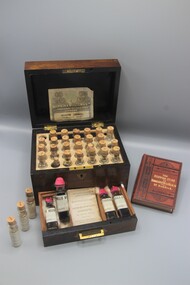
... (These are all separate labels) Ipecacuanha, Vomica, China Oft 1x, Tincture of Bella Donna (poison), Chamilla 3x, Antimonium Tart 3x, Rhus Tox, Carb Veget, Pulsatilla 1x, Sulphur 3x, phosphorus 3, Arsenicum Alb.3x, Colocynthis 3x, Hepar Sulph.6x, Lycopodium 3x, Cina 1x, Verat rum Alb 3x, Kali Bichrom.3x, Cimicifuga 1x, Cantharis Sol. 6x, Gelseminum 1x, Dulcamara 3x, Ignatia Amara 3x, Ferrum-Muriatic 1x, Rose Water Flavouring (R.S.Corson), Larger Bottles in Drawer: Rhus Toxicoderon, Calendula Officinal, Arnica Montana, Hamamelis Virginica, Bottom of Box : Small label :- pound sign 25/- 50/-...This homeopathic kit was owned by the Powling Family (E.W.Father and J.Son) for everyday use homeopathy powling (These are all separate labels) Ipecacuanha, Vomica, China Oft 1x, Tincture of Bella Donna (poison), Chamilla 3x, Antimonium Tart 3x, Rhus Tox, Carb Veget, Pulsatilla 1x, Sulphur 3x, phosphorus 3, Arsenicum Alb.3x, Colocynthis 3x, Hepar Sulph.6x, Lycopodium 3x, Cina 1x, Verat rum Alb 3x, Kali Bichrom.3x, Cimicifuga 1x, Cantharis Sol. 6x, Gelseminum 1x, Dulcamara 3x, Ignatia Amara 3x, Ferrum-Muriatic 1x, Rose Water Flavouring (R.S.Corson), Larger Bottles in Drawer: Rhus Toxicoderon, Calendula Officinal, Arnica Montana, Hamamelis Virginica, Bottom of Box : Small label :- pound sign 25/- 50/- Wooden box with concealed drawer used for storing homeopathic chemicals in the home. ...This homeopathic kit was owned by the Powling Family (E.W.Father and J.Son) for everyday useWooden box with concealed drawer used for storing homeopathic chemicals in the home. Containing 28 small bottles of various chemicals in top layer, plus a book titled "The Stepping Stones of Homeopathy and Health". In the bottom drawer 4 larger bottles of poison, 1 black lid, homeopathic pamphlet, bottles resting in cotton wool, 1 label "Hopkins and Williams Potassium Chromate". 28 cork lids, 4 glass stoppers, 1 bottle missing from top layer.(These are all separate labels) Ipecacuanha, Vomica, China Oft 1x, Tincture of Bella Donna (poison), Chamilla 3x, Antimonium Tart 3x, Rhus Tox, Carb Veget, Pulsatilla 1x, Sulphur 3x, phosphorus 3, Arsenicum Alb.3x, Colocynthis 3x, Hepar Sulph.6x, Lycopodium 3x, Cina 1x, Verat rum Alb 3x, Kali Bichrom.3x, Cimicifuga 1x, Cantharis Sol. 6x, Gelseminum 1x, Dulcamara 3x, Ignatia Amara 3x, Ferrum-Muriatic 1x, Rose Water Flavouring (R.S.Corson), Larger Bottles in Drawer: Rhus Toxicoderon, Calendula Officinal, Arnica Montana, Hamamelis Virginica, Bottom of Box : Small label :- pound sign 25/- 50/-homeopathy, powling -
 City of Greater Geelong
Photograph - Carousel Restoration, Elphinstone, Victoria, Stewart Strachan, 1997-1999
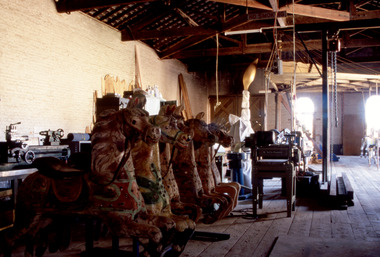
... Chuck Kaparich (from Montana, USA) – Carved the chariots and shipped them for assembly and painting in Elphinstone. ...Chuck Kaparich (from Montana, USA) – Carved the chariots and shipped them for assembly and painting in Elphinstone. ...This image is part of a collection of 35mm colour transparencies taken by photographer Stewart Strachan during the carousel restoration project which took place in Elphinstone between 1997-1999. The Carousel was manufactured around 1892 by the Armitage-Herschell company of New York. The Carousel operated on the Mordialloc Pier from the 1920s to the 1950s. In around 1996, the carousel was found quietly rotting away in a Victorian shed by collector and restorer Rick Furlong, who saw its beauty and potential, then gathered a team of specialist historians, craftspeople and artists to work on the project of authentic restoration. Rick Furlong – Collector, Restorer and Project Manager Lindsay Mew – Woodcarver and Foundry Artist, dismantled, sectioned and cleaned the horses. Graeme Wright – Artist, who stripped up to 40 layers of paint from the horses and completed colour research for each individual horse. Kurt Simmons - Dismantled, sectioned and cleaned the horses. Andy Bull – Carpenter and Joiner, restored the floorboards, platforms, drums and crown panels and recreated a ticket box. Colin Turton – Repaired and restored all the structural metal work. Brendan Furlong & David Ely – Artists, painted the horses in their original colours. Jenny McCracken – Artist, created the paintings on sixteen scenery panels. Denise Puller – Made the pure horsehair tails. Chuck Kaparich (from Montana, USA) – Carved the chariots and shipped them for assembly and painting in Elphinstone. Using only recycled timbers, 24 of the 36 horses were restored with many legs, heads and necks replaced, while 12 replicas were hand-carved to match the originals, believed to be rare examples hand-carved by the American master, Charles Dare. Each horse took 300 hours to restore, with intricate carving, coating, filling, sanding, smoothing, painting and varnishing. The period matched organ and steam engine were sourced from New South Wales and Tasmania respectively. The Steampacket Place Development Board, a joint team formed by the Victorian State Government and the City of Greater Geelong undertook the $30 million revitalisation of the entire Geelong Waterfront from 1995 to 2000. As part of the revitalisation, the Steampacket Place Development Board purchased the Armitage-Herschell portable steam-driven carousel as a major feature on the revitalised waterfront.Colour image showing wooden carousel horses surrounded by machinery and other materials, inside a brick building.merry go-round, horses, carousel, geelong, restoration, rides, j. j. miller, geelong waterfront, steam engine, opening, 35mm colour transparency, steampacket place development board, city of greater geelong, revitalisation, armitage-herschell, stewart strachan photograhy, elphinstone, rick furlong, artists, mordialloc -
 City of Greater Geelong
Photograph - Carousel Restoration, Elphinstone, Victoria, Stewart Strachan, 1997-1999
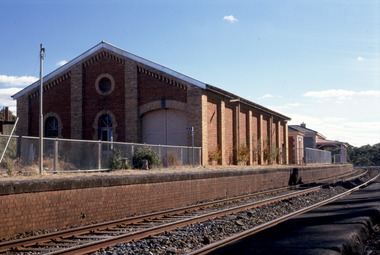
... Chuck Kaparich (from Montana, USA) – Carved the chariots and shipped them for assembly and painting in Elphinstone. ...Chuck Kaparich (from Montana, USA) – Carved the chariots and shipped them for assembly and painting in Elphinstone. ...This image is part of a collection of 35mm colour transparencies taken by photographer Stewart Strachan during the carousel restoration project which took place in Elphinstone between 1997-1999. The Carousel was manufactured around 1892 by the Armitage-Herschell company of New York. The Carousel operated on the Mordialloc Pier from the 1920s to the 1950s. In around 1996, the carousel was found quietly rotting away in a Victorian shed by collector and restorer Rick Furlong, who saw its beauty and potential, then gathered a team of specialist historians, craftspeople and artists to work on the project of authentic restoration. Rick Furlong – Collector, Restorer and Project Manager Lindsay Mew – Woodcarver and Foundry Artist, dismantled, sectioned and cleaned the horses. Graeme Wright – Artist, who stripped up to 40 layers of paint from the horses and completed colour research for each individual horse. Kurt Simmons - Dismantled, sectioned and cleaned the horses. Andy Bull – Carpenter and Joiner, restored the floorboards, platforms, drums and crown panels and recreated a ticket box. Colin Turton – Repaired and restored all the structural metal work. Brendan Furlong & David Ely – Artists, painted the horses in their original colours. Jenny McCracken – Artist, created the paintings on sixteen scenery panels. Denise Puller – Made the pure horsehair tails. Chuck Kaparich (from Montana, USA) – Carved the chariots and shipped them for assembly and painting in Elphinstone. Using only recycled timbers, 24 of the 36 horses were restored with many legs, heads and necks replaced, while 12 replicas were hand-carved to match the originals, believed to be rare examples hand-carved by the American master, Charles Dare. Each horse took 300 hours to restore, with intricate carving, coating, filling, sanding, smoothing, painting and varnishing. The period matched organ and steam engine were sourced from New South Wales and Tasmania respectively. The Steampacket Place Development Board, a joint team formed by the Victorian State Government and the City of Greater Geelong undertook the $30 million revitalisation of the entire Geelong Waterfront from 1995 to 2000. As part of the revitalisation, the Steampacket Place Development Board purchased the Armitage-Herschell portable steam-driven carousel as a major feature on the revitalised waterfront.Colour image showing the exterior of a brick building with a railway line in the foreground.merry go-round, horses, carousel, geelong, restoration, rides, j. j. miller, geelong waterfront, steam engine, opening, 35mm colour transparency, steampacket place development board, city of greater geelong, revitalisation, armitage-herschell, stewart strachan photograhy, elphinstone, rick furlong, artists, mordialloc -
 City of Greater Geelong
Photograph - Carousel Restoration, Elphinstone, Victoria, Stewart Strachan, 1997-1999
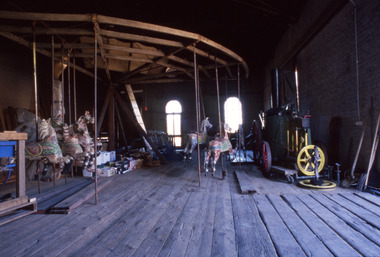
... Chuck Kaparich (from Montana, USA) – Carved the chariots and shipped them for assembly and painting in Elphinstone. ...Chuck Kaparich (from Montana, USA) – Carved the chariots and shipped them for assembly and painting in Elphinstone. ...This image is part of a collection of 35mm colour transparencies taken by photographer Stewart Strachan during the carousel restoration project which took place in Elphinstone between 1997-1999. The Carousel was manufactured around 1892 by the Armitage-Herschell company of New York. The Carousel operated on the Mordialloc Pier from the 1920s to the 1950s. In around 1996, the carousel was found quietly rotting away in a Victorian shed by collector and restorer Rick Furlong, who saw its beauty and potential, then gathered a team of specialist historians, craftspeople and artists to work on the project of authentic restoration. Rick Furlong – Collector, Restorer and Project Manager Lindsay Mew – Woodcarver and Foundry Artist, dismantled, sectioned and cleaned the horses. Graeme Wright – Artist, who stripped up to 40 layers of paint from the horses and completed colour research for each individual horse. Kurt Simmons - Dismantled, sectioned and cleaned the horses. Andy Bull – Carpenter and Joiner, restored the floorboards, platforms, drums and crown panels and recreated a ticket box. Colin Turton – Repaired and restored all the structural metal work. Brendan Furlong & David Ely – Artists, painted the horses in their original colours. Jenny McCracken – Artist, created the paintings on sixteen scenery panels. Denise Puller – Made the pure horsehair tails. Chuck Kaparich (from Montana, USA) – Carved the chariots and shipped them for assembly and painting in Elphinstone. Using only recycled timbers, 24 of the 36 horses were restored with many legs, heads and necks replaced, while 12 replicas were hand-carved to match the originals, believed to be rare examples hand-carved by the American master, Charles Dare. Each horse took 300 hours to restore, with intricate carving, coating, filling, sanding, smoothing, painting and varnishing. The period matched organ and steam engine were sourced from New South Wales and Tasmania respectively. The Steampacket Place Development Board, a joint team formed by the Victorian State Government and the City of Greater Geelong undertook the $30 million revitalisation of the entire Geelong Waterfront from 1995 to 2000. As part of the revitalisation, the Steampacket Place Development Board purchased the Armitage-Herschell portable steam-driven carousel as a major feature on the revitalised waterfront.Colour image showing wooden carousel horses and a steam engine inside a brick building.merry go-round, horses, carousel, geelong, restoration, rides, j. j. miller, geelong waterfront, steam engine, opening, 35mm colour transparency, steampacket place development board, city of greater geelong, revitalisation, armitage-herschell, stewart strachan photograhy, elphinstone, rick furlong, artists, mordialloc -
 City of Greater Geelong
Photograph - Carousel Restoration, Elphinstone, Victoria, Stewart Strachan, 1997-1999
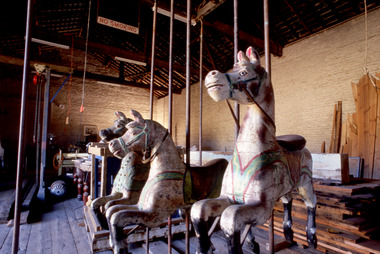
... Chuck Kaparich (from Montana, USA) – Carved the chariots and shipped them for assembly and painting in Elphinstone. ...Chuck Kaparich (from Montana, USA) – Carved the chariots and shipped them for assembly and painting in Elphinstone. ...This image is part of a collection of 35mm colour transparencies taken by photographer Stewart Strachan during the carousel restoration project which took place in Elphinstone between 1997-1999. The Carousel was manufactured around 1892 by the Armitage-Herschell company of New York. The Carousel operated on the Mordialloc Pier from the 1920s to the 1950s. In around 1996, the carousel was found quietly rotting away in a Victorian shed by collector and restorer Rick Furlong, who saw its beauty and potential, then gathered a team of specialist historians, craftspeople and artists to work on the project of authentic restoration. Rick Furlong – Collector, Restorer and Project Manager Lindsay Mew – Woodcarver and Foundry Artist, dismantled, sectioned and cleaned the horses. Graeme Wright – Artist, who stripped up to 40 layers of paint from the horses and completed colour research for each individual horse. Kurt Simmons - Dismantled, sectioned and cleaned the horses. Andy Bull – Carpenter and Joiner, restored the floorboards, platforms, drums and crown panels and recreated a ticket box. Colin Turton – Repaired and restored all the structural metal work. Brendan Furlong & David Ely – Artists, painted the horses in their original colours. Jenny McCracken – Artist, created the paintings on sixteen scenery panels. Denise Puller – Made the pure horsehair tails. Chuck Kaparich (from Montana, USA) – Carved the chariots and shipped them for assembly and painting in Elphinstone. Using only recycled timbers, 24 of the 36 horses were restored with many legs, heads and necks replaced, while 12 replicas were hand-carved to match the originals, believed to be rare examples hand-carved by the American master, Charles Dare. Each horse took 300 hours to restore, with intricate carving, coating, filling, sanding, smoothing, painting and varnishing. The period matched organ and steam engine were sourced from New South Wales and Tasmania respectively. The Steampacket Place Development Board, a joint team formed by the Victorian State Government and the City of Greater Geelong undertook the $30 million revitalisation of the entire Geelong Waterfront from 1995 to 2000. As part of the revitalisation, the Steampacket Place Development Board purchased the Armitage-Herschell portable steam-driven carousel as a major feature on the revitalised waterfront.Colour image showing wooden carousel horses inside a goods shed building.merry go-round, horses, carousel, geelong, restoration, rides, j. j. miller, geelong waterfront, steam engine, opening, 35mm colour transparency, steampacket place development board, city of greater geelong, revitalisation, armitage-herschell, stewart strachan photograhy, elphinstone, rick furlong, artists, mordialloc -
 City of Greater Geelong
Photograph - Carousel Restoration, Elphinstone, Victoria, Stewart Strachan, 1997-1999
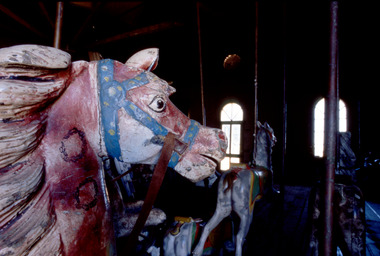
... Chuck Kaparich (from Montana, USA) – Carved the chariots and shipped them for assembly and painting in Elphinstone. ...Chuck Kaparich (from Montana, USA) – Carved the chariots and shipped them for assembly and painting in Elphinstone. ...This image is part of a collection of 35mm colour transparencies taken by photographer Stewart Strachan during the carousel restoration project which took place in Elphinstone between 1997-1999. The Carousel was manufactured around 1892 by the Armitage-Herschell company of New York. The Carousel operated on the Mordialloc Pier from the 1920s to the 1950s. In around 1996, the carousel was found quietly rotting away in a Victorian shed by collector and restorer Rick Furlong, who saw its beauty and potential, then gathered a team of specialist historians, craftspeople and artists to work on the project of authentic restoration. Rick Furlong – Collector, Restorer and Project Manager Lindsay Mew – Woodcarver and Foundry Artist, dismantled, sectioned and cleaned the horses. Graeme Wright – Artist, who stripped up to 40 layers of paint from the horses and completed colour research for each individual horse. Kurt Simmons - Dismantled, sectioned and cleaned the horses. Andy Bull – Carpenter and Joiner, restored the floorboards, platforms, drums and crown panels and recreated a ticket box. Colin Turton – Repaired and restored all the structural metal work. Brendan Furlong & David Ely – Artists, painted the horses in their original colours. Jenny McCracken – Artist, created the paintings on sixteen scenery panels. Denise Puller – Made the pure horsehair tails. Chuck Kaparich (from Montana, USA) – Carved the chariots and shipped them for assembly and painting in Elphinstone. Using only recycled timbers, 24 of the 36 horses were restored with many legs, heads and necks replaced, while 12 replicas were hand-carved to match the originals, believed to be rare examples hand-carved by the American master, Charles Dare. Each horse took 300 hours to restore, with intricate carving, coating, filling, sanding, smoothing, painting and varnishing. The period matched organ and steam engine were sourced from New South Wales and Tasmania respectively. The Steampacket Place Development Board, a joint team formed by the Victorian State Government and the City of Greater Geelong undertook the $30 million revitalisation of the entire Geelong Waterfront from 1995 to 2000. As part of the revitalisation, the Steampacket Place Development Board purchased the Armitage-Herschell portable steam-driven carousel as a major feature on the revitalised waterfront.Colour image showing detail of a head of a wooden carousel horse.merry go-round, horses, carousel, geelong, restoration, rides, j. j. miller, geelong waterfront, steam engine, opening, 35mm colour transparency, steampacket place development board, city of greater geelong, revitalisation, armitage-herschell, stewart strachan photograhy, elphinstone, rick furlong, artists, mordialloc -
 City of Greater Geelong
Photograph - Carousel Restoration, Elphinstone, Victoria, Stewart Strachan, 1997-1999
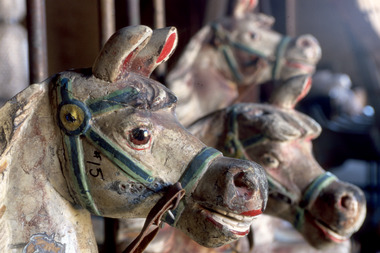
... Chuck Kaparich (from Montana, USA) – Carved the chariots and shipped them for assembly and painting in Elphinstone. ...Chuck Kaparich (from Montana, USA) – Carved the chariots and shipped them for assembly and painting in Elphinstone. ...This image is part of a collection of 35mm colour transparencies taken by photographer Stewart Strachan during the carousel restoration project which took place in Elphinstone between 1997-1999. The Carousel was manufactured around 1892 by the Armitage-Herschell company of New York. The Carousel operated on the Mordialloc Pier from the 1920s to the 1950s. In around 1996, the carousel was found quietly rotting away in a Victorian shed by collector and restorer Rick Furlong, who saw its beauty and potential, then gathered a team of specialist historians, craftspeople and artists to work on the project of authentic restoration. Rick Furlong – Collector, Restorer and Project Manager Lindsay Mew – Woodcarver and Foundry Artist, dismantled, sectioned and cleaned the horses. Graeme Wright – Artist, who stripped up to 40 layers of paint from the horses and completed colour research for each individual horse. Kurt Simmons - Dismantled, sectioned and cleaned the horses. Andy Bull – Carpenter and Joiner, restored the floorboards, platforms, drums and crown panels and recreated a ticket box. Colin Turton – Repaired and restored all the structural metal work. Brendan Furlong & David Ely – Artists, painted the horses in their original colours. Jenny McCracken – Artist, created the paintings on sixteen scenery panels. Denise Puller – Made the pure horsehair tails. Chuck Kaparich (from Montana, USA) – Carved the chariots and shipped them for assembly and painting in Elphinstone. Using only recycled timbers, 24 of the 36 horses were restored with many legs, heads and necks replaced, while 12 replicas were hand-carved to match the originals, believed to be rare examples hand-carved by the American master, Charles Dare. Each horse took 300 hours to restore, with intricate carving, coating, filling, sanding, smoothing, painting and varnishing. The period matched organ and steam engine were sourced from New South Wales and Tasmania respectively. The Steampacket Place Development Board, a joint team formed by the Victorian State Government and the City of Greater Geelong undertook the $30 million revitalisation of the entire Geelong Waterfront from 1995 to 2000. As part of the revitalisation, the Steampacket Place Development Board purchased the Armitage-Herschell portable steam-driven carousel as a major feature on the revitalised waterfront.Colour image showing detail of the heads of wooden carousel horses.merry go-round, horses, carousel, geelong, restoration, rides, j. j. miller, geelong waterfront, steam engine, opening, 35mm colour transparency, steampacket place development board, city of greater geelong, revitalisation, armitage-herschell, stewart strachan photograhy, elphinstone, rick furlong, artists, mordialloc -
 City of Greater Geelong
Photograph - Carousel Restoration, Elphinstone, Victoria, Stewart Strachan, 1997-1999
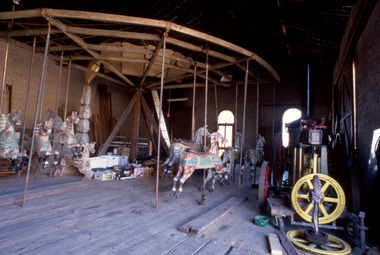
... Chuck Kaparich (from Montana, USA) – Carved the chariots and shipped them for assembly and painting in Elphinstone. ...Chuck Kaparich (from Montana, USA) – Carved the chariots and shipped them for assembly and painting in Elphinstone. ...This image is part of a collection of 35mm colour transparencies taken by photographer Stewart Strachan during the carousel restoration project which took place in Elphinstone between 1997-1999. The Carousel was manufactured around 1892 by the Armitage-Herschell company of New York. The Carousel operated on the Mordialloc Pier from the 1920s to the 1950s. In around 1996, the carousel was found quietly rotting away in a Victorian shed by collector and restorer Rick Furlong, who saw its beauty and potential, then gathered a team of specialist historians, craftspeople and artists to work on the project of authentic restoration. Rick Furlong – Collector, Restorer and Project Manager Lindsay Mew – Woodcarver and Foundry Artist, dismantled, sectioned and cleaned the horses. Graeme Wright – Artist, who stripped up to 40 layers of paint from the horses and completed colour research for each individual horse. Kurt Simmons - Dismantled, sectioned and cleaned the horses. Andy Bull – Carpenter and Joiner, restored the floorboards, platforms, drums and crown panels and recreated a ticket box. Colin Turton – Repaired and restored all the structural metal work. Brendan Furlong & David Ely – Artists, painted the horses in their original colours. Jenny McCracken – Artist, created the paintings on sixteen scenery panels. Denise Puller – Made the pure horsehair tails. Chuck Kaparich (from Montana, USA) – Carved the chariots and shipped them for assembly and painting in Elphinstone. Using only recycled timbers, 24 of the 36 horses were restored with many legs, heads and necks replaced, while 12 replicas were hand-carved to match the originals, believed to be rare examples hand-carved by the American master, Charles Dare. Each horse took 300 hours to restore, with intricate carving, coating, filling, sanding, smoothing, painting and varnishing. The period matched organ and steam engine were sourced from New South Wales and Tasmania respectively. The Steampacket Place Development Board, a joint team formed by the Victorian State Government and the City of Greater Geelong undertook the $30 million revitalisation of the entire Geelong Waterfront from 1995 to 2000. As part of the revitalisation, the Steampacket Place Development Board purchased the Armitage-Herschell portable steam-driven carousel as a major feature on the revitalised waterfront.Colour image showing parts of a historical carousel, wooden horses and steam engine inside a goods shed building.merry go-round, horses, carousel, geelong, restoration, rides, j. j. miller, geelong waterfront, steam engine, opening, 35mm colour transparency, steampacket place development board, city of greater geelong, revitalisation, armitage-herschell, stewart strachan photograhy, elphinstone, rick furlong, artists, mordialloc -
 City of Greater Geelong
Photograph - Carousel Restoration, Elphinstone, Victoria, Stewart Strachan, 1997-1999
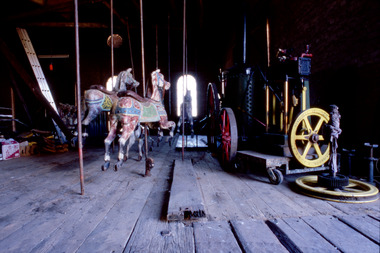
... Chuck Kaparich (from Montana, USA) – Carved the chariots and shipped them for assembly and painting in Elphinstone. ...Chuck Kaparich (from Montana, USA) – Carved the chariots and shipped them for assembly and painting in Elphinstone. ...This image is part of a collection of 35mm colour transparencies taken by photographer Stewart Strachan during the carousel restoration project which took place in Elphinstone between 1997-1999. The Carousel was manufactured around 1892 by the Armitage-Herschell company of New York. The Carousel operated on the Mordialloc Pier from the 1920s to the 1950s. In around 1996, the carousel was found quietly rotting away in a Victorian shed by collector and restorer Rick Furlong, who saw its beauty and potential, then gathered a team of specialist historians, craftspeople and artists to work on the project of authentic restoration. Rick Furlong – Collector, Restorer and Project Manager Lindsay Mew – Woodcarver and Foundry Artist, dismantled, sectioned and cleaned the horses. Graeme Wright – Artist, who stripped up to 40 layers of paint from the horses and completed colour research for each individual horse. Kurt Simmons - Dismantled, sectioned and cleaned the horses. Andy Bull – Carpenter and Joiner, restored the floorboards, platforms, drums and crown panels and recreated a ticket box. Colin Turton – Repaired and restored all the structural metal work. Brendan Furlong & David Ely – Artists, painted the horses in their original colours. Jenny McCracken – Artist, created the paintings on sixteen scenery panels. Denise Puller – Made the pure horsehair tails. Chuck Kaparich (from Montana, USA) – Carved the chariots and shipped them for assembly and painting in Elphinstone. Using only recycled timbers, 24 of the 36 horses were restored with many legs, heads and necks replaced, while 12 replicas were hand-carved to match the originals, believed to be rare examples hand-carved by the American master, Charles Dare. Each horse took 300 hours to restore, with intricate carving, coating, filling, sanding, smoothing, painting and varnishing. The period matched organ and steam engine were sourced from New South Wales and Tasmania respectively. The Steampacket Place Development Board, a joint team formed by the Victorian State Government and the City of Greater Geelong undertook the $30 million revitalisation of the entire Geelong Waterfront from 1995 to 2000. As part of the revitalisation, the Steampacket Place Development Board purchased the Armitage-Herschell portable steam-driven carousel as a major feature on the revitalised waterfront.Colour image showing wooden carousel horses and a steam engine inside a building.merry go-round, horses, carousel, geelong, restoration, rides, j. j. miller, geelong waterfront, steam engine, opening, 35mm colour transparency, steampacket place development board, city of greater geelong, revitalisation, armitage-herschell, stewart strachan photograhy, elphinstone, rick furlong, artists, mordialloc -
 City of Greater Geelong
Photograph - Carousel Restoration, Elphinstone, Victoria, Stewart Strachan, 1997-1999
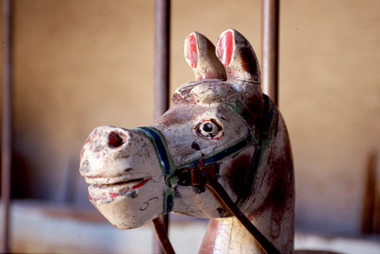
... Chuck Kaparich (from Montana, USA) – Carved the chariots and shipped them for assembly and painting in Elphinstone. ...Chuck Kaparich (from Montana, USA) – Carved the chariots and shipped them for assembly and painting in Elphinstone. ...This image is part of a collection of 35mm colour transparencies taken by photographer Stewart Strachan during the carousel restoration project which took place in Elphinstone between 1997-1999. The Carousel was manufactured around 1892 by the Armitage-Herschell company of New York. The Carousel operated on the Mordialloc Pier from the 1920s to the 1950s. In around 1996, the carousel was found quietly rotting away in a Victorian shed by collector and restorer Rick Furlong, who saw its beauty and potential, then gathered a team of specialist historians, craftspeople and artists to work on the project of authentic restoration. Rick Furlong – Collector, Restorer and Project Manager Lindsay Mew – Woodcarver and Foundry Artist, dismantled, sectioned and cleaned the horses. Graeme Wright – Artist, who stripped up to 40 layers of paint from the horses and completed colour research for each individual horse. Kurt Simmons - Dismantled, sectioned and cleaned the horses. Andy Bull – Carpenter and Joiner, restored the floorboards, platforms, drums and crown panels and recreated a ticket box. Colin Turton – Repaired and restored all the structural metal work. Brendan Furlong & David Ely – Artists, painted the horses in their original colours. Jenny McCracken – Artist, created the paintings on sixteen scenery panels. Denise Puller – Made the pure horsehair tails. Chuck Kaparich (from Montana, USA) – Carved the chariots and shipped them for assembly and painting in Elphinstone. Using only recycled timbers, 24 of the 36 horses were restored with many legs, heads and necks replaced, while 12 replicas were hand-carved to match the originals, believed to be rare examples hand-carved by the American master, Charles Dare. Each horse took 300 hours to restore, with intricate carving, coating, filling, sanding, smoothing, painting and varnishing. The period matched organ and steam engine were sourced from New South Wales and Tasmania respectively. The Steampacket Place Development Board, a joint team formed by the Victorian State Government and the City of Greater Geelong undertook the $30 million revitalisation of the entire Geelong Waterfront from 1995 to 2000. As part of the revitalisation, the Steampacket Place Development Board purchased the Armitage-Herschell portable steam-driven carousel as a major feature on the revitalised waterfront.Colour image showing detail of a head of a wooden carousel horse.merry go-round, horses, carousel, geelong, restoration, rides, j. j. miller, geelong waterfront, steam engine, opening, 35mm colour transparency, steampacket place development board, city of greater geelong, revitalisation, armitage-herschell, stewart strachan photograhy, elphinstone, rick furlong, artists, mordialloc -
 City of Greater Geelong
Photograph - Carousel Restoration, Elphinstone, Victoria, Stewart Strachan, 1997-1999
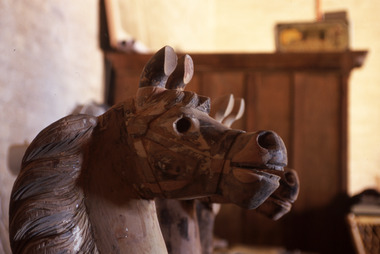
... Chuck Kaparich (from Montana, USA) – Carved the chariots and shipped them for assembly and painting in Elphinstone. ...Chuck Kaparich (from Montana, USA) – Carved the chariots and shipped them for assembly and painting in Elphinstone. ...This image is part of a collection of 35mm colour transparencies taken by photographer Stewart Strachan during the carousel restoration project which took place in Elphinstone between 1997-1999. The Carousel was manufactured around 1892 by the Armitage-Herschell company of New York. The Carousel operated on the Mordialloc Pier from the 1920s to the 1950s. In around 1996, the carousel was found quietly rotting away in a Victorian shed by collector and restorer Rick Furlong, who saw its beauty and potential, then gathered a team of specialist historians, craftspeople and artists to work on the project of authentic restoration. Rick Furlong – Collector, Restorer and Project Manager Lindsay Mew – Woodcarver and Foundry Artist, dismantled, sectioned and cleaned the horses. Graeme Wright – Artist, who stripped up to 40 layers of paint from the horses and completed colour research for each individual horse. Kurt Simmons - Dismantled, sectioned and cleaned the horses. Andy Bull – Carpenter and Joiner, restored the floorboards, platforms, drums and crown panels and recreated a ticket box. Colin Turton – Repaired and restored all the structural metal work. Brendan Furlong & David Ely – Artists, painted the horses in their original colours. Jenny McCracken – Artist, created the paintings on sixteen scenery panels. Denise Puller – Made the pure horsehair tails. Chuck Kaparich (from Montana, USA) – Carved the chariots and shipped them for assembly and painting in Elphinstone. Using only recycled timbers, 24 of the 36 horses were restored with many legs, heads and necks replaced, while 12 replicas were hand-carved to match the originals, believed to be rare examples hand-carved by the American master, Charles Dare. Each horse took 300 hours to restore, with intricate carving, coating, filling, sanding, smoothing, painting and varnishing. The period matched organ and steam engine were sourced from New South Wales and Tasmania respectively. The Steampacket Place Development Board, a joint team formed by the Victorian State Government and the City of Greater Geelong undertook the $30 million revitalisation of the entire Geelong Waterfront from 1995 to 2000. As part of the revitalisation, the Steampacket Place Development Board purchased the Armitage-Herschell portable steam-driven carousel as a major feature on the revitalised waterfront.Colour image showing detail of a wooden carousel horse head.merry go-round, horses, carousel, geelong, restoration, rides, j. j. miller, geelong waterfront, steam engine, opening, 35mm colour transparency, steampacket place development board, city of greater geelong, revitalisation, armitage-herschell, stewart strachan photograhy, elphinstone, rick furlong, artists, mordialloc -
 City of Greater Geelong
Photograph - Carousel Restoration, Elphinstone, Victoria, Stewart Strachan, 1997-1999
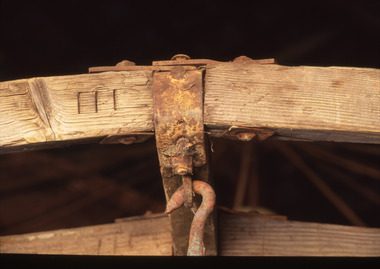
... Chuck Kaparich (from Montana, USA) – Carved the chariots and shipped them for assembly and painting in Elphinstone. ...Chuck Kaparich (from Montana, USA) – Carved the chariots and shipped them for assembly and painting in Elphinstone. ...This image is part of a collection of 35mm colour transparencies taken by photographer Stewart Strachan during the carousel restoration project which took place in Elphinstone between 1997-1999. The Carousel was manufactured around 1892 by the Armitage-Herschell company of New York. The Carousel operated on the Mordialloc Pier from the 1920s to the 1950s. In around 1996, the carousel was found quietly rotting away in a Victorian shed by collector and restorer Rick Furlong, who saw its beauty and potential, then gathered a team of specialist historians, craftspeople and artists to work on the project of authentic restoration. Rick Furlong – Collector, Restorer and Project Manager Lindsay Mew – Woodcarver and Foundry Artist, dismantled, sectioned and cleaned the horses. Graeme Wright – Artist, who stripped up to 40 layers of paint from the horses and completed colour research for each individual horse. Kurt Simmons - Dismantled, sectioned and cleaned the horses. Andy Bull – Carpenter and Joiner, restored the floorboards, platforms, drums and crown panels and recreated a ticket box. Colin Turton – Repaired and restored all the structural metal work. Brendan Furlong & David Ely – Artists, painted the horses in their original colours. Jenny McCracken – Artist, created the paintings on sixteen scenery panels. Denise Puller – Made the pure horsehair tails. Chuck Kaparich (from Montana, USA) – Carved the chariots and shipped them for assembly and painting in Elphinstone. Using only recycled timbers, 24 of the 36 horses were restored with many legs, heads and necks replaced, while 12 replicas were hand-carved to match the originals, believed to be rare examples hand-carved by the American master, Charles Dare. Each horse took 300 hours to restore, with intricate carving, coating, filling, sanding, smoothing, painting and varnishing. The period matched organ and steam engine were sourced from New South Wales and Tasmania respectively. The Steampacket Place Development Board, a joint team formed by the Victorian State Government and the City of Greater Geelong undertook the $30 million revitalisation of the entire Geelong Waterfront from 1995 to 2000. As part of the revitalisation, the Steampacket Place Development Board purchased the Armitage-Herschell portable steam-driven carousel as a major feature on the revitalised waterfront.Colour image showing detail of roman numerals marked in wood of carousel.merry go-round, horses, carousel, geelong, restoration, rides, j. j. miller, geelong waterfront, steam engine, opening, 35mm colour transparency, steampacket place development board, city of greater geelong, revitalisation, armitage-herschell, stewart strachan photograhy, elphinstone, rick furlong, artists, mordialloc -
 City of Greater Geelong
Photograph - Carousel Restoration, Elphinstone, Victoria, Stewart Strachan, 1997-1999
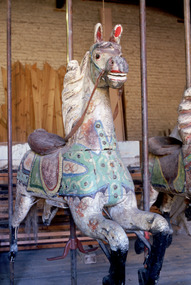
... Chuck Kaparich (from Montana, USA) – Carved the chariots and shipped them for assembly and painting in Elphinstone. ...Chuck Kaparich (from Montana, USA) – Carved the chariots and shipped them for assembly and painting in Elphinstone. ...This image is part of a collection of 35mm colour transparencies taken by photographer Stewart Strachan during the carousel restoration project which took place in Elphinstone between 1997-1999. The Carousel was manufactured around 1892 by the Armitage-Herschell company of New York. The Carousel operated on the Mordialloc Pier from the 1920s to the 1950s. In around 1996, the carousel was found quietly rotting away in a Victorian shed by collector and restorer Rick Furlong, who saw its beauty and potential, then gathered a team of specialist historians, craftspeople and artists to work on the project of authentic restoration. Rick Furlong – Collector, Restorer and Project Manager Lindsay Mew – Woodcarver and Foundry Artist, dismantled, sectioned and cleaned the horses. Graeme Wright – Artist, who stripped up to 40 layers of paint from the horses and completed colour research for each individual horse. Kurt Simmons - Dismantled, sectioned and cleaned the horses. Andy Bull – Carpenter and Joiner, restored the floorboards, platforms, drums and crown panels and recreated a ticket box. Colin Turton – Repaired and restored all the structural metal work. Brendan Furlong & David Ely – Artists, painted the horses in their original colours. Jenny McCracken – Artist, created the paintings on sixteen scenery panels. Denise Puller – Made the pure horsehair tails. Chuck Kaparich (from Montana, USA) – Carved the chariots and shipped them for assembly and painting in Elphinstone. Using only recycled timbers, 24 of the 36 horses were restored with many legs, heads and necks replaced, while 12 replicas were hand-carved to match the originals, believed to be rare examples hand-carved by the American master, Charles Dare. Each horse took 300 hours to restore, with intricate carving, coating, filling, sanding, smoothing, painting and varnishing. The period matched organ and steam engine were sourced from New South Wales and Tasmania respectively. The Steampacket Place Development Board, a joint team formed by the Victorian State Government and the City of Greater Geelong undertook the $30 million revitalisation of the entire Geelong Waterfront from 1995 to 2000. As part of the revitalisation, the Steampacket Place Development Board purchased the Armitage-Herschell portable steam-driven carousel as a major feature on the revitalised waterfront.Colour image showing a wooden carousel horse inside a building.merry go-round, horses, carousel, geelong, restoration, rides, j. j. miller, geelong waterfront, steam engine, opening, 35mm colour transparency, steampacket place development board, city of greater geelong, revitalisation, armitage-herschell, stewart strachan photograhy, elphinstone, rick furlong, artists, mordialloc -
 City of Greater Geelong
Photograph - Carousel Restoration, Elphinstone, Victoria, Stewart Strachan, 1997-1999
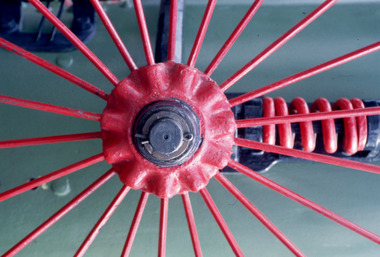
... Chuck Kaparich (from Montana, USA) – Carved the chariots and shipped them for assembly and painting in Elphinstone. ...Chuck Kaparich (from Montana, USA) – Carved the chariots and shipped them for assembly and painting in Elphinstone. ...This image is part of a collection of 35mm colour transparencies taken by photographer Stewart Strachan during the carousel restoration project which took place in Elphinstone between 1997-1999. The Carousel was manufactured around 1892 by the Armitage-Herschell company of New York. The Carousel operated on the Mordialloc Pier from the 1920s to the 1950s. In around 1996, the carousel was found quietly rotting away in a Victorian shed by collector and restorer Rick Furlong, who saw its beauty and potential, then gathered a team of specialist historians, craftspeople and artists to work on the project of authentic restoration. Rick Furlong – Collector, Restorer and Project Manager Lindsay Mew – Woodcarver and Foundry Artist, dismantled, sectioned and cleaned the horses. Graeme Wright – Artist, who stripped up to 40 layers of paint from the horses and completed colour research for each individual horse. Kurt Simmons - Dismantled, sectioned and cleaned the horses. Andy Bull – Carpenter and Joiner, restored the floorboards, platforms, drums and crown panels and recreated a ticket box. Colin Turton – Repaired and restored all the structural metal work. Brendan Furlong & David Ely – Artists, painted the horses in their original colours. Jenny McCracken – Artist, created the paintings on sixteen scenery panels. Denise Puller – Made the pure horsehair tails. Chuck Kaparich (from Montana, USA) – Carved the chariots and shipped them for assembly and painting in Elphinstone. Using only recycled timbers, 24 of the 36 horses were restored with many legs, heads and necks replaced, while 12 replicas were hand-carved to match the originals, believed to be rare examples hand-carved by the American master, Charles Dare. Each horse took 300 hours to restore, with intricate carving, coating, filling, sanding, smoothing, painting and varnishing. The period matched organ and steam engine were sourced from New South Wales and Tasmania respectively. The Steampacket Place Development Board, a joint team formed by the Victorian State Government and the City of Greater Geelong undertook the $30 million revitalisation of the entire Geelong Waterfront from 1995 to 2000. As part of the revitalisation, the Steampacket Place Development Board purchased the Armitage-Herschell portable steam-driven carousel as a major feature on the revitalised waterfront.Colour image showing detail of red wheel spokes.merry go-round, horses, carousel, geelong, restoration, rides, j. j. miller, geelong waterfront, steam engine, opening, 35mm colour transparency, steampacket place development board, city of greater geelong, revitalisation, armitage-herschell, stewart strachan photograhy, elphinstone, rick furlong, artists, mordialloc -
 City of Greater Geelong
Photograph - Carousel Restoration, Elphinstone, Victoria, Stewart Strachan, 1997-1999
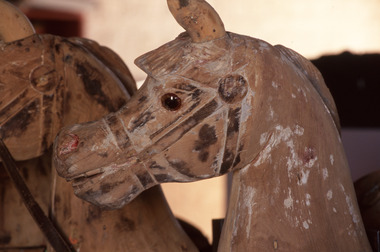
... Chuck Kaparich (from Montana, USA) – Carved the chariots and shipped them for assembly and painting in Elphinstone. ...Chuck Kaparich (from Montana, USA) – Carved the chariots and shipped them for assembly and painting in Elphinstone. ...This image is part of a collection of 35mm colour transparencies taken by photographer Stewart Strachan during the carousel restoration project which took place in Elphinstone between 1997-1999. The Carousel was manufactured around 1892 by the Armitage-Herschell company of New York. The Carousel operated on the Mordialloc Pier from the 1920s to the 1950s. In around 1996, the carousel was found quietly rotting away in a Victorian shed by collector and restorer Rick Furlong, who saw its beauty and potential, then gathered a team of specialist historians, craftspeople and artists to work on the project of authentic restoration. Rick Furlong – Collector, Restorer and Project Manager Lindsay Mew – Woodcarver and Foundry Artist, dismantled, sectioned and cleaned the horses. Graeme Wright – Artist, who stripped up to 40 layers of paint from the horses and completed colour research for each individual horse. Kurt Simmons - Dismantled, sectioned and cleaned the horses. Andy Bull – Carpenter and Joiner, restored the floorboards, platforms, drums and crown panels and recreated a ticket box. Colin Turton – Repaired and restored all the structural metal work. Brendan Furlong & David Ely – Artists, painted the horses in their original colours. Jenny McCracken – Artist, created the paintings on sixteen scenery panels. Denise Puller – Made the pure horsehair tails. Chuck Kaparich (from Montana, USA) – Carved the chariots and shipped them for assembly and painting in Elphinstone. Using only recycled timbers, 24 of the 36 horses were restored with many legs, heads and necks replaced, while 12 replicas were hand-carved to match the originals, believed to be rare examples hand-carved by the American master, Charles Dare. Each horse took 300 hours to restore, with intricate carving, coating, filling, sanding, smoothing, painting and varnishing. The period matched organ and steam engine were sourced from New South Wales and Tasmania respectively. The Steampacket Place Development Board, a joint team formed by the Victorian State Government and the City of Greater Geelong undertook the $30 million revitalisation of the entire Geelong Waterfront from 1995 to 2000. As part of the revitalisation, the Steampacket Place Development Board purchased the Armitage-Herschell portable steam-driven carousel as a major feature on the revitalised waterfront.Colour image showing detail of a wooden carousel horse head.merry go-round, horses, carousel, geelong, restoration, rides, j. j. miller, geelong waterfront, steam engine, opening, 35mm colour transparency, steampacket place development board, city of greater geelong, revitalisation, armitage-herschell, stewart strachan photograhy, elphinstone, rick furlong, artists, mordialloc -
 City of Greater Geelong
Photograph - Carousel Restoration, Elphinstone, Victoria, Stewart Strachan, 1997-1999
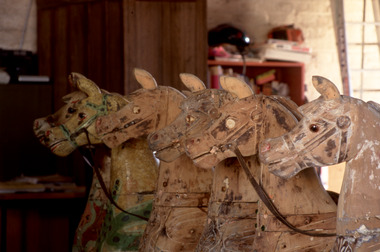
... Chuck Kaparich (from Montana, USA) – Carved the chariots and shipped them for assembly and painting in Elphinstone. ...Chuck Kaparich (from Montana, USA) – Carved the chariots and shipped them for assembly and painting in Elphinstone. ...This image is part of a collection of 35mm colour transparencies taken by photographer Stewart Strachan during the carousel restoration project which took place in Elphinstone between 1997-1999. The Carousel was manufactured around 1892 by the Armitage-Herschell company of New York. The Carousel operated on the Mordialloc Pier from the 1920s to the 1950s. In around 1996, the carousel was found quietly rotting away in a Victorian shed by collector and restorer Rick Furlong, who saw its beauty and potential, then gathered a team of specialist historians, craftspeople and artists to work on the project of authentic restoration. Rick Furlong – Collector, Restorer and Project Manager Lindsay Mew – Woodcarver and Foundry Artist, dismantled, sectioned and cleaned the horses. Graeme Wright – Artist, who stripped up to 40 layers of paint from the horses and completed colour research for each individual horse. Kurt Simmons - Dismantled, sectioned and cleaned the horses. Andy Bull – Carpenter and Joiner, restored the floorboards, platforms, drums and crown panels and recreated a ticket box. Colin Turton – Repaired and restored all the structural metal work. Brendan Furlong & David Ely – Artists, painted the horses in their original colours. Jenny McCracken – Artist, created the paintings on sixteen scenery panels. Denise Puller – Made the pure horsehair tails. Chuck Kaparich (from Montana, USA) – Carved the chariots and shipped them for assembly and painting in Elphinstone. Using only recycled timbers, 24 of the 36 horses were restored with many legs, heads and necks replaced, while 12 replicas were hand-carved to match the originals, believed to be rare examples hand-carved by the American master, Charles Dare. Each horse took 300 hours to restore, with intricate carving, coating, filling, sanding, smoothing, painting and varnishing. The period matched organ and steam engine were sourced from New South Wales and Tasmania respectively. The Steampacket Place Development Board, a joint team formed by the Victorian State Government and the City of Greater Geelong undertook the $30 million revitalisation of the entire Geelong Waterfront from 1995 to 2000. As part of the revitalisation, the Steampacket Place Development Board purchased the Armitage-Herschell portable steam-driven carousel as a major feature on the revitalised waterfront.Colour image showing detail of wooden carousel horses.merry go-round, horses, carousel, geelong, restoration, rides, j. j. miller, geelong waterfront, steam engine, opening, 35mm colour transparency, steampacket place development board, city of greater geelong, revitalisation, armitage-herschell, stewart strachan photograhy, elphinstone, rick furlong, artists, mordialloc -
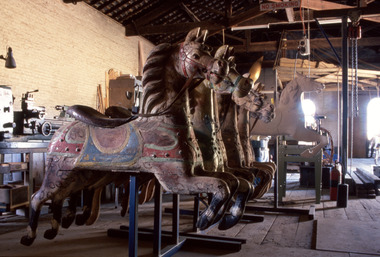 City of Greater Geelong
Photograph - Carousel Restoration, Elphinstone, Victoria, Stewart Strachan, 1997-1999
... Chuck Kaparich (from Montana, USA) – Carved the chariots and shipped them for assembly and painting in Elphinstone. ...Chuck Kaparich (from Montana, USA) – Carved the chariots and shipped them for assembly and painting in Elphinstone. ...This image is part of a collection of 35mm colour transparencies taken by photographer Stewart Strachan during the carousel restoration project which took place in Elphinstone between 1997-1999. The Carousel was manufactured around 1892 by the Armitage-Herschell company of New York. The Carousel operated on the Mordialloc Pier from the 1920s to the 1950s. In around 1996, the carousel was found quietly rotting away in a Victorian shed by collector and restorer Rick Furlong, who saw its beauty and potential, then gathered a team of specialist historians, craftspeople and artists to work on the project of authentic restoration. Rick Furlong – Collector, Restorer and Project Manager Lindsay Mew – Woodcarver and Foundry Artist, dismantled, sectioned and cleaned the horses. Graeme Wright – Artist, who stripped up to 40 layers of paint from the horses and completed colour research for each individual horse. Kurt Simmons - Dismantled, sectioned and cleaned the horses. Andy Bull – Carpenter and Joiner, restored the floorboards, platforms, drums and crown panels and recreated a ticket box. Colin Turton – Repaired and restored all the structural metal work. Brendan Furlong & David Ely – Artists, painted the horses in their original colours. Jenny McCracken – Artist, created the paintings on sixteen scenery panels. Denise Puller – Made the pure horsehair tails. Chuck Kaparich (from Montana, USA) – Carved the chariots and shipped them for assembly and painting in Elphinstone. Using only recycled timbers, 24 of the 36 horses were restored with many legs, heads and necks replaced, while 12 replicas were hand-carved to match the originals, believed to be rare examples hand-carved by the American master, Charles Dare. Each horse took 300 hours to restore, with intricate carving, coating, filling, sanding, smoothing, painting and varnishing. The period matched organ and steam engine were sourced from New South Wales and Tasmania respectively. The Steampacket Place Development Board, a joint team formed by the Victorian State Government and the City of Greater Geelong undertook the $30 million revitalisation of the entire Geelong Waterfront from 1995 to 2000. As part of the revitalisation, the Steampacket Place Development Board purchased the Armitage-Herschell portable steam-driven carousel as a major feature on the revitalised waterfront.Colour image showing a line of wooden carousel horses inside a building.merry go-round, horses, carousel, geelong, restoration, rides, j. j. miller, geelong waterfront, steam engine, opening, 35mm colour transparency, steampacket place development board, city of greater geelong, revitalisation, armitage-herschell, stewart strachan photograhy, elphinstone, rick furlong, artists, mordialloc
