
Showing 11 items matching "moriac"
-
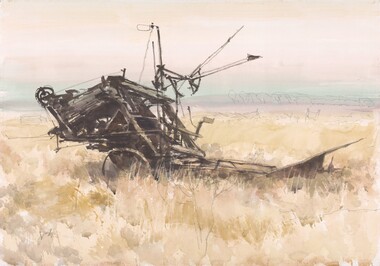 Art Gallery of Swan Hill
Painting, BUSH, Charles, Derelict, Moriac (discarded reaper), c1980
... Derelict, Moriac (discarded reaper)...Derelict, Moriac (discarded reaper) Painting BUSH, Charles ... -
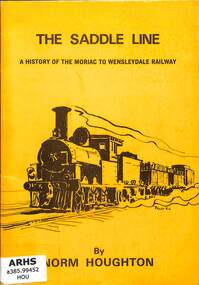 Victorian Railway History Library
Houghton, Norm, The Saddle Line: A History of the Moriac to Wensleydale Railway, 1982
... The Saddle Line: A History of the Moriac to Wensleydale Railway...The Saddle Line: A History of the Moriac to Wensleydale Railway Houghton, Norm ...A history of the branch line from Moriac to Wensleydale in Victoria.index, ill, maps, p.56.non-fictionA history of the branch line from Moriac to Wensleydale in Victoria.railroad construction - victoria - history, wensleydale railway - victoria - history -
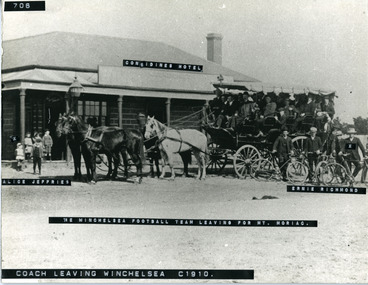 Lorne Historical Society
Photograph, Sports group in coach leaving Winchelsea circa 1910
... Coach leaving Considines Hotel with the Winchelsea football team bound for Mt Moriac. circa 1910...winchelsea tennnis team netball team considines hotel alice jeffries ernie richmond mt moriac 1910 sports group Alice Jeffries, Ernie Richmond. ...Coach leaving Considines Hotel with the Winchelsea football team bound for Mt Moriac. circa 1910Alice Jeffries, Ernie Richmond.winchelsea, tennnis team, netball team, considines hotel, alice jeffries, ernie richmond, mt moriac, 1910, sports group -
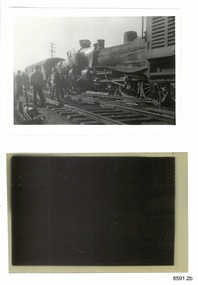 Flagstaff Hill Maritime Museum and Village
Photograph - Photograph and Negative, 1952
... ...Moriac...'Moriac, 1952 On 13 April 1952, a woman was killed and seven people were seriously injured when two passenger trains collided. ...'Moriac, 1952 On 13 April 1952, a woman was killed and seven people were seriously injured when two passenger trains collided. ...'Moriac, 1952 On 13 April 1952, a woman was killed and seven people were seriously injured when two passenger trains collided. A Melbourne-bound train collided with a Warrnambool-bound train, which was still shunting into siding at the station to allow the Melbourne-bound train to pass it on the single track. Both engines were derailed. The victim was in the first carriage of the Melbourne-bound train, which was telescoped after being forced into the tender of the locomotive. https://en.wikipedia.org/wiki/Railway_accidents_in_Victoria' 'April 12th 1952 7.52 p.m. Two passenger trains collided head on, on Warrnambool line near Moriac just out of Geelong. One killed four injured.' https://trove.nla.gov.au/newspaper/article/244373869?searchTerm=1952%20rail%20accident%20warrnambool ONE DEAD, MANY INJURED IN VIC. RAIL CRASH MELBOURNE, Saturday. — A woman was killed and seven persons were seriously injured when two passenger trains collided head-on at Moriac (59 miles south of Melbourne), near Geelong, at 8.15 tonight. Both engines were derailed, and the first carriage of the Geelong-bound train was telescoped by the coal tender. The dead woman was in this carriage. The trains involved were the 3.25 p.m. passenger train from Port Fairy to Geelong, and the 5.50 p.m. train from Melbourne to Warrnambool, which passed through Geelong at 7.05 p.m. ONE SHUNTING The Warrnambool-bound train had stopped at Moriac and was shunting into a siding to allow the other train to pass along the single track when the crash occurred. The impact hurled the Warrnambool-bound train backwards and the two engines, badly wrecked, came to rest 30ft apart. One engine hung at an acute angle on its side and the crew« were badly scalded by escaping steam. The crash was heard several miles away and hundreds of people rushed to the scene. Two ambulances were called from Geelong, and ambulance men joined railwaymen and volunteers in freeing the injured from badly damaged carriages. MANY SHOCKED Many other passengers were slightly hurt or badly affected by shock. They were treated on the spot. Mr. T. Mather, newsagent and postmaster at Moriac, said the noise of the crash startled him and he was on the scene in a matter of minutes. "There was great confusion," he said. "People on the trains were calling out for help. Many feared a fire would break out. However, we soon got relief gangs together and set to work to free those trapped in the wrecked carriage. One woman was dead, and a man seemed to be dead or dying." Special buses were chartered by the Railway Department to convey the passengers to their destinations. The line was blocked, but repair gangs were soon at work clearing the debris. https://trove.nla.gov.au/newspaper/article/18490332# This photograph and negative belonged to Dr. William Roy Angus. It was donated to Flagstaff Hill Maritime Village by his daughter, Bernice McDade. It is part of the “W.R. Angus Collection” includes historical medical equipment, surgical instruments and material once belonging to Dr Edward Ryan and Dr Thomas Francis Ryan, (both of Nhill, Victoria) as well as Dr Angus’ own belongings. The Collection’s history spans the medical practices of the two Doctors Ryan, from 1885-1926 plus that of Dr Angus, up until 1969. ABOUT THE “W.R.ANGUS COLLECTION” Doctor William Roy Angus M.B., B.S., Adel., 1923, F.R.C.S. Edin.,1928 (also known as Dr Roy Angus) was born in Murrumbeena, Victoria in 1901 and lived until 1970. He qualified as a doctor in 1923 at University of Adelaide, was Resident Medical Officer at the Royal Adelaide Hospital in 1924 and for a period was house surgeon to Sir (then Mr.) Henry Simpson Newland. Dr Angus was briefly an Assistant to Dr Riddell of Kapunda, then commenced private practice at Curramulka, Yorke Peninsula, SA, where he was physician, surgeon and chemist. In 1926, he was appointed as new Medical Assistant to Dr Thomas Francis Ryan (T.F. Ryan, or Tom), in Nhill, Victoria, where his experiences included radiology and pharmacy. In 1927 he was Acting House Surgeon in Dr Tom Ryan’s absence. Dr Angus had become engaged to Gladys Forsyth and they decided he further his studies overseas in the UK in 1927. He studied at London University College Hospital and at Edinburgh Royal Infirmary and in 1928, was awarded FRCS (Fellow from the Royal College of Surgeons), Edinburgh. He worked his passage back to Australia as a Ship’s Surgeon on the on the Australian Commonwealth Line’s T.S.S. Largs Bay. Dr Angus married Gladys in 1929, in Ballarat. (They went on to have one son (Graham 1932, born in SA) and two daughters (Helen (died 12/07/1996) and Berenice (Berry), both born at Mira, Nhill ) According to Berry, her mother Gladys made a lot of their clothes. She was very talented and did some lovely embroidery including lingerie for her trousseau and beautifully handmade baby clothes. Dr Angus was a ‘flying doctor’ for the A.I.M. (Australian Inland Ministry) Aerial Medical Service in 1928 . Its first station was in the remote town of Oodnadatta, where Dr Angus was stationed. He was locum tenens there on North-South Railway at 21 Mile Camp. He took up this ‘flying doctor’ position in response to a call from Dr John Flynn; the organisation was later known as the Flying Doctor Service, then the Royal Flying Doctor Service. A lot of his work during this time involved dental surgery also. Between 1928-1932 he was surgeon at the Curramulka Hospital, Yorke Peninsula, South Australia. In 1933 Dr Angus returned to Nhill and purchased a share of the Nelson Street practice and Mira hospital (a 2 bed ward at the Nelson Street Practice) from Dr Les Middleton one of the Middleton Brothers, the current owners of what previously once Dr Tom Ryan’s practice. Dr Tom and his brother had worked as surgeons included eye surgery. Dr Tom Ryan performed many of his operations in the Mira private hospital on his premises. He had been House Surgeon at the Nhill Hospital 1902-1926. Dr Tom Ryan had one of the only two pieces of radiology equipment in Victoria during his practicing years – The Royal Melbourne Hospital had the other one. Over the years Dr Tom Ryan had gradually set up what was effectively a training school for country general-practitioner-surgeons. Each patient was carefully examined, including using the X-ray machine, and any surgery was discussed and planned with Dr Ryan’s assistants several days in advance. Dr Angus gained experience in using the X-ray machine there during his time as assistant to Dr Ryan. When Dr Angus bought into the Nelson Street premises in Nhill he was also appointed as the Nhill Hospital’s Honorary House Surgeon 1933-1938. His practitioner’s plate from his Nhill surgery is now mounted on the doorway to the Port Medical Office at Flagstaff Hill Maritime Village, Warrnambool. When Dr Angus took up practice in the Dr Edward and Dr Tom Ryan’s old premises he obtained their extensive collection of historical medical equipment and materials spanning 1884-1926. A large part of this collection is now on display at the Port Medical Office at Flagstaff Hill Maritime Village in Warrnambool. In 1939 Dr Angus and his family moved to Warrnambool where he purchased “Birchwood,” the 1852 home and medical practice of Dr John Hunter Henderson, at 214 Koroit Street. (This property was sold in1965 to the State Government and is now the site of the Warrnambool Police Station. and an ALDI sore is on the land that was once their tennis court). The Angus family was able to afford gardeners, cooks and maids; their home was a popular place for visiting dignitaries to stay whilst visiting Warrnambool. Dr Angus had his own silk worm farm at home in a Mulberry tree. His young daughter used his centrifuge for spinning the silk. Dr Angus was appointed on a part-time basis as Port Medical Officer (Health Officer) in Warrnambool and held this position until the 1940’s when the government no longer required the service of a Port Medical Officer in Warrnambool; he was thus Warrnambool’s last serving Port Medical Officer. (Masters of immigrant ships arriving in port reported incidents of diseases, illness and death and the Port Medical Officer made a decision on whether the ship required Quarantine and for how long, in this way preventing contagious illness from spreading from new immigrants to the residents already in the colony.) Dr Angus was a member of the Australian Medical Association, for 35 years and surgeon at the Warrnambool Base Hospital 1939-1942, He served as a Surgeon Captain during WWII1942-45, in Ballarat, Victoria, and in Bonegilla, N.S.W., completing his service just before the end of the war due to suffering from a heart attack. During his convalescence he carved an intricate and ‘most artistic’ chess set from the material that dentures were made from. He then studied ophthalmology at the Royal Melbourne Eye and Ear Hospital and created cosmetically superior artificial eyes by pioneering using the intrascleral cartilage. Angus received accolades from the Ophthalmological Society of Australasia for this work. He returned to Warrnambool to commence practice as an ophthalmologist, pioneering in artificial eye improvements. He was Honorary Consultant Ophthalmologist to Warrnambool Base Hospital for 31 years. He made monthly visits to Portland as a visiting surgeon, to perform eye surgery. He represented the Victorian South-West subdivision of the Australian Medical Association as its secretary between 1949 and 1956 and as chairman from 1956 to 1958. In 1968 Dr Angus was elected member of Spain’s Barraquer Institute of Barcelona after his research work in Intrasclearal cartilage grafting, becoming one of the few Australian ophthalmologists to receive this honour, and in the following year presented his final paper on Living Intrasclearal Cartilage Implants at the Inaugural Meeting of the Australian College of Ophthalmologists in Melbourne In his personal life Dr Angus was a Presbyterian and treated Sunday as a Sabbath, a day of rest. He would visit 3 or 4 country patients on a Sunday, taking his children along ‘for the ride’ and to visit with him. Sunday evenings he would play the pianola and sing Scottish songs to his family. One of Dr Angus’ patients was Margaret MacKenzie, author of a book on local shipwrecks that she’d seen as an eye witness from the late 1880’s in Peterborough, Victoria. In the early 1950’s Dr Angus, painted a picture of a shipwreck for the cover jacket of Margaret’s book, Shipwrecks and More Shipwrecks. She was blind in later life and her daughter wrote the actual book for her. Dr Angus and his wife Gladys were very involved in Warrnambool’s society with a strong interest in civic affairs. He had an interest in people and the community They were both involved in the creation of Flagstaff Hill, including the layout of the gardens. After his death (28th March 1970) his family requested his practitioner’s plate, medical instruments and some personal belongings be displayed in the Port Medical Office surgery at Flagstaff Hill Maritime Village, and be called the “W. R. Angus Collection”. All rail accidents are serious, especially those involving fatalities.Photograph and negative showing two steam locomotives that appear to have collided head on. Also a newspaper article about the collision. From the W.R. Angus Collection.1139 on the back of the photograph together with multiple 'Ilford' brand marks.flagstaff hill maritime museum and village, great ocean road, shipwreck coast, rail accident, moriac, 1952, fatality, dr w r angus -
 Anglesea and District Historical Society
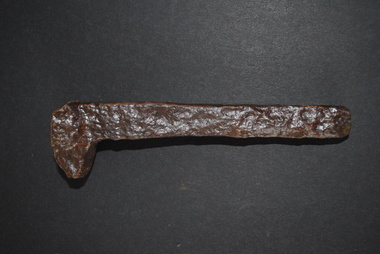
Railway Spike
... The line ran from Moriac to Wensleydale which closed in 1948 and was dismanatled in 1951. ...The line ran from Moriac to Wensleydale which closed in 1948 and was dismanatled in 1951. ...Rail spike from the Wensleydale rail line. The line ran from Moriac to Wensleydale which closed in 1948 and was dismanatled in 1951. The rail spike is a large nail with offset head used to secure rails and base plates to railroad ties in the track.Nonerailway spike, wensleydale railway, crampon -
 Australian Gliding Museum
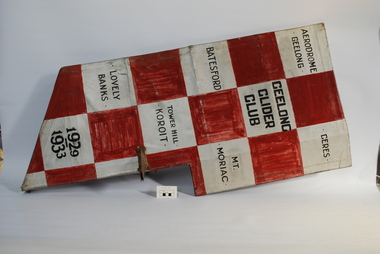
Functional object - Rudder from Geelong Gliding Club Primary Glider, 1929
... On starboard side – Geelong Glider Club; and place names including Geelong Aerodrome, Batesford, Ceres, Lovely Banks, Tower Hill, Koroit, Mount Moriac; and years, 1929-1933 ...On starboard side – Geelong Glider Club; and place names including Geelong Aerodrome, Batesford, Ceres, Lovely Banks, Tower Hill, Koroit, Mount Moriac; and years, 1929-1933 Fabric covered wooden framed primary glider rudder with metal levers decorated with silver and dark red checkered design. ...The Geelong Glider Club was formed in June 1929 at a meeting held at the Belmont Common hangar of Percy Pratt. The club built a Zogling (Primary Glider) based on plans obtained from Germany and flew it off nearby hills at Lovely Banks and other places in the Geelong region. The checked rudder design (without logo and markings) is evident in a picture of a Geelong Glider Club Zogling flying at Tower Hill near Warrambool, Victoria, at Easter 1931 and this lends support to the conclusion that the rudder was part of the Club’s first glider. The logo and markings appear to be a more recent elaboration to the design. Exhibit is a historical link to the earliest gliding activities of the Geelong Glider Club.Fabric covered wooden framed primary glider rudder with metal levers decorated with silver and dark red checkered design. The item has a cat logo on one side and markings on the other of places where the Geelong Gliding Club flew in its early years.On port side – Cat logo. On starboard side – Geelong Glider Club; and place names including Geelong Aerodrome, Batesford, Ceres, Lovely Banks, Tower Hill, Koroit, Mount Moriac; and years, 1929-1933 australian gliding, glider, zogling, primary glider, rudder, geelong gliding club, lovely banks, tower hill. koroit -
 Leopold Tennis Club
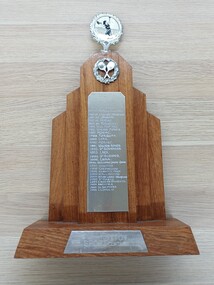
Award, Geelong Coast Tennis Association Mid-Week Pennant Grade 2, 1978
... Geelong Coast Tennis Association Mid-Week Pennant Grade 2 1977-78 Eastern 1978-79 Lara 1979-80 Geelong Lawn Blue 1980-81 Leopold Champions 1981-82 Leopold 1982-83 Moriac 1983-84 Torquay 1985 - Bell Post Hill 1986 Waurn Ponds 1987 Moriac 1988 Torquay 1989 Lara 1990 Moriac 1991 Waurn Ponds 1992 St Bernards 1993 Lara 1994 St Albans 1995 Lara 1996 Geelong Lawn Green 1997 Highton 1998 Gheringhap 1999 Kenwith Park 2000 Wallington 2001 Ocean Grove Champions 2002 St Marys 2003 Eastern Districts 2004 Anglesea 2005 St Stephens 2006 Leopold The Highton Toy Sport Centre trophy...Leopold Tennis Club Highton Toy and Sport Centre St Stephens Tennis Club Anglesea Tennis Club Eastern Districts Tennis Club St Marys Tennis Club Ocean Grove Tennis Club Wallington Tennis Club Kenwith Park Tennis Club Gheringhap Tennis Club Highton Tennis Club Geelong Lawn Tennis Club Lara Tennis Club St Albans Tennis Club St Bernards Tennis Club Waurn Ponds Tennis Club Moriac Tennis Club Torquay Tennis Club Bell Post Hill Tennis Club Geelong Coast Tennis Association Mid-Week Pennant Grade 2 1977-78 Eastern 1978-79 Lara 1979-80 Geelong Lawn Blue 1980-81 Leopold Champions 1981-82 Leopold 1982-83 Moriac 1983-84 Torquay 1985 - Bell Post Hill 1986 Waurn Ponds 1987 Moriac 1988 Torquay 1989 Lara 1990 Moriac 1991 Waurn Ponds 1992 St Bernards 1993 Lara 1994 St Albans 1995 Lara 1996 Geelong Lawn Green 1997 Highton 1998 Gheringhap 1999 Kenwith Park 2000 Wallington 2001 Ocean Grove Champions 2002 St Marys 2003 Eastern Districts 2004 Anglesea 2005 St Stephens 2006 Leopold The Highton Toy Sport Centre trophy 1 brown wooden column topped by gold disc with image of female tennis player. ...Wooden award sponsored by the Highton Toy and Sport Centre for the winner of the Grade 2 Ladies Mid-Week Pennant.1 brown wooden column topped by gold disc with image of female tennis player. Below that two tennis racquets are crossed and surrounded by leaves.Geelong Coast Tennis Association Mid-Week Pennant Grade 2 1977-78 Eastern 1978-79 Lara 1979-80 Geelong Lawn Blue 1980-81 Leopold Champions 1981-82 Leopold 1982-83 Moriac 1983-84 Torquay 1985 - Bell Post Hill 1986 Waurn Ponds 1987 Moriac 1988 Torquay 1989 Lara 1990 Moriac 1991 Waurn Ponds 1992 St Bernards 1993 Lara 1994 St Albans 1995 Lara 1996 Geelong Lawn Green 1997 Highton 1998 Gheringhap 1999 Kenwith Park 2000 Wallington 2001 Ocean Grove Champions 2002 St Marys 2003 Eastern Districts 2004 Anglesea 2005 St Stephens 2006 Leopold The Highton Toy Sport Centre trophyleopold tennis club, highton toy and sport centre, st stephens tennis club, anglesea tennis club, eastern districts tennis club, st marys tennis club, ocean grove tennis club, wallington tennis club, kenwith park tennis club, gheringhap tennis club, highton tennis club, geelong lawn tennis club, lara tennis club, st albans tennis club, st bernards tennis club, waurn ponds tennis club, moriac tennis club, torquay tennis club, bell post hill tennis club -
 Leopold Tennis Club
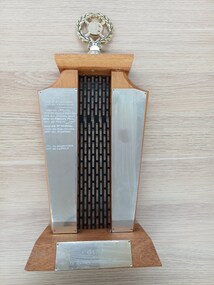
Award, Geelong Coast Tennis Association G13 McQuinn trophy, 1978
... Geelong Coast Tennis Assn G13 McQuinn Trophy 1977-78 Paraparap 1978-79 Connewarre 1979-80 Hamlyn Park 1980-81 Highton 1981-82 Winchelsea 1982-83 Grovedale (Champions) 1983-84 Torquay 1984-85 Waurn Ponds East 1985-86 Geelong West 1986-87 Hamlyn Park 1987-88 Moriac Champions 1988-89 Mt Moriac 1989-90 Winchelsea 1991-92 Highton 1997-98 Waurn Ponds 1999-00 Leopold ...Leopold Tennis Club Highton Tennis Club Waurn Ponds Tennis Club Moriac Tennis Club Torquay Tennis Club Paraparap Tennis Club Connewarre Tennis Club Hamlyn Park Winchelsea Tennis Club Grovedale Tennis Club Geelong West Tennis Club Geelong Coast Tennis Assn G13 McQuinn Trophy 1977-78 Paraparap 1978-79 Connewarre 1979-80 Hamlyn Park 1980-81 Highton 1981-82 Winchelsea 1982-83 Grovedale (Champions) 1983-84 Torquay 1984-85 Waurn Ponds East 1985-86 Geelong West 1986-87 Hamlyn Park 1987-88 Moriac Champions 1988-89 Mt Moriac 1989-90 Winchelsea 1991-92 Highton 1997-98 Waurn Ponds 1999-00 Leopold Two wooden pillars with black grille between, topped by gold wreath with disc in centre and metal nameplates on pillars and base Geelong Coast Tennis Association G13 McQuinn trophy Award ...Wooden award in honour of McQuinn for the winner of the Grade 13 section.Two wooden pillars with black grille between, topped by gold wreath with disc in centre and metal nameplates on pillars and baseGeelong Coast Tennis Assn G13 McQuinn Trophy 1977-78 Paraparap 1978-79 Connewarre 1979-80 Hamlyn Park 1980-81 Highton 1981-82 Winchelsea 1982-83 Grovedale (Champions) 1983-84 Torquay 1984-85 Waurn Ponds East 1985-86 Geelong West 1986-87 Hamlyn Park 1987-88 Moriac Champions 1988-89 Mt Moriac 1989-90 Winchelsea 1991-92 Highton 1997-98 Waurn Ponds 1999-00 Leopold leopold tennis club, highton tennis club, waurn ponds tennis club, moriac tennis club, torquay tennis club, paraparap tennis club, connewarre tennis club, hamlyn park, winchelsea tennis club, grovedale tennis club, geelong west tennis club -
 Anglesea and District Historical Society
Signs
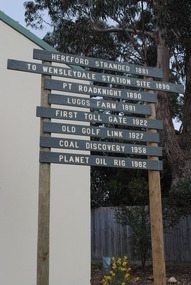
... (Railway Station Moriac to Wensleydale). 3. Pt Roadknight 1890. 4. ...(Railway Station Moriac to Wensleydale). 3. Pt Roadknight 1890. 4. ...Totem of signs. 1. Hereford Stranded 1881. (Ship wrecked off Swampy Creek). 2. To Wensleydale Station Site 1890. (Railway Station Moriac to Wensleydale). 3. Pt Roadknight 1890. 4. Luggs Farm 1891. (orchard and dairy) called The Rookery. 5. First Toll Gate 1922. 6. Old Golf Link 1927. 7. Coal Discovery 1958. 8. Planet Oil Rig 1962.As abovehistoric signs -
 Greensborough Historical Society
Article, Journal, Australian Home Beautiful, Lower Plenty State School LP1295, 20/06/1921o
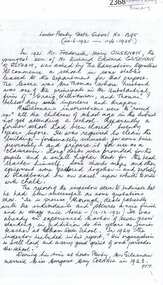
... Mr Gilsenan was transferred to Mt Moriac SS No. 1608 in 1925. The handwritten account is written by Verna....Mr Gilsenan was transferred to Mt Moriac SS No. 1608 in 1925. The handwritten account is written by Verna. ...The Australian Home Beautiful article on the Heidelberg and Eastern Golf Club indicates that its clubhouse comprised two buildings, "Bryn Teg" built by Mrs Thomas, one approximately 1849, the other 40 years later. The club moved into these buildings about 1928. The stables were converted for use in 1921 by Frederick Henry Gilsenan as the Lower Plenty State School No. 1295 which was open from 20/06/1921 to 11/04/1925. Mr. Gilsenan married Margaret Mar Cornall in 1923. They lived in Heidelberg, had a daughter, Verna in 1924. Mr Gilsenan was transferred to Mt Moriac SS No. 1608 in 1925. The handwritten account is written by Verna.Historical significance about the premises of both the Lower Plenty State School and the Heidelberg Golf Club.4 p. photocopied article from Australian Home Beautiful 1 June 1929, with 2p.handwritten history of the school 20/06/1921-11/04/1925 (2 copies) and page of photographs of building and people.lower plenty primary school, gilsenan, frederick henry, heidelberg golf club -
 National Wool Museum
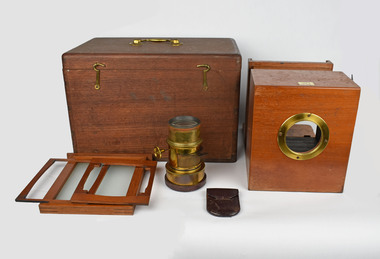
Machine - Sliding Box Plate Camera, 1866-1882
... Booklet details Lugg's military service, working life in Stachan's wool stores and life in Geelong and Moriac. Measurements of parts (in centimeters): 27 26 41.5 Carry Case 24.5 36.5 21.2 Sliding box Camera 15.4 .5 17.6 slide frame 11 14.5 9.5 lens 152 71 cape 9 1.5 6.5 pouch 8.5 .1 6.5 5.5 Filter Lense 8.5 .1 6.5 4.5 Filter Lense 8.5 .1 6.5 3.5 Filter Lense 8.5 .1 6.5 1.2 Filter Lense ...Booklet details Lugg's military service, working life in Stachan's wool stores and life in Geelong and Moriac. Measurements of parts (in centimeters): 27 26 41.5 Carry Case 24.5 36.5 21.2 Sliding box Camera 15.4 .5 17.6 slide frame 11 14.5 9.5 lens 152 71 cape 9 1.5 6.5 pouch 8.5 .1 6.5 5.5 Filter Lense 8.5 .1 6.5 4.5 Filter Lense 8.5 .1 6.5 3.5 Filter Lense 8.5 .1 6.5 1.2 Filter Lense Machine Sliding Box Plate Camera Frederick J. ...Made by Cox, F J 1845-1882 (1891), optical & mathematical instrument maker, optician, camera manufacturer, London.Sliding box camera, about 1855. This type of camera was in use before bellows became common. The camera belonged to Hugh Strachan who passed it on to an employee, Charlie Lugg. The Strachan family is distinguished in the Geelong wool industry. James Ford Strachan, born in Scotland, established a very successful wool broking business and his sons carried on his work.Wooden case with brass handle lined with green felt containing one sliding box camera, with a brass fitting for a lense, a removable glass focussing screen, which conseals the removable lense inside the camera. Also two small wooden frames for developping the photographs. Also a linen cape and a leather pouch containing metal filters with gradients. Booklet about the life of Charles Lugg who owned the camera before it was passed to his nephew who then donated it to the NWM. Booklet details Lugg's military service, working life in Stachan's wool stores and life in Geelong and Moriac. Measurements of parts (in centimeters): 27 26 41.5 Carry Case 24.5 36.5 21.2 Sliding box Camera 15.4 .5 17.6 slide frame 11 14.5 9.5 lens 152 71 cape 9 1.5 6.5 pouch 8.5 .1 6.5 5.5 Filter Lense 8.5 .1 6.5 4.5 Filter Lense 8.5 .1 6.5 3.5 Filter Lense 8.5 .1 6.5 1.2 Filter Lense F.J. Cox/ 26/Ludgate Hill/ London (Plaque on top of box) Fred J Cox/26 Ludgate Hill/London (Engraved on side of Lens)charles lugg, fred j cox, james ford strachan
