
Showing 6 items matching "mortar and cement"
-
 Bendigo Historical Society Inc.
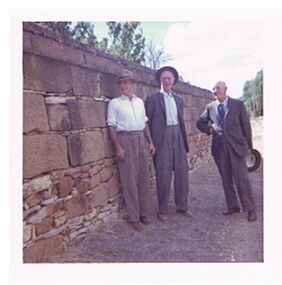
Photograph - DRY WALL LESTER STREET
... Jacob - order not known ) Written on accompanying sheet ' erected by Simon Jame, no cement or mortar used.' Notes appended ' Dry Wall in Lester St. was erected by Simon Jame, no mortar or lime was used in construction and it is still straight and true. ...Jacob - order not known ) Written on accompanying sheet ' erected by Simon Jame, no cement or mortar used.' Notes appended ' Dry Wall in Lester St. was erected by Simon Jame, no mortar or lime was used in construction and it is still straight and true. ...Photograph: dry stone wall, Lester Street, Eaglehawk. Photo shows three men ( identified as W. Crawford, F. Fitzpatrick, C. Jacob - order not known ) Written on accompanying sheet ' erected by Simon Jame, no cement or mortar used.' Notes appended ' Dry Wall in Lester St. was erected by Simon Jame, no mortar or lime was used in construction and it is still straight and true. It was originally erected to enclose a garden.'cottage, miners, dry stone wall, crawford, w., firtzpatrick f., jacob c., eaglehawk -
 Bendigo Historical Society Inc.
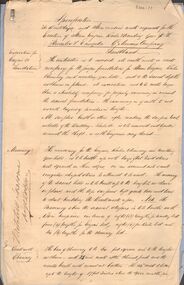
Document - MARKS COLLECTION: SPECIFICATION AND GENERAL CONDITIONS OF CONTRACT HERCULES AND ENERGETIC MINE, 2nd March, 1870
... Handwritten document, outlining 'specifications to bricklayers and stonemasons work required for the erection of Steam Engine, Boiler and Winding Gear for the Hercules and Energetic Goldmining Company, Sandhurst' Sections consist of details for excavation for engine and foundations, masonry, brickwork chimney, excavations for boiler seating, firing floor, firing boiler brickwork engine bed, winding gear, mortar and cement, seating of boiler. Document is dated Mar 12, 1870. ...BENDIGO Buildings fortuna villa William Middleton Hercules and Energetic Gold Mine excavation for engine and foundations masonry brickwork chimney excavations for boiler seating firing floor firing boiler brickwork engine bed winding gear mortar and cement seating of boiler. Drawings by, Wm Middleton, Engineer Sandhursts. ...Handwritten document, outlining 'specifications to bricklayers and stonemasons work required for the erection of Steam Engine, Boiler and Winding Gear for the Hercules and Energetic Goldmining Company, Sandhurst' Sections consist of details for excavation for engine and foundations, masonry, brickwork chimney, excavations for boiler seating, firing floor, firing boiler brickwork engine bed, winding gear, mortar and cement, seating of boiler. Document is dated Mar 12, 1870. Attached to the document is a blue printed 'General Conditions of Contract' document, handwritten on top 'Bricklayers' Drawings by Wm. Middleton, engineer. See 8300.14.Drawings by, Wm Middleton, Engineer Sandhursts.bendigo, buildings, fortuna villa, william middleton, hercules and energetic gold mine, excavation for engine and foundations, masonry, brickwork chimney, excavations for boiler seating, firing floor, firing boiler brickwork engine bed, winding gear, mortar and cement, seating of boiler. -
 Bendigo Historical Society Inc.
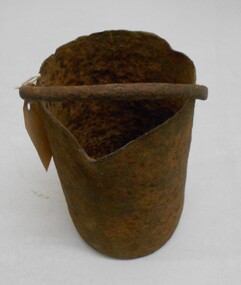
Tool - MERCURY BUCKET
... By the late 1850s the most common way of crushing goldbearing quartz ores or consolidated alluvial cements was in a stamp battery. The battery featured heavy iron stamp heads held in a frame with each head often weighing up to 500 pounds (226 kg) or more (see MSV 1880 page 45) (Birrell 2005). ...Cast iron mercury bucket, used to hold mercury, potentially in the process of recovering minute pieces of gold mixed in soil and sediments. See research page for description of one process of using mercury to extract gold.gold mines, mining equipment, mercury bucket, miners used mercury in a number of ways to amalgamate gold, with each mill or battery operator having their preferred method depending on the nature of the ore. by the late 1850s the most common way of crushing goldbearing quartz ores or consolidated alluvial cements was in a stamp battery. the battery featured heavy iron stamp heads held in a frame, with each head often weighing up to 500 pounds (226 kg) or more (see msv 1880, page 45) (birrell 2005). stamp heads were lifted and dropped by a rotating overhead cam shaft driven by a steam engine or water wheel. ore was fed into a large cast-iron battery box, mixed with a steady stream of water, and pulverised by the stamp heads. in some batteries, mercury was placed in the base of the boxes to amalgamate with freed gold. the violent agitation of the mercury in the mortar box, however, could cause the mercury to break into myriad tiny globules that were carried away by the water with the tailings, thus losing a certain amount of gold in the process (thompson 1867; ritchie & hooker 1997). the water and sand slurry was splashed by the falling stamps from the box through fine mesh screens and onto inclined wooden tables below the mortar box (figure 2). the tables were covered with copper sheets or plates coated with mercury, which caught and amalgamated with a portion of the gold. the grey putty-like amalgam was periodically scraped off the sheets and retorted in a furnace to collect the gold and recover the mercury for reuse. mercury was inevitably lost from the plates, while poor maintenance resulted in further losses of gold and mercury in the tailings. mercury use and loss from gold mining in 19th century victoria. peter davies1, susan lawrence, and jodi turnbull, department of archaeology and history, la trobe university. -
 Kew Historical Society Inc
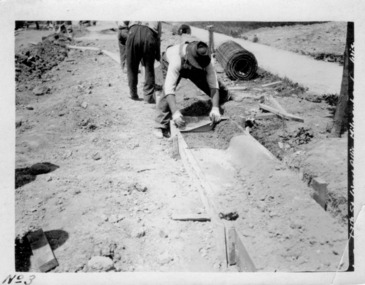
Photograph - Instructional photograph No.3: Using concrete for street kerbs, Portland Cement Association, 1921
... The photos demonstrate knowledge about and the use of concrete in street works in a major Melbourne municipality at an early period. street works kerbing gutters concrete portland cement association "3rd - Metal template for Trimming Concrete 1/2" below Finished Surface ready for Application of Mortar facing." ...One of seven photographs produced by the Portland Cement Association in 1921 showing how concrete kerbs could be created. Portland Cement Association (PCA) was founded in 1916. From 1917, the association actively promoted the benefits of concrete for road works in Australian newspapers. In the nineteenth century in Melbourne (Vic.) 'made roads' typically had gutters and kerbing lined with bluestone.The photographs are important evidence of the availability of instructional models for the use of concrete in street works in Victoria. While the photographs date from the early 1920s, the use of concrete for kerbing did not reach its maturity until after World War 2. The photos demonstrate knowledge about and the use of concrete in street works in a major Melbourne municipality at an early period.Black and white photograph with printed instructions on the reverse showing the production of concrete kerbing on 67th Street, West Allis, Milwaukee, Wisconsin (USA). The photograph was produced by the Portland Cement Association of Chicago in 1921 and used within the Chief Engineer's Department of the City of Kew (Vic.)."3rd - Metal template for Trimming Concrete 1/2" below Finished Surface ready for Application of Mortar facing." street works, kerbing, gutters, concrete, portland cement association -
 Kew Historical Society Inc
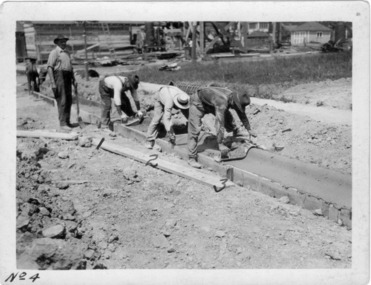
Photograph - Instructional photograph No.4: Using concrete for street kerbs, Portland Cement Association, 1921
... The photos demonstrate knowledge about and the use of concrete in street works in a major Melbourne municipality at an early period. street works kerbing gutters concrete portland cement association "4th - showing the three principal filling operations - 1st Trimming base course; 2nd Mortar facing applied and Trimmed 1/8th high with wooden template; 3rd - Mortar face finished to exact contour with metal finishing trowel, having a rounded face in contact with mortar facing." ...One of seven photographs produced by the Portland Cement Association in 1921 showing how concrete kerbs could be created. Portland Cement Association (PCA) was founded in 1916. From 1917, the association actively promoted the benefits of concrete for road works in Australian newspapers. In the nineteenth century in Melbourne (Vic.) 'made roads' typically had gutters and kerbing lined with bluestone.The photographs are important evidence of the availability of instructional models for the use of concrete in street works in Victoria. While the photographs date from the early 1920s, the use of concrete for kerbing did not reach its maturity until after World War 2. The photos demonstrate knowledge about and the use of concrete in street works in a major Melbourne municipality at an early period.Black and white photograph with printed instructions on the reverse showing the production of concrete kerbing on 67th Street, West Allis, Milwaukee, Wisconsin (USA). The photograph was produced by the Portland Cement Association of Chicago in 1921 and used within the Chief Engineer's Department of the City of Kew (Vic.)."4th - showing the three principal filling operations - 1st Trimming base course; 2nd Mortar facing applied and Trimmed 1/8th high with wooden template; 3rd - Mortar face finished to exact contour with metal finishing trowel, having a rounded face in contact with mortar facing." street works, kerbing, gutters, concrete, portland cement association -
 Kew Historical Society Inc
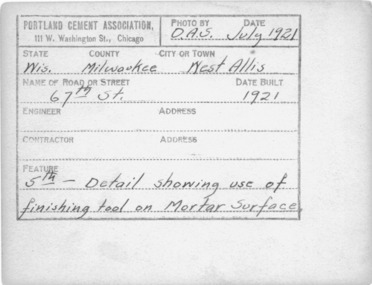
Photograph - Instructional photograph No.5: Using concrete for street kerbs, Portland Cement Association, 1921
... The photos demonstrate knowledge about and the use of concrete in street works in a major Melbourne municipality at an early period. street works kerbing gutters concrete portland cement association "5th Detail. showing use of finishing tool on Mortar Surface" Black and white photograph with printed instructions on the reverse showing the production of concrete kerbing on 67th Street, West Allis, Milwaukee, Wisconsin (USA). ...One of seven photographs produced by the Portland Cement Association in 1921 showing how concrete kerbs could be created. Portland Cement Association (PCA) was founded in 1916. From 1917, the association actively promoted the benefits of concrete for road works in Australian newspapers. In the nineteenth century in Melbourne (Vic.) 'made roads' typically had gutters and kerbing lined with bluestone.The photographs are important evidence of the availability of instructional models for the use of concrete in street works in Victoria. While the photographs date from the early 1920s, the use of concrete for kerbing did not reach its maturity until after World War 2. The photos demonstrate knowledge about and the use of concrete in street works in a major Melbourne municipality at an early period.Black and white photograph with printed instructions on the reverse showing the production of concrete kerbing on 67th Street, West Allis, Milwaukee, Wisconsin (USA). The photograph was produced by the Portland Cement Association of Chicago in 1921 and used within the Chief Engineer's Department of the City of Kew (Vic.)."5th Detail. showing use of finishing tool on Mortar Surface" street works, kerbing, gutters, concrete, portland cement association
