
Showing 73 items matching "musical arranger"
-
 Federation University Historical Collection
Sheet Music, Boosey & Hawkes Ltd, Sirius, Diversions on an Original Theme, mid 1900's
... ...musical arranger...The Frank Wright Medal at the Royal South Street competition is awarded to an individual recognized as making an outstanding contribution to brass music in Australia. frank wright musical arranger sheet music score sirius diversions on an original theme original score The original score is handwritten as is the note 'Parts of Sirius' 1). ...Frank Wright was a renown resident of Smeaton, where he was born on 2 August 1901. He lived at Laura Villa, and attended Smeaton State School. His father William was a gold miner and his mother's name was Sarah. Their family won many singing and instrumental awards. Frank was tutored by Percy Code and was awarded a gold medal for the highest marks in the ALCM examinations in the British Colonies at the age of seventeen years. He became the Australian Open Cornet Champion by the age of eighteen. A year later, Frank conducted the City of Ballarat Band, and later the Ballarat Soldiers’ Memorial Band. He formed the Frank Wright Frisco Band and Frank Wright and his Coliseum Orchestra. These bands won many South Street awards, and Frank as conductor won many awards in the Australian Band Championship contest. In 1933 Frank Wright sailed to England to conduct the famous St Hilda’s Band and was later appointed Musical Director of the London County Council, where he organized many amazing concerts in parks, in and around the London district. He was made Professor of Brass and Military Band Scoring and conducted at the Guildhall of Music and Drama. Frank was often invited to adjudicate Brass Band Championships around Europe, in Australia, including South Street and in New Zealand. The Frank Wright Medal at the Royal South Street competition is awarded to an individual recognized as making an outstanding contribution to brass music in Australia.1). This includes the original thirty-one page handwritten Full Military Band Score of 'Sirius, Diversions on an Original Theme' arranged by Frank Wright. It was written in pen in small, neat writing. 2). There is also a copied Full Orchestral Score, which was originally hand written in the style of the era. 3). As well there are two distinct copies of all the printed parts for the music, one in portrait by Boosey & Hawkes Brass Band Journal 4). and the other in landscape by Molenaar. 5). The Molenaar edition also includes one large buff coloured edition of the printed music, 6). one blue covered printed edition of the music 7). and four small paper copies of the music. 8). Lastly is a hand written note from Frank Wright showing all the instruments used in this piece.The original score is handwritten as is the note 'Parts of Sirius'frank wright, musical arranger, sheet music, score, sirius diversions on an original theme, original score -
 Royal Australian Air Force Band
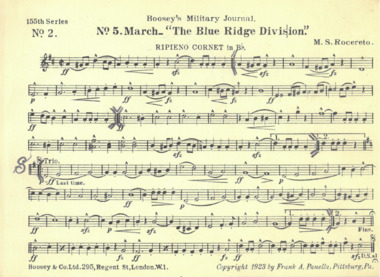
March Card, Rocereto, M.S. (Composer), No 5 MARCH "THE BLUE RIDGE DIVISION", Composed: 1923
... Stamped on the reverse of each card: Australian Broadcasting Commission *Sydney*, Property of Charles Godfrey Musical Director & Arranger...Brass Band Australian Broadcasting Commission Marching Band Concert Band Stamped on the reverse of each card: Australian Broadcasting Commission *Sydney*, Property of Charles Godfrey Musical Director & Arranger 19 Parts Concert Band Instrumentation Quick March Key Signature: C Major Boosey's Military Journal - 155th Series No. 2 Instrumentation: Eb Flute & Piccolo Oboes Eb Clarinets Solo & Ripieno Clarinets in Bb 2nd & 3rd Clarinets in Bb Bassoons Alto Saxophone & Alto Clarinet in Eb Tenor Saxophone 1st & 2nd Horns in Eb 3rd & 4th Horns in Eb Ripieno Cornet in Bb 1st Cornet in Bb 2nd Cornet in Bb 1st Baritone in Bb 1st & 2nd Tenor Trombones Bass Trombone Euphonion Basses Drums No 5 MARCH "THE BLUE RIDGE DIVISION" March Card Rocereto, M.S. ...In 1932 the call was put out to the ABC to start a military band. Their task was to record music to play on air four times a week, and to perform live concerts for the public. By November 1933 the musicians were chosen from around Australia. The band was initially conducted by Captain H. E. Adkins, Director of the Royal Military School of Music, Kneller Hall, London. After the tour, Adkins returned to his position at Kneller Hall, and Stephen Yorke, a retired bandmaster of the Gloucestershire Regiment, was brought out to Australia to become the permanent director and conductor of the band, which he did until the band closed in 1951. During the band’s 17 year history they presented a sizable program of music. Their final concert received a standing ovation from its audience of 1500, with a teary-eyed Yorke.19 Parts Concert Band Instrumentation Quick March Key Signature: C Major Boosey's Military Journal - 155th Series No. 2 Instrumentation: Eb Flute & Piccolo Oboes Eb Clarinets Solo & Ripieno Clarinets in Bb 2nd & 3rd Clarinets in Bb Bassoons Alto Saxophone & Alto Clarinet in Eb Tenor Saxophone 1st & 2nd Horns in Eb 3rd & 4th Horns in Eb Ripieno Cornet in Bb 1st Cornet in Bb 2nd Cornet in Bb 1st Baritone in Bb 1st & 2nd Tenor Trombones Bass Trombone Euphonion Basses DrumsStamped on the reverse of each card: Australian Broadcasting Commission *Sydney*, Property of Charles Godfrey Musical Director & Arrangerbrass band, australian broadcasting commission, marching band, concert band -
 Royal Australian Air Force Band
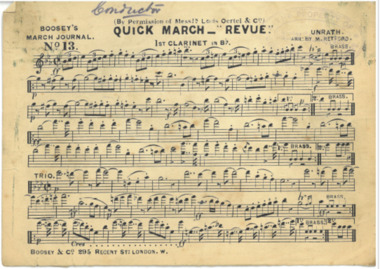
March Card, Unrath, Carl Ludwig (Composer) et al, Quick March "Revue", Composed: ?
... . & The Property of Musical Director & Arranger.... & The Property of Musical Director & Arranger 23 + 2 handwritten parts Concert Band Instrumentation Quick March Key Signature: Db Major Boosey's March Journal No. 13 Instrumentation: 1st Clarinet in Bb (written above in cursive, Conductor) Piccolo in Eb Oboes or Clarinets in C 1st Clarinet in Eb 2nd Clarinet in Eb 1st Clarinet in Bb 2nd Clarinet in Bb 3rd Clarinet in Bb Alto Clarinet in Eb 1st Bassoon or Bass Clarinet in Bb 2nd Bassoon or Bass Clarinet in Bb 1st & 2nd Horns in Eb 3rd & 4th Horns in Eb 1st Trumpet in Eb 2nd Trumpet in Eb (Missing - 1st Cornet in Bb) 2nd Cornet in Bb 1st Tenor Trombone 2nd Tenor Trombone Bass Trombone Baritone in Bb Euphonion Basses Drums Quick March "Revue" March Card Unrath, Carl Ludwig (Composer) Retford, Michael (Arranger) Boosey & Co Ltd ...In 1932 the call was put out to the ABC to start a military band. The band’s task was to record music to play on air four times a week, and to perform live concerts for the public. By November 1933 a band was put together with 40 musicians from around Australia. The band was initially conducted by Captain H. E. Adkins, Director of the Royal Military School of Music, Kneller Hall, London. After the tour, Adkins returned to his position at Kneller Hall, and Stephen Yorke, a retired bandmaster of the Gloucestershire Regiment, was brought out to Australia to become the permanent director and conductor of the band, which he did until the band closed in 1951. During the band’s 17 year history they presented a sizable program of music. Their final concert received a standing ovation from its audience of 1500, with a teary-eyed Yorke. 23 + 2 handwritten parts Concert Band Instrumentation Quick March Key Signature: Db Major Boosey's March Journal No. 13 Instrumentation: 1st Clarinet in Bb (written above in cursive, Conductor) Piccolo in Eb Oboes or Clarinets in C 1st Clarinet in Eb 2nd Clarinet in Eb 1st Clarinet in Bb 2nd Clarinet in Bb 3rd Clarinet in Bb Alto Clarinet in Eb 1st Bassoon or Bass Clarinet in Bb 2nd Bassoon or Bass Clarinet in Bb 1st & 2nd Horns in Eb 3rd & 4th Horns in Eb 1st Trumpet in Eb 2nd Trumpet in Eb (Missing - 1st Cornet in Bb) 2nd Cornet in Bb 1st Tenor Trombone 2nd Tenor Trombone Bass Trombone Baritone in Bb Euphonion Basses DrumsOn envelope: QM171, Revue Unrath, Q141, Scrubbed out 215 Stamped on the reverse of each card: Australian Broadcasting Co. & The Property of Musical Director & Arrangerbrass band, australian broadcasting commission, marching band, concert band -
 Royal Australian Air Force Band
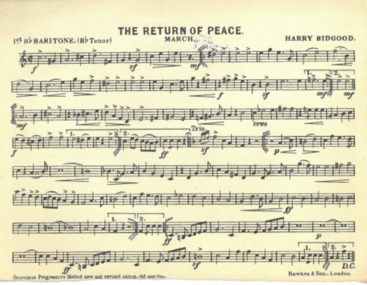
March Card, Bidgood, Harry (Composer), The Return of Peace, Composed: 1920
... . & The Property of Musical Director & Arranger Charles Godfrey.... & The Property of Musical Director & Arranger Charles Godfrey 26 + 1 handwritten parts Concert Band Instrumentation Quick March Key Signature: Bb Major Instrumentation: Solo Bb Cornet Eb Flute & Piccolo Oboes Eb Clarinets 1st Bb Clarinet 2nd Bb Clarinet 3rd & 4th Bb Clarinets 1st Bassoon 2nd Bassoon Solo Eb Saxhorn (Eb Alto) 1st Bb Baritone (Bb Tenor) 1st Eb Horn 2nd Eb Horn 3rd Eb Horn 4th Eb Horn Eb Trumpets Solo Bb Cornet 1st Bb Cornet 2nd Bb Cornet 1st Trombone 2nd Trombone Bass Trombone Euphonium (Baritone) Bombardon (Tuba) Side Drum Bass Drum Rep Clari - handwritten part separate Written underneath on some of the march cards: - Langey's Practical Tutor for the Flute is the best, 4/4 post free. - Klose's Clarinet Method is the best, 16/6 post free - Berr's Clarinet Method is the best, 16/6 post free - Caussinus Progressive Method new and revised edition, 16/6 post free - Langey's Practical Tutor for the Slide Trombone is the best, 4/4 post free - Langey's Practical Tutor for the BassTrombone is the best, 4/4 post free The Return of Peace March Card Bidgood, Harry (Composer) Hawkes & Son ...In 1932 the call was put out to the ABC to start a military band. The band’s task was to record music to play on air four times a week, and to perform live concerts for the public. By November 1933 a band was put together with 40 musicians from around Australia. The band was initially conducted by Captain H. E. Adkins, Director of the Royal Military School of Music, Kneller Hall, London. After the tour, Adkins returned to his position at Kneller Hall, and Stephen Yorke, a retired bandmaster of the Gloucestershire Regiment, was brought out to Australia to become the permanent director and conductor of the band, which he did until the band closed in 1951. During the band’s 17 year history they presented a sizable program of music. Their final concert received a standing ovation from its audience of 1500, with a teary-eyed Yorke. 26 + 1 handwritten parts Concert Band Instrumentation Quick March Key Signature: Bb Major Instrumentation: Solo Bb Cornet Eb Flute & Piccolo Oboes Eb Clarinets 1st Bb Clarinet 2nd Bb Clarinet 3rd & 4th Bb Clarinets 1st Bassoon 2nd Bassoon Solo Eb Saxhorn (Eb Alto) 1st Bb Baritone (Bb Tenor) 1st Eb Horn 2nd Eb Horn 3rd Eb Horn 4th Eb Horn Eb Trumpets Solo Bb Cornet 1st Bb Cornet 2nd Bb Cornet 1st Trombone 2nd Trombone Bass Trombone Euphonium (Baritone) Bombardon (Tuba) Side Drum Bass Drum Rep Clari - handwritten part separate Written underneath on some of the march cards: - Langey's Practical Tutor for the Flute is the best, 4/4 post free. - Klose's Clarinet Method is the best, 16/6 post free - Berr's Clarinet Method is the best, 16/6 post free - Caussinus Progressive Method new and revised edition, 16/6 post free - Langey's Practical Tutor for the Slide Trombone is the best, 4/4 post free - Langey's Practical Tutor for the BassTrombone is the best, 4/4 post freeOn envelope: QM170, The Return of Peace Bidgood, Q140, Scrubbed out 316 Stamped on the reverse of each card: Australian Broadcasting Co. & The Property of Musical Director & Arranger Charles Godfreybrass band, australian broadcasting commission, marching band, concert band -
 Royal Australian Air Force Band
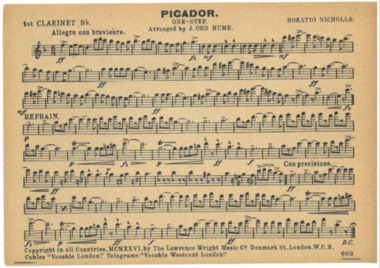
March Card, Nicholls, Horatio (Composer) et al, Picador, Composed: 1926
... On envelope: QM156, Picador Nicholas, Q135, 289 (scrubbed out) Stamped on the reverse of each card: Australian Broadcasting Commission *Sydney*, The Property of Musical Director & Arranger Charles Godfrey...Bottom of 3rd Clarinet: MUSICAL DIRECTORS write for particulars of our Subscription Scheme Picador March Card Nicholls, Horatio (Composer) Hume, J. Ord (Arranger ...In 1932 the call was put out to the ABC to start a military band. The band’s task was to record music to play on air four times a week, and to perform live concerts for the public. By November 1933 a band was put together with 40 musicians from around Australia. The band was initially conducted by Captain H. E. Adkins, Director of the Royal Military School of Music, Kneller Hall, London. After the tour, Adkins returned to his position at Kneller Hall, and Stephen Yorke, a retired bandmaster of the Gloucestershire Regiment, was brought out to Australia to become the permanent director and conductor of the band, which he did until the band closed in 1951. During the band’s 17 year history they presented a sizable program of music. Their final concert received a standing ovation from its audience of 1500, with a teary-eyed Yorke. 22 parts concert band instrumentation One-Step Key Signature: Eb Major Refrain words included on most (but not all) march cards Instrumentation: Flute & Piccolo Eb Oboe Eb Clarinet 1st Bb Clarinet 2nd Bb Clarinet 3rd Bb Clarinet Bassoon Eb Alto Saxophone 1st Eb Horn 2nd Eb Horn 3rd Eb Horn 4th Eb Horn Solo Bb Cornet - Conductor written along the top Repiano Cornet Bb 2nd Bb Cornet 1st Tenor Trombone 2nd Tenor Trombone Bass Trombone 1st Baritone Bb Euphonium (Bass clef) Eb Bass (Bass Clef) Drums Along bottom of most march cards: Cables "Vocable London." Telegrams "Vocable Westcent London." Bottom of 3rd Clarinet: MUSICAL DIRECTORS write for particulars of our Subscription SchemeOn envelope: QM156, Picador Nicholas, Q135, 289 (scrubbed out) Stamped on the reverse of each card: Australian Broadcasting Commission *Sydney*, The Property of Musical Director & Arranger Charles Godfreybrass band, australian broadcasting commission, marching band, concert band -
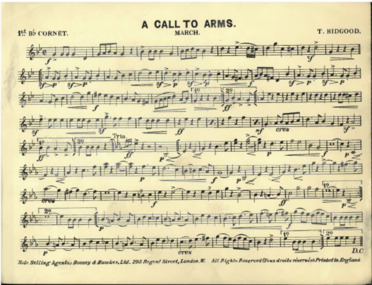 Royal Australian Air Force Band
March Card, Bidgood, T. (Composer), A Call to Arms, Composed: 1912
... On envelope: 27 Nov 1940, 3 Dec 1943, QM27, Q214 Stamped on the reverse of each card: Australian Broadcasting Commission *Sydney*, Property of Charles Godfrey Musical Director & Arranger...Brass Band Australian Broadcasting Commission Marching Band Concert Band ABC Military March Card Collection History goes here or if I need to put instrumentation this goes here too On envelope: 27 Nov 1940, 3 Dec 1943, QM27, Q214 Stamped on the reverse of each card: Australian Broadcasting Commission *Sydney*, Property of Charles Godfrey Musical Director & Arranger 19 PARTS BRASS BAND INSTRUMENTATION ONLY QUICK MARCH Key Sig: F MINOR Band series number: 4874 Instrumentation: Eb Soprano Cornet Solo Bb Cornet 1st Bb Cornet 2nd Bb Cornet 3rd & 4th Cornets 1st Eb Horn 2nd Eb Horn 1st Bb Baritone 2nd Bb Baritone Eb Solo Saxhorn 1st Trombone 2nd Trombone Bass Trombone Bb Euphonium (treble) Eb Bombardon (treble) Bb Bass (treble) Side Drum Bass Drum Written on some parts: - Caussinus progressive Method (for Cornet), new and revised edition 16/6 post free - Langey's Practical Tutor for the Slide Trombone is the best, 4/4 post free A Call to Arms March Card Bidgood, T. ...In 1932 the call was put out to the ABC to start a military band. The band’s task was to record music to play on air four times a week, and to perform live concerts for the public. By November 1933 a band was put together with 40 musicians from around Australia. The band was initially conducted by Captain H. E. Adkins, Director of the Royal Military School of Music, Kneller Hall, London. After the tour, Adkins returned to his position at Kneller Hall, and Stephen Yorke, a retired bandmaster of the Gloucestershire Regiment, was brought out to Australia to become the permanent director and conductor of the band, which he did until the band closed in 1951. During the band’s 17 year history they presented a sizable program of music. Their final concert received a standing ovation from its audience of 1500, with a teary-eyed Yorke.19 PARTS BRASS BAND INSTRUMENTATION ONLY QUICK MARCH Key Sig: F MINOR Band series number: 4874 Instrumentation: Eb Soprano Cornet Solo Bb Cornet 1st Bb Cornet 2nd Bb Cornet 3rd & 4th Cornets 1st Eb Horn 2nd Eb Horn 1st Bb Baritone 2nd Bb Baritone Eb Solo Saxhorn 1st Trombone 2nd Trombone Bass Trombone Bb Euphonium (treble) Eb Bombardon (treble) Bb Bass (treble) Side Drum Bass Drum Written on some parts: - Caussinus progressive Method (for Cornet), new and revised edition 16/6 post free - Langey's Practical Tutor for the Slide Trombone is the best, 4/4 post freeOn envelope: 27 Nov 1940, 3 Dec 1943, QM27, Q214 Stamped on the reverse of each card: Australian Broadcasting Commission *Sydney*, Property of Charles Godfrey Musical Director & Arrangerbrass band, australian broadcasting commission, marching band, concert band -
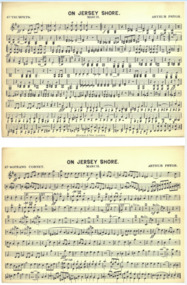 Royal Australian Air Force Band
March Card, Arthur Pryor (Composer), On Jersey Shore, Composed: 1907
... On envelope: QM146, On Jersey Shore Pryor, Q124, 291 (Scrubbed out) Stamped on the reverse of each card: Australian Broadcasting Commission *Sydney*, The Property of Musical Director & Arranger Charles Godfrey...Brass Band Australian Broadcasting Commission Marching Band Concert Band On envelope: QM146, On Jersey Shore Pryor, Q124, 291 (Scrubbed out) Stamped on the reverse of each card: Australian Broadcasting Commission *Sydney*, The Property of Musical Director & Arranger Charles Godfrey 34 parts concert band instrumentation Quick March Key Signature: Bb Major Instrumentation: Solo Bb Cornet (with Conductor pencilled) Eb Flute & Piccolo Oboes Eb Clarinets 1st Bb Clarinet 2nd Bb Clarinet 3rd & 4th Bb Clarinets 1st Bassoon 2nd Bassoon Eb Alto Saxophone Bb Tenor Saxophone Solo Eb Saxhorn 1st Eb Horn 2nd Eb Horn 3rd Eb Horn 4th Eb Horn Eb Trumpets Eb Soprano Cornet 1st Bb Cornet 2nd Bb Cornet 3rd & 4th Bb Cornets 1st Trombone (Tenor Clef) 2nd Trombone (Tenor Clef) 1st Trombone (Bass Clef) 2nd Trombone (Bass Clef) Bass Trombone 1st Bb Baritone 2nd Bb Baritone Bb Euphonium (Treble Clef) Euphonium Bombardon Bb Bass (Treble Clef) Side Drum Bass Drum On Jersey Shore March Card Arthur Pryor (Composer) Hawkes & Son, London ...In 1932 the call was put out to the ABC to start a military band. The band’s task was to record music to play on air four times a week, and to perform live concerts for the public. By November 1933 a band was put together with 40 musicians from around Australia. The band was initially conducted by Captain H. E. Adkins, Director of the Royal Military School of Music, Kneller Hall, London. After the tour, Adkins returned to his position at Kneller Hall, and Stephen Yorke, a retired bandmaster of the Gloucestershire Regiment, was brought out to Australia to become the permanent director and conductor of the band, which he did until the band closed in 1951. During the band’s 17 year history they presented a sizable program of music. Their final concert received a standing ovation from its audience of 1500, with a teary-eyed Yorke. 34 parts concert band instrumentation Quick March Key Signature: Bb Major Instrumentation: Solo Bb Cornet (with Conductor pencilled) Eb Flute & Piccolo Oboes Eb Clarinets 1st Bb Clarinet 2nd Bb Clarinet 3rd & 4th Bb Clarinets 1st Bassoon 2nd Bassoon Eb Alto Saxophone Bb Tenor Saxophone Solo Eb Saxhorn 1st Eb Horn 2nd Eb Horn 3rd Eb Horn 4th Eb Horn Eb Trumpets Eb Soprano Cornet 1st Bb Cornet 2nd Bb Cornet 3rd & 4th Bb Cornets 1st Trombone (Tenor Clef) 2nd Trombone (Tenor Clef) 1st Trombone (Bass Clef) 2nd Trombone (Bass Clef) Bass Trombone 1st Bb Baritone 2nd Bb Baritone Bb Euphonium (Treble Clef) Euphonium Bombardon Bb Bass (Treble Clef) Side Drum Bass DrumOn envelope: QM146, On Jersey Shore Pryor, Q124, 291 (Scrubbed out) Stamped on the reverse of each card: Australian Broadcasting Commission *Sydney*, The Property of Musical Director & Arranger Charles Godfreybrass band, australian broadcasting commission, marching band, concert band -
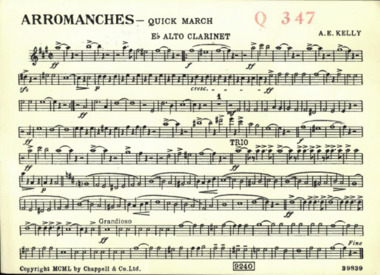 Royal Australian Air Force Band
March Card, Kelly, A. E. (Composer), Arromanches, Composed: 1950
... Stamped on the reverse of each card: Australian Broadcasting Commission *Sydney*, Property of Charles Godfrey Musical Director & Arranger, Music Library RAAF Central Band RAAF Base LAVERTON VIC 3027...Brass Band Australian Broadcasting Commission Marching Band Concert Band Stamped on the reverse of each card: Australian Broadcasting Commission *Sydney*, Property of Charles Godfrey Musical Director & Arranger, Music Library RAAF Central Band RAAF Base LAVERTON VIC 3027 29 Parts Concert Band Instrumentation Quick March Key Signature: C Major Band series number: 9240 / 39839 Instrumentation: Db Piccolo Concert Piccolo Oboe Eb Clarinet 1st Bb Clarinet 2nd Bb Clarinet 3rd Bb Clarinet Eb Alto Clarinet Bb Bass Clarinet 1st Bassoon 2nd Bassoon Bb Soprano Saxophone Eb Alto Saxophone Bb Tenor Saxophone Eb Baritone Saxophone Solo Bb Cornet (Conductor) 2nd Bb Cornet 1st Bb Trumpet 2nd Bb Trumpet 1st Horn in F 2nd Horn in F 3rd Horn in F 4th Horn in F 1st Trombone 2nd Trombone Bass Trombone Euphonium in treble (Baritone) Bass Drums Arromanches March Card Kelly, A. ...In 1932 the call was put out to the ABC to start a military band. The band’s task was to record music to play on air four times a week, and to perform live concerts for the public. By November 1933 a band was put together with 40 musicians from around Australia. The band was initially conducted by Captain H. E. Adkins, Director of the Royal Military School of Music, Kneller Hall, London. After the tour, Adkins returned to his position at Kneller Hall, and Stephen Yorke, a retired bandmaster of the Gloucestershire Regiment, was brought out to Australia to become the permanent director and conductor of the band, which he did until the band closed in 1951. During the band’s 17 year history they presented a sizable program of music. Their final concert received a standing ovation from its audience of 1500, with a teary-eyed Yorke. 29 Parts Concert Band Instrumentation Quick March Key Signature: C Major Band series number: 9240 / 39839 Instrumentation: Db Piccolo Concert Piccolo Oboe Eb Clarinet 1st Bb Clarinet 2nd Bb Clarinet 3rd Bb Clarinet Eb Alto Clarinet Bb Bass Clarinet 1st Bassoon 2nd Bassoon Bb Soprano Saxophone Eb Alto Saxophone Bb Tenor Saxophone Eb Baritone Saxophone Solo Bb Cornet (Conductor) 2nd Bb Cornet 1st Bb Trumpet 2nd Bb Trumpet 1st Horn in F 2nd Horn in F 3rd Horn in F 4th Horn in F 1st Trombone 2nd Trombone Bass Trombone Euphonium in treble (Baritone) Bass DrumsStamped on the reverse of each card: Australian Broadcasting Commission *Sydney*, Property of Charles Godfrey Musical Director & Arranger, Music Library RAAF Central Band RAAF Base LAVERTON VIC 3027brass band, australian broadcasting commission, marching band, concert band -
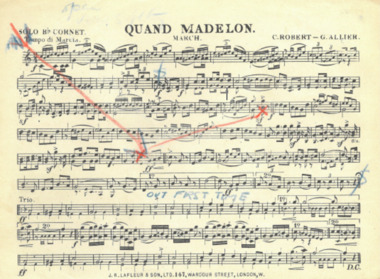 Royal Australian Air Force Band
March Card, Robert, Camille (Composer) et al, Quand Madelon March, Composed: 1914
... . & The Property of Musical Director & Arranger Charles Godfrey.... & The Property of Musical Director & Arranger Charles Godfrey 27 parts Concert Band Instrumentation Quick March Key Signature: Bb Major Instrumentation: Eb Piccolo Oboes Eb Clarinet 1st Bb Clarinet 2nd Bb Clarinet 3rd & 4th Bb Clarinet 1st Bassoon 2nd Bassoon 1st Alto in Eb Eb Alto Saxophone Bb Tenor Saxophone 1st & 2nd Cors in Eb 1st Eb Horn 2nd Eb Horn 3rd Eb Horn 4th Eb Horn Bb Bugle Solo Bb Cornet 2nd Bb Cornet 1st Trombone 2nd Trombone Bass Trombone 1st Bb Baritone Euphonium Bombardon Side Drum Bass Drum Quand Madelon March March Card Robert, Camille (Composer) Allier, Gabriel (Arranger) J.R. ...In 1932 the call was put out to the ABC to start a military band. The band’s task was to record music to play on air four times a week, and to perform live concerts for the public. By November 1933 a band was put together with 40 musicians from around Australia. The band was initially conducted by Captain H. E. Adkins, Director of the Royal Military School of Music, Kneller Hall, London. After the tour, Adkins returned to his position at Kneller Hall, and Stephen Yorke, a retired bandmaster of the Gloucestershire Regiment, was brought out to Australia to become the permanent director and conductor of the band, which he did until the band closed in 1951. During the band’s 17 year history they presented a sizable program of music. Their final concert received a standing ovation from its audience of 1500, with a teary-eyed Yorke. 27 parts Concert Band Instrumentation Quick March Key Signature: Bb Major Instrumentation: Eb Piccolo Oboes Eb Clarinet 1st Bb Clarinet 2nd Bb Clarinet 3rd & 4th Bb Clarinet 1st Bassoon 2nd Bassoon 1st Alto in Eb Eb Alto Saxophone Bb Tenor Saxophone 1st & 2nd Cors in Eb 1st Eb Horn 2nd Eb Horn 3rd Eb Horn 4th Eb Horn Bb Bugle Solo Bb Cornet 2nd Bb Cornet 1st Trombone 2nd Trombone Bass Trombone 1st Bb Baritone Euphonium Bombardon Side Drum Bass DrumOn envelope: Qm163, Quand Madelon (Revised Ed.) Q250 15 Apr 1940 Stamped on the reverse of 1st Alto only: Australian Broadcasting Co. & The Property of Musical Director & Arranger Charles Godfreybrass band, australian broadcasting commission, marching band, concert band -
 Royal Australian Air Force Band
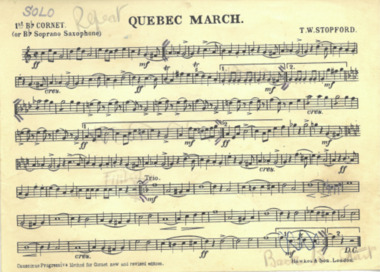
March Card, Stopford, T. W. (Composer), Quebec March, Composed:1927
... . & The Property of Musical Director & Arranger Charles Godfrey.... & The Property of Musical Director & Arranger Charles Godfrey 22 parts Concert Band Instrumentation Quick March Key Signature: Bb Major Instrumentation: Solo Bb Cornet (handwritten 'Conductor') Eb Flute & Piccolo Oboes Eb Clarinet 1st Bb Clarinet 2nd Bb Clarinet 3rd & 4th Bb Clarinets 1st Bassoon 2nd Bassoon (Handwritten) Solo Eb Saxhorn (or Eb Alto Saxophone) 1st Eb Horn 2nd Eb Horn 3rd Eb Horn 1st Bb Cornet (or Bb Soprano Saxophone) 2nd Bb Cornet 1st Trombone 2nd Trombone Bass Trombone Euphonium (Baritone) Bombardon (Tuba) Side Drum Bass Drum Quebec March March Card Stopford, T. ...In 1932 the call was put out to the ABC to start a military band. The band’s task was to record music to play on air four times a week, and to perform live concerts for the public. By November 1933 a band was put together with 40 musicians from around Australia. The band was initially conducted by Captain H. E. Adkins, Director of the Royal Military School of Music, Kneller Hall, London. After the tour, Adkins returned to his position at Kneller Hall, and Stephen Yorke, a retired bandmaster of the Gloucestershire Regiment, was brought out to Australia to become the permanent director and conductor of the band, which he did until the band closed in 1951. During the band’s 17 year history they presented a sizable program of music. Their final concert received a standing ovation from its audience of 1500, with a teary-eyed Yorke. 22 parts Concert Band Instrumentation Quick March Key Signature: Bb Major Instrumentation: Solo Bb Cornet (handwritten 'Conductor') Eb Flute & Piccolo Oboes Eb Clarinet 1st Bb Clarinet 2nd Bb Clarinet 3rd & 4th Bb Clarinets 1st Bassoon 2nd Bassoon (Handwritten) Solo Eb Saxhorn (or Eb Alto Saxophone) 1st Eb Horn 2nd Eb Horn 3rd Eb Horn 1st Bb Cornet (or Bb Soprano Saxophone) 2nd Bb Cornet 1st Trombone 2nd Trombone Bass Trombone Euphonium (Baritone) Bombardon (Tuba) Side Drum Bass DrumOn envelope: QM164, March Quebec Stopford, Q213, Scrubbed out 378 6 Nov 1940 Stamped on the reverse of each card: Australian Broadcasting Co. & The Property of Musical Director & Arranger Charles Godfreybrass band, australian broadcasting commission, marching band, concert band -
 Royal Australian Air Force Band
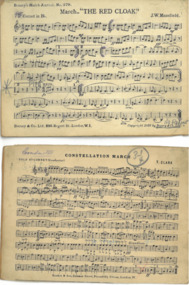
March Card, Clark, Thomas (Composer) et al, Constellation March & Red Cloak, Composed: 1930 / 1925
... . & The Property of Musical Director & Arranger Charles Godfrey.... & The Property of Musical Director & Arranger Charles Godfrey This is a double sided set pasted onto backing card, with The Constellation March on one side, and Red Cloak on the other. ...In 1932 the call was put out to the ABC to start a military band. The band’s task was to record music to play on air four times a week, and to perform live concerts for the public. By November 1933 a band was put together with 40 musicians from around Australia. The band was initially conducted by Captain H. E. Adkins, Director of the Royal Military School of Music, Kneller Hall, London. After the tour, Adkins returned to his position at Kneller Hall, and Stephen Yorke, a retired bandmaster of the Gloucestershire Regiment, was brought out to Australia to become the permanent director and conductor of the band, which he did until the band closed in 1951. During the band’s 17 year history they presented a sizable program of music. Their final concert received a standing ovation from its audience of 1500, with a teary-eyed Yorke. This is a double sided set pasted onto backing card, with The Constellation March on one side, and Red Cloak on the other. Some parts are separate and included in separate files above. 25 / 28 parts Concert Band Instrumentation Quick March Key Signature: Db Major / Eb Major Instrumentation: Solo Bb Cornet (Conductor) / Solo Cornet in Bb Piccolo / Concert Flute & Piccolo Oboe / Oboe Eb Clarinets / Clarinet in Eb 1st Bb Clarinet / Solo Clarinet in Bb 2nd Bb Clarinet / 2nd Clarinet in Bb 3rd & 4th Bb Clarinet / 3rd Clarinet in Bb 1st Bassoon / 1st Bassoon 2nd Bassoon / 2nd Bassoon Eb Alto Saxophone / Alto Saxophone in Eb 1st Eb Horn / 1st & 2nd Horns in Eb 2nd Eb Horn / 1st & 2nd Horns in Eb 1st Bb Cornet / 1st Cornet in Bb 2nd Bb Cornet / 2nd Cornet in Bb 1st Trombone / 1st Trombone in Bb 2nd Trombone / 2nd Trombone in Bb Bass Trombone / Bass Trombone Euphonium / Euphonion (Bass clef) Bombardon / Basses Side Drum / Drums Constellation extra parts: 3rd Eb Horn or 1st Eb Saxhorn Solo Eb Saxhorn 1st Bb Baritone 2nd Bb Baritone Bass Drum Red Cloak missing parts: Ripieno Clarinet in Bb Flute & Piccolo in Eb Tenor Saxophone in Bb 3rd & 4th Horns in Eb On envelope: QM166, Red Cloak J.W. Mansfield, ...Stellation T. Clark, Q144 Stamped on the reverse of some of the loose march cards: Australian Broadcasting Co. & The Property of Musical Director & Arranger Charles Godfreybrass band, australian broadcasting commission, marching band, concert band -
 Royal Australian Air Force Band
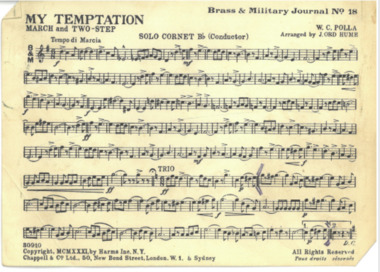
March Card, Polla, W. C. (Composer) et al, My Temptation, Composed: 1931
... . & The Property of Musical Director & Arranger Charles Godfrey.... & The Property of Musical Director & Arranger Charles Godfrey 24 parts Concert Band Instrumentation Quick March & Two Step Key Signature: F major Brass & Military Journal No. 18 Instrumentation: Solo Cornet Bb (Conductor) Piccolo Eb Oboe Eb Clarinet 1st Clarinet in Bb 2nd Clarinet in Bb 3rd Clarinet in Bb Bassoon Eb Alto Saxophone 1st Baritone Bb (and Tenor Saxophone Bb) 1st Horn Eb or Solo Tenor 2nd Horn Eb or 1st Tenor 3rd Horn Eb or 2nd Tenor 4th Horn Eb Repiano Cornet Bb 2nd Cornet Bb 1st Trombone 2nd Trombone Bass Trombone Euphonium (bass clef) Basses Contre Bass Bb Drums My Temptation March Card Polla, W. ...In 1932 the call was put out to the ABC to start a military band. The band’s task was to record music to play on air four times a week, and to perform live concerts for the public. By November 1933 a band was put together with 40 musicians from around Australia. The band was initially conducted by Captain H. E. Adkins, Director of the Royal Military School of Music, Kneller Hall, London. After the tour, Adkins returned to his position at Kneller Hall, and Stephen Yorke, a retired bandmaster of the Gloucestershire Regiment, was brought out to Australia to become the permanent director and conductor of the band, which he did until the band closed in 1951. During the band’s 17 year history they presented a sizable program of music. Their final concert received a standing ovation from its audience of 1500, with a teary-eyed Yorke. 24 parts Concert Band Instrumentation Quick March & Two Step Key Signature: F major Brass & Military Journal No. 18 Instrumentation: Solo Cornet Bb (Conductor) Piccolo Eb Oboe Eb Clarinet 1st Clarinet in Bb 2nd Clarinet in Bb 3rd Clarinet in Bb Bassoon Eb Alto Saxophone 1st Baritone Bb (and Tenor Saxophone Bb) 1st Horn Eb or Solo Tenor 2nd Horn Eb or 1st Tenor 3rd Horn Eb or 2nd Tenor 4th Horn Eb Repiano Cornet Bb 2nd Cornet Bb 1st Trombone 2nd Trombone Bass Trombone Euphonium (bass clef) Basses Contre Bass Bb Drums On envelope: QM136, March Two Step My Temptation Polla, Q114, Scrubbed out 375 Stamped on the reverse of each card: Australian Broadcasting Co. & The Property of Musical Director & Arranger Charles Godfreybrass band, australian broadcasting commission, marching band, concert band -
 Royal Australian Air Force Band
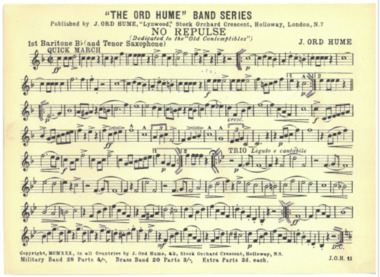
March Card, Hume, J. Ord (Composer), No Repulse, Composed: 1930
... On envelope: QM140, March No Re[pulse Ord Hume, Q120, scrubbed out 354 Stamped on the reverse of each card: Australian Broadcasting Commission *Sydney*, The Property of Musical Director & Arranger Charles Godfrey...Brass Band Australian Broadcasting Commission Marching Band Concert Band On envelope: QM140, March No Re[pulse Ord Hume, Q120, scrubbed out 354 Stamped on the reverse of each card: Australian Broadcasting Commission *Sydney*, The Property of Musical Director & Arranger Charles Godfrey 23 Parts Concert Band Instrumentation Quick March Key Signature: Eb Major "The Ord Hume" Band Series Dedicated to the "Old Contemptibles" Military Band 28 parts 4/-, Brass Band 20 Parts 3/-, Extra Parts 2d. each. ...In 1932 the call was put out to the ABC to start a military band. The band’s task was to record music to play on air four times a week, and to perform live concerts for the public. By November 1933 a band was put together with 40 musicians from around Australia. The band was initially conducted by Captain H. E. Adkins, Director of the Royal Military School of Music, Kneller Hall, London. After the tour, Adkins returned to his position at Kneller Hall, and Stephen Yorke, a retired bandmaster of the Gloucestershire Regiment, was brought out to Australia to become the permanent director and conductor of the band, which he did until the band closed in 1951. During the band’s 17 year history they presented a sizable program of music. Their final concert received a standing ovation from its audience of 1500, with a teary-eyed Yorke. 23 Parts Concert Band Instrumentation Quick March Key Signature: Eb Major "The Ord Hume" Band Series Dedicated to the "Old Contemptibles" Military Band 28 parts 4/-, Brass Band 20 Parts 3/-, Extra Parts 2d. each. Instrumentation: Solo Cornet Bb (Conductor written along the top) Piccolo Eb Oboe Clarinet Eb 1st Clarinet Bb 2nd Clarinet Bb 3rd Clarinets Bb Bassoon 2nd Bb Baritone Eb Soprano Cornet Alto Saophone 1st Baritone Bb (and Tenor Saxophone) 1st Eb Horn (or Solo Tenor) 2nd Eb Horn (Or 1st Tenor) 3rd Eb Horn (or 2nd Tenor) 4th Eb Horn Repiano Bb (Cornet written) Solo Bb Cornet 2nd Bb Cornet 1st Trombone (Tenor Clef) 2nd Trombone (Tenor Clef) Bass Trombone Euphonium (Bass Clef) Basses (Bass Clef) DrumsOn envelope: QM140, March No Re[pulse Ord Hume, Q120, scrubbed out 354 Stamped on the reverse of each card: Australian Broadcasting Commission *Sydney*, The Property of Musical Director & Arranger Charles Godfreybrass band, australian broadcasting commission, marching band, concert band -
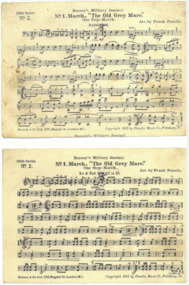 Royal Australian Air Force Band
March Card, Panella, Louis (Composer), The Old Grey Mare, Composed: 1915
... On envelope: QM142 ABC, The Old Grey Mare, Panella, Q130, 332 (Scrubbed out) Stamped on the reverse of each card: Australian Broadcasting Commission *Sydney*, The property of Musical Director & Arranger Charles Godfrey...Brass Band Australian Broadcasting Commission Marching Band Concert Band On envelope: QM142 ABC, The Old Grey Mare, Panella, Q130, 332 (Scrubbed out) Stamped on the reverse of each card: Australian Broadcasting Commission *Sydney*, The property of Musical Director & Arranger Charles Godfrey 11 Parts Incomplete Concert Band Instrumentation One Step-March Key Signature: F Major Boosey's Military Journal 155th Series No. 2 Instrumentation: Eb Clarinets Solo & Ripieno Clarinets in Bb Bassoons 1st & 2nd Horns in Eb 3rd & 4th Horns in Eb Ripieno Cornet in Bb 1st & 2nd Tenor Trombones Bass Trombone 1st Baritone in Bb Basses Drums The Old Grey Mare March Card Panella, Louis (Composer) Boosey & Co Ltd ...In 1932 the call was put out to the ABC to start a military band. The band’s task was to record music to play on air four times a week, and to perform live concerts for the public. By November 1933 a band was put together with 40 musicians from around Australia. The band was initially conducted by Captain H. E. Adkins, Director of the Royal Military School of Music, Kneller Hall, London. After the tour, Adkins returned to his position at Kneller Hall, and Stephen Yorke, a retired bandmaster of the Gloucestershire Regiment, was brought out to Australia to become the permanent director and conductor of the band, which he did until the band closed in 1951. During the band’s 17 year history they presented a sizable program of music. Their final concert received a standing ovation from its audience of 1500, with a teary-eyed Yorke. 11 Parts Incomplete Concert Band Instrumentation One Step-March Key Signature: F Major Boosey's Military Journal 155th Series No. 2 Instrumentation: Eb Clarinets Solo & Ripieno Clarinets in Bb Bassoons 1st & 2nd Horns in Eb 3rd & 4th Horns in Eb Ripieno Cornet in Bb 1st & 2nd Tenor Trombones Bass Trombone 1st Baritone in Bb Basses DrumsOn envelope: QM142 ABC, The Old Grey Mare, Panella, Q130, 332 (Scrubbed out) Stamped on the reverse of each card: Australian Broadcasting Commission *Sydney*, The property of Musical Director & Arranger Charles Godfreybrass band, australian broadcasting commission, marching band, concert band -
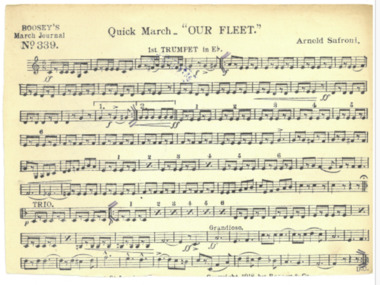 Royal Australian Air Force Band
March Card, Safroni, Arnold (Composer) et al, Our Fleet, Composed: 1918
... On envelope: QM153, Our Fleet Safroni, Q128, 322 (scrubbed out), 9 May 1940, 3 Mar 1941 Stamped on the reverse of each card: Australian Broadcasting Commission *Sydney*, The Property of Musical Director & Arranger Charles Godfrey...Brass Band Australian Broadcasting Commission Marching Band Concert Band On envelope: QM153, Our Fleet Safroni, Q128, 322 (scrubbed out), 9 May 1940, 3 Mar 1941 Stamped on the reverse of each card: Australian Broadcasting Commission *Sydney*, The Property of Musical Director & Arranger Charles Godfrey 23 parts concert band instrumentation Quick March Key Signature: Eb Major Boosey's March Journal No. 339 Instrumentation: st Clarinet in Bb (Conductor written along the top) Eb Flute & Piccolo Oboes 1st Clarinet in Eb 2nd Clarinet in Bb 3rd Clarinet in Bb 1st Bassoon 2nd Bassoon Alto Saxophone in Eb & Alto Clarinet in Eb 1st & 2nd Horns in Eb 3rd & 4th Horns in Eb 1st Trumpet in Eb 2nd Trumpet in Eb 1st Bb Cornet 2nd Bb Cornet 1st Tenor Trombone 2nd Tenor Trombone Bass Trombone 1st Baritone in Bb Euphonion Basses Contrabss in Bb (Treble Clef) Drums Our Fleet March Card Safroni, Arnold (Composer) Hume, J. ...In 1932 the call was put out to the ABC to start a military band. The band’s task was to record music to play on air four times a week, and to perform live concerts for the public. By November 1933 a band was put together with 40 musicians from around Australia. The band was initially conducted by Captain H. E. Adkins, Director of the Royal Military School of Music, Kneller Hall, London. After the tour, Adkins returned to his position at Kneller Hall, and Stephen Yorke, a retired bandmaster of the Gloucestershire Regiment, was brought out to Australia to become the permanent director and conductor of the band, which he did until the band closed in 1951. During the band’s 17 year history they presented a sizable program of music. Their final concert received a standing ovation from its audience of 1500, with a teary-eyed Yorke. 23 parts concert band instrumentation Quick March Key Signature: Eb Major Boosey's March Journal No. 339 Instrumentation: st Clarinet in Bb (Conductor written along the top) Eb Flute & Piccolo Oboes 1st Clarinet in Eb 2nd Clarinet in Bb 3rd Clarinet in Bb 1st Bassoon 2nd Bassoon Alto Saxophone in Eb & Alto Clarinet in Eb 1st & 2nd Horns in Eb 3rd & 4th Horns in Eb 1st Trumpet in Eb 2nd Trumpet in Eb 1st Bb Cornet 2nd Bb Cornet 1st Tenor Trombone 2nd Tenor Trombone Bass Trombone 1st Baritone in Bb Euphonion Basses Contrabss in Bb (Treble Clef) DrumsOn envelope: QM153, Our Fleet Safroni, Q128, 322 (scrubbed out), 9 May 1940, 3 Mar 1941 Stamped on the reverse of each card: Australian Broadcasting Commission *Sydney*, The Property of Musical Director & Arranger Charles Godfreybrass band, australian broadcasting commission, marching band, concert band -
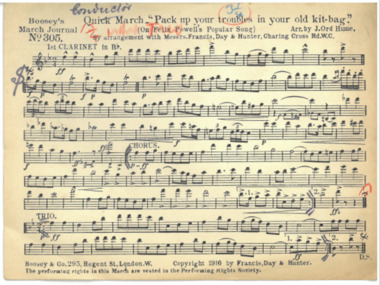 Royal Australian Air Force Band
March Card, Hume, J. Ord (Arranger) et al, Pack up your troubles in your old kitbag, Composed: 1916
... On envelope: QM154, Pack up your Troubles March Powell, Q216 2181 (Scrubbed out), 17 Aug 1940, 7 Dec 1940 Stamped on the reverse of each card: Australian Broadcasting Commission *Sydney*, The Property of Musical Director & Arranger Charles Godfrey...Brass Band Australian Broadcasting Commission Marching Band Concert Band On envelope: QM154, Pack up your Troubles March Powell, Q216 2181 (Scrubbed out), 17 Aug 1940, 7 Dec 1940 Stamped on the reverse of each card: Australian Broadcasting Commission *Sydney*, The Property of Musical Director & Arranger Charles Godfrey 23 parts concert band instrumentation Quick March Key Signature: Ab Major Boosey's March Journal No. 305 Instrumentation: 1st Clarinet in Bb (Conductor written along the top) Eb Flute & Piccolo Oboes 1st Clarinet in Eb 1st Clarinet in Bb 2nd Clarinet in Bb 3rd Clarinet in Bb 1st Bassoon 2nd Bassoon 1st Baritone in Bb Alto Saxophone in Eb & Alto Clarinet in Eb 1st & 2nd Horns in Eb 1st Cornet in Bb 2nd Cornet in Bb 1st Tenor Trombone 2nd Tenor Trombone Bass Trombone Basses Drums 3rd & 4th Horns in Eb Pack up your troubles in your old kitbag March Card Hume, J. ...In 1932 the call was put out to the ABC to start a military band. The band’s task was to record music to play on air four times a week, and to perform live concerts for the public. By November 1933 a band was put together with 40 musicians from around Australia. The band was initially conducted by Captain H. E. Adkins, Director of the Royal Military School of Music, Kneller Hall, London. After the tour, Adkins returned to his position at Kneller Hall, and Stephen Yorke, a retired bandmaster of the Gloucestershire Regiment, was brought out to Australia to become the permanent director and conductor of the band, which he did until the band closed in 1951. During the band’s 17 year history they presented a sizable program of music. Their final concert received a standing ovation from its audience of 1500, with a teary-eyed Yorke. 23 parts concert band instrumentation Quick March Key Signature: Ab Major Boosey's March Journal No. 305 Instrumentation: 1st Clarinet in Bb (Conductor written along the top) Eb Flute & Piccolo Oboes 1st Clarinet in Eb 1st Clarinet in Bb 2nd Clarinet in Bb 3rd Clarinet in Bb 1st Bassoon 2nd Bassoon 1st Baritone in Bb Alto Saxophone in Eb & Alto Clarinet in Eb 1st & 2nd Horns in Eb 1st Cornet in Bb 2nd Cornet in Bb 1st Tenor Trombone 2nd Tenor Trombone Bass Trombone Basses Drums 3rd & 4th Horns in EbOn envelope: QM154, Pack up your Troubles March Powell, Q216 2181 (Scrubbed out), 17 Aug 1940, 7 Dec 1940 Stamped on the reverse of each card: Australian Broadcasting Commission *Sydney*, The Property of Musical Director & Arranger Charles Godfreybrass band, australian broadcasting commission, marching band, concert band -
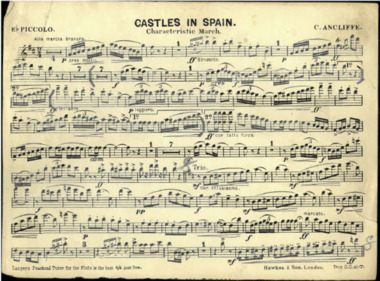 Royal Australian Air Force Band
March Card, Charles Ancliffe (composer), Castles in Spain, Composed: 1917
... Q26 (additional). 295 (crossed out) Stamped on the reverse of each card: Australian Broadcasting Co., The Property of Musical Director & Arranger...Q26 (additional). 295 (crossed out) Stamped on the reverse of each card: Australian Broadcasting Co., The Property of Musical Director & Arranger Concert Band & Brass Band Instrumentation Total 33 Parts Characteristic March Alla Marcia Bravura Key Signature:C minor Instrumentation: Eb Piccolo Oboes Eb Clarinet 1st Bb Clarinet 2nd Bb Clarinet 3rd & 4th Bb Clarinets 1st Bassoon 2nd Bassoon Solo Eb Saxhorn (Eb Alto) 1st Bb Baritone (Bb Tenor) Solo Bb Cornet 1st Bb Cornet 2nd Bb Cornet 3rd & 4th Bb Cornets Eb Trumpets 1st Eb Horn 2nd Eb Horn 3rd Eb Horn 4th Eb Horn 1st Trombone (Bass Clef) 1st Trombone (Tenor Clef) 2nd Trombone (Bass Clef) 2nd Trombone (Tenor Clef) Bass Trombone 2nd Bb Baritone (Bb Tenor) Euphonium (Baritone) Bombardon (Tuba) Eb Bombardon (Treble Clef) Bb Bass Side Drum Bass Drum Additional Hand Written 1st Bb Clarinet Castles in Spain March Card Charles Ancliffe (composer) Hawkes & Son, U.S.A. ...In 1932 the call was put out to the ABC to start a military band. The band’s task was to record music to play on air four times a week, and to perform live concerts for the public. By November 1933 a band was put together with 40 musicians from around Australia. The band was initially conducted by Captain H. E. Adkins, Director of the Royal Military School of Music, Kneller Hall, London. After the tour, Adkins returned to his position at Kneller Hall, and Stephen Yorke, a retired bandmaster of the Gloucestershire Regiment, was brought out to Australia to become the permanent director and conductor of the band, which he did until the band closed in 1951. During the band’s 17 year history they presented a sizable program of music. Their final concert received a standing ovation from its audience of 1500, with a teary-eyed Yorke. Concert Band & Brass Band Instrumentation Total 33 Parts Characteristic March Alla Marcia Bravura Key Signature:C minor Instrumentation: Eb Piccolo Oboes Eb Clarinet 1st Bb Clarinet 2nd Bb Clarinet 3rd & 4th Bb Clarinets 1st Bassoon 2nd Bassoon Solo Eb Saxhorn (Eb Alto) 1st Bb Baritone (Bb Tenor) Solo Bb Cornet 1st Bb Cornet 2nd Bb Cornet 3rd & 4th Bb Cornets Eb Trumpets 1st Eb Horn 2nd Eb Horn 3rd Eb Horn 4th Eb Horn 1st Trombone (Bass Clef) 1st Trombone (Tenor Clef) 2nd Trombone (Bass Clef) 2nd Trombone (Tenor Clef) Bass Trombone 2nd Bb Baritone (Bb Tenor) Euphonium (Baritone) Bombardon (Tuba) Eb Bombardon (Treble Clef) Bb Bass Side Drum Bass Drum Additional Hand Written 1st Bb ClarinetOn envelope: QM30. Castles in Spain. Ancliffe. Stamps indicating 30 OCT 1940, 30 NOV 1940, 23 APR 1941, 17 JAN 1944. Q26 (additional). 295 (crossed out) Stamped on the reverse of each card: Australian Broadcasting Co., The Property of Musical Director & Arrangerbrass band, australian broadcasting commission, marching band, concert band -
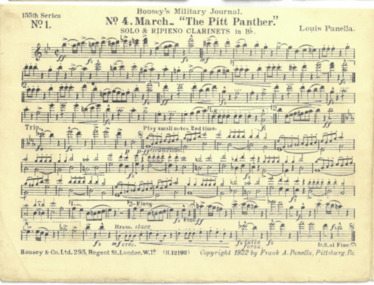 Royal Australian Air Force Band
March Card, Panella, Louis (Composer), No. 4 March "The Pitt Panther", Composed: 1922
... On first envelope: Scrubbed out markings - V10, Dreamy Melody Waltz On second envelope: The Pitt Panther Panella, QM 157, Q36, Scrubbed out: 293 Stamped on the reverse of each card in the second set: Australian Broadcasting Commission *Sydney*, Property of Charles Godfrey Musical Director & Arranger...Brass Band Australian Broadcasting Commission Marching Band Concert Band On first envelope: Scrubbed out markings - V10, Dreamy Melody Waltz On second envelope: The Pitt Panther Panella, QM 157, Q36, Scrubbed out: 293 Stamped on the reverse of each card in the second set: Australian Broadcasting Commission *Sydney*, Property of Charles Godfrey Musical Director & Arranger 18 Parts Concert Band Instrumentation, Quick March Key Signature: A flat Major 155th Series No. 1 Boosey's Military Journal Band series number: H.12192 Instrumentation: Eb Flute & Piccolo Oboes Eb Clarinets Solo & Ripieno Clarinets in Bb 2nd & 3rd Clarinets in Bb Bassoons Alto Saxophone & Alto Clarinet in Eb Tenor Saxophone in Bb 1st & 2nd Horns in Eb 3rd & 4th Horns in Eb Ripieno Cornet in Bb 1st Cornet in Bb 2nd Cornet in Bb 1st Baritone in Bb 1st & 2nd Trombones Bass Trombone Euphonion Basses Drums No. 4 March "The Pitt Panther" March Card Panella, Louis (Composer) Boosey & Co Ltd ...In 1932 the call was put out to the ABC to start a military band. The band’s task was to record music to play on air four times a week, and to perform live concerts for the public. By November 1933 a band was put together with 40 musicians from around Australia. The band was initially conducted by Captain H. E. Adkins, Director of the Royal Military School of Music, Kneller Hall, London. After the tour, Adkins returned to his position at Kneller Hall, and Stephen Yorke, a retired bandmaster of the Gloucestershire Regiment, was brought out to Australia to become the permanent director and conductor of the band, which he did until the band closed in 1951. During the band’s 17 year history they presented a sizable program of music. Their final concert received a standing ovation from its audience of 1500, with a teary-eyed Yorke. 18 Parts Concert Band Instrumentation, Quick March Key Signature: A flat Major 155th Series No. 1 Boosey's Military Journal Band series number: H.12192 Instrumentation: Eb Flute & Piccolo Oboes Eb Clarinets Solo & Ripieno Clarinets in Bb 2nd & 3rd Clarinets in Bb Bassoons Alto Saxophone & Alto Clarinet in Eb Tenor Saxophone in Bb 1st & 2nd Horns in Eb 3rd & 4th Horns in Eb Ripieno Cornet in Bb 1st Cornet in Bb 2nd Cornet in Bb 1st Baritone in Bb 1st & 2nd Trombones Bass Trombone Euphonion Basses DrumsOn first envelope: Scrubbed out markings - V10, Dreamy Melody Waltz On second envelope: The Pitt Panther Panella, QM 157, Q36, Scrubbed out: 293 Stamped on the reverse of each card in the second set: Australian Broadcasting Commission *Sydney*, Property of Charles Godfrey Musical Director & Arrangerbrass band, australian broadcasting commission, marching band, concert band -
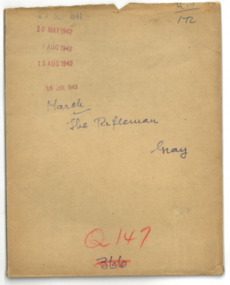 Royal Australian Air Force Band
March Card, Gray, T. (Composer), The Rifleman, Composed: ?
... . & The Property of Musical Director & Arranger Charles Godfrey.... & The Property of Musical Director & Arranger Charles Godfrey 25 parts Concert Band Instrumentation Quick March Key Signature: Ab Major Instrumentation: Solo Bb Cornet (Conductor handwritten at top) Eb Flute & Piccolo Oboes Eb Clarinet 1st Bb Clarinet 2nd Bb Clarinet 3rd & 4th Bb Clarinets 1st Bassoon 2nd Bassoon Solo Eb Saxhorn (or Eb Alto Saxophone) 1st Bb Baritone ( or Bb Tenor Saxophone) 1st Eb Horn 2nd Eb Horn 3rd Eb Horn 4th Eb Horn Eb Trumpets Solo Bb Cornet 1st Bb Cornet (or Bb Soprano Saxophone) 2nd Bb Cornet 1st Trombone 2nd Trombone Bass Trombone Euphonium (Baritone) Bombardon (Tuba) Side Drum Bass Drum The Rifleman March Card Gray, T. ...In 1932 the call was put out to the ABC to start a military band. The band’s task was to record music to play on air four times a week, and to perform live concerts for the public. By November 1933 a band was put together with 40 musicians from around Australia. The band was initially conducted by Captain H. E. Adkins, Director of the Royal Military School of Music, Kneller Hall, London. After the tour, Adkins returned to his position at Kneller Hall, and Stephen Yorke, a retired bandmaster of the Gloucestershire Regiment, was brought out to Australia to become the permanent director and conductor of the band, which he did until the band closed in 1951. During the band’s 17 year history they presented a sizable program of music. Their final concert received a standing ovation from its audience of 1500, with a teary-eyed Yorke. 25 parts Concert Band Instrumentation Quick March Key Signature: Ab Major Instrumentation: Solo Bb Cornet (Conductor handwritten at top) Eb Flute & Piccolo Oboes Eb Clarinet 1st Bb Clarinet 2nd Bb Clarinet 3rd & 4th Bb Clarinets 1st Bassoon 2nd Bassoon Solo Eb Saxhorn (or Eb Alto Saxophone) 1st Bb Baritone ( or Bb Tenor Saxophone) 1st Eb Horn 2nd Eb Horn 3rd Eb Horn 4th Eb Horn Eb Trumpets Solo Bb Cornet 1st Bb Cornet (or Bb Soprano Saxophone) 2nd Bb Cornet 1st Trombone 2nd Trombone Bass Trombone Euphonium (Baritone) Bombardon (Tuba) Side Drum Bass DrumOn envelope: Qm172, March The Rifleman Gray, Q147, Scrubbed out 366 29 Sep 1941, 18 May 1942, 3 Aug 1942, 15 Aug 1942, 16 Jul 1943 Stamped on the reverse of each card: Australian Broadcasting Co. & The Property of Musical Director & Arranger Charles Godfreybrass band, australian broadcasting commission, marching band, concert band -
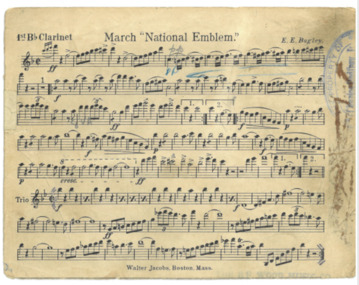 Royal Australian Air Force Band
March Card, Bagley, E. E. (Composer), March "National Emblem", Composed: 1906
... . & The Property of Musical Director & Arranger Charles Godfrey.... & The Property of Musical Director & Arranger Charles Godfrey 20 parts Concert Band Instrumentation Quick March Key Signature: Eb Major Instrumentation: Solo or 1st Bb Cornet (Conductor handwritten at the top) Piccolo (Db handwritten) Eb Clarinet 1st Bb Clarinet 2nd Bb Clarinet 3rd Bb Clarinet Bassoon 1st & 2nd Eb Altos (crossed out and Horns) 3rd & 4th Eb Altos Eb Cornet 1st Bb Cornet (solo scrubbed out) 2nd & 3rd Bb Cornets 1st & 2nd Trombones 3rd Trombone 1st & 2nd Trombones (Treble Clef) 3rd Trombone (Treble Clef) Baritone (scrubbed out and written Euphonium) Baritone (treble clef) March "National Emblem" March Card Bagley, E. ...In 1932 the call was put out to the ABC to start a military band. The band’s task was to record music to play on air four times a week, and to perform live concerts for the public. By November 1933 a band was put together with 40 musicians from around Australia. The band was initially conducted by Captain H. E. Adkins, Director of the Royal Military School of Music, Kneller Hall, London. After the tour, Adkins returned to his position at Kneller Hall, and Stephen Yorke, a retired bandmaster of the Gloucestershire Regiment, was brought out to Australia to become the permanent director and conductor of the band, which he did until the band closed in 1951. During the band’s 17 year history they presented a sizable program of music. Their final concert received a standing ovation from its audience of 1500, with a teary-eyed Yorke. 20 parts Concert Band Instrumentation Quick March Key Signature: Eb Major Instrumentation: Solo or 1st Bb Cornet (Conductor handwritten at the top) Piccolo (Db handwritten) Eb Clarinet 1st Bb Clarinet 2nd Bb Clarinet 3rd Bb Clarinet Bassoon 1st & 2nd Eb Altos (crossed out and Horns) 3rd & 4th Eb Altos Eb Cornet 1st Bb Cornet (solo scrubbed out) 2nd & 3rd Bb Cornets 1st & 2nd Trombones 3rd Trombone 1st & 2nd Trombones (Treble Clef) 3rd Trombone (Treble Clef) Baritone (scrubbed out and written Euphonium) Baritone (treble clef) On envelope: QM137, March National Emblem Bagley, Q122, scrubbed out 396 4 Apr 1940, 8 Sep 1941, 14 Apr 1942, 27 Oct 1942 (twice), 15 Nov 1943 Stamped on the reverse of each card: Australian Broadcasting Co. & The Property of Musical Director & Arranger Charles Godfreybrass band, australian broadcasting commission, marching band, concert band -
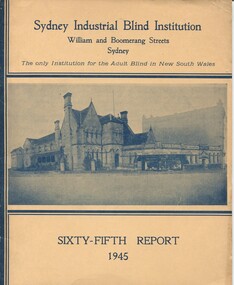 Vision Australia
Administrative record - Text, Sydney Industrial Blind Institution: Sixty-Fifth Report 1945, 1946
... Harris for their work and contribution to the success of the NSW War Blinded Welfare Committee, the response to a letter sent to the incoming Governor-General (the Duke of Gloucester), the compilation of a register of Blind Citizens of NSW, disappointment at not being able to improve or enlarge the property at Woollahra due to unsuccessful requests to the Commonwealth Government, the resignation of Matron Beaver after 8 years at the Haven due to ill health and the appointment of Matron McSwan to the position, continued success of workers in outside employment with only 4 people returning to the Institution, thanks to C H Martin for volunteering to assist in the placement of workers in outside industries, musicales were arranged in the library by Peggy Dunbar and Harold Williams, both a shortage of materials and a power strike has caused the workshop to shut down and workers to be sent home, the manufacture of Ship Fenders was added to our trades with orders from the Royal Australian Navy, Gordon Lavers is undertaking musical instruction at The Haven with two students Sylvia Barnett and Dorothy Falkiner progressing well, the 'Glow Worm' sessions, seeking advice of architects to modernise the William St building, the withdrawal of Ernest Scott as President but continuance on the committee, the appointment of Justice Maxwell as President and the retirement of City Collector W.H. ...Harris for their work and contribution to the success of the NSW War Blinded Welfare Committee, the response to a letter sent to the incoming Governor-General (the Duke of Gloucester), the compilation of a register of Blind Citizens of NSW, disappointment at not being able to improve or enlarge the property at Woollahra due to unsuccessful requests to the Commonwealth Government, the resignation of Matron Beaver after 8 years at the Haven due to ill health and the appointment of Matron McSwan to the position, continued success of workers in outside employment with only 4 people returning to the Institution, thanks to C H Martin for volunteering to assist in the placement of workers in outside industries, musicales were arranged in the library by Peggy Dunbar and Harold Williams, both a shortage of materials and a power strike has caused the workshop to shut down and workers to be sent home, the manufacture of Ship Fenders was added to our trades with orders from the Royal Australian Navy, Gordon Lavers is undertaking musical instruction at The Haven with two students Sylvia Barnett and Dorothy Falkiner progressing well, the 'Glow Worm' sessions, seeking advice of architects to modernise the William St building, the withdrawal of Ernest Scott as President but continuance on the committee, the appointment of Justice Maxwell as President and the retirement of City Collector W.H. ...Articles in the annual report include: praise for Roy Kippax and A.J. Harris for their work and contribution to the success of the NSW War Blinded Welfare Committee, the response to a letter sent to the incoming Governor-General (the Duke of Gloucester), the compilation of a register of Blind Citizens of NSW, disappointment at not being able to improve or enlarge the property at Woollahra due to unsuccessful requests to the Commonwealth Government, the resignation of Matron Beaver after 8 years at the Haven due to ill health and the appointment of Matron McSwan to the position, continued success of workers in outside employment with only 4 people returning to the Institution, thanks to C H Martin for volunteering to assist in the placement of workers in outside industries, musicales were arranged in the library by Peggy Dunbar and Harold Williams, both a shortage of materials and a power strike has caused the workshop to shut down and workers to be sent home, the manufacture of Ship Fenders was added to our trades with orders from the Royal Australian Navy, Gordon Lavers is undertaking musical instruction at The Haven with two students Sylvia Barnett and Dorothy Falkiner progressing well, the 'Glow Worm' sessions, seeking advice of architects to modernise the William St building, the withdrawal of Ernest Scott as President but continuance on the committee, the appointment of Justice Maxwell as President and the retirement of City Collector W.H. Tuckwell who has worked for the Institution for 53 years.1 printed volume with black and white illustrationssydney industrial blind institution, annual report, roy kippax, a.j. harris, helen keller hostel, emily beaver, ch martin, peggy dunbar, harold williams, employment, sylvia barnett, dorothy falkiner, goodie reeve, 2gb, buildings, ernest scott, justice maxwell, wh tuckwell, auxiliaries -
 Flagstaff Hill Maritime Museum and Village
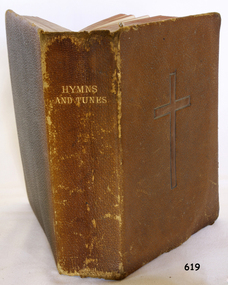
Book - Religious Book, William Clowes & Sons, Limited, Hymns Ancient and Modern, bef. Sept 8th 1884
... Spine: "HYMNS AND TUNES" Front cover: symbol [cross] Fly Page: "HYMNS ANCIENT AND MODERN FOR USE IN THE SERVICES OF THE CHURCH WITH ACCOMPANYING TUNES COMPILED AND ARRANGED UNDER THE MUSICAL EDITORSHIP OF WILLIAM HENRY MONK, PROFESSOR OF VOCAL MUSIC IN KING'S COLLEGE, LONDON." , "Revised and Enlarged Edition", "Young men and maidens, old men and children, praise the Name of the LORD" Inside cover in handwriting: "Nefrea (?...Flagstaff Hill Maritime Museum and Village Flagstaff Hill Warrnambool Maritime Museum Maritime Village Shipwreck Coast Great Ocean Road Religion Religious service St Nicholas Seamen’s Church Williamstown Missions to Seamen Victoria worship service worship music hymn book music book William Clowes and Sons St Nicholas Seamen's Church London Hymns Ancient and Modern Revised and Enlarged edition 1884 Spine: "HYMNS AND TUNES" Front cover: symbol [cross] Fly Page: "HYMNS ANCIENT AND MODERN FOR USE IN THE SERVICES OF THE CHURCH WITH ACCOMPANYING TUNES COMPILED AND ARRANGED UNDER THE MUSICAL EDITORSHIP OF WILLIAM HENRY MONK, PROFESSOR OF VOCAL MUSIC IN KING'S COLLEGE, LONDON." , "Revised and Enlarged Edition", "Young men and maidens, old men and children, praise the Name of the LORD" Inside cover in handwriting: "Nefrea (? ...The brown leather-covered bound book has an embossed inscription on the spine and an impressed cross symbol on the front cover. It has red leaf pages (681 pages). The music and words were compiled and arranged by editor William Henry Monk, and published in London. This Revised and Enlarged edition was printed in London by William Clowes & Sons Ltd. The book's title is "Hymns Ancient and Modern". The inscription shows it was given as a gift in 1884. It has since been added to our St Nicholas Seamen's Church Collection. flagstaff hill maritime museum and village, flagstaff hill, warrnambool, maritime museum, maritime village, shipwreck coast, great ocean road, religion, religious service, st nicholas seamen’s church, williamstown, missions to seamen victoria, worship service, worship music, hymn book, music book, william clowes and sons, st nicholas seamen's church, london, hymns ancient and modern, revised and enlarged edition, 1884 -
 Royal Melbourne Yacht Squadron
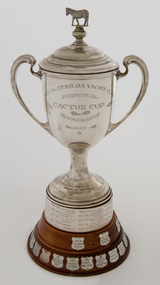
Award - Cactus Cup
... The next contest was April 12, 1930, for another small trophy also donated by Jim Thorpe, and the crew of the winning yacht Petrel, skippered by Stan Gamble, later on having to arrange for a mussel supper to the extent of Trophy money at an informal musical evening held in the spar room. ...The next contest was April 12, 1930, for another small trophy also donated by Jim Thorpe, and the crew of the winning yacht Petrel, skippered by Stan Gamble, later on having to arrange for a mussel supper to the extent of Trophy money at an informal musical evening held in the spar room. ...“The Squadron’s Most Prestigious Trophy” THE CACTUS STORY Years ago a story was told of a Donkey which lived in the desert. The standard of living was poor, and the main course on the menu when things were tough was cactus. The Donkey accepted the good with the bad, and in bad seasons it was always cactus. One day during his wanderings he came to a high fence. On the other side of the fence was lush grass and all sorts of vegetation and animals in prime condition. The Donkey said to a horse, “things look good in there, how does one get in”. The horse said “go down to the end of this fence, and you will come to a gate, there will be someone at the get, ask to get in”. The Donkey went to the end of the fence, found the gate and asked to get in. The horse at the gate said, “what do you want to come in for, all of us are geldings?”. The Donkey said “if that is the case, it is back to the cactus for me”. It was during the early stages of the great depression of 1929-1932, that this story was simulated to the conditions at the then Royal St. Kilda Yacht Club, when during the yachting season there were very few trophies due to the lack of money. A lot of members were out of work, and each Monday many would front up for the jobs that were offering or those who missed out went back to the dole or as many put it “Back to the Cactus”. The “Cactus Cup” race, to be free of entrance fees, was an idea conceived by H.A. (Toby) Armstrong, soon to be backed by Bert Bryant, Ivor Bowles and Jim Thorpe. It was First sailed March 25, 1922, when 9 yachts on sealed handicaps, raced over a 5 mile rectangular course for a small Trophy donated by Jim E. Thorpe and the winning crew of the yacht Helen, skippered by D.Dowse, entertained at a café after the race by the instigators of the race. The next contest was April 12, 1930, for another small trophy also donated by Jim Thorpe, and the crew of the winning yacht Petrel, skippered by Stan Gamble, later on having to arrange for a mussel supper to the extent of Trophy money at an informal musical evening held in the spar room. From then on races for the Cactus Cup became an annual event. In time the format was changed to result in the crew of the first winning yacht having to collect mussels from the pier on the first Saturday of July, cook and prepare them for a no charge informal supper and entertainment evening held in the spar room, towards which the Club provided a keg of Beer. Member Bob Ellis had a special song for the occasion, “Up at Tumba Bloody Rumba shooting Kanga Bloody Roos”. Jim Thorpe then agreed to purchase a Perpetual Cup to be named the Cactus Cup. As guest of honor at the Cactus Supper Evening, May 1940, a dinner suit function in the Spar room, he presented the Cup along with Replica to Barney Snider who won with Eun-Na-Mara. Soon entries became few, for reason nobody wanted to win because of the penalty of having to collect, cook and prepare the mussels. In the interest of the contest and its revival, it was decided that the crew of the last yacht to finish had to collect, cook and prepare the mussels. On the death of Jim E Thorpe in 1944, the trophy, along with its annual replicas, were then provided for by Ivor Bowles until his death in 1970. In time for reason of pollution, the collecting of mussels from the pier was discontinued, so Otto Meik the new provider decided that the format be changed and be replaced by a supper on the day of the race, consisting of bottle mussels, beer and frankfurts. Following the death of Otto Meik in 1979, with no provider for the trophy of replicas, the Squadron in the early 80’s broke tradition by introducing race entry fees. In 2006 the Cactus Cup Tradition was reinstituted by a donation from J.H. (Bert) Ferris – RMYS historian. The Cactus Cup is now free to enter once again for all. The race is run early and a late afternoon feast of mussels and frankfurts is eaten afterwards.Deep sectioned Silver Cup, 300mm high to lip, tapering to thick plain stem flaring out to stepped footing, has two shaped handles. Silver Lid with Donkey positioned on shaped dome. Overall height 110mm. Cup stands on 145mm high round black base with stepped footing, surrounded with Silver winner inscription band.ROYAL ST. KILDA YACHT CLUB PERPETUAL CACTUS CUP INAUGURATED 1922 INSTIGATED BY H.A. ARMSTRONG ESQ. ORIGINAL CUP PRESENTED BY J.E. THORPE ESQ.cactus cup, trophy -
 Federation University Historical Collection
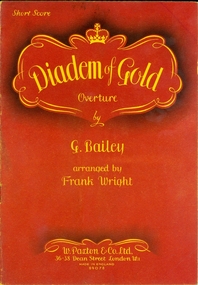
Programme - Music Score, W. Paxton & Co Ltd, Diadem of Gold Overture by G. Bailey and arranged by Frank Wright, mid 1900s
... The Frank Wright Medal at the Royal South Street competition is awarded to an individual recognized as making an outstanding contribution to brass music in Australia. frank wright g bailey diadem of gold overture musical score A 14 page booklet with a red and gold cover, containing the 'Short Score' of the 'Diadem of Gold Overture' written by G Bailey and arranged by Frank Wright. ...Frank Wright was a renown resident of Smeaton, where he was born in 1901. He lived at Laura Villa, and attended Smeaton State School. His father William was a gold miner and his mother's name was Sarah. He was the youngest of eleven children. Their family won many singing and instrumental awards. Frank was tutored by Percy Code and was awarded a gold medal for the highest marks in the ALCM examinations in the British Colonies at the age of seventeen years. He became the Australian Open Cornet Champion by the age of eighteen. A year later, Frank conducted the City of Ballarat Band, and later the Ballarat Soldiers’ Memorial Band. He formed the Frank Wright Frisco Band and Frank Wright and his Coliseum Orchestra. These bands won many South Street awards, and Frank as conductor won many awards in the Australian Band Championship contest. In 1933 Frank Wright sailed to England to conduct the famous St Hilda’s Band and was appointed in 1934 as the Musical Director of the London County Council (the GLC or Greater London Council), where he organized many amazing concerts in most of the 150 parks, in and around the London district. He was also responsible for some of London’s major concerts at Kenwood, the Crystal Palace and Holland Park. He was made Professor of Brass and Military Band Scoring and Conducting and was a Fellow of the Guildhall School of Music and Drama. Frank was often invited to adjudicate Brass Band Championships around Europe, in Australia, including South Street and in New Zealand. Frank was awarded an M.B.E. in 1967 and he died in November 1970. The Frank Wright Medal at the Royal South Street competition is awarded to an individual recognized as making an outstanding contribution to brass music in Australia.A 14 page booklet with a red and gold cover, containing the 'Short Score' of the 'Diadem of Gold Overture' written by G Bailey and arranged by Frank Wright. The score was written for brass bands and on the inside front cover is a printed note written by Frank to the musicians on how to play the new features in the music. frank wright, g bailey, diadem of gold overture, musical score -
 Glen Eira Historical Society
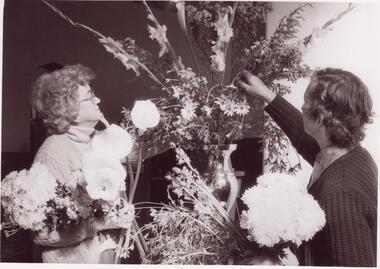
Ephemera - Christ Church, Ormond (Anglican)
... Includes divisions for entry and prizes to be won, entry details and regulations. 2/Photograph of two parishioners arranging flowers for Flowers and Musical Festival, September 1984. ...Includes divisions for entry and prizes to be won, entry details and regulations. 2/Photograph of two parishioners arranging flowers for Flowers and Musical Festival, September 1984. ...Two items relating to special events at Christ Church, Ormond (Anglican): 1/Notice about a Flower Show, held on 22 April 1936. Includes divisions for entry and prizes to be won, entry details and regulations. 2/Photograph of two parishioners arranging flowers for Flowers and Musical Festival, September 1984. Organ shown in background.ormond, autumn flower show, knowling w. d., christ church ormond, north road, adams d., anglican church, wheatley road, fife d., christ church of england ormond, flower & music festival, flower and music festival -
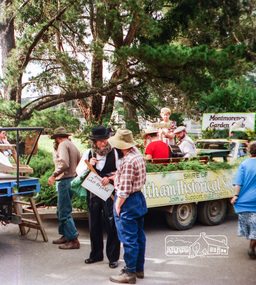 Eltham District Historical Society Inc
Photograph, Eltham Festival, 11 November 1989, 11/11/1989
... Phyllis Macdonald arranged for some of her friends from the Victorian Folk Music Club to provide appropriate musical accompaniment. ...Phyllis Macdonald arranged for some of her friends from the Victorian Folk Music Club to provide appropriate musical accompaniment. ...Society members preparing for the parade in Youth Road behind Eltham Railway Station, Eltham Festival, 11 November 1989. Bruce Ness assembled the float with items loaned by Warrandyte Historical Society and quite a bit of his own ingenuity. Phyllis Macdonald arranged for some of her friends from the Victorian Folk Music Club to provide appropriate musical accompaniment. To provide a level of authenticity, a present day prospector, Jack Hodson was placed in charge of the equipment on the float.Roll of 35mm colour negative film, 6 stripsFuji 100 Neltham, main road, eltham central park, eltham festival, parade, shire of eltham historical society, parade float -
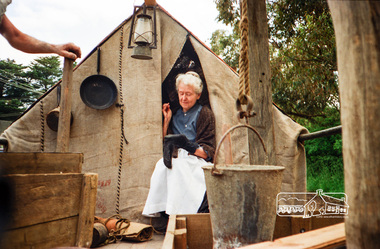 Eltham District Historical Society Inc
Photograph, Eltham Festival, 11 November 1989, 11/11/1989
... Phyllis Macdonald arranged for some of her friends from the Victorian Folk Music Club to provide appropriate musical accompaniment. ...Phyllis Macdonald arranged for some of her friends from the Victorian Folk Music Club to provide appropriate musical accompaniment. ...Society members preparing for the parade in Youth Road behind Eltham Railway Station, Eltham Festival, 11 November 1989. Bruce Ness assembled the float with items loaned by Warrandyte Historical Society and quite a bit of his own ingenuity. Phyllis Macdonald arranged for some of her friends from the Victorian Folk Music Club to provide appropriate musical accompaniment. To provide a level of authenticity, a present day prospector, Jack Hodson was placed in charge of the equipment on the float.Roll of 35mm colour negative film, 6 stripsFuji 100 Neltham, main road, eltham central park, eltham festival, parade, shire of eltham historical society, parade float -
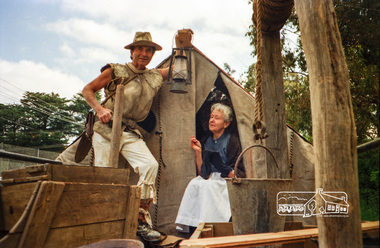 Eltham District Historical Society Inc
Photograph, Eltham Festival, 11 November 1989, 11/11/1989
... Phyllis Macdonald arranged for some of her friends from the Victorian Folk Music Club to provide appropriate musical accompaniment. ...Phyllis Macdonald arranged for some of her friends from the Victorian Folk Music Club to provide appropriate musical accompaniment. ...Society members preparing for the parade in Youth Road behind Eltham Railway Station, Eltham Festival, 11 November 1989. Bruce Ness assembled the float with items loaned by Warrandyte Historical Society and quite a bit of his own ingenuity. Phyllis Macdonald arranged for some of her friends from the Victorian Folk Music Club to provide appropriate musical accompaniment. To provide a level of authenticity, a present day prospector, Jack Hodson was placed in charge of the equipment on the float.Roll of 35mm colour negative film, 6 stripsFuji 100 Neltham, main road, eltham central park, eltham festival, parade, shire of eltham historical society, parade float -
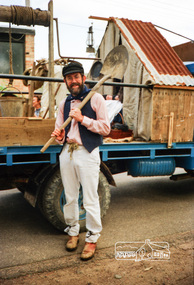 Eltham District Historical Society Inc
Photograph, Eltham Festival, 11 November 1989, 11/11/1989
... Phyllis Macdonald arranged for some of her friends from the Victorian Folk Music Club to provide appropriate musical accompaniment. ...Phyllis Macdonald arranged for some of her friends from the Victorian Folk Music Club to provide appropriate musical accompaniment. ...Society members preparing for the parade in Youth Road behind Eltham Railway Station, Eltham Festival, 11 November 1989. Bruce Ness assembled the float with items loaned by Warrandyte Historical Society and quite a bit of his own ingenuity. Phyllis Macdonald arranged for some of her friends from the Victorian Folk Music Club to provide appropriate musical accompaniment. To provide a level of authenticity, a present day prospector, Jack Hodson was placed in charge of the equipment on the float.Roll of 35mm colour negative film, 6 stripsFuji 100 Neltham, main road, eltham central park, eltham festival, parade, shire of eltham historical society, parade float -
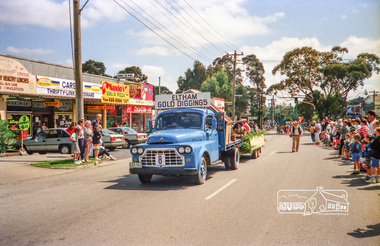 Eltham District Historical Society Inc
Photograph, Eltham Festival, 11 November 1989, 11/11/1989
... Phyllis Macdonald arranged for some of her friends from the Victorian Folk Music Club to provide appropriate musical accompaniment. ...Phyllis Macdonald arranged for some of her friends from the Victorian Folk Music Club to provide appropriate musical accompaniment. ...Society President, Sue Law, and Junior Vice-President Doug Orford carry the Society Banner leading the parade float. The Shire of Eltham Historical Society's parade float featured a gold mining theme - "The Eltham Goldrush" Bruce Ness assembled the float with items loaned by Warrandyte Historical Society and quite a bit of his own ingenuity. Phyllis Macdonald arranged for some of her friends from the Victorian Folk Music Club to provide appropriate musical accompaniment. To provide a level of authenticity, a present day prospector, Jack Hodson was placed in charge of the equipment on the float.Roll of 35mm colour negative film, 6 stripsFuji 100 Neltham, main road, eltham central park, eltham festival, parade, shire of eltham historical society, parade float
