
Showing 4 items matching "myomectomy"
-
 Royal Australian and New Zealand College of Obstetricians & Gynaecologists (RANZCOG)
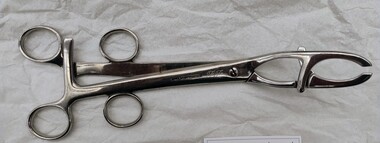
Instrument - Bonney's myomectomy clamp used by Frank Forster, Allen & Hanbury's P/L
... ...Myomectomy...Dr Frank Forster Myomectomy 'ALLEN & HANBURYS LTD LONDON'; 'FF'; 'STAINLESS STEEL' Stainless steel clamp. ...This clamp is engraved with the initials 'F.F', indicating it was owned and used by Dr Frank Forster.Stainless steel clamp. Scissor type instrument with two sets of finger grips and a locking ratchet mechanism. The blades close to form two apertures which can be selectively decreased in size. One side of the clamp near pin is engraved with the curzive text 'F.F'. Clamp also engraved with the text 'ALLEN & HANBURYS LTD LONDON' and 'STAINLESS STEEL''ALLEN & HANBURYS LTD LONDON'; 'FF'; 'STAINLESS STEEL'dr frank forster, myomectomy -
 Royal Australian and New Zealand College of Obstetricians & Gynaecologists (RANZCOG)
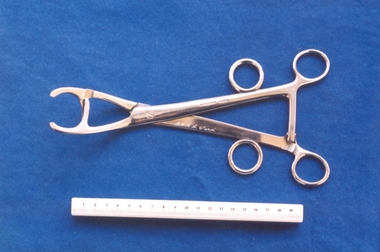
Tool - Bonney's myomectomy clamp used by Box Hill Hospital labour ward, Down Bros., London
... Prior to Bonney, myomectomy “had fallen into disuse because of excessive blood loss during the operating and the infections that commonly followed” (Chamberlain, 'The master of myomectomy') , but Bonney saw an opportunity to revolutionise this practice. ...Prior to Bonney, myomectomy “had fallen into disuse because of excessive blood loss during the operating and the infections that commonly followed” (Chamberlain, 'The master of myomectomy') , but Bonney saw an opportunity to revolutionise this practice. ...Victor Bonney (1872- 1953) was a gifted and innovative surgeon. One of Bonney’s most notable achievements was his development of a successful procedure for myomectomy. After his wife developed fibroids and had her uterus removed early in their marriage, Bonney took a great interest in the practice of conservatism in surgery. Prior to Bonney, myomectomy “had fallen into disuse because of excessive blood loss during the operating and the infections that commonly followed” (Chamberlain, 'The master of myomectomy') , but Bonney saw an opportunity to revolutionise this practice. In his words: “I set myself to make myomectomy so feasible, successful and safe as to render it a fair alternative to hysterectomy in every case… Excepting only in a very few instances… I have succeeded, and now enter the operating theatre free of the trammels which at one time too often compelled my hand against my heart.” (Bonney, 'The fruits of conversatism') Bonney’s crucial innovation was the development of a new surgical clamp, an instrument which is now referred to as Bonney’s myomectomy clamp. The clamp was ingeniously designed to cut off blood supply to the uterus by compressing the uterine arteries, immediately reducing the excessive blood loss which had previously been associated with the procedure. Although technological advances mean that these are now seldom used, Bonney’s success with this procedure was such that his clamps were regularly used for myomectomy procedures for decades after his death. This instrument was included with other obstetric instruments, mostly destructive instruments, given to RANZCOG from Box Hill Hospital labour ward in February- March 1998. The maternity service at Box Hill Hospital combined with St George's Hospital in Kew to be known as Birralee Maternity Service. These instruments were collected by Julie Collette, Unit Manager, St George's Kew and given to RANZCOG Museum Curator, Susan Barnett. Stainless steel clamp. Scissor type instrument with two sets of finger grips and a locking ratchet mechanism. The blades close to form two apertures which can be selectively decreased in size."DOWN BROS LONDON STAINLESS" upper surface of RH handle; "B.H.H.L. WARD" inner surface of LH handle.surgery, obstetrics -
 Royal Australian and New Zealand College of Obstetricians & Gynaecologists (RANZCOG)
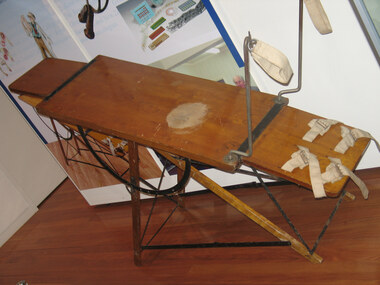
Portable operating table used by Sir Victor Bonney, Allen & Hanburys, England, c. 1900
... First, he was the pioneer of myomectomy; second, with Berkeley, he extended and perfected Wertheim's operation for carcinoma of the cervix; and third, he devised a fine surgical technique emulated by so many of his pupils. ...Sir Victor Bonney was the pioneer of myomectomy, the surgical procedure for removing uterine fibroids. ...This operating table belonged to the famous gynaecological surgeon Dr Victor Bonney and was given to Dr Frank Forster in 1953 by his widow Mrs Annie Bonnie, a distant relative of Forster's. Dr Victor Bonney (1872 - 1953) followed his father into medicine and trained at St Bartholomew's and the Middlesex Hospitals. Writing his obituary in 1953, FW Roques said of Bonney that he "'made three great gifts to surgery. First, he was the pioneer of myomectomy; second, with Berkeley, he extended and perfected Wertheim's operation for carcinoma of the cervix; and third, he devised a fine surgical technique emulated by so many of his pupils. To theatre sisters, labour-ward sisters and young house-surgeons he will always be remembered as the discoverer of 'Bonney's Blue' [antiseptic solution].'" Bonney's utilitarian, portable operating table has a round, worn scrubbed patch showing traces of his famous blue solution.This portable operating table was owned and used by pioneering gynaecological surgeon Sir Victor Bonney in London, U.K. c 1900. Dr Bonney employed two theatre sisters and had two sets of instruments and portable operating tables. This made it possible for Dr Bonney to 'complete three or more operations a day by rotating staff and equipment with a chauffeur driven Lanchester or Rolls Royce', delivering them from one house to the next. The donor of the operating table, the late Dr Frank Forster, was a distant relative of Sir Victor Bonney's widow, Annie Appleyard, formerly of Tasmania. When he visited her in the UK after Bonney's death, she offered the operating table to Dr Forster for the RANZCOG Museum. It was still in a canvas bag in the boot of one of Bonney's cars. Sir Victor Bonney was the pioneer of myomectomy, the surgical procedure for removing uterine fibroids. In collaboration with Berkeley, he extended and perfected Wertheim's operation for carcinoma of the cervix. Bonney was an influential teacher, developing and promoting conservatism of surgical technique (minimal intervention) that has had a lasting influence in modern surgical practice. To theatre-sisters, labour-ward sisters and young house-surgeons he will always be remembered as the discoverer of Bonney's Blue an antiseptic that was characteristically blue.Portable, laminated operating table. Plywood rectangular table with two laminated plywood extensions, a head board, and a foot board. At the foot board are insets of canvas straps to support a patient's ankles. Two detachable stirrup poles, each with a canvas strap attached, fit into two holes at the lower end of the table. The table is supported by two timber trellis cross braces with metal bars, and supported at the centre by a metal rod that allows the table to pivot up and down. Two metal arcs with a locking mechanism fix the table at the desired elevation, allowing a Trendelenburg tilt ( a 45 degree tilt, with the patient's head downwards.) The operating table is demountable for transportation and re-assembly.obstetric delivery -
 Kiewa Valley Historical Society
Uterine Cork Screw (Myomectomy Screw)
... Uterine Cork Screw (Myomectomy Screw) ...This medical instrument was used in the Tawonga District General Hospital which was built in the 1950s specifically for the increase in population due to the Kiewa Hydro Scheme.Historical: Shows the development of scientific hospital equipment. Provenance: Used in the Tawonga District General Hospital which was remote and therefore required good equipment.Used to hold and manoeuvre the uterus when it was excised and exported in the operation of a hysterectomy. Metal instrument with wide handle at one end and a cork screw at the other.medical instrument. hospital equipment. tawonga. mt beauty. uterus, myomectomy screw.
