
Showing 3 items matching "mythology - chinese"
-
 Mrs Aeneas Gunn Memorial Library
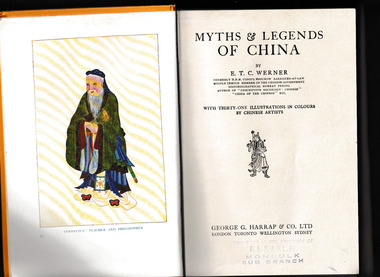
Book, George G. Harrap & Co, Myths and legends of China, 1922
... Mythology - Chinese...Mythology - Chinese Legends - China The West's first encounters with the folk tales and myths of the East proved to be a heady experience, as they were based on an entirely different value system and worldview than those that are reflected in the Greek myths and most subsequent Western folk tales. ...The West's first encounters with the folk tales and myths of the East proved to be a heady experience, as they were based on an entirely different value system and worldview than those that are reflected in the Greek myths and most subsequent Western folk tales. In Myths and Legends of China, author E.T.C. Werner offers up a rich tapestry of Chinese folk narratives. A must-read for fans of world myths, fairy tales, and legends.Index, ill, p.453.non-fictionThe West's first encounters with the folk tales and myths of the East proved to be a heady experience, as they were based on an entirely different value system and worldview than those that are reflected in the Greek myths and most subsequent Western folk tales. In Myths and Legends of China, author E.T.C. Werner offers up a rich tapestry of Chinese folk narratives. A must-read for fans of world myths, fairy tales, and legends. mythology - chinese, legends - china -
 Embroiderers Guild, Victoria
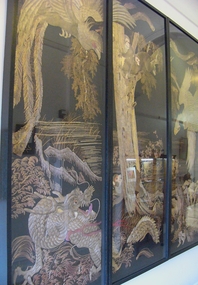
Textile - Japanese Triptych Screen, Late 18th- Early 19th C Edo Period
... The ho-o bird (hōō or 鳳凰) is a legendary, phoenix-like creature from East Asian mythology, originating from the Chinese fenghuang. The name comes from Japanese, where hō represents the male bird and ō represents the female bird, symbolizing yin and yang harmony. ...The ho-o bird (hōō or 鳳凰) is a legendary, phoenix-like creature from East Asian mythology, originating from the Chinese fenghuang. The name comes from Japanese, where hō represents the male bird and ō represents the female bird, symbolizing yin and yang harmony. ...The ho-o bird (hōō or 鳳凰) is a legendary, phoenix-like creature from East Asian mythology, originating from the Chinese fenghuang. The name comes from Japanese, where hō represents the male bird and ō represents the female bird, symbolizing yin and yang harmony. Symbolism: Unlike the Western phoenix, the ho-o does not burn up and rise from ashes. It is a peaceful, divine spirit that appears only to mark times of peace, virtue, or the birth of a just ruler. Appearance: Traditional descriptions combine parts of many animals, featuring the beak of a rooster, head of a pheasant, neck of a snake, and tail of a peacock. Its feathers display five sacred colors (red, yellow, blue, white, and black). Eventually the two creatures merged into one and their combined name was used. The combined creature is still considered to be female, and is often partnered with the tatsu, which is considered to be male. The hōō is one of the most revered and holiest animals in Japan. Second only to the kirin in terms of power, it is the most sacred bird in the Japanese pantheon. Japanese dragon, known as ryū or tatsu (龍 or 竜), is a legendary, serpentine water deity in Japanese mythology and folklore. Physical Appearance: Body: Long, scaly, and snake-like without wings. Claws: Typically depicted with three toes on each foot (distinguishing them from Chinese five-clawed and Korean four-clawed variants). Features: Horns, long whiskers or a beard, and a fierce expression. Movement: Associated with water, oceans, rain, and clouds rather than fire-breathing. Meaning and Symbolism: Water and Weather: Viewed as benevolent water gods controlling rainfall, rivers, and tides. Wisdom and Power: Symbolize strength, protection, and good fortune. Imperial Lineage: Ancient legends state that Japan's imperial family descends from sea deities and dragon royalty like Ryūjin . A Japanese monkey (saru, 猿) in traditional or decorative embroidery symbolizes protection, good luck, cleverness, and the removal of evil. Core Meanings of the Monkey : Warding off evil: Historically, the monkey was viewed as a protector against demons and bad luck. Japanese macaques act as divine messengers in certain Shinto shrines (like the Hie Shrine). Fertility and safe birth: Ancient Japanese clay monkey amulets were used to pray for healthy children and easy childbirth, a meaning that carried into traditional folk textiles and garments. Mischief and playfulness: On a lighter note, single playful monkeys represent cleverness, agility, and lighthearted joy.Large Japanese metal thread screen depicting dragons, ho-o birds and monkeys.embroidery, japanese screen, metal work, surface stitchery -
 City of Stonnington
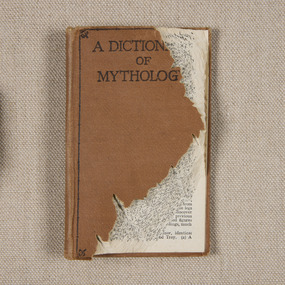
Nicholas Jones, China, 2015
... China Map reference: from the Atlas 'Theatrum Orbis Terrarum’ by Abraham Ortelius (1570) Book sculpted: Miniature Dictionary of Mythology...China Map reference: from the Atlas 'Theatrum Orbis Terrarum’ by Abraham Ortelius (1570) Book sculpted: Miniature Dictionary of Mythology Stonnington contemporary art collection China Nicholas Jones ...Nicholas Jones uses books and printed paper to make works which question the manner in which books are ‘read’. He employs scalpels and a careful hand to carve and incise, fold, tear and sew his materials, manipulating books and pages in a manner that disrupts narrative structure and creates alternative readings. Old books, subject to his process-driven practice, are reborn as sculptural objects. In 2012 Jones was awarded a Creative Fellowship by the State Library of Victoria. Several years of research into mapping and the history of cartography led to his discovery of Terrarum Orbis Theatrum, considered to be the world’s first true modern atlas, published 1570 in Antwerp, Belgium. Inspired by this tome, Jones deftly carved the topographical Readers Digest, Atlas of Australia (Terra Australis nondum cognita) the larger book displayed here, acquired by Council in 2014. The topographical effect achieved by carving imagined coastline through the book is mirrored by the aerial geographical view of an Australian landscape printed on the book's endpapers. To complement this acquisition, four smaller works were commissioned in 2015. Stonnington’s community is diverse and rich in its heritage; Jones references the four most common ethnic origins of residents of the City of Stonnington as listed in the most recent census data. The coastal outlines of these countries, as represented in significant historical maps, are here embodied in little paper vessels of content and history. As Jones intervenes in the physicality of the books, he transforms them into small yet compelling sculptures that challenge and expand the questions and answers books typically provide.China Map reference: from the Atlas 'Theatrum Orbis Terrarum’ by Abraham Ortelius (1570) Book sculpted: Miniature Dictionary of Mythologystonnington contemporary art collection
