
Showing 8 items matching "nails metal-working"
-
 Orbost & District Historical Society
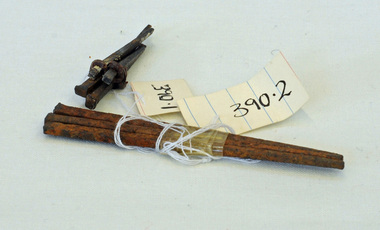
nails, 1890's
... nails metal-working Temples-Store...He packed stores to the Bendoc area gold fields. nails metal-working Temples-Store Two lots of hand-made nails. .1 is a set of five small nails tied together with string. .2 is a set of three longer nails which are very rusty. nails ...These hand-made nails were used in what was Temple's Store built in 1889. It later became Herbert's - now demolished. It was located near the corner of Nicholson Street and Ruskin Street, Orbost. Temple's store was on the corner of Ruskin Street and Nicholson Street. George Temple (1832-1918) established the store in about 1888. He packed stores to the Bendoc area gold fields.Two lots of hand-made nails. .1 is a set of five small nails tied together with string. .2 is a set of three longer nails which are very rusty.nails metal-working temples-store -
 Orbost & District Historical Society
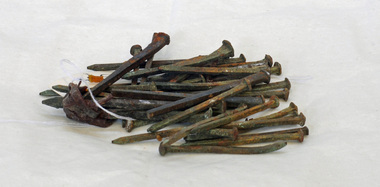
nails
... nails metal-working...nails metal-working Three bunches of hand-made nails in assorted lengths. nails ...Three bunches of hand-made nails in assorted lengths.nails metal-working -
 Orbost & District Historical Society
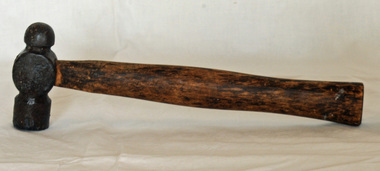
hammer, 1920's
... metal-working. Its steel head is harder than that of a claw hammer, so is less likely to chip on impact. Ball peen hammers are commonly used to drive cold chisels, set rivets, and bend and shape metal. Before the advent of pneumatic rivet guns, ball peen hammers were commonly used for riveting. First the flat head drove the nail...metal-working. Its steel head is harder than that of a claw hammer, so is less likely to chip on impact. Ball peen hammers are commonly used to drive cold chisels, set rivets, and bend and shape metal. Before the advent of pneumatic rivet guns, ball peen hammers were commonly used for riveting. First the flat head drove the nail ...A ball-peen ) hammer, also known as a machinist's hammer, is a type of peening hammer used in metal-working. Its steel head is harder than that of a claw hammer, so is less likely to chip on impact. Ball peen hammers are commonly used to drive cold chisels, set rivets, and bend and shape metal. Before the advent of pneumatic rivet guns, ball peen hammers were commonly used for riveting. First the flat head drove the nail through, then the round ball was used to "peen over" the other side of the rivet. Before the advent of pneumatic rivet guns, ball peen hammers were commonly used for riveting. First the flat head drove the nail through, then the round ball was used to "peen over" the other side of the rivet. These hammers were made to last.Wooden handled ball peen pein) hammer. The handle has been nailed in and may not be the original. The metal head has one end shaped into a sphere and the other flat.hammer-ball-peen tool metal-work -
 Orbost & District Historical Society
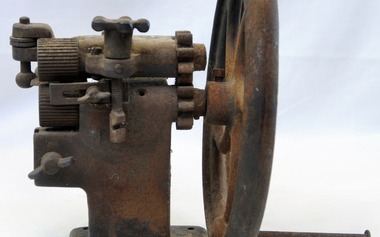
parer - leather
... Leather sole parer, made of metal with large wheel for turning when working. Holes on the bottom stand for nailing or screwing to bench....parer-leather bootmaking trades-leatherwork Leather sole parer, made of metal with large wheel for turning when working. Holes on the bottom stand for nailing or screwing to bench. parer - leather ...Leather sole parer, made of metal with large wheel for turning when working. Holes on the bottom stand for nailing or screwing to bench.parer-leather bootmaking trades-leatherwork -
 Flagstaff Hill Maritime Museum and Village
Awl, 19th-20th century
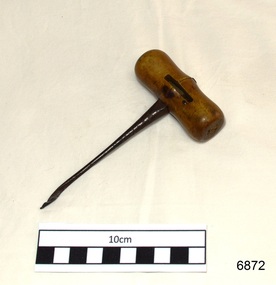
... working tool Stamped into handle "D.R.P. 58012" Awl, part of the W.R. Angus Collection. Wooden handle, metal spiral spike. Used to make a 'pilot hole' for inserting screws and nails. ...This awl was donated to Flagstaff Hill Maritime Village by the family of Doctor William Roy Angus, Surgeon and Oculist. It is part of the “W.R. Angus Collection” includes historical medical equipment, surgical instruments and material once belonging to Dr Edward Ryan and Dr Thomas Francis Ryan, (both of Nhill, Victoria) as well as Dr Angus’ own belongings. The Collection’s history spans the medical practices of the two Doctors Ryan, from 1885-1926 plus that of Dr Angus, up until 1969. ABOUT THE “W.R.ANGUS COLLECTION” Doctor William Roy Angus M.B., B.S., Adel., 1923, F.R.C.S. Edin.,1928 (also known as Dr Roy Angus) was born in Murrumbeena, Victoria in 1901 and lived until 1970. He qualified as a doctor in 1923 at University of Adelaide, was Resident Medical Officer at the Royal Adelaide Hospital in 1924 and for a period was house surgeon to Sir (then Mr.) Henry Simpson Newland. Dr Angus was briefly an Assistant to Dr Riddell of Kapunda, then commenced private practice at Curramulka, Yorke Peninsula, SA, where he was physician, surgeon and chemist. In 1926, he was appointed as new Medical Assistant to Dr Thomas Francis Ryan (T.F. Ryan, or Tom), in Nhill, Victoria, where his experiences included radiology and pharmacy. In 1927 he was Acting House Surgeon in Dr Tom Ryan’s absence. Dr Angus had become engaged to Gladys Forsyth and they decided he further his studies overseas in the UK in 1927. He studied at London University College Hospital and at Edinburgh Royal Infirmary and in 1928, was awarded FRCS (Fellow from the Royal College of Surgeons), Edinburgh. He worked his passage back to Australia as a Ship’s Surgeon on the on the Australian Commonwealth Line’s T.S.S. Largs Bay. Dr Angus married Gladys in 1929, in Ballarat. (They went on to have one son (Graham 1932, born in SA) and two daughters (Helen (died 12/07/1996) and Berenice (Berry), both born at Mira, Nhill ) According to Berry, her mother Gladys made a lot of their clothes. She was very talented and did some lovely embroidery including lingerie for her trousseau and beautifully handmade baby clothes. Dr Angus was a ‘flying doctor’ for the A.I.M. (Australian Inland Ministry) Aerial Medical Service in 1928 . Its first station was in the remote town of Oodnadatta, where Dr Angus was stationed. He was locum tenens there on North-South Railway at 21 Mile Camp. He took up this ‘flying doctor’ position in response to a call from Dr John Flynn; the organisation was later known as the Flying Doctor Service, then the Royal Flying Doctor Service. A lot of his work during this time involved dental surgery also. Between 1928-1932 he was surgeon at the Curramulka Hospital, Yorke Peninsula, South Australia. In 1933 Dr Angus returned to Nhill and purchased a share of the Nelson Street practice and Mira hospital (a 2 bed ward at the Nelson Street Practice) from Dr Les Middleton one of the Middleton Brothers, the current owners of what previously once Dr Tom Ryan’s practice. Dr Tom and his brother had worked as surgeons included eye surgery. Dr Tom Ryan performed many of his operations in the Mira private hospital on his premises. He had been House Surgeon at the Nhill Hospital 1902-1926. Dr Tom Ryan had one of the only two pieces of radiology equipment in Victoria during his practicing years – The Royal Melbourne Hospital had the other one. Over the years Dr Tom Ryan had gradually set up what was effectively a training school for country general-practitioner-surgeons. Each patient was carefully examined, including using the X-ray machine, and any surgery was discussed and planned with Dr Ryan’s assistants several days in advance. Dr Angus gained experience in using the X-ray machine there during his time as assistant to Dr Ryan. When Dr Angus bought into the Nelson Street premises in Nhill he was also appointed as the Nhill Hospital’s Honorary House Surgeon 1933-1938. His practitioner’s plate from his Nhill surgery is now mounted on the doorway to the Port Medical Office at Flagstaff Hill Maritime Village, Warrnambool. When Dr Angus took up practice in the Dr Edward and Dr Tom Ryan’s old premises he obtained their extensive collection of historical medical equipment and materials spanning 1884-1926. A large part of this collection is now on display at the Port Medical Office at Flagstaff Hill Maritime Village in Warrnambool. In 1939 Dr Angus and his family moved to Warrnambool where he purchased “Birchwood,” the 1852 home and medical practice of Dr John Hunter Henderson, at 214 Koroit Street. (This property was sold in1965 to the State Government and is now the site of the Warrnambool Police Station. and an ALDI sore is on the land that was once their tennis court). The Angus family was able to afford gardeners, cooks and maids; their home was a popular place for visiting dignitaries to stay whilst visiting Warrnambool. Dr Angus had his own silk worm farm at home in a Mulberry tree. His young daughter used his centrifuge for spinning the silk. Dr Angus was appointed on a part-time basis as Port Medical Officer (Health Officer) in Warrnambool and held this position until the 1940’s when the government no longer required the service of a Port Medical Officer in Warrnambool; he was thus Warrnambool’s last serving Port Medical Officer. (Masters of immigrant ships arriving in port reported incidents of diseases, illness and death and the Port Medical Officer made a decision on whether the ship required Quarantine and for how long, in this way preventing contagious illness from spreading from new immigrants to the residents already in the colony.) Dr Angus was a member of the Australian Medical Association, for 35 years and surgeon at the Warrnambool Base Hospital 1939-1942, He served as a Surgeon Captain during WWII1942-45, in Ballarat, Victoria, and in Bonegilla, N.S.W., completing his service just before the end of the war due to suffering from a heart attack. During his convalescence he carved an intricate and ‘most artistic’ chess set from the material that dentures were made from. He then studied ophthalmology at the Royal Melbourne Eye and Ear Hospital and created cosmetically superior artificial eyes by pioneering using the intrascleral cartilage. Angus received accolades from the Ophthalmological Society of Australasia for this work. He returned to Warrnambool to commence practice as an ophthalmologist, pioneering in artificial eye improvements. He was Honorary Consultant Ophthalmologist to Warrnambool Base Hospital for 31 years. He made monthly visits to Portland as a visiting surgeon, to perform eye surgery. He represented the Victorian South-West subdivision of the Australian Medical Association as its secretary between 1949 and 1956 and as chairman from 1956 to 1958. In 1968 Dr Angus was elected member of Spain’s Barraquer Institute of Barcelona after his research work in Intrasclearal cartilage grafting, becoming one of the few Australian ophthalmologists to receive this honour, and in the following year presented his final paper on Living Intrasclearal Cartilage Implants at the Inaugural Meeting of the Australian College of Ophthalmologists in Melbourne In his personal life Dr Angus was a Presbyterian and treated Sunday as a Sabbath, a day of rest. He would visit 3 or 4 country patients on a Sunday, taking his children along ‘for the ride’ and to visit with him. Sunday evenings he would play the pianola and sing Scottish songs to his family. One of Dr Angus’ patients was Margaret MacKenzie, author of a book on local shipwrecks that she’d seen as an eye witness from the late 1880’s in Peterborough, Victoria. In the early 1950’s Dr Angus, painted a picture of a shipwreck for the cover jacket of Margaret’s book, Shipwrecks and More Shipwrecks. She was blind in later life and her daughter wrote the actual book for her. Dr Angus and his wife Gladys were very involved in Warrnambool’s society with a strong interest in civic affairs. He had an interest in people and the community They were both involved in the creation of Flagstaff Hill, including the layout of the gardens. After his death (28th March 1970) his family requested his practitioner’s plate, medical instruments and some personal belongings be displayed in the Port Medical Office surgery at Flagstaff Hill Maritime Village, and be called the “W. R. Angus Collection”. W.R. Angus Collection is significant for still being located at the site it is connected with, Doctor Angus being the last Port Medical Officer in Warrnambool. The collection of medical instruments and other equipment is culturally significant, being an historical example of medicine from late 19th to mid-20th century. Dr Angus assisted Dr Tom Ryan, a pioneer in the use of X-rays and in ocular surgery. Awl, part of the W.R. Angus Collection. Wooden handle, metal spiral spike. Used to make a 'pilot hole' for inserting screws and nails. Letters and numbers are stamped into the handle. Stamped into handle "D.R.P. 58012"flagstaff hill, warrnambool, shipwrecked coast, flagstaff hill maritime museum, maritime museum, shipwreck coast, flagstaff hill maritime village, great ocean road, dr w r angus, dr ryan, awl, tool, wood working tool -
 Orbost & District Historical Society
lantern
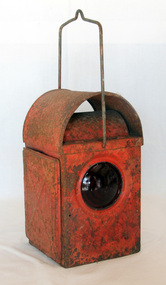
... Lamps of this kind were significantroadworks items in their period of use as essential tools to the safe-working operations of the Country Roads Board.. lantern kerosene light lamp A red metal roadworks warning lantern. It is rectangular with a metal carrying handle. The top is domed. The door at the back is hingedand opens with a small nail ...The kerosene lantern is a type of lighting device that uses kerosene as a fuel. Kerosene lanterns have a wick or mantle as light source. They may be hand-held for portable lighting.This kerosene lantern was used as a light on road works in the Orbost area. It would have been carried/used by one of the road workers. Lamps of this kind were significantroadworks items in their period of use as essential tools to the safe-working operations of the Country Roads Board.. A red metal roadworks warning lantern. It is rectangular with a metal carrying handle. The top is domed. The door at the back is hingedand opens with a small nail. The lamp was lit by kerosene held in a small square tank with a wick.lantern kerosene light lamp -
 Warrnambool and District Historical Society Inc.
Tools, Hand Working Tool, Late 19th century/early 20th century
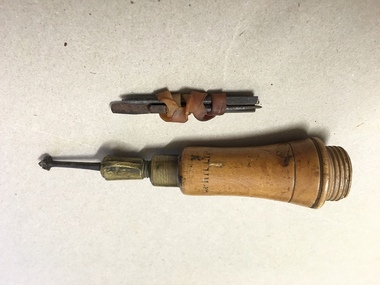
... nail-like piece of metal with a small metal piece at the end in the shape of a star with six points. This end piece gouges out a hole or a pattern in wood or other hard material. The tool belonged to Ernest Phillips and his name is stamped on the handle. Three oblong-shaped metal nails were also with this tool but were not necessarily used with it. Hand Working ...This tool belonged to Ernest Brighton Phillips, a Warrnambool furniture maker. Ernest Phillips (1875-1924) was born in Warrnambool and learnt his carpentry trade at the Warrnambool Box Works. In the late 1890s Phillips established a furniture store at the corner of Liebig and Koroit streets and by the early 20th century he had the largest furniture warehouse and factory in Victoria outside of Melbourne. His products were sold all over Australia. Phillips and his family lived at ‘Heatherlie’ in Koroit Street. Today this property is the site of the residential complex for senior citizens known as ‘Heatherlie’. This tool is of considerable interest as it belonged to Ernest Phillips, a prominent businessman in Warrnambool at the end of the 19th century and the beginning of the 20th century. It is also of interest as a good example of a tool that was in use 100 years ago. This is a small tool with a wooden handle. The top part of the handle that screws in is missing. The tool is attached to the handle by a brass ring and a screw and the tool itself is a thin nail-like piece of metal with a small metal piece at the end in the shape of a star with six points. This end piece gouges out a hole or a pattern in wood or other hard material. The tool belonged to Ernest Phillips and his name is stamped on the handle. Three oblong-shaped metal nails were also with this tool but were not necessarily used with it. ‘E. Phillips’ernest phillips, history of warrnambool -
 Parks Victoria - Wilsons Promontory Lightstation
Anvil
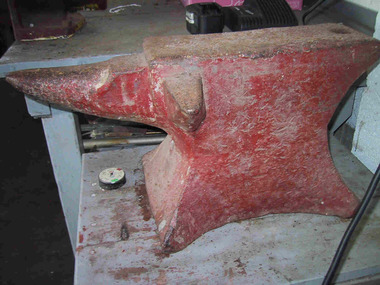
... nails, hooks, chain segments, pulley blocks, hinges, crow bars, picks, chisels, horseshoes and harness hardware. A hames hook (which forms part of the collar worn by a draught horse) survives at the lightstation as do many other heavy metal tools and pieces of equipment. The anvil is an example of the necessary resourcefulness and self sufficiency practiced by lightkeepers working...nails, hooks, chain segments, pulley blocks, hinges, crow bars, picks, chisels, horseshoes and harness hardware. A hames hook (which forms part of the collar worn by a draught horse) survives at the lightstation as do many other heavy metal tools and pieces of equipment. The anvil is an example of the necessary resourcefulness and self sufficiency practiced by lightkeepers working ...As quoted from Wikipedia, ‘An anvil is a block with a hard surface on which another object is, struck. The block is as massive as it is practical, because the higher the inertia of the anvil, the more efficiently it causes the energy of the striking tool to be transferred to the work piece’. The lightstation’s anvil is a red-painted iron block with a conical beak or horn at one end that was used for hammering curved pieces of metal. It would have stood on a heavy free-standing pedestal, such as a large tree stump, to allow complete access to the item being hammered. Some anvils display the manufacturer’s name in the metal on the side, but this is not the case here, and its age, although unknown appears to be quite old, perhaps c.1900. It appears to have had a lot of use, and although no record of this survives, it is presumed that a forge operated on site for hammering, cutting, shaping and repairing tools such as bolts, nails, hooks, chain segments, pulley blocks, hinges, crow bars, picks, chisels, horseshoes and harness hardware. A hames hook (which forms part of the collar worn by a draught horse) survives at the lightstation as do many other heavy metal tools and pieces of equipment. The anvil is an example of the necessary resourcefulness and self sufficiency practiced by lightkeepers working and living in a remotely located workplace and home, and many of the iron items in the collection may have been repaired or even made on its working surface. As a lightstation manager Chris Richter used the anvil to manufacture pulley blocks for sash windows, repair brass door hinges & sharpen cold chisels, crowbars and picks and other lightkeepers have used this anvil for many fabricating jobs such as manufacturing ducting for the generator room ventilation system."The lightship only came in every three months with supplies and there would have been repairs to do between visits from a blacksmith - who would have had to travel on the ship. Also, the ship was only anchored in the bay long enough to unload supplies and collect and deliver lightkeeping staff – probably not enough time to get much smithy work done – especially if the weather packed it in and the ship had to depart. Lightkeepers in our time had to be self sufficient, resourceful and innovative and I imagine that would have been the case in the past." It has second level contributory significance.Red painted blacksmith's anvil.
