
Showing 40 items matching "national wool centre"
-
 National Wool Museum
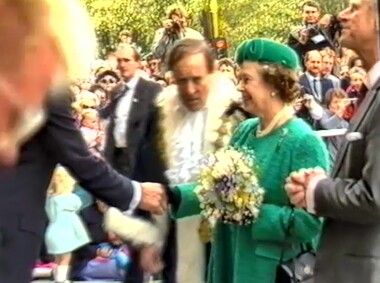
Film - The Visit to the National Wool Centre by Her Majesty Queen Elizabeth II, April 1988
... The Visit to the National Wool Centre by Her Majesty Queen Elizabeth II......National Wool Centre...In April Her Majesty Queen Elizabeth II and Prince Philip arrived in Geelong to open the Wool Week Display in the almost complete National Wool Centre. Crowds gathered to welcome the royal couple, wool shearing demonstrations took place outside the centre and “Spud” the sheepdog exhibited his herding talents. ...Film includes colour footage and audio. 00:13 - titles 00:21 - Queen greeting crowds of people on Moorabool Street 00:41 - sheep herding demonstration on Moorabool Street 01:04 - sheep shearing demonstration 01:53 - Queen tours inside the National Wool Centre 02:17 - Queen watches loom demonstration 02:34 - wool auction 04:02 - Queen and Prince Philip sign two registers 06:10 - Queen exits National Wool Centre 06:12 - Queen greets crowds on the street 07:04 - Queen enters vehicle 07:18 - end...Label on case: Queens Visit / National Wool Centre.... Wool Centre Bicentennial Her Majesty Queen Elizabeth II Prince Philip National Wool Museum Royal visit Label on case: Queens Visit / National Wool Centre. ...In 1988 Her Majesty Queen Elizabeth II and Prince Philip travelled across Australia to take part in the bicentenary celebrations. In April Her Majesty Queen Elizabeth II and Prince Philip arrived in Geelong to open the Wool Week Display in the almost complete National Wool Centre. Crowds gathered to welcome the royal couple, wool shearing demonstrations took place outside the centre and “Spud” the sheepdog exhibited his herding talents. During their visit to the wool centre they were met by the chairman of the Geelong Regional Commission, Mr Colin Atkins and Mrs Monique Atkins. The Queen was presented with a rug woven by the museums 1910 gripper-type Axminster Jacquard carpet loom and the Duke was presented with a woollen jumper. In return the Queen presented three letters from the archives of the Windsor Castle to the museum. The couple left in the afternoon, charming the Geelong crowd.Black VHS tape with black and yellow stickers and printed text. Tape is housed in a black plastic case. Film includes colour footage and audio. 00:13 - titles 00:21 - Queen greeting crowds of people on Moorabool Street 00:41 - sheep herding demonstration on Moorabool Street 01:04 - sheep shearing demonstration 01:53 - Queen tours inside the National Wool Centre 02:17 - Queen watches loom demonstration 02:34 - wool auction 04:02 - Queen and Prince Philip sign two registers 06:10 - Queen exits National Wool Centre 06:12 - Queen greets crowds on the street 07:04 - Queen enters vehicle 07:18 - endLabel on case: Queens Visit / National Wool Centre.film, national wool centre, bicentennial, her majesty queen elizabeth ii, prince philip, national wool museum, royal visit -
 National Wool Museum
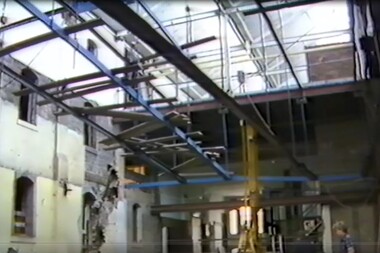
Film - Building Renovation Works, National Wool Centre, 1987-1988
... Building Renovation Works, National Wool Centre......National Wool Centre...In 1988 the National Wool Centre was opened in the same building....Label on tape: National Wool Centre. 87 / Progression Tape / Unedited Wild Footage / National Wool Centre. 1987 / GRC Developmental Progression Wild....In 1988 the National Wool Centre was opened in the same building. ...Film shows the renovation works, both the interior and exterior, of the National Wool Centre being constructed in 1987-1988 in the Dennys Lascelles building on Moorabool Street, Geelong. On 1 August 1872 the CJ Dennys & Co Woolstore opened, adorning the corner of Moorabool and Brougham Streets, Geelong. At the time of opening, the basalt bluestone woolstore was the second largest store in Victoria. In 1988 the National Wool Centre was opened in the same building.Black VHS tape with white stickers and printed text. Tape is housed in a silver and black card case. Film includes colour footage and audio. Film runs for 02:40:24Label on tape: National Wool Centre. 87 / Progression Tape / Unedited Wild Footage / National Wool Centre. 1987 / GRC Developmental Progression Wild.film, national wool centre, national wool museum, bicentennial, building, construction, renovation, moorabool street, dennys lascelles wool store, museum history, labourers, working life -
 National Wool Museum
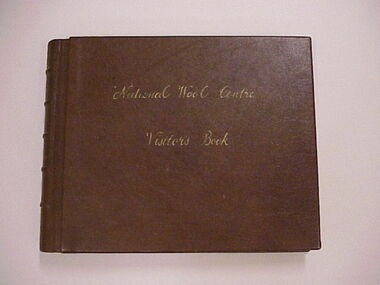
Book, Visitor's, National Wool Centre-Geelong Visitors Book
... National Wool Centre-Geelong Visitors Book..."National Wool Centre- Geelong" Visitor's Book, 1987-1995..."National Wool Centre" Visitor's Book..."National Wool Centre- Geelong" Visitor's Book, 1987-1995 Wool industry Textile Industry Wool industry Textile Industry "National Wool Centre" Visitor's Book National Wool Centre-Geelong Visitors Book Book, Visitor's ..."National Wool Centre- Geelong" Visitor's Book, 1987-1995"National Wool Centre" Visitor's Bookwool industry textile industry, wool industry, textile industry -
 National Wool Museum
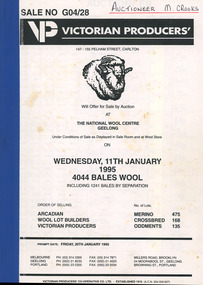
Document - Victorian Producers' Sale Catalogue, National Wool Centre, Geelong, Victorian Producers' Co-operative Limited, 11 January 1995
... Victorian Producers' Sale Catalogue, National Wool Centre, Geelong...This sales catalogue was the one used by Auctioneer Michael Crooks on 11th January 1995 when the million dollar bale was sold at the National Wool Centre, Geelong. The wool was shorn from sheep of the Wyndarra and Rockbank bloodlines. ...CROOKS Front: [printed] SALE NO G04/28 / VICTORIAN PRODUCERS' / 147-155 PELHAM STREET, CARLTON / Will Offer for Sale by Auction / AT / THE NATIONAL WOOL CENTRE / GEELONG / Under Conditions of Sale as Displayed in Sale Room and at Wool Store / ON / WEDNESDAY, 11TH JANUARY / 1995 / 4044 BALES WOOL / INCLUDING 1241 BALES BY SEPARATION...This sales catalogue was the one used by Auctioneer Michael Crooks on 11th January 1995 when the million dollar bale was sold at the National Wool Centre, Geelong. The wool was shorn from sheep of the Wyndarra and Rockbank bloodlines. ...This sales catalogue was the one used by Auctioneer Michael Crooks on 11th January 1995 when the million dollar bale was sold at the National Wool Centre, Geelong. The wool was shorn from sheep of the Wyndarra and Rockbank bloodlines. A flock of 290 sheep were kept undercover at Kadinia, the property of the Appledore family from Brim in the Wimmera district of Victoria. Their record-breaking wool was produced by giving the sheep a special diet and providing each one with a UV-protective coat. Around 180 fleeces were selected for the million dollar bale. The sale of the first bale of wool measuring below 14 microns was held in the Auction Room here at the National Wool Museum. Bidding began at 40,000 (cents a kilogram) and steadily increased until there were only two bidders left. The bidders represented the Japanese firm Aoki International and Loro Piana of Italy. The hammer fell at 1,030,000 cents per kilogram, with Aoki International paying $1,194,800 for the 116kg bale. The fleece was scoured (cleaned) at the Goulburn Wool Scour, New South Wales. The degree of preparation and care taken with the task was extreme. The Scour closed production three days before and was extensively cleaned. On the day of scouring 12 tonnes of 17 micron wool was washed to condition the water, then nine bales of extra super fine wool, worth over $300,000 was washed as a trial run. Toabo Agaki Japan was employed to process the scoured wool into suit cloth. Taobo required the scoured wool to contain 0.5% residual grease, 12% moisture and a yield of 83kg. These requirements were met. The entire staff of the Scour wanted to be part of washing the best wool in the world. Without asking for payment both the night shift and afternoon shift crews assisted the day shift in the task. The bale was fed into the scour in seven minutes and fitted into three bowls, half the scour. It completely disappeared into the dryer and the last wool was fed before the first wool was out. The clean wool was hand-packed into cardboard cartons and freighted to Japan. Aoki International, based in Yokohama Japan, cut three suit lengths from the cloth, then blended the remaining wool into an exclusive line of commercially-available suits. These suits are labelled Kadinia.Bound paper booklet, approximately 35 pages, with printed and handwritten text.Front: [handwritten] AUCTIONEER M. CROOKS Front: [printed] SALE NO G04/28 / VICTORIAN PRODUCERS' / 147-155 PELHAM STREET, CARLTON / Will Offer for Sale by Auction / AT / THE NATIONAL WOOL CENTRE / GEELONG / Under Conditions of Sale as Displayed in Sale Room and at Wool Store / ON / WEDNESDAY, 11TH JANUARY / 1995 / 4044 BALES WOOL / INCLUDING 1241 BALES BY SEPARATIONmichael crooks, auctioneer, wool industry, million dollar bale, geelong, auction, kadinia, appledore, keith jackson, sale room, geelong wool centre -
 National Wool Museum
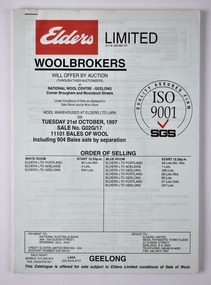
Archive - Wool Auction Catalogue, Elders Limited, 1997
... Catalogue of wool sales at the National Wool Centre Geelong on Tuesday 21st October 1997. ...National Wool Centre, Geelong, Victoria, Australia...Catalogue of wool sales at the National Wool Centre Geelong on Tuesday 21st October 1997. ...Catalogue of wool sales at the National Wool Centre Geelong on Tuesday 21st October 1997. 300 page double sided paper catalogue held with one staple in the top left corner. Pages are white with black printed text. Cover is blue and shows printed text in red and black with Elders logo banner.Elders / LIMITED / A.C.N. 004 045 121 / WOOLBROKERS / WILL OFFER BY AUCTIONwool auction, catalogue, wool bales, sale, wool growing, agriculture, industry, geelong, elders, woolbrokers -
 National Wool Museum
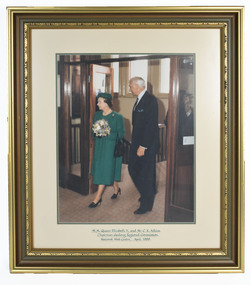
Photograph, HM Queen Elizabeth 11 and Mr C K Atkins, Chairman Geelong Regional Commission, National Wool Centre, April 1988
... HM Queen Elizabeth 11 and Mr C K Atkins, Chairman Geelong Regional Commission, National Wool Centre, April 1988...HM Queen Elizabeth 11 and Mr C K Atkins,/ Chairman Geelong Regional Commission,/ National Wool Centre, April 1988.... - Geelong Regional Commission HM Queen Elizabeth 11 and Mr C K Atkins,/ Chairman Geelong Regional Commission,/ National Wool Centre, April 1988 HM Queen Elizabeth 11 and Mr C K Atkins, Chairman Geelong Regional Commission, National Wool Centre, April 1988 Photograph Photograph ...HM Queen Elizabeth 11 and Mr C K Atkins,/ Chairman Geelong Regional Commission,/ National Wool Centre, April 1988royal visits, geelong regional commission, hrh queen elizabeth 11 atkins, mr colin k. - geelong regional commission -
 National Wool Museum
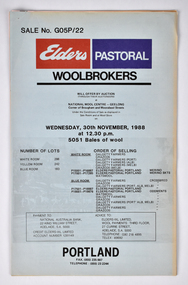
Archive - Wool Auction Catalogue, Elders Limited, 1988
... G05P/22 / Eldres PASTORAL / WOOLBROKERS / WILL OFFER BY AUCTION / (THROUGH THEIR AUCTIONEERS / at / NATIONAL WOOL CENTRE – GEELONG / Corner of Brougham and Moorabool Streets / Under the Conditions of Sale as displayed in / Sale Room and at Wool Store / on / WEDNESDAY, 30th NOVEMBER, 1988 / at 12.30 p.m. / 5051 Bales of wool...National Wool Centre, Geelong, Victoria, Australia...G05P/22 / Eldres PASTORAL / WOOLBROKERS / WILL OFFER BY AUCTION / (THROUGH THEIR AUCTIONEERS / at / NATIONAL WOOL CENTRE – GEELONG / Corner of Brougham and Moorabool Streets / Under the Conditions of Sale as displayed in / Sale Room and at Wool Store / on / WEDNESDAY, 30th NOVEMBER, 1988 / at 12.30 p.m. / 5051 Bales of wool Nine page double sided paper catalogue held with one staple in the top left corner. ...Nine page double sided paper catalogue held with one staple in the top left corner. Pages are blue, yellow and white with black printed text. Cover shows printed text in blue, red and black with Elders logo banner.SALE No. G05P/22 / Eldres PASTORAL / WOOLBROKERS / WILL OFFER BY AUCTION / (THROUGH THEIR AUCTIONEERS / at / NATIONAL WOOL CENTRE – GEELONG / Corner of Brougham and Moorabool Streets / Under the Conditions of Sale as displayed in / Sale Room and at Wool Store / on / WEDNESDAY, 30th NOVEMBER, 1988 / at 12.30 p.m. / 5051 Bales of woolwool auction, catalogue, wool bales, sale, wool growing, agriculture, industry, geelong, elders, woolbrokers -
 National Wool Museum
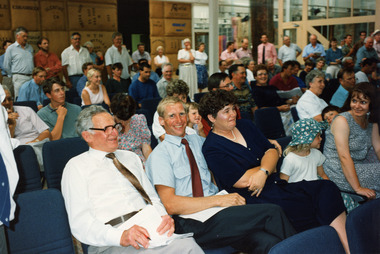
Photograph - Appledore Family, Growers Gallery, National Wool Centre, Geelong, 11 January 1995
... Appledore Family, Growers Gallery, National Wool Centre, Geelong...This photograph depicts people gathered in the Growers Gallery on the 11th January, 1995 at the National Wool Centre, Geelong. It shows the emotions of Murray, Ian and Kaye Appledore while bidding took place for the million dollar bale. ...Photograph Appledore Family, Growers Gallery, National Wool Centre, Geelong ...This photograph depicts people gathered in the Growers Gallery on the 11th January, 1995 at the National Wool Centre, Geelong. It shows the emotions of Murray, Ian and Kaye Appledore while bidding took place for the million dollar bale. The wool was shorn from sheep of the Wyndarra and Rockbank bloodlines. A flock of 290 sheep were kept undercover at Kadinia, the property of the Appledore family from Brim in the Wimmera district of Victoria. Their record-breaking wool was produced by giving the sheep a special diet and providing each one with a UV-protective coat. Around 180 fleeces were selected for the million dollar bale. The sale of the first bale of wool measuring below 14 microns was held in the Auction Room here at the National Wool Museum. Bidding began at 40,000 (cents a kilogram) and steadily increased until there were only two bidders left. The bidders represented the Japanese firm Aoki International and Loro Piana of Italy. The hammer fell at 1,030,000 cents per kilogram, with Aoki International paying $1,194,800 for the 116kg bale. The fleece was scoured (cleaned) at the Goulburn Wool Scour, New South Wales. The degree of preparation and care taken with the task was extreme. The Scour closed production three days before and was extensively cleaned. On the day of scouring 12 tonnes of 17 micron wool was washed to condition the water, then nine bales of extra super fine wool, worth over $300,000 was washed as a trial run. Toabo Agaki Japan was employed to process the scoured wool into suit cloth. Taobo required the scoured wool to contain 0.5% residual grease, 12% moisture and a yield of 83kg. These requirements were met. The entire staff of the Scour wanted to be part of washing the best wool in the world. Without asking for payment both the night shift and afternoon shift crews assisted the day shift in the task. The bale was fed into the scour in seven minutes and fitted into three bowls, half the scour. It completely disappeared into the dryer and the last wool was fed before the first wool was out. The clean wool was hand-packed into cardboard cartons and freighted to Japan. Aoki International, based in Yokohama Japan, cut three suit lengths from the cloth, then blended the remaining wool into an exclusive line of commercially-available suits. These suits are labelled Kadinia.Colour photograph showing an interior view of rows of people seated and standing in room.michael crooks, auctioneer, wool industry, million dollar bale, geelong, auction, kadinia, appledore, keith jackson, sale room -
 National Wool Museum
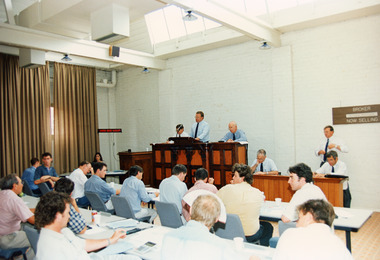
Photograph - Sale Room, National Wool Centre, Geelong, 11 January 1995
... Sale Room, National Wool Centre, Geelong...This photograph shows bidding underway for the million dollar bale in the Sale Room on the 11th January, 1995 at the National Wool Centre, Geelong. People depicted include Sale Team Baxter Murray, Auctioneer Michael Crooks and Wool Manager Keith Jackson. ...Photograph Sale Room, National Wool Centre, Geelong ...This photograph shows bidding underway for the million dollar bale in the Sale Room on the 11th January, 1995 at the National Wool Centre, Geelong. People depicted include Sale Team Baxter Murray, Auctioneer Michael Crooks and Wool Manager Keith Jackson. The wool was shorn from sheep of the Wyndarra and Rockbank bloodlines. A flock of 290 sheep were kept undercover at Kadinia, the property of the Appledore family from Brim in the Wimmera district of Victoria. Their record-breaking wool was produced by giving the sheep a special diet and providing each one with a UV-protective coat. Around 180 fleeces were selected for the million dollar bale. The sale of the first bale of wool measuring below 14 microns was held in the Auction Room here at the National Wool Museum. Bidding began at 40,000 (cents a kilogram) and steadily increased until there were only two bidders left. The bidders represented the Japanese firm Aoki International and Loro Piana of Italy. The hammer fell at 1,030,000 cents per kilogram, with Aoki International paying $1,194,800 for the 116kg bale. The fleece was scoured (cleaned) at the Goulburn Wool Scour, New South Wales. The degree of preparation and care taken with the task was extreme. The Scour closed production three days before and was extensively cleaned. On the day of scouring 12 tonnes of 17 micron wool was washed to condition the water, then nine bales of extra super fine wool, worth over $300,000 was washed as a trial run. Toabo Agaki Japan was employed to process the scoured wool into suit cloth. Taobo required the scoured wool to contain 0.5% residual grease, 12% moisture and a yield of 83kg. These requirements were met. The entire staff of the Scour wanted to be part of washing the best wool in the world. Without asking for payment both the night shift and afternoon shift crews assisted the day shift in the task. The bale was fed into the scour in seven minutes and fitted into three bowls, half the scour. It completely disappeared into the dryer and the last wool was fed before the first wool was out. The clean wool was hand-packed into cardboard cartons and freighted to Japan. Aoki International, based in Yokohama Japan, cut three suit lengths from the cloth, then blended the remaining wool into an exclusive line of commercially-available suits. These suits are labelled Kadinia.Colour photograph showing an interior view of people seated at rows of tables with an auctioneers stand at front of the room.michael crooks, auctioneer, wool industry, million dollar bale, geelong, auction, kadinia, appledore, keith jackson, sale room -
 National Wool Museum
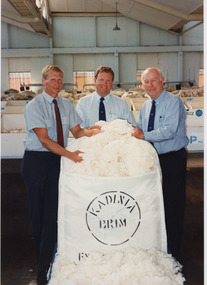
Photograph - Million Dollar Bale, National Wool Centre, Geelong, 11 January 1995
... Million Dollar Bale, National Wool Centre, Geelong...Michael Crooks auctioneer wool industry million dollar bale geelong auction kadinia Appledore Keith Jackson Sale Room Geelong Wool Centre Colour photograph showing three men standing around a bale of wool. Photograph Million Dollar Bale, National Wool Centre, Geelong ...This photograph shows Grower Ian Appledore, Auctioneer Michael Crooks and Wool Manager Keith Jackson posing with the million dollar bale after it was sold on 11th January 1995 in Geelong. The wool was shorn from sheep of the Wyndarra and Rockbank bloodlines. A flock of 290 sheep were kept undercover at Kadinia, the property of the Appledore family from Brim in the Wimmera district of Victoria. Their record-breaking wool was produced by giving the sheep a special diet and providing each one with a UV-protective coat. Around 180 fleeces were selected for the million dollar bale. The sale of the first bale of wool measuring below 14 microns was held in the Auction Room here at the National Wool Museum. Bidding began at 40,000 (cents a kilogram) and steadily increased until there were only two bidders left. The bidders represented the Japanese firm Aoki International and Loro Piana of Italy. The hammer fell at 1,030,000 cents per kilogram, with Aoki International paying $1,194,800 for the 116kg bale. The fleece was scoured (cleaned) at the Goulburn Wool Scour, New South Wales. The degree of preparation and care taken with the task was extreme. The Scour closed production three days before and was extensively cleaned. On the day of scouring 12 tonnes of 17 micron wool was washed to condition the water, then nine bales of extra super fine wool, worth over $300,000 was washed as a trial run. Toabo Agaki Japan was employed to process the scoured wool into suit cloth. Taobo required the scoured wool to contain 0.5% residual grease, 12% moisture and a yield of 83kg. These requirements were met. The entire staff of the Scour wanted to be part of washing the best wool in the world. Without asking for payment both the night shift and afternoon shift crews assisted the day shift in the task. The bale was fed into the scour in seven minutes and fitted into three bowls, half the scour. It completely disappeared into the dryer and the last wool was fed before the first wool was out. The clean wool was hand-packed into cardboard cartons and freighted to Japan. Aoki International, based in Yokohama Japan, cut three suit lengths from the cloth, then blended the remaining wool into an exclusive line of commercially-available suits. These suits are labelled Kadinia.Colour photograph showing three men standing around a bale of wool.michael crooks, auctioneer, wool industry, million dollar bale, geelong, auction, kadinia, appledore, keith jackson, sale room, geelong wool centre -
 National Wool Museum
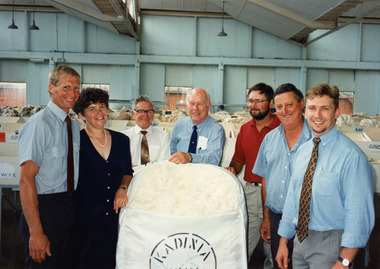
Photograph - Million Dollar Bale, National Wool Centre, Geelong, Gordon Robertson, 11 January 1995
... Million Dollar Bale, National Wool Centre, Geelong...Michael Crooks auctioneer wool industry million dollar bale geelong auction kadinia Appledore Keith Jackson Sale Room Geelong Wool Centre Colour photograph showing three six men and one woman standing around a bale of wool. Photograph Million Dollar Bale, National Wool Centre, Geelong Gordon Robertson ...This photograph shows Growers Ian Appledore, Kaye Appledore and Murray Appledore, Wool Manager Keith Jackson, Wool Classer Phillip Gibson, Geoff Allibon and Brendan Dart posing with the million dollar bale after it was sold on 11th January 1995 in Geelong. The wool was shorn from sheep of the Wyndarra and Rockbank bloodlines. A flock of 290 sheep were kept undercover at Kadinia, the property of the Appledore family from Brim in the Wimmera district of Victoria. Their record-breaking wool was produced by giving the sheep a special diet and providing each one with a UV-protective coat. Around 180 fleeces were selected for the million dollar bale. The sale of the first bale of wool measuring below 14 microns was held in the Auction Room here at the National Wool Museum. Bidding began at 40,000 (cents a kilogram) and steadily increased until there were only two bidders left. The bidders represented the Japanese firm Aoki International and Loro Piana of Italy. The hammer fell at 1,030,000 cents per kilogram, with Aoki International paying $1,194,800 for the 116kg bale. The fleece was scoured (cleaned) at the Goulburn Wool Scour, New South Wales. The degree of preparation and care taken with the task was extreme. The Scour closed production three days before and was extensively cleaned. On the day of scouring 12 tonnes of 17 micron wool was washed to condition the water, then nine bales of extra super fine wool, worth over $300,000 was washed as a trial run. Toabo Agaki Japan was employed to process the scoured wool into suit cloth. Taobo required the scoured wool to contain 0.5% residual grease, 12% moisture and a yield of 83kg. These requirements were met. The entire staff of the Scour wanted to be part of washing the best wool in the world. Without asking for payment both the night shift and afternoon shift crews assisted the day shift in the task. The bale was fed into the scour in seven minutes and fitted into three bowls, half the scour. It completely disappeared into the dryer and the last wool was fed before the first wool was out. The clean wool was hand-packed into cardboard cartons and freighted to Japan. Aoki International, based in Yokohama Japan, cut three suit lengths from the cloth, then blended the remaining wool into an exclusive line of commercially-available suits. These suits are labelled Kadinia.Colour photograph showing three six men and one woman standing around a bale of wool.michael crooks, auctioneer, wool industry, million dollar bale, geelong, auction, kadinia, appledore, keith jackson, sale room, geelong wool centre -
 National Wool Museum
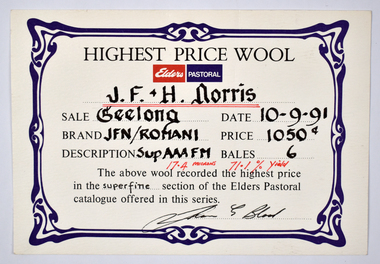
Archive - Prize Certificate, Highest Wool Price, Elders Limited, 10/9/1991
... National Wool Centre, Geelong, Victoria, Australia ...Single sided blue, red, black and white card with printed and hand written text, with decorative border. HIGHEST PRICE WOOL / Elders PASTORAL / J. F. & H Norris / SALE Geelong / DATE 10-9-91 / BRAND JFN/ROMANI / PRICE 1050c / DESCRIPTION SupAAAFM / BALES 6 / 17.4 MICRONS / 71.1% Yield / The above wool recorded the highest price / in the superfine section of the Elders Pastoral / catalogue offered in this series / [signature ? G Blood]wool auction, catalogue, wool bales, sale, wool growing, agriculture, industry, geelong, elders, woolbrokers, prizes -
 National Wool Museum
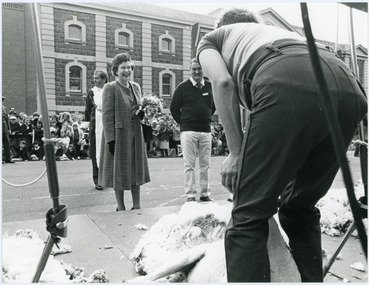
Photograph, Queen Elizabeth II visit to Geelong, 1988
... Wool Centre...Geelong...Queen Elizabeth II...Prince Philip...National...In April Her Majesty Queen Elizabeth II and Prince Philip arrived in Geelong to open the Wool Week Display in the almost complete National Wool Centre. Crowds gathered to welcome the royal couple, wool shearing demonstrations took place outside the centre and “Spud” the sheepdog exhibited his heading talents. ...Two black and white photographs of Her Majesty Queen Elizabeth II, accompanied by the City of Greater Geelong Mayor, Jim Fidge, watching a shearing demonstration by local Geelong shearers outside the then National Wool Centre. Her Majesty Queen Elizabeth II opened the Wool Week Display in the almost complete National Wool Centre during her visit in April 1988.... Wool Centre. bicentenary celebrations Two black and white photographs of Her Majesty Queen Elizabeth II, accompanied by the City of Greater Geelong Mayor, Jim Fidge, watching a shearing demonstration by local Geelong shearers outside the then National Wool Centre. Her Majesty Queen Elizabeth II opened the Wool Week Display in the almost complete National Wool Centre during her visit in April 1988. ...In 1988 Her Majesty Queen Elizabeth II and Prince Philip travelled across Australia to take part in the bicentenary celebrations. In April Her Majesty Queen Elizabeth II and Prince Philip arrived in Geelong to open the Wool Week Display in the almost complete National Wool Centre. Crowds gathered to welcome the royal couple, wool shearing demonstrations took place outside the centre and “Spud” the sheepdog exhibited his heading talents. During their visit to the wool centre they were met by the chairman of the Geelong Regional Commission, Mr Colin Atkins and Mrs Monique Atkins. The Queen was presented with a rug woven by the museums 1910 gripper-type Axminster Jacquard carpet loom and the Duke was presented with a woollen jumper. In return the Queen presented three letters from the archives of the Windsor Castle to the museum. The couple left in the afternoon, charming the Geelong crowd. Two black and white photographs of Her Majesty Queen Elizabeth II, accompanied by the City of Greater Geelong Mayor, Jim Fidge, watching a shearing demonstration by local Geelong shearers outside the then National Wool Centre. Her Majesty Queen Elizabeth II opened the Wool Week Display in the almost complete National Wool Centre during her visit in April 1988.royal visit, wool centre, geelong, queen elizabeth ii, prince philip, national wool centre., bicentenary celebrations -
 National Wool Museum
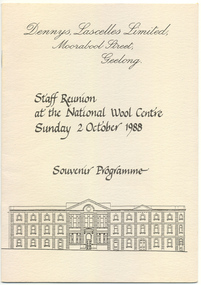
Program, Dennys Lascelles Limited: Staff Reunion at the National Wool Centre 1988
... Dennys Lascelles Limited: Staff Reunion at the National Wool Centre 1988...Dennys Lascelles Limited Judith Laging Program 12pp: soft pale grey cover, contians brief history of the company , the buildings and at the last page is a list of acceptances for the reunion, 2nd October, 1988 Dennys Lascelles Limited: Staff Reunion at the National Wool Centre 1988 Program ...A copy of both the ‘Dennys Lascelles Limited 1857-1957: Annual Wool Report & Centenary Review’ & ‘Staff Reunion Souvenir Programme, 1988’ was donated to the museum in 2021. These were duplicate items so only their story was retained in addition to the image of Rita located in Multimedia. “Enclose two items which may be of interest to add to your collection. They belonged to my mother, Rita Sedgwick (nee Glenn), who died earlier this year in April. She worked for Dennys Lascelles in two separate periods. First as a young girl, who had finished her schooling, at Morongo Presbyterian ladies College, having been sent as boarder there by her parents from their farm at Mathoura (just north of Echuca). This period was from 1942 — 1947. It was her second job out of school having worked first at the then Geelong Telephone Exchange. She would commute daily to work on a bicycle from where she was then living in Drumcondra. She had the front office role of receptionist and telephonist driving an old manual switchboard. The old front desk was her domain. She departed in 1947, shortly after she was married in late 1946. She spoke fondly of her times at the company as a young girl in her late teens and early twenties. Her second stint was much later, but again as the front-desk telephonist and receptionist commencing in 1972, ending 11 years later in 1983. This was a period when Sir Henry Bolte was on the Board, Don Urqhuart was MD, Ray Hobson was General Manger, Cliff Bone the company Secretary, Peter Keys the CFO and Jim Hay was also on the Executive team. While there were some 25 years between her periods of service, she welcomed the chance to re-join the company. Again, it was a time of hard work, and good friends. The busy times were the wool auctions, when the Firm would be visited by representatives of the big Japanese trading houses such as Mitsui, and Kanematsu. The Chief Auctioneer, Mr. Reeves (I can't recall his first name), would hold court at the now demolished Geelong Wool Exchange — I saw him in action once — what a sight. The huge show floors in the Denny's building would be full of open bales and samples for the buyers to inspect, and for mum days would start at 0800, and finish at 1800 or later. In quieter times over summer, it was reported that the empty show floor would provide an excellent arena for the more enthusiastic cricketers to get in a bit of practise with a tennis ball at lunch and after closing time! Dennys was a full-service firm for wool growers, with branches all over the Western Districts as far afield as Mt Gambier, but through Timboon, Warrnambool, and the like, as I am sure you are aware. She also saw the merger of Dennys and Strachan to create DSM, and later the amalgamation with AML&F to create Dennys AML (I think). She saw the change from the old manual switch board to the then latest of PABX technologies and was part of the team the relocated from the original offices to the new address on the south side of Brougham Street. Along with the shift from the large show floor-based sales of the past. She retired from fulltime work in mid-1983, again with fond memories and friendships that lasted a lifetime. I found these two items among her things recently, and felt that given her connection to the industry, and the place in which the Museum now resides you may like to add them to the collection. I hope you can find a home for them, and that they might add a little to the story that the wool museum now houses and curates.” Program 12pp: soft pale grey cover, contians brief history of the company , the buildings and at the last page is a list of acceptances for the reunion, 2nd October, 1988Judith Lagingdennys, lascelles limited -
 National Wool Museum
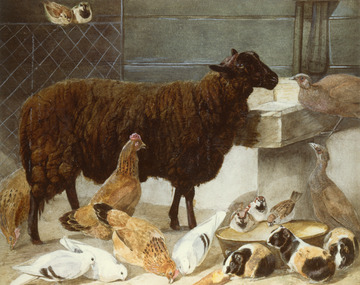
Print, Flora, a Spanish Sheep at Buckingham Palace,1849
... Red leather folder, presented by HRH Elizabeth II on her visit to the National Wool Centre in 1988. Red leather folder, presented by HRH Elizabeth II on her visit to the National Wool Centre in 1988. ...ER/PRESENTED/ TO THE/ NATIONAL WOOL CENTRE/ GEELONG/ BY/ HER MAGESTY THE QUEEN/ 28TH APRIL 1988 "ER"...Reproduction print of "Flora, a Spanish Sheep at Buckingham Palace,1849 ", a watercolour by Frederick Keyl (1823-1871), presented to the National Wool Museum by HRH Queen Elizabeth 11, April 28th, 1988. ER/PRESENTED/ TO THE/ NATIONAL WOOL CENTRE/ GEELONG/ BY/ HER MAGESTY THE QUEEN/ 28TH APRIL 1988 "ER" Red leather folder, presented by HRH Elizabeth II on her visit to the National Wool Centre in 1988. ...Reproduction print of "Flora, a Spanish Sheep at Buckingham Palace,1849 ", a watercolour by Frederick Keyl (1823-1871), presented to the National Wool Museum by HRH Queen Elizabeth 11, April 28th, 1988.Red leather folder, presented by HRH Elizabeth II on her visit to the National Wool Centre in 1988. Red leather folder, presented by HRH Elizabeth II on her visit to the National Wool Centre in 1988. "Flora, a Spanish Sheep at Buckingham Palace,1849 ", print inside presentation folder from HRH Elzabeth II.ER/PRESENTED/ TO THE/ NATIONAL WOOL CENTRE/ GEELONG/ BY/ HER MAGESTY THE QUEEN/ 28TH APRIL 1988 "ER" -
 National Wool Museum
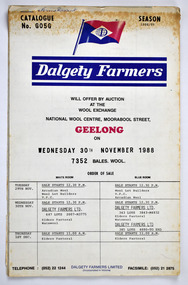
Document - Wool Auction Catalogue, Dalgety Farmers Limited, 1988
... ...National Wool Centre...G05’g / SEASON / 1988/89 / Dalgety Farmers / WILL OFFER BY AUCTION / AT THE / WOOL EXCHANGE / NATIONAL WOOL CENTRE, MOORABOOL STREET, / GEELONG / ON / WEDNESDAY 30TH NOVEMBER 1988 / 7352 BALES. ...Agriculture Wool Sales Dalgety Geelong Wool Exchange National Wool Centre Auction Catalogue front: [printed] CATALOGUE / No. ...Nineteen page double sided paper catalogue held with one staple in the top left corner. Pages are blue, yellow and white with black printed text. Cover shows printed text in blue, red, black and white with Dalgety Farmers banner and logo. front: [printed] CATALOGUE / No. G05’g / SEASON / 1988/89 / Dalgety Farmers / WILL OFFER BY AUCTION / AT THE / WOOL EXCHANGE / NATIONAL WOOL CENTRE, MOORABOOL STREET, / GEELONG / ON / WEDNESDAY 30TH NOVEMBER 1988 / 7352 BALES. WOOL.agriculture, wool, sales, dalgety, geelong, wool exchange, national wool centre, auction, catalogue -
 National Wool Museum
Booklet, Woolclassing. One Hundred Years At The Gordon: Wool, The Gordon's Contribution
... National Wool Centre Geelong, from Bryan Wardle...This booket was reprinted as a book in 1991 with some additions by Bryan Wardle Woolclassing Wool - history Education Cowey Mr Gordon - Gordon Institute of TAFE Wool Department Geelong Heritage Centre Wardle Mr Bryan R. Woolclassing Wool - history Education National Wool Centre Geelong, from Bryan Wardle Woolclassing. ...This booket was reprinted as a book in 1991 with some additions by Bryan WardleNational Wool Centre Geelong, from Bryan Wardlewoolclassing wool - history education, cowey, mr gordon - gordon institute of tafe, wool department geelong heritage centre, wardle, mr bryan r., woolclassing, wool - history, education -
 National Wool Museum
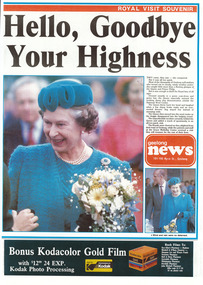
Royal Visit Souvenir, 29th April 1988
... In April Her Majesty Queen Elizabeth II and Prince Philip arrived in Geelong to open the Wool Week Display in the almost complete National Wool Centre. Crowds gathered to welcome the royal couple, wool shearing demonstrations took place outside the centre and “Spud” the sheepdog exhibited his herding talents. ...Souvenir newspaper, relating to Her Majesty Queen Elizabeth II visit to Geelong in April 1988 where she opened the Wool Week Display in the almost complete National Wool Centre....In April Her Majesty Queen Elizabeth II and Prince Philip arrived in Geelong to open the Wool Week Display in the almost complete National Wool Centre. Crowds gathered to welcome the royal couple, wool shearing demonstrations took place outside the centre and “Spud” the sheepdog exhibited his herding talents. ...In 1988 Her Majesty Queen Elizabeth II and Prince Philip travelled across Australia to take part in the bicentenary celebrations. In April Her Majesty Queen Elizabeth II and Prince Philip arrived in Geelong to open the Wool Week Display in the almost complete National Wool Centre. Crowds gathered to welcome the royal couple, wool shearing demonstrations took place outside the centre and “Spud” the sheepdog exhibited his herding talents. During their visit to the wool centre they were met by the chairman of the Geelong Regional Commission, Mr Colin Atkins and Mrs Monique Atkins. The Queen was presented with a rug woven by the museums 1910 gripper-type Axminster Jacquard carpet loom and the Duke was presented with a woollen jumper. In return the Queen presented three letters from the archives of the Windsor Castle to the museum. The couple left in the afternoon, charming the Geelong crowd. Souvenir newspaper, relating to Her Majesty Queen Elizabeth II visit to Geelong in April 1988 where she opened the Wool Week Display in the almost complete National Wool Centre.Front page title: Hello, Goodbye Your Highnessroyal visit -
 National Wool Museum
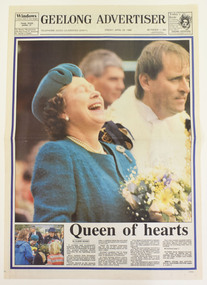
Royal Souvenir Edition, 29/4/1988
... In April Her Majesty Queen Elizabeth II and Prince Philip arrived in Geelong to open the Wool Week Display in the almost complete National Wool Centre. Crowds gathered to welcome the royal couple, wool shearing demonstrations took place outside the centre and “Spud” the sheepdog exhibited his heading talents. ...It contains articles and photographs relating to Her Majesty Queen Elizabeth II visit to Geelong in April 1988 where she opened the Wool Week Display in the almost complete National Wool Centre....In April Her Majesty Queen Elizabeth II and Prince Philip arrived in Geelong to open the Wool Week Display in the almost complete National Wool Centre. Crowds gathered to welcome the royal couple, wool shearing demonstrations took place outside the centre and “Spud” the sheepdog exhibited his heading talents. ...In 1988 Her Majesty Queen Elizabeth II and Prince Philip travelled across Australia to take part in the bicentenary celebrations. In April Her Majesty Queen Elizabeth II and Prince Philip arrived in Geelong to open the Wool Week Display in the almost complete National Wool Centre. Crowds gathered to welcome the royal couple, wool shearing demonstrations took place outside the centre and “Spud” the sheepdog exhibited his heading talents. During their visit to the wool centre they were met by the chairman of the Geelong Regional Commission, Mr Colin Atkins and Mrs Monique Atkins. The Queen was presented with a rug woven by the museums 1910 gripper-type Axminster Jacquard carpet loom and the Duke was presented with a woollen jumper. In return the Queen presented three letters from the archives of the Windsor Castle to the museum. The couple left in the afternoon, charming the Geelong crowd. Souvenir newspaper, consisting of one large rectangular pieces of newsprint folded in half to form two pages. It contains articles and photographs relating to Her Majesty Queen Elizabeth II visit to Geelong in April 1988 where she opened the Wool Week Display in the almost complete National Wool Centre.Front page heading: Queen of heartsroyal visit -
 National Wool Museum
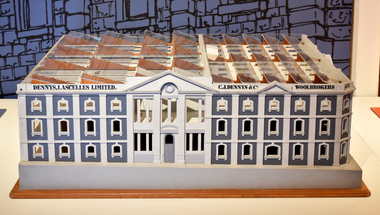
Dennys Lascelles Woolstore Building Model, 1988
... On plaque - 1-50 Scale Model of The Dennys Lascelles Woolstore / Cnr Moorable & Brougham sts, Geelong, Which will house the National Wool Centre - Geelong / The Centre is a project of the Geelong Regional Commission and is Geelongs major bicentinnial celebratons project...On plaque - 1-50 Scale Model of The Dennys Lascelles Woolstore / Cnr Moorable & Brougham sts, Geelong, Which will house the National Wool Centre - Geelong / The Centre is a project of the Geelong Regional Commission and is Geelongs major bicentinnial celebratons project Wooden 1-50 Scale model of the Dennys Lascelles Woolstore Dennys Lascelles Woolstore Building Model ...Wooden 1-50 Scale model of the Dennys Lascelles WoolstoreOn plaque - 1-50 Scale Model of The Dennys Lascelles Woolstore / Cnr Moorable & Brougham sts, Geelong, Which will house the National Wool Centre - Geelong / The Centre is a project of the Geelong Regional Commission and is Geelongs major bicentinnial celebratons project -
 National Wool Museum
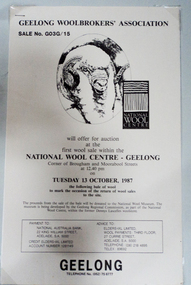
Geelong Woolbrokers' Association auction notice, Geelong Woolbrokers' Association Sale No. G03G/15
... G03G/15 will offer for auction at the first wool sale within the NATIONAL WOOL CENTRE- GEELONG Corner of Brougham and Moorabool Streets at 12:40pm on Tuesday 13 October, 1987 the following bale of wool to mark the...G03G/15 will offer for auction at the first wool sale within the NATIONAL WOOL CENTRE- GEELONG Corner of Brougham and Moorabool Streets at 12:40pm on Tuesday 13 October, 1987 the following bale of wool to mark the Geelong Woolbrokers' Association Sale No. ...Object was on display in museum foyer with other objects from the Queen's visit in 1988, so it was possibly acquired then. Item made in 1987.Geelong Woolbrokers' Association Sale No. G03G/15 will offer for auction at the first wool sale within the NATIONAL WOOL CENTRE- GEELONG Corner of Brougham and Moorabool Streets at 12:40pm on Tuesday 13 October, 1987 the following bale of wool to mark theauction -
 National Wool Museum
Certificate
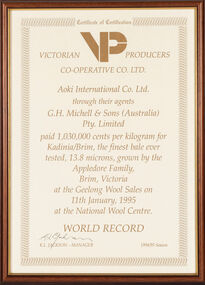
... Certificate commemorating The Geelong Wool Sales at the National Wool Centre 1995 durring which Aoki International paid 1,030,000 cents per kilogram for 13.8 micron wool. ...Certificate commemorating The Geelong Wool Sales at the National Wool Centre 1995 durring which Aoki International paid 1,030,000 cents per kilogram for 13.8 micron wool. ...Certificate commemorating The Geelong Wool Sales at the National Wool Centre 1995 durring which Aoki International paid 1,030,000 cents per kilogram for 13.8 micron wool. Wool was grown by the Appledore Family at Brim Victoria. Aoki International purchased the wool through their agets G.H. Michell & Sons (Australia) Pty. Ltd. Relates to Million Dollar Wool Bale on display in Gallery OneTimber framed certificate with gold inlay and glass covering. Certificate is cream coloured paper with gold printed text and decorative boarder. Hand Signed by K.L. Jackson on bottom left corner. Back of the frame has a horizontal hanging string -
 National Wool Museum
Audio - Wool Auctions, Audio Cassette Tape, 1988
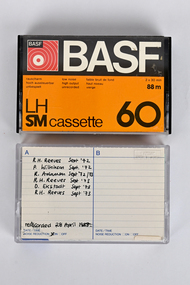
... The tapes were made in 1988 and were used in early exhibition displays when the National Wool Centre which opened in the same year....The tapes were made in 1988 and were used in early exhibition displays when the National Wool Centre which opened in the same year. ...It is believed these tapes contain copies of audio from reel to reel tapes (NWM-9101) containing wool auctions which took place at Dennys Lascelles in Moorabool Street Geelong in 1972 and 1973. The auctioneers featured on the tapes are R. H. Reeves, P. Wilkinson, R. Adamson and D. Ekstadt. The tapes were made in 1988 and were used in early exhibition displays when the National Wool Centre which opened in the same year.Two audio cassette tapes with cardboard inserts in plastic cases. 9102.1 Black audio cassette tape with black, red and orange sticker. Tape has orange, red, black and white card insert and is contained in a black and clear plastic case. The tape sticker has handwritten text. 9102.2 Black audio cassette tape with white, blue and silver sticker. Tape has blue and white card insert and is contained in a clear plastic case. The tape stickers and card insert have hand written text. 9102.1 [handwritten] WOOL AUCTIONS / 9/72 / 9/73 / 1/77 / RHR / PW / RHR / DE / RHR 9101.2 [handwritten] WOOL AUCTION COPY 2. / This cassette is not suitable / for Gall 3 operation TC / R. H. Reeves Sept ’72 / P. Wilkinson Sept ’72 / R. Adamson Sept. ‘72/73 / R. H. Reeves Sept. ’73 / D. Ekstadt Sept. ’73 / R. H. Reeves Sept. ’73 / recorded 28 April 1988 audio, auctions, wool sales, wool auction, dennys lascelles -
 National Wool Museum
Cloth Sample
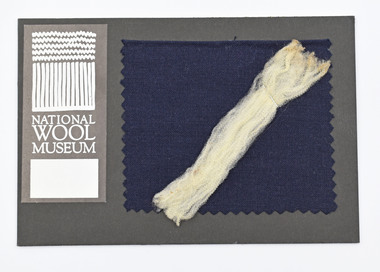
... Made from wool sold atThe Geelong Wool Exchange which had just returned to the National Wool Centre (currently the home of the National Wool Museum, formely Dennys Lascells) on Tuesday 13th of October 1987. ...Made from wool sold atThe Geelong Wool Exchange which had just returned to the National Wool Centre (currently the home of the National Wool Museum, formely Dennys Lascells) on Tuesday 13th of October 1987. ...Made from wool sold atThe Geelong Wool Exchange which had just returned to the National Wool Centre (currently the home of the National Wool Museum, formely Dennys Lascells) on Tuesday 13th of October 1987. Lempriere (Aust.) Pty. Ltd. was the buyer of the first bale of wool who also previously brought the first bale of wool at the first wool auctions in Geelong in 1858. The wool was turned into fabric by CSRIO and Foster Valley.Black cardboard backing with Navy Blue cloth sample glued ontop. Wool sample is stapled to the Navy cloth and black cardboard. Contains Nationa Wool Museum logo on lefthand side 1.5 meter navy blue length of cloth same as the sampled glued to the cardboard is included.NATIONAL/ WOO/ MUSEUM Left hand side of display card -
 Victorian Interpretive Projects Inc.
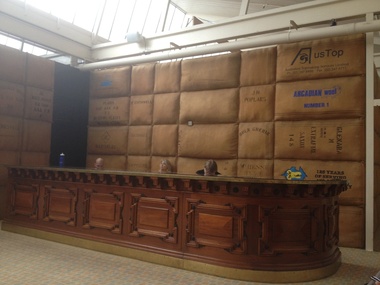
Photograph - colour, Auction Room Lectern at National Wool Museum
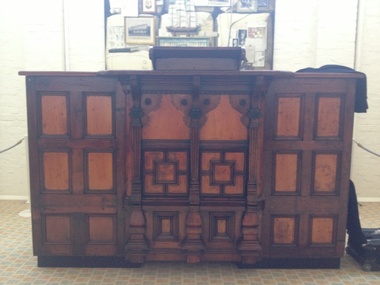
... National Wool Museum, Geelong. Since the arrival of sheep with the First Fleet in 1788, the wool industry has dominated our economy, our agriculture and our reputation as a quality wool-growing nation throughout the world. Geelong is a city synonymous with wool and the wool industry – sheep farming began here in 1835 and the first of many woollen mills opened here in 1868. For many years the city was known as the 'wool centre...National Wool Museum, Geelong. Since the arrival of sheep with the First Fleet in 1788, the wool industry has dominated our economy, our agriculture and our reputation as a quality wool-growing nation throughout the world. Geelong is a city synonymous with wool and the wool industry – sheep farming began here in 1835 and the first of many woollen mills opened here in 1868. For many years the city was known as the 'wool centre ...This photograph on an iPhone 4 during the Museums Australia (Vic) Conference at the National Wool Museum, Geelong. Since the arrival of sheep with the First Fleet in 1788, the wool industry has dominated our economy, our agriculture and our reputation as a quality wool-growing nation throughout the world. Geelong is a city synonymous with wool and the wool industry – sheep farming began here in 1835 and the first of many woollen mills opened here in 1868. For many years the city was known as the 'wool centre of the world'. Two hundred years later, in 1988, the National Wool Museum was established as Australia’s only comprehensive museum of wool. (Since the arrival of sheep with the First Fleet in 1788, the wool industry has dominated our economy, our agriculture and our reputation as a quality wool-growing nation throughout the world. Geelong is a city synonymous with wool and the wool industry – sheep farming began here in 1835 and the first of many woollen mills opened here in 1868. For many years the city was known as the 'wool centre of the world'. Two hundred years later, in 1988, the National Wool Museum was established as Australia’s only comprehensive museum of wool. (Since the arrival of sheep with the First Fleet in 1788, the wool industry has dominated our economy, our agriculture and our reputation as a quality wool-growing nation throughout the world. Geelong is a city synonymous with wool and the wool industry – sheep farming began here in 1835 and the first of many woollen mills opened here in 1868. For many years the city was known as the 'wool centre of the world'. Two hundred years later, in 1988, the National Wool Museum was established as Australia’s only comprehensive museum of wool. (http://www.geelongaustralia.com.au/nwm/about/article/item/8cbcc313afa77a5.aspx)Photograph of a timber lectern used to auction wool in Geelong. It is found in the auction room on the top floor of Geelong's national wool museum.wool, geelong, auction, auction room, national wool museum -
 Victorian Interpretive Projects Inc.
photograph - Colour, Viewing the National Wool Museum's auction room
... National Wool Museum, Geelong. Since the arrival of sheep with the First Fleet in 1788, the wool industry has dominated our economy, our agriculture and our reputation as a quality wool-growing nation throughout the world. Geelong is a city synonymous with wool and the wool industry – sheep farming began here in 1835 and the first of many woollen mills opened here in 1868. For many years the city was known as the 'wool centre...National Wool Museum, Geelong. Since the arrival of sheep with the First Fleet in 1788, the wool industry has dominated our economy, our agriculture and our reputation as a quality wool-growing nation throughout the world. Geelong is a city synonymous with wool and the wool industry – sheep farming began here in 1835 and the first of many woollen mills opened here in 1868. For many years the city was known as the 'wool centre ...This photograph on an iPhone 4 during the Museums Australia (Vic) Conference at the National Wool Museum, Geelong. Since the arrival of sheep with the First Fleet in 1788, the wool industry has dominated our economy, our agriculture and our reputation as a quality wool-growing nation throughout the world. Geelong is a city synonymous with wool and the wool industry – sheep farming began here in 1835 and the first of many woollen mills opened here in 1868. For many years the city was known as the 'wool centre of the world'. Two hundred years later, in 1988, the National Wool Museum was established as Australia’s only comprehensive museum of wool. (Since the arrival of sheep with the First Fleet in 1788, the wool industry has dominated our economy, our agriculture and our reputation as a quality wool-growing nation throughout the world. Geelong is a city synonymous with wool and the wool industry – sheep farming began here in 1835 and the first of many woollen mills opened here in 1868. For many years the city was known as the 'wool centre of the world'. Two hundred years later, in 1988, the National Wool Museum was established as Australia’s only comprehensive museum of wool. (Since the arrival of sheep with the First Fleet in 1788, the wool industry has dominated our economy, our agriculture and our reputation as a quality wool-growing nation throughout the world. Geelong is a city synonymous with wool and the wool industry – sheep farming began here in 1835 and the first of many woollen mills opened here in 1868. For many years the city was known as the 'wool centre of the world'. Two hundred years later, in 1988, the National Wool Museum was established as Australia’s only comprehensive museum of wool. (http://www.geelongaustralia.com.au/nwm/about/article/item/8cbcc313afa77a5.aspx)display of wool ales at the National Wool Museum. Steel girders holding up the roof were made by Dorman Long & Co. Middlesborough, England. In the foreground is a timber counter with brass kick rail and upper edge. Names on wool bales include Austop, Arcadian Wool, Buln Gherin, Mt Hesse, Melrose, Avondale Hills, Kerrsville, Kooringa, Merryville Yass, Sherra Park, Wurrock, Hazeldean, Buanogor Parkwool, geelong, wool bail, auction room, national wool museum -
 National Wool Museum
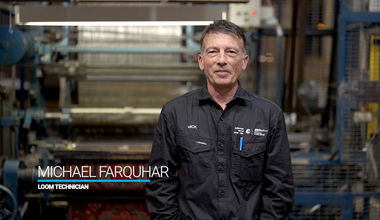
Film - Axminster Carpet Loom with Michael Farquhar, Streamline Media and Communications Group Pty Ltd, 2025
... National Wool Museum. The Axminster Carpet Loom has been set up as a focal point in the centre of the National Wool Museum. ...National Wool Museum. The Axminster Carpet Loom has been set up as a focal point in the centre of the National Wool Museum. ...This film features Loom Technician Michael Farquhar demonstrating how the Axminster Carpet Loom works, at the National Wool Museum. The Axminster Carpet Loom has been set up as a focal point in the centre of the National Wool Museum. The loom was originally built by Brintons in England around 1910 and was initially operating in Geelong in 1960. Brintons designed and built most of their own looms and ancillary equipment. When superseded in 1975 the loom was donated to the Melbourne College of Textiles for weaving training. The College has now donated the loom to the National Wool Museum and Brintons engineering staff has restored it to full working condition. This loom is known as an Axminster gripper loom. The gripper system was invented by Brintons in 1890 and operates using a gripper shaped like a bird's beak. This grips the yarn, the yarn is then cut and the gripper swings down to place the tuft into the woven backing. This particular loom also uses a jacquard system for weaving colours. In jacquard weaving, punched cards are used to instruct the loom as to which colour to use. The system was invented by Joseph Jacquard, a silk weaver from Lyon, and was introduced in 1804. It revolutionised pattern weaving as it had the capacity to create intricate patterns through the use of the cards. By 1833 there were approximately 100,000 power-looms used in Great Britain that had been influenced by Jacquard's invention. Joseph Jacquard died in 1834. Charles Babbage was later to adapt Jacquard's punch-card system to produce a calculator that was the forerunner of todays methods of computer programming.Digital film featuring colour footage, audio and animated graphics. michael farquhar, loom technician, axminster carpet loom, brintons, geelong, textile industry, machinery, weaving, restoration, gripper, jacquard, punch cards -
 National Wool Museum
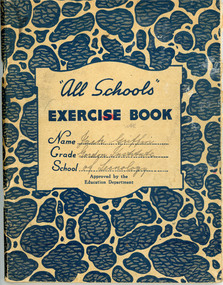
Book - Wool Classing Note Books, John Griffin, 1941-1943
... wool industry training centre. Early specialist short courses were offered around Victoria to assist wool growers in preparing their clip for market, with modules on sheep breeding and pasture development included in the programs. Anne Griffin’s, John’s daughter, donated the exercise books to the National...wool industry training centre. Early specialist short courses were offered around Victoria to assist wool growers in preparing their clip for market, with modules on sheep breeding and pasture development included in the programs. Anne Griffin’s, John’s daughter, donated the exercise books to the National ...John Griffin’s wool classing exercise books from 1941-1943 when he was a student at the Gordon Institute in Geelong. John and his father John Henry Griffin owned a farm in Dunkeld and bred fine merino wool. One year they topped the wool sales figures for the area, in the late 1940s. There are four books in total. One book is on the topic of Veterinary Science and is from 1941. It contains information on topics such as birth and early lamb life, bone structure and other internal organisms of a sheep, such as the heart. Another book is on Wool Classing with topics such as wool scouring, dipping, shearing and micron counts. The third book is on general shearing shed knowledge. This includes a diagram for rolling a fleece, correct method for stamping a wool bale and branding abbreviations. The final book is on the History the Merino Sheep. It is a long form essay answer booklet. The Gordon institute and wool are synonymous with one another, the first class in wool sorting was offered at the Gordon in 1891. With much of the wool clip sent directly to England at this time, The Gordon's focus soon shifted to wool classing and marketing. By the 1930s, The Gordon's wool school was renowned as the state's wool industry training centre. Early specialist short courses were offered around Victoria to assist wool growers in preparing their clip for market, with modules on sheep breeding and pasture development included in the programs. Anne Griffin’s, John’s daughter, donated the exercise books to the National Wool Museum in 2021. Book 1 is predominately blue circular cover with cream background. Middle of book has pink highlighter mark. Reverse of book has an Arithmetical Table and a Multiplication Table in a blue ink on cream paper. It also has four black ink markings Book 2 is predominately blue circular cover with cream background. Book has red tape across the spine. Reverse of book has an Arithmetical Table and a Multiplication Table in a blue ink on cream paper. Book 3 is predominately blue plaid cover with cream background. Middle of book has pink highlighter handwriting which has been crossed with the same colour, leaving the text unreadable. Reverse of book has an Arithmetical Table and a Multiplication Table in a blue ink on cream paper. Book 4 is predominately blue diagonal striped book with cream background. Middle of book has small picture of Australia. Reverse of book has an Arithmetical Table and a Multiplication Table in a blue ink on cream paper. Book 1. Front cover: “All Schools” / EXERCISE BOOK / NAME Jack Griffin Grade Gordon Institute School of Technology(?) / Approved by the / Education Department Back cover. Reverse. ARTHMETICAL TABLES / (Numerous, see media) Book 2. Front cover: 2nd & 3rd / “All Schools” / EXERCISE BOOK / Name Jack Griffin / Grade 2 / School the Gordon / Approved by the / Education Department Back cover. Reverse. ARTHMETICAL TABLES / (Numerous, see media) Book 3. Front cover: Embassy / EXERCUSE BOOK / Name John Griffin / Grade 1 / School (?) / APPROVED BY THE EDUCATION DEPARTMENT / Back cover. Reverse. ARTHMETICAL TABLES / (Numerous, see media) Book 4. Front cover: EXERCISE / APPROVED BY EDUCATION DEPT. / BOOK / NAME Jack Griffin / GRADE 3 / SCHOOL Gordon Back cover. Reverse. ARTHMETICAL TABLES / (Numerous, see media) gordon institute geelong, wool classing, 1940s sheep farming, note book, study, student -
 National Wool Museum
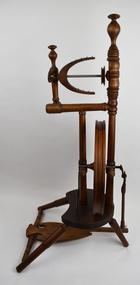
Functional object - Spinning Wheel, Philip Elford, 1976-7
... National Institute of Dramatic Art. My parents had moved to Lake Bunga, a few kilometers north of Lakes Entrance (Victoria). On my first holiday visit to Bunga, I called into the Jolly Jumbuck Country Craft Centre in Bairnsdale http://jumbukwool.com.au/history. I was entranced by the place and spent the following weeks learning to spin lumpy wool...National Institute of Dramatic Art. My parents had moved to Lake Bunga, a few kilometers north of Lakes Entrance (Victoria). On my first holiday visit to Bunga, I called into the Jolly Jumbuck Country Craft Centre in Bairnsdale http://jumbukwool.com.au/history. I was entranced by the place and spent the following weeks learning to spin lumpy wool ...Jackie Kerin's (donor's) story. In 1973, I was in my late teens and while I’d moved to Sydney from Melbourne, to begin my first year of drama studies at the National Institute of Dramatic Art. My parents had moved to Lake Bunga, a few kilometers north of Lakes Entrance (Victoria). On my first holiday visit to Bunga, I called into the Jolly Jumbuck Country Craft Centre in Bairnsdale http://jumbukwool.com.au/history. I was entranced by the place and spent the following weeks learning to spin lumpy wool on an Ashford Wheel. By the end of the holidays, I had my own Ashford and it travelled with me back to Sydney. After graduation, I returned to Melbourne and the hippy “back to nature” movement was in full swing; there were many shops and galleries selling handmade woollen items and pottery etc. So I found an outlet for my pieces. Sometime in 1976-77, I met a spinner and weaver of Swiss origin (I think) – her name was Ingeborg Guber (not sure of the spelling). She had a small gallery/shop at Brighton Beach where she worked, with her pet duck for company. Ingeborg had an upright Philip Elford wheel; an Australian wheel crafted from Acacia melanoxylon (blackwood). I was smitten and ordered one. I have a memory of Philip driving to Hampton from Ballarat to make the delivery. I used this wheel for years but as time and enthusiasm for spinning waned, the wheel became a decorative item in the house. Then in the 90s, and with my drama training, I set myself up travelling to schools and festivals, museums and galleries as a storyteller. The spinning wheel had a new life accompanying me on my adventures. For many children, familiar with references to spinning in fairy tales, seeing the little Philip Elford upright was magical. The wheel was donated to the National Wool Museum in 2021.Vertical tripod leg spinning wheel. 6 spoke wheel with three bobbins. Inscription “Philip Elford Ballart” can be read in gold text stamped to the base of the wheel. Wording, stamped, gold. Philip / Elford / Ballartspinning wheel, textile production, hobby textiles, aciacia melanoxylon (blackwood) -
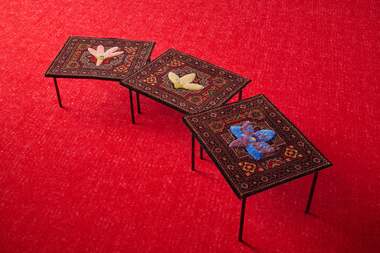 National Wool Museum
Textile - Orchid Tables, Dowel Jones, 2024
... wool and placed in the centre of each rug. The rugs have been attached by cotton thread to three table frames at different heights to create the Orchid Tables. Dowel Jones Ten Years of Dowel Jones National ...The Orchid Tables were on display as part of the Ten Years of Dowel Jones exhibition at the National Wool Museum in 2024. The exhibition label reads: Sitting just outside this exhibition in the National Wool Museum is a 1910 Axminster Jacquard Carpet Loom. This loom was operating at Brintons factory in Geelong from 1960 to 1975, and then at the Melbourne College of Textiles, until it was donated to the museum. In the 1990's the museum commissioned an exclusive pattern called the Manor House Rug. Based on earlier designs from Brintons UK Persian Rug Archive Library, the museum continues to make this rug through the expertise of Loom Technician Michael Farquhar. The Manor House Rug features a central medallion with floral pattern. Working with illustrator Beci Orpin, and referencing Margaret MacDonald & Angair's book 'Orchids of the Anglesea District', we identified regional orchids. By a process of removal and addition, the original floral medallion was replaced with local species as decorative motif. Ten Year of Dowel Jones presents three altered Manor House Rugs, each with different orchids tufted in wool and placed in the centre of each rug. The rugs have been attached by cotton thread to three table frames at different heights to create the Orchid Tables.Three tables consisting of powder coated steel frames, with a woven carpet top. The table tops are made from wool with a jute backing, and feature a red, green, blue, black and cream floral design with an orchid in the centre. Each table is a different height.dowel jones, ten years of dowel jones, national wool museum, axminster loom, carpet, manor house rug, orchids, anglesea, design, art, furniture, beci orpin, brintons, geelong, melbourne college of textiles
