
Showing 29 items matching "native shrubs"
-
 University of Melbourne, Burnley Campus Archives
Document, A.J. Plumridge, Notes on cuttings of native shrubs, 20.03.1968
... Notes on cuttings of native shrubs......native shrubs...Three pages of handwritten notes on taking cuttings from native shrubs by A. J. Plumridge. 20.03.1968....Handwritten Notes on taking cuttings of native shrubs by A.J. Plumridge (Staff) 20.3.68...Three pages of handwritten notes on taking cuttings from native shrubs by A. J. Plumridge. 20.03.1968. a.j. plumridge horticultural note taking gardening cuttings native shrubs Handwritten Notes on taking cuttings of native shrubs by A.J. ...Three pages of handwritten notes on taking cuttings from native shrubs by A. J. Plumridge. 20.03.1968.Handwritten Notes on taking cuttings of native shrubs by A.J. Plumridge (Staff) 20.3.68a.j. plumridge, horticultural note taking, gardening, cuttings, native shrubs -
 Beechworth Honey Archive
Publication, The use of locally-native trees & shrubs in the southern Riverina (Driver, M. & Porteners, M.), Deniliquin, 1996, 1996
... The use of locally-native trees & shrubs in the southern Riverina (Driver, M. & Porteners, M.), Deniliquin, 1996...The use of locally-native trees & shrubs in the southern Riverina (Driver, M. & Porteners, M.), Deniliquin, 1996 Publication ... -
 Beechworth Honey Archive
Publication, The use of locally-native trees & shrubs in the southern Riverina (Driver, M. & Porteners, M.), Deniliquin, 1996, 1996
... The use of locally-native trees & shrubs in the southern Riverina (Driver, M. & Porteners, M.), Deniliquin, 1996...The use of locally-native trees & shrubs in the southern Riverina (Driver, M. & Porteners, M.), Deniliquin, 1996 Publication ... -
 Victorian Aboriginal Corporation for Languages
Book, Leon Costermans, Native trees and shrubs of South-eastern Australia, 1998
... Native trees and shrubs of South-eastern Australia...plants botany NSW Victoria South Australia Colour photographs, illustrations, maps Coloured photos and detailed line drawings are used to give a very clear description of the specific plants and details of their locations and environments. Native trees and shrubs of South-eastern Australia Book Leon Costermans ...Coloured photos and detailed line drawings are used to give a very clear description of the specific plants and details of their locations and environments.Colour photographs, illustrations, mapsplants, botany, nsw, victoria, south australia -
 Wooragee Landcare Group
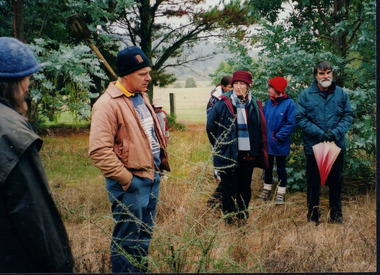
Photograph, 20th June 2004
... ...native trees and shrubs...It was addressed to all local residents and landholders in the area and involved practical demonstration of techniques suitable for successful planting of native trees and shrubs, as well as information about weed control. ...It was addressed to all local residents and landholders in the area and involved practical demonstration of techniques suitable for successful planting of native trees and shrubs, as well as information about weed control. ...This photograph was taken on the 20th June 2004 as part of an event called "Successful Tree Planting!", organised by the Wooragee Landcare Group. It was addressed to all local residents and landholders in the area and involved practical demonstration of techniques suitable for successful planting of native trees and shrubs, as well as information about weed control. In the photograph are illustrated from left to right the following people: Chris Robinson; Tony Prowse; unknown child; Lesley Finedon; Ann Henderson, unknown. Revegetation can improve the condition of remnant vegetation in the area and provide habitat for local animals. Correct species selection, including all layers of vegetation, along with proper weather conditions and adequate site preparation, can maximise the successful outcome. Weed-free conditions and protection from rabbits and kangaroos are two more factors contributing to a quick plant growth. Wooragee Landcare, since its establishment in 1998, has organised a series of events and activities in order to promote weed and pest control, provide assistance and knowledge to landholders and ensure sustainability and protection of natural vegetation.The photograph is an example of the type of events and activities organised by Wooragee Landcare to educate and inform local residents and landholders on the most suitable techniques for successful planting of native trees and shrubs. Wooragee Landcare, abiding by its mission statement, promotes best land management strategies and ensures sustainability through collaboration with local community and council agencies.Landscape coloured photograph printed on gloss paper. Reverse: WAN NA 0ANA0N0 BN1+ 1 1636/ [PRINTED] (No.21)/935/successful tree planting, wooragee landcare group, 20th june 2004, successful planting, native trees and shrubs, weed control, revegetation, remnant vegetation, habitat, local animals, species selection, weather conditions, site preparation, weed-free, rabbits, kangaroos, plant growth, 1998, sustainability, natural vegetation -
 University of Melbourne, Burnley Campus Archives
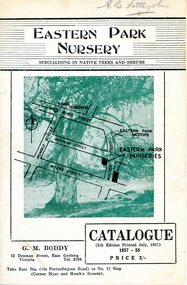
Booklet - Catalogue, G.M. Boddy, Eastern Park Nursery Catalogue, 1957
... shrubs...australian native plants...Catalogue of native trees and shrubs from nursery of G.M. Boddy, East Geelong, specialising in Native trees and shrubs...trees shrubs australian native plants g.m. boddy eastern park nursery geelong catalogue Catalogue of native trees and shrubs from nursery of G.M. ...Catalogue of native trees and shrubs from nursery of G.M. Boddy, East Geelong, specialising in Native trees and shrubstrees, shrubs, australian native plants, g.m. boddy, eastern park nursery geelong, catalogue -
 Whitehorse Historical Society Inc.
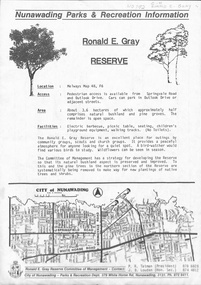
Map, Ronald E. Gray Reserve, n.d
... Strategy of Committee of Management for development of reserve including planting of native trees and shrubs....parks and reserves outlook drive nunawading springvale road ashwood drive olwen street tatman r. r louden j. b. gray ronald e r. e. gray reserve Strategy of Committee of Management for development of reserve including planting of native trees and shrubs. Ronald E. Gray Reserve Map Map ...Strategy of Committee of Management for development of reserve including planting of native trees and shrubs.parks and reserves, outlook drive, nunawading, springvale road, ashwood drive, olwen street, tatman, r. r, louden, j. b., gray, ronald e, r. e. gray reserve -
Whitehorse Historical Society Inc.
Article, Mueller's name on many plants, 1964
... His name is found in the name of some 80 native trees and shrubs....His name is found in the name of some 80 native trees and shrubs....His name is found in the name of some 80 native trees and shrubs. Mueller's name on many plants Article Article ...Article on the history of Ferdinand von Mueller.Article on the history of Ferdinand von Mueller. He arrived in Adelaide in 1847 (had a PhD from Kiel University). He came to Melbourne in 1853 and was appointed the State's first official botanist. He was the first white man to climb Mt Buller and Mt Buffalo. Apart from his activities with the Melbourne Botanical Gardens he was Government Botanist for 43 years. His name is found in the name of some 80 native trees and shrubs.Article on the history of Ferdinand von Mueller. plants, von mueller, ferdinand, dallachy, john, melbourne botanical gardens -
 Eltham District Historical Society Inc
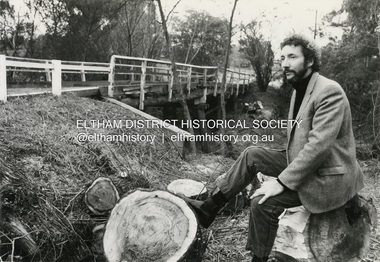
Photograph - Newspaper article, Jo Chandler, Call for council to stop 'the chop', 1989
... In conjunction with the removal council planned to replant the area around the bridge with suitable native shrubs. Jim Connor was hoping to raise awareness of following a policy of gradual removal of such trees over a period of time that overlapped the establishment of new plantings so that their removal would not be such a sudden change....In conjunction with the removal council planned to replant the area around the bridge with suitable native shrubs. Jim Connor was hoping to raise awareness of following a policy of gradual removal of such trees over a period of time that overlapped the establishment of new plantings so that their removal would not be such a sudden change. ...Local Eltham resident Jim Connor highlighted the sudden loss of several Willow trees that shrouded the old wooden Brougham Street bridge. These were removed in 1989 by the Shire of Eltham Department of Parks and Environment as part of ensuring clearnce to powerlines. The department manager, John Galea said that cutting down trees ran contrary to the environment unit's philosophy but was necessary where trees interfere with wires. The MMBW also had an ongoing plan to clear willows from waterways. In conjunction with the removal council planned to replant the area around the bridge with suitable native shrubs. Jim Connor was hoping to raise awareness of following a policy of gradual removal of such trees over a period of time that overlapped the establishment of new plantings so that their removal would not be such a sudden change.jim connor, shire of eltham, parks and environment, mmbw, brougham street bridge, significant trees, john galea, power lines, jim connor collection -
 Lakes Entrance Historical Society
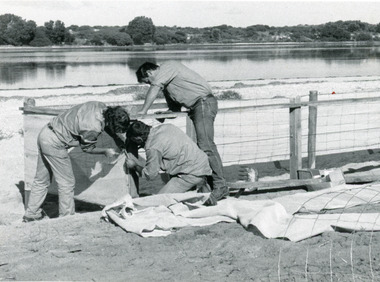
Photograph - Cunninghame Arm. beautification Lakes Entrance Victoria 1991, Lakes Post Newspaper
... It shows three men building a shelter fence, to protect proposed plantings of native trees and shrubs. Lakes Entrance Victoria...It shows three men building a shelter fence, to protect proposed plantings of native trees and shrubs. Lakes Entrance Victoria Photograph Cunninghame Arm. beautification Lakes Entrance Victoria 1991 Lakes Post Newspaper ...Black and white photograph of work in progress during the development of the recreational area beside Cunninghame Arm. It shows three men building a shelter fence, to protect proposed plantings of native trees and shrubs. Lakes Entrance Victoria vegetation, waterfront -
 Federation University Historical Collection
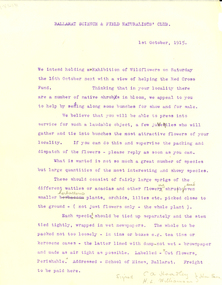
Document - Correspondence, Ballarat Science and Field Naturalists Club Wildflower Exhibition, 1915, 07828.1; 1st 0ctober 1915. 07828.2; 8th September 1916
... Thinking that in your locality there are a number of native shrubs in bloom, we appeal to you to help by sending along some bunches for show and sale. ... .2) THE BALLARAT SCIENCE AND FIELD NATUALISTS' CLUB 8th September, 1916 Dear ................................... ...Thinking that in your locality there are a number of native shrubs in bloom, we appeal to you to help by sending along some bunches for show and sale. ... .2) THE BALLARAT SCIENCE AND FIELD NATUALISTS' CLUB 8th September, 1916 Dear ................................... ...The Ballarat Scinece and Field Natualists' Club was closely associated with the Ballarat School of Mines. Two typed carbon copied letters from the Ballarat Science and Field Naturalists Club regarding wild flower exhibitions. .1) dated 1st October 1915 and signed C. A. Hoadley and H. L. Williamson (Honorary Secretaries). .2) dated 8th September 1916 and signed W. H. Collyer and H. B. Williamson (Honorary Secretaries). Letters describe the picking, packaging and delivery of flowers for the show..1) THE BALLARAT SCIENCE & FIELD NATUALISTS' CLUB 1st October, 1915 We intend holding an Exhibition fo Woldflowers on Saturday the 16th October next with a view of helping the Red Cross Fund. Thinking that in your locality there are a number of native shrubs in bloom, we appeal to you to help by sending along some bunches for show and sale. ... .2) THE BALLARAT SCIENCE AND FIELD NATUALISTS' CLUB 8th September, 1916 Dear ................................... Encourage by the interest in our Wild-floweres Show held in October last yer, and mindful of the fact that our efforts resulted in a substantial ampint being raised for the Red Cross fund, we have decided to hold another Exhibition on the 7th October next, in aid of the same Fund and the Lady Mayoress' League. May we hope for help from you in sending boxes of blooms for show and sale? It may be that you were one of our contributers last year. ... charles hoadley, c. a. hoadley, h. l. williamson, h. b. williamson, smb, ballarat school of mines, ballarat science and field naturalists club, flora, wattles, acacias, herbaceous plants, orchids, lilies -
 Whitehorse Historical Society Inc.
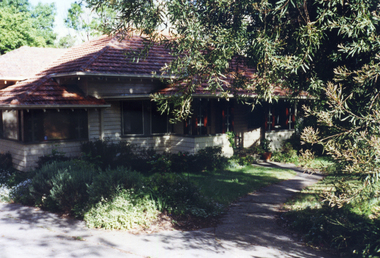
Photograph, 443 Mitcham Road, Mitcham, 1998
... The land was a grass paddock and he planted native trees and shrubs around the perimeter. The Webbs has three children: Eric, Dean and Donald. ...The land was a grass paddock and he planted native trees and shrubs around the perimeter. The Webbs has three children: Eric, Dean and Donald. ...Eric Roger Webb moved to Mitcham with his family in about 1932. They lived at 443 Mitcham Road and owned all the land up to Simpson Street. The land was a grass paddock and he planted native trees and shrubs around the perimeter. The Webbs has three children: Eric, Dean and Donald. Mr Webb worked in the public service. He was a councillor of the Shire of Blackburn and Mitcham and later of the city of Nunawading between 1940 and 1949. He was also a Shire President from 1943-1944.Coloured photograph of a house at 443 Mitcham Road, Mitcham. Tiled roof, verandah, path leading to front door.443 mitcham road, mitcham, houses, webb, eric -
 Wooragee Landcare Group
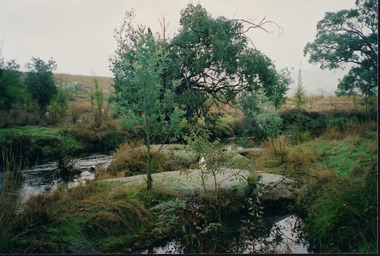
Photograph, 20th June 2004
... Maintaining and reforesting native trees, shrubs and grasses are really important for a variety of reasons, including creating native habitat and food for birds and other animals, shade, biodiversity, visual appeal, cooling, shade for urban areas, sequestering carbon and conservation among other considerations. ...Maintaining and reforesting native trees, shrubs and grasses are really important for a variety of reasons, including creating native habitat and food for birds and other animals, shade, biodiversity, visual appeal, cooling, shade for urban areas, sequestering carbon and conservation among other considerations. ...Photo of streamside planting and rehabilitation at Bev DeJong and Bob Dunnett's place during a paddock demonstration and tree planting field day, called 'Really Successful Tree Planting!' run by Wooragee Landcare on Sunday 20th June 2004. Maintaining and reforesting native trees, shrubs and grasses are really important for a variety of reasons, including creating native habitat and food for birds and other animals, shade, biodiversity, visual appeal, cooling, shade for urban areas, sequestering carbon and conservation among other considerations. The planting must be consistent with the particular needs of the environment, such as trees or shrubs which would naturally occur and are native to the area. Tree planting demonstrations such as this one run by the Landcare Group ensures that the projects are being managed consistently with an overarching commitment to land protection and management and the best methods for best outcomes are employed.This photograph is significant as it provides evidence of a project undertaken by the Wooragee Landcare Group to educate themselves and members of the public on successful techniques needed to plant and maintain trees for replanting in the Wooragee area. The Wooragee Landcare Group has been instrumental in the co-ordination of programs relating to biodiversity protection in the local area, providing great assistance to landholders.Landscape coloured photograph printed on gloss paperReverse: WAN NA 0ANA2N0 AN1 0 1636 / [PRINTED] (No.25) / 938wooragee landcare, wooragee landcare group, beechworth, landcare group, wooragee, tree planting, successful tree planting, demonstration, paddock demonstration, tree planting field day, really successful tree planting, land protection and management, land management, native trees, conservation, streamside, streamside planting -
 Wooragee Landcare Group
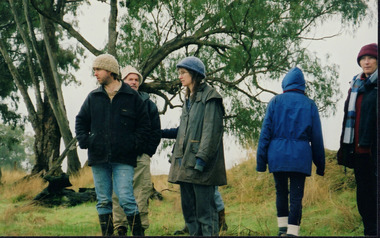
Photograph, 20 June 2004
... Maintaining and reforesting native trees, shrubs and grasses are really important for a variety of reasons, including creating native habitat and food for birds and other animals, shade, biodiversity, visual appeal, cooling, shade for urban areas, sequestering carbon and conservation among other considerations. ...Maintaining and reforesting native trees, shrubs and grasses are really important for a variety of reasons, including creating native habitat and food for birds and other animals, shade, biodiversity, visual appeal, cooling, shade for urban areas, sequestering carbon and conservation among other considerations. ...Photo shows, (L-R): Luke Bayley; Ray Henderson; Chris Robinson; Ann Henderson; Lesley Finedon, assessing successful stream side rehabilitation at Bev DeJong and Bob Dunnett's place during a paddock demonstration and tree planting field day, called 'Really Successful Tree Planting!' run by Wooragee Landcare on Sunday 20th June 2004. Maintaining and reforesting native trees, shrubs and grasses are really important for a variety of reasons, including creating native habitat and food for birds and other animals, shade, biodiversity, visual appeal, cooling, shade for urban areas, sequestering carbon and conservation among other considerations. The planting must be consistent with the particular needs of the environment, such as trees or shrubs which would naturally occur and are native to the area. Tree planting demonstrations such as this one run by the Landcare Group ensures that the projects are being managed consistently with an overarching commitment to land protection and management and the best methods for best outcomes are employed.This photograph is significant as it provides evidence of a project undertaken by the Wooragee Landcare Group to educate themselves and members of the public on successful techniques needed to plant and maintain trees for replanting in the Wooragee area. The Wooragee Landcare Group has been instrumental in the co-ordination of programs relating to biodiversity protection in the local area, providing great assistance to landholders.Landscape coloured photograph printed on gloss paper.Reverse: WAN NA 0ANA2N0 NNN-1 1636/ [PRINTED] (No.23)/936/wooragee landcare, wooragee landcare group, beechworth, landcare group, wooragee, tree planting, successful tree planting, demonstration, paddock demonstration, tree planting field day, really successful tree planting, land protection and management, land management, native trees, conservation -
 Wooragee Landcare Group
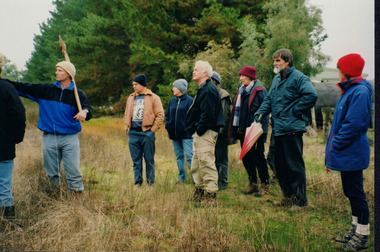
Photograph, 20th June 2004
... Maintaining and reforesting native trees, shrubs and grasses are really important for a variety of reasons, including creating native habitat and food for birds and other animals, shade, biodiversity, visual appeal, cooling, shade for urban areas, sequestering carbon and conservation among other considerations. ...Maintaining and reforesting native trees, shrubs and grasses are really important for a variety of reasons, including creating native habitat and food for birds and other animals, shade, biodiversity, visual appeal, cooling, shade for urban areas, sequestering carbon and conservation among other considerations. ...Photo shows (L-R) Bob Dunnett; Tony Prowse; Mary Prowse; Ray Henderson; unknown; Lesley Finedon; unknown; unknown assessing successful stream side rehabilitation at Bev DeJong and Bob Dunnett's place during a paddock demonstration and tree planting field day, called 'Really Successful Tree Planting!' run by Wooragee Landcare on Sunday 20th June 2004. Maintaining and reforesting native trees, shrubs and grasses are really important for a variety of reasons, including creating native habitat and food for birds and other animals, shade, biodiversity, visual appeal, cooling, shade for urban areas, sequestering carbon and conservation among other considerations. The planting must be consistent with the particular needs of the environment, such as trees or shrubs which would naturally occur and are native to the area. Tree planting demonstrations such as this one run by the Landcare Group ensures that the projects are being managed consistently with an overarching commitment to land protection and management and the best methods for best outcomes are employed. This photograph is significant as it provides evidence of a project undertaken by the Wooragee Landcare Group to educate themselves and members of the public on successful techniques needed to plant and maintain trees for replanting in the Wooragee area. The Wooragee Landcare Group has been instrumental in the co-ordination of programs relating to biodiversity protection in the local area, providing great assistance to landholders.Landscape coloured photograph printed on gloss paperReverse: WAN NA 0ANA2N0 NNN+ 1 1636 / [PRINTED] (No.19) / 933wooragee landcare, wooragee landcare group, beechworth, landcare group, wooragee, tree planting, successful tree planting, demonstration, paddock demonstration, tree planting field day, really successful tree planting, land protection and management, land management, native trees, conservation -
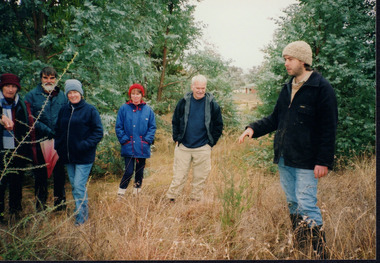 Wooragee Landcare Group
Photograph, 20th June 2004
... Maintaining and reforesting native trees, shrubs and grasses are really important for a variety of reasons, including creating native habitat and food for birds and other animals, shade, biodiversity, visual appeal, cooling, shade for urban areas, sequestering carbon and conservation among other considerations. ...Maintaining and reforesting native trees, shrubs and grasses are really important for a variety of reasons, including creating native habitat and food for birds and other animals, shade, biodiversity, visual appeal, cooling, shade for urban areas, sequestering carbon and conservation among other considerations. ...Photo shows, (L-R): Lesley Finedon; unknown; Mary Prowse; Ann Henderson; Ray Henderson; Luke Bayley (North East CMA), assessing successful stream side rehabilitation at Bev DeJong and Bob Dunnett's place during a paddock demonstration and tree planting field day, called 'Really Successful Tree Planting!' run by Wooragee Landcare on Sunday 20th June 2004. Maintaining and reforesting native trees, shrubs and grasses are really important for a variety of reasons, including creating native habitat and food for birds and other animals, shade, biodiversity, visual appeal, cooling, shade for urban areas, sequestering carbon and conservation among other considerations. The planting must be consistent with the particular needs of the environment, such as trees or shrubs which would naturally occur and are native to the area. Tree planting demonstrations such as this one run by the Landcare Group ensures that the projects are being managed consistently with an overarching commitment to land protection and management and the best methods for best outcomes are employed.This photograph is significant as it provides evidence of a project undertaken by the Wooragee Landcare Group to educate themselves and members of the public on successful techniques needed to plant and maintain trees for replanting in the Wooragee area. The Wooragee Landcare Group has been instrumental in the co-ordination of programs relating to biodiversity protection in the local area, providing great assistance to landholders.WAN NA 0ANAON0 ANN+ 1 1636 / [PRINTED] (No.20) / 934wooragee landcare, wooragee landcare group, beechworth, landcare group, wooragee, tree planting, successful tree planting, demonstration, paddock demonstration, tree planting field day, really successful tree planting, land protection and management, land management, native trees, conservation -
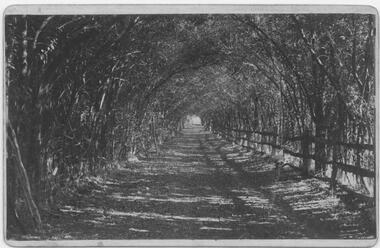 Bacchus Marsh & District Historical Society
Photograph, Osage Orange Avenue Taverner Street Bacchus Marsh
... Osage orange trees (Maclura pomifera) are a small deciduous tree or large shrub, native to the south-central United States. ...Osage orange trees (Maclura pomifera) are a small deciduous tree or large shrub, native to the south-central United States. ...A.C. (Arthur Charles) Simon a pioneer orchardist in the Bacchus Marsh district planted this avenue of Osage orange trees in about 1883, creating an imposing entrance to his property from Taverner Street. Simon also believed that the trees on his orchard property would provide a protective shelter for his other plants. Osage orange trees (Maclura pomifera) are a small deciduous tree or large shrub, native to the south-central United States. It usually grows to about 8 to 15 metres high. The distinctive fruit, a multiple fruit that resembles an immature orange, is roughly spherical in shape, about 8 to 15 centimetres in diameter, and turns bright yellow-green in the autumn. A. C. Simon is believed to have imported the Osage orange seeds from America around the 1860s and later used them to plant the trees depicted in this image. The date of this image is not certain but it probably shows the trees around the 1900s or 1910s. The avenue of trees was known for many years in Bacchus Mars as 'Simons Avenue', and were featured in a Rose series postcard dating from around 1900-1920. The remnants of this avenue or grove of trees can be seen on some of the properties on the north side of Taverner Street Bacchus Marsh and along the Werribee River west of the FIsken Street bridge.The Bacchus Marsh Heritage Study of 1995 described the Osage Orange Tree avenue as being of regional historical significance as a landscaping practice, pioneering of its type, It was also described as of local significance as a well-known landmark due to it be being represented on widely distributed post cards which depicted scenes of Bacchus Marsh in the early part of the twentieth century. This early photographic image is evidence of this social and cultural significance.A black and white photograph print mounted on mounting board showing an avenue of Osage orange trees. trees, osage orange trees, simon family bacchus marsh, arthur charles simon 1833-1924, orchardists -
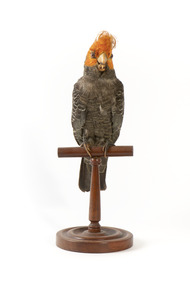 The Beechworth Burke Museum
Animal specimen - Gang Gang Cockatoo (male), Trustees of the Australian Museum, 1860-1880
... They eat mainly seeds from native trees and shrubs along with wattles, eucalypts and hawthorns. ...They eat mainly seeds from native trees and shrubs along with wattles, eucalypts and hawthorns. ...The Gang-gang Cockatoo can be found throughout much of south-eastern Australia. They reside in mountainous forests and open woodlands, often in small groups or larger flocks at sources of food and water. They eat mainly seeds from native trees and shrubs along with wattles, eucalypts and hawthorns. The Gang-gang Cockatoo is also known to incorporate berries, nuts, fruits and insects to their diet. The sound made by this type of Cockatoo is often described as a rasping screech which resembles the sound of a rusty hinge being moved.This type of call is made when the bird is in flight. These birds also fond of attention and can pick their own feathers if they are bored. The name "gang gang" derives from a New South Wales Aboriginal language, either the Ngunnawal or Wiradjuri. This specimen is part of a collection of almost 200 animal specimens that were originally acquired as skins from various institutions across Australia, including the Australian Museum in Sydney and the National Museum of Victoria (known as Museums Victoria since 1983), as well as individuals such as amateur anthropologist Reynell Eveleigh Johns between 1860-1880. These skins were then mounted by members of the Burke Museum Committee and put-on display in the formal space of the Museum’s original exhibition hall where they continue to be on display. This display of taxidermy mounts initially served to instruct visitors to the Burke Museum of the natural world around them, today it serves as an insight into the collecting habits of the 19th century.This specimen is part of a significant and rare taxidermy mount collection in the Burke Museum. This collection is scientifically and culturally important for reminding us of how science continues to shape our understanding of the modern world. They demonstrate a capacity to hold evidence of how Australia’s fauna history existed in the past and are potentially important for future environmental research. This collection continues to be on display in the Museum and has become a key part to interpreting the collecting habits of the 19th century.The male Gang Gang Cockatoo is standing stylised on a wooden perch. The Cockatoo has a dark slate-grey coloured body with a scarlet red/orange coloured head with a wispy crest. This specimen stands with its wings positioned to its sides and has round glass bead eyes. The bill has a hooked shape and is horn-coloured. The legs and feet of this specimen are dark grey.taxidermy mount, taxidermy, animalia, burke museum, beechworth, australian museum, skin, reynell eveleigh johns, bird, australian birds, cockatoo, gang-gang cockatoo, cockie -
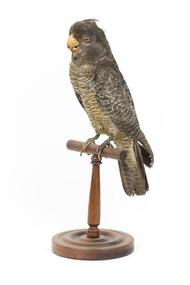 The Beechworth Burke Museum
Animal specimen - Gang Gang Cockatoo (female), Trustees of the Australian Museum, 1860-1880
... They eat mainly seeds from native trees and shrubs along with wattles, eucalypts and hawthorns. ...They eat mainly seeds from native trees and shrubs along with wattles, eucalypts and hawthorns. ...The Gang-gang Cockatoo can be found throughout much of south-eastern Australia. They reside in mountainous forests and open woodlands, often in small groups or larger flocks at sources of food and water. They eat mainly seeds from native trees and shrubs along with wattles, eucalypts and hawthorns. The Gang-gang Cockatoo is also known to incorporate berries, nuts, fruits and insects to their diet. The sound made by this type of Cockatoo is often described as a rasping screech which resembles the sound of a rusty hinge being moved.This type of call is made when the bird is in flight. These birds also fond of attention and can pick their own feathers if they are bored. The name "gang gang" derives from a New South Wales Aboriginal language, either the Ngunnawal or Wiradjuri. This specimen is part of a collection of almost 200 animal specimens that were originally acquired as skins from various institutions across Australia, including the Australian Museum in Sydney and the National Museum of Victoria (known as Museums Victoria since 1983), as well as individuals such as amateur anthropologist Reynell Eveleigh Johns between 1860-1880. These skins were then mounted by members of the Burke Museum Committee and put-on display in the formal space of the Museum’s original exhibition hall where they continue to be on display. This display of taxidermy mounts initially served to instruct visitors to the Burke Museum of the natural world around them, today it serves as an insight into the collecting habits of the 19th century.This specimen is part of a significant and rare taxidermy mount collection in the Burke Museum. This collection is scientifically and culturally important for reminding us of how science continues to shape our understanding of the modern world. They demonstrate a capacity to hold evidence of how Australia’s fauna history existed in the past and are potentially important for future environmental research. This collection continues to be on display in the Museum and has become a key part to interpreting the collecting habits of the 19th century.This female Gang-gang Cockatoo has a grey head and crest with brown glass eyes. The beak is hooked and a pale bone colour. The neck and torso of the cockatoo is patterned with orange and black stripes. The feathers of the underparts and back are slate-grey with an edging of pink and yellow. The female cockatoo has more yellow in their feathers than the males which gives them a further barred appearance. taxidermy mount, taxidermy, animalia, burke museum, beechworth, australian museum, skin, reynell eveleigh johns, bird, australian birds, australaisian shovelor, shovelor, cockatoo, gang-gang cockatoo, cockie -
 Federation University Historical Collection
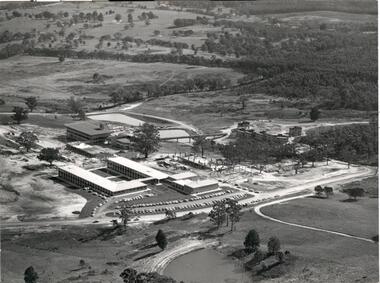
Document, Mount Helen Campus Arboretum, c1992
... In 2018 2000 native trees planted by State Library Victoria and Federation University in the Arboretum .Planted with the help of locals, students, and kindergarten children as part of the joint project the plantings included indigenous trees, shrubs and grasses native to Ballarat. ...In 2018 2000 native trees planted by State Library Victoria and Federation University in the Arboretum .Planted with the help of locals, students, and kindergarten children as part of the joint project the plantings included indigenous trees, shrubs and grasses native to Ballarat. ...A trail travels through the Arboretum where you may see resting kangaroos and wallabies, crosses a creek that holds a vulnerable colony of frogs commonly known as Victorian Smooth Froglet (Geocrinia victoriana), and admire the grass trees (Xanthorrhea australis) that grow on the campus behind accommodation. In 2018 2000 native trees planted by State Library Victoria and Federation University in the Arboretum .Planted with the help of locals, students, and kindergarten children as part of the joint project the plantings included indigenous trees, shrubs and grasses native to Ballarat. Federation University student Clancy Meaney is managing the tree planting project as part of her studies. “The arboretum is a fantastic resource that is used extensively by Federation University students as an outdoor classroom,” Ms Meaney said. “Being situated in between two main forests, our campus is also an important connection for native animals. These new trees will help migrating wildlife to move from one forest to the other.” State Library Victoria Project Management Office Director, Sarah Slade said the project was a wonderful opportunity to work with Mount Helen residents and the University to help protect the native landscape. “We’re thrilled to be able to give back to students, local residents and native flora and fauna through this valuable environmental initiative,” Ms Slade said. The tree planting project is a result of State Library Victoria’s ongoing partnership with Federation University. Construction of the Library’s second state-of-the-art storage facility, BOSS2 (Ballarat off-site store 2), is currently underway on the Federation University site. The existing storage facility at the Mount Helen Campus already holds more than half of the State Library’s collection, including newspapers, books, journals, textiles, paintings, architectural drawings, furniture and photographic glass plate negatives. In addition to State Library collection, BOSS2 will also provide two dedicated storage areas for the University’s collection. When completed, BOSS2 will provide additional storage of 25-30 linear kilometres, the equivalent of driving from Ballarat to Clunes or running 175 lengths of the MCG. The Mount Helen Campus Arboretum was established c1992.arboretum, mt helen campus arboretum, graeme ambrose, mt helen campus -
 City of Moorabbin Historical Society (Operating the Box Cottage Museum)
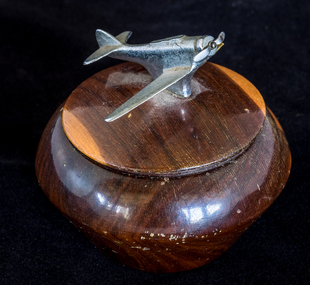
Manufactured Object, Mulga wood bowl, c1950
... Mulga, is an Acacia shrub or small tree native to arid outback areas of Australia. ...Mulga, is an Acacia shrub or small tree native to arid outback areas of Australia. ...Mulga, is an Acacia shrub or small tree native to arid outback areas of Australia. It is light, easy to carve and has strength and durability It is commonly used for turned objects or small decorative items. The wood is dark brown with yellow bands and polishes well. Traditional uses included spears, clubs and boomerangs. George Reed was a draftsman who lived in Bentleigh , City of Moorabbin in mid 20th CGeorge Reed was a draftsman who lived in Bentleigh , City of Moorabbin in mid 20th C and used this Mulga wood bowl in his officeA souvenir Mulga wood bowl with metal aeroplane on the lidearly settlers, market gardeners, wood carvers, souvenirs, mulga wood, acacia trees, boomerangs, vases, post world war 2 estates, bentleigh, mckinnon, highett, cheltenham,south australia, victoria,reed george, reed gladys, clark judy, -
 Bendigo Historical Society Inc.
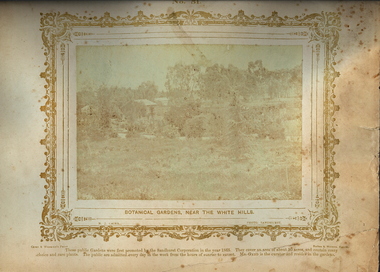
Photograph - VIEWS OF BENDIGO: BOTANICAL GARDENS, WHITE HILLS, 1875
... A variety of exotic trees and shrubs both exotic and native border the path. Inscriptions: Printed mount in gold ink 'Views of Bendigo No. 51' on top. ...A variety of exotic trees and shrubs both exotic and native border the path. Inscriptions: Printed mount in gold ink 'Views of Bendigo No. 51' on top. ...Sepia photograph. View of the Botanical Gardens, White Hills. A path cuts horizontally across the foreground where a young fir tree is growing. Beyond the path there is a small building on the far left a shed structure with surrounding picket fence, followed by a small cottage and a stand of eucalyptus trees extending to the right. A variety of exotic trees and shrubs both exotic and native border the path. Inscriptions: Printed mount in gold ink 'Views of Bendigo No. 51' on top. 'Botanical Gardens Near the White Hills', 'NJ Caire, Photo, Sandhurst', 'Casey & Wenborn's print', Forbes & Holmes, agents'. These public gardens were first promoted by the Sandhurst Corporation in the year 1965. They cover an area of about 30 acres and contain many choice and rare plant. The public are admitted every day in the week from the hours of sunrise to sunset. Mr. Gadd is the curator and resides in the gardens. Nicholas Caire (Two copies)Nicholas, J Caireplace, public gardens, botanical gardens, white hills -
 Victorian Aboriginal Corporation for Languages
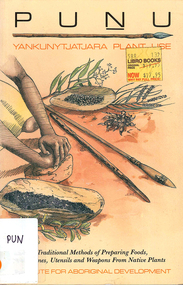
Book, Pun?u : Yankunytjatjara plant use : traditional methods of preparing foods, medicines, utensils and weapons from native plants, 1988
... Climate landforms vegetation vegetable food (mai) fruits seeds roots greens galls fungi nectars sweet secretions gums medicinal plants (Punu ngangkari) language stories plant use trees shrubs subshrubs grasses vines succulents mistletoes plant parts habitat plant processing Yankunytjatjara Central Australia B&w illustrations, colour illustrations, word lists Encyclopedia style entries for 27 plants with standard scientific description plus description, science and stories in Yankunytjatjara with translations. Includes general and linguistic introduction, and extensive glossaries of botanical names, plant parts, processes etc, all Yankunytjatjara and English (and Latin as appropriate) Pun?u : Yankunytjatjara plant use : traditional methods of preparing foods, medicines, utensils and weapons from native ...Encyclopedia style entries for 27 plants with standard scientific description plus description, science and stories in Yankunytjatjara with translations. Includes general and linguistic introduction, and extensive glossaries of botanical names, plant parts, processes etc, all Yankunytjatjara and English (and Latin as appropriate)B&w illustrations, colour illustrations, word listsclimate, landforms, vegetation, vegetable food (mai), fruits, seeds, roots, greens, galls, fungi, nectars, sweet secretions, gums, medicinal plants (punu ngangkari), language, stories, plant use, trees, shrubs, subshrubs, grasses, vines, succulents, mistletoes, plant parts, habitat, plant processing, yankunytjatjara, central australia -
 RMIT Design Archives
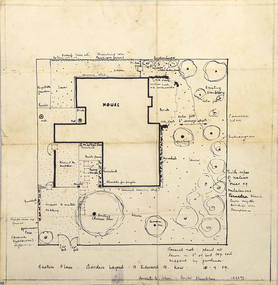
Diazotypes, Sketch Plan: Garden Layout - 13 Edward St. Kew
... Typical of post-war suburban housing thought, the garden is a generous, and the planting a mix of existing shrubs and trees, old favourites such as camelias, hydrangeas, lilacs, and a unusually 'a thick copse of native trees'. ...Typical of post-war suburban housing thought, the garden is a generous, and the planting a mix of existing shrubs and trees, old favourites such as camelias, hydrangeas, lilacs, and a unusually 'a thick copse of native trees'. ...John and Phyllis Murphy designed this house and garden in Kew for Sir Frank and Lady Macfarlane Burnet in 1959, the year before Burnet and Peter Medaware received the Nobel Prize for discovering acquired immunological tolerance. For the most highly honoured scientist to have worked in Australia, Burnet's house is modest - single storey with two bedrooms. Typical of post-war suburban housing thought, the garden is a generous, and the planting a mix of existing shrubs and trees, old favourites such as camelias, hydrangeas, lilacs, and a unusually 'a thick copse of native trees'. John Murphy (1920-2004) and Phyllis Murphy (nee Slater) (1924-) are alumni of RMIT. John commenced his architectural studies at Swinburne Technical College prior to WW2, and subsequently studied at Melbourne Technical College (now RMIT University) from 1944 to 1946. Phyllis studied architecture at Melbourne Technical College from 1942, before transferring to Melbourne University's Architectural Atelier in 1944 They both completed their Bachelor of Architecture in 1949, with Phyllis topping the fourth year, and John coming in second. They established their architectural practice in 1950. One early project was their design with Kevin Borland and Peter McIntyre for the Olympic Swimming Pool (1956). Ann Carew 2018dye, paper, garden design, kew -
 St Kilda Historical Society
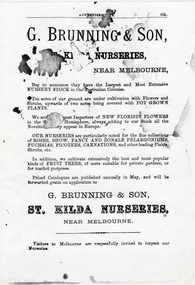
Document - Advertisement, G Brunning & Son St Kilda Nurseries, Pre - 1901 (original)
... native to Australia, had their origins in the nurseries of George Brunning and Sons. The statement is a large one to make, but it is literally true.' G Brunning and Son Plant nurseries Victoria St Kilda 19th century G Brunning & Son, St Kilda Nurseries, Near Melbourne, Beg to announce they have the Largest and Most Extensive Nursery Stock in the Australian Colonies. Ten acres of our ground are under cultivation with Flowers and Shrubs ...George Brunning was born in Suffolk, England, on 2 October 1830 and settled in St Kilda in June, 1852. He was a gardener and became part-proprietor and manager of Rule's Nursery in Richmond before establishing the first nursery of his own in 1861. Following his death on 5 June 1893, his sons continued the business. An article published in Punch in 1907 observed 'Nearly all the flowers grown in and around Melbourne, indeed, throughout Victoria, which are not native to Australia, had their origins in the nurseries of George Brunning and Sons. The statement is a large one to make, but it is literally true.'Single page black and white photocopy of advertisement from an unidentified publication for G Brunning & SonG Brunning & Son, St Kilda Nurseries, Near Melbourne, Beg to announce they have the Largest and Most Extensive Nursery Stock in the Australian Colonies. Ten acres of our ground are under cultivation with Flowers and Shrubs, upwards of two acres being covered with pot grown plants. We are the biggest Importers of new florists flowers in the Southern Hemisphere, always adding to our Stock all the Novelties as they appear in Europe. Our nurseries are particularly noted for the fine collections of roses, show, fancy and zone pelargoniums, fuchsias, picots, carnations, and other leading Plants, Shrubs, etc. In addition, we cultivate extensively the best and most popular kinds of fruit trees, of sorts suitable for private gardens, or for market purposes. Priced Catalogues are published annually in May, and will be forwarded gratis on application to G Brunning & Son, St Kilda Nurseries, Near Melbourne. Visitors to Melbourne are respectfully invited to inspect our Nurseries.g brunning and son, plant nurseries victoria, st kilda, 19th century -
 Nillumbik Shire Council
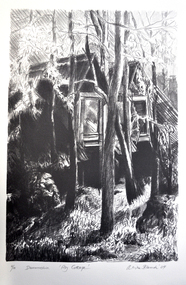
Print (Lithograph): Alice Blanch Chehovski, Alice B. (Blanch) Chehovski, Dunmoochin, My Cottage, Printed 2004
... native land of Australia in 1981 at the age of 60. This lithographic print is one of a set of ten produced at Dunmoochin at the time of Clifton Pugh. chehovski dunmoochin pugh cottage lithograph Bottom left of print: ed. no. '4/10' and work title. Bottom right of print: artist signature 'Alice Blanch '04' Lithographic print in black and white (very dark image) depicting Chehovskis' cottage at Dunmoochin. Small cottage, bushland and shrubs ...Alice Blanch Chehovski was born in Queensland to a Russian mother and Polish father. When her father died leaving three small children to bring up on her own, her took them back to Russia to visit her own parents. In the following fateful year, Stalin came into power and the family was trapped by Russia closing its borders. At the age of twenty three, 1944, Alice entered Moscow's Institute of Decorative Arts and Applied Arts to study ceramics. Neither the subject of ceramics nor the academic drawing in fine pencil inspired her. At that time Moscow was surrounded by German troops, Russian culture was inhibited by the war and generally speaking it was not the time for arts. Alice said 'My soul and my hands were needed as a volunteer, to help the wounded soldiers survive'. Alice struggled through a lifetime of hardship and triumph before returning to her native land of Australia in 1981 at the age of 60. This lithographic print is one of a set of ten produced at Dunmoochin at the time of Clifton Pugh.Lithographic print in black and white (very dark image) depicting Chehovskis' cottage at Dunmoochin. Small cottage, bushland and shrubs.Bottom left of print: ed. no. '4/10' and work title. Bottom right of print: artist signature 'Alice Blanch '04'chehovski, dunmoochin, pugh, cottage, lithograph -
 Nillumbik Shire Council
Print (lino): Kate HUDSON (b.UK - a.1990 AUS), Kate Hudson, Wattle and Circle Vase, 2012
... The wattle depicted is the Acacia Terminalis (Sunshine Wattle), a shrub or small tree that grows to six meters in height. It’s an Australian native commonly found in New South Wales, Victoria and Tasmania. hudson, linocut print, sunshine wattle, acacia terminalis, still life, margaret preston, ceramics, textiles, orient Hand written in pencil: low left '8/26'; bottom centre ' Wattle and Circle Vase'; low right 'Kate Hudson' A reduction coloured lino print. ...Kate Hudson's highly patterned and decorative prints reflect her love of Australian birds and flowers from her immediate environment, as well as oriental art and her training in textile design. Her work is influenced by the Australian artist (printmaker) Margaret Preston and the vases depicted in her prints are based on the ceramic works of her husband Stephen Hudson. The wattle depicted is the Acacia Terminalis (Sunshine Wattle), a shrub or small tree that grows to six meters in height. It’s an Australian native commonly found in New South Wales, Victoria and Tasmania.A reduction coloured lino print. A ceramic vase with a black and white target print at its' centre holds a bunch of Acacia Terminalis (Sunshine Wattle). The vase rests on an orange table cloth decorated in white stylised flowers. The background is light pink. Hand written in pencil: low left '8/26'; bottom centre ' Wattle and Circle Vase'; low right 'Kate Hudson' hudson, linocut print, sunshine wattle, acacia terminalis, still life, margaret preston, ceramics, textiles, orient -
 Sunbury Family History and Heritage Society Inc.
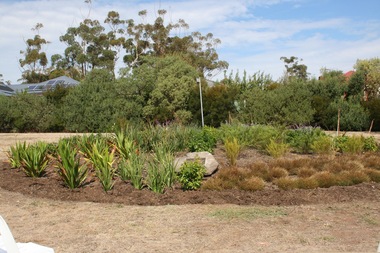
Photograph, Rosa McCall, Sunbury Cemetery, April 2014
... A non-digital coloured photograph of a circular garden of native plants with a memorial plaque in the centre of the garden. There are shrubs and trees in the background....Memorials Sunbury Asylum Industrial School Sunbury Cemetery A non-digital coloured photograph of a circular garden of native plants with a memorial plaque in the centre of the garden. There are shrubs and trees in the background. ...The Rotary Club of Sunbury installed the memorial garden in Sunbury Cemetery in April 2014. The garden is in memory of the former inmates at the Sunbury Asylum and Industrial School who were buried in unmarked graves in the cemetery. It is sited at one end of the Memorial walk which links the garden with the Children's Memorial and the rotunda.A non-digital coloured photograph of a circular garden of native plants with a memorial plaque in the centre of the garden. There are shrubs and trees in the background.memorials, sunbury asylum, industrial school, sunbury cemetery -
University of Melbourne, Burnley Campus Archives
Negative - Colour negatives, Plant Materials, 1996-1997
... Semester 2 Wk 5 Drought Tolerant Plants, Evergreen Trees-Sally R, Ornamental Plants-Indoor Plants 1st Yr, Native Trees 3.5.96, Ferns & Grasses Ruth 2nd negs, Degree/Diploma Coastal Plants Wk 2, Plant Materials II 1997 Wk 9 Cut Flowers. (3) Late Autumn Winter, Aust Shrubs 1, Landscapes-Excursion?...plant materials students drought tolerant plants evergreen trees ornamental plants indoor plants native trees ferns grasses coastal plants eucalypts weeds australian trees australian shrubs shade tolerant plants de-oxygenated soils exotic evergreen trees Miscellaneous rolls of colour negatives. (1) Plant materials and some students. (2) Dip. ...Miscellaneous rolls of colour negatives. (1) Plant materials and some students. (2) Dip. Semester 2 Wk 5 Drought Tolerant Plants, Evergreen Trees-Sally R, Ornamental Plants-Indoor Plants 1st Yr, Native Trees 3.5.96, Ferns & Grasses Ruth 2nd negs, Degree/Diploma Coastal Plants Wk 2, Plant Materials II 1997 Wk 9 Cut Flowers. (3) Late Autumn Winter, Aust Shrubs 1, Landscapes-Excursion?, Eucalypts 1, Weeds. (4) Aust Trees & Shrubs, Nature-like landscapes. (5) RMIT Year 1 Semester 1 Plant Materials Week1 Shade Tolerant, Week 2, Week 3, Week 4 Drought Tolerant, Week 5 De-oxygenated Soils, Week 6 De-oxygenated, Week 7, Week 9, Week 10 Ferns & Grasses, Week 11 Exotic Evergreen trees & shrubs, Week 12 Australian Trees.plant materials, students, drought tolerant plants, evergreen trees, ornamental plants, indoor plants, native trees, ferns, grasses, coastal plants, eucalypts, weeds, australian trees, australian shrubs, shade tolerant plants, de-oxygenated soils, exotic evergreen trees
