
Showing 39 items matching "nettie"
-
 Emerald Museum & Nobelius Heritage Park
Book - Compilation of Nettie Palmer's writings, Palmer, Nettie et al, Nettie Palmer: Her Private Journal 'Fourteen Years' Poems, Reviews and Literary Essays, 1988
... Nettie Palmer: Her Private Journal 'Fourteen Years' Poems, Reviews and Literary Essays...Some of these works were written when Nettie and Vance Palmer lived in Emerald....Palmer, Nettie...Some of these works were written when Nettie and Vance Palmer lived in Emerald. Emerald Victoria Australia authors poetry biographies Australian literature Nettie Palmer Vance Palmer Soft cover, 548 pages Nettie Palmer: Her Private Journal 'Fourteen Years' Poems, Reviews and Literary Essays Book Compilation of Nettie Palmer's writings Palmer, Nettie Smith, Vivian University of Queensland Press ...A dompilation of Nettie Palmer's writings, published in sections including the autobiographical 'Fourteen Years', The Poet, The Literary Critic and Historian, The Literary Essayist, Home and Abroad Iincluding 'The Dandenongs'. Some of these works were written when Nettie and Vance Palmer lived in Emerald.Soft cover, 548 pagesemerald, victoria, australia, authors, poetry, biographies, australian literature, nettie palmer, vance palmer -
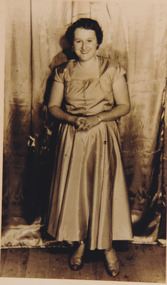 The Beechworth Burke Museum
Audio - Oral History, Jennifer Williams, Nola (Nettie) Maher, 27 April 2000
... Nola (Nettie) Maher...Nola (Nettie) Maher was born in Beechworth on 31st December, 1935. ......Nola (Nettie) Maher...Nola (Nettie) Maher was born in Beechworth on 31st December, 1935. ...Nola (Nettie) Maher was born in Beechworth on 31st December, 1935. Her father returned from World War One and purchased a miner’s cottage in 1919 where Nettie lived in for the majority of her life. Nettie worked for ten years at the Pittman’s Shoe Factory, once located on Ford Street, which was in operation from 1 July 1947 to 28 August 1961. She fondly recalls the camaraderie amongst the staff and certain managers, and details the factory processes, union activities and the work she continued to do once she was married and had children. This oral history recording was part of a project conducted by Jennifer Williams in the year 2000 to capture the everyday life and struggles in Beechworth during the twentieth century. This project involved recording seventy oral histories on cassette tapes of local Beechworth residents which were then published in a book titled: Listen to what they say: voices of twentieth century Beechworth. These cassette tapes were digitised in July 2021 with funds made available by the Friends of the Burke. Nola Nettie Maher’s account of her personal and working life in Beechworth and the local area during the 20th century is historically and socially significant to the cultural heritage of the region. She details important details about life and working in the region post World War Two, including insights into women’s working roles, as well as the social aspects of town life. This oral history account is socially and historically significant as it is part of a broader collection of interviews conducted by Jennifer Williams which were published in the book ‘Listen to what they say: voices of twentieth-century Beechworth.’ While the township of Beechworth is known for its history as a gold rush town, these accounts provide a unique insight into the day-to-day life of the town’s residents during the 20th century, many of which would have been lost had they not been preserved. This is a digital copy of a recording that was originally captured on a cassette tape. The cassette tape is black with a horizontal white strip and is currently stored in a clear flat plastic rectangular container. It holds up 40 minutes of recordings on each side.Nola Maher /beechworth, nola maher, nettie maher, listen to what they say, jennifer williams, oral history, hospital, private hospital, birth, miner’s cottage, kerosine, eucalyptus, rabbit, laundry, dressmaking, dressing certificate, dry cleaners, hotel, shoe, leather, shoe factory, uppers, pittman, ford street, charlie king, union, wages, new years eve, dance, memorial hall, married women, flexible hours, ice cream, milk bar -
 Kew Historical Society Inc
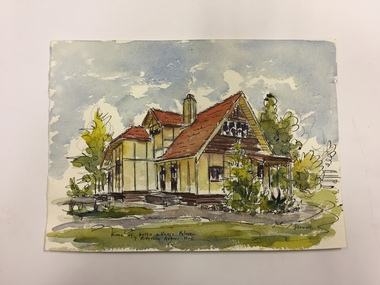
Work on paper, Joy Stewart, Home of Nettie and Vance Palmer, 7 Ridgeway Avenue, Kew, c.1978
... Home of Nettie and Vance Palmer, 7 Ridgeway Avenue, Kew...Watercolour, Pen & Ink on paper by the artist and local historian Joy Stewart of the home in Ridgeway Avenue of Nettie and Vance Palmer. ...Inscription: "Home of Nettie and Vance Palmer / 7 Ridgeway Avenue, Kew." ...Joy Stewart died in Cairns in 2018. joy stewart vance palmer nettie palmer ridgeway avenue (kew) Inscription: "Home of Nettie and Vance Palmer / 7 Ridgeway Avenue, Kew." ...Sydney Joy (joy) Stewart (1925-2018) was a founding member of the Kew Historical Society, and during the 1970s its secretary. During her residence in Kew, she completed numerous property illustrations on commission. These ranged from preliminary sketches, including architectural details to finished pen & ink and wash illustrations on paper. On moving to Queensland, Joy Stewart donated the remaining property illustrations in her possession to the Kew Historical Society. In 1987-88 she fulfilled a commission by the Society of designs for a series of embroideries completed by residents during the Australian Bicentennial commemorations.Sydney Joy (Joy) Stewart was born in Melbourne 1925. She studied at Swinburne Technical College Art School from 1941-1945, then the National Gallery Art School 1946-1948. Her career included employment positions as a display artist, designer/painter, gallery assistant, and art teacher. Joy relocated to Cairns in 1981. Solo exhibitions in Melbourne and Cairns, including 'Done By Me' at Cairns Regional Gallery in 1999. Group exhibitions at Cairns Regional Gallery, 'The Fish John West Regrets, 1993' and 'Facets of Life' 1994. Joy Stewart died in Cairns in 2018.Watercolour, Pen & Ink on paper by the artist and local historian Joy Stewart of the home in Ridgeway Avenue of Nettie and Vance Palmer. Inscription: "Home of Nettie and Vance Palmer / 7 Ridgeway Avenue, Kew." Signed lower right: "JStewart".joy stewart, vance palmer, nettie palmer, ridgeway avenue (kew) -
 Narre Warren and District Family History Group
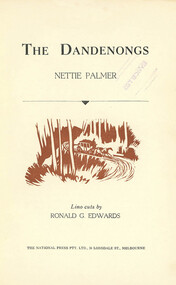
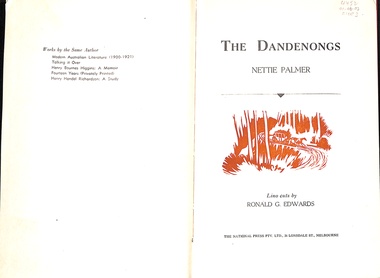
Book, Nettie Palmer, The Dandenongs by Nettie Palmer, 1953
... The Dandenongs by Nettie Palmer...Nettie Palmer...Dustcover has been removed The Dandenongs by Nettie Palmer Book Nettie Palmer ...Life in the Hills area; Towns of Dandenong, Emerald, Monbulk district60 p.; 23 cm. Dustcover has been removednon-fictionLife in the Hills area; Towns of Dandenong, Emerald, Monbulk districtrose charman's cottage, emerald victoria, monbulk vic -
Emerald Museum & Nobelius Heritage Park
Book - Local history book, Nettie Palmer, The Dandenongs, 1953 (Second Edition)
... ...Nettie...Janet Gertrude (Nettie) Palmer (1885-1964), writer and critic, was born on 18 August 1885 at Sandhurst (Bendigo), Victoria. ...Nettie Palmer...Janet Gertrude (Nettie) Palmer (1885-1964), writer and critic, was born on 18 August 1885 at Sandhurst (Bendigo), Victoria. ...Janet Gertrude (Nettie) Palmer (1885-1964), writer and critic, was born on 18 August 1885 at Sandhurst (Bendigo), Victoria. Nettie's education began at home with her mother and continued at Miss Rudd's Seminary at Malvern. In 1900-04 she attended Presbyterian Ladies' College. n 1905 Nettie enrolled at the University of Melbourne (B.A., 1909; M.A., 1912). She was awarded the exhibition and first-class honours in first-year English and gained honours in modern languages. The Palmers returned to Melbourne in 1915 and moved to Katharine Prichard's cottage at Emerald. Between 1918-19 she lived with her aunt Ina Higgins, returning to Emerald living at Rose Charman Cottage in the early 1920s. Nettie emerged as possibly the most important literary critic in Australia. After the publication of Modern Australian Literature 1900-1923 (1924), a landmark in criticism which won the Lothian essay prize, she had many more regular outlets, notably her weekly literary causerie in the Illustrated Tasmanian Mail (212 articles in 5½ years), the Brisbane Courier, All About Books and the Bulletin Red Page. Nettie was committed to the development of a national literature as a means of achieving a more enlightened community. Much of her writing dealt with the themes, subjects and idiom of Australian writers, notably Henry Handel Richardson. She played a seminal role in establishing the canons of Australian literary criticism but she also wrote widely on world literature. Some of her essays were published in Talking it Over (1932); her 1928 anthology, An Australian Story-Book, set standards for the short story. Nettie's lively correspondence from Caloundra, and from 1929 from Melbourne, established a network of contact and encouragement between many Australian and overseas writers and intellectuals, and especially for young women writers such as Marjorie Barnard and Eleanor Dark for whom she provided an anchor. In 1931 she published her biography, Henry Bournes Higgins, and in 1934 she co-edited The Centenary Gift Book. Active in the Australian Literature Society, the Verse-Speaking Association, and later the Fellowship of Australian Writers, she lectured and broadcasted.The book is socially, artistically and historically significant as it is an account of the gradual settlement of the Dandenongs, and Nettie Palmer was a significant figure in Australian art circlesRed hard cover book with buff dust jacket, dust jacket protected with plastic cover.$4.95 (crosses out), 200,$1707 263dandenongs, book, nettie, palmer -
![Book, Nettie Palmer, The Dandenongs, Melbourne : National Press, [1952]](/media/collectors/4f729f7997f83e0308601871/items/4f72b7f797f83e0308605830/item-media/4f72b7f897f83e0308605835/item-fit-380x285.jpg?cb=6) Emerald Museum & Nobelius Heritage Park
Emerald Museum & Nobelius Heritage ParkBook, Nettie Palmer, The Dandenongs, Melbourne : National Press, [1952]
... Hard cover book of an account of the gradual settlement of the Dandenongs since the first white settler penetrated the wooded ranges more than a century ago. Author: Palmer, Nettie, 1885-1964. Illustrations: Edwards, Ron, 1930-2008....Nettie Palmer ...The Dandenongs Book Nettie Palmer ...Well known writer of Australian history and early setttlement of the Dandenongs.This item is significant of an example of the authors writing.Hard cover book of an account of the gradual settlement of the Dandenongs since the first white settler penetrated the wooded ranges more than a century ago. Author: Palmer, Nettie, 1885-1964. Illustrations: Edwards, Ron, 1930-2008.pioneers, settlers, dandenong ranges, raspberry growers, emerald, monbulk, nobelius -
 Returned Nurses RSL Sub-branch
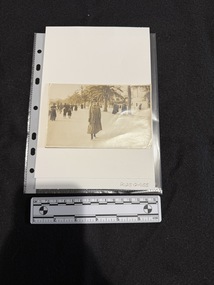
Postcard - Sepia photograph postcard [circa 1900-1920s], unknown
... Unknown woman [likely 1900-1920s in France] Nettie Cannes written on reverse [unable to locate information]...'"Nettie" Cannes [?]' [Pencil on reverse of postcard]...Unknown woman [likely 1900-1920s in France] Nettie Cannes written on reverse [unable to locate information] WWI World War One WW1 postcard France '"Nettie" Cannes [?]' ...Unknown woman [likely 1900-1920s in France] Nettie Cannes written on reverse [unable to locate information]Photographic postcard depicting people walking along a tree lined avenue [likely in France]. There is a woman walking towards and smiling at the camera wearing a long coat, dress and hat, holding something in her left hand. The postcard has a thin white border around the photo and on the reverse is printed 'Carte Postale, Correspondance, Adresse'. The card has previously been glued to something as in all corners and the middle of the long edges have remnants of other paper and adhesive.'"Nettie" Cannes [?]' [Pencil on reverse of postcard]wwi, world war one, ww1, postcard, france -
Rutherglen Historical Society
School Records - Individuals, Higher Elementary School, Rutherglen, Burch, Nettie Marie, 1928
... Burch, Nettie Marie...All sheets are indexed on a spreadsheet at the Common School Museum. rutherglen higher elementary school pupils students school reports Individual school records of the pupils of the Higher Elementary School, Rutherglen. Burch, Nettie Marie School Records - Individuals Higher Elementary School, Rutherglen ...From School records, some more complete than others. Reports should contain information on the pupil's school work and give details of what they did when they left school. They should also show the name of a parent and the occupation. All sheets are indexed on a spreadsheet at the Common School Museum.Individual school records of the pupils of the Higher Elementary School, Rutherglen.rutherglen higher elementary school, pupils, students, school reports -
Emerald Museum & Nobelius Heritage Park
Letter - Letter - Nettie Palmer, 8/02/1954 12:00:00 AM
... Nettie Palmer was a well known Australian writer who lived with her writer husband, Vance Palmer, at Rose Charman's Cottage in Emerald for a period of time....Photocopy of handwritten letter from Nettie Palmer to Mrs Jeffery, dated 8 Feb 1954...Photocopy of handwritten letter from Nettie Palmer to Mrs Jeffery, dated 8 Feb 1954 Letter Letter - Nettie Palmer ...Nettie Palmer was a well known Australian writer who lived with her writer husband, Vance Palmer, at Rose Charman's Cottage in Emerald for a period of time.Photocopy of handwritten letter from Nettie Palmer to Mrs Jeffery, dated 8 Feb 1954Written on Nedou & Sons' Hotel notepaper, printed details and address crossed out.emerald, victoria, australia, writing, nettie palmer -
 Ringwood and District Historical Society
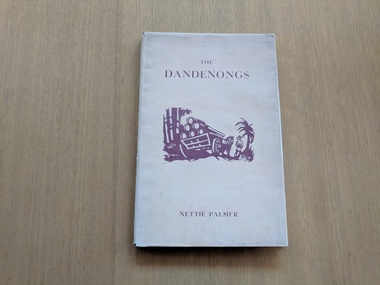
Book, The Dandenongs, 1953
... Nettie Palmer...Reflections of the Dandenongs Second Edition 1953 The Dandenongs Book Nettie Palmer ...Reflections of the Dandenongs Second Edition 1953 -
 Robin Boyd Foundation
Book, Nettie Palmer, The Dandenongs, 1952
... Nettie Palmer...Walsh St library Hardcover w/ Dust Jacket The Dandenongs Book Nettie Palmer The National Press ...Hardcover w/ Dust Jacketwalsh st library -
 Unions Ballarat
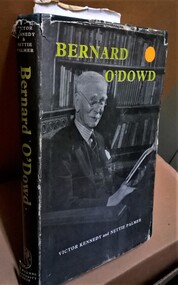
Bernard O'Dowd, 1954
... Victor Kennedy and Nettie Palmer...Bernard O'Dowd Victor Kennedy and Nettie Palmer ...Bernard O'Dowd was an Australian poet and anarchist. He was born in Beaufort in 1866 and worked at different times as a teacher, librarian and parliamentary draftsman. He was dismissed from his position at St Alipius' school in Ballarat for heresy. He had a particular interest in the Federation of Australia and formation of the Constitution, which features in his poem "Australia". O'Dowd co-edited Tocsin with Jack Andrews. Tocsin was a labor newspaper in Melbourne. Others involved with the newspaper include Edward Findley and, for a short time, Norman Lindsay. Tocsin's platform is available in PDF format online http://www.reasoninrevolt.net.au/objects/pdf/a000808.pdf Areas of interest included the constitution, federation and workers' industrial rights (e.g. eight hour day, pensions and arbitration for labour disputes).Biographical interest. Literary interest. Pertinent to Ballarat. Pertinent to constitutional history and industrial relations. Pertinent to labor publications, history and literature.Hardcover - book. Cover dust jacket: black and white photograph of Bernard O'Dowd on front, yellow and white lettering; back is yellow. Cover without dust jacket: green cloth; gold lettering.Cover without dust jacket: authors' names and title on the spine. Cover with dust jacket: authors' names and title on front cover and spine. Inside page: Inscribed in ink, "Happy Birthday Dad from Lorna and John (Sept 17 1960).btlc, ballarat trades and labour council, ballarat trades hall, o'dowd, bernard, writers - poets, newspaper, tocsin, lindsay, norman, andrews, jack, findley, edward, anarchists, biography, palmer, nettie, st alipius school, ballarat, o'dowd, bernard, 1866-1953, industrial relations -
 Mrs Aeneas Gunn Memorial Library
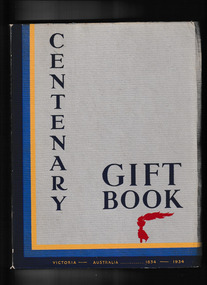
Book, Robertson & Mullens, Centenary gift book, 1934
... Frances Fraser and Nettie Palmer....Centenary gift book Book Robertson & Mullens Frances Fraser and Nettie Palmer. ...Collected short articles, poems and pictures written and illustrated by women in a book created to celebrate Victoria's centenary and highlight women's role in the development of the state. The profits from the sale of the book were dedicated to the Fund for the memorial to the Pioneer Women.Ill, p.162.non-fictionCollected short articles, poems and pictures written and illustrated by women in a book created to celebrate Victoria's centenary and highlight women's role in the development of the state. The profits from the sale of the book were dedicated to the Fund for the memorial to the Pioneer Women. women - victoria - history, women - victoria - social conditions -
Emerald Museum & Nobelius Heritage Park
Book - Biography, Nettie Palmer, Bernard O'Dowd'
... Nettie Palmer...Biography of Bernard O'Dowd Bernard O'Dowd' Book Biography Nettie Palmer ...Biography of Bernard O'Dowd -
Emerald Museum & Nobelius Heritage Park
Booklet - Exhibition Catalogue of Vance and Nettie Palmer, Library Council of Victoria, circa 1985
... ...Nettie...Catalogue of an Exhibition to celebrate the centenary of the births of Vance and Nettie Palmer. Vance and Nettie Palmer, An Exhibition to celebrate the centenary of their births, in the Queen's Hall, State Library of Victoria, 20th August - 30th September, 1985....Catalogue of an Exhibition to celebrate the centenary of the births of Vance and Nettie Palmer. Vance and Nettie Palmer, An Exhibition to celebrate the centenary of their births, in the Queen's Hall, State Library of Victoria, 20th August - 30th September, 1985. ...Catalogue of an Exhibition to celebrate the centenary of the births of Vance and Nettie Palmer. Vance and Nettie Palmer, An Exhibition to celebrate the centenary of their births, in the Queen's Hall, State Library of Victoria, 20th August - 30th September, 1985.The object is culturally, historically and artistically significant as Vance and Janet (Nettie) Palmer, who were for a time Emerald residents, were nationally renowned in Australian literary circles during the early 20th century.Cream cardboard and paper stapled booklet printed in sepiaStamped “Monbulk Historical Society,PO Box 98, Monbulk 3793” on first pageexhibition, vance, nettie, janet, palmer, library of victoria -
 Running Rabbits Military Museum operated by the Upwey Belgrave RSL Sub Branch
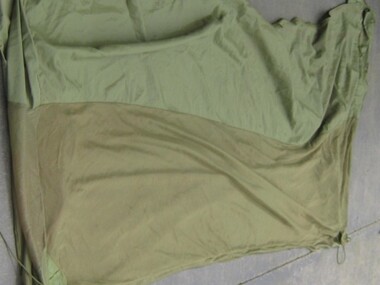
Mosquito Net
... Mosquito Nettiing...Equipment Vietnam Army Mosquito Nettiing Mosquito Net ...Mosquito Nettiingequipment, vietnam, army -
 Flagstaff Hill Maritime Museum and Village
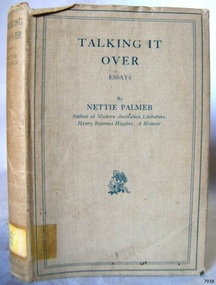
Book, Talking It Over
... Talking It Over Author: Nettie Palmer Publisher: Angus & Robertson Date: 1932...warrnambool shipwrecked-coast flagstaff-hill flagstaff-hill-maritime-museum maritime-museum shipwreck-coast flagstaff-hill-maritime-village shipwrecked-artefact great ocean road book talking it over nettie palmer Label on spine cover with typed text RA 824 PAL Talking It Over Author: Nettie Palmer Publisher: Angus & Robertson Date: 1932 Talking It Over Book ...Talking It Over Author: Nettie Palmer Publisher: Angus & Robertson Date: 1932Label on spine cover with typed text RA 824 PAL warrnambool, shipwrecked-coast, flagstaff-hill, flagstaff-hill-maritime-museum, maritime-museum, shipwreck-coast, flagstaff-hill-maritime-village, shipwrecked-artefact, great ocean road, book, talking it over, nettie palmer -
 The Beechworth Burke Museum
Photograph, 1994
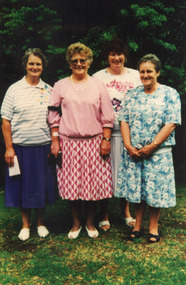
... Pictured from left to right are: Nettie Maher, Beryl Pope, Alice Adams and Leila Doig. ...Nola (Nettie) Maher...Pictured from left to right are: Nettie Maher, Beryl Pope, Alice Adams and Leila Doig. ...Taken in 1994, this photograph depicts the reunion of four women, all of whom were former workers at the Beechworth Shoe Factory. Pictured from left to right are: Nettie Maher, Beryl Pope, Alice Adams and Leila Doig. Nola (Nettie) Maher, who donated this photograph to the museum in 2001, was born in Beechworth on the twenty-first of December 1935. She is one of the many - primarily women - workers employed by the Beechworth Shoe Factory (also known as Pitman's Shoe Factory). Once located on Ford Street, the factory was established by Mr T. Nagle Pitman as a branch of the company Elgins Shoes, and was in operation from the first of July 1947 to the twenty-eighth of August 1961. In an interview given in 2000, Nettie recalls the close trust and friendships that were built amongst the factory workers. A sense of this bond is reflected in this reunion photograph, taken several decades later. This photograph is historically significant as it provides insight into the experiences of women factory workers in Beechworth during the twentieth century. Colour rectangular photograph printed on matte photographic paperReverse: 13 / 6981 /beechworth shoe factory, pitman shoe factory, t. nagle pitman, reunion, female friendships, nola maher, nettie maher, beryl pope, alice adams, leila doig, beechworth shoe factory reunion 1994, elgin shoes, women factory workers, beechworth factories -
 Flagstaff Hill Maritime Museum and Village
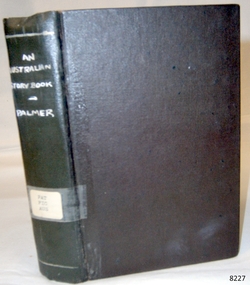
Book, An Australian Story-Book
... An Australian Story-Book Selected by Nettie Palmer Publisher: Angus & Robertson Date: PAT FIC AUS ...The Warrnambool Mechanics' Institute’s publication collection is of both local and state significance. flagstaff hill warrnambool shipwrecked coast flagstaff hill maritime museum maritime museum shipwreck coast flagstaff hill maritime village great ocean road book pattison collection warrnambool library warrnambool mechanics’ institute ralph eric pattison corangamite regional library service warrnambool city librarian mechanics’ institute library victorian library board warrnambool books and records warrnambool children’s library an australian story-book nettie palmer The label on spine cover with typed text PAT FIC AUS Pastedown front endpaper has a sticker from Warrnambool Public Library covered by a sticker from Corangamite Regional Library Service Front loose endpaper has a stamp from Corangamite Regional Library Service The first page of Flyleaf has a stamp from Warrnambool Mechanics Institute An Australian Story-Book Selected by Nettie Palmer Publisher: Angus & Robertson Date: PAT FIC AUS An Australian Story-Book Book ...This book was part of a large group of books referred to as the Pattison Collection, which belonged to the Warrnambool Public Library, part of the Warrnambool Mechanics’ Institute. About RALPH ERIC PATTISON and the ‘PATTISON COLLECTION’ The ‘Pattison Collection’ is a collection of books and records that was originally owned by the Warrnambool Mechanics’ Institute, founded in Warrnambool in 1853. By 1886 the Warrnambool Mechanics’ Institute (WMI) had grown to have a Library, Museum and Fine Arts Gallery, with a collection of “… choice productions of art and valuable specimens in almost every branch and many wonderful national curiosities are now to be seen there, including historic relics of the town and district.” It later included a School of Design. Although it was very well patronised, the WMI was led to ask the City Council to take it over in 1911 due to lack of financial support. In 1935 Ralph Pattison was appointed as City Librarian to establish and organise the Warrnambool Public Library as it was then called. Ralph Eric Pattison was born in Rockhampton, Queensland, in 1891. He married Maude Swan from Warrnambool in 1920 and they set up home in Warrnambool. In 1935 when Pattison accepted the position as City Librarian for the Warrnambool City Council his huge challenge was to make a functional library within two rooms of the Mechanics’ Institute. He tirelessly cleaned, cleared and sorted a disarrayed collection of old books, jars of preserved specimens and other items reserved for exhibition in the city’s museum. He developed and updated the library with a wide variety of books for all tastes, including reference books for students; a difficult task to fulfil during the years following the Depression. He converted all of the lower areas of the building into a library, reference room and reading room for members and the public. The books were sorted and stored using a cataloguing and card index system that he had developed himself. He also prepared the upper floor of the building and established the Art Gallery and later the Museum, a place to exhibit the many old relics that had been stored for years for this purpose. One of the treasures he found was a beautiful ancient clock, which he repaired, restored and enjoyed using in his office during the years of his service there. Ralph Pattison was described as “a meticulous gentleman whose punctuality, floorless courtesy and distinctive neat dress were hallmarks of his character, and ‘his’ clock controlled his daily routine and his opening and closing of the library’s large heavy doors to the minute.” Pattison took leave from 1942 to 1945 to serve in the Royal Australian Navy, Volunteer Reserve as Lieutenant. A few years later he converted one of the Museum’s rooms into a Children’s Library, stocking it with suitable books for the younger generation. This was an instant success. In the 1950’s he had the honour of being appointed to the Victorian Library Board and received more inspiration from the monthly conferences in Melbourne. He was sadly retired in 1959 after over 23 years of service, due to the fact that he had gone over the working age of council officers. However, he continued to take a very keen interest in the continual development of the Library until his death in 1969. THE NEW WARRNAMBOOL LIBRARY When the WMI building was pulled down in 1963 a new civic building was erected on the site and the new Warrnambool Library, on behalf of the City Council, took over all the holdings of the WMI. At this time some of the items were separated and identified as the ‘Pattison Collection’, named after Pattison. Eventually, the components of the WMI were distributed from the Warrnambool Library to various places, including the Art Gallery, Historical Society and Flagstaff Hill. Later some were even distributed to other regional branches of Corangamite Regional Library and passed to and fro. It is difficult now to trace just where all of the items have ended up. The books at Flagstaff Hill Maritime Village generally display stamps and markings from Pattison as well as a variety of other institutions including the Mechanics’ Institute itself. WARRNAMBOOL MECHANICS’ INSTITUTE Warrnambool's Mechanics' Institute (or Institution as it was sometimes called) was one of the earliest in Victoria. On 17th October 1853, a meeting was held where it was resolved to request the Lieutenant Governor of the Colony to grant land for the erection of a Mechanics' Institutes building. A committee was formed at the meeting and Richard Osburne chaired the first meeting of this committee. The land on the North West corner of Banyan and Merri Streets was granted but there were no funds to erect the building. The Formal Rights of the Warrnambool Mechanics' Institute's encompassed its aims and these were officially adopted in1859; "This Institution has for its object the diffusion of literary, scientific, and other useful knowledge amongst its members, excluding all controversial subjects, religious or political. These objects are sought to be obtained by means of a circulating library, a reading room, the establishment of classes, debates, and the occasional delivery of lectures on natural and experimental philosophy, mechanics, astronomy, chemistry, natural history, literature, and the useful and ornamental arts, particularly those which have a more immediate reference to the colony." The Warrnambool Mechanics' Institute opened its first reading room in November 1884 in the National School building at the corner of Banyan and Timor Streets. The Institute was funded by member subscription, payable on a quarterly, half-yearly or yearly basis. Samuel Hannaford, the Manager of the Warrnambool Bank of Australasia, was the first Honorary Secretary of the Mechanics' Institutes, and an early President and Vice-President. He also gave several of the early lectures in the Reading Room. Another early Secretary, Librarian and lecturer was Marmaduke Fisher, the teacher at the National School. Lecture topics included The Poets and Poetry of Ireland', 'The Birth and Development of the Earth', 'The Vertebrae - with Remarks on the pleasures resulting from the study of Natural History' and 'Architecture'. In 1856 the Reading Room was moved to James Hider's shop in Timor Street, and by 1864 it was located in the bookshop of Davies and Read. In the 1860's the Mechanics' Institute struggled as membership waned but in 1866, after a series of fundraising efforts, the committee was able to purchase land in Liebig Street, on a site then called Market Square, between the weighbridge and the fire station. A Mechanics' Institute building was opened at this site in August 1871. The following year four more rooms were added to the main Reading Room and in 1873 the Artisan School of Design was incorporated into the Institute. The same year Joseph Archibald established a Museum; however, it deteriorated when he was transferred to Bendigo in 1877. In 1880, with Archibald's return to Warrnambool, the Museum was re-established, and in 1885 a new building was built at the back of the Institute to accommodate the re-created School of Design, the Art Gallery and the Museum. In 1887 the Museum section was moved to the former courthouse in Timor Street (for some time the walls of the building formed part of the TAFE cafeteria but all is now demolished)). In 1911 the Museum was transferred back to the original building and the management of the Mechanics' Institute was handed over to the Warrnambool City Council. The Museum and Art Gallery became one and housed many fine works of art, and the Library continued to grow. The building was well patronised, with records showing that at the beginning of the 20th century there were between 500 and 800 visitors. During World War One the monthly figures were in the thousands, with 3,400 people visiting in January 1915. The Museum was a much-loved Institution in Warrnambool until the contents of the Museum and Art Gallery were removed to make room for the Warrnambool City Council Engineers' Department. The contents were stored but many of the items were scattered or lost. When the original building was demolished the site became occupied by the Civic Centre, which included the new City Library. (The library was temporarily located in the old Palais building in Koroit Street.) In the process of reorganisation the Collection was distributed amongst the community groups: -The new City Library took some of the historical books and some important documents, historic photographs and newspapers. -The Art Gallery kept the 19th Century art collection and some of the artefacts from the museum. -The Historical Society has some items -The State Museum has some items -Some items were destroyed -Flagstaff Hill Maritime Village has old newspapers, Government Gazettes, most of the Mechanics' Institute Library, ledgers and documents connected to the Mechanics' Institute Library, some framed and unframed artworks and some photographs. The Warrnambool Mechanics' Institute Library book collection is deemed to be of great importance because it is one of the few collections in an almost intact state, and many of the books are now very rare and of great value WARRNAMBOOL PUBLIC LIBRARY The Warrnambool Mechanics’ Institute (WMI) was formed by a voluntary community group in 1863, within six years of Warrnambool’s beginnings, and it's Reading Room opened in 1854. The WMI operated until 1963, at which time it was one of the oldest Mechanics’ Institutes in Victoria. Mechanics’ Institutes offered important services to the public including libraries, reading rooms and places to display and store collections of all sorts such as curiosities and local historical relics. In 1886 a Museum and Fine Arts Gallery were added to the WMI and by the beginning of the 20th century, there was also a billiards room and a School of Art. By this time all Mechanics’ Institutes in country Victoria had museums attached. Over the years the Warrnambool Mechanics’ Institute Library was also known as the Warrnambool Public Library the Warrnambool Library and the Free Library. Early funding from the government was for the “Free Library”. The inscription in a book “Science of Man” was for the “Warrnambool Public Library”, donated by Joseph Archibald in 1899. Another inscription in the book “Catalogue of Plants Under Cultivation in the Melbourne Botanic Gardens 1 & 2, 1883” was presented to the “Warrnambool Library” and signed by the author W.R. Guilfoyle. In 1903 the Warrnambool Public Library decided to add a Juvenile Department to library and stock it with hundreds of books suitable for youth. In 1905 the Public Library committee decided to update the collection of books and added 100 new novels plus arrangements for the latest novels to be included as soon as they were available in Victoria. In July 1911 the Warrnambool Council took over the management of the Public Library, Art Gallery, Museum and Mechanics’ Institute and planned to double the size of the then-current building. In 1953, when Mr R. Pattison was Public Librarian, the Warrnambool Public Library’s senior section 10,000 of the 13,000 books were fiction. The children’s section offered an additional 3,400 books. The library had the equivalent of one book per head of population and served around 33 per cent of the reading population. The collection of books was made up of around 60 per cent reference and 40 per cent fiction. The library was lending 400 books per day. In 1963 the Warrnambool City Council allocated the site of the Mechanics’ Institute building, which included the Public Library, Museum and Art Gallery, for the new Municipal Offices and the Collections were dispersed until 1971. The Warrnambool Library took over the Mechanics’ Institute Library’s holdings on behalf of the Warrnambool City Council. Since the closure of the Warrnambool Mechanics’ Institute, the exact location and composition of the original WMI books and items has become unclear. Other materials have been added to the collection, including items from Terang MI, Warrnambool Court House and Customs House. Many of the books have been identified as the Pattison Collection, named after the Librarian who catalogued and numbered the books during his time as Warrnambool Public Librarian in the time before the Mechanics’ Institute closed. It seems that when Warrnambool became part of the Corangamite Regional Library some of the books and materials went to its head office in Colac and then back to Warrnambool where they were stored at the Art Gallery for quite some time. Some then went to the Warrnambool Historical Society, some stayed at the Art Gallery and some were moved to Flagstaff Hill Maritime Village. The various stamps and labels on the books held at Flagstaff Hill show the variety of the collection’s distribution and origin. The books in the collection at Flagstaff Hill Maritime Village date from the 1850’s to the late 1950s and include rare and valuable volumes. Many of the books are part of the “Pattison Collection” after the Warrnambool’s Public Librarian, Mr R. Pattison. The Pattison Collection, along with other items at Flagstaff Hill Maritime Village, was originally part of the Warrnambool Mechanics' Institute’s collection. The Warrnambool Mechanics’ Institute Collection is primarily significant in its totality, rather than for the individual objects it contains. Its contents are highly representative of the development of Mechanics' Institute libraries across Australia, particularly Victoria. A diversity of publications and themes has been amassed, and these provide clues to our understanding of the nature of and changes in the reading habits of Victorians from the 1850s to the middle of the 20th century. The collection also highlights the Warrnambool community’s commitment to the Mechanics’ Institute, reading, literacy and learning in the regions, and proves that access to knowledge was not impeded by distance. These items help to provide a more complete picture of our community’s ideals and aspirations. The Warrnambool Mechanics Institute book collection has historical and social significance for its strong association with the Mechanics Institute movement and the important role it played in the intellectual, cultural and social development of people throughout the latter part of the nineteenth century and the early twentieth century. The collection of books is a rare example of an early lending library and its significance is enhanced by the survival of an original collection of many volumes. The Warrnambool Mechanics' Institute’s publication collection is of both local and state significance. An Australian Story-Book Selected by Nettie Palmer Publisher: Angus & Robertson Date: PAT FIC AUS The label on spine cover with typed text PAT FIC AUS Pastedown front endpaper has a sticker from Warrnambool Public Library covered by a sticker from Corangamite Regional Library Service Front loose endpaper has a stamp from Corangamite Regional Library Service The first page of Flyleaf has a stamp from Warrnambool Mechanics Institute flagstaff hill, warrnambool, shipwrecked coast, flagstaff hill maritime museum, maritime museum, shipwreck coast, flagstaff hill maritime village, great ocean road, book, pattison collection, warrnambool library, warrnambool mechanics’ institute, ralph eric pattison, corangamite regional library service, warrnambool city librarian, mechanics’ institute library, victorian library board, warrnambool books and records, warrnambool children’s library, an australian story-book, nettie palmer -
 Royal District Nursing Service (now known as Bolton Clarke)
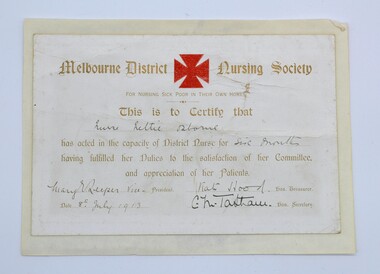
Certificate - Photograph, colour, Melbourne District Nursing Society certificate of employment, 08.07.1913
... This Certificate was presented to Trained nurse, known as 'Nurse' in those days, Nettie Osborne on completion of six months employment with Melbourne District Nursing Society (MDNS). ...Under this, written in black handwriting, is "Nurse Nettie Osborne"/; below this in script is "has acted in the capacity of District Nurse", then in black handwriting the words "Six Months"/. ...This Certificate was presented to Trained nurse, known as 'Nurse' in those days, Nettie Osborne on completion of six months employment with Melbourne District Nursing Society (MDNS). ...This Certificate was presented to Trained nurse, known as 'Nurse' in those days, Nettie Osborne on completion of six months employment with Melbourne District Nursing Society (MDNS). This is the only example of a MDNS Nurses certificate in the RDNS collection. In 1913 the MDNS Nurses had their board and residence, uniforms, bicycles and laundry expenses provided. Newly employed Nurses were paid £50 a year for her first six months. At the end of a year her salary was increased by £5, and later she earned £60 a year. .Following the founding of the Melbourne District Nursing Society (MDNS) in February 1885 to care for the sick poor in Melbourne, subsequent meetings were held to form a Committee and to draw up a Code of Rules of the Society. It was decided that only nurses who had attended a Hospital Nurses Training School and were fully qualified would be employed by the Society. After interviewing several candidates, it was on the first of May 1885 when the first Trained nurse, known as 'Nurse' in those days, Mrs. Ferguson, was employed by MDNS with a salary of £100 per annum. She was employed for three months initially, but this was soon extended, "on the understanding she will make arrangements to live in the more immediate vicinity of her district". A Doctor agreed to assist the Nurse with advice at any time. In rotation, a member of the Superintendence Sub-Committee supervised the Nurse’s visits and could assist to alleviate some poor social conditions they found. A second Nurse, Mrs. Joanna Cannon was employed by MDNS six months later, with a trial period of six months which was extended. They were the stalwarts of the Society in the early years, Nurse Cannon remaining with the Society for four years and Nurse Ferguson for five years, though both had a short break due to illness through the heaviness of the work. Nurses salaries were reduced to account for the cost of uniforms, and then when establishments were rented by the Society and the Nurses could now live in the Nurses Home. The Nurses worked in the now CBD, ie from Spencer Street to Spring Street and from Victoria Parade to Flinders Street. From its inception the Society was at the forefront of health care. They liaised with Doctors and provided high quality trained nursing care; educated their patients in the curing and prevention of disease; teaching the importance of cleanliness, fresh air and good nutrition, both by verbal instruction and demonstration, even supplying soup and milk when needed. At that time they walked the streets and lane ways amid the slums of inner Melbourne carrying their nursing bag containing lotion, ointments, powders, liniment, bandages, dressings, a case of spirits, and the Nurse's own clean apron, soap and small towel. They supplied equipment on loan, such as earthenware hot water bottles, splints, urinals, bed pans, bed cradles, feeding mugs, and air-cushions as well as providing blankets and clean bed linen, and nightdresses as necessary. They provided nursing care to a range of people, often in destitute situations, some lying on rags on the floor as they had no bed, others with just a bed and maybe a thin blanket, a chair and nothing else. Their ages ranged from babes, children, adults to the elderly. The Nurses gave medications as ordered, dressed wounds e.g. to the injured, and surgical cases, and to those with leg ulcers; attended to patients with ‘surgical ailments’ such as ‘hip disease’; gave care to those with acute illnesses such as bronchitis, pleurisy, pneumonia, measles, and scarlet fever, as well as those with chronic illnesses such as consumption (tuberculosis), heart disease, arthritis, cancer, debility, neuritis and paralysis. As the work increased a third Nurse was employed but this was arduous work, particularly in the heat of summer and many nurses only remained with the Society for several months. A Trained Midwife was employed in August 1893. The work was arduous, particularly in the heat of summer. Permission to use bicycles was given to the Nurses in 1898 and the Society decided to purchase their own in 1903. A business man offered ‘new free wheel’ bicycles at £13 each which included maintenance for one year. Bells and wooden frames were added, at a cost of £5 per frame, so the Nurses could carry extra equipment. Nurses’ bags were strapped to the handlebars. Soup was made for those in need 2-3 times a week and if patients could not arrange to have it collected the soup was delivered by the Nurses on their bicycles. The use of bicycles caused a change in uniform, with white pith helmets, and veils covering them and tied under their chin, now being used; straw hats were worn in summer. Over the years the Nurses complained that their veils became wet in the rain and asked for a change of uniform but this did not occur until 1921. Bicycles continued to be used in inner areas until 1945. Public transport was also used over the years, in conjunction with a Motor Auxiliary from 1929 to 1971. MDNS began with its own small fleet of vehicles in the early 1950s which gradually expanded into a full fleet.The coloured Certificate is made of white paper attached to a buff card forming a boarder. It is in gold print on the white background which has a thin gold border. In large bold script are the words "Melbourne District Nursing Society" In between the words "District" and "Nursing" is a red Maltese cross which extends above and below the writing. Underneath this, in smaller capital letters, are the words "For Nursing Sick Poor In Their Own Homes"/. Below this in bold script are the words "This is to Certify that"/. Under this, written in black handwriting, is "Nurse Nettie Osborne"/; below this in script is "has acted in the capacity of District Nurse", then in black handwriting the words "Six Months"/. The next two lines read "having fulfilled her Duties to the satisfaction of her Committee, /"and appreciation of her Patients". The Certificate is signed in black by Mary Leeper, Vice President; Kate Hood; Hon. Treasurer; C.M. Tatham Hon. Secretary, and has Date; 8th July 1913 in black handwriting. On paper attached with tape to the back of the Certificate, is a copy of a photograph of two unidentified people. [Possibly Nettie and her husband]. Some small marks, and in one area a small area of cracking is seen on the white background of the certificate.certificates, mdns, melbourne district nursing society, rdns, royal district nursing service, nurse nettie osborne -
Emerald Museum & Nobelius Heritage Park
Book - History Book, 'Fourteen Years: Extracts from a Private Journal'
... Fourteen Years: Extracts from a Private Journal' by Nettie Palmer 1925 - 1939....Fourteen Years: Extracts from a Private Journal' by Nettie Palmer 1925 - 1939. 'Fourteen Years: Extracts from a Private Journal' Book History Book ...Fourteen Years: Extracts from a Private Journal' by Nettie Palmer 1925 - 1939. -
 Warrnambool and District Historical Society Inc.
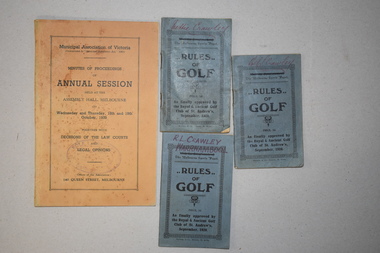
Publication, Wild & Beissel Pty Ltd, Booklet, 1939
... Crawley Warrnambool’ ‘Nettie Crawley’ ...Crawley Warrnambool’ ‘Nettie Crawley’ .1 This is a buff-coloured booklet of 121 pages. ...One of these booklets contains the Minutes of Procedure of the Annual Session of the Municipal Association of Victoria in October 1939. The other three items are booklets containing the rules of golf as approved by the Golf Club of St Andrews in 1920. The four items belonged to Rolf Crawley who had a private surveying, engineering and architects practice in Warrnambool and was also the engineer for the Shire of Warrnambool from 1935 to 1968. The Shire of Warrnambool existed from 1863 to 1994. Rolf Crawley’s grandfather, father and uncle were also engineers and worked in that capacity or as the Shire Secretary for the Shire of Warrnambool, with the Crawley family recording a total of 132 years of service to the Shire. The items came into the possession of Michael Hand who took over the private surveying business of Rolf Crawley in Warrnambool. The Warrnambool and District Historical Society acquired the items, along with several ledgers and other Crawley memorabilia, from the estate of Michael Hand. These booklets are of minor interest as items that belonged to Rolf Crawley, the engineer for the Shire of Warrnambool in the mid 20th century..1 This is a buff-coloured booklet of 121 pages. It has printed matter and one black and white photograph. It has two mauve stamps on the front cover and on the first page. .2.3.4 These are three small identical booklets with blue covers. They each contain 48 pages and have black and white advertisements. They have handwritten names on the front covers. .1 ‘Rolf L. Crawley Civil Engineer, Drainage and Water Supply Engineer, Licensed Surveyor, Registered Architect, Warrnambool’ .2.3.4. ‘Rolf L. Crawley Warrnambool’ ‘Nettie Crawley’ rolf crawley, warrnambool, shire of warrnambool -
Emerald Museum & Nobelius Heritage Park
Book - Novel, Prichard, Katharine Susannah et al, The roaring nineties: A story of the goldfields of Western Australia, 1946
... The author, Katharine Susannah Pritchard, was at one time the owner of Rose Charman's Cottage, which she leased to Vance and Nettie Palmer, and which became a centre for the gathering of well-known literary figures early in the 210th century....The author, Katharine Susannah Pritchard, was at one time the owner of Rose Charman's Cottage, which she leased to Vance and Nettie Palmer, and which became a centre for the gathering of well-known literary figures early in the 210th century. ...The author, Katharine Susannah Pritchard, was at one time the owner of Rose Charman's Cottage, which she leased to Vance and Nettie Palmer, and which became a centre for the gathering of well-known literary figures early in the 210th century.411p.: First published 1946 (by the Australian Pub. Coy.)K.R.W. Davis LTFG Authorised Newsagentemerald, victoria, australia, authors, fiction, katharine susannah prichard, rose charman's cottage -
 Melbourne Tram Museum
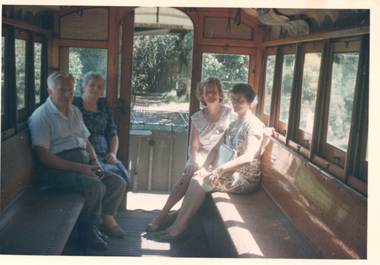
Photograph - Set of 4 - Alf Twentyman cable cars
... The first shows Alf, his wife Ethel (Nettie) and visitors sitting in trailer No. 586 with the others showing the grip car No. 436. ...The first shows Alf, his wife Ethel (Nettie) and visitors sitting in trailer No. 586 with the others showing the grip car No. 436. ...The set shows the cable cars collected by Alf Twentyman at his Northcote home. The first shows Alf, his wife Ethel (Nettie) and visitors sitting in trailer No. 586 with the others showing the grip car No. 436. Photographer and date unknown.Yields information about the Alf Twentyman cable car collection.Set of four colour photos with plain backs.trams, alf twentyman, tram 586, northcote -
 Bendigo Historical Society Inc.
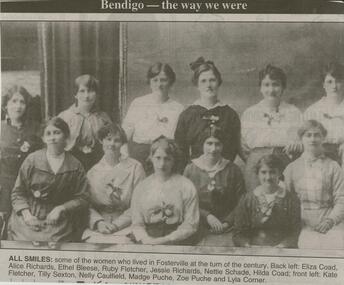
Newspaper - JENNY FOLEY COLLECTION: ALL SMILES
... All smiles: some of the women who lived in Fosterville at the turn of the century, back left: Eliza Coad, Alice Richards, Ethel Bleese, Ruby Fletcher, Jessie Richards, Nettie Schade, Hilda Coad. Front left: Kate Fletcher, Tilly Sexton, Nelly Caulfield, Madge Puche, Zoe Puche and Lyla Corner. ...All smiles: some of the women who lived in Fosterville at the turn of the century, back left: Eliza Coad, Alice Richards, Ethel Bleese, Ruby Fletcher, Jessie Richards, Nettie Schade, Hilda Coad. Front left: Kate Fletcher, Tilly Sexton, Nelly Caulfield, Madge Puche, Zoe Puche and Lyla Corner. ...Bendigo Advertiser ''The way we were'' from 2000. All smiles: some of the women who lived in Fosterville at the turn of the century, back left: Eliza Coad, Alice Richards, Ethel Bleese, Ruby Fletcher, Jessie Richards, Nettie Schade, Hilda Coad. Front left: Kate Fletcher, Tilly Sexton, Nelly Caulfield, Madge Puche, Zoe Puche and Lyla Corner. The clip is in a folder.newspaper, bendigo advertiser, the way we were -
 Glen Eira Historical Society
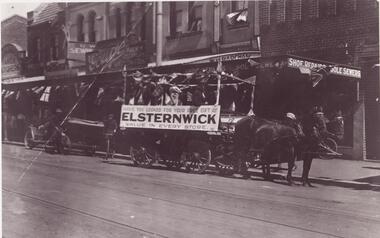
Photograph - ELSTERNWICK
... This file contains 15 items: 1/5 Photocopied photographs of early Elsternwick buildings and railway reserve c. 1901. 2/2 Photocopied photos and one original photo of local transport in Elsternwick c. 1908, and one print of Nettie Palmer on a bicycle in Elsternwick in 1902. 3/7 coloured photographs of painted signage on buildings in Elsternwick uncovered in 1989....Grocers Signs Higgins James Tarrier Blacksmith Palmer Nettie Bicycles Photograph ELSTERNWICK ...This file contains 15 items: 1/5 Photocopied photographs of early Elsternwick buildings and railway reserve c. 1901. 2/2 Photocopied photos and one original photo of local transport in Elsternwick c. 1908, and one print of Nettie Palmer on a bicycle in Elsternwick in 1902. 3/7 coloured photographs of painted signage on buildings in Elsternwick uncovered in 1989.elsternwick, forests, timber, elsternwick post office, elsternwick railway reserve, hampton albert g., motorcars, motorvehicle repair shops, taxis, beavis street, davenport ron, carre street, wagons, johnson mr., grocers, signs, higgins james, tarrier, blacksmith, palmer nettie, bicycles -
Emerald Museum & Nobelius Heritage Park
Book - Historical fiction, Vance Palmer, Seedtime, 1957
... Vance and his wife Nettie Palmer were two such writers. In addition to their literary works, they were remembered for their great compassion and generosity. ...Vance and his wife Nettie Palmer were two such writers. In addition to their literary works, they were remembered for their great compassion and generosity. ...Emerald was a gathering place for some Australian writers in the early 20th century. Vance and his wife Nettie Palmer were two such writers. In addition to their literary works, they were remembered for their great compassion and generosity. Vance Palmer's novels wrote between 1920 and 1959.In 1919, the couple rented Rose Charman's Cottage in Emerald from the writer, Katharine Susannah Prichard.Vance and Netty Palmer advocated for the recognition of Australian literature as a subject worthy of serious study and teaching.Published 1957. Hardback. Novel.On spine: 'Seedtime / Vance / Palmer'vance palmer, author, seedtime, novel, katharine susannah prichard, rose charman's cottage, emerald, victoria, australia, nettie palmer -
 Bendigo Historical Society Inc.
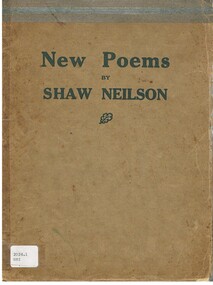
Book - ALEC H CHISHOLM COLLECTION: BOOK 'NEW POEMS' BY SHAW NEILSON
... Inside front cover is stuck a red paper cutting review by Nettie Palmer on Shaw Neilson's Third Book, dated 22-12-27....BOOKS Collections POETRY ALEC H CHISHOLM COLLECTION JOHN SHAW NEILSON NETTIE PALMER WALLACE ANDERSON KATE BAKER. Shaw Neilson Books - ALEC H CHISHOLM COLLECTION . ...Books - ALEC H CHISHOLM COLLECTION . Two copies of a 35 page soft cover book of poems by Shaw Neilson. Published by the Bookfellow in Australia in 1927 and printed by 'The Worker', Sydney. B & W image of Shaw Neilson opposite title page. Copy (a) Catalogue sticker '2024.1 NEI' on front cover. Handwritten in ink on flyleaf 'John Shaw Neilson. Melbourne. 20/12/27' Also on adjoining page 'To Mr Wallace Anderson, from Kate Baker - with Kindest Christmas Greetings Xmas 1935'. Above this is stuck a B & W newspaper image of John Shaw Neilson. Copy (b) Catalogue sticker '2024.2 NEI' on front cover. Inside front cover is stuck a red paper cutting review by Nettie Palmer on Shaw Neilson's Third Book, dated 22-12-27.Shaw Neilsonbooks, collections, poetry, alec h chisholm collection, john shaw neilson, nettie palmer, wallace anderson, kate baker. -
Emerald Museum & Nobelius Heritage Park
Book - Historical fiction, Vance Palmer, Golconda, 1/05/2005 12:00:00 AM
... They emerged as leaders of a profession only beginning to recognize itself; for thirty years and more they (usually Nettie) wrote appreciatively and helpfully, assuring friendship and hospitality, to the author of any book of quality. ...They emerged as leaders of a profession only beginning to recognize itself; for thirty years and more they (usually Nettie) wrote appreciatively and helpfully, assuring friendship and hospitality, to the author of any book of quality. ...Edward Vivian (Vance) Palmer (1885-1959), writer, was born on 28 August 1885 at Bundaberg, Queensland, seventh child of Australian-born Henry Burnet Palmer, schoolteacher, and his Irish wife Jessie, née Carson. He began to write, especially for Steele Rudd's Magazine: 'Rudd' encouraged him and in 1905 published his article, 'An Australian national art', which foreshadowed his basic attitudes. He won a modest place in the English literary world, associating with Katherine Mansfield, Ezra Pound, Wyndham Lewis, Frank Harris, Herbert Read and Will Dyson. On 23 May 1914 in London Palmer married Janet Gertrude Higgins (Nettie). His first volumes of stories and sketches, The World of Men, and poetry, Forerunners, were published in London in 1915, His second volume of verse, The Camp (1920), contained his best-known poem, 'The farmer remembers the Somme'. A liberal socialist of the broad left, Palmer made his last overseas trip in 1955 to Helsinki as delegate to the World Peace Council. He had declined the offer of an O.B.E. After the war Palmer had returned to writing fiction. In 1948 Golconda appeared—the first of a trilogy broadly inspired by the life of E. G. Theodore, novels which are among his best. Moreover, in these years he wrote some of his finest stories, gathered in Let the Birds Fly (1955); and he published with Margaret Sutherland the pioneering work, Old Australian Bush Ballads (1951). He began working on his reminiscences; Intimate Portraits (1969) demonstrates again his biographical talent. The Palmers' partnership was dedicated to promotion of a national literature in a period when few were interested in Australian arts and letters. They emerged as leaders of a profession only beginning to recognize itself; for thirty years and more they (usually Nettie) wrote appreciatively and helpfully, assuring friendship and hospitality, to the author of any book of quality. They were essentially 'intellectuals, deeply concerned with the world of ideas'—their strength was in combining knowledge of world literature and international standards with passionate devotion to fostering national writing.The book is socially and artistically significant as it is written by Vance Palmer who was a significant figure in Australian art circlesRed hard cover book with buff dust jacket, illustration of two men standing near a mine winch. Dust jacket taped to bookMarion Preston, $6book, fiction, golconda, vance, palmer, lead, mining -
 Kew Historical Society Inc
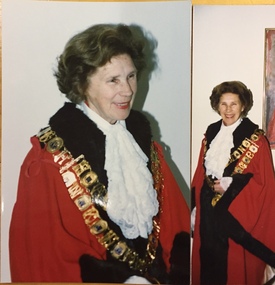
Photograph - Photographs, Cr Phyllis Hore, Mayor of Kew 1985-1986, 1985-1986
... During her Mayoral year, she was instrumental in memorialising Vance and Nettie Palmer, significant Kew writers and poets, by unveiling a plaque at the Kew Library in the year of the centenary of their births. ...During her Mayoral year, she was instrumental in memorialising Vance and Nettie Palmer, significant Kew writers and poets, by unveiling a plaque at the Kew Library in the year of the centenary of their births. ...Phyllis Catherine Hore (née Kiss) was born in 1918. A Kew resident from 1949, she was elected to Council in 1972, after several attempts, and served for twenty- three years until her death in 1994. A secondary teacher by profession, Cr Hore represented College and Sackville Wards. While a councillor, she was a resident of High and later Pakington Streets. She served on Council committees and was a delegate to the Kew Elder Citizens Association, the Family and Community Services (FACS) Local Consultative Committee, and the Kew Music Centre Board of Management. During her Mayoral year, she was instrumental in memorialising Vance and Nettie Palmer, significant Kew writers and poets, by unveiling a plaque at the Kew Library in the year of the centenary of their births. In May 1994, the Mayor of Kew, Cr Tom Indovino, named a meeting room at Kew Library, the Phyllis Hore Room in recognition of her service to the City. She is buried in the Heidelberg (Warringal) Cemetery. (Source: Chairmen and Mayors of Kew 1960-1994, p. 88)Two colour 'proofs' of mayoral photos of Cr Phyllis Hore, donated by her daughter in 2019cr phyllis hore, mayors of kew (vic)
