
Showing 749 items matching "new museum building"
-
 Ballarat Tramway Museum
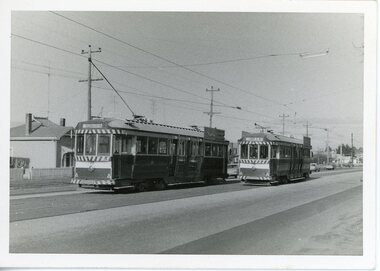
Photograph - Ballarat Tram 39, Ballarat Tram 39 in Skipton Street near the Bell Street loop, 1971
... ...new museum building...When the Ballarat Tramways closed in 1971, it was purchased by the Lismore Lions Club and displayed in a recreational reserve until purchased by the Museum in 1976 and converted into a museum display and souvenir centre located at the depot until the new Museum building was opened in 2022. This photo taken in 1971. ...When the Ballarat Tramways closed in 1971, it was purchased by the Lismore Lions Club and displayed in a recreational reserve until purchased by the Museum in 1976 and converted into a museum display and souvenir centre located at the depot until the new Museum building was opened in 2022. This photo taken in 1971. ...This tram was built in 1914 for thr Prahran and Malvern Tramways Trust and was No 42. It was sold to the State Electricity Commission in 1951 and renumbered 39. When the Ballarat Tramways closed in 1971, it was purchased by the Lismore Lions Club and displayed in a recreational reserve until purchased by the Museum in 1976 and converted into a museum display and souvenir centre located at the depot until the new Museum building was opened in 2022. This photo taken in 1971. It may have been taken on its last trip. Victorian Collection (Ballarat) Item 10755 has 16 images of the tram being moved from Lismore to Ballarat in 1976. Photograph taken by Campbell Duncan.Black and white photograph of Ballarat tram 39.tram 42, built 1914, prahran and malvern tramways trust, state electricity commission, 1951, ballarat tramways, tram 39, closure of ballarat trams, 1971, lismore lions club, 1976, museum disply, souvenir centre, new museum building, 2022, item 10755, campbell duncan, photographer -
 Ballarat Tramway Museum
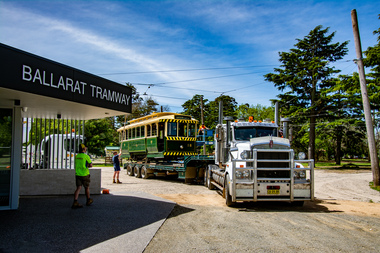
Photograph - Digital photograph of Tram 18 being moved to new museum, Peter Waugh
... Digital photograph of a large articulated truck moving Tram 18 from the workshop into the new museum building. A man uses a pole to lift the overhead wire to give the tram clearance....Tram being moved by truck prior to track construction Yields information about methods of moving trams at the museum BTM moving trams Tram 18 Ballarat Digital photograph of a large articulated truck moving Tram 18 from the workshop into the new museum building. A man uses a pole to lift the overhead wire to give the tram clearance. ...Tram being moved by truck prior to track constructionYields information about methods of moving trams at the museum Digital photograph of a large articulated truck moving Tram 18 from the workshop into the new museum building. A man uses a pole to lift the overhead wire to give the tram clearance.btm, moving trams, tram 18, ballarat -
 Ballarat Tramway Museum
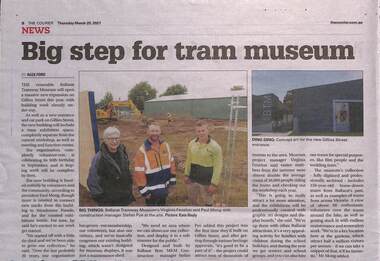
Newspaper, The Courier Ballarat, "Big step for tram museum", 25/03/2021 12:00:00 AM
... Newspaper clipping from The Courier, 25/3/2021, titled "Big step for tram museum" about the commencement of the work to extend the BTM Depot to form a new Museum building. Features a photo of Virginia Fenelon, Paul Mong and Stefan Pye of MKM Constructions, with the site behind them. ...BTM Museum MKM Buildings Depot Newspaper clipping from The Courier, 25/3/2021, titled "Big step for tram museum" about the commencement of the work to extend the BTM Depot to form a new Museum building. ...Newspaper clipping from The Courier, 25/3/2021, titled "Big step for tram museum" about the commencement of the work to extend the BTM Depot to form a new Museum building. Features a photo of Virginia Fenelon, Paul Mong and Stefan Pye of MKM Constructions, with the site behind them. Details the building project and quotes. Story by Alex Ford and photo Kate Healy.btm, museum, mkm, buildings, depot -
 Tatura Irrigation & Wartime Camps Museum
Photograph - original, Tatura Museum Restoration, 1991
... North east view of new room Tatura Museum adjoining present building. B. Doller's car in foreground. ...Colour photograph of exterior of new building. Tatura Museum 1991...Knee working on scaffolding. tatura museum on back: Tatura Museum extension 1991. Colour photograph of exterior of new building. Tatura Museum 1991 Tatura Museum Restoration Photograph - original ...North east view of new room Tatura Museum adjoining present building. B. Doller's car in foreground. Jacaranda tree at left. A. Knee working on scaffolding.Colour photograph of exterior of new building. Tatura Museum 1991on back: Tatura Museum extension 1991. tatura museum -
 Ballarat Tramway Museum
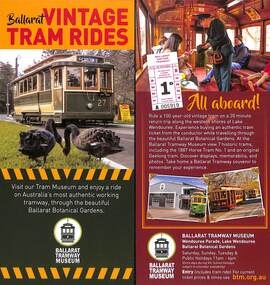
Pamphlet, Ballarat Vintage Tram Rides - 2022
... Gives details of location, opening hours, the new Museum building. Has photos of trams 26, 407 and a conductor handing out tickets....Gives details of location, opening hours, the new Museum building. Has photos of trams 26, 407 and a conductor handing out tickets. ...Pamphlet used to market the Museum featuring tram 27 with swans in the view. Gives details of location, opening hours, the new Museum building. Has photos of trams 26, 407 and a conductor handing out tickets.Yields information about the marketing of the Museum and its publications.Printed single sheet pamphlet DL card, advertising BTM Vintage Tramway, titled "Ballarat Vintage Tram Rides" 4 copies held.btm, ballarat, tramways, pamphlet, tram 27, marketing -
 Ballarat Tramway Museum
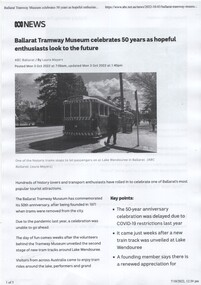
Newspaper, ABC News, "BTM Celbrates 50 years as hopeful enthusiasts look to the future"
... Features photos of trams in Wendouree Parade, Ballarat 27 at Mt Pleasant on its supposed 1,000,000 miles, Richard Gilbert standing by Geelong No 2 and of the event itself with many people standing in front of the new Museum building....Features photos of trams in Wendouree Parade, Ballarat 27 at Mt Pleasant on its supposed 1,000,000 miles, Richard Gilbert standing by Geelong No 2 and of the event itself with many people standing in front of the new Museum building. Demonstrates the 50 + 1 years celebration held on 2-10-2022 BTM ABC News Museums tramways tramcars events 50 years Four A4 pages of the print of an ABC news item dated 3-10-2022 following the Museum's successful Tramcar Celebration day (50+1) years, "BTM Celbrates 50 years as hopeful enthusiasts look to the future" Newspaper ABC News ...Details the Museum's celebration event on Sunday 2 October 2022, published by the ABC on their website. Features photos of trams in Wendouree Parade, Ballarat 27 at Mt Pleasant on its supposed 1,000,000 miles, Richard Gilbert standing by Geelong No 2 and of the event itself with many people standing in front of the new Museum building.Demonstrates the 50 + 1 years celebration held on 2-10-2022Four A4 pages of the print of an ABC news item dated 3-10-2022 following the Museum's successful Tramcar Celebration day (50+1) years,btm, abc news, museums, tramways, tramcars, events, 50 years -
 Ballarat Tramway Museum
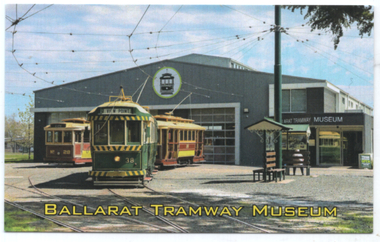
Ephemera - Membership Card/s, Ballarat Tramway Museum (BTM), Oct. 2023
... The 2023-24 one features a photo of three trams on the depot fan outside the New Museum building led by tram 38 with trams 26 and 28. ...The 2023-24 one features a photo of three trams on the depot fan outside the New Museum building led by tram 38 with trams 26 and 28. ...Membership cards are issued to members and feature either a historic or current photo of the Museum's activities. The 2023-24 one features a photo of three trams on the depot fan outside the New Museum building led by tram 38 with trams 26 and 28. On the rear along the bottom edge of the rear, has the words "Photo Benjamin Boehle-Mitchell"Demonstrates the method of issuing Ballarat Tramway Museum membership cards.Colour photograph printed onto white card as a BTM Membership card for 2023-24trams, tramways, membership cards, buildings, museum, btm, new depot, tram 38, tram 28, tram 26 -
 Ballarat Tramway Museum
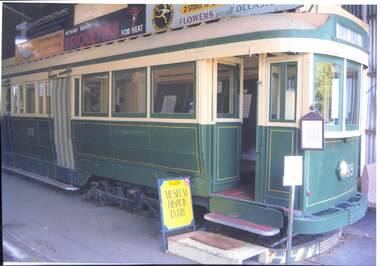
Photograph - Photograph - coloured, Tram 39 - Maximum Traction truck bogie, drop end and centre combination. Museum Display inside
... Lismore Lions Club bought it in 1971 and displayed it in a recreational reserve until the Ballarat Museum purchased it in 1976. the Museum converted it into a museum display and souvenir centre at the depot until the new Museum building was opened in 2022....Lismore Lions Club bought it in 1971 and displayed it in a recreational reserve until the Ballarat Museum purchased it in 1976. the Museum converted it into a museum display and souvenir centre at the depot until the new Museum building was opened in 2022. tram 39 1914 prahran and malvern tramways trust tram 42 state electricity commission 1951 lismore lions club ballarat tramway museum 1976 museum and souvenir shop new museum 2022 Tram green and cream number 39 in gold on ends and sides. ...The tram was built in 1914 for the Prahran and Malvern Tramways Trust and had the number 42. It was sold to the State Electricity Commission in 1951 and renumbered 39. Lismore Lions Club bought it in 1971 and displayed it in a recreational reserve until the Ballarat Museum purchased it in 1976. the Museum converted it into a museum display and souvenir centre at the depot until the new Museum building was opened in 2022.Large coloured photograph of a tram, laminated. Sign outside - Museum Display EntryTram green and cream number 39 in gold on ends and sides. City Oval in destination window. Advertising boards on top of tram.tram 39, 1914, prahran and malvern tramways trust, tram 42, state electricity commission, 1951, lismore lions club, ballarat tramway museum, 1976, museum and souvenir shop, new museum 2022 -
 8th/13th Victorian Mounted Rifles Regimental Collection
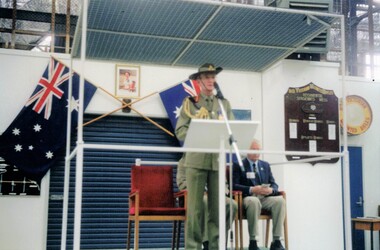
Photograph - Opening museum 105
... museum was first established at Buna Barracks Albury in 1986. In 2000, when the regiment relocated to Building 105 North Bandiana, the museum collection was packed then relayed in a new space. ...Colour photograph of Major General R P Irving AM RFD speaking at the opening of the Victorian Mounted Rifles new museum at Building 105 North Bandiana, 2 August 2003. ...Major General Irving was commander of 2nd Division. vmr bandiana irving museum Colour photograph of Major General R P Irving AM RFD speaking at the opening of the Victorian Mounted Rifles new museum at Building 105 North Bandiana, 2 August 2003. ...The Victorian Mounted Rifles museum was first established at Buna Barracks Albury in 1986. In 2000, when the regiment relocated to Building 105 North Bandiana, the museum collection was packed then relayed in a new space. Major General Irving was commander of 2nd Division. Colour photograph of Major General R P Irving AM RFD speaking at the opening of the Victorian Mounted Rifles new museum at Building 105 North Bandiana, 2 August 2003. Seated on the dais is Lieutenant Colonel (Retired) D J Hunter, chairman of the museum committee.vmr, bandiana, irving, museum -
 Ballarat Tramway Museum
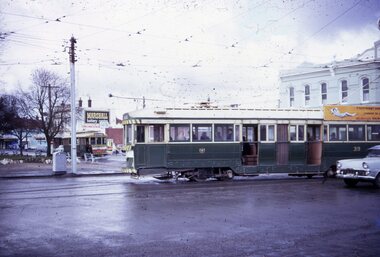
Slide - Ballarat Tram 39, Tram at the Hospital corner, Ballarat, 11 August 1971
... When the trams ceased to run in Ballarat in 1971, Tram 39 was converted into a museum display and souvenir centre located at the depot until the new Museum building was opened during 2022....When the trams ceased to run in Ballarat in 1971, Tram 39 was converted into a museum display and souvenir centre located at the depot until the new Museum building was opened during 2022. ballarat tram 39 drummond street sturt street hospital corner 1971 museum display souvenir centre campbell duncan photographer ballarat tram 17 Handwritten notation in ink on mount. ...The image shows Tram 39 running from Drummond Street South into Sturt Street - at the Ballarat Base Hospital corner. Tram 17 is in Sturt Street. Photograph was taken on 11 August 1971 by Campbell Duncan. When the trams ceased to run in Ballarat in 1971, Tram 39 was converted into a museum display and souvenir centre located at the depot until the new Museum building was opened during 2022.Colour image in cardboard Kodak mount. 35mm slideHandwritten notation in ink on mount.ballarat tram 39, drummond street, sturt street, hospital corner, 1971, museum display, souvenir centre, campbell duncan, photographer, ballarat tram 17 -
 8th/13th Victorian Mounted Rifles Regimental Collection
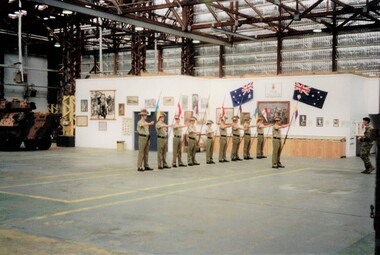
Photograph - Opening museum 105
... museum was first established at Buna Barracks Albury in 1986. In 2000, when the regiment relocated to Building 105 North Bandiana, the museum collection was packed then relayed in a new space. ...Colour photograph of lance guard drawn from VMR Squadron 4/19 Prince of Wales's Light Horse awaiting arrival of Major General R P Irving AM RFD at the opening of the Victorian Mounted Rifles new museum at Building 105 North Bandiana, 2 August 2003....Major General Irving was commander of 2nd Division. 8/13 Victorian Mounted Rifles linked with 4/19 Prince of Wales's Light Horse in 1991 to form the current regiment. vmr bandiana irving museum PWLH guard Colour photograph of lance guard drawn from VMR Squadron 4/19 Prince of Wales's Light Horse awaiting arrival of Major General R P Irving AM RFD at the opening of the Victorian Mounted Rifles new museum at Building 105 North Bandiana, 2 August 2003. ...The Victorian Mounted Rifles museum was first established at Buna Barracks Albury in 1986. In 2000, when the regiment relocated to Building 105 North Bandiana, the museum collection was packed then relayed in a new space. Major General Irving was commander of 2nd Division. 8/13 Victorian Mounted Rifles linked with 4/19 Prince of Wales's Light Horse in 1991 to form the current regiment.Colour photograph of lance guard drawn from VMR Squadron 4/19 Prince of Wales's Light Horse awaiting arrival of Major General R P Irving AM RFD at the opening of the Victorian Mounted Rifles new museum at Building 105 North Bandiana, 2 August 2003.vmr, bandiana, irving, museum, pwlh, guard -
 Ballarat Tramway Museum
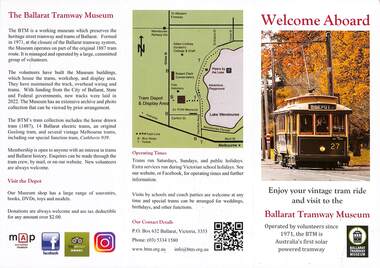
Pamphlet, BTM Welcome Aboard 2022
... Features a photo of tram 26 in the new Museum building. Text revised 2022 for the new building. ...Features a photo of tram 26 in the new Museum building. Text revised 2022 for the new building. ...Features photos of trams 27 and 1 in Wendouree Parade with an interior photo of 26 of a conductor handing out tickets. Has text describing "Your Trip", the trams, Ballarat Tramways, the museum itself along with maps of the Ballarat system and the Gardens area. Features a photo of tram 26 in the new Museum building. Text revised 2022 for the new building. See Reg. items 712, 1532, 4752 and 8061 for details of earlier productions. Item folded as presented to a passenger.Demonstrates the methodology of interpreting the tram trip for the Museum's visitors.Printed colour A4 folded sheet, 2022 version of BTM "Welcome Aboard" pamphlets for handing out to passengers on trams. Three copies held.trams, tramways, ballarat, btm, handouts, passengers, pamphlets -
 8th/13th Victorian Mounted Rifles Regimental Collection
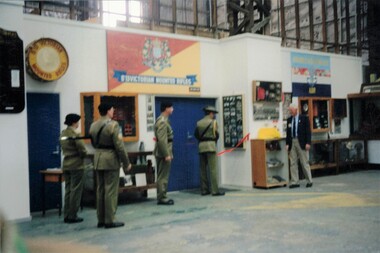
Photograph - Opening museum 105
... museum was first established at Buna Barracks Albury in 1986. In 2000, when the regiment relocated to Building 105 North Bandiana, the museum collection was packed then relayed in a new space. ...Colour photograph of Major General R P Irving AM RFD cutting the ribbon to open the Victorian Mounted Rifles new museum at Building 105 North Bandiana, 2 August 2003. ...Major General Irving was commander of 2nd Division. vmr bandiana irving museum Stevens Snooks Hunter Colour photograph of Major General R P Irving AM RFD cutting the ribbon to open the Victorian Mounted Rifles new museum at Building 105 North Bandiana, 2 August 2003. ...The Victorian Mounted Rifles museum was first established at Buna Barracks Albury in 1986. In 2000, when the regiment relocated to Building 105 North Bandiana, the museum collection was packed then relayed in a new space. Major General Irving was commander of 2nd Division. Colour photograph of Major General R P Irving AM RFD cutting the ribbon to open the Victorian Mounted Rifles new museum at Building 105 North Bandiana, 2 August 2003. Lieutenant Colonel (Retired) D J Hunter, chairman of the museum committee is at right, Lieutenant Colonel A Stevens, Commanding Officer 4/19 Prince of Wales's Light Horse is at left together with RSM Warrant Officer Class One Snooks.vmr, bandiana, irving, museum, stevens, snooks, hunter -
 Ballarat Tramway Museum
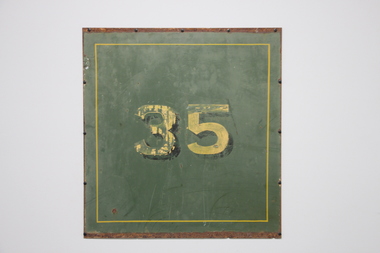
Photograph - Digital Image, Peter Knife, Side panel from tram 35, 5/9/2023
... Digital image of one of the side panels from tram 35, on display in the Ballarat Tramway Museum, new building. Photo by Peter Knife 5/9/2023....Digital image of one of the side panels from tram 35, on display in the Ballarat Tramway Museum, new building. Photo by Peter Knife 5/9/2023. ...Digital image of one of the side panels from tram 35, on display in the Ballarat Tramway Museum, new building. Photo by Peter Knife 5/9/2023.Yields information about former Ballarat tram 35.Digital image of one of the side panels from tram 35.tramways, tramcars, btm, tram 35, displays, tramcar part -
 Ballarat Tramway Museum
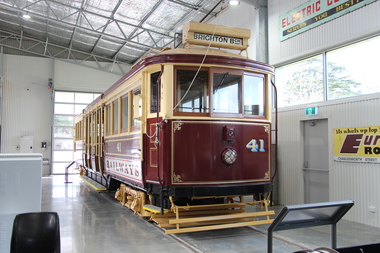
Photograph - Digital Image, Peter Knife, VR Tram 41 on display, 5/9/2023
... Digital image of the Melbourne Tramcar Preservation Association Victorian Railways Tram No. 41 on display in the Ballarat Tramway Museum, new building. Photo by Peter Knife 5/9/2023....Digital image of the Melbourne Tramcar Preservation Association Victorian Railways Tram No. 41 on display in the Ballarat Tramway Museum, new building. Photo by Peter Knife 5/9/2023. ...Digital image of the Melbourne Tramcar Preservation Association Victorian Railways Tram No. 41 on display in the Ballarat Tramway Museum, new building. Photo by Peter Knife 5/9/2023.Yields information about Victorian Railways tram 41.Digital image of VR 41tramways, tramcars, btm, mtpa, tram 41, vr class tramcars -
 Ballarat Tramway Museum
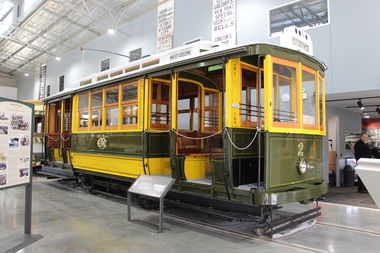
Photograph - Digital Image - set of 6, Peter Knife, Geelong 2 and Ballarat 27 on display and other trams, 5/9/2023
... Set of four digital images of trams on display in the Ballarat Tramway Museum, new building. Geelong 2 and Ballarat 27, and includes interior photos. ...Set of four digital images of trams on display in the Ballarat Tramway Museum, new building. Geelong 2 and Ballarat 27, and includes interior photos. ...Set of four digital images of trams on display in the Ballarat Tramway Museum, new building. Geelong 2 and Ballarat 27, and includes interior photos. Photo by Peter Knife 5/9/2023. Included are photos of tram 38 on No. 2 road and No. 12.Yields information about trams on display at the Museum.Set of six Digital images,tramways, tramcars, btm, tram 2, tram 27, interiors, tram 38, tram 12 -
 Ballarat Tramway Museum
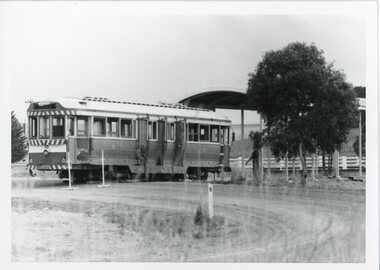
Photograph - Ballarat Tram 39, Tram 39 being returned to Ballarat from Lismore, May 1976
... This was used until the new Museum building was opened in 2022. These photos show the process of loading the tram onto a truck in Lismore and bringing it back to Ballarat. ...This was used until the new Museum building was opened in 2022. These photos show the process of loading the tram onto a truck in Lismore and bringing it back to Ballarat. ...Tram 39 was built in 1914 for the Prahran and Malvern Tramways Trust. In 1951 it was sold to the State Electricity Commission, Ballarat, and renumbered 39. When the Ballarat Tramways closed in 1971, it was sold to Lismore Lions Club and displayed in a recreational reserve. Ballarat Tramway Museum purchased the tram in 1976 and converted it into a museum display and souvenir centre. This was used until the new Museum building was opened in 2022. These photos show the process of loading the tram onto a truck in Lismore and bringing it back to Ballarat. The date of this was 9 May 1976. All photographs were taken by the donor, Campbell Duncan. Each photograph has information written on the back. .1 Lismore, 8/5/76 .2 Lismore, 8/5/76 .3 39 waits to be jacked down - truck ready to depart.9/5/76 .4 Truck has pulled out after 39 jacked up from it. Truck faces back down the driveway. 9/5/76. .5 Lismore. 9/5/76 .6 Lismore. 9/5/76 .7 Lismore. 9/5/76 .8 Lismore. 9/5/76 .9 Mair Street Ballarat East 9/5/76 .10 Mair Street Ballarat East 9/5/76 .11 Victoria Street Ballarat East 9/5/76 .12 Victoria Street Ballarat East 9/5/76 .13 Ballarat East, Victoria Street 9/5/76 .14 Victoria Street Ballarat East 9/5/76 .15 Victoria Street. Truck about to back down driveway 9/5/76. (this photo was used in Ballarat Courier of 15/5/76) See photo 10212. .16 Truck pulling out from under 39. 39's storage shed, Victoria Street Ballarat East 9/5/76. Sixteen black and white photographs taken of Tram 39 being transported from Lismore to Ballarat.Photo information on back of each phototram 39, 1914, prahran and malvern tramways trust, sec ballarat, 1951, lismore lions club, 1971, recreational reserve, ballarat tramway museum, 1976, museum display, souvenir centre, museum opened 2022, victoria street, ballarat east, may 1976 photos, photographer, campbell duncan, mair street, storage shed -
 Flagstaff Hill Maritime Museum and Village
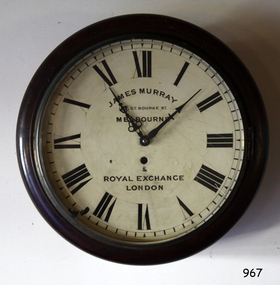
Instrument - Clock
... Museum Victoria). The Bank of Australasia was incorporated by Royal Charter of England in March 1834. It had its Australian beginning on 14th December 1835, opening in Sydney. The Acting Superintendent of the bank at that time was David Charters McArthur. He was Superintendent from 1867-to 1876. The Melbourne branch opened on 28th August 1838 in a two-roomed brick cottage on the north side of Little Collins Street, where two huge mastiff dogs were used at night to guard the bank. The government also provided an armed military sentinel. Due to the bank's rapid growth, a new building...Museum Victoria). The Bank of Australasia was incorporated by Royal Charter of England in March 1834. It had its Australian beginning on 14th December 1835, opening in Sydney. The Acting Superintendent of the bank at that time was David Charters McArthur. He was Superintendent from 1867-to 1876. The Melbourne branch opened on 28th August 1838 in a two-roomed brick cottage on the north side of Little Collins Street, where two huge mastiff dogs were used at night to guard the bank. The government also provided an armed military sentinel. Due to the bank's rapid growth, a new building ...This wall clock originated from the Bank of Australasia. The label on the base matches other items from the same donor. It was spring powered by winding the key mechanism with the clock's key through the hole in the clock face. The hinged door on the base of the clock's case allows access to the clock's working mechanism. James Murray (son of James Murray 1780-1847) was a maker of clocks and chronometers. He worked at No. 1, Royal Exchange, London and from 1861 at 107 Great Bourke Street, Melbourne. In 1854 William Kerr ordered a clock from James Murray and erected it on the Albert Street frontage of the National Model & Training School in Spring Street Melbourne. It was Melbourne's first turret clock and remained there for 80 years before it was transferred to the Public Library in Melbourne in 1934 (now Museum Victoria). The Bank of Australasia was incorporated by Royal Charter of England in March 1834. It had its Australian beginning on 14th December 1835, opening in Sydney. The Acting Superintendent of the bank at that time was David Charters McArthur. He was Superintendent from 1867-to 1876. The Melbourne branch opened on 28th August 1838 in a two-roomed brick cottage on the north side of Little Collins Street, where two huge mastiff dogs were used at night to guard the bank. The government also provided an armed military sentinel. Due to the bank's rapid growth, a new building for the Melbourne branch was opened in 1840 at 75 Collins Street West. By 1879 the bank had been upgraded to a magnificent two-storey building on the corners of Collins and Queens Streets, with the entry on Collins Street. In 1951 the Bank of Australasia amalgamated with the Union Bank to form the Australia and New Zealand Bank, now known as the ANZ. Then in 1970, the ANZ merged with both the ES&A and the London Bank of Australia to form the ANZ Banking Group Limited. The ANZ Banking Group Ltd kindly donated a variety of historic items from the Bank of Australasia. BANK of AUSTRALASIA, WARRNAMBOOL – In 1854 Warrnambool had two banks, the Union Bank and the Bank of Australasia. Later, completely different bank businesses opened; in 1867 the National Bank of Australasia, then in 1875 the Colonial Bank of Australasia. The original Warrnambool branch of the Bank of Australasia was established in July 1854, and operated from a leased cottage on Merri Street, close to Liebig Street. The bank next bought a stone building previously erected by drapers Cramond & Dickson on the corner of Timor and Gibson Streets. Samuel Hannaford was a teller and then Manager at the Warrnambool branch from 1855 to 1856 and the Warrnambool Council chose that bank for its dealings during 1856-57. In 1859 Roberts & Co. was awarded the contract to build the new Bank of Australasia branch for the sum of £3,000. The land was on a sand hill on the northeast corner of Timor and Kepler Streets and had been bought in 1855 from investor James Cust. The new building opened on May 21, 1860. The bank continued to operate there until 1951 when it merged with the Union Bank to form the ANZ Bank, which continued operating from its Liebig Street building. Warrnambool City Council purchased the former Bank of Australasia building in 1971 and renovated it, then on 3rd December 1973 it was officially opened as the Art Gallery by Cr. Harold Stephenson and Gallery Director John Welsh. The Gallery transferred to the purpose-built building in Liebig Street in 1986 and the old bank building is now the Gallery club. Staff at the Bank of Australasia in Warrnambool included the following men but others were also involved: Samuel Hannaford, Teller then Manager from 1855-1856; W H Palmer, Manager from January 1857 until November 1869 when the Teller Basil Spence was promoted to Manager; H B Chomley, Manager from April 1873 and still there in 1886; A Butt, Manager in 1895-1904; J R McCleary Accountant and Acting Manager for 12 months, until 1900; A Kirk, Manager 1904; J Moore, staff until his transfer to Bendigo in December 1908; J S Bath was Manager until 1915; C C Cox, Manager until April 1923; Richard C Stanley, Manager 1923 to April 1928. The clock has significance through its association with the Bank of Australasia. The early Australian bank was established in 1834 by Royal Charter and opened in Sydney, Australia, in Sydney in 1835. The bank had many Australian offices in November 1877, particularly on the east and south coasts. Victoria had 45 percent of all Offices. The clock is significant for its connection with the quality clockmaker James Murray, originally from Royal Exchange London with a branch that opened in Melbourne in 1861. James Murray is renown for making the first turret clock to be installed in Melbourne. The clock is locally significant for its association with the Warrnambool Bank of Australasia, which was established in 1854. It was Warrnambool Council’s first bank. The bank continued to operate until the organisation's merger in 1951 when it became the ANZ Bank Group today. The Bank was an integral part of the growth of local commerce and the community.Wall clock with a round face behind glass in a wooden case. The painted brass face has Roman numerals, two decorative hands, divisions for minutes and a keyhole. The curved base of the case has a hinged access door with a keyhole and adhesive label. The back of the clock's case has metal mounting brackets. Inscriptions on the rectangular white label. Made by James Murray, Melbourne.Face: "JAMES MURRAY / - GT. BOURKE ST. / MELBOURNE / & / ROYAL EXCHANGE / LONEON" Label: "A M / 40"flagstaff hill, warrnambool, shipwrecked coast, flagstaff hill maritime museum, maritime museum, shipwreck coast, flagstaff hill maritime village, great ocean road, bank of australasia, boa, union bank, australia & new zealand bank, anz bank, james murray, clock, wall clock, great bourke street melbourne, royal exchange london, william kerr, turret clock, old model school, national model & training school, access door, winding key -
 Flagstaff Hill Maritime Museum and Village
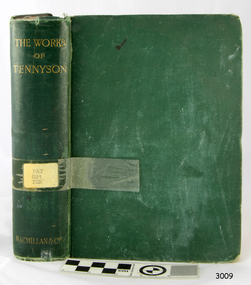
Book, The Works of Alfred Lord Tennyson
... Museum and Art Gallery were removed to make room for the Warrnambool City Council Engineers' Department. The contents were stored but many of the items were scattered or lost. When the original building was demolished the site became occupied by the Civic Centre, which included the new City Library. ...Museum and Art Gallery were removed to make room for the Warrnambool City Council Engineers' Department. The contents were stored but many of the items were scattered or lost. When the original building was demolished the site became occupied by the Civic Centre, which included the new City Library. ...This item is from the ‘Pattison Collection’, a collection of books and records that was originally owned by the Warrnambool Mechanics’ Institute, which was founded in Warrnambool in 1853. By 1886 the Warrnambool Mechanics’ Institute (WMI) had grown to have a Library, Museum and Fine Arts Gallery, with a collection of “… choice productions of art and valuable specimens in almost every branch and many wonderful national curiosities are now to be seen there, including historic relics of the town and district.” It later included a School of Design. Although it was very well patronised, the lack of financial support led the WMI in 1911 to ask the City Council to take it over. In 1935 Ralph Pattison was appointed as City Librarian to establish and organise the Warrnambool Library as it was then called. When the WMI building was pulled down in 1963 a new civic building was erected on the site and the new Warrnambool Library, on behalf of the City Council, took over all the holdings of the WMI. At this time some of the items were separated and identified as the ‘Pattison Collection’, named after Ralph Pattison. Eventually, the components of the WMI were distributed from the Warrnambool Library to various places, including the Art Gallery, Historical Society and Flagstaff Hill. Later some were even distributed to other regional branches of Corangamite Regional Library and passed to and fro. It is difficult now to trace just where all of the items have ended up. The books at Flagstaff Hill Maritime Village generally display stamps and markings from Pattison as well as a variety of other institutions including the Mechanics’ Institute itself. RALPH ERIC PATTISON Ralph Eric Pattison was born in Rockhampton, Queensland, in 1891. He married Maude Swan from Warrnambool in 1920 and they set up home in Warrnambool. In 1935 Pattison accepted a position as City Librarian for the Warrnambool City Council. His huge challenge was to make a functional library within two rooms of the Mechanics’ Institute. He tirelessly cleaned, cleared and sorted a disarrayed collection of old books, jars of preserved specimens and other items reserved for exhibition in the city’s museum. He developed and updated the library with a wide variety of books for all tastes, including reference books for students; a difficult task to fulfil during the years following the Depression. He converted all of the lower areas of the building into a library, reference room and reading room for members and the public. The books were sorted and stored using a cataloguing and card index system that he had developed himself. He also prepared the upper floor of the building and established the Art Gallery and later the Museum, a place to exhibit the many old relics that had been stored for years for this purpose. One of the treasures he found was a beautiful ancient clock, which he repaired, restored and enjoyed using in his office during the years of his service there. Ralph Pattison was described as “a meticulous gentleman whose punctuality, floorless courtesy and distinctive neat dress were hallmarks of his character, and ‘his’ clock controlled his daily routine and his opening and closing of the library’s large heavy doors to the minute.” Pattison took leave from 1942 to 1945 to serve in the Royal Australian Navy, Volunteer Reserve as Lieutenant. A few years later he converted one of the Museum’s rooms into a Children’s Library, stocking it with suitable books for the younger generation. This was an instant success. In the 1950’s he had the honour of being appointed to the Victorian Library Board and received more inspiration from the monthly conferences in Melbourne. He was sadly retired in 1959 after over 23 years of service, due to the fact that he had gone over the working age of council officers. However, he continued to take a very keen interest in the continual development of the Library until his death in 1969. WARRNAMBOOL MECHANICS’ INSTITUTE Warrnambool's Mechanics' Institute (or Institution as it was sometimes called) was one of the earliest in Victoria. On 17th October 1853, a meeting was held where it was resolved to request the Lieutenant Governor of the Colony to grant land for the erection of a Mechanics' Institutes building. A committee was formed at the meeting and Richard Osburne chaired the first meeting of this committee. The land on the North West corner of Banyan and Merri Streets was granted but there were no funds to erect the building. The Formal Rights of the Warrnambool Mechanics' Institute's encompassed its aims and these were officially adopted in1859; "This Institution has for its object the diffusion of literary, scientific, and other useful knowledge amongst its members, excluding all controversial subjects, religious or political. These objects are sought to be obtained by means of a circulating library, a reading room, the establishment of classes, debates, and the occasional delivery of lectures on natural and experimental philosophy, mechanics, astronomy, chemistry, natural history, literature, and the useful and ornamental arts, particularly those which have a more immediate reference to the colony." The Warrnambool Mechanics' Institute opened its first reading room in November 1884 in the National School building at the corner of Banyan and Timor Streets. The Institute was funded by member subscription, payable on a quarterly, half-yearly or yearly basis. Samuel Hannaford, the Manager of the Warrnambool Bank of Australasia, was the first Honorary Secretary of the Mechanics' Institutes, and an early President and Vice-President. He also gave several of the early lectures in the Reading Room. Another early Secretary, Librarian and lecturer was Marmaduke Fisher, the teacher at the National School. Lecture topics included The Poets and Poetry of Ireland', 'The Birth and Development of the Earth', 'The Vertebrae - with Remarks on the pleasures resulting from the study of Natural History' and 'Architecture'. In 1856 the Reading Room was moved to James Hider's shop in Timor Street, and by 1864 it was located in the bookshop of Davies and Read. In the 1860's the Mechanics' Institute struggled as membership waned but in 1866, after a series of fundraising efforts, the committee was able to purchase land in Liebig Street, on a site then called Market Square, between the weighbridge and the fire station. A Mechanics' Institute building was opened at this site in August 1871. The following year four more rooms were added to the main Reading Room and in 1873 the Artisan School of Design was incorporated into the Institute. The same year Joseph Archibald established a Museum; however, it deteriorated when he was transferred to Bendigo in 1877. In 1880, with Archibald's return to Warrnambool, the Museum was re-established, and in 1885 a new building was built at the back of the Institute to accommodate the re-created School of Design, the Art Gallery and the Museum. In 1887 the Museum section was moved to the former courthouse in Timor Street (for some time the walls of the building formed part of the TAFE cafeteria but all is now demolished)). In 1911 the Museum was transferred back to the original building and the management of the Mechanics' Institute was handed over to the Warrnambool City Council. The Museum and Art Gallery became one and housed many fine works of art, and the Library continued to grow. The building was well patronised, with records showing that at the beginning of the 20th century there were between 500 and 800 visitors. During World War One the monthly figures were in the thousands, with 3,400 people visiting in January 1915. The Museum was a much-loved Institution in Warrnambool until the contents of the Museum and Art Gallery were removed to make room for the Warrnambool City Council Engineers' Department. The contents were stored but many of the items were scattered or lost. When the original building was demolished the site became occupied by the Civic Centre, which included the new City Library. (The library was temporarily located in the old Palais building in Koroit Street.) In the process of reorganisation the Collection was distributed amongst the community groups: -The new City Library took some of the historical books and some important documents, historic photographs and newspapers. -The Art Gallery kept the 19th Century art collection and some of the artefacts from the museum. -The Historical Society has some items -The State Museum has some items -Some items were destroyed -Flagstaff Hill Maritime Village has old newspapers, Government Gazettes, most of the Mechanics' Institute Library, ledgers and documents connected to the Mechanics' Institute Library, some framed and unframed artworks and some photographs. The Warrnambool Mechanics' Institute Library book collection is deemed to be of great importance because it is one of the few collections in an almost intact state, and many of the books are now very rare and of great value. The Pattison Collection, along with other items at Flagstaff Hill Maritime Village, was originally part of the Warrnambool Mechanics' Institute’s collection. The Warrnambool Mechanics’ Institute Collection is primarily significant in its totality, rather than for the individual objects it contains. Its contents are highly representative of the development of Mechanics' Institute libraries across Australia, particularly Victoria. A diversity of publications and themes has been amassed, and these provide clues to our understanding of the nature of and changes in the reading habits of Victorians from the 1850s to the middle of the 20th century. The collection also highlights the Warrnambool community’s commitment to the Mechanics’ Institute, reading, literacy and learning in the regions, and proves that access to knowledge was not impeded by distance. These items help to provide a more complete picture of our community’s ideals and aspirations. The Warrnambool Mechanics Institute book collection has historical and social significance for its strong association with the Mechanics Institute movement and the important role it played in the intellectual, cultural and social development of people throughout the latter part of the nineteenth century and the early twentieth century. The collection of books is a rare example of an early lending library and its significance is enhanced by the survival of an original collection of many volumes. The Warrnambool Mechanics' Institute’s publication collection is of both local and state significance. The Works of Alfred Lord Tennyson Author: Alfred, Lord Tennyson - Poet Laureate Publisher: Macmillan And Co Date: 1892The label on spine cover has typed text PAT 821 TEN Pastedown front endpaper has a sticker from Warrnambool Mechanics Institute and Free Library Front loose endpaper has a sticker from Corangamite Regional Library Service Front loose endpaper has a stamp from Corangamite Regional Library Service Flyleaf has a stamp from Warrnambool Public Museumshipwrecked-coast, flagstaff-hill, flagstaff-hill-maritime-museum, warrnambool, maritime-museum, shipwreck-coast, flagstaff-hill-maritime-village, shipwrecked-artefact, book, pattison collection, warrnambool library, warrnambool mechanics’ institute, ralph eric pattison, corangamite regional library service, warrnambool city librarian, mechanics’ institute library, victorian library board, warrnambool books and records, warrnambool children’s library, the works of alfred lord tennyson, alfred, lord tennyson, poet laureate, alfred tennyson -
 Flagstaff Hill Maritime Museum and Village
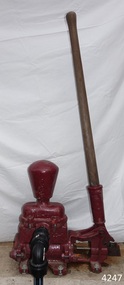
Equipment - Pump, circa 1930's - 1940's
... The former McPherson’s Pty Ltd building in Collins Street Melbourne is now on the Victorian Heritage Register VHR H0942 This pump is representative of mechanical pumps popular in the early to mid-1900’s and still used today. flagstaff hill warrnambool flagstaff hill maritime museum shipwreck coast flagstaff hill maritime village great ocean road ajax pump works tottenham melbourne ajax pump factory kyneton william edward mcpherson thomas mcpherson of melbourne mcpherson’s pty ltd melbourne acme bolt company tool equipment co. pty. ltd associated machine tools australia pty ltd ajax bolt and rivet co. pty ltd new zealand forrers company ipswich queensland ksb ajax pumps ksb australia pty ltd macson lathes tool manufacturer early to mid- 20th century ajax double acting hand pump ajax type l2 series a pump qisjax pumps water pump 1940’s fuel pump 1940’s hand operated constant flow pressure pump reciprocating suction pump agricultural hand pump plumber’s hand pump portable hand pump Embossed on lower section of pump "L2 - 10", "L2 - -1", "AJAX" “(?) ...This pump is an Ajax Type L2 Series A model, made and sold by McPherson’s Pty Ltd of Melbourne circa 1930’s to 1940’s, is a mechanical, hand operated, constant flow pressure pump. It would have been used to pump fluids from one area to another, for example from a dam to a tank or used as a bilge pump on a small vessel, mounted on the vessel’s bulkhead, floor or deck. This type of hand pump is sometimes called a ‘Reciprocating Suction Pump’. It has a mechanical pumping action of the lever moves the piston inside the pump up and down. The water is lifted from below the pump through the inlet pipe and into the pump’s cylinder. This action causes the lower valve to close and the piston’s valve opens and the pressure within the pump forces the water out of the pump through the exit pipe. The limitation of this type of pump is that it can only raise the water a maximum of about 7 metres from beneath the ground and yields 24-26 Litres per minute. This type of pump could be used for many purposes such as pumping water or fuel. McPherson’s 1940’s advertisement proclaims “For all jobs on the land – irrigation, spraying, tank, plumbing, fire-fighting – there’s a suitable “Ajax” pump. Send us the details of you pumping problem. Our Expert’s advice will help you choose the right pump – the one that will give you most years of PROFITABLE PUMPING.” (The Australasian (Melbourne) Sat. 26th October 1940.) McPherson’s Pty Ltd, the manufacturer, advertised a similar pump to this one in The Australasian (Melbourne) in 1936, calling it the Ajax Double Acting Hand Pump. In 1942 another advertisement advised that a representative for a fire-fighting equipment supplier was visiting the western district of Victoria. The company could now supply double-action two-spray Ajax pumps at lower prices than similar pumps the district had recently purchased from Adelaide. McPHERSON’S FOUNDER and COMPANY TIMELINE 1860 – Thomas McPherson, a Scottish immigrant (c. 1853 ), founded McPherson’s in Melbourne, supplying pig iron (lead ingots imported as ballast in ships) to local manufacturers. 1882 – Thomas McPherson established a warehouse in Collins St Melbourne and included tools, steam fittings and machinery in his wares. The business expanded to include steam saw mills and became known as Thomas McPherson and Sons (William Murray and Edward). 1888 – Thomas passed away and his sons inherited the business. In 1896 William Murray became the sole proprietor after his brother Edward’s death. 1900 – The firm expanded, establishing Acme Bolt Company to manufacture nuts and bolts. 1912 – McPhersons Pty Ltd established a machinery warehouse and showroom in 554-556 Collins St Melbourne. McPherson’s went on to establish branches in Sydney (1911), Adelaide (1921) and Perth (1930) 1917 - McPherson’s supplied ‘dog spikes’ for the transcontinental railway, running from Eastern to Western Australia. 1918 – A tool works set up in Kensington, Melbourne, manufacturing Macson lathes and made machine tools that previously had to be imported. 1924 – The Bolt Works was transferred to a new building in Melbourne. McPhersons began making pumps. 1929 – McPherson retired. His son (Sir) William Edward McPherson (known as ‘WE’), was born in Hawthorne, Melbourne, in 1898. After his education he began work in his father’s Melbourne hardware and machinery business He took over as governing director when his father retired. 1929-1932 – McPherson’s supplied thousands of tons of rivets from its Richmond (Melbourne) Bolt Works for the construction of the Sydney Harbour Bridge. 1936 – McPherson’s Pty Ltd is advertising Ajax Pumps in newspapers 1934 – McPhersons purchased the property adjoining the warehouse in Collins Street, and during 1935-1936 built a new office and showrooms on the site of 546-445 Collins St. 1939 - McPherson’s acquired the Tool Equipment Co. Pty. Ltd and Associated Machine Tools Australia Pty Ltd was formed to separate McPherson’s machine-tool manufacturing and merchandising interests. 1939 – Ajax Pump Works, a foundry and pump manufacturing plant, was established in Tottenham, Melbourne, and the Ajax Bolt and Rivet Co Pty Ltd began manufacturing in New Zealand. 1944 - McPherson’s became a public company, McPherson’s Ltd. 1948 - The Ajax Pump Foundry opened at Kyneton, Victoria and in the post war years it grew to became a large manufacturer. 1980’s – Ajax Pumps brochure lists the address as 6 Buckhurst St, South Melbourne, Vic 3205 with the Telephone number 03 669 3588 1988 - Ajax Pumps acquired the Forrers Company, which was established in 1921. Manufacturing in Ipswich, Queensland, specialising in submersible sewage pumps. 1991 – KSB Ajax was formed, bringing together the companies KSB and Ajax Pumps 1993 – Manufacturing was moved to state-of-the-art premises in Tottenham, Victoria 2001 - The Forrers facility was moved to Tottenham. 2007 - Company name KSB Ajax Pumps was changed to KSB Australia Pty Ltd. 2009 - KSB Australia opened a branch in Townsville, Queensland. 2011 - KSB Australia moved to its dedicated Water and Waste Water Competence Centre in Bundamba, Queensland. DISPLAY OF THIS AJAX PUMP This pump was installed at Flagstaff Hill Maritime Village as part of a working display in the village by the Friends of Flagstaff Hill, in acknowledgement of the dedicated involvement of one of its long serving members, Bob Crossman. The display was officially opened 31st March 2018 and incorporates a restored Furphy Tank and Water Pipe Stand. The pump is used to draw water from the lake, through the water stand pipe and into the reconditioned Furphy Tank. This Ajax pump made by McPherson’s Pty Ltd is significant for its association with McPherson’s, a prominent manufacturer of hardware in Victoria. McPherson’s is famous for supplying ‘dog-spikes’ for the transcontinental railway (eastern to western Australia, 1917) and rivets for the Sydney Harbour Bridge (1929-1932). The Ajax pump is also of significance because of its association with McPherson’s Governing Director (Sir) William McPherson, former premier and treasurer in Victoria 1928-1929. The former McPherson’s Pty Ltd building in Collins Street Melbourne is now on the Victorian Heritage Register VHR H0942 This pump is representative of mechanical pumps popular in the early to mid-1900’s and still used today. Hand operated pressure pump, double acting. Cast metal case, painted red, with steel hose attachments and long metal lever. Pump is bolted to wooden plank. Model of pump is AJAX, Type L2, Series A pump. Embossed on lower section of pump "L2 - 10", "L2 - -1", "AJAX" “(?) –2-1” Embossed on lower handle “3-7” “L – 4” Embossed on attached plate “FOR SPARE PARTS / TYPE L2 / SERIES A / PUMP ASSEMBLED BY T R” Manufactured by McPherson’s Pty Ltd of Melbourne circa 1930’s - 1940’s.flagstaff hill, warrnambool, flagstaff hill maritime museum, shipwreck coast, flagstaff hill maritime village, great ocean road, ajax pump works tottenham melbourne, ajax pump factory kyneton, william edward mcpherson, thomas mcpherson of melbourne, mcpherson’s pty ltd melbourne, acme bolt company, tool equipment co. pty. ltd, associated machine tools australia pty ltd, ajax bolt and rivet co. pty ltd new zealand, forrers company ipswich queensland, ksb ajax pumps, ksb australia pty ltd, macson lathes, tool manufacturer early to mid- 20th century, ajax double acting hand pump, ajax type l2 series a pump, qisjax pumps, water pump 1940’s, fuel pump 1940’s, hand operated constant flow pressure pump, reciprocating suction pump, agricultural hand pump, plumber’s hand pump, portable hand pump -
 Federation University Historical Collection
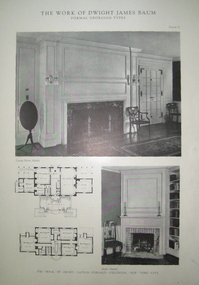
Book, The Work of Dwight James Baum, 1927 (exact)
... New York. As a young man, Baum moved to Syracuse. In 1909, he graduated from Syracuse University with an architecture degree. He worked for Boring and Tilton and Sanford White which are well known Architecture firms in America. Around 1912, he started his own residential design firm. During the 1920s, Baum designed a significant buildings and several houses in Sarasota, Tampa, Terrace, Temple and Florida all in the Mediterranean Revival Style such as the Ringlings dubbed Cà d'Zan, which is now known as the John and Mable Ringling Museum of Art. ...New York. As a young man, Baum moved to Syracuse. In 1909, he graduated from Syracuse University with an architecture degree. He worked for Boring and Tilton and Sanford White which are well known Architecture firms in America. Around 1912, he started his own residential design firm. During the 1920s, Baum designed a significant buildings and several houses in Sarasota, Tampa, Terrace, Temple and Florida all in the Mediterranean Revival Style such as the Ringlings dubbed Cà d'Zan, which is now known as the John and Mable Ringling Museum of Art. ...Dwight James Baum is an American architect. He was born in 1886 in Newville, New York. As a young man, Baum moved to Syracuse. In 1909, he graduated from Syracuse University with an architecture degree. He worked for Boring and Tilton and Sanford White which are well known Architecture firms in America. Around 1912, he started his own residential design firm. During the 1920s, Baum designed a significant buildings and several houses in Sarasota, Tampa, Terrace, Temple and Florida all in the Mediterranean Revival Style such as the Ringlings dubbed Cà d'Zan, which is now known as the John and Mable Ringling Museum of Art. In 1923-1924, he also designed Sunset Hill for Mrs. Eugene D. Stocker at Warren, New York which was listed on the National Register of Historic Places in 2007. During the Depression Baum became involved with Good Housekeeping Magazine as consulting architect, and as designer of their building exhibit at the 1933 Chicago World's Fair. His later work includes Hendricks Memorial Chapel at Syracuse University, with John Russell Pope in 1929–1930 and the pedestal for V. Renzo Baldi's statue of Columbus in the city's Columbus Circle. Dwight James Baum died in 1939. Book with large blue hard cover. Title is written on the front cover and the spine in gold. Manufacturer's logo is written on front cover in gold. The book includes index, preface and an introduction. black and white illustrations, plates and floor planes of the architect's work such as Ca d Zan, the fantastical Venetian Gothic waterfront palace of John and Mable Ringling in Sarasota, Florida and the stately Italianate house of Anthony Campagna in Riverdale, New York and more.architecture, architectural designs, art moderne, domestic designs, ca d zan -
 Federation University Historical Collection
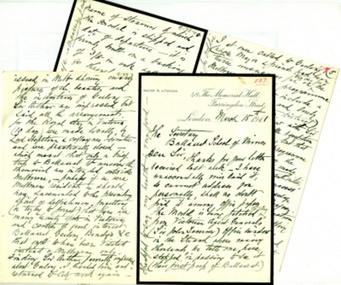
Letter - Correspondence, Walter M. Hitchcock, Letters from Walter M. Hitchcock concerning a model of a Ballarat tent (and more), 1911, 1911 (exact)
... Hitchcock regarding the death of James Oddie and early gold mining at Ballarat, 1910 and 1911 48 The Memorial Hall Farringdon St London Dec1/10 The Secretary Ballarat Museum Dear Sir, I am just now sending you this line, i anticipation of further correspondence later on, simply to forward you a Post Card of the 1st mining tent erected 1851 on the site of he then newly proclaimed Township of Ballarat, which, as the sole survivor of the party who built the original, I have had the pleasure in making, and have decided to present it to your museum, Sir Jno Lasenor out Agent General for Victoria came to a Bazaar recently held in London. where I had it on view in the museum from 3 days, - and desired I would allow its [ ? ] exhibited in the first large window of the beautiful new building of the Victoria Agency situate in the Strand. ...Hitchcock regarding the death of James Oddie and early gold mining at Ballarat, 1910 and 1911 48 The Memorial Hall Farringdon St London Dec1/10 The Secretary Ballarat Museum Dear Sir, I am just now sending you this line, i anticipation of further correspondence later on, simply to forward you a Post Card of the 1st mining tent erected 1851 on the site of he then newly proclaimed Township of Ballarat, which, as the sole survivor of the party who built the original, I have had the pleasure in making, and have decided to present it to your museum, Sir Jno Lasenor out Agent General for Victoria came to a Bazaar recently held in London. where I had it on view in the museum from 3 days, - and desired I would allow its [ ? ] exhibited in the first large window of the beautiful new building of the Victoria Agency situate in the Strand. ...The tent model mentioned in the letters was displayed in the Ballarat School of Mines Museum. During the 1960s it was transferred to the Ballarat Historical Society. Two handwritten letters on paper with black mourning edge written by Walter M. Hitchcock to the Ballarat School of Mines, and another written by Walter's brother George M. Hitchcock.Letter transcription follow: Letter from Walter M. Hitchcock regarding the death of James Oddie and early gold mining at Ballarat, 1910 and 1911 48 The Memorial Hall Farringdon St London Dec1/10 The Secretary Ballarat Museum Dear Sir, I am just now sending you this line, i anticipation of further correspondence later on, simply to forward you a Post Card of the 1st mining tent erected 1851 on the site of he then newly proclaimed Township of Ballarat, which, as the sole survivor of the party who built the original, I have had the pleasure in making, and have decided to present it to your museum, Sir Jno Lasenor out Agent General for Victoria came to a Bazaar recently held in London. where I had it on view in the museum from 3 days, - and desired I would allow its [ ? ] exhibited in the first large window of the beautiful new building of the Victoria Agency situate in the Strand. It is there for the past few days and he may wish it to remain a week or two longer, I know of no other exhibition of it to delay it being packed and shipped to my relatives in Geelong (Mr [?] Bright of Hitchock's Firm) who may wish to show it in one of their windows before forwarding it to your museum - I have had an itemised pane glass case made for it with drop down end and [?} it stands on a plateau of moss, to represent grass 32 x 13 x 13 high and chimney 14 1/2 - the case is made 34 x 26 x 20 high inside - I shall have it very carefully packed - tent emptied tools, beds, &c &c in separate packing and insured for 50 pounds - I will send you full details later on. I hope and believe your President will accept it in due time Meantime believe me to be very truly Cat Walter Hitchcock G.F.B. 48 The Memorial Hall Farringdon St London March 15th 1911 The Secretary Ballarat School of Mines Dear Sir, Thanks for your letter received last week – I have unaccountably mislaid it, so cannot address you personally, shall no doubt find it among office papers. The model is being fetched today from Victorian Agent General’s (Sir John [Lavernor?] office window in the Strand where many thousands, he tells me, have stopped in passing to see it (their first peep of Ballaarat). It will be on view at Blackheath (Kent) for a week, then packed and shipped without further delay. I shall enclose in the glass case (which is 26 x 34 x 16 in high) some spare minced moss and gas (smoke) in case in transit the plateau suffers by shaking (though it is well glued down). All the tools, mining appliances, cradle, windlass, &c will be separately packed enclosed – which you can easily place in respective positions. HRH Prince of Wales has graciously accepted a photo of it – and in my letter to him when sending it for his acceptance I said – as he would probably ere long visit Australia as did his grandfather and father, which ought to (and certainly will) include at least a day or two in seeing your beautiful City, and also something of your mines &c instead of the hurried visit of his father (2 hours) when he, as Duke of York, unveiled a statue to the memory of those slain in the sad Boer War, which now is admitted by almost everybody to have been a big political mistake, - though in the future with England’s present wise policy towards that country it will prove for Africa’s welfare. It may interest you to know that when I ascertained that Geelong was not to be visited by the Royal Pair – I went up to St James’s Palace by appointed time the Duke’s private Secy Sir Arthur Bigge – taking with me a specially illustrated paper issued in Melb. showing many pictures of the beauties and industries of Geelong – Sir Arthur was impressed but said all the arrangements for the Royal stay in Victoria (10 days) were made locally, by Lord Hopetoun and collegues and committee, and were practically closed – which meant that only a brief trip to Ballarat to uncover the memorial was intended outside Melbourne. Perhaps if we were Melbourne residents we should have succumbed to the prevailing spirit of selfishness – forgetting (or trying to forget) that there are many beauty spots in Victoria and centres of great interest - Ballarat, Geelong, Bendigo, &c that ought to have been visited instead of Melbourne only. Finding Sir Arthur favorably impressed about Geelong I thanked him and returned to City work again. I at once called to Geelong whose mayor and friends had been twice unsuccessful in trying for the Melbourne functions programme being altered to include a visit to Geelong and lovely spots in the Western District, reporting my interview with Sir A B and his favourable reception of my representations, but that any alteration to the programme of engagements during the Royal visit must be made locally and by the local authorities. This had the desired success for on receipt of my message the Geelong mayor and colleagues again reopened the question and went to Melbourne, resulting in a concession (but what an altogether inadequate one) and they graciously ? consented to the train, on its way with the Duke and Duchess to your city, to stop at the Geelong stn (15 minutes) and so it came about that by a hasty local effort, 3,000 school children, and not a few of the leading people including the Mayor &c were gathered to welcome them in Geelong. The National anthem being sung, an Address read and presented and kindly replied to. Now Ballarat should doubtless has influence. See to it when our P. Of Wales visits Victoria – an unselfish ¬ programme is fixed up – and HRH afforded ample opportunity of visiting leisurely your city, Geelong, Bendigo and other centres of beauty and importance. The Prince himself will be the gainer by such an equitable and enlightened programme, - and come back with all the more favourable views of the marvellous development ever since our family first settled in Geelong in 1850. A far preferable result of such a visit than night after night having Melbourne Banquets and the visiting of its undoubted attractions - whilst all the rest of the State remained unvisited. Such an official mistake must not be made again. I will write you again, stating name of steamer of which the model is shipped and date of departure – it is firmly built on a backing of 3/8 in oak tall uprights so through the 7/8 in plateau and am entrusting the packing be very careful. I expressed firm – so that except possibly any breakage in glass case – it should reach you in due time all right. The top of case will be screwed so that it can be readily removed temporarily to enable my [ ? ] firm to show it in one of their windows. Believe me Yours very truly Captn Walter M. Hitchcock My brother will deliver it on my a/c – all carriage paid. Mt very kind regards to my friend since 1850 Jas Oddie. University of Ballarat Historical Collection Cat. No. 8133.3 & .4 Letter from Walter M. Hitchcock regarding the death of James Oddie and early gold mining at Ballarat, 1911 48 The Memorial Hall Farringdon St London April 20th 1911 My Dear Sir, It is with no ordinary feeling of regret that I received the tidings of the death of my good friend, your fellow citizen for many years, Mr James Oddie. Living at Geelong from March 1850 I came to know him there as carrying on a foundry business in Ashby. With the discovery of gold at Ballarat started off almost of the working people, as well as of all other classes of the male population. Mr Oddie arrived in Ballarat I believe on or about September 1st 1851. My three comrades and I arrived October 1st 1851 – among the many thousands soon gathered within a mile or so of Golden Point – my friend Oddie and I often met. I returning to Geelong after a year mining – my friend on the other hand remaining at Ballarat ever since – a marvellous record, and I am sure his life has been one of unique value to your City in many ways, - his age (87) naturally prepared me for his call home – and only two mails before the news came I received from him on of his kindly chatty letters in which amongst other things – he referred with pleasure to having received from me two 10 x 12 photos – one being of my model and that he was arranging to have it placed in a shop window in your city. I am interested in the fact of your having known each of my three comrades of 1851/52. It was J.M. Garrett and I who got permission to conduct public Sunday morning service in their large Marquee – used all the week for issue of Licenses in the absence of any church buildings, and it being on wet Sundays impossible to have services as usual under the trees – Ballarat then was more like a Gentleman’s Park – than bush country – but the axe soon did its work – and all were felled for our cooking, and hencewith to make our kindling etc. Shafting of holes not being at first done because too shallow – our deepest (at Eureka) was only 115 ft. Bendigo I hear had now mines of 4,000 ft in depth (deeper than our tin or coal mines here). I fortunately have, in excellent state of preservation, my last of 12 licenses dated October 1 1852 and have recently purchased here a Miner’s Right dated 1864, to that when explaining on matters re Gold Licensing I can show sample of each. With kind regards Believe me Yours sincerely Walter M. Hitchcock Geelong June 20/11 Dear Sir, By rail to day through Messrs Bannister I send the model of miner’s tent packed in a case 50 donated by my brother Captain Walter M. Hitchcock of London. This model was made by my brother and represents the tent he worked in on the Ballarat Gold Fields in the year 1851 or 2. In a separate parcel a few extras omitted from the case. Please send me receipts in duplicate, one for my brother, the other for the Customs, Geelong, as being donated to your institution, after some little correspondence it was admitted [??] any payment for duty. You probably have my brother’s address and would like to acknowledge its arrival, direct. I hope it is in good order. I did not open it for show in Geelong, as there would be less risk of breakage on repacking. With kind remembrances. I am Yours Faithfully Geo. M. Hitchcock. A Mr G. F. B. Sharick who is living near my home called in to see my model – he said he knew FM [Fred Martell] and was lately at Ballaratballarat school of mines, frederick martell, fred martell, james oddie, walter m hitchcock, walter hitchcock, f m garratt, george hitchcock, hitchcock, golden point, gold discovery, j m garrett, gold license, j.m. garrett, t.m. hall, george m. hitchcock, f.m. garratt, walter m. hitchcock -
 Federation University Historical Collection
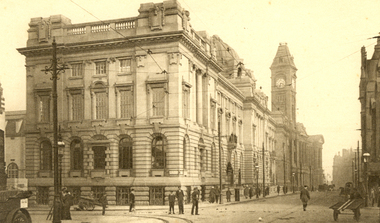
Postcard - black and white, New Art Gallery, Birmingham
... Museum and Art Gallery (BMAG) first opened in 1885. It is housed in a Grade II* listed city centre landmark building. There are over 40 galleries to explore that display art, applied art, social history, archaeology and ethnography. chatham-holmes family collection birmingham birmingham art gallery postcard clock tower World War One Black and white postcard showing a grand four storey building with clock tower. It is the new ...Birmingham Museum and Art Gallery (BMAG) first opened in 1885. It is housed in a Grade II* listed city centre landmark building. There are over 40 galleries to explore that display art, applied art, social history, archaeology and ethnography.Black and white postcard showing a grand four storey building with clock tower. It is the new Art Gallery in Birmingham. chatham-holmes family collection, birmingham, birmingham art gallery, postcard, clock tower, world war one -
 Federation University Historical Collection
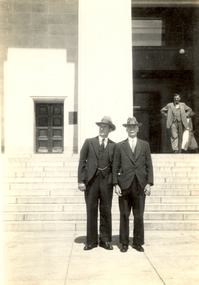
Photograph - black and white, Frank Wright and Mr Buckley in Auckland, New Zealand, Feb 1933
... building. At the top of the stairs is a panelled door to the left and to the right is a man standing with his hands on his hips. The man on the left is Frank Wright and the man on his right is Mr Buckley. The place is the museum in Auckland, New...building. At the top of the stairs is a panelled door to the left and to the right is a man standing with his hands on his hips. The man on the left is Frank Wright and the man on his right is Mr Buckley. The place is the museum in Auckland, New ...Frank Wright was a renown resident of Smeaton, where he was born on 2 August 1901. He lived at Laura Villa, and attended Smeaton State School. His father William was a gold miner and his mother's name was Sarah. Their family won many singing and instrumental awards. Frank was tutored by Percy Code and was awarded a gold medal for the highest marks in the ALCM examinations in the British Colonies at the age of seventeen years. He became the Australian Open Cornet Champion by the age of eighteen. A year later, Frank conducted the City of Ballarat Band, and later the Ballarat Soldiers’ Memorial Band. He formed the Frank Wright Frisco Band and Frank Wright and his Coliseum Orchestra. These bands won many South Street awards, and Frank as conductor won many awards in the Australian Band Championship contest. In 1933 Frank Wright sailed to England to conduct the famous St Hilda’s Band and was later appointed Musical Director of the London County Council, where he organized many amazing concerts in parks, in and around the London district. He was made Professor of Brass and Military Band Scoring and conducted at the Guildhall of Music and Drama. Frank was often invited to adjudicate Brass Band Championships around Europe, in Australia, including South Street and in New Zealand. The Frank Wright Medal at the Royal South Street competition is awarded to an individual recognized as making an outstanding contribution to brass music in Australia.1). Black and white photograph of two men dressed in suits and hats, standing at the bottom of a flight of stairs leading to a large public building. At the top of the stairs is a panelled door to the left and to the right is a man standing with his hands on his hips. The man on the left is Frank Wright and the man on his right is Mr Buckley. The place is the museum in Auckland, New Zealand. 2). Black and white photograph of three men wearing suits and hats, walking along the pavement. In the background city buildings can be seen. The man on the left is Frank Wright and the place is Christchurch, New Zealand.1). Written in pencil on back - Frank Wright, Mr Buckley, Auckland (N.Z.) Museum, Feb 1933 2). Stamped on back - The Filmograph Co. (N.Z.), Majestic Theatre Buildings, Christchurch. (The paper has been cut in half, so half the written information is lost) Written in pencil of back - right, adjudicator, secretary N.Z.B.B.ch., Band Contest, 1933frank wright, mr buckley, auckland museum, magestic theatre buildings, brass band, christchurch, adjudicator -
 Flagstaff Hill Maritime Museum and Village
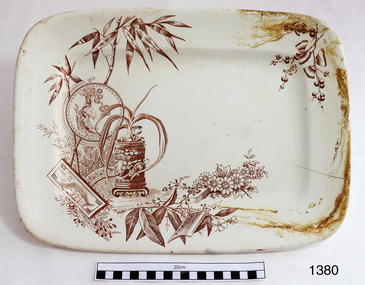
Dish
... New Zealand at Manse Street, Dunedin. The maker’s mark also includes the word ‘PRAHRAN’, which is an inner suburb of Melbourne. “Prahran” may have been the name of this particular pattern or even the location chosen in preference to the location ‘Melbourne’. The Melbourne address was purchased from a long established drapery business, Wright and Neil, between 1911-1914 by Sidney Myer. Myer constructed his 1914 building in on this site in Bourke Street. This platter is an example of late 19th or early 20th century dinnerware. flagstaff hill warrnambool shipwrecked-coast flagstaff-hill flagstaff-hill-maritime-museum ...The maker’s initials on the back of the patter, “A.F. & S.” are one of the marks of Alfred Fenton & Sons (& Co) of Brook Street Works (renamed Century Street in 1950’s), Hanley, Staffordshire, Stoke-on-Trent in the United Kingdom. The partners were Alfred Fenton, James Tunstall Fenton, Arthur Fenton and John Fenton. Other initials used are “A F & Co.” The company operated from 1887 to 1901. According to the London Gazette of January 10, 1899, the Earthenware Manufacturers “Alfred Fenton & Sons“ also had a location in Australia at the corner of Elizabeth Street and 314-316 Bourke Street Melbourne Victoria, and Bond Street, Sydney, and in New Zealand at Manse Street, Dunedin. The maker’s mark also includes the word ‘PRAHRAN’, which is an inner suburb of Melbourne. “Prahran” may have been the name of this particular pattern or even the location chosen in preference to the location ‘Melbourne’. The Melbourne address was purchased from a long established drapery business, Wright and Neil, between 1911-1914 by Sidney Myer. Myer constructed his 1914 building in on this site in Bourke Street. This platter is an example of late 19th or early 20th century dinnerware.Dish; white ceramic rectangular platter with picture in brown ink depicting vegetation (including bamboo and blossoms), flower pot, plates and two oriental persons. Made by Alfred Fenton and Sons 1887-1901.Stamped on back, "PRAHRAN / A.F. & S." surrounded by a buckled belt. Number "14" printed in the clay. flagstaff hill, warrnambool, shipwrecked-coast, flagstaff-hill, flagstaff-hill-maritime-museum, maritime-museum, shipwreck-coast, flagstaff-hill-maritime-village, dish, food perparation, dinnerware, catering, a.f. & s., a fenton and son potters of hanley uk, bourke street melbourne, prahran dinnerwear -
 Flagstaff Hill Maritime Museum and Village
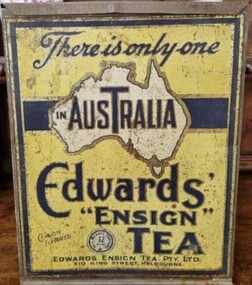
Container - Tin Tea Container, Wilson Bros, 1900-1940
... building. New premises were obtained at 310/18 King Street Melbourne in 1923. there continued to be bill board advertisements for Ensign tea at the King Street address, also regular adverts in the Argus newspaper during1942. An Australia icon during the first half of the 20th century as tea drinking was a popular past time and social activity. flagstaff hill warrnambool shipwrecked coast flagstaff hill maritime museum maritime museum shipwreck coast flagstaff hill maritime village great ocean road tea tin tea caddy drink container Wilson Bros Ensign Tea On label "Edwards Ensign Tea" Container for tea with hinged lid. ...The tin was made by Wilson Bros, Melbourne, for Edwards' Ensign Tea Pty Ltd, Melbourne, Victoria, Australia, 1900-1940. There was a fire at their factory in Flinders Street Melbourne on April 30, 1921 which completely destroyed the building. New premises were obtained at 310/18 King Street Melbourne in 1923. there continued to be bill board advertisements for Ensign tea at the King Street address, also regular adverts in the Argus newspaper during1942.An Australia icon during the first half of the 20th century as tea drinking was a popular past time and social activity.Container for tea with hinged lid. Label yellow with map of Australia. Lid is coming away on one hinge. "Edwards Ensign Tea" On label "Edwards Ensign Tea"flagstaff hill, warrnambool, shipwrecked coast, flagstaff hill maritime museum, maritime museum, shipwreck coast, flagstaff hill maritime village, great ocean road, tea tin, tea caddy, drink, container, wilson bros, ensign tea -
 Mission to Seafarers Victoria
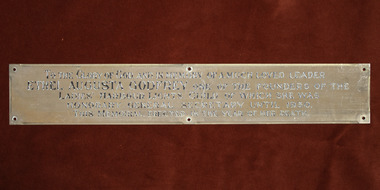
Plaque - Memorial Plaque, Ethel Augusta Godfrey
... building when the Mission purchased the E,S&A Bank in 1943. In 1982, the plaque ws removed from the Williamstown mission along with 4 other plaques, objects and furniture to furnish the chapel of the new Flagstaff Maritime Museum. ...building when the Mission purchased the E,S&A Bank in 1943. In 1982, the plaque ws removed from the Williamstown mission along with 4 other plaques, objects and furniture to furnish the chapel of the new Flagstaff Maritime Museum. ...This plaque was erected in the Williamstown Sailors' Rest, the former skating ring in Thompson Street. It's one the three memorials to Ethel Godfrey with the stained glass window in the St Peter chapel in the Central Institute (See 0064.2) ) and the optus sectile plaque in the 1888 Port Melbourne Institute (See 2053) . This plaque was moved to the Nelson Place building when the Mission purchased the E,S&A Bank in 1943. In 1982, the plaque ws removed from the Williamstown mission along with 4 other plaques, objects and furniture to furnish the chapel of the new Flagstaff Maritime Museum. The transfer of the 5 plaques was requested in 2020 and they returned to the Mission's collection in 2022.The plaque along with the two other memoriels erected in the memory of Ethel Godfrey demonstrates the gratitude for the her 30 years of work.Rectangular plaque for Ethel Augusta Godfrey ethel augusta godfrey 1861-1935, williamstown, thompson street, seamen's mission, sailors' rest, flasgstaff maritime museum, lhlg -
Federation University Historical Collection
Book - Ledger, Ballarat School of Mines Minute Book, 1942-1946, 03/03/1942-20/03/1946
... building plans...john brittain telescope...new workshops...t. barrow...a.w. steane...martha pinkerton...Ballarat School of Mines Museum...new buildings pg 272 - Retirement of J.M. Sutherland pg 280 - Proposed change of name to school pg 297 - Woolclassing Room pg. 342 - pg 353 - D. Taylor Kellock pg 353 - Resignatin of Miss Grigg pg 367 - Dr Pern's Collections of Aboriginal Artefacts pg 377 - Inmates of Ballarat Orphanage pg 356 - Ballarat School of Mines Museum contents Loose - Resolutions Passed by Technical Schools' Association of Victoria, October, 1942, with the Minister's Replies....new buildings pg 272 - Retirement of J.M. Sutherland pg 280 - Proposed change of name to school pg 297 - Woolclassing Room pg. 342 - pg 353 - D. Taylor Kellock pg 353 - Resignatin of Miss Grigg pg 367 - Dr Pern's Collections of Aboriginal Artefacts pg 377 - Inmates of Ballarat Orphanage pg 356 - Ballarat School of Mines Museum contents Loose - Resolutions Passed by Technical Schools' Association of Victoria, October, 1942, with the Minister's Replies. ...The Ballarat School of Mines was established in 1870 and was the first School of Mines in Australasia. Blue hard covered book with brown leather spine and corners. pg 4 - Farewell for Albert W. Steane pg 9 - Instruction in Electrical Engineering pg 30 - The late Cr M. Martin pg 38 - Caretakers Duties pg 40 - The late Cr F. Barrow pg 43 - John Brittain Telescope pg 43 - Martha Pinkerton Bequest pg 66 - Resignation of Albert E. Williams pg 85 - N. Whiteside and Civil Engineering Course pg 128-130 - Technical Education pg 193 - Proposed new buildings pg 272 - Retirement of J.M. Sutherland pg 280 - Proposed change of name to school pg 297 - Woolclassing Room pg. 342 - pg 353 - D. Taylor Kellock pg 353 - Resignatin of Miss Grigg pg 367 - Dr Pern's Collections of Aboriginal Artefacts pg 377 - Inmates of Ballarat Orphanage pg 356 - Ballarat School of Mines Museum contents Loose - Resolutions Passed by Technical Schools' Association of Victoria, October, 1942, with the Minister's Replies.Pg 367 - "Dr Pern's Collection Cr Lederman reported on the proceedings of the special committee meeting held on the 19th February. At that meeting it was suggested that the Ballarat Historical Society might consider transferring their collection to the Museum. It was decided that any expert from Melbourne be invited to come to Ballarat for the purpose of inspecting the mounted birds, which in many instances were falling to pieces, and recommending the best way of dealing with them."m. grigg, t.h. trengrove, building plans, john brittain telescope, new workshops, t. barrow, a.w. steane, martha pinkerton, ballarat school of mines museum, sydney pern, pern collection, ballarat orphanage, thomas aggett, william aggett, sebastian fumberger, peter hogg, ronald irving, eric jackson, ray lear, ken mason, john birch, william gleeson, robert gleeson, robert guyas, ronald holmes, albert king, stuart smith, alan snell, martha pinkerton scholarship, frank pinkerton scholarship, thomas trengrove, d. taylor kellock, architecture course -
Federation University Historical Collection
Photograph - Black and White, Former Ballarat Library, c1960
... Land for additional building to house a Museum and Art Gallery sought and agreement reached in 1882-3. Compensation paid to owners and library granted the land. Plans for a new...Land for additional building to house a Museum and Art Gallery sought and agreement reached in 1882-3. Compensation paid to owners and library granted the land. Plans for a new ...First known development on this site was the establishment of the Government Camp from the early 1850s. It was established to accommodate officials, troopers and police who were needed to administer the goldfields. Some permanent buildings were constructed. Lack of materials and bad weather prolonged the building of more permanent buildings and most men were still living in tents. Area was known as Camp Reserve. In 1864 a subdivision map shows the reserve be used for Public Buildings. Library applied for land on corner of Sturt and Camp Streets in 1878. 1880s plans show section of the reserve be used for a Free Library and Reading Room. Lease was granted and the old mining boardroom was initially used. Land for additional building to house a Museum and Art Gallery sought and agreement reached in 1882-3. Compensation paid to owners and library granted the land. Plans for a new library building with tower and lantern roof abandoned due to lack of funds. It wasn't until 1895 that a solution to funding was found and the library was able to begin constructing the complex of buildings on the Free Library Reserve. A number of changes have occurred since 1910s - the Classical Revival facade replaced with an angled facade in a stripped Classical style with Art Deco features and high parapet. Building is now part of Federation UniversityPhotograph of former library. Shows a two-storey rendered brick building in a Classical style. Some Art Deco features. Central pair of double windows with single window either side. High parapet above.government camp, goldfields, camp reserve, free library, reading room, sturt street, camp street, museum, art gallery, troopers, police, barracks, camp street -
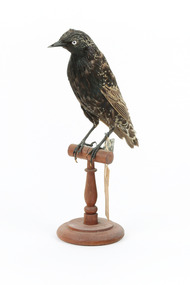 The Beechworth Burke Museum
Animal specimen - Common Starling, Trustees of the Australian Museum, 1860-1880
... buildings, yet there are at least two recorded cases of this species nesting on the backs of living sheep. This specimen is a good and intact example of this species. As the white spots are large and visible, as well as the purple and green shine, this specimen likely died close to Autumn and the breeding season, when these birds get their new bright plumage. This specimen is part of a collection of almost 200 animal specimens that were originally acquired as skins from various institutions across Australia, including the Australian Museum...buildings, yet there are at least two recorded cases of this species nesting on the backs of living sheep. This specimen is a good and intact example of this species. As the white spots are large and visible, as well as the purple and green shine, this specimen likely died close to Autumn and the breeding season, when these birds get their new bright plumage. This specimen is part of a collection of almost 200 animal specimens that were originally acquired as skins from various institutions across Australia, including the Australian Museum ...The Common Starling is an introduced species to Australia (as well as widely throughout the world), and is considered a pest due to its attacks on fruits and seedlings, as well as competing with the native bird population. It was introduced to Victoria in 1861, and has since become abundant, whose sheer numbers cause many problems. These birds are a social species, which can mass in very large flocks (murmations), and show spectacular synchronised aerobatic displays. This species has a distinctive plumage, with glossy black bodies, white spots on their backs and wings, and a purple and green tinge to their underparts and wings. This species, when moving across the ground, has a distinctive 'walk' or 'run' rather than the traditional hopping of many other bird species. This bird is a noisy species, often becoming a nuisance to people. Starlings prefer to nest in holes in trees or buildings, yet there are at least two recorded cases of this species nesting on the backs of living sheep. This specimen is a good and intact example of this species. As the white spots are large and visible, as well as the purple and green shine, this specimen likely died close to Autumn and the breeding season, when these birds get their new bright plumage. This specimen is part of a collection of almost 200 animal specimens that were originally acquired as skins from various institutions across Australia, including the Australian Museum in Sydney and the National Museum of Victoria (known as Museums Victoria since 1983), as well as individuals such as amateur anthropologist Reynell Eveleigh Johns between 1860-1880. These skins were then mounted by members of the Burke Museum Committee and put-on display in the formal space of the Museum’s original exhibition hall where they continue to be on display. This display of taxidermy mounts initially served to instruct visitors to the Burke Museum of the natural world around them, today it serves as an insight into the collecting habits of the 19th century. This specimen is part of a significant and rare taxidermy mount collection in the Burke Museum. This collection is scientifically and culturally important for reminding us of how science continues to shape our understanding of the modern world. They demonstrate a capacity to hold evidence of how Australia’s fauna history existed in the past and are potentially important for future environmental research. This collection continues to be on display in the Museum and has become a key part to interpreting the collecting habits of the 19th century.This adult Common Starling has glossy-black plumage with a metallic sheen, and white speckles throughout. The plumage has a purple and green shine. The irises are white. Its beak is black and pointed. This specimen appears to be male, with less white spots on its underparts. This specimen stands upon a wooden platform and has an identification tag tied around its leg, and a metal tag tied around its foot.Swing-tag: 139a. / Starling / Catalogue Page, 59 / Metal-tag: 1250 (?)taxidermy mount, taxidermy, animalia, burke museum, beechworth, australian museum, skin, reynell eveleigh johns, bird, sheep, common starling, starling, murmations, pest, australian bird
