
Showing 17 items matching "new zealand goldfields"
-
 Bendigo Historical Society Inc.
Photograph - PHOTOS - NEW ZEALAND - BENDIGO NZ GOLD FIELDS
... ...New Zealand Goldfields...Bendigo Goldfields New Zealand Goldfields DVD. Photos, New Zealand, Bendigo N Z Gold Fields. ...DVD. Photos, New Zealand, Bendigo N Z Gold Fields.bendigo goldfields, new zealand goldfields -
 Daylesford & District Historical Society
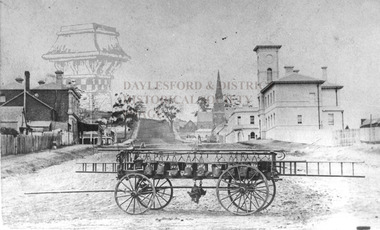
Photograph (copy), Daylesford Fire Brigade First Ladder Carriage, c1867 (original)
... Henshaw was an American who went to the New Zealand goldfields about 1870. Post Office was built in 1867. ...Henshaw was an American who went to the New Zealand goldfields about 1870. Post Office was built in 1867. ...The Daylesford Fire Brigade carriage was locally built by White and Oldham, wheelwrights and carriage makers to the design of Captain Henshaw. Their premises was behind the Victoria Hotel, and American by origin.Photograph of the first ladder carriage bought by the Daylesford Volunteer Fire Brigade, built locally, and designed by Captain Henshaw. It is an important record of purchase and some significant buildings circa 1867.Black and white photograph showing the first ladder carriage of the Daylesford Fire Brigade taken from Bridport Street looking towards Wombat Hill. The carriage stands in Victoria Street (now Central Springs Road) and shows the former Daylesford Post Office on the right. The building on the left was the Bank of Victoria, later the Belvedere Hotel, and in 2012 was Kookla. Other buildings include Victoria Building, Church of England (Anglican), Stanbridge Hall.The carriage shows ten canvas water buckets hanging on hooks, a long ladder and two hoses hang from hooks on the lower section of the four wheeled carriage. The roads and footpaths are unsealed.Typed verso: "Copied from on original kindly loaned by J. Ogilthorpe. Shows Daylesford Fire Brigades first Ladder Carriage outside the then Fire Station where Kindergarten now stands 1977. Date about mid 1860s. This ladder carriage was locally built by a wheel and carriage maker with premises behind Victorian Hotel. White and Oldham. Designed by Capt. Henshaw was an American who went to the New Zealand goldfields about 1870. Post Office was built in 1867. On Belvedre (sic) at this time a a Bank, Bank of Victoria." Stamped: "Daylesford and District Historical Society"dayelsford, daylesford fire brigade, henshaw, post office, white and oldham, -
 Flagstaff Hill Maritime Museum and Village
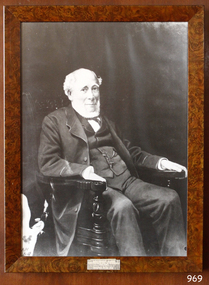
Photograph - Portrait, David Charles McArthur, Superintendent, Bank of Australasia 1867-1876
... goldfields during the 1850s. In 1862, he was appointed as general inspector of branches. He spent time with the bank in New Zealand. ...goldfields during the 1850s. In 1862, he was appointed as general inspector of branches. He spent time with the bank in New Zealand. ...The subject of this photograph, David Charteris McArthur, was the founding manager of the Bank of Australasia in Port Phillip (Melbourne). McArthur was born in 1808 in Gloucester, England, and educated in Scotland. He worked for an insurance firm in Edinburgh, where in 1835 he married Caroline, nee Wright. McArthur and his family party sailed from the U.K. to arrive in Sydney in October 1835, where he joined the Bank of Australasia when it opened in Sydney in December. McArthur sailed to Melbourne in August 1838 with 3000 pounds in coins, protected by armed guards and two bulldogs, to open the Melbourne branch of the Bank of Australasia. The branch grew quickly, servicing both private and government customers. He opened many branches in the goldfields during the 1850s. In 1862, he was appointed as general inspector of branches. He spent time with the bank in New Zealand. On his return to Melbourne, at age 57, he was put in charge of the entire bank. McArthur lived in the hills of Heidelberg, Melbourne. He was the first chairman of Associated Banks and was an advisor to politicians and merchants. He was retired in October 1876 by the London directors and given a free trip to London, an annuity and a seat on the bank’s Advisory Board. McArthur was active in the community, being a member of the Mechanics’ Institute, on the committee that advised Governor Hotham on the Colony’s finances, chairman of the Heidelberg Road Board, one of the original trustees of the Library of Victoria in 1853 and president of the trustees of the Public Library, Museums and National Gallery of Victoria in 1880-83. He was also on many other community organisations. He died in his home “Charterisville” in East Ivanhoe in 1887. He and Caroline had no children. The Melbourne branch of Australia and New Zealand Bank has a portrait of McArthur in its boardroom. St John's Church, Heidelberg, commemorates him with a stained-glass window entitled 'King David'. The McArthur Gallery in the National Gallery of Victoria is also named after him. (David's brother, Donald, moved from Sydney to Melbourne in 1836 with the first government survey team.) ABOUT THE BANK OF AUSTRALASIA In 1836 the Bank of Australasia was established in London by Royal Charter. In 1951 the bank merged with the Union Bank of Australia, to form ANZ Bank Limited. In 1970 it merged with the English, Scottish and Australian Bank to become Australia and New Zealand Banking Group Limited. Since that time the ANZ has acquired other banks and introduced Internet banking and mobile banking. BANK OF AUSTRALASIA IN WARRNAMBOOL The Bank of Australasia first opened in Warrnambool in July 1854 in a building on Merri Street. The manager was Mr Samuel Hannaford. The bank then purchased and moved to a stone building on the corner of Timor and Gibson Streets, previously owned by Cramond and Dickson and almost opposite the Examiner’s office. In January 1957 Mr W.H. Palmer became the new manager and was there until November 1869. The bank then built its own building on the corner of Timor and Kepler Streets in 1859. Mr Basil Spence, the teller, was appointed acting manager in 1869 and Mr H.B. Chomley was the next appointed manager, in April 1873 and was still manager in 1886. The municipality of Warrnambool first banked with the Bank of Australasia from 1856 to April 1857. David Charteris McArthur served as the founding manager of the Bank of Australasia. His leadership marked a significant chapter in Warrnambool's early commercial development. The municipality of Warrnambool relied on the Bank of Australasia as its official bank from 1856 until April 1857. This period is symbolised by a photograph of McArthur, which represents the origins of Warrnambool's commercial history and its early financial infrastructure.Photograph; portrait of David Charteris McArthur. Heavily retouched black and white print in plain brown varnished frame, behind glass, with plaque on lower edge and inscription lower left corner.Lower left corner "A-H 1-9". Engraved on plaque "DAVID CHARTERS MCARTHUR \ SUPERINTENDENT \ BANK OF AUSTRALASIA \ 1867-1876"flagstaff hill, warrnambool, shipwrecked-coast, flagstaff-hill, flagstaff-hill-maritime-museum, maritime-museum, shipwreck-coast, flagstaff-hill-maritime-village, bank of australasia, david charteris mcarthur, superintendent bank of australasia, colonial commerce, manager bank of australasia melbourne, colonial bank, warrnambool bank of australasia, shipwrecked coast, flagstaff hill maritime museum, maritime museum, shipwreck coast, flagstaff hill maritime village, great ocean road, boa, union bank, australia & new zealand bank, anz bank, david charters mcarthur, d c mcarthur -
 Federation University Historical Collection
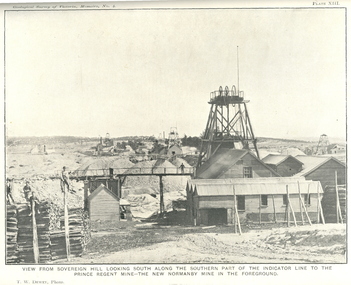
Book, J.W. Gregory, Memoirs of the Geological Survey of Victoria No. 4: The Ballarat East Gold-Field, 1907, 1907
... goldfield...e.j. dunn...geolological survey of victoria...new zealand...Little Bendigo Goldfield, Ballarat West Goldfield, Ballarat East Goldfield, history, nuggets, indicators, faults, microscopic structure of Ballarat Rocks and ores, general type of the Ballarat East Mines and the genesis of their ores. Mines include New Zealand...j.w. gregory ballarat east ballarat east goldfield e.j. dunn geolological survey of victoria new zealand trust llanberris no. 1 llanberris no 2 victoria united britannia united new britannia last chance exchange normanby north new normanby north woah hawp mining indicators gold mining poppet head Blue soft covered report with 40 plates and plans. ...Blue soft covered report with 40 plates and plans. Inciudes Geology of Ballarat. Little Bendigo Goldfield, Ballarat West Goldfield, Ballarat East Goldfield, history, nuggets, indicators, faults, microscopic structure of Ballarat Rocks and ores, general type of the Ballarat East Mines and the genesis of their ores. Mines include New Zealand Trust, Llanberris No. 1, Llanberris No 2, Victoria United, Britannia United, New Britannia, Last Chance, Exchange, Normanby North, New Normanby, North Woah Hawp. Photpgraphic plates include: Victoria United Mine, Llanberres No. 1, Normanby North, North Woah Hawp Mine, View looking south from the Britannia Mullock Heap, View from Sovereign Hill, The place in Learmonth Street Golden Point where gold was first discovered at Ballarat. j.w. gregory, ballarat east, ballarat east goldfield, e.j. dunn, geolological survey of victoria, new zealand trust, llanberris no. 1, llanberris no 2, victoria united, britannia united, new britannia, last chance, exchange, normanby north, new normanby, north woah hawp, mining, indicators, gold mining, poppet head -
 Ringwood and District Historical Society
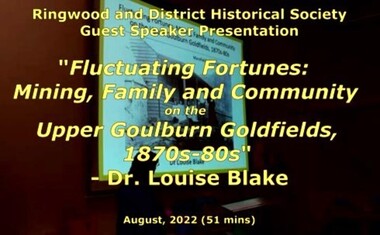
Mixed media - Video, RDHS Guest Speaker Presentation - "Fluctuating Fortunes on the Upper Goulburn Goldfields 1870s-1880s" - Dr. Louise Blake
... Presenter: Louise Blake is a writer and historian with an interest in the stories of women, families, and communities on the nineteenth-century goldfields in Australia and New Zealand. Inspired by her family connection to the gold mining settlement of Woods Point, Louise completed a PhD on Women and Community on the Upper Goulburn Goldfields in north-east Victoria in 2019. ...Presenter: Louise Blake is a writer and historian with an interest in the stories of women, families, and communities on the nineteenth-century goldfields in Australia and New Zealand. Inspired by her family connection to the gold mining settlement of Woods Point, Louise completed a PhD on Women and Community on the Upper Goulburn Goldfields in north-east Victoria in 2019. ...Digitised video (2.66GB) Duration: 51 minutes. Recorded August, 2022 (Video is available for viewing at Ringwood & District Historical Society Archives by appointment)Presenter: Louise Blake is a writer and historian with an interest in the stories of women, families, and communities on the nineteenth-century goldfields in Australia and New Zealand. Inspired by her family connection to the gold mining settlement of Woods Point, Louise completed a PhD on Women and Community on the Upper Goulburn Goldfields in north-east Victoria in 2019. In this talk Louise will share her research on Lawrence and Esther Chubb, who lived and worked at Gaffneys Creek on the Upper Goulburn Goldfields in the 1870s and 80s. In a series of letters Lawrence wrote to his family in England, and now held by the State Library of Victoria, Lawrence shared his early struggles as an independent miner on the central Victorian goldfields, his protracted courtship with Esther, the ordinary intimacies of their life at Gaffneys Creek, the work that Esther did to support the family in this remote mining region, as well as the material and emotional support provided by and to family, friends and neighbours. A rare and revealing source, these letters help to expand our understanding of the lived experience of mining families, particularly the work that women did to sustain families and communities, in this period of waged labour and tribute mining in Victoria. -
 Bendigo Historical Society Inc.
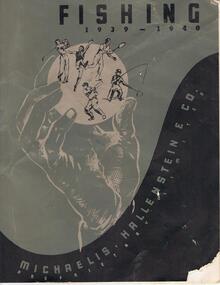
Document - ABBOTT COLLECTION: FISHING CATALOGUE, 1939
... Goldfields. Eventually they bought Cleghorn's tannery in Melbourne but Buttner sold his part to Moritz, Isaac's uncle. The expanded the leather business until they had branches in most states and New Zealand and London. ...Goldfields. Eventually they bought Cleghorn's tannery in Melbourne but Buttner sold his part to Moritz, Isaac's uncle. The expanded the leather business until they had branches in most states and New Zealand and London. ...Founded by Moritz Michaelis and Isaac Hallerstein in 1866. Isaac Hallenstein had previously been partnered with Hermann Buttner and they were travelling salesmen in the Goldfields. Eventually they bought Cleghorn's tannery in Melbourne but Buttner sold his part to Moritz, Isaac's uncle. The expanded the leather business until they had branches in most states and New Zealand and London. After WW1 and the deaths of the founders, the company moved into a variety of leather goods, including shoes, footballs and golf bags. They eventually began to sell all types of sporting goods.Michaelis, Hallenstein & Co PTY LTD Fishing 1939 -1940 Catalogue. Grey and Black cover in light cardboard, with 32 paper pages. Small tear on bottom right corner and top of cover and first page. Photographs and illustrations in B&W. Rear cover lists address as 441 Lonsdale Street Melbourneabbott, fishing -
 Bendigo Historical Society Inc.
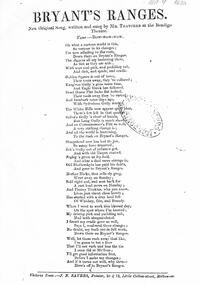
Document - AUSTIN COLLECTION: 'BRYANT'S RANGES' WORDS OF SONG
... New Zealand. Charles Robert Thatcher (1831-1878) trained in England as a flautist before travelling to the Bendigo goldfields in 1853. ...New Zealand. Charles Robert Thatcher (1831-1878) trained in England as a flautist before travelling to the Bendigo goldfields in 1853. ...Bryant's Ranges: Bryant's Ranges is a location near Tarrangower, Victoria. See: https://nla.gov.au/nla.obj-133763991/view - pen, pencil and watercolour, 'Allen and Jesper's store, Bryant's Ranges, Tarrengower, Bendigo, Victoria, 1853 / R.W. Jesper' It is also a location in the South Island, New Zealand. Charles Robert Thatcher (1831-1878) trained in England as a flautist before travelling to the Bendigo goldfields in 1853. He was unsuited and unsuccessful as a miner so decided to rely on his music to make his fortune. He was considered a 'comic vocalist' who wrote many songs about the observations he made on the goldfields. These songs were often satirical and were published in newspapers as poems. He travelled extensively around the Victorian goldfields and also toured New Zealand. In 1861 he married widowed singer Anna Vitellie who performed with him, singing sentimental ballads. In 1870 the family returned to England where Charles became an importer of curios, following in his father's footsteps. He travelled to China, Japan and India sourcing stock for his business and on one such trip he contracted cholera and died in Shanghai. Copy of song written by Charles Thatcher, 'Bryant's Ranges'. Written under title of song: 'New original song, written and sung by Mr Thatcher at the Bendigo Theatre, tune Bow-wow-wow. Song mentions Bendigo reefs and the gold seekers success or otherwise, then they were off to 'Bryant's Ranges'.bendigo, mining, song by charles thatcher -
 Bendigo Historical Society Inc.
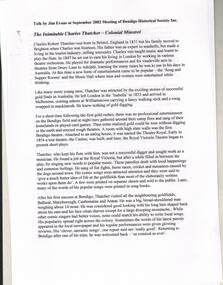
Document - RESEARCH PAPERS: THE INIMITABLE CHARLES THATCHER, 2002
... He travelled extensively around the Victorian goldfields and also toured New Zealand. In 1861 he married widowed singer Anna Vitellie who performed with him, singing sentimental ballads. ...He travelled extensively around the Victorian goldfields and also toured New Zealand. In 1861 he married widowed singer Anna Vitellie who performed with him, singing sentimental ballads. ...Charles Robert Thatcher (1831-1878) trained in England as a flautist before travelling to the Bendigo goldfields in 1853. He was unsuited and unsuccessful as a miner so decided to rely on his music to make his fortune. He was considered a 'comic vocalist' who wrote many songs about the observations he made on the goldfields. These songs were often satirical and were published in newspapers as poems. He travelled extensively around the Victorian goldfields and also toured New Zealand. In 1861 he married widowed singer Anna Vitellie who performed with him, singing sentimental ballads. In 1870 the family returned to England where Charles became an importer of curios, following in his father's footsteps. He travelled to China, Japan and India sourcing stock for his business and on one such trip he contracted cholera and died in Shanghai. His wife returned to Australia and taught singing in Moonee Ponds.3786.12 A talk written by Jim Evans for the Bendigo Historical Society in September 2002 regarding the gold field entertainer Charles Robert Thatcher and his many chaotic adventures and performances across Bendigo and Australia. 3786.12a Newspaper article written by David G. Horsfall. "Poet reflected on goldfield days". Published in a Bendigo Advertiser Special Supplement on the 116th Anniversary of the death of Charles Thatcher. - a comic singer who performed on the Goldfields.charles robert thatcher, jim evans, goldfields -
 Bendigo Historical Society Inc.
Newspaper - Lydia Chancellor collection: Article-Before Bendigo was....Marydale was
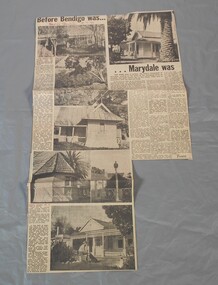
... goldfields before moving on to Bendigo where they initially opened a tent restaurant. This successful endeavour allowed them to purchase the Pall Mall site of the Shamrock hotel. They built their first hotel and a large hall for entertainment that was later called the Theatre Royal. They continued to grow and expand until they built the current Shamrock building. He went on to several other successful theatres and hotels before retiring to "Marydale" in 1879/80. Before moving to New Zealand...goldfields before moving on to Bendigo where they initially opened a tent restaurant. This successful endeavour allowed them to purchase the Pall Mall site of the Shamrock hotel. They built their first hotel and a large hall for entertainment that was later called the Theatre Royal. They continued to grow and expand until they built the current Shamrock building. He went on to several other successful theatres and hotels before retiring to "Marydale" in 1879/80. Before moving to New Zealand ..."Marydale", at 2270 McIvor Hwy., Axedale, was part of the original Campaspe Plains and Axe pastoral runs. By 1857 William Heffernan(1803-1891) had purchased the property from the "Axedale Station's" Robert Ross. it's heritage listing includes the outbuildings that remain in their original format and include the summerhouse and the schoolroom. Also included in the listing are the extensive gardens of mature trees. 1. William Heffernan (1803-1891) was born in Tipparary, Ireland and came to Australia in 1853 with Mr J Crowley. Together they first went to the Heathcote goldfields before moving on to Bendigo where they initially opened a tent restaurant. This successful endeavour allowed them to purchase the Pall Mall site of the Shamrock hotel. They built their first hotel and a large hall for entertainment that was later called the Theatre Royal. They continued to grow and expand until they built the current Shamrock building. He went on to several other successful theatres and hotels before retiring to "Marydale" in 1879/80. Before moving to New Zealand in 1884/5 he sold "Marydale" to Jeremiah Heffernan. He went to NZ to manage a hotel for his newly widowed sister and then built the Pier Hotel in Dunedin. By the time of his death in Dunedin he had lost most of his fortune. 2. Jeramiah Heffernan (1831-1897) was also born in Tipparary, Ireland but was no relation to William. He came to Australia in 1854 and to Bendigo in 1855, where he was employed by William and his partner, Mr Crowley at the Shamrock Hotel in Pall Mall. Twelve months later he became the manager of Heffernan and Crowley's Rose Shamrock and Thistle Hotel at Epsom. After twelve months in this position he bought the Albert Hotel in McCrae Street, Bendigo. He was a successful businessman who later purchased the Victoria Hotel in Pall Mall before retiring in 1887,firstly to "Marydale" that he had bought from William Heffernan in the early 1880's and then to his home in St Kilda. On doctors orders he returned to "Marydale" where he died 13/5/1897.Bendigo Advertiser from 18/07/1970. Article titled "Before Bendigo was....Marydale was." by Toora. The article describes the historic homestead of Marydale at Axedale.In red pen "Bendigo Advertiser 18-7-70"marydale, axedale, historic homestead -
 Bendigo Historical Society Inc.
Photograph - Messrs A. Roberts and Sons Employees Picnic 1897, 1897
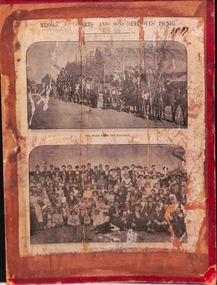
... goldfields would diminish, and widened the sphere of his activities accordingly. Though the requirements of the mining industry maintained the firm, no class of foundry work was ignored. Roberts secured orders for machinery for the two major Broken Hill mines and built steam winding engines for several Western Australian mines, as well as undertaking orders for machinery in South Africa and New Zealand. ...goldfields would diminish, and widened the sphere of his activities accordingly. Though the requirements of the mining industry maintained the firm, no class of foundry work was ignored. Roberts secured orders for machinery for the two major Broken Hill mines and built steam winding engines for several Western Australian mines, as well as undertaking orders for machinery in South Africa and New Zealand. ...Abraham Roberts (1819-1897), ironfounder, was born on 13 July 1819 in Cornwall, England, son of Abraham Roberts, blacksmith, and his wife Mary, née Pentreath. Nothing is known of his education and early training but it is likely that he served an engineering apprenticeship and worked in engineering workshops in Cornwall. Undoubtedly he observed much machinery among the tin mines of Cornwall and absorbed the principles of sound engineering design and high-grade workmanship, which bore fruit in his later years in Sandhurst (Bendigo). On 19 August 1841 he married Elizabeth Tonkin at the parish church at Paul, Cornwall. Roberts arrived on Bendigo in 1853 with his family and engaged in gold-prospecting, then about 1861 opened the United Iron Works, a small engineering shop in Williamson Street, making forge and hand tools. With expansion the business moved to Mitchell Street, until by 1880 it absorbed an entire block covering three acres (1.2 ha) in the heart of the town and employed nearly two hundred men. Three of his sons, William, Abraham and Arthur, helped to run A. Roberts & Sons. As well as being a skilful and enterprising engineer, Roberts was a shrewd businessman, who anticipated that the market for machinery on the local goldfields would diminish, and widened the sphere of his activities accordingly. Though the requirements of the mining industry maintained the firm, no class of foundry work was ignored. Roberts secured orders for machinery for the two major Broken Hill mines and built steam winding engines for several Western Australian mines, as well as undertaking orders for machinery in South Africa and New Zealand. He introduced poppet-heads constructed of steel to the Bendigo goldfield and the 105-head stamp battery for Lansell's Big Blue mine was the largest quartz-crushing battery in Australia at that time. The pair of steam winding engines built by his works for the Hustler's Royal Reserve Co. were the largest on the Bendigo field. The company also carried out steamship repairs, bridgework and many important railway contracts and in 1891 supplied the largest outlet valves in Victoria at Laanecoorie weir.Two photographs in black and white of the picnic for employees of Messrs A. Roberts and Sons in 1897. Photographs are mounted on piece of red cardboard. A. Roberts and Sons owned a foundry that was established in 1865. The event was noted in the Bendigo Advertiser on 18 March 1901.'1897' in ink top right hand corner.bendigo, foundry, roberts and sons, picnic, 1897 -
 Uniting Church Archives - Synod of Victoria
Photograph
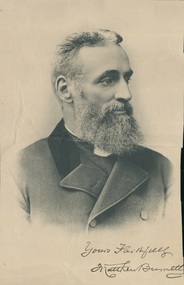
... goldfields evangelising against drink and securing temperance pledges. Sarah Burnett died in 1871 and Matthew returned to England in 1873, meeting leading temperance reformers. He returned to Australia in the mid-1870s. He went to South Australia, Western Australia, Tasmania and New Zealand...goldfields evangelising against drink and securing temperance pledges. Sarah Burnett died in 1871 and Matthew returned to England in 1873, meeting leading temperance reformers. He returned to Australia in the mid-1870s. He went to South Australia, Western Australia, Tasmania and New Zealand ...Matthew Burnett (1839 - 1896). Wesleyan temperance evangelist. Born in Yorkshire, came to Australia in 1857 with his wife Sarah Gibson. He spent the years 1864 to 1867 on the goldfields evangelising against drink and securing temperance pledges. Sarah Burnett died in 1871 and Matthew returned to England in 1873, meeting leading temperance reformers. He returned to Australia in the mid-1870s. He went to South Australia, Western Australia, Tasmania and New Zealand as a temperance campaigner, and claimed to have received pledges from 140,000 people. He returned to England in 1890 and died at Scarborough in 1896.Sepia toned head and shoulders studio portrait of Matthew Burnett in three quarter profile."Yours faithfully Matthew Burnett"matthew burnett, sarah gibson, temperance, evangelist, wesleyan -
 Uniting Church Archives - Synod of Victoria
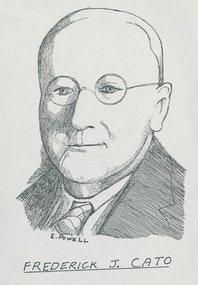
Photograph, Pre-1935
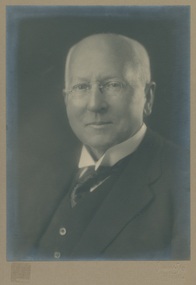
... Born in goldfields (Stawell) in 1858. Began work as teacher in Victoria and then New Zealand. ...Born in goldfields (Stawell) in 1858. Began work as teacher in Victoria and then New Zealand. ...Born in goldfields (Stawell) in 1858. Began work as teacher in Victoria and then New Zealand. In July 1881, joined cousin Thomas Moran and established their chain of grocery stores. By 1935, they operated some 120 stores in Victoria and Tasmania, plus 40 in New South Wales. Died 1935. Ardent Methodist, philanthropist - gave properties to MLC Hawthorn and Elsternwick, Wesley College and other institutions.Head and shoulders studio portrait of Mr. Frederick John Cato wearing suit.moran and cato grocery stores, cato, f. j., methodist, methodist ladies' college, wesley college -
 Uniting Church Archives - Synod of Victoria
Photograph, Pre-1935
... Born in goldfields (Stawell) in 1858. Began work as teacher in Victoria and then New Zealand. ...Born in goldfields (Stawell) in 1858. Began work as teacher in Victoria and then New Zealand. ...Born in goldfields (Stawell) in 1858. Began work as teacher in Victoria and then New Zealand. In July 1881, joined cousin Thomas Moran and established their chain of grocery stores. By 1935, they operated some 120 stores in Victoria and Tasmania, plus 40 in New South Wales. Died 1935. Ardent Methodist, philanthropist - gave properties to MLC Hawthorn and Elsternwick, Wesley College and other institutions.Line drawing by E. Powell of Mr. Frederick John Cato from the shoulders up (reproudced in Church + Nation in 22/06/1988, page 20).Identification on rear.moran and cato grocery stores, cato, f. j., methodist, methodist ladies' college, wesley college -
 Unions Ballarat
Journal of Australasian mining history 2007, Australian Mining History Association, 2007
... BOOK REVIEWS Bullfinch and the Yilgarn Goldfield, Hesperian Press, Victoria Park, Western Australia, 2007; xvi +265pp Reviewer: Lenore Layman, Murdoch University Fool’s Gold: Myths and Legends of Gold seeking in Australia, Lothian Books, Sydney, 2006. Reviewer: Philip Payton, Exeter University Relevant to Australian and New Zealand ...Periodical/journal: "Embracing all aspects of mining history, mining archaeology and heritage." Articles by various contributors Copper Triangle’s Spanish Legacy: Leaching the Waste Dumps at Moonta Mines 1901-1944. Australian Geochemical Mineral Exploration: It all began at Moonta through V.P. Sokoloff. Hegemony, localism and ethnicity: The ‘Welsh’ mining communities of Currawang and Frogmore in southern New South Wales. A Thirsty and Confusing Diggings: The Albert Goldfield, Milparinka-Tibooburra, north-western NSW. ‘Another Broken Hill’: The Mount Deddick Silver-Lead Field. Michael Dineen O’Keeffe: Union Leader - a ‘colourful personality. Radium Hill: Bindi To Boom Town. Tragedy on the Strickland: Jack Hides and the Investors Ltd Expedition of 1937 COMMENTS Observations on the History of the Blackwater Gold Mine. Comment on Brian R. Hill, ‘A Reinterpretation of the History of the Acquisition of the Blackwater Gold Mine’, Journal of Australasian Mining History, vol. 4, September 2006, pp. 156-165. BOOK REVIEWS Bullfinch and the Yilgarn Goldfield, Hesperian Press, Victoria Park, Western Australia, 2007; xvi +265pp Reviewer: Lenore Layman, Murdoch University Fool’s Gold: Myths and Legends of Gold seeking in Australia, Lothian Books, Sydney, 2006. Reviewer: Philip Payton, Exeter University Relevant to Australian and New Zealand history, particularly around miners and mining.Paperback. Front cover: crème coloured background; black and white photo; red and black lettering; 180 pages.Front cover: title and publisher.btlc, ballarat trades and labour council, ballarat trades hall, history - mining, moonta mines, albert goldfield, milparinka-tibooburra, mount deddick, michael dineen o'keeffe, radium hill, strickland, investers ltd, blackwater gold mine, bullfinch, yilgam goldfield, gold -
 Ballarat Heritage Services
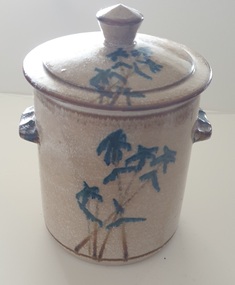
Photograph, Lidded ceramic vessel with Bamboo like design
... Robert MAIR Robert (Bob) Mair (1943- ) Born New Zealand A potter who trained at the Sturt Pottery in Mittagong under Les Blakebrough and later set up a pottery at Clifton Pugh’s Dunmoochin estate at Cottles Bridge near Melbourne. He then worked with John Olsen for two years from 1969-1970, with Mair throwing and Olsen hand-decorating the pots. During the 1970s, Bob Mair worked in goldfield...Robert MAIR Robert (Bob) Mair (1943- ) Born New Zealand A potter who trained at the Sturt Pottery in Mittagong under Les Blakebrough and later set up a pottery at Clifton Pugh’s Dunmoochin estate at Cottles Bridge near Melbourne. He then worked with John Olsen for two years from 1969-1970, with Mair throwing and Olsen hand-decorating the pots. During the 1970s, Bob Mair worked in goldfield ...Robert MAIR Robert (Bob) Mair (1943- ) Born New Zealand A potter who trained at the Sturt Pottery in Mittagong under Les Blakebrough and later set up a pottery at Clifton Pugh’s Dunmoochin estate at Cottles Bridge near Melbourne. He then worked with John Olsen for two years from 1969-1970, with Mair throwing and Olsen hand-decorating the pots. During the 1970s, Bob Mair worked in goldfield production pottery in Ballarat with Robert Pitman before moving to Clarendon in the Adelaide Hills in South Australia in 1982. In the late 1880s and 1990s Robert Mair is working at Sturt Pottery timeline again in the late 1980s/1990s as a visiting potter under Campbell Hegan. In the early 2000s, he and partner Janie Kerr set up a pottery at Braemar in the Southern Highlands of NSW. They then moved, first to Sutton Forest where they took up a residency at Hillview, the former summer residence of the governors of NSW, then to Wingham in the Mid North Coast region of NSW. Mair’s work may be marked with an impressed ‘RM’, an impressed tricuspid symbol or both. In Clarendon, he continued to use the tricuspud symbol with an impressed ‘Old Clarendon Pottery Adelaide’ stamp. A Ballarat mark has not been identified, but simse this lidded pot was found in Ballarat it could be a cross in a circle?Lidded ceramic container with blue bamboo like design on the outside.australian studio pottery, ceramics, bamboo -
 Victorian Railway History Library
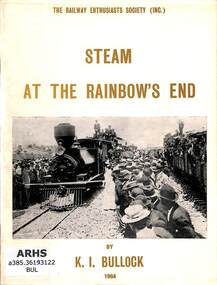
Booklet, Bullock, K.I, Steam at the Rainbow's End: Railways and the Thames Goldfields, 1964
... railroad construction - New Zealand Railroads - New Zealand - North Island - History A short history of the railways serving the Thames goldfields in the North Island of New Zealand. ill, maps, p.23. ...A short history of the railways serving the Thames goldfields in the North Island of New Zealand.ill, maps, p.23.non-fictionA short history of the railways serving the Thames goldfields in the North Island of New Zealand.railroad construction - new zealand, railroads - new zealand - north island - history -
 Bendigo Historical Society Inc.
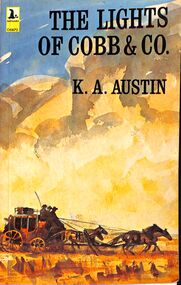
Book - "The Lights of Cobb & Co.", 1977
... The name grew to great prominence in the late 19th century, when it was carried by many stagecoaches carrying passengers and mail to various Australian goldfields, and later to regional and remote areas of the Australian outback. The same name was used in New Zealand and Freeman Cobb used it in South Africa. ...The name grew to great prominence in the late 19th century, when it was carried by many stagecoaches carrying passengers and mail to various Australian goldfields, and later to regional and remote areas of the Australian outback. The same name was used in New Zealand and Freeman Cobb used it in South Africa. ...Cobb & Co was the name used by several independent Australian coach businesses. The first company to use 'Cobb & Co' was established in 1853 by American Freeman Cobb and his partners. The name grew to great prominence in the late 19th century, when it was carried by many stagecoaches carrying passengers and mail to various Australian goldfields, and later to regional and remote areas of the Australian outback. The same name was used in New Zealand and Freeman Cobb used it in South Africa. Although the Queensland branch of the company made an effort to transition to automobiles in the early 20th century, high overhead costs and the growth of alternative transport options for mail, including rail and air, saw the final demise of Cobb & Co. The last Australian Cobb & Co stagecoach ran in Queensland in August 1924. Cobb & Co has become an established part of Australian folklore commemorated in art, literature and on screen. Parallels may be drawn between Australia's Cobb & Co and America’s Wells Fargo stagecoach services, both of which played similar and important roles in their respective countries' histories. Today, the name 'Cobb & Co' is used by a number of Australian bus operators. "The Lights of Cobb & Co." by K. A. Austin. Published Gold. Blood, Sweat and Fear. Bendigo's Diamond Hill and its gullies" by James A Lerk. Published by Rigby Limited in 1967. Reprinted by Seal Books in 1977. Soft cover book. Front cover has colored painted abstract image of coach being pulled by four horses. Back cover is color painting of country scene in abstract. Title written in black on front cover, and aqua on white spine. 228 pp. Has index. Black and white images throughout book. gold, cobb & co, mail, transport
