
Showing 10 items matching "non-fiction / literature and poetry"
-
 Flagstaff Hill Maritime Museum and Village
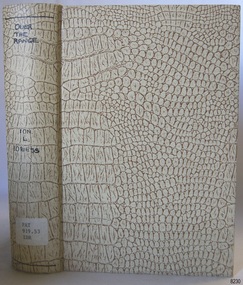
Book - Travel, Over The Range
... Lecture topics included The Poets and Poetry of Ireland', 'The Birth and Development of the Earth', 'The Vertebrae - with Remarks on the pleasures resulting from the study of Natural History' and 'Architecture'. ...Lecture topics included The Poets and Poetry of Ireland', 'The Birth and Development of the Earth', 'The Vertebrae - with Remarks on the pleasures resulting from the study of Natural History' and 'Architecture'. ...This book was part of a large group of books referred to as the Pattison Collection, which belonged to the Warrnambool Public Library, part of the Warrnambool Mechanics’ Institute. About RALPH ERIC PATTISON and the ‘PATTISON COLLECTION’ The ‘Pattison Collection’ is a collection of books and records that was originally owned by the Warrnambool Mechanics’ Institute, founded in Warrnambool in 1853. By 1886 the Warrnambool Mechanics’ Institute (WMI) had grown to have a Library, Museum and Fine Arts Gallery, with a collection of “… choice productions of art and valuable specimens in almost every branch and many wonderful national curiosities are now to be seen there, including historic relics of the town and district.” It later included a School of Design. Although it was very well patronised, the WMI was led to ask the City Council to take it over in 1911 due to lack of financial support. In 1935 Ralph Pattison was appointed as City Librarian to establish and organise the Warrnambool Public Library as it was then called. Ralph Eric Pattison was born in Rockhampton, Queensland, in 1891. He married Maude Swan from Warrnambool in 1920 and they set up home in Warrnambool. In 1935 when Pattison accepted the position as City Librarian for the Warrnambool City Council his huge challenge was to make a functional library within two rooms of the Mechanics’ Institute. He tirelessly cleaned, cleared and sorted a disarrayed collection of old books, jars of preserved specimens and other items reserved for exhibition in the city’s museum. He developed and updated the library with a wide variety of books for all tastes, including reference books for students; a difficult task to fulfil during the years following the Depression. He converted all of the lower areas of the building into a library, reference room and reading room for members and the public. The books were sorted and stored using a cataloguing and card index system that he had developed himself. He also prepared the upper floor of the building and established the Art Gallery and later the Museum, a place to exhibit the many old relics that had been stored for years for this purpose. One of the treasures he found was a beautiful ancient clock, which he repaired, restored and enjoyed using in his office during the years of his service there. Ralph Pattison was described as “a meticulous gentleman whose punctuality, floorless courtesy and distinctive neat dress were hallmarks of his character, and ‘his’ clock controlled his daily routine and his opening and closing of the library’s large heavy doors to the minute.” Pattison took leave from 1942 to 1945 to serve in the Royal Australian Navy, Volunteer Reserve as Lieutenant. A few years later he converted one of the Museum’s rooms into a Children’s Library, stocking it with suitable books for the younger generation. This was an instant success. In the 1950’s he had the honour of being appointed to the Victorian Library Board and received more inspiration from the monthly conferences in Melbourne. He was sadly retired in 1959 after over 23 years of service, due to the fact that he had gone over the working age of council officers. However, he continued to take a very keen interest in the continual development of the Library until his death in 1969. THE NEW WARRNAMBOOL LIBRARY When the WMI building was pulled down in 1963 a new civic building was erected on the site and the new Warrnambool Library, on behalf of the City Council, took over all the holdings of the WMI. At this time some of the items were separated and identified as the ‘Pattison Collection’, named after Pattison. Eventually, the components of the WMI were distributed from the Warrnambool Library to various places, including the Art Gallery, Historical Society and Flagstaff Hill. Later some were even distributed to other regional branches of Corangamite Regional Library and passed to and fro. It is difficult now to trace just where all of the items have ended up. The books at Flagstaff Hill Maritime Village generally display stamps and markings from Pattison as well as a variety of other institutions including the Mechanics’ Institute itself. Ion Llewellyn Idriess was born in Waverley, Sydney, New South Wales on 20th September 1889 and passed away on 6th June 1979 in Mona Vale, Sydney, New South Wales at the age 89. After Idriess finished school he worked in the assay office of Broken Hill Proprietary mine. Both Idriess and his mother had typhoid fever when Ion was about 15 years old and it caused his mother’s death. After spending time with his Grandmother in Sydney he found work on a paddle-steamer and had a relapse of the fever. He then went into the western district of New South Wales where he worked in many different itinerant jobs, including rabbit poisoner, boundary rider, drover, sandalwood harvester, shearer, dingo shooter and opal miner. While opal mining at Lightning Ridge he wrote short stories, about life on the opal fields, for the Bulletin using the name “Gouger”. Idriess then moved to North Queensland in search of gold, tin and sandalwood. He travelled over a great deal of the Cape York Peninsula spending a lot of this travel time with local indigenous people; thus began his lifelong interest in their customs. He then spent time on cattle stations in the Gulf of Carpentaria. In 1914 Idriess travelled to Townsville and enlisted in the 5th Light Horse as a trooper. He became a specialist in sniping and was a spotter for the noted sniper Billy Sing. He saw service in Palestine, Sinai and Turkey. Idriess was wounded at Beersheba and after fighting the Battle of Gaza he was invalided home in March 1918. After recovering from his wounds Idriess again travelled to the Cape York Peninsula where he worked with pearlers and missionaries in the Torres Strait Islands. He then went gold mining in Papua New Guinea, buffalo shooting in the Northern Territory of Australia and then exploring in Central and Western Australia. LITERARY WORKS OF IDRIESS In 1928 Idriess settled in Sydney and published the first of his 47 books. In 1931 - “Lasseter’s Last Ride”, became his first best seller. In the years 1932 and 1940, he published three books in each year. “The Cattle King” (1936) and “Flynn of the Inland” (1932) have gone through reprinting forty to fifty times. His last book was published in 1969. Idriess’ books were in general non-fiction and were written in a colourful and immediate story style, taken from life experiences gained during his travels. Idriess was appointed an Officer of the Most Excellent Order of the British Empire (OBE) for his service to literature in 1968. WARRNAMBOOL PUBLIC LIBRARY The Warrnambool Mechanics’ Institute (WMI) was formed by a voluntary community group in 1863, within six years of Warrnambool’s beginnings, and it's Reading Room opened in 1854. The WMI operated until 1963, at which time it was one of the oldest Mechanics’ Institutes in Victoria. Mechanics’ Institutes offered important services to the public including libraries, reading rooms and places to display and store collections of all sorts such as curiosities and local historical relics. In 1886 a Museum and Fine Arts Gallery were added to the WMI and by the beginning of the 20th century, there was also a billiards room and a School of Art. By this time all Mechanics’ Institutes in country Victoria had museums attached. Over the years the Warrnambool Mechanics’ Institute Library was also known as the Warrnambool Public Library the Warrnambool Library and the Free Library. Early funding from the government was for the “Free Library”. The inscription in a book “Science of Man” was for the “Warrnambool Public Library”, donated by Joseph Archibald in 1899. Another inscription in the book “Catalogue of Plants Under Cultivation in the Melbourne Botanic Gardens 1 & 2, 1883” was presented to the “Warrnambool Library” and signed by the author W.R. Guilfoyle. In 1903 the Warrnambool Public Library decided to add a Juvenile Department to library and stock it with hundreds of books suitable for youth. In 1905 the Public Library committee decided to update the collection of books and added 100 new novels plus arrangements for the latest novels to be included as soon as they were available in Victoria. In July 1911 the Warrnambool Council took over the management of the Public Library, Art Gallery, Museum and Mechanics’ Institute and planned to double the size of the then-current building. In 1953, when Mr R. Pattison was Public Librarian, the Warrnambool Public Library’s senior section 10,000 of the 13,000 books were fiction. The children’s section offered an additional 3,400 books. The library had the equivalent of one book per head of population and served around 33 per cent of the reading population. The collection of books was made up of around 60 per cent reference and 40 per cent fiction. The library was lending 400 books per day. In 1963 the Warrnambool City Council allocated the site of the Mechanics’ Institute building, which included the Public Library, Museum and Art Gallery, for the new Municipal Offices and the Collections were dispersed until 1971. The Warrnambool Library took over the Mechanics’ Institute Library’s holdings on behalf of the Warrnambool City Council. Since the closure of the Warrnambool Mechanics’ Institute, the exact location and composition of the original WMI books and items has become unclear. Other materials have been added to the collection, including items from Terang MI, Warrnambool Court House and Customs House. Many of the books have been identified as the Pattison Collection, named after the Librarian who catalogued and numbered the books during his time as Warrnambool Public Librarian in the time before the Mechanics’ Institute closed. It seems that when Warrnambool became part of the Corangamite Regional Library some of the books and materials went to its head office in Colac and then back to Warrnambool where they were stored at the Art Gallery for quite some time. Some then went to the Warrnambool Historical Society, some stayed at the Art Gallery and some were moved to Flagstaff Hill Maritime Village. The various stamps and labels on the books held at Flagstaff Hill show the variety of the collection’s distribution and origin. The books in the collection at Flagstaff Hill Maritime Village date from the 1850’s to the late 1950s and include rare and valuable volumes. Many of the books are part of the “Pattison Collection” after the Warrnambool’s Public Librarian, Mr R. Pattison. WARRNAMBOOL MECHANICS’ INSTITUTE Warrnambool's Mechanics' Institute (or Institution as it was sometimes called) was one of the earliest in Victoria. On 17th October 1853, a meeting was held where it was resolved to request the Lieutenant Governor of the Colony to grant land for the erection of a Mechanics' Institutes building. A committee was formed at the meeting and Richard Osburne chaired the first meeting of this committee. The land on the North West corner of Banyan and Merri Streets was granted but there were no funds to erect the building. The Formal Rights of the Warrnambool Mechanics' Institute's encompassed its aims and these were officially adopted in1859; "This Institution has for its object the diffusion of literary, scientific, and other useful knowledge amongst its members, excluding all controversial subjects, religious or political. These objects are sought to be obtained by means of a circulating library, a reading room, the establishment of classes, debates, and the occasional delivery of lectures on natural and experimental philosophy, mechanics, astronomy, chemistry, natural history, literature, and the useful and ornamental arts, particularly those which have a more immediate reference to the colony." The Warrnambool Mechanics' Institute opened its first reading room in November 1884 in the National School building at the corner of Banyan and Timor Streets. The Institute was funded by member subscription, payable on a quarterly, half-yearly or yearly basis. Samuel Hannaford, the Manager of the Warrnambool Bank of Australasia, was the first Honorary Secretary of the Mechanics' Institutes, and an early President and Vice-President. He also gave several of the early lectures in the Reading Room. Another early Secretary, Librarian and lecturer was Marmaduke Fisher, the teacher at the National School. Lecture topics included The Poets and Poetry of Ireland', 'The Birth and Development of the Earth', 'The Vertebrae - with Remarks on the pleasures resulting from the study of Natural History' and 'Architecture'. In 1856 the Reading Room was moved to James Hider's shop in Timor Street, and by 1864 it was located in the bookshop of Davies and Read. In the 1860's the Mechanics' Institute struggled as membership waned but in 1866, after a series of fundraising efforts, the committee was able to purchase land in Liebig Street, on a site then called Market Square, between the weighbridge and the fire station. A Mechanics' Institute building was opened at this site in August 1871. The following year four more rooms were added to the main Reading Room and in 1873 the Artisan School of Design was incorporated into the Institute. The same year Joseph Archibald established a Museum; however, it deteriorated when he was transferred to Bendigo in 1877. In 1880, with Archibald's return to Warrnambool, the Museum was re-established, and in 1885 a new building was built at the back of the Institute to accommodate the re-created School of Design, the Art Gallery and the Museum. In 1887 the Museum section was moved to the former courthouse in Timor Street (for some time the walls of the building formed part of the TAFE cafeteria but all is now demolished)). In 1911 the Museum was transferred back to the original building and the management of the Mechanics' Institute was handed over to the Warrnambool City Council. The Museum and Art Gallery became one and housed many fine works of art, and the Library continued to grow. The building was well patronised, with records showing that at the beginning of the 20th century there were between 500 and 800 visitors. During World War One the monthly figures were in the thousands, with 3,400 people visiting in January 1915. The Museum was a much - loved Institution in Warrnambool until the contents of the Museum and Art Gallery were removed to make room for the Warrnambool City Council Engineers' Department. The contents were stored but many of the items were scattered or lost. When the original building was demolished the site became occupied by the Civic Centre, which included the new City Library. (The library was temporarily located in the old Palais building in Koroit Street.) In the process of reorganisation the Collection was distributed amongst the community groups: -The new City Library took some of the historical books and some important documents, historic photographs and newspapers. -The Art Gallery kept the 19th Century art collection and some of the artefacts from the museum. -The Historical Society has some items -The State Museum has some items -Some items were destroyed -Flagstaff Hill Maritime Village has old newspapers, Government Gazettes, most of the Mechanics' Institute Library, ledgers and documents connected to the Mechanics' Institute Library, some framed and unframed artworks and some photographs. The Warrnambool Mechanics' Institute Library book collection is deemed to be of great importance because it is one of the few collections in an almost intact state, and many of the books are now very rare and of great value. The Pattison Collection, along with other items at Flagstaff Hill Maritime Village, was originally part of the Warrnambool Mechanics' Institute’s collection. The Warrnambool Mechanics’ Institute Collection is primarily significant in its totality, rather than for the individual objects it contains. Its contents are highly representative of the development of Mechanics' Institute libraries across Australia, particularly Victoria. A diversity of publications and themes has been amassed, and these provide clues to our understanding of the nature of and changes in the reading habits of Victorians from the 1850s to the middle of the 20th century. The collection also highlights the Warrnambool community’s commitment to the Mechanics’ Institute, reading, literacy and learning in the regions, and proves that access to knowledge was not impeded by distance. These items help to provide a more complete picture of our community’s ideals and aspirations. The Warrnambool Mechanics Institute book collection has historical and social significance for its strong association with the Mechanics Institute movement and the important role it played in the intellectual, cultural and social development of people throughout the latter part of the nineteenth century and the early twentieth century. The collection of books is a rare example of an early lending library and its significance is enhanced by the survival of an original collection of many volumes. The Warrnambool Mechanics' Institute’s publication collection is of both local and state significance. Over The Range Author: Ion L Idriess Publisher: Angus & Robertson Date: 1937 The label on spine cover with typed text PAT 919.53 IDR Front loose endpaper has a sticker from Corangamite Regional Library Service Flyleaf has a stamp from Warrnambool Public Library Flyleaf has a stamp from Warrnambool Mechanics Institute The top of the text block has a stamp from Warrnambool Public Library flagstaff hill, warrnambool, shipwrecked coast, flagstaff hill maritime museum, maritime museum, shipwreck coast, flagstaff hill maritime village, great ocean road, book, pattison collection, warrnambool library, warrnambool mechanics’ institute, ralph eric pattison, corangamite regional library service, warrnambool city librarian, mechanics’ institute library, victorian library board, warrnambool books and records, warrnambool children’s library, over the range, ion l idriess -
 Bendigo Historical Society Inc.
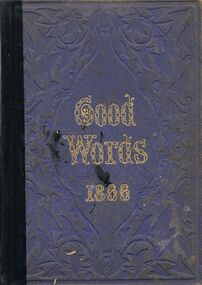
Book - GOOD WORDS 1866
... non fiction... essays... illustrations... poetry... collections... fiction... literature...BOOKS Collections essays Books book non fiction essays illustrations poetry collections fiction literature Norman Macleod, Editor A damaged hard covered book titled ''Good Words 1866.'' ...A damaged hard covered book titled ''Good Words 1866.'' Edited by Norman Macleod, D.D. 'one of Her Majesty's chaplains for Scotland.'' Illustrated by J. Wolf, R.P. Leitch, W. Small, G.J. Pinwell, A.B. Houghton, J.W. North, M.E. Edwards, and others. Strahan & Co., Magazine Publishers, London and New York. 858p. Ill. 1866.Norman Macleod, Editorbooks, collections, essays, books, book, non fiction, essays, illustrations, poetry, collections, fiction, literature -
 Kadimah Jewish Cultural Centre and National Library
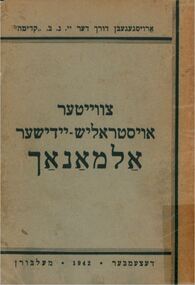
Document - Digitised book, Kadimah Jewish Cultural Centre and National Library, Second Australian-Jewish Almanac 1942, 2023
... Literature The Second Australian Jewish Almanac was published in Melbourne in 1942 to mark the 30 Year Jubilee of the Kadimah. Edited by a collective of Hertz Bergner, Pinchas Goldhar, Bonem Warshawski, Hirsch Munz it provides a unique survey of the views and concerns of Jewish immigrants in Australia. The Almanac contains short fiction and non ...The Second Australian Jewish Almanac was published in Melbourne in 1942 to mark the 30 Year Jubilee of the Kadimah. Edited by a collective of Hertz Bergner, Pinchas Goldhar, Bonem Warshawski, Hirsch Munz it provides a unique survey of the views and concerns of Jewish immigrants in Australia. The Almanac contains short fiction and non-fiction pieces including histories of Jewish communities in Australia, political commentary and poetry. Digitisation of the Almanacs was funded by Martin Munz in honour of his parents Hirsch & Estera Munz.458 page PDF - contains bookmarked table of contentsnon-fictionThe Second Australian Jewish Almanac was published in Melbourne in 1942 to mark the 30 Year Jubilee of the Kadimah. Edited by a collective of Hertz Bergner, Pinchas Goldhar, Bonem Warshawski, Hirsch Munz it provides a unique survey of the views and concerns of Jewish immigrants in Australia. The Almanac contains short fiction and non-fiction pieces including histories of Jewish communities in Australia, political commentary and poetry. Digitisation of the Almanacs was funded by Martin Munz in honour of his parents Hirsch & Estera Munz.jewish immigrants, yiddish melbourne, melekh ravitsh, pinchas goldhar, hirsch munz, hertz bergner, bonem warshawski, j. giligitch, dr. m. lazarson, chaim rosenstein, dr. j. h. gentili, a. yonavitch, brian fitzpatrick, isaac horowitz, y. n. steinberg, aron patkin, dr d. berger, yiddish literature -
 Flagstaff Hill Maritime Museum and Village
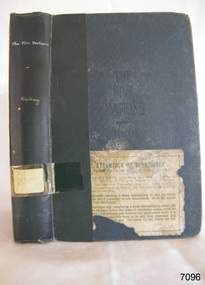
Book - Collection of Poetry, Rudyard Kipling, The Five Nations, 1903
... The Five Nations Book Collection of Poetry Rudyard Kipling Methuen & Co ...The Five Nations is a collection of poems by Rudyard Kipling, first published in late 1903 in both the United Kingdom and the United States. Some poems were new; others had appeared before most notably "Recessional" of 1897 sometimes in different versions. The volume is in two parts: an untitled first section covering a wide range of subjects, and a second titled "Service Songs", mostly concerning the real or imagined experiences of common British soldiers around the turn of the twentieth century. The book is dominated by the Second Anglo-Boer War (1899–1902). Kipling had immersed himself in South African affairs after the conflict erupted in October 1899, and "The Old Issue", later collected here, was issued as a political warning. Well-known pieces include "Boots", "The Islanders", "The Lesson", "Stellenbosch", "The Broken Men", "The Sea and the Hills" and "The White Man's Burden". Kipling placed "Recessional" as the very last poem in the book, following the "Service Songs" suite about how combatants had been changed by the war. The title itself has been debated. In 1903 the United Kingdom consisted of four nations England, Ireland, Scotland and Wales and it was soon suggested that Kipling's "five nations" were Canada, Australia, New Zealand, South Africa (Cape Colony) and "the islands of the sea", meaning the British Isles. Interestingly, no commentator seems to have suggested that India was among them.Hard cover book. The Five Nations Author: Rudyard Kipling Publisher: Methuen & Co Date: 1903 Further Information:Dark Blue Cloth hardcover with lettering and patterning to spine in white texter. The spine has a Library label with an inscription.fictionThe Five Nations is a collection of poems by Rudyard Kipling, first published in late 1903 in both the United Kingdom and the United States. Some poems were new; others had appeared before most notably "Recessional" of 1897 sometimes in different versions. The volume is in two parts: an untitled first section covering a wide range of subjects, and a second titled "Service Songs", mostly concerning the real or imagined experiences of common British soldiers around the turn of the twentieth century. The book is dominated by the Second Anglo-Boer War (1899–1902). Kipling had immersed himself in South African affairs after the conflict erupted in October 1899, and "The Old Issue", later collected here, was issued as a political warning. Well-known pieces include "Boots", "The Islanders", "The Lesson", "Stellenbosch", "The Broken Men", "The Sea and the Hills" and "The White Man's Burden". Kipling placed "Recessional" as the very last poem in the book, following the "Service Songs" suite about how combatants had been changed by the war. The title itself has been debated. In 1903 the United Kingdom consisted of four nations England, Ireland, Scotland and Wales and it was soon suggested that Kipling's "five nations" were Canada, Australia, New Zealand, South Africa (Cape Colony) and "the islands of the sea", meaning the British Isles. Interestingly, no commentator seems to have suggested that India was among them.warrnambool, shipwrecked-coast, flagstaff-hill, flagstaff-hill-maritime-museum, maritime-museum, shipwreck-coast, flagstaff-hill-maritime-village, shipwrecked-artefact, book, the five nations, rudyard kipling -
 Merri-bek City Council
Archival pigment print, Hoda Afshar, Behrouz Boochani – Manus Island No.2, 2018
... Some express themselves through poetry, others through song, while some recall the riots and suicides. ...Some express themselves through poetry, others through song, while some recall the riots and suicides. ...Hoda Afshar's 2018 body of work, "Remain," offers a forthright and unapologetic political commentary on Australia's border protection policy, shedding light on its impact on human rights. This collection comprises a film and a series of photographic portraits that chronicle the stories of stateless men who chose to stay on Manus Island, Papua New Guinea, even after the closure of the immigration detention centre in October 2017. In the accompanying film, the experiences of these men are conveyed through episodic fragments, narrated with a mix of lyrical and brutal voiceovers. Some express themselves through poetry, others through song, while some recall the riots and suicides. Set against the backdrop of a picturesque landscape featuring lush foliage and crystal-clear water—a stark contrast to the harsh realities described—the emotional impact of the work is intensified. It creates a simultaneous sense of beauty and horror. The photographic portraits of the same individuals are equally compelling. Positioned prominently against a dark backdrop, these subjects assert their presence, emphasizing their right to be seen. The deliberate simplicity of these portraits serves as a powerful political statement, countering the invisibility imposed by the act of detention. Afshar metaphorically acknowledges the struggles faced by these men, depicting them contending with the elements—fire, water, and earth—yet never questioning their inherent humanity. Here we see Behrouz Boochani, the Kurdish Iranian writer whose memoir ‘No Friend but the Mountains: Writing from the Manus Prison’ won the Victorian Premier’s Prize for Literature and the Prize for Non-Fiction in 2019. Boochani was held in detention on Manus Island from 2013 until the centre’s closure in 2017 and was forced to remain on the island in a stateless condition. -
 Flagstaff Hill Maritime Museum and Village
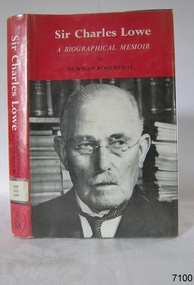
Book - Biography, Newman Rosenthal, Sir Charles Lowe, 1968
... non-fiction, Australian history, academic memoirs, legal texts, educational works, and poetry. In 1960, the company was acquired by its long-time Sydney rival, Angus & Robertson. Despite the buyout, the Robertson & Mullens imprint name and Elizabeth Street storefront were maintained for several decades as a trusted trade brand. The work is not considered a masterpiece of creative literature ...This volume is a biographical account of Sir Charles John Lowe (1880–1969), one of Australia’s most prominent 20th-century jurists. The book details his life and career, including his 37-year tenure (1927–1964) as a judge of the Supreme Court of Victoria the longest in the court's history. It also outlines the high-profile royal commissions and major Australian government inquiries he led, including those into the 1940 Canberra air disaster, the 1942 bombing of Darwin, the 1943 "Brisbane Line" allegation, and the 1949–1950 Royal Commission into the Communist Party. Additionally, it highlights his academic leadership as Chancellor of the University of Melbourne from 1941 to 1954.Hard cover book. Sir Charles Lowe Author: Newman Rosenthal Publisher: Newman H Rosenthal Date: 1968 Further Information: Dust Cover with publication details and picture of Sir Charles Lowe, Cloth covered boards with lettering and patterning to spine in black. The spine has a Library label with an inscription.non-fictionThis volume is a biographical account of Sir Charles John Lowe (1880–1969), one of Australia’s most prominent 20th-century jurists. The book details his life and career, including his 37-year tenure (1927–1964) as a judge of the Supreme Court of Victoria the longest in the court's history. It also outlines the high-profile royal commissions and major Australian government inquiries he led, including those into the 1940 Canberra air disaster, the 1942 bombing of Darwin, the 1943 "Brisbane Line" allegation, and the 1949–1950 Royal Commission into the Communist Party. Additionally, it highlights his academic leadership as Chancellor of the University of Melbourne from 1941 to 1954.warrnambool, shipwrecked-coast, flagstaff-hill, flagstaff-hill-maritime-museum, maritime-museum, shipwreck-coast, flagstaff-hill-maritime-village, shipwrecked-artefact, book, sir charles lowe, newman rosenthal -
 Flagstaff Hill Maritime Museum and Village
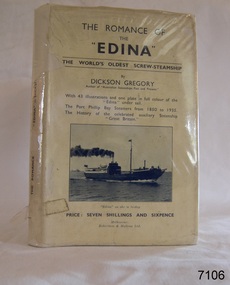
Book - Historical Maritime Research, Robertson & Mullens, The Romance of The Edina, 1935
... The literary value of this work is low to moderate as a pure work of "literature", as it is non-fiction historical research rather than creative or classic literature. ...The Romance of The "Edina" (1935) is a specialised maritime history book. It chronicles the service history of the SS Edina, an iron-hulled screw steamship built in Glasgow in 1854. The key topics covered in the book are the ship's longevity as it served for over 80 years and its role in the Crimean War and early gold rushes, and its decades as a coastal vessel in Victoria’s Port Phillip Bay. It also includes additional chapters on the auxiliary steamship Great Britain and a broader overview of Port Phillip Bay steamers from 1850 to 1935.Hard cover book. The Romance of The Edina Author: Charles Dickson Gregory Publisher: Robertson & Mullens Ltd. Date: 1935 Further Information: Dust cover over hardcover with lettering to cover. There is no Library label or inscription visible.non-fictionThe Romance of The "Edina" (1935) is a specialised maritime history book. It chronicles the service history of the SS Edina, an iron-hulled screw steamship built in Glasgow in 1854. The key topics covered in the book are the ship's longevity as it served for over 80 years and its role in the Crimean War and early gold rushes, and its decades as a coastal vessel in Victoria’s Port Phillip Bay. It also includes additional chapters on the auxiliary steamship Great Britain and a broader overview of Port Phillip Bay steamers from 1850 to 1935.warrnambool, shipwrecked coast, flagstaff hill, flagstaff hill maritime museum, maritime museum, shipwreck coast, flagstaff hill maritime village, shipwrecked artefact, barclay & curle, figurehead 'fair maid of judea', centenary maritime exhibition 1934, a brief review of steam navigation in victoria, pleasure steamer edina, trade and travel late 19th and early 20th century, trade melbourne to geelong, screw steamer edina, coastal trader edina, lighter dinah, cargo carrying for cremean war, cargo carrying for american civil war, passenger and trade in western district of victoria, export gold and currency and gold diggers to new zealand, export vessel to h r h the duke of edinburgh, melbourne - warrnambool - port fairy - portland cargo run, warrnambool steam packet company, stephen henty, captain john thompson, chief engineer john davies, lady bay warrnambool, lighter edina, shipping victoria, port phillip bay steamers, steamship great britain, edina, vhr s199 victorian heritage database, book, the romance of the edina, c dickson gregory, robertson & mullens melbourne -
 Linton Mechanics Institute and Free Library Collection
Book - Novel, Collins, Mortimer et al, The village comedy. In three volumes : Vol I, 1878
... -Fiction / Literature and Poetry...Fiction Social conditions Frances Collins Mortimer Collins Edward James Mortimer Collins English Literature Non-Fiction / Literature and Poetry A sharp, witty village tale with a wide cast of gentry, clergy, and small-town gossip. ...A sharp, witty village tale with a wide cast of gentry, clergy, and small-town gossip. This third and final volume traps a tight web of secrets, marriages, and reputations in a world where appearances mask deeper tensions. Set against Copse Hill’s social circles, the narrative follows the interwoven lives of Miss Temple, Jack, Mrs. Sebright, and the vicar, as rumors rise and loyalties shift. With humor and a keen eye for human foibles, it explores how public manners hide private motives.311p. ; green cover with author and title embossed in black on front cover, and in gold on the spinefictionA sharp, witty village tale with a wide cast of gentry, clergy, and small-town gossip. This third and final volume traps a tight web of secrets, marriages, and reputations in a world where appearances mask deeper tensions. Set against Copse Hill’s social circles, the narrative follows the interwoven lives of Miss Temple, Jack, Mrs. Sebright, and the vicar, as rumors rise and loyalties shift. With humor and a keen eye for human foibles, it explores how public manners hide private motives.fiction, social conditions, frances collins, mortimer collins, edward james mortimer collins, english literature, non-fiction / literature and poetry -
Linton Mechanics Institute and Free Library Collection
Book - Novel, Collins, Frances et al, The village comedy. In three volumes : Vol II, 1878
... Fiction...English Literature...Non...Fiction English Literature Non-Fiction / Literature and Poetry Edward James Mortimer Collins Mortimer Collins Frances Collins A sharp, witty village tale with a wide cast of gentry, clergy, and small-town gossip. ...A sharp, witty village tale with a wide cast of gentry, clergy, and small-town gossip. Set against Copse Hill’s social circles, the narrative follows the interwoven lives of Miss Temple, Jack, Mrs. Sebright, and the vicar, as rumours rise and loyalties shift. With humour and a keen eye for human foibles, it explores how public manners hide private motives.229p. ; green cover with author and title embossed in black on front cover, and in gold on the spinefictionA sharp, witty village tale with a wide cast of gentry, clergy, and small-town gossip. Set against Copse Hill’s social circles, the narrative follows the interwoven lives of Miss Temple, Jack, Mrs. Sebright, and the vicar, as rumours rise and loyalties shift. With humour and a keen eye for human foibles, it explores how public manners hide private motives.fiction, english literature, non-fiction / literature and poetry, edward james mortimer collins, mortimer collins, frances collins -
Linton Mechanics Institute and Free Library Collection
Book - Novel, The village comedy. In three volumes : Vol III, 1878
... ...Non-Fiction / Literature and Poetry...Fiction Non-Fiction / Literature and Poetry English Literature Mortimer Collins Frances Collins Edward James Mortimer Collins Social conditions A sharp, witty village tale with a wide cast of gentry, clergy, and small-town gossip. ...A sharp, witty village tale with a wide cast of gentry, clergy, and small-town gossip. This third and final volume traps a tight web of secrets, marriages, and reputations in a world where appearances mask deeper tensions. Set against Copse Hill’s social circles, the narrative follows the interwoven lives of Miss Temple, Jack, Mrs. Sebright, and the vicar, as rumors rise and loyalties shift. With humor and a keen eye for human foibles, it explores how public manners hide private motives.305p. ; p.1-9 Messrs. Hurst and Blackett's List of new works ; p.10-12 The new and popular novels. Published by Hurst and Blackett' ; p.13-16 Hurst and Blackett's standard library of cheap editions of popular modern works ; green cover with title and author embossed in black on front cover and in gold on spine.fictionA sharp, witty village tale with a wide cast of gentry, clergy, and small-town gossip. This third and final volume traps a tight web of secrets, marriages, and reputations in a world where appearances mask deeper tensions. Set against Copse Hill’s social circles, the narrative follows the interwoven lives of Miss Temple, Jack, Mrs. Sebright, and the vicar, as rumors rise and loyalties shift. With humor and a keen eye for human foibles, it explores how public manners hide private motives.fiction, non-fiction / literature and poetry, english literature, mortimer collins, frances collins, edward james mortimer collins, social conditions
