
Showing 3 items matching "norman nice"
-
 Federation University Historical Collection
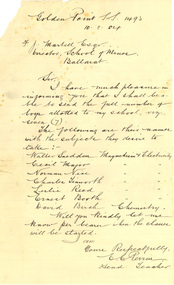
Letter - Document, Correspondence to the Ballarat School of Mines, 1899-1901
... ...Norman Nice...Director School of Mines Sir, The following are the names and classes of the boys from the above school: Charles Tinworth Electricity Ernest Book Electricity Neil Petch Electricity Cecil Major Mineralogy Norman Nice Physics Walter Sneddon Physics David Baird Chemistry Yours faithfully E.C. ...Director School of Mines Sir, The following are the names and classes of the boys from the above school: Charles Tinworth Electricity Ernest Book Electricity Neil Petch Electricity Cecil Major Mineralogy Norman Nice Physics Walter Sneddon Physics David Baird Chemistry Yours faithfully E.C. ...The Ballarat School of Mines held specialist classes for State School Students, including Chemistry and Electricity & Magnetism. Thirty three letters to the Ballarat School of Mines between 1899 and 1904. Some of the correspondence relates to Electricity, Chemistry, Physics and Mineralogy classes for State School students run by the Ballarat School of Mines. The Schools involved were Urquhart Street, Brown Hill, Queen Street, Dana Street, Eureka Street, Mount Pleasant, Sebastopol, Little Bendigo, Mount Clear, Golden Point, Humffray Street, Macarthur Street, Pleasant Street, and Wendouree. .2) Handwritten on lined foolscap paper: 'Golden Point S.S. 1493 10.8.04 F.J. Martell Esq Director, School of Mines, Ballarat Sir, I have much pleasure in informing you that I shall be able to send the full number of boys allotted to my school, viz., seven (7). The following are their names with the subject they desire to take: Walter Sneddon Magnetism & Electricity Cecil Major Magnetism & Electricity Norman Nice Magnetism & Electricity Charles Tinsworth Magnetism & Electricity Leslie Reed Magnetism & Electricity Ernest Booth Magnetism & Electricity David Both Magnetism & Electricity David Birch Chemistry Will you kindly let me know per bearer when the classes will be started. I am Yours respectfully, E.C. Perrin, Head Teacher.' ********* .8) Handwritten on lined paper 'State School 1071 Eureka St, Ballarat East 13/8/04 Sir, In reply to your letter of 8th Inst. I wish to infrom tou that seven boys from teh above school will attend the science classes at teh School of Mines and all of them desire to rak Chemsitry and mineralogy. Yours respectfully R.J. Burke Fred. J Martell Esq.' ********* .22) Eureka St S.S. Ballarat East 23 Aug 1904 Dear Sir, In reply to your last letter I wish to state that Friday afternoon will suit my school the better (for boys attending science lectures) Yours faithfully R.J. Burke F.J. Martell.' ********* .26) Handwritten on lined foolscap paper 'State School 1493 Golden Point 1.9.04 F.J. Martell Esqr. Director School of Mines Sir, The following are the names and classes of the boys from the above school: Charles Tinworth Electricity Ernest Book Electricity Neil Petch Electricity Cecil Major Mineralogy Norman Nice Physics Walter Sneddon Physics David Baird Chemistry Yours faithfully E.C. Perrin, Head Teacher education, school, state school, golden point state school, golden point primary school, eureka street state school, eureka street primary school, perrin, frederick martell, dana street primary school, sebastopol primary school, pleasant street state school, sebastopol state school, mount pleasant state school, mt pleasant state school, mount pleasant, sebsatopol, golden point, charles tinworth, chemistry, electricity, physics, mineralogy, cecil major, norman nice, david baird, walter sneddon, e.c. perrin, leslie reed, ernest booth, david birch, david booth, dana street state school -
 Federation University Historical Collection
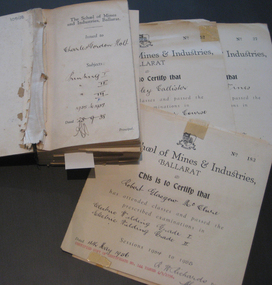
Book - Certificate stub book, School of Mines Ballarat, Ballarat School of Mines Certificate Stubb Book, 1938-1964
... Norman Lawson...Winfield Tonkin...Artuhur Williams...Allan Curtis...Ernest Billinge...John Daelon...Harold Bunting...Stanley Wilton...Robert Sugden...Winsome Stevens...Herbert Stanbridge...Robert Pittard...Henry Bre...Ernest Berriman...Carlyle West-Onley...William Blackic...Lorna Dunstan...Cedric Pike...Stanley Jephson...Hugh Hendrick...Joseph Fisher...Ernest Grove...Ronald Fisher...Heith Halsall...Henry Harris...Maxwell Silvey...Stanley Trengove...Donald Trescowthick...Harold Tolliday...Russell Lucas...John Boyd...John Keys...Stanley Betteridge...Ernest Betteridge...Michael Ross...Robert Stewart...Joseph Beasley...William Beasley...Ray Deveson...George Hennessy...Charles Matthews...Maxwell Silvey...Ian Creek...Geoffrey Moorhouse...Hector Tonks...John Donald...Hugh Hendrick...Stanley Jephson...Ian McIntosh...Robert Nice...Millar Heith Smyth Walter Hines Harold Leslie Joseph Fisher Geoffry Burns Alick Dait George Hill Raymond Wines Robert Manson Albert O'Neill Thomas Green William Stargatt William Harrison Reginald Allen Albert Wilson Allan Curtis Arthur Donald John Wynn Sydney Robinson John Blackic Percy Elsdon Hubert Jenkins Kingsley Callister Douglas Hall Norman Lawson Winfield Tonkin Artuhur Williams Allan Curtis Ernest Billinge John Daelon Harold Bunting Stanley Wilton Robert Sugden Winsome Stevens Herbert Stanbridge Robert Pittard Henry Bre Ernest Berriman Carlyle West-Onley William Blackic Lorna Dunstan Cedric Pike Stanley Jephson Hugh Hendrick Joseph Fisher Ernest Grove Ronald Fisher Heith Halsall Henry Harris Maxwell Silvey Stanley Trengove Donald Trescowthick Harold Tolliday Russell Lucas John Boyd John Keys Stanley Betteridge Ernest Betteridge Michael Ross Robert Stewart Joseph Beasley William Beasley Ray Deveson George Hennessy Charles Matthews Maxwell Silvey Ian Creek Geoffrey Moorhouse Hector Tonks John Donald Hugh Hendrick Stanley Jephson Ian McIntosh Robert Nice Ralph Scott Walter Martin Grant Coutts Lindsay Hannah John Tainsh Hubert Robinson John Donald George Beaton Heather Harris Brian McCarthy Samuel Perry Valentine Pascoe Philip McLean Geoffrey Hewish Hubert Robinson John Borch Frederick Gale Ian Grundell Albert Perry Frank Hutchinson Horace Shuttleworth Kenneth Mason David Hatt Malcom Foster George Jones Graham McKinnon Ronald Newton John Betts Leonard Wade Robert McClure David Beaumont Leslie Powell Samuel Perry Donald Treweek Edgar McArthur Russell Fraser Edgar McArthur Bartrop Clive Carmichael Leslie Fuhrmeister Lindsay Coon Zigurds Plavina Zig Plavina Victor Gingell Rupert McKenna Graham McKinnon David Fairley Johannes Meennen Ronald Murphy Johannes Naus John McConville Graham Melonie William Cutter Thomas Chalkley Kenneth Morton Stanley Shears Robert Auld Donald Campbell John Cofield Brian Whykes William Milford Noel Richards Stewart Jacobs James Robertson Clement Rose Eric Brown Allan Raworth Ernest Salter Neville Cartledge Peter Stacey Robert McClure Antonius Goossens Rodney Cartledge Rodney Hayes Bevan Grigsby James Robertson Neil Stephens John Riddle Andreas Aaus Bruce Fletcher Keith Pedler Allen Flavell Robert Cartledge Ronald Shaw Kenneth Hibberd William Lockland Percival Bilney Petrus Damen James Patterson Robert Sugden Ernest Berriman Stanley Jephson Henry Harris Maxwell Silvey Joseph Beasley Charles Matthews Maxwell Silvey Ian Creek Geoffrey Hewish Robert McClure Kingsley Callister Winfield Tonkin Raymond Wines Oswald Wilde Kenneth Mason trades Each certificate is signed by the current principal of the School of Mines and Industries, Ballarat, and a number have also been signed by the students. ...This certificate stub book contains the subject certificates of the graduates of the School of Mines and Indutsries, Ballarat, a predecessor of Federation University Australia.This item highlights the subjects studied and graduates of the School of Mines between 1938 to 1964. It also records the change of cursive over that time.This book includes stubs of subject certificates from the School of Mines and Industries, Ballarat. This also contains a number of uncollected certificates. It is a brown hardback book with black binding. Its contents covers certificates between 1938 to 1964. Names of recipients include: Charles Holt, Henry Elford, Irvin Singleton, J. H. Hughes, John Morcom, Alfred Amor, John Wastell, John Rudwick, Jared Hines, Harry Allan, L. F. J. Hillman, Arthur Davies, Letitia Stanley, Victor Wright,Raymond Ball, Mary O'Callaghan, Ethna Burke, Alec Foyster, James Duggan, Leonard Auchettl, Reeves Collins, James Patterson, Stanley Douglas Webb, Oswald Lyle, Marvis Orr, Eric Roberts, Jack Clennell, A. R. Millar, Heith Smyth, Walter Hines, Harold Leslie, Joseph Fisher, Geoffry Burns, Alick Dait, George Hill, Raymond Wines, Robert Manson, Albert O'Neill, Thomas Green, William Stargatt, William Harrison, Reginald Allen, Albert Wilson, Allan Curtis, Arthur Donald, John Wynn, Sydney Robinson, John Blackic, Percy Elsdon, Hubert Jenkins, Kingsley Callister, Douglas Hall, Norman Lawson, Winfield Tonkin, Artuhur Williams, Allan Curtis, Ernest, Billinge, John Daelon, Harold Bunting, Stanley Wilton, Robert Sugden, Heith Foster, Winsome Stevens, Herbert Stanbridge, Robert Pittard, Henry Brew, Ernest Berriman, Carlyle West-Onley, William Blackic, Lorna Dunstan, Cedric Pike, Stanley Jephson, Hugh Hendrick, Joseph Fisher, Ernest Grove, Ronald Fisher, Heith Halsall, Henry Harris, Maxwell Silvey, Stanley Trengove, Donald Trescowthick, Harold Tolliday, Russell Lucas, John Boyd, John Keys, Stanley Betteridge, Ernest Betteridge, Michael Ross, Robert Stewart, Joseph Beasley, William Beasley, Ray Deveson, George Hennessy, Charles Matthews, Maxwell Silvey, Ian Creek, Geoffrey Moorhouse, Hector Tonks, John Donald, Hugh Hendrick, Stanley Jephson, Ian McIntosh, Robert Nice, Ralph Scott, Walter Martin, Grant Coutts, Lindsay Hannah, John Tainsh, Hubert Robinson, John Donald, George Beaton, Heather Harris, Brian McCarthy, Samuel Perry, Valentine Pascoe, Philip McLean, Geoffrey Hewish, Hubert Robinson, John Borch, Frederick Gale, Ian Grundell, Albert Perry, Frank Hutchinson, Horace Shuttleworth, Kenneth Mason, David Hatt, Malcom Foster, George Jones, Graham McKinnon, Ronald Newton, John Betts, Leonard Wade, Robert McClure, David Beaumont, Leslie Powell, Samuel Perry, Donald Treweek, Edgar McArthur, Russell Fraser, Edgar McArthur Bartrop, Clive Carmichael, Leslie Fuhrmeister, Lindsay Coon, Zigurds Plavina, Victor Gingell, Rupert McKenna, Graham McKinnon, David Fairley, Johannes Meennen, Ronald Murphy, Johannes Naus, John McConville, Graham Melonie, William Cutter, Thomas Chalkley, Kenneth Morton, Stanley Shears, Robert Auld, Donald Campbell, John Cofield, Brian Whykes, William Milford, Noel Richards, Stewart Jacobs, James Robertson, Clement Rose, Eric Brown, Allan Raworth, Ernest Salter, Neville Cartledge, Peter Stacey, Robert McClure, Antonius Goossens, Rodney Cartledge, Rodney Hayes, Bevan Grigsby, James Robertson, Neil Stephens, John Riddle, Andreas Aaus, Bruce Fletcher, Keith Pedler, Allen Flavell, Robert Cartledge, Ronald Shaw, Kenneth Hibberd, William Lockland, Percival Bilney and Petrus Damen. Uncollected certificates for James Patterson, Robert Sugden, Ernest Berriman, Stanley Jephson, Henry Harris, Maxwell Silvey, Joseph Beasley, Charles Matthews, Maxwell Silvey, Ian Creek, Geoffrey Hewish, Robert McClure, Kingsley Callister, Winfield Tonkin, Raymond Wines, Oswald Wilde and Kenneth Mason are included within. The subjects covered include: Printing, mining, geology, metallurgy, mining geology, mine surveying, mechanics applied to mining, electric welding, machine shop practice, algebra, trigonometry, mechanics and heat, applied mechanics, heat treatment, graphics, oxywelding, engineering drawing, blacksmithing, shorthand theory advanced, shorthand speed, commercial English, intermediate English, plain dressmaking, dressmaking advanced, electric wiring, physics, electric technology, carpentry, machine shop, plumbing, trade science, carpentry and joinery, building construction, heat treatment, wiring, oxyacetylene welding, foremanship, turning and fitting, electric wiring, arithmetic, social studies, commercial correspondence, office routine, bookkeeping, typewriting, shorthand, electric refrigerator servicing, refrigeration, radio mechanics, trade maths, sheetmetal, wool sorting, motor mechanics, human relations in management and industrial supervision. Many of the stubbs are signed by principal Dick Richards. Each certificate is signed by the current principal of the School of Mines and Industries, Ballarat, and a number have also been signed by the students.school of mines, school of mines andindustries, certificate, richard w. richards, horace william shuttleworth, dick richards, charles holt, henry elford, irvin singleton, j. h. hughes, john morcom, alfred amor, john wastell, john rudwick, jared hines, harry allan, l. f. j. hillman, arthur davies, letitia stanley, victor wright, raymond ball, mary o'callaghan, ethna burke, alec foyster, james duggan, leonard auchettl, reeves collins, james patterson, stanley douglas webb, oswald lyle, marvis orr, eric roberts, jack clennell, a. r. millar, heith smyth, walter hines, harold leslie, joseph fisher, geoffry burns, alick dait, george hill, raymond wines, robert manson, albert o'neill, thomas green, william stargatt, william harrison, reginald allen, albert wilson, allan curtis, arthur donald, john wynn, sydney robinson, john blackic, percy elsdon, hubert jenkins, kingsley callister, douglas hall, norman lawson, winfield tonkin, artuhur williams, allan curtis, ernest billinge, john daelon, harold bunting, stanley wilton, robert sugden, winsome stevens, herbert stanbridge, robert pittard, henry bre, ernest berriman, carlyle west-onley, william blackic, lorna dunstan, cedric pike, stanley jephson, hugh hendrick, joseph fisher, ernest grove, ronald fisher, heith halsall, henry harris, maxwell silvey, stanley trengove, donald trescowthick, harold tolliday, russell lucas, john boyd, john keys, stanley betteridge, ernest betteridge, michael ross, robert stewart, joseph beasley, william beasley, ray deveson, george hennessy, charles matthews, maxwell silvey, ian creek, geoffrey moorhouse, hector tonks, john donald, hugh hendrick, stanley jephson, ian mcintosh, robert nice, ralph scott, walter martin, grant coutts, lindsay hannah, john tainsh, hubert robinson, john donald, george beaton, heather harris, brian mccarthy, samuel perry, valentine pascoe, philip mclean, geoffrey hewish, hubert robinson, john borch, frederick gale, ian grundell, albert perry, frank hutchinson, horace shuttleworth, kenneth mason, david hatt, malcom foster, george jones, graham mckinnon, ronald newton, john betts, leonard wade, robert mcclure, david beaumont, leslie powell, samuel perry, donald treweek, edgar mcarthur, russell fraser, edgar mcarthur bartrop, clive carmichael, leslie fuhrmeister, lindsay coon, zigurds plavina, zig plavina, victor gingell, rupert mckenna, graham mckinnon, david fairley, johannes meennen, ronald murphy, johannes naus, john mcconville, graham melonie, william cutter, thomas chalkley, kenneth morton, stanley shears, robert auld, donald campbell, john cofield, brian whykes, william milford, noel richards, stewart jacobs, james robertson, clement rose, eric brown, allan raworth, ernest salter, neville cartledge, peter stacey, robert mcclure, antonius goossens, rodney cartledge, rodney hayes, bevan grigsby, james robertson, neil stephens, john riddle, andreas aaus, bruce fletcher, keith pedler, allen flavell, robert cartledge, ronald shaw, kenneth hibberd, william lockland, percival bilney, petrus damen, james patterson, robert sugden, ernest berriman, stanley jephson, henry harris, maxwell silvey, joseph beasley, charles matthews, maxwell silvey, ian creek, geoffrey hewish, robert mcclure, kingsley callister, winfield tonkin, raymond wines, oswald wilde, kenneth mason, trades -
 Ballarat Heritage Services
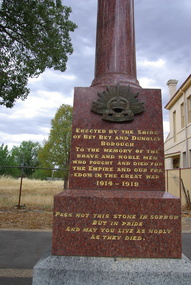
Photograph - War Memorial, Lisa Gervasoni, Dunolly War Memorial, 2025, 1921
... nice people. I had a very enjoyable time with them. I went to a dance in the evening and enjoyed it very much. It was a bit strange for a start, as it is the first dance I have been to since Norman and I had the send off at Dunolly in January, 1915. ...nice people. I had a very enjoyable time with them. I went to a dance in the evening and enjoyed it very much. It was a bit strange for a start, as it is the first dance I have been to since Norman and I had the send off at Dunolly in January, 1915. ...The Dunolly World War One Memorial Pillar, located in front of the Town Hall on Broadway Street, and was unveiled on November 18th 1921. The pillar is topped by an urn and rests on a square concrete plinth, which lists the names ninety-four locals who died serving during the First World War. On Friday afternoon the Premier, accompanied by Messrs. Pennington and Groves, M's.L.A., visited Dunolly, and unveiled a soldiers' memorial — a polished granite column on a square base, erected by the residents at a cost of £300. It bears the names of 94 district soldiers who were killed in action. The Premier, who is a native of Dunolly, referred to his early associations with the town and district. Speaking of the valiant service rendered by the Australian soldiers in the great war, he paid a tribute to those who enlisted from the country districts. He was not one of those who would withhold national memorials to the fallen because provision had not been made for all who had returned. It was right and proper to have these memorials as silent reminders of the great sacrifice made by the many as a lasting tribute to their memory. Messrs. Groves and Pennington and local clergymen also spoke. The school children sang O God, Our Help in Ages Past, and a bugler sounded the Last Post after the unveiling. The shire president entertained the visitors and committee at dinner. The Age (Melbourne), 19 November 1921. Colour photograph of the Dunolly War Memorial. Front Inscription "Erected by the Shire of Bet Bet and Dunolly Borough To the memory of the brave and noble men who fought and died for the Empire and our freedom in the Great War 1914 - 1918. Pass not this stone in sorrow but in pride, and may you live as nobly as they died." "Private L. Polinelli has written several letters to his mother at Dunolly, dated from from Tel el Kebir from January 13th till the 22nd. He had written every day or two, and this example, is a very fine one. He explains why there was an interval some weeks during which he sent no letters. This was just before the evacuation of Gallipoli, and no-one was permitted to send letters at such a critical time, as there were fears that carefully arranged plans might leak out in some way. Gallipoli had been evacuated on the 19th December, which happened to be Private Polinelli's 24th birthday, and he has cause, he says, to remember that birthday particularly, when this important movement, in which he participated, was so success-fully carried out. He was in the best of health. They had been on Lemnos Island for two weeks after leaving Galilipoli, and while there they got billeted and numerous gifts from Australia, which gave great delight. He (Private Polinelli) had got a big mail - 35 letters and a number of parcels. Both Norman Watson and himself were feeling well, although they had a pretty rough time at the front, but they were feeling better every day. Further letters speak of the arrival in Egypt and the Australian being encamped at Tel el Kebir, 40 miles from Cairo. He states that W. Lyndon had returned from England and was with them. He (W. Lyndon) looks splendid and had had a splendid time in England and Scotland. He saw Jack Lewis in England, and thinks he was to return to Australia. Reference is made to the Rev. Father Goidanich who was with their brigade, and who had been wounded at the front, but was all right again. Father Goidanich is well-known in this district. The letters were written in good spirits and many references were made to friends in Dunolly and district. A friend in Dunolly has received a letter from Private L. Polinelli, which is dated February 3rd, and written 'from the Arabian Desert.' This covers a vast extent of country, so that there is no use in speculating as to the locality, and portions of the letter which possibly would have given some indication have bean 'censored.' Private Polinelli wrote that Norman Watson and Himself were in the best of health and have stook the life well. They are right out of civilisation at time of writing. He referred to their Dtsojourns at Lemoos Island, where Christmas was spent, and where the billies and puddings assisted much in their enjoyment. But they were glad to leave Lemnos Island. After being in camp at Tel el E-bir for two weeks they were sent to where they were at the time of writing, all being in good xxxx and the open country suiting them well. He speaks with admiration of the desert work done by the camels so very largely used. The censoring was very strict so that he could not give much news. After alluding to the return to splendid health of W. Lyndon from England, he says he saw a lot of others from round Dunolly on returning to Egypt, including Tom Fishlock, R. Johnson, and J. Taylor, and some others from Betley, and all looked well. He had also seen Erie Williamson a few times, and he looked splendid. He concludes with remembrances to friends, and from himself and Norman Watson to the Loyal Prince Alfred Lodge." (Dunolly and Betbetshire Express and County of Gladstone Advertiser, Tue 14 Mar 1916) "SOLDIER'S LETTERS PRIVATE L. POLINELLI A friend in Dunolly has received another interesting letter from Private L Polinelli, son of Mrs J Davis, South Dunolly. It is from "Somewhere in France," and is dated July 23rd. He remarks with regret that a good deal of the soldiers' mail from Australia went down in the Arabia, and then goes on to say:- "Norman is back here with us again now and looking well. He had a splendid time over in England after he was able to get out of bed. It was two years on the 18th of this month (January) since Norman and I enlisted, and we celebrated the occasion by having a bit of an evening out. I am very pleased that he is back; we spend most of our time together. We are at present out of the line having a spell in a village, so we are not having a bad time just now but we will soon be going into the trenches again. I met Wally Bell a few days ago; they were going into the line to relieve our brigade. We did not have time to have a long talk. He looks rather thin, but he was always that way. He is feeling well, and wishes to be remembered to his friends in Dunolly. I also met C. Game the same day; he looked well but, as he was also going into the line, we could not have much of a talk J. Hughes and C. Atherton are also over here now; I often see them. W. Lyndon and T. Miles are well ; I was speaking to them yesterday. We are having very bad weather over here now ; it is either raining or snowing every day. The snow was about a fool deep a few days ago. When the rain comes after it, it makes things muddy, The mud is very bad over here; it takes us all our time to struggle through it in places. We will all be very glad when the winter is over. I was over in England on furlough last month, and had a splendid time. The people over there do all they can to give us a good time. I had several invitations to visit different people, and those that we did visit gave us a splendid time. At the place where I was staying they always had a guide waiting of a morning to show us any place of interest that we wanted to see. There was also always a supply of free tickets to the different theatres if we wanted them ; so you see that they go to some expense to give ns a good time. When they know yon are from France you are sure of a hearty welcome. was up in Scotland, and spent five days in Edinburgh. It is a very pretty place, especially when it is seen from Edinburgh Castle, which is on a high bill overlooking the place. We veil through the Castle; also Holyrood Palace. There are a lot of interesting things to be seen in the two places connected with the history of Scotland. It was snowing very heavily while v« were in Scotland, and we bad some fine snowballing with the Scotch people. I greatly enjoyed the trip to Scotland. It would take a very long time to see all round London. I saw a lot of the old historical places there, which were very interesting. The fogs are very bad in London. I had an experience of a London fog one day; it was the heaviest they experienced for a number of years. We could only see a few yards ahead of us. Nearly everyone carried torches; it looked very funny. . . . There are nearly always as many women drinking in the bars as men; it struck me as being very strange, a bit different to what we are used to in Australia, a trip through some parts of London is a real eye-opener to us. It is interesting to watch the traffic in some of the business parts of London it moves along in one big mass. It is a wonder that a lot more accidents do not happen. I saw Australia House, where the High Commissioner has his office, in the Strand. It is not yet finished. It looks a very fine place, and when completed will be 'some' place. Both Norman and I are well, and send remembrances to friends." (Since this letter was written we have had the sad news of the death from wounds of Privates Atherton and Hughes, and that Sergeant Miles and Corporal Norman Watson have been wounded.) (Dunolly and Betbetshire Express and County of Gladstone Advertiser , Friday 13 April 1917, page 2) "Private L Polinelli, from some of whose previous letters we have published interesting extracts, has written to a friend in Dunolly, the letter being from France, and dated April 28th. Private Polinelli says among other things, "I am pleased to say that, Norman (Watson), Les (Anderson) and myself are in the best of health. We now have been in France some time. It is a terrible place for rain ; It has been raining all the time we have been here. It has also been very cold, snowing at times, but it is starting to "fine up" now, and the last few days have been splendid. I hope it keeps like that for a while, as it makes things very miserable in the trenches when it is so wet. We get a few days spell out of the trenches every now and again; so things are not as bad here as they were at Gallipoli. It is not so lively here so far as it was over there either. I am sorry to say that Jack Sanderson, who had been Will Lyndon's mate since they joined the forces, got killed during a bombardment last night. He was terribly knocked about with a shell. I saw W. Lyndon to-day and he was telling me all about it. He seemed terribly cut up over it, and so am I, as I was with Jack a lot over at Gallipoli after Will got sent away sick. He was always bright and cheerful, always had a smile up whenever I met him. I feel very sad about it. We will do all we can to make the Germans pay for it. You will most likely know him, as be used to live in Dunolly before going to Bendigo. Will Lyndon had a narrow escape also, as he was not very far from where the shell burst. He escaped with a bit of a shock, otherwise he is in the best of health. We have a good time among the French people when we are out of the trenches. They do all they can to make us feel at home. I am getting quite expert at speaking French. They smile at us a treat trying to speak French, but we generally make ourselves understood and have a good time among them. It is very rarely we see a young Frenchman, they being all away fighting. The women do all the work on the farms themselves, and deserve every credit for it. . . . I was sorry to hear about the death of Nurse M'Mahon; she was a grand old nurse. I heard that her daughter Nelly was nurse in a hospital on Lemnos Island, and when we were there I went to two of the hospitals to try to see her, but she did not happen to be at either, and I had no time to visit any of the others, so I did not see her. I was also sorry to hear about Mrs Rokahr, as she has left so many little ones behind. (Reference is made to other happenings in Dunolly.) So far I am pleased to say Norman and I have had the luck not to have had a day's illness; I think we are very fortunate, as such a lot get sent to the hospital ill. We are also lucky to have escaped the bullets and shells so far. I hope that luck sticks to us. I am sorry that, owing to the censorship, I cannot give you any interesting news of our trip over to France and the places we have seen. I will have to keep that till I get back to Dunolly again. . . . I have just heard that the battalion that Teddy Game is in has arrived, so I am going to look him up first chance I get." (The letter concludes with remembrances to members of the Lodge and other friends.) (Dunolly and Betbetshire Express and County of Gladstone Advertiser, Tuesday 13 June 1916, page 3) "PRIVATE L POLINELLI Another very interesting letter has been received by a friend in Dunolly from Private L. Polinelli, from France dated May 4th, 1916- Private Polinelli says-" I was glad that you got the letter I wrote from the Arabian Desert. The Censor must have crossed a good deal of it out. They seem to cross out a lot more than is really necessary. We left out there all of a sudden, and in a very short while found ourselves over here. It does not take them very long to make a move. I was saying in the last letter that I was going to try and find " Teddy " Game. I met him a few days ago and had a good yarn with him; he looks real well. I also met S. Prew, and "Ted" Smyth and his son Ernie. They all looked splendid, and are in the same battalion. "Ted" Smyth sticks to it well, and looks better than he ever looked. They will be under fire for the first time in a few days. S. Prew was hit in the landing at Gallipoli, but be is quite well now. W. Smythe, who is in our brigade is well ; I see him very often. " Les " Peart is not with us now; he has joined a Pioneer battalion, and I have not seen him since he joined it. I gave all the Dunolly boys your best wishes and they all wish to be remembered to you— also the same remembrance from Dave Millar, who used to play football for Dunolly from Moliagul. He is in our battalion, having come over with reinforcements. I see him every day and he wished to be remembered to you. A brother of Mr A. J. Williamson, manager of the Bank of Victoria, Dunolly, is also in this battalion. He is a great friend of mine ; we often have a talk about Dunolly. He was not well a little while ago, having to go into a hospital, but is all right again and is back with me. Eric Williamson, son of Mr A. J. Williamson is over here ; Norman (Watson) saw him a few days ago and said he looked well. Norman has been a corporal for some time. I was also offered stripes lately, but preferred to remain a private. There is a lot of worry and running about when you are an N.C.O., so I think I will remain as I am. ... So football is about done this season. I don't think they should cut it right out. I suppose some of them have to stay at home, so they ought to have some amusement. I would very much like to have a game, but I think I would just about forget how to play now. It is very amusing for us to read some of the soldiers letters in the Australian papers. . . l told you in the last letter about xxx young "Jack "Sanderson ; I was terribly sorry about him." Private Polinelli mentions in a letter to his sister in Dunolly that he happened to be beach at Gallipoli where the late Lord Kitchener was xxxxx addressed the' soldiers and' xxxxxx to them the message from the King. Private Polinelli states that he was very proud to have been one of those addressed by the great man. He and Norman Watson have never been a day out of the lines since arriving first in Egypt. It is intended to grant special leave to all those who have been kept so close to their posts xxx three months, and they are looking forward to this relaxation with keen anticipation, hoping to visit England and Scotland. (Dunolly and Betbetshire Express and County of Gladstone Advertiser, Tue 27 Jun 1916) "SOLDIER'S LETTERS. CORPORAL L. POLINELLI. Two letters have been received by Mrs J. Davis, South Dunolly, from her son, Corporal L. Polinelli, both written subsequent to the time when he was wounded, as reported when word was received at the time. Corporal Polinelli writes from No. 12 General Hospital, Rouen, France, and his first letter is dated 7th May. He stated that he was in hospital, he having been wounded in the arm and shoulder on 3rd May. He continued— " It is not a bad wound, and will not take long to heal up, as it is a clean wound. I was very lucky to get out of the fight alive, as I was buried by a shell explosion about an hour before I was wounded. It was very rough, and the noise of all the shells was terrible. Four men were killed by the same shell that wounded me, so I was fortunate. I am feeling a bit " shook up," and my head is aching from the concussion of the shells, but after a few days' spell in bed here I will be feeling just the thing again. So you need not worry about me ; a week or two will see me quite right again. We are having very nice warm weather just now-pleasant change after all the bad weather we have had." The second letter is dated May 12, Corporal Polinelli saying— "I am getting along splendidly ; the wound is healing up fast, so it will not be very long before I am quite right. The doc-tor, the other day said it would be better not to take the piece of shell out of my shoulder yet, and that it would not interfere with me in any way ; so perhaps l will always carry it about with me. He feared lest taking it out at that time would interfere with an artery. Rouen, where the hospital is, is a very pretty city. They give us leave to visit all the places when we are well enough. It is a nice spell here, away from the firing line. We have nothing to trouble us at all, so I will soon be just the thing again. When I got buried by a shell it shook me up a good deal. I felt it far more than the wound I got after; but it has not done me any harm, as I feel hardly any effects now. My good luck sticks to me in getting out of it so lightly. I hope you are not worrying at all about me, as I am all right. We are having beautiful weather over here— sunny days just like the Australian spring. . . . The sisters in the hospital are very nice, and treat us well. They have a lot of work to do, as a good few men have been wounded lately. I would have liked to have been sent over to England, but they are not sending many over there now. They treat as many as they can in France on account of attacks on hospital ships. I would have been able to have a good time with Norman (Watson) had l got over. He was just about all right when I heard from him last." Corporal Polinelli sends kind remembrances to friends." (Dunolly and Betbetshire Express and County of Gladstone Advertiser, Friday 6 July 1917, page 2) "SOLDIERS' LETTERS. CORPORAL L. POLINELLI. The following letter, dated from London on December 27; has been received by a friend in Dunolly from Corporal L. Polinelli (son of Mrs J. Davis, South Donolly), who, at the time of writing, after long and hard service at the front, was on furlough in England. After an introduction he says:— I am having a very good time. I went over to Ireland for five days, spending the most of the time in Dublin. I like the place very much. War appearances are not so conspicuous in Ireland as in England. The hotels are open all day, and a good meal can be obtained anywhere, which is more than can be got in England. The war seems to be making things very bad in England. It is very hard to get a good meal in London ; everything is so restricted. The only way to get a good meal is to go into two places. The people have to line up outside the shops for hours to get sugar, tea, and butter, and then they sometimes fail to get any. So many of our boats getting sunk is the cause of it. If things continue to go on in this way I am afraid that there is a very hard time in store for the people in England. Several people that I have spoken to say that they are just beginning to feel the pinch now. I was in London while an air raid was on a few days ago; it caused a lot of excitement among the people. Ten were killed and 70 wounded in the raid. I was about half a mile from where the bombs fell, so I was pretty right. I thought I had left the war behind in France, but it seems to be on over here at times also. I spent Christmas day with a family at Grantham, a town between London and Newcastle; they were very nice people. I had a very enjoyable time with them. I went to a dance in the evening and enjoyed it very much. It was a bit strange for a start, as it is the first dance I have been to since Norman and I had the send off at Dunolly in January, 1915. They do the dances a bit different over here to what they are done in Australia, and that made it worse still. I went through Guinness's Brewery while I was in Dublin. It is a wonderful place, and covers 55 acres of ground. I got a great surprise when I was starting on my leave in France. We were taken to the station we had to start from in a motor lorry, and who should the driver of the lorry be but Syd. Richards (son of Mr W. Richards, South Dunolly), who used to work at the Post Office in Dunolly. I rode on the front with him, so we had a good yarn. I did not know that be had joined, so was surprised to see him. He has grown a lot since I saw him last, and is looking well. Norman and Bill Lyndon were both well when I left France. We had been having a good spell near Messines, in Flanders, but they will be in the trenches by now. We have been round about Ypres for this last four months, and had some pretty rough times there. dunolly, dunolly war memorial, l. polinelli, bet bet, world war one, world war two, j. deledio, b. battilana, c. fitzgerald, f.s. kendall, j.h. hogan, p. zampatti, louisa davis, louisa gervasoni, bill lyndon, norman lyndon, sydney lindsay
