
Showing 357 items matching "northern area"
-
 NMIT (Northern Melbourne Institute of TAFE)
Journal: Northern contact, Northern Area Consultative Committee 1998-2007
... Journal: Northern contact, Northern Area Consultative Committee 1998-2007...Journal: Northern contact, Northern Area Consultative Committee 1998-2007...Northern Area Consultative Committee...Northern Area Consultative Committee Journals A4 size journal published since 1998. ...A4 size journal published since 1998. Years held 1998-2007 (incomplete). Dealt with 'Issues related to vocational skills, business growth and development, vocational education and training, school to work transition and demonstration and achievement of best practice in business, industry and education in the north of Melbourne.' northern area consultative committee, journals -
Bendigo Historical Society Inc.
Document - Forests Commission of Victoria Northern Area Fire Protection Policy, Statement, Future Bush Fire Policy, Plan for Fire Control, 1938-1939
... Forests Commission of Victoria Northern Area Fire Protection Policy, Statement, Future Bush Fire Policy, Plan for Fire Control....Four Files Forests Commission of Victoria Northern Area Report on the 1938-39 Fire Season; and the Fire Protection Policy in Respect of Field activities Prior to the Incidence of the 1939 Fires. ...Document Forests Commission of Victoria Northern Area Fire Protection Policy, Statement, Future Bush Fire Policy, Plan for Fire Control. ...Fanned by powerful winds, the Black Friday fires (13 January 1939) swept rapidly across large areas of Victoria, causing widespread destruction. Flames leaped large distances, and giant trees were blown out of the ground by fierce winds. Large pieces of burning bark (embers) were carried for kilometres, starting new fires in places that had not previously been affected by flames. Almost two million hectares burned across the state. Large areas of state forest, containing giant stands of Mountain Ash and other valuable timbers, were destroyed. As a result, approximately 575,000 hectares of reserved forest and 780,000 hectares of Crown land burned.Four Files Forests Commission of Victoria Northern Area Report on the 1938-39 Fire Season; and the Fire Protection Policy in Respect of Field activities Prior to the Incidence of the 1939 Fires. history, bendigo, forests commision of victoria, 1939 bush fires -
 Melbourne Tram Museum
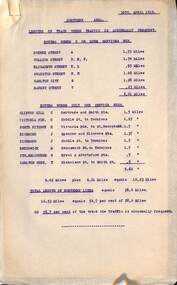
Document - Report, Tramway Board, "Northern Area - Lengths of track where traffic is abnormally frequent", 30/04/1919 12:00:00 AM
... "Northern Area - Lengths of track where traffic is abnormally frequent"...Report - single sheet, typed, titled, "Northern Area - Lengths of track where traffic is abnormally frequent", listing: 1 - Routes where 2 or more services run - giving the length in miles. 2 - route where only one service runs. ...Two copies held. "Northern Area - Lengths of track where traffic is abnormally frequent" Document Report Tramway Board ...Report - single sheet, typed, titled, "Northern Area - Lengths of track where traffic is abnormally frequent", listing: 1 - Routes where 2 or more services run - giving the length in miles. 2 - route where only one service runs. Gives an analysis of the results. Two copies held.trams, tramways, cable trams, track, services -
 Ballarat Tramway Museum
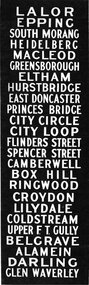
Sign - Sign - Destination Blinds, Trains, Victorian Rail Suburban Train Destination Blind in miniature - North and East stations, Melbourne
... ...northern area...Place names listed are Lalor, Epping, South Morang, Heidelberg, Macleod, Greensborough, Eltham, East Doncaster, Princes Bridge, City Circle, City Loop, Flinders Street, Spencer Street, Camberwell, Box Hill, Ringwood, Croydon, Lilydale, Coldstream, Upper Ferntree Gully, Belgrave, Alamein, Darling, Glen Waverley. train destination blind northern area eastern area lalor epping south morang macleod greensborough eltham hurstbridge east doncaster princes bridge city circle city loop flinders street spencer street camberwell box hill ringwood croydon lilydale coldstream upper ferntree gully belgrave alamein darling glen waverley Station names List of station names on black paper written in white Victorian Rail Suburban Train Destination Blind in miniature - North and East stations, Melbourne Sign Sign - Destination Blinds, Trains ...Ron Bridger was an avid collector of items related to transport, predominately Trams. These items include newspaper cuttings, pamphlets, reports, timetables, fares prices plus special items relating to events. Items from Melbourne and regional Victoria, interstate - Adelaide and Sydney, plus overseas, make up this collection. A suburban train destination blind in miniature. Place names indicate the northern and eastern suburbs that the train travels to. Place names listed are Lalor, Epping, South Morang, Heidelberg, Macleod, Greensborough, Eltham, East Doncaster, Princes Bridge, City Circle, City Loop, Flinders Street, Spencer Street, Camberwell, Box Hill, Ringwood, Croydon, Lilydale, Coldstream, Upper Ferntree Gully, Belgrave, Alamein, Darling, Glen Waverley. List of station names on black paper written in whiteStation namestrain destination blind, northern area, eastern area, lalor, epping, south morang, macleod, greensborough, eltham, hurstbridge, east doncaster, princes bridge, city circle, city loop, flinders street, spencer street, camberwell, box hill, ringwood, croydon, lilydale, coldstream, upper ferntree gully, belgrave, alamein, darling, glen waverley -
 Emerald Museum & Nobelius Heritage Park
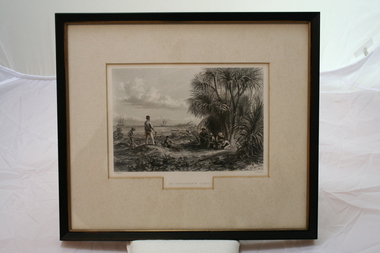
Relief prints, Thomas Baines et al, An Explorer's Camp, Circa 1875
... Thomas Baines joined Augustus Gregory as official artist and storekeeper, in the expedition across northern Australia between 1855-1857 sponsored by the Royal Geographical Society to evaluate the northern area of Australia for suitability as a colonial settlement. ...Thomas Baines joined Augustus Gregory as official artist and storekeeper, in the expedition across northern Australia between 1855-1857 sponsored by the Royal Geographical Society to evaluate the northern area of Australia for suitability as a colonial settlement. ...Thomas Baines joined Augustus Gregory as official artist and storekeeper, in the expedition across northern Australia between 1855-1857 sponsored by the Royal Geographical Society to evaluate the northern area of Australia for suitability as a colonial settlement. ...From 'Australia' by Edwin Carton Booth. Thomas Baines joined Augustus Gregory as official artist and storekeeper, in the expedition across northern Australia between 1855-1857 sponsored by the Royal Geographical Society to evaluate the northern area of Australia for suitability as a colonial settlement. The Baines River was named after him.The item is socially and artistically significant as it is a very early image of Northern Australia.Framed black and white etching depicting a cap site located near the ocean.Artist T. Baines - J.J. Crew. From 'Australia' by Edwin Carton Booth. Thomas Baines joined Augustus Gregory as official artist and storekeeper, in the expedition across northern Australia between 1855-1857 sponsored by the Royal Geographical Society to evaluate the northern area of Australia for suitability as a colonial settlement. The Baines River was named after him.print, baines -
 National Vietnam Veterans Museum (NVVM)
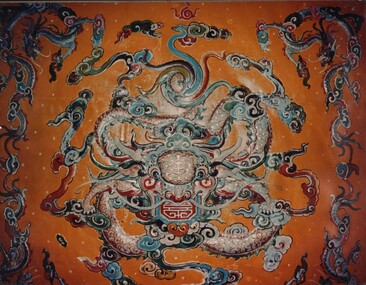
Photograph, Gibbons, Denis, The Imperial Palace Ceiling
... A coloured photograph of Ceiling decorations in the receiving foyer area of the Imperial Palace at Hue, in the Northern area of South Vietnam. The Palace was heavily damaged during the Tet Offensive of January to March 1968. the richness and beauty of the palace was completely scared....Photograph Imperial Palace Hue Tet Offensive 1968 Gibbons Collection Catalogue Denis Gibbons A coloured photograph of Ceiling decorations in the receiving foyer area of the Imperial Palace at Hue, in the Northern area of South Vietnam. The Palace was heavily damaged during the Tet Offensive of January to March 1968. the richness and beauty of the palace was completely scared. ...Denis Gibbons (1937 – 2011) Trained with the Australian Army, before travelling to Vietnam in January 1966, Denis stayed with the 1st Australian Task Force in Nui Dat working as a photographer. For almost five years Gibbons toured with nine Australian infantry battalions, posting compelling war images from within many combat zones before being flown out in late November 1970 after sustaining injuries. The images held within the National Vietnam Veterans Museum make up the Gibbons Collection. A coloured photograph of Ceiling decorations in the receiving foyer area of the Imperial Palace at Hue, in the Northern area of South Vietnam. The Palace was heavily damaged during the Tet Offensive of January to March 1968. the richness and beauty of the palace was completely scared.photograph, imperial palace, hue, tet offensive, 1968, gibbons collection catalogue, denis gibbons -
 Greensborough Historical Society
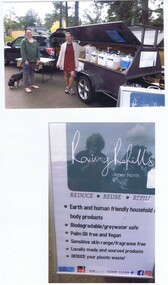
Photograph - Photographs, Rosie Bray, Roving Refills at Greenhills Neighbourhood house, 2021c
... Roving Refills produce and sell their household and body products in the inner northern area of Melbourne....Roving Refills produce and sell their household and body products in the inner northern area of Melbourne. skin care products cleaning products roving refills greenhills neighbourhood house Two colour photographs with order information card Roving Refills at Greenhills Neighbourhood house Photograph Photographs Rosie Bray ...Photographs of publicity and market sales trailer of "Roving Refills", an occasional service at Greenhills Neighbourhood House. Roving Refills produce and sell their household and body products in the inner northern area of Melbourne.Two colour photographs with order information cardskin care products, cleaning products, roving refills, greenhills neighbourhood house -
 Melbourne Tram Museum
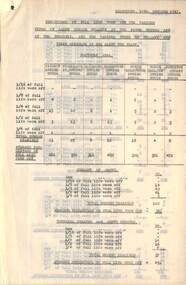
Document - Report, Tramway Board, "Percentage of full life worn off the various type of large sheeves pulleys at the power houses and termini and the various types of pulleys and their spindles in use along the track", 10/10/1917 12:00:00 AM
... Report - typed four pages - two copies - brass clipped together - titled "Percentage of full life worn off the various type of large sheeves pulleys at the power houses and termini and the various types of pulleys and their spindles in use along the track", listing the details for each engine or power house in the Northern Area - Fitzroy, Nicholson St, Richmond, Brunswick, North Melbourne, North Carlton and Johnston St engine houses. ...Trams tramways Cable Trams Track Engine Houses Cables Equipment Report - typed four pages - two copies - brass clipped together - titled "Percentage of full life worn off the various type of large sheeves pulleys at the power houses and termini and the various types of pulleys and their spindles in use along the track", listing the details for each engine or power house in the Northern Area - Fitzroy, Nicholson St, Richmond, Brunswick, North Melbourne, North Carlton and Johnston St engine houses. ...Report - typed four pages - two copies - brass clipped together - titled "Percentage of full life worn off the various type of large sheeves pulleys at the power houses and termini and the various types of pulleys and their spindles in use along the track", listing the details for each engine or power house in the Northern Area - Fitzroy, Nicholson St, Richmond, Brunswick, North Melbourne, North Carlton and Johnston St engine houses. Dated 10/10/1917trams, tramways, cable trams, track, engine houses, cables, equipment -
 Melbourne Tram Museum
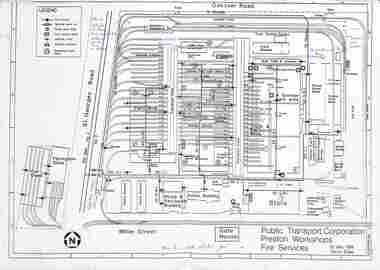
Document - Drawing, Public Transport Corporation (PTC), "PTC Preston Workshops fire services", 12/1997
... Shows track work changes in the northern area of the workshops. Dated 16/12/1997. ...Shows track work changes in the northern area of the workshops. Dated 16/12/1997. ...A3 size drawing titled "PTC Preston Workshops fire services" showing locations of hydrants, mains, alarms, valves, and dangerous goods locations. Includes the Thornbury car shed and fibreglass workshop. Shows track work changes in the northern area of the workshops. Dated 16/12/1997. Original drawing dated 20 May 1996 for the Public Transport Corporation.Yields information about the layout of Preston Workshops in Dec. 1997,A4 sheet, marked up in blue ink for changes to track layout.Dated 16/12/1997 in ink.tramways, preston workshops, trackwork, floor plans, track plans -
 Bendigo Historical Society Inc.
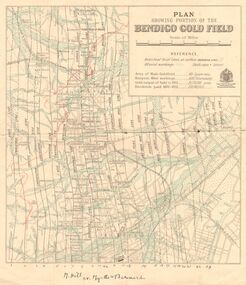
Map - DEPARTMENT OF MINES VICTORIA : PLAN SHOWING PORTION OF THE BENDIGO GOLD FIELD
... J. Tyler 1937 Northern Area. (He was a teacher at Bendigo High - see donation notes). ...J. Tyler 1937 Northern Area. (He was a teacher at Bendigo High - see donation notes). ...Department of Mines Victoria. Plan showing portion of the Bendigo Gold Field. On the back is written, in ink, J. J. Tyler 1937 Northern Area. (He was a teacher at Bendigo High - see donation notes). Across the bottom of the map is written ' M. Hill cr. Myrtle & Barnard' .The named reef lines have been numbered with ink across the bottom of the map. The gullies have been coloured with green pencil and a red pencil line is drawn through the western side of the map. Additional information: anticlinal axial lines at surface, alluvial workings, shaft sites, area of Main Goldfield, Deepest mine workings, Gold output of field to 1935, and Dividends paid 1870 - 1935.bendigo, gold mining, bendigo gold field. gold mining. tyler, j. j. -
 Wodonga & District Historical Society Inc
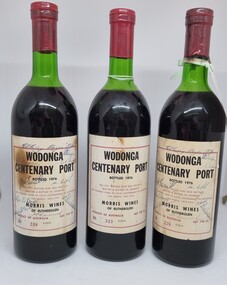
Memorabilia - Bottles - Wodonga Centenary Port, Morris Wines of Rutherglen, 1976
... Wodonga Shire was created in 1876 when the colonial government agreed to ratepayers' petitions to have their northern area severed from the Yackandandah Shire and form a new municipality. ...Wodonga Shire was created in 1876 when the colonial government agreed to ratepayers' petitions to have their northern area severed from the Yackandandah Shire and form a new municipality. ...This bottling of Wodonga Centenary Port was provided by Morris Wines of Rutherglen to celebrate the Centenary of local government in Wodonga. Wodonga Shire was created in 1876 when the colonial government agreed to ratepayers' petitions to have their northern area severed from the Yackandandah Shire and form a new municipality. In 1976 celebrations were held to mark this milestone. These bottles were donated to the Wodonga & District Historical by Jenny Brown nee Terrill daughter of former Wodonga Shire President, Councillor J. A. Terrill. These bottles of the Wodonga Centenary Port were signed by all of the councillors serving in 1976.This artefact represents the celebrations for the centenary of local government in Wodonga.3 bottles of port produced by Morris Wines of Rutherglen. This bottling celebrated the centenary of local government in Wodonga. The label is on beige paper with a maroon outline and black text. These bottle have been autographed and bear the numbers 238. 248 and 343.On Label: "WODONGA / CENTENARY PORT/BOTTLED 1976/ THIS 1975 PORT WAS SPECIALLY/ SELECTED & BOTTLED TO CELEBRATE / ONE HUNDRED YEARS OF LOCAL GOVERNMENT IN WODONGA/ 10th MARCH 1876 - 1976/ MORRIS WINES / OF RUTHERGLEN/ PRODUCT OF AUSTRALIA NET 738 ml/ NO 343 E2314wodonga shire council, wodonga local government, wodonga local government centenary -
 Sunshine and District Historical Society Incorporated
Administrative record - City of Sunshine - Commissioner Mr Alexander Alex George Gillon Collection 1976 - 1982 - Attachments for the ordinary meeting 31st July 1979, City of Sunshine, 31st July 1979
... Attachments for the Ordinary Meeting 31st July 1979 Northern Area Commission Letter Dated 9th July 1979 Resolutions Municipal Association of Victoria Letter Dated 9th July 1979 Special Meeting on Increase in Work Rates by the Melbourne Metropolitan Board of Works Christian Religion Community Letter Dated 12th July 1979 for Purchase of 1 Corio Street (Library) Municipal Association of Victoria Letter Dated 4th July 1979 Amendment to the Melbourne & Metropolitan Board of Works Act 1958 Albion North Kindergarten Letter Dated 10th July 1979 Alterations to Thomas Hall Minister for Post and Telecommunications Letter Provision of Concessional Telephone Services to Pensioners Shire of Werribee Letter Dated 9th July 1979 Additions to Offensive Trades Town Planning Appeals Tribunal Amusement Machines 47 -49 Wright Street Sunshine Town Planning Appeals Tribunal Flats 15 Bardsley Street Sunshine West...Christian Religion Community Corio Street Sunshine Albion North Kindergarten Thomas Hall Furlong Road Sunshine North Wright Street Bardsley Street Sunshine West Attachments for the Ordinary Meeting 31st July 1979 Northern Area Commission Letter Dated 9th July 1979 Resolutions Municipal Association of Victoria Letter Dated 9th July 1979 Special Meeting on Increase in Work Rates by the Melbourne Metropolitan Board of Works Christian Religion Community Letter Dated 12th July 1979 for Purchase of 1 Corio Street (Library) Municipal Association of Victoria Letter Dated 4th July 1979 Amendment to the Melbourne & Metropolitan Board of Works Act 1958 Albion North Kindergarten Letter Dated 10th July 1979 Alterations to Thomas Hall Minister for Post and Telecommunications Letter Provision of Concessional Telephone Services to Pensioners Shire of Werribee Letter Dated 9th July 1979 Additions to Offensive Trades Town Planning Appeals Tribunal Amusement Machines 47 -49 Wright Street Sunshine Town Planning Appeals Tribunal Flats 15 Bardsley Street Sunshine West Foolscap sized document. ...Attachments for the Ordinary Meeting 31st July 1979 Northern Area Commission Letter Dated 9th July 1979 Resolutions Municipal Association of Victoria Letter Dated 9th July 1979 Special Meeting on Increase in Work Rates by the Melbourne Metropolitan Board of Works Christian Religion Community Letter Dated 12th July 1979 for Purchase of 1 Corio Street (Library) Municipal Association of Victoria Letter Dated 4th July 1979 Amendment to the Melbourne & Metropolitan Board of Works Act 1958 Albion North Kindergarten Letter Dated 10th July 1979 Alterations to Thomas Hall Minister for Post and Telecommunications Letter Provision of Concessional Telephone Services to Pensioners Shire of Werribee Letter Dated 9th July 1979 Additions to Offensive Trades Town Planning Appeals Tribunal Amusement Machines 47 -49 Wright Street Sunshine Town Planning Appeals Tribunal Flats 15 Bardsley Street Sunshine Westchristian religion community, corio street, sunshine, albion north kindergarten, thomas hall, furlong road, sunshine north, wright street, bardsley street, sunshine west -
 Bendigo Military Museum
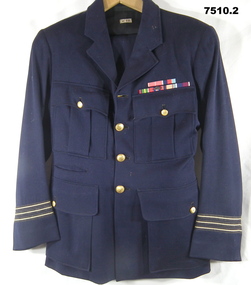
Uniform - DRESS UNIFORM, RAAF
... During WW2 from 1941 he was explosives Inspecting Officer at Northern Area 5 then to Explosive Inspecting Officer for the whole RAAF in the S/W Pacific. ...During WW2 from 1941 he was explosives Inspecting Officer at Northern Area 5 then to Explosive Inspecting Officer for the whole RAAF in the S/W Pacific. ...The uniform belonged to Wing Commander "Leonard Bacon", born 11 June 1906. He enlisted in the RAAF on 31 May 1926 No. 03305 with the rank AC.1. In 9 postings in Vic, QLD and WA he rose through 11 ranks to Sgt Maj Class 2 by 1940. He was commissioned as Flying Officer on 1.8.1940. He rose through the ranks to be Wing Commander on 1.7.1951. During WW2 from 1941 he was explosives Inspecting Officer at Northern Area 5 then to Explosive Inspecting Officer for the whole RAAF in the S/W Pacific. This role took him to some 21 places in the North from Townsville - Darwin to across the islands many several times. Leonard was awarded a "Mention in Despatches" on Morotai in 1945. Post WW2 in 1950 Leonard was appointed Chief Inspector of explosives in the RAAF, one of these roles was the supervision of the disposal of large quantities of War Stock. On 13.6.1958 he was recommended for an “OBE” which he received in the 1959 New Years Honors List. Leonard retired from the RAAF on 11.6.1960 after 34 years. This is a very brief record of his service documents.Dark Blue Service Dress Uniform comprising of jacket (.1) Pants (.2) gold buttons with RAAF emblems. Ribbons on the coat are as follows; Left to Right: OBE, 1939-45 Star, Pacific Star, British War Medal with clasp "MID". Australian Service medal, Long Service and Good Conduct medal. Jacket has black inside lining with belt connected to back. Three stripes of Wing Commander rank on the sleeves. Size "M".raaf, uniform, leonard bacon -
 The Beechworth Burke Museum
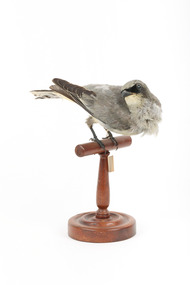
Animal specimen - White-bellied Cuckooshrike, Trustees of the Australian Museum, 1860-1880
... In Australia, it is distributed widely, occurring in tropical northern areas as well as in the eastern parts of the country, including northern Western Australia, the Northern Territory, Queensland, New South Wales, Victoria, and southeastern South Australia. ...In Australia, it is distributed widely, occurring in tropical northern areas as well as in the eastern parts of the country, including northern Western Australia, the Northern Territory, Queensland, New South Wales, Victoria, and southeastern South Australia. ...The white-bellied cuckooshrike inhabits regions across Australia, Indonesia, Papua New Guinea, and the Solomon Islands. In Australia, it is distributed widely, occurring in tropical northern areas as well as in the eastern parts of the country, including northern Western Australia, the Northern Territory, Queensland, New South Wales, Victoria, and southeastern South Australia. The species is prevalent throughout Papua New Guinea and the Solomon Islands, but less frequently observed in Indonesia. Within Indonesia, it is most commonly found in the northern Moluccas, with occasional sightings in Eastern Wallacea. This specimen was originally identified as a young Black-Cuckoo-shrike and catalogued as such in the Burke Museum original catalogue. Analysis conducted as part of a conservation treatment in 2024 reclassified the specimen as a white-bellied cuckooshrike. This specimen is part of a collection of almost 200 animal specimens that were originally acquired as skins from various institutions across Australia, including the Australian Museum in Sydney and the National Museum of Victoria (known as Museums Victoria since 1983), as well as individuals such as amateur anthropologist Reynell Eveleigh Johns between 1860-1880. These skins were then mounted by members of the Burke Museum Committee and put-on display in the formal space of the Museum’s original exhibition hall where they continue to be on display. This display of taxidermy mounts initially served to instruct visitors to the Burke Museum of the natural world around them, today it serves as an insight into the collecting habits of the 19th century.This specimen is part of a significant and rare taxidermy mount collection in the Burke Museum. This collection is scientifically and culturally important for reminding us of how science continues to shape our understanding of the modern world. They demonstrate a capacity to hold evidence of how Australia’s fauna history existed in the past and are potentially important for future environmental research. This collection continues to be on display in the Museum and has become a key part to interpreting the collecting habits of the 19th century.This specimen is a young White-bellied cuckooshrike which stands perched on a wooden mount. It has pale grey colouring which is darker on the rear. The wings are tipped with grey-brown feathers and the same colour feathers also appear on the bird's tale. The specimen has dark limbs and bill and this specimen is provided with two glass eyes which are dark in colouring. The bird has a more creamy pale grey on the throat and stomach. It has a black facial mask which is restricted to an eye stripe. 21a / Black Faced Graculus / See catalogue page 11taxidermy mount, taxidermy, animalia, burke museum, beechworth, australian museum, skin, reynell eveleigh johns, bird, cuckoo, shrike, common birds, australian birds, australian bird, white-bellied cuckooshrike -
 Eltham District Historical Society Inc
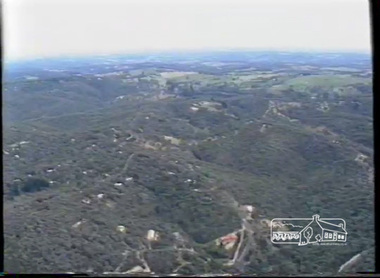
Film - Video (VHS), Phil Burke et al, Shire of Eltham Grants Commsission Submission (Series 69, Item 7), 1993
... The Shire covers over 27,000 hectares with a population in excess of 45,000 residents, more than 70% living in the southern 10% of the Shire in suburbs of Eltham, Montmorency, Lower Plenty and Research. 85% of the Shire in the more sparsely populated northern area which is covered by the Green Wedge. ...The Shire covers over 27,000 hectares with a population in excess of 45,000 residents, more than 70% living in the southern 10% of the Shire in suburbs of Eltham, Montmorency, Lower Plenty and Research. 85% of the Shire in the more sparsely populated northern area which is covered by the Green Wedge. ...Shire of Eltham Archives: Series 69, Item 7 Opens with aerial views of the Shire, 85% of the shire covered by the Green wedge principal. Discusses the obligations required of the Shire to maintain the Green Wedge. The Shire covers over 27,000 hectares with a population in excess of 45,000 residents, more than 70% living in the southern 10% of the Shire in suburbs of Eltham, Montmorency, Lower Plenty and Research. 85% of the Shire in the more sparsely populated northern area which is covered by the Green Wedge. Council is committed to providing a parity of services to all residents such as garbage collection and maintenance of roads. Views of rubbish collection trucks in Montmorency. It is emphasised that the cost of these services in highly populated areas is relatively low whereas in the sparsely populated Green Wedge areas, considerable. There are hundreds of kilometres of roads throughout the Shire, many unmade and maintenance is high to check overhanging trees and erosion especially on the steep hills is expensive and disproportionate to servicing the population in the dense urban areas. Shows views of hilly gravel roads and graders at work maintaining them. Shows scenes of assessing planning applications in these rural areas which takes significantly more time as well as other services provided such as Meals on Wheels, building permits, Ranger services. Provision of recreational facilities in hilly areas requires the acquisition of expensive river flats (views of cricket ground surrounded by hills) and where not possible, costly earthmoving required. Also, views highlighting extensive tracks of natural habitat home to significant bird, animal and plant life. Shire emphasises its commitment highlighted by the Eltham Copper Butterfly which the Shire maintains small pockets of bushland to ensure its survival at significant expense (views of Pauline Toner Copper Butterfly Reserve.) Short interview with Pat Vaughan, Environmental Officer for the Shire discussing the Eltham Copper Butterfly who also mentions many other species in the Shire of high significance from bats to mammals to plants as well as the importance of the Green Wedge to Melbourne – the lungs of Melbourne - and ensuring the protection of very important habitat which requires a great deal of planning and management to look after. Views of Wingrove Park to emphasise this maintenance by machinery in some areas is too damaging and introduced species, etc must be removed by hand. Balancing the services and facilities expected by the community with the needs of the environment requires careful planning demands requires careful planning and the principals of the Green Wedge require constant attention in the face of growing need for housing. Director of Planning & Environment, Richard Allen advises there are approximately 1,300 planning permits and development applications each year ranging from simple subdivision, boundary realignments to further complicated non-urban developments for agricultural pursuits and the level of expertise required from architectural and engineering to land degradation, flora and fauna. Video finishes with aerial views and parklands, streetscapes and rural areas. VHS Video cassette Converted to MP4 file format 00:07:39; 89MBshire of eltham, video recording, shire of eltham archives, eltham shire council, eltham, building permits, cricket ground, development applications, eltham copper butterfly, garbage collection, graders, green wedge, lower plenty, meals on wheels, montmorency, pat vaughan, pauline toner reserve, planning applications, planning permits, ranger services, recreational facilities, research, richard allen, roads, rural areas, wingrove park, victoria grants commission -
 Bendigo Historical Society Inc.
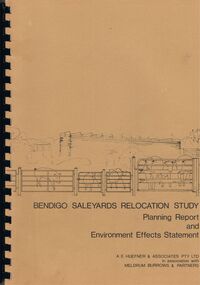
Book - BENDIGO SALEYARDS COLLECTION: BENDIGO SALEYARDS RELOCATION STUDY - PLANNING REPORT AND ENVIRONMENT
... Drawings in Fig 1 Existing Bendigo Saleyards and Surrounding Land Uses, Fig 2 Catchment Area for Bendigo Saleyards 1983, Fig 4.1 Estimated Sheep Populatiuon in Catchment Area 1976 - 77 to 1981 - 82, Fig 4.2 Estimated Cattle Population in Catchment area 1976 -77 to 1981 -82, Fig 3 Possible Saleyard Relocation Areas, Fig 4, Directions from which access to possible Saleyard Locations would be obtained - Estimated percentage of sheep to cattle stock, Fig 5 Possible Saleyard Locations - Northern Area, Fig 6 Possible Locations of Saleyards - Inner West, Fig 7 Possible Locations of Saleyards - Outer West. ...Drawings in Fig 1 Existing Bendigo Saleyards and Surrounding Land Uses, Fig 2 Catchment Area for Bendigo Saleyards 1983, Fig 4.1 Estimated Sheep Populatiuon in Catchment Area 1976 - 77 to 1981 - 82, Fig 4.2 Estimated Cattle Population in Catchment area 1976 -77 to 1981 -82, Fig 3 Possible Saleyard Relocation Areas, Fig 4, Directions from which access to possible Saleyard Locations would be obtained - Estimated percentage of sheep to cattle stock, Fig 5 Possible Saleyard Locations - Northern Area, Fig 6 Possible Locations of Saleyards - Inner West, Fig 7 Possible Locations of Saleyards - Outer West. ...Bendigo Saleyards Relocation Study - Planning Report and Environment Effects Statement for the City of Bendigo by A E Huefner & Associates Pty Ltd in association with Meldrum Burrows & Partners. Book has a light brown cover with black plastic binder spine. Green and yellow pages separate some sections. The front cover has a sketch of a stock transport with a pig, sheep and cattle behind gates. Contents include: Introduction, Summary, Recapitulation on the Feasibility Report which includes The Need for Action, the Site and Existing Uses Adjacent to the Site, The Proposal which includes Concept, Project Description, Components, Siting of Facilities, Land Clearing, Earthworks, Darainage, Buildings and Structures, Roads and Pavements, Services, Landscaping, Soil Profile and Construction Programme. Invironmental Effects which include Visual Impact Dust, Odours, Effluent, Effluent Treatment System, Traffic, Artificial Lighting, Noise, Operational Failures and Nature Conservation Effects. Statutory Planning Considerations which includes Zoning Controls and Suggested Procedure for Initiating I.D.O. Amendment. Appendices are: A.- Copy of Tit;e, B - Soil Investigation, C - Acoustic Assessment and D - Suggested Draft Amendment to Shire of Marong I.D.O. Contains a photo of the area - View of the Site, looking South and a number of drawings. Copies of various Council Reports referring to the Saleyards Relocation Project. It has a bright yellow cover and a hard plastic type spine. Mentioned in the reports is the cost to bring the old saleyards up to standard and list of improvements. Reports are as at 16th July, 1984. Mustard coloured book with plastic spine titled Bendigo Saleyards Relocation Study Feasibility Report by Meldrum Burrows & Partners in association with A E Huefner & Associates Pty Ltd and Acil Australia Pty Ltd dated September, 1983. Items mentioned are: Introduction, Summary, Background, Role in Livestock Marketing for the Bendigo Saleyards (Acil Australia Pty. Ltd., Saleyard Relocation: Strategic Considerations, Financial Implications and Conclusion. Appendix 1: Estimation of Livestock Population in Catchment Area. Drawings in Fig 1 Existing Bendigo Saleyards and Surrounding Land Uses, Fig 2 Catchment Area for Bendigo Saleyards 1983, Fig 4.1 Estimated Sheep Populatiuon in Catchment Area 1976 - 77 to 1981 - 82, Fig 4.2 Estimated Cattle Population in Catchment area 1976 -77 to 1981 -82, Fig 3 Possible Saleyard Relocation Areas, Fig 4, Directions from which access to possible Saleyard Locations would be obtained - Estimated percentage of sheep to cattle stock, Fig 5 Possible Saleyard Locations - Northern Area, Fig 6 Possible Locations of Saleyards - Inner West, Fig 7 Possible Locations of Saleyards - Outer West. Considerations were made as to renovate the existing saleyards or to move them elsewhere. Effluent, transport and stock movement, and condition of the yards were a problem.bendigo, council, cattle markets, bendigo saleyards collection - bendigo saleyards relocation study - planning report and environment effects statement, a e huefner & associates pty ltd, meldrum burrows & partners, city of bendigo, state electricity commission, mal styles, bendigo college of advanced education, n j fieldew, pryce goodale & duncan pty ltd, p b swift, shire of marong -
NMIT (Northern Melbourne Institute of TAFE)
Book: Melbourne’s North – the new knowledge economy Melbourne’s North – the new knowledge economy 2009
... Melbourne’s North – the new knowledge economy is a study commissioned by NORTH Link and the Northern Metropolitan Melbourne Area Consultative Sub-Committee with seed funding from the Victorian Government Department of Innovation, Industry and Regional Development and matching funding from industry, education and local government in Melbourne’s North. ...Northern Melbourne region NMIT Melbourne’s North – the new knowledge economy is a study commissioned by NORTH Link and the Northern Metropolitan Melbourne Area Consultative Sub-Committee with seed funding from the Victorian Government Department of Innovation, Industry and Regional Development and matching funding from industry, education and local government in Melbourne’s North. ...Melbourne’s North – the new knowledge economy is a study commissioned by NORTH Link and the Northern Metropolitan Melbourne Area Consultative Sub-Committee with seed funding from the Victorian Government Department of Innovation, Industry and Regional Development and matching funding from industry, education and local government in Melbourne’s North. It was prepared by National Institute of Economic and Industry Research. The report provides a detailed analysis of the Melbourne’s North regional economy and builds on the previous report, Growing Melbourne’s North – developing an integrated economy. It concludes that the region can achieve significant economic and social benefits if stakeholders share resources and cooperate across local government boundaries to form a discrete economic zone. The report includes recommendations and benchmarks that will support growth and quality employment outcomes for the region into the future as it undergoes the transition into a knowledge economy. Consultants National Institute of Economic and Industry Research (NIEIR), Carmine Consulting ISBN 978-0-9803994-4-3 northern melbourne region, nmit -
 Dandenong/Cranbourne RSL Sub Branch
Memorabilia - Pack Saddle
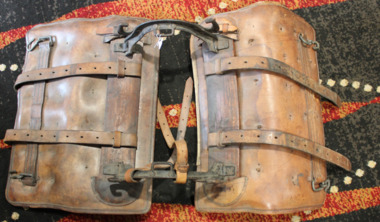
... During the Second World War pack animals were routinely used by patrols, and larger units such as Norforce, in remote areas of northern Australia. The saddle shown here has two separate girths, which crossed under the animal's belly. ...During the Second World War pack animals were routinely used by patrols, and larger units such as Norforce, in remote areas of northern Australia. The saddle shown here has two separate girths, which crossed under the animal's belly. ...Believed to have been made 1939/43. In 1904 the British Army adopted a new General Service (GS) pack saddle with an adjustable tree, known as the Mark V pack saddle. The main innovation was the adjustable tree created by having the front and back steel arches jointed to the wooden sidebars, which allowed them to turn to adjust to the size of the back of whatever animal carried the saddle, from the largest horse to the smallest donkey, and eliminated the need to manufacture saddles in different sizes. The saddle could be adapted, by the addition of hanging bars, or universal slats, to carry a wide variety of stores, tools and equipment, and also wounded men. The GS pack saddle was used in both world wars by both the British and Australian armies. The use of pack saddles was especially important in the campaign in Palestine during the First World War where wheeled transport was often not an option. Each machine gun carried by light horse units was transported on a pack saddle, and was accompanied by a second pack animal carrying spare ammunition. During the Second World War pack animals were routinely used by patrols, and larger units such as Norforce, in remote areas of northern Australia. The saddle shown here has two separate girths, which crossed under the animal's belly. Most later versions of the saddle used a shorter single girth buckled to a 'V' attachment, which was in turn buckled to the sidebars. Use of the 'V' attachment gave greater strength and stability to the saddle, and decreased 'rocking' of the load. -
 Flagstaff Hill Maritime Museum and Village
Planisphere, Early 20th Century
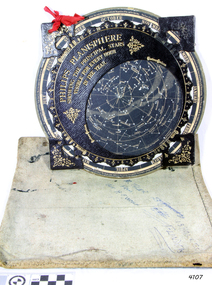
... northern hemisphere, with canvas bag. Planisphere consists of a circular star chart attached at its centre to an opaque circular overlay that has a clear elliptical window or hole so that only a portion of the sky map will be visible in the window or hole area at any given time. ...northern hemisphere, with canvas bag. Planisphere consists of a circular star chart attached at its centre to an opaque circular overlay that has a clear elliptical window or hole so that only a portion of the sky map will be visible in the window or hole area at any given time. ...The word Planisphere (Latin planisphaerium) was originally used in the second century by Claudius Ptolemy to describe the representation of a spherical Earth by a map drawn in the plane. This usage continued into the Renaissance: for example Gerardus Mercator described his 1569 world map as a Planisphere. The word describes the representation of the star-filled celestial sphere on the plane. The first star chart to have the name "Planisphere" was made in 1624 by Jacob Bartsch. Bartsch was the son-in-law of Johannes Kepler, discoverer of Kepler's laws of planetary motion. A significant item of celestial mapping used by marine navigators This particular item was made and used in the first quarter to half of the 20th centuryPlanisphere of northern hemisphere, with canvas bag. Planisphere consists of a circular star chart attached at its centre to an opaque circular overlay that has a clear elliptical window or hole so that only a portion of the sky map will be visible in the window or hole area at any given time. The chart and overlay are mounted so that they are free to rotate about a common pivot point at their centres. The star chart contains the brightest stars, constellations and (possibly) deep-sky objects visible from a particular latitude on Earth. The night sky that one sees from the Earth depends on whether the observer is in the northern or southern hemispheres and the latitude. A Planisphere window is designed for a particular latitude and will be accurate enough for a certain band either side of that. Planisphere makers will usually offer them in a number of versions for different latitudes. Planispheres only show the stars visible from the observer's latitude; stars below the horizon are not included. A complete twenty-four-hour time cycle is marked on the rim of the overlay. A full twelve months of calendar dates are marked on the rim of the starchart. The window is marked to show the direction of the eastern and western horizons. The disc and overlay are adjusted so that the observer's local time of day on the overlay corresponds to that day's date on the star chart disc. The portion of the star chart visible in the window then represents (with a distortion because it is a flat surface representing a spherical volume) the distribution of stars in the sky at that moment for the Planispheres designed location. Users hold the Planisphere above their head with the eastern and western horizons correctly aligned to match the chart to actual star positions. "Made in Germany for GEORGE PHILIP & SONS Ltd. Geographical and Educational Depot, 32 Fleet Street, London" Canvas bag has "Capt. H (Howard) Tyler from Captain H. F. Woolf" "Tyler 22 ? St East Brighton" also "13 Halls St Flinders"flagstaff hill, warrnambool, shipwrecked-coast, flagstaff-hill, flagstaff-hill-maritime-museum, maritime-museum, shipwreck-coast, flagstaff-hill-maritime-village, planisphere, star map, marine navigation, maps, george philip & sons -
 Flagstaff Hill Maritime Museum and Village
Planisphere, Early 20th Century
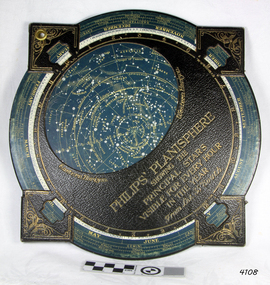
... area at any given time. The chart and overlay are mounted so that they are free to rotate about a common pivot point at their centers. The star chart contains the brightest stars, constellations and (possibly) deep-sky objects visible from a particular latitude on Earth. The night sky that one sees from the Earth depends on whether the observer is in the northern...area at any given time. The chart and overlay are mounted so that they are free to rotate about a common pivot point at their centers. The star chart contains the brightest stars, constellations and (possibly) deep-sky objects visible from a particular latitude on Earth. The night sky that one sees from the Earth depends on whether the observer is in the northern ...The word Planisphere (Latin planisphaerium) was originally used in the second century by Claudius Ptolemy to describe the representation of a spherical Earth by a map drawn in the plane. This usage continued into the Renaissance: for example Gerardus Mercator described his 1569 world map as a Planisphere. The word describes the representation of the star-filled celestial sphere on the plane. The first star chart to have the name "Planisphere" was made in 1624 by Jacob Bartsch. Bartsch was the son-in-law of Johannes Kepler, discoverer of Kepler's laws of planetary motionA significant item of celestial mapping used by marine navigators This particular item was made and used in the first quarter to half of the 20th century.Planisphere consists of a circular star chart attached at its centre to an opaque circular overlay that has a clear elliptical window or hole so that only a portion of the sky map will be visible in the window or hole area at any given time. The chart and overlay are mounted so that they are free to rotate about a common pivot point at their centers. The star chart contains the brightest stars, constellations and (possibly) deep-sky objects visible from a particular latitude on Earth. The night sky that one sees from the Earth depends on whether the observer is in the northern or southern hemispheres and the latitude. A Planisphere window is designed for a particular latitude and will be accurate enough for a certain band either side of that. Planisphere makers will usually offer them in a number of versions for different latitudes. Planispheres only show the stars visible from the observer's latitude; stars below the horizon are not included. A complete twenty-four-hour time cycle is marked on the rim of the overlay. A full twelve months of calendar dates are marked on the rim of the star chart. The window is marked to show the direction of the eastern and western horizons. The disc and overlay are adjusted so that the observer's local time of day on the overlay corresponds to that day's date on the star chart disc. The portion of the star chart visible in the window then represents (with a distortion because it is a flat surface representing a spherical volume) the distribution of stars in the sky at that moment for the Planispheres designed location. Users hold the Planisphere above their head with the eastern and western horizons correctly aligned to match the chart to actual star positions. "Sold by J DONNE & SON, Booksellers & Stationers, 349 Post Office Place Melbourne 349. Admiralty Chart Agents" and " Made in Germany for George Philip & Son Ltd" England . Signature "Capt E. B. ?..id, 22 Baund St"flagstaff hill, warrnambool, shipwrecked-coast, flagstaff-hill, flagstaff-hill-maritime-museum, maritime-museum, shipwreck-coast, flagstaff-hill-maritime-village, star map, marine navigation, maps, george philip & sons -
 Federation University Historical Collection
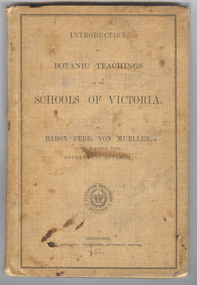
Book, Ferdinand von Mueller, Introduction to Botanic Teachings at the Schools of Victoria, 1877, 1877 (exact)
... Council members, who were inspired by the work of Baron Ferdinand von Mueller, authorised development of an area along the School's northern boundary, fronting Lydiard Street South, and oversaw the establishment of the new Botanical Gardens. ...Council members, who were inspired by the work of Baron Ferdinand von Mueller, authorised development of an area along the School's northern boundary, fronting Lydiard Street South, and oversaw the establishment of the new Botanical Gardens. ...Ferdinand von Mueller was an examiner of botany at the Ballarat School of Mines (SMB) between 1880 and 1888. During that era he was active in donating related items to the School. When the Ballarat School of Mines Council agreed to introduce pharmacy and botany classes in 1879, it was apparent students would require access to botanical specimens in order to further their studies. Council members, who were inspired by the work of Baron Ferdinand von Mueller, authorised development of an area along the School's northern boundary, fronting Lydiard Street South, and oversaw the establishment of the new Botanical Gardens. Baron von Mueller took a practical role the development of SMB's Botanical Gardens from the beginning. He became a generous benefactor who 'donated collections of seeds and leguminous fodder plants, including valued grasses of interest and use to agriculturalists and graziers generally' to SMB over many years. Ferdinand von Mueller's entry on the University of Ballarat Honour Roll can be found at http://www.ballarat.edu.au/curator/honour-roll/honourroll_von_mueller.shtml A light brown, hardcovered book of 152 pages. Chapters include Eucalyptus Trees; Wattles or Acacias; Casuarinas or Sheoaks; Cypress Pines or Sandarac trees; Exocarpos trees of Natice Cherry trees; Mistletoes; Native Honeysuckles or Banksias; Bellflower, Lobelia and Goodenia; Heaths; Correas; Mallow; Buttercups and Clematis; Cruciferous Plants; Mints; Orchids; grasses; ferns. The book has numerous botanical line drawings, and a comprehensive index.Inside front cover "J. Clement Souter M.D."victorian, schools, botany, ferdinand von mueller, von mueller, botanic illustrations, j. clement souter -
 Federation University Historical Collection
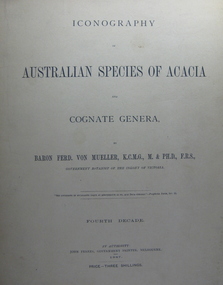
Book, Baron Ferdinand Von Mueller, Iconography of Australian Species of Acacia and Cognate Genera by Ferdinand Von Mueller
... Council members, who were inspired by the work of Baron Ferdinand von Mueller, authorised development of an area along the School's northern boundary, fronting Lydiard Street South, and oversaw the establishment of the new Botanical Gardens. ...Council members, who were inspired by the work of Baron Ferdinand von Mueller, authorised development of an area along the School's northern boundary, fronting Lydiard Street South, and oversaw the establishment of the new Botanical Gardens. ...Ferdinand von Mueller was an examiner of botany at the Ballarat School of Mines (SMB) between 1880 and 1888. During that era he was active in donating related items to the School. When the Ballarat School of Mines Council agreed to introduce pharmacy and botany classes in 1879, it was apparent students would require access to botanical specimens in order to further their studies. Council members, who were inspired by the work of Baron Ferdinand von Mueller, authorised development of an area along the School's northern boundary, fronting Lydiard Street South, and oversaw the establishment of the new Botanical Gardens. Baron von Mueller took a practical role the development of SMB's Botanical Gardens from the beginning. He became a generous benefactor who 'donated collections of seeds and leguminous fodder plants, including valued grasses of interest and use to agriculturalists and graziers generally' to SMB over many years. Ferdinand von Mueller's entry on the University of Ballarat Honour Roll can be found at http://www.ballarat.edu.au/curator/honour-roll/honourroll_von_mueller.shtml Large format, brown, soft covered books with beautiful line drawings. Set contains 6 of 13 parts, Part 1 covers the fourth decade, Part 2 the fifth decade, Part 3 the eight decade, Part 4 the ninth decade, Part 5 the tenth decade and Part 6 the eleventh decade.botany, ferdinand von mueller, von mueller, botanic illustrations, government botanist, acacia -
 Federation University Historical Collection
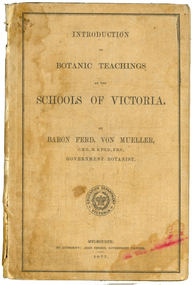
Book, Ferdinand Von Mueller, Introduction to Botanic Teachings at the Schools of Victoria, 1877
... Council members, who were inspired by the work of Baron Ferdinand von Mueller, authorised development of an area along the School's northern boundary, fronting Lydiard Street South, and oversaw the establishment of the new Botanical Gardens. ...Council members, who were inspired by the work of Baron Ferdinand von Mueller, authorised development of an area along the School's northern boundary, fronting Lydiard Street South, and oversaw the establishment of the new Botanical Gardens. ...Ferdinand von Mueller was an examiner of botany at the Ballarat School of Mines (SMB) between 1880 and 1888. During that era he was active in donating related items to the School. When the Ballarat School of Mines Council agreed to introduce pharmacy and botany classes in 1879, it was apparent students would require access to botanical specimens in order to further their studies. Council members, who were inspired by the work of Baron Ferdinand von Mueller, authorised development of an area along the School's northern boundary, fronting Lydiard Street South, and oversaw the establishment of the new Botanical Gardens. Baron von Mueller took a practical role the development of SMB's Botanical Gardens from the beginning. He became a generous benefactor who 'donated collections of seeds and leguminous fodder plants, including valued grasses of interest and use to agriculturalists and graziers generally' to SMB over many years. Ferdinand von Mueller's entry on the University of Ballarat Honour Roll can be found at http://www.ballarat.edu.au/curator/honour-roll/honourroll_von_mueller.shtml Also See Cat. No. 12062A light brown, hardcovered book of 152 pages. Chapters include Eucalyptus Trees; Wattles or Acacias; Casuarinas or Sheoaks; Cypress Pines or Sandarac trees; Exocarpos trees of Natice Cherry trees; Mistletoes; Native Honeysuckles or Banksias; Bellflower, Lobelia and Goodenia; Heaths; Correas; Mallow; Buttercups and Clematis; Cruciferous Plants; Mints; Orchids; grasses; ferns. The book has numerous botanical line drawings, and a comprehensive index.Inside front cover "Botanist, Teacher, researcher. My you make your mark like the baron. Best wishes for your birthday 1999 Martin"victorian, schools, botany, ferdinand von mueller, von mueller, botanic illustrations, flora, change number -
 Flagstaff Hill Maritime Museum and Village
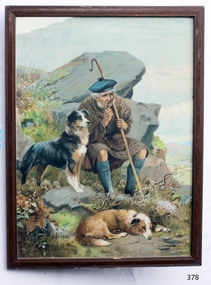
Print - Picture of a Scottish Shepherd and his Two Dogs, A Shepherd and His Friends, 20th Century
... areas. In pre-modern times shepherding was thus centred on regions such as the Middle East, Greece, the Pyrenees, the Carpathian Mountains, Scotland and Northern England. ...areas. In pre-modern times shepherding was thus centred on regions such as the Middle East, Greece, the Pyrenees, the Carpathian Mountains, Scotland and Northern England. ...Shepherding is among the oldest occupations, beginning some 5,000 years ago in Asia Minor. Sheep were kept for their milk, meat and especially their wool. Over the next thousand years, sheep and shepherding spread throughout Eurasia. Henri Fleisch tentatively suggested the Shepherd Neolithic industry of Lebanon may date to the Epipaleolithic and that it may have been used by one of the first cultures of nomadic shepherds in the Beqaa Valley. Some sheep were integrated in the family farm along with other animals such as chickens and pigs. To maintain a large flock, the sheep must be able to move from pasture to another pasture. This required the development of an occupation separate from that of the farmer. The duty of shepherds was to keep their flock intact, protect it from predators and guide it to market areas in time for shearing. In ancient times, shepherds also commonly milked their sheep, and made cheese from this milk; few shepherds still do this today. In many societies, shepherds were an important part of the economy. Unlike farmers, shepherds were often wage earners, being paid to watch the sheep of others. Shepherds also lived apart from society, being largely nomadic. It was mainly a job of solitary males without children, and new shepherds thus needed to be recruited externally. Shepherds were most often the younger sons of farming peasants who did not inherit any land. In other societies, each family would have a family member to shepherd its flock, often a child, youth or an elder who couldn't help much with harder work; these shepherds were fully integrated in society. Shepherds would normally work in groups either looking after one large flock, or each bringing their own and merging their responsibilities. They would live in small cabins, often shared with their sheep, and would buy food from local communities. Less often shepherds lived in covered wagons that travelled with their flocks. Shepherding developed only in certain areas. In the lowlands and river valleys, it was far more efficient to grow grain and cereals than to allow sheep to graze, thus the raising of sheep was confined to rugged and mountainous areas. In pre-modern times shepherding was thus centred on regions such as the Middle East, Greece, the Pyrenees, the Carpathian Mountains, Scotland and Northern England. https://en.wikipedia.org/wiki/Shepherd The Shetland Sheepdog, often known as the Sheltie, is a breed of herding dog that originated in the Shetland Islands of Scotland. The original name was Shetland Collie, but this caused controversy amongst Rough Collie breeders of the time, so the breed's name was formally changed. This diligent small dog is clever, vocal, excitable and willing to please. They are incredibly trustworthy to their owners to the point where they are often referred to as "shadows" due to their attachment to family. This breed was formally recognized by The Kennel Club (UK) in 1909. Like the Shetland pony, Shetland cattle and the Shetland sheep, the Shetland Sheepdog is a hardy but diminutive breed developed to thrive amidst the harsh and meagre conditions of its native islands. While the Sheltie still excels at herding, today it is often raised as a working dog and/or family pet. https://en.wikipedia.org/wiki/Shetland_Sheepdog The Rough Collie (also known as the Long-Haired Collie) is a long-coated dog breed of medium to large size that, in its original form, was a type of collie used and bred for herding sheep in Scotland. More recent breeding has focused on the Collie as a show dog, and also companion. The breed specifications call for a distinctive long narrow tapered snout and tipped (semiprick) ears, so some dogs have their ears taped when young. Rough Collies generally come in shades of sable and white (sometimes mahogany), blue merle, tri-coloured, and colour-headed white. There is a smooth-coated variety known as a Smooth Collie; some breed organisations, including both the American and Canadian Kennel Clubs, consider smooth-coat and rough-coat collies to be variations of the same breed. Rough Collies closely resemble the smaller Shetland Sheepdogs or "Shelties", but the two breeds do not have an exclusive linear relationship. https://en.wikipedia.org/wiki/Rough_Collie This picture shows a typical Scottish scene with a shepherd in kilt and his two sheepdogs.Picture, print of old Scotsman sitting on a stone slab with his dogs nearby. Framed, glass covered colour print. Marked "A SHEPHERD AND HIS FRIENDS", "1897" , "Drummonds" (on picture). Marked "A SHEPHERD AND HIS FRIENDS", "1897" , "Drummonds" (on picture). flagstaff hill, warrnambool, shipwrecked-coast, flagstaff-hill, flagstaff-hill-maritime-museum, maritime-museum, shipwreck-coast, flagstaff-hill-maritime-village, print, picture, wall decoration, shepherd and dogs, a shepherd and his friends, shetland sheep dog, rough collie -
 Greensborough Historical Society
Book - Annual Report, Northern Football League, Northern Football League. Annual Report 2007, 2007
... The Northern Football League (NFL) was previously the Diamond Valley Football League (DVFL) and further renamed Northern Football Netball League (NFNL) in 2017 to incorporate Netball into the clubs. This annual report covers many teams from within the Diamond Valley area. ...A record of the NFL season 2007, includes results of some games and winners of best and fairest awards for all divisions and age groups. In 2007 the Division 1 Premiers were Heidelberg Football Club. The Northern Football League (NFL) was previously the Diamond Valley Football League (DVFL) and further renamed Northern Football Netball League (NFNL) in 2017 to incorporate Netball into the clubs.This annual report covers many teams from within the Diamond Valley area. Includes junior and senior teams.Book, 54 pages. White cover with blue text. Includes tables and photos.australian rules football, diamond valley football league, dvfl, northern football league, nfl, northern football netball league, nfnl, heidelberg football club -
 Greensborough Historical Society
Book - Annual Report, Diamond Valley Football League, Diamond Valley Football League. Annual Report and Statement of Affairs. Season 1952, 03/03/1953
... area. Includes junior and senior teams. australian rules football greensborough football club diamond valley football league dvfl northern football league nfl northern football netball league nfnl Foolscap size book. 12 pages, printed on both sides of page . ...A complete record of the DVFL season 1952, includes financial report, description of events, membership, teams, scores from the seasons games and winners of best and fairest awards for all divisions and age groups. In 1952 the Division 1 Premiers were Greensborough Football Club.This annual report covers many teams from within the Diamond Valley area. Includes junior and senior teams.Foolscap size book. 12 pages, printed on both sides of page . Larger buff cover with black text. Includes typed tables.australian rules football, greensborough football club, diamond valley football league, dvfl, northern football league, nfl, northern football netball league, nfnl -
 Greensborough Historical Society
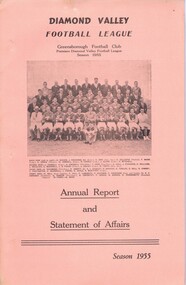
Book - Annual Report, Diamond Valley Football League, Diamond Valley Football League. Annual Report and Statement of Affairs. Season 1955, 03/03/1953
... area. Includes junior and senior teams. australian rules football greensborough football club diamond valley football league dvfl northern football league nfl northern football netball league nfnl Foolscap size book. 19 pages, printed on single sides of page . ...A complete record of the DVFL season 1955, includes financial report, description of events, membership, teams, scores from the seasons games and winners of best and fairest awards for all divisions and age groups. In 1955 the Division 1 Premiers were Greensborough Football Club.This annual report covers many teams from within the Diamond Valley area. Includes junior and senior teams.Foolscap size book. 19 pages, printed on single sides of page . Larger buff cover with black text. Includes typed tables. Photo of premiership teamaustralian rules football, greensborough football club, diamond valley football league, dvfl, northern football league, nfl, northern football netball league, nfnl -
 Greensborough Historical Society
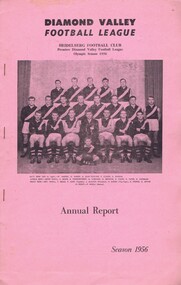
Book - Annual Report, Diamond Valley Football League, Diamond Valley Football League. Annual Report . Season 1956, 03/03/1953
... area. Includes junior and senior teams. australian rules football greensborough football club diamond valley football league dvfl northern football league nfl northern football netball league nfnl heidelberg football club Foolscap size book. 19 pages, printed on single sides of page . ...A complete record of the DVFL season 1956, includes financial report, description of events, membership, teams, scores from the seasons games and winners of best and fairest awards for all divisions and age groups. In 1956 the Division 1 Premiers were Heidelberg Football Club.This annual report covers many teams from within the Diamond Valley area. Includes junior and senior teams.Foolscap size book. 19 pages, printed on single sides of page . Larger pink cover with black text. Includes typed tables. Photo of premiership teams and past president Frank Vale.australian rules football, greensborough football club, diamond valley football league, dvfl, northern football league, nfl, northern football netball league, nfnl, heidelberg football club -
 Greensborough Historical Society
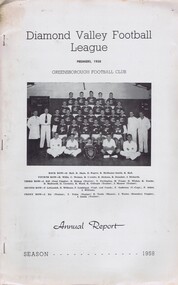
Book - Annual Report, Diamond Valley Football League, Diamond Valley Football League. Annual Report. Season 1958, 03/03/1953
... area. Includes junior and senior teams. australian rules football greensborough football club diamond valley football league dvfl northern football league nfl northern football netball league nfnl Foolscap size book. 28 pages, printed on single sides of page . ...A complete record of the DVFL season 1958, includes financial report, description of events, membership, teams, scores from the seasons games and winners of best and fairest awards for all divisions and age groups. In 1958 the Division 1 Premiers were Greensborough Football Club.This annual report covers many teams from within the Diamond Valley area. Includes junior and senior teams.Foolscap size book. 28 pages, printed on single sides of page . Larger blue cover with black text. Includes typed tables. Photo of premiership team and award winners.australian rules football, greensborough football club, diamond valley football league, dvfl, northern football league, nfl, northern football netball league, nfnl -
 Greensborough Historical Society
Book - Annual Report, Diamond Valley Football League, Diamond Valley Football League. Annual Report and statement of Affairs. Season 1954, 1954
... Cover only - DVFL season 1954, The DVFL was renamed Northern Football League (NFL) in 2008 and further renamed Northern Football Netball League (NFNL) in 2017 to incorporate Netball into the clubs. Most annual reports cover many teams from within the Diamond Valley area. ...Cover only - DVFL season 1954, The DVFL was renamed Northern Football League (NFL) in 2008 and further renamed Northern Football Netball League (NFNL) in 2017 to incorporate Netball into the clubs.Most annual reports cover many teams from within the Diamond Valley area. Includes junior and senior teams.Foolscap size folder. folder only, no internal pages.australian rules football, diamond valley football league, dvfl, northern football league, nfl, northern football netball league, nfnl
