
Showing 69 items matching "nurse's aid"
-
 Federation University Historical Collection
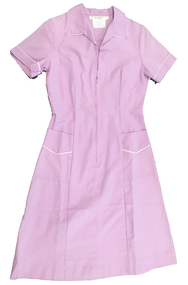
Costume, Nurses Uniform, Early 1970s?
... nurse...uniform...ballarat base hospital...nurse's aid...This nurse's uniform (probably a Nurse's Aid uniform) was used at the Ballarat Base hospital....This nurse's uniform (probably a Nurse's Aid uniform) was used at the Ballarat Base hospital. nurse uniform ballarat base hospital nurse's aid nursing school of nursing costume textiles Written in black maker - B.H. ...This nurse's uniform (probably a Nurse's Aid uniform) was used at the Ballarat Base hospital.This nurses uniform comprises a mauve princess style dress with short sleeves, a front zipper, side pockets and white piping around the collar, sleeve cuff and pocket trim. The back has a yoke and a pleat on either side for comfort. It is made of polyester and cotton blend.Written in black maker - B.H. Written in black marker on a cotton tape - J. Dobbinnurse, uniform, ballarat base hospital, nurse's aid, nursing, school of nursing, costume, textiles -
 Running Rabbits Military Museum operated by the Upwey Belgrave RSL Sub Branch
Uniform Complete
... WW2 Volunteer Aid Detachment Nurse Colour Patch 1st Aust Gen Hosp,jacket (U184a)with service ribbons,skirt(U184b) (needs white shirt, navy tie,shoes,stockings...Uniform WW2 Army WW2 Volunteer Aid Detachment Nurse Colour Patch 1st Aust Gen Hosp,jacket (U184a)with service ribbons,skirt(U184b) (needs white shirt, navy tie,shoes,stockings Uniform Complete ...WW2 Volunteer Aid Detachment Nurse Colour Patch 1st Aust Gen Hosp,jacket (U184a)with service ribbons,skirt(U184b) (needs white shirt, navy tie,shoes,stockingsuniform, ww2, army -
 Glenelg Shire Council Cultural Collection
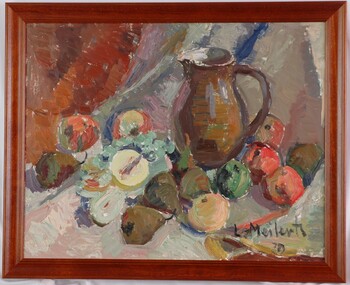
Painting, Ludmilla Meilerts, Still Life, 1970
... She worked as a nurse's aid and in a clothing factory to fund the further development of her artistic career achieving considerable early success with her colourful work encompassing portraiture, florals and city and landscapes. ...She worked as a nurse's aid and in a clothing factory to fund the further development of her artistic career achieving considerable early success with her colourful work encompassing portraiture, florals and city and landscapes. ...Ludmilla Meilerts, Oil On Board, Botanical Gardens, Circa 1970 Ludmilla Meilerts (1908 - 1997), Botanical Gardens, Melbourne, an impressive work painted with bold brushstrokes and a vivid colourful palette which typifies the artists work. Born in Riga,Latvia in 1908 - After displaying an early talent for art she studied at The Latvian Academy Of Fine Arts graduating in 1940. Later that year she married Otto Meilerts, an Economist, and they moved to Stuttgart, Germany to avoid living under Soviet occupation and then emigrated to Australia in 1948 settling in Melbourne. She worked as a nurse's aid and in a clothing factory to fund the further development of her artistic career achieving considerable early success with her colourful work encompassing portraiture, florals and city and landscapes. She particularly like painting dockland scenes. She was a member of The Victorian Artists Society (VAS) and The Melbourne Society Of Woman Painters And Sculptors. Major prizes include The Dunlop Prize in 1952, Gosford Art prize 1971, Camberwell 1973, VAS Purstitz Gold Medal 1982. She is represented in The State Galleries of Victoria, NSW, Tasmania and Western Australia as well as several regional Galleries. Still life of fruit and a jog. Painted in thick impasto paint, creating a very textured surface. Fruit is depicted in green, brown, apricot, pink and red. Background is abstract. Upper left background is brown, upper centre and right background is in shades of grey, blue and green, with some white. Brown wooden frame.Front: L Meilerts 70 (lower right, black paint)still life, female artists, women, women artists -
 Eltham District Historical Society Inc
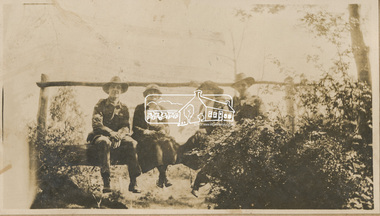
Photograph, "Resting, Eltham", 22 Oct 1919
... nurses Alice Broadhurst, McGeachy and Byrne and two patients of No. 16 AGH Macleod (Mont Park Military Hospital), Curry and Caffery to Eltham in spring 1919. Broadhurst's companions pose sitting on a log bridge. This photo is part of the Alice Broadhurst collection held by Yarra Plenty Regional Library, a series of 12 photo albums compiled by Alice Broadhurst (1896-1981), initially while working as a Voluntary Aid Detachment nurse with the Australian Red Cross at the Mont Park Military Hospital (No. 16 AGH) and subsequently as a nurse at the Royal Melbourne and Royal Women’s hospitals alongside many pioneering doctors of their fields....nurses Alice Broadhurst, McGeachy and Byrne and two patients of No. 16 AGH Macleod (Mont Park Military Hospital), Curry and Caffery to Eltham in spring 1919. Broadhurst's companions pose sitting on a log bridge. This photo is part of the Alice Broadhurst collection held by Yarra Plenty Regional Library, a series of 12 photo albums compiled by Alice Broadhurst (1896-1981), initially while working as a Voluntary Aid Detachment nurse with the Australian Red Cross at the Mont Park Military Hospital (No. 16 AGH) and subsequently as a nurse at the Royal Melbourne and Royal Women’s hospitals alongside many pioneering doctors of their fields. eltham alice elizabeth broadhurst byrne caffery curry mcgeachy nursing staff mont park 16 agh log bridge Digital file "Resting, Eltham" Photograph Photograph ...This photo depicts an outing of VAD nurses Alice Broadhurst, McGeachy and Byrne and two patients of No. 16 AGH Macleod (Mont Park Military Hospital), Curry and Caffery to Eltham in spring 1919. Broadhurst's companions pose sitting on a log bridge. This photo is part of the Alice Broadhurst collection held by Yarra Plenty Regional Library, a series of 12 photo albums compiled by Alice Broadhurst (1896-1981), initially while working as a Voluntary Aid Detachment nurse with the Australian Red Cross at the Mont Park Military Hospital (No. 16 AGH) and subsequently as a nurse at the Royal Melbourne and Royal Women’s hospitals alongside many pioneering doctors of their fields.Digital fileeltham, alice elizabeth broadhurst, byrne, caffery, curry, mcgeachy, nursing staff, mont park, 16 agh, log bridge -
 Eltham District Historical Society Inc
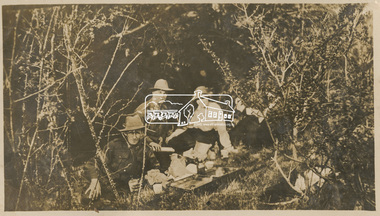
Photograph, Picnic at Eltham with Caffery, Curry, Byrne and McGeachy, 22 Oct 1919
... nurses Alice Broadhurst, McGeachy and Byrne and two patients of No. 16 AGH Macleod (Mont Park Military Hospital), Curry and Caffery to Eltham in spring 1919. Broadhurst's companions pose sitting on a creek bank around a open suitcase which containes their picnic spread. This photo is part of the Alice Broadhurst collection held by Yarra Plenty Regional Library, a series of 12 photo albums compiled by Alice Broadhurst (1896-1981), initially while working as a Voluntary Aid Detachment nurse with the Australian Red Cross at the Mont Park Military Hospital (No. 16 AGH) and subsequently as a nurse at the Royal Melbourne and Royal Women’s hospitals alongside many pioneering doctors of their fields....nurses Alice Broadhurst, McGeachy and Byrne and two patients of No. 16 AGH Macleod (Mont Park Military Hospital), Curry and Caffery to Eltham in spring 1919. Broadhurst's companions pose sitting on a creek bank around a open suitcase which containes their picnic spread. This photo is part of the Alice Broadhurst collection held by Yarra Plenty Regional Library, a series of 12 photo albums compiled by Alice Broadhurst (1896-1981), initially while working as a Voluntary Aid Detachment nurse with the Australian Red Cross at the Mont Park Military Hospital (No. 16 AGH) and subsequently as a nurse at the Royal Melbourne and Royal Women’s hospitals alongside many pioneering doctors of their fields. eltham alice elizabeth broadhurst byrne caffery curry mcgeachy nursing staff mont park 16 agh diamond creek picnic Digital file Picnic at Eltham with Caffery, Curry, Byrne and McGeachy Photograph Photograph ...This photo depicts an outing of VAD nurses Alice Broadhurst, McGeachy and Byrne and two patients of No. 16 AGH Macleod (Mont Park Military Hospital), Curry and Caffery to Eltham in spring 1919. Broadhurst's companions pose sitting on a creek bank around a open suitcase which containes their picnic spread. This photo is part of the Alice Broadhurst collection held by Yarra Plenty Regional Library, a series of 12 photo albums compiled by Alice Broadhurst (1896-1981), initially while working as a Voluntary Aid Detachment nurse with the Australian Red Cross at the Mont Park Military Hospital (No. 16 AGH) and subsequently as a nurse at the Royal Melbourne and Royal Women’s hospitals alongside many pioneering doctors of their fields.Digital fileeltham, alice elizabeth broadhurst, byrne, caffery, curry, mcgeachy, nursing staff, mont park, 16 agh, diamond creek, picnic -
 Eltham District Historical Society Inc
Photograph, "McGeachy, Curry, Byrne & Caffery with an old man who lives there at Eltham", 22 Oct 1919
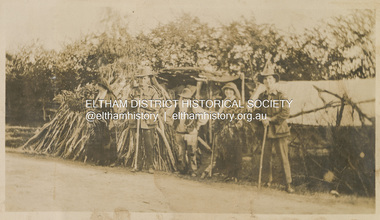
... nurses Alice Broadhurst, McGeachy and Byrne and two patients of No. 16 AGH Macleod (Mont Park Military Hospital), Curry and Caffery to Eltham in spring 1919. Broadhurst's companions pose with an old timer from Eltham on the roadside verge with a large collection of sticks stacked vertically outside a cottage. This photo is part of the Alice Broadhurst collection held by Yarra Plenty Regional Library, a series of 12 photo albums compiled by Alice Broadhurst (1896-1981), initially while working as a Voluntary Aid...nurses Alice Broadhurst, McGeachy and Byrne and two patients of No. 16 AGH Macleod (Mont Park Military Hospital), Curry and Caffery to Eltham in spring 1919. Broadhurst's companions pose with an old timer from Eltham on the roadside verge with a large collection of sticks stacked vertically outside a cottage. This photo is part of the Alice Broadhurst collection held by Yarra Plenty Regional Library, a series of 12 photo albums compiled by Alice Broadhurst (1896-1981), initially while working as a Voluntary Aid ...This photo depicts an outing of VAD nurses Alice Broadhurst, McGeachy and Byrne and two patients of No. 16 AGH Macleod (Mont Park Military Hospital), Curry and Caffery to Eltham in spring 1919. Broadhurst's companions pose with an old timer from Eltham on the roadside verge with a large collection of sticks stacked vertically outside a cottage. This photo is part of the Alice Broadhurst collection held by Yarra Plenty Regional Library, a series of 12 photo albums compiled by Alice Broadhurst (1896-1981), initially while working as a Voluntary Aid Detachment nurse with the Australian Red Cross at the Mont Park Military Hospital (No. 16 AGH) and subsequently as a nurse at the Royal Melbourne and Royal Women’s hospitals alongside many pioneering doctors of their fields.Digital file"McGeachy, Curry, Byrne & Caffery with an old man who lives there at Eltham"eltham, alice elizabeth broadhurst, byrne, caffery, curry, mcgeachy, nursing staff, mont park, 16 agh, old timer, pioneer, cottage, wood pile -
 Eltham District Historical Society Inc
Photograph, "Same group with self instead of Byrne, Eltham", 22 Oct 1919
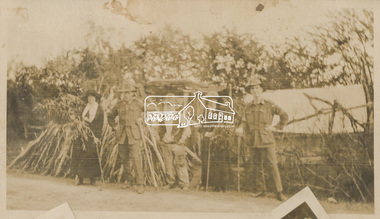
... nurses Alice Broadhurst, McGeachy and Byrne and two patients of No. 16 AGH Macleod (Mont Park Military Hospital), Curry and Caffery to Eltham in spring 1919. Broadhurst's companions pose with an old timer from Eltham on the roadside verge with a large collection of sticks stacked vertically outside a cottage. This photo is part of the Alice Broadhurst collection held by Yarra Plenty Regional Library, a series of 12 photo albums compiled by Alice Broadhurst (1896-1981), initially while working as a Voluntary Aid...nurses Alice Broadhurst, McGeachy and Byrne and two patients of No. 16 AGH Macleod (Mont Park Military Hospital), Curry and Caffery to Eltham in spring 1919. Broadhurst's companions pose with an old timer from Eltham on the roadside verge with a large collection of sticks stacked vertically outside a cottage. This photo is part of the Alice Broadhurst collection held by Yarra Plenty Regional Library, a series of 12 photo albums compiled by Alice Broadhurst (1896-1981), initially while working as a Voluntary Aid ...This photo depicts an outing of VAD nurses Alice Broadhurst, McGeachy and Byrne and two patients of No. 16 AGH Macleod (Mont Park Military Hospital), Curry and Caffery to Eltham in spring 1919. Broadhurst's companions pose with an old timer from Eltham on the roadside verge with a large collection of sticks stacked vertically outside a cottage. This photo is part of the Alice Broadhurst collection held by Yarra Plenty Regional Library, a series of 12 photo albums compiled by Alice Broadhurst (1896-1981), initially while working as a Voluntary Aid Detachment nurse with the Australian Red Cross at the Mont Park Military Hospital (No. 16 AGH) and subsequently as a nurse at the Royal Melbourne and Royal Women’s hospitals alongside many pioneering doctors of their fields.Digital file"Same group with self instead of Byrne, Eltham, Oct 22"eltham, alice elizabeth broadhurst, byrne, caffery, curry, mcgeachy, nursing staff, mont park, 16 agh, old timer, pioneer, cottage, wood pile -
 Eltham District Historical Society Inc
Photograph, "Curry, Byrne, McGeachy & self on rustic bridge, Eltham", 22 Oct 1919
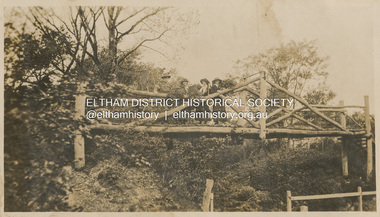
... This photo is part of the Alice Broadhurst collection held by Yarra Plenty Regional Library, a series of 12 photo albums compiled by Alice Broadhurst (1896-1981), initially while working as a Voluntary Aid Detachment nurse with the Australian Red Cross at the Mont Park Military Hospital (No. 16 AGH) and subsequently as a nurse at the Royal Melbourne and Royal Women’s hospitals alongside many pioneering doctors of their fields. ...This photo is part of the Alice Broadhurst collection held by Yarra Plenty Regional Library, a series of 12 photo albums compiled by Alice Broadhurst (1896-1981), initially while working as a Voluntary Aid Detachment nurse with the Australian Red Cross at the Mont Park Military Hospital (No. 16 AGH) and subsequently as a nurse at the Royal Melbourne and Royal Women’s hospitals alongside many pioneering doctors of their fields. ...The old Diamond Street bridge in Eltham had a raised section seen here and a lower section, the railings of which can just be seen. The upper pedestrian crossing provided continual access for foot traffic during times of flood. This photo is part of the Alice Broadhurst collection held by Yarra Plenty Regional Library, a series of 12 photo albums compiled by Alice Broadhurst (1896-1981), initially while working as a Voluntary Aid Detachment nurse with the Australian Red Cross at the Mont Park Military Hospital (No. 16 AGH) and subsequently as a nurse at the Royal Melbourne and Royal Women’s hospitals alongside many pioneering doctors of their fields. This photo depicts an outing with fellow VAD nurses McGeachy and Byrne and two patients of Mont Park, Curry and Caffery to Eltham in spring 1919 Digital file"Curry, Byrne, McGeachy & self on rustic bridge, Eltham, Oct 22, 1919"eltham, diamond creek, diamond street bridge, alice elizabeth broadhurst, byrne, caffery, curry, mcgeachy, nursing staff, mont park, 16 agh -
 Federation University Historical Collection
Photograph, VADs, a Nurse, and Soldiers at Highton, c1917
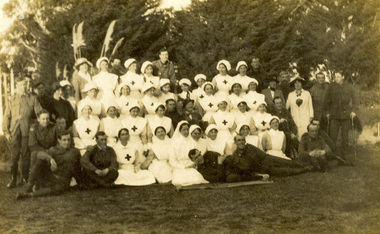
... ...voluntary aid detachment...nurse...(http://www.awm.gov.au/encyclopedia/vad/, accessed 13 August 2014) chatham family archive chatham holmes world war world war 1 world war i world war one highton red cross vad voluntary aid detachment nurse nursing Verso: 'group of nurses and some of the men at Highton - taken at an afternoon we had. ...The primary role of a Voluntary Aid Detachment (VAD) member was that of nursing orderly in hospitals, carrying out menial but essential tasks - scrubbing floors, sweeping, dusting and cleaning bathrooms and other areas, dealing with bedpans, and washing patients. They were not employed in military hospitals, except as ward and pantry maids; rather, they worked in Red Cross convalescent and rest homes, canteens, and on troop trains. At the start of the First World War, Australian VADs were restricted from travelling overseas by the Defence Council. As a result, many chose to travel on their own initiative and join British detachments, often in Australian Hospitals. It is reported that the 1st Australian Auxiliary Hospital included in their nursing staff some 120 VADs, chiefly Australians in the British service, employed through the Australian Red Cross Society. This policy was changed in 1916 after a request from Great Britain, and the first detachment of thirty official Australian VADs to serve overseas left Australia in September 1916.(http://www.awm.gov.au/encyclopedia/vad/, accessed 13 August 2014)A group of VADs, a nurse, and some men from the Australian Imperial Forces. Verso: 'group of nurses and some of the men at Highton - taken at an afternoon we had. Can you find me [Harold Holmes] it is not very clear. The 2nd in uniform from the right hand side.chatham family archive, chatham, holmes, world war, world war 1, world war i, world war one, highton, red cross, vad, voluntary aid detachment, nurse, nursing -
 Federation University Historical Collection
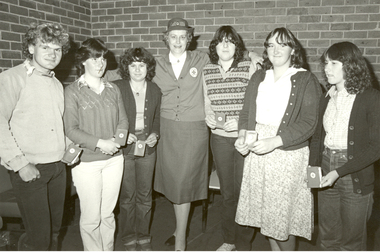
Pamphlet - Nursing, Ballarat School of Mines Nurses Aid Pre-employment Program
... nursing nurses aid Kate Beanland Ballarat School of Mines Ballarat School of Mines Nurses Aid Pre-employment Program Pamphlet Nursing ...nursing, nurses aid, kate beanland, ballarat school of mines -
 Ringwood and District Historical Society
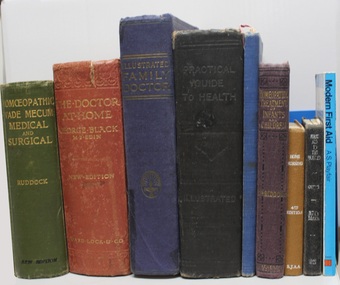
Book, Collection of nine medical books 1900-1935 belonging to Nurse Maggs and descendants (1973), of Ringwood, Victoria
... Nurse Maggs 1909 2. The Doctor at Home Ed. by George Black Presented from friend to Mrs. A Maggs 12-12-1909 3. Illustrated Family Doctor 1935 4.The Practical Guide to Health Frederick Rossiter 5. Johnson and Johnson's First Aid...Aid A.S. PLayfair 1973 Collection of nine medical books 1900-1935 belonging to Nurse Maggs and descendants (1973), of Ringwood, Victoria. ...Nurse Marianne Maggs undertook medical care and midwifery from 1900 - 1926 and delivered more than 500 babies. She was presented with a "wireless" in 1926 in appreciation for her services to the community. She sold her Ringwood house and moved to Mitcham. 10 medical books from 1909 to 1935 1 . Homeopathic Vade Mecum Medical and Surgical by E.H.Ruddock M.D. Xmas gift from G Smith to Nurse Maggs 1909 2. The Doctor at Home Ed. by George Black Presented from friend to Mrs. A Maggs 12-12-1909 3. Illustrated Family Doctor 1935 4.The Practical Guide to Health Frederick Rossiter 5. Johnson and Johnson's First Aid Manual 1909, including booklet - Accidents in the Home 6. Diseases of Infants and Children and their Homeopathic Treatment Dr. Ruddock 1910, including lock of (child's?) hair. 7. Home Nursing St. John's Ambulance 1939 8. First Aid to the Injured 1921 (2 copies) 9. Modern First Aid A.S. PLayfair 1973 -
 Flagstaff Hill Maritime Museum and Village
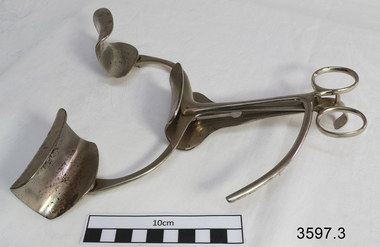
Equipment - Retractor
... They aid in holding back underlying organs or tissues, allowing doctors/nurses better visibility and access to the exposed area. ...They aid in holding back underlying organs or tissues, allowing doctors/nurses better visibility and access to the exposed area. ...Surgical retractors help surgeons and operating room professionals hold an incision or wound open during surgical procedures. They aid in holding back underlying organs or tissues, allowing doctors/nurses better visibility and access to the exposed area. The right retractor and medical device lighting will bring comfort and light directly into the surgical cavity where it is needed. Retractors play a crucial role in surgery. Today they come in different sizes, shapes and designs. Surgical retractor lighting could allow surgeons to better navigate in deep or minimally-open cavities. Better visibility during and at the end of surgery is beneficial to both the surgical team and patient. Surgical retractors are not all created equal and choosing the right one is important. There are two broad categories of retractors: 1. Hand Retractors - (Manual) must be held by an assistant, a robot or the surgeon during a procedure. 2. Self Retaining Retractors - (Stay open on their own) have a screw, ratchet or some type of clamp to hold the tissue by itself. These allow the surgeon with two free hands. Retractors fall under the "Retracting and Exposing" instruments used in the operating room. The various types of retractors are usually named after the organ which they are used in conjunction with. For example, retractors which are used to retract an abdomen, are called abdominal retractors or self retaining abdominal retractors. If it's your skin being handled, there are specific skin retractors. Retracting instruments, retract and expose, for exposure to a surgical site. The main goal is to not necessarily reduce the number of assistants in the operating room but to provide better exposure and safety for the patient. This retractor was donated to Flagstaff Hill Maritime Village by the family of Doctor William Roy Angus, Surgeon and Oculist. It is part of the “W.R. Angus Collection” that includes historical medical equipment, surgical instruments and material once belonging to Dr Edward Ryan and Dr Thomas Francis Ryan, (both of Nhill, Victoria) as well as Dr Angus’ own belongings. The Collection’s history spans the medical practices of the two Doctors Ryan, from 1885-1926 plus that of Dr Angus, up until 1969. ABOUT THE “W.R.ANGUS COLLECTION” Doctor William Roy Angus M.B., B.S., Adel., 1923, F.R.C.S. Edin.,1928 (also known as Dr Roy Angus) was born in Murrumbeena, Victoria in 1901 and lived until 1970. He qualified as a doctor in 1923 at University of Adelaide, was Resident Medical Officer at the Royal Adelaide Hospital in 1924 and for a period was house surgeon to Sir (then Mr.) Henry Simpson Newland. Dr Angus was briefly an Assistant to Dr Riddell of Kapunda, then commenced private practice at Curramulka, Yorke Peninsula, SA, where he was physician, surgeon and chemist. In 1926, he was appointed as new Medical Assistant to Dr Thomas Francis Ryan (T.F. Ryan, or Tom), in Nhill, Victoria, where his experiences included radiology and pharmacy. In 1927 he was Acting House Surgeon in Dr Tom Ryan’s absence. Dr Angus had become engaged to Gladys Forsyth and they decided he would take time to further his studies overseas in the UK in 1927. He studied at London University College Hospital and at Edinburgh Royal Infirmary and in 1928, was awarded FRCS (Fellow from the Royal College of Surgeons), Edinburgh. He worked his passage back to Australia as a Ship’s Surgeon on the on the Australian Commonwealth Line’s T.S.S. Largs Bay. Dr Angus married Gladys in 1929, in Ballarat. (They went on to have one son (Graham 1932, born in SA) and two daughters (Helen (died 12/07/1996) and Berenice (Berry), both born at Mira, Nhill ) Dr Angus was a ‘flying doctor’ for the A.I.M. (Australian Inland Ministry) Aerial Medical Service in 1928 . The organisation began in South Australia through the Presbyterian Church in that year, with its first station being in the remote town of Oodnadatta, where Dr Angus was stationed. He was locum tenens there on North-South Railway at 21 Mile Camp. He took up this ‘flying doctor’ position in response to a call from Dr John Flynn; the organisation was later known as the Flying Doctor Service, then the Royal Flying Doctor Service. A lot of his work during this time involved dental surgery also. Between 1928-1932 he was surgeon at the Curramulka Hospital, Yorke Peninsula, South Australia. In 1933 Dr Angus returned to Nhill where he’d previously worked as Medical Assistant and purchased a share of the Nelson Street practice and Mira hospital from Dr Les Middleton one of the Middleton Brothers, the current owners of what was once Dr Tom Ryan’s practice. Dr L Middleton was House Surgeon to the Nhill Hospital 1926-1933, when he resigned. [Dr Tom Ryan’s practice had originally belonged to his older brother Dr Edward Ryan, who came to Nhill in 1885. Dr Edward saw patients at his rooms, firstly in Victoria Street and in 1886 in Nelson Street, until 1901. The Nelson Street practice also had a 2 bed ward, called Mira Private Hospital ). Dr Edward Ryan was House Surgeon at the Nhill Hospital 1884-1902 . He also had occasions where he successfully performed veterinary surgery for the local farmers too. Dr Tom Ryan then purchased the practice from his brother in 1901. Both Dr Edward and Dr Tom Ryan work as surgeons included eye surgery. Dr Tom Ryan performed many of his operations in the Mira private hospital on his premises. He too was House Surgeon at the Nhill Hospital 1902-1926. Dr Tom Ryan had one of the only two pieces of radiology equipment in Victoria during his practicing years – The Royal Melbourne Hospital had the other one. Over the years Dr Tom Ryan gradually set up what was effectively a training school for country general-practitioner-surgeons. Each patient was carefully examined, including using the X-ray machine, and any surgery was discussed and planned with Dr Ryan’s assistants several days in advance. Dr Angus gained experience in using the X-ray machine there during his time as assistant to Dr Ryan. Dr Tom Ryan moved from Nhill in 1926. He became a Fellow of the Royal Australasian College of Surgeons in 1927, soon after its formation, a rare accolade for a doctor outside any of the major cities. He remained a bachelor and died suddenly on 7th Dec 1955, aged 91, at his home in Ararat. Scholarships and prizes are still awarded to medical students in the honour of Dr T.F. Ryan and his father, Dr Michael Ryan, and brother, John Patrick Ryan. ] When Dr Angus bought into the Nelson Street premises in Nhill he was also appointed as the Nhill Hospital’s Honorary House Surgeon 1933-1938. His practitioner’s plate from his Nhill surgery states “HOURS Daily, except Tuesdays, Fridays and Saturday afternoons, 9-10am, 2-4pm, 7-8pm. Sundays by appointment”. This plate is now mounted on the doorway to the Port Medical Office at Flagstaff Hill Maritime Village, Warrnambool. Dr Edward Ryan and Dr Tom Ryan had an extensive collection of historical medical equipment and materials spanning 1884-1926 and when Dr Angus took up practice in their old premises he obtained this collection, a large part of which is now on display at the Port Medical Office at Flagstaff Hill Maritime Village in Warrnambool. During his time in Nhill Dr Angus was involved in the merging of the Mira Hospital and Nhill Public Hospital into one public hospital and the property titles passed on to Nhill Hospital in 1939. In 1939 Dr Angus and his family moved to Warrnambool where he purchased “Birchwood,” the 1852 home and medical practice of Dr John Hunter Henderson, at 214 Koroit Street. (This property was sold in1965 to the State Government and is now the site of the Warrnambool Police Station. ). The Angus family was able to afford gardeners, cooks and maids; their home was a popular place for visiting dignitaries to stay whilst visiting Warrnambool. Dr Angus had his own silk worm farm at home in a Mulberry tree. His young daughter used his centrifuge for spinning the silk. Dr Angus was appointed on a part-time basis as Port Medical Officer (Health Officer) in Warrnambool and held this position until the 1940’s when the government no longer required the service of a Port Medical Officer in Warrnambool; he was thus Warrnambool’s last serving Port Medical Officer. (The duties of a Port Medical Officer were outlined by the Colonial Secretary on 21st June, 1839 under the terms of the Quarantine Act. Masters of immigrant ships arriving in port reported incidents of diseases, illness and death and the Port Medical Officer made a decision on whether the ship required Quarantine and for how long, in this way preventing contagious illness from spreading from new immigrants to the residents already in the colony.) Dr Angus was a member of the Australian Medical Association, for 35 years and surgeon at the Warrnambool Base Hospital 1939-1942, He served as a Surgeon Captain during WWII1942-45, in Ballarat, Victoria, and in Bonegilla, N.S.W., completing his service just before the end of the war due to suffering from a heart attack. During his convalescence he carved an intricate and ‘most artistic’ chess set from the material that dentures were made from. He then studied ophthalmology at the Royal Melbourne Eye and Ear Hospital and created cosmetically superior artificial eyes by pioneering using the intrascleral cartilage. Angus received accolades from the Ophthalmological Society of Australasia for this work. He returned to Warrnambool to commence practice as an ophthalmologist, pioneering in artificial eye improvements. He was Honorary Consultant Ophthalmologist to Warrnambool Base Hospital for 31 years. He made monthly visits to Portland as a visiting surgeon, to perform eye surgery. He represented the Victorian South-West subdivision of the Australian Medical Association as its secretary between 1949 and 1956 and as chairman from 1956 to 1958. In 1968 Dr Angus was elected member of Spain’s Barraquer Institute of Barcelona after his research work in Intrasclearal cartilage grafting, becoming one of the few Australian ophthalmologists to receive this honour, and in the following year presented his final paper on Living Intrasclearal Cartilage Implants at the Inaugural Meeting of the Australian College of Ophthalmologists in Melbourne In his personal life Dr Angus was a Presbyterian and treated Sunday as a Sabbath, a day of rest. He would visit 3 or 4 country patients on a Sunday, taking his children along ‘for the ride’ and to visit with him. Sunday evenings he would play the pianola and sing Scottish songs to his family. One of Dr Angus’ patients was Margaret MacKenzie, author of a book on local shipwrecks that she’d seen as an eye witness from the late 1880’s in Peterborough, Victoria. In the early 1950’s Dr Angus, painted a picture of a shipwreck for the cover jacket of Margaret’s book, Shipwrecks and More Shipwrecks. She was blind in later life and her daughter wrote the actual book for her. Dr Angus and his wife Gladys were very involved in Warrnambool’s society with a strong interest in civic affairs. Their interests included organisations such as Red Cross, Rostrum, Warrnambool and District Historical Society (founding members), Wine and Food Society, Steering Committee for Tertiary Education in Warrnambool, Local National Trust, Good Neighbour Council, Housing Commission Advisory Board, United Services Institute, Legion of Ex-Servicemen, Olympic Pool Committee, Food for Britain Organisation, Warrnambool Hospital, Anti-Cancer Council, Boys’ Club, Charitable Council, National Fitness Council and Air Raid Precautions Group. He was also a member of the Steam Preservation Society and derived much pleasure from a steam traction engine on his farm. He had an interest in people and the community He and his wife Gladys were both involved in the creation of Flagstaff Hill, including the layout of the gardens. After his death (28th March 1970) his family requested his practitioner’s plate, medical instruments and some personal belongings be displayed in the Port Medical Office surgery at Flagstaff Hill Maritime Village, and be called the “W. R. Angus Collection”. The abdominal retractor is very much an essential tool in surgery today. The W.R. Angus Collection is significant for still being located at the site it is connected with, Doctor Angus being the last Port Medical Officer in Warrnambool. The collection of medical instruments and other equipment is culturally significant, being an historical example of medicine from late 19th to mid-20th century. Dr Angus assisted Dr Tom Ryan, a pioneer in the use of X-rays and in ocular surgery. Retractor from the W.R. Angus Collection. Stainless Steel, Richard-Begouin's abdominal retractor. Swivel pieces at end of arms are detatchable. Noneflagstaff hill, warrnambool, shipwrecked coast, flagstaff hill maritime museum, maritime museum, shipwreck coast, flagstaff hill maritime village, great ocean road, dr w r angus, dr ryan, medical equipment, surgical instrument, warrnambool base hospital, nhill base hospital, mira hospital, flying doctor, medical history, retractors, richard begouin, abdominal surgery -
 Flagstaff Hill Maritime Museum and Village
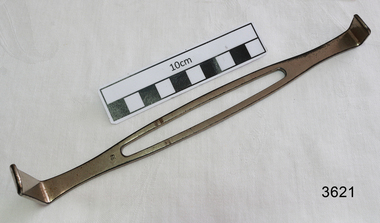
Equipment - Surgical Retractor, Late 19th century
... They aid in holding back underlying organs or tissues, allowing doctors/nurses better visibility and access to the exposed area. ...They aid in holding back underlying organs or tissues, allowing doctors/nurses better visibility and access to the exposed area. ...Surgical retractors help surgeons and operating room professionals hold an incision or wound open during surgical procedures. They aid in holding back underlying organs or tissues, allowing doctors/nurses better visibility and access to the exposed area. The right retractor and medical device lighting will bring comfort and light directly into the surgical cavity where it is needed. Retractors play a crucial role in surgery. Today they come in different sizes, shapes and designs. Surgical retractor lighting could allow surgeons to better navigate in deep or minimally-open cavities. Better visibility during and at the end of surgery is beneficial to both the surgical team and patient. Surgical retractors are not all created equal and choosing the right one is important. There are two broad categories of retractors: 1. Hand Retractors - (Manual) must be held by an assistant, a robot or the surgeon during a procedure. 2. Self Retaining Retractors - (Stay open on their own) have a screw, ratchet or some type of clamp to hold the tissue by itself. These allow the surgeon with two free hands. Retractors fall under the "Retracting and Exposing" instruments used in the operating room. The various types of retractors are usually named after the organ which they are used in conjunction with. For example, retractors which are used to retract an abdomen, are called abdominal retractors or self retaining abdominal retractors. If it's your skin being handled, there are specific skin retractors. Retracting instruments, retract and expose, for exposure to a surgical site. The main goal is to not necessarily reduce the number of assistants in the operating room but to provide better exposure and safety for the patient. This surgical retractor attachment was donated to Flagstaff Hill Maritime Village by the family of Doctor William Roy Angus, Surgeon and Oculist. It is part of the “W.R. Angus Collection” that includes historical medical equipment, surgical instruments and material once belonging to Dr Edward Ryan and Dr Thomas Francis Ryan, (both of Nhill, Victoria) as well as Dr Angus’ own belongings. The Collection’s history spans the medical practices of the two Doctors Ryan, from 1885-1926 plus that of Dr Angus, up until 1969. ABOUT THE “W.R.ANGUS COLLECTION” Doctor William Roy Angus M.B., B.S., Adel., 1923, F.R.C.S. Edin.,1928 (also known as Dr Roy Angus) was born in Murrumbeena, Victoria in 1901 and lived until 1970. He qualified as a doctor in 1923 at University of Adelaide, was Resident Medical Officer at the Royal Adelaide Hospital in 1924 and for a period was house surgeon to Sir (then Mr.) Henry Simpson Newland. Dr Angus was briefly an Assistant to Dr Riddell of Kapunda, then commenced private practice at Curramulka, Yorke Peninsula, SA, where he was physician, surgeon and chemist. In 1926, he was appointed as new Medical Assistant to Dr Thomas Francis Ryan (T.F. Ryan, or Tom), in Nhill, Victoria, where his experiences included radiology and pharmacy. In 1927 he was Acting House Surgeon in Dr Tom Ryan’s absence. Dr Angus had become engaged to Gladys Forsyth and they decided he would take time to further his studies overseas in the UK in 1927. He studied at London University College Hospital and at Edinburgh Royal Infirmary and in 1928, was awarded FRCS (Fellow from the Royal College of Surgeons), Edinburgh. He worked his passage back to Australia as a Ship’s Surgeon on the on the Australian Commonwealth Line’s T.S.S. Largs Bay. Dr Angus married Gladys in 1929, in Ballarat. (They went on to have one son (Graham 1932, born in SA) and two daughters (Helen (died 12/07/1996) and Berenice (Berry), both born at Mira, Nhill ) Dr Angus was a ‘flying doctor’ for the A.I.M. (Australian Inland Ministry) Aerial Medical Service in 1928 . The organisation began in South Australia through the Presbyterian Church in that year, with its first station being in the remote town of Oodnadatta, where Dr Angus was stationed. He was locum tenens there on North-South Railway at 21 Mile Camp. He took up this ‘flying doctor’ position in response to a call from Dr John Flynn; the organisation was later known as the Flying Doctor Service, then the Royal Flying Doctor Service. A lot of his work during this time involved dental surgery also. Between 1928-1932 he was surgeon at the Curramulka Hospital, Yorke Peninsula, South Australia. In 1933 Dr Angus returned to Nhill where he’d previously worked as Medical Assistant and purchased a share of the Nelson Street practice and Mira hospital from Dr Les Middleton one of the Middleton Brothers, the current owners of what was once Dr Tom Ryan’s practice. Dr L Middleton was House Surgeon to the Nhill Hospital 1926-1933, when he resigned. [Dr Tom Ryan’s practice had originally belonged to his older brother Dr Edward Ryan, who came to Nhill in 1885. Dr Edward saw patients at his rooms, firstly in Victoria Street and in 1886 in Nelson Street, until 1901. The Nelson Street practice also had a 2 bed ward, called Mira Private Hospital ). Dr Edward Ryan was House Surgeon at the Nhill Hospital 1884-1902 . He also had occasions where he successfully performed veterinary surgery for the local farmers too. Dr Tom Ryan then purchased the practice from his brother in 1901. Both Dr Edward and Dr Tom Ryan work as surgeons included eye surgery. Dr Tom Ryan performed many of his operations in the Mira private hospital on his premises. He too was House Surgeon at the Nhill Hospital 1902-1926. Dr Tom Ryan had one of the only two pieces of radiology equipment in Victoria during his practicing years – The Royal Melbourne Hospital had the other one. Over the years Dr Tom Ryan gradually set up what was effectively a training school for country general-practitioner-surgeons. Each patient was carefully examined, including using the X-ray machine, and any surgery was discussed and planned with Dr Ryan’s assistants several days in advance. Dr Angus gained experience in using the X-ray machine there during his time as assistant to Dr Ryan. Dr Tom Ryan moved from Nhill in 1926. He became a Fellow of the Royal Australasian College of Surgeons in 1927, soon after its formation, a rare accolade for a doctor outside any of the major cities. He remained a bachelor and died suddenly on 7th Dec 1955, aged 91, at his home in Ararat. Scholarships and prizes are still awarded to medical students in the honour of Dr T.F. Ryan and his father, Dr Michael Ryan, and brother, John Patrick Ryan. ] When Dr Angus bought into the Nelson Street premises in Nhill he was also appointed as the Nhill Hospital’s Honorary House Surgeon 1933-1938. His practitioner’s plate from his Nhill surgery states “HOURS Daily, except Tuesdays, Fridays and Saturday afternoons, 9-10am, 2-4pm, 7-8pm. Sundays by appointment”. This plate is now mounted on the doorway to the Port Medical Office at Flagstaff Hill Maritime Village, Warrnambool. Dr Edward Ryan and Dr Tom Ryan had an extensive collection of historical medical equipment and materials spanning 1884-1926 and when Dr Angus took up practice in their old premises he obtained this collection, a large part of which is now on display at the Port Medical Office at Flagstaff Hill Maritime Village in Warrnambool. During his time in Nhill Dr Angus was involved in the merging of the Mira Hospital and Nhill Public Hospital into one public hospital and the property titles passed on to Nhill Hospital in 1939. In 1939 Dr Angus and his family moved to Warrnambool where he purchased “Birchwood,” the 1852 home and medical practice of Dr John Hunter Henderson, at 214 Koroit Street. (This property was sold in1965 to the State Government and is now the site of the Warrnambool Police Station. ). The Angus family was able to afford gardeners, cooks and maids; their home was a popular place for visiting dignitaries to stay whilst visiting Warrnambool. Dr Angus had his own silk worm farm at home in a Mulberry tree. His young daughter used his centrifuge for spinning the silk. Dr Angus was appointed on a part-time basis as Port Medical Officer (Health Officer) in Warrnambool and held this position until the 1940’s when the government no longer required the service of a Port Medical Officer in Warrnambool; he was thus Warrnambool’s last serving Port Medical Officer. (The duties of a Port Medical Officer were outlined by the Colonial Secretary on 21st June, 1839 under the terms of the Quarantine Act. Masters of immigrant ships arriving in port reported incidents of diseases, illness and death and the Port Medical Officer made a decision on whether the ship required Quarantine and for how long, in this way preventing contagious illness from spreading from new immigrants to the residents already in the colony.) Dr Angus was a member of the Australian Medical Association, for 35 years and surgeon at the Warrnambool Base Hospital 1939-1942, He served as a Surgeon Captain during WWII1942-45, in Ballarat, Victoria, and in Bonegilla, N.S.W., completing his service just before the end of the war due to suffering from a heart attack. During his convalescence he carved an intricate and ‘most artistic’ chess set from the material that dentures were made from. He then studied ophthalmology at the Royal Melbourne Eye and Ear Hospital and created cosmetically superior artificial eyes by pioneering using the intrascleral cartilage. Angus received accolades from the Ophthalmological Society of Australasia for this work. He returned to Warrnambool to commence practice as an ophthalmologist, pioneering in artificial eye improvements. He was Honorary Consultant Ophthalmologist to Warrnambool Base Hospital for 31 years. He made monthly visits to Portland as a visiting surgeon, to perform eye surgery. He represented the Victorian South-West subdivision of the Australian Medical Association as its secretary between 1949 and 1956 and as chairman from 1956 to 1958. In 1968 Dr Angus was elected member of Spain’s Barraquer Institute of Barcelona after his research work in Intrasclearal cartilage grafting, becoming one of the few Australian ophthalmologists to receive this honour, and in the following year presented his final paper on Living Intrasclearal Cartilage Implants at the Inaugural Meeting of the Australian College of Ophthalmologists in Melbourne In his personal life Dr Angus was a Presbyterian and treated Sunday as a Sabbath, a day of rest. He would visit 3 or 4 country patients on a Sunday, taking his children along ‘for the ride’ and to visit with him. Sunday evenings he would play the pianola and sing Scottish songs to his family. One of Dr Angus’ patients was Margaret MacKenzie, author of a book on local shipwrecks that she’d seen as an eye witness from the late 1880’s in Peterborough, Victoria. In the early 1950’s Dr Angus, painted a picture of a shipwreck for the cover jacket of Margaret’s book, Shipwrecks and More Shipwrecks. She was blind in later life and her daughter wrote the actual book for her. Dr Angus and his wife Gladys were very involved in Warrnambool’s society with a strong interest in civic affairs. Their interests included organisations such as Red Cross, Rostrum, Warrnambool and District Historical Society (founding members), Wine and Food Society, Steering Committee for Tertiary Education in Warrnambool, Local National Trust, Good Neighbour Council, Housing Commission Advisory Board, United Services Institute, Legion of Ex-Servicemen, Olympic Pool Committee, Food for Britain Organisation, Warrnambool Hospital, Anti-Cancer Council, Boys’ Club, Charitable Council, National Fitness Council and Air Raid Precautions Group. He was also a member of the Steam Preservation Society and derived much pleasure from a steam traction engine on his farm. He had an interest in people and the community He and his wife Gladys were both involved in the creation of Flagstaff Hill, including the layout of the gardens. After his death (28th March 1970) his family requested his practitioner’s plate, medical instruments and some personal belongings be displayed in the Port Medical Office surgery at Flagstaff Hill Maritime Village, and be called the “W. R. Angus Collection”. The surgical retractor is very much an essential tool in surgery today. The W.R. Angus Collection is significant for still being located at the site it is connected with, Doctor Angus being the last Port Medical Officer in Warrnambool. The collection of medical instruments and other equipment is culturally significant, being an historical example of medicine from late 19th to mid-20th century. Dr Angus assisted Dr Tom Ryan, a pioneer in the use of X-rays and in ocular surgery. Surgical retractor attachment, from the W.R. Angus Collection, for abdominal use. Long handle, U shaped ends. Inscribed "R" on each side. Inscribed "R" on each side. flagstaff hill, warrnambool, shipwrecked coast, flagstaff hill maritime museum, maritime museum, shipwreck coast, flagstaff hill maritime village, great ocean road, dr w r angus, dr ryan, surgical instrument, t.s.s. largs bay, warrnambool base hospital, nhill base hospital, mira hospital, medical treatment, surgery, surgical retractor -
 Heidelberg Repatriation Hospital
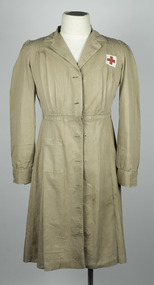
Uniform - VAD Dress and scarf, 1941
... Over time the position evolved into one of a Nursing Aide. uniform nurses world war ii Label reads: NF 480571 RIXON G. Scarf label reads: V.383-1944 / MADE IN AUSTRALIA Voluntary Aid Detachment long sleeve cotton dress and fine sewn scarf, both with red cross emblem. ...Worn by nursing staff during World War II.A nursing group than came into being during the War. Over time the position evolved into one of a Nursing Aide.Voluntary Aid Detachment long sleeve cotton dress and fine sewn scarf, both with red cross emblem.Label reads: NF 480571 RIXON G. Scarf label reads: V.383-1944 / MADE IN AUSTRALIAuniform, nurses, world war ii -
 Heidelberg Repatriation Hospital
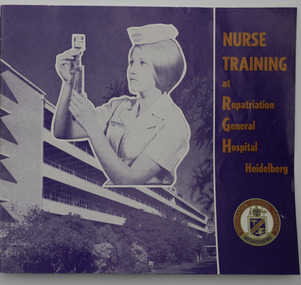
Booklet, Nurse Training At Repatriation General Hospital, Heidelberg, c. 1971
... Produced as an aid to recruitment and nurse training....Produced as an aid to recruitment and nurse training. Nursing Training Education Promotional printed booklet with black and white photo of a nurse and hospital on cover. ...Produced as an aid to recruitment and nurse training.Promotional printed booklet with black and white photo of a nurse and hospital on cover.nursing, training, education -
 Eltham District Historical Society Inc
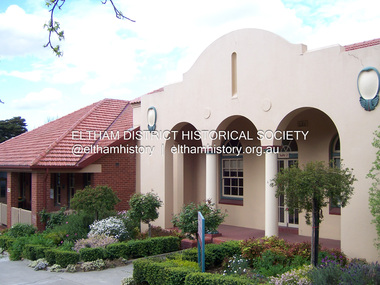
Photograph - Digital Photograph, Marguerite Marshall, Sutherland Home for Children, Diamond Creek, 27 September 2007
... nurse and led the establishment of a public hospital at Masterton. In 1881, while holidaying in Melbourne, Sutherland was so touched by seeing young people living under Princes Bridge, that this determined her future work. Meanwhile Sutherland instigated the Melbourne District Nursing Society, (now Royal District Nursing Service). She also led the founding of The Victorian Neglected Children’s Aid...nurse and led the establishment of a public hospital at Masterton. In 1881, while holidaying in Melbourne, Sutherland was so touched by seeing young people living under Princes Bridge, that this determined her future work. Meanwhile Sutherland instigated the Melbourne District Nursing Society, (now Royal District Nursing Service). She also led the founding of The Victorian Neglected Children’s Aid ...The Sutherland Homes for Children on Yan Yean Road, Diamond Creek cared for thousands of children from when it was opened in 1912. The site closed for this purpose in 1991 and was sold and later developed for commercial and office purposes. Covered under Heritage Overlay, Nillumbik Planning Scheme. Published: Nillumbik Now and Then / Marguerite Marshall 2008; photographs Alan King with Marguerite Marshall.; p107 The Sutherland Homes for Children at 14 Yan Yean Road, Diamond Creek, cared for thousands of children since they opened in 1912, after beginning at La Trobe Street, Melbourne in 1908. In 1994 Sutherland Homes (then called Sutherland Child, Youth and Family Services) amalgamated with Berry Street Child and Family Welfare. Together as Berry Street Victoria, they formed Victoria’s largest independent provider of support and accommodation services for children, young people and families in crisis.1 However with the move from institutional to community care, the Diamond Creek site had not been used since 1991 and was sold to private purchasers in 1999. More than 2000 former residents, staff, neighbours and friends attended a farewell in February, 2000.2 The Sutherland Homes red-brick and stuccoed building in Diamond Creek (a rare design in the Eltham Shire), was opened in 1929 by Lord Somers, the Governor of Victoria. Destitute children lived in dormitories bathed in natural light through large windows. However in 1958 as the cottage–parent system replaced the dormitory system, the first of eight residential cottages accommodating ten to 12 children was built. The site also included Special School 3660 and a farm, and the children were able to form relationships with people outside Sutherland, by staying with holiday hosts. Children were originally placed at Sutherland because of extreme poverty, or because single parents could not cope. However later, most placements occurred due to family violence, abuse or neglect. The property was originally bought from the Crown in 1869 by Timothy Mahony. Later owner, Augusta Meglin, ran a 40-acre (16ha) farm there. In 1909 she bequeathed this, including the house, orchards, vegetable gardens, vineyards and the balance of her income to The Sutherland Homes for Neglected Children. Sutherland Homes’ founder, Selina Sutherland, was known as ‘New Zealand’s Florence Nightingale’. In 1888 she became Victoria’s first licensed ‘child rescuer’3 and was to rescue around 3000 waifs from Victoria’s streets and slums.4 Born in Scotland in 1839, Sutherland joined her sister, who had emigrated with her husband to New Zealand. Sutherland trained as a nurse and led the establishment of a public hospital at Masterton. In 1881, while holidaying in Melbourne, Sutherland was so touched by seeing young people living under Princes Bridge, that this determined her future work. Meanwhile Sutherland instigated the Melbourne District Nursing Society, (now Royal District Nursing Service). She also led the founding of The Victorian Neglected Children’s Aid Society (now Oz Child) and the Presbyterian Neglected Children’s Aid Society (now Kildonan). From 1894 Miss Sutherland was Melbourne’s best known woman and cut a distinctive figure, wearing an alpine hat with a prominent feather. In 1906 Prime Minister Alfred Deakin named her Melbourne’s most successful philanthropic worker. However she was to face some difficult times. That year she suffered severely from an injured shoulder and dizzy turns and was pressured to resign as Superintendent of The Victorian Neglected Children’s Aid Society. In 1908 the committee of management offered her 12 months leave with pay. Sutherland declined – but soon after, was dismissed. However she continued her work from Latrobe Street, Melbourne, with the help of Sister Ellen Sanderson and several committee members. Sutherland attempted to register her new organisation but the Victorian Neglected Children’s Aid Society objected to the government, alleging that Sutherland, because of increasing infirmity, was unable to satisfactorily carry out such duties. They accused her of cruelty and of intoxication. However the charges were not proven, so The Sutherland Homes for Neglected Children was registered.5 Sadly, in 1909 Sutherland died, the day she was to move the children to the ‘country property’ at Diamond Creek. At her death she owned less than £10. Today Berry Street recognises Sutherland’s enormous contribution to child welfare with a memorial and an annual Selina Sutherland Award, presented to an outstanding volunteer.This collection of almost 130 photos about places and people within the Shire of Nillumbik, an urban and rural municipality in Melbourne's north, contributes to an understanding of the history of the Shire. Published in 2008 immediately prior to the Black Saturday bushfires of February 7, 2009, it documents sites that were impacted, and in some cases destroyed by the fires. It includes photographs taken especially for the publication, creating a unique time capsule representing the Shire in the early 21st century. It remains the most recent comprehenesive publication devoted to the Shire's history connecting local residents to the past. nillumbik now and then (marshall-king) collection, diamond creek, sutherland home for children -
Glen Eira Historical Society
Newspaper - MACHIN, Gladys
... Nurse... World War 1... Wallace Gordon Captain... Councillors... Senior Citizens... Meals on Wheels... Youth Centre... Maple Street... Machin Les... Youth Clubs... Caulfield Voluntary Workers Shop... Gladys Machin Senior Citizens' Club... Elderly Citizens Club... Cedar Street... Caulfield Hospital... Blair Max... Blair Mrs... Wallace Gladys... Nurses... World War 1914-1918... Hawthorn Road... South Caulfield... Caulfield South... Caulfield Town Hall... Birch Street... Glenhuntly Road... Booran Road... Murrumbeena Road... King Street... Magnolia Street... Gardenvale Road... Polling booths... Camden Garage ... Burr Madge... Webster Geo... Elsternwick... Gunn Ernest... Leschen Robert... Sailors Soldiers and Airmens Mothers' Association of Victoria... Repatriation Committee... Travellers Aid...Machin Gladys Mayor Caulfield Nurse World War 1 Wallace Gordon Captain Councillors Senior Citizens Meals on Wheels Youth Centre Maple Street Machin Les Youth Clubs Caulfield Voluntary Workers Shop Gladys Machin Senior Citizens' Club Elderly Citizens Club Cedar Street Caulfield Hospital Blair Max Blair Mrs Wallace Gladys Nurses World War 1914-1918 Hawthorn Road South Caulfield Caulfield South Caulfield Town Hall Birch Street Glenhuntly Road Booran Road Murrumbeena Road King Street Magnolia Street Gardenvale Road Polling booths Camden Garage Burr Madge Webster Geo Elsternwick Gunn Ernest Leschen Robert Sailors Soldiers and Airmens Mothers' Association of Victoria Repatriation Committee Travellers Aid Society Awards Develop Victoria Council Newspaper MACHIN, Gladys ...Two items about this former Mayor and Councillor for Caulfield: 1/One photocopied article noted as the Chadstone Press, 1977, highlighting the achievements of Gladys from 1950 to 1971. Includes a black and white photograph. She was the first female Councillor and Mayor for the City of Caulfield. 2/Newspaper article from the Southern Cross dated 10/09/1980; includes a black and white photograph; and mentions that Gladys would be receiving an award for her welfare achievements from the Develop Victoria Council.machin gladys, mayor, caulfield, nurse, world war 1, wallace gordon captain, councillors, senior citizens, meals on wheels, youth centre, maple street, machin les, youth clubs, caulfield voluntary workers shop, gladys machin senior citizens' club, elderly citizens club, cedar street, caulfield hospital, blair max, blair mrs, wallace gladys, nurses, world war 1914-1918, hawthorn road, south caulfield, caulfield south, caulfield town hall, birch street, glenhuntly road, booran road, murrumbeena road, king street, magnolia street, gardenvale road, polling booths, camden garage , burr madge, webster geo, elsternwick, gunn ernest, leschen robert, sailors soldiers and airmens mothers' association of victoria, repatriation committee, travellers aid society, awards, develop victoria council -
 Bendigo Military Museum
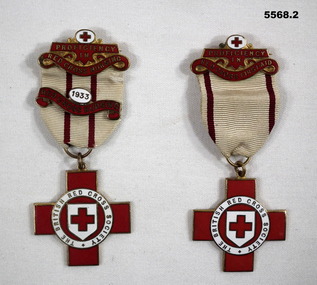
Award - Medals, RED CROSS
... Bages Red Cross Nurse WW1 1. Headed "Proficiency in Red Cross First Aid. Medal inscribed with the " British Red Cross Society". ...Badges relate to Florence Edna Morrell, a Red Cross Nurse in WW1. Refer Cat 3056P. Also refer to Ron Morrell Cat 316, and Beryl Scrimshaw Cat 315.1. Badge of the Red Cross connected with copper chain link to Red and White braid. At top Red and gold pin with small white cross at top. Halfway down the braid is a second metal insignia of Red Cross Nursing. 2. Badge of the Red Cross in metal with name and number engraved on back. Gold copper chain link to Red and White striped material braid. At top decorative Red and gold pin with small white cross at top. 1. Headed "Proficiency in Red Cross First Aid. Medal inscribed with the " British Red Cross Society". On back inscribed "15672 F.E. Morrell 1933" 2. Headed "Proficiency in Red Cross Nursing. Medal inscribed with the " British Red Cross Society". On back inscribed "10325 F.E. Morrell"bages, red cross nurse, ww1 -
 Bendigo Military Museum
Memorabilia - BADGES, WWI & Post War
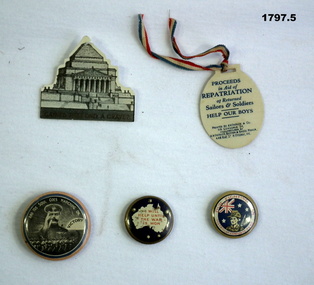
... Fanny Isabella Nicol, Staff nurse A.A.M.S WWI. Badge collection during and post WWI in aid of returned servicemen and War effort. ...Fanny Isabella Nicol, Staff nurse A.A.M.S WWI. Badge collection during and post WWI in aid of returned servicemen and War effort. ...Fanny Isabella Nicol, Staff nurse A.A.M.S WWI. Badge collection during and post WWI in aid of returned servicemen and War effort. Refer 1795P for service history, 2317.6, 2591. 5 fundraising badges ( 3 metal, 2 paper) not individually marked. .1) Graphic of war memorial Melbourne (black & white) .2) Oval badge, floral pattern red/white, blue ribbon re Repatriation. .3) Black & white circular badge, metal (General kitchener) .4) Round, blue, metal, map outline of Australia , red print, help win the war. .5) Round metal badge, Australian Flag & soldierfundraising, numismatics- badges -
 Eltham District Historical Society Inc
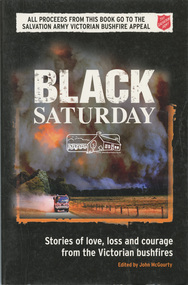
Book, Black Saturday : Stories of love, loss and courage from the Victorian bushfires edited by John McGourty, 2009
... The book is a collection of individual stories, featuring deeply personal contributions from: people directly affected by the bushfires, their friends and relatives; the people who came to their aid - fire fighters, doctors, nurses and wildlife rescuers; accounts from journalists on the scene; and those involved in coordinating the response. ...The book is a collection of individual stories, featuring deeply personal contributions from: people directly affected by the bushfires, their friends and relatives; the people who came to their aid - fire fighters, doctors, nurses and wildlife rescuers; accounts from journalists on the scene; and those involved in coordinating the response. ...The Black Saturday bushfires were a series of bushfires that ignited or were burning across the Australian state of Victoria on and around Saturday, 7 February 2009 and were Australia's all-time worst bushfire disasters. Contributions from reporters and photographers from News Limited. The book is a collection of individual stories, featuring deeply personal contributions from: people directly affected by the bushfires, their friends and relatives; the people who came to their aid - fire fighters, doctors, nurses and wildlife rescuers; accounts from journalists on the scene; and those involved in coordinating the response. Arranged town-by-town, with introductions detailing the scope and impact of the fires on each community. Contents: Kilmore East & Wandong - Strathewen & Kinglake West - St Andrews & Steels Creek - Kinglake - Flowerdale - Marysville--Gippsland -Beechworth & Mudgegonga - the lost ( listing those who perished ) - map of tragedy. Proceeds from the sale of each book was given to the Salvation Army Victorian Bushfire Appeal.SoftcoverYarra Plenty Regional Library identification sticker with name, number and bar code ISBN 9780732290108strathewen, st andrews, black saturday, fires -
 Kiewa Valley Historical Society
Michel Clips
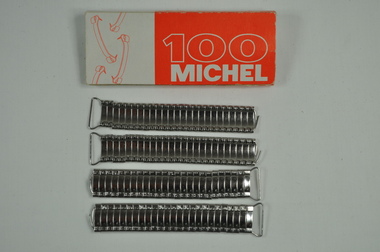
... medical equipment. hospital equipment. tawonga. mt beauty. medical. hospital. nurse. doctor. medical aid. health. stitches....Good condition and good interpretation capacity. medical equipment. hospital equipment. tawonga. mt beauty. medical. hospital. nurse. doctor. medical aid. health. stitches. '100 Michel' (in white writing on orange background) and other side - '18/8' circled (white numbers in orange circle). ...This medical / hospital equipment was used in the Tawonga District General Hospital which was built in the 1950s specifically for the increase in population due to the Kiewa Hydro Scheme.Historical: Shows the development of scientific hospital equipment. Provenance: Used in the Tawonga District General Hospital which was remote and therefore required good equipment. Good condition and good interpretation capacity.Inside white and orange cardboard packet. Metal ends like wire attached to metal sections adjacent to each other. Used instead of stitches. Requires applicator and remover.'100 Michel' (in white writing on orange background) and other side - '18/8' circled (white numbers in orange circle). 'Mt Beauty' handwrittenmedical equipment. hospital equipment. tawonga. mt beauty. medical. hospital. nurse. doctor. medical aid. health. stitches. -
 Monbulk RSL Sub Branch
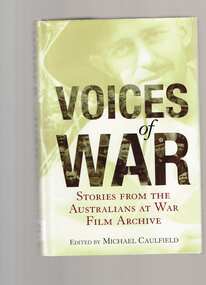
Book, Hodder and Staughton, Voices of war : stories from the Australians at War Film Archive, 2006
... Stories from winners of the VC, POWs, the patrols of Vietnam, peacekeepers in Rwanda, nurses from aid agencies and others. Index, ill, p.541. ...Stories of ordinary Australians caught up by circumstances and by duty. Features their telling of how they answered war's ruthless questions. What are you worth? In what do you believe? Can you endure? Stories from winners of the VC, POWs, the patrols of Vietnam, peacekeepers in Rwanda, nurses from aid agencies and others.Index, ill, p.541.non-fictionStories of ordinary Australians caught up by circumstances and by duty. Features their telling of how they answered war's ruthless questions. What are you worth? In what do you believe? Can you endure? Stories from winners of the VC, POWs, the patrols of Vietnam, peacekeepers in Rwanda, nurses from aid agencies and others.australia - history - military, australia - armed forces - history -
 Royal Australian and New Zealand College of Obstetricians & Gynaecologists (RANZCOG)
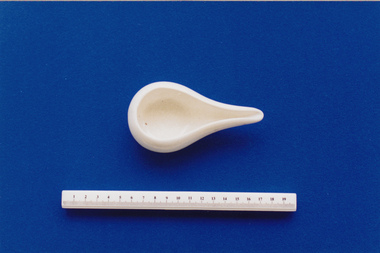
Pap boat associated with midwife Mary Howlett, c. 1866-1920, 1880 (approximate)
... Pap was a mixture of breadcrumbs, flour, rice or barley mixed with fluids such as broth, milk (if the infant was lucky), water, wine and even beer, to aid the digestion of pap it was often pre-chewed by the nurse or nanny. ...Pap was a mixture of breadcrumbs, flour, rice or barley mixed with fluids such as broth, milk (if the infant was lucky), water, wine and even beer, to aid the digestion of pap it was often pre-chewed by the nurse or nanny. ...Pap boats date from approximately 1710 and were in extensive use until the end of the nineteenth century. They were used to feed pap to infants or invalids. Pap was a mixture of breadcrumbs, flour, rice or barley mixed with fluids such as broth, milk (if the infant was lucky), water, wine and even beer, to aid the digestion of pap it was often pre-chewed by the nurse or nanny. Pap was a popular form of infant nutrition for almost 300 years and used in many well to do homes. For unwanted or illegitimate infants in foundling homes it was often the only form of sustenance, however, and as a result the mortality rate was appallingly high. Despite a growing number of experts advising against the use of pap, it nevertheless persisted as a major source of infant nutrition in many nurseries until the late 1800’s, largely due to the ignorance of nannies and nurses who took great delight in disregarding the advice of physicians, who they believed were usurping their position in the household. ‘Nanny knows best’.(Amgueddfa Cymru - National Museum Wales, 'Pap Boat')Mary Howlett (1840-1922) began practising as a country midwife in 1866 in the western district of Victoria. She qualified as a 'ladies monthly nurse' in 1887 and continued to practise as a nurse and midwife until 1920. She began her six months training at the Melbourne Lying-In Hospital. She was known by many as 'Auntie', and her career spanned more than 50 years. Mrs Howlett's midwifery box and contents were given to Dr Frank Forster, and he donated them to the museum collection in 1993. Small round white china container with an extended slim lip. Fluid capacity approximately 30-90ml. The boat has been made from two moulded sections. infant care, infant feeding, midwifery -
 Running Rabbits Military Museum operated by the Upwey Belgrave RSL Sub Branch
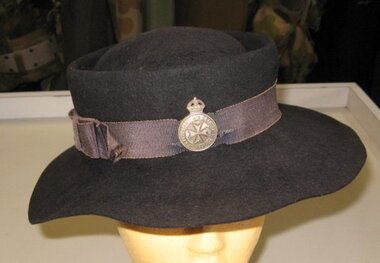
Hat
... Hat Voluntary Aid Detachment "VAD" nurses (part of UC003) (Also can havea Rising Sun hat Badge for late WW2)(Also Part UC013)...Headgear Army Hat Voluntary Aid Detachment "VAD" nurses (part of UC003) (Also can havea Rising Sun hat Badge for late WW2)(Also Part UC013) Hat ...Hat Voluntary Aid Detachment "VAD" nurses (part of UC003) (Also can havea Rising Sun hat Badge for late WW2)(Also Part UC013)headgear, army -
Bendigo Historical Society Inc.
Document - THE MAYORAL AUXILIARY, 25 Sept. 1947
... Nurses: Misses D Farmer & Helen Sargeant. Orchestra: Misses Leggo (Piano); McNair (Violin) & Kerr (Viola). Costumieres: Mr & Mrs L V Lansell. Cake Stall: Mesdames Amer Bryenton & Poulston. Sweets: Mesdames Chellew & Guthery. Sellers: Girls School Students. Doorkeepers: Mesdames Anderson and Streader. Sweets supplied by Girls School High School Mr Wilkinson Mrs Body Misses Burgess & Weller. Tickets donated by Mr Albert Matthews. Stage Manager: Mrs T O Hunter. Compere: Mess L MacGillivray. Assistant: Mr L M Green. The Mayoral Auxiliary. Entertainment arranged by The Mayoral Auxiliary in aid ...The Mayoral Auxiliary. Entertainment arranged by The Mayoral Auxiliary in aid of The Food For Britain Appeal. 25 Sept., 1947. Part 1 - Musical Programme. 1.Piano & Violin: Misses Leggo & McNair. Vocal Solo: Mr Arthur Nicholls. Trio: Mesdames Ennor & Lober & Miss Pianto. Dramatic Scene, Song & Dance: Miss Janice Morgan. Vocal Solo: Mr Beckwith. Specialty Act: Miss Gladys Brown. Vocal Solo: Mrs Ennor. Part 2 - Dramatic Entertainment. Dramatic Personage: Dreamer: Mr Jack Hocking. Grandparents: Mr Mac Walker & Mrs Oliver. Suitors: Messers Beckwith & Harvey. Daughter: Miss Letty White. Dancer: Miss Eileen Clarke. Sports Girl: Miss Mary Stanistreet. Marie & Mary: Misses A Taylor. The Cook & the Lady: Misses Dorothy Farmer & Helen Sargeant. Widow: Miss Beverly Dyer. Sister: Miss Judy Edwards. Bride: Miss Phyllis Farmer. Nanny & the Children: Mrs T O Hunter, Misses Janice Morgan & Gladys Brown. Nurses: Misses D Farmer & Helen Sargeant. Orchestra: Misses Leggo (Piano); McNair (Violin) & Kerr (Viola). Costumieres: Mr & Mrs L V Lansell. Cake Stall: Mesdames Amer, Bryenton & Poulston. Sweets: Mesdames Chellew & Guthery. Sellers: Girls School Students. Doorkeepers: Mesdames Anderson and Streader. Sweets supplied by Girls School, High School, Mr Wilkinson, Mrs Body, Misses Burgess & Weller. Tickets donated by Mr Albert Matthews. Stage Manager: Mrs T O Hunter. Compere: Mess L MacGillivray. Assistant: Mr L M Green. 3 copies of program 4268 a,b,c. 4 pages.entertainment, theatre, the mayoral auxiliary, the mayoral auxiliary in aid the food for britain appeal. 25 sept., 1947. piano & violin: misses leggo & mcnair. vocal solo: mr arthur nicholls. trio: mesdames ennor & lober & miss pianto. dramatic scene, song & dance: miss janice morgan. vocal solo: mr beckwith. specialty act: miss gladys brown. vocal solo: mrs ennor. dramatic personage: dreamer: mr jack hocking. grandparents: mr mac walker & mrs oliver. suitors: messers beckwith & harvey. daughter: miss letty white. dancer: miss eileen clarke. sports girl: miss mary stanistreet. marie & mary: misses a taylor. the cook & the lady: misses dorothy farmer & helen sargeant. widow: miss beverly dyer. sister: miss judy edwards. bride: miss phyllis farmer. nanny & the children: mrs t o hunter, misses janice morgan & gladys brown. nurses: misses d farmer & helen sargeant. orchestra: misses leggo (piano); mcnair (violin) & kerr (viola). costumieres: mr & mrs l v lansell. cake stall: mesdames amer, bryenton & poulston. sweets: mesdames chellew & guthery. sellers: girls school students. doorkeepers: mesdames anderson and streader. sweets supplied by girls school, high school, mr wilkinson, mrs body, misses burgess & weller. tickets donated by mr albert matthews. stage manager: mrs t o hunter. compere: mess l macgillivray. assistant: mr l m green. -
![Front cover of Alfred Hospital Ward Register, [ca.1969]](/media/collectors/50187a8f023fd7201471f198/items/6a30d4b4a14ad37447ea8f77/item-media/6a3b4301735a01b325fa8089/item-fit-380x285.jpg?cb=6) Alfred Hospital Nurses League - Nursing History Collection
Alfred Hospital Nurses League - Nursing History CollectionBook - Ward Register, C & S, Alfred Hospital Ward Register, 1969
... Before electronic medical records, the nurse admitting a patient to a ward, was required to fill in this register with patient details, including basic observations Insight into nursing practice before the time of electronic medical records nursing Alfred Hospital Medical Records previous catalogue number handwritten [black ink] on cloth and a small white sticker at top right of front cover. On front end page at top right 'YEARS C 1970 - 1988 / TEACHING AID ...Before electronic medical records, the nurse admitting a patient to a ward, was required to fill in this register with patient details, including basic observationsInsight into nursing practice before the time of electronic medical recordsGreen cloth bound hardback book, with red tape to spine.T'WARD REGISTER' embossed inn gilit in centre of front cover. Pages have black print with red lines definining 22 columns across two pages. Each column has a heading relating to patient admission. 'ALFRED HOSPITAL WARD REGISTER' printed at top.previous catalogue number handwritten [black ink] on cloth and a small white sticker at top right of front cover. On front end page at top right 'YEARS C 1970 - 1988 / TEACHING AID/SCHOOL of NURSING' [pencil] Fictitious entries have been made on 40 pages nursing, alfred hospital, medical records -
![Front view of Mercurochrome bottle [ca.1950's]](/media/collectors/50187a8f023fd7201471f198/items/6a5ecd52406175e53d4449dd/item-media/6a6d892b134352c62cd0d974/item-fit-380x285.jpg?cb=6) Alfred Hospital Nurses League - Nursing History Collection
Alfred Hospital Nurses League - Nursing History CollectionContainer - Glass bottle, Mercurochrome bottle, unknown
... Sometimes known as 'monkey blood because of its distinct colour Mercurochrome was used by nurses for minor wound treatment mercurochrome First aid Wound treatment previous catalogue number handwritten [black ink] underneath base Round vintage medicine bottle (plain glass) with glass stopper, ' Mercurochrome' printed [black ink] within a blue border on a white rectangular label. ...Mercurochrome (merbronim) was discovered in1919, it became a popular topical antiseptic for treatment of minor cuts and scrapes. use is now restricted because of the mercury content. Sometimes known as 'monkey blood because of its distinct colourMercurochrome was used by nurses for minor wound treatmentRound vintage medicine bottle (plain glass) with glass stopper, ' Mercurochrome' printed [black ink] within a blue border on a white rectangular label. Dry mercurochrome at baseprevious catalogue number handwritten [black ink] underneath basemercurochrome, first aid, wound treatment -
 Alfred Hospital Nurses League - Nursing History Collection
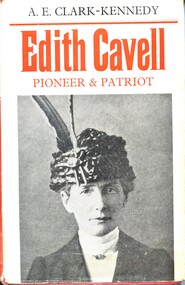
Book - Illustrated Book, A.E. Clark-Kennedy 1893-1985, Edith Cavell: pioneer and patriot, 1965
... Of significance to the AHNL as it is the biography of an important nurse Edith Cavell Nurses-biography This book tells the story of the British nurse, Edith Cavell, who was executed by the Germans during World War I for aiding Allied soldiers escape from Belgium. ...This book tells the story of the British nurse, Edith Cavell, who was executed by the Germans during World War I for aiding Allied soldiers escape from Belgium. The book explores her contributions to nursing, her work establishing the first nursing school in Brussels, and her involvement with the Belgian Resistance. It highlights her bravery and humanitarianism in the face of danger, ultimately leading to her tragic death.Illustrated book with dust jacket. Book has a red cover, with abbreviated title, author's and publisher's names embossed in gilt on spine. The dust jacket has a white background, with a black and white photograph of a woman wearing a hat with feathers (Edith Cavell at her trial, October 1915). Author's name (in black) and book title (in orange) are printed above this photograph. Author's name, book title and publisher's name are also printed on the spine (in Black ink).non-fictionThis book tells the story of the British nurse, Edith Cavell, who was executed by the Germans during World War I for aiding Allied soldiers escape from Belgium. The book explores her contributions to nursing, her work establishing the first nursing school in Brussels, and her involvement with the Belgian Resistance. It highlights her bravery and humanitarianism in the face of danger, ultimately leading to her tragic death.edith cavell, nurses-biography -
 Alfred Hospital Nurses League - Nursing History Collection
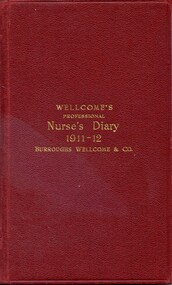
Book - Illustrated Diary, BurroughsWellcome & Co, Wellcome's professional nurse's diary (Australasian Edition) 1911-12, 1910
... aid pharamaceuticals postage In addition to the diary book contains historical information (Barley and fish : their use as food and medicine from ancient to modern times). Contemporary nursing and postal information infomation and advertisements The name N McHugh is hand written in black ink at top left of sectional index page illustrated diary with maroon leather cover, title and publisher's name stamped in gilt on front cover, letters AC and zigzag line embossed atbase of spine. Pages are also edged in gilt. Diary pages are blank Wellcome's professional nurse's ...In addition to the diary book contains historical information (Barley and fish : their use as food and medicine from ancient to modern times). Contemporary nursing and postal information infomation and advertisementsillustrated diary with maroon leather cover, title and publisher's name stamped in gilt on front cover, letters AC and zigzag line embossed atbase of spine. Pages are also edged in gilt. Diary pages are blanknon-fictionIn addition to the diary book contains historical information (Barley and fish : their use as food and medicine from ancient to modern times). Contemporary nursing and postal information infomation and advertisementsnursing, first aid, pharamaceuticals, postage -
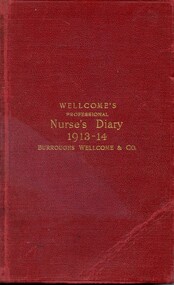 Alfred Hospital Nurses League - Nursing History Collection
Book - Illustrated Diary, Burroughs Wellcome & Co, Wellcome's professional nurse's diary (Australasian Edition) 1913-1914, 1912
... aid, foods and dietry information, surgical nursing and infectious diseases, historical medical equipment and numerous pharmaceutical advertisements On page after front end page tne name M Roberts Austin Hospital Heidleberg is written in black ink. At the top left of the next page, the name N.McHugh is written in black ink. illustrated diary with maroon leather cover, title and publisher's name stamped in gilt on front cover, letters AC and zigzag line embossed atbase of spine. Pages are also edged in gilt. Diary pages are blank Wellcome's professional nurse's ...As well as a diary, there are chapters on 'Nursing in wartime' , first aid, foods and dietry information, surgical nursing and infectious diseases, historical medical equipment and numerous pharmaceutical advertisementsillustrated diary with maroon leather cover, title and publisher's name stamped in gilt on front cover, letters AC and zigzag line embossed atbase of spine. Pages are also edged in gilt. Diary pages are blanknon-fictionAs well as a diary, there are chapters on 'Nursing in wartime' , first aid, foods and dietry information, surgical nursing and infectious diseases, historical medical equipment and numerous pharmaceutical advertisementsnursing, first aid, pharamaceuticals, war time nursing
