
Showing 9 items matching "nurses - ireland"
-
 Returned Nurses RSL Sub-branch
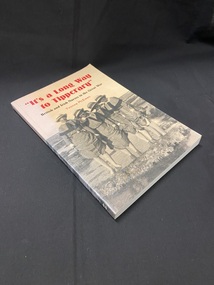
Book - Paperback book, Yvonne McEwan, "It's a long way to Tipperary" : British and Irish Nurses in the Great War, 2006
... ...Nurses - Ireland...Military Nursing WW1 WWI World War One Nurses - Great Britain Nurses - Ireland Ch.1 Overtures and Undertones : Britain, Ireland and Wider World 1901-1913 -- Ch.2 'Oh! ...Ch.1 Overtures and Undertones : Britain, Ireland and Wider World 1901-1913 -- Ch.2 'Oh! We don't want to lose you but we think you ought to go' Dissent and Disaster 1914 -- Ch.3 'Good bye-ee' Men and Women of August 1914 -- Ch.4 'Keep he Home Fires Burning' Western and Home Fronts 1914 -- Ch.5 'Oh W4at a Lovely War' Living, Fighting, )ying and Nursing 1915 -- Ch.6 'Hanging on the Old Barbed Wire' Pro Patria: Right or Wrong 1916 -- Ch.7 'Pack up your Troubles' Spirituality, Inspiration and Esprit de Corps 1917 -- Ch.8 'When this Bloody War Is Over' Fortitude, Finale and Legacy 1918. [contents note from Trove record]Peach coloured cover with a black and white image of four nurses wearing hats and holding the bottom of their dresses up while they stand ankle deep in the ocean. The title is printed above the image in red print with black subtitle. The author's name also appears in red text.non-fiction Ch.1 Overtures and Undertones : Britain, Ireland and Wider World 1901-1913 -- Ch.2 'Oh! We don't want to lose you but we think you ought to go' Dissent and Disaster 1914 -- Ch.3 'Good bye-ee' Men and Women of August 1914 -- Ch.4 'Keep he Home Fires Burning' Western and Home Fronts 1914 -- Ch.5 'Oh W4at a Lovely War' Living, Fighting, )ying and Nursing 1915 -- Ch.6 'Hanging on the Old Barbed Wire' Pro Patria: Right or Wrong 1916 -- Ch.7 'Pack up your Troubles' Spirituality, Inspiration and Esprit de Corps 1917 -- Ch.8 'When this Bloody War Is Over' Fortitude, Finale and Legacy 1918. [contents note from Trove record]military nursing, ww1, wwi, world war one, nurses - great britain, nurses - ireland -
 The Beechworth Burke Museum
Audio - Oral History, Jennifer Williams, Wilma Wells, 10th February 2000
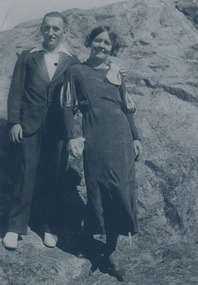
... Her mother born into English heritage bore four children, one who died shortly after birth, while her father had Irish heritage and worked at May Day Hills as a warden and a nurse. Wilma married Ted Wells when she was 23 and subsequently had two daughters. ...Her mother born into English heritage bore four children, one who died shortly after birth, while her father had Irish heritage and worked at May Day Hills as a warden and a nurse. Wilma married Ted Wells when she was 23 and subsequently had two daughters. ...Born on the 24th of December 1912 at the Three Mile was Wilma Wells. Her mother born into English heritage bore four children, one who died shortly after birth, while her father had Irish heritage and worked at May Day Hills as a warden and a nurse. Wilma married Ted Wells when she was 23 and subsequently had two daughters. This oral history recording was part of a project conducted by Jennifer Williams in the year 2000 to capture the everyday life and struggles in Beechworth during the twentieth century. This project involved recording seventy oral histories on cassette tapes of local Beechworth residents which were then published in a book titled: Listen to what they say: voices of twentieth century Beechworth. These cassette tapes were digitised in July 2021 with funds made available by the Friends of the Burke. Wilma Wells account of her life during the 20th century is historically and socially significant to the cultural heritage of Beechworth and the surrounding regions. She details important historical places and hardships within the region that have a lasting impact which includes but is not limited to issues with race, women's societal expectations and economic struggles. This oral history account is socially and historically significant as it is a part of a broader collection of interviews conducted by Jennifer Williams which were published in the book 'Listen to what they say: voices of twentieth-century Beechworth.' While the township of Beechworth is known for its history as a gold rush town, these accounts provide a unique insight into the day-to-day life of the town's residents during the 20th century, many of which will have now been lost if they had not been preserved.This is a digital copy of a recording that was originally captured on a cassette tape. The cassette tape is black with a horizontal white strip and is currently stored in a clear flat plastic rectangular container. It holds up 40 minutes of recordings on each side.Mrs Wilma Wells /beechworth, may day hills, oral history, burke museum, wilma wells, hospital, listen, weddings, three mile, picnic -
 Creswick Museum
Badge, medal collection
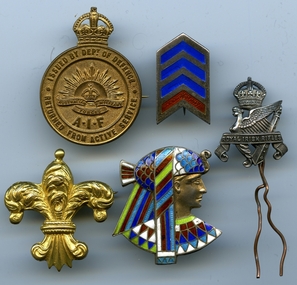
... nurse she embarked on the "Shyarra" from Australia and served at the 1st Australian General Hospital, Egypt. February 1917 she was attached to the 2nd Auxiliary Hospital Southhall, one of the hospitals specializing in fitting artificial limbs. 2 June 1916, she was awarded the Royal Red Cross Medal 2nd class for her valuable services. WW1 Active Service Return Medal WW1 Return from Overseas Services Chevron, Lapel badge WW1 Royal Irish ...This collection belonged to Sister Tessa Thomas R.R.M. (Nee Youngman) Sister Thomas was born at Creswick 1882, died Brisbane 1948. She trained at the Alfred Hospital for 3 years from 1909. On the 28th November 1914, as a staff nurse she embarked on the "Shyarra" from Australia and served at the 1st Australian General Hospital, Egypt. February 1917 she was attached to the 2nd Auxiliary Hospital Southhall, one of the hospitals specializing in fitting artificial limbs. 2 June 1916, she was awarded the Royal Red Cross Medal 2nd class for her valuable services.WW1 Active Service Return Medal WW1 Return from Overseas Services Chevron, Lapel badge WW1 Royal Irish Rifles badge WW1 Manchester Regiment Fleur de Lis Egyptian Enamel Broach -
 Royal Australian and New Zealand College of Obstetricians & Gynaecologists (RANZCOG)
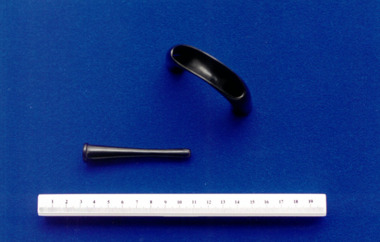
Incomplete vaginal douch apparatus set associated with midwife Mary Howlett, c. 1866 - 1920
... Ireland. Mary Howlett (1840-1922) began practising as a country midwife in 1866 in the western district of Victoria. She qualified as a 'ladies monthly nurse' in 1887 and continued to practise as a nurse and midwife until 1920.She began her six months training at the Melbourne Lying-In Hospital. ...These are parts of a vaginal douch apparatus set. The apparatus appears to be a T More-Madden model, as used at the Rotunda Hospital, Ireland.Mary Howlett (1840-1922) began practising as a country midwife in 1866 in the western district of Victoria. She qualified as a 'ladies monthly nurse' in 1887 and continued to practise as a nurse and midwife until 1920.She began her six months training at the Melbourne Lying-In Hospital. She was known by many as 'Auntie', and her career spanned more than 50 years. Mrs Howlett's midwifery box and contents were given to Dr Frank Forster, and he donated them to the museum collection in 1993.Black vulcanite bridge attachment (.1) and irrigator (.2). The bridge would attach to the rubber tubing of the set and a lead sinker, The bridge would attach to a stopcock at the proximal end of the set.midwifery -
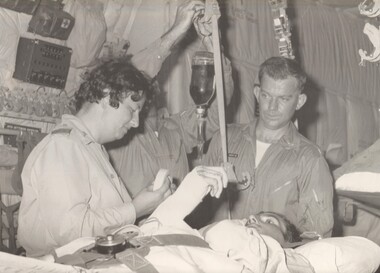 National Vietnam Veterans Museum (NVVM)
Photograph, Hercules Medivac
... Photograph taken by Sgt WM Cooper, RAAF Public Relations Photographer RAAF Nursing Services Medivac RAAF 37 SQN RAAF F.O Connelly C130 Medivac Flight C130 Hercules Vung Tau nurse Black and white photograph. Flying Officer Olive "Irish" Connolly, a RAAF nursing sister, checks the condition of the 2001st patient to be flown from Vietnam by Aeromedical Evacuation (Medevac) to Australia aboard a Hercules aircraft from No. 37 Squadron at Vung Tau. ...Photograph taken by Sgt WM Cooper, RAAF Public Relations PhotographerBlack and white photograph. Flying Officer Olive "Irish" Connolly, a RAAF nursing sister, checks the condition of the 2001st patient to be flown from Vietnam by Aeromedical Evacuation (Medevac) to Australia aboard a Hercules aircraft from No. 37 Squadron at Vung Tau. Adjusting the litter straps is Corporal Ian Knight, a RAAF medical orderly. The patient is Private A. E. Bermingham, a New Zealander of "Whisky" Company, 6 Royal Australian Regiment/NZ (ANZAC) Battalion.raaf nursing services, medivac, raaf, 37 sqn raaf, f.o connelly, c130 medivac flight, c130 hercules, vung tau, nurse -
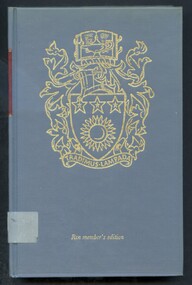 Alfred Hospital Nurses League - Nursing History Collection
Book - Illustrated book, Gerald Bowman, The lamp and the book: the story of the Rcn, 1916-1966, 1967
... of significance to the AHNL as it is a history of the development of nursing as a profession Royal College of Nursing National Council of Nurses of Great Britain and Northern Ireland History of the Royal College of Nursing 1916-1966 At the bottom right of the front end-page is a printed black and white donation sticker: black Maltese cross in circle, "This book was donated to Alfred Archival Association Nursing Division by'. ...History of the Royal College of Nursing 1916-1966Illustrated book with clear protective cover. The book has a grey cover. on the front is the coat of arms of the Royal College of Nursing and the words ' Rcn members edition' both embossed in gilt. Title, on a maroon background under author's name, and above publishers name, all embossed in gilt on spinenon-fictionHistory of the Royal College of Nursing 1916-1966royal college of nursing, national council of nurses of great britain and northern ireland -
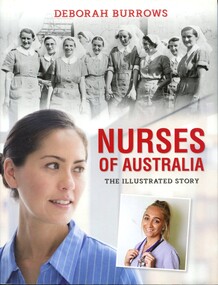 Alfred Hospital Nurses League - Nursing History Collection
Book - Illustrated book, Deborah Burrows 1959, Nurses of Australia: The illustrated story, 2018
... Of significance to the AHNL as it is an important reference of the history of nursing in Australia Nurses-Australia-History Nursing-Australia-History From the First Nation caregivers who healed, birthed and nursed for millennia to the untrained and ill-equipped convict men and women who cared for the sick in the fledgling colony of New South Wales, nursing has been practised in Australia since the beginning. It would take the arrival of a group of dedicated Irish ...From the First Nation caregivers who healed, birthed and nursed for millennia to the untrained and ill-equipped convict men and women who cared for the sick in the fledgling colony of New South Wales, nursing has been practised in Australia since the beginning. It would take the arrival of a group of dedicated Irish nuns, followed by Florence Nightingale-trained nurses - and decades of constant and continuing campaigning - to transform nursing into what it is today: the most trusted profession in Australia. Nurses will recognise their own lived experience in stories about training days, nurses' quarters, changing uniforms, changing roles, the arrival of male nurses and current pathways to nursing. Produced in collaboration with the Australian College of Nursing and the Congress of Aboriginal and Torres Strait Islander Nurses and Midwives, with additional information provided by the Australian Nursing and Midwifery Federation, this is the story of nursing in Australia.Illustrated book. Title and authors name printed on front cover and spine (red ink on front and white ink on red background on spine) Background of front cover has three photographs: black and white photograph of a group of nurses (Malaya 1941 group portrait of Australian Army Nursing Service nurses of the 2/4th Casualty Clearing Station), colour photo of a nurse looking over her shoulder, and a coloured photo of an Indigenous nurse. The back cover has a summary of the book along with four coloured photographs: Portrait of a nun with constitution and quill (Sister Mary Augustine Aikenhead by Nicholas Joseph Cowley), A nurse in uniform with veil (Vivian Bull winkel 1941), an indigenous woman (Lois O'Donoghue) an enrolled nurse (Samuel Yenui)non-fictionFrom the First Nation caregivers who healed, birthed and nursed for millennia to the untrained and ill-equipped convict men and women who cared for the sick in the fledgling colony of New South Wales, nursing has been practised in Australia since the beginning. It would take the arrival of a group of dedicated Irish nuns, followed by Florence Nightingale-trained nurses - and decades of constant and continuing campaigning - to transform nursing into what it is today: the most trusted profession in Australia. Nurses will recognise their own lived experience in stories about training days, nurses' quarters, changing uniforms, changing roles, the arrival of male nurses and current pathways to nursing. Produced in collaboration with the Australian College of Nursing and the Congress of Aboriginal and Torres Strait Islander Nurses and Midwives, with additional information provided by the Australian Nursing and Midwifery Federation, this is the story of nursing in Australia.nurses-australia-history, nursing-australia-history -
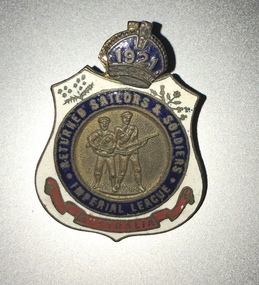 Melbourne Legacy
Badge, R.S.S.I.L.A. Member Badges
... Ireland respectively. The RSSILA was the precursor to the Returned Services League (RSL) and provided support for returned servicemen after World War One. Worn by members of the Returned Sailors, Soldiers Imperial League of Australia, those eligible being members of all services, both wars, including nurses, who have returned from active service outside Australia. ...Ireland respectively. The RSSILA was the precursor to the Returned Services League (RSL) and provided support for returned servicemen after World War One. Worn by members of the Returned Sailors, Soldiers Imperial League of Australia, those eligible being members of all services, both wars, including nurses, who have returned from active service outside Australia. ...Two member badges from the The Returned Sailors, Soldiers Imperial League of Australia (RSSILA). The number 68 on the front could be 1968 as it is detachable and could be updated each year. The badge with 1921 could be the year of membership. The member number is engraved on the rear. The shield design is symbolic of the protection provided to those who wear it. Within the badge, red represents the blood ties of war that exist between comrades; white stands for the purity of the motives in joining the league – to render service without personal gain or ambition; and blue indicates a willingness to serve a comrade anywhere under the blue sky. The wattle represents Australia, with the leek, the rose, the thistle and the shamrock standing for Wales, England, Scotland and Ireland respectively. The RSSILA was the precursor to the Returned Services League (RSL) and provided support for returned servicemen after World War One. Worn by members of the Returned Sailors, Soldiers Imperial League of Australia, those eligible being members of all services, both wars, including nurses, who have returned from active service outside Australia. These were with other World War 1 memorabilia that has come from Private John Basil McLean, 2nd Reinforcements, 37th Battalion, A.I.F. J.B. McLean (Service No. 13824) was from near Maffra, Victoria and enlisted on 22 January 1916. He embarked on 16 December 1916 for Europe. He spent time with the Australian Field Artillery (Pack Section). At the end of the war he worked for a year at the A.I.F. Headquarters in London before returning to Australia on the 'Ceramic', arriving in Portsea in 1920. His full war record is available from the National Archives of Australia (B2455, MCLEAN JBM).The RSSILA was an important organisation for ex-servicemen and many Legatees would have been members.Enamel badges from the R.S.S.I.L.A. The centre of the badge shows a sailor and a soldier in raised detail. A blue enamel circle surrounds the central detail and has 'RETURNED SAILORS & SOLDIERS / IMPERIAL LEAGUE' in gilt lettering. The outer edges of the badge are white enamel with a floral spray to the top left and right of the blue circle. At the bottom of the badge is a red enamelled scroll with 'AUSTRALIA' written in gilt lettering. On the reverse of the badge are soldered two brass lugs with a split pin attached for securing the badge to clothing. 01124.1 Front has '68' and 'Returned Sailors and Soldiers Imperial League of Australia'. On the reverse 'V92210 Badge remains the property of League'. 01124.2 Front has '1921' and 'Returned Sailors and Soldiers Imperial League of Australia'. On the reverse 'R 3871' and 'C.C Roeszler and Son Pty Ltd Melb.'world war one, rssila -
 St Vincent's Hospital Melbourne Archives
Card - The National Insurance Card of Great Britain and Northern Ireland used by Nurse Margaret Slattery in 1955
... The National Insurance Card of Great Britain and Northern Ireland used by Nurse Margaret Slattery in 1955. ...Card The National Insurance Card of Great Britain and Northern Ireland used by Nurse Margaret Slattery in 1955. ...All United Kingdom employers were required in the 1950's to have a National Insurance Card to which a stamp confirming each contribution by an employee was affixed. Margaret Slattery required this card in order to work in the UK. The card has a written number, name, address and signature of employee identified, the second and third page have national insurance stamps attached which cost 10 shillings and 5 pence each. margaret slattery, st vincent's hospital melbourne, national insurance card uk and northern ireland, nursing
