
Showing 7 items matching "old hume highway"
-
 Wodonga & District Historical Society Inc
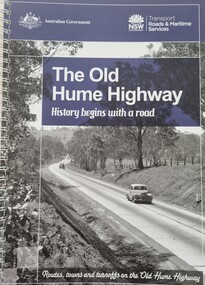
Book - The Old Hume Highway - History begins with a Road, 2014
... The Old Hume Highway - History begins with a Road...The Old Hume Highway - History begins with a Road...Old Hume Highway...A spiral bound volume of 122 pages including maps, photographs and illustrations prepared as a travel guide to the Old Hume Highway. It includes a Foreword by Peter FitzSimons....The Old Hume Highway - History begins with a Road Book The Old Hume Highway - History begins with a Road ...The Hume Highway was officially named in 1928, when both the New South Wales and Victorian governments agreed to give the unified inland route between Sydney and Melbourne the name, honouring explorer Hamilton Hume who, with William Hovell, first found the overland path in 1824. Much of the original highway followed their overland route wherever the landscape allowed. The road connected many small communities and rural properties, although in many parts was narrow and unsurfaced. Over the following years alterations and some deviations occurred with changing transport needs and heavier traffic loads. One of these deviations was completed in 1933 at Table Top north of Albury between Ettamogah and Mullengandra due to the construction of the Hume Weir which flooded the existing highway. Gradually sections of the road were converted to a dual carriageway. In 1961 the first modern freeway-standard, four-lane section was completed in Victoria at Craigieburn. The Hume Highway was also rerouted in Albury to avoid the town centre. Many major bypasses and duplications in New South Wales were completed throughout the 1980s and 1990s. In 1994 the last section of the Hume Highway in Victoria was duplicated with the completion of the Wangaratta bypass. The Albury-Wodonga bypass was opened in 2007 and in 2013 the final section, the Holbrook Bypass in NSW, was opened to traffic on August 7, completing the full Sydney-Melbourne dual carriageway link. In the course of this gigantic engineering achievement, many small, historic towns throughout Victoria and New South Wales were bypassed and often forgotten by passing commuters in a rush to reach their destination. This publication includes maps and information about the sites and landmarks in these towns. It encourages travellers to venture of the modern highway and rediscover the Old Hume Highway and the stories it holds about out past.A spiral bound volume of 122 pages including maps, photographs and illustrations prepared as a travel guide to the Old Hume Highway. It includes a Foreword by Peter FitzSimons.The Hume Highway was officially named in 1928, when both the New South Wales and Victorian governments agreed to give the unified inland route between Sydney and Melbourne the name, honouring explorer Hamilton Hume who, with William Hovell, first found the overland path in 1824. Much of the original highway followed their overland route wherever the landscape allowed. The road connected many small communities and rural properties, although in many parts was narrow and unsurfaced. Over the following years alterations and some deviations occurred with changing transport needs and heavier traffic loads. One of these deviations was completed in 1933 at Table Top north of Albury between Ettamogah and Mullengandra due to the construction of the Hume Weir which flooded the existing highway. Gradually sections of the road were converted to a dual carriageway. In 1961 the first modern freeway-standard, four-lane section was completed in Victoria at Craigieburn. The Hume Highway was also rerouted in Albury to avoid the town centre. Many major bypasses and duplications in New South Wales were completed throughout the 1980s and 1990s. In 1994 the last section of the Hume Highway in Victoria was duplicated with the completion of the Wangaratta bypass. The Albury-Wodonga bypass was opened in 2007 and in 2013 the final section, the Holbrook Bypass in NSW, was opened to traffic on August 7, completing the full Sydney-Melbourne dual carriageway link. In the course of this gigantic engineering achievement, many small, historic towns throughout Victoria and New South Wales were bypassed and often forgotten by passing commuters in a rush to reach their destination. This publication includes maps and information about the sites and landmarks in these towns. It encourages travellers to venture of the modern highway and rediscover the Old Hume Highway and the stories it holds about out past.old hume highway, hume highway, travel guide hume highway, \ -
 Sunshine and District Historical Society Incorporated
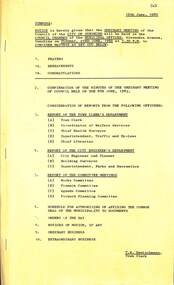
Administrative record - City of Sunshine - Commissioner Mr Alexander Alex George Gillon Collection 1976 - Notice of Ordinary Meeting 16th June 1982, City of Sunshine, 15th June 1982
... Hume Pipe...Van Ness Avenue...Maribyrnong...Highpoint West Shopping Centre...Rosamond Road...Devonshire Road...Duke Street...Navigator Street...Raleigh Road...Old Geelong Road...Brooklyn...Princess Highway...City of Sunshine Alexander "Alex" George Gillon Maidstone Hall Thomson Street Maidstone Deer Park High School Billingham Road Deer Park Charlotte Street Sunshine West Bryan Court Sunshine North Furlong Road Child Care Centre Furlong Road Suffolk Road Glengala Road Holt Street Ardeer Pennell Reserve Burke Street Braybrook Braybrook Youth Club Melbourne Meat Preserving Company Hume Pipe Van Ness Avenue Maribyrnong Highpoint West Shopping Centre Rosamond Road Devonshire Road Duke Street Navigator Street Raleigh Road Old Geelong Road Brooklyn Princess Highway St. ...Ordinary meeting notice including reports from Council's officers Report of the Town Clerk's Department Report of the Town Clerk Proposed Lease Maidstone Hall Use by Yooralla Society Regional Refuse Disposal Strategy Plan Deer Park High School Activity Centre Application for Rate Exemption 42 Duke Street Transfer of Splays from Department of Administrative Services Corner Clyde Street and The Esplanade Proposal to Discontinue Part of Charlotte Street South of Hall Street Land Transfer Discontinued Right of Way 1 Bryon Court Sunshine North Representative of the Melbourne & Metropolitan Board of Works Public Liability Claims Resort & Recreation Fund Report of the Acting Co-Ordinator of Welfare Services Youth Group Support Fund CYSS Refunding Furlong Road Child Care Centre Temporary Closure Sunshine Community Child Care Centres' Association Youth Grant Department of Youth, Sport & Recreation Office of Child Care Review Implications of the Introduction of Child Care Act and Plus Factor Funding Special Accommodation Houses in Sunshine Report of the Chief Health Surveyor Health Act Registration 23B Suffolk Road Sunshine North Application for Transfer of Proprietorship of Premises Under the Health Act 89 Glengala Road Sunshine West Application for Transfer of Proprietorship of Premises Under the Health Act51 Holt Street Ardeer Prosecution Proceedings Sunshine Magistrates' Court Report of the Medical Officer of Health Report of the Superintendent Traffic & By-Laws Dog Act Helicopter Landing Pennell Reserve d. Richardsons & Sons Social Club Report of the Chief Librarian Rainbow Workshop Classes Braybrook Youth Club Classes Migrant Classes at St. Albans and Sunshine West Report of the City Engineer / Planner Former Melbourne Meat Preserving Compnay Buildings M.M.B.W. Humes Property Van Ness Avenue Maribyrnong Historic Buildings Preservation Council Planning Permit Application Shops & Associated Car Parking Highpoint Shopping Centre Rosmond Road Maribyrnong Planning Permit Application Caltex oi Internally Illuminated Sign Corner Devonshire Road and Duke street Sunshine Planning Permit Application Alterations to Existing Planning Permit Amco Existing Service Filling station Corner Raleigh Road . Navigator Street Maribyrnong Delegated Matters Plan of Proposed Consolidation Corner Princes Highway and Old Geelong Road Brooklyn Plan of Subdivision Western Gate North Estate Stages 3B & 3C Plan of Consolidation Hampston Avenue Sunshine Plan of Consolidation Lots 26 & 27 St. Albans Road St. Alban Proposed Subdivison 22 Second Avenue Sunshine Billingham Road Relocation of Bus Stop Churchill Avenue outside Christ the King Roman Catholic College No Standing Anytime Prohibition Cremorne Street No Standing Anytime Prohibition Anderson Road No Standing Anytime Prohibition Ballarat Road Deer Park South Side No Standing Anytime Prohibition Main Road West Cornhill Street Right of Way No Parking Anytime Signs St. Albans Community Centre Health Centre Courtesy Bus Stop at St. Albans Post Office The Hub Surf Jets to Swimming Pool Building Control Act 1981 Building Control Act 1981 Dwellings Unfit for Human Habitation Report of the Building Surveyor Statistical Information Numbers of Building Permits Underground Tanks Lot 1 Emu Road Maidstone Undersize Allotment of Land Lot 22 Rochester Street Braybrook Location of Building Lot 1294 Pineneedle Court St. Albans Location of Building 2 Heaton Close Sunshine West Dangerous Building Brick Service Station 95 Rosamond Road Maidstone Report of the Superintendent of Parks & Recreation Tree Removals 68 Ballarat Road Maidstone, 69 Ballarat Road Maidstone, 74 Ballarat Road Maidstone, 78 Ballarat Road Maidstone city of sunshine, alexander "alex" george gillon, maidstone hall, thomson street, maidstone, deer park high school, billingham road, deer park, charlotte street, sunshine west, bryan court, sunshine north, furlong road child care centre, furlong road, suffolk road, glengala road, holt street, ardeer, pennell reserve, burke street, braybrook, braybrook youth club, melbourne meat preserving company, hume pipe, van ness avenue, maribyrnong, highpoint west shopping centre, rosamond road, devonshire road, duke street, navigator street, raleigh road, old geelong road, brooklyn, princess highway, st. albans road, st. albans, second avenue, sunshine, churchill avenue, cremorne street, anderson road, ballarat road, the hub, sun crescent, emu road, rochester street, pineneedle court, albanvale, heaton close -
 Wodonga & District Historical Society Inc
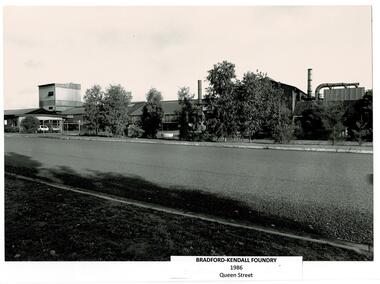
Photograph - Bradford Kendall, Wodonga
... It melted down old railway wheels, rails and redundant machinery to produce a range of low-alloy steel products, especially for earth-moving vehicles, railways, oil rigs and sugar factories. Wodonga was ideally placed as a change point between the different rail gauges of Victoria and New South Wales, close to the Hume Highway and the Snowy Mountain Scheme. ...It melted down old railway wheels, rails and redundant machinery to produce a range of low-alloy steel products, especially for earth-moving vehicles, railways, oil rigs and sugar factories. Wodonga was ideally placed as a change point between the different rail gauges of Victoria and New South Wales, close to the Hume Highway and the Snowy Mountain Scheme. ...Bradford Kendall was established in 1922 by Lesley Bradford and Jim Kendall, investing their winnings on a race horse. They both previously worked at the BHP Steel Works. They gained contracts with the railways and mining industry. During World War II they also manufactured armaments. During the boom of the 1950s they established several foundries in South Australia, Western Australia, Queensland and Victoria. Bradford Kendall Ltd Wodonga foundry was established in 1954. It melted down old railway wheels, rails and redundant machinery to produce a range of low-alloy steel products, especially for earth-moving vehicles, railways, oil rigs and sugar factories. Wodonga was ideally placed as a change point between the different rail gauges of Victoria and New South Wales, close to the Hume Highway and the Snowy Mountain Scheme. The first sod for the site was turned on 2nd June 1954 and the first melt and pour of molten metal at Wodonga took place on 7th July 1954. Bradford Kendall Plant No.5 in Wodonga became one of the most profitable foundries in the Bradford Kendall group. Bill Black became the first plant Manager, a position he held for 30 years. Another long term employee was Pat Gooding who began work at a 15 year old and retired for the position of Bradken foundry Manufacturing Manager 51 years later. In the early 1980s, Australian National Industries Ltd bought Bradford Kendall and other heavy engineering companies. The Wodonga foundry with its (then) 170 or so staff became part of Bradken Consolidated along with nine other foundries in Australia and New Zealand. In 1989, Kerry Packer’s Consolidated Press Holdings Ltd took control of ANI. In January 1999, Smorgon Steel Group acquired ANI, which included the Bradken business. The company changed hands again in 2001 when Smorgon Steel Group sold Bradken to Castle Harlan Australian Mezzanine Partners (CHAMP). In 2016 negotiations began for Bradken to be taken over by Hitachi Construction for A$689 million. In April 2017 Bradken became a wholly owned subsidiary of Hitachi Construction Machinery Co. Limited.A collection of black and white images and advertising for Bradford Kendall (Bradken) Wodonga.bradford kendall, wodonga industries, wodonga businesses -
 Wodonga & District Historical Society Inc
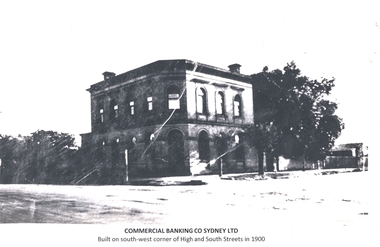
Photograph - Commercial Bank of Sydney, High Street, Wodonga, 1876 - 2025
... Hume Highway. A contemporary newspaper article provides detail of the new bank. The well-lit building with open banking offices was designed by Melbourne architects, Turner and Stephenson, and combined a bright and attractive appearance with a stream-lined working layout. Alderson Swythyn Blackett-Smith, the manager of bank at time of move to new premises stated that the growth of the district and the bank’s business had made the old...Hume Highway. A contemporary newspaper article provides detail of the new bank. The well-lit building with open banking offices was designed by Melbourne architects, Turner and Stephenson, and combined a bright and attractive appearance with a stream-lined working layout. Alderson Swythyn Blackett-Smith, the manager of bank at time of move to new premises stated that the growth of the district and the bank’s business had made the old ...The Bank of Victoria was established in Wodonga during 1873. This two storey bank was constructed on the site in 1876. It later became the Commercial Banking Company of Sydney. In 1876 the Albury Banner and Wodonga Express reported that Mr. Nation had gained the contract for the erection of a new building for the Bank of Victoria, at Wodonga. The site secured for the bank was at the corner of South and Sydney streets, and immediately opposite the new Post and Telegraph Offices. The original bank was demolished in the 1950s and a new bank was built on the site. The new building was constructed with innovative foundations designed to prevent damage from vibrations caused by heavy transport vehicles along High Street which was then part of the Hume Highway. A contemporary newspaper article provides detail of the new bank. The well-lit building with open banking offices was designed by Melbourne architects, Turner and Stephenson, and combined a bright and attractive appearance with a stream-lined working layout. Alderson Swythyn Blackett-Smith, the manager of bank at time of move to new premises stated that the growth of the district and the bank’s business had made the old premises unsatisfactory due to insufficient space. The Commercial Banking Company of Sydney (CBC) merged with the National Bank of Australasia in 1982 to form the National Australia Bank and the second bank was closed. The building has since operated as several retail (including video hire and framing shop), commercial and community functions. It is currently (2025) used by the Wodonga Indie School.These images are significant because they document the development of an important financial institution established in Wodonga in the late 19th century.A series of images showing the evolution of the Commercial Banking Company of Sydney building in Wodonga from its construction in 1876 to the development of the site in 2025.commercial banking company of sydney, banking wodonga, wodonga financial institutions -
 Wodonga & District Historical Society Inc
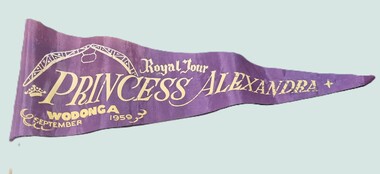
Memorabilia - Flag - Princess Alexandra's visit to Wodonga, 1959
... old Leslie McLeod. Princess Alexandra, led by a pipe band was driven along the Hume Highway and High Street which were lined by thousands of people including school children. ...old Leslie McLeod. Princess Alexandra, led by a pipe band was driven along the Hume Highway and High Street which were lined by thousands of people including school children. ...This flag is a memento produced for Princess Alexandra of Kent's visit to Wodonga in 1959. Princess Alexandra visited Australia as the representative of Queen Elizabeth II for the Queensland Centenary Celebrations. Her six-week visit began with her arrival in Canberra on 14th August and she departed from Canberra on 26th September. Time spent in Australia included three weeks in Queensland. Her Royal Highness' visits to New South Wales and Victoria were comparatively brief and informal. In New South Wales she made two country visits including to Albury and a night spent at Bungowannah Park near Jindera. Her visit to Victoria began in Wodonga where she officially opened the Pollard Archway over the Causeway. She received an enthusiastic welcome as she approached the Archway accompanied by a motorcycle escort. As Princess Alexander stepped forward to take the scissors from a red plush case, her Lady-in-Waiting, Lady Moyra Hamilton, tugged at the Princess' sleeve, whispered, and gave her a coin. The Princess handed the coin (a halfpenny) to the Wodonga Shire President, Cr J. S. Hore, saying: "I must give you this, otherwise it might be unlucky." The halfpenny "gift" stems from an old English superstition that a "sharp" gift such as a knife or scissors must be dulled with copper or else a friendship will be lost. After cutting the ribbon and declaring the Pollard Arch, named in honour of Councillor Charles Pollard M.B.E., she was presented with a bouquet by 10-year-old Leslie McLeod. Princess Alexandra, led by a pipe band was driven along the Hume Highway and High Street which were lined by thousands of people including school children. After a short trip along High Street and Elgin Street to the Railway Station she departed from protocol to speak to the many children who had crossed the barricade. Princess Alexandra then boarded the Royal Train for her journey to Melbourne.This item is significant because it represents the visit to Wodonga of Princess Alexandra in 1959.A small purple flag with gold lettering and a symbol of the Pollard Arch in Wodonga. It is triangular in shape and attached to a thin wooden stick.Royal Tour Princess Alexandra Wodonga September 1959princess alexandra, royal visit 1959 wodonga -
 Wodonga & District Historical Society Inc
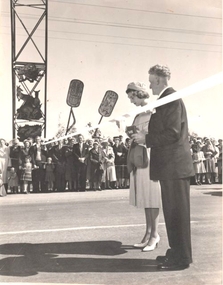
Functional object - Scissors - Princess Alexandra opens Pollard Archway, Wodonga
... old Leslie McLeod. Princess Alexandra led by a pipe band was driven along the Hume Highway and High Street which were lined by thousands of people including school children. ...old Leslie McLeod. Princess Alexandra led by a pipe band was driven along the Hume Highway and High Street which were lined by thousands of people including school children. ...In 1959 Princess Alexandra of Kent visited Australia as the representative of Queen Elizabeth II for the Queensland Centenary Celebrations. Her six week visit began with her arrival in Canberra on 14th August 14 and she departed from Canberra on 26th September. Time spent in Australia included 3 weeks in Queensland. Her Royal Highness' visits to New South Wales and Victoria were comparatively brief and informal. In New South Wales she made two country visits including to Albury and a night spent at Bungowannah Park near Jindera. Her visit to Victoria began in Wodonga where she officially opened the Pollard Archway over the Causeway. She received an enthusiastic welcome as she approached the Archway accompanied by a motorcycle escort. As Princess Alexander stepped forward to take the scissors from a red plush case, her Lady-in- Waiting, Lady Moyra Hamilton, tugged at the Princess' sleeve, whispered and gave her a coin. The Princess handed the coin a halfpenny to the Wodonga Shire President, Cr J. S. Hore, saying: "I must give you this, otherwise it might be unlucky." (The halfpenny "gift" stems from an old English superstition that a "sharp" gift such as a knife or scissors must be dulled with copper or else a friendship will be lost. After cutting the ribbon and declaring the Pollard Arch, named in honour of Councillor Charles Pollard M.B.E. she was presented with a bouquet by 10-year old Leslie McLeod. Princess Alexandra led by a pipe band was driven along the Hume Highway and High Street which were lined by thousands of people including school children. After a short trip along High Street and Elgin Street to the Railway Station she departed from protocol to speak to the many children who had crossed the barricade. Princess Alexandra then boarded the Royal Train for her journey to Melbourne.This item is significant because it represents the visit to Wodonga of Princess Alexandra in 1959.A pair of scissors in a red box. The bottom of the box is lined with red cloth and the lid is lined with white silk bearing the trademark "Jewelcrest". The scissors are engraved with the maker's mark for GIESEN & FORSTHOFF/ SOLINGEN GERMANYOn top of Box. The Official Opening by Her Royal Highness Princess Alexandra of Kent 0f the Cr C F Pollard MBE Archway Wodonga 16th Sept 1959 On Scissors: GIESEN & FORSTHOFF/ SOLINGEN GERMANY TIMOR SOLINGENprincess alexandra, pollard arch -
 Wodonga & District Historical Society Inc
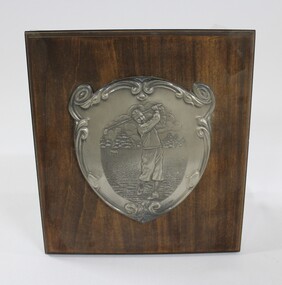
Plaque - Wodonga Golf Club Plaque
... old Wodonga Golf House, built in 1946. The club house and the golf course were extended in 1956 to the area of Belvoir Park. It was demolished in 1987 to make room for the new Hume Highway. ...old Wodonga Golf House, built in 1946. The club house and the golf course were extended in 1956 to the area of Belvoir Park. It was demolished in 1987 to make room for the new Hume Highway. ...A commemorative plaque from the old Wodonga Golf House, built in 1946. The club house and the golf course were extended in 1956 to the area of Belvoir Park. It was demolished in 1987 to make room for the new Hume Highway. This plaque was salvaged from the club house building before demolition. This item has a strong link to the local and sporting history of Wodonga.A wooden plaque with engraved metal plate depicting a male golfer attached. gold, sport, leisure, entertainment, wodonga, wodonga golf club
