
Showing 191 items matching "openers"
-
 Greensborough Historical Society
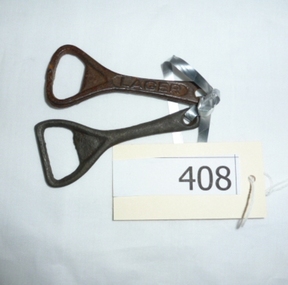
Functional object - Bottle opener, Crown seal bottle openers, 1940c
... Crown seal bottle openers...opener...The Abbots Lager opener may have been a promotional product for this brand of beer....Cast iron bottle openers, rusted exterior. One plain, unnamed; one labelled Abbots Lager....Crown seal bottle openers Functional object Bottle opener Abbots ...Widely used to open early beer or soft drink bottles. The Abbots Lager opener may have been a promotional product for this brand of beer.Cast iron bottle openers, rusted exterior. One plain, unnamed; one labelled Abbots Lager.opener, crown seal beer bottle, cast iron, abbots lager -
 National Wool Museum
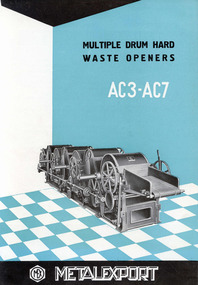
Pamphlet, Multiple Drum Hard Waste Openers AC3-AC7
... Multiple Drum Hard Waste Openers AC3-AC7..."Multiple Drum Hard Waste Openers AC3-AC7" - sole exporters: Metalexport, Warsaw, Poland, c.1950....Pamphlet for a Multiple Drum Hard Waste Openers AC3-AC7; sole exporters: Metalexport, Warsaw, Poland, c.1950....Multiple Drum Hard Waste Openers AC3-AC7 Pamphlet ..."Multiple Drum Hard Waste Openers AC3-AC7" - sole exporters: Metalexport, Warsaw, Poland, c.1950.Pamphlet for a Multiple Drum Hard Waste Openers AC3-AC7; sole exporters: Metalexport, Warsaw, Poland, c.1950.textile machinery textiles - recycling, metalexport, textile machinery, textiles - recycling -
 Bendigo Military Museum
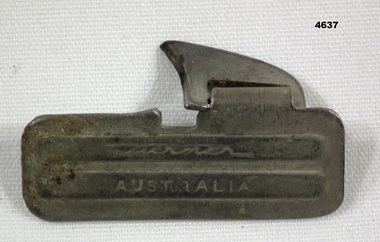
Accessory - OPENER, C.1939 - 45
... OPENER...Openers...These openers were generally issued in ration packs. ...Opener, metal, hinged section folds out to use as a can opener....Opener, metal, hinged section folds out to use as a can opener. ...These openers were generally issued in ration packs. Alan Mason collection, refer cat No 3979.2Opener, metal, hinged section folds out to use as a can opener.“Australia” stamped on.openers, accessory, ration packs -
 Geelong RSL Sub Branch
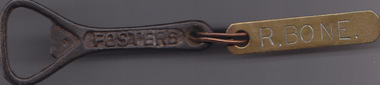
Issue Bottle Opener - VX3032 R Bone, Mid 20th Century
... The Bottle Opener was military issue to VX3032 R Bone who served with the AIF Special Force during WW2...An Army Issue Bottle Opener with a Name Tap attached together by a split ring....On the Opener Fosters Larger, on the Name Tag VX3032 R Bone....Issue Bottle Opener - VX3032 R Bone ...The Bottle Opener was military issue to VX3032 R Bone who served with the AIF Special Force during WW2The Bottle Opener belonged to VX3032 R Bone.An Army Issue Bottle Opener with a Name Tap attached together by a split ring.On the Opener Fosters Larger, on the Name Tag VX3032 R Bone.ww2, vx3032 r bone, aif special force -
 Dandenong/Cranbourne RSL Sub Branch
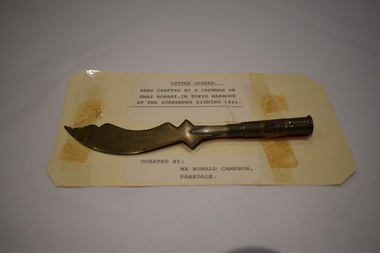
Memorabilia - Trench Art Letter Opener
... Letter opener. Hand crafted by a crewman on HMAS Hobart in Tokyo Harbour at the surrender signing in 1945....Metal trench art letter opener. Rifle cartridge with metal knife blade....Mounted on card. Letter opener. Hand crafted by a crewman on HMAS Hobart in Tokyo Harbour at the surrender signing 1945. ...Memorabilia Trench Art Letter Opener. ...Letter opener. Hand crafted by a crewman on HMAS Hobart in Tokyo Harbour at the surrender signing in 1945.Metal trench art letter opener. Rifle cartridge with metal knife blade.H.M.A.S Hobart. Tokyo. Mounted on card. Letter opener. Hand crafted by a crewman on HMAS Hobart in Tokyo Harbour at the surrender signing 1945. Donated by: Mr. Robert Cameron. Parkdale. -
 Wodonga & District Historical Society Inc
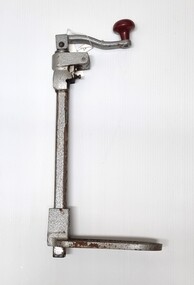
Functional object - Caterer's Can Opener, Mitchell & Cooper of England, 1950s
... Caterer's Can Opener...This Can opener was used at the Bandiana Golf Club near Wodonga. ...Cast iron commercial can opener with rotating handle including a red knob....Underneath base plate "THE BONZER /TRADEMARK/ CATERER'S/ CAN OPENER/ MADE IN ENGLAND"...Caterer's Can Opener Functional object Caterer's Can Opener Mitchell & Cooper of England ...This Can opener was used at the Bandiana Golf Club near Wodonga. Bonzer was a trademark of Mitchell & Cooper of England. Alfred Mitchell & Arthur Cooper started as silversmiths and engravers in 1879 in East London. The family owned business is still operated by Guy Cooper, great grandson of Arthur Cooper. Bandiana Army Golf Club 18 hole course opened in 1949. The Club reached its highest membership with 400 members in the late 1980s. Members played their last competition at this course on 30th October 2103.This utensil was used at the Bandiana Army Golf Course near Wodonga.Cast iron commercial can opener with rotating handle including a red knob.Underneath base plate "THE BONZER /TRADEMARK/ CATERER'S/ CAN OPENER/ MADE IN ENGLAND"caterers' utensils, kitchen utensils -
 Wodonga & District Historical Society Inc
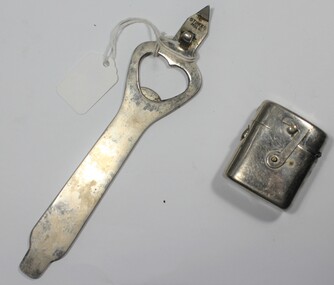
Memorabilia - Rat of Tobruk Arthur Lock's bottle opener and lighter
... Rat of Tobruk Arthur Lock's bottle opener and lighter... A metal can/bottle opener and cigarette lighter.... On Opener "STOKES /MELB"...World War 11 Rats of Tobruk Tobruk On Opener "STOKES /MELB" A metal can/bottle opener and cigarette lighter. ...These items were part of standard supplies and personal items issued to members of the Australian Defence Forces during World War 2.This item is part of a collection of items owned by Arthur Lock, a member of the 2/23rd Battalion, an all-volunteer Second Australian Imperial Force which served as part of the garrison during the Siege of Tobruk, then at El Alamein, New Guinea and Borneo. It has particular local significance as the battalion was know as "Albury's Own" because a large majority of the battalion's initial intake of volunteers came from the Albury–Wodonga region. A metal can/bottle opener and cigarette lighter. On Opener "STOKES /MELB"world war 11, rats of tobruk, tobruk -
 Greensborough Historical Society
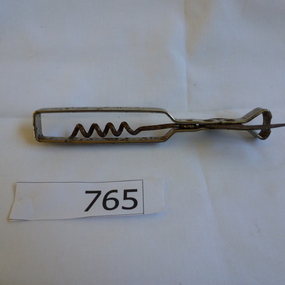
Bottle opener, Metal bottle opener or can opener, 1952c
... Metal bottle opener or can opener...Functions include corkscrew, can-opener and bottle opener....Metal with corkscrew, bottle opener and can opener....Metal with corkscrew, bottle opener and can opener. Metal bottle opener or can opener Bottle opener Henry Squire and Sons ...Multi-purpose opener in common use in the mid 20th century. Functions include corkscrew, can-opener and bottle opener.Metal with corkscrew, bottle opener and can opener."Buckle proof blue blade" and "Made by Henry Squire and Sons" etched into handle.bottle opener, can opener, corkscrew, henry squire and sons -
 National Vietnam Veterans Museum (NVVM)
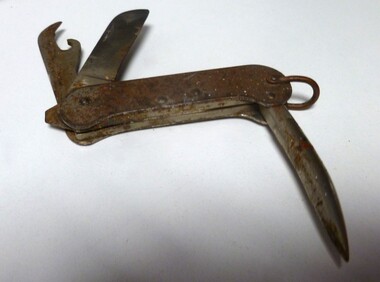
Equipment - Clasp knife
... Stainless steel pocket-knife with blade, spike and can and bottle opener. There is a metal loop attached to the top of the pocket-knife. ...DAD Opener 15737...Pocket knife DAD Opener 15737 Stainless steel pocket-knife with blade, spike and can and bottle opener. ...Clasp knife issued to the Australian Army during the conflict in Vietnam. This is a continuation of the standard pattern of clasp knives issued since before the Second World War.Stainless steel pocket-knife with blade, spike and can and bottle opener. There is a metal loop attached to the top of the pocket-knife. DAD Opener 15737pocket knife -
 National Vietnam Veterans Museum (NVVM)
Equipment - Clasp knife, 1945
... Equipped with a friction folding blade, marlinspike, can/bottle opener and screwdriver stub....Whittingslowe opener 15737, patented in Adelaide...Clasp knife knife pocket knife Whittingslowe opener 15737, patented in Adelaide Nickle plated steel. ...Clasp knife issued to the Australian Army during the conflict in Vietnam. This is a continuation of the standard pattern of clasp knives issued since before the Second World War.Nickle plated steel. Equipped with a friction folding blade, marlinspike, can/bottle opener and screwdriver stub.Whittingslowe opener 15737, patented in Adelaideclasp knife, knife, pocket knife -
 Flagstaff Hill Maritime Museum and Village
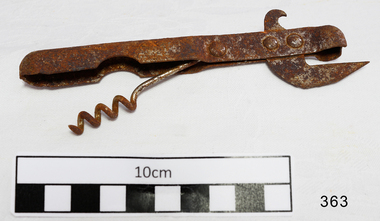
Domestic object - Can Opener, Bottle Opener & Corkscrew
... Because meat was the first and most popular canned substance, these can openers were often shaped to look like cows and given the nickname 'bully beef can openers'. ...Metal can opener, chromed, with bottle opener, and a corkscrew seated in the handle....Domestic object Can Opener, Bottle Opener & Corkscrew ...It took 15 years to invent the can. It took 100 more to invent a standard way to open it. In the 19th century, decades after the invention of canning, there were virtually no can openers. Canned food, such as sardines, came with its own "key" to peel back the tin lid. Birth of the can One of the oddest things about the can opener is that the can predates it by almost 150 years. Though common today, cans were once military-grade technology. In 1795, Napoleon, to whom the phrase "an army marches on its stomach" is attributed, offered 12,000 francs to anyone who could find a way to preserve food. Without any knowledge of bacteria or their role in food spoilage, scientists didn't even know where to begin. It took 15 years before a chef named Nicholas Appert claimed the prize after successfully jarring food. Soon after that, his countryman Philippe de Girard came up with a variant on Appert's method—metal tins—and sold the idea to the British. Spoiled food, and the sickness it caused, was a widespread problem. The public would have benefited from canned food, but for decades cans were almost exclusively for the army and the navy. The canning process, with its hours of boiling and steaming, its scrupulous cleanliness, its heated metal, and its need for a great deal of disposable material, made canned food far too expensive for anyone but the military. No can openers were needed or even possible. The metal of early cans was too thick to make openers practical. Soldiers and sailors had plenty of sharp objects on hand and made ample use of them when they wanted to eat. During the 19th century, the process of canning was refined and mechanised, and the metal wall of the average can slimmed down enough that a civilian could get it open—if that civilian had the right tool. No one had that tool yet, so early cans had to open themselves. In other words, they came with built-in openers. The result was a confusing but pleasing free-for-all, in terms of product engineering. Each type of food came with its own kind of can, and each kind of can came with its own kind of opener. Tinned fish and meat were often sold in rectangular cans. These cans were fitted with a "key" that would roll down the top of the can. Coffee, beans, and other types of meat were packaged in cylinders with metal strips that could be peeled back with their own kinds of built-in keys. Cans of milk, which didn't need to be completely opened, came with puncture devices. As tinned food became more common, its containers became more regular. A nice cylindrical can became the norm, and, as these cans filled kitchens, more engineers put their minds to finding a convenient way to open all of them. The first standalone can opener worked on a simple principle: point, stab, and pull. From the mid-19th century to the end of World War I, the typical can opener looked roughly like a wrench, if the lower 'jaw' of the wrench were replaced with a blade. People used the blade to puncture the top of the can near its edge, push the upper jaw against the side of the can, and drag the blade through the metal along the rim. Because meat was the first and most popular canned substance, these can openers were often shaped to look like cows and given the nickname 'bully beef can openers'. The bully beef can opener, popular in the mid-19th century, resulted in many lost fingers. Later, a corkscrew was added that was seated in the handle, and could be pulled out for use. Bully beef can openers were so common, effective, and sturdy that they are still frequently available on collectors' sites. Some are advertised as “still working,” and every last one of them is, without a doubt, soaked in the blood of our ancestors. Dragging a sharp blade along the edge of a can is certain to cause injury sooner or later. So once people got a reliable can shape and a reliable way to get the can open, the search was on for a reliable way to get a can open without the possibility of losing a finger. The answer came in 1925, from the Star Can Opener Company of San Francisco. This is probably the first can opener that resembles the one people have in their kitchens today. Instead of using a blade to pry open a metal can, buyers could clamp the edge of the can between two wheels and twist the handle of one of the wheels to move the blade around the lip. The Star can openers weren't perfect. Compared to the bully beef model, they were flimsy and breakable, but they probably prevented a few injuries. Six short years after the Star model came to market, the first electric can opener was invented. It was patented in 1931 by the Bunker Clancey Company of Kansas City, who had already been sued by the Star Can Opener Company for trying sell a double-wheeled can opener like the Star model (the case was dismissed). The electric can opener must have seemed like the wave of the future and a sure-fire seller, but it proved to be too far ahead of its time. In 1931 not that many households had electricity, and those that did weren't interested in buying can openers. The Bunker Clancey Company was subsequently bought by the Rival Company, which still makes small appliances like can openers today. It took another 25 years for electrically powered can openers to become practical. In the 1950s, Walter Hess Bodle and his daughter, Elizabeth Bodle, developed an electric can opener in the family garage. Walter came up with the opener's blades and motor, and Elizabeth sculpted the outside. Their can opener was a free-standing unit that could sit on the kitchen counter. The Udico brand of the Union Die Casting Company put it on the market in time for Christmas in 1956 and had great success with it. Over the next few years it came out in different styles and colours, and, like the bully beef can opener, has become a collector's item. Also like the bully beef model, Udico can openers often still work. They don't make 'em like they used to. Although there have been some design changes and refinements over the last sixty years, there have yet to be any more leaps forward in can opener technology. If you're resentfully opening a can, you are almost certainly doing it using the Star design, manually forcing the can between two wheels, or the Bodle design, clamping the can into a free-standing electrical opener. Whether or not you enjoy your holiday meals, at least you can be happy that you are not getting poisoned by your own food or cutting open your hand with the blade you use to get at it. That's something, right?The can opener, Bottle opener and the corkscrew are still very important and essential items in most kitchens.Metal can opener, chromed, with bottle opener, and a corkscrew seated in the handle.None.flagstaff hill, warrnambool, shipwrecked-coast, flagstaff-hill, flagstaff-hill-maritime-museum, maritime-museum, shipwreck-coast, flagstaff-hill-maritime-village, canning, can opener, corkscrew, bottle opener, kitchen equipment -
 Bendigo Historical Society Inc.
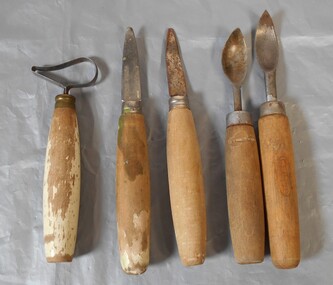
Domestic object - Fowlers Vacola utensils
... Five utensils used for preserving foods. Two bottle openers, two peach pitters and one pear corer. ...On one of the bottle openers the words: Fowlers Vacola bottle opener. ...Fowlers Vacola Preserving tools On one of the bottle openers the words: Fowlers Vacola bottle opener. ...Five utensils used for preserving foods. Two bottle openers, two peach pitters and one pear corer. All have wooden handles. One of the bottle openers and the pear corer still have some white paint on the handle. Part of the Aileen and John Ellison collection.On one of the bottle openers the words: Fowlers Vacola bottle opener. One of the peach pitters has an unreadable inscription within an oval on the wooden handle.fowlers vacola, preserving tools -
 Greensborough Historical Society
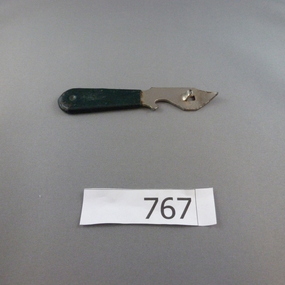
Bottle opener, Persinware, Persinware bottle opener, 1978c
... Persinware bottle opener...Multi purpose bottle or can opener. Size is suitable for carrying in pocket. ...Metal bottle/can opener with black plastic handle....Persinware bottle opener Bottle opener Persinware ...Multi purpose bottle or can opener. Size is suitable for carrying in pocket. [Persinware Openers were advertised in the Canberra Times in June and October 1978]Metal bottle/can opener with black plastic handle.Stamped into metal "Persinware"persinware, bottle opener, can opener -
 Greensborough Historical Society
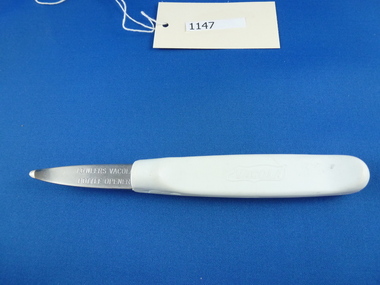
Bottle opener, Fowlers Vacola, Fowlers Vacola bottle opener, 1955c
... Fowlers Vacola bottle opener....[Fowlers Vacola Bottle Openers were advertised as late as 1955]..."Vacola" inscribed on handle; "Fowlers Vacola Bottle Opener" engraved on blade....Fowlers Vacola bottle opener. Bottle opener Fowlers Vacola ...Fowlers Vacola manufactured home fruit and vegetable bottling/preserving outfits. This opener was used for breaking the seal and opening the metal lids on jars of preserves. [Fowlers Vacola Bottle Openers were advertised as late as 1955]Metal blade with white plastic handle."Vacola" inscribed on handle; "Fowlers Vacola Bottle Opener" engraved on blade.fowler vacola, vacola, preserves -
 Dandenong/Cranbourne RSL Sub Branch
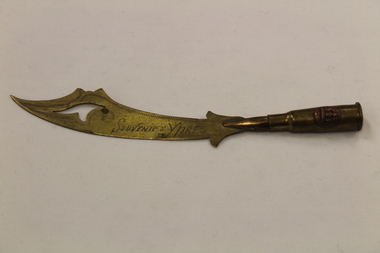
Memorabilia - Trenchart letter opener, Circa 1920s
... WW 1 Brass Trench Art Souvenir Letter Opener. Configured from a bullet on which is mounted a German Crown Button.and a piece of sheet brass from a shell casing....Inscribed on blade of letter opener is Souvenirs Ypres....Inscribed on blade of letter opener is Souvenirs Ypres. WW 1 Brass Trench Art Souvenir Letter Opener. ...The first Battle of Ypres (French: Premiere Bataille de Flandres . German: Erste Flandernsschlacht,19th October - 22 November 1914) was Battle of the First World War fought on the Western Front around Ypres in West Flanders Belgium.WW 1 Brass Trench Art Souvenir Letter Opener. Configured from a bullet on which is mounted a German Crown Button.and a piece of sheet brass from a shell casing.Inscribed on blade of letter opener is Souvenirs Ypres. -
 Mont De Lancey
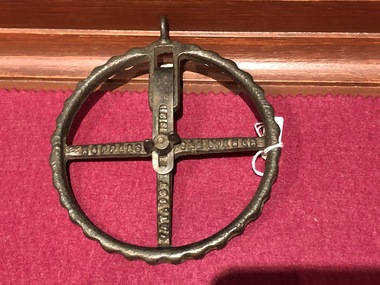
Can opener, Koppers, Circa 1910
... Circular cast iron can opener with adjustable screw and spike to pierce can. ...Koppers Can Opener Pat. Oct 99 ...Tin openers Kitchen equipment Kitchenware Koppers Can Opener Pat. ...Circular cast iron can opener with adjustable screw and spike to pierce can. Outside edge is scalloped shaped and has a small knob to hold onto the can. c1890/1910Koppers Can Opener Pat. Oct 99 tin openers, kitchen equipment, kitchenware -
 Emerald Museum & Nobelius Heritage Park
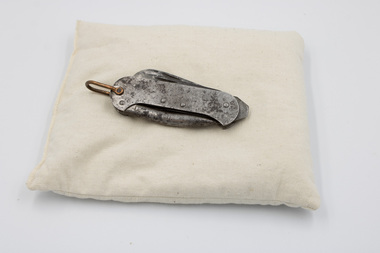
Tool - Carr Fast. Clasp Knife, Whittingslowe
... One blade folds out of the handle. One tin opener folds out of the handle adjacent to the blade. ...Right side of tin opener: "CARR / Arrowhead symbol"...Military world war 2 knife Right side of tin opener: "CARR / Arrowhead symbol" Metal handle. ...Clasp knives were made for military use in the Australian army during World War 2. The 'CARR' symbol indicates that the knife was made by Carr Fasteners company in Whittingslowe factories. The 'arrowhead symbol' below the 'CARR' symbol indicates that the knife was produced for military use.This item is significant as it provides insight into the tools used by the Australian Military in World War 2. It also provides historic insight into the companies that produced and supplied the tools to the military.Metal handle. One blade folds out of the handle. One tin opener folds out of the handle adjacent to the blade. On the opposite end and side of the handle a marlin spike folds out. On the end of the handle is a ring.Right side of tin opener: "CARR / Arrowhead symbol"military, world war 2, knife -
 Greensborough Historical Society
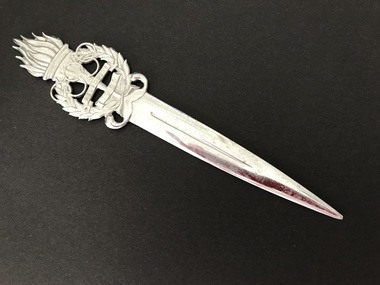
Functional object - Letter Opener, Melbourne Olympics 1956, 1956
... Commemorative letter opener issued to celebrate the Olympic Games in Melbourne 1956....Metal letter opener, handle contains Olympic rings and Olympic flame....Commemorative letter opener issued to celebrate the Olympic Games in Melbourne 1956. letter openers olympic games melbourne 1956 memorabilia On handle "Melbourne 1956" Metal letter opener, handle contains Olympic rings and Olympic flame. ...Commemorative letter opener issued to celebrate the Olympic Games in Melbourne 1956.Metal letter opener, handle contains Olympic rings and Olympic flame.On handle "Melbourne 1956"letter openers, olympic games melbourne 1956, memorabilia -
 National Vietnam Veterans Museum (NVVM)
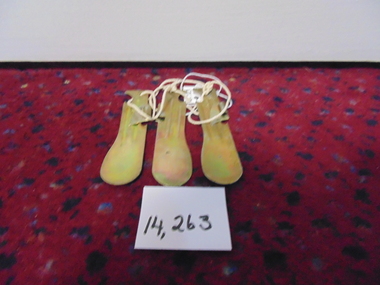
Equipment - Set of Three Army Ration Spoons
... Initially just a can opener, more functions were added, and it could be sterilised. ...Initially just a can opener, more functions were added, and it could be sterilised. ...Initially just a can opener, more functions were added, and it could be sterilised. ...Set of three field ration eating device (FRED) is an Australian eating utensil and multi-tool that serves as a combination of a can opener, bottle opener, and spoon.[ It was first issued around 1943 to the Australian Defence Force for use with its Combat Ration One Man field rations. Initially just a can opener, more functions were added, and it could be sterilised. Sourced from Wikipedia.Set of three field ration eating device (FRED) is an Australian eating utensil and multi-tool that serves as a combination of a can opener, bottle opener, and spoon.[ It was first issued around 1943 to the Australian Defence Force for use with its Combat Ration One Man field rations. Initially just a can opener, more functions were added, and it could be sterilised. Sourced from Wikipedia. 7330 - 66 010 - 0931 (1989) (1989) 1984ration spoons, field ration eating device -
 Bendigo Military Museum
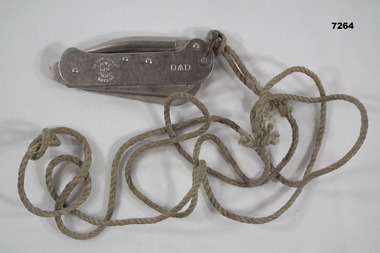
Equipment - KNIFE, CLASP
... Stainless steel construction clasp knife consisting of a blade, a can opener, a screwdriver, and a spike. The knife is attached to a khaki coloured lanyard....Stamped on the side of the knife: “WHITTINGSLOWE OPENER, 15737, PAT. APPN., ADELAIDE, D (upwards arrow) D”...See Catalogue No. 5942P for details of his service record. clasp knife equipment Kevin John Herdman Stamped on the side of the knife: “WHITTINGSLOWE OPENER, 15737, PAT. APPN., ADELAIDE, D (upwards arrow) D” Stainless steel construction clasp knife consisting of a blade, a can opener, a screwdriver, and a spike. ...Standard pattern of clasp knives issued since before the Second World War. Part of the Kevin John Herdman, No. 397661, Collection. See Catalogue No. 5942P for details of his service record.Stainless steel construction clasp knife consisting of a blade, a can opener, a screwdriver, and a spike. The knife is attached to a khaki coloured lanyard.Stamped on the side of the knife: “WHITTINGSLOWE OPENER, 15737, PAT. APPN., ADELAIDE, D (upwards arrow) D”clasp knife, equipment, kevin john herdman -
 Frankston RSL Sub Branch
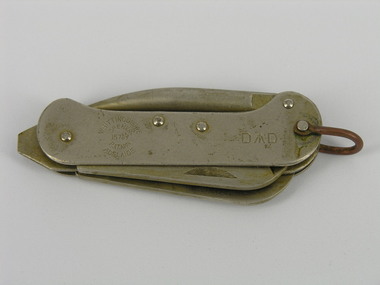
Knife, Pocket
... ...opener...It has a single edge knife blade, a can and bottle opener and a marlin spike all hinged to fold away into the knife body. ...The body of the knife is stamped with the following inscription "WITTINGSLOWE, OPENER, ADELAIDE, PAT.APPLN 15737" and a 'D^D' stamp....vietnam australian army pocket knife opener The body of the knife is stamped with the following inscription "WITTINGSLOWE, OPENER, ADELAIDE, PAT.APPLN 15737" and a 'D^D' stamp. ...Standard Australian Army servicemans metal pocket knife with three folding implements. It has a single edge knife blade, a can and bottle opener and a marlin spike all hinged to fold away into the knife body. One end of the knife is equipped with a screwdriver blade stub. The other end is equipped with a pivoting copper suspension loop. The body of the knife is stamped with the manufacturer's details, which includes a description of the style of knife as an 'opener', patent number '15737' and a 'D^D' stamp. This knife is wrapped in a waxed piece of paper printed with the instructions for using the can opener blade.The body of the knife is stamped with the following inscription "WITTINGSLOWE, OPENER, ADELAIDE, PAT.APPLN 15737" and a 'D^D' stamp.vietnam, australian, army, pocket knife, opener -
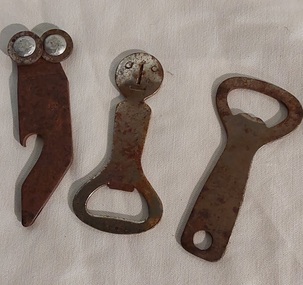 Mont De Lancey
Domestic object - Bottle openers, mid 1900's
... Bottle openers were widely used to open early beer or soft drink bottles. ...Has a shaped rectangular handle with a long hooked end for the opener. ...Bottle openers Bottle accessories Three small rusted vintage metal bottle openers. 1. ...Bottle openers were widely used to open early beer or soft drink bottles. Vintage openers were frequently given away for advertising, becoming common in homes, bars, and restaurants. Three small rusted vintage metal bottle openers. 1. Has a rectangular shaped handle with a hole at the end to hang it. 2. Has a short rectangular handle with a small round face marked end to hold it. 3. Has a shaped rectangular handle with a long hooked end for the opener. bottle openers, bottle accessories, -
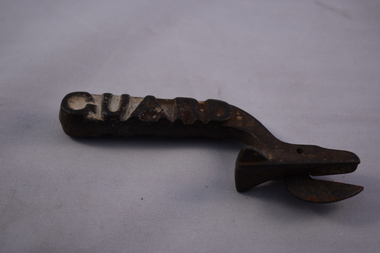 Warrnambool and District Historical Society Inc.
Household, Tin opener, Early 20th century
... Tin opener... Commercial tin openers first appeared in the mid 19th century and this model dates from the early 20th century. ...This is a cast iron tin opener with a cutting blade attached to a piece of metal with a screw. ...Tin opener Household ...Commercial tin openers first appeared in the mid 19th century and this model dates from the early 20th century. An improved version when a second serrated wheel was added came into operation about the mid 1920s. Tins (now cans) of food with sealed tops became popular in the 20th century and all households needed a tin opener. Today the can opener is still used but increasingly the can lids have an inbuilt clip that is pulled out to open the can. This tin opener has no known local provenance but it is retained as an early model of a tin opener from the past. It will be useful for display. This is a cast iron tin opener with a cutting blade attached to a piece of metal with a screw. The metal handle curves out from the metal piece holding the blade. The opener is a little rusty in parts. The name ‘Guard ’ is on both sides of the handle in raised metal letters.‘Guard’ household items, history of warrnambool -
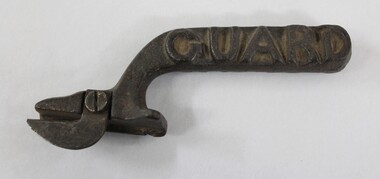 Wodonga & District Historical Society Inc
Functional object - Cast iron tin opener
... Cast iron tin opener...Commercial tin openers first appeared in the mid 19th century and this model dates from the early 20th century. ...This is a cast iron tin opener with a cutting blade attached to a piece of metal with a screw. ...Cast iron tin opener Functional object Cast iron tin opener ...Commercial tin openers first appeared in the mid 19th century and this model dates from the early 20th century. An improved version when a second serrated wheel was added came into operation about the mid 1920s. Tins (now cans) of food with sealed tops became popular in the 20th century and all households needed a tin opener. Today the can opener is still used but increasingly the can lids have an inbuilt clip that is pulled out to open the can.This tin opener has been retained as an early model of a tin opener from the past. It was used locally in Wodonga and donated by a Wodonga resident. It is also in relatively good condition.This is a cast iron tin opener with a cutting blade attached to a piece of metal with a screw. The metal handle curves out from the metal piece holding the blade. The opener is a little rusty in parts. The name ‘Guard ’ is on both sides of the handle in raised metal letters."GUARD" in raised letters on both sides of the handle.household items, cast iron appliances, can openers -
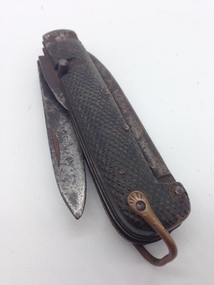 Montmorency–Eltham RSL Sub Branch
Knife, Clasp, with Marlin Spike and Tin Opener, WW1 era to late 1930s
... Knife, Clasp, with Marline Spike and Tin Opener, manufactured in England to the Standard Pattern 6353/1905, as modified in 1913 with specific dimensions to the tin opener. ...Knife, Clasp, with Marlin Spike and Tin Opener, manufactured to the standard British pattern 6353/1905, as modified in 1913 with changed dimensions for the tin opener. ...Knife, Clasp, with Marline Spike and Tin Opener, manufactured in England to the Standard Pattern 6353/1905, as modified in 1913 with specific dimensions to the tin opener. ...Knife, Clasp, with Marline Spike and Tin Opener, manufactured in England to the Standard Pattern 6353/1905, as modified in 1913 with specific dimensions to the tin opener. This pattern was used by British forces, and was one of the patterns issued to members of the Australian Infantry Force during WW1. This pattern was used up until the late 1930s, where it was superseded by other patterns.Knife, Clasp, with Marlin Spike and Tin Opener, manufactured to the standard British pattern 6353/1905, as modified in 1913 with changed dimensions for the tin opener. The hilt of the knife has two chequered pattern sides secured by five metal rivets. The underside of the hilt has two recesses to allow storage of the blade and the tin opener. A tapered steel Marline spike is mounted on the other side of the hilt, pivoting at the opposite end to the blade and tin opener. A copper wire shackle is also secured at this end of the hilt that was used to attach the knife to a lanyard or belt clip. A fingernail indentation is located near the top of one side of the blade. The tin opener has bevelled edges tapered to a point on one side, with a steel post mounted in the middle of the other side.J. CLARKE & SON SHEFFIELDknife, clasp, ww1, steel, marline spike, australian infantry force, milirary -
 Flagstaff Hill Maritime Museum and Village
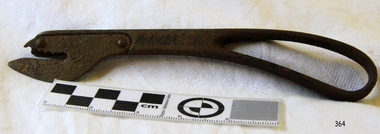
Domestic object - Can Opener
... Because meat was the first and most popular canned substance, these can openers were often shaped to look like cows and given the nickname 'bully beef can openers'. ...Can opener, right handed, metal, upper blade section serrated, inscription 'Peerless Pat.Feb 11-90'....Domestic object Can Opener ...It took 15 years to invent the can. It took 100 more to invent a standard way to open it. In the 19th century, decades after the invention of canning, there were virtually no can openers. Canned food, such as sardines, came with its own "key" to peel back the tin lid. Birth of the can One of the oddest things about the can opener is that the can predates it by almost 150 years. Though common today, cans were once military-grade technology. In 1795, Napoleon, to whom the phrase "an army marches on its stomach" is attributed, offered 12,000 francs to anyone who could find a way to preserve food. Without any knowledge of bacteria or their role in food spoilage, scientists didn't even know where to begin. It took 15 years before a chef named Nicholas Appert claimed the prize after successfully jarring food. Soon after that, his countryman Philippe de Girard came up with a variant on Appert's method—metal tins—and sold the idea to the British. Spoiled food, and the sickness it caused, was a widespread problem. The public would have benefited from canned food, but for decades cans were almost exclusively for the army and the navy. The canning process, with its hours of boiling and steaming, its scrupulous cleanliness, its heated metal, and its need for a great deal of disposable material, made canned food far too expensive for anyone but the military. No can openers were needed or even possible. The metal of early cans was too thick to make openers practical. Soldiers and sailors had plenty of sharp objects on hand and made ample use of them when they wanted to eat. During the 19th century, the process of canning was refined and mechanised, and the metal wall of the average can slimmed down enough that a civilian could get it open—if that civilian had the right tool. No one had that tool yet, so early cans had to open themselves. In other words, they came with built-in openers. The result was a confusing but pleasing free-for-all, in terms of product engineering. Each type of food came with its own kind of can, and each kind of can came with its own kind of opener. Tinned fish and meat were often sold in rectangular cans. These cans were fitted with a "key" that would roll down the top of the can. Coffee, beans, and other types of meat were packaged in cylinders with metal strips that could be peeled back with their own kinds of built-in keys. Cans of milk, which didn't need to be completely opened, came with puncture devices. As tinned food became more common, its containers became more regular. A nice cylindrical can became the norm, and, as these cans filled kitchens, more engineers put their minds to finding a convenient way to open all of them. The first standalone can opener worked on a simple principle: point, stab, and pull. From the mid-19th century to the end of World War I, the typical can opener looked roughly like a wrench, if the lower 'jaw' of the wrench were replaced with a blade. People used the blade to puncture the top of the can near its edge, push the upper jaw against the side of the can, and drag the blade through the metal along the rim. Because meat was the first and most popular canned substance, these can openers were often shaped to look like cows and given the nickname 'bully beef can openers'. The bully beef can opener, popular in the mid-19th century, resulted in many lost fingers. Bully beef can openers were so common, effective, and sturdy that they are still frequently available on collectors' sites. Some are advertised as “still working,” and every last one of them is, without a doubt, soaked in the blood of our ancestors. Dragging a sharp blade along the edge of a can is certain to cause injury sooner or later. So once people got a reliable can shape and a reliable way to get the can open, the search was on for a reliable way to get a can open without the possibility of losing a finger. The answer came in 1925, from the Star Can Opener Company of San Francisco. This is probably the first can opener that resembles the one people have in their kitchens today. Instead of using a blade to pry open a metal can, buyers could clamp the edge of the can between two wheels and twist the handle of one of the wheels to move the blade around the lip. The Star can openers weren't perfect. Compared to the bully beef model, they were flimsy and breakable, but they probably prevented a few injuries. Six short years after the Star model came to market, the first electric can opener was invented. It was patented in 1931 by the Bunker Clancey Company of Kansas City, who had already been sued by the Star Can Opener Company for trying sell a double-wheeled can opener like the Star model (the case was dismissed). The electric can opener must have seemed like the wave of the future and a sure-fire seller, but it proved to be too far ahead of its time. In 1931 not that many households had electricity, and those that did weren't interested in buying can openers. The Bunker Clancey Company was subsequently bought by the Rival Company, which still makes small appliances like can openers today. It took another 25 years for electrically powered can openers to become practical. In the 1950s, Walter Hess Bodle and his daughter, Elizabeth Bodle, developed an electric can opener in the family garage. Walter came up with the opener's blades and motor, and Elizabeth sculpted the outside. Their can opener was a free-standing unit that could sit on the kitchen counter. The Udico brand of the Union Die Casting Company put it on the market in time for Christmas in 1956 and had great success with it. Over the next few years it came out in different styles and colours, and, like the bully beef can opener, has become a collector's item. Also like the bully beef model, Udico can openers often still work. They don't make 'em like they used to. Although there have been some design changes and refinements over the last sixty years, there have yet to be any more leaps forward in can opener technology. If you're resentfully opening a can, you are almost certainly doing it using the Star design, manually forcing the can between two wheels, or the Bodle design, clamping the can into a free-standing electrical opener. Whether or not you enjoy your holiday meals, at least you can be happy that you are not getting poisoned by your own food or cutting open your hand with the blade you use to get at it. That's something, right?The can opener is still a very important and essential item in most kitchens.Can opener, right handed, metal, upper blade section serrated, inscription 'Peerless Pat.Feb 11-90'.Peerless Pat.Feb 11-90flagstaff hill, warrnambool, shipwrecked-coast, flagstaff-hill, flagstaff-hill-maritime-museum, maritime-museum, shipwreck-coast, flagstaff-hill-maritime-village, cannning, can opener, kitchen equipment -
 Mont De Lancey
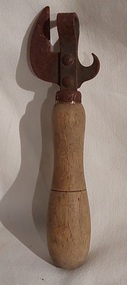
Domestic object - Bottle and Can Opener, 1950's
... Some had only a blade for the can opener....A dual metal can and bottle opener with a decorative line on the turned wooden handle. ...Some had only a blade for the can opener. Can openers Bottle openers Kitchen equipment A dual metal can and bottle opener with a decorative line on the turned wooden handle. ...Early openers were often a single tool for both purposes, a double-ended design that punctured cans with a triangle hole and opened bottles, with modern versions like pull tabs appearing later. Some had only a blade for the can opener.A dual metal can and bottle opener with a decorative line on the turned wooden handle. Rivets join the metal can and bottle opening sections.can openers, bottle openers, kitchen equipment -
Victorian Maritime Centre
Letter Opener
... The souvenir plastic letter opener was purchased sometime during a cruise by an unknown person. ...Plastic letter opener with Tassel "Orcades"...The souvenir plastic letter opener was purchased sometime during a cruise by an unknown person. ...The souvenir plastic letter opener was purchased sometime during a cruise by an unknown person. It is part of a cruise liner collection by D. Benson and Family over a period of years. D. Benson sold part of the collection to the V.M.C who purchased the remaining part. It is a great source of information to visitors to the V.M.C. At the time of ocean liner holiday cruising, many people purchased these souvenirs to keep or give away as gifts.Plastic letter opener with Tassel "Orcades"Orcadessouvenir, s.s orcades -
 Mont De Lancey
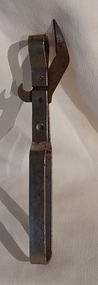
Domestic object - Bottle and Can Opener, 1950's
... Some had only a blade for the can opener....A dual metal can and bottle opener. Three rivets join the metal can and bottle opening sections. ...Some had only a blade for the can opener. Can openers Bottle openers Kitchen equipment A dual metal can and bottle opener. ...Early openers were often a single tool for both purposes, a double-ended design that punctured cans with a triangle hole and opened bottles, with modern versions like pull tabs appearing later. Some had only a blade for the can opener.A dual metal can and bottle opener. Three rivets join the metal can and bottle opening sections. The handle has an open section along the length of it.can openers, bottle openers, kitchen equipment -
 Mont De Lancey
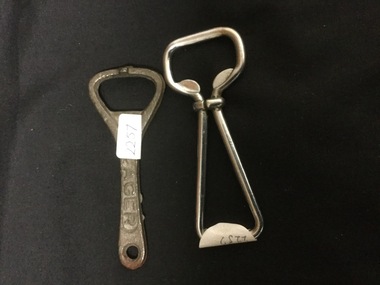
Bottle opener, Carlton & United Breweries, Limited, c1940
... The Abbots Lager opener may have been a promotional product for this brand of beer....Two cast iron bottle openers, rusted exterior. One labelled Fosters Lager; one labelled Abbots Lager....The Abbots Lager opener may have been a promotional product for this brand of beer. bottle openers bottle accessories 'Carlton & Victoria Bitter' 'Abbots Lager' 'Fosters Lager' Two cast iron bottle openers, rusted exterior. ...Widely used to open early beer or soft drink bottles. The Abbots Lager opener may have been a promotional product for this brand of beer.Two cast iron bottle openers, rusted exterior. One labelled Fosters Lager; one labelled Abbots Lager.'Carlton & Victoria Bitter' 'Abbots Lager' 'Fosters Lager'bottle openers, bottle accessories
