
Showing 107 items matching "operating conditions"
-
 Moorabbin Air Museum
Book - McDonnel Douglas DC-10, DC-10 Airplane Characteristics Airport Planning
... ...Operating conditions...McDonnell Douglas DC 10 Airplane description Airplane performance Ground maneuvering Terminal servicing Operating conditions Pavement data Scale drawings Technical overview of DC-10 airliner for airport planning, circa 1979 DC-10 Airplane Characteristics Airport Planning Book McDonnel Douglas DC-10 ...Technical overview of DC-10 airliner for airport planning, circa 1979non-fictionTechnical overview of DC-10 airliner for airport planning, circa 1979airplane description, airplane performance, ground maneuvering, terminal servicing, operating conditions, pavement data, scale drawings -
4th/19th Prince of Wales's Light Horse Regiment Unit History Room
Book, Signal Training (All Arms) Pam No 7 Procedure for Radio Telephony 1952, July 1952
... Soft covered book detailing the system of calling, the procedures used for various operating conditions, and other requirements as used in radio telephony. ...Used by the Regiment Radio training voice procedure WO Code No 8761 Soft covered book detailing the system of calling, the procedures used for various operating conditions, and other requirements as used in radio telephony. ...Used by the RegimentSoft covered book detailing the system of calling, the procedures used for various operating conditions, and other requirements as used in radio telephony. WO Code No 8761radio training, voice procedure -
4th/19th Prince of Wales's Light Horse Regiment Unit History Room
Pamphlet, Signal Training (All Arms) Pam No 7 Procedure for Radio Telephony 1952, July 1952
... Soft covered book detailing the system of calling, the procedures used for various operating conditions, and other requirements as used in radio telephony....Used by the Regiment training radio procedures WO Code No 8761 Soft covered book detailing the system of calling, the procedures used for various operating conditions, and other requirements as used in radio telephony. ...Used by the RegimentSoft covered book detailing the system of calling, the procedures used for various operating conditions, and other requirements as used in radio telephony.WO Code No 8761training, radio procedures -
8th/13th Victorian Mounted Rifles Regimental Collection
Document, October 1988
... Consequently the Squadron deployed on Exercise ‘Northern Explorer’ to gain first-hand knowledge of operating conditions for mounted and dismounted patrolling in the area....Consequently the Squadron deployed on Exercise ‘Northern Explorer’ to gain first-hand knowledge of operating conditions for mounted and dismounted patrolling in the area. ...In 1988, as part of a Defence of Mainland Australian policy, defence of facilities of strategic importance in northern Australia were allocated to Army Reserve units. ‘A’ Squadron was allocated the defence of Tindal Air Force base located 15 KM outside Katherine in Northern Territory. Consequently the Squadron deployed on Exercise ‘Northern Explorer’ to gain first-hand knowledge of operating conditions for mounted and dismounted patrolling in the area.Typed report on exercise ' Northern Explorer ' 15-20 September 1988 prepared by Captain G. Carrington ' A ' Squadron 8/13 Victorian Mounted Rifles. Seven pages, dated 1 October 1988. -
 8th/13th Victorian Mounted Rifles Regimental Collection
Photograph
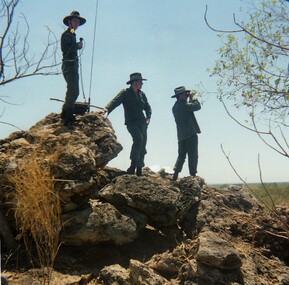
... Consequently the Squadron deployed on Exercise ‘Northern Explorer’ to gain first-hand knowledge of operating conditions for mounted and dismounted patrolling in the area....Consequently the Squadron deployed on Exercise ‘Northern Explorer’ to gain first-hand knowledge of operating conditions for mounted and dismounted patrolling in the area. ...In 1988, as part of a Defence of Mainland Australian policy, defence of facilities of strategic importance in northern Australia were allocated to Army Reserve units. ‘A’ Squadron was allocated the defence of Tindal Air Force base located 15 KM outside Katherine in Northern Territory. Consequently the Squadron deployed on Exercise ‘Northern Explorer’ to gain first-hand knowledge of operating conditions for mounted and dismounted patrolling in the area.Colour photograph of three soldiers of ' A ' Squadron 8/13 VMR using a whip antenna to establish communication with their base while on patrol during exercise ' Northern Explorer.' -
 8th/13th Victorian Mounted Rifles Regimental Collection
Photograph
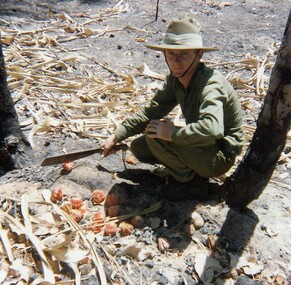
... Consequently the Squadron deployed on Exercise ‘Northern Explorer’ to gain first-hand knowledge of operating conditions for mounted and dismounted patrolling in the area....Consequently the Squadron deployed on Exercise ‘Northern Explorer’ to gain first-hand knowledge of operating conditions for mounted and dismounted patrolling in the area. ...In 1988, as part of a Defence of Mainland Australian policy, defence of facilities of strategic importance in northern Australia were allocated to Army Reserve units. ‘A’ Squadron was allocated the defence of Tindal Air Force base located 15 KM outside Katherine in Northern Territory. Consequently the Squadron deployed on Exercise ‘Northern Explorer’ to gain first-hand knowledge of operating conditions for mounted and dismounted patrolling in the area.Lance Corporal R. Van De Velde, ' A ' Squadron 8/13 VMR during Exercise ' Northern Explorer' September 1988. LCpl Van De Velde has a collection of Pandamus Palm nut prematurely ripened by fire near King River Northern Territory. -
 8th/13th Victorian Mounted Rifles Regimental Collection
Photograph
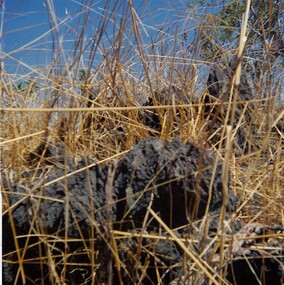
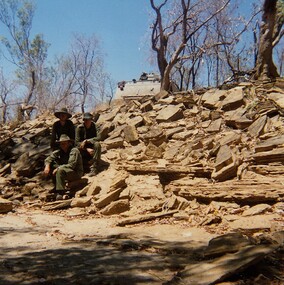
... Consequently the Squadron deployed on Exercise ‘Northern Explorer’ to gain first-hand knowledge of operating conditions for mounted and dismounted patrolling in the area....Consequently the Squadron deployed on Exercise ‘Northern Explorer’ to gain first-hand knowledge of operating conditions for mounted and dismounted patrolling in the area. ...In 1988, as part of a Defence of Mainland Australian policy, defence of facilities of strategic importance in northern Australia were allocated to Army Reserve units. ‘A’ Squadron was allocated the defence of Tindal Air Force base located 15 KM outside Katherine in Northern Territory. Consequently the Squadron deployed on Exercise ‘Northern Explorer’ to gain first-hand knowledge of operating conditions for mounted and dismounted patrolling in the area.Colour photograph of jaggered basalt rock covering most of high country SSW of Tindal RAAF Base, Northern Territory. Photo was taken to illustrate reports of patrols during Exercise " Northern Explorer" September 1988. -
 8th/13th Victorian Mounted Rifles Regimental Collection
Photograph
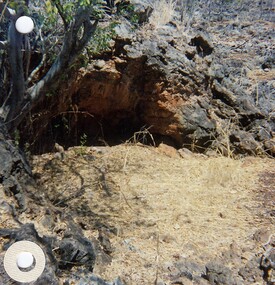
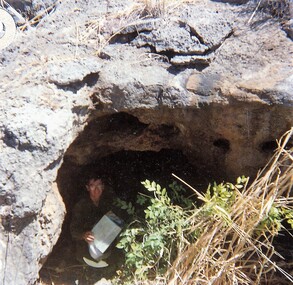
... Consequently the Squadron deployed on Exercise ‘Northern Explorer’ to gain first-hand knowledge of operating conditions for mounted and dismounted patrolling in the area....Consequently the Squadron deployed on Exercise ‘Northern Explorer’ to gain first-hand knowledge of operating conditions for mounted and dismounted patrolling in the area. ...In 1988, as part of a Defence of Mainland Australian policy, defence of facilities of strategic importance in northern Australia were allocated to Army Reserve units. ‘A’ Squadron was allocated the defence of Tindal Air Force base located 15 KM outside Katherine in Northern Territory. Consequently the Squadron deployed on Exercise ‘Northern Explorer’ to gain first-hand knowledge of operating conditions for mounted and dismounted patrolling in the area.Two colour photographs of sink holes/rock depressions cbserved while on patrol during Exercise " Northern Explorer. These features offered the only shade when temperature was 41oC. -
 8th/13th Victorian Mounted Rifles Regimental Collection
Photograph
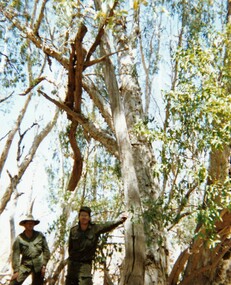
... Consequently the Squadron deployed on Exercise ‘Northern Explorer’ to gain first-hand knowledge of operating conditions for mounted and dismounted patrolling in the area....Consequently the Squadron deployed on Exercise ‘Northern Explorer’ to gain first-hand knowledge of operating conditions for mounted and dismounted patrolling in the area. ...In 1988, as part of a Defence of Mainland Australian policy, defence of facilities of strategic importance in northern Australia were allocated to Army Reserve units. ‘A’ Squadron was allocated the defence of Tindal Air Force base located 15 KM outside Katherine in Northern Territory. Consequently the Squadron deployed on Exercise ‘Northern Explorer’ to gain first-hand knowledge of operating conditions for mounted and dismounted patrolling in the area.Colour photograph of Captain C. Carrington, earing hat, and Sergeant Koschel of ' A ' Squadron 8/13 VMR during Exercise " Northern Explorer." Flood debris caught high in tree branches indicate water level during wet season on Ferguson River, Northern Territory. -
 8th/13th Victorian Mounted Rifles Regimental Collection
Photograph
... Consequently the Squadron deployed on Exercise ‘Northern Explorer’ to gain first-hand knowledge of operating conditions for mounted and dismounted patrolling in the area....Consequently the Squadron deployed on Exercise ‘Northern Explorer’ to gain first-hand knowledge of operating conditions for mounted and dismounted patrolling in the area. ...In 1988, as part of a Defence of Mainland Australian policy, defence of facilities of strategic importance in northern Australia were allocated to Army Reserve units. ‘A’ Squadron was allocated the defence of Tindal Air Force base located 15 KM outside Katherine in Northern Territory. Consequently the Squadron deployed on Exercise ‘Northern Explorer’ to gain first-hand knowledge of operating conditions for mounted and dismounted patrolling in the area.Colour photograph of Captain C. Carrington sheltering from 41o sun during Exercise " Northern Explorer." -
 8th/13th Victorian Mounted Rifles Regimental Collection
Photograph
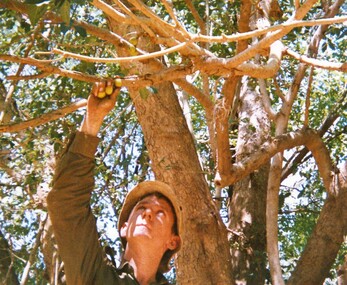
... Consequently the Squadron deployed on Exercise ‘Northern Explorer’ to gain first-hand knowledge of operating conditions for mounted and dismounted patrolling in the area....Consequently the Squadron deployed on Exercise ‘Northern Explorer’ to gain first-hand knowledge of operating conditions for mounted and dismounted patrolling in the area. ...In 1988, as part of a Defence of Mainland Australian policy, defence of facilities of strategic importance in northern Australia were allocated to Army Reserve units. ‘A’ Squadron was allocated the defence of Tindal Air Force base located 15 KM outside Katherine in Northern Territory. Consequently the Squadron deployed on Exercise ‘Northern Explorer’ to gain first-hand knowledge of operating conditions for mounted and dismounted patrolling in the area.Colour photograph of Lance Corporal R. Van. De Velde picking native figs on bank of Ferguson River, Northern Territory during Exercise "Northern Explorer." Soldiers of ' A ' Squadron 8/13 VMR had received instruction of bush food by Major Les Hiddens aka ' The Bush Tucker Man. '100 mm x 100 mm -
 8th/13th Victorian Mounted Rifles Regimental Collection
Photograph
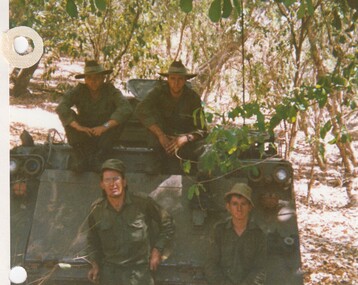
... Consequently the Squadron deployed on Exercise ‘Northern Explorer’ to gain first-hand knowledge of operating conditions for mounted and dismounted patrolling in the area....Consequently the Squadron deployed on Exercise ‘Northern Explorer’ to gain first-hand knowledge of operating conditions for mounted and dismounted patrolling in the area. ...In 1988, as part of a Defence of Mainland Australian policy, defence of facilities of strategic importance in northern Australia were allocated to Army Reserve units. ‘A’ Squadron was allocated the defence of Tindal Air Force base located 15 KM outside Katherine in Northern Territory. Consequently the Squadron deployed on Exercise ‘Northern Explorer’ to gain first-hand knowledge of operating conditions for mounted and dismounted patrolling in the area.Colour photograph of four members of a vehicle patrol of ' A ' Squadron 8/13 VMR at Ferguson River, Northern Territory, during Exercise 'Northern Explorer." -
 8th/13th Victorian Mounted Rifles Regimental Collection
Photograph
... Consequently the Squadron deployed on Exercise ‘Northern Explorer’ to gain first-hand knowledge of operating conditions for mounted and dismounted patrolling in the area....Consequently the Squadron deployed on Exercise ‘Northern Explorer’ to gain first-hand knowledge of operating conditions for mounted and dismounted patrolling in the area. ...In 1988, as part of a Defence of Mainland Australian policy, defence of facilities of strategic importance in northern Australia were allocated to Army Reserve units. ‘A’ Squadron was allocated the defence of Tindal Air Force base located 15 KM outside Katherine in Northern Territory. Consequently the Squadron deployed on Exercise ‘Northern Explorer’ to gain first-hand knowledge of operating conditions for mounted and dismounted patrolling in the area.Colour photograph of vehicle patrol of ' A " Squadron 8/13 VMR accessing the viability of a crossing point of Ferguson River during Exercise ' Northern Explorer. The patrol decided the Armoured Personnel carrier could descend the shale bank but not climb out again. -
 8th/13th Victorian Mounted Rifles Regimental Collection
Photograph
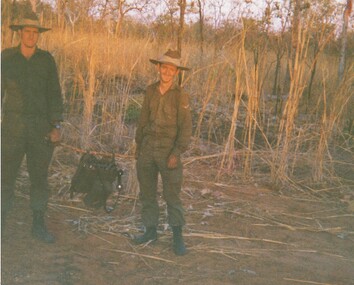
... Consequently the Squadron deployed on Exercise ‘Northern Explorer’ to gain first-hand knowledge of operating conditions for mounted and dismounted patrolling in the area....Consequently the Squadron deployed on Exercise ‘Northern Explorer’ to gain first-hand knowledge of operating conditions for mounted and dismounted patrolling in the area. ...In 1988, as part of a Defence of Mainland Australian policy, defence of facilities of strategic importance in northern Australia were allocated to Army Reserve units. ‘A’ Squadron was allocated the defence of Tindal Air Force base located 15 KM outside Katherine in Northern Territory. Consequently the Squadron deployed on Exercise ‘Northern Explorer’ to gain first-hand knowledge of operating conditions for mounted and dismounted patrolling in the area.Colour photograph of two soldiers of ' A ' Squadron 8/13 VMR during Exercise ' Northern Explorer '. Trooper Pratt and Lance Corporal Van De Valde demonstrate how the F2 radio set could be carried. In addition the men would have webbing, pack and rifle to carry. -
 8th/13th Victorian Mounted Rifles Regimental Collection
Document
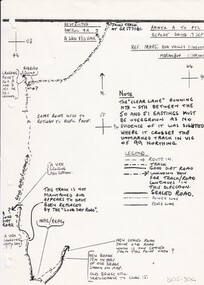
... Consequently the Squadron deployed on Exercise ‘Northern Explorer’ to gain first-hand knowledge of operating conditions for mounted and dismounted patrolling in the area....Consequently the Squadron deployed on Exercise ‘Northern Explorer’ to gain first-hand knowledge of operating conditions for mounted and dismounted patrolling in the area. ...In 1988, as part of a Defence of Mainland Australian policy, defence of facilities of strategic importance in northern Australia were allocated to Army Reserve units. ‘A’ Squadron was allocated the defence of Tindal Air Force base located 15 KM outside Katherine in Northern Territory. Consequently the Squadron deployed on Exercise ‘Northern Explorer’ to gain first-hand knowledge of operating conditions for mounted and dismounted patrolling in the area.Rare example of a patrol report conducted by soldiers of a Victorian Army Reserve regiment while exercising in Northern Territory.Report of reconnaissance patrol conducted by soldiers of 'A' Squadron 8/13 Victorian Mounted Rifles during Exercise 'Northern Explorer, Northern Territory. 13 pages plus sketch map. -
 8th/13th Victorian Mounted Rifles Regimental Collection
Document - Report
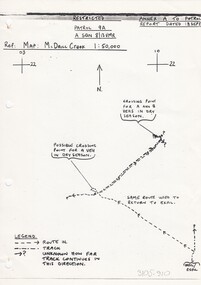
... Consequently the Squadron deployed on Exercise ‘Northern Explorer’ to gain first-hand knowledge of operating conditions for mounted and dismounted patrolling in the area....Consequently the Squadron deployed on Exercise ‘Northern Explorer’ to gain first-hand knowledge of operating conditions for mounted and dismounted patrolling in the area. ...In 1988, as part of a Defence of Mainland Australian policy, defence of facilities of strategic importance in northern Australia were allocated to Army Reserve units. ‘A’ Squadron was allocated the defence of Tindal Air Force base located 15 KM outside Katherine in Northern Territory. Consequently the Squadron deployed on Exercise ‘Northern Explorer’ to gain first-hand knowledge of operating conditions for mounted and dismounted patrolling in the area.Rare patrol report made by soldiers of a Victorian regiment while on exercise in Northern Territory.Report of patrol carried out by soldiers of 'A' Squadron 8/13 Victorian Mounted Rifles 18 September 1988 near Tindal Air Base Northern Territory. Six pages plus sketch map.military, patrol, tindal, northern territory, vmr -
8th/13th Victorian Mounted Rifles Regimental Collection
Document, September 1988
... Consequently the Squadron deployed on Exercise ‘Northern Explorer’ to gain first-hand knowledge of operating conditions for mounted and dismounted patrolling in the area....Consequently the Squadron deployed on Exercise ‘Northern Explorer’ to gain first-hand knowledge of operating conditions for mounted and dismounted patrolling in the area. ...In 1988, as part of a Defence of Mainland Australian policy, defence of facilities of strategic importance in northern Australia were allocated to Army Reserve units. ‘A’ Squadron was allocated the defence of Tindal Air Force base located 15 KM outside Katherine in Northern Territory. Consequently the Squadron deployed on Exercise ‘Northern Explorer’ to gain first-hand knowledge of operating conditions for mounted and dismounted patrolling in the area.Rare example of an assessment prepared by a trooper in a Victorian Citizen Military Forces regiment during an exercise in Northern Territory.Typed assessment of the performance of armoured vehicles during Exercise "Northern Explorer" in September 1988. Document is titled "A Veh Ops in the Tindal AO" prepared by Trooper D J Pratt 1 Troop A Squadron 8/13 Victorian Mounted Rifles. Three pages dated 22 September 1988. -
8th/13th Victorian Mounted Rifles Regimental Collection
Document - report "Northern Explorer"
... Consequently, the Squadron deployed on Exercise ‘Northern Explorer’ to gain first-hand knowledge of operating conditions for mounted and dismounted patrolling in the area....Consequently, the Squadron deployed on Exercise ‘Northern Explorer’ to gain first-hand knowledge of operating conditions for mounted and dismounted patrolling in the area. ...Example of after training report following annual exercise. In 1988, as part of a Defence of Mainland Australian policy, defence of facilities of strategic importance in northern Australia were allocated to Army Reserve units. ‘A’ Squadron was allocated the defence of Tindal Air Force base located 15 KM outside Katherine in Northern Territory. Consequently, the Squadron deployed on Exercise ‘Northern Explorer’ to gain first-hand knowledge of operating conditions for mounted and dismounted patrolling in the area.Typed report on Operational efficiency of AFV vehicles and crews prepared by Lance Corporal Van De Velde ' A ' Squadron 8/13 Victorian Mounted Rifles following Exercise ' Northern Explorer' 15-20 September 1988. Two pages, dated 22 September 1988.northern territory, vmr, tindal, training, carrington, explorer -
 Bendigo Historical Society Inc.
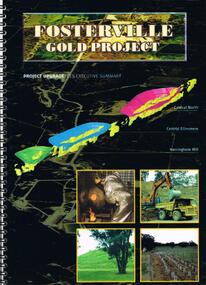
Document - FOSTERVILLE GOLD MINE COLLECTION: FOSTERVILLE GOLD PROJECT UPGRADE EXECUTIVE SUMMARUY
... Environmental issues, and summary of proposed new operating conditions....Environmental issues, and summary of proposed new operating conditions. Document FOSTERVILLE GOLD MINE COLLECTION: FOSTERVILLE GOLD PROJECT UPGRADE EXECUTIVE SUMMARUY ...Black cover book, wire binding, 13 pages of text and maps. On front: Fosterville Gold Project' Map of ore body on cover - Central North, Central Ellesmere, Harringtons Hill. Contents include: open pits, heap leaching, waste dumps, estimated project life, changes from previously approved project, estimated project life, main project components, expanded open pits and underground mines, processing sulphide ore, tailings storages, waste rock dumps. Principles of rehabilitation, site preparation, rehabilitation activities during operation and decommissioning activities. Environmental issues, and summary of proposed new operating conditions.bendigo, mining, fosterville gold mine -
 8th/13th Victorian Mounted Rifles Regimental Collection
Photograph - Training South Australia
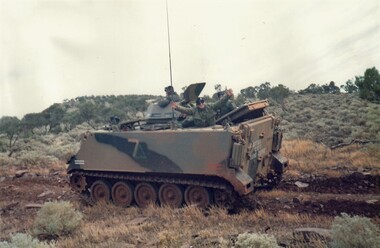
... The location allowed crewmen from north-east Victoria to experience vastly different operating conditions. The 8th/13th Victorian Mounted Rifles was raised as a regiment of the Royal Australian Armoured Corps on 1 May 1948 with Headquarters in Melbourne and squadrons in Sale, Benalla/Wangaratta and Albury. ...The location allowed crewmen from north-east Victoria to experience vastly different operating conditions. The 8th/13th Victorian Mounted Rifles was raised as a regiment of the Royal Australian Armoured Corps on 1 May 1948 with Headquarters in Melbourne and squadrons in Sale, Benalla/Wangaratta and Albury. ...The 8th/13th Victorian Mounted Rifles was raised as a regiment of the Royal Australian Armoured Corps on 1 May 1948 with Headquarters in Melbourne and squadrons in Sale, Benalla/Wangaratta and Albury. In 1955 Regimental Headquarters moved to Wangaratta and a second squadron was located at Albury. The Sale squadron transferred to 4th/19th Prince of Wales’s Light Horse. In 1977 8/13 VMR Regiment was reduced to an independent squadron A Squadron 8th/13th Victorian Mounted Rifles and in 1991 was linked with 4th/19th Prince of Wales’s Light Horse forming the VMR Squadron of that regiment.Collection of six colour photographs showing members of 'A' Squadron 8/13 Victorian Mounted Rifles on a Driving and Servicing Course at Port Augusta South Australia, 1989. The location allowed crewmen from north-east Victoria to experience vastly different operating conditions. The 8th/13th Victorian Mounted Rifles was raised as a regiment of the Royal Australian Armoured Corps on 1 May 1948 with Headquarters in Melbourne and squadrons in Sale, Benalla/Wangaratta and Albury. In 1955 Regimental Headquarters moved to Wangaratta and a second squadron was located at Albury. The Sale squadron transferred to 4th/19th Prince of Wales’s Light Horse. In 1977 8/13 VMR Regiment was reduced to an independent squadron A Squadron 8th/13th Victorian Mounted Rifles and in 1991 was linked with 4th/19th Prince of Wales’s Light Horse forming the VMR Squadron of that regiment.military, vmr, m113, training, south australia -
Frankston RSL Sub Branch
Drift Recorder, W & G, A M Drift Recorder MKII, 1930 - 1939
... Purpose built mechanical calculation machine for determining the drift of aircraft when operating in crosswind conditions. This device has an eyepiece and a prismatic periscope for viewing a distant feature being tracked. ...No 6B/190 No 2668/41 X/ 3606 3E4H28 Purpose built mechanical calculation machine for determining the drift of aircraft when operating in crosswind conditions. This device has an eyepiece and a prismatic periscope for viewing a distant feature being tracked. ...Purpose built mechanical calculation machine for determining the drift of aircraft when operating in crosswind conditions. This device has an eyepiece and a prismatic periscope for viewing a distant feature being tracked. This device has calibrated rotary scales for height, speed (in KNOTS and MPH), and an adjustment to preset the 'crab angle' of the aircaft for cross wind compensation. The device can be opened for cleaning or maintenance purposes. Refer to the following extracts for information about bomb drift: "Crosswinds brought into the bombing problem a new factor, "drift" In order to fly a given ground track in a crosswind, an aircraft had to "crab" into the wind; the angle formed between the aircraft's true heading and its ground track was called the "drift angle" In a crosswind, the bomb would impact directly behind the aircraft and along its longitudinal axis at the moment of release. But this meant that the bomb would strike the ground at some point downwind of the aircraft's ground track. Thus, in order to score a hit, the bomber had to fly a ground track that ran upwind of the target." "Air resistance acting on a bomb after release caused it to lag behind the drop point and hit somewhere behind the bomber. The distance from a point beneath the aircraft at the instant of bomb impact to the point of bomb impact was called "trail." Trail increased as the bomber's airspeed increased or as its altitude increased. Furthermore, since different bombs encountered different resistance in the air, trail was also a factor of bomb shape."A. M. Drift Recorder MKII REF. No 6B/190 No 2668/41 X/ 3606 3E4H28 -
 Flagstaff Hill Maritime Museum and Village
Machine - Lathe, W F & John Barnes, early 1900s
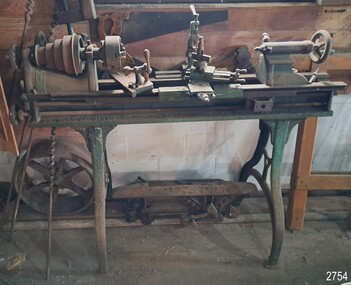
... operated machines and the advent of electrically powered equipment. Its presence exemplifies the progression of industrial technology and craftsmanship during this period. The lathe is particularly notable for its association with the Briggs Brass Foundry. The foundry was known for developing a specialised brass alloy composed of non-ferrous metals, a formulation that resulted in durable products built to withstand the demanding conditions of marine environments. ...This woodworking lathe, connected to both a pulley and a flywheel, demonstrates its historical operation with a steam engine. Such a configuration reflects manufacturing practices from the late 1800s and early 1900s, when steam power was the predominant source for driving workshop and factory machinery. Large machine shops often utilised a single power source, distributing power via roof-mounted belts and pulleys to operate several machines simultaneously. Over time, petrol-driven motors were introduced, and eventually, electricity became the standard power source. Conversion kits were made available in the late 19th and early 20th centuries to adapt older lathes to these newer, cleaner fuels. Manufacturer's History: W.F. & J. Barnes was a renowned maker of hand- and foot-powered treadle woodworking and metalworking machinery, established in 1869. The partnership between William F. Barnes and John Barnes was formalised in 1872, and the firm was incorporated in 1884. Their machines were used for both ‘farm’ applications and professional engineering. By 1881, the company began producing electrically powered machinery. By 1937, W.F. & J. Barnes expanded into manufacturing machinery for automotive assembly. The business closed in 1983, and in 1998, LeBlond Ltd. of Ohio acquired the firm. The lathe was donated by Briggs Marine, Melbourne: In Flagstaff Hill’s formative years, 1972-1975, Briggs Marine, Melbourne (Briggs Brass Foundry), donated equipment and objects used or made at their premises. The foundry was established in 1912 by Herbert Harrison Briggs. In 1965, the firm was owned by partners Cyril Briggs and Frank Lee: Cyril died in 1967, and Frank died in 1971, so the foundry was then run by his son and daughter-in-law, Les and Eva Lee. Briggs Marine’s Warrnambool Branch closed in 1972 after the death of Frank Lee in 1971. Flagstaff Hill’s founding director, John Lindsay, recalled that Briggs Marine’s family members gave personal assistance in setting up the displays in the original village shops, particularly the ‘Brass Foundry’ building, around the time the Maritime Museum opened in 1975. Briggs Marine still exists today, but the Briggs family is no longer involved. This early 1900s lathe marks a significant stage in the evolution of machinery, positioned between the era of hand-operated machines and the advent of electrically powered equipment. Its presence exemplifies the progression of industrial technology and craftsmanship during this period. The lathe is particularly notable for its association with the Briggs Brass Foundry. The foundry was known for developing a specialised brass alloy composed of non-ferrous metals, a formulation that resulted in durable products built to withstand the demanding conditions of marine environments. This focus on resilience and longevity made Briggs Brass Foundry’s goods highly sought after within the maritime sector. Briggs Maine, a long-established business, utilised the foundry’s capabilities to create cast goods tailored to the needs of the marine industry. The facility was equipped to deliver both custom-designed and mass-produced items, ensuring versatility in meeting various requirements. Many of Briggs Foundry’s products found their place on sailing and steam vessels throughout Victoria’s coastline, including in the port town of Warrnambool, where there was once a brancy of Briggs Marine. In addition to general marine fittings, Briggs Marine earned recognition for its expertise in bell-founding. The foundry’s reputation is closely linked to the restoration of the Schomberg Bell at Flagstaff Hill, a small but historically significant bell from a luxury migrant vessel dating back to the mid-19th century. The successful restoration of the Schomberg Bell demonstrates Briggs Brass Foundry’s commitment to preserving craftsmanship and maritime heritage.The lathe is a green, bench-type, steam-powered woodworking machine. Its bench is supported by decorative posts at each end, with each post dividing into arched legs. The lathe is mechanically connected to both a pulley and a flywheel, designed to be operated in conjunction with a steam engine. Included with the lathe is a range of accessories. Across the front of the machine, an inscription is cast, and a stamped, metal lathe pulley guide is attached to the drive mechanism. The lathe was manufactured by W. F. and J. Barnes, Rockford, Illinois, USA, during the 1900s.“W F and J Barnes, Rockford, USA” "1820" "1887"flagstaff hill, flagstaff hill maritime museum and village, warrnambool, maritime museum, maritime village, great ocean road, shipwreck coast, lathe, steam-operated lathe, steam-operated pulley, steam power, steam engine, machine, steam operated machine, metal work, foundry work, metal working trade, tool, pulley driven, metalworking, woodworking, barnes lathe, briggs marine, belt driven, wordworking lathe, free standing lathe, bench lathe, steam powered, vintage lathe, woodturning lathe, w. f. and j. barnes, illanois, early 20th century, briggs, briggs brass foundry, briggs marine foundry, briggs marine products, herbert harrison briggs, george edward briggs, cyril falkiner mckinnon briggs, collingwood, moorabbin, frank lee, les lee, eva lee, briggs marine warrnambool, non-ferrous founders, bell specialists, ship bell specialists, sand cast, marine equipment, marine fittings, foundry, brass foundry, founders -
The Beechworth Burke Museum
Audio - Oral History, Jennifer Williams, Gwen and Jack Scott, 24th February 2000
... operating interstate routes. Prior to joining the family carrier business, Jack on leaving school started work at the tannery and served in the air force during the Second World War. When asked about the working conditions...operating interstate routes. Prior to joining the family carrier business, Jack on leaving school started work at the tannery and served in the air force during the Second World War. When asked about the working conditions ...Jack Scott was born in Beechworth on the 24th January 1919 into a third generation Beechworth family who had migrated from Scotland, Cornwall and Ireland during the 1860s. Also present during the oral history recording is Jack’s wife, Gwen Scott. In 1878 Jack’s grandfather established the carrier business - R. Scott Carriers. Jack’s grandfather secured a contract with the Zwar Brothers' Beechworth Tannery to transport all goods between the tannery and train station via horse and cart. Jack’s father and uncle carried on the family business, before Jack and his brother eventually joined after the Second World War. The company expanded from a single horse and cart short route to multiple trucks operating interstate routes. Prior to joining the family carrier business, Jack on leaving school started work at the tannery and served in the air force during the Second World War. When asked about the working conditions at the tannery, Jack recalls while they did have union representatives, it was not particularly effectual. The union representatives were often placated by sharing multiple whiskies with the Zwar brothers when in their offices to discuss workers’ issues. Gwen’s father also worked for the tannery for a period of time, and she enjoyed the annual picnics the tannery provided for employee families. Both Jack and Gwen’s connections to the tannery reinforces the tannery’s role as a major employer and presence in the Beechworth community. Prior to marrying Jack, Gwen worked in a range of roles including at the Ovens and Murray Hospital for the Aged, managing the family home when her parents both worked during the Second World War, and apprenticed with her sister as a hairdresser. Jack and Gwen provide some insight into maternal health issues in brief discussions of hospital birthing trends and awareness of contraception and family planning. Both Jack and Gwen recalled attending the open-air cinema at ‘The Rock’ in their childhoods. Gwen remembers that the ‘elites’ would sit on chairs at the front, and Gwen’s family sat on a rug at the back, while Jack would jump the fence and get in for nothing. Jack and Gwen discuss attitudes towards both Chinese Australians and Italian migrants in Beechworth. They did not notice any racism and from their perspective felt they were accepted in the town. Jack did note that Italian employees lost their jobs at the tannery during the Second World War, but believed they all stayed within the area and found stonemason and concrete work in the interim. Jack socialised with members of the Italian community and joyfully recalled attending their homes for music nights with lots of drinking and instruments being played. This oral history recording was part of a project conducted by Jennifer Williams in the year 2000 to capture the everyday life and struggles in Beechworth during the twentieth century. This project involved recording seventy oral histories on cassette tapes of local Beechworth residents which were then published in a book titled: Listen to what they say: voices of twentieth century Beechworth. These cassette tapes were digitised in July 2021 with funds made available by the Friends of the Burke. Gwen and Jack Scott’s account of their lives in Beechworth is historically and socially significant to the cultural heritage of the region. Gwen and Jack in reflecting on their everyday experiences of operating a family business, availability of work, leisure opportunities, interaction with migrants, and access to maternal health care provide essential economic, social, and healthcare insights. Gwen and Jack Scott’s oral history recording is part of a larger collection of oral histories recorded by Jennifer Williams in 2000, collectively they provide invaluable insights into Beechworth during the 20th century, much of the information in these oral histories would be lost if not documented and missed in the interpretation of tangible objects. This is a digital copy of a recording that was originally captured on a cassette tape. The cassette tape is black with a horizontal white strip and is currently stored in a clear flat plastic rectangular container. It holds up 40 minutes of recordings on each side.Mrs Gwen and Mr Jack Scott jack scott, gwen scott, r. scott carriers, scott brothers, zwar brother's beechworth tannery, zwar tannery, beechworth tannery, ovens and murray hospital for the aged, benevolent asylum, open-air cinema, the rock cinema, italians beechworth, hospital births 1920s, wang tech, wangaratta tech, nell scott, jennifer williams, oral history, listen to what they say: voices of twentieth century beechworth, tannery union -
 Blacksmith's Cottage and Forge
Matchbox and Matchbox Holder, Box : Bryant and May's, early 20th. century
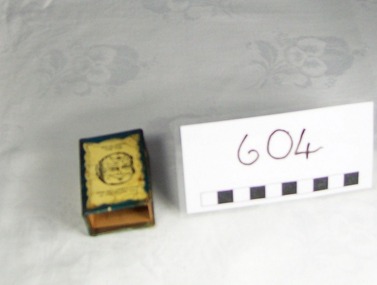
... Bryant and May were unique in that they operated as a model factory providing workers with conditions and amenities which even today seem generous. ...Bryant and May were unique in that they operated as a model factory providing workers with conditions and amenities which even today seem generous. ...The Bryant and May Factory is located in the suburb of Cremorne in Melbourne, Australia. It was constructed in 1909 as the Empire Works to a design by prolific Melbourne architect William Pitt. It was purchased soon after by British safety match manufacturer Bryant and May who significantly expanded the building adding an additional level and the landmark clock tower. Bryant and May were unique in that they operated as a model factory providing workers with conditions and amenities which even today seem generous. These included a dining hall and sports facilities such as a tennis court and bowling green which were constructed in the 1920s. Bryant and May ceased Australian match manufacture in the early 1980s as a result of import competition. Their iconic Redheads matches are now imported from Sweden. The complex has since been converted for use as offices and showrooms but is extremely well preserved. It is listed on the Victorian Heritage Register. Source: www.wikipedia.org Local social history of Bacchus MarshMetal matchbox holder for a matchbox-one side has a photo of a local cricket team, the other side has a caricature of a man's face when held one way up is smiling and when turned up the other way the face is looking unhappy. The cover is blue with yellow. The matchbox cover is made of a thin veneer wood. The makers inscription is in blue and red.Cover/spine: Strike The Border Inn Bacchus Marsh for a good spot Phone 16 Cyril Jones, Proprietor. Cover/side: This man always calls in at the Border Inn. This Man wishes he did Matchbox:Bryant & May's "Crown" Safety Matchesbox, souvenir, sport, item, cricket, match, team, cyril, jones, border, inn, cover, novelty -
 Federation University Historical Collection
Image, Cinematograph Operator's Permit, 1930, 16/08/1930
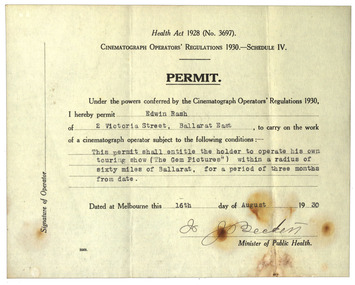
... 1 hereby permit Edwin Rash of 2 Victoria Street, Ballarat East, to carry on the work of a cinematograph operator subject to the following conditions:- This permit shall entitle the holder to operate this how touring show (The Gem Pictures) within a radius of sixty miles of Ballarat, for a period of three months from date....theatre film entertainment gem rash gem pictures edwin rash Cinematograph Operators' Permit 1 hereby permit Edwin Rash of 2 Victoria Street, Ballarat East, to carry on the work of a cinematograph operator subject to the following conditions:- This permit shall entitle the holder to operate this how touring show (The Gem Pictures) within a radius of sixty miles of Ballarat, for a period of three months from date. ...Scan of a permt for Gem Pictures to operate within a 60 mile radius of Ballarat.1 hereby permit Edwin Rash of 2 Victoria Street, Ballarat East, to carry on the work of a cinematograph operator subject to the following conditions:- This permit shall entitle the holder to operate this how touring show (The Gem Pictures) within a radius of sixty miles of Ballarat, for a period of three months from date.theatre, film, entertainment, gem, rash, gem pictures, edwin rash, cinematograph operators' permit -
 Federation University Historical Collection
Photograph - Black and White Photograph, Students, 1977
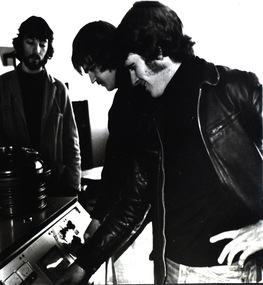
... conditions. (From left to right Athol Shelton, Gunther Jahnke, Trevor Adams) B. Metallurgy students operating a control panel for equipment designed to analyse crystal structure. ...conditions. (From left to right Athol Shelton, Gunther Jahnke, Trevor Adams) B. Metallurgy students operating a control panel for equipment designed to analyse crystal structure. ...Gunther Jahnke graduated in 1980. Trevor Adams graduated in 1978. Subsequently he was employed by ALCOA Australia, and by 2000 was general manager at the Portland (Vic.) plant..1) Two men, one wearing a leather jacket .2) Three men at a metallurgical apparatus .3) A handwritten note by Brian Sunter, relevant to the above photo..3) A. A group of Metallurgy students from Ballarat CAE working on equipment designed for melting metals and alloys under high vacuum conditions. (From left to right Athol Shelton, Gunther Jahnke, Trevor Adams) B. Metallurgy students operating a control panel for equipment designed to analyse crystal structure. (From left: Gunther Jahnke, Trevor Adams) alumni, brian sunter, gunther jahnke, trevor adams, athol shelton, student activity, metallurgy -
 Flagstaff Hill Maritime Museum and Village
Document - Ports and Harbours, Ports and Harbours, Tender for Warrnambool Light, 24-06-1902
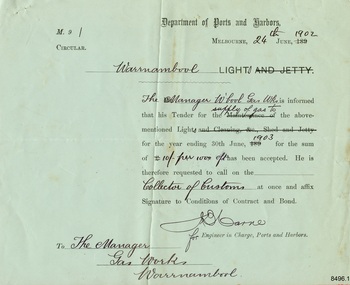
... Conditions of Contract and Bond. The light of Warrnambool's Lady Bay Lighthouse was originally powered by oil. Later it was converted to gas, followed by electricity, then solar power, and finally to battery power. The Warrnambool Gas Company operated...Conditions of Contract and Bond. The light of Warrnambool's Lady Bay Lighthouse was originally powered by oil. Later it was converted to gas, followed by electricity, then solar power, and finally to battery power. The Warrnambool Gas Company operated ...The document confirms that the Tender for the supply of gas to the Warrnambool Light, also known as the Lighthouse, by the Warrnambool Gas Works was successful. The Tender was issued by the Engineer in Charge, Ports and Harbours, Melbourne, for a the period ending 30th June 1903, at the offered rate of 10/- (ten shillings) per 100.0 c/f (cubic feet). The Manager of the Warrnambool Gas Works expected to follow this acceptance with a visit to the Collector of Customs to sign the Conditions of Contract and Bond. The light of Warrnambool's Lady Bay Lighthouse was originally powered by oil. Later it was converted to gas, followed by electricity, then solar power, and finally to battery power. The Warrnambool Gas Company operated the gas works from the 1870's to the late 1920's.This document connects Warrnambool's Lady Bay Lighthouse to the Warrnambool Gas Works during the first decade of the 20th century. It documents to process of a Government department requesting Tenders for the supply of goods to operate a service, the the formal documentation required at that time.Pale green rectangular paper with template text printed in black and completed in black ink script. Letterhead of the Department of Ports and Harbours, Melbourne, and addressed to the Gas Works, Warrnambool, dated 24th June 1902, for the supply of gas to the Warrnambool Light until 30th June 1903 at the cost of Ten Shillings per 100 cubic feet."24th [June] 1902" Warrnambool [Light]" "Manager W'bool Gas Wks" "supply of gas to" "1903" "10/- per 100.0 c/f" "Collector of Customs" " The Manager / Gas Works / Warrnambool" [Signature] "for" [Engineer in Charge, Ports and Harbours]flagstaff hill, flagstaff hill maritime museum and village, warrnambool, maritime museum, maritime village, great ocean road, shipwreck coast, department of ports and harbours, ports and harbours, ports and harbours melbourne, warrnambool light, warrnambool lighthouse, warrnambool gas works, w'bool gas works, gas works, gas supply, early 1900s, early 20th century, shillings, cubic feet, collector of customs, customs, warrnambool customs, engineer in charge, lady bay lighthouse, warrnambool gas company -
 Flagstaff Hill Maritime Museum and Village
Document - Ports and Harbours, Ports and Harbours, Tender for Warrnambool Light, 24-06-1904
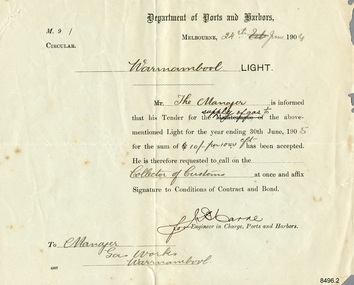
... Conditions of Contract and Bond. The light of Warrnambool's Lady Bay Lighthouse was originally powered by oil. Later it was converted to gas, followed by electricity, then solar power, and finally to battery power. The Warrnambool Gas Company operated...Conditions of Contract and Bond. The light of Warrnambool's Lady Bay Lighthouse was originally powered by oil. Later it was converted to gas, followed by electricity, then solar power, and finally to battery power. The Warrnambool Gas Company operated ...The document confirms that the Tender for the supply of gas to the Warrnambool Light, also known as the Lighthouse, by the Warrnambool Gas Works was successful. The Tender was issued by the Engineer in Charge, Ports and Harbours, Melbourne, for a the period ending 30th June 1905, at the offered rate of 10/- (ten shillings) per 100.0 c/f (cubic feet). The Manager of the Warrnambool Gas Works expected to follow this acceptance with a visit to the Collector of Customs to sign the Conditions of Contract and Bond. The light of Warrnambool's Lady Bay Lighthouse was originally powered by oil. Later it was converted to gas, followed by electricity, then solar power, and finally to battery power. The Warrnambool Gas Company operated the gas works from the 1870's to the late 1920's.This document connects Warrnambool's Lady Bay Lighthouse to the Warrnambool Gas Works during the first decade of the 20th century. It documents to process of a Government department requesting Tenders for the supply of goods to operate a service, the the formal documentation required at that time.Pale cream rectangular paper with template text printed in black and completed in black ink script. Letterhead of the Department of Ports and Harbours, Melbourne, and addressed to the Gas Works, Warrnambool, dated 24th June 1904, for the supply of gas to the Warrnambool Light until 30th June 1905 at the cost of Ten Shillings per 100 cubic feet."24th [June] 1904" Warrnambool [Light]" "Manager W'bool Gas Wks" "supply of gas to" "1905" "10/- per 100.0 c/f" "Collector of Customs" " The Manager / Gas Works / Warrnambool" [Signature] "for" [Engineer in Charge, Ports and Harbours]flagstaff hill, flagstaff hill maritime museum and village, warrnambool, maritime museum, maritime village, great ocean road, shipwreck coast, department of ports and harbours, ports and harbours, ports and harbours melbourne, warrnambool light, warrnambool lighthouse, warrnambool gas works, w'bool gas works, gas works, gas supply, early 1900s, early 20th century, shillings, cubic feet, collector of customs, customs, warrnambool customs, engineer in charge, lady bay lighthouse, warrnambool gas company -
 Flagstaff Hill Maritime Museum and Village
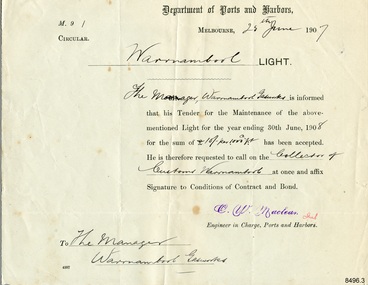
Document - Ports and Harbours, Ports and Harbours, Tender for Warrnambool Light, 24-06-1907
... Conditions of Contract and Bond. The light of Warrnambool's Lady Bay Lighthouse was originally powered by oil. Later it was converted to gas, followed by electricity, then solar power, and finally to battery power. The Warrnambool Gas Company operated...Conditions of Contract and Bond. The light of Warrnambool's Lady Bay Lighthouse was originally powered by oil. Later it was converted to gas, followed by electricity, then solar power, and finally to battery power. The Warrnambool Gas Company operated ...The document confirms that the Tender for the supply of maintenance to the Warrnambool Light, also known as the Lighthouse, by the Warrnambool Gasworks was successful. The Tender was issued by the Engineer in Charge, C. Maclean, Ports and Harbours, Melbourne, for a the period ending 30th June 1908, at the offered rate of 10/- (ten shillings) per 100.0 c/f (cubic feet). The Manager of the Warrnambool Gasworks expected to follow this acceptance with a visit to the Collector of Customs to sign the Conditions of Contract and Bond. The light of Warrnambool's Lady Bay Lighthouse was originally powered by oil. Later it was converted to gas, followed by electricity, then solar power, and finally to battery power. The Warrnambool Gas Company operated the gas works from the 1870's to the late 1920's.This document connects Warrnambool's Lady Bay Lighthouse to the Warrnambool Gas Works during the first decade of the 20th century. It documents to process of a Government department requesting Tenders for the supply of goods to operate a service, the the formal documentation required at that time.Pale cream rectangular paper with template text printed in black and completed in black ink script. Letterhead of the Department of Ports and Harbours, Melbourne, and addressed to the Gas Works, Warrnambool, dated 25th June 1907, for the supply of maintenance to the Warrnambool Light until 30th June 1908 at the cost of Ten Shillings per 100 cubic feet. A purple stamped signature is also added and initialled in red pen."25th [June] 1907" Warrnambool [Light]" "Manager W'bool Gasworks" "supply of gas to" "1908" "10/- per 100.0 c/f" "Collector of Customs" " The Manager / Warrnambool Gasworks" [Signature] "for" [Engineer in Charge, Ports and Harbours] Stamped " C. -. Maclean"flagstaff hill, flagstaff hill maritime museum and village, warrnambool, maritime museum, maritime village, great ocean road, shipwreck coast, department of ports and harbours, ports and harbours, ports and harbours melbourne, warrnambool light, warrnambool lighthouse, warrnambool gas works, w'bool gas works, gas works, gas supply, early 1900s, early 20th century, shillings, cubic feet, collector of customs, customs, warrnambool customs, engineer in charge, lady bay lighthouse, warrnambool gas company, gasworks, warrnambool gasworks, maintenance, c. - maclean -
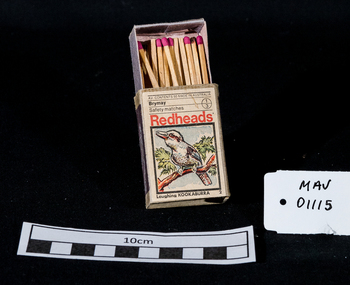 City of Moorabbin Historical Society (Operating the Box Cottage Museum)
Containers, matchbox 'Redhead' with matches, 20thC
... Bryant and May were unique in that they operated as a model factory, providing workers with conditions and amenities that even today seem generous. ...Bryant and May were unique in that they operated as a model factory, providing workers with conditions and amenities that even today seem generous. ...On 15th December 1909, Bryant & May, Australia’s first match factory at Church Street, Richmond, Victoria. was opened by The Honourable Alfred Deakin, Prime Minister of Australia, and Mrs. Deakin. It was heralded by the first Commonwealth Government of newly-federated Australia because the government of the day was anxious to encourage secondary industry and pledged tariff protection of local manufacturers. The building was constructed in 1909 as the Empire Works to a design by prolific Melbourne architect William Pitt and was purchased soon after by British safety match manufacturer Bryant and May, who significantly expanded the building, adding another level and the landmark clock tower. Bryant and May were unique in that they operated as a model factory, providing workers with conditions and amenities that even today seem generous. These included a dining hall and sports facilities such as a tennis court and bowling green which were constructed in the 1920s. Bryant and May ceased Australian match manufacture in the early 1980s as a result of import competition. Their iconic Redheads matches are now imported from Sweden. The complex has since been converted for use as offices and showrooms but is extremely well preserved. It is listed on the Victorian Heritage Register. Bryant and May was a United Kingdom (UK) company created in the mid-nineteenth century specifically to make matches. Their original Bryant and May Factory was located in Bow, London. They later opened other match factories in the United Kingdom and Australia, such as the Bryant and May Factory, Melbourne; and owned match factories in other parts of the world. Bryant and May survived as an independent company for over seventy years, but went through a series of mergers with other match companies and later with consumer products companies. To protect its position Bryant and May merged with or took over its rivals. In 1971 the Northern Ireland factory, Maguire & Patterson closed down following a terrorist attack.. In the 1980s, factories in Gloucester and Glasgow closed too leaving Liverpool as the last match factory in the UK, until December 1994. . The registered trade name Bryant and May still exists and it is owned by Swedish Match, as are many of the other registered trade names of the other, formerly independent, companies within the Bryant and May group. Two French chemists, Henri Savene and Emile David Cahen, proved in 1898 that the addition of phosphorus sesquisulfide meant that the substance was not poisonous, that it could be used in a "strike-anywhere" match, and that the match heads were not explosive. British company Albright and Wilson, was the first company to produce phosphorus sesquisulfide ( Red Phosphorous) matches commercially. The company developed a safe means of making commercial quantities of phosphorus sesquisulfide in 1899 and started selling it to match manufacturers. Matches were first produced by Bryant & May in Australia in 1909. The Redhead name applies to the red striking heads of the matches which were introduced to Australia in 1946. The logo on the matchbox depicted the head and shoulder of a redheaded woman and has had four major updates since that time with a number of special issues depicting birds, animals and notable persons also produced.The Bryant & May Ltd factory in Church St Richmond is a listed building and has been converted to apartments following the closure of the Company 1980. Bryant & May's Ltd were influential in fighting against the dreadful disease known as Phossy jaw which was caused by white phosphorus used in the manufacture of the early matches. They were also the object of the 'Match Girls Strike' in London 1888, which won important improvements in working conditions and pay for the mostly female workforce working with the dangerous white phosphorus. The public were slow to purchase these safety matches because of the higher price .A box of safety matches with unused matches made by Bryant & May Pty Ltd , Richmond Victoria Australia. The tray containing the matches slides inside the open ended cover.. The striking patch is on both sides of the cover. Av. CONTENTS 50 MADE IN AUSTRALIA / Brymay / 1/3 / Safety Matches / Redheads / a colour picture of a Kookaburra / Laughing KOOKABURRAsafety matches, bryant & may pty ltd, phossy jaw disease, early settlers, moorabbin, bentleigh, cheltenham, lights, lamps, tobacco, white phosphorous, phosphorus sesquisulfide, swedish match pty ltd, pitt william, savens henri, cahen emile david , richmond victoria,
