
Showing 15 items matching "operating theatre design"
-
 Alfred Hospital Nurses League - Nursing History Collection
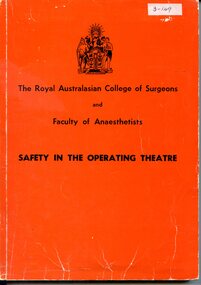
Book - Seminar book, The Royal Australasian College of Surgeons, Safety in the operating theatre - Submissions from woking parties for discussion at seminar, 1971
... ...Operating theatre design...The book contains submissions from working parties for discussion at the Royal Australasian College of Surgeons anf Faculty Of Anaesthetists second seminar on 'Safety in the operating theatre, held on September 30-October 1, 1971 Alfred hospital staff were members of the working parties, and attended the seminar Theatre staffing and resposibilities Patient handlling Operating theatre design anaesthetic equipment apsesis in the operating theatre Previous catalogue number handwrritten [black ink] on small rectangular white sticker at top right of front cover. ...The book contains submissions from working parties for discussion at the Royal Australasian College of Surgeons anf Faculty Of Anaesthetists second seminar on 'Safety in the operating theatre, held on September 30-October 1, 1971Alfred hospital staff were members of the working parties, and attended the seminarIllustrated paperback book, red cover with black print detailing producer and abreviated title under the coat of arms of the Royal Australian College of Surgeons. Also includes a 6 page typed document - final draft of resolutions for session 9.Previous catalogue number handwrritten [black ink] on small rectangular white sticker at top right of front cover. At base of right cover is a rectangular white sticker is a handwritten note [blue ink] detailing the fact that Patti Weeks and Audrey Morwick hd atteneded the seminar and also contributed to the publication, particulary Chapter 5, he theatr sisters section,Nummerous annotations throughouttheatre staffing and resposibilities, patient handlling, operating theatre design, anaesthetic equipment, apsesis in the operating theatre -
 Alfred Hospital Nurses League - Nursing History Collection
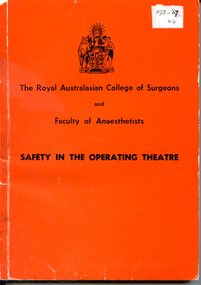
Book - Seminar book, The Royal Australasian College of Surgeons, Safety in the operating theatre - Submissions from woking parties for discussion at seminar, 1971
... ...Operating theatre design...The book contains submissions from working parties for discussion at the Royal Australasian College of Surgeons anf Faculty Of Anaesthetists second seminar on 'Safety in the operating theatre, held on September 30-October 1, 1971 Alfred hospital staff were members of the working parties, and attended the seminar Theatre staffing and resposibilities Patient handlling Operating theatre design anaesthetic equipment apsesis in the operating theatre Previous catalogue number handwrritten [black ink] on small rectangular white sticker at top right of front cover. ...The book contains submissions from working parties for discussion at the Royal Australasian College of Surgeons anf Faculty Of Anaesthetists second seminar on 'Safety in the operating theatre, held on September 30-October 1, 1971Alfred hospital staff were members of the working parties, and attended the seminarIllustrated paperback book, red cover with black print detailing producer and abreviated title under the coat of arms of the Royal Australian College of Surgeons. Also includes a 6 page typed document - final draft of resolutions for session 9.Previous catalogue number handwrritten [black ink] on small rectangular white sticker at top right of front cover. theatre staffing and resposibilities, patient handlling, operating theatre design, anaesthetic equipment, apsesis in the operating theatre -
 Flagstaff Hill Maritime Museum and Village
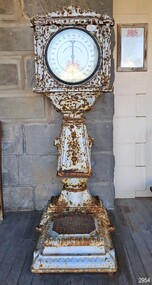
Instrument - Scale, Weighing Machine, G. Salter & Co, 1884-1909
... design, and advertised them as suitable for hotels, pleasure gardens, theatres, exhibition halls, clubs, baths and places of public resort. The company was established in 1760 by brothers Richard and William Salter, and manufactured springs and pocket steelyards (spring balances). After several generations, the company was taken over in 1855 by a nephew, George, and renamed George Salter & Co. In 1884, Salter registered the trademark of a Staffordshire knot pierced by an arrow. The company's expanded range of products included the first coin-operated...design, and advertised them as suitable for hotels, pleasure gardens, theatres, exhibition halls, clubs, baths and places of public resort. The company was established in 1760 by brothers Richard and William Salter, and manufactured springs and pocket steelyards (spring balances). After several generations, the company was taken over in 1855 by a nephew, George, and renamed George Salter & Co. In 1884, Salter registered the trademark of a Staffordshire knot pierced by an arrow. The company's expanded range of products included the first coin-operated ...This ornate, Victorian-era automatic weighing machine was made in England around 1884-1909, by George Salter and Co. of West Bromwich, UK, makers of scales since 1760. It is protected by Queen Victoria’s Royal Letters Patent, signed in 1900. The scale stood outside the Warrnambool Post Office in Timor Street from around 1909 to 1966, as shown on postcards and photographs held at the State Library of Victoria. The scale is identified by the Serial Number '665', and was installed by the distributors, the Australasian Automatic Weighing Machine Co. Ltd.. The scale’s weight measurements were in Imperial stones and pounds up to 20 stone (127 kg). The scale’s face included charts of average weights, for men, women, boys and girls, by various heights, in feet and inches. The coin slot and its face were converted to metric measurements by the Eastern Scale Company Pty. Ltd; that firm was registered on October 2, 1974. The Australasian Automatic Weighing Machine Co. Ltd was a large supplier of weighing scales in Australia and held the Royal Letters patent for their machines, distributing them in prominent locations. In 1902, the firm was listed under the Import Entries Passed at His Majesty’s Customs, importing into Sydney, NSW, eight cases of scales. In 1911, the company asked permission from the Port Pirie Corporation to install a machine in Alexander Street. In 1913, the company applied to the City of Sydney to install machines around the city, including at the tram depot. One application mentions “… three machines in three places for three pounds per year”. In 1923, the firm tendered for the right to place Automatic Weighing Machines on railway and tram premises throughout New South Wales, subsequently for five-year terms, in return for a fixed payment per machine and a portion of the revenue to the NSW Government. In 1928, the Sydney Harbour Trust gave the firm the right to place the weighing machines on various ferry jetties. The firm was still operating in 1941, advertising for two boys aged 14-16 for the workshop and messages, at the Rialto building, 497 Collins St., Melbourne. On December 21, 1946, the Commonwealth government invited offers to tender for the right to place automatic weighing machines on postal premises throughout the six states; the successful company then made arrangements with the federal Postmaster General's Department to place machines outside post offices across the country. A few years later, on September 11, 1950, the firm's Adelaide branch ceased trading. From 11th July 1950, the Australian and Eastern Engineering Company Pty. Ltd took over at the same premises, at 179 Pirie Street, Adelaide. The Perth branch ceased business in WA on July 6th, 1950. Percival Everitt invented and patented the automatic, coin-operated personal scale design. Everitt was a Norfolk-born engineer and regarded as the father of the coin-operated industry. As a young man in 1877, he invented a hay and corn pitcher, a turnip thinner in 1878 and an Automatic Travelling Anchor in 1880. But his fame came in 1883 with the first postcard-vending machine, over a hundred of which he distributed around London. In 1884, he patented one of his many inventions, the coin-operated scales for use in public places; for many people, it was their first exposure to coin-operated machines. His success prompted the formation of the Weighing Machine Company in 1885. Further inventions followed: a blow tester in 1887, the machine for testing a person's grip in 1888, and in 1889, the dispensing machine for hiring out opera glasses, and a device for shutting down the coin entry slot if the machine was empty. In 1890, he invented a fortune-telling machine. Everitt sadly did not make his fortune; he died suddenly in February 1893, in his late forties, with £71 to his name. George Salter & Co., West Bromwich, England, produced automatic weighing scale machines from Everitt’s patented design, and advertised them as suitable for hotels, pleasure gardens, theatres, exhibition halls, clubs, baths and places of public resort. The company was established in 1760 by brothers Richard and William Salter, and manufactured springs and pocket steelyards (spring balances). After several generations, the company was taken over in 1855 by a nephew, George, and renamed George Salter & Co. In 1884, Salter registered the trademark of a Staffordshire knot pierced by an arrow. The company's expanded range of products included the first coin-operated public weighing machines in the 1880s and, in 1895, the first English-made typewriter. In 1915, Salter became a limited company, Geo. Salter & Co. Ltd. When the last George Salter died in 1917, the company passed into the hands of other relatives, but continued to grow before being bought out by Staveley Industries in 1973. Despite several subsequent mergers, the Salter name continues to be seen on household products such as digital scales. This patented, coin-operated weight machine is significant for its association with Percival Everitt, the inventor of the world’s first slot machine, with the renowned maker of scales, G. Salter & Co., which began operating in 1760, and also with the Australasian Automatic Weighing Scale Co., which imported and widely distributed the scales throughout Australia from the early-to-mid 20th century. It is a rare example of an early vending machine used in public places from the late 19th through to the mid-20th century. These machines were the early step in the evolution of coin-in-the-slot machines, which are still used today. The scales give a glimpse into our history; they became quickly popular with the public, which, until then, had little access to weight scales apart from those at medical services. They also provided inexpensive entertainment for families, especially while waiting for trains or visiting the post office. The machines were also attractive and lucrative to the distributors; once installed, they required very little maintenance, and their low cost to customers kept the money coming in. This automatic weighing machine is also significant for its decades of service to the local and regional community of Warrnambool, for personal and commercial purposes. A public coin-operated weighing scale, also called a penny scale. It is a large, silver-painted cast metal stand with a square top on a pedestal that flares outwards to join a rectangular platform base with posts on the side and corners that may have had fitted wheels. The round, white face on top has red and black measurements and inscriptions. A slim indicator with a point at one end and an arc at the other is attached to the face’s centre. The coin slot is above the face, on the left, and the scale’s identification number is engraved on an oval plate on the right. Moulded motifs decorate the pedestal’s front and are repeated on its sides; they depict a tall, narrow urn with a bowl on top and fancy scrolls on either side. There is a decorative panel across the front top of the stand. The top of the pedestal has a small keyhole. The size of the coin slot fitted a penny coin, and the weight measurements on the face were in Imperial stones and pounds. Quite some time after 1966, when Australia introduced new decimal weights, measurements and currency, the scale was updated; the coin slot size was changed, and a new face with metric measurements was installed. The scale now accepts a $1 coin (one dollar) and the scale measures weight in kilograms and grams, from 0 to 125 kg.. The rear of the scale has a small, rectangular metal plate with printed text. The scale was made by G Salter & Co. of West Bromwich, UK, distributed by the Australasian Automatic Weighing Platform Co., and updated to metric measurements by Eastern Scale Co. Pty Ltd. It was previously installed at the Warrnambool Post Office. Engraved on an oval plate on the right: "665" Top centre of the face, in red: "$1 coin" Top of face: "EASTERN SCALE CO. PTY LTD" Base of face, in red: "[Royal Coat of Arms of Britain]" with words, below in red: "BY ROYAL LETTERS PATENT" Around the face, in black: "[numbers 0 to 125, in increments 5, and makes between the numbers for each 500g]" "kg" Below the face, moulded letters within a shield: "AUSTRALASIAN AUTOMATIC WEIGHING MACHINES CO. LTD." At the back of the weighing platform: "G SALTER & CO. / WEST BROMWICH", remnants of logo “[Staffordshire knot pierced by an arrow]” Plate on rear: THIS SCALE REMAINS THE PROPERTY OF EASTERN SCALE CO. PTY. LTD., 8 GEORGE COURT, GREENSBOROUGH, VIC, 3088. PHONE (03 ) _ 34 _ _ 33” (434 9333 ?_flagstaff hill, warrnambool, maritime village, maritime museum, flagstaff hill maritime museum and village, shipwreck coast, great ocean road, scale, weighing scale, salter, australasian, 1 dollar, $1 coin, 1p, 1 penny coin, penny scale, coin in slot scale, eastern scale co. pty. ltd., british royal coat of arms, royal letters patent, letters patent, health, ending machine, coin-operated machine, percival everett, weighing machine co., george salter & co., g salter & co, west bromwich, vending machine, weights & balances, measurements, slot machine, coin operated machine, penny-in-the-slot, coin fed, coin op scale, weights & measures, australasian automatic weighing machine co. ltd., warrnambool post office, machine 665, no. 665, blalnce technology, scales and weights, weights and measures, penny weight scales, vintage, weighing machine, coin in the slot, coin operated, public scale, public weighing machine, penny-weighing machines, penny weighing machines, penny scales, coin operated weighing machine, scale weighing machine -
 The Beechworth Burke Museum
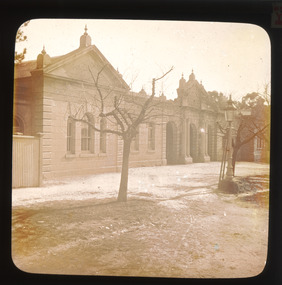
Photograph - Lantern Slide, c1900
... designed by J.H. Dobbyn, cost £2347. The hospital had two wards, a dispensary, apartments for a resident surgeon and the matron, an operating theatre and a board room. ...designed by J.H. Dobbyn, cost £2347. The hospital had two wards, a dispensary, apartments for a resident surgeon and the matron, an operating theatre and a board room. ...This lantern slide shows the Ovens District Hospital (also called the Ovens Goldfields Hospital) in Beechworth in approximately 1900. The Hospital was built as part of a community push to develop the infrastructure needed for a permanent town in the 1850s. At the time there was no hospital located between Melbourne and the NSW town of Goulburn and it was recognised that the nature of mining and agricultural work predisposed people to serious injury. The community voted in 1853 to raise funds for a hospital and a voluntary committee elected from people who contributed £2 or more annually determined the organisation's management policies, which aimed to provide care for poor people at rates levied according to the person's means. Ongoing operations of the hospital were primarily supported by Government grants, however. The foundation stone was laid at a site in Church Street at a ceremony held 1st September 1856 which was attended by 2000 people using a locally crafted trowel with a tin ore handle and pure gold blade. The hospital, which was designed by J.H. Dobbyn, cost £2347. The hospital had two wards, a dispensary, apartments for a resident surgeon and the matron, an operating theatre and a board room. Further medical facilities including services to meet the cultural and health needs of the local Chinese community were later added, in addition to a Palladian-style cut-granite face built in 1862-63. It functioned as the region's primary hospital until surpassed by the Wangaratta Hospital in 1910. In the 1940s much of the building materials were salvaged and repurposed, with the exception of the facade which was restored in 1963 by the Beechworth Lions Club and still stands today. The facade featured on the covers of local history volume 'Beechworth: a Titan's Field' by Carole Woods and heritage-focused travel guide the 'Readers Digest Book of Historic Australian Towns'. Lantern slides, sometimes called 'magic lantern' slides, are glass plates on which an image has been secured for the purpose of projection. Glass slides were etched or hand-painted for this purpose from the Eighteenth Century but the process became more popular and accessible to the public with the development of photographic-emulsion slides used with a 'Magic Lantern' device in the mid-Nineteenth Century. Photographic lantern slides comprise a double-negative emulsion layer (forming a positive image) between thin glass plates that are bound together. A number of processes existed to form and bind the emulsion layer to the base plate, including the albumen, wet plate collodion, gelatine dry plate and woodburytype techniques. Lantern slides and magic lantern technologies are seen as foundational precursors to the development of modern photography and film-making techniques.This glass slide is significant because it provides insight into Beechworth's built environment and infrastructure in the early Twentieth Century, around the time of Australia's Federation. It is also an example of an early photographic and film-making technology in use in regional Victoria in the time period.Thin translucent sheet of glass with a round-edged square image printed on the front and framed in a black backing. It is held together by metal strips to secure the edges of the slide.Obverse: Y /burke museum, beechworth, lantern slide, slide, glass slide, plate, burke museum collection, photograph, monochrome, ovens district hospital, indigo shire, north-east victoria, hospital, palladian architecture, granite, community fundraising, community infrastructure, j.h. dobbyn, beechworth lions club, ovens goldfields hospital, chinese community -
 Royal Australian and New Zealand College of Obstetricians & Gynaecologists (RANZCOG)
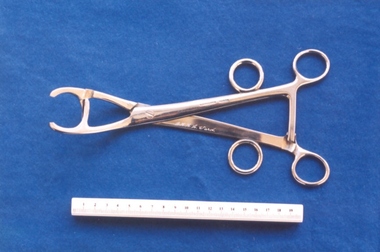
Tool - Bonney's myomectomy clamp used by Box Hill Hospital labour ward, Down Bros., London
... operating theatre free of the trammels which at one time too often compelled my hand against my heart.” (Bonney, 'The fruits of conversatism') Bonney’s crucial innovation was the development of a new surgical clamp, an instrument which is now referred to as Bonney’s myomectomy clamp. The clamp was ingeniously designed...operating theatre free of the trammels which at one time too often compelled my hand against my heart.” (Bonney, 'The fruits of conversatism') Bonney’s crucial innovation was the development of a new surgical clamp, an instrument which is now referred to as Bonney’s myomectomy clamp. The clamp was ingeniously designed ...Victor Bonney (1872- 1953) was a gifted and innovative surgeon. One of Bonney’s most notable achievements was his development of a successful procedure for myomectomy. After his wife developed fibroids and had her uterus removed early in their marriage, Bonney took a great interest in the practice of conservatism in surgery. Prior to Bonney, myomectomy “had fallen into disuse because of excessive blood loss during the operating and the infections that commonly followed” (Chamberlain, 'The master of myomectomy') , but Bonney saw an opportunity to revolutionise this practice. In his words: “I set myself to make myomectomy so feasible, successful and safe as to render it a fair alternative to hysterectomy in every case… Excepting only in a very few instances… I have succeeded, and now enter the operating theatre free of the trammels which at one time too often compelled my hand against my heart.” (Bonney, 'The fruits of conversatism') Bonney’s crucial innovation was the development of a new surgical clamp, an instrument which is now referred to as Bonney’s myomectomy clamp. The clamp was ingeniously designed to cut off blood supply to the uterus by compressing the uterine arteries, immediately reducing the excessive blood loss which had previously been associated with the procedure. Although technological advances mean that these are now seldom used, Bonney’s success with this procedure was such that his clamps were regularly used for myomectomy procedures for decades after his death. This instrument was included with other obstetric instruments, mostly destructive instruments, given to RANZCOG from Box Hill Hospital labour ward in February- March 1998. The maternity service at Box Hill Hospital combined with St George's Hospital in Kew to be known as Birralee Maternity Service. These instruments were collected by Julie Collette, Unit Manager, St George's Kew and given to RANZCOG Museum Curator, Susan Barnett. Stainless steel clamp. Scissor type instrument with two sets of finger grips and a locking ratchet mechanism. The blades close to form two apertures which can be selectively decreased in size."DOWN BROS LONDON STAINLESS" upper surface of RH handle; "B.H.H.L. WARD" inner surface of LH handle.surgery, obstetrics -
 Royal Australian and New Zealand College of Obstetricians & Gynaecologists (RANZCOG)
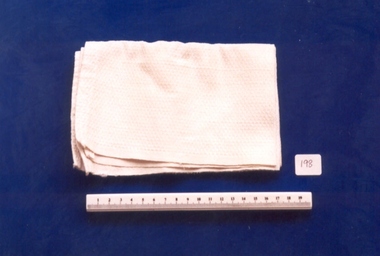
Towel used by Dr Mitchell Henry O'Sullivan
... operating theatres and on dressing trays. The towels became too costly to launder and were replaced by more modern disposable materials. Dr Mitchell Henry O'Sullivan worked in the Victorian country town of Casterton as a general practitioner from 1919 until his death in 1977. He also practiced obstetrics. His son, Dr David More O'Sullivan donated his obstetric bag and its contents to the College in 1999. The bag and contents are a unique time capsule of the type of instruments and pharmaceuticals used in the inter-war period. Obstetric delivery Thick cotton/linen towel, with a 'bubble' or 'chain' design ...These types of towels were introduced into hospitals in the 1900s, where they were used mostly in operating theatres and on dressing trays. The towels became too costly to launder and were replaced by more modern disposable materials.Dr Mitchell Henry O'Sullivan worked in the Victorian country town of Casterton as a general practitioner from 1919 until his death in 1977. He also practiced obstetrics. His son, Dr David More O'Sullivan donated his obstetric bag and its contents to the College in 1999. The bag and contents are a unique time capsule of the type of instruments and pharmaceuticals used in the inter-war period.Thick cotton/linen towel, with a 'bubble' or 'chain' design in the material. The word "Hospital" is woven into the central band. There is a 1.25cm machined hem on unsealable sides.obstetric delivery -
 Royal Australian and New Zealand College of Obstetricians & Gynaecologists (RANZCOG)
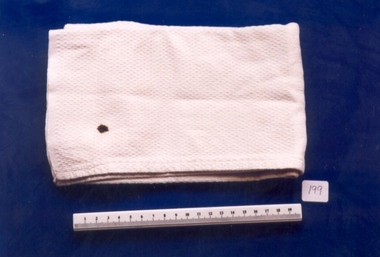
Towel used by Dr Mitchell Henry O'Sullivan
... operating theatres and on dressing trays. The towels became too costly to launder and were replaced by more modern disposable materials. Dr Mitchell Henry O'Sullivan worked in the Victorian country town of Casterton as a general practitioner from 1919 until his death in 1977. He also practiced obstetrics. His son, Dr David More O'Sullivan donated his obstetric bag and its contents to the College in 1999. The bag and contents are a unique time capsule of the type of instruments and pharmaceuticals used in the inter-war period. Obstetric delivery Thick cotton/linen towel, with a 'bubble' or 'chain' design ...These types of towels were introduced into hospitals in the 1900s, where they were used mostly in operating theatres and on dressing trays. The towels became too costly to launder and were replaced by more modern disposable materials.Dr Mitchell Henry O'Sullivan worked in the Victorian country town of Casterton as a general practitioner from 1919 until his death in 1977. He also practiced obstetrics. His son, Dr David More O'Sullivan donated his obstetric bag and its contents to the College in 1999. The bag and contents are a unique time capsule of the type of instruments and pharmaceuticals used in the inter-war period.Thick cotton/linen towel, with a 'bubble' or 'chain' design in the material. The word "Hospital" is woven twice into the central band. There is a 1cm machined hem on unsealable sides.obstetric delivery -
 Bendigo Historical Society Inc.
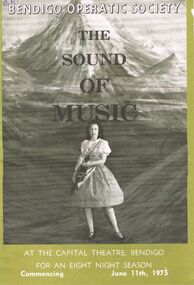
Programme - BENDIGO OPERATIC SOCIETY ''THE SOUND OF MUSIC''
... Bendigo Operatic Society ''The Sound of Music'' At the Capital Theatre Bendigo For an Eight Night Season Commencing June 11th, 1975. Producer: mMax Collis - Assistant Producer, Wardrobe and Ballet Mistress: Madge Welch - Stage Manager and Director of Design: Malcom Cannon - Musical Director: Gwen Grose - Society Pianist: Dianna Cohn. ...PROGRAM Theatre bendigo operatic society Bendigo Operatic Society ''The Sound of Music'' At the Capital Theatre Bendigo For an Eight Night Season Commencing June 11th, 1975. Producer: mMax Collis - Assistant Producer, Wardrobe and Ballet Mistress: Madge Welch - Stage Manager and Director of Design: Malcom Cannon - Musical Director: Gwen Grose - Society Pianist: Dianna Cohn. ...Bendigo Operatic Society ''The Sound of Music'' At the Capital Theatre Bendigo For an Eight Night Season Commencing June 11th, 1975. Producer: mMax Collis - Assistant Producer, Wardrobe and Ballet Mistress: Madge Welch - Stage Manager and Director of Design: Malcom Cannon - Musical Director: Gwen Grose - Society Pianist: Dianna Cohn. Cast in Order of Appearance: Carol McKenzie as Maria Rainer 9A Postulant at Nonnberg Abbey) - Elaine Buckland as Sister Berthe (Mistress of Novice) - Suzanne Fraser as Sister Margaretta (Mistresss of Postulants) - Valerie McCracken as The Mother Abbess - Barbara Potter as Sister Sophia - Fred Trewarne as Captain Georg Von Trapp - Philip Johnston as Franz (The Butler) - Julie Hoebert as Frau Schmidt (The Housekeeper) - Julie Lyon as Liesl - Michael Frayne, Bruce Ashman as Friedrich - Leonie Perry, Carol Bourchier as Louisa - Russell Theodore, Tommy Potter as Kurt - Jacinta Hull, Ann Johnson as Brigitta - Cheryl Wottoon, Andrea Smith as Marta - Suzanne Favaloro, Kristin Bolding as Gretl - Ian Richardson as Rolf Gruber - Sandra Sessions as Elsa Schrader - Gwen Cox as Ursula - Glynn Sessions as Max Detweiler - John Higgs as Herr Zeller - Ray Harding as Baron Elberfeld - Bartina Daws as Baroness Elberfeld - David Castles as Admiral Von Schreiber.program, theatre, bendigo operatic society -
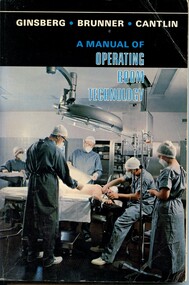 Alfred Hospital Nurses League - Nursing History Collection
Book - Illustrated textbook, Frances Ginsberg et al, A manual of operating room technology, 1966
... Insight into the practices and technologies used in surgical education in the 1960's Operating Theatre Surgical nursing Postoperative care Vintage (1966) textbook designed as a practical concise guide to instruct surgical technicians and nursing students on the foundational principles, sterile techniques and workflows required within an operating the are environment Illustrated textbook, front cover has a coloured photograph of an operating theatre scene with black banner above on which authors' surnames are overprinted in white ink and title in blue ink. ...Vintage (1966) textbook designed as a practical concise guide to instruct surgical technicians and nursing students on the foundational principles, sterile techniques and workflows required within an operating the are environmentIllustrated textbook, front cover has a coloured photograph of an operating theatre scene with black banner above on which authors' surnames are overprinted in white ink and title in blue ink. Title, authors' surnames and publisher also printed on spinenon-fictionVintage (1966) textbook designed as a practical concise guide to instruct surgical technicians and nursing students on the foundational principles, sterile techniques and workflows required within an operating the are environmentoperating theatre, surgical nursing, postoperative care -
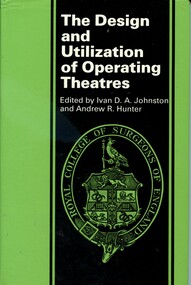 Alfred Hospital Nurses League - Nursing History Collection
Book - Illustrated text book, Ivan D A Johnston, The design and utilization of operating theatres, 1984
... Published in 1984 Insight into recommendations for operating theatre design in the 1980's Operating rooms operating theatres Historic guide focusing on operating room layout construction, ventilation layout design , and preventing airborne bacterial cross-contamination during surgery Bookseller's sticker inside front cover at lower right. ...Historic guide focusing on operating room layout construction, ventilation layout design , and preventing airborne bacterial cross-contamination during surgeryIllustrated textbook with green dustjacket. The front of the dustjacket has a black vertical panel on which the title and editors' names are printed in white above the coat of arms of the Royal College of Surgeons of England. Editors, title and publisher are printed in black on spine. Book itself has a black cover, editors, title and publisher are printed in gilt on spinenon-fictionHistoric guide focusing on operating room layout construction, ventilation layout design , and preventing airborne bacterial cross-contamination during surgeryoperating rooms, operating theatres -
 Alfred Hospital Nurses League - Nursing History Collection
Document - Post Basic Nursing Course Document, Alfred Hospital School of Nursing, Alfred Hospital submission to the Victorian Nursing Council relating to advance studies in perioperative nursing course, 1991, 1991
... This course was designed to compliment the first level course Of significance to the AHNL as this was an Alfred Hospital post basic nursing course Alfred Hospital Alfred Hospital School of Nursing Nursing Perioperative Nursing Post Basic Nursing Course Operating Theatre Small rectangular white sticker at top right of front cover on which previous catalogue number is written [black ink] Glue bound booklet with blue cover. ...This submission was part of a historical period when nurse education was transitioning from hospital based training to the tertiary (university ) sector for a six month post basic trainining nursing course. This course was designed to compliment the first level courseOf significance to the AHNL as this was an Alfred Hospital post basic nursing courseGlue bound booklet with blue cover. Title in black print on front coverSmall rectangular white sticker at top right of front cover on which previous catalogue number is written [black ink]alfred hospital, alfred hospital school of nursing, nursing, perioperative nursing, post basic nursing course, operating theatre -
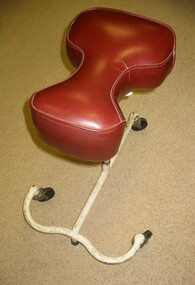 Royal Australasian College of Surgeons Museum and Archives
Functional object - Operating stool, circa 1950s
... operating table, and it was at this time the stool was constructed for him. By now however, he was suffering from secondary melanoma, and he died in September 1952. This object is an interesting example of pioneering apparatus from the days before stools became a familiar piece of theatre equipment. racs gilbert phillips harold dew surgery 2003 none The design of the stool is simple and robust. ...A special stool made to enable a disabled surgeon to operate while sitting was donated to the College by Mr John Farlow FRACS in September 2003.The stool was made for Gilbert Phillips FRACS (1904-52), the legendary Sydney neurosurgeon and wine connoisseur. Phillips was a gifted young graduate, a protégé of (Sir) Harold Dew (PRACS 1953-55). He went to England, where he became surgical assistant to (Sir) Hugh Cairns, amongst others. He was a consultant to the RAAF during WWII, and at the end of the War returned to England at Cairns’ request. Back in Sydney, he returned to Royal Prince Alfred Hospital, where he spent most of his professional career. In 1951, after a long battle with skin cancer, he had his right leg amputated below the knee. Only a few weeks later he was back working at the operating table, and it was at this time the stool was constructed for him. By now however, he was suffering from secondary melanoma, and he died in September 1952.This object is an interesting example of pioneering apparatus from the days before stools became a familiar piece of theatre equipment.The design of the stool is simple and robust. A substantial padded saddle forms the seat, which is adjustable for height. The saddle is upholstered in red leather. The frame is made from tubular steel, painted cream. The whole device runs on three swivelling casters, two at the front and one at the rear, which enable it to be taken in any direction. noneracs, gilbert phillips, harold dew, surgery, 2003 -
 Bayside Gallery - Bayside City Council Art & Heritage Collection
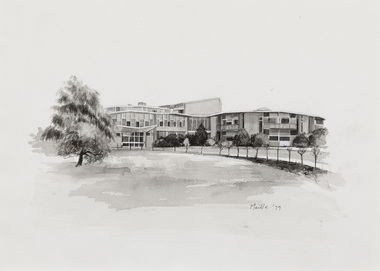
Work on paper - ink and watercolour, Annette Meikle, Sandringham Hospital, 1977
... design. The hospital included circular wings with nurses’ stations at the hub and wards radiating outwards like spokes on a wheel. The hospital included 100 beds, two operating theatres and four delivery rooms and baby nurseries. ...design. The hospital included circular wings with nurses’ stations at the hub and wards radiating outwards like spokes on a wheel. The hospital included 100 beds, two operating theatres and four delivery rooms and baby nurseries. ...In 1977, artist Annette Meikle undertook a commission to illustrate a book recording stories of places and people in the Bayside area. It was published in 1978 as Sandringham Sketchbook, with text by Elizabeth Waters. The sketches were intended to record remaining examples of Bayside’s early architecture and environment, as well as reflect newer architectural changes. Meikle went on to donate 22 of these sketches to Bayside City Council in 2003. Tasmanian architect J.H. Esmond Dorney developed this ground-breaking design for the Sandringham Hospital, which opened in 1964. Dorney had spent significant time recuperating in hospital in the post-war years and developed a special interest in hospital design. The hospital included circular wings with nurses’ stations at the hub and wards radiating outwards like spokes on a wheel. The hospital included 100 beds, two operating theatres and four delivery rooms and baby nurseries. Each ward of two to four beds had its own bathroom, and featured wide windows with garden views. The design was considered radical at the time and was copied as far afield as England and the United States.Annette Meikle, Sandringham Hospital 1977, ink and watercolour, 25.5 x 35.5 cm. Bayside City Council Art and Heritage Collection. Donated by the artist, 2003annette meikle, sandringham sketchbook, elizabeth waters, sandringham hostpital, jh esmond dorney, hospital, architecture, sandringham -
 Australian Army Museum of Western Australia
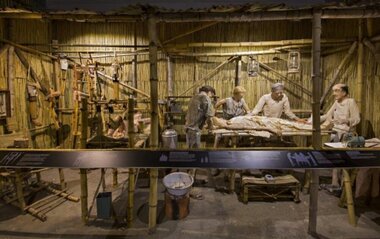
Diorama, 2015
... designed and installed by a collaborative group of artists and craftsmen, all themselves former Prisoners of War in 1995. Bamboo for the display and replica prosthetics was sourced from Thailand. The mannequins are artistic interpretations of identified POW surgical staff and doctors. The original display was moved and reassembled during the Gallery redevelopment process in 2015. All items presented within the diorama are based on POW recorded drawings and diaries of experiences in the Thai Burma Railway POW camps. thai burma railway; 1:1 scale diorama showing operating theatre ...This diorama is the focal point the Prisoner of War Gallery. It was originally designed and installed by a collaborative group of artists and craftsmen, all themselves former Prisoners of War in 1995. Bamboo for the display and replica prosthetics was sourced from Thailand. The mannequins are artistic interpretations of identified POW surgical staff and doctors. The original display was moved and reassembled during the Gallery redevelopment process in 2015. All items presented within the diorama are based on POW recorded drawings and diaries of experiences in the Thai Burma Railway POW camps.1:1 scale diorama showing operating theatre in POW camp on Burma Thai Railway together with reproductions of prothesis and improvised equipmentthai burma railway; -
 Kew Historical Society Inc
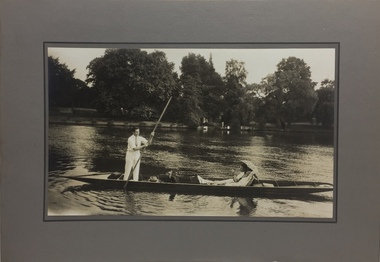
Photograph - John Duncan Brownlee and friends, Yarra River, The Artorium, 1920s
... With a home at 33 Uvadale Road (designed by Eric Nicholls, who managed the architectural practice of Walter Burley and Marion Mahony Grifffin from 1924 to 1932), Beament painted a number of significant murals for the Griffin practice, including those at the Capitol Theatre in Melbourne. A photograph of recreational activities on the River Yarra. The photograph is historically significant as a professionally produced photograph of the Australian operatic ...This mounted and framed photograph of a group of friends punting on the River Yarra has a number of historic and artistic associations. The photograph is primarily important as an informal photograph of the Australian baritone John Donald Mackenzie Brownlee (1900-1969), whose international career at the world's major opera houses from 1927 until his retirement in 1958 included singing at Melba's Covent Garden farewell in 1926, to recordings in the 1930s of a major series of Mozart operas in Glyndebourne Festival productions, conducted by Fritz Busch. Brownlee, born in Geelong, won the gold medal as champion vocalist at the South Street competitions in Ballarat in 1921. Moving to Paris in 1923 he began study with the French baritone, Dinh Gilly, making his operatic debut at the Trianon Lyrique in Montmartre in 1926. The most significant periods of his operatic career were with the Paris Opera from 1927 to 1936, and at the Metropolitan Opera from 1937 to 1957. After his move to Paris in 1923, he is recorded as revisiting Australia in 1928 as a member of the Melba-Williamson Company, and 24 years later in 1952. The photograph of Brownlee and the Gardners in a punt on the Yarra, while putatively dated to 1925, must be from earlier in the 1920s before his move to Paris, or later during the Melba-Williamson Company season. Before his move to Paris in 1923, Brownlee had lived in Belmont Avenue, Kew, where he must have developed a friendship with the Gardners. The photograph has additional artistic significance as it was produced at 'The Artorium', James Beament's design studio next to the Hawthorn Town Hall at 362 Burwood Road. With a home at 33 Uvadale Road (designed by Eric Nicholls, who managed the architectural practice of Walter Burley and Marion Mahony Grifffin from 1924 to 1932), Beament painted a number of significant murals for the Griffin practice, including those at the Capitol Theatre in Melbourne.A photograph of recreational activities on the River Yarra. The photograph is historically significant as a professionally produced photograph of the Australian operatic baritone John Brownlee, either before his move to Paris in 1923, or in 1928 during the Melba-Williamson Company operatic tour of Australia. The photograph has additional aesthetic significance as it was produced in James Beament's Hawthorn Studio - The Artorium - at 362 Burwood Road, next to the Hawthorn Town Hall.Framed photograph of John Duncan Brownlee, the Australian tenor, with Enid Gardner and friend in a punt on the Yarra River. Brownlee was born in Geelong but before his move to Paris in 1923, he lived for a period in Belmont Avenue, Kew. Three labels on reverse. 1. "John Duncan Brownlee, Operatic Star, originally of Geelong later resident of Kew at Belmont Av, on the pole. Also in the punt - Edith Gardner a friend. The Gardners lived on the east corner of Edgevale Rd. & Cotham. Approx. 1925." 2. "This picture is the property of Kew Historical Society 1/4/79". 3. Tel. Hawthorn 842 THE ARTORIUM ...."john brownlee (tenor), punting, recreation - yarra river (kew), james beament, the artorium -- 362 burwood road -- hawthorn (vic.)
