
Showing 17 items matching "operational vehicle"
-
 Ballarat Tramway Museum
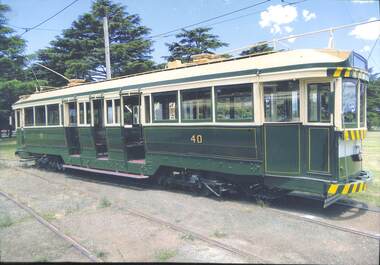
Photograph - Photograph - coloured, Tram No.40 - Maximum Traction truck bogie, drop end and centre combination
... ...operational vehicle...Tram 40 is an operational vehicle and in general use in the Museum service....Tram 40 is an operational vehicle and in general use in the Museum service. 1913 prahran and Malvern Tramways Trust tram 35 state electricity commission tram 40 1951 ballarat tramway museum 1971 last tram sebastopol to depot operational vehicle Tram number 40 and emblem of State Electricity Commission of Victoria in gold on side. ...This tram was built in 1913 for the Prahran and Malvern Tramways Trust. When first in use it was number 35. It was sold to the State Electricity Commission of Victoria and became number 40 in 1951. Ballarat Tramway Museum purchased the tram in 1971. It was the last tram to run when it ran from Sebastopol to the depot on 19 September 1971. Tram 40 is an operational vehicle and in general use in the Museum service.Large coloured photograph, laminated, of green and cream tram number 40.Tram number 40 and emblem of State Electricity Commission of Victoria in gold on side.1913, prahran and malvern tramways trust, tram 35, state electricity commission, tram 40, 1951, ballarat tramway museum, 1971, last tram, sebastopol to depot, operational vehicle -
 8th/13th Victorian Mounted Rifles Regimental Collection
Document - report "Northern Explorer"
... Typed report on Operational efficiency of AFV vehicles and crews prepared by Lance Corporal Van De Velde ' A ' Squadron 8/13 Victorian Mounted Rifles following Exercise ' Northern Explorer' 15-20 September 1988. ...Northern Territory VMR Tindal training Carrington Explorer Typed report on Operational efficiency of AFV vehicles and crews prepared by Lance Corporal Van De Velde ' A ' Squadron 8/13 Victorian Mounted Rifles following Exercise ' Northern Explorer' 15-20 September 1988. ...Example of after training report following annual exercise. In 1988, as part of a Defence of Mainland Australian policy, defence of facilities of strategic importance in northern Australia were allocated to Army Reserve units. ‘A’ Squadron was allocated the defence of Tindal Air Force base located 15 KM outside Katherine in Northern Territory. Consequently, the Squadron deployed on Exercise ‘Northern Explorer’ to gain first-hand knowledge of operating conditions for mounted and dismounted patrolling in the area.Typed report on Operational efficiency of AFV vehicles and crews prepared by Lance Corporal Van De Velde ' A ' Squadron 8/13 Victorian Mounted Rifles following Exercise ' Northern Explorer' 15-20 September 1988. Two pages, dated 22 September 1988.northern territory, vmr, tindal, training, carrington, explorer -
 Flagstaff Hill Maritime Museum and Village
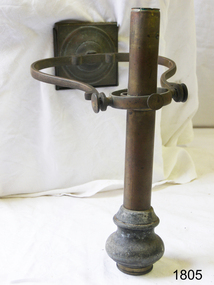
Functional object - Carbide Lamp, Powell & Hanmer, Late 19th to early 20th century
... It is still operational, and one of the oldest working paddle steamers in the world, listed on the Australian Register of Historic Vehicles. flagstaff hill warrnambool flagstaff-hill-maritime-museum maritime-museum shipwreck-coast flagstaff-hill-maritime-village carbide lamp motor vehicle bike lamp lighting vehicle lighting Powell Hanmer Acetylene gas lamp Early Lighting Marine Lighting None Acetylene Carbide lamp, marine pattern burner housing and reflector missing Carbide Lamp, metal. ...Francis Powell (1861-) and Francis Hanmer (1858-1925) founded Powell and Hanmer Ltd in the Summer of 1885 for the manufacturer of bike and carriage lamps. Their first advertisements began to appear in November of 1885. In 1890 they lodged a Patent for “velocipede” lamps to be used by lightweight wheeled vehicles propelled by a rider, such as a bike, tricycle and railroad handcar. In April of 1913, they were selling headlamps for cars and in 1914 built their second factory manufacturing dynamo lighting sets in Rocky Lane Birmingham, also for the production of dynamos for motor cars. Then in 1929 Powell and Hanmer Ltd, was acquired by the Lucas company which was at that time the main competitor for the manufacture of non-electrical equipment for cycles and motorcycles. When a director of Powell and Hanmer joined the board of Austin motor cars, Lucas feared that Austins might encourage Powell and Hanmer to start to produce electrical equipment for supply to the company and as a result this association might affect Lucas's business with other large vehicle manufacturers. As a result, Lucas made an offer to Powell & Hanmer and purchased the business for £500,000. Carbide lighting was used in rural and urban areas of Australia which were not served by electrification. Its use began shortly after 1900 in many countries and continued past the 1950s. Calcium carbide pellets were placed in a container outside the home, with water piped to the container and allowed to drip on the pellets releasing acetylene. This gas was piped to lighting fixtures inside the house, where it was burned, creating a very bright flame. Carbide lighting was inexpensive but was prone to gas leaks and explosions. Early models of the automobile, motorbike and bicycles used carbide lamps as headlamps. Acetylene gas, derived from carbide, enabled early automobiles to drive safely at night. Thick concave mirrors combined with magnifying lenses projected the acetylene flame light. These type of lights were used until reliable batteries and dynamos became available, and manufacturers switched to electric lights. Acetylene lamps were also used on riverboats for night navigation. The National Museum of Australia has a lamp made in about 1910 that was used onboard the PS Enterprise, an 1878 Australian paddle steamer, currently owned by the National Museum of Australia in Canberra. It is still operational, and one of the oldest working paddle steamers in the world, listed on the Australian Register of Historic Vehicles.Acetylene Carbide lamp, marine pattern burner housing and reflector missing Carbide Lamp, metal. Has plate for attaching to wall, & gimbal to allow lamp to remain vertical. Noneflagstaff hill, warrnambool, flagstaff-hill-maritime-museum, maritime-museum, shipwreck-coast, flagstaff-hill-maritime-village, carbide lamp, motor vehicle, bike lamp, lighting, vehicle lighting, powell, hanmer, acetylene gas lamp, early lighting, marine lighting -
 Flagstaff Hill Maritime Museum and Village
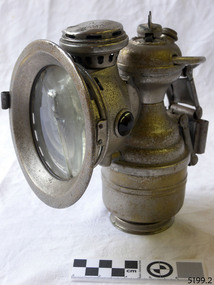
Functional object - Carbide Lamp, Powell & Hanmer, 1920s
... It is still operational, and one of the oldest working paddle steamers in the world, listed on the Australian Register of Historic Vehicles. flagstaff hill warrnambool flagstaff-hill-maritime-museum maritime-museum shipwreck-coast flagstaff-hill-maritime-village carbide lamp motor vehicle bike lamp lighting vehicle lighting Powell Hanmer Acetylene gas lamp Early Lighting Model 75 Acetylene Carbide lamp, Model “Panther” distinct patterned side red and green lenses. ...Francis Powell (1861-) and Francis Hanmer (1858-1925) founded Powell and Hanmer Ltd in the Summer of 1885 for the manufacturer of bike and carriage lamps. Their first advertisements began to appear in November of 1885. In 1890 they lodged a Patent for “velocipede” lamps to be used by lightweight wheeled vehicles propelled by a rider, such as a bike, tricycle and railroad handcar. In April of 1913, they were selling headlamps for cars and in 1914 built their second factory manufacturing dynamo lighting sets in Rocky Lane Birmingham, also for the production of dynamos for motor cars. Then in 1929 Powell and Hanmer Ltd, was acquired by the Lucas company which was at that time the main competitor for the manufacture of non-electrical equipment for cycles and motorcycles. When a director of Powell and Hanmer joined the board of Austin motor cars, Lucas feared that Austins might encourage Powell and Hanmer to start to produce electrical equipment for supply to the company and as a result this association might affect Lucas's business with other large vehicle manufacturers. As a result, Lucas made an offer to Powell & Hanmer and purchased the business for £500,000. Carbide lighting was used in rural and urban areas of Australia which were not served by electrification. Its use began shortly after 1900 in many countries and continued past the 1950s. Calcium carbide pellets were placed in a container outside the home, with water piped to the container and allowed to drip on the pellets releasing acetylene. This gas was piped to lighting fixtures inside the house, where it was burned, creating a very bright flame. Carbide lighting was inexpensive but was prone to gas leaks and explosions. Early models of the automobile, motorbike and bicycles used carbide lamps as headlamps. Acetylene gas, derived from carbide, enabled early automobiles to drive safely at night. Thick concave mirrors combined with magnifying lenses projected the acetylene flame light. These type of lights were used until reliable batteries and dynamos became available, and manufacturers switched to electric lights. Acetylene lamps were also used on riverboats for night navigation. The National Museum of Australia has a lamp made in about 1910 that was used onboard the PS Enterprise, an 1878 Australian paddle steamer, currently owned by the National Museum of Australia in Canberra. It is still operational, and one of the oldest working paddle steamers in the world, listed on the Australian Register of Historic Vehicles.Acetylene Carbide lamp, Model “Panther” distinct patterned side red and green lenses. These lamps were also known as acetylene gas lamps. They work off a chemical reaction between calcium carbide and water.Model 75flagstaff hill, warrnambool, flagstaff-hill-maritime-museum, maritime-museum, shipwreck-coast, flagstaff-hill-maritime-village, carbide lamp, motor vehicle, bike lamp, lighting, vehicle lighting, powell, hanmer, acetylene gas lamp, early lighting -
 Bendigo Military Museum
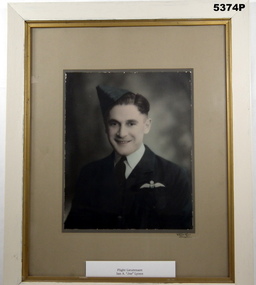
Photograph - PHOTOGRAPH, FRAMED, Vincent Kelly
... vehicle Lyons was travelling in hit a mine (on 9.1.1942), resulting in 5 KIA or WIA. Lyons spent 2 weeks in hospital with severe concussion and deafness. Lyons the embarked for Australia on 11.3.1942 before disembarking on 18.4.1942. He was posted to Townsville with 82nd Sqd on 27.6.1944. Subsequently he was posted to Noemfoor Island on 21.9.1944 as Operational...vehicle Lyons was travelling in hit a mine (on 9.1.1942), resulting in 5 KIA or WIA. Lyons spent 2 weeks in hospital with severe concussion and deafness. Lyons the embarked for Australia on 11.3.1942 before disembarking on 18.4.1942. He was posted to Townsville with 82nd Sqd on 27.6.1944. Subsequently he was posted to Noemfoor Island on 21.9.1944 as Operational ...IAN ALFRED (Joe) LYONS MBE Born 16.2.1915 in Bendigo enlisted in the RAAF aged 25 years on 27.5.1940, No 400095. Starting in the ranks as an LAC, he rose to Flt/Sgt pre-embarkation. He embarked for the Middle East on 2.11.1941before dis-embarking to serve with No 3 Sqd RAAF. During heavy action on 8.1.1942, his plane was forced down due to engine damage. It landed in an enemy minefield and when it came to a halt, its wheels were straddling a mine. After being rescued by a British officer, dozens of mines were located and dug up. On return, some 15 miles from base, the vehicle Lyons was travelling in hit a mine (on 9.1.1942), resulting in 5 KIA or WIA. Lyons spent 2 weeks in hospital with severe concussion and deafness. Lyons the embarked for Australia on 11.3.1942 before disembarking on 18.4.1942. He was posted to Townsville with 82nd Sqd on 27.6.1944. Subsequently he was posted to Noemfoor Island on 21.9.1944 as Operational with 82nd Sqd and promoted to Flt/Lt (Temp.) on 3.1.1945. On 6.1.1945 he was posted to 77Sqd as Operational on Morotai. This deployment ended on 9.7.1945. Records show that he flew 26 Strike/Attack missions and 13 others with both squadrons. Post WW2, Lyons remained with the RAAF with a new service number (033072). On 2.2.1948 he was posted to Japan before returning to Australia on 28.8.1948, apparently for medical reasons. He was appointed Flt/Lt on 23.9.1948 before returning to Japan and Korea on 22.8.1950. He was awarded an MBE as Operations Officer with 77Sqd for 'Outstanding enthusiasm and energy at 3 Korean bases'. A US Bronze Star was awarded to Lyons for 'Distinguished and meritorious service as Operations Officer in Korea during the period 14.10.1950 to 17.2.1951'. After Korea, Lyons received a number of posting from Victoria to Western Australia. He was awarded the Air Efficiency Medal in 1964. At his own request, Flt/Lt Ian Alfred 'Joe' Lyons MBE, retired from the RAAF HQ OP COM on 15.12.1967. The photograph is part of the Ian A. 'Joe' Lyons MBE Collection.Framed hand tinted colour head and shoulders photograph of a man in an RAAF uniform. The photograph is bordered with a light brown matt. THe wooden frome is painted white and gold. A white printed label bearing the name of the man is located below the photograph. Clear perspex covers the photograph. The photographer's name also appears below the photograph. The rear of the frame is covered in brown paper secured with masking tape. Two eyes and white cord are attached for hanging purposes.Handwritten in black below the photograph: 'VINCENT KELLY, Bendigo'.raaf uniform, photograph, flight lieutenant ian a. lyons -
 National Vietnam Veterans Museum (NVVM)
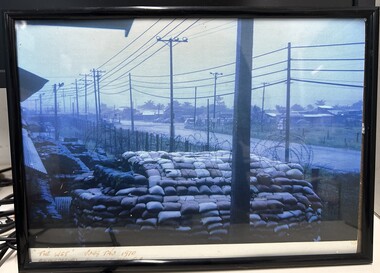
Photograph - A Framed Coloured Photograph, The Wet -Vung Tau 1970, 1970
... Vung Tau Photograph Cpl Joseph Charles Mercieca A316866 Royal Australian Air Force No. 1 Operational Support Unit The Wet In a black frame is a coloured photograph of stacked sandbags in the foreground with a post. There are several other posts with lots of wires running across the tops of them. There is barb wire surrounding the sandbags and building and vehicles ...This photograph was taken by Cpl Joseph Charles Mercieca (A316866) who served with the Royal Australian Air Force and was in Vietnam with No. 1 Operational Unit from July 1969 to July 1970.In a black frame is a coloured photograph of stacked sandbags in the foreground with a post. There are several other posts with lots of wires running across the tops of them. There is barb wire surrounding the sandbags and building and vehicles across the road. At the bottom of the photograph reads The Wet - Vung Tau 1970 photographed by J.C. Merciecavung tau, photograph, cpl joseph charles mercieca, a316866, royal australian air force, no. 1 operational support unit, the wet -
 National Vietnam Veterans Museum (NVVM)
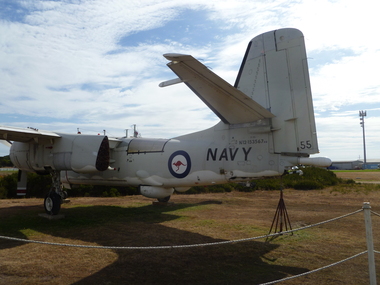
Vehicle - Grumman S2 Tracker, 04/77 (approximate)
... Aircraft Grumman tracker RAN Logo, 855. operational instruction, US construction number N12-153567, Navy Carrier bourne Anti-Submarine Aircraft Vehicle Grumman S2 Tracker Grumman Aircraft Company ...Carrier bourne Anti-Submarine AircraftRAN Logo, 855. operational instruction, US construction number N12-153567, Navyaircraft, grumman tracker -
 Bendigo Military Museum
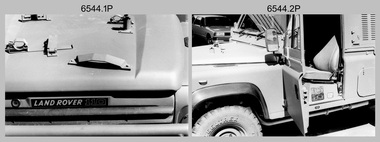
Photograph - 4th Field Survey Squadron - Land Rover Perentie Light Vehicles, Keswick Barracks, Adelaide SA, 1987
... There were 35 vehicles built to satisfy the operational requirements of RA Svy’s units. ...There were 35 vehicles built to satisfy the operational requirements of RA Svy’s units. ...This is a set of 35 photographs featuring 4th Field Survey Squadron’s newly introduced Survey variant of the Land Rover Perentie light vehicle, at Keswick Barracks, Adelaide SA in 1987. The Land Rover Perentie is a nickname for the Land Rover 110 produced by JRA Limited for the Australian Army, and part manufactured and assembled in Moorebank, New South Wales, during the 1980s and 1990s The name Perentie originates from Land Rover's successful tender to Project Perentie, which was the official Australian Army trial to select new 1 and 2-tonne light vehicles to replace the ageing fleet of Series 2A and 3 Land Rovers. The major differences between the Land Rover Perentie and British Land Rovers were the relocation of the spare wheel to a position under the rear of the load area, a galvanised chassis and the Isuzu engine. The Land Rover Perenties were produced in 4x4 and 6x6 variants and powered by an Isuzu 3.9-litre four-cylinder 4BD1 diesel engine. The Truck, Panel, Lightweight, Survey, FFR, Winch, MC2 model was one of eight 4x4 variants built for the Australian Army. There were 35 vehicles built to satisfy the operational requirements of RA Svy’s units. Source – Wikipedia. See item 6545.9P for related photos of these vehicles.This is a set of 35 photographs featuring 4th Field Survey Squadron’s newly introduced Survey variant of the Land Rover Perentie light truck vehicle, at Keswick Barracks, Adelaide SA in 1987. The black & white photographs are on 35mm negative film and are part of the Army Survey Regiment’s Collection. The photographs were scanned at 96 dpi. .1) to .8) - Photo, black & white, 1987. Land Rover Perentie light truck vehicle features. .9) - Photo, colour, 1986. L to R: unidentified, RQMS - WO2 Peter Symmans, unidentified. .10) to .15) - Photo, black & white, 1987. Land Rover Perentie light truck vehicle features. .16) - Photo, black & white, 1987. Land Rover Perentie light truck vehicle. L to R: WO2 Russ Larsen, SSGT Barry Lutwyche, 2IC Terry Lord, SGT Mick Hogan, unidentified. .17) - Photo, black & white, 1987. Land Rover Perentie light truck vehicle features. .18) & .19) - Photo, black & white, 1987. Loading field trip stores into Land Rover Perentie light truck vehicle. .20) & .21) - Photo, black & white, 1987. L to R: SPR Steve Perks, SGT Mick Hogan loading field trip stores into Land Rover Perentie light truck vehicle. .22) to .25) - Photo, black & white, 1987. L to R: SPR Steve Perks loading field trip stores into Land Rover Perentie light truck vehicle. .26) - Photo, black & white, 1987. CAPT Danny Galbraith loading field trip stores into Land Rover Perentie light truck vehicle. .27) to .31) - Photo, black & white, 1987. Loading field trip stores into Land Rover Perentie light truck vehicle. .32) to .34) - Photo, black & white, 1987. Land Rover Perentie light truck vehicle – broken transfer case lever. .35) - Photo, black & white, 1987. Land Rover Perentie light truck vehicle’s Isuzu 3.9-litre four-cylinder 4BD1 diesel engine..1P to .35P – There are no personnel identified. ‘PERENTI MOTOR VEHICLES JUL 87’ annotated on negatives sleeve.royal australian survey corps, rasvy, 4 fd svy sqn -
 Bendigo Military Museum
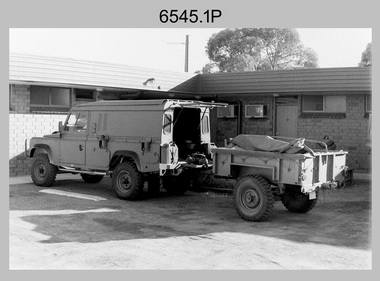
Photograph - 4th Field Survey Squadron - Land Rover Perentie Light Vehicles in the Field, 1987
... There were 35 Vehicles built to satisfy the operational requirements of RA Svy’s units. ...There were 35 Vehicles built to satisfy the operational requirements of RA Svy’s units. ...This is a set of nine photographs featuring 4th Field Survey Squadron’s newly introduced Survey variant of the Land Rover Perentie light truck vehicle on a field trip in SA, in 1987. The Land Rover Perentie is a nickname for the Land Rover 110 produced by JRA Limited for the Australian Army, and part manufactured and assembled in Moorebank, New South Wales, during the 1980s and 1990s The name Perentie originates from Land Rover's successful tender to Project Perentie, which was the official Australian Army trial to select new 1 and 2-tonne light vehicles to replace the ageing fleet of Series 2A and 3 Land Rovers. The major differences between the Land Rover Perentie and British Land Rovers were the relocation of the spare wheel to a position under the rear of the load area, a galvanised chassis and the Isuzu engine. The Land Rover Perenties were produced in 4x4 and 6x6 variants and powered by an Isuzu 3.9-litre four-cylinder 4BD1 diesel engine. The Truck, Panel, Lightweight, Survey, FFR, Winch, MC2 model was one of eight 4x4 variants built for the Australian Army. There were 35 Vehicles built to satisfy the operational requirements of RA Svy’s units. Source – Wikipedia. See item 6544.35P for related photos of these vehicles.This is a set of 35 photographs featuring 4th Field Survey Squadron’s newly introduced Survey variant of the Land Rover Perentie light truck vehicle, at Keswick Barracks, Adelaide SA in 1987. The black & white photograThis is a set of nine photographs featuring 4th Field Survey Squadron’s newly introduced Survey variant of the Land Rover Perentie light truck vehicle on a field trip in SA, in 1987. The black & white photographs are on 35mm negative film and are part of the Army Survey Regiment’s Collection. The photographs were scanned at 96 dpi. .1) - Photo, black & white, 1987. Perentie Land Rover with trailer parked outside unknown motel in SA. .2) & .3) - Photo, black & white, 1987. Field trip featuring Perentie Land Rover. .4) - Photo, black & white, 1987. Field trip featuring Perentie Land Rover. Series 3 Land Rover parked behind. Unidentified personnel. .5) & .6) - Photo, black & white, 1987. Field trip featuring Perentie Land Rover. Unidentified personnel. .7) & .8) - Photo, black & white, 1987. Field trip featuring Perentie Land Rover. Typical sandy 4WD track on fence line. .9) - Photo, black & white, 1987. Field trip featuring Perentie Land Rover. Probable gas extraction facility..1P to .9P – There are no personnel identified. ‘PERENTI MOTOR VEHICLES JUL 87’ annotated on negatives sleeve.tified. royal australian survey corps, rasvy, 4 fd svy sqn -
 Ballarat Tramway Museum
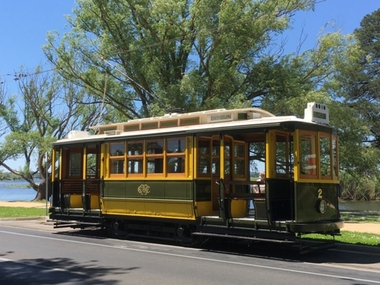
Vehicle - Tramcar, Duncan and Fraser, SECV Geelong No. 2, 1912
... operational. Trams Geelong tram 2 MESCo A two motor four wheel tram car - Single Truck straight sill open combination with a wooden body. SECV Geelong No. 2 Vehicle ...The tram was built by Duncan and Fraser of Adelaide in 1912 for the Melbourne Electric Supply Co (MESCo) for its Geelong operation that opened in 1912 and closed in 1956. The body was subsequently sold to Phil Shoppee, a farmer at Murradoc on the Bellarine Peninsula, purchased by the donor in 1991, who rebuilt the tram back to its MESCo configuration. The tram is fitted with a four-wheel truck from Brussels. To make the tram operable, air and electrical work was carried out by Bendigo Tramways. The tram was donated to the Museum in 2021, and the tram entered service on 6/2/2022. This tram is the only one known to exist of the seven (and four trailers) that opened the Geelong system in 1912. It is the only former MESCo Geelong tram that has been reconstructed to its as-built body configuration and made operational.A two motor four wheel tram car - Single Truck straight sill open combination with a wooden body.trams, geelong, tram 2, mesco -
 Ballarat Tramway Museum
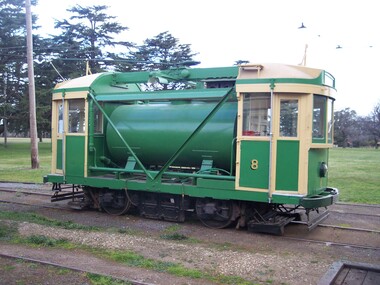
Vehicle - Tramcar, Melbourne and Metropolitan Tramways Board (MMTB), Scrubber Tram No. 8, 1934
... vehicle. Donated to the BTM in 1999 and has been an operational tram 2001. ...The tram carries approx. 4 cubic metres of water. Built by the Melbourne and Metropolitan Tramways Board in 1934 using the cabs from a C class tram (No. 32). It was transported to the isolated Footscray system a number of times to clean the rails there. In 1961 it received additional body bracing and repainted in the diagonal black and string (light cream) stripes. The tram became 8W during 1975 as the then new Z class trams came into service. By the early 1990's the need for the tram and the other similar cars used to "scrub" the surface of the rails was no longer. The tram was stored at Malvern depot for many years before being donated to the Ballarat Tramway Museum by the Public Transport Commission in September 1999. It has been scrubbing the rails in Ballarat since March 2001. For a detailed article see April 2008 issue of Fares Please. Photo Warren Doubleday 20/9/2008 after painting completed. See Destination City for further details.One of a few service vehicles built from almost new by the MMTB rather than being a converted vehicle. Donated to the BTM in 1999 and has been an operational tram 2001.Single truck (4 wheels), special purpose tram fitted with two cabs, control equipment, air brakes, track scrubber or cleaning equipment, pump, water and air lines to clean track. MMTBtrams, scrubber tram, tram 8, tram 8w -
 Melbourne Tram Museum
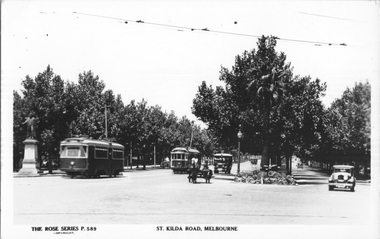
Postcard, Rose Stereograph Co, "St Kilda Road Melbourne", c1931
... vehicles. Tram 300 was fitted with route number boxes in November1933. To the left is the Edmund Fitz Gibbon Memorial in its original location and in the top of the photo is the tram overhead into City Road. Details a scene at the intersection of City Road and St Kilda Road c1931. Very rare to see the Y1 class tram operational ...Rose Series postcard P.589, titled "St Kilda Road Melbourne", with Y1 class 613 outbound with the destination of Toorak and W2 class 300, in bound in St Kilda Road, taken at the intersection with City Road. Has another W2 in the distance and a private bus along with two horse-drawn vehicles. Tram 300 was fitted with route number boxes in November1933. To the left is the Edmund Fitz Gibbon Memorial in its original location and in the top of the photo is the tram overhead into City Road. Details a scene at the intersection of City Road and St Kilda Road c1931. Very rare to see the Y1 class tram operational in a photo.Postcard - printed real photograph with Rose Stereograph Co. name on the rear.In pencil on rear: "M&MTB, Y` 613 southbound to Camberwell? and "W2 300 approaching Princes Bridge (City), photo taken about 1930"trams, st kilda road, tramways, w2 class, y1 class, tram 300, bus, tram 613, rose series -
 Melbourne Tram Museum
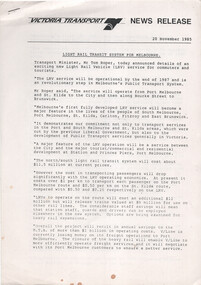
Document - News Release, Victoria Transport, "Light rail Transit system for Melbourne", 20/11/1985
... Notes the first LRV on the Burwood line, the need for new vehicles and that it would be operational by the end of 1987....Notes the first LRV on the Burwood line, the need for new vehicles and that it would be operational by the end of 1987. ...News Release from Victoria Transport titled "Light rail Transit system for Melbourne" - dated 20/11/1985 about the proposed north - south Light Rail service - Nicholson St / St Kilda and Port Melbourne. Announced by Tom Roper, Transport Minister. Notes the first LRV on the Burwood line, the need for new vehicles and that it would be operational by the end of 1987.Yields information about the formal announcement of the St Kilda / Port Melbourne Light rail project.Document - three A4 sheets - has been stapled in top left hand corner.tramways, light rail, st kilda light rail, port melbourne, lrv -
 City of Ballarat Libraries
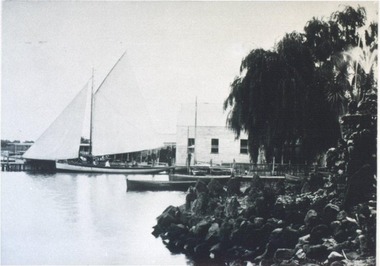
Photograph, Yacht on Lake Wendouree circa 1910
... operational. This location is on the south east corner of the lake. Vehicle building recreation Lake Wendouree Fountain Yacht on Lake Wendouree circa 1910. ...The jetty and boatshed are no longer standing but the fountain is still operational. This location is on the south east corner of the lake.vehicle, building, recreation, lake wendouree, fountain -
 Melbourne Tram Museum
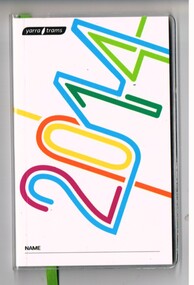
Memorabilia - Diary, Yarra Trams, "2014", 2013
... Contains company information, safety messages, lists depot management personnel, Cardinal rules, safety rules, operational rules, tips on announcements, dates in a weekly format, notes pages and seven sheets which have been perforated to record incidents on including vehicle collisions, derailments, injuries. ...Contains company information, safety messages, lists depot management personnel, Cardinal rules, safety rules, operational rules, tips on announcements, dates in a weekly format, notes pages and seven sheets which have been perforated to record incidents on including vehicle collisions, derailments, injuries. ...Book printed as a diary for 2014, for Yarra Trams employees contained within a clear plastic cover. Has the Yarra Trams logo and the date "2014" on the front cover. Contains company information, safety messages, lists depot management personnel, Cardinal rules, safety rules, operational rules, tips on announcements, dates in a weekly format, notes pages and seven sheets which have been perforated to record incidents on including vehicle collisions, derailments, injuries. Last page provides useful contact information. Has a green cotton place marker strip fitted into the binding.trams, tramways, yarra trams, tram crews, rules, diary, safety, incidents -
 Melbourne Tram Museum
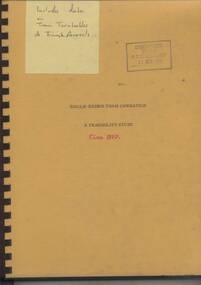
Document - Report, Melbourne & Metropolitan Tramways Board (MMTB), "Single-ended tram operations - a Feasibility study", mid 1970's
... Looks at the background for the proposal, operational issues, including loading and unloading, a CBD loop, capital costs, traffic issues, implementation, vehicle design. ...Looks at the background for the proposal, operational issues, including loading and unloading, a CBD loop, capital costs, traffic issues, implementation, vehicle design. ...Report - 104 pages, with orange card and plastic covers, bound with a black coloured comb binder titled "Single-ended tram operations - A Feasibility study". Looks at the background for the proposal, operational issues, including loading and unloading, a CBD loop, capital costs, traffic issues, implementation, vehicle design. Report notes it has many advantages and disadvantages, but the concept was supportive that single ended vehicles should be introduced. Report not dated as such, but discusses the ordering of new tramcars in 1977/78, dated c1977. See Also Reg Item 337. On front cover is a post-it notes commenting about report - see image. See Reg Item 4388 for the contract tender document for the Z3 class trams which included the option for a single ended tram.Stamped on cover and inside page "Discarded from PTC Library 19 Oct 1989".trams, tramways, single ended tramcars, mmtb, bourke st, collins st, turning loops, swanston st, william st -
 Lake Boga Flying Boat Museum
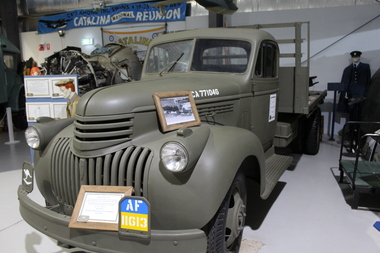
Vehicle - Chevrolet Truck
... Body by GM (USA) The Chevrolet truck is identical to those used at Lake Boga Flying Boat Repair Depot during its operational phase, 1942 to 1947 chevrolet truck Lake Boga Flying Boat Repair Depot WWII AF/11613 CA 771046 Painted dark khaki exterior, metal cab & bonnet, wooden tray. Vehicle ...The Chevrolet trucks were used at Lake Boga Flying Boat Depot during its operational phase, 1942 to 1947. They were used to ferry personnel from location to location, including between the depot and accommodation. The number on the bonnet is the SN (now knows as the VIN), the registration number is that of an RAAF truck which was used here during WW2. Body by GM (USA)The Chevrolet truck is identical to those used at Lake Boga Flying Boat Repair Depot during its operational phase, 1942 to 1947Painted dark khaki exterior, metal cab & bonnet, wooden tray.AF/11613 CA 771046chevrolet, truck, lake boga flying boat repair depot, wwii
