
Showing 29 items matching "order of the british empire (obe)"
-
 Mission to Seafarers Victoria
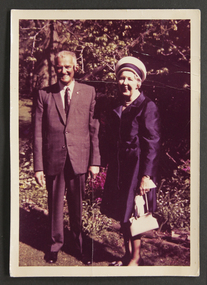
Photograph - Digital Image, series, 23 March 2018
... ...order of the british empire...obe...Dora Walker and husband at Governor's house the day she received the Order of the British Empire on 13 June 1970. dora walker order of the british empire obe lhlg dora simpson Photograph Digital Image, series ...Dora Walker and husband at Governor's house the day she received the Order of the British Empire on 13 June 1970.dora walker, order of the british empire, obe, lhlg, dora simpson -
 National Vietnam Veterans Museum (NVVM)
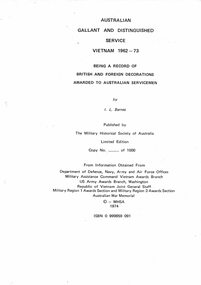
Document, A copy of Australian Gallant and Distinguished Service Vietnam 1962-1973: Being A Record of British and Foreign Decorations Awarded to Australian Servicemen in The Royal Australian Air Force, 1974
... ...Order Of The British Empire (OBE)...Flight Lieutenant Commander Of The Order Of The British Empire CBE Air Commodore Jack Dowling 0370 Air Commodore John Fullarton Lush 0369 Group Captain John Wilkins Hubble 05833 Air Commodore Geoffrey Thompson 0393 Group Captain John Irwin Adams O33119 Air Commodore Frederick Stephen Robey O5787 Group Captain Ronald Jack McKimm O22084 Air Commodore Clarence Haddon Spurgeon O399 Air Commodore Neville Patrick McNamara O11353 Group Captain Roberts (Robert) Hunter Martin O22188 Distinguished Service Order DSO Companion of the Distinguished Service Order Group Captain Peter Frank Raw Wing Commander Anthony Watcyn Powell O314347 Group Captain Selwyn David Evans O22127 Wing Commander John Alan Paule O35028 Wing Commander John Alan Whitehead O33710 Wing Commander Peter Geoffrey Larard O35023 Wing Commander Roy Walter Hibben O37568 Wing Commander Jack Robert Boast O14165 Wing Commander Peter Lionel Howard Coy O26006 Wing Commander Peter William Hahood O52901 Officer of the Order of the British Empire Order Of The British Empire (OBE) Wing Commander Phillip Arthur Bloom O210837 Wing Commander Peter William Kennedy O4667 Member of the Order of the British Empire (MBE) Warrant Officer Andrea Giovanni Pellizzer A4149 Chaplain Third Class Patrick John McCormick O19853 Wing Commander Cecil George Kilsby O33178 Warrant Officer Allan Richard Grinter A31866 Flight Lieutenant Philip Anthony Mogridge O39014 Flight Lieutenant George Walter Foskett O223127 Squandron Leader Ronald Holden Tucker O220878 Flight Lieutenant Neville Colin Walliss O12206 Flight Lieutenant Walter Wolfgang Wurm O55848 Flight Lieutenant John Thomas Connell O33721 Chaplain John Julian White O317689 Squadron Leader Donald Arthur Ernest Tidd O313248 Flight Lieutenant Raymond Keith Crossley O32838 Flight Lieutenant Bruce Victor Tipping O35364 Squadron Leader Robin Norman Wade O217796 Chaplain John Eward Grannall O222956 Distinguished Flying Cross DFC Wing Commander Victor Douglas Guthrie O22015 Wing Commander Raymond Alfred Scott O22143 Wing Commander (Acting) Vance Drummond O33624 Wing Commander Charles James Melchert O11419 Flight Lieutenant Leigh Oxley Hindley O23946 Flight Lieutenant Francis Patrick Riley O216204 Pilot Officer Michael John Haxell O218798 Squadron Leader Anthony John Fookes O33200 Squadron Leader James Henry Cox O216731 Flying Office Macaulay Cottrell O316174 Squadron Leader Peter John Reed O35030 Squadron Leader Athol Charles Jory O15831 Squadron Leader Nicholas James Gregory Watling 015612 Flight Lieutenant Anthony Philip Ford O219917 Flight Lieutenant Peter Graham Smith O216415 Flying Officer Brian Harris Fooks O44200 Wing Commander Jack Darby Espie O33153 Squadron Leader Ronald David Crump O53401 Squadron Leader Brian Leslie John Dirou O314174 Flight Lieutenant Robert Alec Charles Kendell O316951 Flight Lieutenant Donald Herbert Porter O217899 Flight Lieutenant Garry Gordon Cooper O219964 Wing Commander Barry Moore Thomas O32568 Squadron Leader Thomas Ward O14288 Flight Lieutenant Gerald Maurice Cramer O22886 Flight Lieutenant Reginald John Thompson O316968 Flight Lieutenant Roger Arthur Wilson O221235 Flight Lieutenant Peter William Davies O221384 Squadron Leader Graham Dyke O14384 Flight Lieutenant Kenneth James Mitchell O43443 Flight Lieutenant John Frederick Hazelwood O219888 Flying Officer Michael Ross Tardent O113526 Flight Lieutenant Rex Robert Budd O212791 Flying Officer Douglas John Stuart Riding Flight Lieutenant Douglas John Stuart Riding O221573 Flight Lieutenant Edward Brian John Bolger O23741 Squadron Leader Michael Robinson O14202 Squadron Leader Ronald James Crimmins O32764 Squadron Leader Ivan Laurence Grove O34222 Flight Lieutenant Ronald Alexander Slater O61240 Flying Officer Gary John Ennis O19987 Flying Officer Nicholas William Hobson O116949 Squadron Leader Graham Wallace Neil O215111 Flight Lieutenant John Laurence Ellis O315190 Flying Officer Bruce Charles Townsend O224152 Squadron Leader Stewart Cosmann Kostlin Mitchell Wing Commander Stewart Cosmann Kostlin Mitchell O213595 Flight Lieutenant John Patrick Hayden O315434 Flight Lieutenant William Norton Robertson O56673 Flying Officer Christopher Allan Beatty O45549 Flying Officer Robert Francis Meares O223862 Wing Commander Francis John Leonard Downing O34496 Squadron Leader Arthur Barnes O36433 Squadron Leader Donald Couldrey White O13864 Flight Lieutenant Francis Leo Clough O218083 Flight Lieutenant Lindsay Arnold Naylor O315270 Flying Officer David Evan Ozanne O57511 Wing Commander Colin Leonard Ackland O14204 Squadron Leader Stanley Clark O217663 Squadron Leader Kenneth David Clark O52798 Flight Lieutenant Norman Mellville Goodall O43963 Conspicuous Gallantry Medal (Flying) CGM Cpl John Desmond Coughlan A220788 George Medal GM Sgt Gordon Dudley Buttriss A21702 Military Medal MM Sgt Noel Edward Power A111932 Distinguished Flying Medal DFM Sgt Robert Joseph Stoyles A217773 Cpl William Wallace O’Rourke A42889 Cpl John Gordon Yorke A45046 Cpl Barry Thomas Gracie A219151 Sgt Terence John Pinkerton A216972 Cpl George Alexander Edwards A314994 Leading Aircraftman Kerry John Shipp A44980 Leading Aircraftman David Thomas Moles A61704 Leading Aircraftman Trevor Lawrence Hamill A317922 Cpl Rodney Joseph Ranger A222471 British Empire Medal BEM Sgt Ernest Edward Moore O216106 Flight Sergeant Colin Milton Robb A51944 Sgt Alan William Rudd A14871 Sgt Barry William Fitzell A218341 Cpl James Benedict Vanderkyl A216178 British Empire Medal For Gallantry Cpl Robert Albert Stephens A220871 Mentioned in Dispatches MID Flight Lieutenant Ronald George Raymond O33756 Sgt Robert Maxwell Wark A216427 Leading Aircraftman David Michael Gwin A218227 WO Frank Anthony Latham A13057 Pilot Officer Charles John Downes O218221 Flight Lieutenant Anthony Lempriere Harley Abbott O55138 Cpl Robert Patrick St John A218262 Group Captain Lyall Robert Klaffer Squadron Leader Lyall Robert Klaffer O4218 Flight Lieutenant Graeme Alexander Nicholson O41992 Flight Lieutenant George Godfrey O54101 Flying Officer Peter Yates O56263 Cpl Stanley Donald Mellow A14968 Cpl Raymond Charles Chandler A55714 WO James Richard Kenny A21316 Flight Sergeant Thomas George Lenton A2927 Sgt Eric Glen Allen A6548 Aircraftman Ronald Neil McNamara A25038 Squadron Leader Rex Stevens Ramsey O33687 Flight Lieutenant Robert Max Hayes O51626 Flight Lieutenant Clifford Mitchell Dohle O39642 Flight Lieutenant Geoffrey Alfred Banfield O37553 Flight Lieutenant John Terence McDonnell O38531 Flight Lieutenant John McLeod Harris O43732 Flight Sergeant Owen Vincent Cooke A24168 Sgt Douglas William Henry Kennett Cpl Dennis Frederick Olsen A18781 Leading Aircraftman David John Collins A221540 Cpl Herbert Roy Sharpe Leading Aircraftman Herbert Roy Sharpe A45003 Wing Commander Henry Alfred Hughes O21144 Squadron Leader John Irvine Thomson O32446 Squadron Leader Thomas Dunning Wright O27562 Squadron Leader John Maxwell Chesterfield O32860 Flight Lieutenant Barry Squires Squadron Leader Barry Squires O216046 Flight Lieutenant Michael Raymond Lewino Squadron Leader Michael Raymond Lewino O55331 Flight Lieutenant Leslie Wilfred Morris O219176 Flight Lieutenant Jeffrey Allan Pedrina O314595 Flying Officer William Stewart McAlister O17860 Cpl Stewart Hampton Bonett Leading Aircraftman Stewart Hampton Bonett A215424 Cpl Ronald Cecil Orchard Aircraftman Ronald Cecil Orchard A14436 Cpl Gregory Michael Aleckson A222329 Flight Lieutenant William Allen Gill O316957 Flight Lieutenant Robert Charles Thompson O33757 Flight Lieutenant Richard Allan Fisher Flying Officer Richard Allan Fisher O18628 Flying Officer Peter Alexander Davidson Pilot Officer Peter Alexander Davidson O222082 Cpl Murray Denis Johnson A55622 Cpl Arthur Douglas Gale A317317 Flight Lieutenant Alan John Perry O216406 Flying Officer Ian Bruce Cooper O316302 Cpl Allan Elliott Matthews A216396 Wing Commander Robert John Limbury Tebbutt O211575 Squadron Leader Hedley Robert Thomas O219178 Flight Lieutenant Gregory Norman Goddard O15633 Pilot Officer John Knox Ross O113665 Flying Officer Onno Dalmolen O317513 Cpl David John Dubber Leading Aircraftman David John Dubber A317809 Cpl John Henry Parsons Leading Aircraftman John Henry Parsons A223927 Aircraftman John Lynn Seibel A112818 Flying Officer Neil Francis Jonasson Flight Lieutenant Neil Francis Jonasson O314130 Pilot Officer John Jeffrey Wilkinson Flying Officer John Jeffrey Wilkinson O223864 Sgt Patrick Arthur Burkett Flight Sergeant Patrick Arthur Burkett A23477 Leading Aircraftman Ronald Wilson A117793 Cpl Colin William Duffield Leading Aircraftman Colin William Duffield A44284 Squadron Leader Lloyd Duncan Knight Flight Lieutenant Lloyd Duncan Knight O37573 Flight Lieutenant Robert William Howe O218328 Flying Officer Joseph James Wilson O220792 Flying Officer Robert Bruce Treloar O317557 Flight Sergeant Herbert Keith Rieck A13890 Sgt Walter Joseph Jones A36497 Cpl Vincent Albert Lowe Sgt Vincent Albert Lowe A17829 Squadron Leader Hans Jorg Friederich Roser O217004 Flight Lieutenant Raymond John Butler O221233 Flight Lieutenant Bruce David Searle O110302 Flight Lieutenant Kevin Vernon Griffin O43348 Flying Officer Ian Douglas Fogarty O317512 WO David Roy Grover A32816 Squadron Leader Brian Edward O’Shea O116226 Squadron Leader Lynton Thomas Winn O219589 Flight Lieutenant Martin Campbell Newman O316978 Flight Lieutenant Barry Edgar Stanley Williamson O220069 Flight Lieutenant John Francis Byrnes Flying Officer John Francis Byrnes O222542 Flying Officer Stuart Wesley Dalgleish O224143 Flight Sergeant John Penn A25124 Cpl Barry Keith Birchan A44066 Flight Sergeant John Maurice Ignatius Hayes A659 Sgt Ronald O’Neill A12379 Cpl Colin John Gray A21893 Aircraftman Terry David Jackson A317581 Squadron Leader Samuel Nelson Todhunter O53169 Flight Lieutenant Maurice Francis Linden O32387 Flying Officer Richard Neil Kelloway O221393 Pilot Officer Brinley Guest Haylock O223593 WO Patrick Edward Curtis A2887 Leading Aircraftman Jan Johannes Kiewiet A223858 Aircraftman Alan Roy Brazil A45935 Flight Lieutenant Cunningham Norman McIntyre Cassels O316966 Flying Officer Maurice Alexander Lewis O316431 Flying Officer Hector Goldie Rutherford O317276 WO Leslie Alderton A34026 Cpl Barry Alan Sharman A218593 Leading Aircraftman Geoffrey Kenneth Smith A223095 Chaplin Stanley Bruce Ford O217659 Leading Aircraftman Ian Lee Aircraftman Ian Lee A224697 Squadron Leader Lloyd Dennis Brown Flight Lieutenant Lloyd Dennis Brown O110501 Flight Lieutenant Colin Monk O221681 Flight Lieutenant David Kingsley Palmer O44431 Flying Officer Peter Robert Nuske Pilot Officer Peter Robert Nuske O224148 Sgt Kevin Ralph Stapleton A313317 Cpl Glynn James Young Sgt Glynn James Young A56060 Squadron Leader Frank Ronald Lonie Wing Commander Frank Ronald Lonie O35101 Chaplain David Thomas Pritchard O314053 Flight Lieutenant Brian Greatorex Hammond O55985 Flight Lieutenant Kenneth Ian Semmler O44135 Flying Officer Michael Sandro Calvert O57541 Flying Officer Barry James Ellison O15953 Cpl Douwe De Boer A61419 Squadron Leader Bernard Alan Johnson O35022 Flight Lieutenant Anthony John Taylor O116118 Flight Lieutenant John Arthur Power O44953 Flying Officer Robert Upham O117199 Flying Officer Peter Vincent Murphy O117342 Flying Officer Kerry John Connors O117503 Flying Officer John Raymond Huggett O117508 Sgt Kenneth Wayne Marks A222358 Cpl Colin Henry Bruce A222195 Leading Aircraftman Joseph Earl Pettit A113187 Squadron Leader Ian Hamilton Whisker O218759 Flight Lieutenant Bruce John Mouatt Flying Officer Bruce John Mouatt O222080 Flying Officer Robert Lawrence Redman O224385 Cpl Keith John Munns A45385 Wing Commander Elvin Jacki Felton O25166 Flight Lieutenant Rodger Howard Boerth Chaplain Rodger Howard Boerth O318567 Flying Officer Jeffrey Philip Trappett O117198 Flying Officer Rhys Northwood James Pilot Officer Rhys Northwood James O119113 Sgt Gregory Stewart Love A211438 Legion of Merit (LOM The Silver Star Medal (SSM) Flying Officer Macaulay Cottrell 0316174 Squadron Leader Alan Raymond Reed O52363 The Bronze Star Medal Flight Lieutenant William Middlemiss O51083 The Air Medal The National Order of the Republic of Vietnam Fifth Class Medal (Knight’s Badge) Republic of Vietnam Gallantry Cross with Silver Star A copy of Australian Gallant and Distinguished Service Vietnam 1962-1973: Being A Record of British and Foreign Decorations Awarded to Australian Servicemen which was published by The Military Historical Society of Australia. ...Flight Lieutenant A copy of Australian Gallant and Distinguished Service Vietnam 1962-1973: Being A Record of British and Foreign Decorations Awarded to Australian Servicemen which was published by The Military Historical Society of Australia.commander of the order of the british empire, cbe, air commodore jack dowling, 0370, air commodore john fullarton lush, 0369, group captain john wilkins hubble, 05833, air commodore geoffrey thompson, 0393, group captain john irwin adams, o33119, air commodore frederick stephen robey, o5787, group captain ronald jack mckimm, o22084, air commodore clarence haddon spurgeon, o399, air commodore neville patrick mcnamara, o11353, group captain roberts (robert) hunter martin, o22188, distinguished service order, dso, companion of the distinguished service order, group captain peter frank raw, wing commander anthony watcyn powell, o314347, group captain selwyn david evans, o22127, wing commander john alan paule, o35028, wing commander john alan whitehead, o33710, wing commander peter geoffrey larard, o35023, wing commander roy walter hibben, o37568, wing commander jack robert boast, o14165, wing commander peter lionel howard coy, o26006, wing commander peter william hahood, o52901, officer of the order of the british empire, order of the british empire (obe), wing commander phillip arthur bloom, o210837, wing commander peter william kennedy, o4667, member of the order of the british empire (mbe), warrant officer andrea giovanni pellizzer, a4149, chaplain third class patrick john mccormick, o19853, wing commander cecil george kilsby, o33178, warrant officer allan richard grinter, a31866, flight lieutenant philip anthony mogridge, o39014, flight lieutenant george walter foskett, o223127, squandron leader ronald holden tucker, o220878, flight lieutenant neville colin walliss, o12206, flight lieutenant walter wolfgang wurm, o55848, flight lieutenant john thomas connell, o33721, chaplain john julian white, o317689, squadron leader donald arthur ernest tidd, o313248, flight lieutenant raymond keith crossley, o32838, flight lieutenant bruce victor tipping, o35364, squadron leader robin norman wade, o217796, chaplain john eward grannall, o222956, distinguished flying cross, dfc, wing commander victor douglas guthrie, o22015, wing commander raymond alfred scott, o22143, wing commander (acting) vance drummond, o33624, wing commander charles james melchert, o11419, flight lieutenant leigh oxley hindley, o23946, flight lieutenant francis patrick riley, o216204, pilot officer michael john haxell, o218798, squadron leader anthony john fookes, o33200, squadron leader james henry cox, o216731, flying office macaulay cottrell, o316174, squadron leader peter john reed, o35030, squadron leader athol charles jory, o15831, squadron leader nicholas james gregory watling, 015612, flight lieutenant anthony philip ford, o219917, flight lieutenant peter graham smith, o216415, flying officer brian harris fooks, o44200, wing commander jack darby espie, o33153, squadron leader ronald david crump, o53401, squadron leader brian leslie john dirou, o314174, flight lieutenant robert alec charles kendell, o316951, flight lieutenant donald herbert porter, o217899, flight lieutenant garry gordon cooper, o219964, wing commander barry moore thomas, o32568, squadron leader thomas ward, o14288, flight lieutenant gerald maurice cramer, o22886, flight lieutenant reginald john thompson, o316968, flight lieutenant roger arthur wilson, o221235, flight lieutenant peter william davies, o221384, squadron leader graham dyke, o14384, flight lieutenant kenneth james mitchell, o43443, flight lieutenant john frederick hazelwood, o219888, flying officer michael ross tardent, o113526, flight lieutenant rex robert budd, o212791, flying officer douglas john stuart riding, flight lieutenant douglas john stuart riding, o221573, flight lieutenant edward brian john bolger, o23741, squadron leader michael robinson, o14202, squadron leader ronald james crimmins, o32764, squadron leader ivan laurence grove, o34222, flight lieutenant ronald alexander slater, o61240, flying officer gary john ennis, o19987, flying officer nicholas william hobson, o116949, squadron leader graham wallace neil, o215111, flight lieutenant john laurence ellis, o315190, flying officer bruce charles townsend, o224152, squadron leader stewart cosmann kostlin mitchell, wing commander stewart cosmann kostlin mitchell, o213595, flight lieutenant john patrick hayden, o315434, flight lieutenant william norton robertson, o56673, flying officer christopher allan beatty, o45549, flying officer robert francis meares, o223862, wing commander francis john leonard downing, o34496, squadron leader arthur barnes, o36433, squadron leader donald couldrey white, o13864, flight lieutenant francis leo clough, o218083, flight lieutenant lindsay arnold naylor, o315270, flying officer david evan ozanne, o57511, wing commander colin leonard ackland, o14204, squadron leader stanley clark, o217663, squadron leader kenneth david clark, o52798, flight lieutenant norman mellville goodall, o43963, conspicuous gallantry medal (flying), cgm, cpl john desmond coughlan, a220788, george medal, gm, sgt gordon dudley buttriss, a21702, military medal, mm, sgt noel edward power, a111932, distinguished flying medal, dfm, sgt robert joseph stoyles, a217773, cpl william wallace o’rourke, a42889, cpl john gordon yorke, a45046, cpl barry thomas gracie, a219151, sgt terence john pinkerton, a216972, cpl george alexander edwards, a314994, leading aircraftman kerry john shipp, a44980, leading aircraftman david thomas moles, a61704, leading aircraftman trevor lawrence hamill, a317922, cpl rodney joseph ranger, a222471, british empire medal, bem, sgt ernest edward moore, o216106, flight sergeant colin milton robb, a51944, sgt alan william rudd, a14871, sgt barry william fitzell, a218341, cpl james benedict vanderkyl, a216178, british empire medal for gallantry, cpl robert albert stephens, a220871, mentioned in dispatches, mid, flight lieutenant ronald george raymond, o33756, sgt robert maxwell wark, a216427, leading aircraftman david michael gwin, a218227, wo frank anthony latham, a13057, pilot officer charles john downes, o218221, flight lieutenant anthony lempriere harley abbott, o55138, cpl robert patrick st john, a218262, group captain lyall robert klaffer, squadron leader lyall robert klaffer, o4218, flight lieutenant graeme alexander nicholson, o41992, flight lieutenant george godfrey, o54101, flying officer peter yates, o56263, cpl stanley donald mellow, a14968, cpl raymond charles chandler, a55714, wo james richard kenny, a21316, flight sergeant thomas george lenton, a2927, sgt eric glen allen, a6548, aircraftman ronald neil mcnamara, a25038, squadron leader rex stevens ramsey, o33687, flight lieutenant robert max hayes, o51626, flight lieutenant clifford mitchell dohle, o39642, flight lieutenant geoffrey alfred banfield, o37553, flight lieutenant john terence mcdonnell, o38531, flight lieutenant john mcleod harris, o43732, flight sergeant owen vincent cooke, a24168, sgt douglas william henry kennett, cpl dennis frederick olsen, a18781, leading aircraftman david john collins, a221540, cpl herbert roy sharpe, leading aircraftman herbert roy sharpe, a45003, wing commander henry alfred hughes, o21144, squadron leader john irvine thomson, o32446, squadron leader thomas dunning wright, o27562, squadron leader john maxwell chesterfield, o32860, flight lieutenant barry squires, squadron leader barry squires, o216046, flight lieutenant michael raymond lewino, squadron leader michael raymond lewino, o55331, flight lieutenant leslie wilfred morris, o219176, flight lieutenant jeffrey allan pedrina, o314595, flying officer william stewart mcalister, o17860, cpl stewart hampton bonett, leading aircraftman stewart hampton bonett, a215424, cpl ronald cecil orchard, aircraftman ronald cecil orchard, a14436, cpl gregory michael aleckson, a222329, flight lieutenant william allen gill, o316957, flight lieutenant robert charles thompson, o33757, flight lieutenant richard allan fisher, flying officer richard allan fisher, o18628, flying officer peter alexander davidson, pilot officer peter alexander davidson, o222082, cpl murray denis johnson, a55622, cpl arthur douglas gale, a317317, flight lieutenant alan john perry, o216406, flying officer ian bruce cooper, o316302, cpl allan elliott matthews, a216396, wing commander robert john limbury tebbutt, o211575, squadron leader hedley robert thomas, o219178, flight lieutenant gregory norman goddard, o15633, pilot officer john knox ross, o113665, flying officer onno dalmolen, o317513, cpl david john dubber, leading aircraftman david john dubber, a317809, cpl john henry parsons, leading aircraftman john henry parsons, a223927, aircraftman john lynn seibel, a112818, flying officer neil francis jonasson, flight lieutenant neil francis jonasson, o314130, pilot officer john jeffrey wilkinson, flying officer john jeffrey wilkinson, o223864, sgt patrick arthur burkett, flight sergeant patrick arthur burkett, a23477, leading aircraftman ronald wilson, a117793, cpl colin william duffield, leading aircraftman colin william duffield, a44284, squadron leader lloyd duncan knight, flight lieutenant lloyd duncan knight, o37573, flight lieutenant robert william howe, o218328, flying officer joseph james wilson, o220792, flying officer robert bruce treloar, o317557, flight sergeant herbert keith rieck, a13890, sgt walter joseph jones, a36497, cpl vincent albert lowe, sgt vincent albert lowe, a17829, squadron leader hans jorg friederich roser, o217004, flight lieutenant raymond john butler, o221233, flight lieutenant bruce david searle, o110302, flight lieutenant kevin vernon griffin, o43348, flying officer ian douglas fogarty, o317512, wo david roy grover, a32816, squadron leader brian edward o’shea, o116226, squadron leader lynton thomas winn, o219589, flight lieutenant martin campbell newman, o316978, flight lieutenant barry edgar stanley williamson, o220069, flight lieutenant john francis byrnes, flying officer john francis byrnes, o222542, flying officer stuart wesley dalgleish, o224143, flight sergeant john penn, a25124, cpl barry keith birchan, a44066, flight sergeant john maurice ignatius hayes, a659, sgt ronald o’neill, a12379, cpl colin john gray, a21893, aircraftman terry david jackson, a317581, squadron leader samuel nelson todhunter, o53169, flight lieutenant maurice francis linden, o32387, flying officer richard neil kelloway, o221393, pilot officer brinley guest haylock, o223593, wo patrick edward curtis, a2887, leading aircraftman jan johannes kiewiet, a223858, aircraftman alan roy brazil, a45935, flight lieutenant cunningham norman mcintyre cassels, o316966, flying officer maurice alexander lewis, o316431, flying officer hector goldie rutherford, o317276, wo leslie alderton, a34026, cpl barry alan sharman, a218593, leading aircraftman geoffrey kenneth smith, a223095, chaplin stanley bruce ford, o217659, leading aircraftman ian lee, aircraftman ian lee, a224697, squadron leader lloyd dennis brown, flight lieutenant lloyd dennis brown, o110501, flight lieutenant colin monk, o221681, flight lieutenant david kingsley palmer, o44431, flying officer peter robert nuske, pilot officer peter robert nuske, o224148, sgt kevin ralph stapleton, a313317, cpl glynn james young, sgt glynn james young, a56060, squadron leader frank ronald lonie, wing commander frank ronald lonie, o35101, chaplain david thomas pritchard, o314053, flight lieutenant brian greatorex hammond, o55985, flight lieutenant kenneth ian semmler, o44135, flying officer michael sandro calvert, o57541, flying officer barry james ellison, o15953, cpl douwe de boer, a61419, squadron leader bernard alan johnson, o35022, flight lieutenant anthony john taylor, o116118, flight lieutenant john arthur power, o44953, flying officer robert upham, o117199, flying officer peter vincent murphy, o117342, flying officer kerry john connors, o117503, flying officer john raymond huggett, o117508, sgt kenneth wayne marks, a222358, cpl colin henry bruce, a222195, leading aircraftman joseph earl pettit, a113187, squadron leader ian hamilton whisker, o218759, flight lieutenant bruce john mouatt, flying officer bruce john mouatt, o222080, flying officer robert lawrence redman, o224385, cpl keith john munns, a45385, wing commander elvin jacki felton, o25166, flight lieutenant rodger howard boerth, chaplain rodger howard boerth, o318567, flying officer jeffrey philip trappett, o117198, flying officer rhys northwood james, pilot officer rhys northwood james, o119113, sgt gregory stewart love, a211438, legion of merit (lom, the silver star medal (ssm), flying officer macaulay cottrell, 0316174, squadron leader alan raymond reed, o52363, the bronze star medal, flight lieutenant william middlemiss, o51083, the air medal, the national order of the republic of vietnam, fifth class medal (knight’s badge), republic of vietnam gallantry cross with silver star -
 National Vietnam Veterans Museum (NVVM)
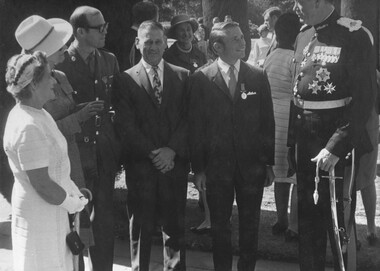
Photograph, Gibbons, Denis, Lt Col Mike Naughton
... ...Order Of The British Empire (OBE)...Photograph Lt Col Naughton Sir Roden Cutler VC Order Of The British Empire (OBE) Gibbons Collection Catalogue Medic Military Medal Victoria Cross Governor of NSW Denis Gibbons A black and white photograph of Lt Col Mike Naughton after receiving his OBE from the Governor of NSW Sir Roden Cutler VC. ...Denis Gibbons (1937 – 2011) Trained with the Australian Army, before travelling to Vietnam in January 1966, Denis stayed with the 1st Australian Task Force in Nui Dat working as a photographer. For almost five years Gibbons toured with nine Australian infantry battalions, posting compelling war images from within many combat zones before being flown out in late November 1970 after sustaining injuries. The images held within the National Vietnam Veterans Museum make up the Gibbons Collection. A black and white photograph of Lt Col Mike Naughton after receiving his OBE from the Governor of NSW Sir Roden Cutler VC. Standing next to Sir Roden is a Medic who received the Military Medal for bravery in Vietnam at the same ceremony.photograph, lt col naughton, sir roden cutler vc, order of the british empire (obe), gibbons collection catalogue, medic, military medal, victoria cross, governor of nsw, denis gibbons -
 National Vietnam Veterans Museum (NVVM)
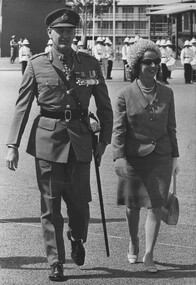
Photograph, Gibbons, Denis, Maj Gen Hassett
... ...Order Of The British Empire (OBE)...Photograph Maj Gen F G Hassett United States Presidential Distinguished Unit D Company 6 RAR Townsville Battle of Long Tan Gibbons Collection Catalogue Mrs Hassett Order Of The British Empire (OBE) Distinguished Service Order DSO Member of the Royal Victorian Order (a British Order of knighthood) MVO Trooping Of the Colour The Royal Australian Regiment 6th Battalion Denis Gibbons A black and white photograph of Maj Gen FG Hassett, OBE, DSO, MVO accompaniedby his wife, arrive to attend the Trooping of the Regimental Colour on the occasion of the presentation of the United States Presidential Distinguished Unit Citation to D Company, 6th Battalion, the Royal Australian Regiment in Townsend 18/08/1968 Maj Gen Hassett Photograph Gibbons, Denis ...Denis Gibbons (1937 – 2011) Trained with the Australian Army, before travelling to Vietnam in January 1966, Denis stayed with the 1st Australian Task Force in Nui Dat working as a photographer. For almost five years Gibbons toured with nine Australian infantry battalions, posting compelling war images from within many combat zones before being flown out in late November 1970 after sustaining injuries. The images held within the National Vietnam Veterans Museum make up the Gibbons Collection.A black and white photograph of Maj Gen FG Hassett, OBE, DSO, MVO accompaniedby his wife, arrive to attend the Trooping of the Regimental Colour on the occasion of the presentation of the United States Presidential Distinguished Unit Citation to D Company, 6th Battalion, the Royal Australian Regiment in Townsend 18/08/1968photograph, maj gen f g hassett, united states presidential distinguished unit, d company, 6 rar, townsville, battle of long tan, gibbons collection catalogue, mrs hassett, order of the british empire (obe), distinguished service order, dso, member of the royal victorian order (a british order of knighthood), mvo, trooping of the colour, the royal australian regiment, 6th battalion, denis gibbons -
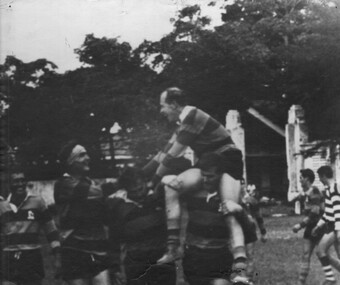 National Vietnam Veterans Museum (NVVM)
Photograph, Gibbons, Denis, Rugby Union
... ...Order Of The British Empire (OBE)...Photograph 1st Australian Field Hospital Vung Tau Lt Col Naughton Order Of The British Empire (OBE) 1st ATF Base Gibbons Collection Catalogue Commanding Officer Engineers 1st Australian Task Force Nui Dat Denis Gibbons A black and white photograph of Lt Col Mike Naughton OBE Commanding Officer of 1st Field Hospital, Vung Tau is lifted onto the shoulders of his team mates after the hospital rugby union team defeated an Engineers team from 1st Australian Task Force Base, Nui Dat, Rugby Union Photograph Gibbons, Denis ...Denis Gibbons (1937 – 2011) Trained with the Australian Army, before travelling to Vietnam in January 1966, Denis stayed with the 1st Australian Task Force in Nui Dat working as a photographer. For almost five years Gibbons toured with nine Australian infantry battalions, posting compelling war images from within many combat zones before being flown out in late November 1970 after sustaining injuries. The images held within the National Vietnam Veterans Museum make up the Gibbons Collection.A black and white photograph of Lt Col Mike Naughton OBE Commanding Officer of 1st Field Hospital, Vung Tau is lifted onto the shoulders of his team mates after the hospital rugby union team defeated an Engineers team from 1st Australian Task Force Base, Nui Dat,photograph, 1st australian field hospital, vung tau, lt col naughton, order of the british empire (obe), 1st atf base, gibbons collection catalogue, commanding officer, engineers, 1st australian task force, nui dat, denis gibbons -
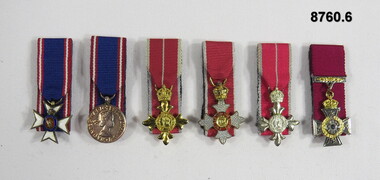 Bendigo Military Museum
Award - MEDALS, MINIATURE, Unknown
... Original - Most Excellent Order of the British Empire OBE (Military). 4. Original - Most Excellent Order of the British Empire OBE (Civil) 5. ...Original - Most Excellent Order of the British Empire OBE (Military). 4. Original - Most Excellent Order of the British Empire OBE (Civil) 5. ...Miniature Medals, all original, court mounted. 1. Original - The Royal Victorian Order of Knights Commanders (KEVO). 2. Original - Royal Victorian Medal ERII. 3. Original - Most Excellent Order of the British Empire OBE (Military). 4. Original - Most Excellent Order of the British Empire OBE (Civil) 5. Original - Most Excellent Order of the British Empire MBE (Military). 6. Original - New Zealand Cross (Instituted 1869).passchendaele barracks trust, pbt180to183, bob english collection, medals -
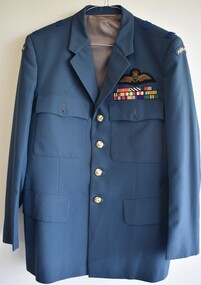 Moorabbin Air Museum
Uniform (item) - Royal Australian Air Force (RAAF) Officer's Service Dress Jacket H.V. Gavin 408185
... Comprising the following ribbons, Top Row, Officer of the Order of the British Empire (OBE) awarded 01.01.72. Distinguished Flying Cross (DFC) awarded 21.09.45 1939-1945 Star Second Row, Africa Star with Rosette. ...Comprising the following ribbons, Top Row, Officer of the Order of the British Empire (OBE) awarded 01.01.72. Distinguished Flying Cross (DFC) awarded 21.09.45 1939-1945 Star Second Row, Africa Star with Rosette. ...Jacket believed to be owned by Howard Valentine Gavin AIR CDRE (Rtd) OBE, DFC, Service No. 408185. Label inside jacket bears the name Gavin from which the included information was ascertained.Manufacturers Label C.G.C.F 1970 Size: 41R 4D -
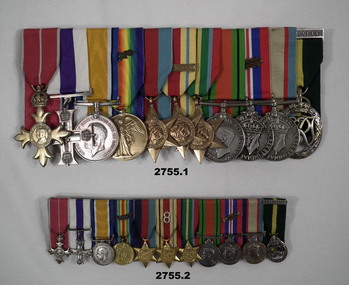 Bendigo Military Museum
Award - MEDAL SETS, WW1, WW2, Post 1919, Post 1945
... WWI & WWII Medals: .1) Medal set, brass plate mounted, set of 11 re H T ALLAN OBE, MC, ED. 1. Order of the British Empire - OBE. 2. Military Cross - MC. 3. ...British Empire Awards system and therefore quite rare. The addition of 5 Mention in Dispatches adds to that rarity. The medals are in very good condition with only a small amount of tarnishing. The ribbons are new and Court mounting for display purposes, the originals have been kept for historical purposes. medals military bravery .1) “CAPTAIN H T ALLAN AIF” “NX12229 H J ALLEN” “NX12229 COL ALLEN H T” Note: Correct spelling is H T ALLAN WWI & WWII Medals: .1) Medal set, brass plate mounted, set of 11 re H T ALLAN OBE, MC, ED. 1. Order ...HERBERT TRANGMAR ALLAN OBE, MC, ED. (Born Sydney, enlisted Paddington NSW) Herbert Allan served pre WW1 with Sydney University Scouts with the rank of 2nd Lieut. Joined the AIF 6.9.1915 in the 14th Reinforcements 17th Batt aged 21 years 6 months, embarked for England 22.8.1916, promoted to Lieut, embarked for France 22.1.1917, awarded the Military Cross 9.10.1917 at Passchendaele Ridge, WIA slight 3.11.1917. Awarded a Mention in Despatches, promoted to Captain 24.11.1917, WIA 3.10.1918, Gassed, appointment terminated in the AIF 26.5.1919. He remains active in several postings in the CMF as a Captain. He goes on full time duty 9.10.1939 with 2nd Garrison Batt No N60005, transfers to the 2nd AIF No NX12229 1.5.1940, posted Captain in 2nd 17th Batt. Embarks for the Middle East 10.10.1940, serves in Tobruk, promoted to Major 7.1.1941, promoted to Brigade Major 20th Inf Brigade 12.6.1941, appointed Claims Officer 9th Division 13.2 1942, awarded the “OBE” 14.4.1942, embark for Australia 27.1.1943, promoted Lt Col 8.6.1943, emplaned for New Guinea 16.6.1943, one of 5 to New Guinea and New Britain, promoted T/Colonel 1.4.1945, final disembark in Australia 28.8.1945, appointed to Command the Pacific Islands Regt 10.10.1945, appointed Hon Colonel in the Reserve of Officers 1.5.1946. During WW11 he was awarded a Mention in Despatches 4 times, once in the Middle East and 3 in the Pacific. He spent 1773 days outside Australia and 253 in Australia during WW11. Awarded Efficiency Decoration (ED) in 1946. Refer 2756.The group of medals were awarded to Herbert Trangmar Allan OBE, MC, ED plus mentioned in Dispatches 5 times. With the medals to add to their significance is a large collection of documentation covering his career with some 136 items plus photographs. As Commander of the Pacific Islands Regiment after WW2 he was presented with a pair of Japanese Artillery Binoculars to bring home as a War Trophy. This is in the collection also. This group of eleven (11) Decoration, Campaign and Service Medals has a very high significance as they relate to both World Wars and service recognition from 1915 through to 1946, 31 years. There is also a full set of miniatures to compliment the main medal set. The “Order of the British Empire”, “Military Cross”, Efficiency Decoration” gained over both Wars and Service are among the highest in the British Empire Awards system and therefore quite rare. The addition of 5 Mention in Dispatches adds to that rarity. The medals are in very good condition with only a small amount of tarnishing. The ribbons are new and Court mounting for display purposes, the originals have been kept for historical purposes.WWI & WWII Medals: .1) Medal set, brass plate mounted, set of 11 re H T ALLAN OBE, MC, ED. 1. Order of the British Empire - OBE. 2. Military Cross - MC. 3. War Medal 1914 - 1918 4. Victory Medal 1914 - 1919 with clasp - Mention in Despatches. 5. 1939 - 45 Star. 6. African Star with clasp - 8th Army. 7. Pacific Star. 8. Defence Medal. 9. War Medal 1939 - 45 with clasp - Mention in Despatches. 10. Australian Service Medal 1939 - 45 11. Efficiency Decoration - ED. WWI & WWII Medals: .2) Medal set, minatures, brass plate mounted, set of 11 re H T ALLAN OBE, MC, ED. Same as in .1) .3) Original ribbons as per .1). .4) Original ribbons as per .2)..1) “CAPTAIN H T ALLAN AIF” “NX12229 H J ALLEN” “NX12229 COL ALLEN H T” Note: Correct spelling is H T ALLANmedals, military, bravery -
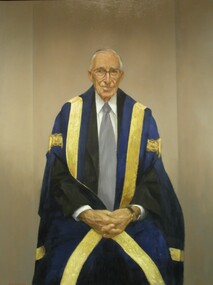 Federation University Art Collection
Painting - Artwork - Painting, 'Professor Emeritus David Caro' by Rick Amor, 2000
... His appointments include Officer in the Order of the British Empire (OBE) and Officer in the Order of Australia (AO). ...His appointments include Officer in the Order of the British Empire (OBE) and Officer in the Order of Australia (AO). ...Rick AMOR (1948- ) Born Frankston, Victoria After completing a Certificate of Art at the Caulfield Institute of Art in 1865 Rick Amor studied at the National Gallery School, Melbourne from 1966 to 1968. Amor has held over 60 solo exhibitions, and has worked in Barcelona, New York and London. In 1999 Rick Amor became the first official Australian war artist since the Vietnam War. He was appointed by the Australian War Memorial to document the devastated land in East Timor, and the reconstruction efforts of peacekeepers. Professor David Caro OAM was Chancellor of the University of Ballarat for two terms, between 1998 and 2004. His contributions to academia and science have recognised on a national and international global scale. His appointments include Officer in the Order of the British Empire (OBE) and Officer in the Order of Australia (AO). This item is part of the Federation University Art Collection. The Art Collection features over 2000 works and was listed as a 'Ballarat Treasure' in 2007. ContemporaryFramed portrait of Professor Emeritus David Caro, University of Ballarat (later Federation University Australia)art, artwork, rick amor, amor, chancellor, david caro, caro, academic portrait, portrait, oil, oil on linen, commissioned, academic regalia -
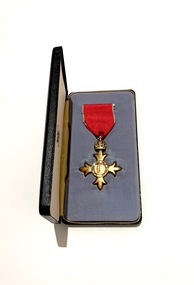 The Beechworth Burke Museum
Medal - Order of the British Empire Medal, 01/01/1976
... In recognition for his outstanding achievements and services rendered to the Beechworth community he was awarded an Order of the British Empire (OBE) in 1976. David McKenzie-McHarg died on 6th June 1992 and is buried in Beechworth Cemetery. ...In recognition for his outstanding achievements and services rendered to the Beechworth community he was awarded an Order of the British Empire (OBE) in 1976. David McKenzie-McHarg died on 6th June 1992 and is buried in Beechworth Cemetery. ...David Aloysius Patrick McKenzie-McHarg, L.I.B, O.B.E was born on 20th June 1918 in Albury, NSW to Hugh Patrick McKenzie-McHarg and Laura May (Dunne) McKenzie-McHarg. McKenzie-McHarg served on the Council of the United Shire of Beechworth for more than a decade during the 1960s-70s, including seven years as president. He was renowned as a public speaker and played a significant role in the community. In recognition for his outstanding achievements and services rendered to the Beechworth community he was awarded an Order of the British Empire (OBE) in 1976. David McKenzie-McHarg died on 6th June 1992 and is buried in Beechworth Cemetery. David McKenzie-McHarg’s wife, Marjorie Jean McKenzie McHarg, was well known to the Beechworth community as a brilliant pianist and played at all the balls and house parties. Apparently, she could play without sheet-music and would only have to hear a tune once to play it to near perfection. Together, they were a formidable asset to the Beechworth community over many years The British honours system has various orders, usually relating to the monarchy, military and colonial officials. An OBE (or order of the British Empire) is given for an outstanding achievement or service to the community. This will have had a long-term, significant impact and stand out as an example to others. This Order was established by George V in 1917 in response to recognising the thousands of men and women who served in a variety of non-combatant roles during the First world war who didn’t otherwise receive any formal recognition but were certainly worthy of acknowledgement. Recommendations for appointments to this Order were originally made on the nomination of the United Kingdom, however this soon became available to Commonwealth countries as well. However, Australia officially ceased to recommend the Order of the British Empire in 1989 with the establishment of the Order of Australia. Silver badge suspended from red ribbon with pearl-grey edges. The badge is in the form of a cross patonce (having the arms growing broader and floriated toward the end), the obverse of which bears the same field as the star pictures George V and Queen Mary. The reverse bears George V's Royal and Imperial Cypher. Both are within a ring bearing the motto of the Order: FOR GOD AND THE EMPIRE. The presentation case in which the medal is housed is of a black outer boarder edge leatherette finishing, block letters in gold OBE. The inside has a cream velvet base with a silk padded liner to the roof with the full set of Royal Mint Crest Mark. Obverse: FOR GOD AND THE EMPIRE / burke museum, obe, obe medal, beechworth, david mckenzie-mcharg, british honours system, george v, beechworth community, order of australia., order of the british empire, marjorie jean mckenzie mcharg -
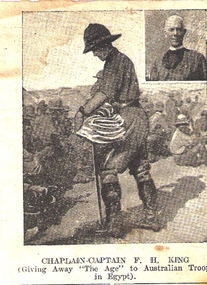 Waverley RSL Sub Branch
News paper Cutting Chaplain-Captain F. H. King, ? 1917
... He was later awarded th Order of the British Empire (OBE) 1 “The Junction” a history of St Mark’s Sunshine ...He was later awarded th Order of the British Empire (OBE) 1 “The Junction” a history of St Mark’s Sunshine The picture of Chaplain-Captain F.H. ...Captain Frank Herbert King was born in the Parish of St. Saviors in the borough of Brougham London March 5th 1875. He was educated in theology at St. Augustine's College Durban University. He went on to serve for 2 1/2 years in South Africa during the Boer Wars and then re-enlisted in the A.I.F.16th November 1916 when he listed his address as "The Vicarage Sunshine Victoria" and listed his wife as "Kathleen King" “Revd McCoy announced his intention of moving to the parish of Deniliquin in October 1915. He was replaced by F.H. King. Though the parish could not house him, he came in November. King was a typical “new broom”. In January 1916, at his instigation, the parish agreed to change its hymn book to Ancient and Modern. This decision could be viewed as a “churchmanship” matter, one of many that happened in these years. He pushed through the building of the vicarage, from tender in January to blessed and occupied by June. At the Annual General Meeting, King described 1915 as a trying time in the church and looked forward to a happier and more prosperous time during 1916. At a special vestry meeting, 3 November 1916, King announced that he had accepted an appointment by the Archbishop for service at the front, and that he had been instructed to prepare to go abroad. It was decided in his absence the parish use lay-readers, with periodic visits by clergy for Holy Communion. On 12 November, King thanked the parish for their loyalty and their devotion to him and the church. In return the parish presented him with a wrist watch. The parish was not formally vacant; just without a vicar. In September 1917, the Archbishop wrote advising that King had resigned. He appointed the Rev. W. Green to the parish, but Green declined.”(1) He was sent to Egypt where he administered to the Australian Stationary Hospital Australian 3rd and 5th light horse brigades. His Army record states he was Invalided and Completion of Duty 12 July 1918. He was later awarded th Order of the British Empire (OBE) 1 “The Junction” a history of St Mark’s Sunshine The picture of Chaplain-Captain F.H. King was carried in the Bible of Sig. H. C. Roussac ( a Gallipoli veteran) during his service with the A.I.F. in France. It can only be assumed that F.H.King had a profound effect on Sig. Roussac.Cutting of a lithographic picture showing Chaplain-Captain F. H. King giving away "The Age" (News paper) to Australian troops in Egypt 1917 Chaplain-Captain F. H. King giving away "The Age" to Australian troops in Egypta.i.f. egypt, chaplain, f.h.king, light horse egypt, roussac, o.b.e., boer war -
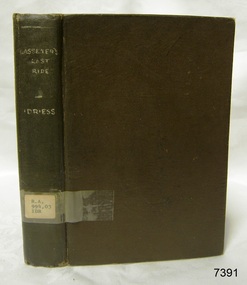 Flagstaff Hill Maritime Museum and Village
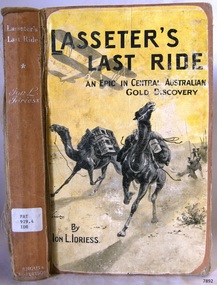
Book, Lasseters Last Ride
... Idriess was appointed an Officer of the Most Excellent Order of the British Empire (OBE) for his service to literature in 1968. ...Idriess was appointed an Officer of the Most Excellent Order of the British Empire (OBE) for his service to literature in 1968. ...About Ion L Idriess Ion Llewellyn Idriess was born in Waverley, Sydney, New South Wales on 20th September 1889 and passed away on 6th June 1979 in Mona Vale, Sydney, New South Wales at the age 89. After Idriess finished school he worked in the assay office of Broken Hill Proprietary mine. Both Idriess and his mother had typhoid fever when Ion was about 15 years old and it caused his mother’s death. After spending time with his Grandmother in Sydney he found work on a paddle-steamer and had a relapse of the fever. He then went into the western district of New South Wales where he worked in many different itinerant jobs, including rabbit poisoner, boundary rider, drover, sandalwood harvester, shearer, dingo shooter and opal miner. While opal mining at Lightning Ridge he wrote short stories, about life on the opal fields, for the Bulletin using the name “Gouger”. Idriess then moved to North Queensland in search of gold, tin and sandalwood. He travelled over a great deal of the Cape York Peninsula spending a lot of this travel time with local indigenous people; thus began his lifelong interest in their customs. He then spent time on cattle stations in the Gulf of Carpentaria. In 1914 Idriess travelled to Townsville and enlisted in the 5th Light Horse as a trooper. He became a specialist in sniping and was a spotter for the noted sniper Billy Sing. He saw service in Palestine, Sinai and Turkey. Idriess was wounded at Beersheba and after fighting the Battle of Gaza he was invalided home in March 1918. After recovering from his wounds Idriess again travelled to Cape York Peninsula where he worked with pearlers and missionaries in the Torres Strait Islands. He then went gold mining in Papua New Guinea, buffalo shooting in the Northern Territory of Australia and then exploring in Central and Western Australia. LITERARY WORKS OF IDRIESS In 1928 Idriess settled in Sydney and published the first of his 47 books. In 1931 - “Lasseter’s Last Ride”, became his first best seller. In the years 1932 and 1940 he published three books in each year. “The Cattle King” (1936) and “Flynn of the Inland” (1932) have gone through reprinting forty to fifty times. His last book was published in 1969. Idriess’ books where in general non-fiction and were written in a colourful and immediate story style, taken from life experiences gained during his travels. Idriess was appointed an Officer of the Most Excellent Order of the British Empire (OBE) for his service to literature in 1968. Warrnambool Public Library The Warrnambool Mechanics’ Institute (WMI) was formed by a voluntary community group in 1863, within six years of Warrnambool’s beginnings, and its Reading Room opened in 1854. The WMI operated until 1963, at which time it was one of the oldest Mechanics’ Institutes in Victoria. Mechanics’ Institutes offered important services to the public including libraries, reading rooms and places to display and store collections of all sorts such as curiosities and local historical relics. In 1886 a Museum and Fine Arts Gallery were added to the WMI and by the beginning of the 20th century there was also a billiards room and a School of Art. By this time all Mechanics’ Institutes in country Victoria had museums attached. Over the years the Warrnambool Mechanics’ Institute Library was also known as the Warrnambool Public Library the Warrnambool Library and the Free Library. Early funding from the government was for the “Free Library”. The inscription in a book “Science of Man” was for the “Warrnambool Public Library”, donated by Joseph Archibald in 1899. Another inscription in the book “Catalogue of Plants Under Cultivation in the Melbourne Botanic Gardens 1 & 2, 1883” was presented to the “Warrnambool Library” and signed by the author W.R. Guilfoyle. In 1903 the Warrnambool Public Library decided to add a Juvenile Department to library and stock it with hundreds of books suitable for youth. In 1905 the Public Library committee decided to update the collection of books and added 100 new novels plus arrangements for the latest novels to be included as soon as they were available in Victoria. In July 1911 the Warrnambool Council took over the management of the Public Library, Art Gallery, Museum and Mechanics’ Institute and planned to double the size of the then-current building. In 1953, when Mr. R. Pattison was Public Librarian, the Warrnambool Public Library’s senior section 10,000 of the 13,000 books were fiction. The children’s section offered an additional 3,400 books. The library had the equivalent of one book per head of population and served around 33 percent of the reading population. The collection of books was made up of around 60 percent reference and 40 percent fiction. The library was lending 400 books per day. In 1963 the Warrnambool City Council allocated the site of the Mechanics’ Institute building, which included the Public Library, Museum and Art Gallery, for the new Municipal Offices and the Collections were dispersed until 1971. The Warrnambool Library took over the Mechanics’ Institute Library’s holdings on behalf of the Warrnambool City Council. Since the closure of the Warrnambool Mechanics’ Institute the exact location and composition of the original WMI books and items has become unclear. Other materials have been added to the collection, including items from Terang MI, Warrnambool Court House and Customs House. Many of the books have been identified as the Pattison Collection, named after the Librarian who catalogued and numbered the books during his time as Warrnambool Public Librarian in the time before the Mechanics’ Institute closed. It seems that when Warrnambool became part of the Corangamite Regional Library some of the books and materials went to its head office in Colac and then back to Warrnambool where they were stored at the Art Gallery for quite some time. Some then went to the Warrnambool Historical Society, some stayed at the Art Gallery and some were moved to Flagstaff Hill Maritime Village. The various stamps and labels on the books held at Flagstaff Hill show the variety of the collection’s distribution and origin. The books in the collection at Flagstaff Hill Maritime Village date from the 1850’s to the late 1950’s and include rare and valuable volumes. Many of the books are part of the “Pattison Collection” after the Warrnambool’s Public Librarian, Mr. R. Pattison SIGNIFICANCE The Warrnambool Mechanics' Institute Collection is primarily significant in its totality, rather than for the individual objects it contains. Its contents are highly representative of the development of Mechanics' Institute libraries across Australia, particularly Victoria. A diversity of publications and themes has been amassed, and these provide clues to our understanding of the nature of and changes in the reading habits of Victorians from the 1850s to the middle of the 20th century. The collection also highlights the Warrnambool community’s commitment to the Mechanics’ Institute, and to reading, literacy and learning in the regions, and proves that access to knowledge was not impeded by distance. These items help to provide a more complete picture of our community’s ideals and aspirations. As with many Mechanics' Institutes in Australia, the one which operated in Warrnambool was established and overseen for many years by key individuals associated with the development of the city itself. The WMI publication collection is historically significant because of its association with local people, places and the key historical themes in the development of Warrnambool of rural development, industry, farming, education, and community. The collection documents and illustrates the changing interests, focus and tastes of Victorians, especially those in regional cities. Generally the individual items in the collection are not particularly rare, as examples of all probably exist in other public collections in Victoria. It is primarily because there are so very few surviving Mechanics' Institute collections in Victoria, which lends this overall collection its significance. Many items in the WMI Collection have the potential to support further research, both as individual objects and through the collection in its entirety. This material is significant for its ability to assist in the interpretation of the history of the area and adds to the general understanding of the development of the township. Many components of the WMI publication collection complement and reinforce the Flagstaff Hill Maritime Museum Collection, the Warrnambool Art Gallery Collection, and that in the Warrnambool Historical Society, and also contribute to a clearer understanding of the original Warrnambool Mechanics' Institute collections. This will greatly enhance the appreciation of the few surviving Mechanics' Institute collections across Victoria, and also in New South Wales. The similarities and differences between the small number of collections that have survived can provide further insights into how the people of Victoria in general, and Warrnambool in particular, constructed a civic culture of adult learning to foster an informed citizenry. The Warrnambool Mechanics' Institute publication collection is of both local and state significance. Lasseters Last Ride First published in 1931 Author: Ion Idriess Publisher: Angus & Robertson Label on spine with typed text R.A. 994.03 IDR warrnambool, shipwrecked-coast, flagstaff-hill, flagstaff-hill-maritime-museum, maritime-museum, shipwreck-coast, flagstaff-hill-maritime-village, shipwrecked-artefact, great ocean road, book, warrnambool library, warrnambool mechanics’ institute, mechanics’ institute library, victorian library board, warrnambool books and records, warrnambool children’s library, warrnambool public library, lasseters last ride, ion idriess, indigenous people -
 Flagstaff Hill Maritime Museum and Village
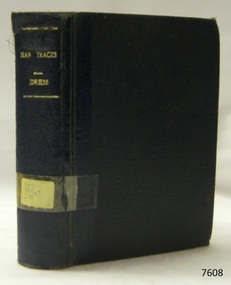
Book - Historical, Australia, Man Tracks
... Idriess was appointed an Officer of the Most Excellent Order of the British Empire (OBE) for his service to literature in 1968....Idriess was appointed an Officer of the Most Excellent Order of the British Empire (OBE) for his service to literature in 1968. ...This item is from the ‘Pattison Collection’, a collection of books and records that was originally owned by the Warrnambool Mechanics’ Institute, which was founded in Warrnambool in 1853. By 1886 the Warrnambool Mechanics’ Institute (WMI) had grown to have a Library, Museum and Fine Arts Gallery, with a collection of “… choice productions of art, and valuable specimens in almost every branch and many wonderful national curiosities are now to be seen there, including historic relics of the town and district.” It later included a School of Design. Although it was very well patronised, the lack of financial support led the WMI in 1911 to ask the City Council to take it over. In 1935 Ralph Pattison was appointed as City Librarian to establish and organise the Warrnambool Library as it was then called. When the WMI building was pulled down in 1963 a new civic building was erected on the site and the new Warrnambool Library, on behalf of the City Council, took over all the holdings of the WMI. At this time some of the items were separated and identified as the ‘Pattison Collection’, named after Ralph Pattison. Eventually, the components of the WMI were distributed from the Warrnambool Library to various places, including the Art Gallery, Historical Society and Flagstaff Hill. Later some were even distributed to other regional branches of Corangamite Regional Library and passed to and fro. It is difficult now to trace just where all of the items have ended up. The books at Flagstaff Hill Maritime Village generally display stamps and markings from Pattison as well as a variety of other institutions including the Mechanics’ Institute itself. RALPH ERIC PATTISON Ralph Eric Pattison was born in Rockhampton, Queensland, in 1891. He married Maude Swan from Warrnambool in 1920 and they set up a home in Warrnambool. In 1935 Pattison accepted a position as City Librarian for the Warrnambool City Council. His huge challenge was to make a functional library within two rooms of the Mechanics’ Institute. He tirelessly cleaned, cleared and sorted a disarrayed collection of old books, jars of preserved specimens and other items reserved for exhibition in the city’s museum. He developed and updated the library with a wide variety of books for all tastes, including reference books for students; a difficult task to fulfil during the years following the Depression. He converted all of the lower areas of the building into a library, reference room and reading room for members and the public. The books were sorted and stored using a cataloguing and card index system that he had developed himself. He also prepared the upper floor of the building and established the Art Gallery and later the Museum, a place to exhibit the many old relics that had been stored for years for this purpose. One of the treasures he found was a beautiful ancient clock, which he repaired, restored and enjoyed using in his office during the years of his service there. Ralph Pattison was described as “a meticulous gentleman whose punctuality, floorless courtesy and distinctive neat dress were hallmarks of his character, and ‘his’ clock controlled his daily routine, and his opening and closing of the library’s large heavy doors to the minute.” Pattison took leave from 1942 to 1945 to serve in the Royal Australian Navy, Volunteer Reserve as a Lieutenant. A few years later he converted one of the Museum’s rooms into a Children’s Library, stocking it with suitable books for the younger generation. This was an instant success. In the 1950’s he had the honour of being appointed to the Victorian Library Board and received more inspiration from the monthly conferences in Melbourne. He was sadly retired in 1959 after over 23 years of service because he had gone over the working age of council officers. However, he continued to take a very keen interest in the continual development of the Library until he died in 1969. About Ion L Idriess Ion Llewellyn Idriess was born in Waverley, Sydney, New South Wales on 20th September 1889 and passed away on 6th June 1979 in Mona Vale, Sydney, New South Wales at the age of 89. After Idriess finished school he worked in the assay office of Broken Hill Proprietary mine. Both Idriess and his mother had typhoid fever when Ion was about 15 years old and it caused his mother’s death. After spending time with his Grandmother in Sydney he found work on a paddle steamer and had a relapse of the fever. He then went into the western district of New South Wales where he worked in many different itinerant jobs, including rabbit poisoner, boundary rider, drover, sandalwood harvester, shearer, dingo shooter and opal miner. While opal mining at Lightning Ridge he wrote short stories, about life on the opal fields, for the Bulletin using the name “Gouger”. Idriess then moved to North Queensland in search of gold, tin and sandalwood. He travelled over a great deal of the Cape York Peninsula spending a lot of this travel time with local indigenous people; thus began his lifelong interest in their customs. He then spent time on cattle stations in the Gulf of Carpentaria. In 1914 Idriess travelled to Townsville and enlisted in the 5th Light Horse as a trooper. He became a specialist in sniping and was a spotter for the noted sniper Billy Sing. He saw service in Palestine, Sinai and Turkey. Idriess was wounded at Beersheba and after fighting the Battle of Gaza he was invalided home in March 1918. After recovering from his wounds Idriess again travelled to Cape York Peninsula where he worked with pearlers and missionaries in the Torres Strait Islands. He then went gold mining in Papua New Guinea, buffalo shooting in the Northern Territory of Australia and then exploring in Central and Western Australia. LITERARY WORKS OF IDRIESS In 1928 Idriess settled in Sydney and published the first of his 47 books. In 1931 - “Lasseter’s Last Ride”, became his first best seller. In the years 1932,d 1940 he published three books each year. “The Cattle King” (1936) and “Flynn of the Inland” (1932) have gone through reprinting forty to fifty times. His last book was published in 1969. Idriess’ were where in general non-fiction and were written in a colourful and immediate story style, taken from life experiences gained during his travels. Idriess was appointed an Officer of the Most Excellent Order of the British Empire (OBE) for his service to literature in 1968.The Pattison Collection, along with other items at Flagstaff Hill Maritime Village, was originally part of the Warrnambool Mechanics' Institute’s collection. The Warrnambool Mechanics’ Institute Collection is primarily significant in its totality, rather than for the individual objects it contains. Its contents are highly representative of the development of Mechanics' Institute libraries across Australia, particularly Victoria. A diversity of publications and themes has been amassed, and these provide clues to our understanding of the nature of and changes in the reading habits of Victorians from the 1850s to the middle of the 20th century. The collection also highlights the Warrnambool community’s commitment to the Mechanics’ Institute, reading, literacy and learning in the regions, and proves that access to knowledge was not impeded by distance. These items help to provide a more complete picture of our community’s ideals and aspirations. The Warrnambool Mechanics Institute book collection has historical and social significance for its strong association with the Mechanics Institute movement and the important role it played in the intellectual, cultural and social development of people throughout the latter part of the nineteenth century and the early twentieth century. The collection of books is a rare example of an early lending library and its significance is enhanced by the survival of an original collection of many volumes. The Warrnambool Mechanics' Institute’s publication collection is of both local and state significance. About Ion L Idriess Ion Llewellyn Idriess was born in Waverley, Sydney, New South Wales on 20th September 1889 and passed away on 6th June 1979 in Mona Vale, Sydney, New South Wales at the age 89. After Idriess finished school he worked in the assay office of Broken Hill Proprietary mine. Both Idriess and his mother had typhoid fever when Ion was about 15 years old and it caused his mother’s death. After spending time with his Grandmother in Sydney he found work on a paddle-steamer and had a relapse of the fever. He then went into the western district of New South Wales where he worked in many different itinerant jobs, including rabbit poisoner, boundary rider, drover, sandalwood harvester, shearer, dingo shooter and opal miner. While opal mining at Lightning Ridge he wrote short stories, about life on the opal fields, for the Bulletin using the name “Gouger”. Idriess then moved to North Queensland in search of gold, tin and sandalwood. He travelled over a great deal of the Cape York Peninsula spending a lot of this travel time with local indigenous people; thus began his lifelong interest in their customs. He then spent time on cattle stations in the Gulf of Carpentaria. In 1914 Idriess travelled to Townsville and enlisted in the 5th Light Horse as a trooper. He became a specialist in sniping and was a spotter for the noted sniper Billy Sing. He saw service in Palestine, Sinai and Turkey. Idriess was wounded at Beersheba and after fighting the Battle of Gaza he was invalided home in March 1918. After recovering from his wounds Idriess again travelled to Cape York Peninsula where he worked with pearlers and missionaries in the Torres Strait Islands. He then went gold mining in Papua New Guinea, buffalo shooting in the Northern Territory of Australia and then exploring in Central and Western Australia. LITERARY WORKS OF IDRIESS In 1928 Idriess settled in Sydney and published the first of his 47 books. In 1931 - “Lasseter’s Last Ride”, became his first best seller. In the years 1932 and 1940 he published three books in each year. “The Cattle King” (1936) and “Flynn of the Inland” (1932) have gone through reprinting forty to fifty times. His last book was published in 1969. Idriess’ books where in general non-fiction and were written in a colourful and immediate story style, taken from life experiences gained during his travels. Idriess was appointed an Officer of the Most Excellent Order of the British Empire (OBE) for his service to literature in 1968. Man Tracks with the Mounted Police in Australian Wilds Author: Ion Idriess Publisher: Angus & Robertson Date: 1935Label on spine cover with typed text PAT 364.1 IDR Pastedown front endpaper has sticker from Corangamite Regional Library Service Front loose endpaper has a stamp from Corangamite Regional Library Service and a stamp from Warrnambool Public Librarywarrnambool, shipwrecked-coast, flagstaff-hill, flagstaff-hill-maritime-museum, maritime-museum, shipwreck-coast, flagstaff-hill-maritime-village, shipwrecked-artefact, book, warrnambool mechanics’ institute, pattison collection, warrnambool library, ralph eric pattison, corangamite regional library service, warrnambool city librarian, mechanics’ institute library, victorian library board, warrnambool books and records, warrnambool children’s library, man tracks, ion idriess, historical book -
 Flagstaff Hill Maritime Museum and Village
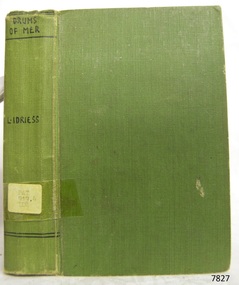
Book - Historical, novel, Drums of Mer
... Idriess was appointed an Officer of the Most Excellent Order of the British Empire (OBE) for his service to literature in 1968. ...Idriess was appointed an Officer of the Most Excellent Order of the British Empire (OBE) for his service to literature in 1968. ...This item is from the ‘Pattison Collection’, a collection of books and records that was originally owned by the Warrnambool Mechanics’ Institute, which was founded in Warrnambool in 1853. By 1886 the Warrnambool Mechanics’ Institute (WMI) had grown to have a Library, Museum and Fine Arts Gallery, with a collection of “… choice productions of art, and valuable specimens in almost every branch and many wonderful national curiosities are now to be seen there, including historic relics of the town and district.” It later included a School of Design. Although it was very well patronised, the lack of financial support led the WMI in 1911 to ask the City Council to take it over. In 1935 Ralph Pattison was appointed as City Librarian to establish and organise the Warrnambool Library as it was then called. When the WMI building was pulled down in 1963 a new civic building was erected on the site and the new Warrnambool Library, on behalf of the City Council, took over all the holdings of the WMI. At this time some of the items were separated and identified as the ‘Pattison Collection’, named after Ralph Pattison. Eventually the components of the WMI were distributed from the Warrnambool Library to various places, including the Art Gallery, Historical Society and Flagstaff Hill. Later some were even distributed to other regional branches of Corangamite Regional Library and passed to and fro. It is difficult now to trace just where all of the items have ended up. The books at Flagstaff Hill Maritime Village generally display stamps and markings from Pattison as well as a variety of other institutions including the Mechanics’ Institute itself. RALPH ERIC PATTISON Ralph Eric Pattison was born in Rockhampton, Queensland, in 1891. He married Maude Swan from Warrnambool in 1920 and they set up home in Warrnambool. In 1935 Pattison accepted a position as City Librarian for the Warrnambool City Council. His huge challenge was to make a functional library within two rooms of the Mechanics’ Institute. He tirelessly cleaned, cleared and sorted a disarrayed collection of old books, jars of preserved specimens and other items reserved for exhibition in the city’s museum. He developed and updated the library with a wide variety of books for all tastes, including reference books for students; a difficult task to fulfil during the years following the Depression. He converted all of the lower area of the building into a library, reference room and reading room for members and the public. The books were sorted and stored using a cataloguing and card index system that he had developed himself. He also prepared the upper floor of the building and established the Art Gallery and later the Museum, a place to exhibit the many old relics that had been stored for years for this purpose. One of the treasures he found was a beautiful ancient clock, which he repaired, restored and enjoyed using in his office during the years of his service there. Ralph Pattison was described as “a meticulous gentleman whose punctuality, floorless courtesy and distinctive neat dress were hallmarks of his character, and ‘his’ clock controlled his daily routine, and his opening and closing of the library’s large heavy doors to the minute.” Pattison took leave during 1942 to 1945 to serve in the Royal Australian Navy, Volunteer Reserve as Lieutenant. A few years later he converted one of the Museum’s rooms into a Children’s Library, stocking it with suitable books for the younger generation. This was an instant success. In the 1950’s he had the honour of being appointed to the Victorian Library Board and received more inspiration from the monthly conferences in Melbourne. He was sadly retired in 1959 after over 23 years of service, due to the fact that he had gone over the working age of council officers. However he continued to take a very keen interest in the continual development of the Library until his death in 1969. About Ion L Idriess Ion Llewellyn Idriess was born in Waverley, Sydney, New South Wales on 20th September 1889 and passed away on 6th June 1979 in Mona Vale, Sydney, New South Wales at the age 89. After Idriess finished school he worked in the assay office of Broken Hill Proprietary mine. Both Idriess and his mother had typhoid fever when Ion was about 15 years old and it caused his mother’s death. After spending time with his Grandmother in Sydney he found work on a paddle-steamer and had a relapse of the fever. He then went into the western district of New South Wales where he worked in many different itinerant jobs, including rabbit poisoner, boundary rider, drover, sandalwood harvester, shearer, dingo shooter and opal miner. While opal mining at Lightning Ridge he wrote short stories, about life on the opal fields, for the Bulletin using the name “Gouger”. Idriess then moved to North Queensland in search of gold, tin and sandalwood. He travelled over a great deal of the Cape York Peninsula spending a lot of this travel time with local indigenous people; thus began his lifelong interest in their customs. He then spent time on cattle stations in the Gulf of Carpentaria. In 1914 Idriess travelled to Townsville and enlisted in the 5th Light Horse as a trooper. He became a specialist in sniping and was a spotter for the noted sniper Billy Sing. He saw service in Palestine, Sinai and Turkey. Idriess was wounded at Beersheba and after fighting the Battle of Gaza he was invalided home in March 1918. After recovering from his wounds Idriess again travelled to Cape York Peninsula where he worked with pearlers and missionaries in the Torres Strait Islands. He then went gold mining in Papua New Guinea, buffalo shooting in the Northern Territory of Australia and then exploring in Central and Western Australia. LITERARY WORKS OF IDRIESS In 1928 Idriess settled in Sydney and published the first of his 47 books. In 1931 - “Lasseter’s Last Ride”, became his first best seller. In the years 1932 and 1940 he published three books in each year. “The Cattle King” (1936) and “Flynn of the Inland” (1932) have gone through reprinting forty to fifty times. His last book was published in 1969. Idriess’ books where in general non-fiction and were written in a colourful and immediate story style, taken from life experiences gained during his travels. Idriess was appointed an Officer of the Most Excellent Order of the British Empire (OBE) for his service to literature in 1968. The Pattison Collection, along with other items at Flagstaff Hill Maritime Village, was originally part of the Warrnambool Mechanics' Institute’s collection. The Warrnambool Mechanics’ Institute Collection is primarily significant in its totality, rather than for the individual objects it contains. Its contents are highly representative of the development of Mechanics' Institute libraries across Australia, particularly Victoria. A diversity of publications and themes has been amassed, and these provide clues to our understanding of the nature of and changes in the reading habits of Victorians from the 1850s to the middle of the 20th century. The collection also highlights the Warrnambool community’s commitment to the Mechanics’ Institute, reading, literacy and learning in the regions, and proves that access to knowledge was not impeded by distance. These items help to provide a more complete picture of our community’s ideals and aspirations. The Warrnambool Mechanics Institute book collection has historical and social significance for its strong association with the Mechanics Institute movement and the important role it played in the intellectual, cultural and social development of people throughout the latter part of the nineteenth century and the early twentieth century. The collection of books is a rare example of an early lending library and its significance is enhanced by the survival of an original collection of many volumes. The Warrnambool Mechanics' Institute’s publication collection is of both local and state significance. Drums of Mer Author: Ion L Idriess Publisher: Angus & Robertson Date: 1933Label on spine cover with typed text PAT 919.4 IDR Pastedown front endpaper has sticker from Warrnambool Mechanics Institute and Free Library covered by a sticker from Corangamite Regional Library Service Front loose endpaper has a stamp from Corangamite Regional Library Service warrnambool, shipwrecked-coast, flagstaff-hill, flagstaff-hill-maritime-museum, maritime-museum, shipwreck-coast, flagstaff-hill-maritime-village, shipwrecked-artefact, book, pattison collection, warrnambool library, warrnambool mechanics’ institute, ralph eric pattison, corangamite regional library service, warrnambool city librarian, mechanics’ institute library, victorian library board, warrnambool books and records, warrnambool children’s library, great ocean road -
 Flagstaff Hill Maritime Museum and Village
Book, Lasseters Last Ride
... Idriess was appointed an Officer of the Most Excellent Order of the British Empire (OBE) for his service to literature in 1968. ...Idriess was appointed an Officer of the Most Excellent Order of the British Empire (OBE) for his service to literature in 1968. ...This item is from the ‘Pattison Collection’, a collection of books and records that was originally owned by the Warrnambool Mechanics’ Institute, which was founded in Warrnambool in 1853. By 1886 the Warrnambool Mechanics’ Institute (WMI) had grown to have a Library, Museum and Fine Arts Gallery, with a collection of “… choice productions of art, and valuable specimens in almost every branch and many wonderful national curiosities are now to be seen there, including historic relics of the town and district.” It later included a School of Design. Although it was very well patronised, the lack of financial support led the WMI in 1911 to ask the City Council to take it over. In 1935 Ralph Pattison was appointed as City Librarian to establish and organise the Warrnambool Library as it was then called. When the WMI building was pulled down in 1963 a new civic building was erected on the site and the new Warrnambool Library, on behalf of the City Council, took over all the holdings of the WMI. At this time some of the items were separated and identified as the ‘Pattison Collection’, named after Ralph Pattison. Eventually the components of the WMI were distributed from the Warrnambool Library to various places, including the Art Gallery, Historical Society and Flagstaff Hill. Later some were even distributed to other regional branches of Corangamite Regional Library and passed to and fro. It is difficult now to trace just where all of the items have ended up. The books at Flagstaff Hill Maritime Village generally display stamps and markings from Pattison as well as a variety of other institutions including the Mechanics’ Institute itself. RALPH ERIC PATTISON Ralph Eric Pattison was born in Rockhampton, Queensland, in 1891. He married Maude Swan from Warrnambool in 1920 and they set up home in Warrnambool. In 1935 Pattison accepted a position as City Librarian for the Warrnambool City Council. His huge challenge was to make a functional library within two rooms of the Mechanics’ Institute. He tirelessly cleaned, cleared and sorted a disarrayed collection of old books, jars of preserved specimens and other items reserved for exhibition in the city’s museum. He developed and updated the library with a wide variety of books for all tastes, including reference books for students; a difficult task to fulfil during the years following the Depression. He converted all of the lower area of the building into a library, reference room and reading room for members and the public. The books were sorted and stored using a cataloguing and card index system that he had developed himself. He also prepared the upper floor of the building and established the Art Gallery and later the Museum, a place to exhibit the many old relics that had been stored for years for this purpose. One of the treasures he found was a beautiful ancient clock, which he repaired, restored and enjoyed using in his office during the years of his service there. Ralph Pattison was described as “a meticulous gentleman whose punctuality, floorless courtesy and distinctive neat dress were hallmarks of his character, and ‘his’ clock controlled his daily routine, and his opening and closing of the library’s large heavy doors to the minute.” Pattison took leave during 1942 to 1945 to serve in the Royal Australian Navy, Volunteer Reserve as Lieutenant. A few years later he converted one of the Museum’s rooms into a Children’s Library, stocking it with suitable books for the younger generation. This was an instant success. In the 1950’s he had the honour of being appointed to the Victorian Library Board and received more inspiration from the monthly conferences in Melbourne. He was sadly retired in 1959 after over 23 years of service, due to the fact that he had gone over the working age of council officers. However he continued to take a very keen interest in the continual development of the Library until his death in 1969. About Ion L Idriess Ion Llewellyn Idriess was born in Waverley, Sydney, New South Wales on 20th September 1889 and passed away on 6th June 1979 in Mona Vale, Sydney, New South Wales at the age 89. After Idriess finished school he worked in the assay office of Broken Hill Proprietary mine. Both Idriess and his mother had typhoid fever when Ion was about 15 years old and it caused his mother’s death. After spending time with his Grandmother in Sydney he found work on a paddle-steamer and had a relapse of the fever. He then went into the western district of New South Wales where he worked in many different itinerant jobs, including rabbit poisoner, boundary rider, drover, sandalwood harvester, shearer, dingo shooter and opal miner. While opal mining at Lightning Ridge he wrote short stories, about life on the opal fields, for the Bulletin using the name “Gouger”. Idriess then moved to North Queensland in search of gold, tin and sandalwood. He travelled over a great deal of the Cape York Peninsula spending a lot of this travel time with local indigenous people; thus began his lifelong interest in their customs. He then spent time on cattle stations in the Gulf of Carpentaria. In 1914 Idriess travelled to Townsville and enlisted in the 5th Light Horse as a trooper. He became a specialist in sniping and was a spotter for the noted sniper Billy Sing. He saw service in Palestine, Sinai and Turkey. Idriess was wounded at Beersheba and after fighting the Battle of Gaza he was invalided home in March 1918. After recovering from his wounds Idriess again travelled to Cape York Peninsula where he worked with pearlers and missionaries in the Torres Strait Islands. He then went gold mining in Papua New Guinea, buffalo shooting in the Northern Territory of Australia and then exploring in Central and Western Australia. LITERARY WORKS OF IDRIESS In 1928 Idriess settled in Sydney and published the first of his 47 books. In 1931 - “Lasseter’s Last Ride”, became his first best seller. In the years 1932 and 1940 he published three books in each year. “The Cattle King” (1936) and “Flynn of the Inland” (1932) have gone through reprinting forty to fifty times. His last book was published in 1969. Idriess’ books where in general non-fiction and were written in a colourful and immediate story style, taken from life experiences gained during his travels. Idriess was appointed an Officer of the Most Excellent Order of the British Empire (OBE) for his service to literature in 1968. The Pattison Collection, along with other items at Flagstaff Hill Maritime Village, was originally part of the Warrnambool Mechanics' Institute’s collection. The Warrnambool Mechanics’ Institute Collection is primarily significant in its totality, rather than for the individual objects it contains. Its contents are highly representative of the development of Mechanics' Institute libraries across Australia, particularly Victoria. A diversity of publications and themes has been amassed, and these provide clues to our understanding of the nature of and changes in the reading habits of Victorians from the 1850s to the middle of the 20th century. The collection also highlights the Warrnambool community’s commitment to the Mechanics’ Institute, reading, literacy and learning in the regions, and proves that access to knowledge was not impeded by distance. These items help to provide a more complete picture of our community’s ideals and aspirations. The Warrnambool Mechanics Institute book collection has historical and social significance for its strong association with the Mechanics Institute movement and the important role it played in the intellectual, cultural and social development of people throughout the latter part of the nineteenth century and the early twentieth century. The collection of books is a rare example of an early lending library and its significance is enhanced by the survival of an original collection of many volumes. The Warrnambool Mechanics' Institute’s publication collection is of both local and state significance. About Ion L Idriess Ion Llewellyn Idriess was born in Waverley, Sydney, New South Wales on 20th September 1889 and passed away on 6th June 1979 in Mona Vale, Sydney, New South Wales at the age 89. After Idriess finished school he worked in the assay office of Broken Hill Proprietary mine. Both Idriess and his mother had typhoid fever when Ion was about 15 years old and it caused his mother’s death. After spending time with his Grandmother in Sydney he found work on a paddle-steamer and had a relapse of the fever. He then went into the western district of New South Wales where he worked in many different itinerant jobs, including rabbit poisoner, boundary rider, drover, sandalwood harvester, shearer, dingo shooter and opal miner. While opal mining at Lightning Ridge he wrote short stories, about life on the opal fields, for the Bulletin using the name “Gouger”. Idriess then moved to North Queensland in search of gold, tin and sandalwood. He travelled over a great deal of the Cape York Peninsula spending a lot of this travel time with local indigenous people; thus began his lifelong interest in their customs. He then spent time on cattle stations in the Gulf of Carpentaria. In 1914 Idriess travelled to Townsville and enlisted in the 5th Light Horse as a trooper. He became a specialist in sniping and was a spotter for the noted sniper Billy Sing. He saw service in Palestine, Sinai and Turkey. Idriess was wounded at Beersheba and after fighting the Battle of Gaza he was invalided home in March 1918. After recovering from his wounds Idriess again travelled to Cape York Peninsula where he worked with pearlers and missionaries in the Torres Strait Islands. He then went gold mining in Papua New Guinea, buffalo shooting in the Northern Territory of Australia and then exploring in Central and Western Australia. LITERARY WORKS OF IDRIESS In 1928 Idriess settled in Sydney and published the first of his 47 books. In 1931 - “Lasseter’s Last Ride”, became his first best seller. In the years 1932 and 1940 he published three books in each year. “The Cattle King” (1936) and “Flynn of the Inland” (1932) have gone through reprinting forty to fifty times. His last book was published in 1969. Idriess’ books where in general non-fiction and were written in a colourful and immediate story style, taken from life experiences gained during his travels. Idriess was appointed an Officer of the Most Excellent Order of the British Empire (OBE) for his service to literature in 1968. Lasseters Last Ride An Epic of Central Australian Gold Discovery First Published 1931 Author: Ion Idriess Publisher: John Murray Date: 1950Label on spine cover with typed text PAT 919.4 IDR Pastedown front endpaper has sticker from Corangamite Regional Library Servicewarrnambool, shipwrecked-coast, flagstaff-hill, flagstaff-hill-maritime-museum, maritime-museum, shipwreck-coast, flagstaff-hill-maritime-village, shipwrecked-artefact, book, pattison collection, warrnambool library, warrnambool mechanics’ institute, ralph eric pattison, corangamite regional library service, warrnambool city librarian, mechanics’ institute library, victorian library board, warrnambool books and records, warrnambool children’s library, great ocean road, ion idriess, lasseters last ride -
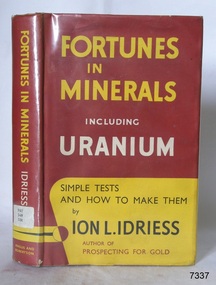 Flagstaff Hill Maritime Museum and Village
Book, Fortunes in Minerals
... Idriess was appointed an Officer of the Most Excellent Order of the British Empire (OBE) for his service to literature in 1968. ...Idriess was appointed an Officer of the Most Excellent Order of the British Empire (OBE) for his service to literature in 1968. ...This item is from the ‘Pattison Collection’, a collection of books and records that was originally owned by the Warrnambool Mechanics’ Institute, which was founded in Warrnambool in 1853. By 1886 the Warrnambool Mechanics’ Institute (WMI) had grown to have a Library, Museum and Fine Arts Gallery, with a collection of “… choice productions of art, and valuable specimens in almost every branch and many wonderful national curiosities are now to be seen there, including historic relics of the town and district.” It later included a School of Design. Although it was very well patronised, the lack of financial support led the WMI in 1911 to ask the City Council to take it over. In 1935 Ralph Pattison was appointed as City Librarian to establish and organise the Warrnambool Library as it was then called. When the WMI building was pulled down in 1963 a new civic building was erected on the site and the new Warrnambool Library, on behalf of the City Council, took over all the holdings of the WMI. At this time some of the items were separated and identified as the ‘Pattison Collection’, named after Ralph Pattison. Eventually the components of the WMI were distributed from the Warrnambool Library to various places, including the Art Gallery, Historical Society and Flagstaff Hill. Later some were even distributed to other regional branches of Corangamite Regional Library and passed to and fro. It is difficult now to trace just where all of the items have ended up. The books at Flagstaff Hill Maritime Village generally display stamps and markings from Pattison as well as a variety of other institutions including the Mechanics’ Institute itself. RALPH ERIC PATTISON Ralph Eric Pattison was born in Rockhampton, Queensland, in 1891. He married Maude Swan from Warrnambool in 1920 and they set up home in Warrnambool. In 1935 Pattison accepted a position as City Librarian for the Warrnambool City Council. His huge challenge was to make a functional library within two rooms of the Mechanics’ Institute. He tirelessly cleaned, cleared and sorted a disarrayed collection of old books, jars of preserved specimens and other items reserved for exhibition in the city’s museum. He developed and updated the library with a wide variety of books for all tastes, including reference books for students; a difficult task to fulfil during the years following the Depression. He converted all of the lower area of the building into a library, reference room and reading room for members and the public. The books were sorted and stored using a cataloguing and card index system that he had developed himself. He also prepared the upper floor of the building and established the Art Gallery and later the Museum, a place to exhibit the many old relics that had been stored for years for this purpose. One of the treasures he found was a beautiful ancient clock, which he repaired, restored and enjoyed using in his office during the years of his service there. Ralph Pattison was described as “a meticulous gentleman whose punctuality, floorless courtesy and distinctive neat dress were hallmarks of his character, and ‘his’ clock controlled his daily routine, and his opening and closing of the library’s large heavy doors to the minute.” Pattison took leave during 1942 to 1942 to serve in the Royal Australian Navy, Volunteer Reserve as Lieutenant. A few years later he converted one of the Museum’s rooms into a Children’s Library, stocking it with suitable books for the younger generation. This was an instant success. In the 1950’s he had the honour of being appointed to the Victorian Library Board and received more inspiration from the monthly conferences in Melbourne. He was sadly retired in 1959 after over 23 years of service, due to the fact that he had gone over the working age of council officers. However he continued to take a very keen interest in the continual development of the Library until his death in 1969. About Ion L Idriess Ion Llewellyn Idriess was born in Waverley, Sydney, New South Wales on 20th September 1889 and passed away on 6th June 1979 in Mona Vale, Sydney, New South Wales at the age 89. After Idriess finished school he worked in the assay office of Broken Hill Proprietary mine. Both Idriess and his mother had typhoid fever when Ion was about 15 years old and it caused his mother’s death. After spending time with his Grandmother in Sydney he found work on a paddle-steamer and had a relapse of the fever. He then went into the western district of New South Wales where he worked in many different itinerant jobs, including rabbit poisoner, boundary rider, drover, sandalwood harvester, shearer, dingo shooter and opal miner. While opal mining at Lightning Ridge he wrote short stories, about life on the opal fields, for the Bulletin using the name “Gouger”. Idriess then moved to North Queensland in search of gold, tin and sandalwood. He travelled over a great deal of the Cape York Peninsula spending a lot of this travel time with local indigenous people; thus began his lifelong interest in their customs. He then spent time on cattle stations in the Gulf of Carpentaria. In 1914 Idriess travelled to Townsville and enlisted in the 5th Light Horse as a trooper. He became a specialist in sniping and was a spotter for the noted sniper Billy Sing. He saw service in Palestine, Sinai and Turkey. Idriess was wounded at Beersheba and after fighting the Battle of Gaza he was invalided home in March 1918. After recovering from his wounds Idriess again travelled to Cape York Peninsula where he worked with pearlers and missionaries in the Torres Strait Islands. He then went gold mining in Papua New Guinea, buffalo shooting in the Northern Territory of Australia and then exploring in Central and Western Australia. LITERARY WORKS OF IDRIESS In 1928 Idriess settled in Sydney and published the first of his 47 books. In 1931 - “Lasseter’s Last Ride”, became his first best seller. In the years 1932 and 1940 he published three books in each year. “The Cattle King” (1936) and “Flynn of the Inland” (1932) have gone through reprinting forty to fifty times. His last book was published in 1969. Idriess’ books where in general non-fiction and were written in a colourful and immediate story style, taken from life experiences gained during his travels. Idriess was appointed an Officer of the Most Excellent Order of the British Empire (OBE) for his service to literature in 1968. The Pattison Collection, along with other items at Flagstaff Hill Maritime Village, was originally part of the Warrnambool Mechanics' Institute’s collection. The Warrnambool Mechanics’ Institute Collection is primarily significant in its totality, rather than for the individual objects it contains. Its contents are highly representative of the development of Mechanics' Institute libraries across Australia, particularly Victoria. A diversity of publications and themes has been amassed, and these provide clues to our understanding of the nature of and changes in the reading habits of Victorians from the 1850s to the middle of the 20th century. The collection also highlights the Warrnambool community’s commitment to the Mechanics’ Institute, reading, literacy and learning in the regions, and proves that access to knowledge was not impeded by distance. These items help to provide a more complete picture of our community’s ideals and aspirations. The Warrnambool Mechanics Institute book collection has historical and social significance for its strong association with the Mechanics Institute movement and the important role it played in the intellectual, cultural and social development of people throughout the latter part of the nineteenth century and the early twentieth century. The collection of books is a rare example of an early lending library and its significance is enhanced by the survival of an original collection of many volumes. The Warrnambool Mechanics' Institute’s publication collection is of both local and state significance. About Ion L Idriess Ion Llewellyn Idriess was born in Waverley, Sydney, New South Wales on 20th September 1889 and passed away on 6th June 1979 in Mona Vale, Sydney, New South Wales at the age 89. After Idriess finished school he worked in the assay office of Broken Hill Proprietary mine. Both Idriess and his mother had typhoid fever when Ion was about 15 years old and it caused his mother’s death. After spending time with his Grandmother in Sydney he found work on a paddle-steamer and had a relapse of the fever. He then went into the western district of New South Wales where he worked in many different itinerant jobs, including rabbit poisoner, boundary rider, drover, sandalwood harvester, shearer, dingo shooter and opal miner. While opal mining at Lightning Ridge he wrote short stories, about life on the opal fields, for the Bulletin using the name “Gouger”. Idriess then moved to North Queensland in search of gold, tin and sandalwood. He travelled over a great deal of the Cape York Peninsula spending a lot of this travel time with local indigenous people; thus began his lifelong interest in their customs. He then spent time on cattle stations in the Gulf of Carpentaria. In 1914 Idriess travelled to Townsville and enlisted in the 5th Light Horse as a trooper. He became a specialist in sniping and was a spotter for the noted sniper Billy Sing. He saw service in Palestine, Sinai and Turkey. Idriess was wounded at Beersheba and after fighting the Battle of Gaza he was invalided home in March 1918. After recovering from his wounds Idriess again travelled to Cape York Peninsula where he worked with pearlers and missionaries in the Torres Strait Islands. He then went gold mining in Papua New Guinea, buffalo shooting in the Northern Territory of Australia and then exploring in Central and Western Australia. LITERARY WORKS OF IDRIESS In 1928 Idriess settled in Sydney and published the first of his 47 books. In 1931 - “Lasseter’s Last Ride”, became his first best seller. In the years 1932 and 1940 he published three books in each year. “The Cattle King” (1936) and “Flynn of the Inland” (1932) have gone through reprinting forty to fifty times. His last book was published in 1969. Idriess’ books where in general non-fiction and were written in a colourful and immediate story style, taken from life experiences gained during his travels. Idriess was appointed an Officer of the Most Excellent Order of the British Empire (OBE) for his service to literature in 1968. Fortunes in Minerals Author: Ion Idriess Publisher: Angus & Robertson Date: 1954 Label on spine with typed text PAT 549 IDR Inside front cover has a sticker that reads Corangamite Regional Library Service warrnambool, shipwrecked-coast, flagstaff-hill, flagstaff-hill-maritime-museum, maritime-museum, shipwreck-coast, flagstaff-hill-maritime-village, shipwrecked-artefact, book, pattison collection, warrnambool library, warrnambool mechanics’ institute, ralph eric pattison, warrnambool city librarian, mechanics’ institute library, victorian library board, warrnambool books and records, ion idriess, fortunes in minerals -
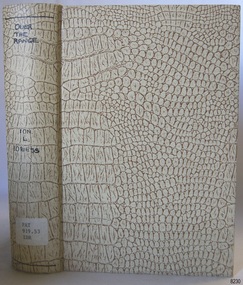 Flagstaff Hill Maritime Museum and Village
Book - Travel, Over The Range
... Idriess was appointed an Officer of the Most Excellent Order of the British Empire (OBE) for his service to literature in 1968. ...Idriess was appointed an Officer of the Most Excellent Order of the British Empire (OBE) for his service to literature in 1968. ...This book was part of a large group of books referred to as the Pattison Collection, which belonged to the Warrnambool Public Library, part of the Warrnambool Mechanics’ Institute. About RALPH ERIC PATTISON and the ‘PATTISON COLLECTION’ The ‘Pattison Collection’ is a collection of books and records that was originally owned by the Warrnambool Mechanics’ Institute, founded in Warrnambool in 1853. By 1886 the Warrnambool Mechanics’ Institute (WMI) had grown to have a Library, Museum and Fine Arts Gallery, with a collection of “… choice productions of art and valuable specimens in almost every branch and many wonderful national curiosities are now to be seen there, including historic relics of the town and district.” It later included a School of Design. Although it was very well patronised, the WMI was led to ask the City Council to take it over in 1911 due to lack of financial support. In 1935 Ralph Pattison was appointed as City Librarian to establish and organise the Warrnambool Public Library as it was then called. Ralph Eric Pattison was born in Rockhampton, Queensland, in 1891. He married Maude Swan from Warrnambool in 1920 and they set up home in Warrnambool. In 1935 when Pattison accepted the position as City Librarian for the Warrnambool City Council his huge challenge was to make a functional library within two rooms of the Mechanics’ Institute. He tirelessly cleaned, cleared and sorted a disarrayed collection of old books, jars of preserved specimens and other items reserved for exhibition in the city’s museum. He developed and updated the library with a wide variety of books for all tastes, including reference books for students; a difficult task to fulfil during the years following the Depression. He converted all of the lower areas of the building into a library, reference room and reading room for members and the public. The books were sorted and stored using a cataloguing and card index system that he had developed himself. He also prepared the upper floor of the building and established the Art Gallery and later the Museum, a place to exhibit the many old relics that had been stored for years for this purpose. One of the treasures he found was a beautiful ancient clock, which he repaired, restored and enjoyed using in his office during the years of his service there. Ralph Pattison was described as “a meticulous gentleman whose punctuality, floorless courtesy and distinctive neat dress were hallmarks of his character, and ‘his’ clock controlled his daily routine and his opening and closing of the library’s large heavy doors to the minute.” Pattison took leave from 1942 to 1945 to serve in the Royal Australian Navy, Volunteer Reserve as Lieutenant. A few years later he converted one of the Museum’s rooms into a Children’s Library, stocking it with suitable books for the younger generation. This was an instant success. In the 1950’s he had the honour of being appointed to the Victorian Library Board and received more inspiration from the monthly conferences in Melbourne. He was sadly retired in 1959 after over 23 years of service, due to the fact that he had gone over the working age of council officers. However, he continued to take a very keen interest in the continual development of the Library until his death in 1969. THE NEW WARRNAMBOOL LIBRARY When the WMI building was pulled down in 1963 a new civic building was erected on the site and the new Warrnambool Library, on behalf of the City Council, took over all the holdings of the WMI. At this time some of the items were separated and identified as the ‘Pattison Collection’, named after Pattison. Eventually, the components of the WMI were distributed from the Warrnambool Library to various places, including the Art Gallery, Historical Society and Flagstaff Hill. Later some were even distributed to other regional branches of Corangamite Regional Library and passed to and fro. It is difficult now to trace just where all of the items have ended up. The books at Flagstaff Hill Maritime Village generally display stamps and markings from Pattison as well as a variety of other institutions including the Mechanics’ Institute itself. Ion Llewellyn Idriess was born in Waverley, Sydney, New South Wales on 20th September 1889 and passed away on 6th June 1979 in Mona Vale, Sydney, New South Wales at the age 89. After Idriess finished school he worked in the assay office of Broken Hill Proprietary mine. Both Idriess and his mother had typhoid fever when Ion was about 15 years old and it caused his mother’s death. After spending time with his Grandmother in Sydney he found work on a paddle-steamer and had a relapse of the fever. He then went into the western district of New South Wales where he worked in many different itinerant jobs, including rabbit poisoner, boundary rider, drover, sandalwood harvester, shearer, dingo shooter and opal miner. While opal mining at Lightning Ridge he wrote short stories, about life on the opal fields, for the Bulletin using the name “Gouger”. Idriess then moved to North Queensland in search of gold, tin and sandalwood. He travelled over a great deal of the Cape York Peninsula spending a lot of this travel time with local indigenous people; thus began his lifelong interest in their customs. He then spent time on cattle stations in the Gulf of Carpentaria. In 1914 Idriess travelled to Townsville and enlisted in the 5th Light Horse as a trooper. He became a specialist in sniping and was a spotter for the noted sniper Billy Sing. He saw service in Palestine, Sinai and Turkey. Idriess was wounded at Beersheba and after fighting the Battle of Gaza he was invalided home in March 1918. After recovering from his wounds Idriess again travelled to the Cape York Peninsula where he worked with pearlers and missionaries in the Torres Strait Islands. He then went gold mining in Papua New Guinea, buffalo shooting in the Northern Territory of Australia and then exploring in Central and Western Australia. LITERARY WORKS OF IDRIESS In 1928 Idriess settled in Sydney and published the first of his 47 books. In 1931 - “Lasseter’s Last Ride”, became his first best seller. In the years 1932 and 1940, he published three books in each year. “The Cattle King” (1936) and “Flynn of the Inland” (1932) have gone through reprinting forty to fifty times. His last book was published in 1969. Idriess’ books were in general non-fiction and were written in a colourful and immediate story style, taken from life experiences gained during his travels. Idriess was appointed an Officer of the Most Excellent Order of the British Empire (OBE) for his service to literature in 1968. WARRNAMBOOL PUBLIC LIBRARY The Warrnambool Mechanics’ Institute (WMI) was formed by a voluntary community group in 1863, within six years of Warrnambool’s beginnings, and it's Reading Room opened in 1854. The WMI operated until 1963, at which time it was one of the oldest Mechanics’ Institutes in Victoria. Mechanics’ Institutes offered important services to the public including libraries, reading rooms and places to display and store collections of all sorts such as curiosities and local historical relics. In 1886 a Museum and Fine Arts Gallery were added to the WMI and by the beginning of the 20th century, there was also a billiards room and a School of Art. By this time all Mechanics’ Institutes in country Victoria had museums attached. Over the years the Warrnambool Mechanics’ Institute Library was also known as the Warrnambool Public Library the Warrnambool Library and the Free Library. Early funding from the government was for the “Free Library”. The inscription in a book “Science of Man” was for the “Warrnambool Public Library”, donated by Joseph Archibald in 1899. Another inscription in the book “Catalogue of Plants Under Cultivation in the Melbourne Botanic Gardens 1 & 2, 1883” was presented to the “Warrnambool Library” and signed by the author W.R. Guilfoyle. In 1903 the Warrnambool Public Library decided to add a Juvenile Department to library and stock it with hundreds of books suitable for youth. In 1905 the Public Library committee decided to update the collection of books and added 100 new novels plus arrangements for the latest novels to be included as soon as they were available in Victoria. In July 1911 the Warrnambool Council took over the management of the Public Library, Art Gallery, Museum and Mechanics’ Institute and planned to double the size of the then-current building. In 1953, when Mr R. Pattison was Public Librarian, the Warrnambool Public Library’s senior section 10,000 of the 13,000 books were fiction. The children’s section offered an additional 3,400 books. The library had the equivalent of one book per head of population and served around 33 per cent of the reading population. The collection of books was made up of around 60 per cent reference and 40 per cent fiction. The library was lending 400 books per day. In 1963 the Warrnambool City Council allocated the site of the Mechanics’ Institute building, which included the Public Library, Museum and Art Gallery, for the new Municipal Offices and the Collections were dispersed until 1971. The Warrnambool Library took over the Mechanics’ Institute Library’s holdings on behalf of the Warrnambool City Council. Since the closure of the Warrnambool Mechanics’ Institute, the exact location and composition of the original WMI books and items has become unclear. Other materials have been added to the collection, including items from Terang MI, Warrnambool Court House and Customs House. Many of the books have been identified as the Pattison Collection, named after the Librarian who catalogued and numbered the books during his time as Warrnambool Public Librarian in the time before the Mechanics’ Institute closed. It seems that when Warrnambool became part of the Corangamite Regional Library some of the books and materials went to its head office in Colac and then back to Warrnambool where they were stored at the Art Gallery for quite some time. Some then went to the Warrnambool Historical Society, some stayed at the Art Gallery and some were moved to Flagstaff Hill Maritime Village. The various stamps and labels on the books held at Flagstaff Hill show the variety of the collection’s distribution and origin. The books in the collection at Flagstaff Hill Maritime Village date from the 1850’s to the late 1950s and include rare and valuable volumes. Many of the books are part of the “Pattison Collection” after the Warrnambool’s Public Librarian, Mr R. Pattison. WARRNAMBOOL MECHANICS’ INSTITUTE Warrnambool's Mechanics' Institute (or Institution as it was sometimes called) was one of the earliest in Victoria. On 17th October 1853, a meeting was held where it was resolved to request the Lieutenant Governor of the Colony to grant land for the erection of a Mechanics' Institutes building. A committee was formed at the meeting and Richard Osburne chaired the first meeting of this committee. The land on the North West corner of Banyan and Merri Streets was granted but there were no funds to erect the building. The Formal Rights of the Warrnambool Mechanics' Institute's encompassed its aims and these were officially adopted in1859; "This Institution has for its object the diffusion of literary, scientific, and other useful knowledge amongst its members, excluding all controversial subjects, religious or political. These objects are sought to be obtained by means of a circulating library, a reading room, the establishment of classes, debates, and the occasional delivery of lectures on natural and experimental philosophy, mechanics, astronomy, chemistry, natural history, literature, and the useful and ornamental arts, particularly those which have a more immediate reference to the colony." The Warrnambool Mechanics' Institute opened its first reading room in November 1884 in the National School building at the corner of Banyan and Timor Streets. The Institute was funded by member subscription, payable on a quarterly, half-yearly or yearly basis. Samuel Hannaford, the Manager of the Warrnambool Bank of Australasia, was the first Honorary Secretary of the Mechanics' Institutes, and an early President and Vice-President. He also gave several of the early lectures in the Reading Room. Another early Secretary, Librarian and lecturer was Marmaduke Fisher, the teacher at the National School. Lecture topics included The Poets and Poetry of Ireland', 'The Birth and Development of the Earth', 'The Vertebrae - with Remarks on the pleasures resulting from the study of Natural History' and 'Architecture'. In 1856 the Reading Room was moved to James Hider's shop in Timor Street, and by 1864 it was located in the bookshop of Davies and Read. In the 1860's the Mechanics' Institute struggled as membership waned but in 1866, after a series of fundraising efforts, the committee was able to purchase land in Liebig Street, on a site then called Market Square, between the weighbridge and the fire station. A Mechanics' Institute building was opened at this site in August 1871. The following year four more rooms were added to the main Reading Room and in 1873 the Artisan School of Design was incorporated into the Institute. The same year Joseph Archibald established a Museum; however, it deteriorated when he was transferred to Bendigo in 1877. In 1880, with Archibald's return to Warrnambool, the Museum was re-established, and in 1885 a new building was built at the back of the Institute to accommodate the re-created School of Design, the Art Gallery and the Museum. In 1887 the Museum section was moved to the former courthouse in Timor Street (for some time the walls of the building formed part of the TAFE cafeteria but all is now demolished)). In 1911 the Museum was transferred back to the original building and the management of the Mechanics' Institute was handed over to the Warrnambool City Council. The Museum and Art Gallery became one and housed many fine works of art, and the Library continued to grow. The building was well patronised, with records showing that at the beginning of the 20th century there were between 500 and 800 visitors. During World War One the monthly figures were in the thousands, with 3,400 people visiting in January 1915. The Museum was a much - loved Institution in Warrnambool until the contents of the Museum and Art Gallery were removed to make room for the Warrnambool City Council Engineers' Department. The contents were stored but many of the items were scattered or lost. When the original building was demolished the site became occupied by the Civic Centre, which included the new City Library. (The library was temporarily located in the old Palais building in Koroit Street.) In the process of reorganisation the Collection was distributed amongst the community groups: -The new City Library took some of the historical books and some important documents, historic photographs and newspapers. -The Art Gallery kept the 19th Century art collection and some of the artefacts from the museum. -The Historical Society has some items -The State Museum has some items -Some items were destroyed -Flagstaff Hill Maritime Village has old newspapers, Government Gazettes, most of the Mechanics' Institute Library, ledgers and documents connected to the Mechanics' Institute Library, some framed and unframed artworks and some photographs. The Warrnambool Mechanics' Institute Library book collection is deemed to be of great importance because it is one of the few collections in an almost intact state, and many of the books are now very rare and of great value. The Pattison Collection, along with other items at Flagstaff Hill Maritime Village, was originally part of the Warrnambool Mechanics' Institute’s collection. The Warrnambool Mechanics’ Institute Collection is primarily significant in its totality, rather than for the individual objects it contains. Its contents are highly representative of the development of Mechanics' Institute libraries across Australia, particularly Victoria. A diversity of publications and themes has been amassed, and these provide clues to our understanding of the nature of and changes in the reading habits of Victorians from the 1850s to the middle of the 20th century. The collection also highlights the Warrnambool community’s commitment to the Mechanics’ Institute, reading, literacy and learning in the regions, and proves that access to knowledge was not impeded by distance. These items help to provide a more complete picture of our community’s ideals and aspirations. The Warrnambool Mechanics Institute book collection has historical and social significance for its strong association with the Mechanics Institute movement and the important role it played in the intellectual, cultural and social development of people throughout the latter part of the nineteenth century and the early twentieth century. The collection of books is a rare example of an early lending library and its significance is enhanced by the survival of an original collection of many volumes. The Warrnambool Mechanics' Institute’s publication collection is of both local and state significance. Over The Range Author: Ion L Idriess Publisher: Angus & Robertson Date: 1937 The label on spine cover with typed text PAT 919.53 IDR Front loose endpaper has a sticker from Corangamite Regional Library Service Flyleaf has a stamp from Warrnambool Public Library Flyleaf has a stamp from Warrnambool Mechanics Institute The top of the text block has a stamp from Warrnambool Public Library flagstaff hill, warrnambool, shipwrecked coast, flagstaff hill maritime museum, maritime museum, shipwreck coast, flagstaff hill maritime village, great ocean road, book, pattison collection, warrnambool library, warrnambool mechanics’ institute, ralph eric pattison, corangamite regional library service, warrnambool city librarian, mechanics’ institute library, victorian library board, warrnambool books and records, warrnambool children’s library, over the range, ion l idriess -
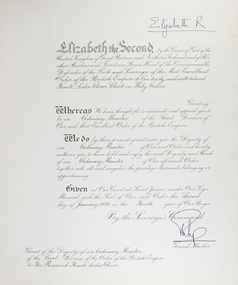 Mission to Seafarers Victoria
Letter - Letter with envelope, January 1956
... order of the british empire...queen elizabeth ii...obe...OBE in 1956. Indicative of the recognition of long service at the Mission and reflects early vice regal support for the Mission and services, ongoing Royal patronage by the Princess Royal, and previous interest with visits by HRH Prince of Wales in 1920 and the Governor of Australia Duke and Duchess of Gloucester circa 1945. padre oliver order of the british empire queen elizabeth ii obe padre frank leslie oliver see image Sheet of paper with calligraphic dedication and statement in heavy paper folder. ...The Reverend Frank Leslie Oliver, Senior Chaplain at the Mission to seamen from 1930-1960, was awarded an OBE in 1956.Indicative of the recognition of long service at the Mission and reflects early vice regal support for the Mission and services, ongoing Royal patronage by the Princess Royal, and previous interest with visits by HRH Prince of Wales in 1920 and the Governor of Australia Duke and Duchess of Gloucester circa 1945. Sheet of paper with calligraphic dedication and statement in heavy paper folder.see imagepadre oliver, order of the british empire, queen elizabeth ii, obe, padre frank leslie oliver -
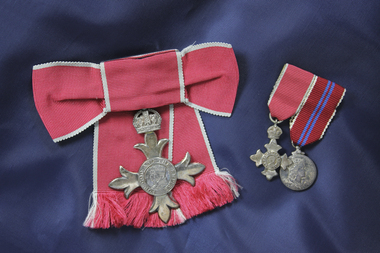 Mission to Seafarers Victoria
Photograph - Digital Image, series, Dora Walker's medals of the Order of the British Empire, 28 March 2018
... In March 2018, David Simpson, son of Dora, brought the metal along with a photograph to be digitised. dora simpson nee walker obe order of the british empire harbour lights guild hlg Brought to the Mission to Seafarer Victoria by her sons on 28 April 2018 to be photographed Dora Walker's medals of the Order of the British Empire Photograph Digital Image, series ...In March 2018, David Simpson, son of Dora, brought the metal along with a photograph to be digitised.Brought to the Mission to Seafarer Victoria by her sons on 28 April 2018 to be photographeddora simpson nee walker, obe, order of the british empire, harbour lights guild, hlg -
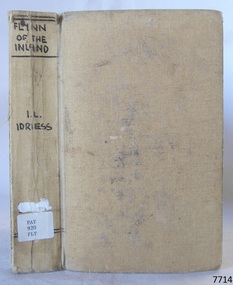 Flagstaff Hill Maritime Museum and Village
Book - Biography, Flynn of The Inland
... Idriess was appointed an Officer of the Most Excellent Order of the British Empire (OBE) for his service to literature in 1968. ...This item is from the ‘Pattison Collection’, a collection of books and records that was originally owned by the Warrnambool Mechanics’ Institute, which was founded in Warrnambool in 1853. By 1886 the Warrnambool Mechanics’ Institute (WMI) had grown to have a Library, Museum and Fine Arts Gallery, with a collection of “… choice productions of art, and valuable specimens in almost every branch and many wonderful national curiosities are now to be seen there, including historic relics of the town and district.” It later included a School of Design. Although it was very well patronised, the lack of financial support led the WMI in 1911 to ask the City Council to take it over. In 1935 Ralph Pattison was appointed as City Librarian to establish and organise the Warrnambool Library as it was then called. When the WMI building was pulled down in 1963 a new civic building was erected on the site and the new Warrnambool Library, on behalf of the City Council, took over all the holdings of the WMI. At this time some of the items were separated and identified as the ‘Pattison Collection’, named after Ralph Pattison. Eventually the components of the WMI were distributed from the Warrnambool Library to various places, including the Art Gallery, Historical Society and Flagstaff Hill. Later some were even distributed to other regional branches of Corangamite Regional Library and passed to and fro. It is difficult now to trace just where all of the items have ended up. The books at Flagstaff Hill Maritime Village generally display stamps and markings from Pattison as well as a variety of other institutions including the Mechanics’ Institute itself. RALPH ERIC PATTISON Ralph Eric Pattison was born in Rockhampton, Queensland, in 1891. He married Maude Swan from Warrnambool in 1920 and they set up home in Warrnambool. In 1935 Pattison accepted a position as City Librarian for the Warrnambool City Council. His huge challenge was to make a functional library within two rooms of the Mechanics’ Institute. He tirelessly cleaned, cleared and sorted a disarrayed collection of old books, jars of preserved specimens and other items reserved for exhibition in the city’s museum. He developed and updated the library with a wide variety of books for all tastes, including reference books for students; a difficult task to fulfil during the years following the Depression. He converted all of the lower area of the building into a library, reference room and reading room for members and the public. The books were sorted and stored using a cataloguing and card index system that he had developed himself. He also prepared the upper floor of the building and established the Art Gallery and later the Museum, a place to exhibit the many old relics that had been stored for years for this purpose. One of the treasures he found was a beautiful ancient clock, which he repaired, restored and enjoyed using in his office during the years of his service there. Ralph Pattison was described as “a meticulous gentleman whose punctuality, floorless courtesy and distinctive neat dress were hallmarks of his character, and ‘his’ clock controlled his daily routine, and his opening and closing of the library’s large heavy doors to the minute.” Pattison took leave during 1942 to 1945 to serve in the Royal Australian Navy, Volunteer Reserve as Lieutenant. A few years later he converted one of the Museum’s rooms into a Children’s Library, stocking it with suitable books for the younger generation. This was an instant success. In the 1950’s he had the honour of being appointed to the Victorian Library Board and received more inspiration from the monthly conferences in Melbourne. He was sadly retired in 1959 after over 23 years of service, due to the fact that he had gone over the working age of council officers. However he continued to take a very keen interest in the continual development of the Library until his death in 1969. WARRNAMBOOL PUBLIC LIBRARY The Warrnambool Mechanics’ Institute (WMI) was formed by a voluntary community group in 1863, within six years of Warrnambool’s beginnings, and its Reading Room opened in 1854. The WMI operated until 1963, at which time it was one of the oldest Mechanics’ Institutes in Victoria. Mechanics’ Institutes offered important services to the public including libraries, reading rooms and places to display and store collections of all sorts such as curiosities and local historical relics. In 1886 a Museum and Fine Arts Gallery were added to the WMI and by the beginning of the 20th century there was also a billiards room and a School of Art. By this time all Mechanics’ Institutes in country Victoria had museums attached. Over the years the Warrnambool Mechanics’ Institute Library was also known as the Warrnambool Public Library the Warrnambool Library and the Free Library. Early funding from the government was for the “Free Library”. The inscription in a book “Science of Man” was for the “Warrnambool Public Library”, donated by Joseph Archibald in 1899. Another inscription in the book “Catalogue of Plants Under Cultivation in the Melbourne Botanic Gardens 1 & 2, 1883” was presented to the “Warrnambool Library” and signed by the author W.R. Guilfoyle. In 1903 the Warrnambool Public Library decided to add a Juvenile Department to library and stock it with hundreds of books suitable for youth. In 1905 the Public Library committee decided to update the collection of books and added 100 new novels plus arrangements for the latest novels to be included as soon as they were available in Victoria. In July 1911 the Warrnambool Council took over the management of the Public Library, Art Gallery, Museum and Mechanics’ Institute and planned to double the size of the then-current building. In 1953, when Mr. R. Pattison was Public Librarian, the Warrnambool Public Library’s senior section 10,000 of the 13,000 books were fiction. The children’s section offered an additional 3,400 books. The library had the equivalent of one book per head of population and served around 33 percent of the reading population. The collection of books was made up of around 60 percent reference and 40 percent fiction. The library was lending 400 books per day. In 1963 the Warrnambool City Council allocated the site of the Mechanics’ Institute building, which included the Public Library, Museum and Art Gallery, for the new Municipal Offices and the Collections were dispersed until 1971. The Warrnambool Library took over the Mechanics’ Institute Library’s holdings on behalf of the Warrnambool City Council. Since the closure of the Warrnambool Mechanics’ Institute the exact location and composition of the original WMI books and items has become unclear. Other materials have been added to the collection, including items from Terang MI, Warrnambool Court House and Customs House. Many of the books have been identified as the Pattison Collection, named after the Librarian who catalogued and numbered the books during his time as Warrnambool Public Librarian in the time before the Mechanics’ Institute closed. It seems that when Warrnambool became part of the Corangamite Regional Library some of the books and materials went to its head office in Colac and then back to Warrnambool where they were stored at the Art Gallery for quite some time. Some then went to the Warrnambool Historical Society, some stayed at the Art Gallery and some were moved to Flagstaff Hill Maritime Village. The various stamps and labels on the books held at Flagstaff Hill show the variety of the collection’s distribution and origin. The books in the collection at Flagstaff Hill Maritime Village date from the 1850’s to the late 1950’s and include rare and valuable volumes. Many of the books are part of the “Pattison Collection” after the Warrnambool’s Public Librarian, Mr. R. Pattison. The Pattison Collection, along with other items at Flagstaff Hill Maritime Village, was originally part of the Warrnambool Mechanics' Institute’s collection. The Warrnambool Mechanics’ Institute Collection is primarily significant in its totality, rather than for the individual objects it contains. Its contents are highly representative of the development of Mechanics' Institute libraries across Australia, particularly Victoria. A diversity of publications and themes has been amassed, and these provide clues to our understanding of the nature of and changes in the reading habits of Victorians from the 1850s to the middle of the 20th century. The collection also highlights the Warrnambool community’s commitment to the Mechanics’ Institute, reading, literacy and learning in the regions, and proves that access to knowledge was not impeded by distance. These items help to provide a more complete picture of our community’s ideals and aspirations. The Warrnambool Mechanics Institute book collection has historical and social significance for its strong association with the Mechanics Institute movement and the important role it played in the intellectual, cultural and social development of people throughout the latter part of the nineteenth century and the early twentieth century. The collection of books is a rare example of an early lending library and its significance is enhanced by the survival of an original collection of many volumes. The Warrnambool Mechanics' Institute’s publication collection is of both local and state significance. About Ion L Idriess Ion Llewellyn Idriess was born in Waverley, Sydney, New South Wales on 20th September 1889 and passed away on 6th June 1979 in Mona Vale, Sydney, New South Wales at the age 89. After Idriess finished school he worked in the assay office of Broken Hill Proprietary mine. Both Idriess and his mother had typhoid fever when Ion was about 15 years old and it caused his mother’s death. After spending time with his Grandmother in Sydney he found work on a paddle-steamer and had a relapse of the fever. He then went into the western district of New South Wales where he worked in many different itinerant jobs, including rabbit poisoner, boundary rider, drover, sandalwood harvester, shearer, dingo shooter and opal miner. While opal mining at Lightning Ridge he wrote short stories, about life on the opal fields, for the Bulletin using the name “Gouger”. Idriess then moved to North Queensland in search of gold, tin and sandalwood. He travelled over a great deal of the Cape York Peninsula spending a lot of this travel time with local indigenous people; thus began his lifelong interest in their customs. He then spent time on cattle stations in the Gulf of Carpentaria. In 1914 Idriess travelled to Townsville and enlisted in the 5th Light Horse as a trooper. He became a specialist in sniping and was a spotter for the noted sniper Billy Sing. He saw service in Palestine, Sinai and Turkey. Idriess was wounded at Beersheba and after fighting the Battle of Gaza he was invalided home in March 1918. After recovering from his wounds Idriess again travelled to Cape York Peninsula where he worked with pearlers and missionaries in the Torres Strait Islands. He then went gold mining in Papua New Guinea, buffalo shooting in the Northern Territory of Australia and then exploring in Central and Western Australia. LITERARY WORKS OF IDRIESS In 1928 Idriess settled in Sydney and published the first of his 47 books. In 1931 - “Lasseter’s Last Ride”, became his first best seller. In the years 1932 and 1940 he published three books in each year. “The Cattle King” (1936) and “Flynn of the Inland” (1932) have gone through reprinting forty to fifty times. His last book was published in 1969. Idriess’ books where in general non-fiction and were written in a colourful and immediate story style, taken from life experiences gained during his travels. Idriess was appointed an Officer of the Most Excellent Order of the British Empire (OBE) for his service to literature in 1968. The Warrnambool Mechanics' Institute Collection is primarily significant in its totality, rather than for the individual objects it contains. Its contents are highly representative of the development of Mechanics' Institute libraries across Australia, particularly Victoria. A diversity of publications and themes has been amassed, and these provide clues to our understanding of the nature of and changes in the reading habits of Victorians from the 1850s to the middle of the 20th century. The collection also highlights the Warrnambool community’s commitment to the Mechanics’ Institute, and to reading, literacy and learning in the regions, and proves that access to knowledge was not impeded by distance. These items help to provide a more complete picture of our community’s ideals and aspirations. As with many Mechanics' Institutes in Australia, the one which operated in Warrnambool was established and overseen for many years by key individuals associated with the development of the city itself. The WMI publication collection is historically significant because of its association with local people, places and the key historical themes in the development of Warrnambool of rural development, industry, farming, education, and community. The collection documents and illustrates the changing interests, focus and tastes of Victorians, especially those in regional cities. Generally the individual items in the collection are not particularly rare, as examples of all probably exist in other public collections in Victoria. It is primarily because there are so very few surviving Mechanics' Institute collections in Victoria, which lends this overall collection its significance. Many items in the WMI Collection have the potential to support further research, both as individual objects and through the collection in its entirety. This material is significant for its ability to assist in the interpretation of the history of the area and adds to the general understanding of the development of the township. Many components of the WMI publication collection complement and reinforce the Flagstaff Hill Maritime Museum Collection, the Warrnambool Art Gallery Collection, and that in the Warrnambool Historical Society, and also contribute to a clearer understanding of the original Warrnambool Mechanics' Institute collections. This will greatly enhance the appreciation of the few surviving Mechanics' Institute collections across Victoria, and also in New South Wales. The similarities and differences between the small number of collections that have survived can provide further insights into how the people of Victoria in general, and Warrnambool in particular, constructed a civic culture of adult learning to foster an informed citizenry. The Warrnambool Mechanics' Institute publication collection is of both local and state significance. Flynn of The Inland Author: Ion Idriess Publisher: Angus & Robertson Date: 1932Label on spine cover with typed text PAT 920 FLY Pastedown front endpaper has sticker from Warrnambool Public Library Front loose endpaper has a sticker from Corangamite Regional Library Service warrnambool, shipwrecked-coast, flagstaff-hill, flagstaff-hill-maritime-museum, maritime-museum, shipwreck-coast, flagstaff-hill-maritime-village, shipwrecked-artefact, book, pattison collection, warrnambool library, warrnambool mechanics’ institute, ralph eric pattison, corangamite regional library service, warrnambool city librarian, mechanics’ institute library, victorian library board, warrnambool books and records, warrnambool children’s library, great ocean road, flynn of the inland, ion idriess -
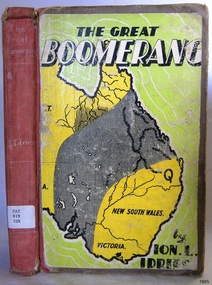 Flagstaff Hill Maritime Museum and Village
Book - Historical, Australia, The Great Boomerang
... Idriess was appointed an Officer of the Most Excellent Order of the British Empire (OBE) for his service to literature in 1968. warrnambool shipwrecked-coast flagstaff-hill flagstaff-hill-maritime-museum maritime-museum shipwreck-coast flagstaff-hill-maritime-village shipwrecked-artefact book pattison collection warrnambool library warrnambool mechanics’ institute ralph eric pattison corangamite regional library service warrnambool city librarian mechanics’ institute library victorian library board warrnambool books and records warrnambool children’s library great ocean road the great boomerang ion l idriess Label on spine cover with typed text PAT 919 IDR Pastedown front endpaper has sticker from Corangamite Regional Library Service The Great Boomerang Author: Ion L Idriess Publisher: Angus & Robertson Date: 1948 The Great Boomerang Book Historical, Australia ...This item is from the ‘Pattison Collection’, a collection of books and records that was originally owned by the Warrnambool Mechanics’ Institute, which was founded in Warrnambool in 1853. By 1886 the Warrnambool Mechanics’ Institute (WMI) had grown to have a Library, Museum and Fine Arts Gallery, with a collection of “… choice productions of art, and valuable specimens in almost every branch and many wonderful national curiosities are now to be seen there, including historic relics of the town and district.” It later included a School of Design. Although it was very well patronised, the lack of financial support led the WMI in 1911 to ask the City Council to take it over. In 1935 Ralph Pattison was appointed as City Librarian to establish and organise the Warrnambool Library as it was then called. When the WMI building was pulled down in 1963 a new civic building was erected on the site and the new Warrnambool Library, on behalf of the City Council, took over all the holdings of the WMI. At this time some of the items were separated and identified as the ‘Pattison Collection’, named after Ralph Pattison. Eventually the components of the WMI were distributed from the Warrnambool Library to various places, including the Art Gallery, Historical Society and Flagstaff Hill. Later some were even distributed to other regional branches of Corangamite Regional Library and passed to and fro. It is difficult now to trace just where all of the items have ended up. The books at Flagstaff Hill Maritime Village generally display stamps and markings from Pattison as well as a variety of other institutions including the Mechanics’ Institute itself. RALPH ERIC PATTISON Ralph Eric Pattison was born in Rockhampton, Queensland, in 1891. He married Maude Swan from Warrnambool in 1920 and they set up home in Warrnambool. In 1935 Pattison accepted a position as City Librarian for the Warrnambool City Council. His huge challenge was to make a functional library within two rooms of the Mechanics’ Institute. He tirelessly cleaned, cleared and sorted a disarrayed collection of old books, jars of preserved specimens and other items reserved for exhibition in the city’s museum. He developed and updated the library with a wide variety of books for all tastes, including reference books for students; a difficult task to fulfil during the years following the Depression. He converted all of the lower area of the building into a library, reference room and reading room for members and the public. The books were sorted and stored using a cataloguing and card index system that he had developed himself. He also prepared the upper floor of the building and established the Art Gallery and later the Museum, a place to exhibit the many old relics that had been stored for years for this purpose. One of the treasures he found was a beautiful ancient clock, which he repaired, restored and enjoyed using in his office during the years of his service there. Ralph Pattison was described as “a meticulous gentleman whose punctuality, floorless courtesy and distinctive neat dress were hallmarks of his character, and ‘his’ clock controlled his daily routine, and his opening and closing of the library’s large heavy doors to the minute.” Pattison took leave during 1942 to 1945 to serve in the Royal Australian Navy, Volunteer Reserve as Lieutenant. A few years later he converted one of the Museum’s rooms into a Children’s Library, stocking it with suitable books for the younger generation. This was an instant success. In the 1950’s he had the honour of being appointed to the Victorian Library Board and received more inspiration from the monthly conferences in Melbourne. He was sadly retired in 1959 after over 23 years of service, due to the fact that he had gone over the working age of council officers. However he continued to take a very keen interest in the continual development of the Library until his death in 1969. The Pattison Collection, along with other items at Flagstaff Hill Maritime Village, was originally part of the Warrnambool Mechanics' Institute’s collection. The Warrnambool Mechanics’ Institute Collection is primarily significant in its totality, rather than for the individual objects it contains. Its contents are highly representative of the development of Mechanics' Institute libraries across Australia, particularly Victoria. A diversity of publications and themes has been amassed, and these provide clues to our understanding of the nature of and changes in the reading habits of Victorians from the 1850s to the middle of the 20th century. The collection also highlights the Warrnambool community’s commitment to the Mechanics’ Institute, reading, literacy and learning in the regions, and proves that access to knowledge was not impeded by distance. These items help to provide a more complete picture of our community’s ideals and aspirations. The Warrnambool Mechanics Institute book collection has historical and social significance for its strong association with the Mechanics Institute movement and the important role it played in the intellectual, cultural and social development of people throughout the latter part of the nineteenth century and the early twentieth century. The collection of books is a rare example of an early lending library and its significance is enhanced by the survival of an original collection of many volumes. The Warrnambool Mechanics' Institute’s publication collection is of both local and state significance. About Ion L Idriess Ion Llewellyn Idriess was born in Waverley, Sydney, New South Wales on 20th September 1889 and passed away on 6th June 1979 in Mona Vale, Sydney, New South Wales at the age 89. After Idriess finished school he worked in the assay office of Broken Hill Proprietary mine. Both Idriess and his mother had typhoid fever when Ion was about 15 years old and it caused his mother’s death. After spending time with his Grandmother in Sydney he found work on a paddle-steamer and had a relapse of the fever. He then went into the western district of New South Wales where he worked in many different itinerant jobs, including rabbit poisoner, boundary rider, drover, sandalwood harvester, shearer, dingo shooter and opal miner. While opal mining at Lightning Ridge he wrote short stories, about life on the opal fields, for the Bulletin using the name “Gouger”. Idriess then moved to North Queensland in search of gold, tin and sandalwood. He travelled over a great deal of the Cape York Peninsula spending a lot of this travel time with local indigenous people; thus began his lifelong interest in their customs. He then spent time on cattle stations in the Gulf of Carpentaria. In 1914 Idriess travelled to Townsville and enlisted in the 5th Light Horse as a trooper. He became a specialist in sniping and was a spotter for the noted sniper Billy Sing. He saw service in Palestine, Sinai and Turkey. Idriess was wounded at Beersheba and after fighting the Battle of Gaza he was invalided home in March 1918. After recovering from his wounds Idriess again travelled to Cape York Peninsula where he worked with pearlers and missionaries in the Torres Strait Islands. He then went gold mining in Papua New Guinea, buffalo shooting in the Northern Territory of Australia and then exploring in Central and Western Australia. LITERARY WORKS OF IDRIESS In 1928 Idriess settled in Sydney and published the first of his 47 books. In 1931 - “Lasseter’s Last Ride”, became his first best seller. In the years 1932 and 1940 he published three books in each year. “The Cattle King” (1936) and “Flynn of the Inland” (1932) have gone through reprinting forty to fifty times. His last book was published in 1969. Idriess’ books where in general non-fiction and were written in a colourful and immediate story style, taken from life experiences gained during his travels. Idriess was appointed an Officer of the Most Excellent Order of the British Empire (OBE) for his service to literature in 1968. The Great Boomerang Author: Ion L Idriess Publisher: Angus & Robertson Date: 1948Label on spine cover with typed text PAT 919 IDR Pastedown front endpaper has sticker from Corangamite Regional Library Service warrnambool, shipwrecked-coast, flagstaff-hill, flagstaff-hill-maritime-museum, maritime-museum, shipwreck-coast, flagstaff-hill-maritime-village, shipwrecked-artefact, book, pattison collection, warrnambool library, warrnambool mechanics’ institute, ralph eric pattison, corangamite regional library service, warrnambool city librarian, mechanics’ institute library, victorian library board, warrnambool books and records, warrnambool children’s library, great ocean road, the great boomerang, ion l idriess -
 Bendigo Military Museum
Administrative record - COMPENDIUM WW1 - WW2, 4) A H Pettifer, Government Printer et al, 2) 14.2.1946; .3) 1.3.1919; .4) 30.11.1954 .5) 24.11.19? - WWI; .6) 31.10.1917; .7) 12.6.1917; .8) Page 1: 20.12.1915, Page 2: 10.12.1915, Page 6: 19.1915; .9) 10.9.1918; .10) 18.4.1919; .11) c.2.3.19?; .12) 18.9.1920; .14) post WWI; .15) 24.4.1920; .17) 18.4.1942; .18) 19.6.1943; .19) 18.3.1947; .20) 1944; .21) 1944; .23) 22.10.1941; .26) 13.9.1944; .27) 1.1944; .30) 7.3.1950; .31) 31.7.1944; .32) 16.4.1942; .33) 13.6.1946; .34) 6.5.1946; .36) a) & b) 3.11.1947; .37) 24.10.1951; .38) 24.9.1957; .39) 9.10.1957; .40) 19.2.1958; .41) 26.2.1958; .42) 1.3.1958; .43) & .44) 7.3.1958; .45) 25.2.1958; .46) 3.1.1948; .47) 26.2.1948; .48) 22.4.1958; .49) 24.2.1958; .50) 12.3.1958; .51) 6.1958; .52) c.Mar/Apr 1958; .53) 5.4.1958; .54) c.end WWII; .55) a.b. 13.6.1967; .56) 26.5.1967; .57) 18.2.1954
... Handwritten bottom L corner: Col H T Allan Bottom R corner: OBE, MC, 1914-19, Victory, ED, MID 1914-18, MID 1939-45 On back: Steak & Kidney Morris ) Clark ) Vowood ) 10/- 70215 Maughan ) Allan ) .31) Top of page: Imprinted Coat of Arms Top LHS in black ink: TOP SECRET AND PERSONAL Handwritten signature: Stanley Sauige .32) Embossed top L corner: Seal of the Most Excellent Order of the British Empire. ...Handwritten bottom L corner: Col H T Allan Bottom R corner: OBE, MC, 1914-19, Victory, ED, MID 1914-18, MID 1939-45 On back: Steak & Kidney Morris ) Clark ) Vowood ) 10/- 70215 Maughan ) Allan ) .31) Top of page: Imprinted Coat of Arms Top LHS in black ink: TOP SECRET AND PERSONAL Handwritten signature: Stanley Sauige .32) Embossed top L corner: Seal of the Most Excellent Order of the British Empire. ...Herbert Trangmar Allan, refer 2755.4 for his extensive service history and wards. .2) Details gifting of a pair of Japanese binoculars to Col H T ALLAN by Pacific Island Regiment. .3) Certificate issued by Winston Churchill, Secretary of State for War (The War of 1914-1918), awarded to Capt H T ALLAN MC. .4) Herbert Trangman ALLAN born 5.1.1895 at Woolwich, NSW. Middle name misspelled, should be Trangmar not Trangman. .6) Congratulating H T ALLAN on receiving the Military Cross award for leading 2 companies which had lost officers during action on Passchendaele Ridge on 9.10.1917. .7) Describes life behind the lines whilst H T ALLAN's battalion has been resting for a month. Daily life consisted of training drills, sport & entertainment. Writer takes time to describe the countryside & weather. .8) Relate to H T ALLAN's military exam results & his promotion to 2nd Lieutenant in 1915. .9) To Herbert Allan's father, Mr P Allan detailing the citation for awarding of the Military Cross to Herbert ALLAN. Original citation appeared in the London Gazette,5.4.1918. .10) Form addressed to Capt H ALLAN MC, 17th Battalion stating his period of enlistment in the 1st AIF was to expire 26.5.1919. .11) Letter from Lord BIRDWOOD (General) to Herbert ALLAN in response to a letter received 19.11.19?. General BIRDWOOD expresses his opinions on difficulties the allied troops face in their fight against the Japanese. .12) Letter to Capt H T ALLAN advising of MID oak leaves sent to him. Details guidelines for attaching oak leaves to both the larger Victory Medal & the small service dress medal. .13) Form details H T ALLAN's WWII Army No, Rank, Unit & Decorations & Medals held. The form has not been signed & dated. .14) Details service record of Lt Col H T ALLAN NX12229. Includes military service from 1912 - 1944, schools & courses attended, decorations, promotions & overseas service. .16) Form issued to H T ALLAN on 15.12.1939 granting permission to leave New Guinea for Australia & return within a period of 12 months. Issued by Customs Office in Salamaua. Lists H T ALLAN's age as 44, height 5' 10" & occupation. .17) Letter from Major General MORSHEAD GOC, AIF (ME) to Major H T ALLAN, OBE, MC congratulating him on being awarded the OBE for outstanding service at Tobruch. .18) Letter from Major General MORSHEAD to Major H T ALLAN, OBE, MC replying to ALLAN's letter of 15.6.1943. MORSHEAD is congratulating ALLAN on his appointment to New Guinea Force, also acknowledges his excellent service record. .19) Letter acknowledges H T ALLAN's resignation from the Office of Production Member of the Australian New Guinea Production Control Board, effective from 28.8.1946. .20) Major General WINDEYER commanded the 20th Brigade from 1942-1946. .22) Card sent from the CO of the 3rd Australian Anti-Tank Regiment. .23) Menu for Farewell Dinner held in the Officer's Mess of the 20th Infantry Brigade, Tobruch on 22.10.1941. .24) Menu & Toast list for Farewell Dinner to Brigadier J J MURRAY DSO MC VD. Attended by H T ALLAN & held in the Officers Mess, 2/17 Australian Infantry Battalion on 22.12.1941. .25) Invitation to Col H T ALLAN by Lady Gowrie (wife of Governor General Baron Gowrie) to attend a Luncheon at Government House, Canberra, ACT. .26) Letter to Major (T/Lt Col) H T ALLAN from Major W A JENNER advising him of his secondment to 2/17 Australian Infantry Battalion & appointment to command 5 Aust Base Sub Area. .27) Application for Africa Star with Eighth Army Clasp signed by H T ALLAN & approved by Lt Colonel of 2/17 Australian Infantry Battalion. H T ALLAN held the rank of Major (substantive) at the time of qualification, 1.3.1942 - 11.1942. He held the rank of Lt Colonel at the time of application in 2.1944. .28) Detailing changes in command & promotions including that of Lt Col H T ALLAN, dated 1.4.19? .29) For Lt Col H T ALLAN detailing movements required by First Australian Army command. .30) Acknowledgement & confirmation of Col H T ALLAN's application for campaign awards for WWII. .31) Letter addressed to Lt Col H T ALLAN from Lt Gen Stanley Sauige requesting information on New Britain for a forthcoming visit. .32) Certificate was presented to H T ALLAN on 16.4.1942 when he was awarded an OBE by King George VI. .33) Document details H T ALLAN's relinguishing of Command of the HQ of Pacific Islands Regiment. ALLAN also relinguished the rank of temporary Colonel & was transferred to the Reserve of Officers with rank of substantive Lt Colonel. .35) Official letter to Colonel H T ALLAN from Joseph Francis, Minister for the Army. The letter acknowledges Col ALLAN's long & distinguished career during both peace & wartime. .36) a) & b) From H T ALLAN (assumed) to Prime Minister J B CHIFFLEY referring to the production of copra in New Guinea, the actions of the Commonwealth Bank in relation to planters & the collaboration of New Guinea natives with the Japanese. Assumed to be a copy of original. .37) Letter to H T ALLAN indicating he had been placed on the Retired List with the rank of Honorary Colonel. .38) Letter invites H T ALLAN to officially open the State Conference in Lae in late March or early April 1958. Invitation was extended due to H T ALLAN for distinguished service in PNG. .39) Letter to H T ALLAN thanking him for accepting the invitation to open the Papua & New Guinea State Conference in late March or early April 1958. .40) Letter from H T ALLAN to Lt Gen Sir Henry WELLS, Chief of the General Staff, Victoria Barracks, Melbourne. ALLAN requests permission to wear his uniform for official engagements during his upcoming visit to New Guinea. ALLAN also offers advice on how to deal with native troops including serving time with them, learning their language & studying their customs. He suggests that this would help quell & dissent & revolt. .41) Reply from Major General DALY to HT ALLAN thanking him for his offer to spend time with the CO of the Pacific Island Regiment to address concerns with that unit. This meeting would coincide with ALLAN's upcoming visit to PNG. .42) HT ALLAN's reply to Major General T J DALY's letter of 26.2.1958. ALLAN requests an opportunity to discuss PIR issues with Major General DALY prior to his visit to PNG. .43) Major General T J DALY's reply to HT ALLAN's request for a meeting to discuss ongoing issues with the Pacific Island Regiment. .44) Letter from HT ALLAN to Brigadier D M CLELAND notifying him that he will be staying in Port Moresby on his way to the RSS&AILA Congress in Lae. .45) Lieutenant Colonel MCGUINN writes to invite Colonel ALLAN to visit the PIR during his visit to New Guinea at the end of March of the beginning of April 1959. .46) Letter of appreciation to H T ALLAN thanking him for his efforts in presenting the case for the Territory of New Guinea during the post WWII transition period. .47) Letter to H T ALLAN from New Guinea Citizens Association, Lae Branch, thanking him for his service on behalf of the people of the Territory of New Guinea. The association offered to send ALLAN a suitable present in recognition of his service. .48) Major General T J DALY's reply to HT ALLAN's suggestions for handling disquiet amongst the native troops in the Pacific Island Regiment. .49) Reply from Lieutenant General WELLS to H T ALLAN granting him permission to wear his uniform on his forthcoming visit to New Guinea. WELLS also notes that he has passed other requests made by ALLAN to Major General DALY. .50) Copy of H T ALLAN's reply to Lieutenant General WELL's letter of 24.2.1958 [.49)]. .51) A written account of Colonel H T Blue ALLAN's visit to New Guinea in 3.1958. Article appeared on p.65 & 67 of the 6.1958 edition of Pacific Islands Monthly. .52) Newspaper account of Colonel H T Blue ALLAN's opening of the Rabaul Branch of the Native Ex Servicemen's Association. Colonel ALLAN spoke of the involvement of the Pacific Islands Regiment during WWII. .53) The Rabaul Times account of Colonel H T Blue ALLAN's opening of the Rabaul Branch of Native Ex Servicemen's Club. Featured on p1, concluded p3. .54) Biographical account of Colonel H T ALLAN's service in WWI & WWII. In addition an account of his success in New Guinea between the wars is included. .55) a.b. Biography of Colonel H T ALLAN written by R W Robson who was the founder of the Pacific Islands Monthly. Article was written following ALLAN's death on 23.5.1967 aged 72. This item is a pre publication copy of Robson's article which appeared in the Pacific Islands Monthly. .56) Text of a valedictory given at the funeral of Colonel Herbert Trangmar ALLAN OBE, MC, ED, NX12229 held 26.5.1967 following his death on 23.5.1967. The speech summarized his life in both wars & civilian life. 57) Invitation issued to Colonel H T & Mrs ALLAN to attend a Garden Party at Government House on 18.2.1954. At this function Colonel H T & Mrs ALLAN were to be presented to her Majesty Queen Elizabeth II.Herbert T ALLAN Collection. The contents are all of various size, the Album is the size documented. .1) Large teal green album containing 16 plastic pockets each with white card insert. Various documents & photos contained in each pocket. .2) Typed letter, black type on cream paper. .3) Certificate mounted on fawn card backed with dark brown veneer. Presented to Capt H T ALLAN MC for being mentioned in despatches on 7.11.1917. .4) New South Wales Birth Certificate extract, printed on pink paper with watermark. .5) Telegram on tissue paper to a sheet of cream paper. Pin located top L corner. Requests the attendance of Lt Herbert ALLAN, Russell Hotel, Russell Square. .6) Typed letter mounted on grey cardboard. .7) 2 page letter on foolscap paper, secured by pin top L corner. Written from France by Herbert (Bert) ALLAN & addressed to his father. .8) 11 pages secured with a clip top L corner. 1st document typed, 2nd handwritten, remainder printed. Relate to H T ALLAN's military exam results. .9) Typed letter from Department of Defence Base Records Office to P ALLAN. .10) Document, printed form to inform the recipient that their period of enlistment in the 1st AIF had expired. .11) 4 page handwritten letter on 2 sheets of paper. 1st page has a printed letterhead. .12) BR Form No 20. Typed formal letter from AIF Base Records Office to accompany Mentioned in Despatches oak leaves sent to the recipient. .13) Form AAFA36 used for recommending the awarding of an Efficiency Decoration. Form details service record & details of a serving soldier. .14) 1 large / 1 small page, numbered, detailing the service record of Lt Col H T ALLAN. Black type on cream paper. 2 pages are loose but evidence of attachment visible. .15) Bachelor of Arts Degree Certificate (testamur) granted by the University of Sydney, awarded to Herbert Trangmar ALLAN. Printed on cream parchment. .16) Proforma document issued by the Territory of New Guinea permitting leave & return to the Territory. Printed 2 sides, black type on cream paper. .17) Letter on Australian Imperial Force letterhead from Major General MORSHEAD to Major H T ALLAN. .18 Letter on HQ2 Aust Corps letterhead from Major General MORSHEAD to Major H T ALLAN. .19) Typed letter on External Territories letterhead from J R Halligan to H T ALLAN. .20) Cream Christmas card folded in 2, sent to H T ALLAN. On front in black lettering is HQ 20th Australian Infantry Brigade below black Rising Sun emblem. Inside in black lettering is With Best Wishes for Christmas and New Year. Christmas 1944. .21) Cream card folded in 2. Front illustration depicts a devil figure riding a platypus & carrying a pennant with 2/13 on it. The devil is depicted attacking a German & Japanese soldier. Below the devil is a boomerang with Greetings Xmas 1944 printed on it. Illustration is in green & black. Inside on LHS is a message from 2/13 Battalion. On RHS is a list of 2/13 battle honours from 1940-1943. On back in black print is 1944-1945 New Guinea Australia. .22) Cream Christmas card folded in 2. Front illustration in brown with word Greetings in green. RHS inside printing in green & brown letters. Artillery badge on back in brown. .23) Cream card folded in 2. Typed menu on cream paper attached inside. Front cover illustrated with 20th Infantry Brigade colour patch & a rat over a scroll with words - So What? .24) Cream card folded in 2. On front black printing accompanied by 2/17 Battalion colour patch that is black over green diamond shape. Inside a list of Toasts & Dinner Menu printed in black. Back page for autographs. .25) Cream invitation card. Black cursive script printing below gold crown on front. .26) Typed letter on cream paper. .27) Typed foolscap application form to claim the Africa Star. .28) & .29) Message form filled with typed orders. .30) Typed letter acknowledging an application for campaign medals & listing eligible awards. .31) Typed letter on bond paper. .32) Certificate on cream parchment. Black print in cursive script. Text details the awarding of an OBE to the recipient. .33) Typed text on Australian Military Forces letterhead. Cream paper. .34) Typed text. Temporary note for H T ALLAN's discharge from AMF. .35) Typed letter on Commonwealth of Australia, Minister for the Army letterhead. .36) a) & b) 2 page letter in black type on cream paper. Pages are loose, letter unsigned. .37) 1 page typed letter on Australian Military Forces letterhead. .38) & .39) 1 page typed letter on Return Sailors, Soldiers & Airmen's Imperial League of Australia, Papua & New Guinea Branch letterhead. .40) 1 page typed letter, unsigned. .41) Single sided typed letter on Australian Military Forces letterhead on cream paper. .42) 1 page typed letter, unsigned on cream paper. .43) Single sided typed letter on Australian Military Forces, Northern Command, Victoria Barracks, Brisbane letterhead on cream paper. .44) Single sided typed letter on cream paper. .45) 2 page typed letter on folded cream paper bearing the letterhead of the Pacific Islands Regiment. .46) 1 page typed letter on cream, lined paper. .47) 1 page typed letter on cream paper. .48) 1 page typed letter on Australian Military Forces, Northern Command Headquarters, Victoria Barracks, Brisbane letterhead on cream paper. .49) 1 page typed letter on Chief of General Staff, Australian Military Forces, Army Headquarters, Victoria Barracks, Melbourne letterhead on cream paper. .50) 1 page copy of an unsigned letter on cream paper. .51) Magazine article: Building a New Nation in New Guinea : Some advice from Colonel Blue ALLAN. Black & white article with a 2nd small section stapled to the main page. Large page features a black & white captioned photo of a group listening to a uniformed Officer deliver a speech. Also features advertising front & back. .52) Newspaper article: Official Opening of Native Ex Servicemen's Club. Black & white typed newspaper article featuring a captioned black & white photo of a uniformed Australian Officer & a group of New Guinea Ex Servicemen. .53) a. b. c. Newspaper article: Master Blue Came Back to the Islands: 4000 Attend Club Opening. 3 Section article cut from a newspaper. One part is the banner of the newspaper with date published. Other sections contain the text of the article. The larger section features a black & white photo of an Australian Army Officer in uniform. .54) Newspaper article, untitled. Black & white typed newspaper article with black & white caricature of an Australian Army Officer featured. .55) a. b. Magazine article: The Story of a Big Man who Loved Soldiering. 2 page black & white typed article with sub headings. .56) Text of a Speech. 2 page typed text written for a valedictory given at a funeral. Pages connected with a staple in the top L corner. .57) Printed, cream card invitation to a Garden Party for the recipient to meet Queen Elizabeth II & The Duke of Edinburgh. Text is in cursive script under the Coat of Arms of Her Majesty. .2) Signature ? Capt S C PIR. .4) Date of issue typed: 30.11.1954 Name of recipient: Herbert Trangman Allan Stamped: T Wells, Registrar General NSW .5) Handwritten: To Lt Herbert Allan, Russell Hotel, Russell Square. Typed: Buckingham Palace OHS. Your attendance is required at Buckingham Palace on Wednesday next the Twentyeighth inst (28.11.19?) at ten o'clock am service dress please telegraph acknowledgement Lord Chamberlain London. Stamped: Central District 24 NO 19. .6) Signed in pencil: W Birdwood. In pencil on back: 15 x 12. .8) p1: Handwritten signature. Copy dated 29.12.1915. p2 Handwritten in ink: P Allan Esq, Mount Hunter Hill. Military Examination. Copy dated 29.12.1915. Handwritten in pencil: Results: H T Allan. Tactics - Distinction 92% HE Barff p3 Underlined in ink: 38th Infantry Herbert Trangmar Allan to be 2nd Lieutenant (provisionally). Dated 16 June 1914. p5 Handwritten: Total 139. Lieut Allan tied with 15 others for 20 place. p7, 9, 10 & 11underlined in ink: H T Allan. p8 Underlined in ink: Allan HT. .9) & .10) Signature in black ink. .12) Handwritten signature in black ink: On back handwritten signature in black ink: Clive Wilkinson, Buddong, Robinson St, Chatswood. Also ? Rd, Cremorne Pt. .13) Handwritten in black ink: Details of HT Allan's Commission Service from 16.6.1914 - 18.2.1946. .15) Handwritten signature of the University Chancellor, Dean of Faculty of Arts & Registrar. Handwritten name of recipient. Seal of the University of Sydney imprinted bottom LHS. .16) Handwritten in black ink: Details of recipient. Stamped in red ink: New Guinea Customs. Stamped in blue ink: H M Customs, Cooktown, dated 17.12.1939. Handwritten on reverse: Signature. Stamped on reverse in red ink: New Guinea Customs, dated 15.12.1939. .17) & .18) Handwritten signature: Major General Morshead. .19) Handwritten signature in black ink: J R Halligan. .20) Handwritten inside in blue ink: Lt Col Allan. Good wishes from your many friends here. Signed by Major General Windeyer. .21) Inside LHS handwritten in blue ink: Lt Col Allan & an indecipherable signature. .22) Inside RHS handwritten: To Major (Blue) Allan OBE MC from Lt Col? .23) On front handwritten in blue ink: H T Allan?. Inside in black ink & pencil are 19 signatures. .24) On front: 3 signatures in black ink & pencil. On back: 36 signatures in black & blue ink & pencil. .25) On back handwritten in black ink: Colonel H T Allan OBE MC, with 3 ink lines below name. .26) Handwritten in blue/black ink: Signature. Handwritten in blue pencil top R corner: A32/3477. Handwritten in black ink bottom L corner: Cond (?) 15/9A. Handwritten in black ink: Signature. .27) Stamped top R corner: 2/17 Bn Received 9.2.1944. Signature in black ink: H T Allan. Signature in black ink: ? Lt Col 2/17 Aust Inf Bn 10.2.1944 Page bottom in pencil: Blue will keep 1 1/4 for you? .30) Handwritten: Details of eligible medals. Handwritten signature: J C K Miller Capt 7.3.50. Handwritten bottom L corner: Col H T Allan Bottom R corner: OBE, MC, 1914-19, Victory, ED, MID 1914-18, MID 1939-45 On back: Steak & Kidney Morris ) Clark ) Vowood ) 10/- 70215 Maughan ) Allan ) .31) Top of page: Imprinted Coat of Arms Top LHS in black ink: TOP SECRET AND PERSONAL Handwritten signature: Stanley Sauige .32) Embossed top L corner: Seal of the Most Excellent Order of the British Empire. Handwritten: Mary R. .32) Signed: Queen Mary, mother of George VI. .33) Handwritten signature. .34) Handwritten in blue ink: HERBERT TRANGMAR ALLAN 6 MAY 46 Handwritten signature. .35) Handwritten signature in blue ink: Joseph Francis, Minister for the Army. .37) Handwritten signature. .38) & .39) Handwritten signature: J W Knight. .41), .43) & .45) Handwritten signature in blue ink. .46) & .47) Handwritten signature in black ink: Henry G Eckhoff. .48) Handwritten signature in blue ink: With best wishes Yours sincerely T J Daly. .49) Handwritten signature in black ink: Yours sincerely H Wells. .57) Handwritten in black ink: Colonel & Mrs H T Allan.certificates, records, awards, administrative, compendium -
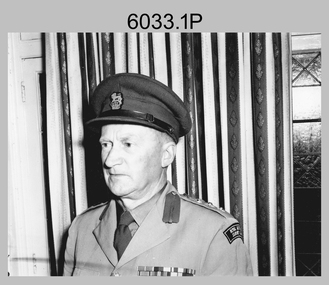 Bendigo Military Museum
Photograph - Directors of Survey, Army Headquarters, c1942-1978
... COL Lawrence FitzGerald OBE was Director from 1942 to 1960. He received the Order of the British Empire in 1948 for his service in WW2. ...COL Lawrence FitzGerald OBE was Director from 1942 to 1960. He received the Order of the British Empire in 1948 for his service in WW2. ...This is a set of ten photographs of Directors of Survey Army Headquarters circa 1942 to 1967. COL Lawrence FitzGerald OBE was Director from 1942 to 1960. He received the Order of the British Empire in 1948 for his service in WW2. Although it is not known when BRIG Lawrence FitzGerald OBE was promoted to Brigadier, it is possibly an honorary promotion on his retirement in 1960. He served in the Australian Army from 03 September 1923 to 05 January 1960. COL Lawrence FitzGerald OBE was succeeded by COL Donald Macdonald AM, MID, whose appointment to Director was from 1960 to 1967. COL Macdonald AM, MID was promoted to Brigadier on his retirement before assuming the honorary position of Colonel Commandant of the Royal Australian Survey Corps. He served in the Australian Army from 01 January 1936 to 22 March 1960. COL Frank D. Buckland, OBE MID was Director from March 1967 to August 1972 and was later appointed Colonel Commandant, after retirement and promotion to Brigadier, from January 1973 to January 1976. He served in the Australian Army from 01June 1938 to 31 October 1972. He was also Commanding Officer of the AHQ Survey Regiment from 1962 to 1965 overseeing significant changes to the Regiment's operation both technically and militarily. Colonel James L Stedman was Director from July 1975 to February 1975. He served in the Army from 27 February1941 to 28 February 1978 and was later appointed Colonel Commandant from September 1978 to February 1983. From 1940 to 1978 all Directors of Survey Army Headquarters served in the Second World War.This is a set of two photographs of Directors of Survey Army Headquarters circa 1942 to 1967.The photographs were printed on photographic paper and are part of the Army Survey Regiment’s Collection. They were scanned at 300 dpi. .1) - Photo, black and white, c1950s. D-SVY COL Lawrence FitzGerald OBE. .2) - Photo, black and white, c1960s. D-SVY COL Don Macdonald AM, MID. .3) - Photo, black and white, c1950s. D-SVY COL Lawrence FitzGerald OBE. .4) - Photo, black and white, c1960s. D-SVY COL Frank D. Buckland, OBE, MID. .5) - Photo, black and white, c1950s. D-SVY COL Frank D. Buckland, OBE, MID. .6) - Photo, black and white, c1960s. D-SVY COL Frank D. Buckland, OBE, MID. .7) - Photo, black and white, c1950s. D-SVY COL Frank D. Buckland, OBE, MID. .8) - Photo, black and white, c1950s. D-SVY COL Lawrence FitzGerald OBE. .9) - Photo, black and white, c1970s. D-SVY COL J. L. Stedman. .10) - Photo, black and white, c1970s. D-SVY COL J. L. Stedman..1P to .10P – no annotationsroyal australian survey corps, rasvy, army survey regiment, army svy regt, fortuna, asr, directorate of army survey, dsvy, director of survey - army, ahq survey regiment -
 4th/19th Prince of Wales's Light Horse Regiment Unit History Room
Medal, Order of the British Empire (Civil)
... Most Excellent Order of the British Empire Awarded by Sovereign of the United Kingdom Type Order of Chivalry Motto For God and the Empire Eligibility British nationals or anyone who makes an impact for the UK Awarded for A national order of chivalry Status Currently constituted Sovereign Queen Elizabeth II Grand Master Prince Philip, Duke of Edinburgh Principal Commander Sovereign Grades (w/ post-nominals) Knight/Dame Grand Cross (GBE) Knight/Dame Commander (KBE/DBE) Commander (CBE) Officer (OBE) Member (MBE) Established 1917 Precedence Next (higher) Royal Victorian Order Next (lower) Varies, depending on rank...Most Excellent Order of the British Empire Awarded by Sovereign of the United Kingdom Type Order of Chivalry Motto For God and the Empire Eligibility British nationals or anyone who makes an impact for the UK Awarded for A national order of chivalry Status Currently constituted Sovereign Queen Elizabeth II Grand Master Prince Philip, Duke of Edinburgh Principal Commander Sovereign Grades (w/ post-nominals) Knight/Dame Grand Cross (GBE) Knight/Dame Commander (KBE/DBE) Commander (CBE) Officer (OBE) Member (MBE) Established 1917 Precedence Next (higher) Royal Victorian Order Next (lower) Varies, depending on rank Medal OBE - Miniature medal with ribbon Order of the British Empire (Civil) Medal ...Most Excellent Order of the British Empire Awarded by Sovereign of the United Kingdom Type Order of Chivalry Motto For God and the Empire Eligibility British nationals or anyone who makes an impact for the UK Awarded for A national order of chivalry Status Currently constituted Sovereign Queen Elizabeth II Grand Master Prince Philip, Duke of Edinburgh Principal Commander Sovereign Grades (w/ post-nominals) Knight/Dame Grand Cross (GBE) Knight/Dame Commander (KBE/DBE) Commander (CBE) Officer (OBE) Member (MBE) Established 1917 Precedence Next (higher) Royal Victorian Order Next (lower) Varies, depending on rankMiniature medal with ribbon-medal, obe -
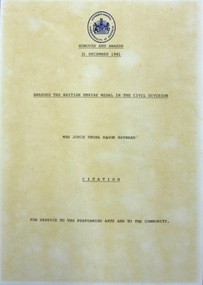 Warrnambool and District Historical Society Inc.
Document - Citation Award, British Empire Medal Citation awarded to Mrs Joyce Thora Hagon Hayward, 1981
... Order of the British Empire was formed in 1917 to reward service to the British Empire in the United Kingdom and abroad. Originally having only a civil division, a military division was added in 1918 to acknowledge distinguished military service of a non-combative nature. The Order has five classes of appointment in each division and a medal of the Order. In descending order, the classes are: Grand Cross (GB); Knights and Dames Commander (KCB and DCB); Commanders (CBE); Officers (OBE...Order of the British Empire was formed in 1917 to reward service to the British Empire in the United Kingdom and abroad. Originally having only a civil division, a military division was added in 1918 to acknowledge distinguished military service of a non-combative nature. The Order has five classes of appointment in each division and a medal of the Order. In descending order, the classes are: Grand Cross (GB); Knights and Dames Commander (KCB and DCB); Commanders (CBE); Officers (OBE ...The Order of the British Empire was formed in 1917 to reward service to the British Empire in the United Kingdom and abroad. Originally having only a civil division, a military division was added in 1918 to acknowledge distinguished military service of a non-combative nature. The Order has five classes of appointment in each division and a medal of the Order. In descending order, the classes are: Grand Cross (GB); Knights and Dames Commander (KCB and DCB); Commanders (CBE); Officers (OBE); Members (MBE), and Medal (BEM). Mrs Joyce Hayward along with her husband Cyril, had a 30 year association with the Warrnambool Theatre Company. They acted, directed and produced a number of works from the 1950’s through to the 1980’s. Mrs Hayward taught drama and speech at Warrnambool High School and St Ann’s College. They both worked towards reviving the Warrnambool Arts Council.. They were involved in Christ Church choir, readings for the blind, Probus and Penguin club. They retired to Bribie Island in 1985. Joyce Hayward died aged 97 in 2007. Joyce Hayward played a significant role in the development of the performing arts in Warrnambool. The British Empire medal is an award of some importance and recognizes the contribution Mrs Hayward made to the Warrnambool Community. Both Mrs Joyce Hayward and her husband Cyril were awarded the British Empire Medal. Cream paper with black typed text. Navy blue seal at top. Framed in black and gold plastic frame. Governor General Commonwealth of Australia printed at top. warrnambool, joyce hayward, cyril hayward, british empire medal, joyce thora hagon hayward -
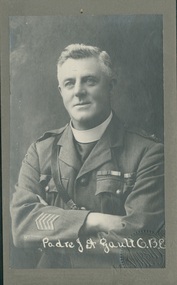 Uniting Church Archives - Synod of Victoria
Photograph, Undated c.1915 - 1918
... Order of the British Empire. On his return to Australia In 1920 he was stationed at Brunswick for three years, and then followed ministries at Port Melbourne, Spring-road, Malvern and finally at Camberwell. A deeply spiritual man, he brought a rare devotion to his ministry, and was beloved by his congregations and ministerial brethren alike. He shunned the limelight, and was one of the most retiring men in conference affairs. The deceased is survived by a widow, two daughters and, one, son. Dr. Edward L. Gaul is a brother." - from the Melbourne Age 02 Feb 1938 Padre J.A. Gault OBE ...Born 26 June 1865 at Manchester, England Husband of Mrs. Edith Ann Maria GAULT Of 'The Inglenook', Sea Parade, Cheltenham, Vic. Aged 50 years Enlisted 01 July 1915 for Continuous Service Embarked 16 July 1915 per 'HMAT Demosthenes' from Melbourne, Vic Pay rate of 19s 0d after embarkation Embarked 29 March 1916 per 'RMS Orontes' from Melbourne, Vic. Served in Egypt and on the Western Front Returned to Australia 01 November 1919 Awarded OBE Death of Rev. J. A. Gault The Rev. J. A. Gault, a Methodist minister, who was widely known to Australian soldiers as Padre Gault, died yesterday after a long illness. One of the best-loved padres in the AIF, Mr. Gault served for four years with the Australians, at first in Egypt and later in France and England. After the war, he continued to show great interest in returned soldiers and work in training camps. When he retired in February, 1934, Mr. Gault had been in the ministry for 40 years. Bom at Manchester. England on June 10, 1865 he came to Australia when aged three years in the sailing-ship Antiope. He was educated at Gold street State school and later at Wesley College. After his appointment as a minister, he served the church in many circuits in Tasmania and Victoria. Before the war he was superintendent of the Methodist Mission at Collingwood,and after his return from overseas he occupied important positions, including those of superintendent minister in the Brunswick, Port Melbourne, and Yarra street, Geelong, circuits. His last charge was at Camberwell. After ill-health caused him to retire, he lived at Mentone. He has left a widow, a son, and two daughters. Dr. Edward Gault. of Collins street, is a brother, and there are two sisters in New Zealand. The funeral will leave Mr. Gault's home In Sea parade, Mentone, tomorrow, at 2p.m., for the Methodist Church, Mentone. It will then proceed to the Springvale Crematorium. W. D. Rose and Son. Cheltenham, are making the arrangemnts. R.S.L. Tribute "Returned soldiers will learn of the death of Padre Gault with deep regret," said the president of the Returned Soldiers' League (Mr. G. W. Holland) lastnight. "He was revered by the AIF. for his unfailing sympathy, understanding, and comradeship." - from the Melbourne Argus 02 Feb 1938 "REV. J. A. GAULT. BELOVED A.I.F."PADRE." Death After A Long Illness. After a long Illness, the death occurred at his home at Mentone yesterday afternoon, of Rev. James Archibald ("Padre") Gault, one of the best known and beloved Methodist chaplains to the A.I.F. at Galllpoli and in France. Sorrow at the "padre's" demise, at the age of 72 years, will be shared not only by the thousands to whom he rendered, both spiritual and temporal comfort during the war, but, also by a host of friends won during a long and. fruitful, ministry at many centres in the State, and as chaplain at military camps after the war. He retired from the ministry three years ago, and had suffered Ill-health from that time. Deceased entered the Methodist ministry in 1894, and was ordained four years later. After a successful year as conference evangelist. he was stationed at Mansfield, then at Richmond. Following a ministry at Richmond he was transferred to Tasmania, where for twelve years he exercised his ministry at Mt Lyell Launceston, Penguin and Hobart. Returning to Victoria, Mr. Gault was stationed at St. Kilda, and when the war broke out he was associated with the Colllngwood Mission. He left on active service as a chaplain with the first troops, and was ' present ' throughout the Galllpoli campaign. Later he was with the forces In France, and remained on active service until the last of the troops were demobilised to 1920. He was affectionately known as "padre"after the war to the thousands of soldiers who had learned to regard him as guide, philosopher and friend In the trenches. He was noted always for the good cheer he invariably brought to the troops, and his famous "stunts" among the men were subsequently recorded by him in his publication, "The Stunt Book." For services rendered he was made a member of the Order of the British Empire. On his return to Australia In 1920 he was stationed at Brunswick for three years, and then followed ministries at Port Melbourne, Spring-road, Malvern and finally at Camberwell. A deeply spiritual man, he brought a rare devotion to his ministry, and was beloved by his congregations and ministerial brethren alike. He shunned the limelight, and was one of the most retiring men in conference affairs. The deceased is survived by a widow, two daughters and, one, son. Dr. Edward L. Gaul is a brother." - from the Melbourne Age 02 Feb 1938 B & W waist length studio portrait of the Rev. James Archibald Gault dressed in uniform as Chaplain to the A.I.F. Mounted on grey card.Padre J.A. Gault OBE -
 Moorabbin Air Museum
Badge (item) - Military Medal Ribbon, Order OF The British Empire
... Military Medal Ribbon, Order OF The British Empire, which includes the awards of Commander (CBE), Officer (OBE) and Member (MBE). ...Military Medal Ribbon, Order OF The British Empire, which includes the awards of Commander (CBE), Officer (OBE) and Member (MBE). ... -
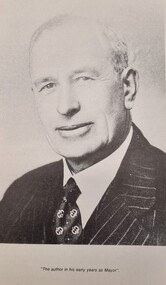 Wodonga & District Historical Society Inc
Book - A Memorable Life, Cleaver E Bunton, 1988
... In 1954 he was awarded the Order of the British Empire (OBE) for his service as the Mayor of Albury. ...Cleaver Bunton was born in Albury on 5 May 1902, son of Ernest Edward Bunton and Matilda Caroline nee Luhrs. He left school at 13 and initially worked as a clerk in a solicitor's office before becoming an accountant. He was also involved in Albury sporting and community affairs, playing Australian Rules Football with the Albury Football Club, becoming Captain-Coach and Club Secretary at 17. In recognition of his role in Albury, Cleaver was encouraged to run for a position on the Albury Municipal Council, and was elected in 1925 at the age of 22, the youngest person ever elected to a council to that time. After initially retiring in 1931 from Council, he returned to the council in 1937. He was elected Mayor of Albury in 1945, serving from 1946 until August 1976 (with brief breaks in 1961 and 1972–73). In 1954 he was awarded the Order of the British Empire (OBE) for his service as the Mayor of Albury. In 1979 Cleaver was recognised as an Officer of the Order of Australian in recognition of service to Local Government. He died in Albury on 20 January 1999. This memoir is a light-hearted reflection on aspects of Cleaver Bunton’s life.A booklet of 68 pages including some photographic illustrations and an index. The book is signed on the title page: "Cleaver E. Bunton" 1988non-fictionCleaver Bunton was born in Albury on 5 May 1902, son of Ernest Edward Bunton and Matilda Caroline nee Luhrs. He left school at 13 and initially worked as a clerk in a solicitor's office before becoming an accountant. He was also involved in Albury sporting and community affairs, playing Australian Rules Football with the Albury Football Club, becoming Captain-Coach and Club Secretary at 17. In recognition of his role in Albury, Cleaver was encouraged to run for a position on the Albury Municipal Council, and was elected in 1925 at the age of 22, the youngest person ever elected to a council to that time. After initially retiring in 1931 from Council, he returned to the council in 1937. He was elected Mayor of Albury in 1945, serving from 1946 until August 1976 (with brief breaks in 1961 and 1972–73). In 1954 he was awarded the Order of the British Empire (OBE) for his service as the Mayor of Albury. In 1979 Cleaver was recognised as an Officer of the Order of Australian in recognition of service to Local Government. He died in Albury on 20 January 1999. This memoir is a light-hearted reflection on aspects of Cleaver Bunton’s life.cleaver bunton, albury mayor -
 Federation University Art Collection
Painting - Mural, French, Leonard, 'The Tapestry' by Leonard French, 1959
... Leonard FRENCH (OBE) (08 October 1928 - 10 January 2017) Born Brunswick, Victoria Died Heathcote, Victoria Known for his enormous dalle de verre (concrete and slab glass) ceiling in the Great Hall of the National Gallery of Victoria Leonard French produced a large body of work throughout his lifetime. French won the Sulman Prize in 1960, and the Blake Prize for Religious Art in 1963 and in 1980. He was also awarded a Harkness Fellowship in 1965. In the Queen's Birthday Honours of June 1968 he was appointed an Officer of the Order of the British Empire...Leonard FRENCH (OBE) (08 October 1928 - 10 January 2017) Born Brunswick, Victoria Died Heathcote, Victoria Known for his enormous dalle de verre (concrete and slab glass) ceiling in the Great Hall of the National Gallery of Victoria Leonard French produced a large body of work throughout his lifetime. French won the Sulman Prize in 1960, and the Blake Prize for Religious Art in 1963 and in 1980. He was also awarded a Harkness Fellowship in 1965. In the Queen's Birthday Honours of June 1968 he was appointed an Officer of the Order of the British Empire ...Artist Leonard French said of this work:- "The centre panel suggests a tree of knowledge growing out of a jewelled fish (a spiritual accompaniment is intended), and from the tree birds rise, spreading out through the cloud shapes of the other panels. Hands and figures rise from the earth, reaching for the birds. The left hand panel depicts the journey of figures in a boat, the seeking after or journeying to the source of knowledge. The far right hand panel is the garden, figures in a primitive state, a sort of evolution of figures from a primitive garden (the first garden). Visualization, verbalization, music and dance are tools we have to express a concept. The analysis of an art work is a delicate and sensitive task and great harm can be done in an attempt to become verbal about a form which relies upon elements peculiar to itself for intrinsic meaning." Leonard FRENCH (OBE) (08 October 1928 - 10 January 2017) Born Brunswick, Victoria Died Heathcote, Victoria Known for his enormous dalle de verre (concrete and slab glass) ceiling in the Great Hall of the National Gallery of Victoria Leonard French produced a large body of work throughout his lifetime. French won the Sulman Prize in 1960, and the Blake Prize for Religious Art in 1963 and in 1980. He was also awarded a Harkness Fellowship in 1965. In the Queen's Birthday Honours of June 1968 he was appointed an Officer of the Order of the British Empire. In early 1959 Leonard French was commissioned by the Ballarat Teachers' College students to paint a mural. The students were responsible for the payment of the work. When unveiled artist George Bush remarked: "the 1959 students have left something not just to 'oooh' and 'ah' at, but something that is thought provoking, arresting and interesting. This work of art keeps something in reserve and draws you to search for deeper meaning behind the splendour of colour. This mural is not one which will not fade the interest of its beholders, but one which will provide intrigue for generations to come." Originally French intended the mural to be five panels, each entitled (left to right) 'the Journey', 'Man', 'The Tree', 'The Earth', 'The Garden'. The finished mural was reduced to four panels with the central tree incorporated into the panels 'Earth' and 'Man'. Ballarat Teachers' College Art lecturer Arch Cuthbertson explained that the artist:- "Aims at evoking emotional flashed, opening doors to simultaneous thinking and feeling. To accomplish this he juxtaposes the threads of conscious and unconscious images, thus effecting a tapestry that allows many points of reference to converge upon his singular images. Whether the colours offer metaphysical sensations or convey a literal meaning will depend upon the breadth and depth of the viewer's experience. Similarly with the bird - we might well ask is it a defiance of gravity, a metaphysical ascension or the elusive winged knowledge? Again the answer could well be that these three associations have a singular purpose. " This item is part of the Federation University Art Collection. The Art Collection features over 2000 works and was listed as a 'Ballarat Treasure' in 2007.A four panel mural by Leonard French, commissioned and gifted by the Ballarat Teachers' College Student in 1959. Art lecturer Arch Cuthbertson was highly involved in this commission. Artist Charles Bush unveiled the mural at the Ballarat Teachers' College in Gillies Street, Ballarat. At that time he said:- "You have left behind you on object which will be full of interest to a lot of people. A work of art, so long as it is in existence, is constantly under review. Most of the good things that keep on going are usually to the uninitiated a little worrying. Many of you will be worried by this, because it does not make its message immediately clear. But come back and assess it again and again." art, leonard french, french, artwork, mural, ballarat teachers' college, class of 1959
