
Showing 22 items matching "ostrich feathers"
-
 Wodonga & District Historical Society Inc
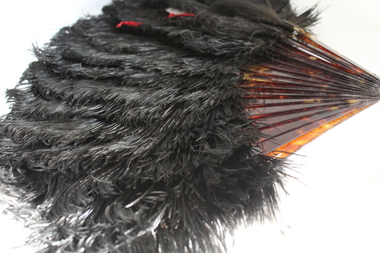
Accessory - Black ostrich feather fan, c1910 - 1920s
... Black ostrich feather fan...Black ostrich feather fan...This ostrich feather fan is part of a collection donated by Mrs. ...A black ostrich feather fan with vanes of faux tortoiseshell....Black ostrich feather fan Accessory Black ostrich feather fan ...This ostrich feather fan is part of a collection donated by Mrs. Jean Raper of Wodonga.This item is from Raper Collection donated to the Wodonga Historical Society by Mrs. Jean Raper. A black ostrich feather fan with vanes of faux tortoiseshell.accessories, fashion, vintage fashion -
 Bayside Gallery - Bayside City Council Art & Heritage Collection
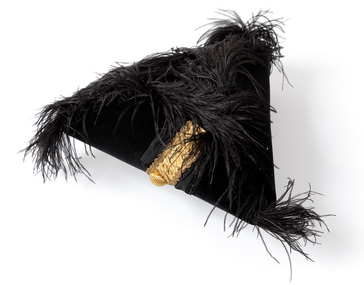
Ceremonial object - Hat, R.W. Bredin & Son, City of Brighton Mayor's tricorne hat, C. 1975-1985
... ...Ostrich feathers...Triangular shaped black velvet ceremonial headwear with black ostrich feathers attached from each corner/point to centre. ...Tricorne Hat Mayor Ceremonial Wear City of Brighton Bayside Headwear Ostrich feathers R.W. Bredin & Son Mayoral Regalia Triangular shaped black velvet ceremonial headwear with black ostrich feathers attached from each corner/point to centre. ...Triangular shaped black velvet ceremonial headwear with black ostrich feathers attached from each corner/point to centre. Gold coloured brocade and decorative button on the left-hand side, atop black pleated fabric. Satin-like lining, adjustable drawstring, with hard head support under the material.tricorne, hat, mayor, ceremonial wear, city of brighton, bayside, headwear, ostrich feathers, r.w. bredin & son, mayoral regalia -
 Stawell Historical Society Inc
Accessory - Costume and Accessories
... Two Black Ostrich Feathers. Dane Family....Stawell Clothing Material Two Black Ostrich Feathers. Dane Family. Accessory Costume and Accessories ...Two Black Ostrich Feathers. Dane Family.stawell clothing material -
 Mont De Lancey
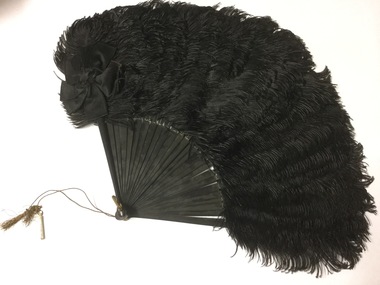
Accessory - Fan
... Black ostrich feather folding fan with satin bow....fans folding fans gibson collection Black ostrich feather folding fan with satin bow. Accessory Fan ...Black ostrich feather folding fan with satin bow.fans, folding fans, gibson collection -
 Whitehorse Historical Society Inc.
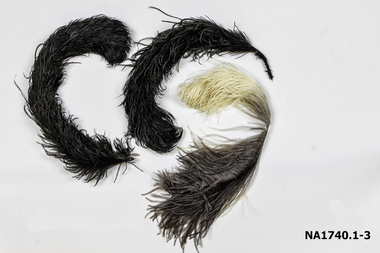
Decorative object - Feathers
... Three ostrich feathers - 2 black and 1 Grey and white.Articles not numbered...costume accessories female Three ostrich feathers - 2 black and 1 Grey and white.Articles not numbered Decorative object Feathers ...Three ostrich feathers - 2 black and 1 Grey and white.Articles not numberedcostume accessories, female -
 Friends of Westgarthtown
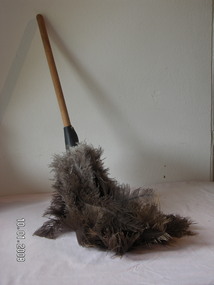
Domestic object - Duster, feather
... ...feather...ostrich...Brown ostrich-feather duster, with rubber matt to attach feathers to wooden handle....domestic items cleaning feather ostrich duster domestic No visible markings Brown ostrich-feather duster, with rubber matt to attach feathers to wooden handle. ...Brown ostrich-feather duster, with rubber matt to attach feathers to wooden handle.No visible markingsdomestic items, cleaning, feather, ostrich, duster, domestic -
 Brighton Historical Society
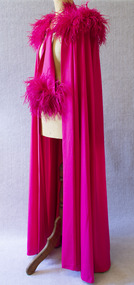
Cape, Evening cape, 1974
... Full-length bright pink rayon jersey cape with pink ostrich feathers around the collar....It's been a pleasure to dress people, to make them look good and feel pleased with themselves." pearl's boutique pearl's of brighton paula folks 1970s Full-length bright pink rayon jersey cape with pink ostrich feathers around the collar. Evening cape Cape Van Roth ...This cape was worn in a pre-racing season fashion parade held in October 1974 by Pearl's Boutique, a well-known fashion boutique that operated in Brighton from 1965 until 2005. Paula Folks, the store's manager at the time, recalled that this parade had been loosely red, white and blue themed in honour of Princess Anne's wedding to Mark Phillips, which took place on 14 November of that year. The parade was likely held at Tudor Court in Caulfield, a popular reception venue. Pearl's Boutique was established by Elsebe Wilhelmine Wills and Pearl Murray in 1965. The two friends had grown up together in Horsham, and decided to go into business together after reading in Fashionweek that women in their thirties, forties, fifties and older had trouble finding young-looking styles. Setting out to fill this gap in the market, they established a store at 240 St Kilda Street, near the Brighton Yacht Club, with Elsebe handled the buying while Pearl fronted the shop. They moved to 40 Church Street, Brighton in 1967. Paula Folks joined the business as a manager in 1968, became a partner in 1971 and took over from the original owners in 1988. When she closed the boutique in 2005, she donated a number of garments to Brighton Historical Society. Reflecting fondly on her 38 years at Pearls, she told The Age, "I have enjoyed all my days here because people are special to me. I love fashion. It's been a pleasure to dress people, to make them look good and feel pleased with themselves."Full-length bright pink rayon jersey cape with pink ostrich feathers around the collar.pearl's boutique, pearl's of brighton, paula folks, 1970s -
 Hobsons Bay City Council
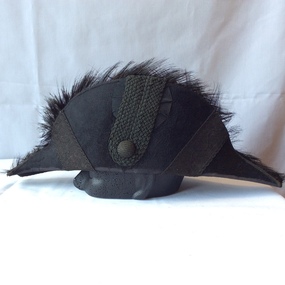
Bicorn Hat, Circa pre 1880
... Black beaver fur bicorn ceremonial hat with silk brocade and ostrich feather trim. Silk lined....Black beaver fur bicorn ceremonial hat with silk brocade and ostrich feather trim. Silk lined. Bicorn Hat ...This hat was part of the ceremonial dress of Williamstown Mayors. It is evident in early photographs of Williamstown Mayors from circa 1880 to the 1920's. The hat is designed to be folded as is often shown carried under the arm in Mayoral portraits.The hat is significant as an example of Mayoral ceremonial dress and is documented in Mayoral portraits associated with Williamstown Council.Black beaver fur bicorn ceremonial hat with silk brocade and ostrich feather trim. Silk lined. -
 Rosedale and District Historical Society
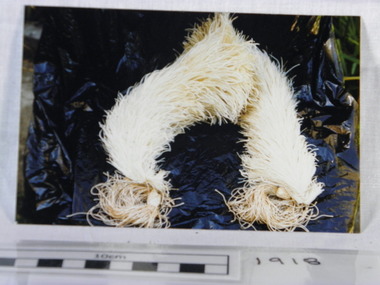
Feather Boa
... ...ostrich feather...Ostrich feather Boa, cream feathers with tassels on both ends, the feathers on either side run upwards and peak at the neck....world war one france 1918 wwi ostrich feather boa cream in colour miss jean millar mrs jean lees rosedale gordon farley war momento Ostrich feather Boa, cream feathers with tassels on both ends, the feathers on either side run upwards and peak at the neck. ...Ostrich feather Boa, cream feathers with tassels on both ends, the feathers on either side run upwards and peak at the neck.world war one, france, 1918, wwi, ostrich feather, boa, cream in colour, miss jean millar, mrs jean lees, rosedale, gordon farley, war momento -
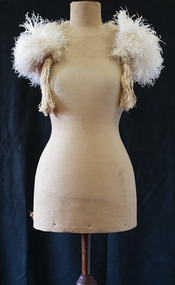 Brighton Historical Society
Cape, Capelet, circa 1920
... ...ostrich feather...White ostrich feather capelet. Feathers sewn onto crescent-shaped cream cotton fabric, with an elaborate silk tassel at either end....During his last year of life, despite serious illness, he served as Speaker of the Legislative Assembly under the Hogan government. ellen grace snowball ellen grace anketell oswald snowball capelet ostrich feather 1920s White ostrich feather capelet. ...This capelet belonged to Ellen Grace Snowball, nee Anketell, (1866-1945), who lived with husband Oswald Robinson Snowball (1859-1928) at 'Wolsingham', 11 Boxshall Street, Brighton. Oswald Snowball was a solicitor and politician who was active in the Freemasons and the Orange Order. Active in Protestant moral crusades during the 1990s, he was a vocal opponent of liquor and gambling and advocated Bible reading in public schools. In 1909 he succeeded Sir Thomas Bent as Brighton's representative in the Victorian Legislative Assembly, a seat he held for close to twenty years until his death in 1928. During his last year of life, despite serious illness, he served as Speaker of the Legislative Assembly under the Hogan government.White ostrich feather capelet. Feathers sewn onto crescent-shaped cream cotton fabric, with an elaborate silk tassel at either end.ellen grace snowball, ellen grace anketell, oswald snowball, capelet, ostrich feather, 1920s -
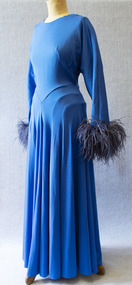 Brighton Historical Society
Dress, Evening dress, 1974
... Cuffs edged with blue-grey ostrich feathers. Zip at back....Cuffs edged with blue-grey ostrich feathers. Zip at back. Evening dress Dress Van Roth ...This dress was worn in a pre-racing season fashion parade held in October 1974 by Pearl's Boutique, a well-known fashion boutique that operated in Brighton from 1965 until 2005. Paula Folks, the store's manager at the time, recalled that this parade had been loosely red, white and blue themed in honour of Princess Anne's wedding to Mark Phillips, which took place on 14 November of that year. The parade was likely held at Tudor Court in Caulfield, a popular reception venue. Pearl's Boutique was established by Elsebe Wilhelmine Wills and Pearl Murray in 1965. The two friends had grown up together in Horsham, and decided to go into business together after reading in Fashionweek that women in their thirties, forties, fifties and older had trouble finding young-looking styles. Setting out to fill this gap in the market, they established a store at 240 St Kilda Street, near the Brighton Yacht Club, with Elsebe handled the buying while Pearl fronted the shop. They moved to 40 Church Street, Brighton in 1967. Paula Folks joined the business as a manager in 1968, became a partner in 1971 and took over from the original owners in 1988. When she closed the boutique in 2005, she donated a number of garments to Brighton Historical Society. Reflecting fondly on her 38 years at Pearls, she told The Age, "I have enjoyed all my days here because people are special to me. I love fashion. It's been a pleasure to dress people, to make them look good and feel pleased with themselves."Full-length blue jersey evening dress with round neckline and long sleeves. Cuffs edged with blue-grey ostrich feathers. Zip at back.Label: "Van Roth / REGD". Labels on side of inner zip: "100% POLYESTER" / SIZE 14 / TO FIT / BUST 90cm / WAIST 70cm / HIP 95cm".pearl's boutique, pearl's of brighton, paula folks, van roth, melbourne designers, flinders lane, 1970s -
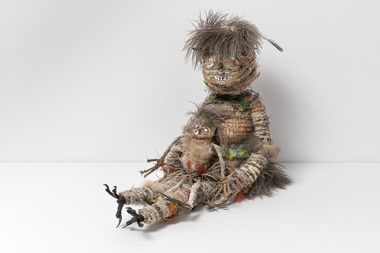 Bayside Gallery - Bayside City Council Art & Heritage Collection
Sculpture, Lisa Waup, Chosen before birth, 2016
... emu feathers, parrot feathers, ostrich feathers, tapa cloth, fibre, crow’s feet, parrot feet, parrot wings, possum fur, seeds, raffia, wood...mother and child sculpure weaving lisa waup torres strait islander gunditjmara indigenous handcraft chosen before birth adoption emu feather possum mother child emu feathers, parrot feathers, ostrich feathers, tapa cloth, fibre, crow’s feet, parrot feet, parrot wings, possum fur, seeds, raffia, wood Chosen before birth Sculpture sculpture Lisa Waup ...It is known that we choose our family before we are born, for me I get a great deal of comfort knowing this, for me it is very true. I was adopted at birth, I have always known this. My mum is my best friend, she is my confidant in times of sadness and pain. She is my guiding light in times when I have lost my way. I share everything with her as she does me. She is my hero, especially now that I have my own children, seeing the sacrifices she has made along the way and is still sacrificing so much for our wellbeing. I celebrate her daily for all she does, we celebrate together the wonderful things that we achieve on a daily basis no matter how small they appear to be. She is always there for me – how privileged I am to have her in my life. I met my birth mother once I had children of my own, I understood what a sacrifice it must have been to give me up. The first words that I muttered out of my mouth when I met her was, “I am so proud of you, and thank you”. She was quite baffled by this and then I explained. Through your unconditional sacrifice I have been given a wonderful life, the doors have been opened to me in so many ways. I have been loved unconditionally and have had the devotion of my mum and dad behind me all the way – how blessed I have been. The dual figures that I have weaved signify my mothers, my mum is holding a babe in arms a gift from the universe. My birthmother is present within this figure, her face is at the back of my mums head. She wasn’t physically there during my many years without her, yet spiritually she never left. This figure is a homage to my mothers, a recognition of respect and admiration, to hold them in great esteem, adulation and worship. Lisa Waup, 2016emu feathers, parrot feathers, ostrich feathers, tapa cloth, fibre, crow’s feet, parrot feet, parrot wings, possum fur, seeds, raffia, woodmother and child, sculpure, weaving, lisa waup, torres strait islander, gunditjmara, indigenous, handcraft, chosen before birth, adoption, emu, feather, possum, mother, child -
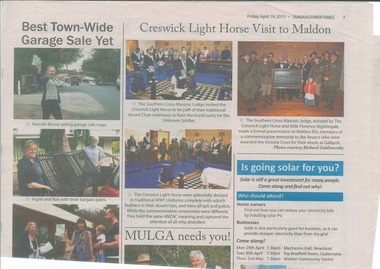 Freemasons Victoria - Southern Cross Lodge No. 24 (Maldon)
Newspaper Clipping, Creswick Light Horse Visit to Maldon, 19 April 2013
... The Creswick Light Horse were splendidly dressed in traditional WW1 Uniforms complete with ostrich feathers in their slouch hats, and were all spit and polish....The Creswick Light Horse were splendidly dressed in traditional WW1 Uniforms complete with ostrich feathers in their slouch hats, and were all spit and polish. ...The Southern Cross Masonic Lodge invited the Creswick Light Horse to be part of their traditional Vacant chair ceremony to form the burial party for the unknown soldier. The Creswick Light Horse were splendidly dressed in traditional WW1 Uniforms complete with ostrich feathers in their slouch hats, and were all spit and polish. -
 City of Greater Bendigo - Civic Collection
Ceremonial object - Bicorne Hat, 19th Century
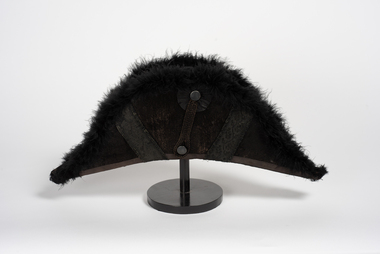
... Trimmed with black ostrich feathers....Trimmed with black ostrich feathers. Ceremonial object Bicorne Hat ...The bicorne or bicorn (two-cornered) was a hat widely adopted in the 1790s as an item of uniform by European and American army and naval officers. Military style uniforms were largely adopted for any man serving in an official capacity, such as a post master, mayor or police before specifically designed uniforms or robes were created.Black hand made hat with two distinctive halves pinned up to create a semi circular fan shape. Black braided cockade with two buttons and decorative knot with two decorative fabric pieces running top to bottom on front face only. Trimmed with black ostrich feathers.Makers print under crown illegible (London - Melbourne)city of greater bendigo ceremonial item -
 City of Greater Bendigo - Civic Collection
Ceremonial object - Bicorne Hat, 19th Century
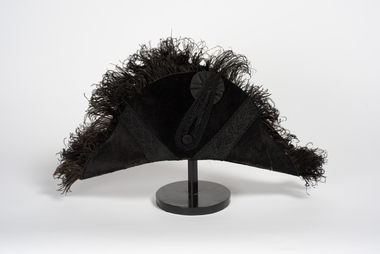
... Trimmed with black ostrich feathers....Trimmed with black ostrich feathers. Ceremonial object Bicorne Hat ...The bicorne or bicorn (two-cornered) was a hat widely adopted in the 1790s as an item of uniform by European and American army and naval officers. Military style uniforms were largely adopted for any man serving in an official capacity, such as a Post Master, Mayor or Police officer before specifically designed uniforms or robes were worn.Black hand made hat with two distinctive halves pinned up to create a semi circular fan shape. Black braided cockade with single button and decorative knot with wo decorative fabric pieces running top to bottom on front face only. Trimmed with black ostrich feathers.Nonecity of greater bendigo ceremonial item -
 Bendigo Historical Society Inc.
Photograph - POST CARD ELIZABETH STREET MELBOURNE
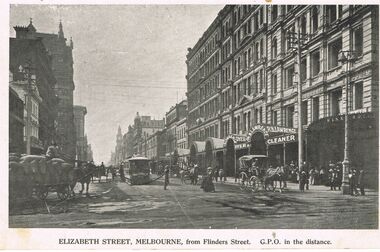
... . / back of card R B LAWRENCE , DRY CLEANER , Dry Cleaner , Ostrich Feather Dresser etc, / card addressed to Branch , 209 Mitchell St Bendigo / no stamp included ..... / back of card R B LAWRENCE , DRY CLEANER , Dry Cleaner , Ostrich Feather Dresser etc, / card addressed to Branch , 209 Mitchell St Bendigo / no stamp included . ...post card Elizabeth street Melbourne , from Flinders Street . GPO in the distance - early 1900s ? / black and white photo on paper / picture shows R W LAWRENCE DRY CLEANER , HORSES AND CARTS AND EARLY TRAM . / back of card R B LAWRENCE , DRY CLEANER , Dry Cleaner , Ostrich Feather Dresser etc, / card addressed to Branch , 209 Mitchell St Bendigo / no stamp included .postcard, photograph, post card elizabeth street melbourne , from flinders street . gpo in the distance - early 1900s / r w lawrence dry cleaner / -
 Bendigo Historical Society Inc.
Photograph - MRS PIEPER, 1880
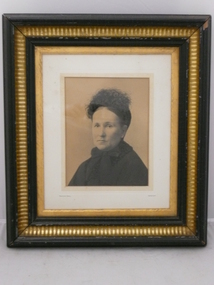
... She is wearing a high neck dress and a small ostrich feather hair decoration. On back.. Dorothy Pieper of Piepers Hill. ...She is wearing a high neck dress and a small ostrich feather hair decoration. On back.. Dorothy Pieper of Piepers Hill. ...Black and white photo of Mrs Pieper. She is wearing a high neck dress and a small ostrich feather hair decoration. On back.. Dorothy Pieper of Piepers Hill. Atho? Pieper. Gilt frame. D1 533. Bartlett Bros. Sandhurst. From W.H.Brown. Practical Picture Frame Maker. Carver and gilder. Plush worker wtc. View street. Bendigo. Opposite Sports Ground. Upper reserve. Tram pass the door.Bartlett Bros, Sandhurstperson, individual, portrait female, pieper, pieper's hill, woman, hat -
 Blacksmith's Cottage and Forge
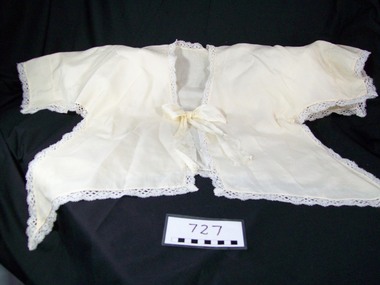
Bed Jacket
... It was popularized in 1930s Hollywood films featuring glamorous settings and glamorous stars lounging languorously in their silken bedrooms. Ostrich feather tips, swan’s down, pleated tulle and shirred lace were just a few examples of the extravagant materials that could be used in creating these confections. ...It was popularized in 1930s Hollywood films featuring glamorous settings and glamorous stars lounging languorously in their silken bedrooms. Ostrich feather tips, swan’s down, pleated tulle and shirred lace were just a few examples of the extravagant materials that could be used in creating these confections. ...The bed jacket, a woman's garment, is a waist-length robe worn to cover the chest, shoulders and arms while sitting up in bed. Its short length and cape-like cut allowed it to be put on (or removed) while in bed. Often made of sheer or lacy fabrics and displaying very feminine trimmings and details, it was often used more for seduction, rather than warmth or modesty. It was popularized in 1930s Hollywood films featuring glamorous settings and glamorous stars lounging languorously in their silken bedrooms. Ostrich feather tips, swan’s down, pleated tulle and shirred lace were just a few examples of the extravagant materials that could be used in creating these confections. These garments are currently very popular with people who have been hospitalized or recommended bed rest. (Source: http://www.wikipedia.com) Pale lemon coloured ladies silk bed jacket with silk lace edging. Figured silk bow tie at front neck.home, lace, female, ladies, silk, bed, jacket, bow, made -
 Bendigo Historical Society Inc.
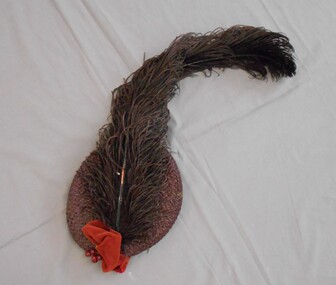
Clothing - MAGGIE BARBER COLLECTION: STRAW ''PILL-BOX'' HAT WITH FEATHER AND BERRY TRIM, Early 1900's
... Attached to the front of the hat is a 51 cm long, deep brown ostrich feather. A cluster of seven deep red (one loose) glass bead 'berries' and a scrunch of dark red velvet, hold the feather in place. ...Attached to the front of the hat is a 51 cm long, deep brown ostrich feather. A cluster of seven deep red (one loose) glass bead 'berries' and a scrunch of dark red velvet, hold the feather in place. ...Clothing. Oval in shape, 4 cms deep at the back, and slightly flattened to 2 cms deep at the front. Deep brown straw on the outside, with a slight sheen, deep blue straw on the inside with a glossy finish. A fine elastic is attached at each side, to hold the hat in place. A band of stiffening lines the inside of the back, to hold the shape. Attached to the front of the hat is a 51 cm long, deep brown ostrich feather. A cluster of seven deep red (one loose) glass bead 'berries' and a scrunch of dark red velvet, hold the feather in place. The feather passes over the top of the pill box and extends an extended 30 cms over the back edge, in a sweeping, gracious curve.costume accessories, female, straw pill box hat with feather -
The 5th/6th Battalion Royal Victoria Regiment Historical Collection
Headwear - Ceremonial Headdress, Bonnet Feather Highland Drummer, C.1950
... Black feathers are ostrich with a white hackle. It has four feather tassles on right side. ...Bonnet was used in pipes and drums from 1950's through to 1998 Anzac Day. 5/6 rvr pipes and drums headress vsr 5/6 rvr bhq Black feathers are ostrich with a white hackle. It has four feather tassles on right side. ...Bonnet was used in pipes and drums from 1950's through to 1998 Anzac Day.Bonnet was used in pipes and drums from 1950's through to 1998 Anzac Day.Black feathers are ostrich with a white hackle. It has four feather tassles on right side. Headband is of red/white and black chequers. Badge is the rampart lion on a black rosette. Brown leather chin strap. Has two black ribbons at rear of bonnet.5/6 rvr pipes and drums, headress, vsr, 5/6 rvr bhq -
 City of Moorabbin Historical Society (Operating the Box Cottage Museum)
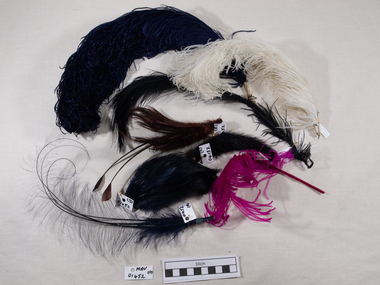
Clothing, Hat feathers x 8 c1910, c1910
... 8 x feathers of various sizes and colours for adorning a Lady's hat c 1910 a) Blue & b) White Ostrich, c) Black Cockerel, d) Black Emu Feathers. ...Her garments were used by her family and the Ormond Choral Society C1910 Women in Moorabbin Shire followed the fashion from Europe and made their own clothes and accessories using their dressmaking, craftwork and design skills clothing, millinery, hat feathers, haberdashery, crochet, doilies, brighton, moorabbin, pioneers, dressmaking, market gardeners, early settlers, craftwork , bentleigh, lacework, moorabbin shire,reed gladys, clark judy, dairy farms, fruit orchards footwear, shoes, buckles, clothing, silver, pewter, brass, victorian fashion, edwardian fashion, mckinnon, moorabbin, cheltenham, wedding dresses, evening wear, 8 x feathers of various sizes and colours for adorning a Lady's hat c 1910 a) Blue & b) White Ostrich, c) Black Cockerel, d) Black Emu Feathers. e) Brown stripped Coque Diamond Tail f) Pink dyed ostrich, g) Black duck, h) black fur Clothing, Hat feathers x 8 c1910 Family of Gladys Reed ...Victorian and Edwardian ladies adorned their hats with various bird feathers. Although living conditions in Moorabbin Shire c1910, were basic families still held onto their traditional English and European customs and took pride in presenting elements of refined society. Gladys Reed was a member of the Ormond Choral Society c 1950. who performed plays and musicals the City of Moorabbin and she was skilled in craftwork, hand knitting, crochet and dressmaking. Her garments were used by her family and the Ormond Choral Society C1910 Women in Moorabbin Shire followed the fashion from Europe and made their own clothes and accessories using their dressmaking, craftwork and design skills 8 x feathers of various sizes and colours for adorning a Lady's hat c 1910 a) Blue & b) White Ostrich, c) Black Cockerel, d) Black Emu Feathers. e) Brown stripped Coque Diamond Tail f) Pink dyed ostrich, g) Black duck, h) black fur clothing, millinery, hat feathers, haberdashery, crochet, doilies, brighton, moorabbin, pioneers, dressmaking, market gardeners, early settlers, craftwork , bentleigh, lacework, moorabbin shire,reed gladys, clark judy, dairy farms, fruit orchards, footwear, shoes, buckles, clothing, silver, pewter, brass, victorian fashion, edwardian fashion, mckinnon, moorabbin, cheltenham, wedding dresses, evening wear, -
 City of Melbourne Libraries
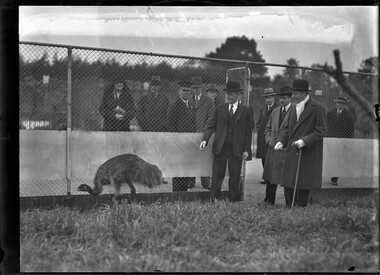
Photograph, Bull, Hugh Jones, 1897-1993, Vice-regal visit to zoo: Lord Huntingfield meets an emu
... ostrich, standing up to 1.9 metres tall and weighing up to 50 kilograms. The Emu has long, powerful legs with three forward facing toes and is the only bird with calf muscles. It is able to jump 2.1 metres into the air and run 50 kilometres per hour. It communicates by drumming and booming through an inflatable neck sac which can be heard up to two kilometres away. Along with its tough hide and a body more feathers...ostrich, standing up to 1.9 metres tall and weighing up to 50 kilograms. The Emu has long, powerful legs with three forward facing toes and is the only bird with calf muscles. It is able to jump 2.1 metres into the air and run 50 kilometres per hour. It communicates by drumming and booming through an inflatable neck sac which can be heard up to two kilometres away. Along with its tough hide and a body more feathers ...Photographer notations on slide: "Vice Regal visit to Zoo B42" Not published. Description: A group of men and one woman all dressed in hats and overcoats stand by a wire fence while watching an emu. Research by project volunteer, Fiona Collyer: On 25 June 1934, new Victorian Governor, His Excellency Lord Huntingfield and his wife Lady Huntingfield made an official visit to the Melbourne Zoological Gardens in order to grant his patronage to the Royal Zoological and Acclimatisation Society. During the visit, zoo director Mr. Andrew Wilkie introduced them to some of the zoo’s inhabitants, including an emu. After the First World War, many returned soldiers took up the Government’s offer of land in the Soldier Settlement Scheme. Most of the veterans had little or no farming experience and much of the land offered was of poor quality, with blocks often too small to be viable. Many of the settlers had ongoing physical and mental injuries from the war. The Western Australian government allocated land to 5000 former soldiers but by 1929, one quarter of the men had already abandoned their land, unable to make a living. Not only was the world economy struggling with the Great Depression, but the settlers also had to contend with plummeting wheat and wool prices, crippling drought and rabbit infestation. The Scullin Government (Oct 1929-Jan 1932) had promised subsidies to the Western Australian farmers if they increased their wheat crops but were unable to pass the legislation in the Senate. The new Lyons Government (Jan 1932-April 1939) abandoned the legislation and the subsidies were never paid, bringing calls from Western Australia of secession from Australia. In October 1932, a deputation of soldier settlers from the Campion wheatbelt region in Western Australia, petitioned Commonwealth Minister for Defence, Western Australian Senator Sir George Pearce, for assistance. A mob of 20,000 emus were migrating to the coast after breeding and were gathering along the eastern side of the Number 1 Rabbit Proof Fence, attracted to the ripening crops and the dams the farmers had built. They were heading towards Campion, 303 kilometres east of Perth, eating and trampling the wheat, destroying the fences and letting the rabbits in. Having witnessed firsthand the effectiveness of machine guns in killing people in war, the former soldiers thought the guns would be ideal for killing emus. Sir George, wanting to demonstrate that his government was sympathetic to the settlers and hoping to quell Western Australian succession talk, agreed. However, he stipulated that no expense would be incurred by the Commonwealth Government and only active military personnel could use the machine guns. The farmers had to pay for the ammunition, food and accommodation for the military for the length of the operation. The cost for the ammunition was £50 for 10,000 rounds. Sir George also felt the operation would provide excellent target practice for the soldiers! The operation was headed by Major Gwynydd Purves Wynn-Aubrey Meredith, 1887-1975, of the Seventh Heavy Battery of the Royal Australian Artillery, and assisted by Sergeant S. McMurray and Gunner J. O'Halloran. They were equipped with two American-designed Lewis light machine guns and 10,000 rounds. Each magazine held 47 rounds of ammunition and the gun was capable of firing 500 to 600 rounds per minute with effective firing range of 800 metres. A cinematographer from British Movietone News accompanied the soldiers in order to record what was expected to be not only an easy victory but also useful propaganda for both the military and the Lyons Government. Emu (Dromaius novaehollandiae, meaning New Holland Racer) is a species of long-necked flightless bird endemic to Australia. The Tasmanian and the dwarf King and Kangaroo Island subspecies were hunted to extinction after the European settlement of Australia. It is the second largest bird in the world after the ostrich, standing up to 1.9 metres tall and weighing up to 50 kilograms. The Emu has long, powerful legs with three forward facing toes and is the only bird with calf muscles. It is able to jump 2.1 metres into the air and run 50 kilometres per hour. It communicates by drumming and booming through an inflatable neck sac which can be heard up to two kilometres away. Along with its tough hide and a body more feathers than flesh, the emu can be a tricky target. Emus had been a protected native species until 1922, when the government changed their status to “vermin” in response to the emus breaking down fences and destroying crops. Major Meredith told the press that Colonel Oswald V. Hoad of the 1st Cavalry Division NSW had especially requested he send 100 emu skins to replenish the plumage on his Light Horsemen’s hat tops. On the first day of the Emu War, 2 November 1932, Major Meredith spotted a mob of emus out of range of the guns, so he asked the farmers to use their vehicles to drive the emus towards the fence and the guns. The panicked birds split into small groups, kicking up the dust and scattering every which way. Only six were killed, though some were wounded. After that, the emus became very wary of humans. On 4 November, Major Meredith staged a dawn ambush at a dam. As 1000 emus approached to drink, the soldiers opened fire, killing 12 emus. After reloading, the gun jammed and the emus dispersed in all directions, and were not sighted again that day. The West Australian newspaper reported on 4 November 1932 that, “The emus have proved that they are not so stupid as they are usually considered to be. Each mob has its leader, always an enormous black-plumed bird standing fully six-feet high, who keeps watch while his fellows busy themselves with the wheat. At the first suspicious sign, he gives the signal, and dozens of heads stretch up out of the crop. A few birds will take fright, starting a headlong stampede for the scrub, the leader always remaining until his followers have reached safety.” In a later attempt, they mounted a gun onto the bed of a truck in order to chase and mow down the birds. However the truck couldn’t drive fast enough over the rough terrain and it was too bumpy to fire the gun accurately. The birds easily outran the truck except for one hapless emu who faltered while being chased and fell under the truck, its body wedging in the steering gear, causing the driver to crash the truck, and bringing down half a chain of the rabbit proof fence. RSPCA inspector Mr. Arthur Austin arrived with a rifle and knife in order to finish the work of the Lewis guns and dispatch injured emus. He said that while his society was sympathetic to the stricken settlers, he was anxious that wounded birds should not be left to suffer. Major Meredith told the inspector, “What speed can you run? You have to be better than Peter Pan if you want to catch wounded emus that make for the scrub.” (Racehorse “Peter Pan” had won the 1932 Melbourne Cup a few weeks earlier.) The commentator of the British Movietime newsreel uses a jocular tone to optimistically proclaim, “The scouts [emus] of the advancing army have keen eyesight, and in order to get close to the main body, our lads have to do some real stalking, with the enemy watching events through their periscopes raised up over the heads of corn... Instead of the birds ruining the farmers, tables are turned, there will be no more damage down here for many a day to come once the enemy is eliminated.” Emus proved tougher adversaries than expected, barely breaking stride even when badly injured from machine gun bullets, and the suspicious emus soon learnt to stay out of range of the men and their guns. Meanwhile, in the eastern states concern was being expressed about the cruelty of machine-gunning the native birds. Senator James Guthrie UAP of Victoria suggested that there must be “more humane, if less spectacular methods” of coping with the pests. People wrote letters to the newspapers to express their dismay at the inhumane methods used. R.F. Bellchambers from Humbug Scrub, 25 November 1932, lamented that, “At the present rate of extinctions, it will shortly be necessary to go to the Museum to see the remains of our fauna.” The Murchison Times published a letter on 16 November 1932 from “Clay Pan Joe”: “War on Emus. Slaughter of innocent birds would be more appropriate... The birds may be a nuisance and it may be necessary to destroy them, but why cause so much suffering amongst these innocent birds.” E.S. Playford of Norton’s Summit wrote to The Advertiser, 22 November 1932, that “...habitation on the earth would be impossible without bird life. Therefore, it is unwise to say that any bird is useless. Is sentiment dying? Are we so keen on personal gain that our lovely and unique birds have to be ruthlessly slaughtered in thousands and their bodies left rotting in the sun?” In Sydney, picture palace patrons expressed “considerable concern” after viewing the Movietone News newsreel of emus fleeing from the barrage of machine-guns, and wounded emus in the fields in Campion. The press had a field day, dubbing it the “The Emu War” and joking that the “Chicago method” was being used against the feathered foe. The Daily News newspaper published a cartoon depicting the emus outrunning and outsmarting the soldiers. In Parliament NSW Senator James Dunn called Sir George the “Minister for the Emu War”. Labor member Mr. Rosevear, midst great laughter, asked if the minister would consider declaring an armistice and withdrawing his troops from the Western Front. Prime Minister Joe Lyons was asked if medals would be struck for those taking part in the war. Labor parliamentarian Mr. A.E. Green declared any medals should go to the emus who had “won every round so far”. With the embarrassing press coverage and poor results, Sir George ordered a stop to the project on 9 November, and Major Meredith and the soldiers departed for Perth. The WA Premier Sir James Mitchell and the Campion farmers demanded they return, citing the continued destruction of crops and fences by the emus. Major Meredith and his two gunners were allowed to return on 13 November and seemingly having learnt from their previous experiences, had slightly more success this time killing emus. The operation finally finished on 10 December with Major Meredith reporting “definite kills” of 986 emus for 9860 rounds of ammunition, coincidentally and conveniently exactly 10% of the number of rounds used. A further 2500 birds were said to have died from their injuries and although this is a disputed figure, even if accurate, the ratio of rounds expended to emu casualties was thought too high to justify continuing. The operation barely caused a dint in the marauding mob of 20,000 emus. “There’s only one way to kill an emu”, one of the party bitterly remarked: “Shoot him through the back of the head when his mouth is closed or through the front of his mouth when his mouth is open. That’s how hard it is.” Australian ornithologist Dominic L. Serventy noted that “The machine-gunners’ dreams of point blank fire into serried masses of Emus were soon dissipated. The Emu command had evidently ordered guerrilla tactics, and its unwieldy army soon split up into innumerable small units that made use of the military equipment uneconomic. A crestfallen field force therefore withdrew from the combat area after about a month.” Major Meredith expressed the greatest of respect for the enemy. He said, “If we had a military division with the bullet-carrying capacity of these birds, it would face any army in the world. They could face machine guns with the invulnerability of tanks. They are like Zulus, whom even dum dum bullets would not stop." The Major’s official report stated that there were no human casualties in “The Emu War.” Emus are considered the victors of “The Great Emu War.” Western Australian farmers requested military assistance in 1934, 1943 and 1948, including using bombs, but the government refused. The bounty system instigated in 1923 continued, with farmers using rifles against their fleet-footed foe, with 57,034 bounties for dead emus claimed in six months in 1934 in Western Australia alone. 284,704 emus were killed in Western Australia between 1945 and 1960. The other most effective defence against the emus was the construction of a robust, vermin proof fence spanning over a long distance. Emus were formally protected in 1999 by the Environment Protection and Biodiversity Conservation Act. It’s estimated there are between 625,000 to 725,000 wild emus in Australia in 2024. An emu and a kangaroo feature on Australia’s coat of arms, holding up a shield illustrated with symbols of the six states. The animals symbolise the nation moving forward as neither animal can walk backwards. Campion is now a ghost town. A book about the operation, “Letters from the Emu War” by J.A. Bryden was published in 2023 by Playtime Books. In 2024, an Australian film called “The Emu War” was released, starring Damian Callinan and Luke McGregor. Andrew Arthur Wellesley Wilkie, 1853-1948, was Director of the Melbourne Zoo from 1923 to 1936 and was associated with the zoo for 70 years. He first worked as a horticultural assistant to Government botanist Baron Ferdinand von Mueller at the Botanical Gardens at the age of 13, along with his older brother David. One of Andrew’s jobs was to capture moths for the National Herbarium. In 1857, a group of prominent Melburnians assembled at St. Patrick’s Hall to form the Zoological Society of Victoria, with the aim of introducing animals and plants from overseas. It was conceived, “For the purposes of science and for that of affording the public the advantages of studying the habits of the animal creation in properly arranged zoological gardens.” The Victorian Government granted 32 acres (13 hectares) of land to the Zoological Society at the southern end of Richmond Paddock on the opposite bank to the Botanical Gardens. (This is where AAMI Stadium and Collingwood Football Club now stand.) In 1861, the Zoological Society of Victoria was renamed The Acclimatisation Society of Victoria. Unfortunately the Yarra River frontage was damp, swampy and subject to flooding, so the animals were briefly housed at the Botanical Gardens until in 1862, the City of Melbourne donated 55 acres (22 hectares) of land at Royal Park for the fledgling zoo. Baron von Mueller secured employment at Royal Park for Andrew and David and they helped to lay out the gardens, plant trees and take care of a collection of deer, pheasants, hares and partridges. Initially the zoo was used for the acclimatisation of animals recovering from the long voyage to Australia and for breeding them for sport. In 1872, the zoo bought two lions, a leopard and a cheetah that had been seized from circus showmen Keith and Phillips when they were unable to pay the bill of butcher Mr T K Bennet of Bourke Street. The first zoo director, Mr. Albert Le Souef, negotiated with captains of ships to buy animals at overseas ports they visited and soon a multitude of exotic species arrived, including a ten-year-old Indian elephant in 1878. In 1923, after being head keeper for some years, Andrew was appointed director of the zoo. By 1933, the zoo had 110 different species of animals, 200 species of birds and 72 species of reptiles under Andrew’s care. He had personally planted all but six trees and laid out the garden beds. As director he lobbied authorities for funds to build more humane enclosures for the animals. In June 1928, Table Talk magazine wrote of Andrew Wilkie: “Up at the Zoo there is a humble gentleman who is a lion among the lions, who knows the proper specific to employ when the boa constrictor has chilblains, and who is a friend and confidant of Queenie the elephant. His fount of zoological lore has never been plumbed. It is bottomless, like his good fellowship and geniality. Every day he may be seen somewhere in the grounds of that growing sanctuary for the strange and arresting fauna and creeping things of the world, and I assure you as one who is privy to his passion that that area and its inhabitants are rarely out of his thoughts.” Andrew retired from the zoo in 1936 at the age of 83 and in 1948 died at his home in Brunswick aged 94. He and his wife Josephine had six children. The Victorian Acclimatisation Society was founded in 1861 by Edward Wilson, 1813-1878, then owner and editor of The Argus newspaper. He said that Australian indigenous animals were practically useless, providing only “a little sport and an occasional meal”. The Society believed that Australia’s plants and animals were vastly inferior to those in Europe. They wanted to introduce and acclimatise to Victoria “all innoxious animals, birds, fishes, insects and vegetables, whether useful or ornamental” for sport and for the table, and to spread indigenous animals and plants from the colony around the world. Their motto was “if it lives, we want it”. The Society was primarily responsible for introducing sparrows, starlings, sambar and hog deer, ostriches, brown trout, blackberries, and carp to the Murray River. They released the European songbirds, thrush and blackbird to quell the homesickness of British settlers. The Society also sent Australian animals like platypus, echidnas, kangaroos and koalas to Europe for scientific and novelty purposes. Thomas Austin, a wealthy sheep farmer of Barwon Park, Winchelsea (property now owned by the National Trust) was a member and in 1859 he introduced hares, blackbirds, thrushes and partridges onto his property. He is probably best known for introducing 24 breeding rabbits onto his estate as game for shooting parties. Thomas quipped, “The introduction of a few rabbits could do little harm and might provide a touch of home, in addition to a spot of hunting." In 2022, genomic data confirmed that Australia’s feral rabbit population is entirely descended from these rabbits. Biological control has brought the rabbit population down from an estimated high of 10 billion rabbits in the 1920s to approximately 200 million today, inhabiting 70% of Australian landmass (5.3 million square kilometres). In 1872, the Acclimatisation Society was renamed The Zoological and Acclimatisation Society of Victoria and they focused on importing exotic animals for display purposes to the zoo. In 1937, the Royal Acclimatisation Society of Victoria was recreated as the Zoological Board of Victoria with a focus on research of native animals threatened with extinction. In an editorial for The Argus newspaper, 16 March 1856, Edward Wilson lamented: "...this country has been shamelessly stolen from the blacks. Had they been like the New Zealanders or the North American Indians, we should have bought their land, and supplied them with the means of living when we took it... In less than twenty years we have nearly swept them off the face of the earth. We have shot them down like dogs. In the guise of friendship we have issued corrosion sublimate in their damper, and consigned whole tribes to the agonies of an excruciating death. We have made them drunkards, and infected them with disease which has rotted the bones of their adults, and made such few children as are born amongst them a sorrow and a torture from the very instant of their birth. We have made them outcasts on their own land, and are rapidly consigning them to entire annihilation. There are but a few of them left, comparatively. This is what we would do for that few. We would feed and clothe every one of them.” [Note: this last sentence is italicized in the original newspaper article text]. Lord Huntingfield, (William Charles Arcedeckne Vanneck) 1883-1969, Governor of Victoria 1934-1939, was a British Conservative Party politician and the first ever Australian-born Governor of an Australian state (although he was always considered British). He was patron of the Royal Zoological and Acclimatisation Society of Victoria and was acting Governor-General for six months during the absence of Lord Gowie in 1938. Lady Huntingfield (née Margaret Eleanor Crosby) 1884-1943, his American-born wife showed great interest in social welfare and the advancement of women and children. She was president of the City Newsboys Society and Patroness of the Girls Friendly Society. In 1937, rose breeder Alister Clark named a yellow hybrid tea rose for her. In 1940, the City of Melbourne opened the Lady Huntingfield Free Kindergarten in North Melbourne, now the Lady Huntingfield Early Learning and Family Services Centre. Lady Huntingfield died in London in 1943 after her house was bombed during a German airstrike. The Lady Huntingfield Memorial Scholarship was established after the City of Melbourne raised £1000 in a public appeal conducted in her memory for students undertaking a Social Work degree at the University of Melbourne. It is awarded annually to this day. The Queen Victoria Hospital named a bed in her honour. References: VICE-ROYALTY GREETS THE KING OF BEASTS AT THE ZOO. (1934, June 26). The Age (Melbourne, Vic. : 1854 - 1954), p. 11. Retrieved August 23, 2024, from http://nla.gov.au/nla.news-article204818472 Prominent Personalities ANDREW WILKIE (1928, June 7). Table Talk (Melbourne, Vic. : 1885 - 1939), p. 15. Retrieved August 29, 2024, from http://nla.gov.au/nla.news-article146562949 'Edward Wilson (journalist)', Wikipedia, https://en.wikipedia.org/wiki/Edward_Wilson_(journalist) 'Thomas Austin (pastoralist)', Wikipedia, https://en.wikipedia.org/wiki/Thomas_Austin_(pastoralist) 'The Acclimatisation Society was driven by misguided ideals about 'fixing nature' in Australia', ABC News, https://www.abc.net.au/news/2022-11-04/acclimatisation-society-introduced-species-history-listen/101588262?utm_campaign=abc_news_web&utm_content=link&utm_medium=content_shared&utm_source=abc_news_web THE ABORIGINES. (1856, March 16). The Argus (Melbourne, Vic. : 1848 - 1957), p. 5. Retrieved September 28, 2024, from http://nla.gov.au/nla.news-article4833244 WAR ON EMUS. (1932, November 4). The West Australian (Perth, WA : 1879 - 1954), p. 12. Retrieved September 29, 2024, from http://nla.gov.au/nla.news-article32588972 'The Great Emu War: how it started and who won', ABC Australia, https://www.youtube.com/watch?v=Y1wA0PKeJqc Advertising (1932, November 25). The West Australian (Perth, WA : 1879 - 1954), p. 2. Retrieved October 26, 2024, from http://nla.gov.au/nla.news-article32584578 Emu Chasers Must Outstrip Peter Pan (1932, November 9). The Labor Daily (Sydney, NSW : 1924 - 1938), p. 5. Retrieved October 10, 2024, from http://nla.gov.au/nla.news-article237042749 WAR ON EMUS (1932, November 22). The Advertiser (Adelaide, SA : 1931 - 1954), p. 18. Retrieved October 15, 2024, from http://nla.gov.au/nla.news-article73997254 WAR ON EMUS. (1932, October 28). The Labor Daily (Sydney, NSW : 1924 - 1938), p. 6. Retrieved October 24, 2024, from http://nla.gov.au/nla.news-article237046601 EMU WAR (1932, December 3). Mirror (Perth, WA : 1921 - 1956), p. 7. Retrieved October 24, 2024, from http://nla.gov.au/nla.news-article75626301 Machine Gun Offensive Against Emus. (1932, November 10). Western Mail (Perth, WA : 1885 - 1954), p. 3 (PICTORIAL SECTION). Retrieved October 24, 2024, from http://nla.gov.au/nla.news-article37766670 A THOUSAND BIRDS IN LUCK. (1932, November 10). Western Mail (Perth, WA : 1885 - 1954), p. 28. Retrieved October 11, 2024, from http://nla.gov.au/nla.news-article37766849 New Strategy In A War On The Emu (1953, July 5). The Sunday Herald (Sydney, NSW : 1949 - 1953), p. 13. Retrieved October 11, 2024, from http://nla.gov.au/nla.news-article18516559 This is a nice emu-that was! (1932, November 5). The Daily News (Perth, WA : 1882 - 1955), p. 9 (HOME EDITION). Retrieved September 30, 2024, from http://nla.gov.au/nla.news-article82878309 LOCAL AND GENERAL (1932, November 16). The Murchison Times (Cue, WA : 1924 - 1937), p. 2. Retrieved October 14, 2024, from http://nla.gov.au/nla.news-article257500260 Taking Him for a Ride! (1932, October 13). The Daily News (Perth, WA : 1882 - 1955), p. 6 (HOME EDITION). Retrieved September 30, 2024, from http://nla.gov.au/nla.news-article83717338 'The Emu War', History Nuggets, https://historynuggets.squarespace.com/nuggets/2018/4/21/the-emu-war New Strategy In A War On The Emu (1953, July 5). The Sunday Herald (Sydney, NSW : 1949 - 1953), p. 13. Retrieved October 23, 2024, from http://nla.gov.au/nla.news-article18516559 'This is the story of how Australia went to war with emus and lost', First Dog on the Moon, https://www.theguardian.com/commentisfree/2018/jul/26/this-is-the-story-of-how-australia-went-to-war-with-emus-and-lost Photographer notations on slide: "Vice Regal visit to Zoo B42"emu wars, governors, melbourne zoo, city of melbourne, 1930-1939, hunting, lord huntingfield, lady huntingfield, royal park, animals, wildlife
