
Showing 4 items matching "packing strip"
-
 Flagstaff Hill Maritime Museum and Village
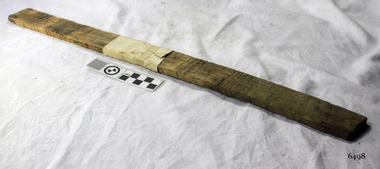
Packing Strip
... Packing Strip......packing strip...Wooden Packing Strip from the slate stacks, Artefact Reg No FoH/16, recovered from the wreck of the Falls of Halladale....Packing Strip ...The iron-hulled, four-masted barque, the Falls of Halladale, was a bulk carrier of general cargo. She left New York in August 1908 on her way to Melbourne and Sydney. In her hold, along with 56,763 tiles of unusual beautiful green American slates (roofing tiles), 5,673 coils of barbed wire, 600 stoves, 500 sewing machines, 6500 gallons of oil, 14400 gallons of benzene, and many other manufactured items, were 117 cases of crockery and glassware. Three months later and close to her destination, a navigational error caused the Falls of Halladale to be wrecked on a reef off the Peterborough headland at 3 am on the morning of the 15th of November, 1908. The captain and 29 crew members all survived, but her valuable cargo was largely lost, despite two salvage attempts in 1908-09 and 1910. ABOUT THE ‘FALLS OF HALLADALE’ (1886 - 1908) Built: in1886 by Russell & Co., Greenock shipyards, River Clyde, Scotland, UK. The company was founded in 1870 (or 1873) as a partnership between Joseph Russell (1834-1917), Anderson Rodger and William Todd Lithgow. During the period 1882-92 Russell & Co., standardised designs, which sped up their building process so much that they were able to build 271 ships over that time. In 1886 they introduced a 3000 ton class of sailing vessel with auxiliary engines and brace halyard winches. In 1890 they broke the world output record. Owner: Falls Line, Wright, Breakenridge & Co, 111 Union Street, Glasgow, Scotland. Configuration: Four masted sailing ship; iron-hulled barque; iron masts, wire rigging, fore & aft lifting bridges. Size: Length 83.87m x Breadth 12.6m x Depth 7.23m, Gross tonnage 2085 ton Wrecked: the night of 14th November 1908, Curdies Inlet, Peterborough south west Victoria Crew: 29 The Falls of Halladale was a four-masted sailing ship built-in 1886 in Glasgow, Scotland, for the long-distance cargo trade and was mostly used for Pacific grain trade. She was owned by Wright, Breakenridge & Co of Glasgow and was one of several Falls Line ships, all of which were named after waterfalls in Scotland. The lines flag was of red, blue and white vertical stripes. The Falls of Halladale had a sturdy construction built to carry maximum cargo and able to maintain full sail in heavy gales, one of the last of the ‘windjammers’ that sailed the Trade Route. She and her sister ship, the Falls of Garry, were the first ships in the world to include fore and aft lifting bridges. Previous to this, heavily loaded vessels could have heavy seas break along the full length of the deck, causing serious injury or even death to those on deck. The new, raised catwalk-type decking allowed the crew to move above the deck stormy conditions. This idea is still used today on the most modern tankers and cargo vessels and has proved to be an important step forward in the safety of men at sea. On 4th August 1908, with new sails, 29 crew, and 2800 tons of cargo, the Falls of Halladale left New York, bound for Melbourne and Sydney via the Cape of Good Hope. The cargo on board was valued at £35,000 and included 56,763 tiles of American slate roofing tiles (roof slates), 5,673 coils of barbed wire, 600 stoves, 500 sewing machines, 6,500 gallons of oil, 14,400 gallons of benzene, plumbing iron, 117 cases of crockery and glassware and many other manufactured items. The Falls of Halladale had been at sail for 102 days when, at 3 am on the night of 14th November 1908, under full sail in calm seas with a six knots breeze behind and misleading fog along the coast, the great vessel rose upon an ocean swell and settled on top of a submerged reef near Peterborough on the south-west Victoria’s coast. The ship was jammed on the rocks and began filling with water. The crew launched the two lifeboats and all 29 crew landed safely on the beach over 4 miles away at the Bay of Islands. The postmistress at Peterborough, who kept a watch for vessels in distress, saw the stranding and sent out an alert to the local people. A rescue party went to the aid of the sailors and the Port Campbell rocket crew was dispatched, but the crew had all managed to reach shore safely by the time help arrived. The ship stayed in full sail on the rocky shelf for nearly two months, attracting hundreds of sightseers who watched her slowly disintegrate until the pounding seas and dynamiting by salvagers finally broke her back, and her remains disappeared back into deeper water. The valuable cargo was largely lost, despite two salvage attempts in 1908-09 and 1910. Further salvage operations were made from 1974-1986, during which time 22,000 slate tiles were recovered with the help of 14 oil drums to float them, plus personal artefacts, ship fittings, reams of paper and other items. The Court of Marine Inquiry in Melbourne ruled that the foundering of the ship was entirely due to Captain David Wood Thomson’s navigational error, not too technical failure of the Clyde-built ship. The shipwreck is a popular site for divers, about 300m offshore and in 3 – 15m of water. Some of the original cargo can be seen at the site, including pieces of roof slate and coils of barbed wire. The Falls of Halladale shipwreck is listed on the Victorian Heritage Register (No. S255). She was one of the last ships to sail the Trade Routes. She is one of the first vessels to have fore and aft lifting bridges. She is an example of the remains of an International Cargo Ship and also represents aspects of Victoria’s shipping industry. The wreck is protected as a Historic Shipwreck under the Commonwealth Historic Shipwrecks Act (1976).Wooden Packing Strip from the slate stacks, Artefact Reg No FoH/16, recovered from the wreck of the Falls of Halladale.flagstaff hill, warrnambool, shipwrecked coast, flagstaff hill maritime museum, maritime museum, shipwreck coast, flagstaff hill maritime village, great ocean road, falls of halladale, shipwreck peterborough, 1908 shipwreck, great clipper ships, russell & co., packing strip -
 City of Moorabbin Historical Society (Operating the Box Cottage Museum)
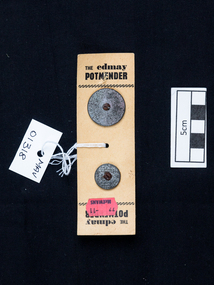
Kitchen Equipment, 'the edmay' Pot mender, c1930
... packing strip; THE edmay POTMENDER / Price tag ; McEWANS 77 - 11...Bunnings Pty Ltd is currently a successful hardware retailer for trade and public customers. early settlers, market gardeners, cooking utensils, kitchenware, castiron cooking pots, blacksmiths, slow cooking, moorabbin shire, bentleigh, mckinnon, highett, cheltenham,mcewan james pty ltd, melbourne, bunnings pty ltd, packing strip; THE edmay POTMENDER / Price tag ; McEWANS 77 - 11 Two metal discs with screw and nut for mending holes in cast iron pots, pans and kettles c1930 Kitchen Equipment, 'the edmay' Pot mender The edmay Potmender ...Early settlers in Moorabbin Shire used large cast iron pots, pans and kettles, that were suspended over the open fire in the kitchen, for cooking meals. They had to be frugal and self-sufficient and so repaired the equipment to prolong its useful lifetime. Blacksmiths also made and repaired household equipment. James McEwan & Co 1852 - 1993 once dominated the the hardware retailing scene in Victoria. Established in 1852 to service the booming gold rush in Victoria the company went on to become one of the longest established retailers in Australia. Over it’s 140 year history the company went through many booms and busts. The McEwans name finally left the Australian retail scene with little fanfare when the last store was re-badged Bunnings in 1993Early settlers were frugal and self sufficient so they repaired their kitchen equipment when possible . McEwans Pty Ltd. was an established hardware company in Melbourne 1852-1993. Bunnings Pty Ltd is currently a successful hardware retailer for trade and public customers.Two metal discs with screw and nut for mending holes in cast iron pots, pans and kettles c1930 packing strip; THE edmay POTMENDER / Price tag ; McEWANS 77 - 11early settlers, market gardeners, cooking utensils, kitchenware, castiron cooking pots, blacksmiths, slow cooking, moorabbin shire, bentleigh, mckinnon, highett, cheltenham,mcewan james pty ltd, melbourne, bunnings pty ltd, -
 Ballarat Tramway Museum
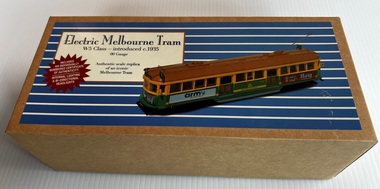
Model - Model Melbourne SW5 tram and presentation case, Cooee Concepts Pty Ltd, 2008
... packing case with a blue felt base, contained within a cardboard outer case. The cardboard cover or case has a printed sheet giving details of the model and the history of the W5 Class tramcar. The wooden case has a brass plate detailing the contents. Scale 00 or 1:76. Model made from plastic and metal, with operable lights and motors with operable trolley poles, swiveling bogies, the destination of St Kilda, showing route 16. Headlights function in the direction of travel. The package has a manufacturing date of 2008 printed on it. Contains a plastic cover strip...packing case with a blue felt base, contained within a cardboard outer case. The cardboard cover or case has a printed sheet giving details of the model and the history of the W5 Class tramcar. The wooden case has a brass plate detailing the contents. Scale 00 or 1:76. Model made from plastic and metal, with operable lights and motors with operable trolley poles, swiveling bogies, the destination of St Kilda, showing route 16. Headlights function in the direction of travel. The package has a manufacturing date of 2008 printed on it. Contains a plastic cover strip ...Detailed in The Met colour scheme of the 1980s with the logo of the early 1980s. Demonstrates an operable model of a Melbourne SW5 class tram.Model of Melbourne Melbourne tram W5 (actually an SW5) No. 812, electric model, made by Cooee Concepts Pty Ltd in China. The model is packaged in a wooden packing case with a blue felt base, contained within a cardboard outer case. The cardboard cover or case has a printed sheet giving details of the model and the history of the W5 Class tramcar. The wooden case has a brass plate detailing the contents. Scale 00 or 1:76. Model made from plastic and metal, with operable lights and motors with operable trolley poles, swiveling bogies, the destination of St Kilda, showing route 16. Headlights function in the direction of travel. The package has a manufacturing date of 2008 printed on it. Contains a plastic cover strip, a plastic holder for the tram, a plastic lift-out strip, a printed Certificate of Authenticity, No. 553 of 700, and a folded sheet giving instructions for the use of the tram on a model tramway - up to 15V DC.models, the met, tramcars, w5 class, sw5 class, tram 812, cooee, cooee collectables -
 Melbourne Tram Museum
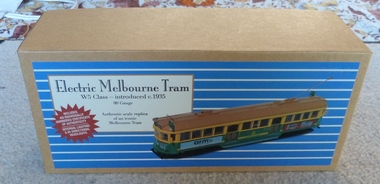
Leisure object - Model tram and presentation case, Cooee Concepts Pty Ltd, Model of Melbourne tram W5 (actually a SW5) No. 812, 2008
... packing case with a red felt base, contained within a card board outer case. The card board cover or case has a printed sheet giving details of the model and the history of the W5 Class tramcar. The wooden case has a brass plate detailing the contents. Scale 00 or 1:76. Model made from plastic and metal, with operable lights and motors with operable trolley poles, swivelling bogies, destination of St Kilda, showing route 16. Headlights function in the direction of travel. Package has manufacturing date of 2008 printed on it. Contains a plastic cover strip...packing case with a red felt base, contained within a card board outer case. The card board cover or case has a printed sheet giving details of the model and the history of the W5 Class tramcar. The wooden case has a brass plate detailing the contents. Scale 00 or 1:76. Model made from plastic and metal, with operable lights and motors with operable trolley poles, swivelling bogies, destination of St Kilda, showing route 16. Headlights function in the direction of travel. Package has manufacturing date of 2008 printed on it. Contains a plastic cover strip ...Model of Melbourne tram W5 (actually a SW5) No. 812, electric model, made by Cooee Concepts Pty Ltd in China. Model packaged in a wooden packing case with a red felt base, contained within a card board outer case. The card board cover or case has a printed sheet giving details of the model and the history of the W5 Class tramcar. The wooden case has a brass plate detailing the contents. Scale 00 or 1:76. Model made from plastic and metal, with operable lights and motors with operable trolley poles, swivelling bogies, destination of St Kilda, showing route 16. Headlights function in the direction of travel. Package has manufacturing date of 2008 printed on it. Contains a plastic cover strip, plastic holder for the tram, plastic lift out strip, a printed Certificate of Authenticity, No. 335 of 700 and a folded sheet giving instructions for the use of the tram on a model tramway - up to 15V DC.trams, tramways, models, w5 class, the met, cooee models, tram 812
